

The Sicilian mafia is arguably one of the most infamous institutions in the Western world. After its first appearance in Sicily in the 1870s it soon infiltrated the economic and political spheres of Italy and of the United States and has, at times, been considered a serious threat to the rule of law in both countries. Although outcomes of the mafia's actions such as murders, bombings, and embezzlement of public money have been observed during the last 140 years, the reasons behind its emergence are still obscure.
In this article, we study the rise of the Sicilian mafia using a unique dataset from the end of the nineteenth century. The main hypothesis is that the growth and consolidation of the Sicilian mafia is strongly associated with an exogenous shock in the demand for lemons after 1800, driven by James Lind's discovery on the effective use of citrus fruits in curing scurvy. Given Sicily's already dominant position in the international market for citrus fruits, the increase in demand resulted in a very large inflow of revenues to citrus-producing towns during the 1800s. Citrus trees can be cultivated only in areas that meet specific requirements (such as mild and constant temperature throughout the year and abundance of water) guaranteeing substantial profits to relatively few local producers.Footnote 1 The combination of high profits, a weak rule of law, a low level of interpersonal trust, and a high level of local poverty made lemon producers a suitable target for predation. Neither the Bourbon regime (1816–1860), nor the newly formed government after Italian independence in 1861 had the strength or the means to effectively enforce private property rights. Lemon producers, therefore, resorted to hiring mafia affiliates for private protection and to act as intermediaries between the retailers and exporters in the harbors.
Our article presents a conceptual framework that links the institutional setting of Sicily in the early 1800s with the specific characteristics of the market and production of lemons following the international boom in export demand. The main implications of our conceptual framework are tested using two data sets from Sicilian towns and districts gathered from a parliamentary inquiry conducted between 1881–1886 (Damiani Reference Damiani1886) and an additional one from 1900 (Cutrera Reference Cutrera1900). Our results indicate that mafia presence in the 1880s is strongly associated with the prevalence of citrus cultivation. No other crop or industry has a robust impact on mafia activity. The results continue to hold when we include several control variables, address a possible endogeneity issue using data on climatic conditions, and adopt two alternative dependent variables collected and coded from a later source.
Our article relates to several different strands of literature.Footnote 2 First, is the literature on the historical emergence of an “extractive” institution that hampers economic development and that can appear, at critical junctures, in a country's history (Acemoglu, Verdier, and Robinson Reference Acemoglu, Verdier and Robinson2004; Acemoglu and Robinson Reference Acemoglu and Robinson2012). The mafia is undoubtedly an example of this, emerging during a critical period in the Italian history (i.e., Italian unification). Our analysis though, departs from this strand, since we emphasize the economic or market structure-related factors behind mafia organization rather than its political origins (such as the role played by a weak and oppressive Bourbon state in Sicily with substantial social inequalities, as discussed further later).
Our results are also strongly associated with research on the “curse of natural resources” (see van der Ploeg Reference van der Ploeg2011 for a recent overview). We claim that the economic boom in international citrus demand, and the subsequent rise of Sicilian exports during the nineteenth century, are key factors behind the rise of mafia. This is also consistent with the more recent finding that windfall gains from natural resources are often associated with intense rent seeking and patronage politics. For instance, Xavier Sala-i-Martin and Arvind Subramanian (Reference Sala-i-Martin and Subramanian2003) argue that political corruption related to oil revenues hampered Nigeria's growth for decades. Daron Acemoglu, Thierry Verdier, and James A. Robinson (Reference Acemoglu, Verdier and Robinson2004) show how mineral wealth in Zaire allowed President Mobutu to buy off political challengers. A recurrent theme in this tradition is that resource windfalls might actually destabilize and deteriorate institutions, if key groups in the society believe that predation is more profitable than production (Mehlum, Moene, and Torvik Reference Mehlum, Karl and Torvik2006; Congdon Fors and Olsson Reference Congdon Fors and Olsson2007).
Another literature that our analysis connects with is the economic analysis of organized crime, which focuses on weak institutions, predation, and enforcement of property rights (Fiorentini Reference Fiorentini1999; Grossman Reference Grossman1995; Anderson Reference Anderson, Fiorentini and Peltzman1995; Skaperdas and Syropoulu Reference Skaperdas, Syropoulos, Fiorentini and Peltzman1995; Skaperdas Reference Skaperdas2001). Herschel I. Grossman (Reference Grossman1995) and Stergios Skaperdas (Reference Skaperdas2001) both consider mafia as an alternative enforcer of property rights. Using a model with two actors (a self-governing community and mafia) and potential robbers, Skaperdas (Reference Skaperdas2001) shows that in the absence of an enforcer of property rights, mafia can represent a sort of second best solution.Footnote 3 Regarding the economic costs of organized crime, Peter Reuter (Reference Reuter1987) and Diego Gambetta and Reuter (Reference Gambetta, Reuters, Fiorentini and Peltzman1995) analyze the effect of organized crime on the enforcement of cartel agreements in legal markets. Giuseppe De Feo and Giacomo Davide De Luca (Reference De Feo and Davide De Luca2017) study how the mafia influenced the rise of the Christian Democratic Party.
Our article is most closely related to Oriana Bandiera (Reference Bandiera2003). Bandiera's main hypothesis is that the increase in land fragmentation following the Bourbon-era land reforms (1816–1860) provided the breeding ground for mafia protection: a higher number of land owners increased the need for private protection. In Bandiera's model, a key feature is that protection of one producer generates a negative externality on other producers, since it makes them more likely to become objects of predation. In an empirical section where she uses information from the Summary Report presented to the Italian parliament by A. Damiani (Reference Damiani1886), Bandiera (Reference Bandiera2003) concludes that land fragmentation is a significant determinant of mafia presence.Footnote 4
While our analysis also identifies landowners' demand for private protection as the main process through which the mafia was mobilized, we explicitly focus on the role of revenues from citrus production rather than on land fragmentation. We improve on Bandiera (Reference Bandiera2003) by using the original Damiani survey (1883) where pretori (lower court judges) provided answers on the causes of crime. This allows us to extend the analysis from the 70 towns located in the western part of the island (Bandiera Reference Bandiera2003) to almost all available Sicilian towns (143 in total) for which pretori provided answers. With this more complete sample, we find that Land Fragmentation indeed explains some of the variation in mafia presence. However, we also find that the most robust determinant of mafia activity is the production of citrus fruits.
Paolo Buonanno, Ruben Durante, Giovanni Prarolo, et al. (Reference Buonanno, Durante and Prarolo2015) also studies the importance of export markets (sulphur production) for mafia appearance using data from Antonino Cutrera (Reference Cutrera1900), a police officer in Palermo. Cutrera uses as sources Napoleone Colajanni (Reference Colajanni1900), Giuseppe Alongi (Reference Alongi1886) and other data from local police offices to create a map of Sicily where the intensity of mafia activity is outlined for every city.Footnote 5 Even though the data show figures on the level of mafia for most of the Sicilian cities at the beginning of the twentieth century, they refer to a period of almost 20 years later than the Damiani Inquiry. In the meantime, mafia extended its activity to cities that initially were unaffected and hence, we believe that data from Cutrera are more appropriate for understanding the evolution of the mafia phenomenon over time.Footnote 6 Buonanno, Durante, Prarolo, et al. (Reference Buonanno, Durante and Prarolo2015) find that sulphur production has a strong association with mafia presence in 1900. Our results show that citrus production explained the presence of mafia holds even when we use Cutrera's data. In summary, we believe our focus on the importance of citrus production complements (rather than competes with) the findings in previous studies on the key roles played by land fragmentation and sulphur exports.
Our analysis is also related to a long tradition in anthropology, sociology, and history on the Sicilian mafia. The classical contributions include early investigations from Pasquale Villari (Reference Villari1875), Sidney Sonnino and Leopoldo Franchetti (Reference Sonnino and Franchetti1877), and Colajanni (Reference Colajanni1885, Reference Colajanni1895). In recent years, the origin of Sicilian mafia has also been discussed in Gambetta (Reference Gambetta1996), John Dickie (Reference Dickie2004), and Salvatore Lupo (Reference Lupo2011).Footnote 7 While Lupo (Reference Lupo2011) and Dickie (Reference Dickie2004) consider profits from the lemon industry in the Western part of the island as a pre-condition for the development of mafia, Gambetta (Reference Gambetta1996) focuses on the division of land resulting from the abolition of feudalism and other policies introduced by the Italian government after 1860 (i.e., the sale of land owned by the church and the crown before the unification). These policies opened a market for private protection, where the mafia acted as an incumbent.
The extensive literature discussed earlier provides plausible explanations for the rise of the Sicilian mafia. Yet, with the exception of Bandiera (Reference Bandiera2003) and Buonanno, Durante, Prarolo, et al. (Reference Buonanno, Durante and Prarolo2015), it is still difficult to understand why we observe a substantial variation in mafia activity across provinces experiencing very similar social, economic, and political conditions. If a weak state, a high regulatory burden, and a lack of public trust are the factors that matter for the development of mafia, then we should not observe any province variation. However, this is not the case. Across counties and villages exposed to the same environment there is a notable difference in mafia presence: organized forms of crime initially appeared only in a small number of localities and then spread all over the region. The combined hypothesis of a resource boom under a weak rule of law advanced here not only complements existing theories of mafia emergence (for instance those focusing on political factors), but is also consistent with the timing of the rise of the mafia. It also allows us to explain the cross-regional variation across Sicily.
BACKGROUND
Historical and Institutional Setting
Sicily is the largest island in the Mediterranean and, given its central position within the Mediterranean trade routes, has always been considered a strategic location. Its history is marked by continuous foreign domination. Having been colonized by Greeks during early antiquity, it was subsequently controlled by Romans, Byzantine, Arabs, Normans, Spanish, and French. This long period of different foreign domination strongly shaped its social development. In fact, from the economic and institutional point of view, Sicily has been a lagging region in Italy.
The death of Fredrick II represents a turning point. In his effort to establish a modern and centralized state in Sicily, Fredrick II promulgated the Constitution of Melfi in 1231 which limited the jurisdictional power of princes and barons and empowered local magistrates who were responsible only to the king. As a result, princes and barons were responsible for civil justice only, while the king, through the appointment of local magistrates who remained in charge for one year, was responsible for criminal justice.
However, with the death of Fredrick II, a period of political instability followed which led to an increasing decentralization of power to feudal lords who de facto established a mero et mixto imperio in which the king delegated the political, administrative, fiscal, military, and judicial power to the feudal lord. Between 1583 and 1748 the Sicilian population under the direct jurisdiction of feudal lords increased from 44 to 58 percent (Benigno and Pharum Reference Benigno2001). The weak and distant governance of the Bourbons only increased the prevalence of insecurity, providing the barons with unrivaled domination over local affairs (Blok Reference Blok1975). As a result, they took into their own hands the business of protection appointing their own militia to maintain law and order and to supervise other employees, such as stewards, field guards, tax collectors, etc. (Blok Reference Blok1975).
The French, who reigned over the island from 1805 to 1815, tried to modernize this archaic system by introducing, in 1812, a new constitution which abolished the feudal privileges and the primogeniture. However, the reform did not achieve the desired results given the financial inability of small scale owners to invest in land, which was auctioned by parishes. As a result, the feudal structure was perpetuated and barons retained their power. Indeed, the reform may have made the situation worse. Beside feudal privileges, the reform also abolished civic, social, and judicial duties of feudal lords, transforming the feud in a simple allodial land (Colajanni Reference Colajanni1900).
The period 1812–1860 was marked by popular revolts and the spread of brigandage, during which several feudal lords fled, delegating the responsibility for the large estates to the gabellotti, who acted as mediators between landowners and the proletariat. From having been simple tenants (renting the land from landowners and subletting it to peasants), many gabellotti became landowners following the auctioning of feudal land after 1812. To maintain order and to avoid being plundered by brigands, they hired their own private guards, referred to as campieri. According to Colajanni (1900) the easiest way to hire a campiere was to recruit him from the brigands. Such an arrangement secured the estate against attacks from the campiere's former companions. The coalition between gabellotti, campiere members of the compagnia d'armi (a private militia hired by the Bourbon government to maintain order in the countryside), and brigands triggered a system of corruption and intimidation such that landowners who could not afford to hire a campiere became the target of brigands and they had to pay (componende) to get back stolen goods and livestock. We argue that this adverse institutional environment provided the breeding ground for the organization which would become known as the mafia.
The Production of Lemons
According to available historical evidence, the bitter orangeFootnote 8 (Citrus higaradia) was introduced in Sicily by the Arabs in the tenth century. Because of favorable weather conditions, the plant spread quite quickly and bitter orange started growing wildly almost all over the island. The island's hot coastal plains, together with the exceptionally fertile soil, containing a limestone base with heavy coatings of lava, were well-suited for growing citrus fruits. Lemon trees, however, have a very poor tolerance for extreme climatic conditions. In order to grow and develop they require temperatures between 13–30°C where the average temperature in Sicily is between 10–22°C. Flowers (and fruits) may die after few minutes of exposure to temperatures below 1–2°C. The intolerance to frost explains the geographic concentration and location of the trees on the island. Areas slightly above the coastline are more suitable because of the relatively low variation in daily (and annual) temperature than locations in the mountains, where the variation in temperature is greater.
In the absence of a strong national and international demand before the nineteenth century, lemons were mainly used for decorative purposes and for extracting essences. It was an aristocratic symbol of wealth. According to the detailed description of lemon production in Harold G. Powell (Reference Powell1908), the production of lemons in nineteenth century Sicily started with the sowing of bitter orange seeds in spring in small seed beds under the bearing lemon trees. After one year from the seeding, the small trees were transplanted in small clumps at a distance of about 60 cm from each other. When the plant reached a height of almost a meter, the tree was transplanted to the groves at 3–4 meters of distance from each other. The quality of the lemons largely depended on the quality of the soil.“The lemons produced on the lighter soils are rougher in texture and poorer in quality than the lemons from the heavier lands. They ripen earlier and are said to have poorer keeping qualities” (Powell Reference Powell1908, p. 21). Because of the lower quality, lemons planted on lighter soils were generally used for citrates (a soft drink) and essences, whereas lemons produced on heavier soils were exported.
Every one to two years dead branches were pruned. In order to keep the soil moisturized, the land was generally turned over with a short, heavy hoe twice a year. At the same time, land was fertilized either with natural or, in some cases, with chemical fertilizers. Because of water needs (plants need to be watered at least once every week) irrigation was practiced in almost all groves using the noria, a sort of horse powered mill which pumps water from the well into terracotta tile channels where the water was carried to the heads of the rows. Because flowering trees are extremely sensitive to frost, in the regions where the temperature dropped below zero, a system of trellises were built over the grove. Walls and fences were also used to protect the plant against the hot wind from Africa (scirocco).
Despite being seasonal, efforts by producers made it possible to harvest lemons at least twice a year. Products were therefore able to stay on the market for the entire year: in October, fruit that had an early maturation were collected, whereas fruit that matured in February were left on the trees as long as possible in order to extend their supply. The last fruit to go on the market were those maturing in summer time, though they were considered of a lower quality. Lemons were harvested from the trees when they were still green. In winter time, the fruits were placed in boxes and kept in underground storage rooms, where the lemons could complete the maturation process (Lupo Reference Lupo1990).Footnote 9
The type of contracts signed between landlord and tenant/gabellotto represented variations of the sharecropping contract. Sonnino (Lupo Reference Lupo1990) documents a quite advanced type of contract proposed by the baron Turrisi to his tenants, where the tenant was allowed to keep one-fourth of the total output. However, this share could go up or down depending on the quality of the groves. When groves were of particularly high quality, the tenant's share was around one-eighth of the final output and it would go up to one-half in case of lower quality. The landlord provided the trees, the water, and the fertilizers, and the tenant was responsible for farming the land and for soil preparation. Usually, the contract lasted between 6–8 years, which is the minimum number of years for a lemon grove to become fully productive.
Given the uncertainty associated with the sharecropping agreement, it was, overtime, replaced by simple employment contracts according to which the landlord hired an employee (castaldo) on a fixed wage. The castaldo was in charge of the lemon grove and of the workforce that permanently worked on the land. Besides the wage, the castaldo could sometimes be allowed to live in a small house close to the landlord, having wood and access to the vegetables and cereals cultivated on the land. In some cases, mainly after some years of experience, he could even attain the role of legal representative of the landlord when citrus fruits were brought to the market.
The workforce supervised by the castaldo was typically a squad of about 15 people (Lupo Reference Lupo1990). Their main responsibility was to pick fruits and then with extreme care, putting the fruits in baskets covered with blankets. Each basket, weighing around 8 kg (Lupo Reference Lupo1990), was then moved into a larger area where (usually) a woman cut the stalks and started a preliminary selection of the fruits. Later, these baskets were again carried to storage rooms from where they would be transported to the closest harbor. The essence industry was somewhat similar. However, the procedure to extract the essence and the oil from the fruits was more complex and required extremely skilled workers. Usually, the warehouses where this sort of processing took place were situated very close to the harbor, giving rise to a whole new neighborhood where employees organized their lives around the industry (Lupo Reference Lupo1990).
The key agents in the negotiations were the sensali (i.e., a broker that connected the lemon producers with the exporters in the harbor). Direct transactions between the producer and the retailer were infrequent. Sensali and landlords could negotiate price and quantity at harvest time when the quality of fruits could be evaluated (i.e., spot contract). Otherwise they could negotiate the entire yield of the grove before the ripening season (i.e., future contract). This type of contract provided more guarantees and certainty to the producer. The spot contract was usually more popular among those producers who were in control of the market, who could rely on existing financial assets and who aimed at a higher price (Sonnino and Franchetti Reference Sonnino and Franchetti1877).
When an agreement was reached, a fruit was placed on top of the gate leading to the grove to signal the end of the deal and that such a grove was protected by the mafia which supposedly guaranteed that the property and its fruits were free of damage (Lupo Reference Lupo1990). The mafia often also provided different forms of contract enforcement. In fact, because of the weak rule of law and the pervasive uncertainty associated with an environment dominated by informal relationships, mafiosi were often involved in the negotiations between brokers and producers, filling the legal vacuum and the lack of trust between different actors (Lupo Reference Lupo1990). According to Sonnino and Franchetti (Reference Sonnino and Franchetti1877), the power of mafia in the area of Palermo became particularly strong in the decade after the unification of Italy with the mafia being involved in all the aspects of productions from the simple appointment of the castaldo (generally associated to the mafia) to the choice of workforce, the negotiations and enforcement of contracts.
The Role of Citrus in the Sicilian Economy
Despite its underdeveloped economy, Sicily in the nineteenth century was a leading producer of wheat, olive oil, wine, and above all, citrus fruits. International demand for lemons started to increase from the late 1700s when lemons and, in particular, lemon juice became a standard preventive treatment against scurvy. Scientific support for the theory that consumption of citrus fruits cured scurvy was established by James Lind, a British naval officer and surgeon, in the latter part of the eighteenth century. Although Lind performed, according to many, the first controlled therapeutic trial of his time, it took time for his results to be publicly recognized and for his suggestions to be adopted by the Royal Navy. In the words of Jeremy H. Baron (Reference Baron2009): “The Sick and Hurt Commission agreed to supply all naval ships on foreign service with lemon juice, extended in 1799 to all the ships on the British coast. Between 1795 and 1814 the admiralty issued 1.6 million gallons of lemon juice. Sweet lemons were imported, especially from the Mediterranean region turning Sicily into a vast lemon juice factory.”Footnote 10
When peace was restored in 1814, international trade began to grow again and the international demand for Sicilian lemons boomed. Table 1 shows exports of barrels of lemon juice and lemon fragrances from the harbor of Messina throughout the nineteenth century.Footnote 11 Over the period 1837–1850, the total exports of lemon juice increased from 740 barrels to almost 20,707 barrels. The exports of lemon fragrances (in pounds) went from 57,918 pounds in 1837 to almost 624,977 pounds in 1850.
EXPORTS OF LEMON JUICE AND FRAGRANCES FROM THE HARBOUR OF MESSINA

Source: Battaglia (2003).
Production increased in the following years and the total surface area devoted to the citrus production went from 7,695 hectares in 1853 to 26,840 hectares in 1880 (Pescosolido Reference Pescosolido2010). The expansion was a direct result of the large returns associated with the demand for lemons. Will S. Monroe (Reference Monroe1909) estimates that revenues were almost $200 per acre (in 1908 U.S. dollars), providing a net profit of more than $150 per acre.Footnote 12 Dickie (Reference Dickie2004) describes the evolution of citrus production: “In 1834, more than 400,000 cases of lemons were exported. By 1850, it was 750,000. In the mid-1880s an astonishing 2.5 million cases of Italian citrus fruit arrived in New York every year, most of them from Palermo”. …. “citrus cultivation yielded more than 60 times the average profit per hectare for the rest of the island” (Dickie Reference Dickie2004, p. 39).
From 1881–1885, the quantity of citrus exported went up to almost 949,000 quintals (2.5 million cases approximately),Footnote 13 compared to 250,000 quintals in 1850 (Pescosolido Reference Pescosolido2010). In this period, a large share of production went to the United States. A combination of factors contributed to this outcome: a favorable international context, elimination of exports duties, and a considerable improvement in transportation. Table 2 shows figures on the lemon trade between Italy and the United States in 1898–1903. The left-hand side of the table shows the total Italian lemons exports and the relative percentage exported to the United States. The right-hand side shows the total U.S. lemons imports and the estimated percentage coming from Italy.Footnote 14 The average quantity of lemons exported from Italy (and therefore mainly from Sicily) over this period amounts to 389 million pounds and the average share of fruit imported by the United States is almost 34 percent of the total Italian production.Footnote 15 Calculating the total Italian exports to the United States, we estimate that almost 78.4 percent of the total U.S. lemons imports between 1898–1903 came from Italy. Besides the United States, the United Kingdom and Austria were two others large importers of lemons. Over the decade 1898–1908, the United Kingdom imported between 17.7 to 25 percent of the total Italian lemons exports, and Austro-Hungary imported between 14.4 and 22.8 percent (Powell Reference Powell1908).
TOTAL ITALIAN EXPORTS OF LEMON AND TOTAL U.S. IMPORTS

Notes: ∗Percentages provided by Powell (Reference Powell1908).
∗∗ Percentages estimated using percentages on quantity exported from Italy above. For example, for the year 1900 the quantity exported to the United States is 331,563,577 ∗0.29=96,153,473 which divided by 159,384,389 provides a percentage equal to 60.32 percent.
∧ In 1898 and 1902 the percentage exported from Italy to the United States exceeds the total import into the United States. This is because Italian figures refer to the calendar year, while U.S. figures refer to the fiscal year.
Source: Powell (Reference Powell1908).
Powell (Reference Powell1908) provides a quite detailed account of the costs and profits associated to the production of lemons. He suggests that “a fair estimate of the cost of producing a crop on a bearing grove, including cultivation, irrigation, fertilization, pruning, and other operations up to the time of picking, is from $25 to $60 per acre (that is, between 130 and 300 Italian lire per acre)” (Powell Reference Powell1908, p 33). The average wage of men during the picking season was equal to about 1.5 lire per day. Powell (Reference Powell1908) estimates that an average man could pick almost 5,000 fruits per day. The average price of 1,000 lemons in 1908 was around 17 Italian lire, providing a revenue per worker of almost 85 lire per day against a marginal cost in terms of wage payment of 1.5 lire.
Compared to lemons, the costs for olive trees and for grapes were much lower. According to the Damiani Inquiry (Reference Damiani1886) olive trees in the nineteenth century were generally grafted trees and besides pruning and tilling, there were no other substantial costs related to irrigation or protection from frost and wind. The situation was similar for grapes which developed from branches of grapevines that did not bring fruit in the previous year.
Estimates of the profit and costs associated with different crops are provided in the Damiani Inquiry by the mayor of Bisacquino according to whom the average annual cost for a hectare of wheat is lire 88 producing a profit of lire 200. The cost of 1,000 grape plants is 60 lire, providing a profit of lire 50. Finally, the cost of 1,000 lemon plants is 2,000 lire for a profit of lire 14,000. The profit from a hectare of land cultivated with olives is almost lire 400 (lire 98 per hectoliter), but no costs are reported. Therefore, the annual cost for a thousand plants of lemons is almost 33 times larger than the cost for a thousand plant of grapes, but the profit is almost 35 times higher than the profit from olives (the second most profitable crop). In summary, the fixed and marginal costs of lemon production were so much higher for lemon than for any other crop, but so was profitability.
The Rise of the Mafia
The origin of the word mafioso (and consequently mafia) is found in the Arab language where the word marfud used to mean swindler or cheater (Lupo Reference Lupo2011). In Italian, the original meaning of the word did not have a negative connotation, but simply characterized somebody who had proud/courageous behaviour. In fact, in the period before the unification of Italy—when the proto-mafia developedFootnote 16 (Lupo Reference Lupo2011)—a mafioso was a man who had gained the respect of the local population by standing up against the brigands and the malicious crimes of the campieri and compagnia d'armi (Colajanni Reference Colajanni1900). This respect from the local population contributed to a legitimization of the mafioso, who received the support of the population given that their crimes were justified when committed against delinquents who were even worse than he (Colajanni Reference Colajanni1900). For this reason, almost everybody became directly or indirectly involved with the mafia, either by taking part in mafia activities or by covering and protecting those who committed such illegal acts (i.e., omerta'). It became a general practice to define men who showed courage and resolution as mafiosi.
The institutional setting on Sicily, based on corruption, crime, and private protection continued after unification in 1860. The Italian government was unable to take effective control of the island or to enforce the rule of law. As a result, the pre-unification system persisted. Actually, the situation became even worse as the discontent of the people increased due to the policies promoted by the new government which led to the uprising of Palermo in 1863. According to Lupo (Reference Lupo2011), this is the period during which the proto-mafia turned into the new kind of mafia that would play an important role in the subsequent history of Sicily.
At the same time, there is no perfect account of its appearance. What we know about such groups is that they formed a secret society of sworn-in men who managed to overcome the collective action problem through various measures like brutal punishments in the case of defection.Footnote 17 Mafiosi were recruited from very diverse occupations in society, including gabellotti, peasants, doctors, and politicians, and typically performed their daily jobs as an integrated part of society while also undertaking mafia activities. In the latter half of the nineteenth century, it is known that the key mafia activity was the protection of businesses, but we do not know if this was their original purpose (Gambetta Reference Gambetta1996).
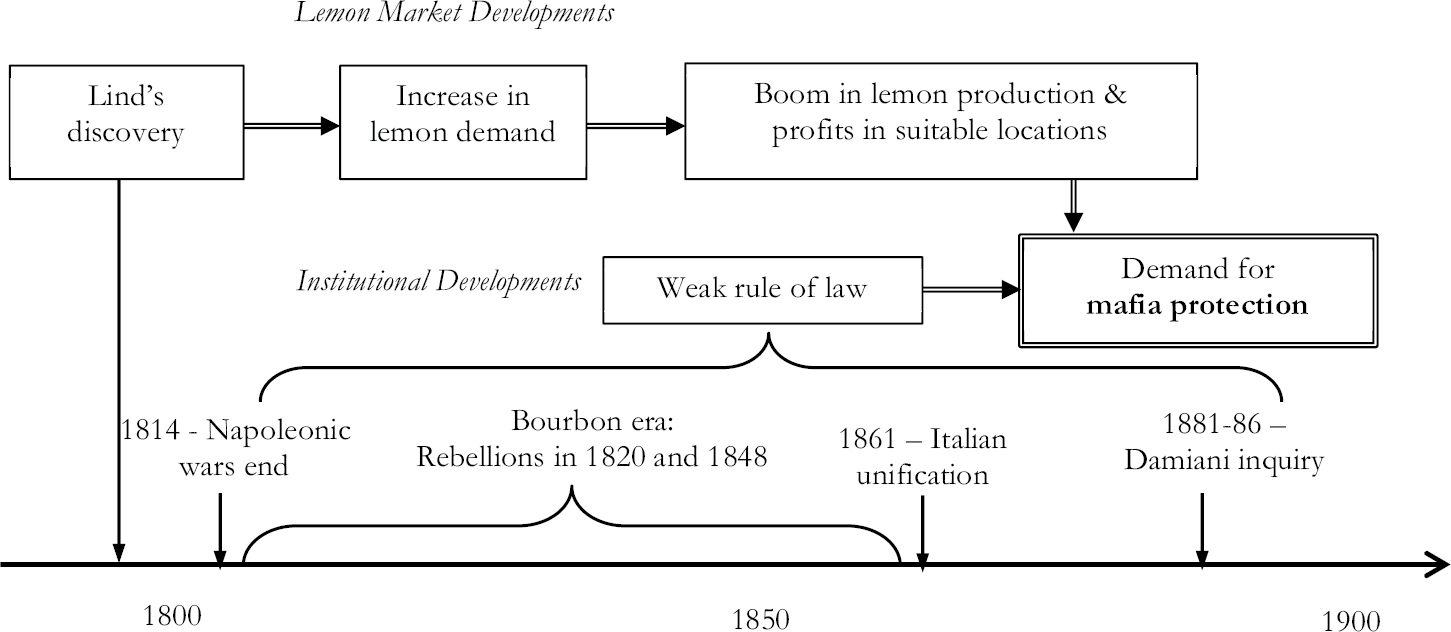
We argue that the combination of a generally weak rule of law, the boom in international demand for citrus fruits, and the risky and sensitive nature of lemon production together provided the breeding ground for the growth and consolidation of a mafia-type organization that could meet the challenges from producers, workers, and exporters in the lemon industry. Our schematic framework is shown in Figure 1 which features two major types of developments relevant for understanding the rise of the mafia: one political and one specific to the citrus sector.
MODEL OF MAFIA EMERGENCE
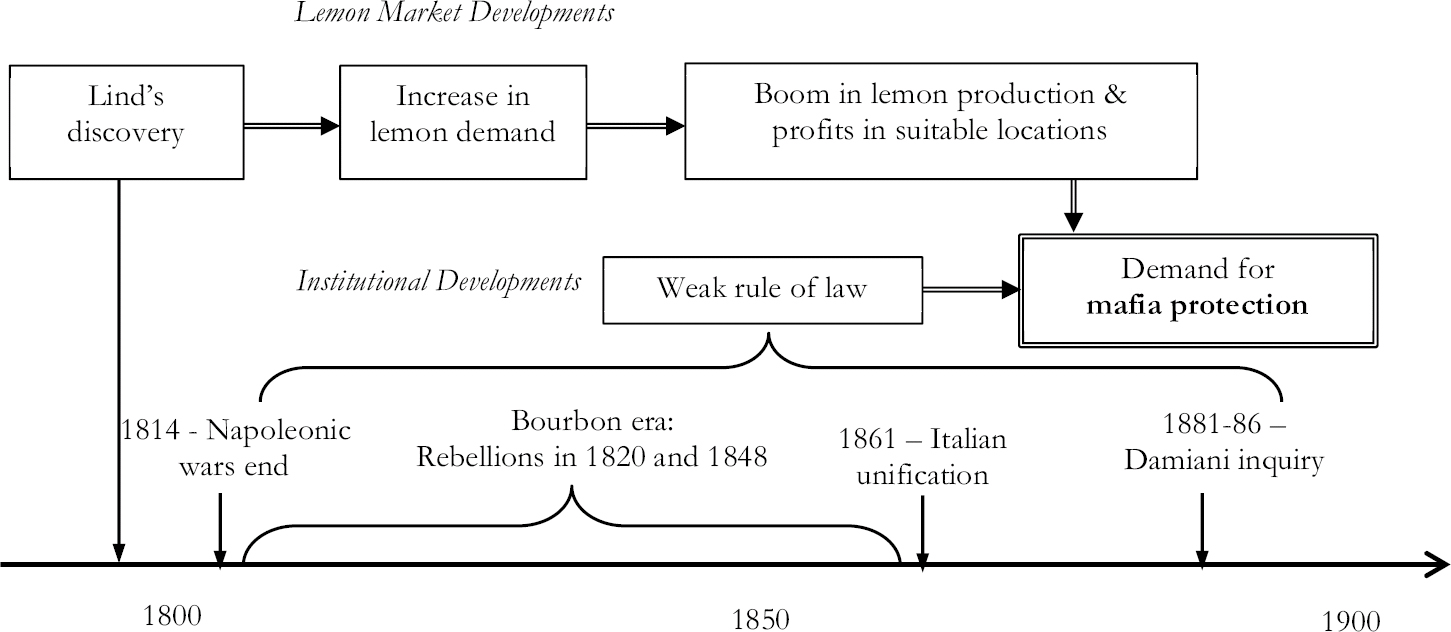
Despite the fact that the exact circumstances under which the mafia arose are not completely clear, we know that they thrived from offering protection to lemon and orange producers, from manipulating market prices, and from acting as intermediaries between producers and exporters. The protection services easily slipped into extortion where producers faced a direct threat of violence from the mafia if they refused to pay protection money. In line with standard models on the “hold-up problem,” it is natural to assume that in equilibrium, the mafia managed to extract rents for protection to an extent such that producers were almost indifferent about continuing their business or abandoning cultivation altogether.Footnote 18
Why would the mafia focus on citrus production and not, for example, on the cultivation of wheat or wine? There are three basic reasons for the special importance of citrus fruit. First, the market value and profitability of citrus fruits was unusually high at the time, certainly much higher than for basic food crops like wheat. Second, the large fixed costs associated with irrigation and the long time before trees matured, made producers sensitive to predation. Third, the technology of predation on citrus fruits was relatively easy and cheap. According to Lupo (Reference Lupo2011), a harvest of lemon fruits is very difficult to protect when the fruits are still on the trees. Picking a few hundred ripe lemons from a grove during a dark night should have been much easier for a thief than harvesting olives or grapes, not to mention wheat. As a consequence, lemon groves were more vulnerable to predation, despite the frequent construction of walls and the use of dogs and guards.
The straightforward hypothesis that arises from this framework is the following: In the period of the Damiani Inquiry in the 1880s, after several decades of a gradually growing production and exports of oranges and lemons in Sicily, the mafia should mainly be observed in local communities with citrus cultivation. More specifically, there should be a positive relationship between the dependent variable (mafia presence) and the main independent variable (citrus cultivation) in a cross-section of Sicilian local communities. Our framework suggests that natural control variables that might confound the analysis of a causal effect from citrus production to mafia presence are land ownership patterns and the production of other crops.
DATA
Data from Damiani (Reference Damiani1886)
The data used come from the Damiani Inquiry (Reference Damiani1886),Footnote 19 which was part of a larger inquiry, approved in March 1877 and proposed by Stefano Jacini, that aimed at assessing the conditions of the agricultural sector and the conditions of peasantry in every region of Italy. Abele Damiani was an MP (Member of Parliament) for the region Sicily. The Damiani Inquiry represents one of the earliest and most important primary sources about the economic and social conditions of Sicily in the 1880s.Footnote 20
Data both at town and district level (mandamento)Footnote 21 are collected for the seven provinces in which Sicily was split at the time of analysis (Caltanissetta, Catania, Girgenti, Messina, Palermo, Syracuse, and Trapani) for a total of 143 observations.Footnote 22
The section of the Inquiry that matters to our analysis is comprised of two parts. The first discusses the situation of the agricultural sector, with particular reference to tax burden, wages, the kind of crops produced, and the relations between peasants and landlords (i.e., tenancy contracts, fractionalization of land, etc.). Questionnaires were sent out to almost 357 mayors of whom less than half provided complete information.Footnote 23
The second part of the Inquiry provides information on the moral and social conditions of peasants. Questionnaires were sent to 179 pretori (lower court judges).Footnote 24 In this section, we focus on the type/level of crime in the region. The question asked was: “What is the most common form of crime in the district? What are their causes?” We coded as the dependent variable a binary dummy, Mafia, for whether the pretore of the town recognizes mafia as the most important source of crime in the district.Footnote 25
Bandiera (Reference Bandiera2003) and Buonanno, Durante, Prarolo, et al. (Reference Buonanno, Durante and Prarolo2015) opted for a different dependent variable: an ordinal variable for the intensity of mafia collected from the Summary Report that Abele Damiani sent to the Italian parliament on the basis of the original Inquiry. However, in the original Inquiry it emerges that very few pretori mention the intensity of mafia (less than one-tenth). Since the origin of the additional information is unclear, we prefer to use to the original document, which appears to be more accurate.Footnote 26
There are potential concerns with the data on mafia presence. First, the mafia could still be present in a district even though the pretore did not list it as the most common form of crime. It is indeed possible that some districts had mafia activity, even though the pretore did not report it as being a major crime. This problem may slightly affect our results.
Second, if pretori were themselves mafiosi and they were likely to understate the presence of mafia. The answer to this question is most likely to be no although there is no conclusive evidence in either direction. Pretori were directly appointed by the Minister of Justice by a Regio decreto (royal order) and any other aspect concerning their career was subject to an evaluation made by a committee of experts belonging to the local Court of Appeal. For the first ten years of their career, pretori changed district (mandamento) very often, which may have restricted their possibilities of connecting with the local environment.Footnote 27
Third, did the pretori have a general understanding of what the term mafia implies? This indeed appears to have been the case. In the 1880s, the word mafia was already used to indicate a criminal organization, at least since 1863, when a comedy titled “I Mafiusi di la Vicaria” was shown in Palermo. Also, in 1865, the prefect of Palermo (Filippo Gualterio) used the word mafia in a private document to identify the criminal organization and later, in 1871, mafia membership became a public law offence. We, therefore, believe it highly unlikely that there was only misinterpretation.Footnote 28
In Figure 2 we show the local distribution of mafia in our sample. On average, 36 percent of towns were strongly affected by mafia which means that almost 51 out of the 143 towns had mafia listed as the most common form of crime. Girgenti is the province with the highest presence of mafia, where 14 out of 17 towns have strong mafia presence. In Trapani, the mafia operates in 6 out of 15 towns, and in the Caltanissetta province in 7 districts out of 16. In almost one-third of the districts in Palermo (mainly those in the Conca d'Oro) and Catania provinces there is some form of mafia presence. Messina and Syracuse are the ones with the lowest incidence. These statistics (reported in Table 3) are also consistent with Colajanni (Reference Colajanni1885).Footnote 29
MAFIA AND NON-MAFIA TOWNS IN SICILY IN 1880S (DAMIANI SAMPLE)

DISTRIBUTION OF MAFIA AND AGRICULTURAL PRODUCTION ACROSS PROVINCES IN 1881–1886
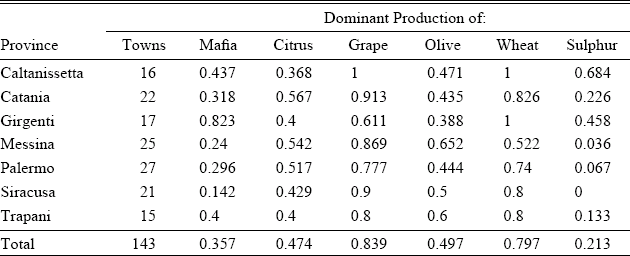
Notes: Numbers in the table refer to the share of towns within each province with mafia presence and/or with dominant production of each commodity. Each variable in the table is a binary dummy. Mafia=1 if mafia is perceived to be the most common form of crime in the town and 0 otherwise, as explained in the text. Citrus, Grape, Olive, Wheat, and Sulphur are also binary dummies taking on the value of one if the commodity is listed by the pretore as one of the key agricultural goods produced in the town, as explained in the text. Towns shows the number of municipalities per province for which we have data on mafia.
Source: Damiani (Reference Damiani1886).
The independent variables we employed in the analysis can be divided into three groups. Colajanni (Reference Colajanni1885), Dickie (Reference Dickie2004), and Lupo (Reference Lupo2011) identify the profitable production of goods as important determinants of mafia presence. For this reason, the first group of independent variables includes: Citrus, Wheat, Olives, Grape, and Sulphur. Footnote 30 Given that the Inquiry does not provide information on hectares per crop for every mandamento, we decided to use a dummy variable (only recording whether the crop is predominant or not) in order to minimize the potential measurement error. The question we draw on for data in the Damiani Inquiry is: “Which is the dominant crop produced in the city?” Mayors listed more than one crop (for a few cities they also reported quantities) and, because of that, dummies are not mutually exclusive. Whenever possible this information has been double checked with Question 8 which provides a better picture on dominant crops.Footnote 31 For example, for the town of Agira, the mayor does not list citrus as a dominant crop, but then he argues that the total production of lemons is 400,000 units, providing an average revenue per hectares of about 592 lire.Footnote 32 Therefore, we decided to recode the variable using this additional information.Footnote 33
Because data on citrus production plays a key role in our analysis, in a couple of instances where the Inquiry has ambiguous information (or no information is available), we used the data from Guiseppe Di Vita (Reference Di Vita1906) to complement the Damiani Inquiry.Footnote 34 Di Vita (Reference Di Vita1906) also provided data on sulphur mines, and we used that to code this variable. As argued by Colajanni (Reference Colajanni1885), sulphur mines are almost exclusively concentrated in the province of Girgenti (12 out of 17 towns). Outside Girgenti, there are five mines in the province of Catania, three in Palermo, and one in the province of Messina and Trapani. Wheat production is high in the entire province of Girgenti, but is low in the province of Messina. Grapes and olives are almost equally distributed across the island. Our summary statistics seem to match the picture provided in Colajanni (Reference Colajanni1885) quite well.Footnote 35
The second group of explanatory variables intends to control for the political status of each town and to assess the impact of policies implemented between 1812 and 1870 to increase the small-scale ownership of land. We consider three types of policies: (1) the abolition of feudalism and the auction/allocation of land to smallholders, (2) the enfiteusi, a perpetual lease that allowed farmers to use the land as if they were owner, and (3) the seizure of Church-ruled territories and the consequent land auctions, which occurred after Italy's unification. For each city, mayors provided information on the effectiveness of these policies in increasing land fragmentation. We use this information to code a dummy variable which is positive in case of reported effectiveness.Footnote 36 According to our data, highest effectiveness was reached in the Caltanissetta, Girgenti, and Catania areas, where the latifund was dominant. In the provinces of Palermo and Caltanissetta, the distribution of land appears to have been more fractionalized in relative terms. This was mainly due to the fact that the majority of cities in these provinces were ruled directly by the crown instead of the typical feudal hierarchy dominant in other provinces. As a consequence, fractionalization policies had little effect in increasing private ownership among peasants because land was already fractionalized.Footnote 37
Regarding land distribution, fractionalization is high in almost 50 towns and relatively low in 45 towns.Footnote 38 The questions asked were: “What is the dominant scale of the plantation? And what is the fractionalization of land?” The scale of plantation tends to be relatively high in Palermo, whereas in the other provinces its percentage is around 33 percent. Small-scale plantations are fairly common in all provinces, but particularly in Trapani, Messina, and Catania. Girgenti and Caltanissetta instead are the provinces with the lowest number of small-scale plantations.Footnote 39
Data from Cutrera (Reference Cutrera1900)
Cutrera (Reference Cutrera1900) is the second source of data on Mafia we use. Using information from police offices and newspapers, Cutrera drew a detailed map of the intensity of mafia in Sicily in 1900. Therefore, for each town, we code the intensity of mafia activity using an ordinal variable ranging from 0 (no mafia) to 3 (high intensity of mafia).Footnote 40 This alternative source presents some issues. First, this data source records the level of mafia in 1900, more than 20 years later than the Damiani's Inquiry. During these two decades, it is reasonable to assume that the mafia spread for reasons different from the ones that determined its emergence (e.g., internal conflicts).Footnote 41
Second, Cutrera's data covers only towns with and without mafia for East Sicily (provinces of Messina and Syracuse). For the remaining provinces (i.e., Palermo, Girgenti, and Trapani), the author reports only towns with mafia, without providing any information about the ones missing, that is, whether they are not mentioned because there is no mafia or because there is no information available. Because we cannot disentangle these two motivations, we decided to use two different coding strategies: (1) We code a variable of mafia intensity for towns reported in the map following Cutrera's coding rule, and (2) we use the spatial distribution of mafia in order to interpolate levels of mafia activity for towns where information have not been reported. We assume that towns that are in the neighborhood of others with a high mafia intensity are likely to be also affected by some sort of mafia activity. As a result, we can use an inverse distance weight interpolation technique to interpolate data for those towns for which there is no information on mafia activity. The level of mafia activity depends therefore both on the intensity and on the distance from neighboring cities where mafia is present. The results of this interpolation are shown in Figure 3. White areas denote towns with a low intensity of mafia (between 0 and 0.69), whereas black areas denote towns with a high intensity of mafia (between 2.25 and 3).
MAFIA INTERPOLATED USING AN IDW

We merge this source with data on crop suitability from the FAO GAEZ (Food and Agriculture Organization – Global Agro-Ecological Zones).Footnote 42 We collect data for the three main crops produced in Sicily (lemon fruits, olive, and wheat). Data on grape suitability and sulphur is not provided by the FAO GAEZ. For this reason we integrate data from the FAO GAEZ with dummies on grape production from Damiani (integrated with data from Di Vita Reference Di Vita1906) and sulphur mines from Di Vita (Reference Di Vita1906).Footnote 43
To minimize the risk of omitted variable bias, we use a large set of climatic and geographical indices related to factors which may affect agricultural production, and hence mafia. From the FAO GAEZ, we include indices for the median altitude, inland water scarcity, and natural soil fertility (natural soil nutrients). We complete the list of independent variables by adding: (1) spatial data on distance from the coast (NASA Ocean Biology Processing Group)Footnote 44 and (2) data on soil neutrality (pH) from the FAO Geonetwork.Footnote 45
ECONOMETRIC ANALYSIS
Specification
We consider a simple model in which the probability of mafia depends on the prevalence of citrus production and other covariates. The baseline ordinary least square (OLS) model to be estimated can be written as:

The main explanatory variable is an indicator for citrus production in the municipality i and province p, which we denote by Citrusi,p
. Our key hypothesis is that  represents a set of control variables suggested in our theoretical framework that may affect the probability of mafia such as the presence of other crops, land fragmentation, the degree of trust citizens have in the law, or the peripherality of each town. Finally,
  represents provincial fixed effects that may be correlated with the error term
  .
.
Results Using Data from Damiani
We present the OLS estimates with mafia presence in the 1880s as the dependent variable in Table 4. We start by estimating a simple model, where mafia presence in the 1880s depends only on variables capturing the economic activity of the town, the dummy for fractionalization policies, and a dummy for large scale production given that large fixed costs related to investment in irrigation (norie) were much more likely to be sustained in towns where the scale of the plantation was relatively large (because of the decreasing cost per hectare), making producers more vulnerable to a potential loss due to extortion. We then proceed by introducing additional variables to control for observables.
MAFIA OLS MODEL
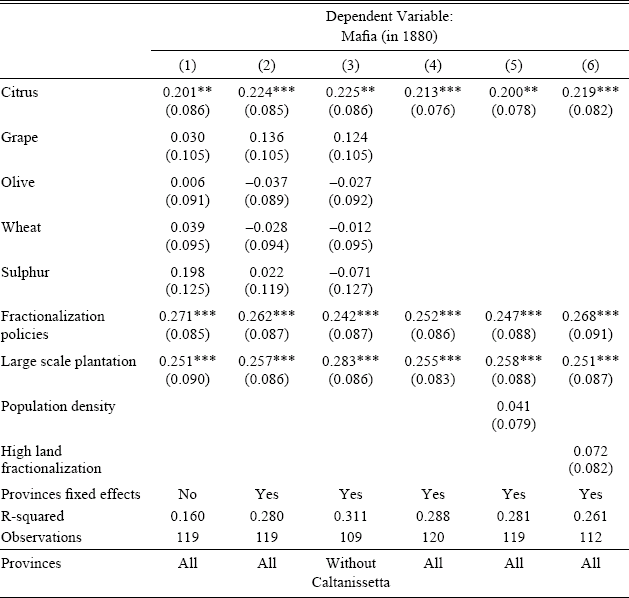
Notes: The estimator is OLS in all specifications. Robust standard errors in parentheses. ∗∗∗ p<0.01, ∗∗ p<0.05, ∗ p<0.1.
Source: Authors' calculation.
In Column 1, the diffusion of the mafia significantly depends on citrus production. At the mean, the production of citrus increases the probability of mafia by 20 percent. The Fractionalization Policy dummy has also a strong significant effect on the probability of mafia presence, as does the dummy for large scale plantations which increases the probability of mafia presence by 25 percent. The latter reflects the perverse system of corruption and private protection which developed in the latifund as outlined in the institutional setting. In Column 2, we re-estimate the same model, but controlling now for province dummies to capture regional fixed effects: the same results still hold. In Column 3, we drop the observations for the province of Caltanissetta in order to detect any potential bias due to a different source of data. The estimated effects, in Column 3, are almost unchanged as are the coefficients and the t-statistics. In Column 4, we change specification by dropping the non-significant variables (to prevent an excessive reduction of the degrees of freedom) and again the results still hold. In Column 5, we use population density which is normally used as a proxy of income per capita and urbanization and the variable is not significant.
Bandiera (Reference Bandiera2003) argues that the effect of fractionalization policies occurs through the increase in the number of small-owners private property which made them vulnerable. At the same time, it is also possible that the dummy for fractionalization policies captures the absence of public providers of protection (i.e., a landlord) after the abolition of feudalism given that the aim of these policies was to limit the power of landlords by redistributing land to private owners. In fact, even though private ownership did increase, the resulting fractionalization in former feudal cities never exceeded that in crown-ruled cities where land has always been fractionalized. Therefore, to better assess the effects of this control, in Column 6 we also include a dummy variable for the degree of land fractionalization. The dummy variable high land fractionalization turns out to be not significant. As argued earlier, though fractionalization policies in former feudal cities had some effects in increasing private ownership, the overall effect was not large enough and land distribution was not more fractionalized than in former crown-ruled cities. As a result it is possible that the consequence of these fractionalization policies was to release on the open market a new commodity: the armed guards that used to work for the feudal barons (Sonnino and Franchetti Reference Sonnino and Franchetti1877).
The set of covariates specified in Column 6 represents our preferred specification. In this model, the presence of mafia is significantly determined by the citrus production, the effect of policies for private ownership, and by the scale of the plantation.Footnote 46
As discussed earlier, our hypothesis is that the positive shock on the demand for citrus, following Lind's discovery of the beneficial properties of citrus fruits in the treatment of scurvy, together with a comparative advantage in climatic conditions, gave Sicily a dominant position in the market for lemons. This in turn resulted in larger profits for some Sicilian producers in a weakly institutionalized setting, which created a demand for the mafia. Both the historical evidence of exports of citrus from Sicily and of prices of lemons in the nineteenth century, provided in Section 3 and OLS results in Table 4 support this hypothesis.
To provide additional robustness to our results, we re-estimate using an Instrumental Variable estimator (IV).Footnote 47 The instrument for citrus is obtained using data on thermal regimes from FAO GAEZ. Among the several indicators on thermal regimes provided by the FAO GAEZ, we chose a measure of the frost-free period.Footnote 48 GAEZ estimates of climate and agro-climatic analysis are based on mean climatic data for the period 1961–1990. Therefore, we assume that large changes in climatic conditions have not occurred during the last two centuries.
The reason for using data on the risk of frost as an instrument for lemons is related to the minimal tolerance of the lemon tree to frost. The probability of frost, therefore, represents an important fixed cost for the production of lemons, and we assume that lemon production will occur in towns characterized by a mild climate characterized by a shorter frost period and a lower seasonal variation.Footnote 49 High profits generated and more protection against potential losses required from local producers, play a key role on the level of mafia activity. Support for the use of this instrument is provided by the mayor of Bisacquino, who reports that the production of citrus is almost absent in his town because of adverse climate conditions.
The equations we estimate can be written as follows:


The first stage regression (Equation 2) predicts the probability of lemon production, which then, in the second stage, affects the probability of mafia (Equation 3).
In Table 5, Panel A shows the results for the second stage regression.Footnote 50 The coefficients and levels of significance for the excluded instrument, together with diagnostic tests are also reported. In Column 1, we report estimates for the IV and all variables in the baseline model are statistically significant at least at the 5 percent level. Citrus increases the probability of mafia presence by almost 54 percent, fractionalization policies by almost 24 percent, and large-scale plantations by almost 22 percent. Diagnostic tests confirm the relevance of the instrument. The Cragg Donald F-statistics is well above critical values for weak instruments and the partial F-statistics from the first stage is well above ten, normally considered the threshold value for relevance of instruments with one endogenous variable (Stock and Yogo Reference Stock, Yogo, Andrews and Stock2005). We also report estimates from using an IV Probit: results (in Column 2) are consistent with the IV estimates.
2-SLS ESTIMATES
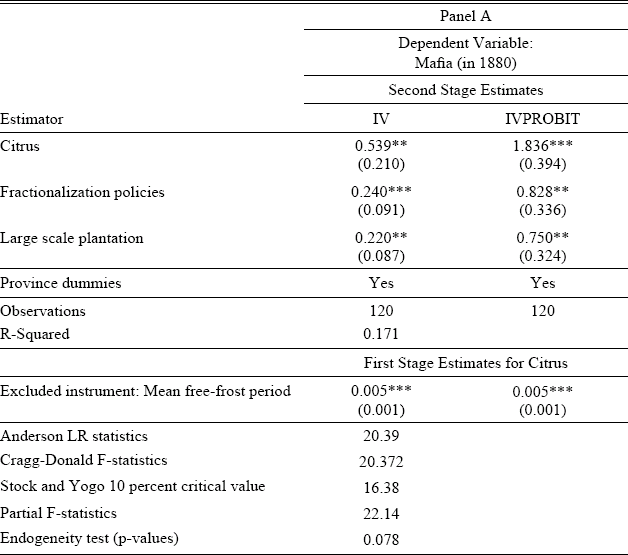
Notes: The estimator is an IV in Column 1 and IVPROBIT in Column 2. We run a two-stage least square estimations with Citrus as the endogenous variable and mean free-frost period as the excludable instrument. Robust standard errors in parentheses. ∗∗∗ p<0.01, ∗∗ p<0.05, ∗ p<0.1.
Source: Authors' calculation.
Results Using Data from Cutrera (2000)
To test further the robustness of our empirical specification, we run the same regressions but using data on mafia from Cutrera (Reference Cutrera1900), merged with independent variables on crops suitability from the FAO/GAEZ.
In Table 6 we show the results. The dependent variable used in the first three columns is the mean intensity of mafia using Cutrera's coding rule. Because of that, the sample is confined to the 289 towns for which the author provides data. The first model is estimated using an ordinal probit. The variable proxying the suitability for citrus is significant at 1 percent level. In Column 2, we re-estimate the same model using an OLS estimator, and in Column 3, we control for spatial correlation of the error terms using Timothy Conley, Christian B. Hansen, and Robert E. McCulloch, et al. (Reference Conley, Hansen and McCulloch2008) spatial HAC estimator. For both models, the variable for suitability for citrus turns out to be significant at 5 percent level at least and its standard error decreases quite significantly, when we control for spatial correlation.
MAFIA INTENSITY AND CITRUS SUITABILITY

Notes: Robust standard errors in parentheses for Columns (1), (2), and (4). Conley (Reference Conley, Hansen and McCulloch2008) robust spatial standard errors in parentheses for Columns (3) and (5). Distance cutoff in Columns (3) and (5) equal to 20 km. We tried different cutoff levels and standard errors decreases when we increase the cutoff. ∗∗∗ p<0.01, ∗∗ p<0.05, ∗ p<0.1.
Source: Authors' calculation.
In Columns 4 and 5, we change the dependent variable and use our interpolated measure of mafia intensity, which allows us to expand the sample to the entire population of Sicilian towns. We regress this new measure of mafia intensity against the same independent variables using an OLS (Column 4) and a spatial HAC estimator (Column 5). In both models, citrus suitability has a significant and positive effect on the intensity of mafia. In addition, the coefficient on citrus suitability remains quite stable (close to 1.2) compared to the other smaller sample. Overall, one standard deviation in suitability to citrus increases the intensity of mafia by almost 1.3 percent.
CONCLUSIONS
Understanding how socially inefficient institutions arise and persist is a key issue in economic history. In this article, we have investigated the origins of the Sicilian mafia. Unlike existing works that emphasize political and historical factors, our analysis identifies the importance of an exogenous shock in the international demand for lemons. The extraordinary revenues that certain producers received, combined with the general political insecurity and weak rule of law, provided an ideal breeding ground for the emergence of a mafia that provided protection and acted as intermediaries.
The empirical analysis, using data from two sources, shows that the presence of mafia is strongly related to the production of citrus fruits. The results continue to hold when we include several control variables, address a possible endogeneity issue and employ two different dependent variables. We believe that our results contribute to shedding light on the emergence of one of the most harmful economic institutions in Europe during the modern era.