





1. Introduction
The primacy of literal meaning has often been taken for granted (Bolognesi & Werkmann Horvat, Reference Bolognesi and Werkmann Horvat2022). In linguistics, but also other fields and non-academic discussions, the literal meaning is often taken to be the default meaning of a word. Usually, literal meanings are said to be more frequent and concrete (Coulson, Reference Coulson and Brown2006), historically older (Steen et al., Reference Steen, Dorst, Herrmann, Kaal, Krennmayr and Pasma2010), easier to access (Clark & Lucy, Reference Clark and Lucy1975; Grice, Reference Grice, Cole and Morgan1975) and acquired earlier (Winner, Reference Winner1988). These views have been challenged in some cases. For instance, Deignan (Reference Deignan2005) shows that the corpus data reveal that certain words are commonly used in their metaphorical sense when serving as verbs, whereas they are more often employed in their literal sense when functioning as nouns (e.g. bridge). Along similar lines, Allan (Reference Allan and da Silva2021) shows that diachronic evidence of the more abstract meaning of the word dull appears earlier than its more concrete, literal meaning.
Regarding the role that the aforementioned primacy plays in cognition, there is a long-lasting debate on the processing of literal and figurative meanings, specifically regarding the very conventional figurative meanings. The indirect access model, associated with Grice’s theory, suggests that we first access the literal meaning before processing the figurative meaning. Some early evidence (Clark & Lucy, Reference Clark and Lucy1975) supports this by showing that literal language is easier to process than figurative language. Shortly after these findings emerged, other scholars (Gibbs, Reference Gibbs1984; Gildea & Glucksberg, Reference Gildea and Glucksberg1983; Harris, Reference Harris1976) argued for the direct access model, proposing that both literal and figurative meanings are processed using the same cognitive mechanisms. Many studies (e.g. Inhoff et al., Reference Inhoff, Lima and Carroll1984; McElree & Nordlie, Reference McElree and Nordlie1999; Ortony et al., Reference Ortony, Schallert, Reynolds and Antos1978) supported this by demonstrating that, under certain conditions, there is no difference in processing between figurative and literal language. Nevertheless, in recent years, some EEG studies have shown differences in processing literal and metaphorical meanings, making it challenging to support the direct access model definitively (Bonnaud et al., Reference Bonnaud, Gil and Ingrand2002; Weiland et al., Reference Weiland, Bambini and Schumacher2014), while others have shown results supporting the idea that there are similar cognitive mechanisms involved in the processing of both types of meaning but also showing differences that may be due to context or the nature of the stimuli (Bambini et al., Reference Bambini, Bertini, Schaeken, Stella and Di Russo2016; Lai et al., Reference Lai, Curran and Menn2009). The debate on how metaphorical language is processed remains unresolved after more than 40 years of research with new theories and models emerging from the older traditions (Bowdle & Gentner, Reference Bowdle and Gentner2005; Coulson & Matlock, Reference Coulson and Matlock2001; Giora, Reference Giora1997; Katz & Ferretti, Reference Katz and Ferretti2001; Libben & Titone, Reference Libben and Titone2008; Titone & Connine, Reference Titone and Connine1999, etc.).
Along similar lines, it has been claimed that figurative meaning is more difficult to acquire. Early research on the acquisition of figurative language shows that metaphor comprehension skills develop rather late, around when the child is 8 years old (Winner, Reference Winner1988). This early evidence is compatible with the indirect access model. However, some more recent studies found that metaphorical competence starts developing at the age of 3 (Pouscoulous & Tomasello, Reference Pouscoulous and Tomasello2020) and gradually continues to improve until the age of 7 (Declercq et al., Reference Declercq, Baltazart and Didon2010; see Di Paola et al., Reference Di Paola, Domaneschi and Pouscoulous2020 for an overview). As for other types of figurative language, some studies, such as Falkum et al. (Reference Falkum, Recasens and Clark2017), show that the acquisition of metonymy happens early, as in certain contexts, 3-year-olds even prefer the metonymic expressions over literal ones.
Therefore, recent evidence suggests that figurative competence develops early and that figurative meanings might possibly not present a difficulty in certain contexts in first language acquisition. However, the issue is complex, since the same child can at the same time question the metaphorical meanings of words around 3;08 years old, for instance, laughing in disbelief at the fact that a plane has a nose (attested case, author’s diary), but also produce metaphor spontaneously at 4;0 years old, calling two pigs in a blanket (puff pastry dish) that are stuck together twins (attested case, author’s diary). On the one hand, some previous studies confirm early spontaneous use of metaphorical language (see Pouscoulous, Reference Pouscoulous2011, Reference Pouscoulous and Matthews2014 for an overview), while other studies report on possible difficulties with early metaphor comprehension (Asch & Nerlove, Reference Asch and Nerlove1960; Billow, Reference Billow1975; Dryll, Reference Dryll2009; Winner et al., Reference Winner, Rosenstiel and Gardner1976).
In this study, we explore the early production of a specific type of figurative meaning: metaphorical (e.g. shark meaning a rapacious crafty person) and metonymic (e.g. house meaning an organisation) meanings in English polysemous nouns and verbs. This specific class of words is intriguing since metaphor and metonymy play a crucial role in the generation of polysemy (Allan, Reference Allan and da Silva2021; Bowdle & Gentner, Reference Bowdle and Gentner2005; Geeraerts, Reference Geeraerts and Wright2015; Pustejovsky & Boguraev, Reference Pustejovsky and Boguraev1997; Traugott, Reference Traugott, Bergs and Brinton2012), and the meanings that are created via this process usually over time become very conventional, frequent meanings (Bowdle & Gentner, Reference Bowdle and Gentner2005), often not perceived nor processed as figurative in everyday use even by adults (Steen, Reference Steen2013, Reference Steen2015; Werkmann Horvat et al., Reference Werkmann Horvat, Bolognesi and Althaus2023). Furthermore, nouns and verbs are the most prevalent parts of speech in early vocabulary, but also the most prevalent vehicles of figurative meaning in language in general (Cameron, Reference Cameron2003; Deignan, Reference Deignan2005; Goatly, Reference Goatly1997; etc.). The aim of this study is to explore the development of the use of conventional figurative meanings (metaphorical and metonymic) by looking at the longitudinal data of the Braunwald corpus (Braunwald, Reference Braunwald1971), which tracks a single child’s speech from the age of 1 year, 5 months to 7 years. This allowed us to track the production of polysemous words over a longer period of time, that is, from before the figurative meanings appear until they are fully acquired. Our study employs a fairly novel approach, only recently used for the first time by Gaskins et al. (Reference Gaskins, Falcone and Rundblad2023) and Gaskins (Reference Gaskins2024), who used corpus data to explore metaphor use in young children. We explore the production of very conventional metaphorical and metonymic meanings, from the child’s first words to when they are 7 years old, which is a novel approach since no study to this date looked at the production of both metaphor and metonymy over a longer period of language acquisition.
2. Theoretical background
2.1. Acquisition of figurative meanings
From the earliest studies in first language acquisition of figurative language, there was a prevailing view that figurative language has a secondary status in child language, that is, that it is acquired later than literal language in a more effortful process. Most early studies (Asch & Nerlove, Reference Asch and Nerlove1960; Billow, Reference Billow1975; Winner et al., Reference Winner, Rosenstiel and Gardner1976) concluded that figurative language acquisition occurs late in language development. A widely cited study by Winner et al. (Reference Winner, Rosenstiel and Gardner1976) showed that spontaneous production of metaphoric expressions actually precedes metaphoric comprehension that only comes after the age of 6, and the ability to explain the metaphor comes even later (around 10 years). Asch and Nerlove (Reference Asch and Nerlove1960) also investigated the language development period when children acquire the ability to understand metaphors and successfully explain their meaning. According to their findings, this ability only came at around 11–12 years of age. These findings could be interpreted in line with the indirect access accounts, that is, meaning that the developmental path also relies on the primacy of the literal meaning (Winner, Reference Winner1988, pp. 41–44). In other words, these studies suggest that by the age 5 or 6, children interpret metaphors literally. After that, they acquire the ability to assign abstract properties to a more concrete domain but not necessarily the right properties. Only later, they gain the ability needed to appropriately interpret the conceptual mappings. While these early findings were confirmed by some later studies (Dryll, Reference Dryll2009), they explain only one aspect of metaphor use – the metalinguistic ability to explain a metaphor. This ability is a complex skill that requires rather intricate cognitive processes, as well as the vocabulary that is needed to talk about this, which might not be developed until later. However, most metaphor use happens unintentionally, and according to some assumptions without even activating the mappings necessary to explain the metaphor (Steen, Reference Steen2013, Reference Steen2015, Reference Steen and Gibbs2016; Werkmann Horvat et al., Reference Werkmann Horvat, Bolognesi and Althaus2023). Thus, it might be hypothesised that conventional metaphors could appear in child speech even before the meaning of the metaphors is fully understood.
In accordance with this prediction, most later studies actually show that the skills necessary for metaphor development develop as early as 3 years old. For instance, Pearson (Reference Pearson1990) investigated the performance of 3;0 to 5;02 years old children on a repetition task. The results showed that their accuracy did not differ between metaphorical and literal stimuli, which suggested that metaphors are not semantically anomalous for young kids and emerge early in language development. Similar claims were made in a recent study by Pouscoulous and Tomasello (Reference Pouscoulous and Tomasello2020), who investigated the cognitive capacities of 3-year-olds in comprehending novel metaphors. The study used a behavioural choice paradigm in which children had to choose one of two objects described by a metaphorical phrase. The findings indicated that 3-year-olds possess the ability to comprehend novel metaphors that align with their vocabulary and general knowledge. However, it must be noted that this study explored novel metaphors, which are substantially different in nature than the conventional metaphorical expressions we explore in our paper. Likewise, Özçalişkan (Reference Özçalişkan2005) showed that 4-year-olds can successfully comprehend metaphor, and what is even more, once a certain mapping is established, they can apply it to different contexts. This study used conventional metaphorical phrases (such as time flies by), which is crucial, since these conventional expressions are generally more frequent in everyday speech than A is B metaphors that tended to be used in previous studies (Asch & Nerlove, Reference Asch and Nerlove1960; Gardner et al., Reference Gardner, Kircher, Winner and Perkins1975; Schecter & Broughton, Reference Schecter and Broughton1991; Winner et al., Reference Winner, Rosenstiel and Gardner1976). These findings are further supported by other studies with similar findings, such as Özçalışkan (Reference Özçalışkan2007), showing evidence for successful comprehension of metaphorical motion by the age of 4 in English and Turkish, and Stites and Özçalişkan (Reference Stites and Özçalişkan2013), showing that children can consistently comprehend different types of spatial metaphors by the time they are 5 years old and explain them by 6 years of age.
Some of these findings, regarding the early acquisition of metaphor comprehension abilities, have been further corroborated by studies exploring metaphor production. Billow (Reference Billow1981) observed how kindergarten children spontaneously produce metaphors during a period of free play. The findings of this study showed that children produce metaphors as early as 2;07 years old, and what is even more, they do so deliberately to achieve a certain conversational purpose. Similarly, Gottfried’s (Reference Gottfried1997) study also showed that children as young as 3 can produce compound metaphors (e.g. stick bug). However, in this study, this was not spontaneous production but rather elicited responses.
Nevertheless, Jakobson and Wickman (Reference Jakobson and Wickman2007) showed similar patterns in school children who spontaneously and consistently produced a variety of metaphors that were rich in meaning, when talking about science content. Recently, Gaskins et al. (Reference Gaskins, Falcone and Rundblad2023) explored metaphor production by using a corpus of child language focusing on one child (2;0 to 3;1 old). The study found that the child was able to use some metaphorical expressions as early as 2 years old, showing that children use primary single-word metaphors very early on during language acquisition.
Recently, the research on the acquisition of figurative language has focused on the skills necessary to produce and comprehend metaphors in the early stages of language development and the factors that might affect them. For instance, Clark (Reference Clark2020) discusses non-linguistic prerequisites for the use of figurative language, that is, perspective-taking and pretend-play. Both perspective-taking (e.g. considering an object as belonging to two different categories) and pretend-play (e.g. treating one object as another) are crucial abilities for later use and understanding of the mappings that form the basis of figurative expressions. This type of behaviour is often present around 2 years of age and can be seen in cases where, for instance, a 23-month-old child called herself a porcupine because of her pointy wet hair or a 2-year-old called her father a kiwi because of his shaved head (Pouscoulous, Reference Pouscoulous2011). These have often been rejected as examples of real metaphor use; however, Pouscoulous (Reference Pouscoulous2011, Reference Pouscoulous and Matthews2014) claims that over-extensions and pretend-play, while sometimes really are just that, are in general strong evidence that children possess the abilities necessary for figurative language production very early on in language development. This is in line with conceptual metaphor and metonymy theories, which are the theoretical basis of our approach in this paper (see Section 2.2). Pouscoulous (Reference Pouscoulous2011, Reference Pouscoulous and Matthews2014) shows that early figurative language use depends on different factors such as context, complexity and conceptual knowledge and that these factors have not been sufficiently explored in previous studies. In other words, sometimes children might not be able to comprehend figurative language not because they have not reached that stage of language development, but because the context is not clear enough or is overly complex, or perhaps they lack conceptual knowledge to establish similarities between different domains. Among non-developmental factors that might have influenced the findings of previous studies, Pouscoulous (Reference Pouscoulous2011, Reference Pouscoulous and Matthews2014) also mentions the types of stimuli as well as the complexity of the experimental task.
Different cognitive abilities can also serve as predictors of figurative language development. Willinger et al. (Reference Willinger, Deckert, Schmöger, Schaunig-Busch, Formann and Auff2019) explored how age, analogical reasoning, information processing speed and cognitive flexibility in 7-, 9- and 11-year-olds affect the ability to comprehend metaphor with a hypothesis that the abilities should differ among the groups. Interestingly, even though at this age children tend to be fully fluent in their first language, age still remains the strongest metaphor comprehension predictor. With respect to the cognitive predictors, cognitive flexibility under time pressure and information processing speed are the strongest predictors. This is interpreted in light of the fact that metaphor comprehension often involves adaption during the conversational process as different levels of conventionality and complexity can appear. Another developmental study by Rundblad and Annaz (Reference Rundblad and Annaz2010) tracked metaphor and metonymy comprehension from 5 to 37 years of age and found that metaphor comprehension abilities develop more slowly than metonymy comprehension abilities. The authors (p. 556) claim that this shows that metonymy and metaphor have different cognitive requirements with metonymy being a cognitively more basic category than metaphor. Metonymy is often considered a more cognitively basic category than metaphor because it involves a direct associative connection within the same conceptual domain. Metaphor, however, involves cross-domain mapping where concepts from different domains are linked, such as in ‘time is money’, where concepts from the domains of ‘time’ and ‘economics’ are connected. Because metonymy works within the same domain and does not require the conceptual leap across different domains, it demands less cognitive effort and processing. Neurological studies also support that metonymy and metaphor are processed differently, with metonymy potentially engaging more straightforward, less abstract cognitive pathways (Coulson, Reference Coulson2001; see also Section 5 for the notion of frame metonymy explained on our results).
Despite the fundamental role that metonymy, according to the conceptual metonymy theory (Barcelona, Reference Barcelona and Barcelona2000; Brdar & Brdar Szabó, Reference Brdar, Brdar Szabó, Radden, Köpcke, Berg and Siemund2007; Kövecses & Radden, Reference Kövecses and Radden1998; Radden, Reference Radden, Dirven and Pörings2002; etc.), plays in everyday communication, research on the acquisition of the ability to produce and comprehend metonymic expressions has been scarce, especially in comparison with studies on metaphor use. In a small comprehension study involving two short stories and a picture choice task, Nerlich et al. (Reference Nerlich, Clarke, Todd, Panther and Radden1999) observed that 4- and 5-year-olds understand metonymy better than 2- and 3-year-olds, which corroborated the results of previous studies on metaphor acquisition. The two stories differed in how rich the context was, that is, in one story there was a direct clue that helped with metonymy comprehension. Both age groups improved when provided with the clue that clarified the metonymic reference. More recently, Falkum et al. (Reference Falkum, Recasens and Clark2017) explored the capacity of preschoolers and adults to comprehend and generate novel metonyms. The study showed that even 3-year-olds displayed the ability to comprehend and produce metonymic expressions in specific contexts and that young children sometimes even preferred metonyms to refer to entities without conventional labels as opposed to providing elaborate descriptions. Nevertheless, the results also showed that with age older children tended to prefer literal interpretations in certain cases. The results of this study were replicated in a follow-up study by Köder and Falkum (Reference Köder and Falkum2020). In this study, Köder and Falkum used a combination of offline (picture selection) and online (eye-tracking) measures to test children’s comprehension of metonymy. Their results showed that there is an ‘early sensitivity’ (Köder & Falkum Reference Köder and Falkum2020, p. 200) to metonymy at the age of 3 followed by a preference for the literal interpretation at the ages of 4 and 5. However, from the age of 6, the metonymic competence improves again, suggesting a U-shaped development of metonymic comprehension in children.
To conclude, while many studies have explored the acquisition of figurative meanings, different aspects of this process have not been investigated to the same extent. A significant body of research has focused on the comprehension of metaphorical or metonymic meanings, whereas much less attention has been given to their production. To obtain a comprehensive understanding of the acquisition of figurative language, studies must address both comprehension and production. This is particularly crucial because, in the acquisition of figurative meanings, production can sometimes precede comprehension (Winner et al., Reference Winner, Rosenstiel and Gardner1976). Understanding the relationship between these two aspects is essential for elucidating the functioning of this system, highlighting the need for more research on the production of figurative meanings.
2.2. The current study
Since recent findings imply that, in fact, metaphorical and metonymic competence can appear early in language development, this study aims to investigate the early production of metaphorical and metonymic meanings in English polysemous nouns and verbs by using a corpus of child language.
This approach is beneficial for several reasons. First of all, the metaphorical and metonymic meanings that appear in polysemous nouns and verbs are highly conventionalised and frequent in everyday language, which makes them the type of figurative expressions that children are expected to be exposed to early and frequently in different types of contexts, thus making them most likely to be used early in production as well. We support the view that the stimuli used in earlier comprehension studies and the types of metaphors explored in production studies should be approached with more theoretical and methodological rigour. Figurative language (especially metaphor) comes in many different forms (see Werkmann Horvat et al., Reference Werkmann Horvat, Bolognesi and Lahiri2021, pp. 131–136 for an overview of methodological issues regarding experimental metaphor studies), and therefore it cannot be expected that all types of figurative expressions exhibit the same patterns in language development.
Our study, which involved identifying and analysing the production of highly conventional figurative uses of nouns and verbs, is based on conceptual metaphor (and metonymy) theory (Lakoff, Reference Lakoff and Ortony1993) and the theory of primary metaphors (Grady, Reference Grady1997; Lakoff & Johnson, Reference Lakoff and Johnson1999), and employs a widely used and well-tested metaphor detection procedure (MIP; Pragglejaz Group, 2007). The conceptual metaphor theory (CMT) emphasises the significance of metaphors for everyday language users and establishes their role as a crucial component of our conceptual system. This perspective, which views metaphors as essential to the encoding, storage, representation and retrieval of concepts, asserts that thinking about a concept inevitably involves activating related metaphorical structures. This idea is now broadly accepted across various fields, including linguistics, literature, psychology, cognitive science, sociology and neuroscience. According to the CMT, abstract concepts are primarily understood through metaphorical frameworks. This theory is further supported by Grady (Reference Grady1997) and Johnson (Reference Johnson1997), who note that primary metaphors often link directly to relevant perceptual experiences. Consequently, our conceptualisation of abstract ideas, such as love, friendship, or morality, is typically metaphorical. This means we tend to think about and discuss these concepts in terms of more tangible experiences, such as warmth, closeness or cleanliness. A substantial body of experimental research demonstrates a cognitive link between the sources and targets of metaphors, especially in cases involving primary metaphors (for an overview, see Dancygier & Sweetser, Reference Dancygier and Sweetser2014, pp. 36–38). The theories of conflation (Johnson, Reference Johnson1997) and primary metaphors (Grady, Reference Grady1997) are grounded in the observation that, across all cultures, humans develop connections during early childhood between co-occurring physical sensorimotor experiences and subjective judgements. This development leads to the conflation of these experiences and establishes mechanisms for metaphorical mappings from sources to targets, known as primary metaphors. For instance, the act of moving forward to accomplish an intended action creates a strong link between the concepts of purposeful action and forward motion. This connection forms the primary metaphor purposeful action is forward motion, a pervasive metaphor that significantly influences our conceptualisation of event structures in both thought and language. In our study, we focus on a particular type of metaphor and metonymy which can be expected to appear early due to the frequency and conventionality in everyday use, that is, polysemous nouns and verbs.
Second, studies on the production of figurative language are scarce and mainly explore spontaneous metaphor production at a certain age (e.g. Billow, Reference Billow1981; Jakobson & Wickman, Reference Jakobson and Wickman2007). Recently, two studies (Gaskins, Reference Gaskins2024; Gaskins et al., Reference Gaskins, Falcone and Rundblad2023) applied a usage-based approach to studying early metaphor use in a corpus. In our study, we apply a similar approach by using a longitudinal corpus which allowed us to track the production of polysemous meanings over a longer period of time, that is, from before the figurative meanings appear to they are fully acquired.
Therefore, the current study aims to answer the following research questions:
-
1. At which age do children start producing metonymically and metaphorically polysemous words (using their different meanings)? Is the literal meaning of polysemous words always produced prior to the figurative one?
-
2. What is the ratio of metonymically versus metaphorically polysemous words and how does this change over time?
3. Methods
3.1. Materials
The study relied on the Braunwald corpus (Braunwald, Reference Braunwald1971), a longitudinal dataset documenting the linguistic development of a single child from 1 year and 5 months to 7 years of age. This corpus comprises 200 transcripts of parent–child interactions involving Laura, spanning from her toddler years to early childhood. In total, it encompasses 56,524 word types and 2,689 tokens. All transcripts are lemmatised and morphologically coded, allowing for the extraction of the lists of verbs and nouns. The data are densely populated during the initial years but become less abundant in the later stages; for instance, there are approximately 60 transcripts for each of the first 2 years, 45 for the third, 25 for the fourth, and only one or two transcripts for each subsequent year up to age 7. The participants conversed in American English. Accessible through the Child Language Data Exchange System (CHILDES; MacWhinney, Reference MacWhinney2000), the Braunwald corpus facilitates analysis through Computerised Language Analysis software (CLAN; MacWhinney, Reference MacWhinney2000). There are many corpora in the Talk Bank that are suitable for this analysis. From the many English corpora available, we have selected this corpus primarily because it presents longitudinal data of one child across a broad age range, with relatively dense sampling for the majority of the years. Additionally, the sampling was performed in various situations, including guided play, free play, meals and other family activities, providing a rich conversational context.
We used the CLAN programme Freq to extract the list of nouns and verbs used by the child. Subsequently, all nouns and verbs recurring more than once in the child’s speech (totalling 641 nouns and 247 verbs) were documented within an.x lsx file. A thorough manual review of these lists resulted in the identification and removal of 20 mistakenly categorised words as nouns and 31 erroneously labelled as verbs. This process ultimately yielded a refined list consisting of 621 nouns and 216 verbs.
As instructed by the MIP (Pragglejaz, 2007), we first used the Merriam-Webster dictionary to determine the various meanings associated with each noun and verb in our compiled lists. We annotated the identified meanings from the dictionary into categories. First, we listed all meanings of a word retrieved from the dictionary in a file (see Table 1), and then each meaning was identified as literal, metaphorical or metonymic. This allowed us to approach the analysis of corpus with predefined meanings of each word.
The analysis of the possible meanings of the noun ‘eye’ based on the MIP

In the second step, we used the CLAN programme Kwal to generate a list of utterances containing the nouns and verbs under investigation. To avoid the inclusion of unwanted material such as repetitions, pretense and overextensions, we generated the Kwal list containing the three utterances preceding and following the target word. Additionally, we consulted the transcript when necessary. This process allowed us to isolate and retain only the target expressions. The data were saved in an.x lsx file with the following columns: file number, age, line, lemma, utterance, meaning number and meaning type. The first five columns were automatically populated, while the authors filled in the last two. The meaning number was determined using the previously annotated list of nouns and verbs with the meanings from the dictionary. The meaning type column was crucial: employing the MIP (Pragglejaz, 2007), we annotated all tokens of each noun and verb in the corpus with potential tags such as literal, metaphorical, metonymic, simile or N/A (if the meaning is unclear from the context). To ascertain the meaning type, we often utilised Kwal to examine words within the broader context (e.g. ± two lines), or alternatively we thoroughly reviewed larger sections of the transcript. If after this process the intended meaning was still not clear, we marked the word as N/A.
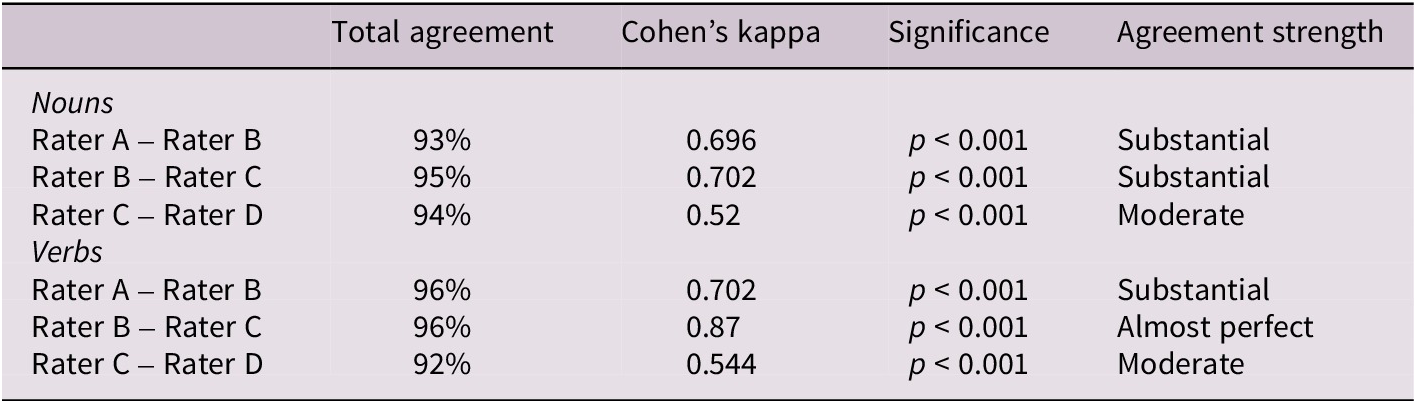
The list of nouns and verbs was evenly divided into three separate lists, one list per annotator. To ensure consensus among the three raters (Werkmann Horvat, Despot and Hržica), each rater recorded the meaning number and meaning type in two lists of nouns and two lists of verbs, that is, each word was analysed by two annotators independently, meaning that each annotator analysed around 400 nouns and 140 verbs, which totalled to around 9,500 lines for analysis per each annotator. This enabled us to calculate the agreement percentage by dividing the instances where raters concurred on the same data item by the total number of data items. The agreement between raters ranged from 93% to 96%. We also calculated the percentage of agreement adjusted for chance (Cohen’s kappa). These values ranged from moderate to almost perfect (see Table 2). Following the confirmation of substantial agreement in most cases, we collectively addressed the instances of disagreement and collaboratively determined the most suitable resolutions, reverting to ‘N/A’ when consensus could not be reached.
Interrater agreement
3.2. Methods of analysis
To answer our research questions, we conducted the following analyses, namely:
-
1. Dictionary-based analysis of lemmas: For each noun and verb in the list, we determined whether it has a single or multiple meanings, and categorised the nature of those meanings (literal, metaphorical or metonymic).
-
2. Corpus-based analysis of lemmas: For each noun and verb in the list, we determined whether it appeared with a single meaning or multiple meanings in the child’s language, and categorised the nature of those meanings (literal, metaphorical or metonymic).
-
3. Types of meanings per month of chronological age: We calculated the percentage of literal, metaphorical and metonymic meanings for nouns and verbs in tokens, separately for each month of chronological age. We explored correlations between the chronological age and the percentage of literal, metaphorical and metonymic meanings.
-
4. Determining the order of meanings: For each noun and verb in the list, we identified the type of meaning in which it first appeared (literal, metaphorical or metonymic). We also observed the time elapsed between the appearance of the first and second meanings.
During early language development, the child typically produces fewer words compared to later stages. This was visible in our corpus as well, though, as previously mentioned, there are substantially more transcripts for the earlier than for the later years in this corpus. Additionally, variations in language samples may arise from factors such as the number of participants in conversation and the nature of activities involved. To mitigate the impact of sample size, we computed the percentage of each meaning type for each month of the child’s age. Given the non-normal distribution of the data, we employed Spearman’s correlation to explore the relationship between the percentage of specific meaning types and the child’s age. Descriptive statistics and correlations were calculated in programme IBM SPSS Statistics (Version 27). The data on the analysis of all nouns and verbs are freely available at https://osf.io/wu3c8/.
4. Results and analysis
4.1. Nouns
4.1.1. Dictionary-based analysis of lemmas
During the 32-month observation period, the child produced 621 different nouns (lemmas). According to the analysis of dictionary meanings, 501 of these nouns possessed multiple meanings, primarily metaphorical or metonymic (120 nouns had a single meaning).
4.1.2. Corpus-based analysis of lemmas
Despite the polysemy observed in the dictionary data, the child predominantly used polysemous nouns in their literal meaning. In the observed period, out of the total number of nouns, most nouns (80%, N = 497) were used solely in their literal meaning, while the remaining 20% (N = 126) were used either in a figurative sense or a combination of both. Table 3 shows different nouns and their meanings used throughout the corpus. Each row represents a noun with all its meanings, irrespective of when a noun or a meaning was first attested. Notably, the child used certain nouns exclusively in a figurative context (8% of child’s total vocabulary, N = 52), with 6% (N= 40) being metonymic and 2% (N = 12) metaphorical (see Figure 1 for details). Polysemous nouns constituted 12% (N = 72) of the child’s total vocabulary, with the predominant usage being a combination of literal and metonymic meaning (7%, N = 41). Additionally, literal and metaphorical usage accounted for 5% (N = 29), with only two nouns conveying all three – literal, metonymic and metaphorical meaning. The usage of nouns with different meanings is often context-based, and the child uses a word according to the situation.
Examples of nouns with figurative meaning(s) in the corpus

Nouns and their meanings in the early child lexicon (each dot represents a noun, so the number of dots per category represents the number of nouns encompassing a certain array of meanings).

4.1.3. Types of meanings per month of chronological age
The results showed a consistent trend in the child’s language development. During the entire observed period, there is a clear prevalence of using nouns (in tokens) with their literal meanings (see Table 4). Both the number and percentage of figurative meanings per month are low, with a mean value of 5% (N = 11) for metonymic usage and 3% (N = 5) for metaphorical usage.
Number and percentage of tokens with literal, metonymic and metaphorical meaning per month of the observation period (nouns)

However, although in small percentages, the child is consistent in the usage of figurative meanings from the first months of the observed period to the last. A notable exception occurs at age 6;05, where, albeit with limited data, the child exclusively employs literal meanings. Over the 32 months, there is a marked shift towards the consistent expression of figurative meanings, particularly in the context of the metaphorical usage of words. Despite the persistent prevalence of literal meanings in each month, there is a clear temporal evolution. Figurative meanings, especially in metaphorical contexts, become more prominent over time, revealing a dynamic progression in the child’s linguistic abilities.
Spearman’s correlation showed that there is no relationship between age and the percentage of literal meanings. However, there is a negative medium correlation between the age and the percentage of metonymic meanings (rs = −.457, p < .05), while there is a positive high correlation between the age and the percentage of metaphorical meanings (rs = .661, p < .001). Although figurative meanings are present in the child’s early lexicon, there is a relationship between age and type of the figurative meaning, that is, the usage of metonymic meanings decreases with age, while the opposite is true for the metaphorical meanings. See Figure 2 for a visual representation of these relationships.
The percentage of metonymic, metaphorical and literal use of nouns by chronological age (x-axis: month of chronological age; y-axis: instances of noun usage categorised as literal, metaphorical or metonymic).

4.1.4. Determining the order of meanings
In individual polysemous nouns, a discernible pattern emerges (see Table 5), with most nouns initially manifesting in their literal meaning (70%, N = 50). The remaining instances unveil a split, with some nouns first appearing in a figurative sense – metonymic (15%, N = 11) or metaphorical (15%, N = 11).
Number of months to the appearance of the second meaning of a noun

The timing of the second meaning’s emergence varies widely. While some polysemous nouns reveal both meanings in the same month, others unfold this complexity only after a couple of years. Table 5 shows the number of months between the first meaning and the second meaning: for the nouns with the first literal meaning, the nouns with the first metonymic meaning and the nouns with the first metaphorical meaning. Typically, this second meaning appears within 14 or 15 months for nouns originating in literal and metaphorical meaning, but the mean number of months between two meanings is much lower (6 months) for nouns initially appearing in the metonymic meaning. Given the relatively small sample sizes within subgroups and the exclusion of additional relevant factors such as frequency, these differences should be interpreted with caution. It is essential to note that the first appearance of a polysemous word’s literal meaning is not necessarily a prerequisite, as it can also be influenced by the frequency of a specific (i.e. figurative) meaning in the child’s language.
4.2. Verbs
4.2.1. Dictionary-based analysis of lemmas
During the 32-month observation period, the child produced 213 different verbs. According to the analysis of dictionary meanings, 205 of these verbs possessed multiple meanings, primarily metaphorical or metonymic (eight verbs had a single meaning).
4.2.2. Corpus-based analysis of lemmas
Despite the polysemy observed in dictionary data, the child predominantly used polysemous verbs in their literal meaning. In the observed period, out of the total number of verbs, most verbs were used solely in their literal meaning (76%, N = 163), while the remaining 24% (N = 53) were used either in a figurative sense or a combination of both. Table 6 shows different verbs and their meanings used throughout the corpus. Each row represents a verb with all its meanings, irrespective of when a verb or a meaning was first attested. Verbs were rarely exclusively used in a figurative context, with one being only metonymic and two only metaphorical (see Figure 3 for details). Polysemous verbs constituted 23% (N = 50) of the child’s total vocabulary, with the predominant usage being a combination of literal and metaphorical meaning (10%, N = 21). Additionally, literal and metonymic usage accounted for 6% (N = 14), with 7% (N = 15) of verbs conveying all three – literal, metonymic and metaphorical meaning. The usage of verbs with different meanings is often context-based, and the child uses a word according to the situation.
Examples of verbs with figurative meaning(s) in the corpus

The verbs and their meanings in the early child lexicon (each dot represents a verb, so the number of dots per category represents the number of verbs encompassing a certain array of meanings).

4.2.3. Types of meanings per month of chronological age
During the entire observed period, there is a clear prevalence of using verbs (in tokens) with their literal meanings (Table 7). Both the number and percentage of figurative meanings per month are low, with a mean value of 4% (N = 11) for metonymic usage and 7% (N = 18) for metaphorical usage.
Number and percentage of tokens with literal, metonymic and metaphorical meaning per month of the observation period (verbs)

The child is consistent in the usage of figurative meanings from the first months of the observed period to the last, although the percentages are small. Over the 32 months, there is a shift towards a consistent expression of figurative meanings. Despite the persistent prevalence of literal meanings in each month, there is a clear temporal evolution. Figurative meanings, especially in metaphorical contexts, become more prominent over time, revealing a dynamic progression in the child’s linguistic abilities.
Spearman’s correlation showed that there is a negative relationship between age and the percentage of literal meanings of verbs. The higher the chronological age, the lower the percentage of literal usages of verbs (rs = −.679, p < .01). There is no significant correlation between the age and the percentage of metonymic meanings, while there is a positive high correlation between the age and the percentage of metaphorical meanings (rs = .779, p < .001). Although figurative meanings are present in the child’s early lexicon, there is a relationship between age and type of figurative meaning, that is, the usage of metonymic meanings shows no relationship with age, but the usage of literal meanings decreases with age, and the usage of metaphorical meanings increases with age. See Figure 4 for a visual representation of these relationships.
The percentage of metonymic, metaphorical and literal use of verbs by chronological age (x-axis: month of chronological age; y-axis: instances of verb usage categorised as literal, metaphorical or metonymic).

4.2.4. Determining the order of meanings
The analysis of individual polysemous verbs showed that the majority initially manifests in their literal meaning (86%, N = 41). The remaining instances first appear in a figurative sense – metonymic (10%, N = 5) or metaphorical (4%, N = 2).
The timing of the second meaning’s emergence varies. Some polysemous verbs reveal both meanings in the same month, while for others the second meaning appears only after a couple of years. Table 8 shows the number of months between the first and second meanings: for the nouns with the first literal meaning, the nouns with the first metonymic meaning and the nouns with the first metaphorical meaning. Typically, this second meaning appears within a year for verbs originating in literal and metonymic meaning, but the mean number of months between two meanings is much lower for verbs originating in the metaphorical meaning. As is the case with nouns, with the relatively limited sample sizes in subgroup analysis and the omission of other important factors like frequency, these variances should be approached with caution. It is important to recognise that the initial usage of a polysemous verb’s literal sense is not always a precondition, as it may also be shaped by the prevalence of a particular (e.g. figurative) interpretation in the child’s linguistic environment.
Number of months to the appearance of the second meaning of a verb

5. Discussion
This study explored how and when metaphorical and metonymic meanings emerge in child language using a longitudinal corpus. We examined the progression of figurative language use by analysing longitudinal data from the Braunwald corpus, which documents the language development of a single child from 1 year and 5 months to 7 years old. The current study provides evidence for the early emergence of conventional figurative language in children and challenges traditional views that suggest a later development. The results offer evidence that can advance our understanding of the early stages of figurative thought development and figurative language production, as well as the development of the early semantic system, especially with respect to ambiguous, that is, polysemous words.
Our findings reveal that children as young as 1;05 years begin to produce utterances that contain metonymic meanings, with metaphorical meanings following closely at 1;07 years. This finding challenges previously established benchmarks and reveals the existence of the capacity for figurative language production from a very young age. The current knowledge about metaphor acquisition focuses on metaphor processing and comprehension, while studies on metaphor production have been rare and often concentrated on children above the age of 3 (e.g. Gottfried, Reference Gottfried1997; Jakobson & Wickman, Reference Jakobson and Wickman2007; Naylor & Van Herwegen, Reference Naylor and Van Herwegen2012). Recently, production studies have discovered a large number of metaphors in corpora of children from the age of 2;0 acquiring English (Gaskins et al., Reference Gaskins, Falcone and Rundblad2023) and Polish (Gaskins, Reference Gaskins2024), which aligns with our results. However, these results seem to be in contrast with previous comprehension studies suggesting that metaphorical understanding develops later (Asch & Nerlove, Reference Asch and Nerlove1960; Billow, Reference Billow1975; Winner et al., Reference Winner, Rosenstiel and Gardner1976; etc.). On the other hand, they align with studies indicating that children can grasp shifts in meaning, including metaphor and metonymy, at earlier ages than previously thought, for example, Waggoner and Palermo (Reference Waggoner and Palermo1989); Özçalişkan (Reference Özçalişkan2005, Reference Özçalışkan2007), and especially Pouscoulous and Tomasello (Reference Pouscoulous and Tomasello2020), who have shown that the ability to understand non-literal language seems to be in place as early as 3 years old, or Billow (Reference Billow1981), who showed that children produce metaphors as early as 2;07 years old. However, our findings significantly lower the age limit, extending it to the very onset of speech.
Before further discussion, it should be noted that comparing the age at which children can produce and comprehend figurative language across different studies is challenging due to considerable methodological differences, differences in the types of stimuli, in the definitions of what constitutes a metaphoric expression in children’s language, and the varying levels of metaphor conventionality and complexity observed. Additionally, in some studies, only the metalinguistic ability to explain a metaphor is considered to be the sign of the proper understanding of metaphoric expression, and in some studies, the figurative use has to be intentional for an expression to be metaphorical, and additionally the hearer has to perceive it as a metaphor to understand it as a metaphor (Marschark & Nall, Reference Marschark, Nall and Reese1985), which is not a view corroborated by the CMT and similar contemporary theories (e.g. Lakoff, Reference Lakoff and Ortony1993) that we follow in this paper (see Section 2.2). Within cognitive metaphor theories, these metaphors are known as deliberate metaphors (Steen, Reference Steen2013, Reference Steen2015). Moreover, very often forms of overextensions, associations and pretence were not considered to be metaphors or metonymies (see Pouscoulous & Tomasello, Reference Pouscoulous and Tomasello2020 for more details on such approaches). Our corpus study, which involved identifying and analysing the production of highly conventional figurative uses of nouns and verbs, is based on CMT (Lakoff, Reference Lakoff and Ortony1993) and employs a widely used and well-tested MIP (Pragglejaz Group, 2007). According to this theory and method, even highly conventional and idiomatic expressions are considered metaphoric if they involve frame-to-frame mapping. We recognise that this definition of metaphor is not commonly used in language acquisition studies, but we believe it can provide both methodological rigour and valuable insights into the earliest conceptual mechanisms and the foundation of more complex metaphorical systems.
Our results have shown that from the onset of speech, at the age 1;05, the child produced utterances based on metonymic pars pro toto or part for the whole principles (part of the action for the entire action, object for action, words for action):


These types of expressions are typical during the earliest stages of language acquisition and production. However, they have not been previously recognised as having a distinct metonymic basis, as this is a very typical use of reference in early production when resources are limited, but this reference is not arbitrary – on the contrary, it is based on what Dancygier and Sweetser (Reference Dancygier and Sweetser2014) call frame metonymy. In frame metonymy, the metonymic relationship is established between parts of the same frame. The term frame metonymy comprises ‘all usages where one reference to an element of a frame is used to refer to either the frame as a whole or to other associated elements of the frame’ (Dancygier & Sweetser, Reference Dancygier and Sweetser2014, p. 101). In both examples ((1) and (2)), there is a frame/scenario of leaving the house, activated in example (1), by a lexical unit car, which is a frame element of the instrument used to leave the house and go away, and in example (2), by a lexical unit bye-bye, which are the words we use when someone is leaving. In both examples, these parts of the frame stand for the entire frame. This type of metonymy is a basic principle for the part-whole metonymy (also called meronymy or partonymy), which involves mentioning a part as a way of referring to the whole of which it is a part. These early metonymies demonstrate the child’s ability to think metonymically and verbalise these conceptual metonymic associations between parts of the same frame.
The evidence that metonymy manifests itself from the very beginning of speech further emphasises its pervasive nature in perception, cognition and consequently, in language. This suggests that metonymy, like metaphor, is deeply ingrained in human cognition and perhaps even more so. Our results serve as evidence that metonymic thinking precedes metaphorical thinking in cognitive and linguistic development and that metonymy is more cognitively basic than metaphor, a view advocated by several linguists (Barcelona, Reference Barcelona and Barcelona2000; Brdar & Brdar Szabó, Reference Brdar, Brdar Szabó, Radden, Köpcke, Berg and Siemund2007; Kövecses, Reference Kövecses2013; Kövecses & Radden, Reference Kövecses and Radden1998; Radden, Reference Radden, Dirven and Pörings2002; Rundblad & Annaz, Reference Rundblad and Annaz2010; etc.). Moreover, frame metonymy, or the frame evocation by elements, characterises other species, not only humans, and it is essential for categorisation and the understanding of context (Dancygier & Sweetser, Reference Dancygier and Sweetser2014, p. 101). Furthermore, pattern completion from partial visual data represents a basic part of perception, so the cognitive basis for metonymy is deeply rooted in perception and brain patterns (Dancygier & Sweetser, Reference Dancygier and Sweetser2014, p. 102). Several researchers (e.g. Kövecses, Reference Kövecses2013) argue that primary metaphors (Grady, Reference Grady1997; Lakoff & Johnson, Reference Lakoff and Johnson1999), which are correlation-based, emerge from frame metonymy.
Even though it plays a crucial role in language development, metonymy has not received much attention in the developmental literature. Such studies are scarce (e.g. Falkum & Köder, Reference Falkum and Köder2020; Köder & Falkum, Reference Köder and Falkum2020; Nerlich et al., Reference Nerlich, Clarke, Todd, Panther and Radden1999; Rundblad & Annaz, Reference Rundblad and Annaz2010), but they suggest that there is an early-emerging ability for creating metonymic meanings; however, not as early as evidenced in our results. Early instances of metonymy were previously observed (such as nose used to refer to a handkerchief in Werner & Kaplan, Reference Werner and Kaplan1963; cookie to denote a bag that previously contained a cookie in Huttenlocher & Smiley, Reference Huttenlocher and Smiley1987; or nap used for a crib blanket in Rescorla, Reference Rescorla1980), and yet these instances were initially not interpreted as true metonymy but rather as overextensions or the utilisation of salient associative relations to convey referential or relational meanings, similar to metonymic usage (Falkum & Köder, Reference Falkum and Köder2020). We consider these types of examples to be clear cases of metonymy, more precisely, frame metonymy. Interestingly, a study by Rundblad and Annaz (Reference Rundblad and Annaz2010), who tracked metaphor and metonymy comprehension from 5 to 37 years of age, found that metaphor comprehension abilities develop more slowly than metonymy comprehension abilities, which upholds our results and a view that metonymy is a cognitively more basic category than metaphor.
Other metonymy examples in our corpus include conventional metonymy content of the container for the container (examples (3), (11) and (12)); meal for the food eaten at that meal (examples (5) and (9)); frame metonymy part of the frame for the entire frame (toe for tickling; example (3)); small unit for small amount (bite for small amount of food, minute for small amount time in examples (6) and (8)); institution/building for people working/living at the institution/building (examples (10) and (13)), part of the body for the person (head/hand for the person; examples (8) and (14)).


As for metaphor use, first metaphorically motivated utterances were produced as early as 1;07. In our corpus, the first metaphorical utterance is based on shape similarity, egg for head in example (15), and the ones following closely at 1;08 and 1;09, examples (16) and (17), are based on the general metaphor action is motion, and its specification change of action is change of motion, a primary and probably a universal metaphor. Interestingly, in the attested case outside this paper’s corpus (author’s diary), another child has also started producing metaphors at 1;09, and also similarity-based and embodied ones (yelling: on your legs, on your legs when watching planes land, mapping the plane’s wheels onto human legs).


With respect to example (17), the child uses the verb turn in its literal sense since the age 3;01, which means figurative meaning is produced before the literal one. In Section 4, we have seen that this is not a rare occurrence in our data (more than 22% of nouns appear in their figurative meaning first, and more than 12% of verbs). This is additional evidence against the neurocognitive metaphor comprehension model (Corcoran, Reference Corcoran1999) and similar indirect access models (see Section 1), which assume that a person first attempts to determine an appropriate literal meaning before favouring the metaphorical meaning. Our results align with studies that found no difference between the comprehension speed of metaphorical speech and literal speech (direct access models [see Gibbs, Reference Gibbs1984; Gildea & Glucksberg, Reference Gildea and Glucksberg1983; Harris, Reference Harris1976; Kintsch & Bowles, Reference Kintsch and Bowles2002] but also later theories following similar ideas such as the career of metaphor theory [see Bowdle & Gentner, Reference Bowdle and Gentner2005 etc.]), indicating that metaphors that are commonly used and more familiar are understood like literal sentences, which shows that the effect of familiarity is stronger than the effect of figurativeness (Despot et al., Reference Despot, Sekulić Sović, Vilibić and Mimica2021). Based on our results, we can assume that the acquisition and early production work on similar principles as metaphor comprehension in general: conventional metaphors are comprehended similarly to literal utterances, as predicted by the career of metaphor theory (Bowdle & Gentner, Reference Bowdle and Gentner2005). This would imply that the metalinguistic understanding of metaphor, which many studies explore (e.g. Asch & Nerlove, Reference Asch and Nerlove1960; Winner et al., Reference Winner, Rosenstiel and Gardner1976), is not necessary for the early use of very conventional figurative meanings. For example, for a child to say that they support someone, it is not necessary for them to fully understand the mapping between the concrete and abstract domains. In this case, the child only needs to acquire the two different meanings, which are then most likely accessed by categorisation, rather than by cross-domain comparison (Bowdle & Gentner, Reference Bowdle and Gentner2005).
Other examples of metaphorical expressions from the corpus include expressions like:


We can observe from these selected examples that the child produces different types of metaphors, from conventional metaphors (examples (18), (24), (26), (27) and (31)) and image metaphors based on visual similarity (examples (20)–(23)), to more complex metaphorical mappings (examples (19), (25) and (28)–(30)), and, as the child gets older and her vocabulary and world-knowledge develops, she produces more complex metaphors and figurative idiomatic expressions (examples (31)–(34)). For instance, example (34) shows that the child’s metalinguistic knowledge, as well as idiomatic metaphoric expressions, is evidenced at 4;10, where the child uses an idiomatic metaphoric expression (driving up the wall) to explain the meaning of another idiomatic expression (bananas).
Our study adds to a growing body of research (Pouscoulous & Tomasello, Reference Pouscoulous and Tomasello2020; see Di Paola et al., Reference Di Paola, Domaneschi and Pouscoulous2020; Pouscoulous, Reference Pouscoulous2011, Reference Pouscoulous and Matthews2014, for an overview) considering analogical perception and polysemy as important figurative language development mechanisms. By showing that basic apparatus and basic forms of figurative language production are present from the onset of speech, we do not imply that metaphor production ability does not become more and more complex over time as was noted in the earlier studies of figurative language comprehension (Asch & Nerlove, Reference Asch and Nerlove1960; Billow, Reference Billow1975; Dryll, Reference Dryll2009; Winner, Reference Winner1988; Winner et al., Reference Winner, Rosenstiel and Gardner1976), but that early mechanisms (possibly simpler) are also available for certain types of metaphoric expressions.
As for the comparison of different parts of speech, our study shows that when it comes to nouns, the use of metonymic meanings seems to drop over time (Figure 2), while the use of metaphorical meanings rises over time. The drop in metonymic meanings as children get older is also noticed in Falkum et al. (Reference Falkum, Recasens and Clark2017). They suggest that this might be due to the fact the children’s metalinguistic skills improve which makes them reflect more deeply on their language use, which is line with other studies such as Gombert (Reference Gombert1992) and Karmiloff-Smith (Reference Karmiloff-Smith1992), and results in preference for the use of literal senses. In the case of verbs, metonymic meanings are used consistently over time, while the use of metaphorical meanings rises with time (Figure 4). Interestingly, in both nouns and verbs, the use of metaphorical meanings rises with time, probably due to the development of more intricate cognitive skills, necessary for production and comprehension of more complex metaphorical meanings. Importantly, when two meanings are used in nouns, these are predominantly literal and metonymic, while for verbs, these are literal and metaphorical. This is in line with Deignan (Reference Deignan2005), who demonstrates, for example, that certain words tend to be frequently used metaphorically as verbs, while they are predominantly used literally as nouns. This exemplifies how the part of speech can influence the distribution of meanings, which consequently affects language acquisition, as is evident from our findings.
Finally, we discuss several limitations of the current study. First, the corpus data usually represent only the corpus reality, so it is entirely possible that some meanings did not appear in the corpus, but the child might have said them. Our choice of corpus might have additionally limited the study in that respect. Instead of the most densely sampled corpus available, we selected one with a broad age range, allowing us to explore language production over a longer period. However, this choice may have reduced our chances of capturing the target expressions as frequently. Second, the interpretation of metaphorical and metonymic meanings, even though it is based on a reliable and well-tested method and even though we had two rounds of independent annotation and measured inter-annotator agreement, is inherently partially subjective. We sometimes experienced difficulties with determining the figurativeness of the meaning – especially with high-frequency verbs like get, make, do and have (see Raukko, Reference Raukko, Nerlich, Todd, Herman and Clarke2003, for a discussion on the semantic complexities of the verb get). For example, with the verb to get, only the meaning get an object is literal, and it is produced first (age 1;05), and all other in the corpus attested meanings are metaphorically or metonymically motivated, such as derivatives of get into a location/position (get up, get down, get in jail, age 1;05–2;03), and then from this conceptual metaphor via primary metaphor states are locations, we have get into a state (get ready 1;10; get sick/get upset 2;03; get better 2;06; get angry/tired/dirty 3;03 etc.). Finally, our study relies on longitudinal data from a single child, which may not represent the diversity of figurative language production across different children or cultures. The specific socio-linguistic environment of the child in the Braunwald corpus may not be reflective of broader linguistic environments.
Given the scarcity of corpus-based studies on figurative language production in early childhood, our methods and findings reveal a path forward for interested scholars and a way to delve deeper into the existing corpora to explore the cognitive underpinnings of this aspect of language acquisition. The early emergence of metaphorical and metonymic use, as evidenced in our study, poses questions for future research related to how children navigate the complex interplay of literal and conventional figurative meanings, and meaning in general, but also sheds light on the ways in which the human mind navigates the complexities of abstract thought and language. Despite the mentioned limitations, our findings challenge the traditional timeline for the development of figurative language and suggest that children are capable of producing figurative meanings much earlier than previously thought. This has important implications for theories of language acquisition and cognitive development, figurative language theories, as well as for educational practices aimed at supporting early language development.
6. Conclusion
Our study adds to the limiting body of evidence exploring the production of figurative meanings. We show that children start acquiring figurative meanings at a much earlier age than previously thought, with some who start producing figurative meanings as young as 1 year and 5 months demonstrating this ability. In this early stage, metonymic meanings emerge sooner, around 1 year and 5 months, while metaphorical meanings come a few months later, at around 1 year and 9 months. These findings challenge prior beliefs established in most of the previous studies that children only develop figurative language skills between 3 and 8 years of age and show that it is not only pre-figurative skills that develop early but also the production of very conventional types of figurative meaning. Notably, even though literal meanings are more common, children can sometimes express figurative meanings even before grasping the literal interpretation. The study also shows that figurative language can take various forms, including metaphors, metonymy, similes, conventional phrases, idioms and creative expressions.
Data availability statement
The data on the analysis of all nouns and verbs are freely available at https://osf.io/wu3c8/.
Acknowledgements
This study was conducted as part of the project Metaphor and Metonymy in Language and Thought, NextGeneration EU. The views and opinions expressed in it are solely those of the authors and do not necessarily reflect the official positions of the European Union or the European Commission. Neither the European Union nor the European Commission can be held responsible for them.
Author contribution
All authors contributed to the study’s conception and design, data collection and analysis and manuscript preparation equally. All authors have read and approved the final manuscript.
Funding statement
This study was funded by the European Union – NextGenerationEU. The study was also supported by the Science Fund of the Faculty of Humanities and Social Sciences in Osijek.
Competing interest
The authors declare that they have no competing interests.


 Open access

