
Hostname: page-component-77f85d65b8-t6st2 Total loading time: 0 Render date: 2026-04-22T07:21:36.637Z Has data issue: false hasContentIssue false

Turbulent boundary-layer flow beneath a vortex. Part 2. Power-law swirl

Published online by Cambridge University Press:  03 April 2020

David E. Loper*
Affiliation:
Professor Emeritus, Florida State University, Tallahassee, FL32306, USA
*
Email address for correspondence: loper@fsu.edu

Abstract

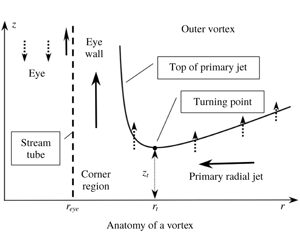
The problem formulated in Part 1 (Loper, J. Fluid Mech., vol. 892, 2020, A16) for flow in the turbulent boundary layer beneath a vortex is solved for a power-law swirl: $v_{\infty }(r)\sim r^{2\unicode[STIX]{x1D703}-1}$, where $r$ is cylindrical radius and $\unicode[STIX]{x1D703}$ is a constant parameter, with turbulent diffusivity parameterized as $\unicode[STIX]{x1D708}=v_{\infty }L$ and the diffusivity function $L$ either independent of axial distance $z$ from a stationary plane (model A) or constant within a rough layer of thickness $z_{0}$ adjoining the plane and linear in $z$ outside (model B). Model A is not a useful model of vortical flow, whereas model B produces realistic results. As found in Part 1 for $\unicode[STIX]{x1D703}=1.0$, radial flow consists of a sequence jets having thicknesses that vary nearly linearly with $r$. A novel structural feature is the turning point $(r_{t},z_{t})$, where the primary jet has a minimum height. The radius $r_{t}$ is a proxy for the eye radius of a vortex and $z_{t}$ is a proxy for the size of the corner region. As $r$ decreases from $r_{t}$, the primary jet thickens, axial outflow from the layer increases and axial oscillations become larger, presaging a breakdown of the boundary layer. For small $\unicode[STIX]{x1D703}$, $r_{t}\sim z_{0}/\unicode[STIX]{x1D716}\unicode[STIX]{x1D703}$ and $z_{t}\sim z_{0}/\unicode[STIX]{x1D703}^{3/2}$. The lack of existence of the turning point for $\unicode[STIX]{x1D703}\gtrsim 0.42$ and the acceleration of the turning point away from the origin of the meridional plane as $\unicode[STIX]{x1D703}\rightarrow 0$ provide partial explanations why weakly swirling flows do not have eyes, why strongly swirling flows have eyes and why a boundary layer cannot exist beneath a potential vortex.

Information

Type
JFM Papers
Copyright
© The Author(s), 2020. Published by Cambridge University Press

Access options

Get access to the full version of this content by using one of the access options below. (Log in options will check for institutional or personal access. Content may require purchase if you do not have access.)

Article purchase

Temporarily unavailable