

How do electoral rules influence voters? Reforms to electoral rules are prevalent. At least 74 countries have made major reforms to their electoral rules since 1991.Footnote 1 Questions about the effects of switching electoral rules on political behavior have likewise been core to political science scholarship on democratic institutions (e.g., Blais and Carty Reference Blais and Carty1990; Carey and Shugart Reference Carey and Shugart1995; Catalinac Reference Catalinac2016b; Reference Catalinac2018; Chang and Golden Reference Chang and Golden2007; Cox Reference Cox1997; Cox, Fiva, and Smith Reference Cox, Fiva and Smith2016; Cox, Fiva, and Smith Reference Cox, Fiva and Smith2019; Duverger Reference Duverger1954; Hirano Reference Hirano2006; Karp and Banducci Reference Karp and Banducci2008; Müller-Crepon Reference Müller-Crepon2022; Paulsen Reference Paulsen2022; Teele Reference Teele2023). Decisions about which electoral rules to employ can be quite contentious (Boix Reference Boix1999; Cox, Fiva, and Smith Reference Cox, Fiva and Smith2019; Cusack, Iversen, and Soskice Reference Cusack, Iversen and Soskice2007; Rokkan Reference Rokkan1970) precisely because they are anticipated to be consequential.
Although existing literature on the consequences of electoral rules has largely focused on elite mechanisms that mediate between electoral rules and voters (e.g., Catalinac Reference Catalinac2016b; Reference Catalinac2018; Chang and Golden Reference Chang and Golden2007; Cox, Fiva, and Smith Reference Cox, Fiva and Smith2016; Eggers Reference Eggers2015; Figueroa Reference Figueroa2024; Motolinia Reference Motolinia2021; Reference Motolinia2025; Müller-Crepon Reference Müller-Crepon2022; Paulsen Reference Paulsen2022; Teele Reference Teele2023), a growing literature investigates the direct effects of electoral rules on voter attitudes and behaviors (Birch Reference Birch2008; Reference Birch2010; Blumenau et al. Reference Blumenau, Eggers, Hangartner and Hix2017; Duverger Reference Duverger1954; Eggers and Nowacki Reference Eggers and Nowacki2024; Eggers and Vivyan Reference Eggers and Vivyan2020; Horiuchi, Smith, and Yamamoto Reference Horiuchi, Smith and Yamamoto2020; Lockwood and Krönke Reference Lockwood and Krönke2021; Moser and Scheiner Reference Moser and Scheiner2009; Reference Moser and Scheiner2005; Tambe and Jormfeldt Reference Tambe and Jormfeldt2024; Tavits and Annus Reference Tavits and Annus2006). However, with important exceptions (e.g., Lockwood and Krönke Reference Lockwood and Krönke2021; Moser and Scheiner Reference Moser and Scheiner2012; Schaffer Reference Schaffer2000; Tavits and Annus Reference Tavits and Annus2006), studies of direct influences on voters have been in advanced industrialized democracies, where political information is widespread, where elections are long established, and where programmatic politics dominate, despite arguments that such conditions are likely to limit generalizability.Footnote 2
In order to expand our knowledge of how electoral rules influence voters outside of advanced industrialized democracies, we conducted a first of its kind field experiment in Sierra Leone. Sierra Leone is a developing clientelistic democracy that had been holding single-member plurality elections since 2002. Not long before its 2023 general elections, Sierra Leone implemented a switch to closed-list proportional representation multimember districts (MMDs) for parliamentary seats. Due to the suddenness of the change, many citizens did not know about the new electoral rules in the lead-up to the election. In partnership with a local nonpartisan nongovernmental organization, we randomized information about the new rules across individuals and collected original panel survey data from both control and treatment respondents before and after the treated respondents were exposed to the new rules. We tested the effect of exposure to the MMD–PR rules on citizens’ knowledge about electoral rules, intentions to participate in the elections, reactions to different types of campaign appeals, and trust in the elections. We followed up with a survey experiment that randomly assigned Sierra Leone respondents to different electoral systems to further explore mechanisms.
We find that exposure to the MMD closed-list PR reform bolsters women’s commitment to voting, decreases support for particularistic campaign appeals, and has ambiguous effects on trust in elections. These results expand the set of conditions under which closed-list PR can mobilize marginalized voters and reduce support for particularistic appeals, and they challenge assumptions about the level of trust that PR necessarily inspires. Existing literature points to the entry of new parties, representation of smaller parties, significant increases in political competition, perceptions of increased pivotality, perceptions of increased women’s representation, decreases in electoral violence, and switches to programmatic politics as mechanisms connecting MMD closed-list PR to turnout, campaigning, and trust. None of these mechanisms holds in our study. Instead, respondents (both men and women) understand a switch from single member plurality rules to MMD closed-list PR to mean simply: a weakening of direct ties between individual candidates and voters and more accountability of candidates to party leadership. Respondents worry that this move might actually reduce transparency as the selection of candidates transfers to parties. Respondents also believe that this change makes particularistic promises to local communities less credible; such promises had previously been enforced through direct lobbying of individual politicians by local communities, and that process is now muted because voters can no longer choose their specific representatives. In light of these considerations, men have mixed reactions about the value of voting in the elections: some bemoan the loss of the ability to choose a specific representative they could lobby directly and say voting is not worth it; others think choosing only a party makes voting simpler and thus less costly. By contrast, women respondents react more uniformly and more positively on average to the switch to voting for only parties, even as they acknowledge the lower credibility of particularistic promises and the potential lack of transparency in candidate selection. Both men and women believe that a party-centered system would do more for women’s development even if it does not increase women’s representation. Women therefore upweight the value of turning out to vote under the new rules.
These results underscore two important points: First, voters do not need to understand all the intricacies of elite incentives or to be able to predict the aggregate changes electoral rules might bring in order to react to an electoral reform. In this study, respondents derive a host of reactions from the simple fact that under the old system, they could choose candidates on their ballots and under the new system, they can choose only parties. Second, it is important to study the effects of electoral rule changes in clientelistic democracies. In a clientelistic democracy, some voters—perhaps more often men—may feel confident pressuring specific candidates for quid pro quo delivery of goods. These voters may withdraw from or react more ambivalently to a party-centered electoral system. Other voters—perhaps more often women—may feel less capable of exerting accountability pressures on specific candidates and may thus find party-centered accountability (relatively) more mobilizing. In other words, clientelism may be an important background condition for the influence of electoral rules on voters.
This article makes several contributions with its design and findings. To our knowledge, it is the first field experimental study of the effects of electoral rules on voters. Existing studies have used many creative research designs to study electoral rules’ direct effects on voters: from conjoint and survey experiments (Blumenau et al. Reference Blumenau, Eggers, Hangartner and Hix2017; Eggers and Nowacki Reference Eggers and Nowacki2024; Horiuchi, Smith, and Yamamoto Reference Horiuchi, Smith and Yamamoto2020), to analyses of survey data across countries with different electoral rules (Birch Reference Birch2008; Lockwood and Krönke Reference Lockwood and Krönke2021; Tambe and Jormfeldt Reference Tambe and Jormfeldt2024), and to analyses of voter behavior across separate ballots in mixed member systems (Moser and Scheiner Reference Moser and Scheiner2005; Reference Moser and Scheiner2009). We add a field experiment to the library of designs upon which researchers in this area can draw. In addition, the article reinforces calls for more research on electoral rules in new, developing, and clientelistic democracies (Ferree, Powell, and Scheiner Reference Ferree, Powell and Scheiner2014; Moser and Scheiner Reference Moser and Scheiner2012; Tavits and Annus Reference Tavits and Annus2006). Switches in electoral rules are even more common in newer democracies than in more established ones (Norris Reference Norris2014), and conditions common in newer democracies (e.g., clientelism and lower levels of political information) may shape how electoral rules influence voters. As Taagepera (Reference Taagepera2002) argues has happened in other contexts, we also find that elites in Sierra Leone did not fully adjust to the new electoral rules right away. The article thus provides evidence that voters can react to electoral rules even in the absence of extensive elite mobilization consistent with the new rules, and voter exposure to the new rules may facilitate the consequences of the new rules even in the first electoral cycle following reform. Finally, the article advances literature on the consequences of voter education. The civic education literature (Campbell Reference Campbell2019; Finkel and Lim Reference Finkel and Lim2021; Holbein and Hillygus Reference Holbein and Hillygus2020; Mvukiyehe and Samii Reference Mvukiyehe and Samii2017; Sperber, McClendon, and Kaaba Reference Sperber, McClendon and Kaaba2022; Reference Sperber, McClendon and Kaaba2025; Willeck and Mendelberg Reference Willeck and Mendelberg2022) has not often examined the consequences of voter education about electoral rules per se. Here, we find that this specific type of civic education can have important consequences on voters.
VOTER REACTIONS TO ELECTORAL RULES IN CLIENTELISTIC DEMOCRACIES
There is a large theoretical and empirical literature on the impact of electoral rules on political outcomes. Much of this literature describes elite-driven mechanisms that mediate between electoral rules and voter behavior: For instance, PR rules can increase turnout by heightening the competitiveness of elections, thereby giving elites incentives to go out and mobilize more (new) voters (e.g., Cox, Fiva, and Smith Reference Cox, Fiva and Smith2016; Kittilson and Schwindt-Bayer Reference Kittilson and Schwindt-Bayer2010; Reference Kittilson and Schwindt-Bayer2012; Lijphart Reference Lijphart1997; Powell Jr. Reference Powell1986; Skorge Reference Skorge2023; Tambe and Jormfeldt Reference Tambe and Jormfeldt2024). Yet, there is a growing literature examining electoral rules’ direct effects on voters. Following Duverger’s (Reference Duverger1954) insight—formalized by Cox (Reference Cox1997)—that voters do not want to waste their votes, a number of scholars have investigated the influence of electoral rules on strategic and split ticket voting (e.g., Eggers Reference Eggers2015; Eggers and Nowacki Reference Eggers and Nowacki2024; Moser and Scheiner Reference Moser and Scheiner2005; Reference Moser and Scheiner2009; Tavits and Annus Reference Tavits and Annus2006). Other scholars have investigated whether electoral systems affect the personal attributes of candidates voters value (Horiuchi, Smith, and Yamamoto Reference Horiuchi, Smith and Yamamoto2020), lead voters to prefer unified or fractionalized parties (Blumenau et al. Reference Blumenau, Eggers, Hangartner and Hix2017), influence the channels voters use to participate in politics (Lockwood and Krönke Reference Lockwood and Krönke2021; Tambe and Jormfeldt Reference Tambe and Jormfeldt2024), or affect the level of trust voters place in elections (Birch Reference Birch2008; Reference Birch2010).
These findings about direct effects on voters may not always generalize beyond conditions associated with advanced industrialized democracies. Ferree, Powell, and Scheiner (Reference Ferree, Powell and Scheiner2014) and Moser and Scheiner (Reference Moser and Scheiner2012) show, for instance, that Duverger’s law that plurality rules will narrow the number of effective parties, relative to proportional rules, does not always hold in more ethnically fractionalized societies where voters have strong attachments to ethnic group-specific parties or have trouble uniting around one opposition party and thus are less likely to engage in strategic voting. Tavits and Annus (Reference Tavits and Annus2006) and Lago and i Coma (Reference Lago and i Coma2012) find that there are more wasted votes and less strategic voting in newer democracies even under restrictive systems because voters face more political uncertainty. Schaffer (Reference Schaffer2000) argues that when voters fear electoral violence, they may seek more consensual outcomes and respond to electoral rules differently than they would with firm expectations of peaceful elections. Generally, Ferree, Powell, and Scheiner (Reference Ferree, Powell and Scheiner2014) and Moser and Scheiner (Reference Moser and Scheiner2012) argue that economic, cultural, and political contexts are likely to condition the effect of electoral rules on voters.
Consider the literature on PR and turnout. Many studies argue that PR systems encourage higher levels of aggregate turnout, especially from marginal voters (e.g., women), than majoritarian systems (e.g., Teele Reference Teele2023). There are several commonly suggested mechanisms: if PR lowers barriers for more (and smaller) parties to gain seats (Cox Reference Cox1997; Duverger Reference Duverger1954; Figueroa Reference Figueroa2024), PR rules will tend on average to increase the competitiveness of elections significantly, giving elites incentives to go out and mobilize more (new) voters (e.g., Cox, Fiva, and Smith Reference Cox, Fiva and Smith2016; Kittilson and Schwindt-Bayer Reference Kittilson and Schwindt-Bayer2010, Reference Kittilson and Schwindt-Bayer2012; Lijphart Reference Lijphart1997; Powell Reference Powell1986; Skorge Reference Skorge2023; Tambe and Jormfeldt Reference Tambe and Jormfeldt2024). Citizens who do not like the most viable political choices under majoritarian rules might abstain under majoritarian rules but decide to vote under PR because parties they like more have a chance to win a seat (Ladner and Milner Reference Ladner and Milner1999; Powell Reference Powell1986). Because PR rules mean that the translation of votes into seats is less distorted, even voters who like the top parties under majoritarian rules may view their votes as more pivotal to electoral outcomes when they learn about a switch to PR (Blais and Carty Reference Blais and Carty1990; Grofman and Lijphart Reference Grofman and Lijphart1986). Alternatively, the proportional translation of vote shares into seats may be seen as more fair and transparent than winner-take-all rules, increasing voters’ trust in the electoral system and thereby increasing reluctant voters’ willingness to participate in that system (Birch Reference Birch2010). Finally, women’s turnout may increase under PR (particularly PR with larger district magnitudes) to the extent that PR is expected to generate higher levels of women’s representation (cf. Moser Reference Moser2001).
In principle, these mechanisms linking proportional representation to increased commitments to voting could extend to newer, developing, and clientelistic democracies. Indeed, we preregisteredFootnote 3 the expectation that exposure to MMD closed-list PR would increase commitments to voting, especially among women, with the above mechanisms in mind. However, there might be reasons to expect that these mechanisms would have limited purchase under conditions more typical of new, developing democracies. If, for instance, strong attachments to ethnic identities mean the number of effective parties does not change much between plurality and proportional representation systems, as Ferree, Powell, and Scheiner (Reference Ferree, Powell and Scheiner2014) and Moser and Scheiner (Reference Moser and Scheiner2012) argue, then there may be little change in the constellation of parties or the level of competition with the switch to PR and thus little reason for new voters to join the elections to support new parties. If women lack the resources to organize to obtain higher placement on party lists, then, as Moser (Reference Moser2001) argues, there may not be expectations of increases in women’s representation under closed-list PR. If citizens have long operated under clientelistic voter–candidate relationships, they may not have as strong attachment to parties or may view their vote as less translatable into quid pro quo local public or individual goods if they can no longer select a specific candidate to lobby. Under these circumstances, voters are more likely to increase their commitments to voting under closed-list PR only if they find voting under closed-list PR less costly than under first-past-the-post (FPTP) or if they believe that party-centered systems may serve their interests better than direct lobbying of individual candidates.
Another strand of the existing literature studies the impact of electoral rules on politician–voter campaigning ties. Most of these studies argue that electoral systems with less intraparty competition encourage more issue-based or universalistic campaigning during elections rather than campaigning on particularistic promises (of pork, local public goods and services, and clientelistic goods) to narrow constituencies. The typical logic posited is that less intraparty competition means fewer incentives for candidates to cultivate a personal vote through promises of pork (Carey and Shugart Reference Carey and Shugart1995; Catalinac Reference Catalinac2016b). Candidates are instead more likely to focus on enhancing the party brand by drawing attention to the party’s programmatic platforms or their party’s ability to deliver goods widely rather than in a narrowly targeted way (Catalinac Reference Catalinac2016a). Intraparty competition could be reduced through a variety of revisions to an electoral system, e.g., by lowering district magnitude within a majoritarian system (cf. Crisp, Jensen, and Shomer Reference Crisp, Jensen and Shomer2007) or by introducing re-election in any system (Motolinia Reference Motolinia2021). An even more common way is by reducing or eliminating voters’ ability to signal support for candidates rather than parties (Carey and Shugart Reference Carey and Shugart1995; Crisp, Jensen, and Shomer Reference Crisp, Jensen and Shomer2007). Where there is closed-list PR with multiple representatives elected per district, elites may have even fewer incentives to cultivate a personal vote (Chang and Golden Reference Chang and Golden2007) because they do not expect voters to be able to accurately attribute pork to a single candidate (cf. Bagashka and Clark Reference Bagashka and Clark2016) or to be able to express preference over candidates. Importantly, voters may anticipate these elite incentives and therefore distrust particularistic promises more under MMD closed-list PR than under single-member plurality systems.
In principle, these mechanisms linking closed-list PR and MMDs to less particularistic campaigning and to voter skepticism about particularistic appeals could extend to newer, developing, and clientelistic democracies.Footnote 4 Again, we preregistered the expectation that exposure to MMD closed-list PR would decrease Sierra Leoneans’ support for particularistic appeals and increase their support for universalistic appeals with the above mechanisms in mind. However, there are reasons to suspect that these mechanisms might be limited or operate differently under conditions associated with new and developing democracies. In clientelistic polities with weak state capacity, for instance, it might not be possible to move immediately, or at all, to programmatic party competition with the switch to MMD closed-list PR (Gottlieb Reference Gottlieb2024). Not only might politicians have more experience with clientelism than with campaigning and delivering on programmatic policies, but the resources and infrastructure required for delivering on programmatic promises might make such promises non-credible to most voters (Nathan Reference Nathan2019), regardless of the electoral rules. The switch to MMD closed-list PR might therefore have no effect on voters’ perceptions of universalistic programmatic policies in such contexts. However, voters might still intuit that, under MMD closed-list PR politicians will have a weaker accountability relationship with local communities than with larger districts or with the party simply because specific candidates are no longer chosen by voters in a constituency. So this phenomenon may make particularistic promises to local constituencies less credible under proportional representation even without fundamentally changing the nature of campaigning or party competition.
Finally, a third strand of the existing literature studies the impact of electoral rules on trust in elections. Studies point out that plurality rules are more conducive to elites’ engaging in electoral misconduct and violence than proportional rules (e.g., Birch Reference Birch2011; Asunka et al. Reference Asunka, Brierley, Golden, Kramon and Ofosu2019), because majoritarian rules are higher stakes “winner-take-all” contests in which even low-scale misconduct or violence might make a difference in who wins. PR rules instead allow for more power-sharing, and PR contests typically generate less of a payoff for elites who might engage in misconduct or violence (Norris Reference Norris2014).Footnote 5 Especially in places where there has been public discussion of the association of electoral misconduct with majoritarian rules, voters may be likely to place more trust in elections run under proportional representation rules. Even if voters do not fully understand elite incentives under different electoral systems, Birch (Reference Birch2008) and others have argued that PR rules may generate voter trust in elections simply because they are, by definition, less disproportional when it comes to the translation of vote shares into seats, and therefore, voters may perceive them as more transparent. Voters aligned with minority parties may view the system as more fair because their side can still get a seat at the table, as it were. These intuitions follow simply from the proportional rather than winner-take-all nature of PR.
In principle, these mechanisms linking closed-list proportional representation to higher trust in elections could extend to any democracy. We preregistered the expectation that exposure to MMD closed-list PR would increase trust in elections with these mechanisms in mind. However, there are reasons to suppose that PR might not generate more trust in every context. For example, it is possible that in some developing and clientelistic democracies, voters are cynical enough based on past experience that they expect less than free and fair elections no matter the electoral system. If that is the case, PR might do little to increase trust. Alternatively, in democracies that have operated under clientelistic voter-state linkages for a long time, it is possible that voters may have greater trust (relatively speaking) in tried-and-true relationships between local communities and individual politicians than they do in the apparati of political parties. Voters in low-information environments that often characterize new, developing democracies may therefore perceive PR as more opaque and therefore less trustworthy than plurality rules.
In sum, existing literature provides many mechanisms linking MMD closed-list PR to increased turnout, reduced particularism, and increased trust. Although the greater part of the literature has focused on elite-driven mechanisms and aggregate political outcomes, there are also plausible mechanisms linking electoral rules directly to voters’ attitudes.Footnote 6 However, these mechanisms have been tested most frequently in advanced industrialized democracies and there are reasons to believe that other mechanisms might operate in newer democracies, particularly in those characterized by clientelism and low information.
We preregistered the following treatment effects before running the field experiment:Footnote 7
H1: Exposure to information about MMD, closed-list proportional representation rules would increase knowledge about the relevant contests’ being run according to MMD, closed-list proportional representation rules.
H2: Exposure to information about MMD, closed-list proportional representation rules would increase intended political participation, and that treatment effects would be larger or more robust among women (marginalized voters)Footnote 8 than among men (Skorge Reference Skorge2023; Teele Reference Teele2023).
H3: Exposure to information about MMD, closed-list proportional representation rules would decrease the appeal of particularistic political promises, and increase the appeal of universalistic appeals (Catalinac Reference Catalinac2016a; Reference Catalinac2018).
H4: Exposure to information about MMD, closed-list proportional representation rules would increase trust in the elections.
We then use a follow-up survey experiment to explore whether the existing literature’s suggested mechanisms for these results meet with support in this context.
THE SIERRA LEONE 2023 POLITICAL CONTEXT
Sierra Leone is a developing country democracy in West Africa that emerged from a decade-long civil war in 2002. It has conducted regular elections and experienced peaceful transitions of power across two major parties, the All People’s Congress (APC) and the Sierra Leone People’s Party (SLPP), since then. Elections for president, parliament, mayors, and local city councils take place concurrently every five years, and in 2007, 2012, and 2018, all of these elections took place under FPTP rules.Footnote 9
Voter–politician linkages in Sierra Leone are typically clientelistic (Casey, Kamara, and Meriggi Reference Casey, Kamara and Meriggi2021; Isaksson and Bigsten Reference Isaksson and Bigsten2017; Osei Reference Osei2022).Footnote 10 Under plurality rules, each member of parliament oversaw a single geographic constituency and competed to show that they could deliver local favors and goods in exchange for votes with local communities (Osei Reference Osei2022). Members of parliament did not have formal constituency development funds so candidates often had to demonstrate personal wealth and generosity to woo voters (Casey, Kamara, and Meriggi Reference Casey, Kamara and Meriggi2021). Sierra Leone has stood out among regional neighbors in the share of citizens in nationally representative surveys reporting that a politician’s primary duty was to benefit his group rather than society as a whole (Isaksson and Bigsten Reference Isaksson and Bigsten2017). Sierra Leone is also a highly ethnically diverse country, and ethnic groups associated with particular regions of the country nest within political parties. Major ethnic groups in the north and north-west of the country tend to align with the APC, whereas major ethnic groups in the south and east of the country tend to align with the SLPP. Campaign promises of delivery along ethnic and regional lines are common (Casey Reference Casey2015; MCormack-Hale and Fridy Reference MCormack-Hale and Fridy2011).
Voter turnout in Sierra Leonean elections has generally been high, ranging between 75% and 87% of registered voters (Table B.1 in the Supplementary Material). Although Sierra Leone’s Election Commission does not publish disaggregated voter turnout information by gender or ethnicity, election observation missions document barriers to women’s participation relative to men’s both as candidates and as voters (The Carter Center 2012; 2018). The typically long polling station lines, combined with significant care and household responsibilities as well as fear of electoral violence in some parts of the country, deter some women from casting their votes (The Carter Center 2018). In 2007 and 2012, parties charged high candidate nomination fees in some elections, which proved a significant hurdle for the nomination of relatively less resourced women candidates (The Carter Center 2012). In 2018, these high fees were removed, but the election saw no significant change in women’s representation. Scholars documented that civil society efforts to increase the participation of women voters and candidates were sometimes met with threats of violence or actual violence (M’Cormack-Hale and Ibrahim Reference M’Cormack-Hale and Ibrahim2023).
In October 2022, the incumbent SLPP introduced a directive for the Electoral Commission to implement a switch to MMD, closed-list PR for parliamentary and city council elections in the June 2023 elections. Instead of single-member constituencies, members of parliament would now be elected across 16 larger geographic districts according to their parties’ vote shares in those districts and their place on party lists decided by party leadership. District magnitudes ranged from 4 to 16 (Table B.2 in the Supplementary Material). Rhetorically, the SLPP justified the switch in rules by arguing that majoritarian rules had led to electoral violence in previous elections because of their “winner-take-all” nature. The SLPP thus argued that the reform would promote peace. However, observers noted that smaller parties (e.g., the Coalition for Change [C4C] and the National Grand Coalition [NGC]) had won some significant regionally concentrated support in the 2018 election.Footnote 11 The reform may have been aimed in part at increasing major party representation in these areas and at disadvantaging these smaller, regionally concentrated parties.Footnote 12 Notably, the proposal for MMD, closed-list PR included a high 11.9% electoral threshold, which would reduce any incentive for very small parties to enter.
Given these motivations behind the reform, it is perhaps not surprising that political competitiveness did not increase dramatically during the 2023 elections. As Table B.3 in the Supplementary Material shows, in the vast majority of districts,Footnote 13 the margin of victory of the largest party and the vote share of the largest party both increased between 2018 and 2023. Whereas in 2018 a number of seats were won by smaller parties and independents, in 2023 the SLPP and APC won all elected seats in parliament. As Table B.4 in the Supplementary Material shows, even if one considers the shortest distance to gaining one more seat under SMD plurality rules in 2018 and under MMD PR in 2023,Footnote 14 that distance decreased only modestly (3.33 percentage points) on average in 2023, with several districts showing an increased distance to one more seat with the switch to MMD PR. The case of Sierra Leone thus provided a context in which to test whether MMD closed-list PR would have an impact on citizens’ willingness to vote where turnout was already fairly high, where representation of smaller parties disappeared, and where party competition did not increase dramatically.
The majority of Sierra Leoneans were uninformed about the switch in rules in the lead-up to the election. A poll conducted two months before the elections found that only 15% of the population knew that the parliamentary elections would be run according to MMD closed-list PR rules.Footnote 15 The poll showed some small heterogeneity in pre-election knowledge by district, but even the most urban areas of the country showed only between a fifth and a quarter of the population knew the parliamentary races would be held under PR, which was the upper bound across all regions.Footnote 16 An even less publicized part of the reform was that each party would be required to have one third of the candidates on their closed lists be women.Footnote 17 As we describe in Section C of the Supplementary Material, we collaborated with journalists in 6 of the country’s 16 districts to collect observations of campaigning in the weeks leading up to the election.Footnote 18 In the four weeks leading up to election day, these journalists logged qualitative reports about the campaign activity they witnessed in their district, focusing on posters, fliers, rallies, radio shows, and WhatsApp advertising. Very little of that campaigning involved voter education about any aspect of the new rules. In contrast to cases in which everyone knows the rules of an election and thus the counterfactual of how voters would have behaved in the absence of those rules is difficult to approximate, Sierra Leone allowed space for us, as researchers, to vary exposure to the new rules across individual citizens.
The journalists’ and our observations also revealed that many elites had not fully adjusted to MMD closed-list PR in the lead-up to the election. We observed parliamentary campaign posters during the 2023 electoral season that featured one MP candidate (not the leader of any party) and encouraged voters to vote for that person, even though voters would actually be able to indicate only their preferred party on the ballot for parliament. Two such parliamentary campaign posters are displayed in Figure 1. During a semi-structured interview with an APC candidate from Western Area Urban, he told us that several members of political parties were caught unaware by the shift and that his own campaign style continued to follow 2018’s constituency-level candidate-centric formula of campaigning because that was what he knew how to do. In journalist accounts across districts, there were multiple instances where candidates in the parliamentary and councilor races emphasized their personal qualities and experience and made particularistic pledges to their former constituencies, a familiar strategy from the old plurality-rule, single-member constituency system. There was no clear switch to programmatic styles of campaigning. This is not to suggest that elites were completely unaware or unwilling to adjust their campaigns to the requirements of the new PR system (see Section C of the Supplementary Material for counterexamples). Yet, on balance, the journalists’ observations suggest that 2023 elections were an out of equilibrium moment in many ways. Parties and candidates adjusted to the new rules at most partially rather than fully. As Taagepera (Reference Taagepera2002) argues, this partial adjustment of elites in the first electoral cycle or two after a reform is not unique to Sierra Leone. It allows us to examine how voters react to the new electoral rules, in the absence of strong elite mechanisms shifting voter attitudes in accordance with the new rules.
Many MPs Continued Campaigning as under FPTP

FIELD EXPERIMENT DESIGN
We implemented a field experiment in the weeks before the June 2023 general elections in which we randomized exposure to information about the new MMD closed-list PR rules. Our local partner, the Institute for Governance Reform (IGR), had developed an app with pages discussing which contests were part of the upcoming general elections, the switch to MMD, closed-list PR rules, each of the main parties’ official manifestos, and the “citizen manifesto”—a compilation of issue priorities IGR and other nonpartisan organizations had collected from surveying citizens.Footnote 19 The app also included a section where users could ask the questions by typing in a query. The app was designed to be factual, accurate, and nonpartisan.
Given the short time frame between the court’s decision and the elections, IGR could not roll out the app to all eligible voters who might benefit from using it. We collaborated with them to share resources that would help them reach more people than they would otherwise have. We assisted IGR specifically in urban areas where people were most likely to have smartphone and internet access necessary to use the app, while randomizing information about the app across individuals so as to study the impact of exposure to information about MMD/closed-list PR rules on respondents. As we discussed in the previous section, voter knowledge about PR was very low across rural and urban areas of the country alike, so dedicating limited resources to roll out information about the new electoral rules to only urban voters did not undercut IGR’s objective of increasing voter exposure to the reform.
Unlike many studies of civic education interventions (Finkel and Smith Reference Finkel and Smith2011; Finkel, Horowitz, and Rojo-Mendoza Reference Finkel, Horowitz and Rojo-Mendoza2012; Sperber, McClendon, and Kaaba Reference Sperber, McClendon and Kaaba2022), we did not rely on self-selection into the study sample (cf. Mvukiyehe and Samii Reference Mvukiyehe and Samii2017). Instead, in all urban centers across the country, enumerators started walking from randomly selected points in the city and approached every fifth or tenth household and randomly selected an adult from the household to invite to take the survey, alternating on gender and oversampling people who said they have a smartphone. Even though this procedure was done only in urban areas, this random walk approach means that we recruited urban adults into the study regardless of whether they might otherwise be sufficiently interested in politics that they would volunteer for a civics education course (cf. Sperber, McClendon, and Kaaba Reference Sperber, McClendon and Kaaba2022; Reference Sperber, McClendon and Kaaba2025). Switches in electoral rules apply to everyone, regardless of level of political interest, so although a volunteer approach might be appropriate for studies of non-obligatory adult civic education programs, our approach of random sampling first and then randomizing respondents into treatment is a better approach to understanding the effects of exposure to different electoral rules.
Using this sampling method, we conducted a baseline survey of 1,132 urban respondents in early June 2023, informing a randomly selected half of those respondents about the app at the end of the baseline survey. Respondents in the baseline survey received airtime compensation for their time and were told there might be follow-up communication or additional surveys. We then sent the treatment group two follow-up text messages that included information about the MMD, closed-list PR rules in case some in the treatment group could not access the app due to inadequate internet coverage.Footnote 20
The reminder text messages read as follows:
If you are not a smartphone user, do not worry. Here are some key details about the new election system available on Sense Bod app:
-
1. On June 24, Sierra Leone is using a new system to choose our MPs.
-
2. Instead of choosing a candidate in your constituency, you’ll now choose a PARTY SYMBOL for the DISTRICT when you vote.
-
3. The old way of picking one MP for your constituency is changing; you’ll now vote for a PARTY for your DISTRICT.
-
4. The number of seats a district gets in Parliament is based on how many people live in the district.
-
5. The more total votes a party gets in your district, the more MP seats they’ll win.
-
6. To win any seats, a party or independent candidate needs to get AT LEAST 11.9% of all votes in your district.
Remember, being informed is key to voting wisely! Download Sense Bod today.
Treated respondents with smartphones and WhatsApp (i.e., the treated subgroup most likely to be able to download the app) then also received one more reminder about the app via WhatsApp. This reminder included a 2-minute radio jingle in Krio created by IGR to promote the app and also the following message:
Election time is fast approaching, and it’s critical for citizens to stay informed. Introducing SENSE BOD mobile app, your ultimate election guide. It provides reliable info about the new voting system in Sierra Leone, updated party manifestos, citizens’ demands, information about your nearest polling center, plus an interactive chat for instant answers to your election-related questions. Additionally, it offers a unique section for testing your knowledge about the elections. Get the Sense Bod app today from the Google Play Store for free using this link: https://play.google.com/store/apps/details?id=com.igrsl.sense_bod. Or simply search “Sense Bod” on the Play Store. Apple users, the app will be available on the App Store soon. Let’s make informed decisions and actively contribute to Sierra Leone’s future. Download Sense Bod now!
Ten days after the baseline survey, we conducted an in-person endline survey asking the same respondents about their political knowledge, their intent to vote, their attention to the parties’ issue platforms, their approval of different kinds of campaign appeals, and their trust in the elections. Wording of all questions is in Section H of the Supplementary Material. The questions about approval for different kinds of campaign appeals included the following exercise: in random order, respondents were presented with three appeals that concerned similar issues (youth employment and healthcare) but that made promises that were either (1) focused on delivery of pork to a particular community (the respondent’s chiefdom/town), (2) focused on programmatic goals targeting all Sierra Leoneans,Footnote 21 or (3) focused on particular candidate traits (leadership qualities and record of delivery). The content of the appeals was designed to be realistic without being obviously tied to a particular party, though in the analyses, we do control for proxies for party identification. Party identification was proxied for with a combination of respondents’ district, language, and town.Footnote 22 After each appeal, the respondents were asked how much they approved of it. The text of the appeals is included in Section H of the Supplementary Material.
For ethical reasons, all respondents in the control group were told about the app and about MMD, closed-list PR rules at the very end of the endline survey so as to ensure that no respondents were deprived unnecessarily of important political information before the election took place. We did not consider it ethical to withhold this kind of information entirely from citizens that we could reach before the actual elections. We, therefore, do not collect behavioral outcome data during the election and instead focus on attitudinal differences between the treatment and control respondents before the control respondents learn about the app. See Section A of the Supplementary Material for further discussion of ethical considerations.
We used the random assignment of information about the new MMD/closed-list PR rules (mainly through the text message information given implementation challenges described below) to generate a randomly-assigned variation in which individuals were more exposed to the new rules. We preregistered our hypotheses on June 23, 2023, before gaining any access to the survey responses for analysis. Figure 2 visualizes the research timeline of the project.
Field Experiment Timeline

IMPLEMENTATION
As with most field studies, especially those conducted during election periods, there were implementation challenges. Specifically, IGR had difficulty ensuring that all respondents with a smartphone could access the app. Apple gave IGR a very hard time registering the app through the Apple App Store, resulting in long unanticipated delays. The app was available on Google Play but not in the Apple App Store during the main study period, and respondents who had iPhones instead of Androids could not easily download the app. Google also initially required that the app request an email login for app users, which proved to be a barrier for many respondents because they did not have email addresses. The IGR team removed this requirement as soon as it was able, but the requirement initially hampered access to the app for the treated group.
As a result of these challenges, we conceptualize the treatment as the survey and text message information about the switch to MMD/closed-list PR rather than as information about the new rules plus information about party manifestos and citizen manifestos, etc., that were included in the app. All treatment respondents received information about the switch to MMD/closed-list PR through text messages, regardless of what type of phone they had and regardless of whether they had an email address. We preregistered some additional hypotheses that we thought would stem from full access to the app. For instance, we preregistered an expectation that treatment would increase respondents’ abilities to match out-parties to issues in their manifestos. We preregistered that downloading the app would amplify treatment effects. However, these expectations were based on the planned full implementation of treatment. Given challenges with digital equality and access to the full app, we were not surprised to find null results on knowledge about party manifestos and low rates of app downloads (see Tables E.24–E.27 in the Supplementary Material). Table F.1 in the Supplementary Material lists deviations from our pre-analysis plan due to these unanticipated implementation challenges.
FIELD EXPERIMENT RESULTS
Table E.1 in the Supplementary Material provides descriptive statistics on the 737 respondents who completed both the baseline and the endline surveys in the field experiment. Half of the sample were men and half were women by design. About half the sample was married. The average respondent was 34 years old, reflecting Sierra Leone’s very young population, and had two children and a secondary school education. We experienced 35% attrition from baseline to endline—a rate that is not atypical for field experiments in developing countries (Adida et al. Reference Adida, Gottlieb, Kramon and McClendon2020). Fortunately, there is no detectable differential attrition across treatment and control groups (Table E.3 in the Supplementary Material). Unrelated to treatment assignment, attrition appears to have been driven by enumerators’ difficulties finding some baseline respondents for the endline survey or some respondents’ not having time to complete the endline survey even when found. These difficulties are unsurprising, given that the panel data were collected during a busy election season when many respondents were likely moving around to vote where they were registered. Following our pre-analysis plan, we test whether attrition is systematically related to baseline covariates in a way that differs by treatment assignment. We interact treatment status with several pretreatment characteristics (gender, marital status, educational attainment, discussing politics, having children, and number of children) and test whether these interaction terms are jointly significant, finding little evidence of differential attrition by treatment conditional on prognostic baseline covariates.
We estimate intent-to-treat (ITT) effects using ordinary least squares (OLS), with treatment assignment as the independent variable of interest.Footnote 23 Our approach follows the pre-analysis plan, where the main estimating equation is
 $$ \begin{array}{rl}{Y}_i=\alpha +\beta \cdot {\mathrm{Treated}}_i+{\mathbf{X}}_i.\boldsymbol{\gamma} +{\varepsilon}_i,& \end{array} $$
where $ {Y}_i $
is the outcome (or an index of a family of outcomes where relevant) for respondent i,
$ {Y}_i $
is the outcome (or an index of a family of outcomes where relevant) for respondent i, $ {\mathrm{Treated}}_i $
is a binary indicator equal to 1 for individuals assigned to the treatment group that received information about new electoral rules, and
$ {\mathrm{Treated}}_i $
is a binary indicator equal to 1 for individuals assigned to the treatment group that received information about new electoral rules, and $ {\mathbf{X}}_i $
is a vector of covariates. Unless otherwise noted,
$ {\mathbf{X}}_i $
is a vector of covariates. Unless otherwise noted, $ {\mathbf{X}}_i $
includes controls for respondent marital status and number of children, which were modestly imbalanced at baseline.Footnote 24 In Tables E.13–E.30 in the Supplementary Material, we also report estimates without covariates.
$ {\mathbf{X}}_i $
includes controls for respondent marital status and number of children, which were modestly imbalanced at baseline.Footnote 24 In Tables E.13–E.30 in the Supplementary Material, we also report estimates without covariates.
Before testing for treatment effects on the main outcomes of interest, we first examine whether assignment to receive information about the MMD, closed-list PR rules increased political knowledge relative to control. In Table 1, we check for treatment effects on knowing that the parliamentary elections will be run under these rules (column 1) and on knowing that the presidential election will, in contrast, be run according to majoritarian rules (column 2). We see an increase in knowledge that the parliamentary elections are being conducted under closed-list PR rules due to treatment and a positive but not statistically significant treatment effect on knowing that the presidential election will be run according to majoritarian rules. The effect on knowledge that the MP race will be under PR rules is 6 percentage points, or about a 15% increase over the share of people who knew in the control group who got that question right. Even with implementation challenges, the treatment increased exposure to MMD/closed-list PR rules. Although a 15 % increase in knowledge over baseline is not huge, we show in Tables E.7 and E.8 in the Supplementary Material that it is likely large enough to mediate treatment effects. In the follow-up survey experiment described below, we also reinforce treatment by having respondents answer recall questions about electoral rules and find similar results as in the field experiment.
Treatment Effects on Knowledge of Electoral Systems

Note: Controls include the number of children and marital status to correct for minor imbalance. Full results are shown in Table E.9 in the Supplementary Material. Results without covariates are shown in Table E.13 in the Supplementary Material. $ {}^{*}p<0.1 $
;
$ {}^{*}p<0.1 $
; $ {}^{***}p<0.01 $
.
$ {}^{***}p<0.01 $
.
Table 1 also shows that treatment does not increase other forms of political knowledge other than knowledge of party- rather than candidate-selection on the ballot. For instance, the 2023 elections also included party quotas for women candidates,Footnote 25 but these provisions were not part of IGR’s app, were mentioned in both treatment and control versions of the surveys, and were not included in the text messages for the treated respondents. In response to a question about women’s representation, treated respondents are no more accurate in answering the question than control respondents (column 3). Treatment also does not increase the accuracy of respondents’ reporting which offices were at stake in the upcoming elections (see Table E.4 in the Supplementary Material, column 2) or how candidates were ordered on the list (see Table E.4 in the Supplementary Material, column 1)—information that was not included in treatment text messages. Together, the findings in Table 1 and Table E.4 in the Supplementary Material suggest that the treatment increased knowledge specifically about the closed-list PR nature of the ballot but not more general political knowledge. We reach similar conclusions using an index that combines these knowledge measures (Table E.5 in the Supplementary Material), which shows no statistically discernible overall increase in broader political knowledge from treatment.
Turning to our measures of intended participation, recall that we expected exposure to MMD/closed-list PR to increase participation among marginalized voters. We preregistered that an example of marginalized voters in this context is women who, unlike men, were not already at a turnout ceiling in majoritarian contests in Sierra Leone (Lekalake and Gyimah-Boadi Reference Lekalake and Gyimah-Boadi2016). We also preregistered expectations that some of the measures of intent to participate would not move in response to treatment because they would likely be at ceiling.Footnote 26 In keeping with these expectations, we find no average treatment effects on intended participation,Footnote 27 but we do find evidence of a positive treatment effect on some key measures of participation among women.
Table 2 shows treatment effects on intended participation moderated by gender. Specifically, exposure to MMD/closed-list PR rules increases the time women reported willing to wait to vote by more than an hour. Treatment does not have the same impact on men, thus closing the gender gap in willingness to persist in casting a vote. Treatment increases the time women were willing to wait by about 37%, which is a significant amount of time given how long wait times can be to vote in Sierra Leone.Footnote 28 This is also notable given the additional childcare and household responsibilities that tend to pose barriers for women waiting in line to vote in Sierra Leone (The Carter Center 2018).
Treatment Effects on Political Participation

Note: Controls include the number of children and marital status to correct for minor imbalance. Full results are shown in Table E.11 in the Supplementary Material. Results without covariates are shown in Table E.15 in the Supplementary Material. $ {}^{*}p<0.1 $
;
$ {}^{*}p<0.1 $
; $ {}^{**}p<0.05 $
;
$ {}^{**}p<0.05 $
; $ {}^{***}p<0.01 $
.
$ {}^{***}p<0.01 $
.
In line with our expectations about ceiling effects, treatment does not move anyone’s intention to vote, which we know tends to be over-reported in surveys (Adida et al. Reference Adida, Gottlieb, Kramon and McClendon2019) and which was incredibly high (around 90% of respondents reporting an intention to vote) at baseline. We find evidence of treatment effects on willingness to register others to vote among swing voters and among SLPP voters (see Table E.18 in the Supplementary Material), but no effects for volunteering, which is not surprising given that there did not end up being many opportunities for ordinary citizens to volunteer during the 2023 elections. So these null results may not be terribly surprising or informative.
In line with preregistered expectations, we also find that exposure to MMD/closed-list PR decreased individuals’ support for particularistic appeals.Footnote 29 Table 3 shows that, conditional on party ID, treatment decreases strong approval of the particularistic appeal by 12.2 percentage points.Footnote 30 Proxies for party identification correlate with support for the appeals, which we modeled on examples of campaigning actually taking place in Sierra Leone during this election cycle. Despite our best efforts, the appeals we provided may have sounded like appeals from the incumbent SLPP because likely SLPP voters more strongly supported all of the appeals than likely APC voters and likely swing voters. Nevertheless, we see no differences in associations between partisanship and support across the appeals, meaning that the universal appeal was no more likely than the particularistic appeal or the leader quality appeal to resemble an SLPP appeal. Likewise, the effect of exposure to MMD/closed-list PR on support for the different appeals is not moderated by likely partisanship. Respondents of all likely partisan leanings are moved by exposure to MMD/PR to lower their approval for particularistic appeals.
Treatment Effects on Approval of Different Campaign Appeals

Note: Controls include the number of children and marital status to correct for minor imbalance. Full results are shown in Table E.10 in the Supplementary Material. Results without covariates are shown in Table E.14 in the Supplementary Material. $ {}^{*}p<0.1 $
;
$ {}^{*}p<0.1 $
; $ {}^{**}p<0.05 $
;
$ {}^{**}p<0.05 $
; $ {}^{***}p<0.01 $
.
$ {}^{***}p<0.01 $
.
Finally, we find limited evidence in support of our preregistered expectation that exposure to MMD closed-list PR would increase trust in elections. We hypothesized that voter learning about the new rules might increase trust because PR rules are less disproportional by definition and might thus be viewed as more fair (Anderson et al. Reference Anderson, Blais, Bowler, Donovan and Listhaug2005; Birch Reference Birch2008) and/or because voters understand that PR rules create fewer incentives to engage in electoral misconduct because they are not winner-take-all (Birch Reference Birch2011; Müller-Crepon Reference Müller-Crepon2022). Indeed, the SLPP publicly said that its motivation for switching the rules was to reduce violence. However, as Table 4 shows, we do not see a strong treatment effect of exposure to the new rules on trust within the full sample. Instead, we see that exposure to the new rules increased trust in the elections only when respondents were first reminded of the 2018 elections. Half of our sample was randomly assigned to be asked first about trust in the 2018 elections, and half was randomly assigned to be asked first about trust in the 2023 elections. Column 1 of Table 4 shows being randomly assigned to be asked first about trust in the 2018 elections (in which electoral violence occurred) lowers reported trust in the free and fairness of the 2023 elections in the absence of treatment. For the group first reminded of the 2018 elections, exposure to MMD/closed-list PR rules then increases trust in the 2023 elections.
Effects of Treatment on Trust in Elections

Note: Controls include the number of children and marital status to correct for minor imbalance. Full results are shown in Table E.12 in the Supplementary Material. Results without covariates are shown in Table E.16 in the Supplementary Material. The result using a trust index that takes a simple average of these three trust variables is reported in Table E.31 in the Supplementary Material. $ {}^{*}p<0.1 $
;
$ {}^{*}p<0.1 $
; $ {}^{**}p<0.05 $
;
$ {}^{**}p<0.05 $
; $ {}^{***}p<0.01 $
.
$ {}^{***}p<0.01 $
.
The fact that the treatment effect on trust appears only when respondents were randomly assigned to be asked first about the 2018 elections—a pattern that we did not preregister—points to the possibility that the treatment effect may not be about the switch to MMD closed-list PR per se. Respondents might have been eager for a change from the status quo when reminded of past misconduct (Müller-Crepon Reference Müller-Crepon2022). The treatment effect may be due to learning about any reform, regardless of content. We find further support for this interpretation below in the follow-up survey experiment.
In sum, we find in the field experiment that exposure to information about MMD closed-list PR increased women’s commitment to voting, decreased support for particularistic campaign appeals, and had circumscribed effects on trust in elections. These results are robust to a number of potential inferential concerns. First, although our results are against the background of a politicized reform, they are not consistent with pure politicization effects, as we show in Section E.5 of the Supplementary Material. Second, as we discuss in Section E.6 of the Supplementary Material, our results are not likely to be driven by high sensitivity to political questions, data collection issues, or social desirability even though outcome measures are drawn from self-reports. Third, we preregistered that we would adjust for multiple comparisons for outcomes that had multiple associated measures, in order to address the risk of false positives. These preregistered families of outcomes were: participation, trust, and knowledge. We report in Tables E.33–E.35 in the Supplementary Material the FDR-corrected p-values using the Benjamini–Hochberg procedure (Benjamini and Hochberg Reference Benjamini and Hochberg1995) within families of these outcomes and show that, with the exception of the treatment effect on knowledge, these findings are robust to corrections for multiple comparisons. In light of this weaker result on knowledge, we conduct a follow-up experiment in which we go to greater length to ensure most respondents absorb information about electoral rules to see if the other results still hold under those conditions.
SURVEY EXPERIMENT RESULTS AND MECHANISMS
Any field study has limitations, especially one designed and implemented quickly in response to a sudden real-world change. In our field experiment surveys, we asked very few questions that allow us to explore mechanisms underpinning the above results in more depth. Furthermore, the field experiment compared information about the new rules to a control with no new information. As we note above, some of the results could therefore be due to exposure to any reform or to any information about electoral rules, rather than to MMD closed-list PR itself.
To address some of these limitations, we conducted a follow-up survey experiment in 2025. We recruited 1,464Footnote 31 Sierra Leonean adults on FacebookFootnote 32 and randomly assigned them to read about one of the following electoral systems governing a hypothetical parliamentary election in Sierra Leone:
-
1. MMD, closed-list PR, with a 12% electoral threshold, approximating the information in our field experiment treatment,
-
2. a pure control in which respondents were simply asked to imagine a parliamentary election in Sierra Leone,
-
3. FPTP,
-
4. a system in which each party was required to have one third of its candidates be women (gender party quota),Footnote 33
-
5. FPTP with the gender party quota,
-
6. MMD, closed-list PR, with a 12% electoral threshold and the gender party quota,
-
7. MMD, closed-list PR, with a 1% threshold and the gender party quota,
-
8. MMD, closed-list PR, with the gender party quota but no specified threshold, or
-
9. MMD, closed-list PR, with no specified gender quota or threshold.
Because the survey experiment took place in 2025, MMD closed-list PR was the status quo rather than a reform during the survey experiment. Conducting a survey experiment allowed us to pull apart exposure to the MMD closed-list ballot from exposure to a reform, from plurality rules, from a specific electoral threshold, and from quotas for women candidates, none of which we could do in the context of the field experiment around a real-world policy change that bundled these elements. The survey also allowed us to more tightly control whether respondents absorbed information about the electoral rules. Each respondent who saw a description of an electoral system was then asked to recall information about the electoral system, in order to reinforce the treatment. On average, respondents got most (69%) of the recall questions correct, and more than 60% of the respondents answered all recall questions correctly (Table G.1 in the Supplementary Material). Finally, the survey experiment allowed us to ask more open-ended questions as well as closed-ended questions about intermediate outcomes. The texts of all experimental conditions, as well as the wording of all questions in the survey experiment, are shown in Section I of the Supplementary Material.
Social media users tend not to be nationally representative, particularly in developing countries where internet access and smartphone ownership are often more limited. However, in our case, many of the typical attributes of social media users—that they tend to live in urban areas, are more likely to have smartphones, are somewhat more educated and younger than the national population (Bollen Reference Bollen2022)—are also true of our field experimental sample, because we sampled for the field experiment within urban centers only. Nevertheless, differences remain (Table G.25 in the Supplementary Material). In Tables G.26–G.33 in the Supplementary Material, we re-weight our survey experiment sample to more closely match the observable characteristics of our field experiment sample and find that the direction of the patterns described below all hold, with occasional differences in statistical significance.
In the exploratory analyses below,Footnote 34 we first compare outcomes between FPTP and MMD, closed-list PR with a 12% threshold only, because this was the assumed comparison in the field experiment. In open-ended questions, respondents tended to interpret the pure control as referring to MMD, closed-list PR with a 12% threshold, so we then introduce the pure control in the second column of each table. Finally, we introduce conditions that included party quotas for women and different levels (or no mention) of the electoral threshold.Footnote 35
Mechanisms Driving Women’s Participation
Despite the hypothetical setup, despite the later timing of the survey experiment, and despite the differences in sample characteristics, we find in the survey experiment, as in the field experiment, that MMD closed-list PR with a 12% threshold increases women’s commitment to voting. As can be seen in column 1 of Table G.4 in the Supplementary Material, women respond to the PR plus 12% threshold treatment, relative to the FPTP treatment, by reporting a longer time they would be willing to wait in line to vote. They respond to the pure control scenario, relative to the FPTP scenario, in a similar way now that the status quo is the MMD closed-list PR plus 12% threshold system (column 2). These patterns persist when we introduce the other experimental conditions, including party quotas for women candidates and a lower electoral threshold (columns 3 and 4).
Why do women respond in this way? We find little evidence in the survey experiment that these results are driven by women believing more strongly that their vote matters. Table G.17 in the Supplementary Material shows that there are no detectable differences across conditions in how much men or women agreed or disagreed with the statement, “My vote would matter in the election described above.” See Table G.18 in the Supplementary Material for results by gender. Likewise, there are no detectable differences across experimental conditions in internal efficacy—that is, with disagreement with the statement, “Politics is too complicated for someone like me to understand” (Table G.20 in the Supplementary Material). This lack of evidence that belief in non-wasted votes and internal efficacy were higher under MMD closed-list PR is consistent with the open-ended responses. Respondents were asked, “Briefly, can you explain why you would wait this amount of time to vote?” Respondents in every experimental condition, whether PR or FPTP, say that their vote could influence the election. Respondents in the FPTP condition point out reasons FPTP is easy to understand (e.g., “Simple Majority explains in simple terms the winner”) and respondents in the PR plus 12% condition also point out reasons PR ballots are easy to understand (e.g.,“I just have to watch for the party symbol which I believe is very easy to identify”). There is also little evidence that women’s commitment to voting increases because PR increases women’s trust in elections. As we discuss below, and as can be seen in Table G.6 in the Supplementary Material, women (and men) respondents in the survey experiment actually trust elections less under PR.
Instead, the survey experiment suggests two other reasons for women’s increased commitment to voting. First, many of the PR conditions, including the MMD PR plus 12% threshold that mimicked our field experiment treatment, increase the perception (among both men and women) that politicians would focus on “development policies that focus on women in particular,” relative to FPTP (see Tables G.15 and G.16 in the Supplementary Material). The perception that PR systems lead to prioritizing women’s development occurs even though respondents are no more likely to believe that PR plus 12% would increase women’s representation (Table G.24 in the Supplementary Material).Footnote 36 Second (and perhaps related), women respondents in the PR plus 12% threshold condition and other PR conditions often express enthusiasm for voting only for parties—one respondents writes that she would wait all day, “Because of the love I have for the party”—whereas male respondents’ reactions to being able to vote only for parties are much more mixed. Some men say they want to stay in line to get their party over the threshold, but others say that they do not want to vote at all in a system that does not allow them to choose a specific candidate to whom they can go and whom they can hold accountable. One writes that he would not stand in line at all to vote under PR, “Because after all am not voting for someone specific.” Another writes, “I know it’s my rights to vote but I vote for candidate not political parties.” Another says he would not vote, “Because I not the one making choice but the party. My interest is not taken seriously so for me it’s all a joke.” By contrast, in the FPTP condition, a male respondent writes that he would wait in line for a long time, “So I can have a hand in picking the Man responsible for making the change I want to see.” A couple of women respondents also articulate a preference for choosing a candidate directly, but, on the whole, women respond more positively to the switch to party-centered accountability, whereas men’s reactions are much more mixed.
The expectation (from both men and women) that PR plus 12% increases attention to women’s development together with women’s relatively lower concern about losing direct accountability relationships with individual candidates provides a logic for women’s (and not men’s) increased commitment to voting under the new rules that we saw in the field experiment. It is worth exploring in other clientelistic contexts whether men are on average more able to navigate direct politician–voter linkages under FPTP rules to get what they need than women are, such that party-centered systems might be relatively more mobilizing for women.
Mechanisms Reducing Support for Particularistic Appeals
We also find evidence in the survey experiment that MMD closed-list PR plus 12% threshold reduces the credibility of promises of locally targeted goods, consistent with findings in the field experiment. In the PR plus 12% threshold condition, respondents think it would be much less likely that politicians would prioritize “neighborhood and chiefdom development” compared to under FPTP (Table G.10 in the Supplementary Material, columns 1–4). They also think politicians operating under PR with a 12% threshold would be much more likely than those operating under FPTP to prioritize “party–leader relationships” during campaigning (see Table G.14 in the Supplementary Material).
The open-ended responses bolster this credibility mechanism. In each treatment condition, respondents were told to imagine electoral promises made during that election to deliver a clinic, school, and money to their neighborhood or constituency. Respondents were then asked to what degree they found the promises credible and then, “Briefly, can you explain why you believe in these promises to this degree?” Skeptical responses are common under every hypothetical system as well as in control, but responses to PR are particularly doubtful. A respondent in the PR plus 12% threshold condition writes, “Because I voted for the party not the candidate, he might ended up by saying, you only vote me in because of the party not me, so bringing development to the area by might be difficult at times.” Another respondent writes, “Because in an Electoral system like this, candidates tend to be more loyal to their parties for their names to be considered on the top of the list.” Another writes, “I will not believe in such promises as the candidate is not answerable to the masses rather his political party.” It is clear across responses to the PR conditions that respondents understand these systems to make politicians more accountable to party leadership than to local constituencies. As a result, they find promises of delivering goods to chiefdoms and neighborhoods particularly unbelievable. Responses to FPTP are remarkably different on this score. A respondent in the FPTP only condition writes, “I would believe because the candidate would want to maintain his or her integrity.” Another writes that he believes the promises, “Because, I know my MP that representing, we can form a team and meet him or her to explain to us about the promises he or she made to us.” This latter response echoes observations from the previous section: under FPTP rules, many respondents (men especially) believe that promises of local delivery are enforceable through lobbying of individual representatives. They want to be able to select those representatives directly, and one reason is to be able to enforce particularistic promises.
These observations illustrate how particularistic promises might become less appealing under the new MMD closed-list PR rules, even absent a definitive shift toward programmatic politics. The credibility of promises to benefit the country as a whole does not change detectably across treatment conditions (Table G.8 in the Supplementary Material). Yet, perceptions of the priorities of politicians (away from local community efforts to lobby for particularism and toward party leadership) did change.
Mechanisms Affecting Trust in Elections
The survey experiment also reinforces the interpretation that the treatment effects on trust in the field experiment were due to a change from the previous status quo rather than to MMD closed-list PR itself. In the survey experiment, MMD closed-list PR plus 12% threshold had become the status quo in the two years since the election when we conducted the field experiment. Table G.5 in the Supplementary Material shows that both the PR plus 12% condition and the pure control decreases trust that elections would be free and fair, relative to FPTP (the now change from the status quo). This decrease in trust under PR holds among both men and women (Table G.6 in the Supplementary Material). Furthermore, when asked to react to the statement “The election above chooses political representatives in a fair way,” respondents in the PR conditions report lower levels of agreement with that statement than respondents in the FPTP condition (Table G.23 in the Supplementary Material). In all of these tables, respondents in the pure control condition respond in ways more similar to respondents in the PR conditions than to those in the FPTP conditions.
Why do respondents in the survey experiment indicate lower trust in PR elections? After being asked in a closed-ended way about their trust in free and fair elections under their assigned system, respondents were asked, “Briefly, can you explain why you believe the election described above would be run in this way?” Many respondents in the PR conditions write answers like the following: “Party leaders hypothetically deciding which candidate should be selected after (the party) being voted by voters? Uhmmm, I smell bias, corruption and bribery all over this conduct. A lot would happen behind the scenes.” Another writes, “As for electoral misconduct I personally believe that we need to know our leaders before voting and I think dictatorship will be evident in the parties.” Another writes, “If two or more MPs stand in a district within the same party…how [are] party leaders going to apoint the winner in that same party. So it is going to be difficult and also violent and misconduct will occur.” Although some respondents in the PR condition write that proportional representation can be more fair to minority groups, we were struck by the number of respondents who saw closed-list PR as potentially less than free and fair because it obscures candidate selection by shifting it to within parties. These concerns also show up in Table G.19 in the Supplementary Material, where we can see that many PR conditions, including the PR plus 12%, decrease agreement with the statement, “I am likely to have good options for candidates/parties to vote for in the above election,” relative to FPTP.
In sum, the survey experiment allows us not only to replicate results about participation and campaign appeals within a different experimental setup, a different sample, during a different time period, and with more confidence that respondents absorbed information about electoral rules; it also allows us to offer further insight about possible mechanisms. The impact of MMD closed-list PR on commitment to participating appears to have less to do with perceived pivotality, perceptions of increased competition, or increased trust in the system; instead, whether MMD closed-list PR increased commitment to voting may have hinged more on whether voters saw advantages in a party-centered system or not. The survey experiment results also allow us to bolster our claims about the effect of Sierra Leone’s MMD closed-list PR system on support for particularistic appeals by showing more detailed evidence of the credibility mechanism. Respondents expect that politicians under MMD closed-list PR will be unlikely to make or keep particularistic promises. The survey experiment also lends more credence to the possibility that the trust results from the field experiment were due to MMD closed-list PR being an alternative to the status quo at the time. In the survey experiment, respondents articulate reasons that PR, now the status quo, could in fact be perceived as less transparent than FPTP.
DISCUSSION
In the wake of a sudden switch to holding parliamentary contests under MMD, closed-list proportional representation rules, a local partner and we randomized the provision of information about the new rules across urban voters in the lead-up to the Sierra Leone general elections in June 2023. We then conducted a survey experiment after the new rules had become the status quo, in order to further explore mechanisms. We found that exposure to MMD closed-list PR increased women’s commitment to voting and decreased men’s and women’s support for particularistic campaign appeals. These results occurred despite a decrease in the representation of smaller parties, little significant change in party competition on average, and no clear switch to programmatic politics. Instead, citizens perceived MMD closed-list PR as shifting accountability relationships from single-politician vis-à-vis local communities to politicians vis-à-vis party leadership. For both men and women, this perceived shift meant that particularistic promises to local communities became less credible. The perceived shift may also have raised concerns for men and women about transparency and opportunities for misconduct once the new rules were no longer simply a change from the status quo. However, for some citizens (e.g., women) who were perhaps less able to navigate clientelistic politician–local community relationships, MMD closed-list PR may have offered possibilities to further broader development for people like them.
As Moser and Scheiner (Reference Moser and Scheiner2012) and Ferree, Powell, and Scheiner (Reference Ferree, Powell and Scheiner2014) have argued, newer democracies like Sierra Leone often differ from established democracies in a host of ways that can alter voters’ reactions to electoral rules, including in the force of clientelistic relationships, in levels of ethnic diversity, and in their low information, high uncertainty environments. Although some of the effects we found on commitment to turnout and appraisal of campaign appeals were in keeping with arguments about the aggregate consequences of switches in electoral rules in established democracies (Anderson et al. Reference Anderson, Blais, Bowler, Donovan and Listhaug2005; Birch Reference Birch2008; Reference Birch2011; Carey and Shugart Reference Carey and Shugart1995; Catalinac Reference Catalinac2016b; Reference Catalinac2018; Eggers Reference Eggers2015; Karp and Banducci Reference Karp and Banducci2008; Müller-Crepon Reference Müller-Crepon2022; Paulsen Reference Paulsen2022; Teele Reference Teele2023), the mechanisms underpinning those effects differed in intriguing ways that are worthy of future research, particularly in clientelistic settings.
Many existing studies of electoral rules focus on elite-driven mechanisms that induce change, and some argue that any political change will appear only after a few election cycles once elites have had a chance to adjust to the new electoral rules (Taagepera Reference Taagepera2002). Here, we provide evidence that voter exposure to new rules itself also has an impact on how voters react to the political system. Voters who learned about new electoral rules adjusted their commitment to vote and their assessments of different types of appeals even in the first election cycle following the reform and even though elites had not yet fully adjusted to the new rules. It is possible that the effects we document would be even stronger in other contexts where elites have more fully adjusted.Footnote 37
Of course, as with any study, there are limitations worth probing in future research. We limited the study to urban residents because of the need to ensure that respondents could receive treatment messages and because of the existing plans of our partner organization. Given that many urban and rural voters did not know about the rules in our study context, our approach to randomizing exposure to the new rules was equally valid in urban areas. Sub-Saharan Africa is also rapidly urbanizing and already highly urban in many countries (Nathan Reference Nathan2019), so the results from this study are substantively important and applicable in a range of other contexts. Nevertheless, future research might examine whether exposure to MMD/PR rules has similar consequences among rural respondents. One might also further probe the extent to which the results in this study extend to verified turnout and vote choice. For ethical reasons, we did not withhold important and under-disbursed information about electoral rules from voters all the way through the election and instead revealed information about PR to the control group in the endline survey. We therefore had to rely on survey measures of political attitudes and behavior, and the local research review board prohibited us from asking about vote choice. Finally, as we have raised several times throughout the article, future research might further explore the extent to which the party-centered versus candidate-centered mechanisms documented here apply in other clientelistic settings.
SUPPLEMENTARY MATERIAL
The supplementary material for this article can be found at https://doi.org/10.1017/S0003055426101518.
DATA AVAILABILITY STATEMENT
Research documentation and data that support the findings of this study are openly available at the American Political Science Review Dataverse: https://doi.org/10.7910/DVN/ACMM3W.
ACKNOWLEDGEMENTS
We thank the Institute for Governance Reform (IGR) in Sierra Leone for its collaboration with this study. Special thanks go to IGR’s Director Andrew Lavali, as well as to Justice Ganawah and Gilbert Fullah, for their integral help with managing the team of enumerators and for spearheading the technological development of the app. We are also grateful to Fredline M’Cormack Hale for her input on the design of the study. We thank Paige Bollen, Amy Catalinac, Ruth Dassoneville, Thalia Gerzso, Leonie Huddy, Peter Loewen, Lucia Motolinia, Tine Paulsen, Dan Pemstein, Yael Shomer, Dan M. Smith, Michael Wahman, Raduan van Velthem Meira, two anonymous reviewers, and participants at the Toronto-Montréal Political Behavior Workshop, the SUNY Stony Brook Department Colloquium, the Washington University in St. Louis Comparative Politics Annual Conference, the 2024 Midwest Political Science Association Annual Conference, and the 2024 Mini Conference on Institutions and Democracy in Africa for helpful feedback.
FUNDING STATEMENT
This research was funded by New York University.
CONFLICT OF INTEREST
The authors declare no ethical issues or conflicts of interest in this research.
ETHICAL STANDARDS
The authors declare that the human subjects research in the field experiment received approval from the Sierra Leone Ethics Review Committee (SLESRC 033/05/2023) as well as from the Institutional Review Board at New York University (IRB-FY2023-7668). The online survey experiment was approved by the NYU Institutional Review Board as a modification to the field experiment study. The authors affirm that this article adheres to the principles concerning research with human participants laid out in APSA’s Principles and Guidance on Human Subject Research (2020).

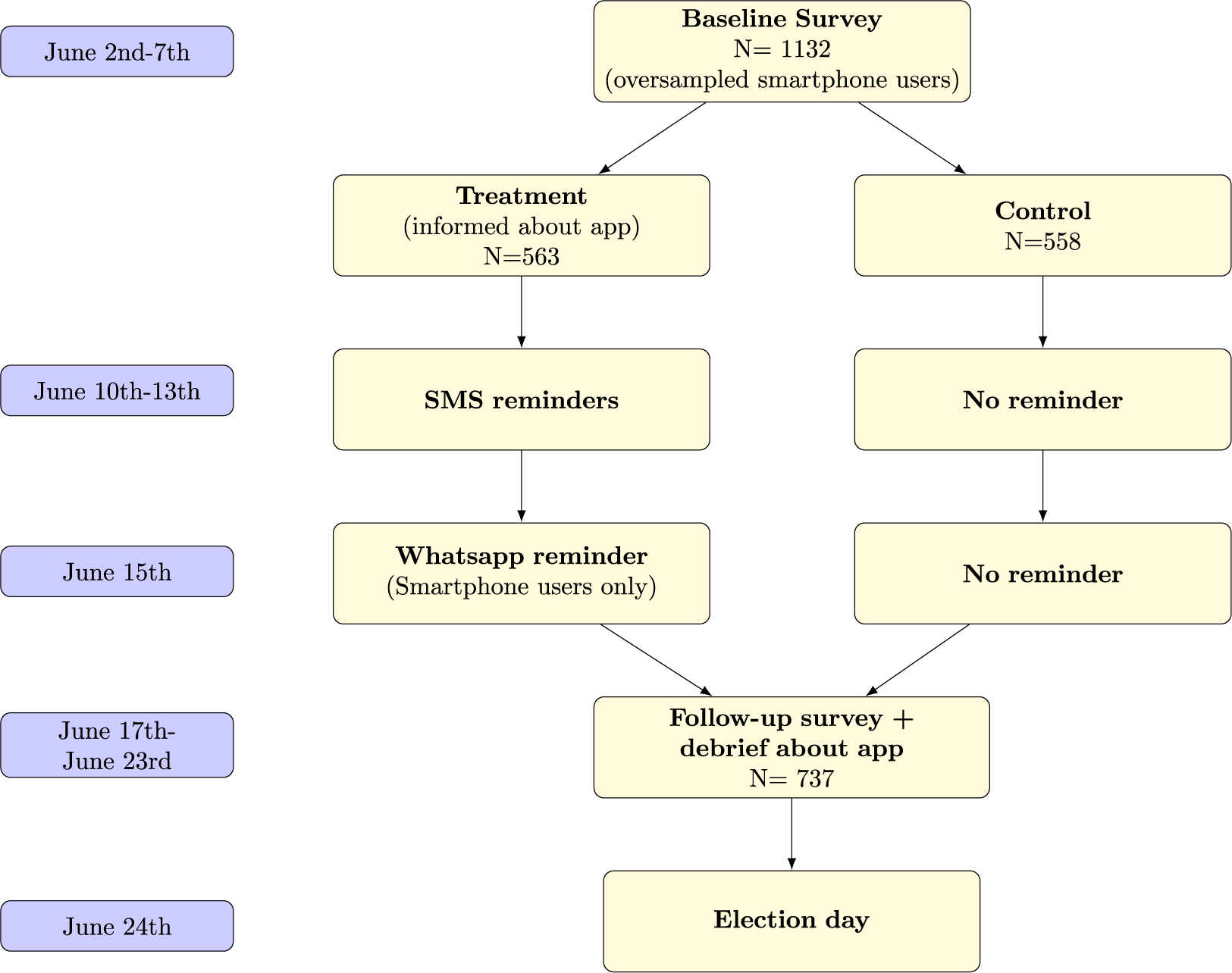
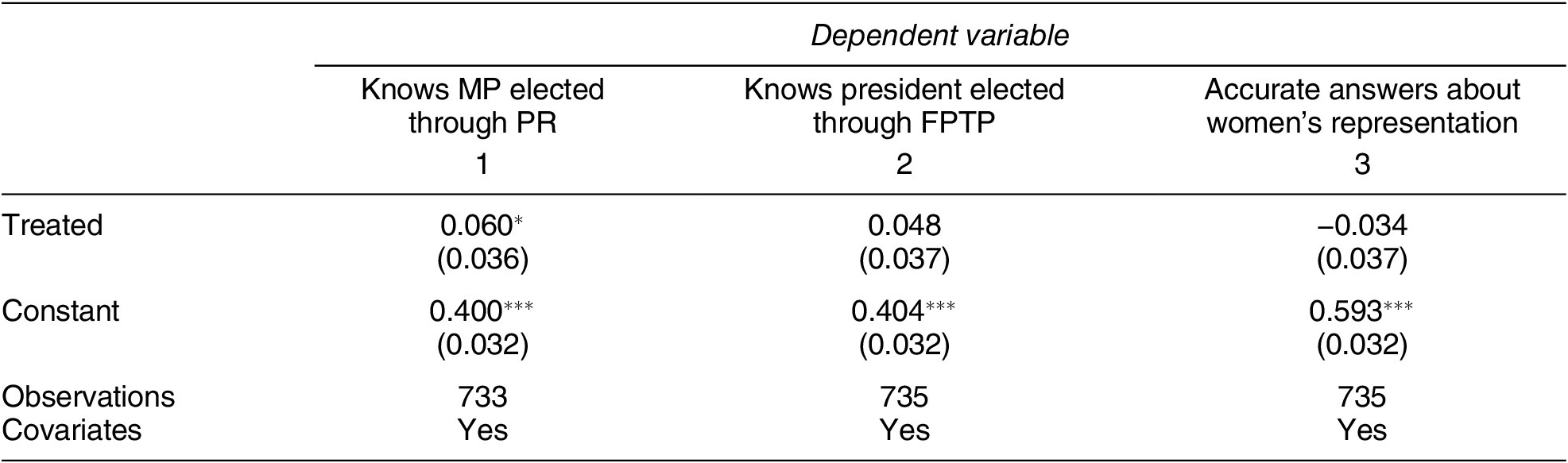
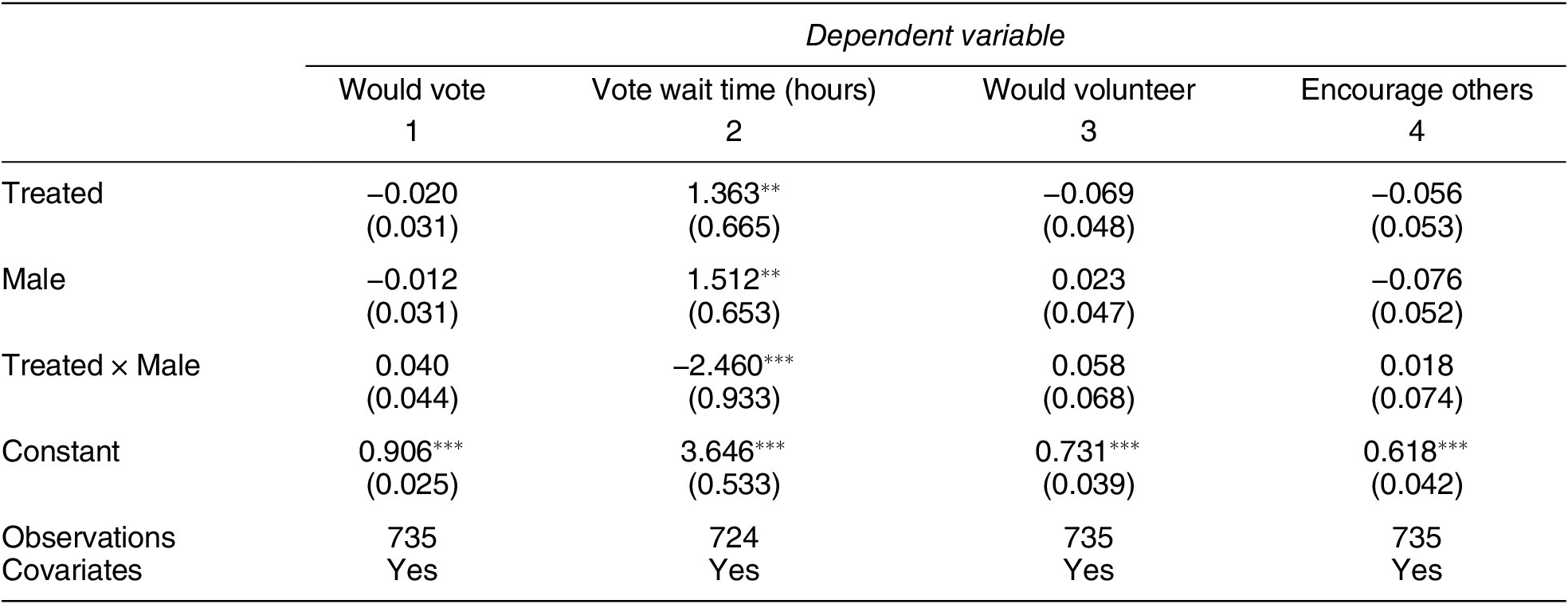
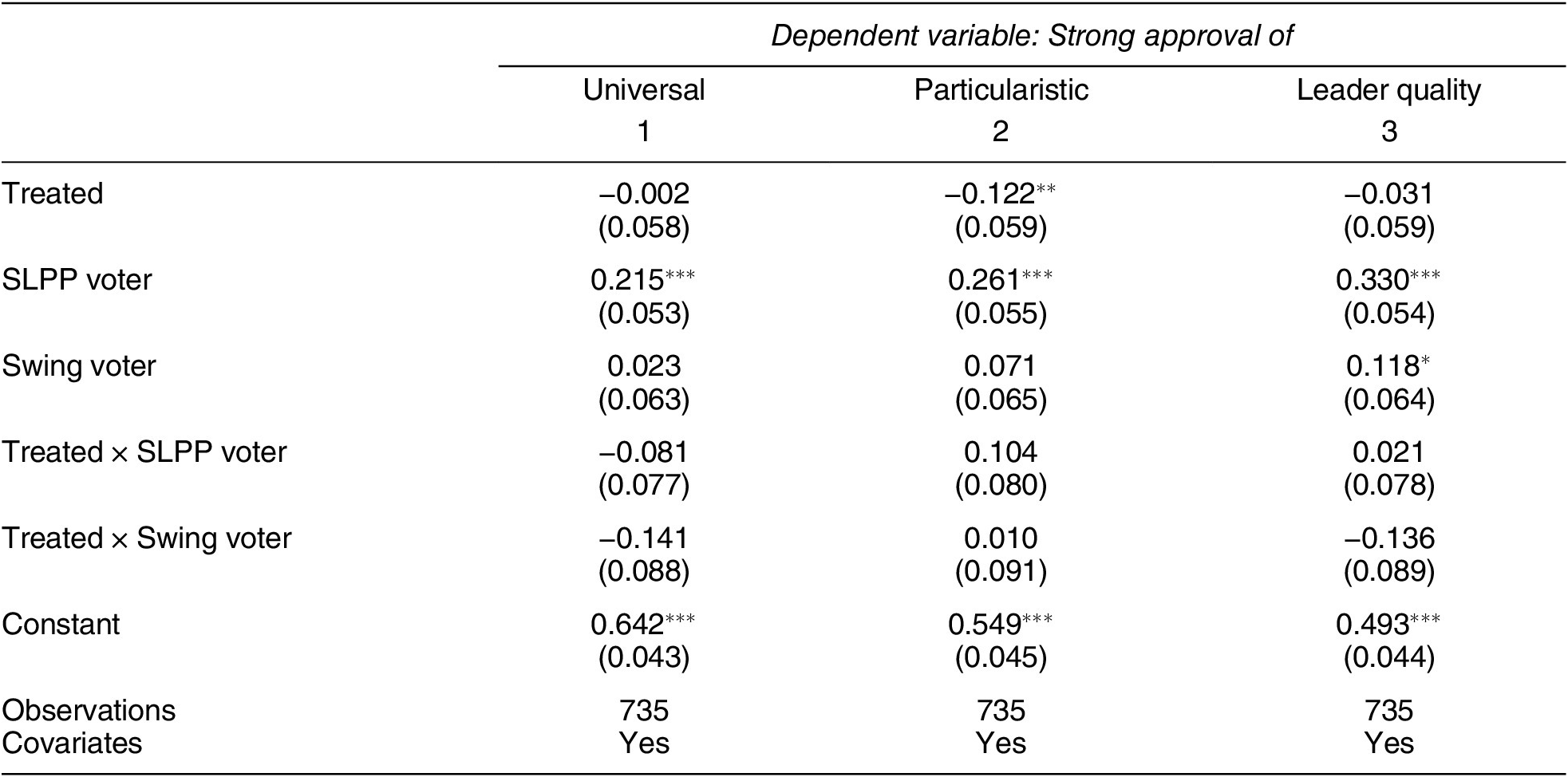
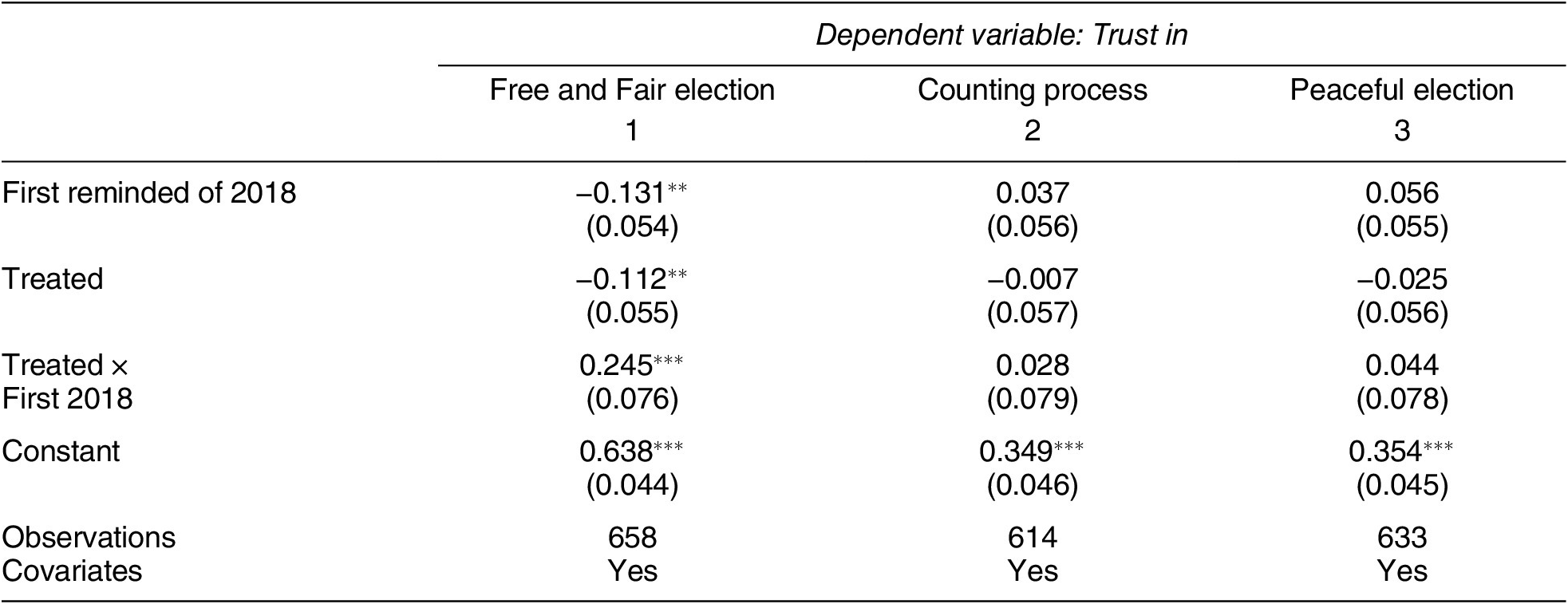


 Open access


Comments
No Comments have been published for this article.