


Introduction
Parisian archives still hold many epigraphic surprises from North Africa. They are the result of scientific missions undertaken by members of the French colonial administration during almost a century and a half of subjugation (beginning with the French conquest of Algeria in 1830 and the end with the independence of Tunisia and Algeria in 1962/3). The colonial institutions were particularly interested in studying the Roman documentation of the sites, paying particular attention to epigraphic monuments. The documentation process began early on with the paradigmatic case of Capitaine Delamare (expeditions made between 1840–1845) (Delamare Reference Delamare1850, see also Dondin-Payre Reference Dondin-Payre1994), who made numerous drawings and sketches of North African ruins (mainly in Algeria), including inscriptions. Subsequently, a profusion of new colonial sociétés savantes historiques et géographiques in North African towns led to the creation of archaeological, historical, and geographical societies that began to publish systematic biannual or annual bulletins (Laporte Reference Laporte2012, 40 provides the dates of the beginning of this process in 1881 for Algeria and 1912 for Tunisia). Metropolitan France also created a specific section for North Africa in the Comité des Travaux Historiques et Scientifiques (CTHS), which systematically published all the latest news. Information flowed in the form of reports, drawings, squeezes and, in rare cases, photographs. However, the well-known Poinssot family, present in Tunisia since the 19th century, held positions of responsibility in the French colonial organisation. Active in the documentation and protection of archaeological heritage, they would go on to generate private documentation that was eventually acquired by the French Institut National d'Histoire de l'Art and the ANHIMA centre, then the Centre Gustave Glotz, in 2006 (Dondin-Payre et al. Reference Dondin-Payre, Jaïdi, Saint-Amans, Sebaï and Dondin-Payre2016). Julien Poinssot (1844–1900), Louis Poinssot (1879–1967) and Claude Poinssot (1928–2002) gathered a huge amount of documentation (Dondin-Payre Reference Dondin-Payre2016) that represents an archival wealth that has been only partially explored (Benzina Ben Abdallah et al. Reference Benzina Ben Abdallah, Blonce and Rocca2014; Dondin-Payre Reference Dondin-Payre2020) and is generally called as Fonds Poinssot (Archives 106, documentation between 1875–2002). An exhaustive cataloguing by the ANHIMA team has provided new information on the excavations carried out in Algeria and Tunisia.
A new examination of the documentation relating to the North African town of Mustis has also revealed new epigraphic material. Most of the photographs used for this research were taken between 1959 and 1961 except some rare photographs taken in the 1930s. This article presents five new inscriptions and provides details of others that have already been published. We worked with printed photographs, negatives and slides, although the written information does not reveal much about their measurements, their specific context beyond the name of the town, or the specifications of the support. Some of the inscriptions are still preserved at the site itself, while the locations of the others are unknown. Excavation reports for the site have been sought unsuccessfully during the various 2020–21 study campaigns at the INHA, the Académie des Inscriptions et Belles-Lettres, and the Archives nationales. The data provided here are taken from ‘Dossier 106, 110, 02. 7. Musti’ and ‘Dossier 106, 111, 02. 4’ (the cataloguing process of the Fonds Poinssot were made between 2006 and 2014).
The Roman town of Mustis is near present-day Mest Henshir (Tunisia). This important town in the Roman province of Africa Proconsularis has a corpus of about 200 inscriptions, in addition to some 90 that remain unpublished and those that can be documented through archival information. Major excavations were carried out in the mid-20th century, with the Beschaouch (Reference Beschaouch1968) corpus being the last major update for the town. After the end of French imperial period, the site remained abandoned until a couple of years ago, when the team from the Uniwersytet Gdański (Poland) quietly resumed interest in it (Kłodziński and Abid Reference Kłodziński and Abid2021).
It should be noted that Beschaouch (Reference Beschaouch1968) was assisted by Louis Poinssot in the publication of his corpus, even using many of his photographs (also in the Paris archive). However, he must not have had access to all the documentation from the excavations of the 1950s and early 1960s, as the inscriptions presented here were already catalogued at the time.
Votive inscription to Minerva
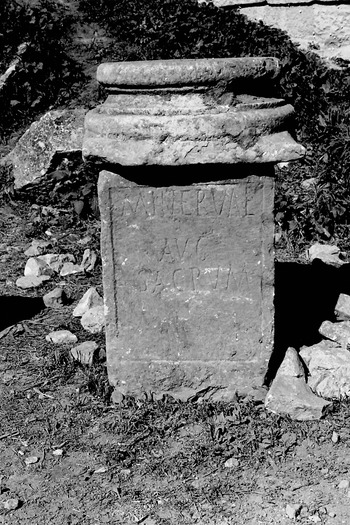
This votive inscription dedicated to Minerva is found with a group of inscriptions documented by Louis Poinssot on the 1961 trip (Figure 1).
Minervae
Aug(ustae)
3. sacrum.
Inscription dedicated to Minerva (Fond Poinssot, INHA).

Translation: Consecrated to Minerva Augusta
Quadrangular pedestal with a prepared, although undecorated epigraphic field. Symmetrical ordinatio, although its palaeography is not as meticulous as in other epigraphs. It leads us to propose a late-Antonine or Severan chronology between the end of the 2nd or beginning of the 3rd centuries.
This is the first dedication to Minerva found in the town of Mustis, although she was a popularly venerated deity in surrounding towns and in the province. Marmouri's study (Reference Marmouri2008) reveals that the cult of this goddess was found mainly in two very specific areas: the Carthago-Theveste road and the central area of the province around Thysdrus. This new inscription is located in the former (Carthago-Theveste road). Specifically, it is in the neighbouring fundus Turris Rutunda Footnote 1 (Saumagne Reference Saumagne1927; Beschaouch Reference Beschaouch1981, 107), part of the patrimonium Caesaris (González Bordas, Reference González Bordas, Dalla Rosa and Maiuroforthcoming), that a slab with the same text was found, albeit with slight differences.Footnote 2 Although neither a drawing nor an image has been preserved, a height of about 70 centimetres is given, which would make it similar to the Mustis inscription. A temple dedicated to this goddess was also documented in the neighbouring town of Thugga, as well as several epigraphic attestationsFootnote 3 along the same road, but to the south, at the site of Hr. Zarounine. There is also epigraphic evidence of the worship of the goddess at sites such as Vazari,Footnote 4 Tichilla or ObbaFootnote 5. It has been suggested that there is a certain relationship between Minerva and Venus (Astarte), which in the end would be a different double interpretation of the same Libyco-Punic divinity (Cadotte Reference Cadotte2006, 223).
Votive inscription to Neptunus
This inscription (Figure 2), like the previous one, is the first known dedication to Neptune to be found at Mustis. Its text is similar to the previous one:
Inscription dedicated to Neptune (Fond Poinssot, INHA).
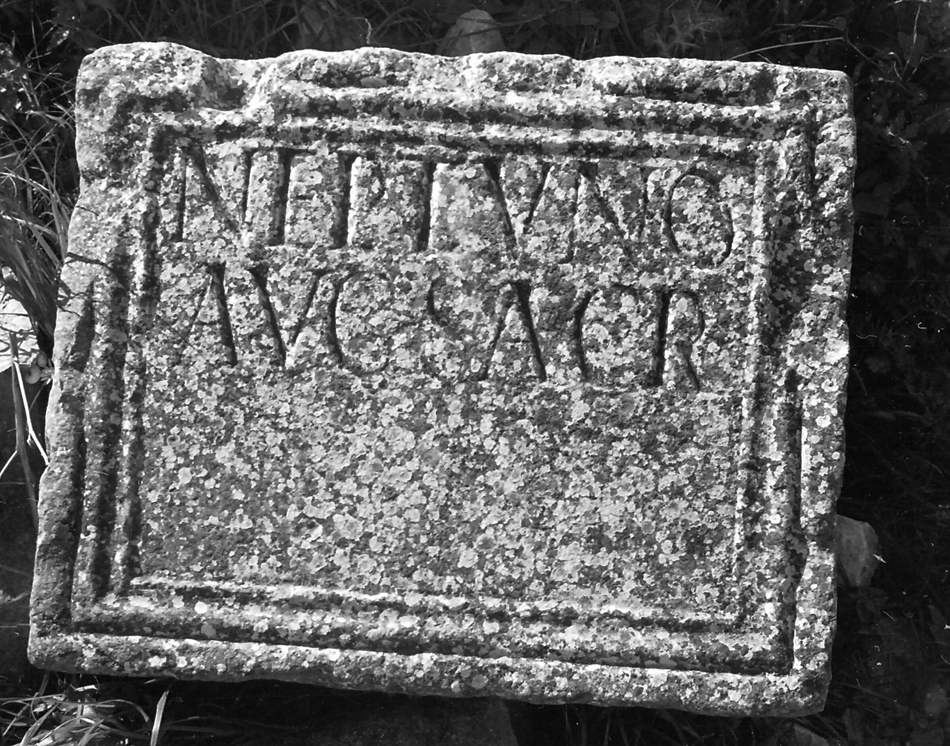
Neptuno
2. Aug(usto) sacr(um).
Translation: Consecrated to Neptunus Augustus
With elegant letters and neat ordinatio, its palaeography is similar to that of other inscriptions found in the town. This suggests a Hadrianic chronology from the second half of the 2nd century. It has a triple moulding that frames the epigraphic field, although the text only occupies the upper half, suggesting that at least a third line of text was originally planned but never inscribed. Unfortunately, these short texts do not provide information about the dedicant, as is the case of more elaborate texts also found in Mustis (regarding the role of dedicators and divinities with the epithet Augustus/a, see Panciera Reference Panciera, Erdkamp, Hekster, de Kleijn, Mols and de Blois2003 for Rome and Arnaldi Reference Arnaldi2006 for Mauretania Tingitana).
The epithet Augustus/a borne by both the Minerva and Neptune inscriptions has always been somewhat controversial and has been interpreted from various perspectives (Étienne Reference Étienne1958, 339–340; Fishwick Reference Fishwick1991, 446–454; Liertz Reference Liertz1998, 163–188; Clauss Reference Clauss1999, 280–289; Panciera Reference Panciera, Erdkamp, Hekster, de Kleijn, Mols and de Blois2003; Arnaldi Reference Arnaldi2006; Villaret, Reference Villaret2016; Cases Mora Reference Cases Mora, Martínez García, Jiménez Vialás and Martínez Sánchez2020). The epigraphic record from Africa, and above all its placement in specific contexts, makes it possible to link the cult of these divinities with the imperial cult in numerous cases (Mastino Reference Mastino2018); this however is something that has not always been accepted by all researchers and is not easy to clarify. Again, in the neighbouring colony of Thugga, at least two of the four inscriptions (Mabrouk Reference Mabrouk2015, 478–482; Maurin Reference Maurin, Aounallah and Golvin2016, 517) dedicated to Neptune were associated with the emperor (Mastino Reference Mastino2018, 10).
In Africa, Neptune inscriptions followed by the epithet Augustus are quite common. Cadotte's compilation (Reference Cadotte2002; Reference Cadotte2006, 308–14) has revealed that at least 29 of the 51 inscriptions bear such an epithet. Its use or not must have involved nuances in the dedication and was neither casual nor trivial (Lott Reference Lott2014–2015, 131), at least originally, although from the 2nd century onwards its systematic use was interpreted in the West as a mechanical process (Fishwick Reference Fishwick1991). However, in North Africa and specifically in the Mustis area the syncretisation process makes the analysis of this factor much more complex. The beginning of an epigraphic habitus later than in coastal areas would only be evidence that the use of the epithet was introduced as a part of a process of formally imposing religious epigraphic uses that had already functioned in previously Latinised African regions (mainly on the coast). In the nearby town of Thugga the epithet Augustus is often linked to the emperor. That is why we should consider that the epithet Augustus and the imperial cult had a similar relationship in Mustis. Perhaps these inscriptions were once placed in an imperial cult precinct in the town itself. Whether or not the linking of these epithets is accepted, both inscriptions offer us a broader picture of the religious panorama of Mustis. This epigraphic evidence can be added to that already known, such as Mercurius Augustus,Footnote 6 Apollo Augustus,Footnote 7 (Pluto) Frugiferus Augustus,Footnote 8 dii Mauri Castores Augustis,Footnote 9 Nutrix,Footnote 10 Tellus Augusta,Footnote 11 Caelestis Augusta (together with Aesculapius),Footnote 12 Liber Pater (together with Venus),Footnote 13 Virtus AugustaFootnote 14 and Ceres Augusta.Footnote 15 The complex syncretic panorama of a town of Libyco-Punic origin such as Mustis is a factor to be taken into account. The whole pantheon of Mustis has a pre-Roman origin but it was adapted through the Roman interpretation. This syncretisation, together with the Latinisation process, could have boosted the predominance of the use of the Augustan epithet and its link to the imperial cult. In this way, the epigraphic construction of the Latinised divinities also underwent a process of epigraphic standardisation while it was linked it to the imperial household. As in other regions (Cases Mora Reference Cases Mora2021), the use of the epithet on local divinities would have meant their officialisation and inclusion in the local pantheon. In the African case, the syncretisation of local gods to Roman standards would emphasise even more the officialisation of local cults, which, as Cadotte (Reference Cadotte2006) has already pointed out, still maintained pre-Roman rites or particular local ascriptions, as seems to be evidenced by the Frugiferus Augustus with Pluto rather than with the African Saturn.
Votive inscription to Jupiter from Septimius Severus
This inscription (Figure 3) has not been formally published, although it does appear in the Clauss Slaby database under the number EDCS-59800107 (©Manfred Clauss). The record in the Poinssot collection indicates that it was found during the excavations of the Capitol in 1961 and bears the following text:
[—]o Maximo
[—S]everi ❦ Pii ❦Pertinaci[s—]
3. [—Antoni]ni ❦ Pii Felicis ❦ Augu[sti—]
Dedication to Jupiter Optimus Maximus (Fond Poinssot, INHA).

EDCS reintegration can be corrected and extended as follows:
[Iovi Optim]o Maximo [Iunoni Reg(inae), Minervae Aug(ustae) sacrum]
[pro salute Imp(eratoris) Caes(aris) L(uci) Septimi S]everi ❦ Pii ❦Pertinaci[s Aug(usti) Arabici Adiab(enici) Parth(ici) max(imi) et]
3. [Imp(eratoris) Caes(aris) M(arci) Aureli Antoni]ni ❦ Pii Felicis ❦ Augu[sti et P(ubli) Septimi Getae nob(ilissimi) Caes(aris) et Iuliae Aug(ustae) matris Aug(usti) et castrorum totiusque domus divinae].
Translation: Consecrated to Jupiter Optimus Maximus, Juno Regina, Minerva Augusta, for the health of the emperor Caesar Lucius Septimius Severus Pius Pertinax Augustus Arabicus Adiabenicus Parthicus maximus and emperor Caesaris Marcus Aurelius Antoninus Pius Felix Augustus and Publius Septimius Geta, very renowned Caesar, and Iulia Augusta, mother of the Augusti and the military camps and to all the divine imperial household.
This monumental inscription reflects a typically painstaking Severian palaeography and a planned, regular ordinatio decreasing in size from the upper to the lower lines. The only interpuncts on l. 2 are in the form of hedera, but they are in every single space, so we can speculate that they were used throughout the text. The inscribed area is bordered at the bottom by three horizontal bands. This local sandstone inscription is definitely a product of a local workshop that produced pieces of excellent quality. Its text is very similar to Severan inscriptions dedicated to Jupiter. It is therefore necessary to add Iulia Domna and Geta (later erased), which is present in all inscriptions of this type, as well as a closing expression that could well have been [totiusque domus divinae], also very common on similar epigraphic monuments. We could also consider a final formula quoting the res publica Mustitanorum as a form of closure, since it is present in similar inscriptions, although that is somewhat more hypothetical.
A parallelepiped block of greyish limestone contains only the central part of the text (proposed restitution in Figure 4); the right and left parts are missing. It appears to have been carved like this in a process of reuse. This inscription probably met the same fate as others published by Beschaouch (Reference Beschaouch1968) that he was able to document as having been reused in the Byzantine fortress.
Proposed restitution of the inscription (S. España-Chamorro).

Once again, we have the first epigraphic evidence of the worship of hitherto unidentified gods in the town. This inscription, which clearly alludes to Jupiter, could easily be a votive inscription to the Capitoline Triad. In l. 2 one could propose the integration of [Iunoni Reg(inae), Minervae Aug(ustae) sacrum] before the good health wishes for the emperor. Almost all the Severian dedications to Jupiter found in Africa Proconsularis express this.Footnote 16 Could this be proof that Mustis had a capitol? The latest global review of the controversial issue of capitolia in the Roman world (Quinn and Wilson Reference Quinn and Wilson2013) concluded that there was conclusive archaeological or epigraphic evidence for 27 capitolia Footnote 17 and possibly another eight.Footnote 18 If the inscription restitution that includes Juno and Minerva together with Jupiter is accepted, then Mustis would be the twenty-eighth confirmed capitolium in the African provinces. It would also allow the reinterpretation and completion of an inscription from Uchi Maius (CIL VIII, 25484) that appears to have almost an identical text. As I have already pointed out, the back of the photograph has a manuscript note that states fouilles 1961, inscription du capitole and Claude Poinssot had already advanced this hypothesis, even though it was never published (only this single reference to the note on the back of the photograph).
Quadruple funerary inscription
The last caption is a fragmentary text that presents the epitaphs of four individuals. The back of the photograph contains indications of its location (insc. du mausolée voisin de l'arc), which tells us that it came from (or was at least documented in) the mausoleum next to the triumphal arch of Mustis. It was documented in the 1961 campaign (Figure 5a and Figure 5b). The first epitaph is lost, leaving only the remains of letters.
[——]
[——]
[—-v(ixit) an(nos)–]III
4. [—]s.
[I]ulia Q(uinta) f(ili)a
Quieta
flamin(ica)
4. p(ia) v(ixit) a(nnos) ▴ LXXXXI.
Q(uintus) Iulius Am=
pliatus ve=
teranus v(ixit)
4. ann(os) LXXXV.
Q(uintus) Iulius Q(uinti) f(ilius)
Respectus
v(ixit) an(nos) XVIIII Ae[—]
4. Castricius
(a) and (b) Funerary inscription (Fond Poinssot, INHA).

The inscription probably had an upper part (now lost) on which was written the formula D(is) M(anibus) s(acrum). It is a typical formula not only throughout the Empire but also in this region.
Translation: [For the Manes of — lived —]III [years—]s; [For the Manes of] Iulia Quieta, daughter of Quintus, who was a flaminica and lived 91 years; [For the Manes of] Quintus Iulius Ampliatus veteran, who lived 85 years; [For the Manes of] Quintus Iulius Respectus, son of Quintus, who lived 19 years, Ae[—] Castricius
This is a very well carved inscription with a meticulous ordinatio and palaeography that suggests an Antonine chronology. The high quality of some of the town's inscriptions that suggest there was an officina lapidaria from the middle of the 2nd century producing inscriptions, both public and private, to a high standard, as can be seen in this tombstone.
The epitaph of Iulia Quieta contains a curious anomaly. Behind her affiliation there is an A which, both by ordinatio and the logic of the onomastics of the following epitaph, undoubtedly belongs to the female. We have to bear in mind that, at least of the three names we know, she is the only woman in the inscription and her status as a flaminica is clearly visible, demonstrating the importance of her position. This is a device not commonly used in epigraphy, but it leads us to think that perhaps this A would have emphasised the female affiliation (filia).
Quieta is a very frequent cognomen in the province of Africa Proconsularis, where it is almost in the majority in the total evidence (102 of the 307 inscriptions, see Kajanto Reference Kajanto1982, 18 and 262). Kajanto himself (Reference Kajanto1982, 69) indicates that this cognomen was quite common in persons of slave or freedman origin.
Quintus Iulius Ampliatus Veteranus does not present great onomastic particularities, although he is the only person in the inscription who does not present filiation. The cognomen Ampliatus is widely known, predominating in female names and slaves/freedmen (Kajanto Reference Kajanto1982, 349). What is interesting is the agnomen Veteranus, a distinctive onomastic element that would have referred to the military origin of the branch of Ampliatus’ family that settled in Africa (probably not in Mustis, which was not a veterans’ colony, but in a nearby one).
Quintus Iulis Respectus is a cognomen widely used in the Trajanic or Hadrianic period (Kajanto Reference Kajanto1982, 355). After the epitaph of Iulius Respectus we find another partial name: Ae[—] Castricius. It is not common to find a name here of another deceased person after the indication of the years, and we can hypothesise that Castricius was a member of the family who died unexpectedly and that his name was entered in this small space. So, we can say that the total number of individuals was perhaps five and not four.
A boundary stone from Mustis from the reign of Antoninus Pius
This inscription is not included in the information provided by the Parisian archives, but is given through the photograph of EDCS-55701564 (©Manfred Clauss, see Figure 6), where it has been included without epigraphic editing or comment. This is the third text of a known series, as it is the same text that appears on two other termini. Carton (Reference Carton1895, 61–63) published the first text that Wilmanns included as CIL VIII, 27459 (= after Dessau in ILS 5943a). The second (Figure 7) was published by Saumagne in the BCTHS in 1927 (p. IX = AE 1929, 71). All three have their own characteristics with minor differences in the ordinatio that confirm this new inscription is not one of the earlier ones:Footnote 19
Ex auctorita[te]
et sententia
Imp(eratoris) ■ Caes(aris) ■ T(iti) ■ Aeli
Antonini ■ Aug(usti)
5. Pii ■ determina=
tio facta publica
Mustitanoru^m.
New terminus from Mustis (EDCS©).

First published terminus from Mustis (Saumagne Reference Saumagne1927).

Translation: By the authority and according to the decision of the emperor Caesar Titus Aelius Antoninus Augustus Pius, the surveyed demarcation of the limits of (the community of) Mustis was made public
This inscription reveals the confirmation of the public limits of the res publica Mustitanorum. Beschaouch had already indicated that Mustis was located in a particular geographical position. The epigraphic repertoire shows it was between the pertica of Carthago (AE 1981, 866), to the north and east, and the ager of Sicca Veneria (AE 1981, 867), to the south and east.Footnote 20 Beschaouch also indicates that, during the first two centuries of Roman rule in Africa Proconsularis, its territory was divided between the three great colonies founded by Julius Caesar (the two aforementioned and Cirta). This created administrative anomalies and peregrine communities such as Mustis, which achieved municipal status during this period, must have remained as exclaves within the large tracts of land.
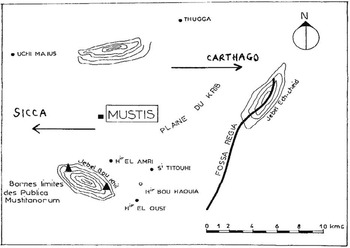
This new piece confirms the text of the previous termini (slightly correcting the reintegration by Saumagne, who had omitted part of Antoninus Pius’ titles). Unfortunately, the decontextualisation of this piece makes it impossible to know exactly where it was located in the territorium of Mustis. However, the other two boundary stones were found in the hills of Jeberi Bou Khil (Figure 8), which suggests that the delimitation was centred on the southern part of its territorium.
Limits of Mustis (by Beschaouch Reference Beschaouch1981, 114, fig. 6).

One aspect of this series of boundary stones that has not been dealt with is the expression determinatio facta publica. This determination of the limits made public is a part of the legal process rarely indicated in liminal epigraphy and requires a specific legal investigation. This determinatio facta was carried out on a specific date and consisted of the process prior the terminatio (draft plan), including figures such as the distance between termini. Until recently it was thought that it had been undertaken by the mensor, but new epigraphic evidence in Italy (Dalmiglio et al. Reference Dalmiglio, Ghini, Granino, Palladino, Fischetti and Attema2019) has revealed the existence of the figure of the determinante together with the mensor. What is interesting is that these positions, determinante and mensor, are indicated as two different roles. In the Italian dispute, the person who applied the emperor's verdict was a primus pilus, an important military figure in the community. In Mustis only one primus pilus has been documented (Kłodziński and Abid Reference Kłodziński and Abid2021), and only in the 3rd century.
There is sparse evidence for the intervention of Antoninus Pius in the re-examination of the African public boundaries (vid. Romanelli Reference Romanelli1959, 361). There is only this verdict, in addition to the confirmation of the limits of a ratio privata (imperial property)Footnote 21 in Medjana, Bordj Bou Arreridj, Algeria. In the case of Mustis it is difficult to know the reason for the redefinition of the municipal boundaries. The municipium Iulium Aurelium Mustitanum was promoted by Caesar and its inhabitants were included the tribus Cornelia (Beschaouch Reference Beschaouch1967, Reference Beschaouch1968, Reference Beschaouch1981, Reference Beschaouch2014), although the cognomen Aurelius indicates a refoundation in the time of Marcus Aurelius. This could be related to a need to revise the municipal boundaries due to a conflict. This problem is indicated by the expression “ex sententia” (by the verdict), as well as the fact that the emperor was exercising “auctoritas” to finalise the resolution of this boundary problem. For arbitration trials between towns, the resolution (sententia) had to do with the substance and the effects, while the decretum indicated who performed the arbitration and how it was carried out, with prior knowledge of all the circumstances from both parties (Cortés Bárcena 2013, 275; España-Chamorro Reference España-Chamorro2021, 388).
The erection of the boundary stones of the colony of Sicca Veneria may suggest similar problems (although these inscriptions appear to be slightly earlier, with the palaeography suggesting a Hadrianic chronology). In contrast, the inscription indicating the pertica of Carthago appears to correspond to internal partitioning and is probably not related to the dispute (Beschaouch Reference Beschaouch1981, Reference Beschaouch2014). Therefore, we must consider a possible conflict involving the eastern limit of Sicca Veneria and the south/south-western limit of the territory of Mustis. Another important fact is that the sentence comes from the emperor himself, meaning that the conflict and the trial involved a Roman colony (España-Chamorro Reference España-Chamorro2021, 389 note 53). Therefore, everything points to a redefinition of the boundaries of Mustis in the time of Marcus Aurelius that led to a problem with Sicca Veneria
Other known inscriptions
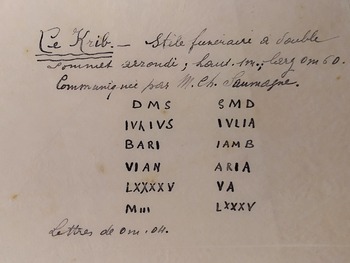
The other inscriptions presented here are already known texts, but for which we had no information other than the text itself and, only in some cases, information about their epigraphic medium. The Poinssot photographic collection allows us to see for the first time an image of these texts and to compare the original information that was published at the beginning of the 20th century, such as the twin inscriptions of Iulius Bari and Iulia Iambaria (Cagnat Reference Cagnat1923, CXXVIII = ILT 1536, see Figure 9). This shows that the Poinssot collection includes some of the original papers that were sent from Tunisia and Algeria to the Comité des Travaux Historiques et Scientifiques, although they were never kept in their archives and remained the property of the Poinssot family. In particular, it is necessary to comment on a hapax from ILT 1536. As it is a duplicate inscription, the formula of the heading has been imitated as a mirror image D(is) M(anibus) s(acrum) / S(acrum) M(anibus) D(is). This inversion is unique in a twin inscription and is only found in three other African inscriptions and one from Baetica.Footnote 22
Original document for publishing the information in the BCTHS (Cagnat Reference Cagnat1923, p. CXXVIII).

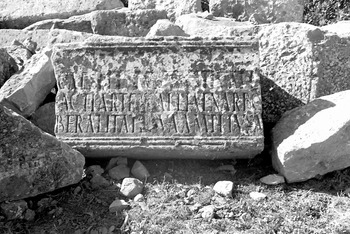
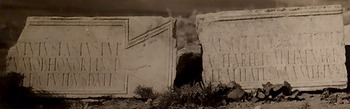
The inscription CIL VIII, 1578 was described by Wilmanns in two fragments. Figure 10 shown here corresponds to a fragment of the beginning of the titles of the emperor, who was subsequently subjected to the abolitio memoriae. Wilmanns proposed that the titles of Alexander Severus could be seen on such a piece. It appears to have been made in the same officina as Inscription 3 referring to Jupiter Optimus Maximus. Figure 11 is an even older photo from Louis Poinssot's collection of notes and photographs sent to the CTHS. It shows that this piece was made as a tabula ansata and that Fragment b had already lost the first letters on its left side compared to the Berbrugger's notes received by Wilmanns for publication in the CIL.
Photograph of CIL VIII, 1578a by Claude Poinssot (Fond Poinssot, INHA).

Photograph of CIL VIII, 1578a and b by Louis Poinssot (Fond Poinssot, INHA).

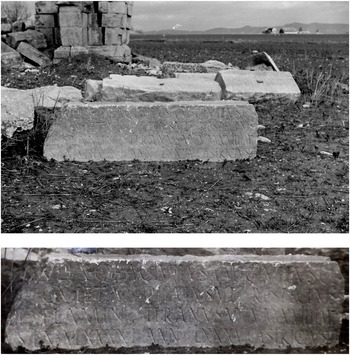
The set of four blocks from ILT 1538 (AE 1933, 33) contains a double inscription: a first text with the title of Marcus Aurelius, which, from the title of Armeniacus, allows it to be dated to between 164–5 (Figure 12). The second text was made under the reign of Valentinian and Valens from 364. The photograph shows that the medium used must have been part of a building structure. The ordinatio of the first inscription had a text with wide margins on the side and at the top and bottom, which allowed the second text to be added after the first inscription. The palaeography is obviously different: the Marcus Aurelius text is neat and regular, while that from the 4th century shows signs of little prior preparation, given the different sizes of the letters and a certain irregularity in the outline. Modern EDCS photographs (©Manfred Clauss) show that some of the text has since deteriorated, although it is still largely preserved, and Fragments b and c remain in situ. Of the blocks indicated in ILT 1538, photos of a, b, c and e are provided.
Photographs of ILT 1538 (Fragments a, b, c, e) (Fond Poinssot, INHA).

A further archive photograph (Figure 13) presents an inscription of which we only previously knew the text CIL VIII, 15627). The monument is apparently of marble in the form of an altar with an inscribed area bordered by decorative frames. The ordinatio reveals an error by the lapicida. In l. 2 the artisan appears to have omitted the initial P and then added it, as it is the only letter that does not respect the margin; the last line is also smaller than the rest.
Photograph of CIL VIII, 15627 (Fond Poinssot, INHA).

The photographic collection also includes recently published inscriptions such as the epitaph of the primus pilus (Kłodziński and Abid Reference Kłodziński and Abid2021) or the group of milestones published in 2016 by Chaouali (Reference Chaouali and Mrabet2016 = AE 2016, 1914–1916). Claude Poinssot indicates that they were found during the 1961 excavation.Footnote 23
Acknowledgements
I wish to thank the kindness of the staff of the Institut National d'Histoire de l'Art in Paris. They provided me access to their collections despite the difficulties of COVID-19 during 2020. This research is based on my postdoctoral project (RomAFRICA II - Programa de Atracción de Talento (2020-T2/HUM-19810 Comunidad de Madrid) at the Universidad Complutense de Madrid. I have received funding support from my IdEx project RomAFRICA I (Initiatives d'excellence) at the Institut Ausonius (Bordeaux), and the Spanish National Research Projects ‘Identidades norteafricanas en transformación: etnias líbico-bereberes y romanitas a través del imaginario funerario’ (MINECO Ref. PID2019-107176GB-100) and ‘Carmina Latina Epigraphica como expresión de la identidad del mundo romano. Estudios interdisciplinarios’ (MINECO Ref. PGC2018-095981- B-I00). This research is also included in the Grupo de investigación ‘Arqueología Africana’ (UCM-971713). I thank the anonymous reviewers for their helpful and stimulating comments. This article has also received numerous helpful comments from Gian Luca Gregori.
Abbreviations
- AE
L'Année épigraphique : revue des publications épigraphiques relatives à l'antiquité romaine, Paris 1888-
- BCTHS
Bulletin archéologique du Comité des Travaux Historiques et Scientifiques, Paris 1883-
- CIL
Corpus Inscriptionum Latinarum. CIL VIII: Inscriptiones Africae Latinae. Collegit G. Wilmanns. Ed. Th. Mommsen. 1881 (impr. Iter. 1960).
- EDCS
Epigraphik-Datenbank Clauss / Slaby https://db.edcs.eu/
- ILAlg
Inscriptions Latines de l'Algerie. Paris 1922–2003.
- ILS
Inscriptiones Latinae Selectae. Berlin 1892–1916.
- ILT
Inscriptions Latines de la Tunisie. Paris 1944.






 Open access

