





Half a century ago, genetic engineering left the domain of science fiction and entered the history of scientific practice with Boyer and Cohen’s 1972 invention of recombinant-DNA (rDNA) technology. Since then, advancements in the field have revolutionized our understanding of biology and enabled unprecedented biotechnological possibilities. This article looks back at the past decade of human genetic engineering through the lens of CRISPR. CRISPR stands for Clustered Regularly Interspaced Short Palindromic Repeats, which are sequences of DNA that bacteria use as a defence system against viruses. CRISPR allows scientists to precisely target and modify specific regions of the genome in living cells, using an enzyme called Cas9 and a guide RNA that matches the desired sequence. We argue that the representations and images surrounding CRISPR exemplify, and to an extent define, the visual cultures of human genetic engineering over the past decade. We further argue that intermedial figuration across science communication plays a stabilizing, amplifying and affective role in the contemporary history of the public perception of human genetic engineering technologies.
We begin by situating the history of CRISPR within the wider context of genetic engineering. We narrow the scope of the article to human applications for CRISPR, which emerged between the years 2012 and 2022. We break down this time frame into four phases: the CRISPR craze, the gene therapy initiatives, the He Jiankui controversy and the clinical trials. Next, we move through this special issue’s topic: intermediality. We extend our interpretation of the term, discuss its role in science communication and consider how it functions between genres (e.g. reporting in specialist science news and the mainstream press) and between media (e.g. traditional media and social media). We further theorize visual culture through the lens of feminist science studies, which informs our understanding of figuration. We introduce our mixed-methods approach, which draws on visual and social-media analysis. We then introduce our three figures – the double helix, the scientist and the human subject – and present an empirical analysis of their functions across all four phases and within social media. We conclude with a discussion about the role of intermedial figuration within science communication.
A history of CRISPR within the context of genetic engineering
The modern era of genetic engineering began in 1973, when American biochemists Stanley N. Cohen and Herbert W. Boyer created the first rDNA molecule by cutting and rejoining fragments of different genes and inserting them into E. coli bacteria. In 1995, Paul Berg organized the Asilomar Conference, which established guidelines around the use of rDNA, replacing a proposed ‘moratorium’ on the science, while establishing it in the public domain.Footnote 1 Cohen, Boyer, Berg and others’ work on rDNA paved the way for the manipulation of genes, marking a pivotal moment in biotechnology. Subsequent breakthroughs, such as the development of the polymerase chain reaction (PCR) by Kary Mullis in 1983, revolutionized DNA amplification, enabling scientists to exponentially replicate specific DNA sequences.Footnote 2 Concurrently, the Human Genome Project, initiated in 1990, aimed to map and sequence the entire human genome, a project that was completed between 2000 and 2004. These advancements established the landscape of genetic engineering in the late twentieth century.
Cheap and easy, relative to the field, CRISPR is a part of this history, and arguably has defined the history of human genetic engineering over the past decade. A team of Japanese scientists, led by Yoshizumi Ishino, first discovered CRISPR in 1987.Footnote 3 Its significance was not immediately apparent, and the repeated sequences were largely regarded as junk DNA until 1995, when Spanish post-doc Francisco Mojica elucidated their role as an anti-viral defence system. From 2007, CRISPR gained traction through experimentation with food, notably yoghurt. Our story gains momentum in 2012, when Jennifer Doudna and Emmanuelle Charpentier proposed that CRISPR-Cas9 systems could be used to modify the human genome.Footnote 4 From this watershed moment, the history of CRISPR’s use in human genetic engineering unfolds in four distinct, yet overlapping, phases.
• The CRISPR craze. Following Doudna and Charpentier’s breakthrough, there was an explosion of research and interest in CRISPR. Borrowing a phrase from Science in 2013, we refer to this as the ‘CRISPR craze’, spanning between 2012 and 2015.Footnote 5
• Gene therapy initiatives. The period from 2015 to 2018 saw a surge in efforts to apply CRISPR in gene therapy. While patent disputes continued until 2022, we note that this phase dominated the media during these years.
• The He Jiankui controversy. In November 2018, Chinese scientist He Jiankui announced at the Second International Summit on Human Genome Editing that he had created the world’s first genetically edited babies, using CRISPR to modify the embryos. Backlash from the scientific community and the public influenced the perception of CRISPR until approximately March 2019.
• Clinical trials. Following the He scandal, from 2019 there was a shift in the media, and public, perception of CRISPR technology. We understand the clinical-trials phase as a recuperative cycle in the media, focusing on rigorous testing and the evaluation of CRISPR-based therapies.
Using these phases as historical touchstones, we can trace the impact of CRISPR on the landscape of the public understanding of genetic engineering through the visual cultures that surround it in the media.
Intermediality in science communication
Media and communication studies, as a field, considers the media collectively. Whilst a medium might be singular, media are always collective and interconnected. To talk about the media after 1990 is to talk about the digital. Ronald Rice describes this form of intermediality as ‘convergence, whereby the underlying digital nature of information allows the same content to be accessible through different media (separately or in combinations)’.Footnote 6 The materials that we examine in this piece were born digital – they converge through online dissemination channels – thus we locate intermediality occurring not only from one medium to another, but between genres and platforms. Here we extend our understanding of intermediality through its role in the public dissemination of scientific research, and we identify and discuss the two specific intermedial relationships that we address in this piece (i.e. between specialist science reporting and the mainstream press, and between traditional and social media).
Intermediality features heavily in the dissemination of information within networks. As applicable and flexible as it is abstract, intermediality is broadly defined as ‘a generic term for phenomena at the point of intersection between different media, or crossing their borders, or for their interconnection, typically in the context of digital media’.Footnote 7 This interconnectedness logically plays out across the medium of networked environments (i.e. the Internet) as well as within a networked model of science communication.
In 1992, Bruce Lewenstein proposed a ‘web model’ of science communication.Footnote 8 This arose as an alternative to the previous decades’ ‘linear model’ of ‘work in the lab/field, followed by formal peer-reviewed publication, followed by public dissemination of reliable scientific information’ as established by William Garvey and colleagues.Footnote 9 Blanka Jergović succinctly explains the web model: ‘Here the emphasis is on communication, which is a two way process and not only one way as it is implied in the linear model’.Footnote 10 We understand this symbiotic, bilateral connection, or communication, as intermedial. Within this web, intermediality shapes the public impact of science communication by enhancing understanding through multiple media forms, increasing reach through different audiences, boosting engagement and interaction through some platform affordances, and solidifying trust and credibility through consistent and coherent presentation of information. Contemporary science communication is a web within a web, and intermediality gives us the framework to begin to untangle it.
We consider first the intermedial relationship between specialist science reporting and the mainstream press. In this instance, we understand intermediality as a relationship occurring between science communication genres of different kinds. We draw on Klaus Jensen’s work to reinforce this claim:
Here the interrelations are established not so much between media, but between genres with particular communicative functions: The news genre and the various subgenres of journalism provide formats and frameworks in which public political communication, broadly speaking, can be carried on and into a whole range of social contexts, including face-to-face interaction or media of the first degree.Footnote 11
Like Jensen, we do not see intermediality as necessarily synonymous with comparative media analysis. Instead, similarly examining the ‘news genre’, we locate it at the intersection of Jensen’s ‘formats and frameworks’, or publications, and ‘social contexts’, or perceived audiences. Throughout the CRISPR craze and early gene therapy initiatives, we observe the intermedial relationship between specialist science-reporting genres and mainstream press genres operating within Lewenstein’s ‘web model’ as they bilaterally inform one another and, in turn, co-construct the visual culture of this technology during this period.
We next consider the intermedial relationship between what can be characterized as traditional or broadcast media and social media. Social media is characterized by the rapid dissemination of information amongst a global audience, which not only amplifies public perception of emerging technologies, but also introduces a new dimension of public engagement. As Christopher Calabrese et al. observe, social media not only provides knowledge and information, but also triggers public discussions; therefore, examining how CRISPR is represented through social media enables researchers, scientists and stakeholders to better understand public perceptions of this emerging technology.Footnote 12 Here, traditional broadcast media forms act as a source of content, while social media functions as an accelerator for engagement and interaction. As with the intermedial relation between specialist science reporting and the mainstream press, the relationship between traditional media and social media operates within Lewenstein’s web model as these public perceptions, in turn, inform the mainstream press. Features of social media, such as images and hashtags, are not merely adjuncts to traditional reporting; they are integral to how scientific concepts are understood and engaged with by the public. Maintaining a focus on visual culture, we examine the role of figures in these intermedial relationships, analysing how their repeated appearances, across specialist science reporting, the mainstream press and social media, influence and stabilize understandings of CRISPR within science communications.
Visual cultures: feminist science and technology studies and figuration
The emergence and establishment of a visual culture around genomics – the gene, the double helix and the human genome – have been documented within the field of feminist science studies. Fox Keller’s identification of the twentieth century as ‘the century of the gene’ has powerful reach beyond academic debates, and features as part of a broader public culture.Footnote 13 Susan Lindee and Dorothy Nelkin’s work echoes this claim, arguing that the portrayal of the gene in popular culture borders on deceptive as it lends this icon power, and ultimately mystique, over the human experience even as it generates hype in public discussions.Footnote 14 Nelkin and Suzanne Anker extend this analysis beyond the gene and examine the figure of the double helix – a familiar structure in the public eye despite its abstract nature – across art and culture.Footnote 15 More broadly, Jose van Dijck critiques the representation of genetics as a ‘spectacle’, or a ‘theatre of representation’, as imagery is developed and distributed in public culture through the interacting interests of stakeholders.Footnote 16 This observation supports Susan Wright’s argument that human genetic engineering is not only a scientific endeavour, but also a political one that involves competing interests, values and ideologies. Collectively, these analyses extend a framework for comprehending how abstract scientific concepts, such as genomics, are translated into a visual culture that resonates with the public.
Feminist science studies also provides a valuable lens through which to examine the visual cultures of CRISPR. We draw inspiration from Sarah Franklin’s influential work on the ‘cyborg embryo’, which offers critical insights into the visual cultures of embryos in the context of practices and representations of in vitro fertilization (IVF) during the 1990s.Footnote 17 Her inquiries trace the interconnections between IVF, stem cells and genetics, grounding them in the affectively charged figure of the embryo. Additionally, Franklin’s scholarship engages with other influential voices, including Donna Haraway, Imogen Tyler and Claudia Castañeda, who have contributed to the discourse on figures and figuration. Through the conceptual figures of the cyborg, the chav and the child, respectively, this body of work illustrates how figures traverse genres and forms, imbuing public imaginaries and practices with layered meaning.
Working from this scholarly legacy, we predominately draw on Castañeda’s work on figuration as a theoretical avenue toward our understanding of intermediality. ‘A figure’, argues Castañeda, ‘is the simultaneously material and semiotic effect of specific practices’.Footnote 18 She elaborates, ‘Figuration is thus understood here to incorporate a double force: constitutive effect and generative circulation.’Footnote 19 Each figure that we identify in this article – the double helix, the scientist and the human subject in its many manifestations – is aligned with its own array of material references, as evidenced by the illustrations, photographs and digital models that we observe in the media. However, as Castañeda argues, these visualizations are simultaneously semiotic, both accruing meaning from the publications through which they circulate and generating meaning within these contexts.
Methods
Within our broader media analysis method, we use visual analysis and social-media analysis to examine the role of intermedial figuration across science communications.
For our primary method, we conducted a visual analysis of a corpus of specialist science reporting and UK mainstream press pertaining to CRISPR’s use in human genetic engineering between 2012 and 2022. CRISPR rarely appears in the UK mainstream press prior to 2015. Thus we examined CRISPR’s prior appearance in specialist science reporting (i.e. Science, Nature Reviews, Current Biology, Popular Science and so on) from 2012 to 2015 to understand both the visual culture of CRISPR during this time and the influence that science reporting has on the mainstream press cycle. For the bulk of our analysis, we examined 150 news articles pertaining to CRISPR’s use in human genetic modification published by the UK’s ten most popular periodicals from 2012 to 2022.Footnote 20 Rather than reproducing the corpus, we draw on a selection of representative examples that illustrate each intermedial figure’s trajectory across time and genre.
To further consider the role of intermedial figuration in the relationship between traditional and social media, we conducted a social-media analysis of Instagram representations of CRISPR, due to its image-based platform, between 2018 and 2022 (the availability of the data). We use these data, which effectively encompass the later stages of the gene therapy initiatives, the He scandal and the clinical trials, to contextualize and augment our visual analysis of science communication publications. We used CrowdTangle, a public-insights tool from Meta, which tracks metrics from ‘influential’ accounts (e.g. Verified users, organizations, public figures and so on). We narrowed the parameters to English-language verified accounts, and we filtered by hashtag and keyword, using the term ‘CRISPR’. For our empirical analysis, we further narrowed the parameters to photographic posts.
We collected data on the volume of posts and interactions to identify key topics across this time frame and examine the role of our intermedial figures within them. Over the four-year period, our analysis revealed a significant overall increase in engagement, with interactions rising from 248,108 to 416,827 and posts per year from 117 to 128. This indicated a growing interest and engagement with CRISPR-related social media, while reporting remained relatively consistent. The year-over-year data showed fluctuations, with the peak in 2020 at 722,664 interactions from 189 posts (during the height of the He scandal), followed by a decrease in subsequent years, reflecting the dynamic nature of public engagement with CRISPR through social media.Footnote 21
In developing this article, we used the AI-driven language model ChatGPT-4, developed by OpenAI, to aid in processing data, synthesizing information, generating content and ensuring stylistic consistency.
Intermedial figuration in CRISPR science communications
In our media analysis, we follow our three figures – the double helix, the scientist and the human subject – across our four phases. In each section, we theoretically and historically contextualize the significance of the figure. We then establish the figure’s use in science reporting through its employment in CRISPR craze, and we trace its intermedial impact on the mainstream press through its transformation, or lack thereof, through the gene therapy initiatives, the He Jiankui controversy and the clinical trials. Finally, we draw on our social-media analysis to understand how the figure operates between traditional and social media.
The double helix
The double helix remains a fixture throughout the four phases, often working as a surrogate for CRISPR itself. Abstract portrayals of CRISPR across science communications operate within the visual history of the double helix as the popular representation of the human genome. The language of genomics has established metaphors. So frequently has the genome been likened to ‘the book of life’, a ‘blueprint’, a ‘map’ or ‘the genetic code’ that these words have become what Van Dijck identifies as ‘root metaphors’, arising ‘out of common sense to become conceptual archetypes’.Footnote 22 Rendered indexical through its many microscopic, photographic, digitally simulated and artistic renderings, the double helix operates as the visual archetype of genomics. Jackie Stacey describes the image: ‘The classic visualization of the structure of DNA in popular representations of science displays the twin spirals of the double helix connected by a twisting ladder of adjacent, paired molecules (nucleotides)’.Footnote 23 In part an attempt to divorce molecular biology from its association with eugenics, James Watson’s The Double Helix, argues Van Dijck, both popularized and propagandized the ‘discovery’ of the double helix as the ‘origin story’ that ‘rendered the gene palpable’.Footnote 24 This framing contributed to the isolation and neutralization of figurative meaning, enabling it to be repeated ad infinitum in genomics-related media regardless of topic. James Strick cautions that the use of such metaphors risks the ‘unconscious mechanism of projecting our own world onto nature’, and speculates that the language we use to describe tools such as CRISPR-Cas9 systems, which offer more control over the manipulation of DNA, could direct the future of this science.Footnote 25 Regarded more as a process than as an object, CRISPR is depicted as that which is being done to the double helix.Footnote 26 It is often articulated through the language of computation and writing mechanics (e.g. a word processor, cutting and pasting, rewriting the code and so on).Footnote 27 However, as we elucidate, the mainstream press frequently visually represents this technology using images of manual tools and techniques.
During the CRISPR craze, specialist scientific reporting and the mainstream press experimented with a variety of ways to represent what CRISPR is and does, and, due to their intermedial relationship, both landed on the double helix. The technology appeared more frequently in specialist science reporting than in the press during the CRISPR craze, with a blend of visual metaphor and scientific iconography. In Nature Reviews, graphic metaphors include a dart board (a reference to off-target mutations), a magnifying glass surveying a DNA sequence and stand-alone scissors (a reference to the ‘cut-and-paste’ metaphor).Footnote 28 Ultimately, the double helix gained visual prominence, and in Popular Science, for instance, the figure was rendered artistically as highways and string lights or ‘realistically’ as digital models being severed by Cas proteins as shown in Figure 1. The UK press took up and perpetuated this visual culture.Footnote 29 A notable 2013 article in The Times, which speculated on technology’s use in gene therapy, drew on the figuration used in scientific publications to feature a 3D model of the double helix.Footnote 30 Historically a shorthand for genomics, the double helix now moonlighted as a surrogate for CRISPR.
The figure of the double helix featured in Popular Science.

Citing and circulating these early intermedial images from scientific publications in a manner reminiscent of Lewenstein’s ‘web model’, the national press consistently depicted the double-helix-cum-CRISPR throughout the following three phases, with a marked shift occurring in late 2018 after the He Jiankui controversy. The UK press slowly picked up the imagery of the double helix after the CRISPR craze, with the figure exploding in 2017, during the gene therapy initiatives. Articles originating from publications ranging from The Independent to The Sun used it to illustrate stories of speculative promise about curing cancer and other diseases, extending human life and improving success rates in IVF treatments, as well as those that prophesied the dangers of the technology.Footnote 31 In these instances, the images were digitally stylized, did not feature human intervention and were often cast in shades of blue. After November 2018, following the announcement of the CRISPR twins, the imagery took on a darker tone, with visuals of embryos and pictures of the scientist, He Jiankui, sometimes accompanied by genetic spirals.Footnote 32 Notably, a story in The Times featured a cartoon rendering of the archetypal scissors snipping away at a double helix while following a manual for engineering a foetus, marking this visual shift.Footnote 33 From 2019, as CRISPR’s image began to recover, media representations alternated between its prior abstract form and new images, such as that depicted in the Mail Online, of it being manipulated or damaged, reflecting the shifting public perception of CRISPR technology.Footnote 34 Previously, these depictions were more common in science writing and on book covers, but came to dominate press portrayals after the CRISPR twins’ birth, marking the changes in public reception with distinct visual cues.
The double helix maintains its consistency as a figure throughout our social-media analysis, fluctuating somewhat in relation to the other figures. In 2018, during the resolution of the gene therapy initiatives, the figure comprised approximately 13.5 per cent of the seventy-four Instagram photographic posts. In 2019, in the aftermath of the He Jiankui controversy, it appeared in only approximately 7.9 per cent of the eighty-nine photographic posts. This number rose slightly in 2020 when the public image of the technology continued to be repaired during the onset of the clinical-trials phase, appearing in approximately 11.7 per cent of the 163 photographic posts. As the clinical trials progressed in 2021, the number shrank again to approximately 6.7 per cent of the 120 photographic posts as the human subject gained prominence. In 2022, the double helix appeared in approximately 16.3 per cent of the ninety-eight photographic posts as the values approached equilibrium across all three figures.
The figure of the double helix consistently represents CRISPR across science communication, emerging as a stabilizing figure across media. It appears early on in specialist science reporting and is reproduced and amplified across the UK mainstream press. Its presence in social media remains relatively consistent, decreasing somewhat during the He Jiankui controversy and increasing again during the clinical trials. It provides an effective baseline against which we compare our other two figures.
The scientist
The figure of the scientist persists throughout narratives of scientific advancement, with Maureen McNeil describing ‘him’ as a mythical ‘magician and machine, eternal researcher and unfulfilled discoverer’, as well as a national hero.Footnote 35 However, specific scientists established visual prominence during the CRISPR craze through publications and patents. Representations of these scientists gained traction across science communication, with the scientist in question shifting across the phases. The intermedial portraiture of these scientists carries with it the racist legacies of nineteenth-century enlightenment science.Footnote 36 The weight of this racialized imaginary played out to affectively associate Western scientists with hopeful CRISPR advancements. It aligned He specifically with Chinese identity, science and irresponsible CRISPR experiments. This replicated the choreography of alignment and distance in therapeutic stem cell reporting in 2005 in which USA-based training and co-authorship were minimized.Footnote 37
The CRISPR craze was marked by a competitive rush to publish research, secure patents and form gene-editing companies. Science-reporting publications, such as Science, heavily featured key figures like Jennifer Doudna, Emmanuelle Charpentier, George Church and Feng Zhang for their pioneering work.Footnote 38 Doudna and Charpentier’s groundbreaking 2012 paper in Science on CRISPR-Cas9 genome editing was followed by contributions from Church and Zhang. This led to a rapid race for patents and the founding of competitive companies like CRISPR Therapeutics and Editas Medicine.Footnote 39 This period was characterized by intense negotiations and disputes over claims and ownership, as well as the rise of scientists to celebrity status outside scientific spheres. An intermedial figure, the celebrity scientist was amplified throughout the UK press in the following phases.
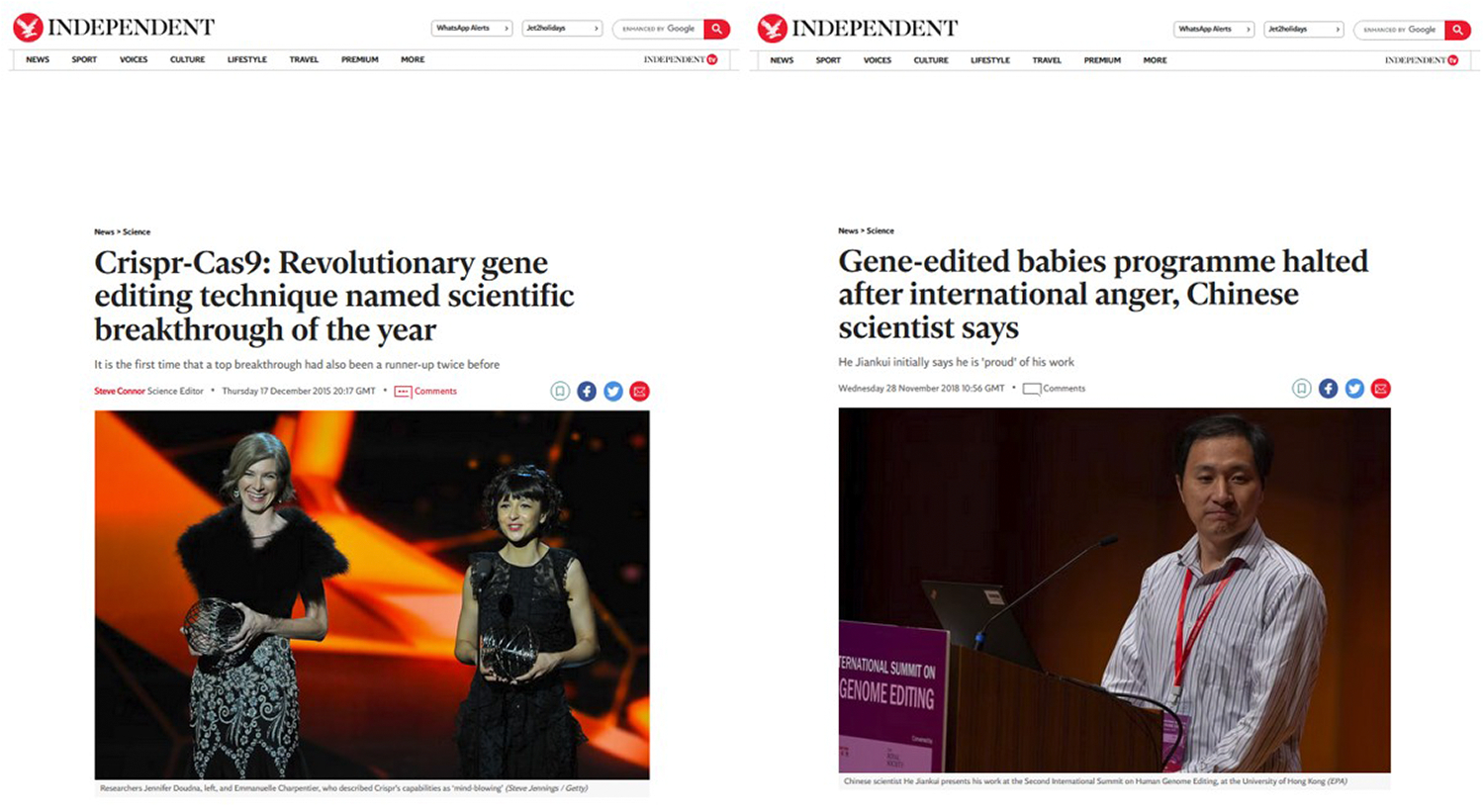
UK press coverage during the gene therapy initiatives centred on the significance of the CRISPR-Cas9 breakthrough, patent conflicts and the ethical considerations of gene editing. Early in this phase, publications such as The Independent focused on Doudna and Charpentier, often photographed together as shown in Figure 2, reporting on topics ranging from the significance of CRISPR-Cas9 breakthroughs to the subsequent patent wars and infighting.Footnote 40 In 2016, Kathy Niakan became a focal point after receiving a license to conduct research on embryos. Often portrayed as smiling and positioned in a lab, her imagery in publications like The Guardian was crafted to emphasize her credibility and the healing potential of her work.Footnote 41 The media narrative further contrasted ‘responsible’ scientists like Niakan with ‘rogue’ figures like Jo Zayner, who was known for self-editing her DNA and selling DIY CRISPR kits. Science communication has historically cast suspicion on the practice of DIY biology, partly through the boundary work which defines science.Footnote 42 Zayner, for instance, is framed as less professional in the Mirror, pictured wearing a T-shirt rather than a lab coat.Footnote 43 The media set the affective stage for its presentation of He and his announcement as it sought to preserve CRISPR’s image as a positive technology when practised by scientists who behave appropriately.
On 26 November 2018, when He Jiankui’s CRISPR gene-editing work came to light just before the Second International Summit on Human Genome Editing, He became the figure of the scientist doing CRISPR wrong. Across science communication, He was branded a ‘rogue scientist’, which emphasized his separation from his US academic history and focused on his Chinese affiliations.Footnote 44 But as famous geneticist George Church put it succinctly, ‘He had an awful lot of company to be called a “rogue”’.Footnote 45 The imagery in publications such as The Times and The Independent depicted him as isolated, engaged with his lab equipment (an image harvested from his YouTube channel on which he explained his experiment to the public) or presenting at the summit as shown in Figure 2, reinforcing this portrayal through the absence of his Western connections.Footnote 46 News articles, such as the one in the Evening Standard, amplified the critique from UK scientists, describing his work in strongly negative language, while often downplaying or omitting his ties to US institutions like Rice University and Stanford University, where he studied and worked.Footnote 47 Most mainstream UK news articles failed to mention that Michael Deem, He’s former PhD supervisor at Rice, was listed as a senior author on the manuscript detailing the experiment (though this would have been widely known in the sciences) and that Stanford researchers Stephen Quake, Matthew Porteus and William Hurlbut were, to varying degrees, aware of He’s plans.Footnote 48 He’s close association with the Southern University of Science and Technology in Shenzhen was instead highlighted, aligning him more with China in public perception, underscoring a narrative that painted him as an outlier in the scientific community.
Contrasted images of He and Doudna and Charpentier featured in The Independent.
By 2019, when the clinical trials really got under way, he remained a controversial figure associated with contentious research in China, but the overall narrative began to shift. During this time, figures like George Church re-emerged in the visual culture of the science, his profile, notably portrayed in the Telegraph, gazing forward against a bright white background.Footnote 49 Looking to the future, the image underscored his views on the promise the technology holds for eradicating genetic diseases. The awarding of the Nobel Prize in Chemistry to Charpentier and Doudna in 2020 for CRISPR-Cas9 gene editing further cemented the technology’s standing. Their intermedial images dominated both the press and science reporting, as evidenced in a Science article, which notes that history was made as as ‘no previous science Nobel [had] been given to two women only’.Footnote 50 Science communication largely focused on the positive potential of CRISPR while framing He’s actions as an isolated instance of unethical experimentation, thus restoring the optimistic view of CRISPR that prevailed before the gene-edited-babies scandal.
Although a consistent and stabilizing figure across our social-media analysis, the scientist fluctuated in emphasis in relation to events involving key or celebrity scientists, echoing the results of our traditional-media analysis. In 2018, scientists comprised approximately 17.6 per cent of the Instagram posts, indicating similar representational significance as the double helix. Of these, approximately 23 per cent featured He as the scandal broke late in the year. The year 2019 reflects a similar trend, with approximately 11.24 per cent of the posts featuring scientists, and of these approximately 33.3 per cent featured He. In 2020, after Charpentier and Doudna won the Nobel Prize, the figure of the scientist comprised approximately 48.5 per cent of the posts, with Charpentier and Doudna featuring in approximately 83 per cent of these. In 2021, as CRISPR’s image stabilized around somatic cures, scientists comprised approximately 22.5 per cent of the posts, with Charpentier and Doudna featuring in approximately 62.5 per cent of these. In 2022, the figure of the scientist is featured in approximately 16.3 per cent of the posts, the same as the double helix, indicating a stabilization of the visual culture surrounding this technology.
The intermedial figure of the scientist is both a stabilizing and a polarizing figure. Key scientists who contributed to CRISPR breakthroughs are featured heavily in science reporting, and their images are picked up and reproduced by the press. A division occurs across ethnic lines with the championing of Western scientists, such as Charpentier and Doudna, and the demonization of He, who is largely presented as isolated from the West and affiliated with China. This figure was amplified through social media, with spikes in its representation occurring around the He Jiankui controversy and the Nobel Prize in Chemistry. Through the scientist, we see the affective charge of figures across media, which is only intensified within the portrayal of our third figure.
The human subject: embryos, children and patients
Steeped in pathos, the figure of the human subject has an affective weight different to that of the abstract figure or the scientist. The figure takes three distinct forms in CRISPR visual culture: the embryo, the baby and the patient. Of the three, the embryo emerges as the most salient and polarizing form through both its presence and its absence; the others acquire meaning, in part, through their relation to the embryo. Here we examine the significance of the embryo, and chart some of its choreography and affective association, and by extension those of the human subject, through the four phases. To an extent, the embryo’s CRISPR visual trajectory replays historically contingent meanings developed through the stem cell news media in the previous decades. This coverage also moved through phases of hype, hope, controversy and stabilization.Footnote 51
Indicative of germline modification, the embryo is a socially charged manifestation of the human subject. Visually, it walks the line between an abstract figure and a human baby. Despite functioning as what Franklin describes as a ‘basket category, describing everything from a conceptus, a zygote or a blastocyst to a reconstructed cell, a fertilized egg or an embryoid body’, the embryo nevertheless holds a place within the cultural psyche as that which is always already becoming human.Footnote 52 Thomson claims that ‘differences in approaches to bioethics come out in a gendered way’, and the topic of the embryo is rife with feminist ethical concerns.Footnote 53 These encompass conversations surrounding the ubiquitous ‘designer baby’ and its affiliated spectre of eugenics.Footnote 54 In seeking to eliminate genetic disease in embryos, scientists risk discriminating against poor, ethnic-minority and disabled communities as, in Hubbard’s words, they ‘make and implement decisions about who is fit to be born’.Footnote 55 While the embryo conceptually represents human futurity, practically it designates the futurity of a select few. Gumer reminds us that ‘even if the use of CRISPR to edit embryos was an effective means of improving health outcomes, the inevitably high price tag of the procedure would make it available only to those with significant resources’.Footnote 56 Sociopolitical factors transform the idea of the embryo into the question of which embryo. Considering its cultural significance and its affective charge as always already ‘potential and emergent’ the embryo is unsurprisingly a fixture in CRISPR press regarding human subjects.
During the initial CRISPR craze, human subjects were largely absent from the visual culture. This changed during the gene therapy initiatives phase when, in 2015, Lanphier et al. published the pivotal paper ‘Don’t edit the human germ line’ in Nature, an article represented by the image of a tool modifying the double helix (this time a pencil erasing it into obscurity). Lanphier et al. warn, ‘In our view, genome editing in human embryos using current technologies could have unpredictable effects on future generations’.Footnote 57 The following month, Nature reported that Junjiu Huang’s research team at Sun Yat-sen University in Guangzhou had edited human embryos – albeit non-viable ones – for the first time to address a potentially fatal blood disorder.Footnote 58 The announcement was accompanied in publications such as the Telegraph and The Times by the intermedial circulation of stock images of oocytes, zygotes and embryos being penetrated by pipettes as shown in Figure 3.Footnote 59 Publications such as The Independent and The Guardian replicated these and similar images in September of the same year when UK scientists applied for permission to modify embryos for miscarriage research, and again in February 2016 when Dr Kathy Niakan’s team was the first to receive this permission from the Human Fertilisation and Embryology Authority (HFEA).Footnote 60 The imagery of tools, specifically a pipette, penetrating oocytes and embryonic forms complements those of scissors, scalpels and tweezers modifying the double helix. Theoretically, these visualizations of modified embryos, statically assisted in their becoming, functioned as an extension of what Franklin terms the ‘cyborg embryo’, ‘a product of high-tech procedures … as it is of hope for a child and the desire for technological assistance to overcome infertility’.Footnote 61 A figure of hope for fertility and futurity, the embryo appeared during this time alongside a figure of fear: the child.
The figure of the embryo, referenced through the oocyte being penetrated by a pipette, featured in the Telegraph.

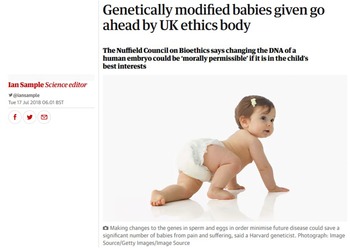
While less prevalent than that of the embryo, the figure of the child, often shown as a baby, also populated the gene therapy initiatives phase. Castañeda claims that ‘the child accrues power and value across its multiple figurations’, and it certainly had the opportunity to do so through the intermedial reporting within science communication at the time.Footnote 62 Following the first successful editing of a human embryo in 2017 and the Nuffield Council on Bioethics announcement in 2018 that editing embryos was morally passable, a rash of photographs of swaddled white babies were featured in publications such as The Independent and The Guardian.Footnote 63 Often, these images were accompanied by the term ‘designer babies’. The definition of the ‘designer baby’ is nearly as ambiguous as that of the embryo, and the discourse surrounding it gestures towards parents using the technology to offer their child a genetic advantage (e.g. in intelligence or athletics) or to actualize their own dreams (e.g. ‘a parent who laments her inability to become a proficient piano player might try to design a child with musical proclivities’Footnote 64). Lodged firmly within the already exclusive IVF industry, the capacity of designer babies will likely reify inequities along economic, or class, lines, as well as those of race and ability with which they intersect. The stock-photograph babies are overwhelmingly white, a visual argument that underscores Patricia Williams’s claim that the current trend in genomics of biologizing and, potentially, modifying race serves only to emphasize racist notions of purity and the problematic narratives that accompany them. She elaborates, ‘our best – and worst – efforts at human uplift seem disproportionately concentrated upon germ line manipulation, eugenics as “cosmetic choice,” and general technological heedlessness to unintended consequence in the rush to commodify life forms’.Footnote 65 These concerns about eugenics also extend to disabled communities as science rushes to ‘fix’ the disability rather than to adjust societal perceptions of people with disabilities.Footnote 66 It is within this discursive context that the first CRISPR-modified babies were born.
The figure of the child featured in The Guardian.

He’s CRISPR babies, and their reception, operate in line with Franklin’s observations regarding IVF, or cyborg embryos. Franklin identifies the cyborg embryo as a product of ‘transbiology’, or the process ‘in which biology is made in order that it be born’.Footnote 67 Since, as Science reported, He attempted to edit the embryos’ ‘normal CCR5 gene into a mutant that resembles the Δ32 version’, which would provide them with HIV resistance, and then implanted them in a woman, the CRISPR twins, Lulu and Nana, were certainly made and then – and with that intention – born.Footnote 68 Franklin, however, elaborates, ‘transbiology is also made up out of the complex intersection of the pure and the impure’, a dichotomy in which the latter is perpetually sacrificed to create ‘functional, safe, and marketable human biology’.Footnote 69 The experiment was unsuccessful, disabling the twins’ CCR5 genes in some cells but not in others, thus failing to mimic the CCR5Δ32 variation, potentially rendering one or both infants genetically either heterozygous or mosaic, inciting the possibility ‘off-target’ mutations, and ultimately creating ‘changes that had never been seen in humans before’.Footnote 70 As a result, the CRISPR twins were condemned to the realm of the scientifically impure, a connotation cemented through their portrayal in science communication. Despite their mutations, Lulu and Nana were indistinguishable from non-GM babies. Their representation in the press, then, is fraught with visual symbolism. Some news outlets, like The Guardian, used stock images of babies facing the camera, as shown in Figure 4, thus calling upon the reader to project stories of genetic mutations upon their innocent forms.Footnote 71 Others, like Metro and the Express, used artistic depictions of foetuses (as opposed to the comforting abstraction of the tool-assisted developing embryo) cast in a red glow, occasionally accompanied by the Chinese flag.Footnote 72 In this context, the figure of the designer baby implies that impure science is both that which occurs overseas and something that could impact the global germline.
Following the controversy, CRISPR imagery in science communication evolved from embryos and babies to hospital patients being treated for genetic diseases, signalling a media shift into the clinical-trials phase. This recuperation phase focused on the therapeutic potential of CRISPR, particularly for somatic cell editing, which is seen as having fewer ethical concerns than germline modification.Footnote 73 The press echoed this sentiment as publications such as The Independent and the Daily Mail ran celebratory articles complete with pictures of adult patients preparing for trial tests to treat sickle-cell or undergoing procedures to cure genetic forms of blindness.Footnote 74 It is no surprise that this fixation on disease also coincided with the COVID-19 pandemic, and the Broad Institute’s research into using CRISPR to detect the virus also lent the technology credibility.Footnote 75 As with the figure of the scientist, this consistency in the intermedial figure but change in the subject of the image helped shift the public perception of CRISPR into a different, more hopeful affective register.
The figure of the human subject fluctuates across our social-media analysis, largely in relation to the proposed applications of CRISPR. In 2018, the figure only comprised approximately 1.4 per cent of the Instagram posts as human applications were still largely theoretical. In 2019, this number jumped to approximately 18 per cent, with approximately 62.5 per cent of these comprising embryos and babies – likely in response to the He scandal – and approximately 31.3 per cent of the posts comprising images of Victoria Gray, the first patient to undergo a CRISPR clinical trial to treat sickle-cell. In 2020, representations of the human subject decreased to approximately 2.5 per cent as the figure of the scientist rose to prominence. In 2021, this number rose again to approximately 14.2 per cent of the posts, with approximately 53 per cent of these featuring children and approximately 70.6 per cent featuring patients. During this time, there was a significant overlap between the figure of the patient and the figure of the child as CRISPR was beginning to be used to treat somatic cell genetic disease in children, offering a hopeful alternative to the polarizing figure of the designer baby. This trend continued in 2022 when the figure of the human subject comprised approximately 23.5 per cent of posts with 78.3 per cent featuring children and approximately 65.2 per cent featuring patients.
The figure of the human subject is the most affectively polarizing intermedial figure across science communication. While it is largely absent from both science reporting and the press early on, it gains prominence through the figure of the embryo in relation to the early IVF experiments, the figure of the child in relation to the He scandal, and the figure of the patient in relation to the clinical trials. This trajectory is reflected in our social-media analysis, with the figure of the child-as-patient gaining prominence in later years. Its affective resonance shifts across this time with the embryo associated with an apprehensive futurity, the child associated with fear of ‘designer babies’, and the patient associated with hope for the cure for genetic disease.
Discussion and conclusion
Intermedial figuration in science communication serves as a bridge between genres and platforms, playing a stabilizing, amplifying and affective role in the visual culture surrounding genetic engineering technologies such as CRISPR. This discussion dissects the roles our three intermedial figures – the double helix, the scientist and the human subject – and examines their influence across the genres of science reporting and mainstream press, between traditional and social media, and across science communication in general.
We see generic intermedial figuration playing a key role in Lewenstein’s ‘web model’ of science communication, specifically functioning between the subgenres of science reporting and the mainstream press. Each genre picks up, reproduces and amplifies the figures portrayed by the other to generate a broader visual culture. The figure of the double helix has emerged as a visual shorthand for CRISPR, often being the central icon in narratives of genetic possibilities. Its abstract yet recognizable form provides a stabilizing visual cue that remains relatively neutral in reporting around the science. The scientist figure has oscillated between the archetypal innovator during the CRISPR craze and gene therapy initiatives, to the rogue scientist in the wake of the He Jiankui controversy, to the figure of the celebrity scientist following the 2020 Nobel Prize in Chemistry. This shift reflects the broader societal sentiments and biases around perceptions of ‘good’ and ‘bad’ scientists. Meanwhile, the human subject – particularly the embryo, the child and the patient – plays a flexible affective role across media as it is employed to incite feelings of apprehensive futurity, fear and hope in relation to its manifestation and the context in which it is employed. These intermedial figures are not confined to traditional media, however.
The role of intermedial figuration is amplified in the interplay between traditional and social media. Traditional media’s reportage provides the foundational content, while social media’s rapid dissemination mechanisms amplify the reach and engagement. The double helix’s role as a constant visual touchstone remains unchallenged, providing continuity amid the discourse. The figure of the scientist in social media becomes a focal point for discussion, especially in relation to breakthroughs and scandals by key celebrity scientists. The figure of the human subject gains a heightened affective charge in this space, where it mirrors the development of the science, and its public focus, across the identified phases. Specifically, we see it clustering around the affectively loaded figure of the child and transforming into the hopeful figure of the patient (and the child-as-patient), reflecting a public focus on somatic cell cures for genetic disease. Social media, then, gives us the context to develop a broader picture of this visual culture.
Intermedial figures thus play a stabilizing role in the history of the public perception of human genetic engineering by providing consistency and familiarity in the visual culture of CRISPR across media forms. They also have an amplifying effect, particularly in social media, where the rapid sharing and visual nature of platforms can magnify the presence and perceived significance of these figures. They carry an affective charge, with each figure evoking different emotional responses that influence public perception and discourse surrounding CRISPR. Intermedial figuration scaffolds the visual culture of science communication.



 Open access

