

Introduction
Gender equality, decent work, and adequate housing are essential components of the sustainable development goals (SDGs), fostering inclusive and sustainable human development. In Nigeria and other African or developing countries, the impact of homeownership, family structure, gender, and other variables on self-employment decisions remains mixed, primarily due to the heterogeneity in self-employment. This heterogeneity encompasses various sub-groups within self-employment, with gender differences playing a significant role (Gindling and Newhouse Reference Gindling and Newhouse2014; Grimm et al Reference Grimm, Knorringa and Jann2012; Nwaka et al Reference Nwaka, Guven-Lisaniler and Tuna2016).
One facet of this heterogeneity lies in the decision to pursue home-based self-employment (HBS), which is where businesses operate within the home. Despite evidence of both positive and negative effects of homeownership on the decision to be self-employed (Chen and Hu Reference Chen and Hu2018), the significance of homeownership in determining HBS has been under-researched, especially in developing countries. Homeownership can act as collateral for financing a new business, increasing the likelihood of self-employment (Blanchflower and Oswald Reference Blanchflower and Oswald2013), and reducing costs associated with setting up new business locations (Reuschke Reference Reuschke2016). However, it may also deter (self)employment due to the risks associated with business failure (Bracke et al Reference Bracke, Hilber and Silva2014; Chen and Hu Reference Chen and Hu2018). Compared to men, HBS is more prevalent among women, offering flexibility in balancing paid and unpaid work (Thompson et al Reference Thompson, Jones-Evans and Kwong2009; Aridakis et al Reference Aridakis, Marlow and Storey2014). Nevertheless, female-owned HBS businesses face challenges, particularly in smaller, lower-income cities, suggesting that HBS may be a choice for the economically disadvantaged due to its lower capital requirements (Mason et al Reference Mason, Carter and Tagg2011).
This research aims to investigate the socioeconomic factors influencing HBS and assess whether homeownership could help address the gender gap in self-employment. Departing from conventional economic paradigms, the study focuses on the motivations behind HBS, particularly the decisions of female business owners. It provides a nuanced understanding distinct from traditional mainstream models that typically emphasise profit maximisation as the primary motivator for entrepreneurial decisions. The research emphasises that the choice of HBS goes beyond monetary gains, considering factors such as the need for flexible work schedules, social institutions that perpetuate gender norms, family dynamics, household infrastructure, and homeownership. To the best of the authors’ knowledge, no other study has attempted to ascertain the gender-differentiated determinants of HBS in Nigeria. Close to our study is that of Reuschke (Reference Reuschke2016) which ascertains the importance of housing for home-based business decisions in the UK but does not address gender-specific effects or apply robust empirical techniques, such as econometric and machine learning approaches, to disentangle the gender gap as this paper does.
The case for Nigeria is compelling due to its unique characteristics—a population of 218 million people and the highest proportion of self-employment to total employment, with females (86%) outnumbering males (77%) (World Bank Reference World Bank and Development Indicators2024a). This sizeable population provides a strong sample for examining various aspects of self-employment, allowing for more in-depth and potentially generalisable findings. Also, from a policy perspective, in Nigeria and other developing countries, it is noteworthy that many business owners who are engaged in informal employment and home-based own-account work, particularly women, are unsuccessful entrepreneurs. Thus, unravelling the gender-differentiated impact of HBS choices in Nigeria is imperative for understanding the motivations behind these choices. Unlike the conventional mainstream thought emphasising profit maximisation, other factors such as marriage, having children, and household responsibilities significantly impact women’s choices, leading many to opt for home-based work as a viable alternative (Nwaka et al Reference Nwaka, Guven-Lisaniler and Tuna2016; Guven-Lisaniler et al Reference Guven-Lisaniler, Tuna and Nwaka2018; Joona Reference Joona2018). Additionally, female engagement in HBS may be driven more by necessity than a desire for profit, hindering progress towards SDGs related to gender equality (SDG 5), decent work and economic growth (SDG 8), poverty eradication (SDG 1) and reduced inequalities (SDG 10).
The present study contributes to the literature in multiple ways. Firstly, the research, for the first time ascertains the gender differentiated determinants of HBS engagements in Nigeria. Second, the study applies the probit model, the random effects model and the Blinder–Oaxaca (B–O) decomposition technique to analyse cross-sectional household survey data from 2010 to 2018. The B–O technique has been applied in the determination of the gender wage gap in Nigeria (Orji & Nwosu, Reference Orji and Nwosu2024), the present study is however oriented towards self-employment dynamics which contrasts with employee-oriented wage dynamics. Lastly, the study also employs the LASSO estimator as a robustness test for the validity of the coefficients. This is the first study in Nigeria and Africa to use the machine learning LASSO estimator to evaluate gender gaps in self-employment.
Key results from this research show that female business owners are more inclined towards home-based self-employment (HBS) compared to their male counterparts, underscoring the importance of gender equality (SDG 5) and decent work (SDG 8). While male HBS owners are mainly motivated by profit, females emphasise balancing paid and unpaid work. These insights, framed within heterodox economics, reveal that self-employment motivations extend beyond profit and highlight the necessity for gender-inclusive policies. Addressing gender-specific challenges in HBS can inform governments in developing policies that foster equitable economic opportunities and promote sustainable growth.
The study proceeds by presenting data on self-employment outcomes in Nigeria, then developing hypotheses on the effects of homeownership on HBS based on existing literature. Subsequent sections discuss data, methodology and results, followed by further discussion and conclusions.
Self-employment business trends in Nigeria: some stylised facts
Nigeria, with a population exceeding 200 million, constitutes approximately 18% of the Sub-Saharan African population (World Bank Reference World Bank and Development Indicators2024b). Despite being acknowledged as the largest economy in Africa, it remains one of the world’s poorest countries. Table 1 outlines the role of self-employment in employment generation in Sub-Saharan Africa (SSA), with particular emphasis on Nigeria. Notably, Nigeria surpasses SSA and global averages in the proportion of self-employed individuals. Conversely, wage employment claims a relatively smaller share for both males and females compared to SSA or the global average.
Average employment and unemployment statistics (2010–2019)

Source: World Development Indicators (Reference World Bank and Development Indicators2024b)
According to the International Labour Organization (ILO), Nigeria maintains a modest unemployment rate of about 5%, which aligns with the global average. However, persistent economic challenges have pushed approximately 47% of the population into absolute poverty, defined as individuals living on less than 1.90 US dollars daily. This reality supports Fields’ (Reference Fields2014) perspective, asserting that the prevalent absolute poverty is not merely an issue of unemployment but stems from employment vulnerability, limited earning opportunities, and the heterogeneous nature of self-employment.
According to the Nigeria Bureau of Statistics (NBS), by the third quarter of 2023, 87% of working-age Nigerians were self-employed. Disaggregating by gender, there is a 6.3% gap, with 90.5% of females engaged in self-employment. This high rate of self-employment may reflect necessity rather than opportunity due to the scarcity of formal job opportunities in Nigeria. At the same time, 92.3% of the Nigerian workforce was involved in informal employment.
Data from the ILO for 2022 show that the high level of self-employment (over 87%) in Nigeria contrasts sharply with 6.3% in the US, 8.7% in Germany, 29% in South Africa, 15.6% in the UK, 30% in Turkey, 75% in Ghana, and 81% in Uganda. Evidently, advanced economies have a much lower proportion of self-employed individuals compared to low-income and emerging economies.
Gender disparities in self-employment are also evident. In the US, 8.4% of male employment was self-employed compared to 6.3% for females. In Germany, the figures were 10.74% for males and 6.5% for females, while in the UK, it was 19.7% for males and 11.3% for females. In Uganda, 86% of females and 76% of males were self-employed, whereas in Ghana, the figures were 82% for females and 69% for males. These disparities suggest that self-employment in emerging and low-income economies may often be driven by a lack of formal job opportunities rather than profit potential.
Studies on Nigeria’s labour market have consistently highlighted the varied characteristics of labour demand and supply across different employment types. (Guven-Lisaniler et al Reference Guven-Lisaniler, Tuna and Nwaka2018; Nwaka et al Reference Nwaka, Guven-Lisaniler and Tuna2016). Demand heterogeneity is associated with employment features such as type, location and occupation, while worker attributes influence supply. Within this context, a prominent characteristic of self-employment in Nigeria is the prevalence of home-based businesses compared to those operating beyond the household realm.
Figures 1–4 report the distribution of HBS and non-HBS by gender, educational level, sector of activity and homeownership. While non-HBS appear to be male-dominated, the HBS is female-dominated, as found in other studies (Thompson et al Reference Thompson, Jones-Evans and Kwong2009). Individuals with primary education as the highest qualifications are more oriented towards HBS, while those with secondary education are predominantly in non-HBS employment. From Figure 5, it can also be observed that home-based businesses have a higher distribution in the north relative to the southern part of Nigeria. From Figure 6, heterogeneity in household earnings from home-based and non-homebased businesses can be observed, with the oil rich Niger Delta in the south having the highest earners in home-based businesses. The descriptive scenario explains the low-skill attributes in most HBS establishments. Also, compared to other sectors (manufacturing and services), HBS is more oriented towards wholesale and trade businesses. In Nigeria, wholesale/trade businesses come in various sizes and types, such as street hawking, and the low-scale sale of various electronic and household utilities, groceries and food items. HBS is also more common amongst homeowners than renters and, indeed offers insights into homeownership-driven self-employment motives.
Distribution of business location by owner’s gender and (in)formality (2010–2018 Survey Weights).
Source: Authors’ Computation from General Household Survey–Nigeria Bureau of Statistics (2010–2018).

Distribution of business location by owner’s level of education (2010–2018 Survey).
Source: Authors’ Computation from General Household Survey–Nigeria Bureau of Statistics (2010–2018).

Distribution of homeownership status by business location (2010–2018 survey weights).
Source: Authors’ Computation from General Household Survey–Nigeria Bureau of Statistics (2010–2018).

Percentage distribution of homebased business location by owner’s gender and industry.
Source: Authors’ Computation from General Household Survey–Nigeria Bureau of Statistics (2010–2018).

Percentage distribution of homebased businesses by states in Nigeria (2010–2018).

Earning differences by states in Nigeria (2010–2018).

Literature review and hypotheses development: HBS, gender and homeownership effects
Scholarly literature often cites self-employment as a diverse category comprising various groups of skilled and unskilled individuals, including agricultural workers, formal and informal household enterprises, employers, employees and own account workers – also known as small business owners (Burrows and Ford Reference Burrows and Ford1998; Gindling and Newhouse Reference Gindling and Newhouse2014; Nwaka et al Reference Nwaka, Guven-Lisaniler and Tuna2016; Guven-Lisaniler et al Reference Guven-Lisaniler, Tuna and Nwaka2018). Within this context, businesses can operate either within the home premises (HBS) or outside the home (non-HBS). For simplicity, we exclude agricultural workers from our self-employment characterisation. In developing countries, home-based occupations are primarily informal, producing various goods for local and international markets, such as services (hair-cutting, beautification, laundry, dry-cleaning, shoe repairs), wholesale and trade, as well as various forms of manufacturing (textiles, crafts, garments, shoemaking, cosmetics) (Chen Reference Chen2014).
Existing literature suggests that decisions to operate ventures from home are often linked to cost minimisation, as start-up costs can be easily financed from an individual’s savings (Vorley and Rodgers Reference Vorley and Rodgers2014; Daniel et al Reference Daniel, Dominico and Sharm2015). In contrast, non-home-based ventures in industrial layouts or towns may require significant capital for operation (Reuschke Reference Reuschke2016). Home-based establishments are characterised by fungible resource allocations, facilitating swift and efficient transfers of resources without value losses (Kellet and Tipple Reference Kellet and Tipple2000). This allows participants to easily reinvest cash from sales into the business or spend it on household needs, so improving their living or working conditions.
Flexibility is often presented as a critical attribute of running HBS especially for women who are more likely to undertake HBS due to the burden of unpaid work (Walker Reference Walker2004; Thompson et al Reference Thompson, Jones-Evans and Kwong2009; Nwaka et al Reference Nwaka, Guven-Lisaniler and Tuna2016; Heck Reference Heck1991). However, this flexibility comes with costs, as women tend to bear a major burden for their associated expenses (Thompson et al Reference Thompson, Jones-Evans and Kwong2009; Meisam et al Reference Meisam, Zahra, Kambiz and Maghsoud2017). Childcare responsibilities, in particular, can reduce self-employment duration and so, earnings (Williams, Reference Williams2004; Joona, Reference Joona2018), thus female business owners’ engagement in HBS is an outcome from necessity for achieving a work–life balance rather than pursuing profit.
Such necessity highlights how, to a large extent, social institutions shape women’s entrepreneurial decisions. Staveren and Oyebode (Reference Staveren and Ode Bode2007) perceive gender norms as asymmetric institutions, the expression of which is mediated by other institutions such as the household. Unlike formal institutions such as the household, informal institutions such as role models have been shown to influence women’s propensity to engage in entrepreneurial activity in some environments (Noguera et al Reference Noguera, Alvarez, Merigo and Urbano2015). However, this may occur in different forms in a less egalitarian society such as Nigeria where gender norms are deeply entrenched in the culture and find dominant expression in both informal and formal institutions. These norms, by their very nature, deny women access to property ownership (Ajala, Reference Ajala2017) and constrain their self-empowerment (Farnworth et al Reference Farnworth, Badstue, Williams, Tegbaru and Gaya2020).
Cultural and tribal heterogeneity and socioeconomic differences necessitate examining what are determinants of self-employment choices and homeownership in Nigeria, and the extent to which they align with the extant literature. This leads to the first set of hypotheses.
Hypothesis 1a The female gender positively influences the propensity of female business owners to engage in home-based self-employment.
Hypothesis 1b Childcare responsibilities positively correlate with the propensity of business owners to choose home-based self-employment.
Hypothesis 1c The positive relationship between home-based self-employment and childcare responsibilities is valid for female business owners but not males.
Hypothesis 1d Marital status positively influences the propensity of female business owners to choose home-based self-employment.
The literature highlights three essential housing features in examining the link between homeownership and self-employment choices. Firstly, homeownership is a financial asset in financing a business, known as the ‘collateral effects’, where houses act as collateral for securing loans (Chen and Hu Reference Chen and Hu2018; Reuschke Reference Reuschke2016). Secondly, studies suggest that owning a home may act as security and pose a risk by creating wealth or crowding out potential employment respectively, depending on circumstances (Blanchflower and Oswald, Reference Blanchflower and Oswald2013). Thirdly, spatial or locational attributes can encourage small business formation, an aspect yet to be explored in the self-employment literature. Also, given the existence of owned homes, entrance into HBS may be more flexible for female business owners with dependents, reflecting the strong influence of gender roles linked to ancient traditional norms in developing economies like Nigeria. This sets the stage for the second set of hypotheses.
Hypothesis 2a Outright homeownership positively influences the propensity of business owners to engage in home-based self-employment.
Hypothesis 2b The positive relationship between home-based self-employment and homeownership is stronger for male than female business owners.
Understanding the factors associated with female home-based employment choices in Nigeria, considering cultural inclinations, is crucial for implementing policies to minimise observed gender inequality. This study proceeds as a foundational step towards unravelling inherent gender-differentiated determinants in the decision to engage in HBS in Nigeria, addressing these differences, and proposing potential policies to mitigate any resulting adverse outcomes.
Data and empirical methodology
Data and self-employment definition
This study uses data from the Nigeria General Household Surveys Panel (GHS-Panel), conducted in 2010/2011, 2012/13, 2015/16, and 2018/19. This nationally representative survey of 5,000 households results from collaboration between the Nigeria Bureau of Statistics (NBS), the Bill and Melinda Gates Foundation (BMGF), and the World Bank. The GHS-Panel data has been widely used in various studies of Nigeria (Guven-Lisaniler et al Reference Guven-Lisaniler, Tuna and Nwaka2018; Nwaka et al Reference Nwaka, Guven-Lisaniler and Tuna2016; Nwaka et al Reference Nwaka, Uma and Ike2020). Vijverberg (Reference Vijverberg1992) show that household surveys provide a more accurate representation of small-scale enterprises than dedicated enterprise surveys.
We used data from the four GHS-Panel waves, sourced from the World Bank’s Living Standard Measurement Study (LSMS) microdata library (see Nigeria Bureau of Statistics, 2010 for more details). The survey includes questionnaires on personal, labour and household characteristics, as well as inquiries into non-farm household enterprises and housing details. Typically, household heads or those most knowledgeable about household business operations serve as respondents.
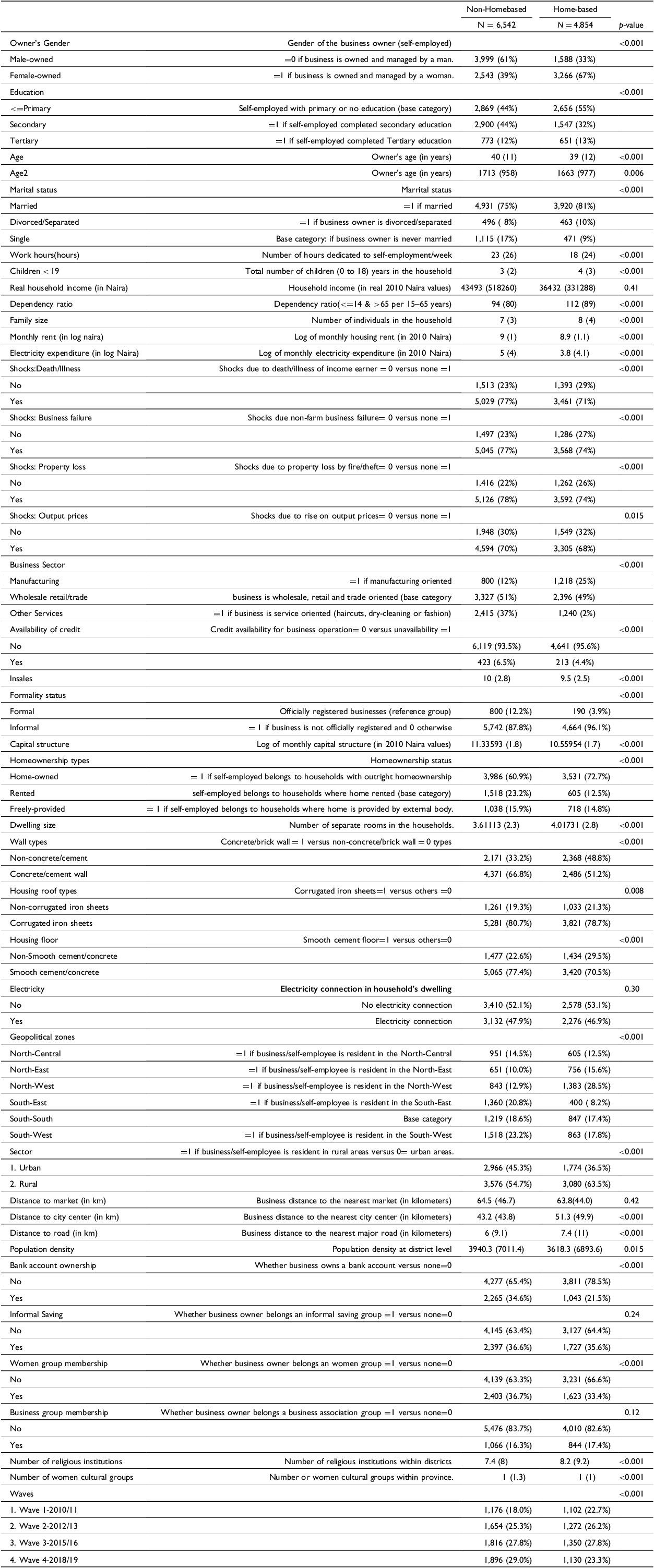
Focusing on the gender gap in family business choices—home-based or non-home-based—we restricted the sample to female and male owners aged 20 to 64 who own at least one family enterprise. This age range includes crucial decision-makers in self-employment and household management. We matched individuals based on their characteristics, households and business attributes. Each wave’s sample comprises an average of about 2,014 unique households, 2,840 non-farm enterprises, and 11,396 observations. We used survey weights to accurately reflect the broader population and adjust for any survey biases. Detailed definitions of the variables used in the estimation, along with descriptive statistics, are presented in Table 2.
Variable’s definition and description statistics by business owner’s gender
Dependent variable
The primary focus of this study revolves around family businesses or self-employment jobs primarily conducted from home. The International Classification of Status in Employment (ICSE-93) categorises employment into paid (employees) and self-employment (ILO, 1993). According to ICSE-93, self-employment encompasses:
-
i. Those employers who employ workers continuously
-
ii. Own-account workers without external workers – self-managed businesses
-
iii. Producer cooperative societies and their members
-
iv. Family workers in market-oriented establishments
Hence, an affirmative response to the GHS questionnaire, such as ‘During the past 12 months has any member of the Household worked for himself other than a farm or raising animals’, is employed to capture self-employment, aligning with the fourth definition according to ICSE-93. Similarly, we also determine whether self-employment is home-based, based on whether it operates within the home’s vicinity (inside and outside the residence) or otherwise. The dependent variable, HBS, is binary (HBS vs. non-HBS). Table 2 indicates that approximately 43% of family enterprises are home-based.
Independent variables
Individual characteristics
To account for self-employment characteristics, we include the owner’s gender, age and work hours. The literature suggests that, for flexibility and the ability to contribute to home goods, females are more inclined towards HBS than males (Walker, Reference Walker2004; Thompson et al Reference Thompson, Jones-Evans and Kwong2009; Nwaka et al Reference Nwaka, Guven-Lisaniler and Tuna2016). As Table 2 indicates, a higher proportion (67%) of female-owned businesses are home-based, while males dominate the non-home-based category at around 61%. Educational levels (primary or less, secondary, and tertiary) have been included to minimise potential measurement errors associated with the years of schooling indicator. The age variable plays a crucial role in homeownership and self-employment choices, with expectations that self-employment choices are more profound among older workers due to possible accumulation of entrepreneurial human capital or the time needed to intensify networks for entrepreneurial opportunities (Millan et al Reference Millan, Congregado and Roman2012). The signs of coefficients for marital status and work hours in self-employment vary and differ by gender in the literature. Additionally, the impact of multiple exogenous shocks on households varies due to different coping strategies and perception to risks between genders (Nguyen et al Reference Nguyen, Nguyen and Grote2020).
Business/Regional characteristics
Factors affecting the economic structure or location of self-employment represent business characteristics. These include self-employment, industrial structure (manufacturing, wholesale retail/trade, and services), business earnings, informality, and credit availability. Regional/community-based variables (geopolitical zones, business proximity to the nearest market, distance to the main road and urban-rural differences) capture spatial/regional attributes influencing the decision to engage in HBS in Nigeria.
Given that a higher proportion of female owners operate informal HBS, most HBS are expected to be informal (Burrows and Ford Reference Burrows and Ford1998; Gindling and Newhouse Reference Gindling and Newhouse2014). However, due to the limited earning potential of HBS, earnings are anticipated to be relatively lower than those of non-HBS. The occupational concentration of HBS may result in varying signs of the self-employment sectoral structure variables due to potential disparities related to sectoral opportunities. As depicted in Table 2, while many occupations in the HBS and non-HBS categories are wholesale retail and trade-oriented, manufacturing-related ones appear more home-based. Geopolitical zones capture diverse economic opportunities influencing self-employment outcomes (Nwaka et al Reference Nwaka, Guven-Lisaniler and Tuna2016; Guven-Lisaniler et al Reference Guven-Lisaniler, Tuna and Nwaka2018). Hence, geopolitical zones present varied economic opportunities needed for business growth. In Table 2, many HBS are in the North (North West), while 23% of non-HBS are in the South-West. Urban locations generally offer better economic opportunities, while rural locations are more oriented towards agriculture and other forms of self-employment (Nwaka et al Reference Nwaka, Guven-Lisaniler and Tuna2016). Consequently, HBS are more dominant in rural areas than urban areas, as shown in Table 2.
Housing characteristics
Homeownership status and housing characteristics (electricity connection, floor type, wall types and occupancy rate) may also influence the decision to engage in HBS. Homeownership, as pointed out in the literature, inspires self-employment through collateral effects (Fairlie and Krashinsky Reference Fairlie and Krashinsky2012; Gaetano Reference Gaetano2017; Jani-Petri Reference Jani-Petri2018). Table 2 also reveals a higher proportion of HBS with outright homeownership (73%) than non-HBS (61%). While the choice of HBS is expected to rise with an increase in dwelling space, as evidenced in the literature (Reuschke Reference Reuschke2016), the effects of children on self-employment are mixed (Nwaka et al Reference Nwaka, Guven-Lisaniler and Tuna2016).
Institutional characteristics
Studies have underscored the critical role of institutions in entrepreneurship (Estrin and Mickiewicz, Reference Estrin and Mickiewicz2011). Baumol (Reference Baumol1990) contends that the impact of institutions varies with a country’s development level, while Staveren and Ode Bode (Reference Staveren and Ode Bode2007) view gender norms as asymmetric institutions reflected in others, like the household. Informal institutions in particular, are significant in mediating gender norms that exclude women from various social privileges (Noguera et al Reference Noguera, Alvarez, Merigo and Urbano2015; Ajala, Reference Ajala2017; Horak & Suseno, Reference Horak and Suseno2023).
In this paper, we examine several institutional variables: bank account ownership, informal savings memberships, women’s group membership, business association membership and the number of religious and cultural institutions. These variables capture both formal and informal institutional influences. Bank account ownership and informal savings memberships highlight the role of financial inclusion in home-based work. Memberships in women’s groups, business associations and religious and cultural institutions underscore the importance of community-based support networks (Horak and Suseno, Reference Horak and Suseno2023; Anderson et al Reference Anderson, Locker and Nugent2002). Additionally, we incorporate formal institutional variables to reflect family context, including marriage, the number of children under 19, dependency ratios, family size, income and household shocks such as business failure, property loss, price increases and illness or death of family members. Income is measured by real household income in Naira, and education by secondary and post-secondary attainment.
Empirical methodology
In this study, self-employment participation is examined based on whether owners run businesses at their residence or elsewhere. The owner’s gender and other relevant factors influence the choice of home-based self-employment (HBS). We use a standard probability model to explore how gender and these factors impact the decision to engage in HBS as follows:
 $$HBS_{it}^* = {\beta _0} + {\beta _1}{X_{it}} + {\varepsilon _{it}} + {\mu _i}$$
 $$HB{S_{it}} = \left\{ {\matrix{ {1\;if\;HBS_i^* \gt 0\;ie\;homebased\;\;\;\;\;\;\;} \cr {0\;if\;HBS_i^* \le 0\;ie\;nonhomebased\;} \cr } } \right\}$$
where $HBS_{it}^*$
is the unobserved latent variable and
$HBS_{it}^*$
is the unobserved latent variable and $HB{S_{it}}$
represents a binary variable that denotes an individual’s probability of operating home-based self-employment given period (t).
$HB{S_{it}}$
represents a binary variable that denotes an individual’s probability of operating home-based self-employment given period (t). ${X_i}$
is a vector of variables determining HBS choices including individual, household, business, regional, housing and institutional characteristics. The parameters to be estimated are represented by
${X_i}$
is a vector of variables determining HBS choices including individual, household, business, regional, housing and institutional characteristics. The parameters to be estimated are represented by ${\beta _0}$
,
${\beta _0}$
, ${\beta _1}$
and
${\beta _1}$
and ${\beta _2}.$ ${\varepsilon _{it}}$
is a normally distributed stochastic error term with zero mean and unit standard deviation,
${\varepsilon _{it}}$
is a normally distributed stochastic error term with zero mean and unit standard deviation, ${\mu _i}$
capture individual fixed effects. Since both
${\mu _i}$
capture individual fixed effects. Since both ${\varepsilon _{it}}$
and
${\varepsilon _{it}}$
and ${\mu _i}$
are independent normal random variables, it follows that
${\mu _i}$
are independent normal random variables, it follows that ${\varepsilon _{it}} + {\mu _i}$
is normally distributed with zero mean and variance of
${\varepsilon _{it}} + {\mu _i}$
is normally distributed with zero mean and variance of $1 + \sigma _\mu ^2$
. Given the panel structure of the data, Equation 1 estimated using both pooled probit (Probitall) and random effects probitFootnote
1
(REPall) estimators as follows:
$1 + \sigma _\mu ^2$
. Given the panel structure of the data, Equation 1 estimated using both pooled probit (Probitall) and random effects probitFootnote
1
(REPall) estimators as follows:
 $${\rm{Pr}}\left( {HB{S_{it}} = 1|\;{X_{it}}} \right) = \Phi \left( {{{{\beta _0} + {\beta _1}{X_{it}}} \over {\sqrt {1 + \sigma _\mu ^2} }}} \right)$$
where ${\rm{\Phi }}\left( . \right)$
capture the standard normal cumulative function (see Bland and Cook Reference Bland and Cook2019)
${\rm{\Phi }}\left( . \right)$
capture the standard normal cumulative function (see Bland and Cook Reference Bland and Cook2019)
Machine learning estimator
To identify factors predicting HBS, we use machine learning estimators. Unlike baseline models like Probitall and REPall, these estimators minimise residuals with a tuning parameter (Böheim and Stöllinger, Reference Böheim and Stöllinger2021). We apply the least absolute shrinkage and selection operator (LASSO), which has seldom been used for examining the gender gap in HBS. LASSO selects relevant variables, eliminates correlated ones, and shrinks some coefficients by adding a penalty to the conventional models (Probit and Random Effects Probit), penalising the sum of absolute coefficient values. Given $n\;$
observations, each labelled with
$n\;$
observations, each labelled with $i$
, and p variables, Equation 3 is modified as follows:
$i$
, and p variables, Equation 3 is modified as follows:
 $${\widehat \beta _l} = \arg min\sum\nolimits_{i = 1}^n {{{\left( {\Pr \left( {HB{S_{it}} = 1|\;{X_{it}}} \right) - \Phi \left( {{{{\beta _0} + {\beta _1}{X_{it}}} \over {\sqrt {1 + \sigma _\mu ^2} }}} \right)} \right)}^2}} + \lambda \sum\nolimits_{j = 1}^p {\left| {{\beta _j}} \right|} $$
where ${{\rm{\widehat \beta }}_l}$
captures the LASSO coefficients in vector form, while p and
${{\rm{\widehat \beta }}_l}$
captures the LASSO coefficients in vector form, while p and $\lambda $
are the number of independent variables and tuning parameter respectively. As
$\lambda $
are the number of independent variables and tuning parameter respectively. As $\lambda $
increases, the LASSO estimator diverges from the probit model, increasing the bias (Bonaccolto-Töpfer and Briel Reference Bonaccolto-Töpfer and Briel2022, Böheim and Stöllinger Reference Böheim and Stöllinger2021). A
$\lambda $
increases, the LASSO estimator diverges from the probit model, increasing the bias (Bonaccolto-Töpfer and Briel Reference Bonaccolto-Töpfer and Briel2022, Böheim and Stöllinger Reference Böheim and Stöllinger2021). A $\lambda $
of zero produces the original probit model. The choice of
$\lambda $
of zero produces the original probit model. The choice of $\lambda $
is determined by the algorithm. Figure 7 shows the cross-validated
$\lambda $
is determined by the algorithm. Figure 7 shows the cross-validated $\lambda $
using the one standard error bound, and
$\lambda $
using the one standard error bound, and ${\lambda _{cv}}$
show the chosen
${\lambda _{cv}}$
show the chosen $\lambda $
value=0.0096 according to this bound as well as the number of variables included in the model. Refer to the Online Supplementary Material for the post-selection goodness of fit test result (Table A).
$\lambda $
value=0.0096 according to this bound as well as the number of variables included in the model. Refer to the Online Supplementary Material for the post-selection goodness of fit test result (Table A).
Cross-validation for Lambda.

Following Böheim and Stöllinger Reference Böheim and Stöllinger2021, we apply pooled probit and random effects probit models to all variables listed in Table 2 for both female and male business owners, conducting separate analyses for each group. We then re-run the regression using only the variables selected by LASSO estimator (POSTLASSO models).
To analyse how individual, household, business, regional and housing characteristics contribute to the gender gap in HBS choices, we employed the Blinder–Oaxaca (B–O) decomposition technique for nonlinear binary outcomes. According to Averkamp et al. (Reference Averkamp, Bredemeier and Juessen2024), the extended decomposition method used in gender wage gap analysis attributes a larger portion of the gender gap to differences in observed endowments. In this study, the characteristics of male business owners are key determinants of the gender gap in HBS. This approach examines whether the gender gap in HBS engagement would be greater if male business owners were assumed to possess female characteristics, and vice versa. The B–O method (Blinder Reference Blinder1973; Oaxaca Reference Oaxaca1973) is commonly used to study gender and group-based wage differences and has been applied in health (Fagbamigbe et al., Reference Fagbamigbe, Adeniji and Morakinyo2022), food security (Zingwe et al., Reference Zingwe, Manja and Chirwa2023), and entrepreneurship (Hewa-Wellalage et al., Reference Hewa-Wellalage, Boubaker, Hunjra and Verhoeven2022). Details of the decomposition model are provided in the Online Supplementary Material.
Empirical results and discussions
Table 3 presents estimates of factors influencing home-based business (HBS) engagements. Following Böheim and Stöllinger Reference Böheim and Stöllinger2021, we use three specifications: a probit regression with all explanatory variables (PROBITall, Model 1), a random effects probit regression with all explanatory variables (REPall, Model 2), and the POSTLASSO specification, which re-estimates the probit and random effects probit regressions using only the variables selected by the LASSO model (POSTLASSOprobit and POSTLASSOrep). The POSTLASSO model is applied to the overall sample (Models 3 and 4) as well as to female and male samples (Models 5 and 6). All models are statistically significantly different from 0 at the 1% level, indicating that observable characteristics collectively explain the probability of HBS operation among surveyed business owners.
Probit (Random Effect Probit) average marginal effects of factors determining homebased business choices, overall sample and business owner’s gender (compared to Non-homebased)

Note: Robust standard errors clustered at the enterprise and household levels are shown in parentheses. PROBITall and REPall are the probit and random effects probit model specification that utilized all explanatory variables. POSTLASSO is the re-estimation of the probit regressions of the homebased business choices that includes only the explanatory variables selected by the LASSO model according to the one standard error rule.
*** p < 0.01, ** p < 0.05, * p < 0.1.
The likelihood of engaging in home-based self-employment (HBS) is significantly higher for female business owners, as shown in models 1 to 4, supporting hypothesis 1a. This finding contrasts with Reuschke (Reference Reuschke2016) for the UK, where gender does not influence HBS decisions. Developmental disparities between countries may explain this difference. In the UK, gender norms are less pronounced due to established institutions and human rights, unlike Nigeria, where gender-biased patriarchy and traditional values confine women to domestic roles (Anderson & Ojediran, Reference Anderson and Ojediran2022). Age affects HBS engagement non-linearly for females, with older women being more inclined due to household responsibilities and intensified networks for entrepreneurial opportunities (Millan et al Reference Millan, Congregado and Roman2012). Although work hours are insignificant overall, they impact genders differently: increased self-employment time raises HBS likelihood for females but decreases it for males. Higher monthly rent also boosts HBS participation for females, indicating how economic burdens affect HBS decisions differently for women.
Regarding institutional variables, the absence of household shocks affects HBS engagement similarly for both genders. Marriage positively influences HBS engagement overall but is insignificant for males, supporting hypothesis 1d. For females, marital circumstances, including the need to balance paid and unpaid work and enhance household income, are factors that drive HBS participation. Economic benefits from marriage also prompt female HBS engagement, as seen in Tanzania where sales among small business owners increase during marriage seasons due to gifts and incentives (Anderson & Ojediran, Reference Anderson and Ojediran2022). Divorced and separated individuals, particularly females, exhibit higher HBS engagement compared to never-married individuals, indicating persistent work balance needs post-separation (Nwaka et al Reference Nwaka, Guven-Lisaniler and Tuna2016).
HBS owners with post-secondary education are generally more likely to engage in home-based self-employment, but this trend does not hold for females. Higher household income slightly reduces the likelihood of HBS for females, suggesting that HBS is neither particularly risky nor profitable and that it is not complementary to higher income, supporting the notion of subsistence self-employment (Nwaka & Uma, Reference Nwaka and Uma2021). The presence of children under 19 increases HBS likelihood in both the full sample and among males, indicating a greater burden on females. These findings contrast with Reuschke (Reference Reuschke2016) for the UK, highlighting how gender norms and social barriers differently affect female HBS motivations.
The choice of HBS among female business owners is linked to flexibility and balancing economic and household responsibilities, reflecting the primary caregiving role of Nigerian females. Higher dependency ratios slightly increase female HBS participation, reinforcing gender norms. Ownership of a bank account reduces HBS likelihood for females, indicating some financial empowerment and linkage to formal sector employment, though the evidence is weak. Membership in business associations significantly decreases HBS likelihood across all specifications, suggesting a preference for formal sector employment among members.
Business characteristics further influence HBS participation. Compared to the wholesale and trade sector, HBS is more prevalent in the manufacturing sector and, to a lesser extent, the services sector, though the latter effect is absent in the male sub-sample. This finding is consistent with Reuschke (Reference Reuschke2016). Manufacturing sector businesses are highly capital intensive and outright ownership of a home can form a significant portion of that capital. Higher sales and capital stock reduce HBS likelihood, particularly for males, revealing the economic disadvantages of HBS. Gender norms constrain female business owners, who remain primary caregivers despite higher capital. Consequently, males view higher capital as an opportunity to maximise profits through non-HBS engagements, while females prioritise balancing paid and unpaid work.
Housing characteristics show that renting a home significantly decreases HBS likelihood across all samples, supporting hypotheses 2a and 2b. This effect is stronger for males, suggesting that homeownership compels both genders to participate in HBS. This finding is consistent with Reuschke (Reference Reuschke2016) and validates the assumption that home ownership reduces the start-up capital that would likely accumulate if the business was non-home-based. Larger dwelling spaces increase HBS participation only for males, implying that females are indifferent to dwelling size and prioritise work–life balance. Electricity connection increases HBS likelihood for females but not males, reflecting economic constraints and a persistent need to balance work-life despite challenges. Energy intensity is not significant across self-employment types, although small-scale business operations generally require some form of energy.
Regional characteristics reveal significant differences across Nigeria’s geopolitical zones. Business owners in the North-East are more likely to engage in HBS than those in the South-South. Female business owners in the North-Central have a higher HBS likelihood compared to males, reflecting varying social and religious norms. In the North-West, a predominantly Muslim region, similar patterns are observed, though males do not differ significantly from South-South counterparts. In the South-East, business owners are less likely to engage in HBS compared to the South-South, a significant effect for both genders. In the South-West, HBS likelihood is lower in the full sample but not for females, indicating no statistical difference between South-West and South-South female business owners. These variations are influenced by religious and cultural differences between Northern and Southern regions.
Geographical factors further affect HBS engagement. The greater the distance between the business owner’s home and the market, the less likely they are to engage in HBS, a significant effect for females only. Over time, the likelihood of female HBS engagement has decreased across different survey waves from 2010/2011 to 2018/2019, suggesting changing dynamics in female self-employment.
Gender gaps in HBS
This section presents the B–O decomposition model results. A set of nonlinear decomposition models is initially estimated using all explanatory variables as well as POSTLASSO selected variables, as reported in Table 4. Further analyses are conducted by waves and homeownership status (Figure 8), educational level and industry types, (Figure 9), geopolitical zones (Figure 10) and owner’s membership to an organisation.
B-O decomposition between male and female business owners: female coefficients–Grouped variables

Note: Robust standard errors clustered at the enterprise and household levels are shown in parentheses. PROBITall is a probit model specification that utilized all explanatory variables. POSTLASSO is the re-estimation of the probit regression of the homebased business choices that includes only the explanatory variables selected by the LASSO model according to the one standard error rule.
*** p < 0.01, ** p < 0.05, * p < 0.1.
POSTLASSO B-O decomposition: gender gap by waves (years) and homeownership status.
Source: Authors’ computation using Nigerian GHS-Panel data (2010–2019).

POSTLASSO B-O decomposition: gender gap by owner’s educational level and industry types.
Source: Authors’ computation using Nigerian GHS-Panel data (2010–2019).

POSTLASSO B-O decomposition: Gender gap by geopolitical zones.
Source: Authors’ computation using Nigerian GHS-Panel data (2010–2019).

POSTLASSO B-O decomposition: Gender gap by business registration status (formality) and owner’s membership to an association.
Source: Authors’ computation using Nigerian GHS-Panel data (2010–2019).

The results from Table 4 and Figures 7 and 8 reveal a significant gender gap in HBS operation across all categories. In Table 4, the average probability of females operating an HBS is 27.9% higher than that of males. The gender gap is more pronounced among homeowners (Figure 8), and businesses in wholesale trade show lower gender gaps than those in manufacturing and services (Figure 9). Primary education or less exhibits the highest gender gaps (Figure 9), while Northern geopolitical zones have higher gender gaps than Southern zones (Figure 10). Also, relative to non-registered businesses, registered businesses revealed lower gender gaps with statistically insignificant endowment effects (Figure 11).
Furthermore, Table 4 confirms that if male business owners had characteristics similar to females, their HBS probability would increase by 4.8% (endowment effect). Conversely, if male business owners had female business owners’ coefficients, their HBS probability would decrease by 25.4% (coefficient effect). In essence, if male business owners had female characteristics, it would slightly close the gap (4.8%), but if they had female returns, the gap would increase significantly (25.4%).
About 91% of the total gender gap in the non-HBS group is explained by coefficient effects, while the remaining gap is due to interaction effects (26.16%) and endowment effects (-17.20%). From Table 4, 3.5% (-0.013/0.048) and 43% (-0.111/-0.254) of the endowment and coefficient gaps, respectively, come from returns to formal institutions (marriage and children). Additionally, about 64% (-0.047/-0.073) of the interaction gap is due to informal institutions (such as business association membership or financial inclusion). Additionally, Table B (see the Online Supplementary Material) reveals a larger gender gap among married business owners (-0.304) compared to non-married owners (-0.207), with partner characteristics contributing marginally. This highlights the impact of institutions, cultural differences and socioeconomic factors on gender disparity in home-based self-employment.
Conclusion and implications
This study explores how homeownership and other factors influence the decision to operate HBS versus non-home-based businesses in Nigeria, and whether the owner’s gender plays a role. Existing labour literature highlights the diversity within HBS and underscores the role of housing as a financial enabler for business creation. We used the LASSO estimator to select explanatory variables and applied these in probit regression, random-effects probit, and the B–O decomposition technique on longitudinal household survey data from four waves.
Our findings indicate that individual characteristics (such as gender and age), formal institutional factors (including marriage and number of children), and business attributes are crucial in determining HBS choices in Nigeria. Significant gender differences are evident: female business owners are more likely to engage in HBS compared to their male counterparts. While men are driven by profit and convenience, women are motivated by the need to balance paid and unpaid work. Notably, having children increases the likelihood of HBS for women but has no such effect on men. Higher sales reduce the likelihood of HBS, suggesting that HBS participants often operate at lower economic levels. Marriage increases the likelihood of HBS only for women, indicating that marital circumstances or economic benefits influence this choice.
These results underscore the significance of gender-based institutional and societal constraints that shape self-employment outcomes and perpetuate the gender gap (Noguera et al Reference Noguera, Alvarez, Merigo and Urbano2015; Ajala, Reference Ajala2017; Horak & Suseno, Reference Horak and Suseno2023; Horak and Suseno, Reference Horak and Suseno2023; Anderson et al Reference Anderson, Locker and Nugent2002). From a heterodox economic perspective, our findings reveal how these constraints, which extend beyond mere economic incentives, exacerbate the gender disparity in HBS. For example, we observed that women’s membership in business associations or access to bank accounts reduces the likelihood of female engagement in HBS. Conversely, if male business owners had characteristics typically associated with females, their probability of engaging in HBS would decrease. This suggests that female HBS choices are often driven by the need to balance market and non-market work, influenced by societal constraints, as reflected in the coefficient effects observed in the Oaxaca decomposition model.
Cultural preferences for male heirs complicate women’s access to homeownership and economic resources. Cultural practices in Nigeria favour male inheritance, which affects women’s ability to own property and, consequently, their engagement in HBS. Nigeria’s lower homeownership rates compared to countries like Indonesia, Kenya, and South Africa (Center for Affordable Housing in Africa 2018) reflect this issue. Affordable housing remains a significant constraint, particularly for women, impacting their welfare and business efficiency (Nwuba et al Reference Nwuba, Kalu and Umeh2015). Public policy should focus on housing as a means to support household livelihoods, especially for women.
Electricity connection positively impacts female HBS participation but shows no effect for men, again reflecting economic disparities. Overall, motivations for HBS differ significantly by gender in Nigeria. Women face greater constraints in balancing work and life (Heck, Reference Heck1991; Nwaka et al Reference Nwaka, Uma and Ike2020; Nwaka et al Reference Nwaka, Uma and Ike2020a; Nwaka and Emeagwali Reference Nwaka and Emeagwali2024). Female-headed households, often with fewer members (Mberu, Reference Mberu2007; Akerele and Adewuyi Reference Akerele and Adewuyi2011), bear a greater burden, increasing their vulnerability to poverty.
Building on the recent findings of Nwaka and Emeagwali (Reference Nwaka and Emeagwali2024), this study underscores that HBS is most prevalent among owners in the manufacturing sector, surpassing those in services or trade. Given the vulnerable nature of self-employment and gender disparities in HBS representation (Gindling and Newhouse Reference Gindling and Newhouse2014; Nwaka et al Reference Nwaka, Guven-Lisaniler and Tuna2016; Guven-Lisaniler et al Reference Guven-Lisaniler, Tuna and Nwaka2018; Lakemann Reference Lakemann2023), enhancing best practices in home-based entrepreneurship, especially for women, is crucial for advancing the Sustainable Development Goals (SDGs). Nigeria can progress towards SDGs 5 (Gender Equality), 1 (No Poverty), and 8 (Decent Work) by not only supporting home-based businesses with grants and loans, particularly for women, but also implementing gender-inclusive policies. Subsidising internet access for vulnerable female entrepreneurs could also enhance their business exposure and sales.
While this study makes a valuable contribution, it has limitations. The survey did not include certain housing characteristics, such as house type (detached, terraced or apartment), which could have provided additional insights into homeownership. Nevertheless, the research remains robust despite this omission.
Supplementary material
To view supplementary material for this article, please visit https://doi.org/10.1017/elr.2024.45
Data availability statement
Not applicable.
Funding statement
Not applicable
Competing interests
The authors declare that there are no competing interests.
Ethical standards
Not applicable.
Informed consent
Not applicable.
Ikechukwu Darlington Nwaka is a lecturer in the Department of Marketing, Business Economics, and Law at the Alberta School of Business, University of Alberta, Canada. He holds a PhD in Economics, and his research integrates several emerging areas of enquiry, including labour economics and quality of life, gender dynamics in household decision-making and family entrepreneurship, environmental economics, and economic development. His current work focuses on exploring the interconnected pathways through which climate change and energy poverty impact households and family businesses in Africa.
George Nwokike Ike is an Assistant Professor in the Department of Economics at Girne American University, North Cyprus, Turkey. He earned his PhD in Economics from Eastern Mediterranean University, North Cyprus, Turkey. His research interests encompass sustainable development, resources and energy economics, environmental economics, and tourism.


 Open access

