




The Gold Coast natives are particularly fond of dress. The simplicity of the national costume does not admit of any other variety than what can be obtained by change of colours and of texture.Footnote 1
— Brodie Cruickshank, 1853, Cape CoastWhile visiting the Gold Coast in the 1840s, an American naval officer, Horatio Bridge noted that ‘native wifes [sic]’ married to ‘Europeans [and Euro-Africans]’, dressed ‘in a modest, but peculiar style’.Footnote 2 For Bridge, Yaa Hom, the Asante wife of James Samuel Bannerman, a prominent Anglo-Gã merchant of Accra ‘may give an example’.Footnote 3 In describing Yaa Hom's formal and imported Victorian-style dress, Bridge noted that she ‘wore a close-fitting muslin chemisette, buttoned to the throat with gold buttons, a black silk tunic extending to the thigh, a colored cotton cloth, fastened round the waist and falling as low as the ancles [sic], black silk stockings and prunella shoes'. Evidently, Bridge was a curious guest of the Bannerman family. He offers us one of the most detailed Western descriptions of the fashion tastes of a named West African before the twentieth century. Bridge's description of Yaa Hom's choice of imported European clothing and articles of adornment was not uncommon among the Gold Coast's Euro-African and African mercantile elite. His surprised observations about fashion in the Bannerman household was a consequence of over two centuries of Atlantic commerce not just in captives, and gold and metals, but also beads, textiles, cloths, and tailored European clothing.
In this article, I examine how the Gã and Fante mercantile elite consciously transformed their dress culture through their participation in a vast European-dominated global commerce and subsequently in their interaction with the Basel and Wesleyan missionaries.Footnote 4 In doing so, mercantile families expressed their cultural dynamism and ability to communicate respectability through self-fashioning and economic success in the eighteenth and nineteenth centuries. Though the peoples of the Gold Coast and its Akan interior had been accustomed to imported beads and textiles in centuries of trans-Saharan trade, the Gã and Fante would greatly expand their fashion choices during the Atlantic era.Footnote 5 Atlantic commerce provided direct access to European, African, and Asian textiles and beads via European vessels. It is important to note that these commercial exchanges connected the Gold Coast to a vast imperial commodity network that gave European actors leverage, favorable opportunity costs, and economies of scale.Footnote 6 Despite the inequities of Atlantic commerce, Gold Coast Africans translated imported material goods into new cultural meanings and practices. For example, imported Venetian glass beads were important articles of adornment during otofo/dipo (nubility rites) among the Gã and the Dãŋme of the southeastern Gold Coast. Thus, wealthy African families created new relationships of power out of these imported articles of adornment by using them as important tools for the performance of ritual, power, and grandeur.
In emphasizing Gold Coast elites’ sartorial choices, I discuss how wealthy families used imported textiles and articles of adornment to strengthen their role as patrons for non-elites and dependents. By the end of the seventeenth century, cheap imported cloth had largely displaced locally-manufactured ones on the Gold Coast. For this reason, non-elites largely depended on elite patrons for cheap cloths and expensive textiles, especially during various rites of passage. Non-elites who borrowed articles of adornment for formal occasions not only aspired to elite status but also communicated respectability and expressed autonomy in their choice of material adornments to serve their cultural needs.
Given this complicated background, Gold Coast Africans’ appropriation of semblances of ‘European’ or Christian missionary material culture — such as clothing or stone houses — transcend popular scholarly ideas of ‘creolization’, ‘Europeanization’, ‘mimicry’, or simply ‘hybridity’.Footnote 7 Despite its widespread use in the historiography of the African Atlantic world, terms like ‘creole’ or ‘creolization’ have been fraught with conceptual and empirical problems, and their precise meanings have been contested by scholars since the early twentieth century.Footnote 8 In West Africa, the creole label has been applied to Black diaspora repatriates and/or resettled African survivors of the Middle Passage and their descendants in nineteenth-century Sierra Leone and Liberia. But more recently, scholars like John Thornton and Linda Heywood have used the term creole to describe Africans who appropriated Christianity, European languages, and material culture on their own terms in Africa and in the diaspora. While this framing accords Africans agency and autonomy in appropriating Euro-American cultures even ‘under the stultifying influence of slavery’, it also privileges Western cultural norms in such encounters.Footnote 9 Thus enslaved African captives in the Americas and mercantile elites on the continent are simply cast as communities that assimilated into European institutions and cultures.Footnote 10
In the context of the Gold Coast and Atlantic Africa, the term ‘creole’ and ‘creolization’ has often been applied in hindsight to describe ‘christianized’ elites and their supposed valorization of ‘whiteness’ or ‘European values'.Footnote 11 In contrast, neither the term ‘Euro-African’ or its equivalent, the more dated and offensive ‘mulatto’, are synonymous with ‘creole'. Historically, mixed-race Gold Coast Africans self-identified as ‘mulatto’ in ways that overlapped local Gã and Fante identities.Footnote 12 Casting African Atlantic actors as ‘creole’ not only limits our understanding of the dynamism of local (material) cultures but often presents such exchanges as if they were wholly unidirectional.Footnote 13 In fact, European traders on the Gold Coast depended on local polities and powerful merchants for food, medicine, contractual oaths (Gã: kitã; Akan: ntam), and marriage partners. All these strategies ensured that European residents relied more on Gold Coast legal and cultural institutions for their survival than is often acknowledged by modern scholars.Footnote 14 Likewise on the global stage, Europeans not only traded in European merchandise on the Gold Coast, but also Asian and African textiles, beads, and cowries, and all of these material goods enlarged the Gã and Fante cultural repertoire. Though this might seem trite, it must be emphasized that Europeans were not impervious to African and Asian influences. In fact, until the later nineteenth century, (South) Asian societies produced much of the so-called ‘European merchandise’ traded on the Gold Coast and West Africa, including cotton, many varieties of silk fabrics, spices, and tea.Footnote 15 Thus, African societies, like European ones, simply expanded their cultural repertoire of material goods and dress within the context of Atlantic and global commerce.Footnote 16 For example, when nineteenth–century Gold Coast women appropriated missionary dressmaking, they did so in ways that served their sartorial and cultural needs rather than Christian or European ideals of modesty.
The Gold Coast fashion scene reflected influences of diverse global origins and these shaped the ‘textures and colours’ of Gã and Fante ‘national costume’. In recognizing these dynamic material cultural realities, I shift focus away from stereotypical discussions of ‘authentic’ or ‘traditional’ African dress to emphasize the dynamism of African material cultures.Footnote 17 Such an approach makes it possible for me to highlight the dynamic meanings that Gã and Fante merchant families created out of imported articles of adornment and missionary dressmaking. An emphasis on dynamic meanings serves as a prism to discuss a broader social and cultural history of the Gold Coast within the context of the early modern global economy and Christian missionization. Elite Gold Coast families not only valued imported textiles, clothing, and beads based on their quality or rarity but also imbued these materials with spiritual meanings over generations. Thus, imported articles of adornment, when inherited from an ancestor — and therefore connected to the dead — made them exceptionally valuable spiritually and commercially.
The peoples of the Gold Coast understood value as having a sacred and commercial quality. In fact, the Gã and Fante words for property, gboshinii and egyapadze, respectively, both connote ‘things left by the dead’. These meanings underscore the fact that Yaa Hom's imported chemisette or prunella shoes and stockings — as European as they may appear — could be regarded by her descendants as sacred in the same way as her ‘indigenous’ danta or tɛklɛ (undergarments). To that effect, the commercial value of material goods such as family heirlooms or inherited articles of adornment were anchored in and reinforced by ancestral spirits. In providing new cultural meanings, norms, and contexts for imported articles of adornments, the Gold Coast elite used these expensive textiles and beads to communicate and enforce the respectability and power of their families during funerals, marriage ceremonies, festivals, and nubility rites. These cultural practices help us understand the relationship between spirituality, value, power, clothing, self-aggrandizement, and self-fashioning on the urban Gold Coast in an era of Atlantic commerce and cultural exchange.Footnote 18
Innovation and continuity in Gold Coast dress culture
Despite the importance of fashion and dress in the history of the Gold Coast and West Africa, the lack of consistent visual sources depicting clothing prior to the nineteenth century has been a major obstacle to the systematic study of the region's precolonial fashion and dress culture.Footnote 19 However, a careful reading of Western travelogues, Christian missionary archives, legal records, and the trade lists of European mercantilist company logbooks, as well as ethnographic studies of extant African cloth and bead collections, can help us make some informed historical analyses of pre-twentieth-century fashion trends on the Gold Coast.Footnote 20 The trading lists of the Danish, Dutch, and English companies on the Gold Coast reveal dozens of terms for Indian and European linen, cotton prints, batiks, and silks, and varieties of glass beads and metals.Footnote 21 Nonetheless, foreign textiles, clothing, and articles of adornment were not unknown on the Gold Coast and its Akan interior prior to the emergence of Atlantic commerce.Footnote 22
By the eleventh and twelfth centuries, the Gold Coast region and most parts of West Africa were connected to an intricate network of trans-Saharan trade routes to North Africa, the Mediterranean, and Near East. These trade connections facilitated the importation of textiles, cotton garments, clothing, beads, and cowries.Footnote 23 However, the emergence of Atlantic commerce in the seventeenth century increasingly led to the rerouting of Akan trade in gold and captives away from the Saharan trade to the Gold Coast in exchange for European and Asian textiles and merchandise. When the Portuguese arrived on the Gold Coast in the late fifteenth century, they tapped into an already existing trans-Saharan trade in beads and textiles.Footnote 24 Between 1480–1540, imported cloth accounted for an estimated 40 per cent of Portuguese trade at Elmina, compared to the trade in captives which accounted for 10 per cent of commerce.Footnote 25
By the mid-fifteenth century, bark cloth was the most common form of bodily adornment on the Gold Coast and its interior.Footnote 26 There were three varieties of bark cloth. This included kyɛnkyɛn, derived from the name of the tree from which the bark was obtained and obofu, a lighter variety from the Antiaris Africana and the kuntunkuni trees.Footnote 27 By the end of the seventeenth century, imported European, Indian, and Ivorian ‘kwakwa’ cloths began to displace not only bark cloth but indigenous textile production on the Gold Coast.Footnote 28 Even so, French Huguenot trader Jean Barbot observed at the end of the seventeenth century that ‘multicolored bark cloth which was sold in the market of Assini’ in the Nzema-speaking region of the Ivory and Gold Coasts.Footnote 29 In fact, despite its waning popularity and the decline in the manufacture of household bark cloth, the product survived into the early twentieth century.Footnote 30 Apart from bark cloths, the Nzema were also producers of ‘fine grass cloths, which are strong and durable’. In addition, the Nzema had a thriving dying industry. In the mid-nineteenth century, Brodie Cruickshank was obviously impressed by Nzema (‘Apollonian’) dyes of ‘red, blue, yellow, and a green formed of a mixture of blue and yellow’ that they produced.Footnote 31 Similarly, polities to the north of the Gold Coast, such as Asante and the Islamic-influenced Gonja and Dagbaŋ (Dagbon), had thriving textile weaving industries into the nineteenth and twentieth centuries. The patterns of Dagbaŋ and Gonja ‘white cloths’ as British diplomat Thomas Bowdich observed in 1820 were of ‘various patterns and not inelegant'. These white cloths were an important trading commodity in Kumase, the Asante capital.Footnote 32
From the seventeenth century onwards, cloth, textiles, and glass beads of varying qualities were among the most prized goods on the Gold Coast. In effect, Atlantic trade provided access to a wide variety of cheaper and to some extent higher quality textiles and cloths than the more expensive locally woven varieties.Footnote 33 By the 1830s and 1840s, Fante weavers, as Cruickshank observed, seldom spun ‘thread from the cotton which grows in the country’ but ‘more commonly make use of thread out of English cloths, which they pick to pieces’. The thread was then spun into a ‘web’ which was ‘seldom broader than four inches, and [wa]s interwoven with a great variety of colours’. These recycled but ‘elaborately wrought’ cloths were cheaper to make but were ‘sold at high prices’.Footnote 34
The popularity of foreign cloth had a considerable impact on local dress culture. In fact, the Gã word for cotton cloth is aligidɔŋ from the Portuguese algodão. Another Gã word, kaliko is derived from ‘calico’, after the Indian port city of Calicut from where the Portuguese and later the British imported hand-woven unbleached coarse cotton cloth to the Gold Coast beginning in the sixteenth century.Footnote 35 The Portuguese word for shirt, camisa became kamisa in Fante and kãmiisãa in Gã. Both terms refer(red) to singlet, camisole, or chemise.Footnote 36 Despite the importation of European and Indian textiles, a careful reading of European travelogues from the seventeenth to the nineteenth centuries suggests a consistency in clothing for most people into the twentieth century. Though trade lists from the seventeenth, eighteenth, and nineteenth centuries suggest that there was an increasing Gold Coast African demand for European hats, stockings, shoes, coats, breeches, gowns, old wigs, clothing, and boxes of shoes, there is no evidence that this was widespread beyond the indigenous political elite and Euro-African mercantile class.Footnote 37
However, the vast majority of Gold Coast Africans wore indigenous loin cloth or wrappers increasingly made of imported European or Indian fabrics. It appears that what changed for most people was not so much the style of dress, but the textures, patterns, and colors of the fabrics people adorned themselves in.Footnote 38
European residents not only supplied most of the textile/cloth needs of the Gold Coast but also had some detailed knowledge of local dress culture. Gold Coast men and women wore what European observers called ‘[smaller]pantjies’, or an undergarment known as tɛklɛ in Gã or danta in Akan. Historically, the tɛklɛ was made of the ‘finest texture’, since it covered the private parts and was worn beneath the ‘large pantjies’.Footnote 39 The tɛklɛ was made of a ‘small strip’ of imported linen, cotton, or silk cloth ‘about half an ell wide and two ells long [one ell = 1.14 meters]’ in the late eighteenth century. This small strip of cloth was passed in between the legs or thighs ‘and the ends secured to the folds at one side’.Footnote 40 Besides the tɛklɛ, there was the ‘large pantjies’ known in Gã and Akan as mama ni lɛɛ and ntama kɛsse, respectively. In the sixteenth century, a Portuguese factor at Elmina, Duarte Pacheco Pereira, observed that ‘[t]he negroes in this country go about naked, save for a loin-cloth or a piece of striped cloth which they consider a very noble garment’.Footnote 41 Pereira's observation certainly was uncharitable. But more than two centuries later the German-born physician, naturalist, and cultural relativist Paul Isert, who tried to revise earlier European claims about Gold Coast cultures and peoples, would explain that ‘[w]hen a Black has on both the täklä and the mammale, he is fully clothed’.Footnote 42 ‘For a grown Black’, Isert noted that the mama ni lɛɛ was ‘three ells long and as wide’. Males could use the mama ni lɛɛ as a ‘coverlet’ at night and ‘during the day as formal dress’.Footnote 43 On formal occasions men draped themselves in the mama ni lɛɛ, while exposing the left shoulder, in a manner which was reminiscent of the Roman toga. This style of donning cloth survived into the twentieth and twenty-first centuries as the formal ‘traditional’ attire of southern Ghana.Footnote 44
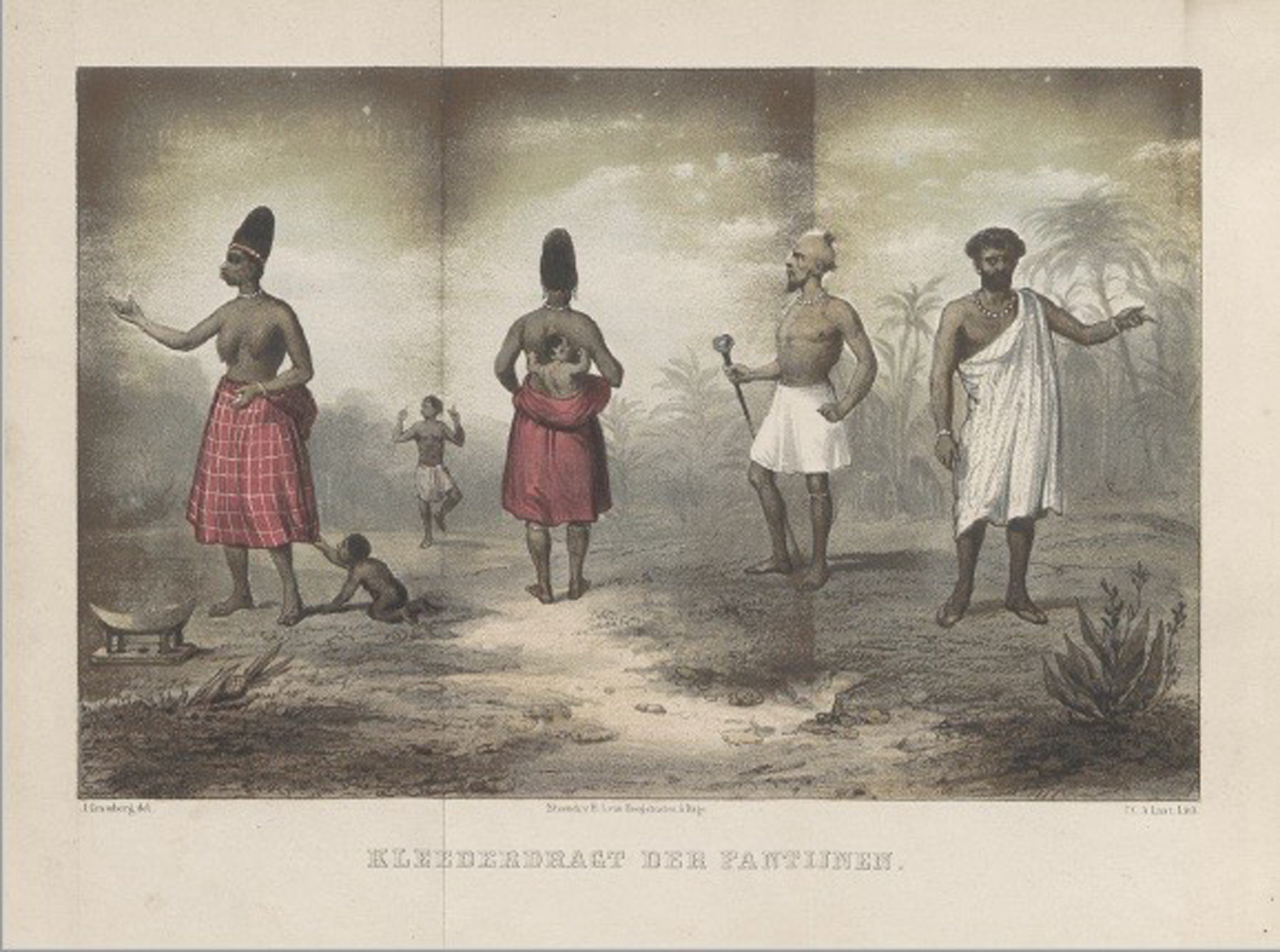
Historically, women's formal attire consisted of a mama ni lɛɛ or a wrapper cloth which may or may not cover the breasts. For women, the style of wearing the tɛklɛ differed markedly from men. While men allowed their tɛklɛ to hang down in front, women threw ‘the end to the back, where, instead, it is then rolled up into a ball so that when the large pantjes [mama ni lɛɛ] cover it, it looks more or less like a saddle’.Footnote 45 What Isert called a saddle is actually an extension of Gã and Fante women's fastened tɛklɛ which formed a pouch on women's backs and was used for strapping babies and thus allowed women to secure their toddlers while working in the fields or in the domestic space (see Fig. 1).Footnote 46 But by the first half of the nineteenth century, older women wore ‘an additional cloth, which is passed round under the arms, and meets the lower robe or petticoat, leaving only the shoulders, arms, and neck exposed’.Footnote 47 The various ways in which Gold Coast men and women dressed reflected their age, social status, and wealth, as well as their access to global trade. Isert noted that ‘[t]he kind of cloth from which the mammale [mama ni lɛɛ] is made indicates one man's wealth and privilege in relation to another's just as, among our own people, the officer is distinguished from the private soldier’. The prestige associated with the expensive mama ni lɛɛ also stemmed from the fact that by the late eighteenth century it was usually made of imported ‘coarse cotton cloth’ from ‘East India, or of printed cotton, or of chintz, or half-silk or silk cotton'.Footnote 48
Dutchman J. S. G Gramberg's ‘Kleederdragt der Fantijnen’ (‘Dress of the Fantes’).
This mid-nineteenth century watercolor painting perfectly illustrates Paul Isert's late eighteenth-century description of women using an outward extension of the tɛklɛ/danta which formed a ‘saddle’ or, more accurately, a pouch or strap which women used to secure their babies on their backs while they worked. The two women would be wearing their danta underneath the mama ni lɛɛ/ntama kɛsse.
Source: J. S. G. Gramberg, Schetsen van Afrika's Westkust (Amsterdam, 1861).
In the nineteenth century, wealthy Gold Coast men and women increasingly wore cloth made from ‘Manchester goods of silks, of velvets, and of their own rich country cloths’.Footnote 49 The emergence of reliable commercial shipping in the nineteenth century ensured that Gold Coast merchants could add ‘fresh acquisition’ of ‘mercantile novelties’ to their ‘private stock every year’ from both European and West African sources.Footnote 50 Local mercantile households had increased their importation of British-manufactured ‘Manchester goods’ which comprised ‘cottons, damasks &c’ and other ‘wearing apparel’ from £19,650 in 1846 to £82,238 in 1855.Footnote 51 Given their preeminent access to the Atlantic and global markets, Gold Coast mercantile families had access to many of these imported fabrics, beads, and clothing of diverse European, African, and Asian origins. While most Gã and Fante dressed in indigenous styles using imported fabrics, the mercantile and Euro-African elites began to adopt European fashion trends which they often fused with local elements.
European residents on the Gold Coast began taking note of these changes in the fashion tastes of the mercantile elite since at least the eighteenth and nineteenth centuries.Footnote 52 Danish physician and naturalist Peter Thonning, who lived in Osu and explored the southeastern Gold Coast between 1799–1803, noted that ‘[a]lmost all the mulattoes are tailors, and some of them also quite good’.Footnote 53 Decades later in the 1840s, British traveler James Alexander observed at the residence of a Euro-African merchant's house in Accra that all his ‘brown-skinned’ female relatives ‘wore beads round the neck; and their dress was composed of a loose white shift, without stays, which in a hot climate must be most disagreeable, and a striped wrapper round their waist, with shoes and white cotton stockings:- a mixture of European and Fantee [sic, Gã] costume’.Footnote 54 Alexander noted not only the influences of European tailoring and fashion but how Euro-African women fused these imported aesthetics and styles with local ones.Footnote 55
A few years later an equally bemused Cruickshank wrote from his base in Cape Coast that ‘the national costumes of the men and women’ of the Gold Coast ‘like everything else in their condition’ were ‘being largely encroached upon by a growing taste for our European style of dress’.Footnote 56 Cruickshank may have exaggerated the widespread use of tailored European clothing, but certainly such influences were discernible enough among sections of the mercantile elite to have attracted European commentary. Alexander and Cruickshank's separate observations of elite Gold Coast fashion both suggests their disapproval of the fusions of ‘African’ and ‘European’ clothing as incongruous and an imitation of foreign styles. The idea that Gold Coast elites were simply imitating European fashion styles much to their own detriment was quite widespread among not only white residents of the Gold Coast but some local Western-educated African intellectuals as well.Footnote 57 In all of these discussions, Europeans often failed to understand that Gã and Fante dress was dynamic and being shaped by the same forces of global commercial and cultural exchange transforming European fashion and aesthetics.
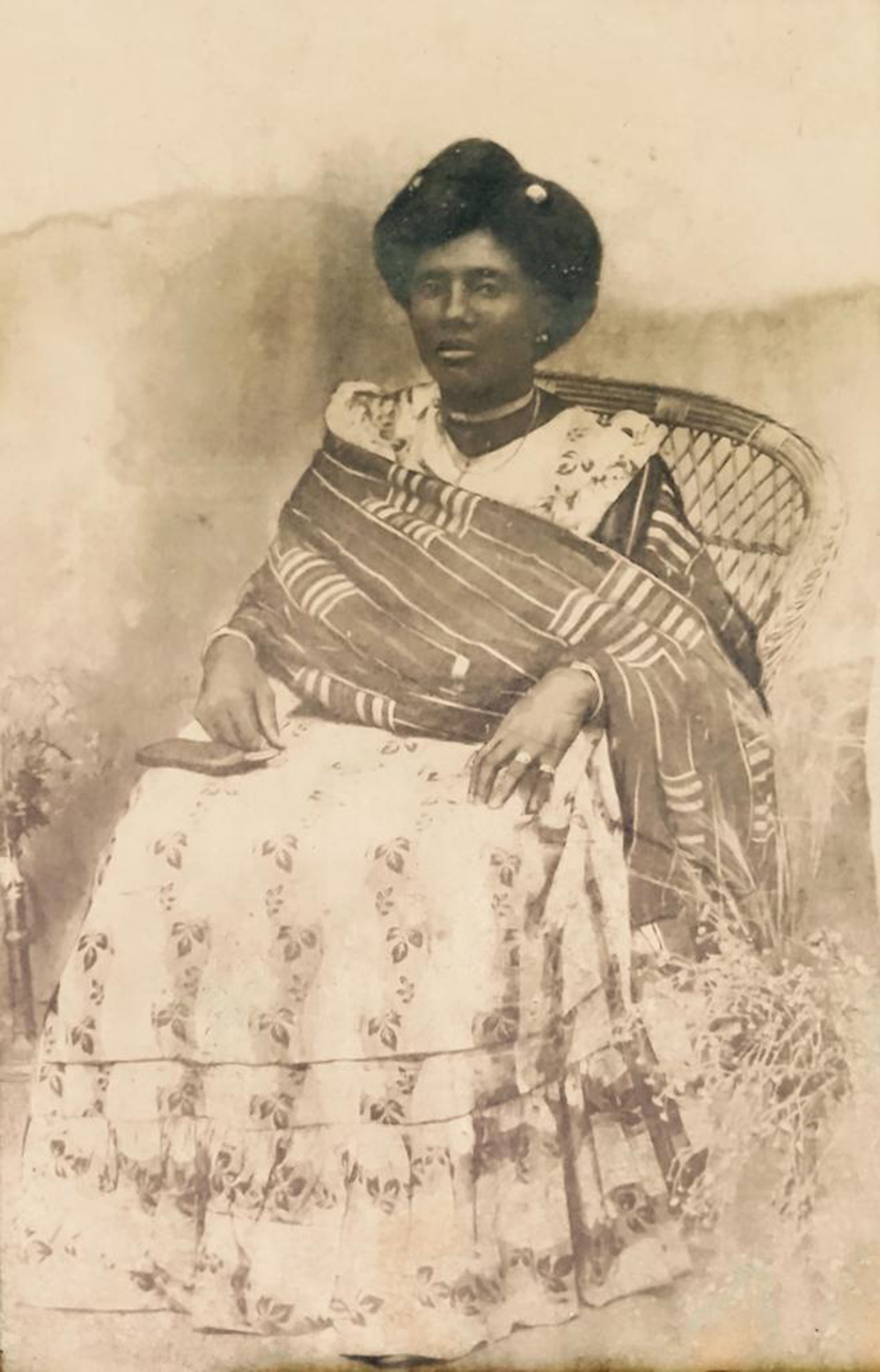
Even when the vast majority of Gold Coast Africans conformed to an ‘indigenous’ mode of dressing, such adornments were largely expressed through imported European and Indian fabrics and beads. Wealthy Gold Coast African merchants and rulers in particular used imported articles of adornment as tools to not only express their ‘privileged essence’ but also to order their social, spiritual, and material worlds in ways that were befitting of their status.Footnote 58 In this sense, Horatio Bridge's description of Yaa Hom's choice of a Victorian-style dress shows her cosmopolitan outlook and connections to global commercial circuits. Unfortunately, there is no known surviving photograph or portrait of Yaa Hom. Nonetheless, contemporary photographs of Gold Coast merchants’ spouses or daughters give us a good sense of how elite women with such global connections adorned themselves. Mid- to late nineteenth-century studio photographs like this one of Okãile of Osu, a daughter of Gã merchant Nii Okãŋte Shikatsɛ (Fig. 2 below), expresses the confidence and sense of cultural sophistication of the mercantile class. Okãile is wearing a dress made of imported chintz fabric with a kente shawl, likely custom-made and imported from Asante. Okãile's shawl is one of the earliest photographs depicting kente as a modern fashion accessory.Footnote 59 She is also adorned with rings, bracelets, a necklace, and a hairpin, all made of gold. It is likely she also wore expensive waist beads beneath her dress.
Okãile of Osu (a daughter of nineteenth century Gã merchant Nii Okãŋte Shikatsɛ) in dress made of imported chintz fabric with a kente shawl. She is also adorned with gold rings, bracelets, a necklace, and a hair pin, ca. 1890.
Source: Photograph reproduced with the kind permission of the Okantey family of Osu, Accra.
Regardless of the style or appearance of dressing, both the mama ni lɛɛ or locally-adapted European style dresses were worn over a bustle, known as otofo in Gã or antofo (atofo) in Akan.Footnote 60 Bustles were one of the most defining features of Gã and Fante women's fashion from the seventeenth to the early twentieth centuries.Footnote 61 It was therefore not surprising that during Bowdich's visit to Kumase in the 1820s, he noted that they ‘w[ore] little or no antififoo, a sort of cushion projecting from just below the small of the back in the Fantee women, by the size of which, frequently preposterous, and at all times unsightly, their rank, or the number of their children is known’. Bowdich's detailed descriptions suggest that beyond fashion, aesthetics, or sartorial choices, the otofo was crucial to Gã and Fante womanhood and gender identity.
About two and a half decades later, another British official, Brodie Cruickshank, who resided in Cape Coast and Anomabo for eighteen years, recalled that Fante women ‘occup[ied] no little portion of their time about their toilet, of which the proper adjustment of the bustle is their chief study. The size of this extraordinary appendage varies according to the consequence of the wearer, always increasing in proportion to her dignity’.Footnote 62 Imported dress and articles of adornment such as chintz, damasks, brocades, and other expensive textiles not only marked social status but were also accumulated as wealth and considered sacred. Such ‘sacred things’ were used in ritual and funerary adornments of the dead and in other rites of passage.
Adornments, commerce, and sacred ‘things’
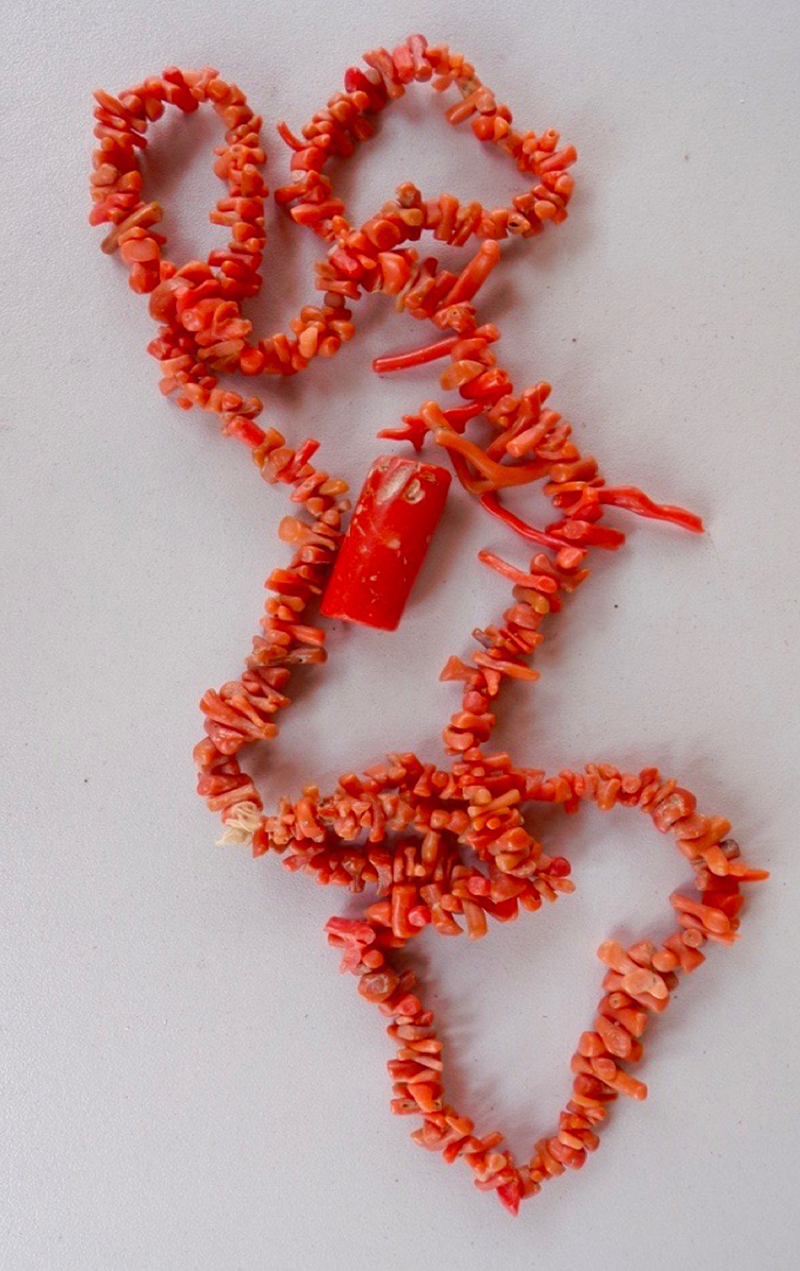
Articles of adornments obtained in Atlantic or West African regional markets could be incorporated into funerary or mortuary practices or inherited from deceased relatives. The Gã and Fante considered such articles of adornment as sacred. Late eighteenth- and particularly nineteenth-century sources make it possible to discuss these cultural processes in detail. In the 1850s William Daniell, a British travel writer, observed that local merchants in Accra imported a ‘testaceous product’ (coral), which was used in the manufacture of necklaces (coral beads) which was then in ‘vogue’ on the Gold Coast and ‘among the multitudinous tribes of the interior’. In Accra, Gã ‘fetish men and their families’ considered coral beads as ‘sacred’ and arrogated to themselves ‘the function of conservators’ for ‘all articles of aboriginal foundation’ (see Fig. 3).Footnote 63 Such an assessment could be broadened to include the major towns along the Gold Coast. Archaeological evidence suggests that imported European and regional trade goods and ceramics ‘were far more common in undisturbed articulated Elmina burials’ in pre-nineteenth and nineteenth-century contexts.Footnote 64
A nineteenth-century coral necklace.
Source: Photographed by author in January 2019 and reproduced with the kind permission of Leonard Crossland.
Despite some fluctuations in prices and perhaps quantity, the importation of beads generally increased in the nineteenth century compared to the eighteenth. For example, while the total cost of imported beads were valued at £8,660 in 1846, it cost £11,000 in 1847, £9,000 in 1848, £4,835 in 1855, and £2,200 in 1858.Footnote 65
In the African Atlantic world, articles of adornment were not just associated with commerce but also central to social status, ritual, and funerary praxis. Though copper manillas were used as currency in the Niger Delta during the peak of the slave trade, they were also required to enter the powerful Èkpè secret societies.Footnote 66 Likewise cloth currencies were used in elaborate royal burials in the Kongo in the late eighteenth century.Footnote 67 In the coastal towns of the Gold Coast and its Akan interior, imported silk (Gã: sliki; Akan: sirikye) became the preferred textile for making tɛklɛ/danta. For many Gã and Fante, sliki tɛklɛ or sirikye danta also became the undergarment of choice for deceased people and this survived into the twentieth century. Towards the end of his life, a Gã man named Archibald Mensah Wellington (1896–1987) would make a death wish to be buried in a sliki tɛklɛ. In the nineteenth and twentieth centuries such death wishes were epitomized in the popular Gã expression ‘matse sliki tɛklɛ’ or to wit, ‘I shall don the silk loin cloth’.Footnote 68 Apart from the sliki tɛklɛ, other articles of mortuary adornment very much expressed Gold Coast families’ connection to Atlantic commerce and wealth accumulation.
In 1859, a son of James Bannerman and Yaa Hom, Charles, recounted seeing the body of his deceased ‘mulatto aunt’ dressed in the ‘gayest raiment’ at Accra. The deceased was fitted with gold and other valuable ornaments in addition to ‘a [Spanish] doubloon’ ‘tied over each eye’ and laid in state in ‘a large stone house’.Footnote 69 Unfortunately, Charles did not explain the significance of tying doubloons on the eyes of the corpse. Having being raised and educated in England, Charles returned to Accra as a young man and was probably ignorant of what he observed. Several years later as a mature Accra man in 1859, Charles could still not give the full cultural details of his observation. He seemed quite detached from the funeral and described the events in very ethnographic language: ‘That [same] day she was buried, and the noise, and bristle and excitement of an African funeral were for the first time since the days of my infancy presented to my notice’.Footnote 70 Besides his odd distance from his own kith and kin, as evident in his writings, Charles's observations hint at the ritual significance of imported artifacts like the doubloon in Gã and Fante burial practices and beliefs about the usefulness of these artifacts in the netherworld (Gã: gbohiiajeŋ; Akan: nsamando). But what could Spanish gold coins or doubloons (also known as Spanish dollars) do for a Gold Coast ‘mulatto’ lady in the netherworld?
In tying a Spanish gold coin on each eye of their deceased relative, the Bannerman family portrayed the elaborate symbolism that characterized Gã, Fante, and classical Greek obsequies. The spectacular display of doubloons and gold ornaments on the body of the deceased also reinforced the popular Gold Coast belief in the importance of wealth in the afterlife. Nonetheless, the specific ritual of tying a coin on each eye of Charles's ‘mulatto aunt’ also pointed to the classical Greek custom, known as Charon's obol. The Bannerman family must have picked up this custom from European sailors at Accra or from their knowledge of the Greek classics or both.Footnote 71 In this custom, a coin or obol was paid to Charon, the mythical ferryman who transported the souls of the newly dead across the River Styx in a skiff to the netherworld.Footnote 72 While the specific placement of the doubloon on each eye suggests the Bannerman family's familiarity with classical mythology, it also complemented similar Gã and Fante beliefs. In the first decade of the nineteenth century, Hans Monrad, a Danish chaplain at Christiansborg Castle, observed at Osu and Accra that ‘Negroes’ were buried with ‘goods, beads, gold, etc. which the deceased takes with him in his coffin or grave, all the cowries used to pay for the funeral will appear in the other world, along with the deceased to his advantage’.Footnote 73 What this means is that the netherworld, though considered spiritual or ethereal, very much mirrored the material world of the living. In Gã and Fante belief at the time, grave goods were considered animate objects with souls. In that case, the spirit of the deceased could ‘put’ the goods ‘to use’ in the netherworld ‘although physically the objects remain untouched’.Footnote 74 While grave goods underscored the belief in the afterlife, such movable property also reflected the material cultural influences of Gold Coast merchants’ global commercial networks.
The choreography of placing and using Spanish gold coins as obols on Charles's aunt's eyes reinforced the social status and self-fashioning of elite merchant families as cosmopolitan and sophisticated. In the 1830s and 40s, Cruickshank observed that ‘doubloons’ were among several gold ornaments such as ‘sovereigns, figures of serpents, fish, alligators, and crosses’ that ‘completely covered the hair’ of Fante (and by extension Gã) girls undergoing puberty rites.Footnote 75 Such displays of the doubloon points to its important cultural resonance as gboshinii or egyapadze which could be used for rites of passage such as puberty rites and burials. These elaborate rituals involved the artistic reenactments of the lifestyle, vocation, or pastime of deceased persons. As a member of a wealthy mercantile family, Charles's aunt was probably an importer of luxury goods, textiles, and clothing from Europe, the Americas, or Asia. And as such was one who needed doubloons to participate in international commercial exchanges. In that regard, the funeral could be read as a celebration of the accumulative prowess of African merchant households on the Gold Coast in the eighteenth and nineteenth centuries. It is not clear from Charles's writings in which of the ‘large’ Bannerman ‘stone house[s]’ the funeral was held. But many of their family establishments, including that of James Bannerman's, had ‘some twelve or fifteen steps’ and ‘the under part forming a store house, in which everything arriving from England was deposited’.Footnote 76
While ostentatious displays of ornate exotic fabrics and jewelry were the norm in major towns along the Gold Coast, there was a wide diversity in the aesthetic displays of adorned corpses. In Cape Coast, Cruickshank observed a Fante funeral in which the deceased's body was dressed ‘with great care in the richest robes’ and ‘[t]hus appareled, it [was] then propped up in a chair or sofa, and [was] ready to receive the visits of those who come to do the honours of its burial’.Footnote 77 More importantly, ‘[s]pirits and food are placed upon a table before it, and a close observation is necessary to satisfy one that life is extinct, so closely do the arrangements resemble the ordinary occasions of show and festivity, which he was wont to observe in his life-time’.Footnote 78 The reenactment of past lives during funerals and the burial of the dead with grave goods further cemented the belief in the afterlife. The practice also reveals how imported clothing and articles of adornment were purposely combined with local aesthetics and cultural practices such as funerals to communicate prestige and economic success. In attempting to showcase their power and social status through ostentatious funerals, the surviving relatives of deceased persons often borrowed huge sums of money to please the dead. Several European ethnographic accounts recorded between the seventeenth and nineteenth centuries provide details about the ostentatious nature of Gã and Fante funerals. Many such commemorations often extended several days or even months depending on the social or political status of the deceased.Footnote 79
Historically, families were responsible for adorning their deceased relatives. More importantly, articles of adornment buried with the dead were absolutely necessary for the deceased. William Daniell observed that deceased women in Gã-speaking towns were ‘seldom interred until bedecked with a zone of [“fufua”] shells’ obtained from the Ewe and Dãŋme-speaking regions of the southeastern Gold Coast. The reason being that they would not be recognized by ‘their friends and ancestors in the next world’.Footnote 80 Apart from the fufua shells, bɔdɔm and akoso beads made from pulverized and heated imported glass or liquor bottles were used to adorn deceased relatives.Footnote 81 In that regard, many Gã and Fante believed that an uneventful funeral or lack of expensive jewelry or clothing for deceased people could provoke their anger or disappointment. For this reason, surviving relatives strove to organize expensive funerals for the dead.Footnote 82 But the spiritual and social significance given to funerals ensured that they were very expensive undertakings and also a major source of indebtedness for many Gã and Fante families.Footnote 83 Wealthy deceased people with private wealth could usually be adorned in their own expensive clothing or jewelry. Elite women could also be dressed in articles bequeathed them during their marriage to wealthy husbands. For example, upon her death in 1845, a certain Abenaba Kwessel of Cape Coast was adorned and buried with ‘one string’ of ‘Coral Beads’. It was likely the family also adorned her with a bunch of ‘silver keys’, that her British husband, a Mr. Scott, had given her as a marriage gift.Footnote 84
Like funerals, marriages and other rites of passage were important occasions for self-fashioning. By the seventeenth and eighteenth centuries, imported ornamental keys had become important fashion accessories for elite West African women. On the Gold Coast and elsewhere on the West African coast, particularly in Senegambia, European men gifted ornamental keys made of gold, silver, or brass to their African wives and these became important status symbols.Footnote 85 In many cultures along West Africa's Atlantic coast, keys and locks functioned as objects through which desires were spiritually brought to fruition.Footnote 86A bunch of keys would have been a perfect metaphor to celebrate interracial marriages, since such unions conferred trade concessions and economic opportunities for the couple and their respective communities.Footnote 87 As early as the end of the sixteenth century, Dutchman Pieter de Marees, observed that Gold Coast African women put imported European keys ‘together in a bunch and hang on their bodies’ but such artifacts were brought in ‘such quantities that they were no longer wanted or valued'. The reason being that the ‘keys did not fit their [Gold Coast African] wives’ chests’.Footnote 88 De Marees's observation is one of the earliest accounts of ornamental keys and its connection to marriage. Rather than dying out as de Marees observed in about 1602, the ‘tradition’ of keeping imported keys persisted throughout the eighteenth and nineteenth centuries.Footnote 89
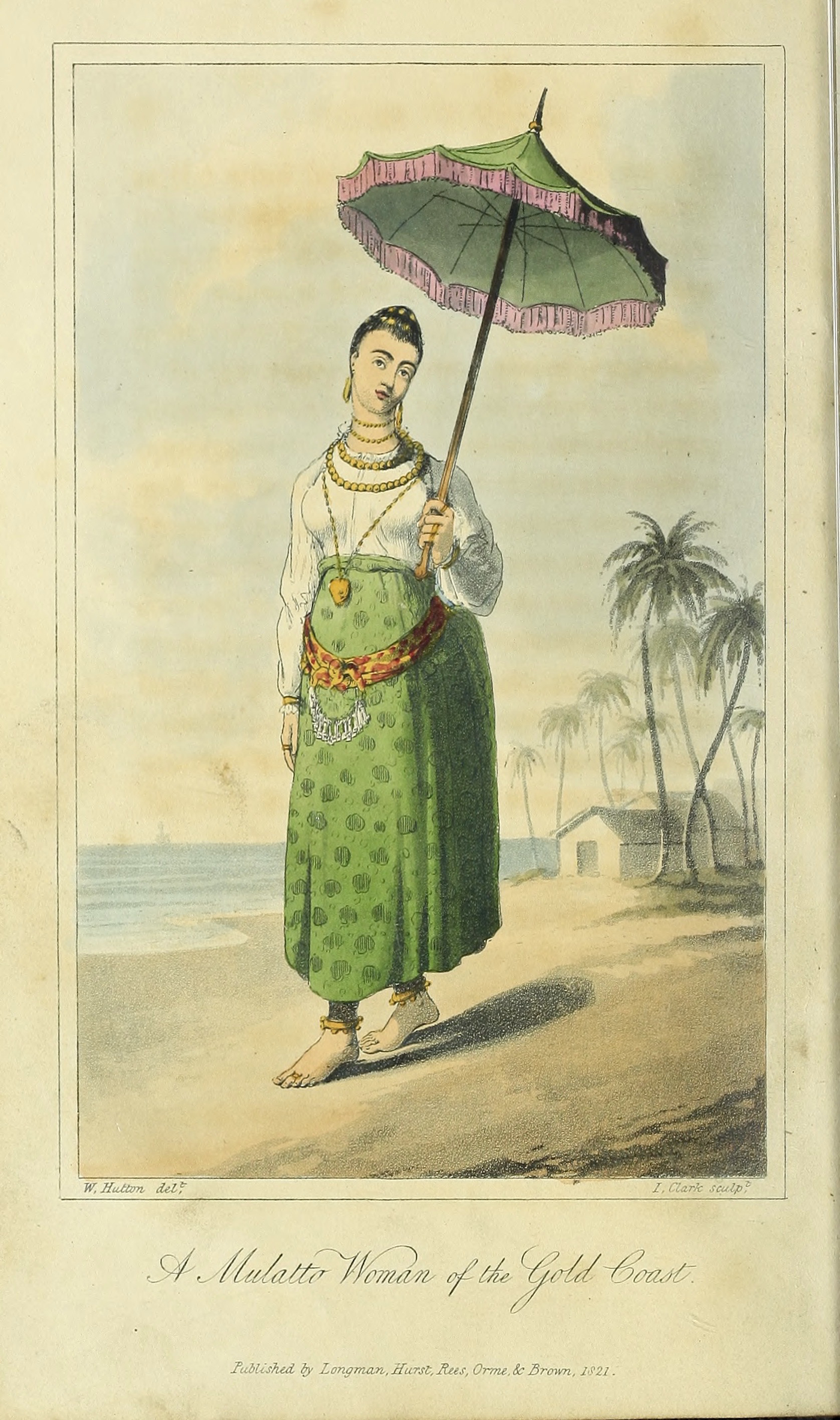
In the 1780s, Paul Isert observed at Osu and Accra that ‘[i]n the knot in front of the Regio Critica [critical area] hangs a large bunch of silver keys, small bells and Spanish thaler [doubloon], which makes a jingling sound while the woman is walking so that one can hear her at a distance of some hundred paces when she appears in public’.Footnote 90 At the beginning of the nineteenth century, the wearing of keys around the girdle was still popular among elite African and Euro-African women. In an engraving in his travelogue published in London in 1821, William Hutton depicted a ‘Mulatto Woman’ of the Gold Coast wearing an imported white long-sleeved blouse, a long skirt of chintz fabric with a traditional Gold Coast-style bustle underneath, and a colorful girdle with a bunch of hanging silver keys. These valuable materials were used as trade goods or marriage gifts (See Fig. 4 below). In the 1850s, William Daniell wrote that a ‘bunch of keys’ were part of ‘gifts of connubial import’ that was central to the consummation of marriages between European and Euro-African or African women on the Gold Coast.Footnote 91 By the mid to late nineteenth century, elite women still wore a bunch of silver keys ‘suspended’ on the ‘girdle by [their] side’.Footnote 92 The exchange of gifts of clothing and jewelry during marriage ceremonies ensured that families not only accumulated more wealth but also had enough articles of adornment to perform other public rites such as funerals and puberty rituals.
An engraving of a Euro-African woman of the Gold Coast with a bunch of silver keys tied to her girdle, resting on her bustle. Some of the gold ornaments in her hair may include Spanish gold doubloons.
Source: William Hutton, A Voyage to Africa, 1821.
In the eighteenth and nineteenth centuries, the public display of adornments of foreign origin remained an important cultural feature of rites of passage ceremonies on the urban Gold Coast. But this cultural requirement also shows the deep social disparities on the Gold Coast in an age of Atlantic commerce. In hindsight, such cultural displays help us understand the dynamics of social inequality and the unequal local access to wealth flows from the Atlantic world. In dressing up for public events, Paul Isert noted in the 1780s, wealthy or noble Gã women in the late eighteenth century adorned themselves with ‘masses of strings of beads made of multi-coloured glass, or of shells from a species of small snail obtained from the Assianthee [Asante] kingdom, or of blue lapis lazuli or polished agate, etc’. These beads were worn in combination with ‘silver or even gold bracelets’ with ‘pendants of gold pieces, such as louis d'or or Johannes, which they obtain by trade with the Europeans’. It is important to note that the lapis lazuli originated from Afghanistan and could have been obtained via trans-Saharan or transatlantic sources or both. Noble women also wore gold and silver rings and ornaments on their ‘fingers and toes’ as well as a ‘stout anklet fashioned from silver which can weigh from 16 loth to pound’.Footnote 93 Given all the expensive accoutrements a woman had to portray to be considered well-attired for a public function, many from wealthy families simply wore valuables that they had inherited from their ancestors.
Poorer families with little or no accumulated ‘things’ would often borrow articles of adornments from wealthy families. For poorer families, this act of borrowing enabled them to aspire to elite status or to symbolically present themselves as people of means. By doing so, non-elites who could not afford these material goods could still satisfy their own fashion tastes and cultural needs. However, the frequent borrowings of articles of adornment and textiles were based on relationships of dependency and reciprocity between the wealthy and the poor. But these relationships of trust were often strained or extinguished when borrowers of expensive articles of adornment failed to return them or alienated them without the owners’ knowledge. Police and court records from Accra and Cape Coast from the mid to late nineteenth century suggests that theft of expensive articles of adornments by borrowers were not uncommon.Footnote 94 In one such court case from 25 May 1858, a Gã realtor and merchant, William Addo, sued a woman named ‘Hep’ in an Accra court for theft. ‘Hep’ had borrowed ‘24 coral beads and a silver waist chain [read: girdle]’ from Addo for the purpose of adorning herself at a ‘custom’. In European sources, the term ‘custom’, is usually a direct translation of the Gã/Dãŋme and Akan terms, ‘kusum’ and ‘amamerɛ’, respectively. These terms referred to any African gathering or performance of a ritual, festive, funerary, or religious nature. It is not clear from the legal suit which of these ceremonies ‘Hep’ attended or if she indeed attended any custom at all. In her pleas in court, ‘Hep’ stated that she had ran into ‘debt’ and had to ‘pawn’ Addo's property to a man in ‘Dutch Accra’ named Laate.Footnote 95 Though ‘Hep’ produced the 24 coral beads, she couldn't produce the ‘silver chain’. Consequently, the court sentenced her to two weeks imprisonment for knowingly ‘pawning property which did not belong to her’. The ornaments, particularly the silver waist girdle, Addo lent to ‘Hep’ were probably heirlooms inherited from a female ancestor or relative. Though not a woman, Addo's possession of inherited female jewelry would have been a source of family pride as well as social and economic capital and a statement of self-fashioning in public spaces.
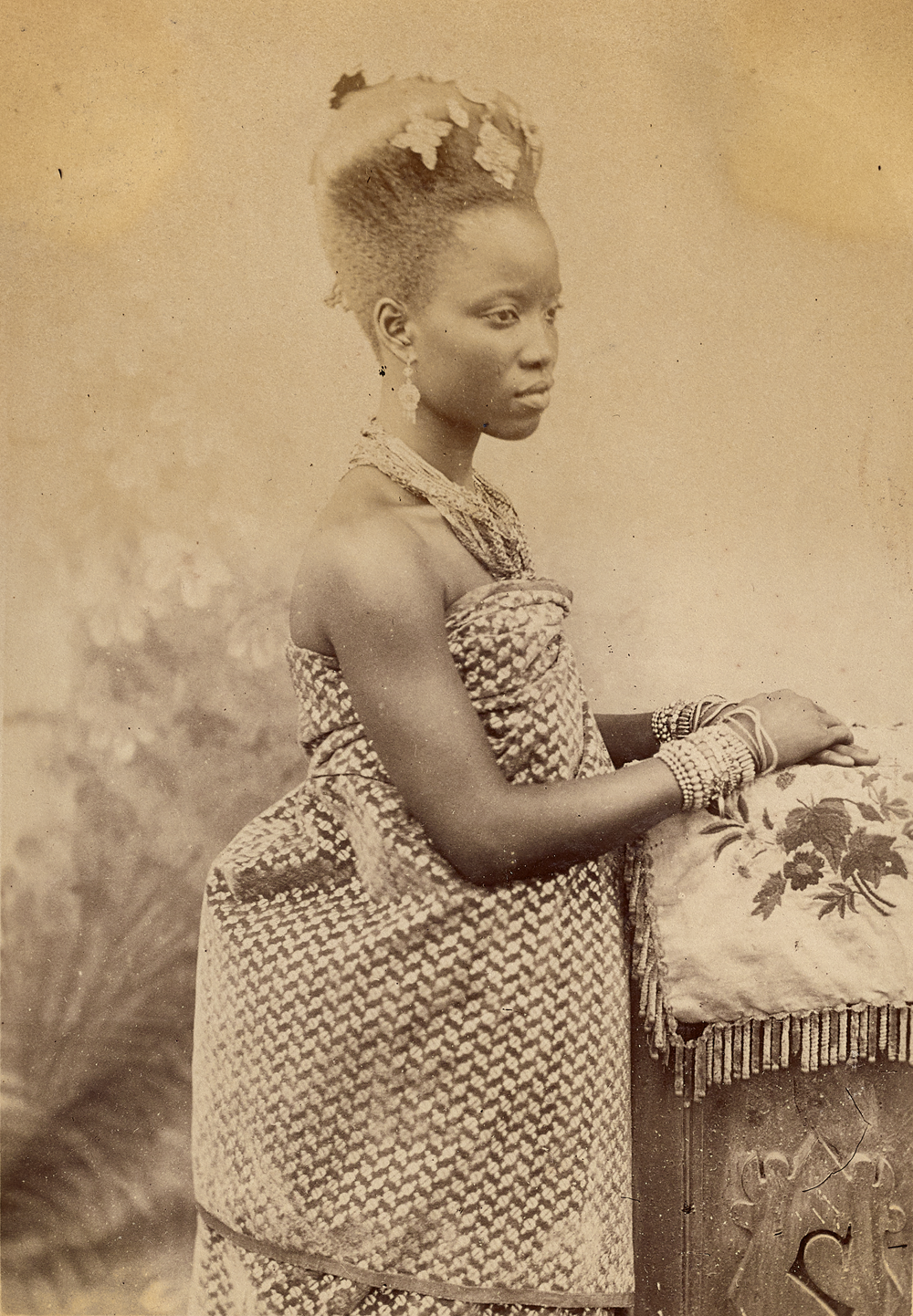
The rich ethnographic descriptions of articles of adornment in European travelogues, court records, and nineteenth-century photographs makes it possible to historicize the dynamic meanings that the Gã and Fante accorded public self-fashioning. In the late nineteenth-century photograph of a ‘Young Fante woman’ below (Fig. 5), the unknown photographer may have attempted to capture for posterity the splendor of what it meant to dress up for a custom at the time. The photograph may have originated from a local photo studio in Cape Coast. The picture depicts the ubiquitous Gã and Fante onion-shaped oduku or tekua hairdo with gold ornamentation as well as beaded necklaces and bracelets for a public ‘custom'.Footnote 96 In this picture the girl is dressed in an expensive mama ni lɛɛ/ntama kɛsse and not a tailored dress. Despite the increasing popularity of locally tailored clothing on the Gold Coast by the late nineteenth century, certain forms of public ‘customs’ required the wearing of mama ni lɛɛ/ntama kɛsse. While the inhabitants of major towns such as Cape Coast, Elmina, Osu, and Accra had options to wear cloth or tailored clothing, the scanty or revealing nature of the former often came under racist European and missionary scrutiny.
Young Fante woman, Cape Coast, Ghana.
Source: Photographer unknown, c. 1885–1910, Ghana Photographic Album, EEPA 1995-018-0002, Eliot Elisofon Photographic Archives, National Museum of African Art, Smithsonian Institution.
In describing what girls typically wore in Cape Coast for their puberty rites, in the 1840s, Cruickshank's observations were a mixture of admiration and prejudiced value-judgement. He noted that:
[W]ith the most extraordinary care in rich silks, borrowed in many instances for the occasion. Her hair is completely covered with golden ornaments, consisting of doubloons, sovereigns, figures of serpents, fish, alligators, and crosses. Chains of gold hang down over her bosom, which is left uncovered, and her tawny skin is exquisitely painted in very delicate lines of white chalk, giving her the appearance of having on a tightly fitting vest of the finest lace. Armlets and anklets of gold encircle her wrists and feet, while the silk robe extending from the waist to the ankle is gracefully fitted over a neat bustle, and compressed by means of a broad silk girdle around her loins. There is often an appearance of great elegance in the naked simplicity of this attire; well suited to set off to advantage the trim little figures of the young virgins, whose delicate features, sparkling eyes, beautiful teeth, soft velvety skin, and fine rounded breasts, greatly add to the charm of their appearance.Footnote 97
When one takes Cruickshank's remarks at face value, it may simply come across as a compliment. But a careful reading suggests not only his ethnocentric condescension but also the moralizing and sexualized tone of his writing. His deliberate distancing from his objects also betrays the fact that he had been immersed in Fante culture and language for eighteen years. In Cruickshank's view, Fante dress ‘often’ had ‘an appearance of great elegance’ because of its ‘naked simplicity’. Evidently, while the ‘young virgins’ comfortably expressed their self-fashioning in their non-tailored clothing, Cruickshank exoticized their attire and regarded it as inferior to sewn dresses. Despite the moralizing tone in Cruickshank's writing, he was also clearly sexualizing the so-called ‘young virgins’, whose ‘fine rounded breasts’ according to him was nothing more than an additional charm to their appearance. But despite the racist scrutiny of European observers, Africans and Euro-African elites appropriated imported or locally-made tailored clothing, textiles, and fashion accessories on their own terms and in accordance with their cultural needs.
Moralizing the body: missionary discourses and African self-fashioning
By the 1830s, the Evangelical Missionary Society of Basel and the Wesleyan Methodists — two of the largest missionary organizations on the Gold Coast — often expressed cynical views about ‘indigenous’ clothing. Apart from attempting to convert the Gã and Fante to Christianity, European missionaries also brought with them ideas about modesty, respectability, and what they deemed ‘proper’ dressing etiquette, especially for African women. Christian missionaries considered the revealing nature of the mama ni lɛɛ/ntama kɛsse and the fact that loin cloths left the torso uncovered as a form of nudity and sign of moral depravity. For the wives of European missionaries, tailored clothing for African women was crucial in propagating their pietist ideas of middle class femininity and respectability.Footnote 98 While the idea of clothing as a vehicle for expressing respectability increasingly resonated with Gold Coast Africans, the latter's notions underpinning these ideals were different. For the masses of urban dwellers on the Gold Coast, missionary dress gave them more options to express cosmopolitan respectability and sophistication. This local appropriation of missionary dress culture was far removed from Christian attempts to use tailored clothing as a channel for upholding pietist and Victorian ideas of modesty and respectability. In line with these ideals, the Wesleyan and Basel missionaries promoted sewing and tailoring in their girls’ boarding schools in Osu, Abokobi, and Cape Coast by the 1850s. Prior to this point, some decent dressmaking and tailoring had existed in the major towns along the Gold Coast littoral. But tailoring was practically absent in the immediate hinterland of Accra until the 1860s and 1870s, when the Basel Missionaries effectively introduced dressmaking in Akuropɔn, the capital of the Akan-dominated Akuapem state.Footnote 99
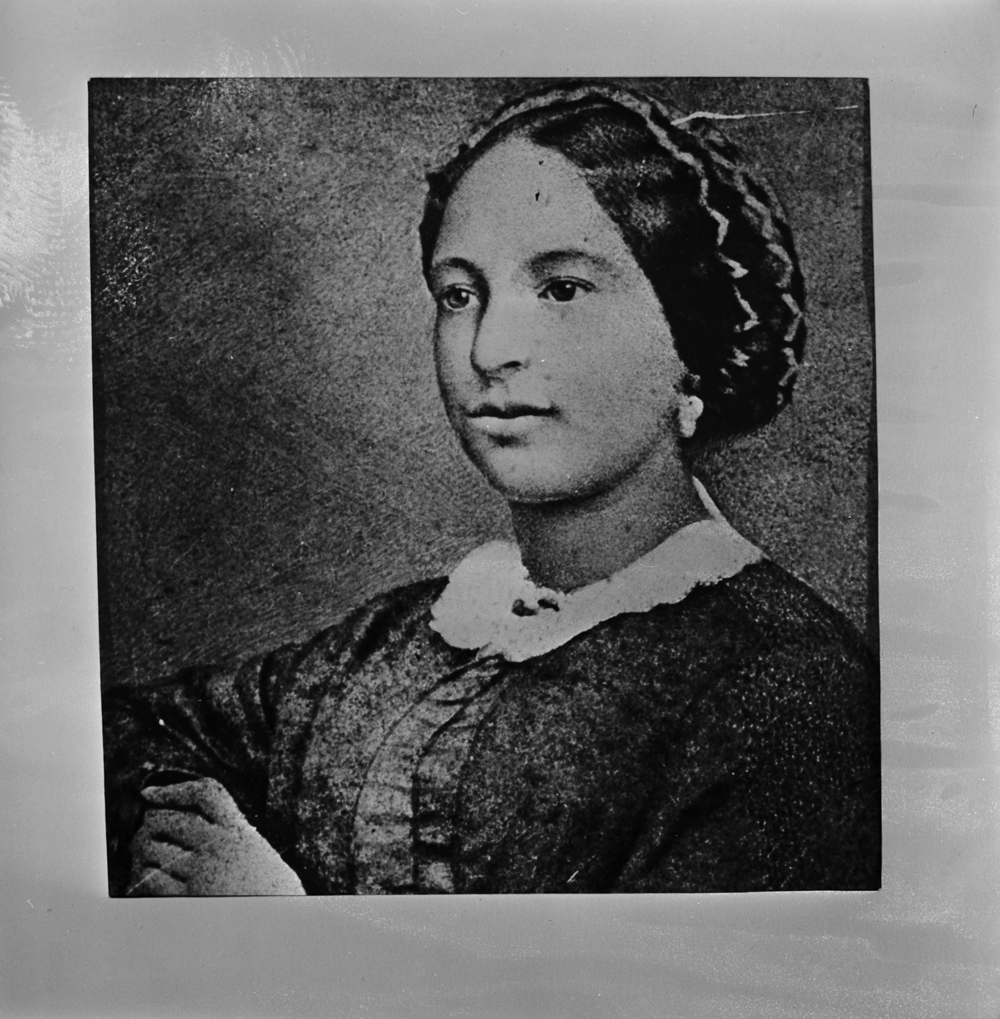
While the missionaries considered dressmaking as the domain of women and girls, that vocation became a marked feature of female Christian converts. By the second half of the nineteenth century, evidence of missionary influence in Gold Coast women's fashion became more discernible in photographs. Missionary influence in local fashion provided Gold Coast women with more sartorial choices. In separately discussing the apparent sartorial differences and hairstyle choices between different generations of Euro-African Christian (or ‘christianized’) women on the Gold Coast and Senegal, historians Pernille Ipsen and Hilary Jones have argued that such styles went in a more European direction.Footnote 100 Ipsen maintained that Wilhelmine Josephine Wulff (born c. 1840), a daughter of Gã-Danish woman, Sara Malm (c.1815–98) and Wulff Joseph Wulff (1809–42), a Danish Jewish administrator at Christiansborg Castle, abandoned her mother's headdress in favor of ‘European-style coiffures with ribbons or hairnet’ (see Fig. 6).Footnote 101 But a careful reading of a broad set of photographic and contemporaneous ethnographic evidence from the Gold Coast suggests less of a linear transgenerational transition in dress or hairdo among Euro-African or Christian women.
Wilhelmine Josephine Wulff, daughter of Sara Malm and Wulff Joseph Wulff.
Source: Reproduced with the kind permission of Museum Østjyland, Randers, Denmark.
For example, in Wulff's watercolor painting below (Fig. 7) of his wife, Sara Malm in the 1830s, he provided some detailed ethnographic notes about her attire and how it supposedly differed from other contemporary Euro-African women in Osu. Wulff noted that these Euro-African women in Osu and Accra, ‘often go without shirts, thus, fully exposed, they usually paint their [upper] bodies with white colouring, drawing all manner of figures on their necks, shoulders, arms, breasts and backs’.Footnote 102 Wulff's description of topless Euro-African women in Osu/Accra in the 1830s may at face value contradict earlier accounts of mixed-race denizens wearing tailored clothing or drawings of ‘fully clothed’ women from the urban Gold Coast. But it's likely these women were at a kusum or ‘custom’. In this case, these christianized Euro-African women would wear ‘indigenous’ rather than ‘Europeanized’ clothing. Just like in contemporary Ghana, the kind of public occasion determined the attire people wore or expressed themselves in.
Sara Malm with gold necklaces, bracelets, anklets, and ornaments in her oduku hairstyle. Her dress neatly blends European and Gold Coast influences. Watercolor by Wulff Joseph Wulff.
Source: Reproduced with the kind permission of Museum Østjyland, Randers, Denmark.

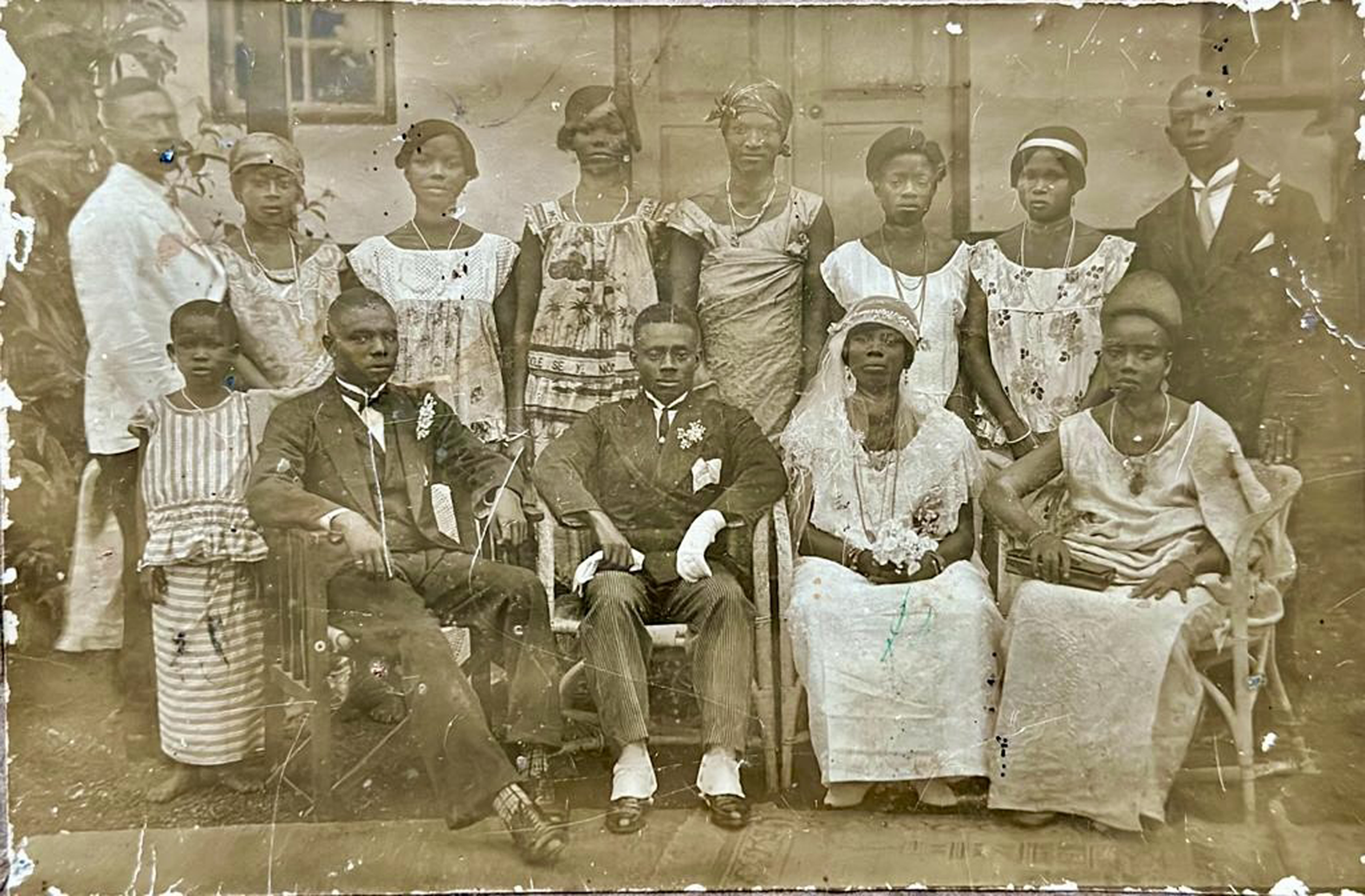
Furthermore, photographic evidence from the late nineteenth and early twentieth centuries depict women styled in older coiffures and fashion styles. Indeed, family photographs of some of Sara Malm's relatives from the early1900s, show that Christian women wore the indigenous conical or onion-shaped oduku or tekua hairstyle into the twentieth century.Footnote 103 In the above photograph (Fig. 8.) taken around 1914 in Osu, my great-grandmother, Sarah Malm (1893–1978) — a great-great-grandniece of Wulff's wife, Sara Malm, seated on the extreme right near the bride — is seen wearing an oduku hairstyle. In this picture, the female wedding guests and relatives of the newly wedded couple are dressed in a ‘modest’ missionary-influenced cover-shoulder blouse known locally as kaba srotu. The men are in tuxedos. All these self-fashioning statements do not necessarily represent a transgenerational transition in dress, but rather evidence of increasing sartorial options and fashion tastes made possible by Atlantic commerce and missionary dressmaking.
The author's great-grandma Sarah Malm, seated to the right at a wedding in Osu, was a great-great-grandniece of Sara Malm. Studio Photography, c.1914–8.
Source: Reproduced with the kind permission of the estate of the late Christian Lebrecht Malm-Hesse (1914–2000).
Despite the often ethnocentric motives informing European dress culture, missionary- inspired local fashion rather provided greater options for non-elite women and girls to expand their couture and aspire to upward social mobility. Carl Christian Reindorf (1834–1917), a Gã-Danish historian and clergyman, cynically noted that ‘[t]he lower classes imitate [upper class women] with the mistaken idea that to go in a European dress is to play the lady, and that, as soon as one puts on dress, she is to live as the rich ladies’.Footnote 104 But Reindorf's frustrations could be read as Gold Coast women expressing self-fashioning and elite aspirations beyond the moral constraints of the Basel Missionaries. Reindorf contrasted an image of docile educated rural women who wore ‘dresses’ and yet did work meant for the ‘uneducated’ only ‘to be laughed at by coast ladies’. Reindorf also believed that in Sierra Leone and Lagos ‘women of lower classes put on their dresses and do all that others do in their country’. So far as Reindorf was concerned Lagosian and Sierra Leonean women ‘keep to the principles which had been implanted in them, but not one of the Gold Coast ladies keeps to the principles in which she was trained’.Footnote 105 Reindorf's views may reflect missionary prejudices and frustration at the lack of patriarchal control over Christian women's self-fashioning. But at the same time, missionary discourses such as these enhance our understanding of different ways in which Gold Coast men and women transformed their fashion tastes prior to the twentieth century.
Conclusion
Gold Coast mercantile families not only participated in Atlantic commerce and the global textile trade, but also transformed their fashion tastes to suit their own cultural needs. These continuities and transformations in Gã, Fante, and Akan dress during the Atlantic era were not unique but rather expressive of their broader cultural dynamism. Prior to the emergence of Atlantic commerce, trans-Saharan routes provided imported access to foreign textiles, beads, and other articles of adornment. Despite the global inequities that structured Atlantic commerce, it provided a similar commercial and cultural function as the trans-Saharan trading system. In this sense European and global cultural influences in dress were neither unique nor evidence of Gold Coast African elites becoming ‘Europeanized’, ‘creolized’, less ‘African’, or simply ‘imitators'. Such arguments tend to privilege European culture in global encounters with Africa and Asia in ways that almost completely mutes how African agency and consumption patterns shaped and informed the circulation and production of goods.Footnote 106 In the context of the global textile trade, African and European dress cultures were both being shaped by these exchanges and aesthetics.
In the case of the Gold Coast, changes and continuities in dress culture serves as a prism to examine the cultural, economic, political, and religious history of the region. For the Gã, Fante, or Euro-African elite, imported European or Asian textiles, clothing, and beads were crucial in the ways they communicated respectability and economic success through rites of passage or public ‘customs’. By incorporating foreign articles of adornment into their dress culture and aesthetics, Gold Coast Africans were able to express cultural aspirations and agencies rooted more in African than in European cultures. In that vein, Gold Coast importers were not passive actors in the vast European-dominated imperial commodity network that connected Asia and Europe to Africa, but also shaped global supply chains. These Gold Coast African re-creations of imported and locally produced articles of adornment would spawn a truly ‘[m]odest, but peculiar [s]tyle’, not only in the nineteenth century Gold Coast as Horatio Bridge observed, but also in contemporary Ghana.
Acknowledgements
Earlier versions of this paper benefited from conversations, comments and feedback I got from my friends and colleagues: Jim Sweet, Larry Yarak, Leonard Crossland, Jim Sidbury, Pernille Ipsen, Bright Gyamfi, Mauro Nobili, Daniel Domingues da Silva, Kweku Darko Ankrah, and Ernest Sewordor. My time as a Mellon Sawyer Seminar Postdoctoral Associate at Rice University in the 2021–22 academic year made it possible for me to write this article. I can be contacted on vonhesse@illinois.edu.


 Open access

