


1. Introduction
Ice streams are regions in a grounded ice sheet which flow much faster than the surrounding ice. These arteries of fast- flowing ice radiate out from the interior and are arguably the most dynamic feature contained within it. In general, contemporary ice streams are characterised by large dimensions (typically > 20 km in width and > 150 km in length) with a highly convergent onset zone feeding a main ice- stream channel. Ice streams are also characterised by their rapid velocities, typically flowing at speeds greater than 300 m a —1. Such high velocities are in sharp contrast to the slower-moving ice which borders the ice stream and this creates an abrupt, narrow shear margin. Two further characteristics of contemporary ice streams, although not necessarily exclusive to them, are pervasively deformed till, which may play a role in reducing the basal friction of the ice stream (Reference Engelhardt, Humphrey, Kamb and FahnestockEngelhardt and others, 1990) and offshore sediment accumulations or “till deltas”, which are thought to be a direct result of ice-stream sediment deposition on continental shelves (Reference Alley, Blankenship, Rooney and BentleyAlley and others, 1989). For a thorough review of contemporary ice streams, see Reference BentleyBentley (1987).
In Antarctica, many ice streams have been identified. Here, it is thought they may contribute to as much as 90% of its drainage (Reference Morgan, Jacka, Akerman and ClarkeMorgan and others, 1982). They also play a significant role in the dynamics of the Greenland ice sheet. For example, the largest ice stream in Greenland, Jakobshavn Isbræ is thought to account for as much as 6.5% of the total ice-sheet drainage (Reference Iken, Echelmeyer, Harrison and FunkIken and others, 1993). Most of these contemporary ice streams can be broadly classified as either “pure” or “topographic”. Pure ice streams do not appear to lie in bedrock troughs, whereas the location of topographic ice streams is largely constrained by the underlying bedrock topography. Our understanding suggests that pure ice streams are confined to West Antarctica, particularly the five Siple Coast ice streams (A—E), which feed the Ross Ice Shelf. However, a “rapid flow feature”” has been identified in north-east Greenland (Reference Fahnestock, Bindschadler, Kwok and JezekFahnestock and others, 1993) and this is of interest since it may be the only contemporary pure ice stream outside the Siple Coast system. Topographic ice streams are more synonymous with outlet glaciers and have a much wider range of locations, draining large parts of East Antarctica and Greenland. In terms of finding former ice streams, Reference Marshall, Clarke, Dyke and FisherMarshall and others (1996), argue that topographic ice streams may leave little or no geological imprint, but instead, should be easily identified by topographic maps of suitably high resolution, provided that ice thicknesses can be readily reconstructed. Hence, this paper deals only with pure ice streams, since topographic ice streams should be easier to infer on the basis of topography and reconstructed ice-sheet geometries.
Ice streams are thought to have played important roles in the dynamics of former ice sheets and finding their locations is of great importance for a number of reasons:
-
(1) Their huge ice flux would have had a profound effect on ice-sheet configurations, including drainage basin and ice-divide locations. Finding their locations is thus of major importance for reconstructing ice-sheet geometries.
-
(2) It is difficult and expensive to study the beds of contemporary ice streams. Former ice-stream tracks provide an ideal opportunity to glean information about the processes occurring beneath ice streams.
-
(3) Their interactions with climate are of crucial importance, not only when reconstructing past climate change, but also for predicting the response of contemporary ice sheets to future climate perturbations (e.g. the West Antarctic ice sheet).(4)
-
(4) Their huge sediment flux is comparable with the largest fluvial systems. Extremely large sedimentary submarine fans are often produced at ice-stream termini, for which their structure and stability have implications for mineral exploration and potential geohazards.
Many workers have postulated the locations of specific ice streams within the last ice sheets. The main inhibitor to this research is that geomorphological evidence of ice-stream activity is quite poorly understood. A consequence of this is that hypothesised former ice streams have often outweighed meaningful evidence for their existence. To address this problem, there is a need to develop geomorphological criteria which can aid the identification of ice streams in formerly glaciated areas. This paper attempts to review and outline the main geomorphological indicators of fast flow, produced by former ice streams. These can then be used to build a conceptual land-systems model of the geomorphological signatures left behind by ice streams.
A logical basis for the development of such criteria can be found in the fundamental characteristics of contemporary ice streams. Some of these characteristics may be manifest in the glacial geomorphological record produced by an ice stream. Thus, theories of glacial geomorphology, coupled with research on contemporary ice streams, can provide information for developing geomorphological criteria to identify former ice streams. Individual criteria may not necessarily be exclusive to ice-stream activity, but collectively they can be thought of as comprising a characteristic land system, adding weight to our inference that they were sculptured by ice streams. A simple land-systems model can then be used as an observational template upon which hypotheses of former ice streams can be better based.
2. Hypothesised Former Ice Streams: A Brief Review
The main problem in the past was that many former ice streams were prescribed on a rather ad hoc basis, without substantial evidence. This is particularly true for whole ice- sheet reconstructions where ice streams have often been incorporated rather liberally (e.g. see Reference Denton, Hughes, Denton and HughesDenton and Hughes, 1981, Fig. 8.11, where ice streams were prescribed mainly from trough topography and ice-sheet geometry). More recently, ice-sheet-scale modelling has demonstrated that the locations of pure ice streams in the Laurentide ice sheet may have been controlled by soft deformable sediments. Reference Marshall, Clarke, Dyke and FisherMarshall and others (1996) note that their ice-stream likelihood maps of North America and Canada look very similar to geological maps which depict areas of deformable beds. Thus, certain bed conditions may predispose areas of an ice sheet to ice streaming. This has profound implications for contemporary ice-stream research and recent geophysical evidence from West Antarctica appears to support this argument, suggesting that the locations of the Siple Coast ice streams may in some way be controlled by the underlying bedrock geology (Reference Anandakrishnan, Blankenship, Alley and StoffaAnandakrishnan and others, 1998; Reference BellBell and others, 1998). However, ascertaining the extent to which pure ice streams are controlled by bedrock geology represents a major challenge to ice-stream research and it should be noted that other modelling work has demonstrated that neither soft sediments or topographic troughs are required for ice streaming (Reference Payne and BaldwinPayne and Baldwin, 1999). Rather, it is suggested that ice streams can arise solely from the ice sheet’s internal glaciological dynamics.
On a smaller scale, specific ice streams have been postulated from a number of ice sheets, based on a variety of evidence. Table 1 contains a selection of hypothesised former ice streams along with the key evidence used in their identification. It can be seen that not only have ice streams been postulated from a variety of locations, but more importantly, that a variety of evidence has been used which has often evaded detailed scrutiny.
Selection of hypothesizedformer ice streamsfrom a variety of former ice sheets indicating the main lines ofevidence used in their identification.
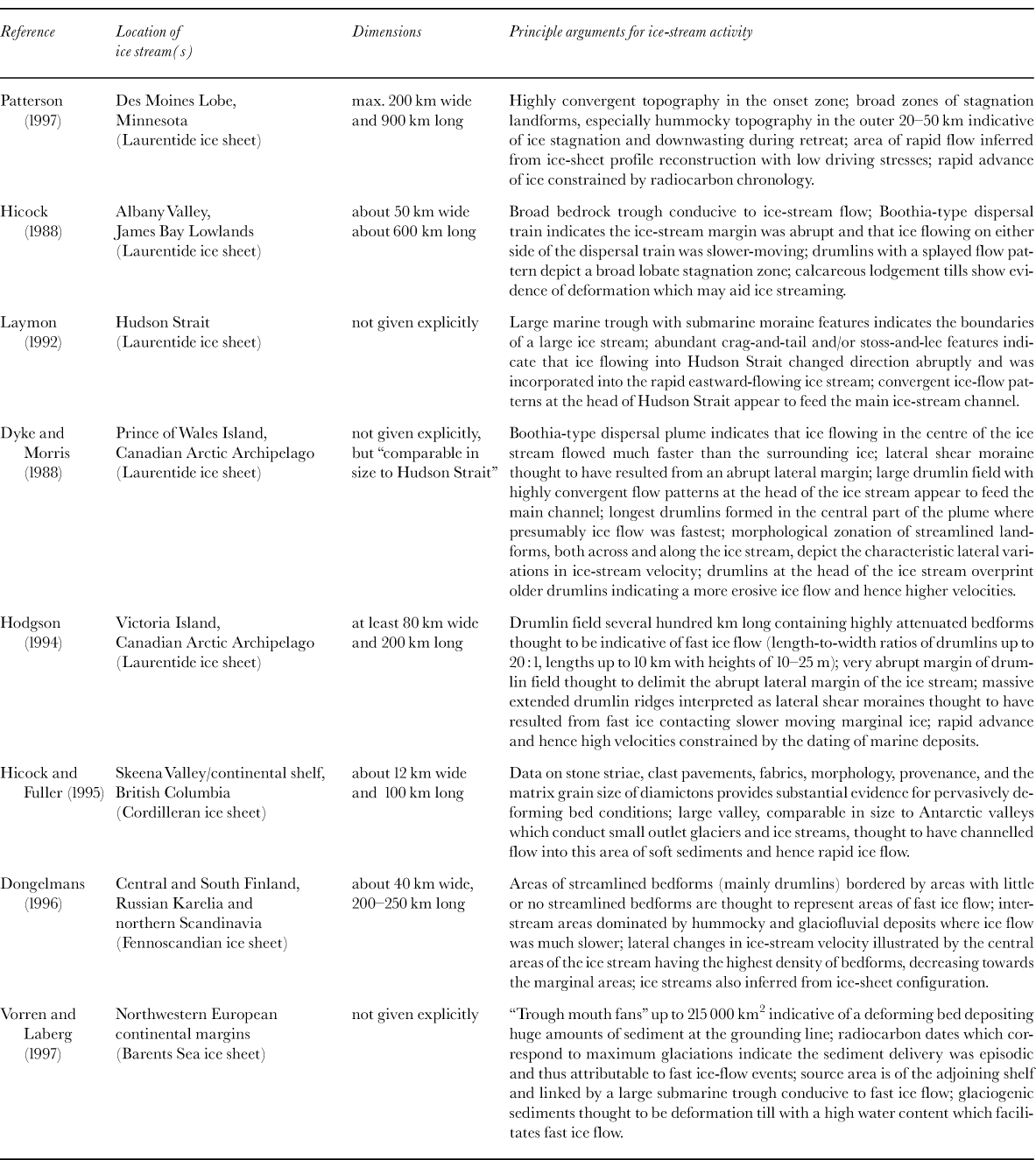
The now exposed area once covered by the Laurentide ice sheet has provided many clues to the existence of former ice streams and some workers have postulated that the southern margin of the Laurentide ice sheet may have been drained by terrestrial ice streams (e.g. Reference HicockHicock, 1988; Reference PattersonPatterson, 1997, Reference Patterson1998). Former ice streams have also been hypothesized in the Canadian Arctic Archipelago (Reference Dyke and MorrisDyke and Morris, 1988; Reference HodgsonHodgson, 1994), but such propositions are in no way restricted to the Laurentide ice sheet. Hypothesized ice streams have also been proposed in the Cordilleran ice sheet complex (e.g. Reference Hicock and FullerHicock and Fuller, 1995; Reference EvansEvans, 1996), the British and Irish ice sheets (e.g. Reference Merritt, Auton and FirthMerritt and others, 1995; Reference Knight and McCabeKnight and McCabe, 1997), the Scandinavian ice sheet (e.g. Reference PunkariPunkari, 1995; Reference DongelmansDongelmans, 1996) and more recently, the Svalbard— Barents Sea ice sheet (e.g.Reference Vorren and LabergVorren and Laberg, 1997).
Thus, it can be seen that many attempts have been made to verify the existence of specific ice streams. However, the development of criteria to identify them is an essential prerequisite to such propositions. This point was noted by Reference MathewsMathews (1991), who emphasised the need for criteria: “Still other candidates for ice stream tracks may be found within the network of channels between the islands of the Canadian Arctic. Though I doubt if many of these will ultimately qualify, they nevertheless merit investigation with this possibility in mind once the criteria for identifying ice stream tracks become better established.” Thus, there is a need to develop criteria to identify the former existence of ice streams. This will then help to substantiate the evidence that is provided for their hypothesized locations.
3. Geomorphological Criteria of Icestream Activity
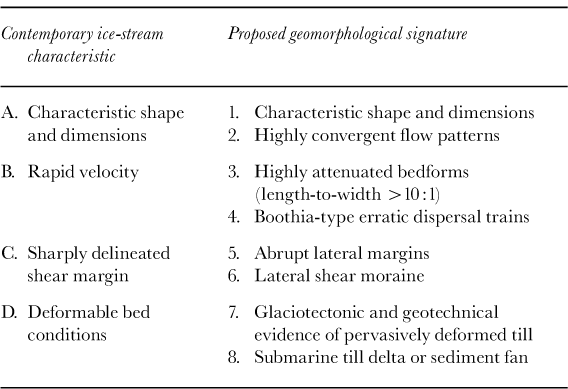
The characteristic features of contemporary ice streams may be manifest in the geomorphological and geological products of former ice streams. The criteria listed below are based entirely on the known characteristics of contemporary ice streams. Table 2 illustrates how these criteria relate to the fundamental characteristics of contemporary ice streams. In brief, a former ice stream needs to have the characteristic shape and dimensions, and display a large degree of convergence in the onset area. Indicators of the rapid ice velocity provide two further criterion, highly attenuated bedforms and “Boothia type” dispersal trains. A manifestation of the sharply delineated margin found on ice streams may be an abrupt lateral margin to the bedform pattern and lateral shear moraines, and the last two criteria are not necessarily indicative of ice-stream flow but may provide substantial supporting evidence when found in conjunction with the other criteria.
Geomorphological criteria for identifying former ice Streams.
-
(1) Characteristic shape and dimensions
When inferring former ice-stream activity, the most obvious clue to its existence is the shape and dimension. From what we know of contemporary ice streams, they are large features and are characteristically greater than 20 km wide and 150 km long. Clearly, there is plenty of scope for a former ice stream to be larger or even smaller, especially if the shape is consistent with contemporary ice streams. Figure 1 shows the simplified theoretical shape of an ice stream. We acknowledge the fact that contemporary ice streams may not necessarily be a representative sample of the population of ice streams that have ever existed. However, they do provide the only analogues on which to base our assumptions.
-
(2) Highly convergent flow patterns
The second clue to the existence of former fast-flow zones is highly convergent flow patterns. In contemporary ice streams, the onset of streaming is characterised by a large convergence zone (Fig. 1) where slower moving ice is generally incorporated into the ice stream (Reference Hodge and DoppelhammerHodge and Doppelhammer, 1996). Thus, the bedforms produced by an ice stream may exhibit a large degree of convergence at the head of the postulated former ice-stream track. This was observed at the head of the ice stream on south-eastern Prince of Wales Island by Reference Dyke and MorrisDyke and Morris (1988). Here, the orientation of the drumlins represents a pattern of convergence feeding into the main ice-stream axis.
-
(3) Highly attenuated bedforms
Streamlined bedforms are known to vary in their elongation ratio. Highly attenuated bedforms (i.e. with a large length- to-width ratio, usually > 10: 1) could arise from either fast ice flow over a short duration or slower moving ice over a longer duration (Reference ClarkClark, 1994). Nevertheless, many workers argue that a high elongation ratio is indicative of fast ice flow. One line of argument is that as the flow geometry of ice sheets are known to vary rapidly (cf. Reference Boulton and ClarkBoulton and Clark, 1990), then it is unlikely that highly attenuated bedforms, such as the megascale lineations detected by Reference ClarkClark (1993), were formed by slow-moving ice over very long time periods.
Thus, it is suggested that swarms of highly attenuated drumlins and mega-lineations may record the flow direction and spatial extent of former ice streams. For example, a set of drumlins associated with an hypothesized ice stream on north-eastern Victoria Island had length-to-width ratios approaching 20: 1 (Reference HodgsonHodgson, 1994). Whilst this popular view remains unproven, we regard it as a useful criterion for identifying fast ice flow which may have arisen from episodic ice-stream activity.
-
(4) Boothia-type erratic dispersal trains
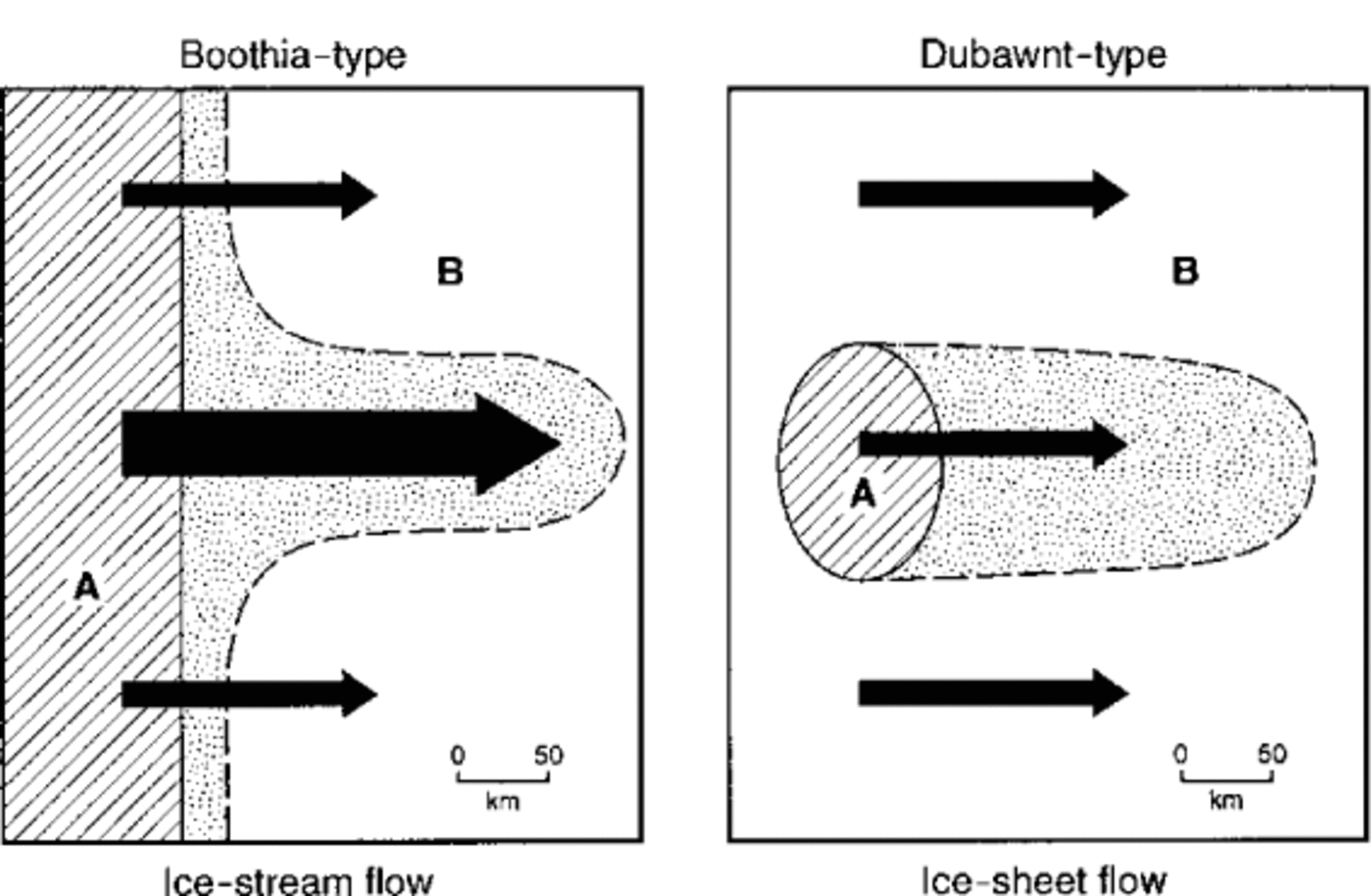
Dispersal trains “are long and relatively narrow belts of glacial debris of some distinctive composition transported down-ice from a source area” (Reference Dyke and MorrisDyke and Morris, 1988). Reference Dyke and MorrisDyke and Morris (1988) recognise two types of dispersal train, schematically represented in Figure 2. Only the “Boothia- type”” dispersal train is indicative of ice-stream activity, as the “Dubawnt-type”” can be formed by slow sheet-flow. Hence, it is important to identify the spatial extent of the source area from which the distinctive till is transported.There is not necessarily a blatant connection between ice streams and dispersal trains, but when found in conjunction with other criteria, it may be highly suggestive of streaming activity. This is because ice streams have the ability to transport sediment in a very distinctive fashion. The Boothia- type plume was identified on south-eastern Prince of Wales Island in the Canadian Arctic. Reference Dyke and MorrisDyke and Morris (1988) suggest that this plume was formed by the central part of an ice stream because of the sharply delineated margins and the much longer transport of material within it, compared to either side of it. It is also interesting to note that the more attenuated drumlins were formed in the central part of the plume, where presumably the flow was quickest. This provides further support for the ideas addressed in section (3).
-
(5) Abrupt lateral margins
Ice streams are characterised by their abrupt lateral margins bordered by slower-moving ice. Figure 3 shows the characteristic lateral variation in velocity across an ice stream and it can be seen that the crevassed marginal area is only around one-tenth of the ice-stream width. Thus, the characteristic geomorphology inscribed by a former ice stream would be expected to exhibit a sharp zonation of landforms at the margin. Reference HodgsonHodgson (1994) noted a “well- defined margin of the drumlin field” when postulating the existence of a large ice stream flowing northwards over the eastern portion of Victoria Island in the Canadian Arctic. Hence, an abrupt marginal area (approximately one-tenth of the ice-stream width) would be expected to delimit the extent of a former ice-stream track.
-
(6) Lateral shear moraines
An abrupt lateral margin, of fast ice contacting slower ice, may also produce characteristic landforms. On south-eastern Prince of Wales Island, Reference Dyke and MorrisDyke and Morris (1988) identified a single, narrow ridge of till that delineated the western side of the drumlin field. This ridge is approximately 68 km long, but less than 1 km in width (Reference Dyke, Morris, Green and EnglandDyke and others, 1992). In a discussion of its origin, the ridge was interpreted as being a “lateral shear moraine”. It marked a shear zone at the side of an ice stream, separating fast-flowing ice from slower flowing cold-based ice (Reference Dyke and MorrisDyke and Morris, 1988). A similar ridge was also identified by Reference HodgsonHodgson (1994), flanking the hypothesized ice stream on eastern Victoria Island. Hence, it appears that lateral shear moraines may arise from the margins of former ice streams.
-
(7) Evidence of pervasively deformed sediment
Subglacial till deformation has been associated with fast flow (Reference Alley, Blankenship, Bentley and RooneyAlley and others, 1986), and because it has been detected beneath Ice Stream B on the Siple Coast of West Antarctica (Reference Engelhardt, Humphrey, Kamb and FahnestockEngelhardt and others, 1990), evidence of pervasively deformed till has been linked to former ice-stream activity. Thus, areas of highly deformable till may predispose parts of an ice sheet to fast flow. So, if we find firm evidence of deformable till that can be demonstrated to be spatially extensive, it is reasonable to infer that this was a fast-flow zone.
-
(8) Offshore sediment accumulation fan
Although not necessarily indicative of ice-stream activity, focused accumulations of substantial sediment on a continental shelf may provide compelling evidence for ice-stream activity. Recently, Reference Vorren and LabergVorren and Laberg (1997) identified huge submarine till deltas, thought to have been produced by ice streams draining the north-western part of the Fennoscandian and the Barents Sea ice sheet. These features are termed “trough mouth fans” and range in size from 2700 to 215 000 km2. Their formation is thought to be attributable to a deformable till layer being deposited at the grounding line by rapidly moving ice streams (Reference Vorren and LabergVorren and Laberg, 1997). This mechanism is consistent with the observations and model of Reference Alley, Blankenship, Rooney and BentleyAlley and others (1989) on a contemporary ice stream. As a stable ice-sheet margin (i.e. without an ice stream) would not deliver such concentrated accumulations of sediment to the continental shelf over short time periods, it is clear that offshore sediment accumulations can provide a valuable clue to the former existence of ice streams. However, substantial sediment may be accumulated at a stable margin if the ice sheet focuses small amounts of sediment over very long time periods. This may occur, for example, in topographic troughs which are not prone to ice streaming. Thus, it is very important to constrain the timing of the sediment deposition in order to correctly ascertain the glaciological setting.
Simplified theoretical shape of an ice stream, characterized by convergent flowlines in the onset zone feeding the main channel.

Simplified diagram of Boothia- and Dubawnt-type dispersal trains. Only the Boothia-type dispersal train is indicative of ice-stream activity, as the Dubawnt-type is formed by slow-moving ice. Hence, it is important to ascertain the source area of the distinctive sediment prior to making assumptions concerning ice velocity (after Reference Dyke and MorrisDyke and Morris, 1988).
Lateral variation in ice-stream velocity, simplified from Reference Echelmeyer, Harrison, Larsen and MitchellEchelmeyer and others (1994). Lateral variation in ice- stream velocity is characterized by a slight decrease in velocity from the centre line, followed by a rapid decrease at the margin. As a result of this abrupt change in velocity, the marginal areas of ice streams are heavily crevassed, enabling their margins to be delineated easily.

Application of criteria
It is suggested that the eight criteria outlined above are the key indicators of ice streams which existed during the Pleistocene. Referring back to Table 1, we can see that some of these criteria appear to have been applied to former ice streams. However, some of the criteria seem to have been rarely cited as evidence for ice-stream activity. We suggest it is perhaps the rarer geomorphological criteria that are more unique to ice-stream signatures. For example, highly attenuated bedforms may be a sure sign of fast ice flow but may not distinguish between outlet-glacier flow, surge-type flow or ice-stream flow in the geological record. However, complementary evidence, such as a lateral shear moraine, may well substantiate evidence for ice streaming. The problem is, that these defining characteristics have often been modified and may not have been preserved, leaving us with only half the picture and perhaps only two or three of the criteria. An example of this is illustrated by the M’Clintock Channel ice stream postulated by Reference HodgsonHodgson (1994). While this may be an excellent candidate for a former marine-based ice stream, it only exhibits perhaps three or four of the criteria. Nevertheless, if we know what to look for in the geomorphological record and make predictions, it introduces far more objectivity into our methodology. In summary, evidence of fast ice flow does not necessarily mean that an ice stream existed. However, if the associated evidence fits a geographical template (size, shape, abrupt margins, etc.), then it is logical to infer ice-stream activity. In essence, the more criteria we can find, the more certain we can be.
4. A Land-Systems Approach to Ice-Stream Signatures
It would be highly unlikely that all of the geomorphological criteria should be found in one location, produced by a single ice stream, as not all will leave a complete geomorphological signature. Nevertheless, collectively, the criteria can be used to illustrate the perfect, or “fantasy”, former ice-stream land system. This may then provide an observational template on which to base future work.
A land system is an area of common terrain attributes. In terms of glacial geomorphology, the concept of land systems introduces a holistic approach (Reference Benn and EvansBenn and Evans, 1998). Here, we are dealing with the subglacial land system, and the bedforms produced are genetically related to the processes involved in their development, in this case, ice-stream activity.
Categorisation of former ice-stream land systems
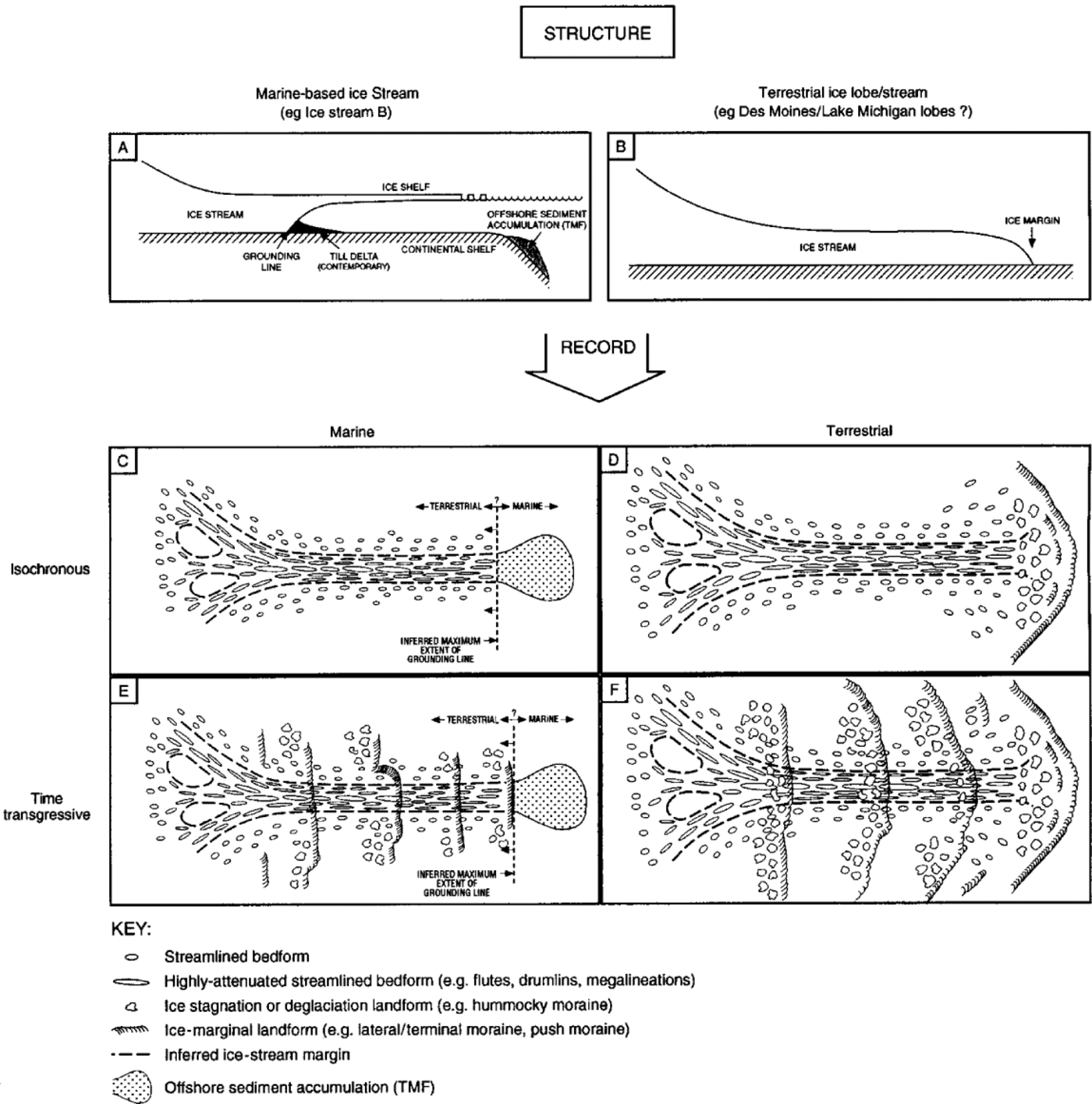
Ice streams can be broadly categorised as either terrestrial or marine-based, depending upon the environment in which they terminate. All contemporary ice streams are marine in nature, but former ice sheets may also have been drained by terrestrial ice streams. The difference between these two classes of ice streams will be reflected in the geomorphological signature of their activity. Clearly, terrestrial ice streams cannot produce an offshore sediment accumulation fan. Also, a marine based ice stream will become terrestrial once it retreats from the grounding line and progresses inland. Similarly, it is quite plausible that a terrestrial ice stream may also become a marine-based ice stream, should the ice sheet build up to such an extent that it reaches coastal areas, or as a result of sea-level rise. These scenarios have important ramifications for the geomorphological record left behind by an ice stream.
Furthermore, the geomorphological signature of ice-stream activity can be broadly classified as either time-transgressive or isochronous (cf. Reference ClarkClark, 1999). A time-transgressive record of ice-stream activity is characterised by several phases of landform development, often coinciding with a time of retreat or indeed advance. Hence, a series of marginal or stagnation landforms, such as hummocky moraine, may be superimposed upon the earlier geomorphology produced entirely by subglacial processes (e.g. drumlins). A time-transgressive record may also be characterized by cross-cutting landforms, whereby subsequent stages of advance or retreat may sculpture the earlier bedforms in a different direction. In contrast, an isochronous record of ice-stream activity may remain largely unaltered. This may be produced when an ice stream is “switched off”, and cold- based retreat preserves a largely intact record of ice-stream activity. These ideas can be represented by four simple land- system models (Fig. 4) of former ice-stream activity incorporating the geomorphological criteria suggested above. This shows the two types of ice stream, marine-based (a) and terrestrial (b), and because each type may leave either a time- transgressive or isochronous record of their existence, there are four possible records of former ice-stream activity (indicated in Fig. 4c, d, e and f). These four scenarios provide a simple observational template upon which the tracks of former ice streams may be better interpreted.
Four types of land-system signature produced by former ice streams. An ice stream may be broadly classified as either marine (a) or terrestrial (b), depending on the environment in which it terminates. This will be reflected in the evidence it leaves behind. The recorded geomorphological evidence (i.e. its signature) may also be loosely classified as time-transgressive, characterized by a series of retreat phases and stillstands, or isochronous, whereby the ice stream leaves a largely intact, unmodified record. Thus, four possible land systems may result from former ice-stream activity (c, d, e and f). Note that times-transgressive terrestrial ice streams may also superimpose (i.e. cross-cut) a splayed pattern of drumlins onto the earlier bedforms as the lobate marginal area retreats. This has been omitted from the diagram for clarity. These land systems are based on the geomorphological criteria outlined in this paper as indicative of former ice-stream activity (see section (4)).
Ideally, the validity of our land-systems model should be tested prior to its application. However, until we are able to make detailed examinations of the submarine and subglacial geomorphology and geology of contemporary ice streams, this will not be possible.
5. Conclusions and Implications
Several geomorphological criteria have been reviewed and developed to aid the identification of former ice streams. These criteria are developed from a convergence of knowledge gained from contemporary ice-stream research, coupled with theories of glacial geomorphology. It is thus postulated that the following six criteria are fundamental to former ice-stream signatures:
-
(1) Characteristic shape and dimension;
-
(2) Highly convergent flow patterns;
-
(3) Highly attenuated bedforms;
-
(4) Boothia-type erratic dispersal trains;
-
(5) Abrupt lateral margins; and
-
(6) Lateral shear moraines.
A further two additional criteria may be present. A former ice stream may also leave evidence of (7) pervasively deformed sediment. If the ice stream entered a marine basin, a further criterion would be (8) an offshore sediment accumulation. Taking a land-systems approach and using the criteria as a basis, conceptual models have been produced to illustrate the unaltered geomorphology of a marine-based and terrestrial former ice stream. These simple models provide an observational template upon which theories of former ice streams can be better based. The criteria, and indeed the proposed models, not only allow for the testing of previously hypothesised locations, but may also aid the search for ice streams in relatively unknown formerly glaciated areas. More importantly, once we are confident of the location, geomorphology and glacial history of a former ice stream, such information can be utilised to advance ice-stream understanding and modelling, in that poorly-constrained model parameters, such as those on basal geology, can be better represented.
As with all historical science, we rely heavily on assumptions, particularly when modern analogues cannot be readily accessed and observed. We have to rely on what is left behind once the ice has melted and so we can never be unequivocal when postulating the locations of former ice streams. However, the aim of this paper is to introduce some objectivity to the research by developing criteria to aid the identification of former ice streams. These criteria are not definitive, but merely introduce a more objective methodology to the research on former ice streams.
This work has implications for research on contemporary ice streams and particularly the possible instability of the West Antarctic ice sheet. Recently, it has been ascertained that both the East and West Antarctic ice sheets advanced a considerable distance across the continental shelf during the Last Glacial Maximum (Reference BindschadlerBindschadler and others, 1998). Their subsequent retreat, which began approximately 17 000 years ago in East Antarctica and 10 000 years ago in West Antarctica, has exposed the sea floor to examination. In the Ross Sea region of West Antarctica, the ice sheet has retreated approximately 150 km from the continental shelf margin. This retreat was rapid and almost certainly facilitated through ice streams. We predict that some of the geomorphological criteria outlined here as characteristic of ice-stream activity will be found on the Ross Sea floor and that these criteria can also be viewed as a predictive tool for marine sonar investigations on submarine ice-stream tracks.
Acknowledgements
The authors would like to thank W. Blake, Jr and D. Morse for their helpful and constructive comments during the review of this manuscript. We are also grateful to the staff of the Cartographic Services, Department of Geography, Sheffield University, who drew the figures for this paper.



