





1. Introduction
A relevant question in non-native (‘L2’) language processing research is whether L2 speakers are able to process their L2 as efficiently as their native language (‘L1’), and, in contrast, what factors limit the efficacy of L2 processing. Here, we focus on the processing of morphologically complex words, that is, words consisting of more than one morpheme, such as player (play + -er) or replay (re- + play). Morphological processing is often investigated using the masked priming paradigm (see e.g., the L2 studies by Kirkici & Clahsen, Reference Kirkici and Clahsen2013; Li, Taft et al., Reference Li, Taft and Xu2017; Li, Jiang et al., Reference Li, Jiang and Gor2017). In a masked morphological priming experiment, participants perform a lexical decision on target words preceded by morphologically related or unrelated primes (e.g., ‘player-play’ versus ‘helper-play’). These are masked and presented very briefly (typically 50 ms), thus preventing their conscious perception. A ‘morphological priming effect’ is observed when reaction times (RTs) are faster for target words preceded by morphologically related primes compared to unrelated primes. Morphological priming effects are assumed to reflect automatic and unconscious access to the morphological information contained in the morphologically complex prime (e.g., ‘play’ and ‘er’ in ‘player’). Different mechanisms have been put forward to explain morphological priming; some postulate a level of morphological analysis and representation with automatic recognition of affixes and/or stems (see ‘affix stripping’, e.g., Rastle et al., Reference Rastle, Davis and New2004; Taft & Forster, Reference Taft and Forster1975; and ‘edge-aligned embedded word activation’, for example, Grainger & Beyersmann, Reference Grainger, Beyersmann and Ross2017), while others reject the idea of a separate level of morphological representation, attributing morphological priming effects to the semantic and orthographic similarities between the prime and target words (e.g., Baayen et al., Reference Baayen, Milin, Đurđević, Hendrix and Marelli2011; Feldman, Reference Feldman2000).
Irrespective of the specific mechanism explaining masked morphological priming effects, a key question in L2 morphological processing research is whether L2 speakers are able to access morphological information as efficiently as native speakers, as would be reflected by equal priming magnitudes in both groups. While some studies have suggested that native-like morphological processing in an L2 is theoretically possible (see e.g., Ciaccio & Clahsen, Reference Ciaccio and Clahsen2020), others have provided evidence for less efficient processing in non-native compared to native speakers, as manifested by weaker or absent morphological priming effects (e.g., Fernandes et al., Reference Fernandes, Luna, Soares and Comesaña2023; Gu, Reference Gu2022; Jacob et al., Reference Jacob, Heyer and Veríssimo2018; Li, Taft et al., Reference Li, Taft and Xu2017). An important goal for L2 morphological processing research is, then, to specifically identify what factors constrain the efficacy of L2 morphological processing, leading to less efficient priming in some circumstances, but not others.
Recent research has pointed to at least two factors that can limit the efficacy of morphological processing in an L2. One factor has to do with the speaker’s characteristics, and more specifically, their proficiency, which affects how strongly L2 speakers rely on orthographic cues during morphological processing. Some studies have reported priming effects of similar magnitudes for morphologically related prime-target pairs and purely orthographically related pairs (e.g., scandal-scan) in L2 speakers, both under masked and overt priming conditions, unlike in L1speakers, who show no orthographic priming effects or even inhibitory effects (see e.g., Ciaccio & Jacob, Reference Ciaccio and Jacob2019; Heyer & Clahsen, Reference Heyer and Clahsen2015; Kahraman & Beyersmann, Reference Kahraman and Beyersmann2024; Li, Taft et al., Reference Li, Taft and Xu2017; Li, Jiang et al., Reference Li, Jiang and Gor2017; Viviani & Crepaldi, Reference Viviani and Crepaldi2022). This suggests that L2 speakers might rely more on orthographic cues than L1 speakers during morphological processing. However, with increasing L2 proficiency, reliance on orthographic cues decreases (Gu, Reference Gu2022; Kahraman & Beyersmann, Reference Kahraman and Beyersmann2024; Li, Taft et al., Reference Li, Taft and Xu2017; Viviani & Crepaldi, Reference Viviani and Crepaldi2022).
The second factor pertains to the linguistic properties of the stimuli, and more specifically, the contrast between inflectional and word-formation morphology. For the latter, a series of studies covering a wide range of different types of derivations (e.g., ‘player’) and compounds (‘playground’) have repeatedly reported robust priming effects that are similar in magnitude to L1 speakers (e.g., Ciaccio & Clahsen, Reference Ciaccio and Clahsen2020; González Alonso et al., Reference González Alonso, Baquero Castellanos and Müller2016; Kirkici & Clahsen, Reference Kirkici and Clahsen2013; Li, Jiang et al., Reference Li, Jiang and Gor2017), which is suggestive of native-like performance. In contrast, when it comes to inflectional morphology, several studies have found that L2 speakers face specific difficulties in processing inflected forms (e.g., ‘played’), as manifested by weaker or at least more variable morphological priming effects compared to those obtained with derivations or compounds (Ciaccio & Veríssimo, Reference Ciaccio and Veríssimo2022; Jacob et al., Reference Jacob, Heyer and Veríssimo2018; Kirkici & Clahsen, Reference Kirkici and Clahsen2013; Silva & Clahsen, Reference Silva and Clahsen2008; but see Feldman et al., Reference Feldman, Kostić, Basnight-Brown, Đurđević and Pastizzo2010).
An additional factor that may limit processing efficacy in an L2 is the characteristics of speakers’ L1. That cross-linguistic influences might affect morphological processing in an L2 seems reasonable in the light of results from cross-language masked morphological priming studies (Kahraman et al., Reference Kahraman, Casalis, Javourey-Drevet, Menut, de Wit and Beyersmann2025; see Kahraman & Beyersmann, Reference Kahraman, Beyersmann, Elgort, Siyanova-Chanturia and Brysbaert2023 for a review). In these experiments, the (morphologically related or unrelated) prime and the target are presented in two different languages, one being the participants’ L1 and the other their L2 (e.g., Spanish-English: dirección ‘direction’ – direct). Several studies of this kind, with different language combinations, have found significant cross-language masked morphological priming effects, at least for the case of cognate words. This is interpreted in terms of simultaneous activation of the L1 and L2, happening already in the very early stages of visual word recognition (e.g., Duñabeitia et al., Reference Duñabeitia, Dimitropoulou, Morris and Diependaele2013; Ko & Wang, Reference Ko and Wang2015; Voga & Grainger, Reference Voga and Grainger2007; for a review, see Kahraman & Beyersmann, Reference Kahraman, Beyersmann, Elgort, Siyanova-Chanturia and Brysbaert2023). Given this simultaneous activation of both languages, it may follow that not only entire morphemes, but more generally the morphological characteristics of a speaker’s L1 would be available during the early stages of L2 processing and, therefore, that the efficacy of L2 morphological processing would be limited by the specific characteristics of a speaker’s L1. Indeed, two recent morphological priming studies by Li and Taft (Reference Li and Taft2020) and Gu (Reference Gu2022) seem to support this hypothesis. Both studies investigated morphological processing in L2 English with native speakers of Chinese, and reported no evidence for genuine morphological priming effects with prefixed words (e.g., prepay-pay). The authors argued that, because Chinese makes very little use of prefixes, this group of L2 speakers may face specific difficulties in processing prefixed derived words, unlike previously reported for other groups of L2 speakers (e.g., Ciaccio & Clahsen, Reference Ciaccio and Clahsen2020).
However, more evidence from different language combinations is needed to further investigate the role of cross-linguistic influences in L2 morphological processing. While it is true that Chinese has very poor prefixing morphology, it is also a language with poor morphology overall: Chinese is an isolating language, characterized by a low number of morphemes per word, minimal inflectional morphology, and rather rare derivational affixes, as most morphologically complex words are in fact compound words (Hsieh et al., Reference Hsieh, Hong, Huang, Huang, Lin, Chen and Hsu2022). Therefore, investigating speakers whose L1 presents a clearer contrast in the use of prefixes and suffixes might be more informative with regard to the role of cross-linguistic influences in the processing of prefixing and suffixing morphology.
2. The present study
The present study aims to further investigate possible cross-linguistic influences in L2 morphological processing. To this end, we performed a replication of the study by Ciaccio and Clahsen (Reference Ciaccio and Clahsen2020), testing morphological priming effects with both prefixed and suffixed words in L1 and L2 German, but with a different population of L2 speakers. In Ciaccio and Clahsen (Reference Ciaccio and Clahsen2020), the L2 group had Russian as L1, a language that has similar prefixation phenomena to German. L2 speakers showed significant priming effects with all types of derived words, similar in magnitude for prefixed and suffixed words. Here, we tested L2 speakers of German with L1 Turkish, a language in which prefixation is virtually absent.
For inflectional morphology, both Turkish and German, respectively, the L1 and the L2 of the speakers we investigated, are highly suffixing languages (World Atlas of Language Structures – WALS online; Dryer, Reference Dryer, Dryer and Haspelmath2013). When it comes to derivational processes, instead, these two languages considerably differ from each other. German is a language with a rich word formation system. Prefixes are used productively for derivations across nouns, adjectives and verbs. For nouns, the word category with the largest number of morphologically complex words, compounding and suffixation are more frequent; instead, in the case of verbs, prefixes are the most productive word-formation process, while compounding and suffixation only play a marginal role (see Barz, Reference Barz, Müller, Ohnheiser, Olsen and Rainer2016; Fleischer & Barz, Reference Fleischer and Barz2012: pp. 255, 352–354; Sadeniemi et al., Reference Sadeniemi, Kettunen, Lindh-Knuutila and Honkela2008). Turkish, in contrast, almost exclusively makes use of suffixes (Göksel and Kerslake, Reference Göksel and Kerslake2005: p. 43; Wilkens, Reference Wilkens, Müller, Ohnheiser, Olsen and Rainer2016). As reported by Göksel and Kerslake (Reference Göksel and Kerslake2005), prefixation only pertains few exceptional word-formation phenomena: the only prefixes in Turkish are of foreign origin (e.g., ‘anti-’, ‘post-’) or non-productive cases of reduplication (pp. 63; 90–91). According to other authors, prefixation is entirely absent in Turkish, and those rare morphological phenomena that have been ascribed to prefixation should in fact be considered compounds (for details, see Wilkens, Reference Wilkens, Müller, Ohnheiser, Olsen and Rainer2016). Considering that Turkish is an agglutinative language with rich morphology, and that almost all polysyllabic words are morphologically complex (Göksel and Kerslake, Reference Göksel and Kerslake2005: p. 43), the (almost) complete absence of prefixation in Turkish is particularly noteworthy.
Assuming cross-linguistic influences as a potential factor influencing morphological processing in an L2, we would expect that a population whose L1 is particularly rich in suffixing morphology would process suffixed words in their L2 as efficiently as in their L1. Indeed, previous research on L2 speakers of English and German with Turkish as L1 has shown robust priming effects with suffixed derived words (Kirkici & Clahsen, Reference Kirkici and Clahsen2013; Veríssimo et al., Reference Veríssimo, Heyer, Jacob and Clahsen2018). However, no study has ever focused on prefixed words with this population. If the processing of derived words is particularly robust in an L2 language, irrespective of the properties of speakers’ L1, then our results should replicate those of the L1 Russian-L2 German group tested in Ciaccio and Clahsen (Reference Ciaccio and Clahsen2020). If, instead, the processing efficacy of complex words in an L2 is constrained by the specific properties of the speakers’ L1, then we should find no or reduced priming effects for prefixed compared to suffixed words in this specific population. This would be in line with the previous findings by Li and Taft (Reference Li and Taft2020) and Gu (Reference Gu2022).
Note that, unlike the two previous studies by Gu (Reference Gu2022) and Li and Taft (Reference Li and Taft2020), the present study was specifically designed to directly compare prefixation and suffixation priming on the same targets. Indeed, Gu (Reference Gu2022) tested prefixation and suffixation priming in two different sets of items; therefore, any difference that the authors found between prefixation and suffixation priming might still potentially be attributable to the different target words employed in the two sets. Li and Taft (Reference Li and Taft2020), instead, only tested prefixation priming; it is therefore impossible to know whether the group they tested would show robust priming effects with suffixed words, and consequently, if they truly had a selective problem with prefixation morphology.
The study was preregistered on the Open Science Framework, specifying the design of the study, the hypotheses we sought to test, the criteria for data collection, as well as the data analyses. The preregistration is available at: https://osf.io/grwca.
3. Method
3.1. Participants
Participants were L2 speakers of German with L1 Turkish. A crucial aspect of our pre-registration was that participants should be comparable to the L2 speakers from the study by Ciaccio and Clahsen (Reference Ciaccio and Clahsen2020) at least for the age of acquisition and skill in German. The age of acquisition of the L2 speakers from Ciaccio and Clahsen (Reference Ciaccio and Clahsen2020) ranged from 6 to 24 (M 13.02, SD 5.46); we therefore aimed for a similar range. Concerning skill in German, this was assessed by means of a language test developed by the Goethe Institute (https://www.goethe.de), which had been used in the study by Ciaccio and Clahsen (Reference Ciaccio and Clahsen2020) as well as in several other similar studies (e.g., Ciaccio & Jacob, Reference Ciaccio and Jacob2019; Jacob et al., Reference Jacob, Heyer and Veríssimo2018; Veríssimo et al., Reference Veríssimo, Heyer, Jacob and Clahsen2018). This is a 30-item multiple-choice test mostly covering grammar. It aims at providing an indicative assessment of participants’ skill in German within the proficiency categories of the Common European Framework of Reference for Languages (CEFR; see Verhelst et al., Reference Verhelst, Van Avermaet, Takala, Figueras and North2009), to ensure that participants meet the inclusion criteria for participation in the study; it is not particularly suitable for analyses of individual differences across different linguistic levels or modalities. In the study by Ciaccio and Clahsen (Reference Ciaccio and Clahsen2020), L2 speakers’ skill in German spanned from B2 to C2 (results of language test: M 25.31/30, SD 3.07, range 19–30). Therefore, we set the B2 level as an inclusion criterion for participation in the study.
We recruited 42 participants (11 men, 31 women) who met the inclusion criteria. Data from an additional five participants whose language test revealed a German level below B2 were discardedFootnote 1. All participants received remuneration or course credits for their participation. Participants were comparable to the L2 group of Ciaccio and Clahsen (Reference Ciaccio and Clahsen2020) in terms of age (M 26.95, SD 6.83, range 19–50; Ciaccio & Clahsen = M 26.04, SD 4.82, range 20–41), age of acquisition of German (M 15.67, SD 5.59, range 7–28) and skill in German (M 23.17/30, SD 3.01, range 17–29), which roughly encompassed B2 to C2 of the CEFR. Half participants had a university degree, while the other half had high-school level education. All participants lived in Germany and reported using both written and spoken German (use of written German: M 45.92%, SD 22.57, range 7.5–99.5%; use of spoken German: M 37.94%, SD 16.94, range 12.5–70%). All of them additionally reported actively using some Turkish, at least spoken (written: M 34.68%, SD 18.93, range 0.5–80%; spoken: M 43.99%, SD 19.01, range 15–75%). Most of them (N = 38) reported speaking at least an additional language.
3.2. Materials
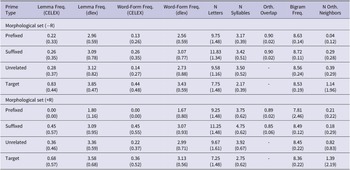
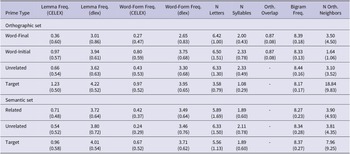
The materials and procedure were those used in Ciaccio and Clahsen (Reference Ciaccio and Clahsen2020). The experiment included a main set of experimental items testing morphological priming, plus two sets of control items testing orthographic and semantic priming. For all items, we report (base 10 log-transformed) lemma and word-form frequency per million from the webCELEX database (http://celex.mpi.nl/), as well as lemma and (case-insensitive) word-form frequency extracted from the dlex database (Heister et al., Reference Heister, Würzner, Bubenzer, Pohl, Hanneforth, Geyken and Kliegl2011), expressed in the zipf scale (see van Heuven et al., Reference van Heuven, Mandera, Keuleers and Brysbaert2014). We additionally report character bigram frequency, in the zipf scale, and number of orthographic neighbors, normalized per million, extracted from the dlex database (Heister et al., Reference Heister, Würzner, Bubenzer, Pohl, Hanneforth, Geyken and Kliegl2011). For the related prime-target pairs of the morphological and orthographic sets, we obtained a measure of orthographic overlap (Spatial Coding) from Davis’ (Reference Davis2010) Match Calculator. All the information extracted from dlex was not included in the original study by Ciaccio and Clahsen (Reference Ciaccio and Clahsen2020). A summary of the item properties can be found in Tables 1 and 2, while a full list of the stimuli is available at https://osf.io/3m47e/.
Item Characteristics for the Morphological Sets (means and standard deviations)

Table 1. Long description
The table contains 10 columns: Prime Type, Lemma Freq. (C E L E X), Lemma Freq. (dlex), Word-Form Freq. (C E L E X), Word-Form Freq. (dlex), N Letters, N Syllables, Orth. Overlap, Bigram Freq., and N Orth. Neighbors. Values are presented as means with standard deviations in brackets.
Morphological set (minus R):
* Prefixed: Lemma Freq. (C E L E X) 0.22 (0.33), Lemma Freq. (dlex) 2.96 (0.59), N Letters 9.75 (1.48), N Syllables 3.17 (0.39), Orth. Overlap 0.90 (0.02).
* Suffixed: Lemma Freq. (C E L E X) 0.26 (0.35), Lemma Freq. (dlex) 3.09 (0.78), N Letters 11.83 (1.34), N Syllables 3.42 (0.51), Orth. Overlap 0.90 (0.02).
* Unrelated: Lemma Freq. (C E L E X) 0.28 (0.37), Lemma Freq. (dlex) 3.12 (0.82), N Letters 9.58 (1.16), N Syllables 3.50 (0.52).
* Target: Lemma Freq. (C E L E X) 0.83 (0.44), Lemma Freq. (dlex) 3.85 (0.47), N Letters 7.75 (1.48), N Syllables 2.17 (0.39).
Morphological set (plus R):
* Prefixed: Lemma Freq. (C E L E X) 0.00 (0.00), Lemma Freq. (dlex) 1.80 (1.16), N Letters 9.25 (1.48), N Syllables 3.75 (0.62), Orth. Overlap 0.89 (0.02).
* Suffixed: Lemma Freq. (C E L E X) 0.45 (0.57), Lemma Freq. (dlex) 3.09 (0.95), N Letters 11.25 (1.48), N Syllables 4.75 (0.62), Orth. Overlap 0.85 (0.06).
* Unrelated: Lemma Freq. (C E L E X) 0.36 (0.46), Lemma Freq. (dlex) 3.36 (0.59), N Letters 9.67 (1.61), N Syllables 3.92 (0.67).
* Target: Lemma Freq. (C E L E X) 0.68 (0.57), Lemma Freq. (dlex) 3.58 (0.68), N Letters 7.25 (1.48), N Syllables 2.75 (0.62).
Item Characteristics for the Control Sets (means and standard deviations)

Table 2. Long description
The table contains 10 columns: Prime Type, Lemma Freq. (C E L E X), Lemma Freq. (dlex), Word-Form Freq. (C E L E X), Word-Form Freq. (dlex), N Letters, N Syllables, Orth. Overlap, Bigram Freq., and N Orth. Neighbors. Values are presented as means with standard deviations in brackets.
Orthographic set:
* Word-Final: Lemma Freq. (C E L E X) 0.36 (0.60), Lemma Freq. (dlex) 3.01 (0.86), Word-Form Freq. (C E L E X) 0.27 (0.47), Word-Form Freq. (dlex) 2.65 (0.83), N Letters 6.42 (1.00), N Syllables 2.00 (0.43), Orth. Overlap 0.87 (0.08), Bigram Freq. 8.39 (0.18), N Orth. Neighbors 3.50 (4.50).
* Word-Initial: Lemma Freq. (C E L E X) 0.97 (0.57), Lemma Freq. (dlex) 3.94 (0.61), Word-Form Freq. (C E L E X) 0.80 (0.59), Word-Form Freq. (dlex) 3.75 (0.68), N Letters 6.50 (1.51), N Syllables 2.33 (0.78), Orth. Overlap 0.87 (0.08), Bigram Freq. 8.33 (0.13), N Orth. Neighbors 1.64 (1.06).
* Unrelated: Lemma Freq. (C E L E X) 0.66 (0.54), Lemma Freq. (dlex) 3.62 (0.63), Word-Form Freq. (C E L E X) 0.43 (0.53), Word-Form Freq. (dlex) 3.30 (0.68), N Letters 6.33 (1.30), N Syllables 2.33 (0.49), Orth. Overlap -, Bigram Freq. 8.44 (0.16), N Orth. Neighbors 3.10 (3.52).
* Target: Lemma Freq. (C E L E X) 1.23 (0.50), Lemma Freq. (dlex) 4.22 (0.52), Word-Form Freq. (C E L E X) 0.97 (0.52), Word-Form Freq. (dlex) 3.95 (0.65), N Letters 3.58 (0.79), N Syllables 1.08 (0.29), Orth. Overlap -, Bigram Freq. 8.17 (0.17), N Orth. Neighbors 18.84 (9.83).
Semantic set:
* Related: Lemma Freq. (C E L E X) 0.71 (0.48), Lemma Freq. (dlex) 3.72 (0.64), Word-Form Freq. (C E L E X) 0.42 (0.37), Word-Form Freq. (dlex) 3.49 (0.64), N Letters 5.89 (1.69), N Syllables 1.89 (0.60), Orth. Overlap -, Bigram Freq. 8.27 (0.23), N Orth. Neighbors 3.90 (4.93).
* Unrelated: Lemma Freq. (C E L E X) 0.54 (0.52), Lemma Freq. (dlex) 3.80 (0.72), Word-Form Freq. (C E L E X) 0.24 (0.29), Word-Form Freq. (dlex) 3.46 (0.76), N Letters 6.33 (1.50), N Syllables 2.11 (0.78), Orth. Overlap -, Bigram Freq. 8.34 (0.28), N Orth. Neighbors 3.81 (4.35).
* Target: Lemma Freq. (C E L E X) 0.96 (0.58), Lemma Freq. (dlex) 4.01 (0.54), Word-Form Freq. (C E L E X) 0.67 (0.52), Word-Form Freq. (dlex) 3.71 (0.62), N Letters 5.56 (1.13), N Syllables 1.89 (0.60), Orth. Overlap -, Bigram Freq. 8.37 (0.27), N Orth. Neighbors 7.96 (9.25).
Morphological priming was tested with German ‘lexically unrestricted’ (−R) and ‘lexically restricted’ (+R) affixes. While ‘lexically restricted’ affixes can only be applied to non-native stems, ‘unrestricted’ affixes can attach to any kind of stem, that is, potentially to both native and non-native stems (Aronoff, Reference Aronoff1976; see Ciaccio & Clahsen, Reference Ciaccio and Clahsen2020, for additional details). In both subsets (−R and +R), each target was paired with a prefixed, a suffixed, and an unrelated prime, so that prefixation and suffixation priming were tested on the same target. The prefixed prime was a negated derived adjective with the prefix un- (−R) or in- (+R); for example, unsauber–sauber ‘not clean–clean’ (−R), inaktiv–aktiv ‘inactive–active’ (+R). The suffixed prime was a nominalization of the adjectival stem, formed with the suffix -keit (−R) or -ität (+R); for example, Sauberkeit–sauber ‘cleanness–clean’, Aktivität–aktiv ‘activity–active’. Unrelated primes were dissimilar in form and meaning from their targets. Both morphological subsets (−R and + R) contained 12 prime-target pairs for each prime type (prefixed, suffixed, unrelated), for a total of 72 prime-target pairs in each list. Note that suffixes and prefixes differ in length, prefixes being two letters long and suffixes four letters long. This was a necessary compromise to ensure that prefixation and suffixation priming were tested on the same stems, and with prefixes and suffixes that are equally productive; see Footnote 3 for an additional check of potential effects of prime length.
In the orthographic control set, each target was paired with one unrelated prime, one prime in which targets were fully embedded word-finally, mimicking prefixation (e.g., Tutor-Tor ‘tutor–gate/goal’), and one in which they were fully embedded word-initially, mimicking suffixation (Tortur–Tor ‘torture–gate/goal’). Related prime-target pairs only overlapped in form. Each list contained 12 prime-target pairs for each prime type (word-final overlap, word-initial overlap, unrelated). In the semantic control set, each target was associated with two prime types: one related to the target in meaning (e.g., Herd-Pfanne ‘stove-pan’, fleißig-faul ‘diligent-lazy’), and one unrelated. There were 12 prime-target pairs for each prime type (related, unrelated), but three items had to be excluded due to experimental error (the removed items are not included in the item characteristics in Table 2). Thus, each list contained 18 prime-target pairs in total.
All prime types within each item set, as well as targets across all the sets, were kept as similar as possible. For additional details on the item sets, particularly with regard to matching across the different types of primes and sets, we refer to Ciaccio and Clahsen (Reference Ciaccio and Clahsen2020). The item properties that were not fully balanced across conditions were tested for inclusion as covariates in the corresponding statistical models; see Data Analysis for details.
Each experimental list presented all prime-target pairs, divided into three blocks. Each of the blocks contained all of the targets from the morphological and orthographic sets, each associated with one type of prime. Each block contained an equal amount of prefixed (or word-finally overlapping), suffixed (or word-initially overlapping) and unrelated primes. Pairs from the semantic set were contained in only two of the three blocks, as each target was associated with only two prime types (related, unrelated). We created three experimental lists, with different orders of the blocks, plus three additional lists containing the items in the reversed order, to counterbalance for training or fatigue effects. Each list contained 132 prime-target pairs from the morphological and the control sets (126 after exclusion of the problematic items in the semantic control set), plus 468 filler pairs, distributed pseudo-randomly across the blocks, resulting in 600 trials. Fillers were unrelated prime-target pairs. Of all the filler pairs, 300 contained non-word targets, thus requiring a no-response in 50% of the trials. Nonwords were generated by replacing one to three graphemes in existing German words. Fillers (including non-word targets) included both simple and morphologically complex words, and the number of suffixed and prefixed fillers was roughly balancedFootnote 2. In each list, only 13.83% of the prime-target pairs were related.
3.3. Procedure
Participants were tested in a quiet room. They were informed that they would see a series of existing German words and invented words on the computer screen, and that they would have to decide as quickly and as accurately as possible whether each word was an existing German word by pressing a ‘Yes’ or a ‘No’ button on a gamepad. Participants provided ‘Yes’ responses with their dominant hand and ‘No’ responses with the other hand. Trials consisted of the following events: a 500-millisecond blank screen; a forward mask comprising a number of hashes equal in length to the prime; the prime word, presented for 50 milliseconds; the target word. The target word was replaced automatically by a blank screen after 500 milliseconds. Participants had a maximum of 5,000 milliseconds for their lexical decision. The following trial started immediately after the button press or after the time-out. The experiment was run using the software DMDX (Forster & Forster, Reference Forster and Forster2003), measuring participants’ responses and RTs in milliseconds.
3.4. Data analysis
All analyses closely follow those described in Ciaccio and Clahsen (Reference Ciaccio and Clahsen2020) and our pre-registration. Before data analyses, we log-transformed RTs. We excluded timeouts, incorrect responses (11.19% of the experimental trials), and responses below and above two and a half standard deviations from each participant’s mean log-RT in the experimental trials (1.40% of the remaining experimental trials). We analyzed log-RTs with mixed-effect linear regression models using R, version 4.4.2 (R Core Team, 2020), using the package lme4 (Bates et al., Reference Bates, Mächler, Bolker and Walker2015). For all the models, we report p-values computed using the package ‘lmerTest’ (Kuznetsova et al., Reference Kuznetsova, Brockhoff and Christensen2017).
In our analyses, we first focus on the data specifically collected for the present study by presenting an analysis of morphological priming effects in our L1 Turkish-L2 German population. Then, following our pre-registration, we present a series of models fitted on the data of our L2 group and the L1 group from Ciaccio and Clahsen (Reference Ciaccio and Clahsen2020). The goal of these models was to fully replicate the analyses presented in the previous study. These aimed at testing: (i) if the two groups show significant differences in morphological priming; (ii) if the two groups differ regarding possible contributions of orthographic and semantic effects on morphological priming. Following a reviewer’s comment, we additionally tested whether the morphological priming effects of our L2 group differ from those of the L2 group from Ciaccio and Clahsen (Reference Ciaccio and Clahsen2020), who have Russian as L1.
Each model contained different combinations of the fixed effects Group (L1 Turkish-L2 German versus L1 German; L1 Turkish-L2 German versus L1 Russian-L2 German), Set (+R, −R), Relatedness Type (morphological, orthographic, semantic) and Prime Type (e.g., prefixed, suffixed, unrelated) and their interactions, depending on what each model is testing. Contrasts for all factors were computed with the generalized inverse function (Schad et al., Reference Schad, Vasishth, Hohenstein and Kliegl2020) so that they show main effects of each level of a factor across, for instance, different groups or morphological sets, as compared to the baseline level (e.g., a main effect of Prefixed Prime versus Unrelated Prime across both L1 and L2 speakers and across -R and +R items). All models additionally contained the (centered) covariate Block to account for target repetition. Because some of the properties of the primes could not be fully matched for the relevant comparisons, we additionally tested the following covariates for inclusion in the models: prime lemma and word-form frequency, both from CELEX and dlex, bigram frequency, number of neighbors and length in letters. Additionally, when applicable, skill in German was also tested for inclusion as a covariateFootnote 3. All models contained random intercepts for participants and items (targets). They additionally included random slopes by participants and/or items for the fixed effects contained in the model, if these improved the model fit (see Matuschek et al., Reference Matuschek, Kliegl, Vasishth, Baayen and Bates2017). For all the models we fitted, we report the full model formula, including both the fixed effect and the random effect structure. For further details on the data analyses and how the best-fit models were selected, see Ciaccio and Clahsen (Reference Ciaccio and Clahsen2020) and our pre-registration: https://osf.io/grwca. Scripts and data can be found at the project’s OSF repository: https://osf.io/3m47e/.
4. Results
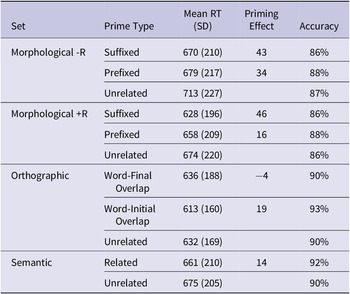
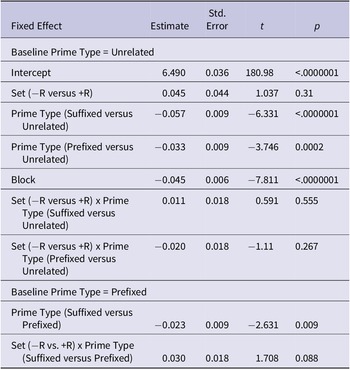
Table 3 shows mean RTs and accuracy scores. Our first model tested for morphological priming in our L1 Turkish-L2 German group, in the −R and + R morphological subsets. The model contained the fixed effects Set (−R, +R), Prime Type (Prefixed, Suffixed, Unrelated) and their interactions, plus the covariate Block. The results of the model are provided in Table 4 and show significant morphological priming for both suffixed and prefixed primes, with no interactions between Prime Type and morphological Sets (−R and +R). By changing the baseline of Prime Type to ‘Prefixed’ to directly compare prefixation to suffixation priming, we found that the former was significantly weaker than the latter.
Mean RTs in ms (and standard deviations) and accuracy scores in L1 Turkish-L2 German speakers

Table 3. Long description
The table is organized into five columns: Set, Prime Type, Mean R T (S D), Priming Effect, and Accuracy.
* Morphological minus R set:
- Suffixed: 670 (210) R T, 43 priming effect, 86% accuracy.
- Prefixed: 679 (217) R T, 34 priming effect, 88% accuracy.
- Unrelated: 713 (227) R T, 87% accuracy.
* Morphological plus R set:
- Suffixed: 628 (196) R T, 46 priming effect, 86% accuracy.
- Prefixed: 658 (209) R T, 16 priming effect, 88% accuracy.
- Unrelated: 674 (220) R T, 86% accuracy.
* Orthographic set:
- Word-Final Overlap: 636 (188) R T, minus 4 priming effect, 90% accuracy.
- Word-Initial Overlap: 613 (160) R T, 19 priming effect, 93% accuracy.
- Unrelated: 632 (169) R T, 90% accuracy.
* Semantic set:
- Related: 661 (210) R T, 14 priming effect, 92% accuracy.
- Unrelated: 675 (205) R T, 90% accuracy.
Output of the model (fixed effects) testing morphological priming effects with prefixed and suffixed words in L1 Turkish-L2 German speakers

Table 4. Long description
A data table with five columns: Fixed Effect, Estimate, Std. Error, t, and p.
Section 1: Baseline Prime Type equals Unrelated.
* Intercept: Estimate 6.490, Std. Error 0.036, t 180.98, p less than .0000001.
* Set (-R versus +R): Estimate 0.045, Std. Error 0.044, t 1.037, p 0.31.
* Prime Type (Suffixed versus Unrelated): Estimate -0.057, Std. Error 0.009, t -6.331, p less than .0000001.
* Prime Type (Prefixed versus Unrelated): Estimate -0.033, Std. Error 0.009, t -3.746, p 0.0002.
* Block: Estimate -0.045, Std. Error 0.006, t -7.811, p less than .0000001.
* Set (-R versus +R) x Prime Type (Suffixed versus Unrelated): Estimate 0.011, Std. Error 0.018, t 0.591, p 0.555.
* Set (-R versus +R) x Prime Type (Prefixed versus Unrelated): Estimate -0.020, Std. Error 0.018, t -1.11, p 0.267.
Section 2: Baseline Prime Type equals Prefixed.
* Prime Type (Suffixed versus Prefixed): Estimate -0.023, Std. Error 0.009, t -2.631, p 0.009.
* Set (-R versus +R) x Prime Type (Suffixed versus Prefixed): Estimate 0.030, Std. Error 0.018, t 1.708, p 0.088.
Note: Formula of the best-fit model in R: log(RT) ~ Set * Prime Type + Block + (1 + Set + Block | Participant) + (1 | Target).
We next compared the results from our L2 group to those of the L1 group from Ciaccio and Clahsen (Reference Ciaccio and Clahsen2020)Footnote 4. We fitted a model containing the factors Group (L2, L1), Set (+R, −R), Prime Type (Prefixed, Suffixed, Unrelated) and their interactions, plus the covariate Block. Similarly to Ciaccio and Clahsen (Reference Ciaccio and Clahsen2020), we found no significant two-way interactions of Group and Prime Type or three-way interactions of Group, Set and Prime Type (all ps > .269). The interaction between Group and Prime Type was also not significant when releveling Prime Type to ‘Prefixed’, to directly compare prefixation and suffixation priming in L2 and L1 (b = −0.011, SE = 0.011, t = −1.048, p = .295). Across both groups, there was indeed a main effect of Prime Type for this prefixation-suffixation contrast (b = −0.018, SE = 0.005, t = −3.331, p = .0009). The full model output can be found at the project’s OSF directory (https://osf.io/3m47e/), under supplementary materials, Tables S1–S2.
We then compared morphological priming across the two groups with orthographic and semantic priming. The model comparing morphological to orthographic priming contained the fixed effects Group (L2, L1), Relatedness Type (morphological, orthographic), Prime Type (prefixed/final overlap, suffixed/initial overlap, unrelated), their interactions and the covariate Block. Like in Ciaccio and Clahsen (Reference Ciaccio and Clahsen2020), the interaction between Relatedness Type and Prime Type was significant both for the comparison between suffixed and word-initial overlap primes (b = −0.027, SE = 0.009, t = −3.020, p = .003) and for that between prefixed and word-final overlap primes (b = −0.035, SE = 0.009, t = −3.930, p = .00009), suggesting that, across both groups, morphological effects could be distinguished from bare orthographic priming effects. None of the interactions involving Group and Prime Type were significant (all ps > .266); therefore, there is no evidence that the results for this comparison would differ between the two groups. Because the semantic control set contained only two types of primes (related, unrelated), we fitted two separate models to compare morphological to semantic priming: one contrasting morphological suffixation priming against semantic priming, and the other contrasting morphological prefixation priming against semantic priming. Both models contained the fixed effects Group (L2, L1), Relatedness Type (morphological, semantic), Prime Type (prefixed/suffixed/related, unrelated), their interactions and the covariate Block. We found a significant interaction between Relatedness Type and Prime Type for suffixation versus semantic priming (b = −0.035, SE = 0.010, t = −3.575, p = .0004), suggesting that morphological priming with suffixed words could be distinguished from bare semantic priming. Instead, the interaction only approached significance for prefixation versus semantic priming (b = −0.017, SE = 0.010, t = −1.714, p = .087), possibly due to the weaker priming effects with prefixed primes, which may then be even indistinguishable from semantic priming. All interactions involving Group and Prime Type were not significant (all ps > .266), providing no evidence that the results for morphological against semantic priming would differ between the two groups. All the full model outputs are available at the project’s OSF directory (https://osf.io/3m47e/), under supplementary materials, Tables S3, S4, and S5.
We finally compared the morphological priming effects from our L1 Turkish-L2 German group to those of the L1 Russian-L2 German group from Ciaccio and Clahsen (Reference Ciaccio and Clahsen2020)Footnote 5. When using the unrelated prime as baseline for the factor Prime Type, none of the two-way interactions involving Group and Prime Type or three-way interactions involving Group, Set and Prime Type were significant (all ps > .091). However, when re-leveling to ‘Prefixed’ as baseline to directly compare suffixed versus prefixed primes, the interaction was significant (b = −0.030, SE = 0.012, t = −2.583, p = .010). This suggests a relative difference in the size of suffixation and prefixation priming between the two groups, due to the smaller priming with prefixation that we reported for the L1 Turkish-L2 German group. The model additionally shows a significant interaction between Set and Prime Type, reflecting different priming magnitudes for prefixed compared to suffixed primes in the two morphological sets across both groups (b = 0.026, SE = 0.012, t = 2.231, p = .026). The full model output is presented in Tables S6–S7 of the Supplementary Materials.
Taken together, the morphological priming results for the Turkish L1-German L2 group suggest a disadvantage for prefixation versus suffixation priming, which might be selective for the L2-specific population under investigation, as suggested by the results comparing our L2 group to the L2 group from Ciaccio and Clahsen (Reference Ciaccio and Clahsen2020). At the same time, the comparison to the L1 original group does not provide evidence for a significant difference between L2 and L1 speakers for the effects investigated.
5. Discussion
Previous morphological priming studies have highlighted three possible factors that constrain L2 speakers’ performance during morphological processing: (i) speakers’ proficiency, affecting the relative focus on orthographic versus morphological cues (Gu, Reference Gu2022; Kahraman & Beyersmann, Reference Kahraman and Beyersmann2024; Li, Taft et al., Reference Li, Taft and Xu2017; Viviani & Crepaldi, Reference Viviani and Crepaldi2022); (ii) the grammatical nature of affixes, which makes the processing of inflectional morphology more challenging than the processing of word-formation morphology (Ciaccio & Veríssimo, Reference Ciaccio and Veríssimo2022; Jacob et al., Reference Jacob, Heyer and Veríssimo2018; Kirkici & Clahsen, Reference Kirkici and Clahsen2013; Silva & Clahsen, Reference Silva and Clahsen2008); (iii) cross-linguistic influences from the speakers’ L1. This latter factor has been documented by investigating English prefixed derived words in L1 speakers of Chinese, which have very weak prefixing morphology (Li & Taft, Reference Li and Taft2020; Gu, Reference Gu2022). In the present study, we further investigated to what extent the lack of prefixation in speakers’ L1 limits their ability to process prefixed words in an L2, by testing morphological priming effects with both prefixed and suffixed words in L2 speakers of German with Turkish as L1. The study was a pre-registered replication of Ciaccio and Clahsen (Reference Ciaccio and Clahsen2020), which involved a different L2 population.
We found significant priming effects with both prefixed and suffixed primes, across different types of affixes (lexically restricted and unrestricted). Furthermore, priming effects were significantly weaker with prefixed than suffixed words. However, when comparing our L1 Turkish-L2 German group to the L1 German group from Ciaccio and Clahsen (Reference Ciaccio and Clahsen2020), we found no difference between the two groups. Instead, when comparing our L2 group to the L1 Russian-L2 German group from Ciaccio and Clahsen (Reference Ciaccio and Clahsen2020), we found that the two groups significantly differed for the contrast between prefixation and suffixation priming, reflecting a larger difference between prefixation and suffixation for the speakers with L1 Turkish. Finally, morphological priming across our L2 group and the L1 group was distinguishable from orthographic priming and, at least for suffixed words, from semantic priming.
The morphological priming effects that we found with both prefixed and suffixed words in our L1 Turkish-L2 German group show that, as previously reported (Jacob et al., Reference Jacob, Heyer and Veríssimo2018; Kirkici & Clahsen, Reference Kirkici and Clahsen2013), L2 speakers can access the morphological information contained in derived words, at least to some extent. However, our study also shows that priming with derived words in an L2 was weaker for prefixed than suffixed words, suggesting more costly processing for prefixed words in this population. This is different from what we had reported for the L2 group of our previous study on the same materials (Ciaccio & Clahsen, Reference Ciaccio and Clahsen2020), which had shown priming effects of similar magnitudes across prefixed and suffixed primes.
A possible explanation for this result is that L2 morphological processing performance can be constrained by the characteristics of a speaker’s native language: in line with what had been suggested by Li and Taft (Reference Li and Taft2020) and Gu (Reference Gu2022), the absence of prefixes in the speakers’ L1 might lead to less efficient processing of prefixed words compared to suffixed words. The comparison of morphological effects in our L1 Turkish-L2 German group to the group with L1 Russian, showing a larger difference between prefixation and suffixation priming for the former, indeed supports this interpretation. The two studies by Li and Taft (Reference Li and Taft2020) and Gu (Reference Gu2022) focused on speakers with L1 Chinese, which is a language with overall very poor morphology. In the present study, instead, we focused on a group whose L1, Turkish, presents a strong contrast between its very productive suffixing morphology and its virtually absent prefixing morphology; this makes it a better test case to investigate our research question. Our results from the L1 Turkish-L2 German group, together with the significant difference from the L1 Russian-L2 German group from Ciaccio and Clahsen (Reference Ciaccio and Clahsen2020) and the evidence from Li and Taft (Reference Li and Taft2020) and Gu (Reference Gu2022), are compatible with evidence from cross-language masked priming studies with bilingual participants suggesting that morphemes from both languages are automatically activated during L2 morphological processing (Kahraman et al., Reference Kahraman, Casalis, Javourey-Drevet, Menut, de Wit and Beyersmann2025; see Kahraman & Beyersmann, Reference Kahraman, Beyersmann, Elgort, Siyanova-Chanturia and Brysbaert2023), and more generally with models of bilingual language processing positing automatic and simultaneous co-activation of both languages (e.g., BIA+ model: Dijkstra & van Heuven, Reference Dijkstra and van Heuven2002; Multilink: Dijkstra et al., Reference Dijkstra, Wahl, Buytenhuijs, Halem, Al-Jibouri, Korte and Rekké2019). More specifically, the results from the series of studies on prefixation would extend this evidence by showing that not only the L1 and L2 are automatically co-activated, but more generally, the linguistic characteristics of a speaker’s L1 are active during L2 processing to the extent that they can influence the mechanisms of L2 processing.
However, alternative explanations for our results should also be considered. This is because when, following our pre-registered analysis, we compared our L2 group to the L1 group from Ciaccio and Clahsen (Reference Ciaccio and Clahsen2020), we found no evidence for (or against) a difference between these two groups. Furthermore, while we found robust evidence for suffixation priming effects being distinguishable from both orthographic and semantic priming (across both L2 and L1 speakers), prefixation priming was not robustly different from semantic priming, and it could consequently be a bare effect of semantic relatedness. Note that priming effects from the L1 group in the original study were numerically slightly weaker for prefixed words, but these were not statistically different from suffixation priming. When the results from this group are merged with those from our present L2 group, which shows a large suffixation-prefixation contrast, it is then clear why the two groups would not statistically differ from each other, and a significant difference between prefixation and suffixation priming across both groups is observed.
Given this result on morphological priming across these two groups, it remains unclear whether the selective prefixation-suffixation difference we reported for L1 Turkish-L2 German speakers is specific to the population we investigated in the present study or may also extend to other populations (even L1 speakers). Prefixed words have indeed been claimed to be overall more challenging to process compared to suffixed words. This would be because of the costs associated with processing the most salient section of the word from a lexical/semantic perspective, that is, the stem, in word-final position (Cutler et al., Reference Cutler, Hawkins and Gilligan1985). Indeed, several psycholinguistics studies on native language processing have investigated this hypothesis, though providing mixed results. On the one hand, larger processing costs for prefixed words compared to suffixed words have been reported in studies on native speakers involving simple lexical decision (Bergman et al., Reference Bergman, Hudson and Eling1988; Colé et al., Reference Colé, Beauvillain and Segui1989; Ferrari Bridgers & Kacinik, Reference Ferrari Bridgers and Kacinik2017) and letter-search tasks (Beyersmann et al., Reference Beyersmann, Ziegler and Grainger2015), or eye-tracking (Beauvillain, Reference Beauvillain1996). These findings have been interpreted in terms of less automatic decomposition of prefixed words. Instead, the few available masked priming studies directly comparing L1 processing of prefixed and suffixed words (or pseudowords) show a more incoherent picture: while some found parallel effects for prefixed and suffixed words (e.g., Beyersmann et al., Reference Beyersmann, Cavalli, Casalis and Colé2016; Ciaccio & Clahsen, Reference Ciaccio and Clahsen2020; Mousikou & Schroeder, Reference Mousikou and Schroeder2019), others found again some processing asymmetries in favor of suffixed words (Giraudo & Grainger, Reference Giraudo, Grainger, Baayen and Schreuder2003; Kim et al., Reference Kim, Wang and Taft2015).
If it is true that prefixed words are more difficult to process, the question remains why only some studies found a processing disadvantage for prefixed words. Studies investigating variability in processing might be helpful to reconcile all these findings. These have linked variability in processing to the stability of lexical representations: when lexical representations are well-established, variability decreases, while it increases in the case of unstable representations (Ciaccio & Veríssimo, Reference Ciaccio and Veríssimo2022; Segalowitz, & Segalowitz, Reference Segalowitz and Segalowitz1993; Segalowitz et al., Reference Segalowitz, Segalowitz and Wood1998; Solovyeva & DeKeyser, Reference Solovyeva and DeKeyser2018). This is also compatible with the Lexical Quality Hypothesis (Perfetti, Reference Perfetti2007; Perfetti & Hart, Reference Perfetti, Hart, Verhoeven, Elbro and Reitsma2008), although in our case the focus lies more on the properties of words rather than on speakers’ reading skills. If lexical representations of prefixed words are less well-established, then this should lead to increased variability in performance, potentially explaining why studies investigating the prefixation-suffixation contrast have shown such a variable output. However, this can only be a speculative interpretation. Future studies should aim at providing a better characterization of such variability, trying to understand under what circumstances the prefixation-suffixation dichotomy indeed becomes observable.
Taken together, the contribution of our study to current L2 morphological processing research can be summarized as follows: (i) putting together our results from the L1 Turkish-L2 German group with the previous studies by Gu (Reference Gu2022) and Li and Taft (Reference Li and Taft2020), some evidence is available suggesting an influence of speakers’ L1 on L2 processing of complex words, leading to less consistent priming effects with prefixed words for those speakers whose L1 has poor or absent prefixing morphology; (ii) a general processing disadvantage for prefixed words might however additionally, at least partly, explain why some studies find weaker priming effects for prefixed compared to suffixed words. Given the possibility of generally larger processing costs for prefixed words, future studies aiming at addressing the contribution of cross-linguistic influences in L2 morphological processing should ideally target other morphological phenomena. This would help disentangle the role of cross-linguistic influences from a more general processing disadvantage for prefixed words.
Supplementary material
Supplementary materials present full model outputs of the analyses comparing our L1 Turkish-L2 German group to, respectively, the L1 German group and the L1 Russian-L2 German group from Ciaccio and Clahsen (Reference Ciaccio and Clahsen2020). They are available at the project’s OSF directory: https://osf.io/3m47e/.
Data availability statement
The data that support the findings of this study are openly available at https://osf.io/3m47e/.
Acknowledgments
We thank Serkan Uygun and Iulia Topal for support with data collection and Harald Clahsen for feedback on the project. This work has been partly funded by the Deutsche Forschungsgemeinschaft (DFG, German Research Foundation) – Project ID 317633480 – SFB 1287.
Competing interests
The authors declare none.

 Open access

