




Introduction
In recent years, scholarly interest in wage labour, wage differentials, and wage inequality in colonial Africa has grown significantly.Footnote 1 These studies have highlighted substantial wage disparities between African and European workers, as well as variations in wages among African labourers across different periods and regions. Another central theme in this literature is the use of coercive or semi-coercive measures employed to secure a steady supply of African wage labourers. While these contributions have deepened our understanding of the socio-economic conditions faced by indigenous workers under colonial rule, they are not without limitations. Quantitative analyses are often restricted by the lack of individual-level data, with colonial records frequently providing only aggregate or average wage figures. Further, data limitations forces researchers to focus primarily on male wages, although it is well known that a significant proportion of women also worked for wages in colonial Africa. Additionally, studies on African wage labour have seldom addressed the motivations behind in-kind wage payments in agricultural work, despite their prominence in pre-industrial remuneration systems. In-kind wages were often used as a tool by employers to restrict the mobility of workers, a practice that merits further investigation in the context of colonial Africa.Footnote 2
Our study contributes to the literature on African wage labour and living standards by examining the wages and employment contracts of indigenous Khoe labourers working as farm labourers and pastoral herders in Graaff Reinet, a district on the eastern frontier of the Cape Colony in the early nineteenth century. This research is significant as it provides a detailed account of an indigenous workforce about whom little is known, despite their essential role in the development of the colonial Cape.Footnote 3 Additionally, our data offers the first individual level wage estimates for both male and female Africans in a colonial context, including details of both cash and in-kind payments, as well as the length of labour contracts. Although the scope is limited, this dataset provides valuable insights into the living and working conditions of Khoe wage labourers. The wage registers, compiled between 1801 and 1810, meticulously record which European farmer employed each Khoe labourer, the duration of employment, and whether wages were paid in cash (rixdollars) or in kind, with goods such as sheep, cattle, or clothing.
In this study, we utilize a wide array of historical sources to investigate three interrelated themes. First, we analyse wage differentials within the Khoe labour force employed on European-operated farms, uncovering pronounced socio-economic stratification. These findings highlight the limitations of relying solely on aggregate data to interpret living standards and inequality in rural African contexts, where significant intra-group disparities often remain obscured.
Second, we examine gendered wage dynamics among Khoe farm labourers, suggesting that gender wage differentials were notable despite the central role of Khoe women in pastoral economies. Women contributed extensively to herding, milk processing, and non-agricultural activities such as soap production.Footnote 4 However, we hypothesize that periods of frontier conflict, which created shortages of male Khoe labourers, may have temporarily narrowed these disparities.
These findings imply that colonial labour norms, deeply influenced by Victorian ideals of gender divisions, exerted considerable influence, even shaping wage practices at the local farm level. This underscores the far-reaching impact of colonial ideologies on labour structures within the Cape's frontier economy.
Finally, we observe a shift in wage composition, with a decrease in the proportion paid in kind and an increase in cash payments over the period. If in-kind wages can be seen as a proxy for settler coercion, this trend suggests a decline in coercive labour practices, despite the abolition of the slave trade in 1807, which restricted settlers’ access to enslaved labour.Footnote 5
We argue that the peripheral nature of the Cape frontier economy, with its limited reliance on enslaved labour, meant that its local labour market was relatively insulated from the global ban on the slave trade in 1807, at least in the immediate years following the prohibition. Instead, the increase in cash payments was driven more directly by local conditions. Ongoing frontier conflicts, the risk of Khoe labourers absconding, and the colonial administration's attempts to curtail the harshest labour practices in Graaff Reinet prompted frontier farmers to reduce coercive methods and increase cash wages to retain a reliable Khoe labour force for their pastoral farming ventures.
Despite the limitations inherent in our fragmentary data, our findings highlight the importance of caution when drawing conclusions about living standards and socio-economic disparities in colonial Africa. Data aggregation risks overlooking significant contributions of female labour, potentially leading to incomplete portrayals of labour dynamics and inequality.
The paper is structured as follows. We begin with a brief review of the literature on African wage labour and the challenges posed by colonial-era data. We then provide an overview of the Graaff Reinet district, with a focus on its population and economic activities. This is followed by a discussion of the sources and data used, including their strengths and limitations. Finally, we present a descriptive analysis of wages and living standards at Graaff Reinet unpacking gender wage dynamics and the prevalence of in-kind wages.
African Wage Labour, Wages, and Coercion
It is widely argued that the study of wages not only enhances our understanding of living standards over time but also provides more reliable estimates of economic development than gross domestic product, particularly in cases where data on production, inputs, and prices are incomplete or inconsistent. Consequently, scholars have used historical wage data to investigate major questions, such as the transition from pre-modern to modern economic growth and patterns of regional divergence and convergence over time.Footnote 6
Africa has been largely excluded from these discussions, yet, as we argue, the study of wages in Africa can benefit from insights gained through wage research and remuneration types in other regions, particularly medieval Europe.
Until recently, studies of wage labour in colonial Africa rarely involved systematic quantification of wages or an analysis of how wage contracts evolved over time. That said, the body of literature on African wage labour under colonial rule is extensive and has made important contributions to our understanding of the economic and social dynamics of European colonialism. Previous studies have explored a wide range of topics, from the rise of an African wage-working class to the role of African wage labourers as a force opposing colonial authority.Footnote 7 A central theme in this literature is the use of both direct and indirect coercive methods to increase the supply of labour. Scholars argue that a general reluctance among Africans to work for Europeans, combined with low population densities, enabled many Africans to sustain themselves as independent farmers rather than entering the colonial labour market.Footnote 8
It is commonly argued that various coercive policies implemented by colonial authorities to boost the labour supply were crucial in supporting profitable European-controlled agriculture, mining, and manufacturing. In some cases, colonial governments resorted to forced recruitment to compel Africans to work for colonial enterprises or the authorities themselves.Footnote 9 More frequently, however, indirect measures were used to drive Africans into wage labour. These included land dispossession, taxes, and restrictions on cultivating profitable cash crops, all of which limited African economic independence and forced Africans into the colonial labour market.Footnote 10
In recent years, scholars have increasingly gathered wage data to investigate African living standards across different times and regions in colonial Africa. The seminal work by Frankema and Van Waijenburg has been pivotal in advancing this field of study.Footnote 11 Frankema and colleagues estimate urban real wages for unskilled African male workers across nine British colonies. An important finding from their study is that urban real wages were higher in West Africa (Ghana) than in East Africa (Kenya). They argue that this difference is partially because of Kenya's status as a settler colony, where colonial authorities implemented various measures to increase the supply of African wage labour. In contrast, no similar interventions were enacted in non-settler colonies such as Ghana. This finding aligns with arguments made by historians in the 1970s, who posited that coercive labour policies in settler colonies were instrumental in keeping African wages comparatively low.Footnote 12
Subsequent to their study, several papers on the same theme have emerged, although they rarely concentrate explicitly on African wage labourers. Nonetheless, they offer estimations of real wages for African unskilled wage workers. Unlike Frankema and Van Waijenburg,Footnote 13 these studies also include wage labourers in rural settings. The Bolt and Hillbom study of Bechuanaland and the Aboagye and Bolt investigation of the Gold Coast show that rural wages consistently exceeded subsistence levels throughout the colonial era, exhibiting modest growth over time but remaining lower than the real wages provided to unskilled urban workers.Footnote 14 Additionally, the De Haas study on Buganda and the work of Tadei and Alfani on French West Africa have contributed significantly to our understanding of living standards and inequality in colonial Africa.Footnote 15
A major constraint inherent in the recent wage data lies in the manner in which estimates are conveyed within archival records. Specifically, there is a notable absence of individual or household wage data for the African demographic. Instead, colonial records typically present wage information in terms of minimums, maximums, or averages for specific occupational cohorts. Complicating matters further, unskilled and agricultural labourers are often amalgamated into broad, undifferentiated categories. Consequently, scholars are compelled to impute an average wage to cohorts comprising thousands of individuals engaged in diverse tasks and operating under varied contractual arrangements. This methodological challenge finds resonance in studies of pre-industrial economies such as Sweden, where disparities in real wages among different labour categories have been illuminated. For instance, research by Gary and Olsson underscores substantial differentials in remuneration between unskilled day labourers and those engaged in longer-term contracts.Footnote 16 This example highlights the nuanced complexities inherent in wage determination and emphasizes the necessity for nuanced approaches in interpreting historical wage data.
Another significant limitation arises from the paucity of reliable data concerning female wage labourers and their earnings. Twentieth-century colonial authorities in Africa were notably influenced by Victorian ideals, promoting a domestic division of labour in which men served as primary breadwinners while women were assigned responsibilities within the home. This perspective, rooted in European industrialized contexts, was presumed to be universally applicable, yet recent research indicates otherwise. Studies on pre-industrial Europe, such as Broadberry et al.,Footnote 17 reveal that a substantial portion of women's labour time, averaging 43 per cent, was spent outside the domestic sphere between 1381 and 1851. Similarly, Gary and Olsson highlight a significant presence of women among unskilled labourers in seventeenth-century Kalmar, southern Sweden, constituting 50 per cent or more of the total workforce for half of the period examined.Footnote 18
A significant gap in the existing literature lies in the fact that archival records for twentieth-century Africa predominantly present wages as cash payments, thereby marginalizing discussions of alternative forms of remuneration. As Claridge, Delabastita, and Gibbs highlight,Footnote 19 in-kind payments were a critical component of compensation systems in pre-industrial societies and remained prevalent well into the nineteenth century. These forms of remuneration, deeply rooted in the economic systems of earlier labour arrangements, played a pivotal role in shaping African labour dynamics and warrant closer scholarly attention.
The dataset analysed in this study provides a detailed account of both monetary and non-monetary payments received by Khoesan farm workers, both men and women, employed by European settler farmers. This individual-level data offers a rare insight into how in-kind payments were strategically employed by settler farmers on the Cape eastern frontier to address specific labour market frictions prevalent in this frontier economy.
The Cape Colony in the early nineteenth century represents a unique case within the broader African colonial context, differing in fundamental ways from the twentieth-century African colonies commonly addressed in wage studies. We acknowledge this distinction and do not intend to offer a comparative framework for understanding labour and colonialism across these disparate settings. Instead, this study emphasizes the distinctive character of the Cape data and its potential contributions to African historical scholarship. By examining the nuanced dynamics of in-kind remuneration within this context, we aim to expand the analytical scope of labour history research in Africa.
That said, certain parallels can be drawn between the Cape and many regions of twentieth-century colonial Africa. However, the early nineteenth-century Cape Colony diverged in key respects. First, while it is widely recognized that colonial administrations in twentieth-century Africa were often financially constrained and exerted only limited control over their territories,Footnote 20 the colonial authorities at the Cape were even weaker. Governed by the Dutch East India Company (VOC) between 1652 and 1795, the Cape had no territorial ambitions beyond what was necessary to sustain its trading objectives. As a chartered company, the VOC's principal aim was to deliver profits to its shareholders through global trade, not to establish extensive territorial control. Within the Dutch Empire, the Cape's primary function was to supply provisions to passing ships rather than produce valuable goods for the metropole. Throughout its administration, the VOC consistently ran budget deficits, a reality underscored by Groenewald's observation that the VOC at the Cape “ran at an enormous loss”.Footnote 21
The fragility of colonial rule was further exacerbated by competing claims over the colony. During the period under study, the VOC lost control of the Cape to Britain in 1795, regained it in 1802, only to cede it permanently in 1806. This political instability severely constrained the ability of colonial authorities to impose coercive measures or ensure their enforcement on the ground.
Second, neither the VOC nor the British, apart from permitting and even encouraging European settlers to take control of land traditionally used by the indigenous Khoe for pasture, implemented additional coercive measures to integrate the Khoe into the labour market during our study period. As in twentieth-century Africa, low population densities and a general reluctance among the Khoe to work for European settlers presented significant challenges. Rather than directly coercing the Khoe, these challenges were addressed through the importation of enslaved labour, initially from Asia and later from East Africa. This system persisted until the British abolition of the slave trade in 1807.Footnote 22 Slavery, however, was a costly institution. Most frontier farmers owned very few slaves, if any. In Graaff Reinet, the average number of slaves per frontier household was approximately 1.15, with a significant proportion of households owning no slaves at all.
Frontier farmers in Graaff Reinet, constrained by limited financial resources and the lack of substantial support from colonial authorities, relied heavily on labour from the Khoe. To mitigate the bargaining power of the Khoe, these farmers developed alternative strategies, with the form of remuneration – whether in kind or in cash – playing a critical role. This dimension of labour relations has been largely neglected in the existing literature on African labour history and warrants closer examination.
The Cape Colony and Graaff Reinet District
In 1652, the VOC established a refreshment station at what is now Cape Town, situated at the southern tip of Africa. Although the initial intention was not to establish a colony, the decision to allow a limited number of Europeans to settle beyond Table Mountain marked the beginning of a period of sustained colonial expansion. By the late eighteenth century, the VOC's control extended over a territory comparable in size to Italy.Footnote 23
Over time, the Cape became a site of relative affluence for European settlers. Fourie argues that the prosperity of eighteenth-century settlers at the Cape rivalled that of England and Holland.Footnote 24 Similarly, Du Plessis and Du Plessis and De Zwart,Footnote 25 as well as Cilliers and Green,Footnote 26 document substantial increases in real wages among settlers at the Cape over the course of the eighteenth century. The existing literature portrays a society characterized by significant upward mobility within the European settler population, underpinned by partible inheritance systems and the widespread use of enslaved labour among elites. Research also highlights the role of debt in wealth accumulation, with the Cape's well-developed local credit system fostering notable social mobility among settlers.Footnote 27 Yet this prosperity coexisted with stark levels of inequality within the European settler community. Wealth inequality at the Cape exceeded that of other eighteenth-century colonial societies, such as the American colonies. While the Cape offered opportunities for settlers to achieve elite status through hard work, this potential for social advancement was accompanied by significant socio-economic disparities.
Despite these advances in understanding the living standards of European settlers, knowledge about the indigenous Khoe people, who inhabited the Cape long before European arrival, remains limited. The absence of pre-colonial written records makes it challenging to reconstruct the Khoe's living standards. Nevertheless, scholars such as Fourie and Green and Dye and La Croix have attempted to estimate the Khoe population and their contributions to the colonial economy of the eighteenth century.Footnote 28 Despite these efforts, considerable gaps remain in understanding the nature of inequality and the living conditions of the Khoe under colonial rule.
The Graaff Reinet district, formally established in 1786, emerged from earlier colonial incursions that had begun around two decades before. The district became a flashpoint for repeated conflicts involving European settlers, local Khoe communities, and the amaXhosa, who inhabited the eastern regions of southern Africa. These confrontations, which spanned from 1779 to 1879, became known as the Frontier Wars and marked a century of violent struggle between southern African communities and European settlers. Despite Graaff Reinet's incorporation into the Cape Colony, persistent instability often forced settlers to abandon their farms, underscoring the precarious nature of colonial expansion in the region.
By the early nineteenth century, Khoe resistance had largely diminished, weakened by conflicts with European settlers and high mortality rates from communicable diseases. However, between 1799 and 1803, the Servants’ Revolt – an uprising led by the amaXhosa in collaboration with Khoe farm labourers – temporarily disrupted European control in Graaff Reinet. Known as the Third Frontier War, this period saw local African groups exploiting the Dutch Republic's vulnerabilities during the Napoleonic Wars to reclaim land and resist colonial encroachment. It was only after the Fourth Frontier War (1811–1812) that British colonial authorities were able to reassert control over Graaff Reinet and stabilize their hold on the district.Footnote 29
This history reveals the complex interplay of resistance, colonial ambition, and economic inequality that defined the eastern frontier, illustrating the need for further investigation into the lived experiences of both settlers and the indigenous communities they displaced.
The settlers in Graaff Reinet primarily engaged in pastoral farming, as the region's environmental conditions were unsuited to sedentary crop cultivation. As Neumark and Links, Fourie, and Green argue, farmers were initially drawn to the Graaff Reinet district because animal husbandry presented greater economic opportunities than crop farming.Footnote 30 The natural environment of the district, characterized by expansive grazing lands, was well suited to livestock farming, a fact underscored by the historical presence of Khoe nomadic pastoralists who had long practised herding in the region.Footnote 31 Despite the challenges posed by vast distances, inadequate infrastructure, and harsh climatic conditions, Graaff Reinet emerged as a major supplier of meat to the Cape Colony during the nineteenth century.Footnote 32 Livestock farming, particularly the rearing of cattle and sheep, dominated agricultural production, with the scale of livestock holdings far exceeding other agricultural activities in the region.Footnote 33
European pastoral farmers in Graaff Reinet relied significantly less on enslaved labour than their counterparts in Stellenbosch and Cape Town. Several factors explain this disparity. First, the average European farmer in Graaff Reinet was poorer than those in the south-western Cape and less able to afford enslaved labour.Footnote 34 Second, pastoral farming required a specific set of skills and resilience better suited to Khoe labourers. As Malherbe notes,Footnote 35 the Khoe were highly skilled herders and renowned for their ability to endure the demanding conditions of stock farming. Consequently, Khoe labourers became a vital workforce for Graaff Reinet settlers, who often employed them in mixed roles, encompassing livestock rearing, crop cultivation, and domestic tasks.
The reliance on Khoe labour was also shaped by its relative accessibility. Unlike enslaved labour, which required significant investment and long-term procurement, Khoe labourers could often be acquired through coercive means, including raids, whenever settlers faced labour shortages.Footnote 36 This reliance on local labour insulated Graaff Reinet's economy from the wider disruptions caused by the 1807 abolition of the slave trade, which had a negligible impact on the labour market of the eastern frontier. As a result, the region continued to rely on the exploitative use of Khoe labour to sustain its pastoral economy, underscoring the distinctiveness of Graaff Reinet's colonial labour dynamics compared to other parts of the Cape.
In Figure 1, fluctuations in the settler, slave, and Khoe populations within the Graaff Reinet district over time are evident. One plausible explanation for these variations lies in administrative changes resulting from shifts in district boundaries. For instance, in around 1806, coinciding with the second British occupation of the Cape and the establishment of the Tulbagh district, there was a notable decline in the recorded settler population. This decline corresponded to an increase in settler numbers on the eastern frontier, which prompted a reorganization of governance. Consequently, some settlers who had previously fallen under the jurisdiction of the Graaff Reinet landdrost were reassigned to the newly created Tulbagh sub-district.Footnote 37 Additionally, the political uncertainty accompanying the transition from Dutch to British rule during this period likely disrupted record-keeping processes, further complicating the accuracy of population data.
The labour force at Graaff Reinet.
Source: British tax data and MOOC-8 series.
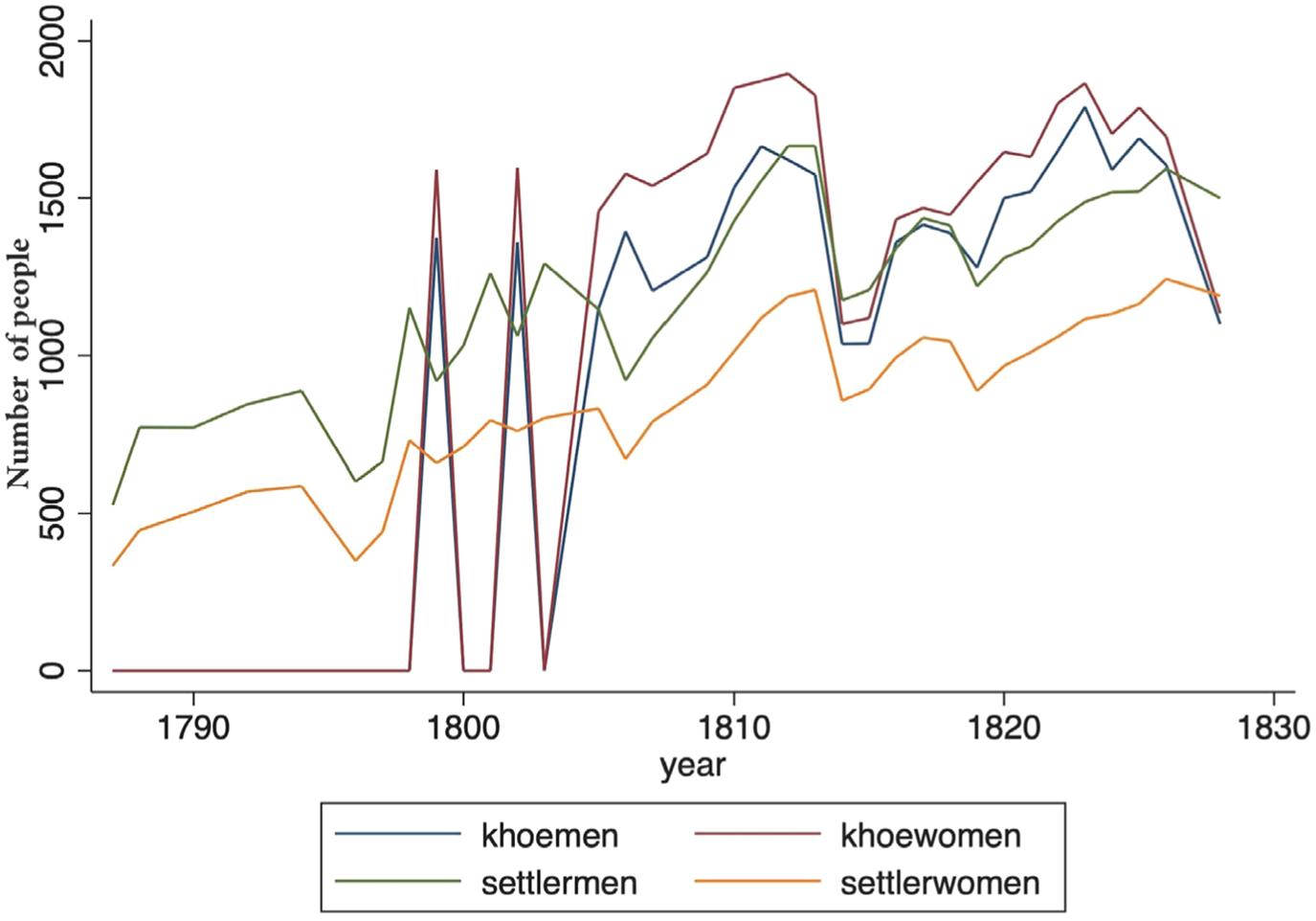
However, the significant declines in settler and Khoe populations depicted in Figure 1 reflect more than administrative changes or record-keeping inaccuracies. These declines also highlight the social and political upheavals characteristic of the time. For example, during the Third Frontier War (1799–1803), amaXhosa chiefs and armed Khoe labourers dealt severe blows to the settler economy, forcing many settlers to abandon their farms.Footnote 38 As a result, the recurring conflicts in Graaff Reinet significantly influenced population dynamics, leading to periodic fluctuations in settler figures.Footnote 39
The extent to which the Khoe could be considered free during the eighteenth century remains a topic of scholarly debate. While it is true that the Khoe were legally prohibited from being enslaved, their ability to sustain their traditional role as free pastoral farmers – established over the preceding two millennia – was systematically eroded by the expansion of colonial borders and the encroachment of European farms. The gradual loss of access to grazing land left many Khoe with little choice but to flee or integrate into the colonial economy as labourers, a status that Ross, Elphick, and Giliomee describe as ”not far removed from that of serfs”.Footnote 40 As farm labourers, the Khoe were neither protected by nor subjected to specific legislative measures, a legal vacuum that overwhelmingly favoured the more powerful European farmers.
There is substantial evidence of the harsh treatment meted out to Khoe labourers, yet isolated instances also exist in which Khoe labourers successfully brought cases against their employers in colonial courts.Footnote 41 By the late eighteenth century, however, formal measures increasingly curtailed the Khoe's freedoms. In 1775, the VOC introduced the inboekstelsel system, which meant that the Khoe were now required to carry proof of a fixed place of abode or employment with a European master in order to move within the colony. The introduction of the Caledon Code by the British in 1809 marked another significant restriction: this colonial legislation permitted European farmers to indenture the children of Khoe women and enslaved men. The system legally bound these children to farm labour, further eroding Khoe autonomy.Footnote 42
Thus, the Khoe farm workers examined in this paper, though technically free in legal terms, operated within a colonial system that severely constrained their autonomy. Their freedom was shaped and undermined by structural inequalities, legislative interventions, and the exploitative practices of European settlers. These dynamics profoundly influenced labour relations on the Cape's eastern frontier.
Data
In order to understand the distribution of the workforce at Graaff Reinet and major agricultural outputs we used the newly transcribed data from the British tax census for Graaff Reinet (1800–1828).47 The total number of farms considered for analysis in Graaff Reinet district is 18,246. The tax data provides information on the number of settler men, women, and children in the household, the number of slaves owned, the number of indigenous Khoe labourers employed, and the agricultural assets and output, including the numbers of various kinds of livestock, the number of wagons, the number of vines, the amount of wine produced, and the crops sown and reaped. It is the statistical breakdown of the number of male and female indigenous Khoe labourers on each farm that is particularly important and useful for the analysis of this paper. Such a breakdown is rare for nineteenth-century colonial archives, because, while the number of settlers and slaves were meticulously recorded, far less information is available on the economic contribution of the Khoe.Footnote 43
In addition, we also utilize wage data for Khoesan labourers in the settler economy at Graaff Reinet. The motivation for compiling these Khoesan wage records appears to stem from the need for colonial authorities to formalize labour relations with the rebelling indigenous population. The tumultuous period following 1775, culminating in the Third Frontier War twenty-five years later, necessitated the formal recognition of Khoesan labour to quell rebellion. Under this new colonial dispensation, labour contracts had to specify the wage and period for which a labourer was hired. It remains unclear whether this formalization was coercive or liberating for the Khoesan, as the new labour laws severely restricted Khoe movements but also offered them recourse against employer transgressions. However, it is evident that both the Batavian Republic and the British had to acknowledge the role of Khoesan labour in the colony to suppress dissent.Footnote 44
Our knowledge of the methods used to collect all our data is scant. It would appear that a government official, probably the veldkornet (or field-cornet, who was a local leader), travelled through each sub-district in order to collect data from each farm, which was then sent on to Cape Town for copying and safekeeping. When looking at the tax data it is possible to distinguish between the number of male and female Khoe labourers, but they do not give a clear indication as to the different duties of Khoe men and women on these settler farms. Apart from being able to observe farm output levels, it is also very difficult to ascertain which tasks were assigned to whom, and who was directly responsible for which agricultural undertakings.
In turn, the wage dataset covers the years 1800–1810 and includes information on approximately 905 male and female Khoesan labourers. The register lists the names of Khoesan individuals, the settler farmers they worked for, their ages (when provided), tenure, and payment in cash or kind.Footnote 45 This data contains a lack of detail regarding the specific types of work for which men and women were remunerated. Since the labourers are linked to a settler farmer, we will assume that all of these labourers did agricultural work. There is some evidence to support this assumption as many frontier settler farmers relied heavily on the Khoe for the pastoral care of their flocks and sheep.Footnote 46
The general weakness of both our datasets qua data collection process could also negatively affect the results of analyses. Yet we would argue that none of these problems or weaknesses are systematically related to the central hypotheses under investigation in this paper. We believe the data limitations are likely to be random such that they do not materially affect the testable hypotheses under investigation here.
Results
Wage Composition and Number of Labourers
At first glance, Figure 2 reveals that the recorded numbers of Khoe males and females were notably high in 1801 but declined sharply thereafter, with no recovery in subsequent years. This trend may reflect an initial effort by frontier farmers to comply with colonial efforts to stabilize labour relations following the violent disruptions of the Third Frontier War (1799–1803). However, this initial enthusiasm appears to wane over time. It is plausible that frontier farmers, predominantly of Dutch descent, grew reluctant to disclose information about their labour arrangements with the Khoe owing to fears of scrutiny and potential repercussions from the newly established English administration. As Penn and Marks and Atmore observe,Footnote 47 frontier farmers often resorted to violent and questionable methods to secure Khoe labour, practices that would have conflicted with the English colonial government's stated aim of stabilizing relations between Europeans and the Khoe.
Males and females in the wage register.
Source: Colonial Wage Registers.
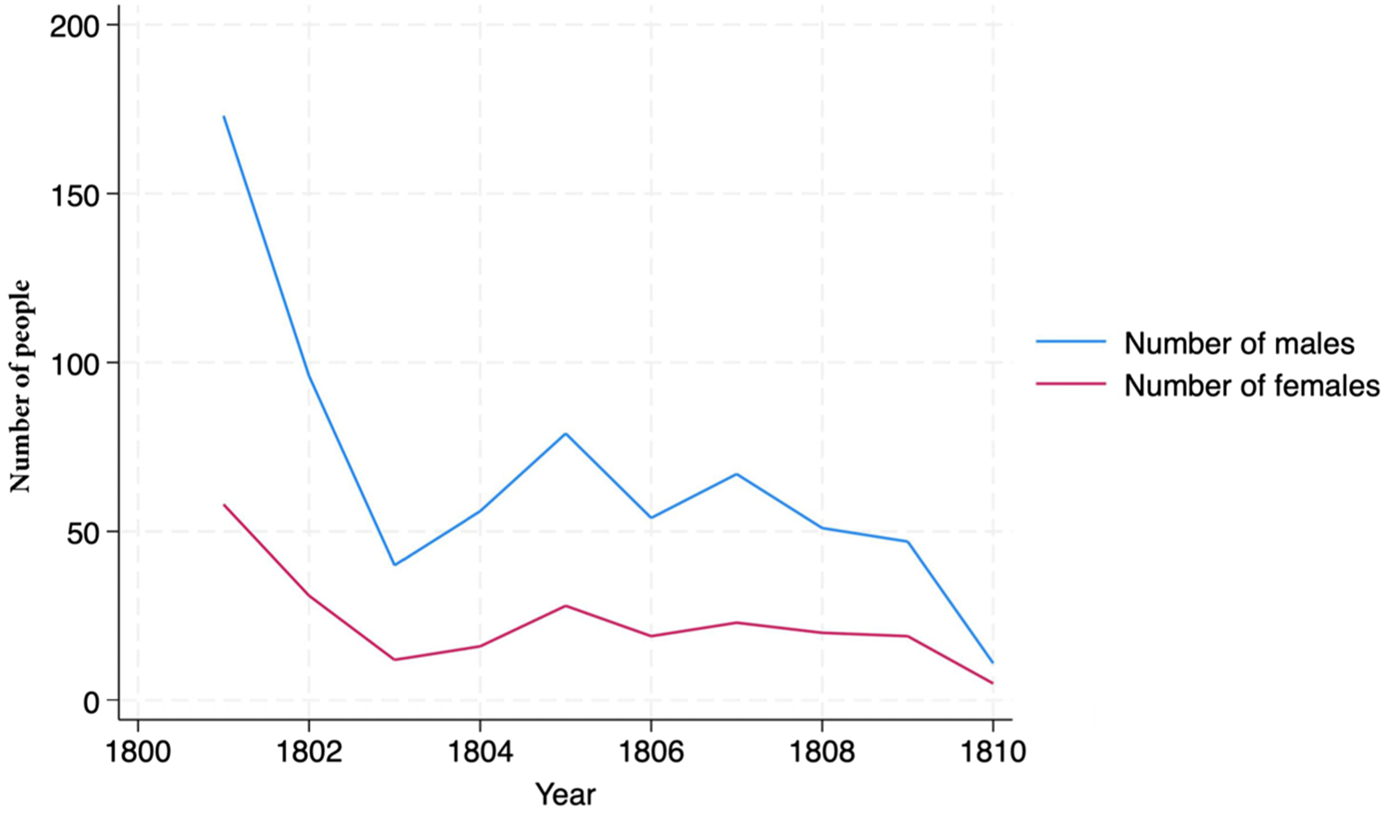
In terms of absolute numbers recorded in the labour registers, European farmers on the frontier demonstrated a clear preference for employing Khoe men over women. This preference is apparent in the wage registers, which show disproportionately higher numbers of male labourers compared with females. However, this contrasts with the demographic patterns visible in the tax records, in which Khoe women consistently outnumbered men, as Figure 1 shows. Malherbe explains this divergence by noting that many of the Khoe listed in wage registers were labourers affiliated with mission stations such as Bethelsdorp or Enon.Footnote 48 By registering their place of abode at these mission stations, Khoe labourers could circumvent much of the English vagrancy legislation implemented during the first decade of the nineteenth century.
The discrepancy between the wage registers and the tax records likely reflects a nuanced dynamic in colonial labour practices. European farmers appeared to prioritize free Khoe male labour for farm work but turned to female labour as a secondary option when male labour was unavailable. This reliance on female labour was likely exacerbated by the drafting of many Khoe men into the Cape Regiment to participate in frontier conflicts. Moreover, the tax records indicate that a significant proportion of Khoe labourers were indentured, suggesting that male labour was often secured through wage contracts, whereas female labour was more commonly obtained under coercive arrangements.
This reliance on indentured female labour offers a possible explanation for the higher representation of Khoe women in the Graaff Reinet tax records. These figures likely reflect a combination of economic necessity and the practical challenges faced by settler farmers, who had to adapt their labour practices to the limited availability of Khoe men. This pattern highlights the gendered dimensions of labour exploitation on the colonial frontier, where Khoe women were frequently subjected to more coercive and precarious forms of employment than their male counterparts. Such gendered labour dynamics underscore the broader inequalities embedded within the colonial labour regime.
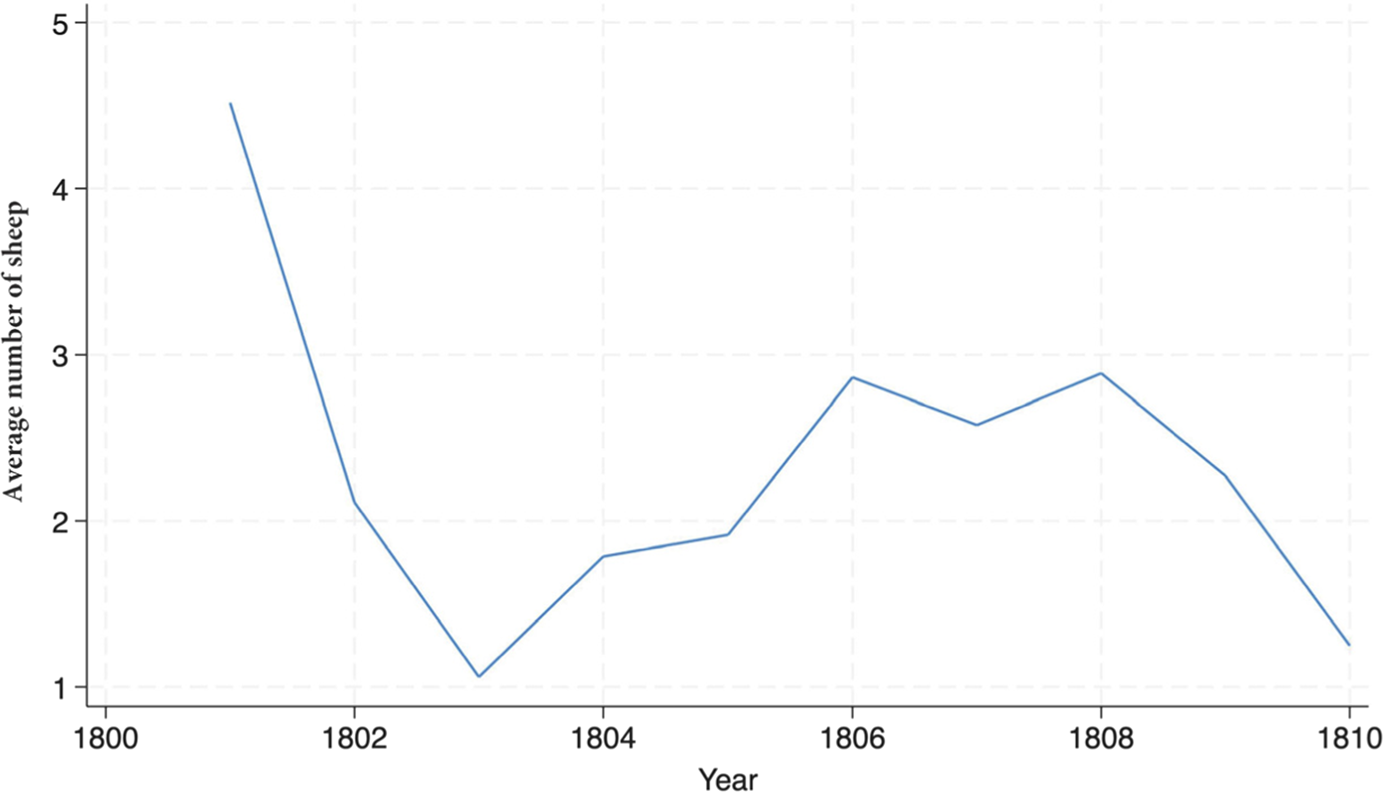
Turning to the forms of remuneration recorded, the wage registers reveal that both in-kind and cash payments were widely utilized. Among in-kind payments, sheep were by far the most prevalent. This preference is likely attributable to the fact that Graaff Reinet was a predominantly pastoral agricultural district. As illustrated in Figure 3, the average annual wage for Khoe labourers paid in livestock amounted to approximately two sheep per worker. This reliance on sheep as a medium of payment reflects their practical utility and possibly symbolic importance within the historically nomadic pastoralist Khoe society.
Average annual in-kind compensation: sheep.
Source: Colonial Wage Registers.
Other forms of livestock, including cattle, goats, and occasionally horses, were also used for in-kind payments. However, as shown in Figure 4, payments involving livestock other than sheep were significantly more volatile and far less common. This volatility may reflect the fluctuating availability of these animals, their higher economic value, or the logistical challenges associated with transferring ownership of larger or less numerous livestock. Sheep, by contrast, offered a more consistent and accessible form of in-kind remuneration, aligning with both the economic realities of frontier farming and the Khoe's cultural preferences.
Average annual in-kind compensation: other livestock.
Source: Colonial Wage Registers.
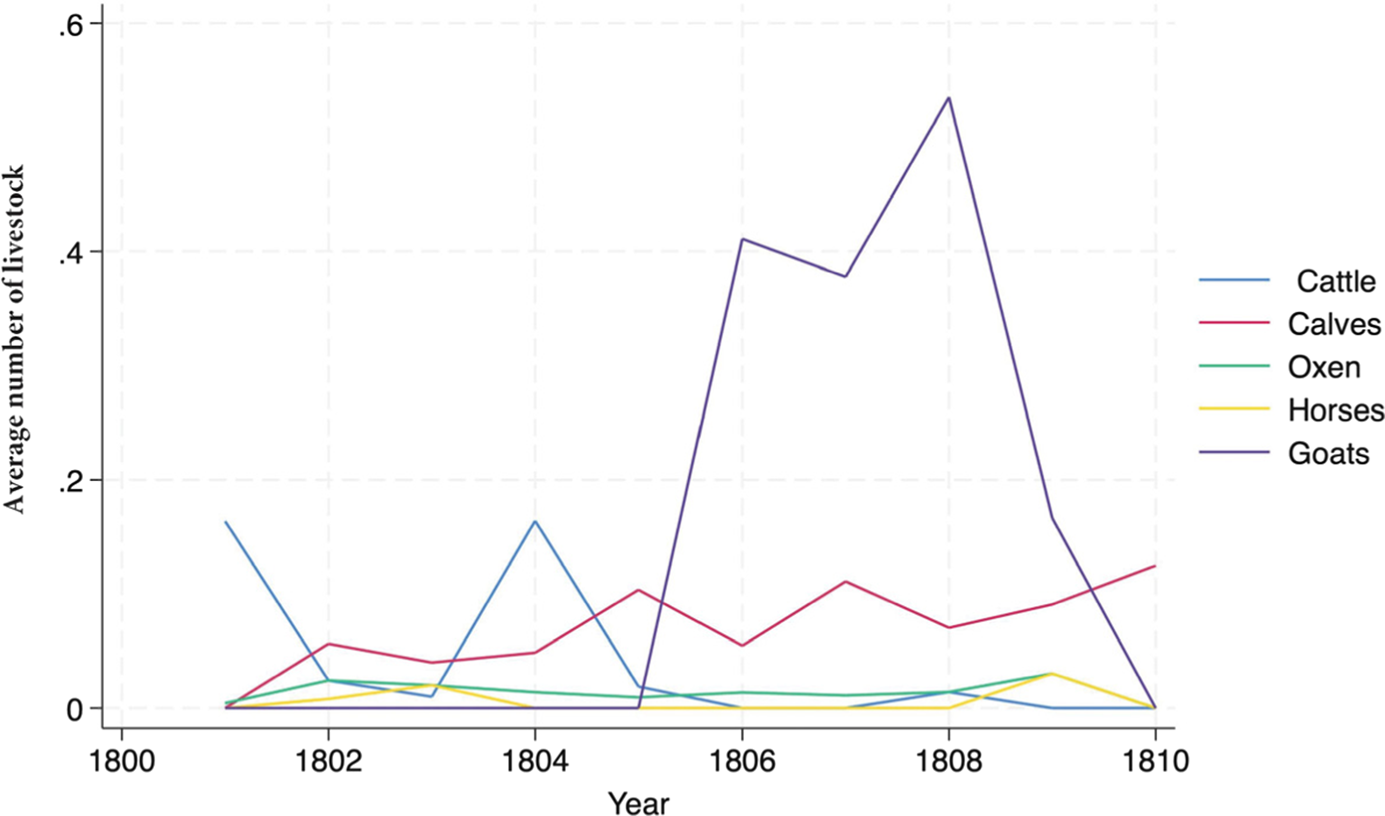
The predominance of sheep as payment therefore highlights the interplay between colonial economic practices and indigenous labour systems. It underscores the ways in which settlers adapted their wage practices to align with Khoe priorities, even as these practices were embedded within exploitative colonial structures. The volatility in the use of other livestock for payments, meanwhile, points to the broader constraints and uncertainties that shaped labour relations on the colonial frontier. This dynamic warrants further exploration to better understand how in-kind remuneration evolved in response to changing economic and social conditions.
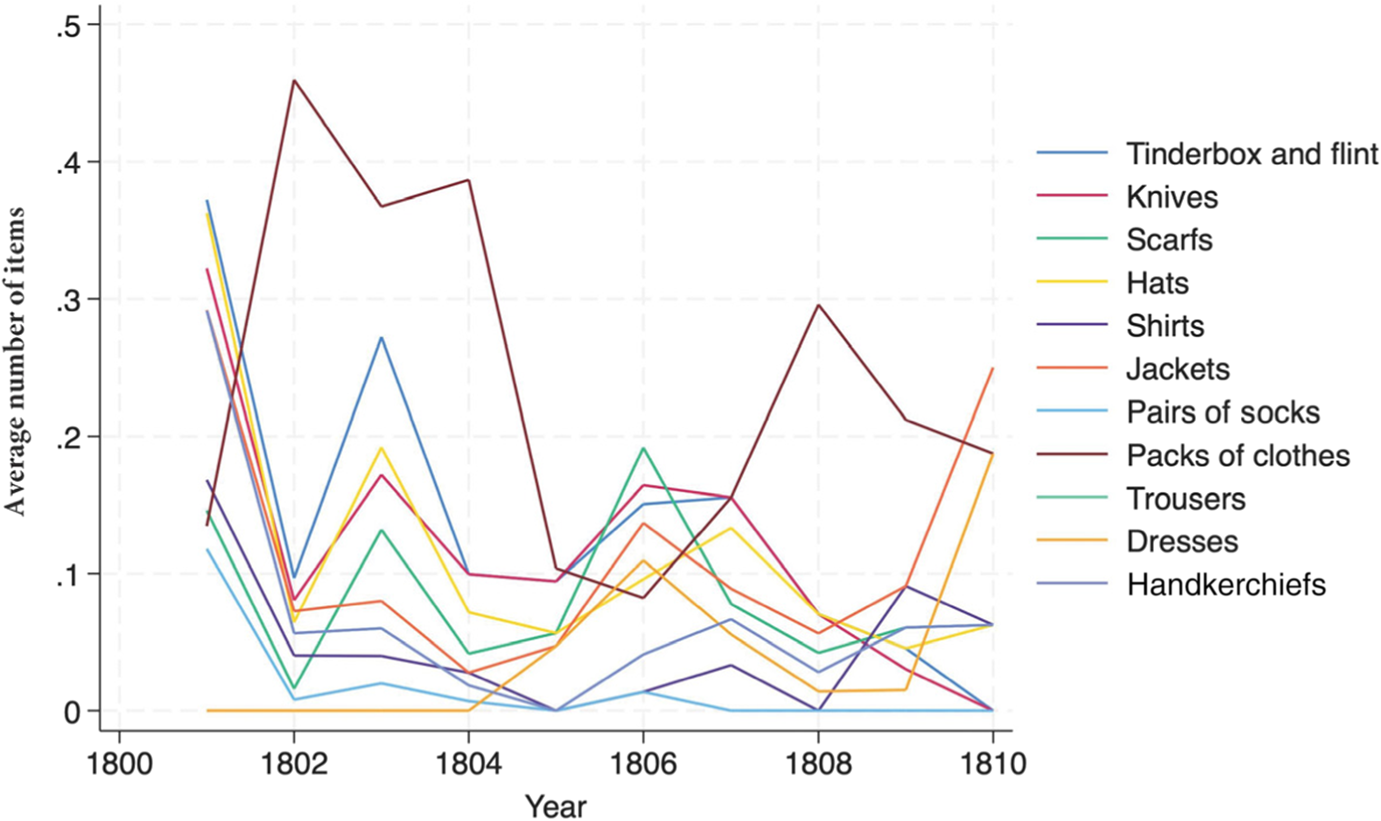
In some cases, labourers were remunerated with practical items such as a tinderbox and flint. Another common mode of remuneration was a “pack of clothing”, which appears to have been quite a popular form of payment to women in particular. A diverse range of in-kind wages was therefore utilized on the Cape frontier to compensate pastoral labour.
However, dissatisfaction with being paid in the form of clothing is a recurring theme in Cape frontier literature. Khoe labourers often expressed frustration with this form of payment, particularly when it was offered in lieu of more valued goods such as livestock or cash. Such grievances were not merely symbolic; they reflected the exploitative nature of colonial labour practices, in which compensation frequently failed to meet the economic or cultural needs of workers. As Penn and Malherbe observe,Footnote 49 dissatisfaction with clothing as a form of remuneration often culminated in open rebellion.
These instances of rebellion highlight the broader tensions within colonial labour systems, where the forms of remuneration imposed by settler farmers were, at times, deeply at odds with the expectations and priorities of Khoe workers. Such conflicts reveal the precarious balance between coercion and negotiation in shaping labour relations on the colonial frontier and underscore the agency of Khoe labourers in resisting exploitative practices. We also posit that such acts of resistance by the Khoesan heavily influenced the evolution of labour systems in the Cape Colony.
Figure 5 illustrates the average proportion of Khoe farm labourer wages paid in kind by European settler farmers over the first decade of the nineteenth century. In 1801, on average, approximately eighty per cent of wages were paid in kind, but this proportion declined to around sixty per cent by 1810. This trend suggests a gradual shift towards the monetization of the economy in Graaff Reinet, reflecting broader transformations in labour compensation practices during this period.
Average proportion of annual wages in-kind compensation.
Source: Colonial Wage Registers.

Figure 6 depicts all the other items that Khoe workers were remunerated with over the period of the study. The data confirm that average remuneration of other in-kind items were far less popular than sheep. The figure also shows that packs of clothing were a popular mode of remuneration for Khoe workers (especially women) at Graaff Reinet. This supports the claims by Malherbe on the popularity of packs of clothing as a form of payment for services rendered.Footnote 50
Average annual in-kind compensation: Number of other items.
Source: Colonial Wage Registers.
Average Wage Levels at Graaff Reinet
In Figure 7 we represent the average cash wages received by Khoe workers during the period of the study. In turn, we calculated a mean combined value for cash and in-kind wages, as depicted in Figure 8. Similar in spirit to the method used by Claridge, Delabastita, and Gibbs,Footnote 51 we took the items listed in the wage registers and combined them with median prices obtained from both the Member of the Orphan Chamber auction rolls and probate inventories for the specific years within which the remuneration took place. Our protocol for assigning values to compensation items prioritized prices from the auction rolls, as they more accurately reflected market prices for a particular year. If an item was not listed in the auction roll data, we used price data from the probate inventories. Since probate prices were assigned by a magistrate or veldcornet at the death of an individual, they may not realistically reflect the true market value of the goods. However, these prices enable us to scale the items in the compensation basket to approximate a reasonable average wage per Khoe worker in the wage registers.
Average annual cash wages paid.
Source: Colonial Wage Registers.

Average annual wages.
Source: Colonial Wage Registers.
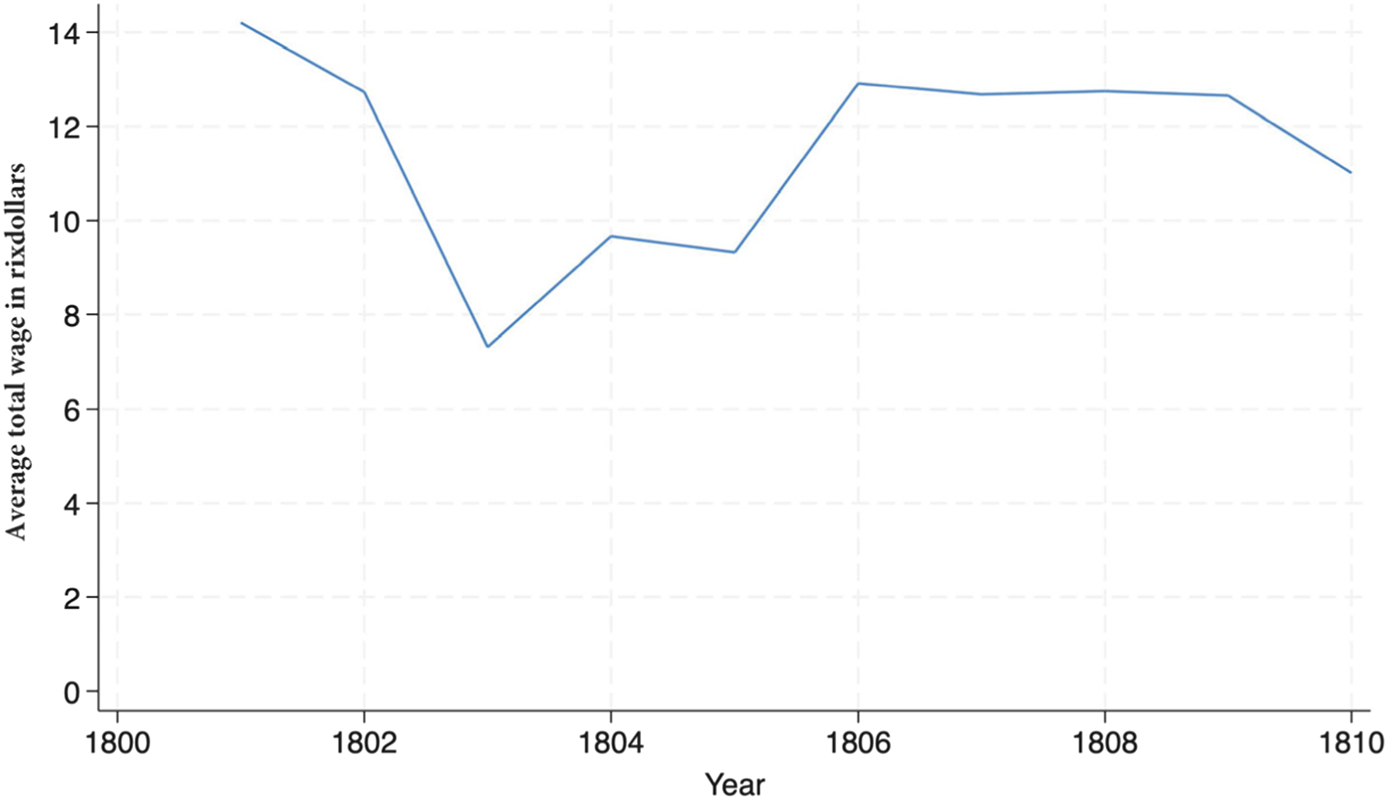
Figure 8 indicates that average total annual wages were approximately 14 rixdollars in 1801, but declined to just below 8 rixdollars in 1802 and 1803. This wage reduction likely took place because of the severe disturbances, owing to the intensification of the frontier war, on the eastern frontier during this period. Freund documents that the large-scale abandonment of frontier farms around Graaff Reinet severely disrupted the colonial economy.Footnote 52 Many Khoe were unwilling to work owing to the rebellion, and European farmers, whose farms were adversely affected by the conflict, were unable to offer competitive wages.
To contextualize the average wages of Khoe agricultural labourers, we perform a simple purchasing power exercise. Considering the average annual wage for a Khoe worker at Graaff Reinet in 1801, which was approximately 14 rixdollars, this wage could purchase 0.28 horses (with a horse costing about 50 rixdollars) or 0.003 slaves (with an enslaved individual costing about 472 rixdollars). This indicates that Khoe agricultural wages were low and had limited purchasing power.
In Figure 7, the average cash wages vary between 2 and 7 rixdollars per year over the period of this study. Over the first decade of the nineteenth century, the value of average cash wages at Graaff Reinet increased. This suggests that initially fewer Khoe labourers were paid in cash, but over time, the proportion of their wages paid in cash grew.
When examining wage differentials over time, Figure 8 shows that overall wages fluctuated within a range of 7 to 14 rixdollars. Additionally, the proportion of wages paid in cash was generally smaller than the value of in-kind compensation. However, while total annual average compensation remained relatively stable from 1805 to 1810, the value of wages paid in cash continued to grow. In 1801 around 20 per cent of Khoe farm wages were in the form of cash but by 1810 the average proportion of wages paid out in cash was 60 per cent. This suggests that although the Khoe were mostly paid in kind at the turn of the nineteenth century, a greater percentage of wages was paid in cash by 1810.
Gender Wage Gap at Graaff Reinet
Turning to the gender wage gap, Figure 9 illustrates that throughout much of the study period, Khoe males received higher wages compared to Khoe females. Similarly, both male and female Khoe wages experienced a decline in 1802 and 1803 before largely recovering to 1801 levels. Notably, male wages declined at a faster rate than female wages during these conflict years, resulting in nearly equal wages by 1803. Following the cessation of the war, Khoe male wages rebounded more quickly than Khoe female wages.
Average annual wages men versus women.
Source: Colonial Wage Registers.
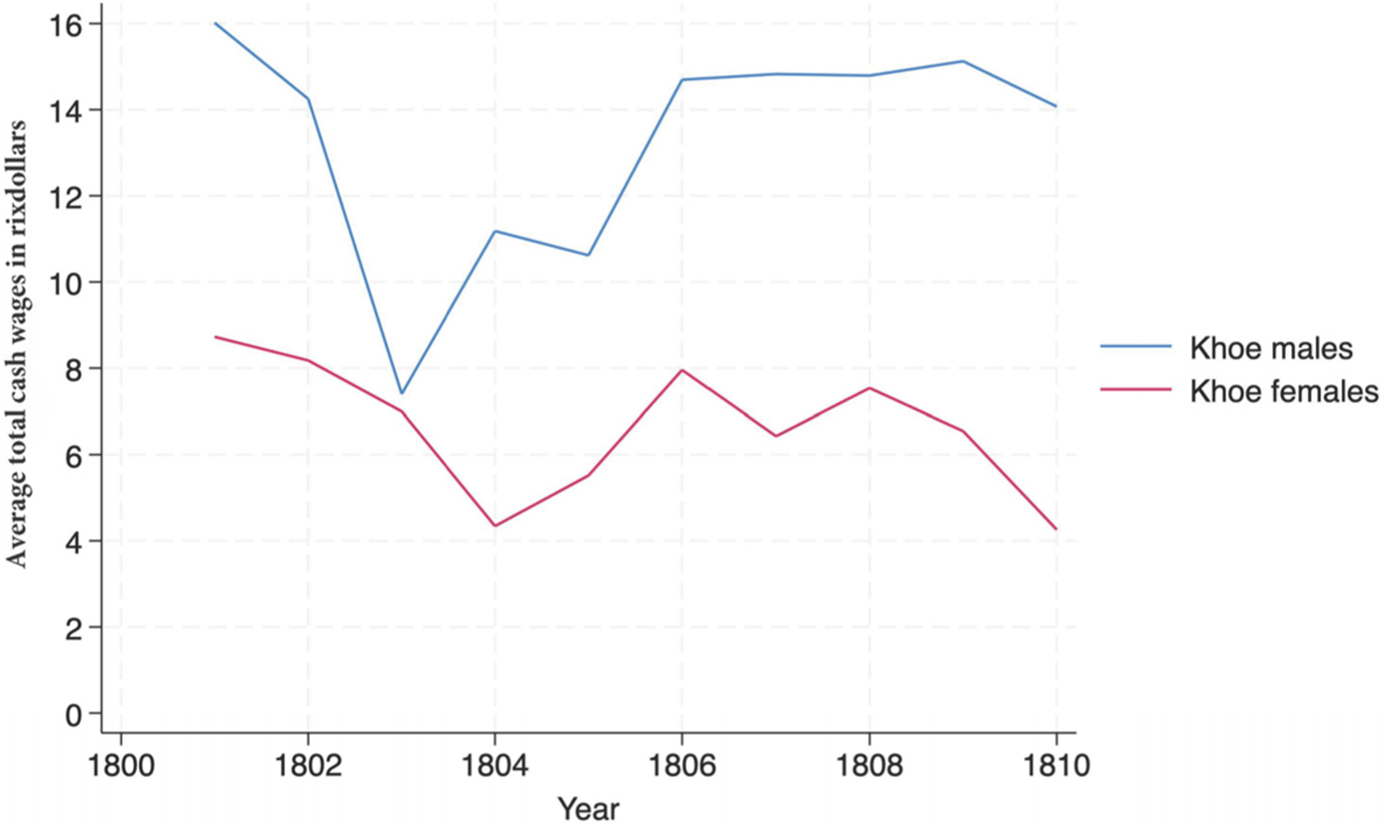
The accelerated decline in average male wages during the conflict period likely stemmed from the significant involvement of Khoe men in the fighting on both sides of the conflict. Given the preference for male labour among frontier farmers, shortages of male labour during the conflict necessitated the employment of women to compensate for the shortfall, unless the European settlers abandoned their farms altogether. During this brief period, women seemed to perform comparable to men (in terms of average wages).
Apart from this brief period of wage convergence, Khoe males consistently received higher agricultural wages than Khoe females. Except for 1803, when male wages were only about five per cent higher than female wages, women typically earned around forty-eight per cent less than men. The wage premium for men peaked at sixty-nine per cent in 1810. This wage differential may be attributed to two factors: the distinct tasks performed by men and women on European settler farms and British and Dutch colonial gender norms. These factors likely influenced the employment of Khoe women in housework or childcare and Khoe men in herding and agricultural tasks. According to Malherbe,Footnote 53 many colonial envoys, including Robert Barrow, noted the crucial roles that Khoe women played in milk management, soap boiling, skin tanning and processing, as well as childcare, while men were primarily involved with herding and the transport of goods.
Khoe Wage Inequality at Graaff Reinet
In order to study income inequality within the Graaff Reinet Khoesan community over the period examined, we calculate a Gini coefficient for each year covered in the colonial wage registers. A Gini coefficient is a statistical measure that quantifies income inequality within a population, ranging from 0 to 1, where 0 represents perfect equality (everyone has the same income) and 1 indicates perfect inequality (one person has all the income while others have none). It is commonly used in income inequality studies to assess the distribution of wealth among individuals or households in a specific area, allowing researchers and policymakers to identify disparities and track changes over time. By analysing the Gini coefficient, scholars can gain insights into the socio-economic structures of societies and the effectiveness of economic policies aimed at reducing inequality.
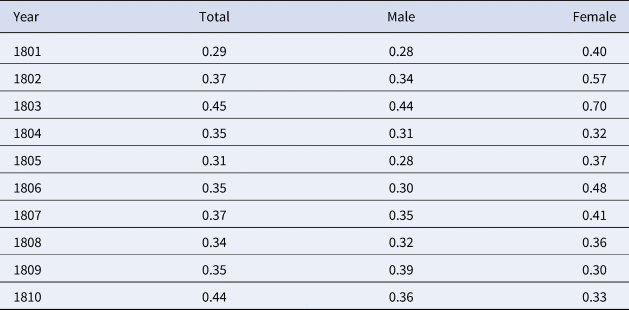
The data on the Khoesan's within-group wage inequality from 1801 to 1810 (depicted in Table 1) shows significant volatility, indicating varying economic and social conditions over the decade. The Gini coefficients provide a quantitative measure of this inequality, beginning at a relatively moderate level of 0.29 in 1801. A marked increase is seen in 1802, with the Gini coefficient rising to 0.37, and further peaking at 0.45 in 1803, indicating severe inequality during the frontier war years. This period reflects the underlying economic challenges and disruptions that impacted the frontier agricultural sector. After this peak, there is a gradual decline in inequality, reaching 0.31 by 1805, suggesting some improvements in income distribution, possibly owing to economic stabilization after the British gain control of the Cape. However, this trend is not consistent, as inequality rises again to 0.35 in 1806 and fluctuates around this higher level for the next few years. By 1810, the Gini coefficient stands at 0.44, indicating a return to somewhat higher inequality levels, comparable to the earlier peak in 1803. These fluctuations highlight the dynamic nature of within-group wage inequality for the Khoesan, influenced by multiple factors such as economic conditions, social changes, and possibly varying access to resources and opportunities within the community. Merely assuming away within-group inequality would therefore be incorrect.
Gini coefficients for Khoe workers (1801–1810).
Source: Colonial Wage Registers.
Wage Inequality and Gender Dynamics at the Frontier
Table 1 reports the Gini coefficients for Khoe male and female workers, revealing that women consistently experienced higher levels of wage inequality than their male counterparts. These disparities likely reflect the shifting labour dynamics of the eastern frontier, where factors such as frontier conflicts influenced labour availability and, consequently, the structure and nature of wages paid. The consistently higher Gini coefficients for Khoe females underscore entrenched structural gender-based inequalities within the labour force, stemming in part from the limited bargaining power and restricted economic opportunities available to female workers.
The pronounced inequality among female labourers emerges as a significant driver of the trends observed. The impact of the Third Frontier War (1799–1803) is particularly evident, with overall wage inequality peaking during this period of conflict. Between 1801 and 1803, inequality rises sharply across all groups, with female wage inequality increasing from 0.40 to 0.70. This sharp rise may reflect the enhanced bargaining power of some Khoe women during this period, as the scarcity of male labourers forced settlers to rely more heavily on female workers. As noted by Malherbe,Footnote 54 Khoe women were adept at tasks such as herding cattle and sheep, making their labour a viable substitute for male labour in certain agricultural activities. This substitution likely led to opportunities for some women to demand higher wages, contributing to the observed increase in inequality.
From 1804 to 1808, inequality declines across all groups, stabilizing at levels significantly lower than the wartime peak of 1803. This stabilization suggests a relative easing of economic pressures and a normalization of labour markets in the post-conflict years. The abolition of the slave trade in 1807 does not appear to have had an immediate or pronounced effect on wage inequality on the eastern Cape frontier. This lack of impact can be attributed to the peripheral nature of the region, where the effects of metropolitan policies, such as the ban on the slave trade, often took years to materialize. Furthermore, the low levels of slave ownership in Graaff Reinet meant that the abolition had minimal direct impact on the local labour market.
By 1809–1810, a notable divergence in male and female wage inequality emerges. Male wage inequality increases to 0.39, while female wage inequality decreases significantly to 0.30–0.33. This divergence highlights shifting labour dynamics in the post-war period. Female workers appear to have experienced more equitable wage distributions, likely because of a decline in the number of female workers recorded in the wage registers. This suggests that only specialized female workers, hired for specific tasks, were retained, resulting in a more compressed wage distribution. Conversely, the increase in male wage inequality may reflect a broader dispersion of roles and tasks performed by men, as well as the continuing preference for male labour in general farm work. These patterns underscore the evolving complexities of the frontier labour market and the interplay of gender, skill, and economic necessity in shaping wage structures.
In-Kind Wage Analysis
Figure 10 illustrates the enduring predominance of in-kind wages as a defining feature of the labour economy in Graaff Reinet. Throughout the decade, the proportion of wages paid in kind remains consistently high, starting at approximately 0.8 in 1800 and seldom falling below 0.6. This trend underscores that in-kind remuneration was the dominant mode of payment for Khoe labourers during this period. Despite indications of a gradual increase in cash payments, the overwhelming reliance on in-kind compensation reflects the practical and economic constraints of the frontier. Of the 905 Khoe workers recorded in the wage registers for the 1801–1810 period, only 137 were paid exclusively in cash, while 654 were compensated solely in kind.
Proportion of wages in kind.
Source: Colonial Wage Registers.
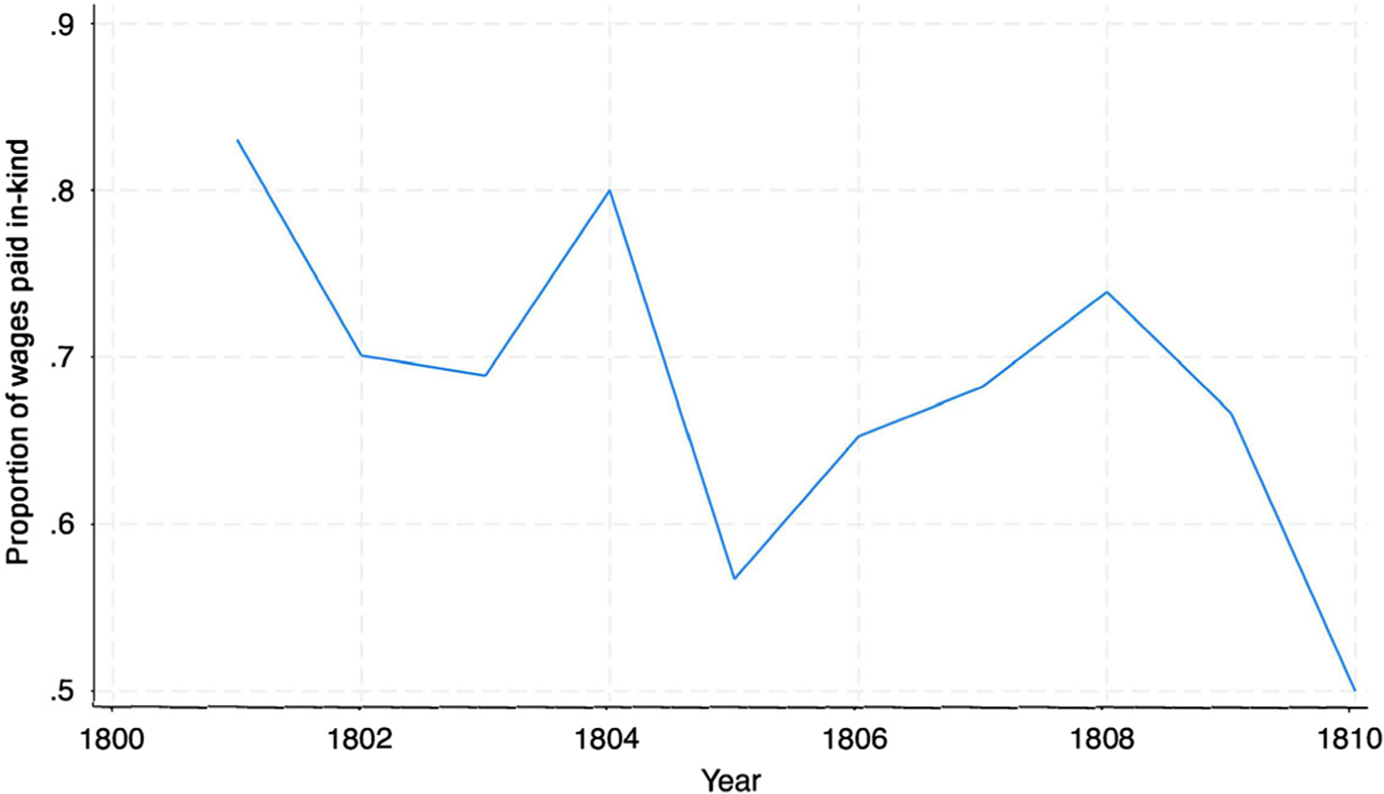
By 1810, the graph shows a sharp decline in the proportion of in-kind payments. This trend may signal a potential shift in labour market dynamics or evolving payment practices; however, the steepness of the decline also raises the possibility of data anomalies or incomplete records for the final year. The persistence of in-kind payments over much of the decade highlights the influence of local practices, shaped by the economic isolation and under-developed currency circulation on the eastern frontier. It also suggests the role of coercive measures by settler farmers, who continued to rely on in-kind payments to maintain control over their labour force.
Nevertheless, the gradual increase in cash payments during this period, despite the scarcity of currency, points to the growing influence of the British colonial administration. Pressured to reduce overtly coercive practices and establish formal labour contracts, settlers may have increasingly turned to cash payments to comply with new labour regulations. This shift reflects broader efforts by the colonial dispensation to stabilize frontier relations and impose greater oversight over the treatment of Khoe labourers, even within the constraints of a frontier economy.
Figure 11 reveals significant gender disparities in the form of wage payments on the eastern Cape frontier. In this graph, the variable 0 corresponds to males and 1 to females. The trends illustrate that in most years, the proportion of in-kind wages paid to females exceeded that paid to males. This disparity highlights the broader economic and social factors shaping wage composition, including the differentiated labour roles assigned to men and women, market constraints, and cultural practices prevalent at the time.
In-kind wage dynamics across gender.
Source: Colonial Wage Registers.
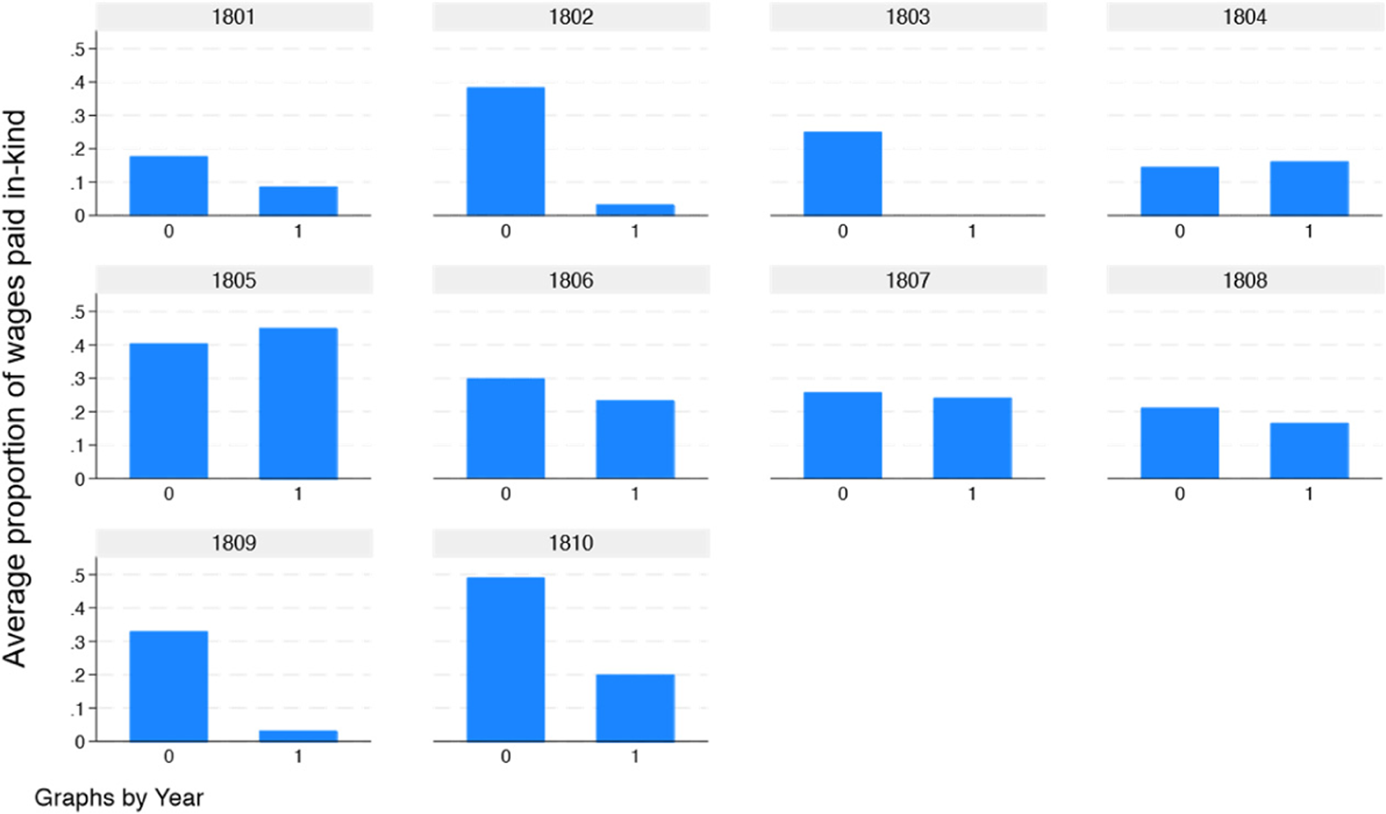
The higher reliance on in-kind payments for female labourers suggests that settler farmers often compensated women differently, likely reflecting the specific nature of the work they performed or their more restricted bargaining power within the labour market. Female labourers, for instance, were often engaged in roles such as domestic work or auxiliary agricultural tasks, which may have been undervalued compared with male-dominated roles such as herding or ploughing.
Moreover, the pronounced gender gap in remuneration practices reflects the intersecting effects of gender- and race-based discrimination, which limited women's ability to negotiate for better wages or conditions. Female workers were frequently compensated with goods such as packs of clothing rather than monetary wages or were paid at rates substantially lower than their male counterparts for comparable tasks. This practice not only underscores the economic marginalization of women within the Khoe labour force but also illustrates how settler strategies for labour control intersected with deeply entrenched hierarchies of race and gender. These patterns emphasize the need to consider both structural inequalities and the cultural contexts that influenced labour practices in colonial frontier economies.
Graaff Reinet and In-Kind Wages
As Claridge, Delabastita, and Gibbs note,Footnote 55 in-kind wages were a defining feature of pre-industrial labour markets, frequently arising from frictions in both goods and labour markets.
At Graaff Reinet, a frontier region marked by economic isolation and sparse infrastructure, multiple factors contributed to the prevalence of in-kind payments. Yet, as the British were intent on quelling Khoe revolts owing to ill treatment by the settlers, it became increasingly difficult for the settlers to coerce the indigenous population without rebuke from the colonial government. This ultimately drove the shift towards cash payments and a decline in in-kind remuneration.
We acknowledge that the existence of in-kind payments at Graaff Reinet was due to a mix of reasons. One significant factor was probably a shortage of currency. Situated over 660 kilometres from Cape Town and separated by the rugged South African escarpment, the region faced limited circulation of physical currency. The scarcity of cash raised the transaction costs associated with monetary payments, making in-kind wages a practical alternative. As Tan highlights,Footnote 56 similar dynamics were observed in Britain during the Truck System period, when high transaction costs made non-monetary remuneration attractive. Furthermore, under-developed product markets in frontier regions such as Graaff Reinet often meant that essential goods were not easily available for purchase with cash, reinforcing the practicality of in-kind wages, which provided workers with immediate access to subsistence resources. In addition, in-kind wages served as a hedge against food price volatility and scarcity, protecting both employers and labourers during periods of economic uncertainty.Footnote 57
For Khoe labourers, in-kind payments, particularly in livestock, aligned with cultural and practical needs. Livestock, such as sheep and cattle, formed the backbone of Graaff Reinet's agricultural economy and were often included in compensation packages. This form of remuneration resonated with Khoe cultural values, as pastoralism and livestock ownership were central to their identity and livelihood. Payments in livestock thus met both economic and social needs, making them an appealing option for Khoe workers.Footnote 58
From the settlers’ perspective, in-kind wages offered additional advantages in addressing labour management challenges. Claridge, Delabastita, and Gibbs note that in-kind payments could help mitigate principal–agent problems, where difficulties in supervising labourers, particularly in tasks such as herding, reduced the efficacy of cash wages.Footnote 59 Tying compensation directly to labour outcomes, such as providing calves or lambs, incentivized productivity and aligned workers’ interests with those of the employer. However, some settlers also utilized in-kind payments to restrict labourers’ mobility and autonomy. As argued by Claridge, Delabastita, and Gibbs,Footnote 60 as well as Tan,Footnote 61 bulky goods such as grain or livestock complicated relocation and discouraged the accumulation of savings, effectively binding workers to their employers and reinforcing dependence.
We acknowledge that a combination of these factors sustained the prevalence of in-kind wages at Graaff Reinet. However; the weak British colonial government's willingness to avoid expensive border conflicts with the Khoe meant that coercive practices were discouraged and formal labour contracts were favoured that protected the interest of both Khoe and settler. The administration sought to impose order on the volatile eastern frontier. The colony's first civilian governor, the Earl of Caledon, was particularly determined to resolve the persistent disputes that had long destabilized the region. Viewing the frontier as a space of unchecked conflict between settlers, indigenous communities, and colonial authorities, Caledon envisioned a more stable and governable colonial periphery. Upon his appointment, he wrote:
Whereas it appears that provisions made from time to time for securing the fulfilling of contracts of hire between the inhabitants of this colony and Hottentots are not sufficient for the intended [peaceful] purpose; and whereas for the benefit of this colony at large, it is necessary, that not only the individuals of the Hottentot nation, in the same manner as the other inhabitants, should be subject to proper regularity in regard to their places of abode and occupations, but also that they should find an encouragement for preferring entering the service of the inhabitants …
The British administration believed that defining the relationship between master – the settler – and servant – the Khoe – through legislative means would protect the interests of both parties. For the settler population such measures promised a reliable supply of labour for their farms, while for the Khoe it ostensibly ensured protection under the law from corporal punishment and severe mistreatment. Masters were now legally required to provide their Khoe servants with the basic necessities for survival, and Khoe labourers could no longer be arbitrarily imprisoned or punished for unpaid debts. On the downside, Caledon enacted the Hottentot Proclamation of 1809, with its sixteen provisions, so that the Khoe would be tied to a specific settler and would be mandated to present the necessary documentation to prove this fact if requested by a government official. Not only was this a revival of the old pass regulation but it also required that the Khoe be attached to a settler household.Footnote 62 These measures appeared, at least to the British, to keep both the settlers and Khoe in check.
As the colonial government had no appetite for continued conflict with the Khoe, settler farmers had to adjust their recruitment tactics to attract and retain Khoe workers. They could no longer arbitrarily coerce their Khoe workforce as the decade progressed. As cash payments granted workers greater autonomy and were inherently less coercive than in-kind remuneration, their adoption increased over time. This shift was further driven by the demands of a labour market adapting to external shocks, such as frontier conflicts and population movements.
In examining the evolution of in-kind payments for Khoe men and women, we identify a decline in their prevalence, replaced by cash payments. This change in forms of remuneration clearly reflected that the colonial authorities’ efforts to reduce coercive practices had worked to some degree.
Conclusion
This study contributes to the growing scholarship on wage labour, wage differentials, and inequality in colonial Africa by examining the wages and employment conditions of Khoe labourers on the eastern frontier of the Cape Colony in the early nineteenth century. By utilizing individual-level data from Graaff Reinet's wage registers, we provide one of the most detailed accounts of an indigenous workforce whose critical role in the colonial economy has often been overlooked. Our analysis of cash and in-kind payments, gendered labour dynamics, and wage differentials underscores the complexity of labour practices in this frontier context and highlights the socio-economic stratification within the Khoe workforce.
Our findings show that gendered disparities were a notable feature of Khoe wage labour, with women consistently experiencing higher levels of inequality than men. This trend reflects not only structural inequalities rooted in colonial ideologies of gender but also the influence of local economic and labour dynamics. However, periods of frontier conflict temporarily narrowed these disparities as male labour shortages enhanced the bargaining power of certain Khoe women. These insights illustrate the nuanced ways in which colonial labour systems intersected with race, gender, and the frontier's volatile economic conditions.
Furthermore, our analysis identifies a gradual decline in the prevalence of in-kind payments, replaced by a growing reliance on cash wages. While in-kind payments were initially sustained by logistical and cultural factors, their decline signifies a shift towards less overtly coercive labour practices, shaped by the pressures of British colonial reforms and local economic necessities. This transition was not uniform, reflecting the peripheral nature of Graaff Reinet's economy, which remained insulated from broader changes, such as the abolition of the slave trade in 1807, for much of the period under review.
Through its focus on individual-level data, this study cautions against over-reliance on aggregate figures to understand living standards and inequality in colonial African contexts. Such approaches risk obscuring the contributions of marginalized groups, including women, and fail to capture the socio-economic stratification within indigenous communities. By foregrounding the lived experiences of Khoe labourers, we shed light on the intricate labour dynamics of a frontier society in flux and argue for a more granular approach to understanding colonial labour systems.
In conclusion, this paper demonstrates the potential of integrating individual-level wage data with broader historical analysis to deepen our understanding of labour and inequality in colonial Africa. By situating the Khoe workforce within the broader context of Graaff Reinet's economy, this study contributes to ongoing debates about the intersections of race, gender, and coercion in pre-industrial labour markets. We hope this research inspires further investigations into the complexities of indigenous labour under colonial rule and fosters a more nuanced understanding of the diverse experiences of African workers in the past.


 Open access

