


Introduction
Dans le liber primus de l’Historia Persecutionis Africanae provinciae, Victor de Vita évoque l’aventure des chrétiens envoyés en relégation chez le roi maure Capsur.Footnote 1 Ils tentent de répandre la renommée du Seigneur Christ à travers le désert où il y a « une immense foule de Barbares païens ».Footnote 2 En s’appuyant sur des sources littéraires et ecclésiastiques outre quelques données archéologiques, on essaie de discuter la question des évêchés et des traits saillants du paysage ecclésiastique au sud de la Byzacène et à l’ouest de la Tripolitaine aux IIIe–VIIe siècles. L’enjeu principal de cette étude tourne autour de nouvelles réflexions sur les particularités de la présence de l’Église d’Afrique du Nord dans une zone présaharienne, ouverte sur deux provinces administratives romaines et mitoyenne du limes. Pour être plus précis, on ambitionne de déterminer les principaux sièges épiscopaux attestés dans cet espace frontalier en fonction de leur répartition géographique, leurs spécificités et leur poids au sein de l’administration ecclésiastique africaine.Footnote 3
Indiscutablement, on est en présence d’un dossier dont la complexité tient principalement aux spécificités des sources et à la rareté des données de l’archéologie. Les sources écrites sont majoritairement constituées des listes épiscopales, des appendices d’actes conciliaires, des lettres synodales et des indications de saint Augustin. L’essentiel des vestiges archéologiques a été découvert à l’époque coloniale grâce aux travaux des officiers topographiques. Deux publications en 2003 et 2014 montrent bel et bien la pauvreté inquiétante des vestiges chrétiens antiques dans la zone de la présente étude. D’une part, on cite la liste des sites ayant livré des témoignages de christianisation attestés au sud-ouest de la Byzacène et au sud de la Numidie et qui est dressée par Yves Modéran.Footnote 4 De l’autre, les données infimes de l’inventaire des monuments chrétiens de la Tunisie dans l’ouvrage collectif « Basiliques chrétiennes d’Afrique du Nord II ».Footnote 5
En vérité, plusieurs raisons incitent à reprendre et repenser cette question. De prime abord, on ne peut nier que les études relatives aux évêchés et au christianisme africain sont continuellement enrichies.Footnote 6 Citons, pour l’époque coloniale, « Le christianisme en Afrique », du Père Mesnage publié en 1914. Il y conclut, en ce qui concerne le territoire qui nous préoccupe, « on peut donc affirmer ceci: le christianisme en Afrique, avait atteint en 430 les limites mêmes de l’Empire, mais il ne les avait nulle part dépassées ».Footnote 7 A cet ouvrage, devenu caduc, s’ajoute un article sur « La diffusion du christianisme en Afrique, au sud des territoires soumis à Rome, après le Ve siècle » d’Auguste Audollent.Footnote 8 Ensuite, pour ce qui est des mécanismes de la création des évêchés et des subdivisions ecclésiastiques africaines, quelques problèmes sont restés dans l’ombre. Dans un article publié, il y a maintenant une quarantaine d’années,Footnote 9 Yvette Duval se demande, non sans raison, « on ne sait comment sont nés ces multiples évêchés ? Quand, comment décide-t-on de créer un nouvel évêché ? Qui décide et définit la nouvelle circonscription ? Quel est le rôle des communautés-elles-mêmes ? ».Footnote 10
Puis, nous voudrions mettre en exergue les conditions de l’éclosion et le processus de l’évolution du paysage épiscopal au sud de la Byzacène et en Tripolitaine occidentale du IIIe siècle à l’époque byzantine. Enfin, il est équitable de revenir sur le thème de l’Église d’Afrique et des missions qui fait encore couler l’encre entre les érudits. En effet, il est une problématique essentielle inhérente à la christianisation des peuplades païennes de la zone du limes et du pré-désert: s’agit-il d’une politique d’évangélisation spontanée ou officielle ?
I Les conditions de la propagation du christianisme au sud de la Byzacène et à l’ouest de la Tripolitaine:
1 Les facteurs politiques et économiques:
A l’appui des remarques qui viennent d’être présentées, on se donne la tâche de jeter de nouvelles lumières sur la place de l’espace étudié dans le paysage ecclésiastique africain en tenant compte de ses particularités géographiques et administratives. De toute évidence, le cadre géographique de la Byzacène méridionale, se distingue par deux versants.Footnote 11 Si le versant saharien se compose de l’Erg, le Dhahar et le Nefzaoua, le versant méditerranéen englobe les plaines littorales de l’Aradh et la Jfara (partie tunisienne) outre la zone du Jebel.Footnote 12 C’est un territoire caractérisé par une diversité géographique exceptionnelle: oasis, plaines, désert et montagnes. Polyvalent, il comprend le Nefzaoua, le Dhahar, le pays des Chotts et la région de Gafsa. Ici, prédominent deux modes de vie: nomadisme et sédentarité.Footnote 13
Sur le plan administratif, cet espace géographique jouit d’une double identité en ce sens qu’il ouvre sur la Byzacène méridionale et la Tripolitaine occidentale où s’étend une grande partie du limes Tripolitanus. Nonobstant quelques nuances, il paraît presque établi aujourd’hui que la création des deux provinces de Byzacène et de Tripolitaine remonterait au temps de la première Tétrarchie.Footnote 14 A vrai dire, la limite entre la frontière septentrionale et occidentale de la Tripolitania et la limite méridionale de la Byzacène ne fait pas unanimité entre les spécialistes.Footnote 15 D’où, les difficultés relatives à l’appartenance de certains évêchés à telle ou telle province.Footnote 16
A Le facteur politique:
Le facteur politique fut déterminant dans la diffusion du christianisme en Proconsulaire qui dut s’opérer dans un calme relatif pendant la seconde moitié du IIIe siècle.Footnote 17 De surcroît, la paix entraîna vraisemblablement un climat de liberté relative entre 250 et 300 ap. J.-C. Le meilleur indice en serait la carte de la distribution des évêchés en Afrique Proconsulaire vers la fin du IIIe siècle. Le christianisme africain, au temps de Cyprien, paraît relativement dense sur le littoral de la Proconsulaire et de la Numidie.Footnote 18 En dépit du laconisme des sources, les évêchés catholiques et donatistes devraient être importants à l’intérieur et dans les campagnes africaines. Une étude pertinente de L. Dossey examine le processus de formation et de reconnaissance officielle des communautés rurales, à travers l’organisation des évêchés africains structurant le monde rural aux IVe et Ve siècles.Footnote 19 Selon l’autrice, il devrait être « des évêques là où il ne devrait pas y avoir d’évêques ».Footnote 20 En conséquence, le nombre des évêques catholiques et donatistes fut important dans les campagnes, les montagnes et les milieux ruraux.
Au cours du règne de Genséric, Byzacène, Numidie et Tripolitaine subirent seulement des expulsions isolées d’évêques jugés hostiles. La politique d’Huneric fut plus répressive entre 480–84 notamment les deux années 483–84 comme en témoigne le martyre des sept moines de Capsa. Footnote 21 Evidemment, les rapports entre ariens, donatistes et catholiques furent marqués par des tensions souvent aiguës sous les Vandales.Footnote 22 Le retour à la liberté religieuse en 523 causa plusieurs conflits dont l’exemple de Liberatus de la Byzacène qui refusa l’autonomie aux monastères. En même temps, il fut un défenseur ardent de l’indépendance de la Byzacène face à Carthage. La multiplication des tensions et des débats religieux entre catholiques et ariens ne semblerait pas avoir entravé la diffusion du christianisme. Autrement dit, ces tensions auraient « joué un rôle souvent mineur dans la propagation du christianisme en Afrique Proconsulaire ».Footnote 23
Sous les Byzantins, les restes archéologiques du culte chrétien en Tripolitaine occidentale et au sud de la Byzacène sont très minces. Il faut avouer que cette zone n’a pas été systématiquement prospectée pour la région de Gabès, le secteur étendu entre le Jebel Matmata et le Jebel Demmer ou pour le pays du Jrid.Footnote 24 Et ce, inversement au cas du Jebel de l’autre côté de la Tripolitaine où des églises byzantines et des cimetières chrétiens tardifs ont été identifiés.Footnote 25 En revanche, de très rares indices relatifs à la christianisation sont attestés dans les plaines littorales de l’Aradh et la Jfara. Citons, entre autres, des plats à monogrammes à Oum Ettamr (Métameur) dans la région de Médenine et vraisemblablement un édifice à trois nefs à Oglet Saad à 30 km au sud de Gabès ? Des restes chrétiens ont été découverts, il y a longtemps, à Hr. Bou Guerba tandis qu’une inscription chrétienne avec croix est signalée à Hr. Bettiour à 14 km au sud-ouest de Mareth.Footnote 26
B Le rôle du trafic et de l’armée:
Le rôle du commerce caravanier fut positif dans la propagation des idées chrétiennes chez les populations païennes du pré-désert. Ce trafic fut actif sur les frontières méridionales de l’Empire vers la fin du IVe siècle. En effet, les guides et transporteurs Arzuges païens mentionnés par Publicola, dans sa lettre à Augustin, vers l’an 397,Footnote 27 seraient impliqués dans des activités commerciales reliant le pré-désert aux emporia de la Petite Syrte comme Tacape, Gigthis, Zitha et Girba. Ils auraient contacté des commerçants chrétiens et fréquenté les communautés chrétiennes de la Proconsulaire méridionale.
Les croyances chrétiennes se seraient propagées dans le pré-désert à partir de la cité de Capsa où existe déjà un évêché depuis le troisième siècle de l’Empire.Footnote 28 Des soldats et des limitanei christianisés auraient vécu dans les fermes et les postes frontaliers. Il serait le cas pour le camp de Tillibari où fut découverte une lampe chrétienne.Footnote 29 Deux autres témoignages archéologiques ont été signalés dans la région de Tatahouine. D’un côté, un bas-relief représentant peut-être Daniel et les trois enfants hébreux sans compter des fragments de lampe chrétienne.Footnote 30 De l’autre, l’un des bas-reliefs du castellum mis en place au nord de Bir Ghoumrassen serait orné d’un emblème chrétien.Footnote 31 A cela s’ajoute une inscription chrétienne sur cassette d’argent découverte, parait-il, dans le Jrid ?Footnote 32
2 Les efforts des évêques africains:
A Les acteurs:
A la lumière des sources littéraires et ecclésiastiques, il est permis de dégager des exemples plaidant dans le sens des efforts du clergé africain pour faire propager le christianisme au sud de la Byzacène et à l’ouest de la Tripolitaine. Certains hommes d’église tentèrent d’évangéliser les Afri Barbari c’est-à-dire les Maures du pré-désert que ce soit à l’époque vandaleFootnote 33 ou sous les Byzantins.Footnote 34
Eugène de Carthage exilé au Nefzaoua. Depuis Genséric, il y avait une volonté royale de briser l’épiscopat catholique caractérisée par une longue politique d’exil.Footnote 35 L’un des épisodes d’exil les plus célèbres dans l’histoire de la persécution vandale en Afrique est celui d’Eugène de Carthage. La piété et la popularité du fameux évêque auraient irrité les ariens.Footnote 36 Il avait été exilé vers l’an 484 dans « une cité proche de désert voisine de la province de Tripolitaine » nous dit Victor de Vita. Il est indubitablement question de TamallumaFootnote 37 située en bordure orientale du Chott el Jrid.Footnote 38 Cependant, Eugène de Carthage ne serait pas seul dans son séjour au Nefzaoua puisque Victor de Vita reçut, lui-même, des informations précises de Tamalluma. Si elle est recevable, cette idée expliquerait ses précisions sur l’attitude de l’évêque arien Antonius à l’égard d’Eugène et d’un autre évêque appelé Habetdeum.Footnote 39 Des efforts d’évangélisation auraient été entrepris par d’autres évêques exilés au Nefzaoua, et ce pour deux raisons au moins. En premier lieu, l’exil d’Eugène à Tamalluma ne paraît pas le premier de ce type. Des cas analogues auraient eu lieu avant 484 pour que l’autorité vandale ait choisi le Nefzaoua comme lieu d’exil d’un personnage si opiniâtre qu’Eugène. En second lieu, les mesures de confiscation des églises et d’interdiction du culte ne furent prises qu’en Proconsulaire seulement. Selon Modéran, cette idée vaut pour l’ensemble de l’époque vandale de 439 jusqu’en 523 hormis l’année 484.Footnote 40
Habetdeum de Turris Tamalleni. Incontournable, l’œuvre de Victor de Vita demeure d’une importance capitale pour la compréhension de l’histoire de l’Afrique vandale.Footnote 41 Néanmoins, on doit être vigilant quant aux stratégies littéraires et rhétoriques utilisées par Victor de Vita.Footnote 42 On cite, en particulier, Eric Fournier qui, en analysant ces stratégies, en déduit que Victor de Vita cherche à présenter les Vandales comme ennemis des Romains.Footnote 43 En tant qu’homme de l’église, Victor de Vita nous renseigne, à sa manière, sur les rapports entre catholiques et ariens.Footnote 44 Dans ce cadre, il note que Habetdeum fut rebaptisé, bâillonné et pieds et poings liés. Si la Notitia de 484 ne mentionne pas son exil, Victor évoque son aller-retour à Carthage et son entrevue surprenante avec Huneric. (III, 53–54). Il aurait été exilé sur place dans une résidence surveillée assez proche de la ville où il vit. Le but en serait une neutralisation de l’évêque et de l’influence qu’il aurait pu exercer dans les affaires locales.Footnote 45
Donc, la dimension politique d’une telle mesure n’est pas à écarter comme pour le cas de Faustus évêque de Praesidium (Diolele) relégué « non longe a cathedra sua » où il fonda un monastère.Footnote 46 Habetdeum parvint à rencontrer Huneric à Carthage pour lui demander de revenir sur sa politique de persécution. En contrepartie, il porta plainte contre les rebaptêmes forcés comme celui qu’Antonius lui imposa si l’on se réfère à l’expression « praedones animarum » (III, 48, initio).Footnote 47 Huneric lui répondit de se conformer à l’enseignement des évêques ariens.Footnote 48 Sans conteste, la Byzacène est représentée, en 484, par 107 évêques alors que la Tripolitania n’est y représentée que par cinq. Beaucoup d’évêques ont été empêchés d’y assister à cause des bannissements qui frappent des clercs de la Byzacène (Sufes, Aquae, Hadrumetum) et de la Tripolitaine comme Urbanus de Girba, Vicis de Sabratha et Cresconius d’Oea.Footnote 49
Les clercs catholiques exilés chez le roi Capsur. Victor de Vita rapporte un épisode d’évangélisation déroulé sur les frontières méridionales voire désertiques du royaume vandale. Il s’agit d’un envoi en relégation chez un roi nommé Capsur du catholique Martinianus et de ses compagnons vers 460 ap. J.-C.Footnote 50 Plus loin, Victor de Vita dira que les fidèles exilés chez Capsur envoyèrent des messagers « per itinera distenta deserti » en direction d’une ville romaine.Footnote 51 Mises à part les difficultés d’une localisation satisfaisante du royaume de Capsur qualifié du pays des Caprapicti, il est permis de chercher une partie du moins de son territoire non loin du pays des Chotts en se basant sur trois observations. D’abord, la tribu de Capsur est voisine du désert. Ensuite, elle serait proche d’un territoire méridional appartenant à une province romaine. Il serait situé entre le sud-ouest de la Byzacène et la Numidie présaharienne peut-être entre le Jrid et les Nemenchas.Footnote 52 Enfin, l’analogie Capsur-Capsa-Ad Capsum sur laquelle se sont appuyés, avec d’autres indices, Chr. Courtois et S. Lancel paraît peu convaincante.Footnote 53
Laetus de Nepte. Il découle du discours de Victor de Vita que Laetus de Nepte aurait eu l’audace de défier sans crainte Genséric et son allié Capsur. Le prix de son défi fut son martyre brûlé vif après une longue incarcération « dans la casse d’un cachot ».Footnote 54 La réputation de cet épisode n’est pas due uniquement à son atrocité. Elle s’expliquerait également par les efforts de Laetus en matière de christianisation appréciés par l’épiscopat de Carthage et de Byzacène. Grâce au rôle incessant des évêques indigènes et exilés, des Maures païens se seraient christianisés dans le pays des Chotts. Conséquemment, l’exemple d’Eugène montre que certains prêtres expulsés ici jouirent d’une certaine liberté d’action.Footnote 55 Incarcéré avant la tenue du colloque, il reste en prison jusqu’à la date du 24 septembre 484 où il meurt brûlé. D’après Victor de Tunnuna et Isidore de Séville, Laetus apparaît en songe à Justinien pour l’inciter à envoyer ses armées en Afrique. Mgr. Toulotte admet que l’évêque appelé Filtosus ou Filitosus de Nepte serait ce vénérable confesseur de la foi que les manuscrits de Victor de Vita appellent Fusculus ou Flosculus.Footnote 56
Les sept frères de Capsa. Ils sont connus par leur martyre daté du 2 juillet 484. S’ils ont été gardés en prison quelques semaines, leur arrestation remonterait au printemps 484.Footnote 57 Ce sont Bonifatius, Servus, Rusticus, Liberatus, Rogatus, Septimus et Maximus.Footnote 58 D’après Victor de Vita, ces évêques étaient originaires du territoire de la cité de Capsa qui avait à sa tête le saint Vindemialis qualifié « prêtre exemplaire et fidèle évêque du Christ ».Footnote 59 De ce passage, se dégage deux idées essentielles. Premièrement, rien ne permet de dire que Vindemialis fut évêque de l’episcopus Capsensis. Il pourrait s’agir d’une église située dans la région de Gafsa où d’autres monastères sont mentionnés par les sources écrites dont Praesidium (Diolele) entre Capsa et Thelepte. Ici, l’évêque Faustus construisit un monastère après son exil en 484 non loin de sa ville épiscopale.Footnote 60 Dans un premier temps, il accueillit Fulgence mais à cause d’une nouvelle persécution survenue en 495/496, Fulgence trouva refuge dans un monastère proche dirigé par un certain Felix.Footnote 61 Deuxièmement, Vindemialis de Capsa est présenté comme un personnage exemplaire. Il serait un bon défenseur de la foi catholique et aurait œuvré pour y faire propager le christianisme. Il est qualifié « sacerdos egregius et Christi fidelis antistes » au cours du récit du martyre des sept moines de Capsa. Bien plus, il est connu par un passage du Grégoire de Tours quoi qu’il ne nomme pas son siège. Il l’a mis en scène dans un récit de la guérison par Eugène de l’aveugle de Carthage.Footnote 62 Victime du patriarche arien Cyrila, Vindemialis est condamné à la mort par le glaive au cours de la persécution menée par Huneric.Footnote 63
B Les autres évêques:
Nous incluons dans la liste suivante, assurément sélective, deux catégories d’évêques. D’une part, les évêques appartenant aux sièges épiscopaux de la Byzacène méridionale et de la Tripolitaine occidentale. De l’autre, les hommes des deux églises de Carthage et de la Byzacène qui auraient des rapports avec la société ecclésiastique dans le territoire en question. Rappelons qu’entre 256 et la fin de l’époque vandale des conciles épiscopaux africains se sont réunis en 345, 348, 393, 394, 401, 403, 411, 418, 445, 454, 484, 523 et 525.Footnote 64 Cependant, ceux qui fournissent une liste nominative des évêques présents sont réduits.Footnote 65
Antonius. Évêque arien présenté par Victor de Vita comme un monstre de cruauté « courant çà et là » à la recherche de nouvelles victimes.Footnote 66 Il fut chargé de la garde d’Eugenius de Carthage lors de son exil à partir du 25 février 484. Il tenta de convertir à l’arianisme Habetdeum de Turris Tamalleni mais en vain.Footnote 67
Aptus. Il serait vraisemblablement désigné par Augustin comme « Aptus iste nescio quis ». Il aurait essayé de circonvenir les chrétiens par des pratiques judaïsantes inquiétantes.Footnote 68
Aptus Tusuritanus. Il fut présent en 411 parmi les conciliarii donatistes.
Aptus Tigiensis. Membre de la liste des vingt évêques désignés par le concile de Carthage du 13 septembre 401. Sa mission fut de procéder au remplacement d’Equitius évêque destitué d’Hippo Diarrhytus. Footnote 69
Asellicus de Tusuros. Il intervint à l’occasion de la conférence de l’an 411 en disant que Victorinus d’Aquae fut simple prêtre donatiste avant d’aller à Carthage et qu’il a été ordonné évêque pendant la route. Ce fut probablement lui qui écrivit à Donatianus primat de la Byzacène pour lui demander conseil face à l’action judaïsante d’un certain AptusFootnote 70. Il aurait reçu, après l’été 418, une réponse à ses inquiétudes de la part de saint Augustin.Footnote 71
Bonifatius episcopus ecclesiae carthaginensis. Ce primat d’Afrique en 523 fut en faveur de la politique tolérante d’Huneric. Il envoya en 523 une lettre à Liberatus primat de Byzacène pour lui demander de résoudre le problème entre le monasterium Baccense et l’ecclesia Maximiamensis. Le 13 décembre 523, il reçut une lettre du primat de Byzacène qui lui demande des réponses à des questions relatives à trois églises locales et à un problème de contestation de frontière ecclésiastique. Face à ces interrogations, Bonifatius exprima son attachement à la tradition et son refus de tout essai de modification. Il rappela la nécessité d’exécuter les décisions conciliaires s’opposant aux empiètements de frontière ecclésiastique.Footnote 72
En décembre 524, il adressa deux lettres aux évêques de Proconsulaire et de Tripolitaine. Le sujet étant le débat des mesures à prendre contre « les usurpations inconsidérées de certains ». Lors du concile de Carthage réuni le 5 février 525, des évêques de Proconsulaire, de Tripolitaine, de Numidie et de Maurétanie Césarienne sont présents. Bonifatius exprima son étonnement face à l’absence, retard ou refus ? du primat de Byzacène Liberatus pourtant invité pour deux fois pour cette date. Par conséquent, le primat d’Afrique demanda conseil sur l’attitude à prendre envers l’évêque défaillant.Footnote 73 M. Eisenberg pense que Boniface de Carthage a utilisé ce concile pour tenter de rétablir le pouvoir sur les évêques nicéens d’Afrique du Nord. Car, ceux-ci manquent de lignes d’autorité claire en raison du règne vandale.Footnote 74
Donatianus. Évêque de Thelepte qui présida le concile Byzacénien du 24 février 418. La même année, il accéda à la primatie de la province ecclésiastique de la Byzacène. Après le concile du mai 418 tenu à Carthage, il y resta avec d’autres indices electi de sa province désignés afin de connaitre des affaires soumises au concile.Footnote 75 Son nom figure le premier sur la liste des destinataires d’une importante lettre épiscopale. Il s’agit de la lettre adressée le 1er août 419 par Aurelius de Carthage à tous les évêques « per tractum provinciae Byzacenae et Arzugitanae ».
On y lit: « Dilectissimis ac desiderabilibus fratribus et consacertotibus Donatiano primae sedis, Januario, Felicis, Palatino, Primiano, Gaiano, Januareo, Victorino et ceteris tractum provinciae Byzacenae et Arzugitanae constitutis Aurelius episcopus ».Footnote 76 De ce qui précède, Donatianus évoque une subdivision ecclésiastique nommée Arzugitana. Il connut les Arzuges chrétiens et barbares et fut au courant des rapports entre « Arzugitani et Tripolitanii fratres ». Aussi, cette lettre donne-t-elle l’impression de relations souvent positives entre chrétiens de l’Arzugitana et de la Tripolitaine vers les années vingt du Ve siècle au moins.
3 La politique d’évangélisation sur les frontières de l’Empire:
En général, l’historiographie moderne a répondu négativement au thème de l’Église d’Afrique et des missions.Footnote 77 D’aucuns estiment que le clergé romain n’a pas entrepris un grand effort pour convertir les Maures à l’intérieur et sur les marges de l’Empire.Footnote 78 J.-P. Callu admet que la diffusion du christianisme au Nefzaoua n’est sûre que pour les confins de la Byzacène et les débuts du limes Tripolitanus. Footnote 79 Au témoignage de sa lettre à Publicola, Saint Augustin s’avère conscient de cette lacune et de son intérêt pour la sécurité de l’Afrique. Au contraire, son récit ne plaide pas dans le sens d’un véritable projet d’évangélisation des Afri barbari d’au-delà du limes. Footnote 80 Sa position serait vraisemblablement justifiée par le fait qu’il ne considère pas les peuplades présahariennes comme des sujets de mission. Faut-il noter que, vers la fin du IVe siècle, la garantie de la paix aux frontières serait une priorité inévitable pour Augustin. Dans ce cadre, le Père Mesnage avance que le christianisme africain n’aurait pas dépassé en 430 les limites de l’Empire.Footnote 81 A. Audollent opte pour une « conversion spontanée à l’égard des Maures des frontières ». En tout état de cause, la christianisation des territoires au sud de l’Empire serait l’œuvre des évêchés proches du limes et du pré-désert.Footnote 82 Ces sièges auraient tâché à répandre la renommée du Seigneur Christ dans un territoire où il y a « une immense foule de Barbares païens » malgré le silence des sources.
Sans réticence, les textes du VIe et VIIe siècles n’évoquent aucune mission ou conversion officielle en Byzacène, en Numidie ou sur les marges de ces deux provinces.Footnote 83 Dans son « De Aedificiis », Procope ne dit aucun mot sur les constructions d’églises en Tripolitaine après la région du Chott el Jrid. Partant, la majorité des tribus présahariennes furent restées païennes, du même type que ces Barbares dangereux auxquels songe saint Augustin dans sa réponse à Publicola. Parallèlement, il est assuré que la pacification fut la clef de l’évangélisation dans le pays du limes. Footnote 84 C’est vrai qu’un vide politique est nettement observable sur les marges de l’Afrique vandale et byzantine. Mais il n’est pas moins vrai que les régimes politiques maures érigés au sud de la Numidie, dans la Dorsale et en Tripolitaine sont des réponses locales à ce vide.Footnote 85 La faiblesse du pouvoir central expliquerait le manque d’un véritable projet officiel pour la diffusion du christianisme dans le pré-désert. Dans un autre ordre d’idées, l’absence de missions officielles d’évangélisation, ne nie pas l’existence des activités ecclésiastiques souvent spontanées entreprises par certains évêchés au-delà là des frontières.
Les Maures de Capsur auxquels Victor de Vita fait allusion apparaissent païens au début de son récit. Un peu plus loin, beaucoup parmi eux seraient convertis au christianisme. Mais la véracité de cette conversion massive n’est pas certaine. Car, il ne faut pas dissocier cette idée du projet de Victor de Vita qui, selon Lancel, consiste à construire un récit autour du martyr.Footnote 86 Autrement dit, la mission principale de Victor de Vita serait de mettre en exergue le martyr des catholiques dont les acteurs sont les Maures païens de Capsur.Footnote 87 Ceci dit, les fidèles exilés semblent ignorer la géographie et le relief du pays des Caprapicti qui désignerait un territoire avec des gravures ou des peintures rupestres.Footnote 88
Quoi qu’il en soit, Victor de Vita insiste sur le succès de Martinianus et de ses compagnons. Ils ont réussi à christianiser « une très foule de Barbares ». Il décrit leur succès en ces termes: « Et de lupis grex fecundus multiplicatur agnorum ». C’est-à-dire « et à partir de ces loups vient se multiplier un fécond troupeau d’agneaux ».Footnote 89 Mais dans quelle mesure on pourrait croire Victor de Vitra quand il évoque la christianisation en masse de ces Maures frontaliers ? Sans sous-estimer l’aspect légendaire ou mythique de son récit, il est possible que certains Maures de Capsur soient convertis bien avant la persécution menée par les Vandales. La raison en serait les contacts éventuels entre ces païens et les évêchés de l’Arzugitana ou de la région de Gafsa.
Les évêchés de la Byzacène méridionale et de la Tripolitaine occidentale aux IIIe et IVe siècles.

II Naissance et évolution des évêchés de la Byzacène méridionale et de la Tripolitaine occidentale:
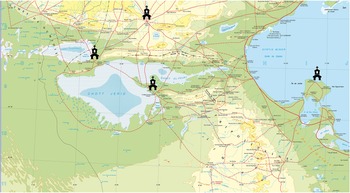
1 Les deux premiers sièges: (Voir Figure 1)
A L’episcopus plebis capsensis:
L’episcopus plebis capsensis est situé à 65 km au sud de Thelepte et à 135 km au nord-ouest de Tacape. Footnote 90 Sans doute, la connaissance de l’éclosion et de l’expansion des sièges africains est-elle redevable à l’histoire des conciles provinciaux et régionaux.Footnote 91 Les conciles pré-cyprianiques sont connus par les lettres de Saint Cyprien. En ce qui concerne la Proconsulaire méridionale, deux évêques sont cités dans les Sententiae episcoporum du concile de Cyprien de l’an 256 ap. J.-C. à savoir Monnulus de Girba et Donatulus de Capse. Footnote 92 Donc, au milieu du IIIe siècle deux évêchés seulement appartiennent à la Byzacène méridionale et la Tripolitaine occidentale, à savoir Capsa et Girba. Auraient-ils joué un rôle dans l’évangélisation de ces contrées ? Par quoi expliquer cette création ? En évidence, Cyprien joua un rôle considérable dans la propagation du christianisme en Afrique.Footnote 93 Ses qualités appréciables l’auraient incité à entreprendre de multiples efforts dans ce sens jusqu’au territoire qui nous préoccupe.
Au total, on connait treize évêques de la plebs capsensis depuis sa création jusqu’à 484. Signalons, entre autres, Donatulus en 256 et Fortunatianus capsitanus, évêque catholique au concile organisé vers 345/348 à Carthage.Footnote 94 A l’occasion de la conférence de Carthage en 411, sont mentionnés l’évêque catholique FortunatusFootnote 95 et son rival donatiste Celer.Footnote 96 En 484, est mentionné l’évêque Vindemialis CapsensisFootnote 97 qui serait identifié avec l’évêque Vindemialis que Grégoire de Tours dit passer pour avoir ressuscité un mort.Footnote 98 Du côté de l’archéologie, très rares sont les indices relatifs à la ville de Capsa chrétienne. Les vestiges de l’église de Capsa ne sont pas encore mis à jour. Les piscines dites « romaines » pourraient traduire, partiellement au moins, le passé chrétien de Capsa à l’époque antique.Footnote 99 Essentiellement, il pourrait s’agir du bassin est dit « Aïn ennsara » qui signifie littéralement « la source des chrétiens ».Footnote 100 Outre cette rareté des vestiges chrétiens attestés à la ville de Gafsa, aucun texte épigraphique datable de l’époque chrétienne n’y est signalé.Footnote 101
B L’episcopus plebis Girbensis:
Ce siège, connu depuis le concile de 256 ap. J.-C. par son évêque Monnulus, est situé sur le littoral de la Petite Syrte. En juin 394, le siège de Girba fut représenté par Procolus évêque donatiste maximianiste.Footnote 102 En 411, il avait deux évêques: Quodvultdeus clerc catholique et son rival donatiste appelé Evasius.Footnote 103 Vers 445–55, son moine catholique Urbanus fut exilé sous les ordres de Genséric. En 484, est mentionné Faustinus évêque catholique tandis que Vincentius est attesté vers 523–25.Footnote 104
Le nombre des sièges appartenant à la Byzacène méridionale et la Tripolitaine occidentale augmente très lentement depuis le milieu du IIIe siècle puisque presque un siècle plus tard Gaudentius, évêque catholique de Turris Tamalleni, participa aux conciles de 345 et 358 ap. J.-C.Footnote 105 Est-ce que la création du siège de Turris Tamalleni fut le fruit des efforts de l’église de Capsa ou de Girba ? Si l’on tient compte de l’appartenance ecclésiastique de Turris Tamalleni à la province de la Byzacène et la proximité géographique entre Turris Tamalleni et Capsa, on pourrait privilégier le rôle de l’église de Capsa.
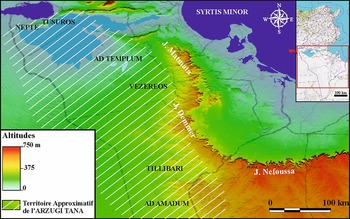
Territoire approximatif de l’ARZUGITANA.

2 L’Arzugitana: une circonscription ecclésiastique présaharienne de la Byzacène:
A Les contours approximatifs: (Voir Figure 2)
Lors de la séance du 28 août 397 du concile de Carthage, l’évêque Aurelius de Carthage évoque deux informations précieuses inhérentes aux Arzuges. Footnote 106 Primo, il mentionne « Praeterea quia in Tripoli forte et in Arzuge interiacere uidentur barbarae gentes…»Footnote 107. Ariane Bodin propose de traduire ce passage ainsi: « De plus, parce que des peuples barbares semblent se tenir, par hasard, entre [les pays] de Tripolis et l’Arzuge ».Footnote 108 Secundo, Aurelius indique, dans la même lettre, les Arzugitani fratres à côté des Tripolitanii. Footnote 109 En 419, il adressa une lettre aux évêques établis « per tractum provinciae Byzacenae et Arzugitanae ».
Il est constatable que le canon du concile de Carthage réuni en 397 ap. J.-C. édicte des dispositions spéciales pour la consécration des évêques en ces termes: « Propterea quia et in Tripoli forte et in Arzuge interiacere videntur barbarae gentes…».Footnote 110 Le mot Arzuge désignerait, dans ce cas, une région géographique où évoluèrent des Barbares qui ne sont pas explicitement cités. Modéran pense que « rien n’autorise de les appeler Arzuges puisque la Tripolitaine est également mentionnée ».Footnote 111
J. Desanges voit que « les peuples barbares s’avèrent tout aussi indigènes (interiacere) que ces communautés ».Footnote 112 Cette indication dénote chez Aurelius d’une entité géographique mise sur le même plan d’importance que la Tripolis. Il serait question, pour le clergé africain, de deux circonscriptions différentes l’une de l’autre. D’où, on retient que l’Arzugitana ecclésiastique n’appartient pas à la Tripolitaine.Footnote 113 Modéran observe que le passage vient après une question sur les visites épiscopales en Maurétanie. Il admet que cet évêque considéra Maurétaniens, Tripolitains et Arzugitains, d’un point de vue politique et religieux, « comme les voisins des Barbares ».Footnote 114
Certes, les Arzugitani fratres et les Tripolitanii sont les chrétiens des territoires de Tripolitaine et d’Arzugis. Selon ce raisonnement, Arzugitana et Tripolitania furent donc deux circonscriptions ecclésiastiques différentes aux yeux de l’épiscopat de Carthage. Il suffit pour s’en convaincre de revenir à la phrase suivante: « nam in Tripoli, ut asseritur, episcopi sunt quinque…».Footnote 115 En tout cas, une interrogation essentielle se pose: pourquoi les différents documents déjà cités associent l’Arzugitana tantôt à la Byzacène, tantôt à la Tripolitaine ? Pour tenter d’y répondre, pourrait-on avancer que l’Arzugis appartenait administrativement à la Byzacène et géographiquement à la Tripolitaine ?Footnote 116
B Les principaux sièges de l’Arzugitana:
* Aquae. La correspondance entre le siège d’Aquae et le site d’el Hamma du Jrid est aujourd’hui admise.Footnote 117 En 393, un évêque donatiste nommé Ianuarius participa au concile de Cabarsussi. Le siège d’Aquae fut représenté en 411 par l’évêque donatiste Victorianus Aquensis qui semblerait ne pas avoir pris possession de son siège épiscopal. Il n’a pas de rival catholique mentionné. C’est lui qui, avec Asellicus de Tusuros, avaient franchi le pays appelé Arzugibus. Footnote 118
* Neptitana plebs. L’oasis de Nefta est située dans l’extrémité nord-ouest du Chott el Jrid. Son siège est représenté en 411 par l’évêque catholique Quodvultdeus sans rival donatiste. Sur la liste de 484, Laetus Neptitanus représentant du siège d’Aggarsel Nepte fut parmi les clercs catholiques les plus actifs du Jrid. Il fut présenté par Victor de Vita comme l’une des fameuses victimes de la persécution d’Hunéric.Footnote 119
* Ticensis Plebs. Ce siège serait situé à Thiges dans le groupe des oasis d’el Ouediane à Degache à 14 km au nord-ouest de Tozeur sur la route vers Gafsa. En 411, l’évêque catholique Gallus Ticensis (39e) avait pour compétiteur un donatiste qui nous est anonyme bien qu’il ait envoyé une lettre. En 484, le siège de Ticibus fut vacant (Not., Byz., 115). Plus tard, Romulus episcopus ecclesiae civitatis Ticibus fut présent au concile de 641. Au cours de la conférence de Carthage, Asellicus Tusuritanus souscrit immédiatement après Aptus Tigiensis sans rival donatiste. Jusqu’à présent, le problème de la localisation exacte de cette plebs n’est pas résolu, bien que ce siège soit représenté au concile de 646 de l’ère chrétienne dont les actes nous sont transmis par les actes du concile de Latran de 649.Footnote 120
* Tusuros. L’évêché de Tusuros fut représenté en 393 par Benenatus et en 411 par l’évêque catholique Asellicus (13e) qui avait pour compétiteur le donatiste Aptus (73e). La Notitia de 484 nomme Florentinus Tuziritanus parmi les évêques de la Byzacène (Not., Byz., 48). Asellicus fut le destinataire de la lettre 196 de Saint Augustin qui lui répondit sur ses plaintes contre l’évêque Aptus puisqu’on lui reproche d’être judaïsant. Il aurait écrit, après 411, au primat de Byzacène Donatianus pour lui demander conseil.Footnote 121 Récemment fouillé, le site de Koustilya a livré les restes d’une église rurale qui, de plan classique, renferme des aménagements liturgiques particuliers. Son architecture semble ressembler, en grande partie, à celle des églises de la Tripolitaine.Footnote 122
* Turris Tamalluma. L’évêché de Turris Tamalluma situé au nord du Nefzaoua correspond généralement au groupe des oasis de Telmine-Rabta-Mansoura-Jedida.Footnote 123 Il fut représenté au concile de Carthage en 349 par l’évêque Gaudentius Turretamallienis. En 411, ce siège est disputé par l’évêque catholique Sabratius et son rival donatiste Jurata. En 484, Habetdeum Tamallumensis figure le 55e sur la liste des évêques de la Byzacène. Il s’opposa farouchement à la persécution d’Huneric, se rendit à Carthage et réussit à rencontrer le second roi vandale. L’activité remarquable de l’évêché de Turris Tamalluma se poursuit au moins jusqu’en 641. Pentasius episc eccl Turrimum Tamat est parmi ceux qui signèrent les derniers la lettre du concile de la Byzacène adressée à l’empereur Constantin III contre les erreurs des monothélites. Cet évêché est représenté, à l’instar de Ticensis Plebs, au concile de 646 ap. J.-C.Footnote 124 En plus de ces cinq évêchés sûrs de l’Arzugitana, au moins deux autres sièges y seraient éventuellement soumis à savoir l’Auzagerensis Plebs et le siège de Tagarbala.
* Auzagerensis Plebs ? Le siège Auzagerensis est représenté en 411 par un évêque donatiste appelé Donatianus sans rival catholique. En 484, l’évêque Villaticus figure au 96e rang de la liste des évêques de la province de la Byzacène. Mgr. Toulotte propose de situer cet évêché à Timezegeri Turris que la Table de Peutinger place à l’est du Jrid (segmentum VI, 4). Son hypothèse est fondée sur la similitude qu’il prête aux suffixes libyco-berbères Au et Tim. D’aucuns proposent de le situer dans les Matmata où les noms de deux toponymes sont à rapprocher de la racine ZGR: Zegrarine el-Khalia et Zegrarine. Cependant, Abdellatif Mrabet rejette les différentes identifications de ce toponyme.Footnote 125 D’après lui, Timezegeri Turris correspondrait au site de la Benia Guedah Esseder sur la voie longeant le Jebel Tebaga à dix milles de Sidi Abdennour/Avibus. Footnote 126 Il va sans dire que le cas de l’Auzagerensis Plebis repose la question du flottement des limites de la Tripolitaine ecclésiastique sur la Byzacène. Sa création serait l’œuvre soit de l’évêché de Turris Tamalleni, soit de celui de Tacape. Footnote 127 Car, ces deux sièges sont géographiquement plus proches de la région d’el Hamma de Gabès et des Matmata que les évêchés du Jrid, de Capsa ou de Girba.
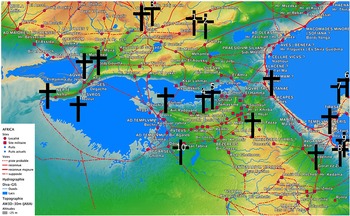
Principaux évêchés et vestiges d’églises en Byzacène méridionale et en Tripolitaine occidentale (partie tunisienne).
1 Hr. el Baroud/2 Hr. Dhraa essayem/3 Gemellensis plebs/4 Tagarbala ? (Borj Tamra)/5 Tagarbala ? (Hr. Mgarine)/6 L’episcopus plebis Girbensis/7 L’église de Meninx (el Kantara)/8 Carcabianensis plebs/9 Putiensis plebs ? (Putea Pallene)/10 Putiensis plebs ? (Bir Abdallah).

* Tagarbala ? Il serait identifié avec la station d’Agarlabas mentionnée par l’Itinéraire Antonin entre Ad Aquas et Turris Tamalleni. La localisation de ce toponyme oscille essentiellement entre deux sites. D’une part, Borj Tamra qui est presque à mi-chemin à l’est de Kebili et le sud-est d’el Hamma de Gabès. De l’autre, Hr. Mgarine situé à environ 10 km à l’est-nord-est de Borj Tamra. L’évêché de Tagarbala est attesté une seule fois en 484 (Byz., 83) avec l’évêque Fortunatianus. Il s’agit d’une petite église rurale entre Kebili et el Hamma de Gabès.Footnote 128 Sans le confirmer absolument, on ne peut exclure que d’autres évêchés puissent exister dans l’Arzugitana comme dans la région du Jrid malgré le silence des sources littéraires et la pénurie des données de l’archéologie.Footnote 129
3 Les autres évêchés: (Voir Figure 3)
A la région de Gafsa:
Plusieurs vestiges de monuments du culte chrétien antiques furent découverts dans la région de Gafsa située dans le sud-ouest de la Byzacène. Citons les restes d’une basilique à trois nefs trouvés à Hr. el Baroud situé à 60 km à l’est de Gafsa.Footnote 130 Des vestiges des édifices du culte chrétien renfermant des symboles de christianisme sont attestés à Hr. Es-Somâa à 45 km au nord de la ville de Gafsa, à Aïn Damous à une cinquantaine de km au nord-ouest de la même ville et à Hr. Baten el Guettar à 10 km au nord-ouest de Gafsa.Footnote 131 Située à 60 km au nord-est de la ville de Gafsa, la région de Bled Talh révèle des traces archéologiques et épigraphiques liées au christianisme à Ksar Graouech et à Hr. Badra. Une petite église à trois nefs précédée d’une cour fut découverte à Hr. Dhraa essayem à 20 km à l’est de Baten Zemmour.Footnote 132
Les sources évoquent deux évêques pour le siège de Gemellae: Litteus en 256 ap. J.-C. et Burcaton en 411 ap. J.-C., donatiste sans compétiteur catholique. Douteuse, la localisation de Gemellensis plebs oscille entre la Byzacène à Hr. Sidi Aïch à 40 km au nord de Gafsa et la Numidie (au sud de Biskra ou dans la région de Sétif).Footnote 133 La même ambiguïté concerne le siège de Praesidiensis plebs/Praesidium. Il faudrait distinguer Praesidium Silvani représenté en 484 et qui pourrait correspondre à Sidi Mhebeb près de Skhira du Praesidium Diolele situé par la Table de Peutinger au nord-ouest de Capsa. Footnote 134 Le donatiste Leontius représente ce siège en 411 et Faustus en 484. Ce dernier serait relégué par Huneric non loin de sa ville épiscopale en un lieu où il fonda un monastère. Plus tard, cet évêché accueillit le jeune Fulgence vers 495–96.
B Le littoral de la Syrtis minor:
Carcabianensis plebs. Ce siège est représenté en 411 par Donatianus et, en 484, par Simplicius. Il correspondrait à Hr. Carcabia situé un peu à l’est de Gergis (Zarzis) selon le Père Mesnage.Footnote 135
Putiensis plebs. Deux sièges de ce nom sont attestés en 484: le premier en Numidie et le second en Byzacène méridionale mais il demeure non repérable. Il serait situé soit à Putae Pallene à 20 km au nord-nord-ouest de Ben Guerdane; soit à 14 milles d’Aggarsel à Bir Abdallah. Il fut représenté en 411 par le donatiste Felix.Footnote 136
Gigthis. Gigthis est situé au fond du Golfe de Bou Ghrara à 30 km au nord-est de Médenine en face de l’île de Jirba. En 403, l’évêque catholique Catulinus représente cet évêché sans rival donatiste. En 411, intervint le catholique Catulinus episcopus Plebis Gittensis. Plusieurs vestiges chrétiens furent découverts à Gigthis. Citons une chapelle en forme de croix avec tombeau de reliques en marbre, des épitaphes chrétiennes et une pierre avec chrisme.Footnote 137
Hr. Gorāat Ez-Zid. Une petite église a été signalée dans ce site qui se trouve à 4 km à l’est de la route actuelle reliant Médenine à Tatahouine à la hauteur de Harboub. (Feuille Kirchaou au 1/100000, 36 G 96ʹ50 et 9 G 11ʹ50). C’est une cathédrale dotée de deux absides orientées approximativement ouest-est.Footnote 138
Meninx. Ce site identifié avec Houmet Essouk est situé au sud de l’île de Jirba au débouché de la voie qui la relie au continent. Quoi que les sources écrites ne citent aucun évêque de Meninx, les vestiges de trois églises sont découverts à el Kantara. L’église importante se trouvait à l’extrémité nord-ouest du site tandis que de la seconde chapelle il ne subsiste essentiellement que l’abside. La troisième chapelle aurait été aménagée dans un hypogée chrétien composé de galeries à colonnades et de grandes niches (arcosolia).Footnote 139 Il est notoire que les monuments chrétiens de l’île de Jirba utilisent beaucoup d’éléments en marbre importé, certains de remploi.Footnote 140
Tacape. Tacape est mentionné par Pline, l’Itinéraire Antonin, la Tabula Peutingeriana et l’Anonyme de Ravenne.Footnote 141 Cette oasis maritime érigée sur la côte moyenne de la Syrtis Minor, fut représentée en 403 par Dulcitius évêque catholique qui n’a pas pu arriver à temps.Footnote 142 En 411, le siège de Tacape fut représenté par Dulcitius et son rival donatiste nommé Felix. Dulcitius fut désigné délégué de la Tripolitaine au concile de Carthage réuni le 25 août 419.Footnote 143 Dans la Notitia de 484 est mentionné Servilius Tacapitanus. L’évêque catholique Gaius de Tacape fut legatus de la Tripolitaine au concile de Carthage tenu en février 525. Il s’associa avec son collègue Vincentius à la réaction unanime des évêques de l’Africa face au primat de Carthage. Ceux-ci disent que « leur présence est, à leur avis, un témoignage suffisant de (leur) obédience à l’égard de l’évêque de Carthage ». Gaius aurait participé au concile de Carthage en 535.Footnote 144 Notons que des sortes de catacombes sans loculi dans les parois furent signalées à 8 km de Gabès par A.-F. Léynaud.Footnote 145
III Particularités du paysage ecclésiastique de la Byzacène méridionale et de la Tripolitaine occidentale:
1 Une faible représentation aux conciles africains:
La faible représentation de cette vingtaine de sièges épiscopaux de la Byzacène méridionale et de la Tripolitaine occidentale aux conciles africains est observable à plusieurs occasions comme lors de la conférence de Carthage en 411 ap. J.-C.Footnote 146 Elle s’expliquerait par les troubles suscités par les Maures qui auraient pu faire disparaitre un certain nombre de sièges épiscopaux. Si la Byzacène n’a pas été représentée au concile de Carthage de 525, la Tripolitaine y participe par deux évêques.Footnote 147 De cette remarque, Ch. Diehl suppose que la Tripolitaine ecclésiastique s’est réunie en général à la Byzacène ecclésiastique. Il ajoute que les évêques de la côte des Syrtes siégeaient à Carthage au début du VIIe siècle.Footnote 148 Sous le règne de Justinien, la Tripolitaine aurait gardé ses cinq sièges épiscopaux: Girba, Tacape, Lepcis Magna, Oea et Sabratha. Footnote 149
En Byzacène, l’activité ecclésiastique, maintenue durant le VIe siècle,Footnote 150 connut parfois des tensions entre les évêques de la Byzacène et de la Tripolitaine relatives aux champs d’action de chaque évêché. Au concile de Iunca, réuni en 523, le primat de la Byzacène Liberatus envoya des légats à Boniface de Carthage. Ils demandèrent que l’évêque de Girba fût averti d’avoir à renoncer à ses empiétements sur le diocèse de Tamalluma. Cet évènement prouve que l’influence de l’évêché de Tamalluma aurait dépassé le Nefzaoua et le massif des Matmata jusqu’au littoral de la Jfara tunisienne. En contrepartie, le champ d’action du siège de Girba s’était étendu en dehors de l’île. Sous les Byzantins, au moins dix-sept conciles furent convoqués entre 533 et 698 dont quatre conciles généraux et treize provinciaux.Footnote 151 Or, aucun concile ne fut convoqué en Tripolitaine qui fut la moins représentée avec cinq évêchés seulement. Fait étrange étant donnée l’existence de plusieurs cités dans la région de Gabès et du Golfe de Bou Ghrara n’ayant pas atteint le statut d’évêché à l’instar de Marta, Agma, Aquae Tacapitanae, Zitha, Gergis, Augrami…Footnote 152
2 L’imprécision des limites ecclésiastiques entre la Byzacène et la Tripolitaine
Dans tous les cas, il nous semble qu’aucune ambiguïté ne devrait demeurer sur le problème de l’incompatibilité des subdivisions ecclésiastiques avec les divisions administratives. En premier lieu, le siège de Turris Tamalleni appartient à la Byzacène ecclésiastique bien qu’il soit géographiquement situé en Tripolitaine. En second lieu, si l’évêque catholique de Gigthis nommé Catulinus figure, en 411, dans une liste où sont rassemblés la plupart des évêques de la Tripolitaine,Footnote 153 l’ecclesia Gittensis ne figure dans la liste des cinq sièges de la province ecclésiastique de la Tripolitaine en 484.Footnote 154 En troisième lieu, Urbanus de Girba est compté en Byzacène par Victor de Vita, (I, 23). N’est-il pas téméraire d’avancer que, dans certains cas, des sièges de la Tripolitaine seraient comptés comme appartenant à la Byzacène ?
Souvent, le facteur politique explique, en grande partie, la faible représentativité des sièges de la Tripolitaine ecclésiastique. Il s’agit de l’insécurité et des troubles auxquels fait allusion la lettre d’Aurelius de Carthage vers l’an 419. De telles tensions auraient gêné la mobilité des évêques tripolitains qui furent représentés par leurs coreligionnaires byzacéniens. Dans ce cadre, Chr. Courtois estime que même si les diocèses sont groupés en provinces civiles, cette coïncidence n’est pas absolue en ce qui concerne « les provinces ecclésiastiques pour des raisons qui nous échappent ».Footnote 155 Quoi qu’on compte 55 conciles, tant catholiques que dissidents, tenus en Afrique entre 312 et 429, la Tingitane et la Tripolitaine n’ont jamais eu, semble-t-il, des primats. Ch. Courtois va plus loin en doutant « qu’une province ecclésiastique de la Tripolitaine ait un statut juridique car elle ne comprend que cinq évêchés ».Footnote 156 Aussi, faut-il observer que, depuis 582, la Tripolitaine était tournée vers le diocèse d’Égypte jusqu’à l’arrivée des Arabes.Footnote 157
3 Une terre de cohabitation:
L’étude du Donatisme constitue une pierre angulaire pour comprendre l’Afrique vandale et son paysage ecclésiastique.Footnote 158 Ce schisme avait ses adeptes en Numidie, en Tripolitaine, en Proconsulaire et ailleurs, depuis le Bas-empire jusqu’à l’époque vandale voire après,Footnote 159 dans les villes comme dans les campagnes.Footnote 160 Souvent, deux délégués représentent les évêchés aux conciles africains. L’arianisme est attesté au sud de la Byzacène et en Tripolitaine et l’exil d’Eugène en est le meilleur exemple.Footnote 161 L’animosité réciproque entre ariens et catholiques est révélée par Procope. Lors de la guerre du chef tripolitain Kabaon, cet auteur multiplie les abus des Vandales envers les catholiques.Footnote 162 Le pouvoir byzantin installé en Afrique affirma sa volonté de lutter contre les dissidences religieuses.Footnote 163
Le paganisme fut présent en Byzacène méridionale et en Tripolitaine occidentale. Les questions de Publicola à Augustin ne laissent aucun doute sur ce phénomène vers la fin du IVe siècle ap. J.-C.Footnote 164 Bien plus, des divinités d’origine maure sont signalées par Corippus dont Abretupa, Gurzil, Sinifere, Mastiman…au milieu du VIe siècle. En plein Moyen-âge musulman, beaucoup d’indices témoignent de la survivance du paganisme dans le pré-désert et le Sahara oriental.Footnote 165 Les sources arabo-musulmanes attestent des Afariqa c’est-à-dire des Berbères descendants des anciens Rūm au Nefzaoua. Des communautés chrétiennes existent à Gafsa, Qastîlyya et Nefzaoua au Xe siècle.Footnote 166 Des chrétiens vécurent encore à Nefta à la fin du XIIe siècle.Footnote 167 Kebili porte un nom chrétien issu, semble-t-il, du latin capella / chapelle selon T. Lewicki.Footnote 168 Dans la région du Jrid, se propage la légende des sept dormants à l’instar de la grotte des sept dormants à Taqyus et le sanctuaire dédié aux sept dormants à Midès à 60 km au nord de Tozeur. A cela s’ajoute la mosquée des sept dormants de Chenini dans le Jebel Demmer dans la région de Tatahouine. Pourrions-nous défendre une éventuelle origine préislamique pour cette légende ? Aurait-elle un rapport avec le martyr des sept moines de Capsa conduits à Carthage et suppliciés ?Footnote 169 Ajoutons aussi des coutumes byzantines relatives au baptême qui se sont répercutées dans les cérémonies de circoncision célèbres dans la région de Tozeur jusqu’au début du XXe siècle.Footnote 170
Conclusion:
Pour conclure, on peut retenir quelques résultats relatifs aux spécificités du paysage ecclésiastique au sud de la Byzacène et à l’ouest de la Tripolitaine. D’abord, ce paysage se compose d’au moins vingt-deux sièges et restes d’églises attestés par les sources littéraires ou ecclésiastiques, par l’archéologie et grâce aux recherches de la géographie historique. Ils se répartissent entre la région de Gafsa, l’Arzugitana et le littoral de la Petite Syrte. Les récentes découvertes dans la région de Gafsa montrent que d’autres églises et sièges peuvent exister. Ils devraient se rattacher essentiellement à des agglomérations secondaires ou à des petits sites ruraux. Ensuite, du point de vue de l’administration ecclésiastique, les évêchés du Jrid et du Nefzaoua constituent l’Arzugitana qui forme la subdivision méridionale voire présaharienne de la provincia ecclesia Byzacena. Puis, l’appartenance de quelques évêchés à la Byzacène ecclésiastique en dépit de leur identité géographique tripolitaine. Enfin, le problème des flottements entre les frontières administratives et ecclésiastiques de la Byzacène et de la Tripolitaine.
Malgré le nombre restreint des évêchés attestés au sud de la Byzacène et en Tripolitaine occidentale par rapport à ceux attestés dans le Kairouanais, dans les Hautes Steppes ou en Tripolitaine libyenne, leur existence dénote d’une activité cléricale considérable bien que son rythme puisse apparaitre lent. On y trouve, côte à côte, catholiques, ariens, donatistes, maximianistes, païens et juifs. Ce fut une terre de tolérance malgré une christianisation souvent tardive et sélective. Elle ne fut pas à l’écart des tensions religieuses qu’avait connues l’Afrique du Nord à l’époque tardive. Elle avait ses acteurs des plus fervents qui ont défendu la cause catholique et ont œuvré à propager le christianisme souvent d’une manière spontanée. Loin d’être mince, le bilan de cette étude aide au moins à démonter la diversité, le dynamisme et l’évolution du paysage ecclésiastique dans un espace frontalier et présaharien. Au reste, l’archéologie rurale, oasienne et montagnarde contribuera à une meilleure connaissance du dossier de l’atlas du culte chrétien en Byzacène méridionale et en Tripolitaine occidentale à l’époque antique.
Remerciement
Je tiens à exprimer ma profonde gratitude aux Professeurs Claude Briand-Ponsart et François Baratte qui ont accepté de lire ce texte et de me faire part de leurs remarques savantes.

 Open access

