

Countries around the world have achieved considerable gains in women's representation through the implementation of gender quotas (Krook Reference Krook2009; Tripp and Kang Reference Tripp and Kang2008). Whether through reserved seats, legislated candidate quotas, or voluntary party quotas, such mechanisms have contributed to leveling the playing field between male and female contenders in the heretofore pervasively masculine formal political realm. The results, however, have not been uniformly positive. In several cases, there have been instances of elite resistance and backlash, leading to a circumvention of the intended results of the quota (Franceschet, Krook, and Piscopo Reference Franceschet, Krook and Piscopo2012; Krook Reference Krook2015). Moreover, not all electoral and party systems have proved conducive to the use of quotas.
Indeed, Brazil's 1995 gender quota, which mandates that political parties reserve at least 30% of the spaces on their legislative candidate lists for women, has largely failed to mitigate its dearth of female politicians. With women making up only 9.9% of those elected to the Chamber of Deputies in 2014, Brazil is ranked a lowly 154th (out of 191 countries) in terms of women's legislative presence and is outranked by all of its Latin American neighbors (IPU 2016). Women fare only marginally better in state legislatures, where they hold 11.3% of the 1,059 seats in Brazil's 27 state assemblies (TSE 2015).
The inability of the Lei de Cotas to rectify the severe underrepresentation of women throughout formal Brazilian politics is particularly striking given the country's substantial socioeconomic progress and dynamic women's movement (Alvarez Reference Alvarez1990; Costa Reference Costa2008; Htun Reference Htun2002).Footnote 1 Moreover, as evidenced by recent public opinion polls (CESOP 2010; Opinião Pública 2012) and the 2010 election and 2014 reelection of the first woman president, Dilma Rousseff, the Brazilian electorate appears increasingly receptive to female politicians. In this article, we explain the puzzling underrepresentation of women in Brazilian legislatures, yielding insights into how quotas interact with other electoral rules and party structures to affect women's electoral prospects. We posit that the male-dominated character of Brazil's decentralized party politics contributes to the limited number of women legislative candidates as a whole, but especially viable women candidates.Footnote 2 Gendered political institutions and highly competitive legislative elections combine to create an environment in which mostly male subnational party leaders use their dominance of state party organizations to protect the interests of their political allies, leaving most women outside the candidate selection and resource allocation process during elections and, consequently, undermining the institutional changes established by the gender quota.
We start with a brief discussion of this article's contribution to the literature, followed by an explanation of the rules of the game in Brazil's open-list proportional representation (OLPR) legislative elections. We then examine the 1995 Lei de Cotas and the 2009 mini-reform, proposing a gendered approach to understanding its limitations and emphasizing two often-cited sources of gender quotas’ limited results in Brazil: the top-down implementation process and the language of the law. We continue our discussion by shifting the focus from the gender quota itself to the pivotal role of parties in the underrepresentation of women, elucidating how Brazil's decentralized party politics and the consequent accumulation of power in the hands of a few primarily male subnational party leaders impede the election of women to Brazilian legislatures. Finally, we provide a state party-level statistical analysis of the factors influencing the nomination and election of women legislators, using data spanning five election cycles and two legislative offices.
CONTRIBUTIONS
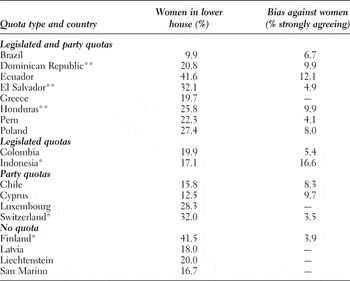
Driven by select success stories widely trumpeted by international organizations and pressures to appear “modern” and inclusive, the use of quotas to enhance women's representation has diffused around the world (Dahlerup Reference Dahlerup2006). Because closed-list PR elections greatly facilitate the mechanics of candidate quotas (Htun and Jones Reference Htun, Jones, Craske and Molyneux2002), many analyses hastily dismiss quotas in OLPR elections such as those in Brazil and move on. And because so few countries implemented quota laws under OLPR systems (see Table 1), cross-national analyses of the relationship are scarce. As a result, knowledge of the effects of quotas on women's representation in preferential voting systems in general and in OLPR systems in particular remains limited. Discussions of the effects of party systems on the functioning of quotas are even more elusive (for an exception, see Krook Reference Krook2009).
Table 1. Preferential elections, voter bias, and women's representation

*World Values Survey (2009).
**AmericasBarometer (LAPOP 2012, 2014). We thank the Latin American Public Opinion Project and its major supporters (United States Agency for International Development, United Nations Development Programme, Inter-American Development Bank, and Vanderbilt University) for making these data available.
Sources: GEPPAL (2009); IPU (2016); QuotaProject (2015); Schmidt (Reference Schmidt2009); World Values Survey Association (2014); and personal communication with Matthew Shugart.
If quotas are to be promoted as mechanisms to achieve equality in legislative representation, we must broaden our understanding of their interactions with both the electoral and party systems in which they are embedded. This article contributes to that mission, responding to Mona Lena Krook's call—“Ideally, future work will focus on analyzing single cases and situating them in relation to other quota campaigns” (Reference Krook2009, 226)—and thereby enhancing our comprehension of how quotas may be successfully employed to further the representation of marginalized groups. Holding constant the Brazilian electoral and political context while employing extensive variation in women's candidacies and election across two offices (federal and state legislatures), 27 states, and 29 parties in five election cycles—before (1994) and after the quota's implementation (1998–2006) and its reform (2010)—we advance an array of quantitative and qualitative data to provide the first comprehensive analysis of the reformed Lei de Cotas (Quota Law) and its implications for women's representation. We build on the work of Clara Araújo (Reference Araújo2003, Reference Araújo2010), who pioneered the study of the Lei de Cotas, and draw on individual, party, and state-level electoral data, as well as interviews with candidates, party leaders, activists, and bureaucrats and observation of state party conventions to explain the persistent limitations of the quota and its subsequent reform efforts.
The Brazilian case offers an opportunity to examine institutional change and resistance outside the advanced industrial context that still dominates our theoretical underpinnings and cross-national analyses. While several have cautioned against simple application of “Western”-derived assumptions to recently (re)democratized contexts (Matland Reference Matland1998; Salmond Reference Salmond2006), our understanding of women's representation outside the United States and Europe remains undertheorized. Therefore, we seize the extensive variation within Brazil to conduct a controlled comparison across elections, state parties, and legislatures, illuminating how party elites (circum)navigate changing institutional constraints within a gendered political landscape.
This article reveals that while the Lei de Cotas is certainly limited in scope by the open-list format of Brazil's proportional elections, that feature is but one of the sources of the quota's striking failure to induce real change in the tendencies by many parties to marginalize women. A key but often overlooked component of the explanation for why the quota has failed rests in the gendered character of Brazil's decentralized party politics; for the primarily male party elites that dominate the leadership of most subnational party organizations, the quota law remains a lei que não pega (law on paper only). Such tendencies do not apply to all parties in all states, however, with significant variation in the nomination and election of women legislators across the country. By applying a party-centric approach at the state level, we gain leverage on such variation among state parties to explain why some heed the quota while others continue to ignore it. Our conclusions have fundamental implications for reform efforts, which must work to target not only electoral rules but also the party structures that mediate those rules if they are to achieve significant advances in the representation of women and other marginalized groups.
THE (GENDERED) RULES OF THE GAME
This research applies a gendered approach to understanding Brazilian political institutions. The primary assumption is that gender and gender biases are embedded in Brazil's political institutions. These biases affect processes of institutional change and how political actors will behave in light of such institutional changes (see Krook and Mackay Reference Krook and Mackay2011; Mackay Reference Mackay2014; Mackay and Waylen Reference Mackay and Waylen2014). In other words, we seek to explain, in the context of Brazil's OLPR system, the gendered character of a “new” institution (the Lei de Cotas) and how institutional actors contest those new rules by utilizing old and new ways to maintain the (gendered) status quo of the system.
Political institutions are gendered in the sense that the processes, practices, ideologies, and distributions of power are directly related to the relationship (negotiation) between men, women, and their gendered identities (Beckwith Reference Beckwith2010; Chappell Reference Chappell2006; Kenney Reference Kenney1996; Krook and Mackay Reference Krook and Mackay2011). Political institutions such as the electoral system (and electoral laws) and party structures are biased against women because they were created by men, are interpreted from the standpoint of men in leading positions, and are defined by the absence of women (Acker Reference Acker1990, Reference Acker1992). These gendered relations are not static, and changes in the political system will affect the relationship between gendered actors within the system as “political institutions produce, reproduce, and subvert gender” (Kenney Reference Kenney1996, 456). When new institutions such as quota laws are proposed, designed, and implemented, they are embedded in an institutional environment that is inherently gendered and often detrimental to the advancement of women. As Mackay (Reference Mackay2014, 550) posits, “postdesign, what follows is a longer process of transition—marked by instability and uncertainty—whereby an institutional blueprint is put into practice and institutionalized.” The case of Brazil's 1995 Lei de Cotas and its 2009 reform exemplifies how a new institution with a clear objective (increase the representation of women in legislatures) can be undermined by established gendered behavior and norms and the pervasive drive to maintain the status quo.
When thinking about institutional change and women's representation in a comparative perspective, we must recognize the importance of electoral institutions in changing or reinforcing gender imbalances. Indeed, several cross-national studies have amassed considerable evidence affirming that countries with closed-list PR and gender quotas with placement mandates tend to elect more women (Htun and Jones Reference Htun, Jones, Craske and Molyneux2002; Schwindt-Bayer Reference Schwindt-Bayer2009; Tripp and Kang Reference Tripp and Kang2008).
While voters in closed-list PR elections choose among party lists of candidates preordered by party leadership, voters in OLPR elections cast their ballots for candidates. By enabling voters to “disturb the list,” the OLPR system diminishes party control over candidate rank ordering. There exist a host of variations creating a mix between closed- and open-list PR, but in Brazil's proportional legislative elections, citizens cast a single vote for one candidate.Footnote 3 In order to be elected, a candidate's party or coalition list must collectively meet the electoral quotient threshold (with each list allocated one seat per “electoral quota” that it collectively earns), and the candidate must receive enough individual votes to be among her or his list's top vote earners. The open-list format incentivizes fellow partisans to compete among themselves (Ames Reference Ames2002; Carey and Shugart Reference Carey and Shugart1995; Nicolau Reference Nicolau2006; Samuels Reference Samuels, Siavelis and Morgenstern2008), leading to extremely expensive candidate-centered campaigns.
Recent studies find that the presence of the personal vote often has a negative effect on women's electoral prospects (Thames and Williams Reference Thames and Williams2010; Valdini Reference Valdini2013). Valdini (Reference Valdini2013) elaborates on the relationship, finding that the negative effect of the personal vote on women's representation overall is conditional on voter bias against women. Interestingly, she concludes that in countries where intense voter bias against women is nearly absent, the personal vote has no significant effect on the overall proportion of women elected.
However, as demonstrated in Table 1, if the electoral disadvantage for women posed by the incentive to cultivate a personal vote is conditioned by voter bias, the severity of women's underrepresentation in Brazil seems excessive given relatively moderate levels of intense bias (“strongly agree”) against women. Indeed, although only 6.7% of Brazilian respondents in the latest wave of the World Values Survey espoused strong agreement with the assertion of male political superiority, Brazil suffers the lowest rate of women's representation of all countries with preferential voting.Footnote 4 Even countries with higher levels of bias among voters outperform Brazil in terms of women's legislative presence (IPU 2016; LAPOP 2014; World Values Survey Association 2014). Moreover, Colombia, the Dominican Republic, Ecuador, El Salvador, Greece, Honduras, Indonesia, Peru, and Poland have all had significantly greater success combining legislative gender quotas with preferential voting than has Brazil, which ranks lowest among all countries employing preferential elections, including those with no quota mandates. Brazilian public opinion polls also report postulated support for female candidates (CESOP 2010), with such intentions being actualized in the 2010 and 2014 presidential elections, when 66.2% and 64.5% of voters, respectively, cast a vote for a woman (TSE 2015). Women were also the top vote earners in 7 of Brazil's 27 states in the 2010 Chamber of Deputies elections (TSE 2015).
We argue, therefore, that the OLPR system and its poor fit for gender quotas cannot fully account for the extraordinary failure of Brazil's Lei de Cotas to enhance women's representation, nor can it explain the substantial variation within Brazil. We contend that the extensive interparty variation across Brazilian states in the nomination and election of women constitutes an observable implication of the primacy of parties for our understanding of electoral institutions. Moreover, we contend that the gender dynamics of subnational party leadership must be taken into account when discussing electoral strategy in the Brazilian context. Accordingly, in the following sections, we explore in detail the electoral changes proposed and implemented to address gender inequality in Brazil—specifically, the 1995 Lei de Cotas and the 2009 mini-reform—emphasizing party responses to those changes.
THE 1995 LEI DE COTAS
Bearing in mind the limitations posed by OLPR rules for quota implementation, we argue that three interconnected and gendered aspects of the Lei de Cotas and the political system in which the law is embedded must be taken into account to fully comprehend its inadequacies. First, the design and implementation of the law proceeded in a top-down manner, with primarily male party elites with vested interests in preserving their own power negotiating key aspects of the legislation. Second, as a consequence of this top-down negotiation, the design and language of the law allowed parties to take advantage of loopholes to avoid complying with the 30% requirement for candidacies. Finally, a critical but often overlooked point is the decentralized and gendered character of party politics in Brazil, which allows male party elites to dominate most state party leadership structures (where the decisions regarding candidate nomination and support are made) and, in turn, ignore the quota law without fear of being punished by either the state-level Brazilian electoral tribunals or national party mandates. In this section, we discuss the gendered character of Brazil's political institutions and the first two of the limitations outlined earlier, with the following section exploring in detail the critical role of parties in explaining the underrepresentation of women in general and the failure of the gender quota in particular.
Institutional Change from the Top
The use of gender quotas in Brazil was initiated by the Workers’ Party (Partido dos Trabalhadores, PT), which in 1991 instituted a requirement that party directorates must at a minimum be composed of 30% women. In 1993, the Unified Workers’ Union, the country's largest union, followed suit. Although discussions of the successes of those measures, as well as the Argentine quota, appeared in reports from meetings of the women's movement in the run-up to the pivotal 1995 Beijing Conference, much of the women's movement in Brazil appears to have tiptoed around any explicit reference to legislated gender quotas for electoral posts (Araújo Reference Araújo1999; Suplicy Reference Suplicy1996).Footnote 5 Instead, it was PT deputies Marta Suplicy and Paulo Bernardo who first introduced the proposal to amend the electoral law to require parties to advance female candidacies (Suplicy Reference Suplicy1996).
Many Brazilian feminists viewed quotas with reservation because of their emphasis on institutional politics, difference, quantification, and the potential to set a ceiling. In the final reports and statements of the women's movement leading up to the Beijing Conference, quota laws were not mentioned; rather, activists emphasized pushing parties directly to incentivize women's participation in party life and as candidates and, in particular, to promote political capacity-building opportunities for women (Araújo Reference Araújo1999). Therefore, while the women's caucus in Congress tried to push for a quota law that would empower women candidates (Suplicy Reference Suplicy1996), the final product was the result of party leaders attempting to appease the limited pressure from outside while ensuring the status quo would remain nearly intact. In 1995, the Lei de Cotas was implemented without much fanfare and full of loopholes (see the next section). As recently as 2009, more than a decade after its implementation, less than a quarter of respondents to a national survey had even heard of the quota law (IBOPE 2009). Therefore, it is no surprise that the generic quota, a product of diffusion from the Argentine model that was implemented from the top down, has not materialized substantial results in Brazil's quite different OLPR elections (see Table 2).
Table 2. Women's participation in Brazil's legislative elections, 1994–2014
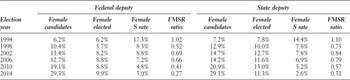
Notes: Success rate (S rate) is number of (women) elected divided by the number of (women) candidates. A female-male success rate ratio (FMSR ratio) greater than 1 indicates that women candidates have a higher success rate than male candidates.
Sources: TSE (2015); CFEMEA.
Laws, Language, and Loopholes
Scholars and activists have long proposed that the language of the Lei de Cotas is the main reason that it has not led to a significant increase in elected women. Indeed, with a striking lack of publicized debate throughout the top-down design and implementation process (Araújo Reference Araújo1999, 117), several qualifications of the proposed quota law were ushered through. The final product not only saw a reduction in the target from 30% to 20% but also an application of the target to the candidacies allowed rather than seats available (9.100/1995). Several iterations of Brazil's Electoral Law (including 4.737/1965, 6.990/1982, 7.454/1985, 9.100/1995, and 9.504/1997) allow each party to advance excess candidacies that exceed the number of available seats in a district in proportional elections; yet the excess candidacies provision was lifted for the 1994 elections (Lamounier and Amorim Neto Reference Lamounier, Neto and Nohlen2005), only to be reintroduced alongside the quota (9.100/1995).Footnote 6 Although the quota target was raised back to 30% prior to the 1998 elections for the Chamber of Deputies and state legislative assemblies, it remained applicable to candidacies allowed, equal to 150% of available seats in those elections (9.504/1997), resulting in a diluted quota (Suplicy Reference Suplicy1996). Another qualification required that parties merely reserve 30% of their candidacies for women rather than advance 30% female candidates on their ticket. By reserving slots, the law only indicated that parties or coalitions could not run a full slate of male candidates, but if they did not fill all of their allocated candidacies (given the excess candidacies provisions, parties rarely filled their ticket), they could run an all-male ticket as long as those candidacies did not occupy the “reserved” slots for women.
To illustrate the implications of these qualifications, consider a state with a district magnitude of eight (i.e., electing eight deputies). Rather than requiring that each party run at least three female candidates, applying the target to the candidacies allowed (given the excess candidacies provision) permitted each party to advance 12 candidates, still enabling each party to run eight male candidates. Moreover, because parties needed to merely “reserve” candidacy spots for women, and given the high number of candidates that each party or coalition can advance, parties in the foregoing scenario running eight male candidates and not a single woman would still be in compliance with the quota legislation.
Former deputy, senator, and minister Emília Fernandes said that the bancada feminina (women's caucus) knew then that the quota law was “completely insufficient,” but it was all they could get through.Footnote 7 In practice, the compromises ensured that the number of vacancies available for men was not reduced, therefore sustaining general support for the measure. The result of such compromises, however, was a gaping loophole and a diluted quota (Rangel Reference Rangel2009; Suplicy Reference Suplicy1996).
The development of the 1995 Lei de Cotas exemplifies the difficulty of establishing gender-related legislation in a male-dominated political structure. As Mackay states, “while embedding institutional innovation is always difficult, the combination of ‘newness’ and ‘gender’ appears to make institutionalization of reform even harder” (Reference Mackay2014, 566). In the case of Brazil's quota law, while the pressures from the Beijing Conference and the recent success of the Argentine quota law forced party elites to address the low number of women in legislatures, the top-down implementation process resulted in a quota law with a design and language affording parties ample loopholes to circumvent the quota's ostensible purpose of enhancing women's participation. As we discuss next, many (but not all) parties have seized on those loopholes, maintaining the status quo of male political dominance rather than developing effective mechanisms for recruiting and supporting women candidates.
Parties as the Key Arbiters: Decentralization and Power
The Lei de Cotas was summarily diluted and pushed through with no expectation that it would actually change the power structures in place. As explained by Araújo (Reference Araújo1999, 129), the limited debate derived in part from the complicit understanding that “quotas would not alter the political engineering of the process of political composition of candidacies and of competition.” Indeed, Deputy Jandira Feghali stated that while it was politically incorrect for politicians to position themselves against the gender quota, “they also knew deep down that it [the quota] did not have the power to alter this structure, such that nothing passed that signified concrete support” (quoted in Araújo Reference Araújo1999, 125). With mere inclusion on the electoral list being secondary to “the weight of subsequent arrangements that are necessary to turn a candidacy potentially electable,” the potential of the quota to fundamentally alter power structures through the incorporation of new voices into the political decision-making process was inherently limited (Araújo Reference Araújo1999, 129).
For nearly two decades, earnest implementation of the quota has been the exception. Party leaders have been skeptical about the potential of female candidates (Santos Reference Santos2012), and party organizational support for their candidacies remains woefully inadequate (Wylie Reference Wylie2012). Many parties’ approach to “recruiting” female candidates has consisted of last-ditch pleas for women, with an eye toward filling spots and garnering a few hundred votes for the party ticket that would help inch well-established (usually male) politicians toward the electoral quotient threshold. A three-term state legislator's description of her first candidacy for electoral office is illustrative: “When election time arrived no women volunteered to be a candidate so they asked me if I wanted to have my name on the ballot.”Footnote 8 Yet party leaders provide their new “recruits” with little information about or support for the campaign process. A female candidate for municipal-level office stated, “I was invited by a well-established female politician to run, because of the quota for women, but no one explained how the campaign process actually worked.”Footnote 9
Women involved in the political process, including several female candidates interviewed and the PT's national women's secretary, Laisy Moriére, believe the goal of such final-hour nominations was not to increase the number of women elected but rather to feign attempted compliance with the quota while gaining a few votes for the party or coalition ticket to the benefit of their priority candidates, most often men directly involved in the party leadership.
The stories of the candidates mentioned here are representative of the afterthought “recruitment” of women still common among many of Brazil's state parties and correspond with a broader consensus that parties’ candidate selection procedures are central to understanding women's representation in general and the functioning of quotas in particular (Bjarnegård Reference Bjarnegård2013; Hinojosa Reference Hinojosa2012; Kenny Reference Kenny2013). According to Magda Hinojosa's recent work on candidate selection in Latin America, decentralized candidate selection processes, as is the case throughout Brazil (Samuels Reference Samuels, Siavelis and Morgenstern2008), undermine women's prospects for inclusion because of the influence of “local power monopolies” generally dominated by men (Hinojosa Reference Hinojosa2012). Although a centralized electorate does not guarantee that national party leaders will promote women's candidacies, it is more likely to select candidates that will benefit the party's overall fortunes and image and thus circumvent local power monopolies intent on preserving their own power (Hinojosa Reference Hinojosa2012).
Scholars of political recruitment have only limited knowledge about the candidate selection process and party strategies for supporting candidates in Brazil. This is partly because Brazilian party politics is highly decentralized, allowing substantial autonomy to subnational party organizations in the nomination process and legislative campaign strategies. While some parties—such as bigger “national” parties such as the PT, the Party for the Brazilian Democratic Movement (Partido do Movimento Democrático Brasileiro, PMDB), and the Brazilian Social Democratic Party (Partido da Social Democracia Brasileira, PSDB), and, notably, three smaller leftist parties: the Communist Party of Brazil (Partido Comunista do Brasil, PC do B), the Socialism and Freedom Party (Partido Socialismo e Liberdade, PSOL), and the United Socialist Workers Party (Partido Socialista dos Trabalhadores Unificado, PSTU)—try to coordinate as much as possible at the national level and address (at least rhetorically) gender inequality, the final decision on candidate nomination is still made by a handful of subnational leaders. Even the PT, which arguably has the country's strongest national organization, has only limited control over the decision making of subnational leadership. Each party's 5- to 10-member state executive committee, constituted by (overwhelmingly male) subnational party leaders, tends to dominate the nomination process, with party conventions serving as a mere formality to rubber-stamp those nominations (Braga Reference Braga2008; Mainwaring Reference Mainwaring1991; Ribeiro Reference Ribeiro2013). Given the control of party decisions in the hands of a limited and localized few, the Brazilian party system creates barriers to political outsiders, thereby excluding most women from the election process.
In other words, the gendered party establishment at the subnational level, composed almost completely of male leaders, has considerable control over the selection and support of legislative candidacies. This dynamic leads to a limited voice for women within these subnational party directorates, as women are rarely a part of the small cadre of decision makers. As a consequence, even as national party directorates pay lip service to increasing women's representation, and although some national leaders genuinely strive to change the gender makeup of party leadership and legislative candidates, the quota law does not adequately incentivize subnational party bosses to address the issue.
Our interviews corroborate the perception that one or two party bosses dominate subnational party leadership and decision making. When asked about the role of the subnational party executive in the selection of candidates, a politician in the state of Goiás declared,
Normally the party executive is comprised of seven people. Today anyone can be chosen (to be a candidate), but normally it is the party executive that makes this decision. I was in a party of “chiefs” and the party executive did not listen to the party leadership, they only listened to the party “chief.”Footnote 10 In my current party there is a discussion between the executive and other party leaders. But there are parties where the party leader puts his son, his wife, his dog in charge of the party executive, making him the de facto decision maker.Footnote 11
While conducting fieldwork in Bahia, Goiás, and the Federal District, we attended five state party conventions. In each of them, the party's state executive committee named all candidates with no deliberation. In only one instance, at the PT's state convention in Goiás (June 2010), the party leadership acknowledged the low number of female candidates and asked party members to allow the state executive committee to continue looking for female candidates until the formal deadline to register candidates.
We argue that the decentralization of party decision making leads to the dominance of predominantly male subnational power monopolies in the nomination process, which results in the lack of a continuous project to promote the ascension of well-qualified female candidates. The outcome is exceedingly few female state and federal deputies. To interrupt that exclusionary process, parties must develop long-term projects to actively recruit and cultivate viable female candidacies, empowering women's units within the party and introducing a gendered lens into all party decision making. Last-minute appeals are insufficient. As stated by a representative from one party's national organ for women's affairs, “parties only remember that we need female candidates two months before the election. So they say to us: ‘So, can we find some women?’”Footnote 12 However, women will be unlikely to launch a campaign they know will not have party support; a recent nationally representative survey found that 41% of women respondents reported the lack of party support as the primary motive keeping women from running for office (far above interest, competition, family, or work) (DataSenado 2014).
The sentiment is also shared by other women involved in the political process. Lucia Rincon, professor at Goiânia's Catholic University and Goiás's state legislative candidate in 2010 with the PC do B, asserted, “Party leaders talk about electing more women, but they do not seem sincere.”Footnote 13 Luzia de Paula, state legislative candidate in the Federal District with the Popular Socialist Party in 2010, sees a “lack of political maturity by party leaders, [and] a lack of commitment to women.”Footnote 14 Eliana Pedrosa, state legislative candidate in the Federal District with the Democrats (DEM) in 2010, explained that “in Brazil most parties have ‘bosses.’… The men running the party do not think about women.”Footnote 15
Because parties have subnational “bosses” and electoral strategy rests in their hands, official campaign resources and party support tend to go to a select group of candidates. Most parties run a large number of candidates but prioritize those close to the party leadership. The secretive character of the selection process combines with the particularistic (not based on national strategies) allocation of resources to undermine the candidacies of those who are not members of the established political elite, regardless of gender. Given that the Brazilian formal political sphere remains largely dominated by men (see Table 2), party decisions regarding candidate nominations and tacit support for candidates have posed a more formidable obstacle to women than to men.
Brazil's 1995 Lei de Cotas was ill equipped to intervene in the “secret garden of politics” (candidate selection) and was arguably modified by party elites with the intent of minimizing its impact. The law was passed only after political leaders decided on a diluting compromise. Party strategies had to change little after the implementation of the gender quota, and the loopholes provided to bypass the law, combined with the well-established “local boss” culture, left little room for women to increase their presence as viable candidates. Because the quota law did not address often subtle and informal manifestations of gender discrimination within the parties, resources continued to flow toward well-established party elites and away from female newcomers.
THE 2009 “MINI-REFORM”
In the wake of International Women's Day in 2009, with heightened pressure from the bancada feminina and women's movement stalwarts such as the Feminist Center for Studies and Advisory Services (Centro Feminista de Estudos e Assessoria, CFEMEA), President Luiz Inácio Lula da Silva's Secretariat of Women's Affairs formed a Tripartite Commission (with representatives from the executive and legislative branches as well as from civil society) to deliberate and propose changes to the Electoral Law that would enhance women's participation in formal politics.
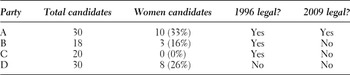
Despite the broad toolkit of possibilities advocated by the bancada feminina and women's organizations in the Tripartite Commission, debates with congressional leadership ensued in the deliberations and the accomplishments of the subsequent mini-reform (12.034/2009) were rather limited.Footnote 16 The approved measures directly affecting women included the following: (1) changes in the language of the quota law from “reserve” to “fill” a minimum of 30% and maximum of 70% of candidacies per party list with candidates of each sex (Article 10), (2) a minimum of 5% of federally allocated party organization funds devoted to the promotion of women's participation (Article 44), and (3) a dedicated 10% of each party's publically funded Free Electoral Airtime (Horário Gratuito de Propaganda Eleitoral, HGPE) (Article 45).Footnote 17 Importantly, the changes came with enforceable sanctions, perhaps the most noteworthy achievement of the mini-reform. Table 3 uses hypothetical parties to demonstrate the formal changes resulting from the first component of the mini-reform.
Table 3. Lei de Cotas, 1996 and 2009

In spite of the impressive convergence of attention to women's underrepresentation with broad civil society participation and concrete policy proposals followed by actual changes, the reformed quota law has yet to bear much fruit. While significantly more women ran as candidates in the 2010 state and national legislative elections, the end result was stagnation, with a Chamber of Deputies with exactly the same number of women that it had in the prior legislature, a meager 8.8%. The percentage of women elected to the state legislatures inched up from 11.6% to 12.9%. And although the 2014 elections saw additional increases in female candidacies, the end result remained meager, with a 1.1 percentage point gain in the Chamber of Deputies and a 1.7 percentage point decrease across the state legislative assemblies (see Table 2). We contend that the gender quota's persistent underperformance signals the critical importance of Brazil's decentralized and generally male-dominant subnational party politics for understanding its limitations.
The often mere formality of the written rules of the game in Brazil's decentralized party politics becomes evident when considering the enforcement of the 2009 mini-reform to the gender quota (12.034/2009). In a 6–1 vote on August 12, 2010, by the electoral court (Tribunal Superior Eleitoral), the ministers ruled that “30% women is law” and that lists that did not comply with the recently revised electoral law would have to increase the number of female candidates, decrease the number of male candidates, or have the list rejected, with “exceptional” justifications being granted only by the electoral court (Torres and Abreu Reference Torres and Abreu2010). Under pressure from political parties, regional electoral officials varied widely in their enforcement of the quota in the 2010 legislative elections (Congresso em Foco 2010).
In the end, less than 18% of the party/coalition lists met the 30% quota in elections to the Chamber of Deputies (Silva Reference Silva2010). Of the 607 and 768 parties contesting the 2010 and 2014 Chamber of Deputies elections, 44.2% and 30.7%, respectively, did not run a single female candidate (TSE 2015). Had the language or top-down implementation been the extent of the quota law's problems, the 2009 reforms to the quota language with enhanced participation from civil society in the process should have prompted significant change across parties. Yet the lei que não pega culture among party elites of Brazil's male dominant subnational party organizations persists unscathed. If the OLPR system remained the primary culprit of the quota law's woes, such a trend should be universal. Notably, however, parties with a critical mass of women leaders were significantly more likely to comply with the quota and advanced and elected significantly greater proportions of female candidates than parties with more than 75% men in their leadership.Footnote 18 , Footnote 19 Together, these findings suggest that party leadership is critical for explaining the persistent underrepresentation of women in Brazil.Footnote 20 In the following section, we supplement the foregoing qualitative and descriptive assessments of the role of subnational power monopolies with multivariate statistical analyses of women's presence among state party lists in elections to the federal and state legislatures.
EXPLAINING THE CANDIDACY AND ELECTION OF WOMEN
While the overall assessment of the Lei de Cotas is rather bleak, it obscures interparty variation that may help illuminate how the inadequacies of the law can be rectified. With an average proportion of women among parties’ 2010 state and federal legislative delegations at 0.056 (6%) and a standard deviation of 0.189, variation across state parties is evident. For instance, in 2010, 10 of the PC do B's 33 elected state and federal deputies were women (30%). The PSDB, in contrast, had only 10% women among its elected deputies. We also see substantial variation within parties across Brazil; for instance, in the 2010 Chamber of Deputies elections, the DEM state party organizations advanced no female candidates in 12 states but 33% women or more in five others.Footnote 21 In the analysis that follows, we seek to explain why some of Brazil's political parties have substantially superior records in nominating and electing women than others. We apply hierarchical linear modeling to estimate the proportion of women advanced (candidates) and elected (state and federal deputies), embedding parties within their district-specific contexts to account for both between and within-state variation in women's representation and its correlates.
 $$\eqalign{ \hbox{Proportion Women}_{ij} &= \cr \hbox{ Party-level model:}}$$
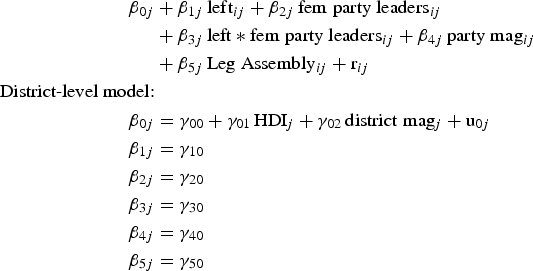 $$\eqalign{& \cr {{\rm \beta} _{{\rm 0}j}} & + {{\rm \beta} _{{\rm 1}j}}\,{\rm lef}{{\rm t}_{ij}} + {{\rm \beta} _{{\rm 2}j}}\,{\rm fem \;party \;leader}{{\rm s}_{ij}} \cr & + {{\rm \beta} _{{\rm 3}j}}\,{\rm left * fem \;party \;leader}{{\rm s}_{ij}} + {{\rm \beta} _{{\rm 4}j}}\,{\rm party \;ma}{{\rm g}_{ij}} \cr & + {{\rm \beta} _{{\rm 5}j}}\,{\rm Leg \;Assembl}{{\rm y}_{ij}} + {{\rm r}_{ij}} \cr \hbox{District-level model:} & \cr {{\rm \beta} _{{\rm 0}j}} & = {{\rm \gamma} _{{\rm 00}}} + {\rm} {{\rm \gamma} _{{\rm 01}}}\,{\rm HD}{{\rm I}_j} + {{\rm \gamma} _{{\rm 02}}}\,{\rm district \;ma}{{\rm g}_j} + {{\rm u}_{{\rm 0}j}} \cr {{\rm \beta} _{{\rm 1}j}} & = {{\rm \gamma} _{{\rm 10}}} \cr {{\rm \beta} _{{\rm 2}j}} & = {{\rm \gamma} _{{\rm 20}}} \cr {{\rm \beta} _{{\rm 3}j}} & = {{\rm \gamma} _{{\rm 30}}} \cr {{\rm \beta} _{{\rm 4}j}} & = {{\rm \gamma} _{{\rm 40}}} \cr {{\rm \beta} _{{\rm 5}j}} & = {{\rm \gamma} _{{\rm 50}}}} $$
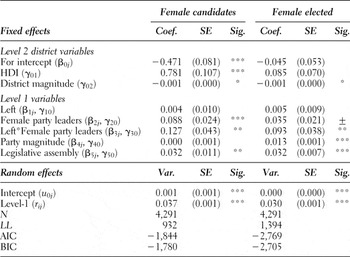
Results from that hierarchical model of the proportion of women candidates and elected legislators by state party list are displayed in Table 4. Controlling for state development level (Human Development Index, HDI), party magnitude, and ideology, we find that the extent of male dominance in state party leadership exercises a significant effect on its proportion of female candidates and deputies.Footnote 22 The finding holds when women's presence in state party leadership is measured continuously or dichotomously (critical mass). As catalogued in Godinho's narrative of how women's presence in the PT evolved over time, women in party leadership structures are well positioned to “let the ladder down” to other women (Kittilson Reference Kittilson2006), lobbying the party executive on behalf of female aspirants and mobilizing resources to cultivate and bulwark female candidacies (Godinho Reference Godinho1996).Footnote 23 , Footnote 24 Interestingly, the often-cited positive effect of leftist ideology for women's representation is contingent on the presence of women in party leadership. Although leftist parties in Brazil and elsewhere have historically been more open to women and to equality initiatives, an evolving electorate and now mandatory quota law may be recasting the effect of ideology as indirect.
Table 4. Proportion of women candidates and deputies, by state party
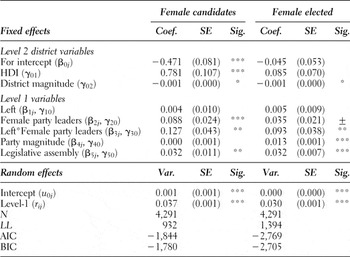
***p < .001; **p < .01; *p < .05; ± p < .1 (one-tailed tests).
As seen in the descriptive data, state parties are more likely to advance and elect women in the state legislatures than in the Chamber of Deputies. Because the stakes are lower at the subnational level, parties may be more open to female candidacies (however viable) for state legislatures. Most parties advance significantly more candidates per available seat in state assembly elections than in Chamber of Deputies elections, and they are less likely to “flood” their list with nonviable candidates in elections to the federal legislature.Footnote 25 It is also likely that more women are willing to run for state assemblies because travel requirements (the state capital) are limited relative to the Chamber of Deputies (located in Brasília, in the Central-West region). With women still bearing the brunt of marital and parental responsibilities, proximity to family can be formative in the political ambitions of women politicians (Wylie Reference Wylie2012). Given that the same set of actors control the decision-making process and the allocation of resources to female candidates for both offices, this finding merits further consideration.
It is also noteworthy that levels of development in a state (HDI) have a positive influence on the nomination (candidacy) of women but no significant effect on their election. The predictive power of modernization-based hypotheses for women's representation in Brazil have been called into question by prior studies (Miguel and Queiroz Reference Miguel and de Queiroz2006; Wylie Reference Wylie2012). Several of Brazil's most prominent female politicians (e.g., Marina Silva, Heloisa Helena) emerged from the less developed north and northeast. Family-based political capital also looms large in the northeast, enhancing the electoral prospects of candidates (male and female) from the region's political families.
Looking to party funds (which, along with campaign materials, production assistance for HGPE television/radio spots, and support from the party's gubernatorial campaign, constitute valuable party resources for a campaign), we see that in the 2010 elections to the Chamber of Deputies, among the top 14 parties, national directorates devoted only 8% of their party funds to the campaigns of women, who represented 19.7% of the total candidates (Mendonça and Navarro Reference Mendonça and Navarro2012). The reforms proposed by the Tripartite Commission for public financing of campaigns (which ultimately were rejected), or at least for a more proportionate distribution of the publically allocated party funds, would go a long way toward mitigating such discrepancies. In the interim, our findings suggest that an effective way to compel parties to mobilize resources for women is to require more equitable leadership structures. The parties most likely to devote resources to female candidacies are precisely those with more women leaders. Tellingly, the male-dominant PSDB advanced 20.4% female candidates but dedicated less than 2% of its funds to women's candidacies. In response, the PSDB's national president, Sérgio Guerra, stated, “This pattern will only change with more mobilization and pressure by women” (quoted in Mendonça and Navarro Reference Mendonça and Navarro2012).Footnote 26 In contrast, the women-inclusive PC do B actually gave proportionately more money to the campaigns of female candidates than to men (Mendonça and Navarro Reference Mendonça and Navarro2012).Footnote 27
Although the PMDB has long counted on active women's sectors (Perondi Reference Perondi2007), women have not been included in the upper echelons of the party's leadership.Footnote 28 As stated by Regina Perondi, vice president of the women's organ of the PMDB, “the biggest obstacle is precisely the men in the party, they do not want to listen to us. They think that we want to take control of the party, they do not perceive it as a way to democratize the party.”Footnote 29 As a result of the failure to incorporate women in state party leadership, and thus the absence of an effective commitment to furthering women's candidacies, less than 13% of state parties complied with the quota in the 1998–2010 elections to the Chamber of Deputies. In our 2008 interview, Deputy Rita Camata expressed frustration with what she perceived as disregard for the quota among PMDB leadership; the men não vão abrir a mão, or will not give up their power and privileges, and, she continued, do not seek out female candidates until the last hour in a meaningless gesture toward the quota with no intent of supporting their candidacies.Footnote 30
In sum, as stated by Deputy Luiza Erundina, many parties have not complied with the quota because of a “lack of commitment to questions of gender.”Footnote 31 Responding to a question about the quota law, Deputy Roberto Santos (PSDB) of the Special Commission of Electoral and Party Legislation stated, “It is only the leaderships in favor of women that end up (improving the political process for women)” (quoted in Araújo Reference Araújo1999, 125). Once women gain access to party leadership structures, they are able to explicitly incorporate gender into party decision making and hold the party accountable to the pro-women provisions of the electoral law. In sum, party dynamics are the key to understanding women's underrepresentation in Brazilian legislatures.
CONCLUSIONS
This article has demonstrated that while Brazil's combination of OLPR and the Lei de Cotas leaves much to be desired, what has proved most formidable to women's representation is the decentralized character of party politics, which allows primarily male subnational power monopolies to dominate decision making. CFEMEA summarizes the conundrum:
The parties have not undertaken the challenge to stimulate and contribute substantively to the increased political participation of women. In this sense, very few have adopted gender quotas for the composition of party leadership and, in general, they (parties) do not have policies to devote resources and media time to the promotion of women's political participation. They are masculine institutions whose functioning and structure make female participation difficult. It is necessary to democratize the party life and structures. (CFEMEA 2004, 5)
When parties include more women in decision-making structures, the promotion of women's participation is more likely to become a party priority. Although women do not always work on behalf of other women, as they increase in number, the possibility becomes far more probable. And at minimum, women's presence among the leadership forces party structures to “stop functioning exclusively as masculine clubs” (Godinho Reference Godinho1996, 155). Thus, reformers seeking to further women's representation in Brazil must rekindle the momentum of the 2009 Tripartite Commission, focusing their efforts not only on the formal rules of the game but also on the political parties that mediate those rules. To eradicate the entrenched informal norm of quota neglect, parties must be incentivized to incorporate women in their leadership structures and to actively cultivate viable female candidacies.
SUPPLEMENTARY MATERIAL
To view supplementary material for this article, please visit http://dx.doi.org/10.1017/S1743923X16000179