





Public significance statement
The present study highlights the dynamic nature of parental reflective functioning at the level of daily fluctuations, and its associations with daily change in parenting stress and adolescent difficulties. These findings underscore the importance of interventions that support parents in regulating parenting stress in order to maintain their reflective capacities in daily life, thereby ultimately improving parenting and child development.
Highlights
-
This diary study found evidence for substantial day-to-day fluctuations in three dimensions of parental reflective functioning – prementalizing, certainty about mental states, and interest and curiosity in mental states.
-
Daily parenting stress and perceived externalizing adolescent difficulties were associated with more daily prementalizing and less certainty about mental states.
-
Associations were similar for community and adoptive parents.
Parental reflective functioning refers to parents’ capacity to envision the mental states underlying their child’s behavior, as well as parents’ capacity to reflect upon their own mental states in relation to their child (Luyten, Nijssens, et al., Reference Luyten, Nijssens, Fonagy and Mayes2017; Slade, Reference Slade2005). An increasing amount of research has demonstrated that this capacity plays a fundamental role in the socioemotional adjustment of children (Moreira et al., Reference Moreira, Vives and Ballespí2024) and their parents (Camoirano, Reference Camoirano2017; Stuhrmann et al., Reference Stuhrmann, Göbel, Bindt and Mudra2022).
Most studies to date have examined parental reflective functioning in terms of interindividual differences between parents, despite the capacity being conceptualized as being susceptible to intraindividual fluctuations over time (Luyten et al., Reference Luyten, Malcorps, Fonagy, Ensink, Bateman and Fonagy2019). According to the biobehavioral switch model, fluctuations in parental reflective functioning largely depend on changes in internal and external stressors that can put parental reflective functioning under pressure (Luyten & Fonagy, Reference Luyten and Fonagy2015; Luyten, Mayes, et al., Reference Luyten, Mayes, Nijssens and Fonagy2017). One specific stressor that may compromise parents’ daily reflective functioning is difficult child behavior, as it may heighten parental stress levels, thereby temporarily reducing parents’ capacity to step back and reflect on the mental states underlying their child’s actions. This may be especially true for parents of adolescents, given that adolescence is a developmental period characterized by pronounced fluctuations in mood and behavior (Soenens et al., Reference Soenens, Vansteenkiste, Beyers and Bornstein2019).
Currently, there is a lack of studies investigating intraindividual fluctuations in parental reflective functioning, in particular during adolescence. To address this gap, the present study used a diary method approach to examine day-to-day fluctuations in parental reflective functioning in daily life and the role of parenting stress and perceived adolescent difficulties in these fluctuations. To ensure variability and heterogeneity in both parents’ and adolescents’ experiences and behaviors, the sample included both parents of adolescents from the general population and parents of transnationally adopted adolescents, a group shown to be at increased risk for socioemotional difficulties and challenges in the parent–child relationship (Askeland et al., Reference Askeland, Hysing, La Greca, Aarø, Tell and Sivertsen2017).
Parental reflective functioning
Parental reflective functioning is a multidimensional concept (Luyten, Nijssens, et al., Reference Luyten, Nijssens, Fonagy and Mayes2017). Of the different measures that have been developed to assess parental reflective functioning, the Parental Reflective Functioning Questionnaire (PRFQ; Luyten, Mayes, et al., Reference Luyten, Mayes, Nijssens and Fonagy2017) most explicitly aimed to operationalize the multidimensional nature of this capacity, and has been widely validated across samples at varying levels of risk for developmental problems (Carlone et al., Reference Carlone, Milan, Decoste, Borelli, McMahon and Suchman2023; Moreira et al., Reference Moreira, Vives and Ballespí2024).
The PRFQ assesses three key dimensions of parental reflective functioning. First, prementalizing, referring to parents’ inability to perceive and interpret their child’s mental states accurately, is the most maladaptive dimension of parental reflective functioning; it is typically expressed in a tendency to make malevolent attributions about the child’s mental states. This dimension has been associated with a wide range of maladaptive parental outcomes, including insensitive parenting behavior (Dieleman et al., Reference Dieleman, Soenens, De Pauw, Prinzie, Vansteenkiste and Luyten2020; Edler et al., Reference Edler, Behrens, Wang and Valentino2023; Szabó et al., Reference Szabó, Futó, Luyten, Boda and Miklósi2024), parental attachment insecurity as measured with questionnaires (Egmose et al., Reference Egmose, Steenhoff, Tharner and Væver2024; Rostad & Whitaker, Reference Rostad and Whitaker2016; Szabó et al., Reference Szabó, Futó, Luyten, Boda and Miklósi2024), parenting stress (Carlone et al., Reference Carlone, Milan, Decoste, Borelli, McMahon and Suchman2023; Kamza et al., Reference Kamza, Luyten and Piotrowski2024; Malcorps et al., Reference Malcorps, Vliegen, Fonagy and Luyten2022), and various forms of parental mental health problems (Hestbaek et al., Reference Hestbaek, Kretzschmar, Krasnik, Smith-Nielsen, Juul, Væver and Simonsen2024; Kamza et al., Reference Kamza, Luyten and Piotrowski2024; Khoshroo & Seyed Mousavi, Reference Khoshroo and Seyed Mousavi2022). In addition to these associations with maladaptive parental outcomes, parental prementalizing is associated with a number of maladaptive child outcomes, including behavioral problems (Charpentier Mora et al., Reference Charpentier Mora, Bastianoni, Koren-Karie, Cavanna, Tironi and Bizzi2022; Condon et al., Reference Condon, Holland, Slade, Redeker, Mayes and Sadler2019; Ghanbari et al., Reference Ghanbari, Goudarzi, Ebrahimi, Sabzalizadeh, Erfanian Delavar and Javaherian2023) and internalizing symptoms (Condon et al., Reference Condon, Holland, Slade, Redeker, Mayes and Sadler2019; Ghanbari et al., Reference Ghanbari, Goudarzi, Ebrahimi, Sabzalizadeh, Erfanian Delavar and Javaherian2023). Overall, parental prementalizing clearly represents a risk factor for more severe problems in parents’ and children’s individual functioning, as well as for more problematic parent–child interactions.
Second, certainty about mental states reflects the extent to which parents feel they know and understand their child’s mind. Research has shown that very low scores on this dimension indicate a lack of understanding of the child’s mind, whereas very high scores reflect overconfidence and pseudomentalizing (Luyten, Mayes, et al., Reference Luyten, Mayes, Nijssens and Fonagy2017). Generally, studies have indicated that the experience of parents that they know and understand their child’s mind is negatively associated with insensitive parenting behavior (Stover et al., Reference Stover, Farren, Campbell, Day and Sernyak2023; Szabó et al., Reference Szabó, Futó, Luyten, Boda and Miklósi2024), parenting stress (Carlone et al., Reference Carlone, Milan, Decoste, Borelli, McMahon and Suchman2023), and various forms of parental mental health problems (Hestbaek et al., Reference Hestbaek, Kretzschmar, Krasnik, Smith-Nielsen, Juul, Væver and Simonsen2024; Khoshroo & Seyed Mousavi, Reference Khoshroo and Seyed Mousavi2022; Nobre-Trindade et al., Reference Nobre-Trindade, Caçador, Canavarro and Moreira2021), and positively associated with parental attachment security as measured with questionnaires (Luyten, Mayes, et al., Reference Luyten, Mayes, Nijssens and Fonagy2017; Rostad & Whitaker, Reference Rostad and Whitaker2016; Szabó et al., Reference Szabó, Futó, Luyten, Boda and Miklósi2024).
Third, research has shown that interest and curiosity, referring to the parent’s capacity to be genuinely interested in and curious about their child’s inner mental states, is positively associated with a range of adaptive parenting behaviors and outcomes. Studies investigating the role of interest and curiosity have found positive associations with sensitive parenting behavior (Edler et al., Reference Edler, Behrens, Wang and Valentino2023; Kungl et al., Reference Kungl, Gabler, White, Spangler and Vrticka2024), parental warmth (Szabó et al., Reference Szabó, Futó, Luyten, Boda and Miklósi2024; Ye et al., Reference Ye, Ju, Zheng, Dang and Bian2022), coparenting quality (De Palma et al., Reference De Palma, Rooney, Izett, Mancini and Kane2023), parental attachment security as measured with questionnaires (Egmose et al., Reference Egmose, Steenhoff, Tharner and Væver2024; Luyten, Mayes, et al., Reference Luyten, Mayes, Nijssens and Fonagy2017; Rostad & Whitaker, Reference Rostad and Whitaker2016), parental feelings of satisfaction (De Roo et al., Reference De Roo, Wong, Rempel and Fraser2019), and parental self-efficacy (Cooke et al., Reference Cooke, Priddis, Luyten, Kendall and Cavanagh2017; De Roo et al., Reference De Roo, Wong, Rempel and Fraser2019; Gordo et al., Reference Gordo, Martínez-Pampliega, Iriarte Elejalde and Luyten2020). Furthermore, with regard to child outcomes, studies have found positive associations between interest and curiosity and children’s socioemotional adjustment (De Palma et al., Reference De Palma, Rooney, Izett, Mancini and Kane2023; Gordo et al., Reference Gordo, Martínez-Pampliega, Iriarte Elejalde and Luyten2020), prosocial behavior (Ghanbari et al., Reference Ghanbari, Goudarzi, Ebrahimi, Sabzalizadeh, Erfanian Delavar and Javaherian2023), and emotion-regulation capacities (Álvarez et al., Reference Álvarez, Lázaro, Gordo, Elejalde and Pampliega2022; Ghanbari et al., Reference Ghanbari, Goudarzi, Ebrahimi, Sabzalizadeh, Erfanian Delavar and Javaherian2023; Shao et al., Reference Shao, Liu, Coplan, Chen and Liu2023).
There is therefore ample cross-sectional evidence for associations between each of the three dimensions of parental reflective functioning and aspects of parent and child functioning. However, most studies to date have focused primarily on between-parent differences in parental reflective functioning as predictors of parent and child outcomes. This is unfortunate because critical questions about intraindividual fluctuations in parental reflective functioning have not been answered.
Parental reflective functioning and parenting stress
According to the biobehavioral switch model, heightened stress makes it more challenging for parents to reflect on their own mental states and those of their child (Luyten & Fonagy, Reference Luyten and Fonagy2015; Luyten et al., Reference Luyten, Malcorps, Fonagy, Ensink, Bateman and Fonagy2019). Reflective functioning would tend to go “offline” under increasing stress, leading to fast, automatic, and often negatively biased assumptions about oneself and others (Luyten & Fonagy, Reference Luyten and Fonagy2015; Luyten, Mayes, et al., Reference Luyten, Mayes, Nijssens and Fonagy2017). Consistent with these assumptions, a study among 125 mothers of 3-year-olds found that self-reported parenting stress was associated positively with prementalizing (Cowes & Santelices, Reference Cowes and Santelices2022). Similarly, a study involving 86 mothers of 4-year-olds reported that perceived parenting stress was linked to mothers using fewer mental-state words when describing their child (McMahon & Meins, Reference McMahon and Meins2012). In further support of these findings, a study among 979 mothers of children under 5 years of age found that parenting stress was associated positively with prementalizing and negatively with certainty about mental states (Kamza et al., Reference Kamza, Luyten and Piotrowski2024). In addition to these cross-sectional results, a longitudinal study involving mothers and fathers of 76 infants found that different dimensions of parenting stress were associated positively with prementalizing over the course of a 1-year period (Nijssens et al., Reference Nijssens, Bleys, Casalin, Vliegen and Luyten2018). Heightened parenting stress is associated with more malevolent attributions about the child’s mental states and greater difficulty understanding the child’s mind – and this association is very likely bidirectional in nature, as diminished parental reflective functioning may also contribute to elevated stress.
There is also experimental and observational research showing that the relationship between parental reflective functioning and parenting stress manifests at the level of physiological stress responses. A landmark experimental study conducted among 59 mothers of infants found that mothers with a greater tendency to prementalize had higher physiological stress levels (indicated by elevations in blood pressure and heart rate) in the context of a standardized stress paradigm in which they were asked to soothe a lifelike crying baby simulator (Rutherford et al., Reference Rutherford, Booth, Luyten, Bridgett and Mayes2015). The study also showed that mothers scoring higher on prementalizing displayed shorter persistence times in trying to soothe the baby simulator (Rutherford et al., Reference Rutherford, Booth, Luyten, Bridgett and Mayes2015), whereas mothers scoring higher on interest and curiosity showed longer persistence times in a study using the same procedure (Rutherford et al., Reference Rutherford, Goldberg, Luyten, Bridgett and Mayes2013). Studies involving parents of older children have provided similar evidence. A study among 106 mothers of school-aged children found that mothers with lower overall levels of parental reflective functioning, coded on parent development interviews (PDIs) using the Reflective Functioning Scale (RFS) (Slade et al., Reference Slade, Berger, Bresgi and Kaplan2003), engaged in more controlling behaviors toward their child under conditions of experimentally induced stress (Borelli et al., Reference Borelli, Hong, Rasmussen and Smiley2017). Likewise, a study among 49 parents of adolescents found that lower parental reflective functioning, also coded on the PDI using the RFS, was associated positively with heightened cortisol reactivity during a conflict-discussion task with their adolescent child (Decarli et al., Reference Decarli, Schulz, Pierrehumbert and Vögele2023).
Although each of these studies provides evidence for an association between parental reflective functioning and parenting stress, none of them directly tested dynamic associations at the level of parents’ naturally unfolding day-to-day experiences. In order to gain a more thorough understanding of the dynamic nature of parental reflective functioning, it is important to overcome three caveats in the current literature. First, most studies focused on interindividual differences in parental reflective functioning and parenting stress, leaving intraindividual dynamics in daily life largely unexplored. This is unfortunate because the biobehavioral switch model conceptualizes parental reflective functioning as a capacity that is calibrated continuously on a day-to-day basis and thereby shows substantial intraindividual fluctuations over time (Luyten & Fonagy, Reference Luyten and Fonagy2015). Second, whereas research often focuses on parental reflective functioning as a long-term predictor of parent and child outcomes, it is also important to examine its short-term, daily associations with these variables. Such knowledge is essential from both a basic science perspective and from an applied perspective, as it could improve the effectiveness of interventions targeting parental reflective functioning (Byrne et al., Reference Byrne, Sleed, Midgley, Fearon, Mein, Bateman and Fonagy2019; Midgley et al., Reference Midgley, Ensink, Lindqvist, Malberg and Muller2017; Volkert et al., Reference Volkert, Taubner, Byrne, Rossouw and Midgley2021). Third, the focus of studies investigating parental reflective functioning has been mainly on early childhood, limiting the generalizability of findings to other developmental stages such as adolescence.
The present study addresses these three key gaps in the literature by using a diary method as a novel approach to investigate intraindividual changes in parental reflective functioning in daily life, as well as its associations with daily parenting stress and adolescent internalizing and externalizing difficulties. Adolescence is a particularly relevant developmental period in which to investigate the dynamic nature of parental reflective functioning and its associates. Studies increasingly demonstrate that parental reflective functioning plays a critical role in adolescence (Benbassat & Priel, Reference Benbassat and Priel2012; Fiore et al., Reference Fiore, Mabbe, Luyten, Vliegen and Soenens2024; Zhou et al., Reference Zhou, Tian, Hong, Fan and Chen2024). Moreover, adolescence is replete with rapid changes in the parent–child relationship that may generate stress and could therefore put parental reflective functioning under pressure. For example, adolescents start to assert more independence and consider more issues to be personal and beyond parental authority, which leads to them engaging more often in negotiations with their parents about rules, decisions, and daily behaviors (Soenens et al., Reference Soenens, Vansteenkiste, Beyers and Bornstein2019). Adolescence is also marked by strong emotional volatility, with early adolescents displaying heightened responsiveness to emotional cues and searching for ways to regulate their emotions adequately (Romeo, Reference Romeo2010). In addition to these accumulating changes, adolescence is characterized by an overall increase in socioemotional difficulties (for recent meta-analytic evidence see: Sacco et al., Reference Sacco, Camilleri, Eberhardt, Umla-Runge and Newbury-Birch2024) and substantial day-to-day fluctuations in both internalizing and externalizing behavior (Dietvorst et al., Reference Dietvorst, Hiemstra, Maciejewski, van Roekel, Ter Bogt, Hillegers and Keijsers2021; Kendall et al., Reference Kendall, Wilt, Walls, Scherer, Beardslee, Revelle and Shrier2014; Maciejewski et al., Reference Maciejewski, Keijsers, van Lier, Branje, Meeus and Koot2019).
To ensure sufficient variability and heterogeneity in daily parenting stress and adolescent difficulties, this study oversampled parents of adolescents at increased risk for socioemotional difficulties. Specifically, this study included a group of parents of transnationally adopted adolescents – a population known to encounter more socioemotional challenges during adolescence (Askeland et al., Reference Askeland, Hysing, La Greca, Aarø, Tell and Sivertsen2017).
The present study
Although parental reflective functioning has been conceptualized as a dynamic resource that can be (de-)activated by quickly changing daily experiences, most studies to date have focused on interindividual differences between parents. As a result, the extent to which parental reflective functioning varies as a function of daily parenting stress and difficult child behaviors remains poorly understood. To address this gap, the current study used a 7-day diary method approach to investigate intraindividual change in parental reflective functioning and its associations with day-to-day fluctuations in parenting stress and internalizing and externalizing adolescent difficulties. First, it was hypothesized that parents would display substantial day-to-day fluctuations in prementalizing, certainty about mental states, and interest and curiosity. Second, it was hypothesized that daily parenting stress and perceived adolescent difficulties (both internalizing and externalizing) would be negatively associated with certainty about mental states and interest and curiosity, and positively associated with prementalizing. Although associations between parental reflective functioning, parenting stress, and adolescent problem behavior are very likely bidirectional in nature, the current study models parenting stress and adolescent problem behavior as predictors of parental reflective functioning. This decision is grounded in conceptual frameworks, such as the biobehavioral switch model, that outline stress as a factor that may put reflective functioning under pressure (Luyten & Fonagy, Reference Luyten and Fonagy2015). Recent longitudinal research in early childhood further indicates that parental reflective functioning is shaped by both contextual and child-related factors (Lindblom et al., Reference Lindblom, Pajulo, Nolvi, Tervahartiala, Karlsson, Karlsson and Korja2022; Malcorps et al., Reference Malcorps, Vliegen, Fonagy and Luyten2022). Third, it was exploratively investigated whether parental status (i.e., community vs. adoptive) would moderate the daily associations between parenting stress, adolescent difficulties, and parental reflective functioning, although it should be noted that these analyses were conducted with limited statistical power.
Methods
Transparency and openness
In accordance with the Transparency and Openness Promotion (TOP) guidelines, comprehensive details regarding the inclusion and exclusion criteria, as well as information on the specific measures and scoring procedures used, are fully reported. An overview of the included items can be found in Table S1 in the Supplementary Materials. Analysis scripts are provided as supporting information to facilitate replication and further investigation. Data access requests will be considered if confidentiality and anonymity can be fully ensured. The study was not preregistered. The descriptive statistics were computed using IBM SPSS Statistics (version 30), and the main analyses and sensitivity analyses were conducted using Mplus 8.8 (Muthén & Muthén, Reference Muthén and Muthén2017).
Participants
In total, 156 families participated in this 7-day diary method study, including 128 community families (M child age = 13.08 years, SD = 0 .85, range 10–15, 66.50% female) and 28 adoptive families (M child age = 12.07 years, SD = 0.63, range 11–14, 37.5% female). The community sample comprised 216 individual parents (M age = 45.71 years, SD = 4.54, range 33–61, 55.60% mothers) and the adoptive sample contained 54 individual parents (M age = 46.80 years, SD = 4.29, range 39–58, 50% mothers). Of all participating families, 81.82% of the families had two participating parents, whereas 10% of the families were single-parent families. In 9% of the participating families data could be used from only one parent, as the other parent did not complete the diary at all or did not complete the diary as instructed. In 96% of adoptive families both parents participated; in the remaining families only the mother participated. Of all community families, 5.5% indicated that they had an ethnic background other than Belgian. Regarding adoptive families, all parents and adolescent children had Belgian nationality. Adolescents had been transnationally adopted at a mean age of 12.38 months (SD = 5.68, range 4–26) from 6 different countries: Ethiopia (15), South Africa (6), Kazakhstan (4), China (1), Nigeria (1), and Sri Lanka (1). Regarding educational status, 22.3% of the community parents and 23.3% of the adoptive parents indicated secondary education as their highest level of education; 40% and 35% of the community and adoptive parents, respectively, indicated having a bachelor’s degree as their highest level of education; and 36.7% of the community parents and 42.7% of the adoptive parents had obtained a master’s degree or PhD.
Procedure
Before data were collected, the study received ethical admission by the Research Ethics Board of KU Leuven in 2020 (reference no G-2020-2037). Data in the community and adoption samples were collected from November 2021 to June 2023.
For data collection among community families, university students were trained to recruit families with an adolescent child, preferably aged 11–13 years. Students were provided with a detailed protocol for explaining the study’s purpose and obtaining written informed consent from parents. Consent was obtained during home visits with both parents and adolescents, after which the students instructed the families on how to complete baseline questionnaires via the online survey platform Qualtrics. Starting the day after the home visit, participants received daily questionnaires – shortened versions of the baseline questionnaire – for 7 consecutive days, which were to be completed before bedtime. Families were not compensated for their participation but were entered into a draw to win movie tickets.
Data collection among adoptive families took place within a broader longitudinal study on the socioemotional development of transnationally adopted children and their parents in Flanders, Belgium (see also: Malcorps et al., Reference Malcorps, Vliegen, Nijssens, Tang, Casalin, Slade and Luyten2021, Reference Malcorps, Vliegen, Fonagy and Luyten2022, Reference Malcorps, Vliegen, Nijssens and Luyten2023). Adoptive families were recruited before child placement via adoptive agencies and social media. Only heterosexual couples who had no biological children of their own and were applying for the transnational adoption of their first child were included. If the adopted child was older than 2.5 years at placement, or if the parents planned to raise their child in a language other than Dutch, the child was excluded. Of the 58 families that initially agreed to participate before child placement, 7 were excluded because their child was older than 2.5 years at placement, 1 couple discontinued the adoption process, and 2 couples chose not to participate after the first home visit. Following the initial home visit conducted before child placement, families were visited annually in their home environment by a research assistant. By 2023, 37 families were still participating in the study, resulting in an attrition rate of 33%. For the present study, only 28 families participated, as 5 families declined to participate in this research wave, and 4 others had a child younger than 11 years. Similar to the community sample, the adoptive families received information about the study’s purpose during home visits conducted by the first author, and written informed consent was obtained from all participants. Furthermore, parents were instructed on how to complete the baseline questionnaires, and they also received guidance on how to fill out the seven daily questionnaires that were distributed from the next day onwards. Adoptive families were compensated for their participation with movie tickets to the value of $27.
Measures
Daily parental reflective functioning
Daily levels of parental reflective functioning were assessed using a 9-item daily version of the Parental Reflective Functioning Questionnaire (PRFQ; Luyten, Mayes, et al., Reference Luyten, Mayes, Nijssens and Fonagy2017), which was constructed for this study. For each subscale, three items with the highest factor loadings from the initial validation study of the PRFQ were selected (Luyten, Mayes, et al., Reference Luyten, Mayes, Nijssens and Fonagy2017), provided they could be adapted for daily use. As in the original PRFQ, each item was rated on a 7-point Likert scale ranging from 1 (strongly disagree) to 7 (strongly agree). Average correlations between the daily prementalizing subscale (“Today my child acted unpleasantly to annoy me”), the daily certainty about mental states subscale (“Today I could exactly read my child’s mind”), the daily interest and curiosity subscale (“Today I liked to think about the reasons for my child’s behavior and feelings”) and the full corresponding PRFQ subscales, measured at baseline in the current study, were 0.42 (range .36–.47), .48 (range .37–.50), and .32 (range .28–.36), respectively. Average Cronbach’s alphas for the daily scores on the prementalizing, certainty about mental states, and interest and curiosity subscales across the 7-day period were 0.56 (range .47–.63), 0.85 (range .77–.91), and .66 (range .63–.74), respectively.
Perceived internalizing and externalizing adolescent behavior
The Strengths and Difficulties Questionnaire (SDQ; Muris et al., Reference Muris, Meesters and van den Berg2003) was used to assess internalizing and externalizing adolescent behavior as perceived by parents. Parents were asked to rate items using a 3-point Likert scale (0 = not true, 1 = somewhat true, 2 = definitely true). For the daily questionnaire, the three items with the highest factor loading from a previous factor analysis among 1,194 adolescents (Giannakopoulos et al., Reference Giannakopoulos, Tzavara, Dimitrakaki, Kolaitis, Rotsika and Tountas2009) were selected and adapted for daily use. The daily Internalizing Scale included items for emotional symptoms (“Today, my child had many fears, and was easily scared”) and problems with peers (“Today, my child fought with other children or bullied them”), and the daily Externalizing Scale included items for conduct problems (“Today, my child had temper tantrums or a hot temper”) and hyperactivity/inattention (“Today, my child was restless, overactive, and could not stay still for long”) (Muris et al., Reference Muris, Meesters and van den Berg2003). The Cronbach’s alphas for the daily internalizing scale and the daily externalizing scale were on average 0.60 (range 0.57–0.66) and 0.72 (range 0.71–0.74), respectively.
Parenting stress
The Parental Stress Scale (PSS; Berry & Jones, Reference Berry and Jones1995) was used to assess parenting stress. Three items with the highest factor loading in a previous factor analysis (Harding et al., Reference Harding, Murray, Shakespeare-Finch and Frey2020) were selected and adapted for daily use (“Caring for my child took more time and energy than I could offer today”; “Being a parent left little time and flexibility in my life today”; “Because of my child, it was difficult to balance different responsibilities today”). Parents rated each item using a 5-point Likert scale (1 = strongly disagree; 5 = strongly agree). The Cronbach’s alpha of the daily questionnaire was on average 0.81 (range 0.68–0.89).
Data analysis
A multilevel structural equation modeling approach in Mplus version 8.8 (Muthén & Muthén, Reference Muthén and Muthén2017) was used to analyze the data. The study design consisted of repeated measurements on 7 consecutive days (i.e., within-parent level), nested within 270 parents (i.e., between-parent level) and 156 families (between-family level). Predictors at the within-parent level were group-mean centered and predictors at the between-parent level were grand-mean centered. To investigate whether there was enough variability at each level of analysis to justify multilevel modeling, intercept-only models were calculated to estimate intraclass correlations (ICCs), and a cutoff value of 5% was used to decide whether each level contained enough variability (Preacher et al., Reference Preacher, Zyphur and Zhang2010).
To investigate the missing data pattern, a Little’s missing completely at random test was conducted, suggesting that missing data were missing completely at random (χ2 (3) = 4.65, p = .20). In order to handle missing data, full information maximum likelihood estimation with standard errors robust to non-normality (MLR) was used (Schafer, Reference Schafer1997).
The main research questions were investigated using three-level multilevel models to examine the unique associations of parenting stress and internalizing and externalizing adolescent difficulties with prementalizing, certainty about mental states, and interest and curiosity, separately, at the daily level. This approach controlled for the associations between the same variables at the between-parent and between-family levels (see Figures S1–S3 in the Supplementary Materials). To investigate the fit of each model, it was determined whether the comparative fit index was greater than 0.95, the root mean square error of approximation lower than 0.08, and the standardized root mean square residual lower than 0.08 (Hu & Bentler, Reference Hu and Bentler1999; Muthén & Muthén, Reference Muthén and Muthén2017).
To exploratively investigate whether parental status (community vs. adoptive) moderated the daily associations between parenting stress, internalizing and externalizing adolescent difficulties, and each dimension of parental reflective functioning, a series of multigroup analyses were conducted. In order to quantify the moderating role of parental status, the chi-square difference test was used to compare the fit of a constrained model (where path coefficients were set to be equal across the community and adoptive groups) with an unconstrained model (where path coefficients were allowed to vary between both groups). A significant difference between the two models would indicate a better fit for the unconstrained model compared with the constrained model, suggesting that group status would moderate the associations (Satorra & Bentler, Reference Satorra and Bentler2001).
Results
Descriptive statistics and preliminary analyses
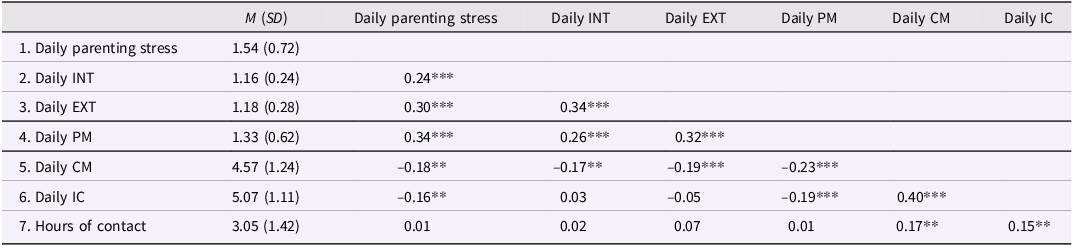
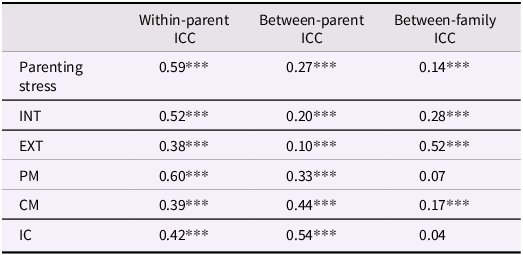
Table 1 displays the means and standard deviations, as well as the correlations between the study variables at the within-parent level. Table 2 displays the ICCs, which are the proportion of variance associated with each variable, located at the within-parent, between-parent, and between-family levels. ICCs indicated that a significant portion of the variance of each of the variables was situated at the level of daily fluctuations. For instance, ICCs indicated that 60%, 39%, and 42% of the variance in prementalizing, certainty about mental states, and interest and curiosity, respectively, was situated at the within-parent level. Similarly, a significant portion of the variance of the predictors, varying between 38% and 59%, was situated at the level of daily fluctuations. Although ICCs contain error variances, these results suggest that for each dimension of parental reflective functioning and the hypothesized associates a substantial portion of the total variance resides at the level of day-to-day fluctuations. Furthermore, as each level contains more than 5% of the total variance, the data were found to be suited for multilevel modeling (Preacher et al., Reference Preacher, Zyphur and Zhang2010).
Descriptive statistics and within-parent correlations for the main study variables
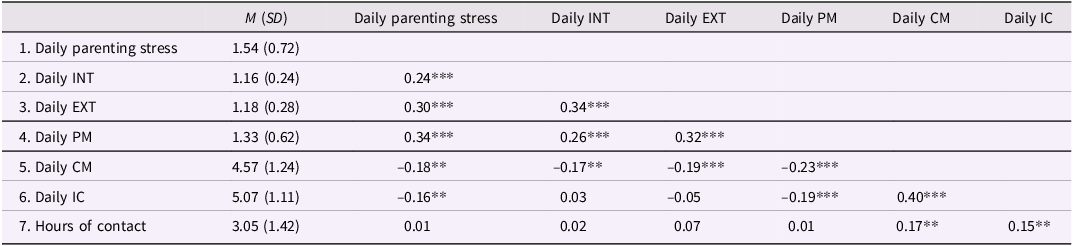
Note. ** p < .01. *** p < .001. INT = internalizing adolescent difficulties, EXT = externalizing adolescent difficulties, PM = prementalizing, CM = certainty about mental states, IC = interest and curiosity.
Percentage of variance in the study variables attributable to within-person, between-person, or between-family variance
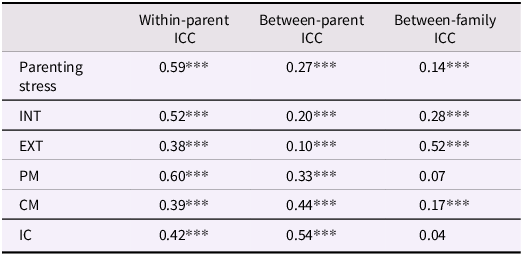
Note. The chi-squared difference test, was used to investigate whether the variance at each level of change (within-parent, between-parent, or between-family) associated with a single predictor differed significantly from zero. ICC = intraclass correlation, INT = internalizing adolescent difficulties, EXT = externalizing adolescent difficulties, PM = prementalizing, CM = certainty about mental states, IC = interest and curiosity. *** p < .001.
Furthermore, within-parent (i.e., daily) correlations indicated that daily parenting stress, as well as perceived internalizing and externalizing difficulties, were significantly positively correlated with daily prementalizing and significantly negatively correlated with certainty about mental states and interest and curiosity. The correlations with certainty about mental states and interest and curiosity were less pronounced than those with prementalizing. Surprisingly, correlations between perceived internalizing and externalizing difficulties and interest and curiosity were not statistically significant. When examining within-level correlations separately for community and adoptive parents (see Table S2 in Supplementary Materials), interest and curiosity was significantly negatively associated with parenting stress only among community parents. However, this difference in statistical significance is primarily due to the disparity in sample sizes between the two groups, with the community parent group having a larger sample, which provided greater statistical power to detect this association, highlighted by the comparable effect sizes for both groups (−0.14 for community parents, −0.17 for adoptive parents).
To investigate whether there were mean-level differences in the study variables between community and adoptive parents, a series of independent samples t-tests was conducted. Results suggested that on a daily basis, adoptive parents reported higher levels of parenting stress (t (1798) = –2.03, p = .042) and higher levels of perceived externalizing difficulties (t (1798) = –6.65, p < .001), but there were no significant mean-level differences in terms of perceived internalizing difficulties (t (1798) = –0.76, p = .448), prementalizing (t (1798) = –0.46, p = .648), certainty about mental states (t (1798) = –0.37, p = .711), and interest and curiosity (t (570.84) = –1.20, p = .232).
To examine associations between relevant background variables (parental age and gender, adolescent age and gender, day (1 to 7), hours of contact (the total number of hours parents had contact with their adolescent child that day), and the study variables, multilevel models with background variables as predictors of the study variables were conducted. Results indicated that parental gender (β = –0.26, SE = 0.09, p = .006) significantly predicted daily prementalizing, with mothers scoring significantly lower on prementalizing than fathers. For further details on the correlations between maternal and paternal reflective functioning, see Table S6 in the supplementary materials. Furthermore, contact hours per day (β = 0.09, SE = 0.02, p < .001) significantly predicted daily certainty about mental states. Finally, contact hours per day (β = 0.07, SE = 0.02, p < .001) and parental gender (β = 0.49, SE = 0.10, p < .001) significantly predicted daily interest and curiosity. No other associations were statistically significant. Based on these results, parental gender and contact hours per day were included as covariates in the corresponding models.
Primary analyses
Aim 1: Daily associations between parenting stress, perceived adolescent difficulties, and parental reflective functioning
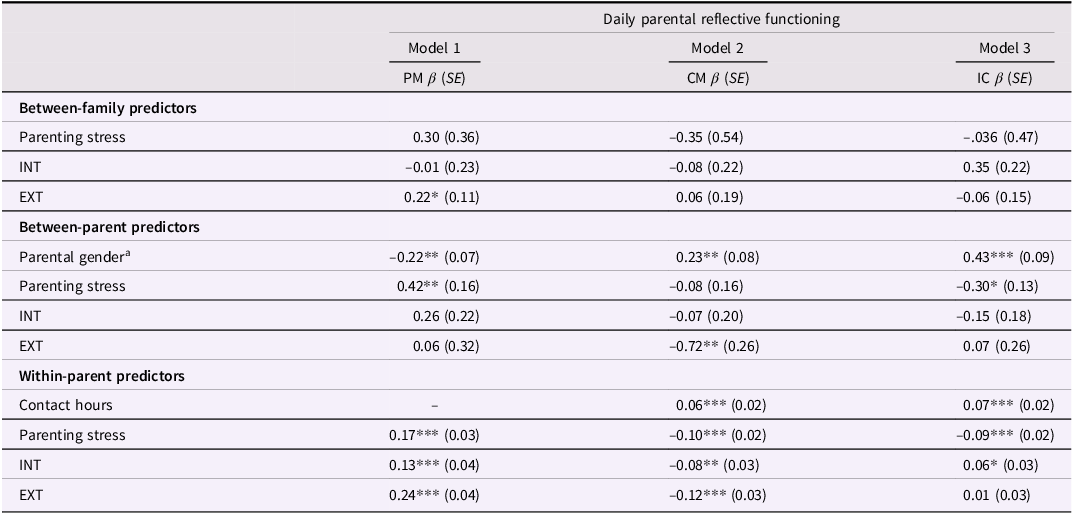
Results are shown in Table 3. Parenting stress was associated positively with prementalizing (β = 0.17, SE = 0.03, p < .001), and negatively with certainty about mental states (β = –0.10, SE = 0.02, p < .001) and interest and curiosity (β = –0.09, SE = 0.02, p < .001). All three associations remained statistically significant after applying the Benjamini–Hochberg procedure to control for the false discovery rate (adjusted p = .002 for each). In addition, perceived internalizing adolescent difficulties were associated positively with prementalizing (β = 0.13, SE = 0.04, p = .001) and with interest and curiosity (β = 0.06, SE = 0.03, p = .040), and negatively with certainty about mental states (β = –0.08, SE = 0.03, p = .008). Each of these associations remained significant following the Benjamini–Hochberg correction, with adjusted p-values of .002, .045, and .01, respectively. Finally, perceived externalizing adolescent difficulties were associated positively with daily prementalizing (β = 0.24, SE = 0.04, p < .001) and negatively with certainty about mental states (β = –0.12, SE = 0.03, p < .001), but no significant association was found with interest and curiosity (β = 0.01, SE = 0.03, p = .749). Both significant associations remained significant after the Benjamini–Hochberg correction (adjusted p = .002 for each).
Daily parental reflective functioning as predicted by daily parenting stress, internalizing adolescent difficulties, and externalizing adolescent difficulties
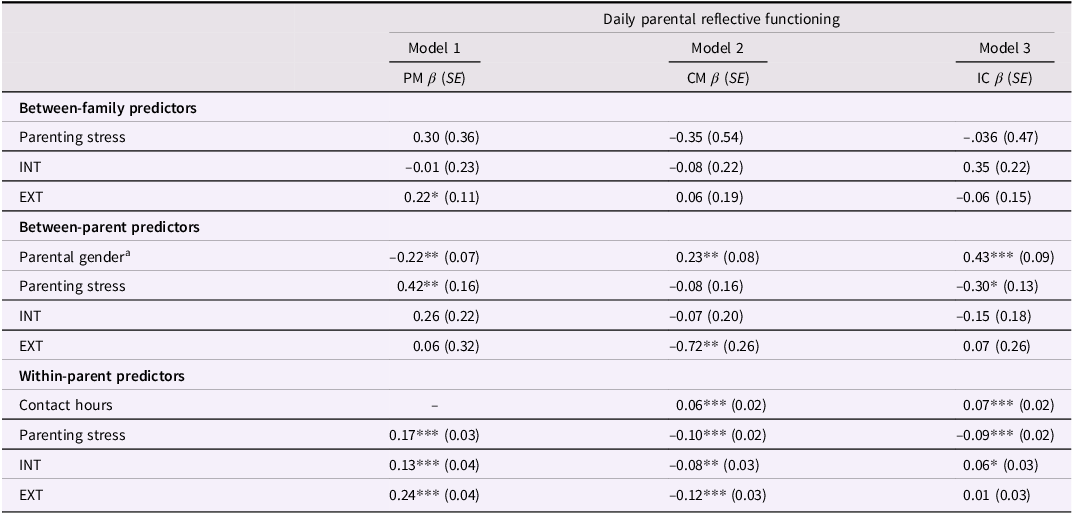
Note. * p < .05. ** p < .01. *** p < .001. Standardized coefficients are presented. aFemale versus male. INT = internalizing adolescent difficulties, EXT = externalizing adolescent difficulties, PM = prementalizing, CM = certainty about mental states, IC = interest and curiosity.
Aim 2: The moderating role of parental status
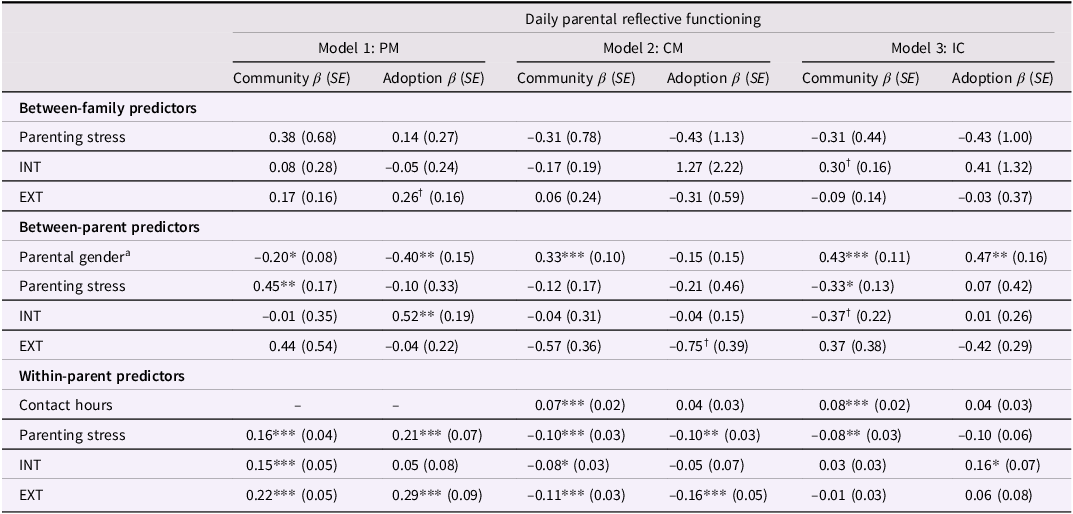
The estimated coefficients for community and adoptive parents separately are shown in Table 4. The Satorra–Bentler chi-square difference test indicated that the fit of the unconstrained model was not significantly better than the constrained model for prementalizing (ΔSBS-χ2 (7) = 5.67, p = .578) and certainty about mental states (ΔSBS-χ2 (8) = 7.63, p = .471), indicating that parental status did not seem to play a moderating role in these two models. After applying the Benjamini–Hochberg procedure to control for multiple comparisons, the p-values for these tests remained nonsignificant (adjusted p = .578 and .565, respectively). However, parental status did seem to significantly moderate the model for interest and curiosity (ΔSBS-χ2 (10) = 24.90, p = .006), with the Benjamini–Hochberg adjusted p-value indicating a significant result (adjusted p = .036). Further analysis of the moderating effect of parental status on the daily association between internalizing adolescent difficulties and interest and curiosity seemed to show a trend toward significance (ΔSBS-χ2 (1) = 2.80, p = .094). This association did not reach conventional levels of statistical significance after correction (adjusted p = .188). Regarding the specific associations between internalizing adolescent difficulties and interest and curiosity, the results seem to reveal that this association was significant among adoptive parents (β = 0.16, SE = 0.07, p = .024), but not among community parents (β = 0.03, SE = 0.03, p = .261). After applying the Benjamini–Hochberg procedure, the association for adoptive parents seemed to show a trend toward significance (adjusted p = .072), although it was originally significant before correction. In contrast, the association for community parents remained nonsignificant (adjusted p = .392).
Daily parental reflective functioning as predicted by daily parenting stress, internalizing adolescent difficulties, and externalizing adolescent difficulties for community and adoptive parents separately
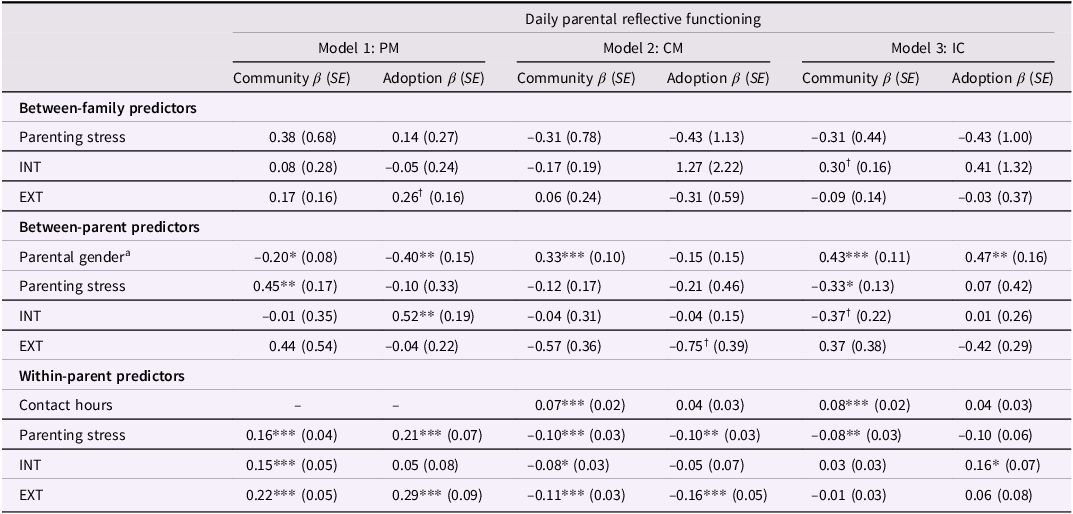
Note. † p ≤ .10. * p ≤ .05. ** p ≤ .01. *** p ≤ .001. Standardized coefficients are presented. aFemale versus male. INT = internalizing adolescent difficulties, EXT = externalizing adolescent difficulties, PM = prementalizing, CM = certainty about mental states, IC = interest and curiosity.
Sensitivity analyses
Differences between boys and girls. Although analyses indicated that adolescent gender was not significantly associated with any of the study variables, it could still moderate the structural associations between the study variables. Multigroup analyses with adolescent gender as a moderator indicated that it did not significantly moderate the associations between parenting stress, perceived adolescent difficulties, and prementalizing (ΔSBS-χ2 (7) = 5.94, p = .547), nor did it moderate the daily associations with certainty about mental states (ΔSBS-χ2 (9) = 8.63, p = .473) or interest and curiosity (ΔSBS-χ2 (10) = 10.44, p = .403).
Robustness of estimates for cross-level covariate interactions. To examine whether within-parent associations differed by parental gender, cross-level interactions between gender and the daily predictors were tested. Initially, these interactions were modeled in full three-level models, which did not converge. Therefore, supplementary two-level analyses (within- and between-parent) were conducted using a Bayesian estimation approach with Monte Carlo integration (5,000 iterations). The results (Table S3, Supplementary Materials) indicated that most cross-level interactions were not significant for daily prementalizing and certainty about mental states. For daily interest and curiosity, the associations of parenting stress and externalizing difficulties with parental gender had raw p-values suggesting potential effects; however, after applying the Benjamini–Hochberg correction, these interactions were no longer statistically significant (adjusted p-values = .15, .075, respectively). These findings indicate that, although there were initial indications of modest gender differences, fathers and mothers generally followed similar daily association patterns. Given that these analyses were limited to a two-level model and the number of potential moderating effects was small, these results should be interpreted cautiously.
Carry-over effects from one day to the next. The main analyses focused on within-day associations of parenting stress and internalizing and externalizing difficulties with parental reflective functioning. To examine whether some of the effects of parenting stress and perceived levels of adolescent difficulties occur not only within a given day but also have lingering effects on parents’ reflective functioning the next day, additional models were conducted in which the association between parenting stress and internalizing/externalizing adolescent difficulties on day t with prementalizing, certainty about mental states, and interest and curiosity on day t + 1 were investigated (controlling for the respective dimension of parental reflective functioning on day t). To examine potentially bidirectional cross-over effects between days, we also estimated models with the opposite effects (i.e., parental reflective functioning on day t predicting parenting stress and adolescent difficulties on day t + 1). Results of these analyses (which are presented in Tables S4 and S5 in the Supplementary Materials) generally indicated an absence of carry-over effects from one day to the next, with the exception of one significant carry-over effect indicating that higher levels of prementalizing on one day were significantly associated with lower levels of parenting stress the next day (β = –0.07, SE = 0.03, p = .037).
Discussion
Generally, results indicated that parents showed marked day-to-day fluctuations in prementalizing, certainty about mental states, and interest and curiosity across the 7-day period. The current study is among the first to show that, in addition to trait-like variance, a substantial part of the variance in parents’ reflective functioning is daily variation. Apparently, on some days it is easier for parents to thoroughly consider and understand their adolescent’s mental states, whereas on other days parents are more clueless or even tend to engage in hostile attributions of their adolescent’s intentions and mental states. These findings are crucial from both a prevention and an intervention perspective, as existing interventions that target parental reflective functioning, such as mentalization-based treatment for families (Asen & Fonagy, Reference Asen and Fonagy2012), could be further strengthened by incorporating strategies to help parents monitor and reflect on the fluctuations in their reflective functioning. This, in turn, could provide more personalized and tailored support addressing both the static aspects of reflective functioning and the dynamic, day-to-day challenges parents encounter.
To understand the daily fluctuations in parents’ reflective functioning, we considered the roles of daily parenting stress and perceived adolescent difficulties. Daily parenting stress and internalizing and externalizing adolescent difficulties were associated positively with daily prementalizing, and negatively with daily certainty about mental states. As such, parents engaged in more maladaptive reflective functioning on days when they also experienced more parenting stress and perceived more adolescent difficulties, while at the same time recognizing that they had more difficulty in understanding what was going on in their adolescent’s mind.
Considering interest and curiosity, results indicated that parents were less able to display interest and curiosity in their adolescent’s mental states on days when they experienced higher levels of parenting stress. Surprisingly, on days when they perceived more internalizing adolescent difficulties, they were more interested and curious in their adolescent’s mental states, whereas there was no significant association with daily externalizing adolescent difficulties. Follow-up analyses indicated that the positive within-day association between adolescent internalizing problems and parents’ interest and curiosity seemed to be specific to adoptive parents and was not detected among community families. This association is reminiscent of findings reported by Aunola et al. (Reference Aunola, Viljaranta and Tolvanen2017), who found that parents tend to become less controlling after a day on which adolescents displayed more internalizing difficulties. It is possible that adoptive parents are inclined to decrease the pressure and to show more interest and understanding when they notice that their adolescent is struggling emotionally on a given day. By contrast, previous research has shown that when adolescents display internalizing problems across a longer period of time (not just on a given day), parents tend to engage in more dismissive and domineering behaviors (Soenens et al., Reference Soenens, Vansteenkiste, Duriez and Goossens2008). These more chronic internalizing difficulties may gradually erode parents’ capacity for reflective functioning, ultimately leading to more dysfunctional parenting practices. As such, the current findings testify to the importance of studying parental reflective functioning and its interplay with child behaviors over different time-scales.
Overall, parental stress appeared to have a stronger influence on parents’ interest and curiosity than perceived adolescent difficulties. One possible interpretation of this pattern is that adolescent difficulties may not necessarily diminish parents’ interest and curiosity, particularly if these difficulties are not experienced as highly stressful. Parental emotion regulation may play an important role in this context, as effective emotion regulation could help parents remain relatively calm even when adolescents experience challenges (Schultheis et al., Reference Schultheis, Mayes and Rutherford2019). When such difficulties (and other potential stressors) do increase parental stress, parents might find it more challenging to maintain their interest in their adolescent’s mental states. It is plausible that heightened parental stress could shift parents’ focus toward their own mental states, potentially reducing attention to the adolescent’s perspective. Future research is needed to replicate and extend these findings
Several findings of this study align with the biobehavioral switch model, which describes how reflective functioning tends to go “offline” under increasing stress or emotional arousal, which puts adaptive reflective functioning under pressure while increasing the likelihood of maladaptive forms of reflective functioning (Luyten & Fonagy, Reference Luyten and Fonagy2015; Mayes, Reference Mayes2006). Although many studies have provided evidence for an association between both self-reported and physiological stress and parental reflective functioning, these studies did not unravel the dynamic nature of this association as it unfolds on a daily basis. The diary methodology used in the present study therefore provided a novel approach to investigating intraindividual change in parental reflective functioning in daily life, as well as its associations with parenting stress and internalizing and externalizing adolescent difficulties. In accordance with the biobehavioral switch model, results indicated that parents show substantial fluctuations in their reflective capacities that go hand in hand with fluctuations in parenting stress and challenging adolescent behavior (Luyten & Fonagy, Reference Luyten and Fonagy2015).
In order to ensure variability in the daily experiences of parents, the present study oversampled for adolescents at risk for socioemotional difficulties by including a group of adoptive parents. Consistent with meta-analytic evidence, the study found that transnationally adopted adolescents exhibited higher levels of externalizing difficulties, but not internalizing difficulties, compared with their non-adopted peers (Askeland et al., Reference Askeland, Hysing, La Greca, Aarø, Tell and Sivertsen2017). Additionally, results indicated that adoptive parents reported higher levels of parenting stress compared with community parents. Together, these results highlight how adoptive parents of transnationally adopted adolescents may encounter more challenges in their daily parenting, compared with community parents.
With regard to daily associations with parental reflective functioning, results indicated that parental status did not significantly moderate the daily relationships between parenting stress, perceived adolescent difficulties, and prementalizing or certainty about mental states. This suggests that the strength of these associations was comparable for adoptive and community parents. As noted, adoptive parents reported higher average levels of parenting stress and perceived externalizing adolescent difficulties. While the absence of significant moderation precludes strong conclusions about differences, these findings allow cautious speculation. For instance, despite experiencing higher levels of parenting stress and challenges, adoptive parents may show changes in reflective functioning that are broadly similar to community parents. This could potentially reflect characteristics previously noted in the literature, such as prior screening, training, and other factors that may support coping in adoptive parents (Malcorps et al., Reference Malcorps, Vliegen, Nijssens, Tang, Casalin, Slade and Luyten2021; Palacios & Sánchez-Sandoval, Reference Palacios and Sánchez-Sandoval2006; Pinderhughes & Brodzinsky, Reference Pinderhughes, Brodzinsky and Bornstein2019). Nevertheless, these analyses are exploratory due to the relatively small sample of adoptive parents and limited statistical power for detecting moderation effects. To further assess the potential moderating role of parental status, we conducted a post hoc Monte Carlo simulation with 1,000 simulated datasets. This simulation aimed to detect multigroup differences between community and adoptive parents in terms of predictors such as parenting stress and adolescent difficulties, for each parental reflective functioning dimension separately. The estimated power for detecting significant interactions was 0.38 for prementalizing, 0.47 for certainty about mental states, and 0.07 for interest and curiosity, highlighting the tentative nature of these findings. Further investigation of differences between community and adoptive parents in larger samples is warranted to more robustly evaluate these potential group differences.
Strengths, limitations, and future directions
The study has several limitations. The first and most notable is its exclusive reliance on parent-reported measures for all study constructs. While this approach allowed us to capture parents’ subjective experiences and daily fluctuations in a feasible and consistent manner, it also introduces the risk of shared method variance and limits the generalizability of the findings. In particular, caution is warranted when interpreting the role of challenging adolescent behavior in parental reflective functioning, as these associations may reflect perceptions unique to the parent rather than objective patterns of behavior. To disentangle associations that are “in the eye of the beholder” from those grounded in observable dynamics, future research would benefit from employing a multi-informant, multi-method design. This could include reports from adolescents, partners, or independent observers, as well as alternative assessment methods such as interviews, observational coding, or physiological measures.
Second, to measure daily parental reflective functioning, three items with the highest factor loadings on each scale, selected from the initial validation study of the PRFQ (Luyten, Mayes, et al., Reference Luyten, Mayes, Nijssens and Fonagy2017), were slightly adapted for daily application. Although internal consistency was good for daily certainty about mental states and interest and curiosity, it was low for daily prementalizing. An important limitation of this study is therefore the low internal consistency of the daily prementalizing scale (Cronbach’s α = 0.47–0.63; M = 0.56), indicating that there is room for psychometric improvement and that the development of scales suited for daily use should be a central focus of future studies. Yet, it is important to contextualize this low internal consistency in the context of the broader psychometric literature, as it is an often encountered phenomenon in intensive longitudinal designs using brief, repeated measures that internal consistency is low due to reduced item variance (Song et al., Reference Song, Howe, Oltmanns and Fisher2023). This could be particularly pronounced for prementalizing as parents scored relatively low in terms of prementalizing on a day-to-day basis, thereby further constraining the available variance. A possible explanation for this floor effect may be that parents were rather highly educated, and that more variance may be available in low-income, poorly educated and highly stressed families, yet this remains to be empirically investigated. Furthermore, it is important to note that despite the low internal consistency of the daily prementalizing scale, the daily prementalizing scores demonstrated moderate correlations with the overall prementalizing score assessed using the PRFQ prior to the diary study (α = 0.68; r = .42, range = .36–.47) and displayed item-total correlations at a daily level providing suggestive evidence for its internal validity (range r = .41–.71). Furthermore, the daily prementalizing scores showed meaningful and significant correlations with certainty about mental states and interest and curiosity at a daily level, thereby supporting not only the predictive validity but also the concurrent validity of the scale. Nonetheless, future research should aim to strengthen the psychometric properties of daily assessments of parental reflective functioning, and daily prementalizing in particular. Doing so would enhance interpretability and improve measurement precision in daily-life contexts.
Third, the study focused on parenting stress and perceived adolescent behavior as associates of parental reflective functioning. However, consistent with prior research in which parental reflective functioning has typically been studied as a predictor of parent and child adjustment, it is likely that parenting stress, adolescent behavior, and parental reflective functioning are bidirectionally and mutually reinforcingly associated, warranting caution in interpreting directionality. For instance, while elevated stress and adolescent difficulties may impair parents’ capacity to reflect on their child’s internal experiences, diminished reflective functioning may also contribute to increased stress and strained parent–child interactions. As such, the current modeling approach does not capture the full dynamic interplay between these constructs. Future studies using designs that allow more fine-grained, time-sensitive assessments – such as ecological momentary assessment or intensive longitudinal designs – are needed to examine these bidirectional processes in greater detail. Furthermore, given that all variables were reported by the same respondent, response biases may account for a significant portion of the observed covariance. Consequently, the directionality of the associations is unclear. In order to address the issue of directionality to some extent, sensitivity analyses in this study examined the directionality of associations across days and found that carry-over effects were largely absent. An unexpected finding was, however, that higher levels of prementalizing on one day were associated with lower parenting stress the following day. While we advise caution in interpreting this counterintuitive association, one possible explanation is that families in our relatively advantaged sample, characterized by higher education and income, may possess the resources and capacity to recover effectively from daily challenges, effectively “starting each day with a clean slate.” This pattern may reflect a resilience process, where parents are able to bounce back from stressful interactions rather than becoming trapped in a downward spiral of negative experiences across days. It is possible that negative carry-over effects from one day to the next occur more frequently in families experiencing greater adversity or chronic stress, a hypothesis that warrants further investigation in future research. Furthermore, it is also likely that associations occur more frequently at the micro-level within a single day rather than at the macro-level across days. Although this study did not include within-day data, future research could employ an ecological momentary assessment design to explore fluctuations in parental reflective functioning within the same day, as well as potential carry-over effects in future interactions, both within a single day and across multiple days.
The fourth and final limitation of the current study concerns the structure of the items used to assess adolescents’ internalizing and externalizing problems. Specifically, several items combined more than one behavior within a single question (e.g., “Today, my child had many fears, and was easily scared”), which may introduce ambiguity and reduce measurement precision (Petersen et al., Reference Petersen, Bates, Dodge, Lansford and Pettit2016). Prior research has shown that when such compound items are separated into distinct questions, the resulting scores can differ in magnitude and may not be strongly correlated, indicating that each component may tap into slightly different constructs (Menold, Reference Menold2020). As such, we acknowledge that future diary studies would benefit from evaluating the impact of item formulation on psychometric properties more explicitly, for example, by testing decoupled versus compound items side by side, to enhance measurement precision and construct validity in intensive longitudinal designs.
Conclusion
The present study offers evidence for notable day-to-day variability in parental reflective functioning and corresponding fluctuations in parenting stress and perceived adolescent difficulties. On days when parents reported higher levels of parenting stress or perceived adolescent difficulties, they also reported increased prementalizing and reduced certainty regarding their adolescent’s mental states. Elevated parenting stress was also associated with decreased parental interest and curiosity. Most of these associations applied consistently across biological and adoptive parents and across parental gender. These findings underscore the dynamic and context-sensitive nature of parental reflective functioning and point to the association with both parenting stress and adolescent behavior. The findings provide preliminary support for the potential value of focusing on parents’ reflective functioning during periods of stress or child difficulties. By helping parents recognize moments when their reflective functioning may be temporarily lower, interventions may more effectively support attunement to their own and their child’s mental states. At the same time, further research is needed to replicate and extend these findings, particularly using designs that capture micro-level fluctuations and different time-scales.
Supplementary material
The supplementary material for this article can be found at https://doi.org/10.1017/S0954579425100849.
Data availability statement
The data supporting this study are not publicly available to protect participant confidentiality and anonymity, but access may be granted upon reasonable request. All analysis scripts, methods, and materials, including questionnaires and experimental protocols, are provided in the Supplementary Materials, with additional materials available from the corresponding author upon request.
Author contribution
SF conceived of the study, performed the formal analysis, and coordinated and drafted the manuscript; PL supervised, participated in the research design, helped in interpreting the data, and edited the manuscript; NV participated in the research design and helped in interpreting the data; NF helped in performing the formal analysis and interpreting the data, and edited the manuscript; SM helped in interpreting the data, and edited the manuscript; BS supervised, helped in interpreting the data, and edited the manuscript. All authors read and approved the final manuscript.
Funding statement
The research leading to these results received funding from The Research Foundation – Flanders (FWO) under Grant Agreement no G071120N and partial financial support by the Flemish agency Child and Family (In Dutch: Kind en Gezin, https://www.kindengezin.be/). The funders had no role in study design, data collection and analysis, decision to publish, or preparation of the manuscript. The authors have no financial or proprietary interests in any material discussed in this article.
Competing interests
The authors have no competing interests to declare.
Ethical standards
The study received ethical approval from the Social and Societal Ethics Committee of the University of Leuven in 2020 under reference no G-2020-2037.
Consent to participate
Written informed consent was obtained from all individual participants included in the study.
Preregistration statement
This study was not preregistered. The research was informed by a clear theoretical framework that guided the development of hypotheses and analyses.


 Open access

