


Introduction
Brass is a copper-zinc alloy that is widely used today and its large-scale production can be traced back to the first millennium BC (Pollard et al. Reference Pollard2017; Morton Reference Morton2019). Mining and smelting relics and artefacts and written accounts document the prosperity of the brass (orichalcum) industry in the Classical world (Caley Reference Caley1964; Craddock Reference Craddock1978; Pollard et al. Reference Pollard2017; Morton Reference Morton2019). Initially centred in Europe and the Ancient Near East, the use of brass spread eastward through trade, political integrations and population movements, ultimately leading to a global diffusion of brass technology. Brass industry was established on the Iranian Plateau around the sixth–seventh centuries AD (Craddock et al. Reference Craddock and Craddock1990), in Central Asia around the eighth century AD (Park & Voyakin Reference Park and Voyakin2009) and in East Asia around the tenth century AD (Zhou Reference Zhou2002a; Nishiyama et al. Reference Nishiyama2022).
In China, local brass production is generally believed to have begun around the tenth century AD. This view is supported by evidence from historical records and archaeological discoveries relating to brass production at that time (Zhou Reference Zhou2002b; Xiao Reference Xiao2024) and the identification of local lead isotopic signatures in brass artefacts dating to this period (Xiao et al. Reference Xiao2020; Zhao et al. Reference Zhao2025). Sporadic, earlier examples of brass objects, often exhibiting exotic features, are typically interpreted as imports, primarily from Rome, Persia or India (Li et al. Reference Li2018; Shao et al. Reference Shao2021). Yet, direct evidence of medieval brass production—such as furnaces, crucibles and slag—remains largely absent in China, and no brass-making crucibles have been reported in East Asia before the sixteenth century. This wide gap hinders our understanding of the technological characteristics of brass production in East Asia, as well as the further exploration of technological interactions across Eurasia.
To address this gap, we undertook systematic analyses on crucibles excavated from an official metallurgical workshop in Guangzhou. In examining the results, our objectives are to: 1) identify if and when brass production began in this workshop; 2) identify the technological characteristics of brass production, if confirmed; 3) explore the possible origins and transmission routes of brass technology in medieval China (eighth–fourteenth century AD).
Archaeological context
As a major metropolis in southern China since the medieval period, Guangzhou has served as an important hub for international interactions. A historical site in Guangzhou is the Royal Palace of the Nanyue Kingdom (南越国, 204–111 BC), which continued to function as the regional administrative centre for nearly two millennia after the collapse of the Nanyue Kingdom (Figure 1a).
a) Location of the Royal Palace of the Nanyue Kingdom in Guangzhou, South China; b) field photograph of the in situ crucibles; c) a brass earring (IT707⑨a:4); d) field photograph of an in situ furnace (IIT705⑨a); scale bar = 40mm (figure by authors).

Figure 1 Long description
The image consists of four elements: a map, a photograph of in situ crucibles, an image of a brass earring, and a photograph of an in situ furnace. The map shows the location of the Royal Palace of the Nanyue Kingdom in Guangzhou, South China. The photograph of the in situ crucibles displays three crucibles on the ground. The image of the brass earring shows a detailed view of the artifact. The photograph of the in situ furnace captures a large, circular structure in the ground. The scale bar in the images indicates a measurement of forty millimeters.
Archaeological excavations at the palace, conducted between 1975 and 2007, uncovered a series of structures, including a metallurgical workshop that dated from the third to eighteenth centuries AD (Fen et al. Reference Fen2000; Li & Li Reference Li and Li2002; Hu et al. Reference Hu2007; Li Reference Li2020, Reference Li2023). Furnaces, crucibles and dozens of metal artefacts have been recovered, verifying metalworking activities involving copper-based alloys, silver and iron carried out by local government over a period of more than a millennium.
Nearly 80 complete crucibles and crucible sherds have been discovered in situ (Figure 1b). Based on typological and stratigraphic analyses, these are categorised into four chronological groups: Eastern Jin to Southern Dynasties (group I; third–sixth centuries AD); Tang to Five Dynasties (group II; seventh–tenth centuries AD); Northern Song to Yuan Dynasty (group III; tenth–fourteenth centuries AD); and Ming Dynasty (group IV; fourteenth–seventeenth centuries AD). Within the Tang to Five Dynasties group, two subgroups are further identified: IIa (seventh–ninth centuries AD); and IIb (ninth–tenth centuries AD).
Four copper-based artefacts dating to the seventh–tenth centuries have also been recovered: a shard of mirror, a bell, a buckle and an earring (Figure 1c), representing daily essentials or personal ornaments.
A well-preserved semi-subterranean furnace also dates to the seventh–tenth centuries, contemporaneous with the group-II crucibles and artefacts (Figure 1d). The bag-shaped furnace measures 0.36m in diameter and 0.15m in height. Evidence of its operation includes 50–80mm-thick deposits of fuel ash and reddish heat-altered earth concentrated on the inner base and surrounding areas.
Materials
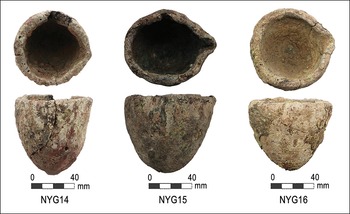
Based on a general scientific test on crucibles and sherds from groups I and II (n = 51), a subset of the recovered crucibles from group IIb exhibiting diagnostic evidence for brass production is presented in this article, comprising three well-preserved, unequivocal examples of brass-making vessels (Figure 2) The specimens exhibit consistent morphological characteristics, including a cup-shaped body, a slightly inward-sloping rim—sometimes equipped with a pouring spout—and a rounded base. All crucibles share similar dimensions, measuring 60–80mm in diameter and 60–70mm in height, with an approximate capacity of 0.2–0.3litres.
Brass-making crucibles unearthed from the workshop at the Royal Palace of the Nanyue Kingdom (figure by authors).

Figure 2 Long description
The image displays three ancient brass-making crucibles from the Royal Palace of the Nanyue Kingdom. Each crucible is shown from two angles: the top view and a side view. The crucibles exhibit varying degrees of wear and discoloration, indicative of their age and use. Each crucible is accompanied by a scale in millimeters, providing a sense of their size. The crucibles are labeled as NYG14, NYG15, and NYG16, respectively. The top views reveal the interior shapes and conditions, while the side views show the exterior forms and any visible damage or alterations. The crucibles are placed side by side for comparison, highlighting their similarities and differences in design and condition.
Extensive vitrification is evident on both interior and exterior surfaces of the crucibles, with severe vitrification concentrated on the external base. Black carbonaceous deposits, slaggy reaction products and green copper corrosion residues are observed on the interior surfaces. Exterior surfaces display metallic condensates and distributed bloating pores. No lids have yet been found, suggesting the possibility of a lid-free structure.
Methods
Portable energy-dispersive x-ray fluorescence analysis (pXRF)
Unbalanced thermochemical properties of elements make it difficult to determine the exact compositions of metal processed in the crucibles using pXRF (Dungworth Reference Dungworth2000; Kearns et al. Reference Kearns2010). However, this analysis is still useful as it quantifies the presence of different metallic elements, providing a preliminary indication of metal type. All crucibles underwent pXRF analysis using an Olympus Innovx Vanta VMR portable x-ray fluorescence analyser (50kV, 100μA, 30s live time, 3mm beam spot). The four copper-based alloy artefacts were also analysed, concentrating on unpolished areas with little corrosion. All elemental data are presented as relative concentrations for comparative purposes only.
Scanning electron microscopy with energy dispersive spectroscopy (SEM-EDS)
Cross-sectional samples of selected crucibles were prepared through a process of embedding fragments in epoxy resin, sequential polishing (180→2500 grit SiC paper) and final polishing. Microstructural and compositional analyses were conducted using a Hitachi TM3030 Tabletop SEM coupled with a Bruker Quantac 70 EDS system (15kV accelerating voltage, 80s live time). A standard sample ETM-EB375 (a leaded brass alloy) was used for quality control (Table 1). Values were measured three times and averaged.
The certified values of the standard sample ETM-EB375 and the measured values obtained by SEM-EDS (unit: wt%).

Lead isotopic analysis (MC-ICP-MS)
Samples were prepared following established protocols (Cui & Wu Reference Cui and Wu2008). After post-solution treatment, the lead isotope ratios of metallic residues adhering to the internal surfaces of the three best preserved crucibles were determined with a VG Elemental multicollector inductively coupled plasma mass spectrometer (MC-ICP-MS) in the School of Earth and Space at Peking University. Repeated analyses of the lead isotope standard SRM981 were conducted after every eight to 10 samples during the analytical run to check the accuracy and precision of the instrument. The overall analytical error (2s) for all lead isotope ratios was less than 0.06%.
Results of pXRF analysis
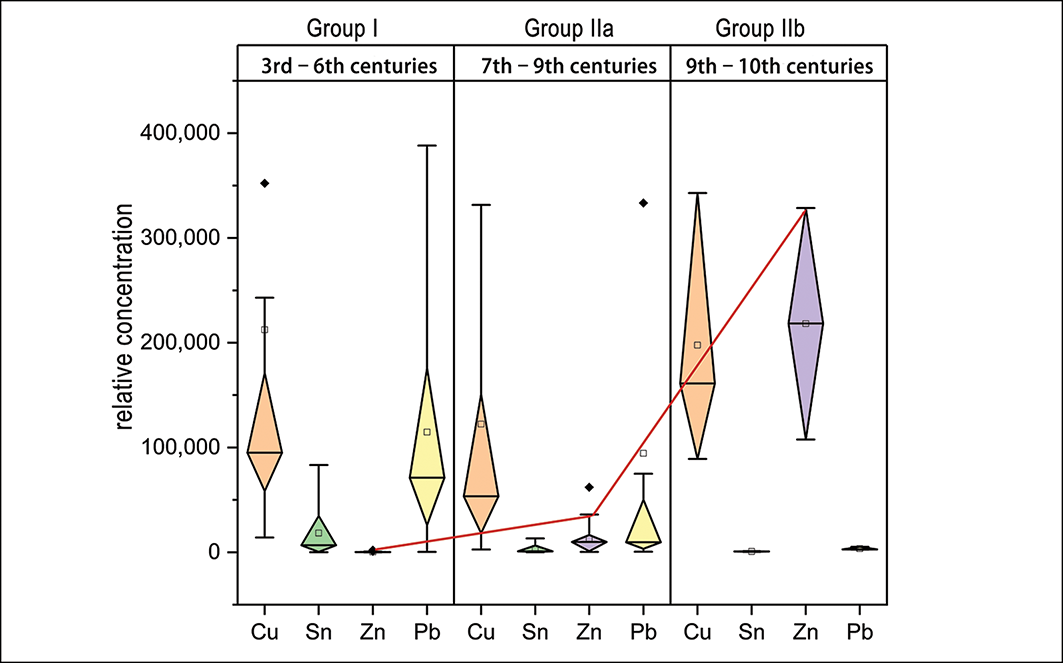
Enrichment of metallic elements was apparent on the interior surface of all crucibles, confirming their use in various non-ferrous metal production (Table S1). The levels of copper (Cu), tin (Sn), zinc (Zn) and lead (Pb) on interior surfaces present different profiles for crucibles from different time periods (Figure 3). Until the sixth century, copper, tin and lead are the dominant contaminants, while zinc levels are typically below 0.1%. From the seventh century, zinc levels rise steadily up to 3.5%, with relative decreases in tin and lead. At the turn of the ninth century, zinc levels rise sharply to 32%, while tin and lead levels decline to a minimum. The distinctive increase in zinc marks a transition from the processing of zinc-free to zinc-containing raw materials, though whether this pertains to brass-related metallurgical processes cannot be determined through pXRF alone.
Comparative composition of metal residues from the interiors of Group I and II crucibles. The phased growth of zinc is highlighted by the red line (figure by authors).

Figure 3 Long description
The box-and-whisker plot compares the relative concentration of copper, tin, zinc, and lead in metal residues from the interiors of Group I and II crucibles. The plot is divided into three groups: Group I (3rd-6th centuries), Group IIa (7th-9th centuries), and Group IIb (9th-10th centuries). The x-axis represents the elements (Cu, Sn, Zn, Pb) and the y-axis represents the relative concentration, ranging from 0 to 400,000. Each group contains four vertical box plots for each element. The boxes indicate the interquartile range (Q1 to Q3), with the median (Q2) marked by a horizontal line inside the box. The whiskers extend to the minimum and maximum values, and outliers are shown as individual points. Group I shows high variability in copper and lead concentrations, while Group IIa and IIb show more consistent concentrations. The red line highlights the phased growth of zinc concentrations over time. All values are approximated.
The copper-based artefacts also indicate compositional differences through time (Table S2). The two artefacts dating from the third–ninth centuries are both made from a leaded bronze alloy. In contrast, only one of the artefacts from the ninth–tenth centuries is made from leaded bronze, the other is made from leaded brass (with 13%Zn & 48%Pb).
SEM-EDS analysis
Crucible-making craftsmanship
Observation of crucible sherds macroscopically and under an optical microscopic reveals a sandwich-like structure composed of an external coating layer (1–2mm), the ceramic body (10–15mm) and an internal lining layer (1mm) (Figure 4).
Micrographs of crucibles with sandwich structures: a) optical micrograph of the cross section of crucible NYG14; b) interior surface of crucible showing adherent slags and metal residues; c–e) vitrified interior lining layer; f–h) organic and quartz tempers in ceramic body; i–l) vitrified coating layer (figure by authors).

Figure 4 Long description
A cross-sectional view of a crucible labeled NYG14. The image shows various layers and internal structures. The interior surface of the crucible displays adherent slags and metal residues. The vitrified interior lining layer is visible in three different micrographs. The ceramic body contains organic and quartz tempers. The vitrified coating layer is also depicted in multiple micrographs.
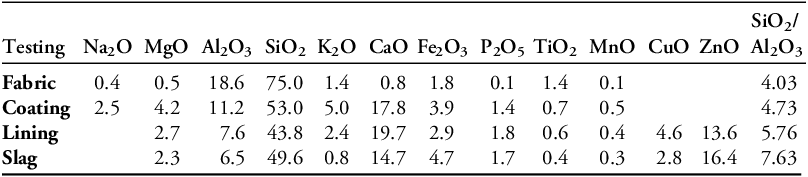
Chemical analysis through SEM-EDS identifies the fabric of the ceramic body as china-stone-based clay, with 75.0% silicon dioxide (SiO2) and 18.6% aluminium (III) oxide (Al2O3) on average (see Table 2). The flux oxides of sodium, potassium and calcium (Na2O, K2O and CaO) are present at levels below 2%, indicating high refractoriness (the ability to withstand high temperatures without melting or deforming) of the ceramic body. Low concentrations of the impurity elements iron (III) oxide (Fe2O3), titanium dioxide (TiO2) and manganese (II) oxide (MnO) contribute to the original white colour. Microstructural observation reveals two types of tempers within the ceramic matrix. The use of organic tempers, primarily rice husks and straw, are evidenced by both phytolith imprints and preserved carbonised fibres. Most organic material has been burnt out, leaving only channel or vesicle voids. Moisture retained by these plant materials resulted in incomplete oxidation and consequently the blackening of the ceramic fabric. Quartz serves as the mineral temper. The sub-angular shape and coarse size indicate intentional crushing and addition rather than natural inclusions.
Averaged chemical compositions (wt%) for the ceramic body, coating layer, lining layer and slags of brass-making crucibles.

Table 2 Long description
The table presents the averaged chemical compositions in weight percentages for the ceramic body, coating layer, lining layer, and slags of brass-making crucibles. It includes data for various oxides such as sodium oxide (Na2O), magnesium oxide (MgO), aluminum oxide (Al2O3), silicon dioxide (SiO2), potassium oxide (K2O), calcium oxide (CaO), iron oxide (Fe2O3), phosphorus pentoxide (P2O5), titanium dioxide (TiO2), manganese oxide (MnO), copper oxide (CuO), zinc oxide (ZnO), and the ratio of silicon dioxide to aluminum oxide (SiO2/Al2O3). The table has four rows representing fabric, coating, lining, and slag, and thirteen columns representing different oxides and their ratios. Notable trends include varying concentrations of silicon dioxide and aluminum oxide across different layers, with the fabric having the highest silicon dioxide content and the slag having the highest aluminum oxide content.
* Considering both Na Kα and Na Kβ peaks overlap with Zn Lα peak, Na content is omitted when zinc content is significant.
The external coating is a sacrificial layer intentionally applied to isolate the ceramic fabric from direct contact with the flame and from fuel ash infiltration, thereby protecting the underlying crucible fabric from deeper chemical and mechanical damage. Chemical analysis reveals distinctive concentrations of 18% calcium oxide (CaO), identifying the coating as a lime-rich layer with poor refractoriness which would promote early vitrification and glassy barrier formation. The proportions of K2O (5.0%), Fe2O3 (4%) and MnO (0.5%) and the ratio of SiO2 to Al2O3 (4.7) are substantially higher in the coating than the ceramic body. The enrichment of Na2O, magnesium oxide (MgO) and K2O in the coating reflects the influence of fuel ash, which points to a method of heating from below, consistent with the distinct vitrification observed on the exterior base.
The interior lining is another kind of applied protective layer. It was used to shield the interior from molten metal infiltration, therefore weaking interfacial adhesion and facilitating post-use cleaning. The internal lining layer also exhibits a lime-rich composition (19.7% CaO), resulting in similarly poor refractory properties as the external coating layer. The ratio of SiO2 to Al2O3 (5.8) and the concentrations of Fe2O3 (2.9%) and MnO (0.4%) generally match those of the coating, but K2O levels are substantially lower due to isolation from fuel ash. Instead, direct contact with molten metal has enriched the lining layer with CuO (4.6%) and ZnO (13.6%). Fe3+/ Fe2+ and Cu+ contribute to the orange to brown colour of the internal surface.
Metallurgical activity
Chemical analysis of the slaggy reaction products adherent on the internal surfaces of the crucibles identifies them as high-zinc CaO-SiO2 glassy slag. The slag maintains compositional continuity with the lining layer in terms of CaO (14.7%), ZnO (16.4%), CuO (2.8%) and MnO (0.3%), but shows a slight increase in Fe2O3 (4.7%) and a rise in the SiO2/Al2O3 ratio (7.6). Microstructure observation reveals brass droplets, ZnO residues and secondary willemite (zinc silicate) spreading over the matrix, accompanied by minerals including sphalerite, K-feldspar, apatite and haematite.
Two types of brass-alloying crucibles are recognised based on the residual metal droplets trapped in the slags. Type A crucibles contain primarily copper and binary brass droplets (Figure 5). The copper is of high purity (>99%) with only trace amounts of iron and lead; the binary brass droplets show consistent zinc contents ranging from 11 to 17%. In contrast, type B crucibles are dominated by bronze and ternary Cu-Zn-Sn droplets (Figure 6). This indicates that unleaded bronze (2–4%Sn) was loaded as the base material, ultimately yielding a Cu-Zn-Sn alloy (also known as gunmetal) with 2–4%Sn and 11–15%Zn. Most metal droplets trapped in slags show minimal oxidation and vary in diameter from micrometres to 1.2mm.
Micrographs of metal residues within type A brass-making crucible NYG14, indicating that the copper + zinc ore → Cu-Zn brass strategy was employed: a) unreacted pure copper as copper-based material; b–f) cluster of zinc oxide (ZnO), secondary willemite (Wlm) and resulting Cu-Zn brass droplets (figure by authors).

Figure 5 Long description
The image displays micrographs of metal residues within a type A brass-making crucible labeled NYG14. It highlights the copper and zinc ore transformation into Cu-Zn brass. Panel a shows unreacted pure copper as the copper-based material. Panels b to f depict clusters of zinc oxide, secondary willemite, and resulting Cu-Zn brass droplets. The micrographs illustrate the copper and zinc ore to Cu-Zn brass strategy employed in brass-making.
Micrographs of metal residues within type B brass-making crucible NYG16, indicating that the bronze + zinc ore → Cu-Sn-Zn brass strategy was employed: a) unreacted Cu-Sn as copper-based material; b–d) cluster of zinc oxide (ZnO), secondary willemite (Wlm) and resulting Cu-Sn-Zn brass droplets; e) haematite (Hem) impurity; f) sphalerite (Sp) impurity (figure by authors).

Figure 6 Long description
The image presents microscopic images of metal residues within a type B brass-making crucible, indicating the use of the bronze plus zinc ore to produce Cu-Sn-Zn brass strategy. Image (a) shows unreacted Cu-Sn as copper-based material. Images (b) to (d) display a cluster of zinc oxide (ZnO), secondary willemite (Wlm), and resulting Cu-Sn-Zn brass droplets. Image (e) highlights a haematite (Hem) impurity, while image (f) shows a sphalerite (Sp) impurity. The images provide detailed visual evidence of the different stages and components involved in the brass-making process.
Within the glassy internal lining layer, ZnO particles, hexagonal willemite, cubic spinel phases (ZnAl2O4, Zn2SnO4 & ZnFe2O4) and dendrite cuprite have developed (Figure 7). Micron-scale (<24μm) porous brass droplets are observed, with cuprite crystallising around the margins, showing a complex redox environment within different parts of the crucibles. A layer of solidified brass melt adhering to the lining layer is heavily oxidised.
Micrographs of metal residues in the lining layer of type A brass-making crucible NYG15: a) oxidised Cu-Zn brass melt adhering to the internal surface, and willemite (Wlm), zinc oxide (ZnO) and spinel (Spn) (including ZnAl2O4 and Zn2SnO4) in vitrified lining layer; b–c) zinc-oxide (ZnO) bar, oxidising Cu-Zn brass with growing dendritic cuprite (Cup) over willemite (Wlm) matrix; d–e) dendritic cuprite (Cup) in vitrified lining; f) oxidising Cu droplets, with dendritic cuprite crystallising around the margins (figure by authors).

Figure 7 Long description
The image displays micrographs of metal residues in the lining layer of a type A brass-making crucible. Panel a shows oxidized copper-zinc brass melt adhering to the internal surface, with willemite, zinc oxide, and spinel in the vitrified lining layer. Panels b and c depict a zinc-oxide bar and oxidizing copper-zinc brass with growing dendritic cuprite over a willemite matrix. Panels d and e illustrate dendritic cuprite in the vitrified lining. Panel f shows oxidizing copper droplets with dendritic cuprite crystallizing around the margins.
Lead isotopic analysis
In all three of the analysed crucibles, the 206Pb/204Pb ratios fall within a narrow range of 18.41–18.52 (see Table 3), while the 207Pb/204Pb ratios range from 15.6 to 15.7, consistent with the typical lead isotopic signatures of the Cathaysia tectonic province (Hsu & Sabatini Reference Hsu and Sabatini2019). Although this type of lead is also widely distributed across southern China, it is reasonable to prioritise a local origin for raw materials.
Lead isotopic ratios of metal residues in crucibles obtained by MC-ICP-MS.

Table 3 Long description
The table presents lead isotopic ratios of metal residues in crucibles obtained by MC-ICP-MS. It includes data for four experiments labeled NYG14, NYG15, and NYG16, with metals processed being Cu-Zn and Cu-Zn-Sn. The table has six columns: Experiment Number, Metal Processed, 206Pb/204Pb, 207Pb/204Pb, 208Pb/204Pb, 207Pb/206Pb, and 208Pb/206Pb. Each row provides specific isotopic ratio values for the corresponding experiment. For instance, Experiment NYG14 with Cu-Zn processed shows 206Pb/204Pb ratio of 18.421, 207Pb/204Pb ratio of 15.623, 208Pb/204Pb ratio of 38.546, 207Pb/206Pb ratio of 0.8480, and 208Pb/206Pb ratio of 2.0924. Similar detailed data is provided for the other experiments, highlighting the isotopic signatures of the Cathaysia tectonic province.
As almost all the brass droplets in the crucibles are unleaded, lead isotopic ratios mainly reflect mixed source signals derived from copper and zinc ores. The lead isotopic ratios of brass and Cu-Sn-Zn alloy (gunmetal) cluster closely, with those of NYG14 and NYG16 even overlapping, suggesting a broadly shared provenance of the raw materials processed within those crucibles.
Discussion
Brass production began in the ninth–tenth centuries
Bronze was the dominant alloy in the metallurgical industry at Guangzhou from its earliest phases. Analysis of group I crucibles has identified most as vessels for bronze melting and alloying, confirming a long-lasting bronze-working tradition (Xiao et al. Reference Xiao2025). Low to medium concentrations of ZnO are observed dissolved within the slag matrix adhering to group IIa crucibles, accompanied by limited visible willemite clusters, but no brass droplets are identified. Copper, bronze and tin oxides remain the primary metallic residues. It is therefore assumed that the moderate zinc concentrations in the slags may be attributed to the use of zinc-bearing raw materials, further amplified by the high vapour pressure and favourable oxidation-free energy of zinc under high temperatures.
Brass production activities are first identified in group IIb crucibles in this workshop; these are indicated by a sharp increase in zinc concentrations on the interior surface and further corroborated by the coexistence of copper-based materials, ZnO residues and finished brass. Thus, from the presence of raw materials and final products, the complete end-to-end production sequence is evidenced.
Archaeometric studies on European cementation brass crucibles suggest various diagnostic features, including brass-alloy droplets, ZnO phases, elevated zinc concentrations on interior surfaces, high-temperature phase products such as willemite (Zn2SiO4) and gahnite (ZnAl2O4) and reducing-atmosphere indicators such as wüstite (FeO) (Rehren Reference Rehren1999a; Martinón-Torres & Rehren Reference Martinón-Torres and Rehren2002; König Reference König2014; Merkel Reference Merkel2016). The group IIb crucibles from Guangzhou exhibit some, though not all, of these features, thereby enriching our understanding of technological variability in brass making across different periods and regions.
The emergence of brass-making crucibles from the ninth century onwards provides direct evidence for the establishment of an official brass industry at Guangzhou by the end of the first millennium AD. The package of furnace, brass-making crucibles and brass artefacts demonstrates an integrated workflow of brass production, further confirming domestic brass manufacture and consumption. Accordingly, the establishment of a government-led, community-oriented brass industry could be inferred in Guangzhou as early as the ninth–tenth centuries.
Technological characteristics of cementation brass production
Before the availability of metallic zinc, brass across Eurasia was primarily manufactured through cementation. In this process, metallic copper, zinc ore and charcoal were charged in crucibles. When heated above 950℃, the zinc ore was reduced by the charcoal to form zinc vapour, which reacted with the copper to form copper-zinc alloys (Bayley Reference Bayley and Craddock1990). The identification of brass-making crucibles, not just brass artefacts, offers direct evidence of the cementation process and thus provides valuable insight into the technological details.
Copper and bronze served as the base materials in the cementation process undertaken at Guangzhou. The choice between copper and bronze reflects two different alloying strategies employed by coppersmiths (Figure 8a). Fresh copper free of tin and lead was used in NYG14 and NYG15 (type A crucible), producing classic binary brass (Cu-Zn alloy). In contrast, bronze with 4% tin was charged in NYG16 (type B crucible), indicating the recycling of bronze scraps for base material, leading to the formation of ternary gunmetal (Cu-Zn-Sn alloy). The coexistence of bronze and Cu-Zn-Sn alloy supports the hypothesis that gunmetal arose from bronze recycling rather than the intentional addition of tin, thereby explaining the occurrence of tin-bearing brass artefacts since the second century onwards across Eurasia (Park & Voyakin Reference Park and Voyakin2009; Morton Reference Morton2019; Zhao et al. Reference Zhao2025).
Technological characteristics of brass production at the Royal Palace of Nanyue Kingdom. a) Two different alloy strategies applied during the cementation process; b) re-construction of the organisation of a semi-subterranean furnace and crucibles (figure by authors).

Figure 8 Long description
The diagram illustrates the technological characteristics of brass production at the Royal Palace of Nanyue Kingdom. Part a shows two different alloy strategies applied during the cementation process. It depicts the combination of base materials copper (Cu) and copper-tin (Cu-Sn) with zinc ore (calamine, ZnO) to produce brass alloys Cu-Zn and Cu-Zn-Sn. Part b reconstructs the organization of a semi-subterranean furnace with multiple crucibles arranged inside, indicating the setup used for the production process.
Zinc ore was the key ingredient in the cementation process. Abundant ZnO residues on the internal surfaces of the crucibles confirm surplus charges of zinc ore, most of which were reduced to zinc vapour and subsequently reacted with the copper to form brass, but a portion inevitably reacted with the crucible fabric to produce secondary zinc silicates and spinel phases. Identifying the specific zinc ore is challenging because only zinc oxide would survive high-temperature processing, regardless of whether calamine (ZnCO3) or roasted sphalerite (ZnS) was originally charged. The rise in SiO2/Al2O3 ratios of the slaggy residues compared to the lining and coating layers indicates extra silicate introduced by mineral feedstocks. This observation excludes the use of silicate-free ZnO derived from roasted sphalerite. Mineral inclusions on internal surfaces, such as sphalerite and haematite, further support the use of unprocessed ore retaining natural gangue minerals. Therefore, lead-free calamine is considered the most likely zinc-bearing material employed in the cementation process at Guangzhou.
The cementation process was carried out in small crucibles. These were made of china stone, a special clay native to southern China (Li Reference Li1998) able to withstand temperatures above 1200°C. To enhance thermal performance, locally available rice husks and straw were recycled as tempers in the ceramic body, a practice widely applied in traditional Chinese crucibles and moulds (Tan Reference Tan1999). Special calcium-rich protective layers, likely composed of a mixture of clay and plant ash, were applied to the outer and inner surfaces of the ceramic body. The use of china-stone-based clay, together with the rice husk and straw tempers, reflects adaptations to local resources and technological traditions in southern China. The employment of small crucibles balances production scale with metallurgical precision, while also maximising the efficiency of heat use and energy input. Production expansion was achieved by using more vessels, rather than increasing the size of the individual vessels (Rehren Reference Rehren1999a).
Based on the dimensions of the crucibles and the semi-subterranean furnace found at Guangzhou, approximately 19 crucibles could be accommodated per cycle at this workshop (Figure 8b). With each crucible holding about 0.2–0.3litres of charges, this would allow a maximum output of 3.8–5.7litres of brass per cycle, equivalent to 33–50kg of brass alloy. However, given the compositional characteristics of the leaded-brass earring also excavated at this site, brass ingots likely underwent a further re-alloying with lead.
Although no lids have yet been recovered from the workshop, their absence does not necessarily exclude their employment during the cementation process. Later zinc distillation practices involved the use of thin ceramic lids that were then added into crucibles in the next cycle to recycle the rich ZnO residues adhering to their inner surface (Xiao et al. Reference Xiao2020). A similar practice at Guangzhou would remove lids from the archaeological record but that cannot, at present, be verified.
Comparative analysis between southern China and Islamic areas
Previous research has widely acknowledged the transmission of brass technology via the Silk Road from West or South Asia through Central Asia (e.g. Needham Reference Needham1974; Lin Reference Lin1999; Pollard & Liu Reference Pollard and Liu2022). Close geopolitical connections facilitated contacts between West and Central Asia and East Asia via overland routes. Historical records from the second century onwards document an eastward flow of brass artefacts from Rome, Persia and north-west India, further supporting this technological transmission hypothesis.
The discovery of brass-making crucibles at Guangzhou provides a new perspective on the provenance of brass-making technology. A morphological transformation from lidded to unlidded crucibles is archaeologically attested between the Roman and medieval periods in Europe, possibly as a response to technological change (Rehren Reference Rehren and Young1999b; Bayley & Rehren Reference Bayley, Rehren and La Niece2007). The use of lidded crucibles was likely adapted to solid-gas reactions under 1083°C (the melting point of pure copper), and produced high-zinc brass (>20wt%Zn). Unlidded crucibles were possibly introduced from the Islamic world and were better suited to liquid-gas reactions at higher temperatures, yielding coarse brass with lower zinc contents (<20wt%Zn). Though brass-making crucibles have not yet been archaeologically identified in Islamic regions, a series of textual sources confirms the prevalent use of unlidded crucibles from at least the tenth century onwards (Allan Reference Allan1979). Yet this recorded use of unlidded crucibles alone does not constitute a unique or exclusive indicator for the technological origin of the unlidded process in the Islamic world.
Morphologically, the lid-free crucibles from Guangzhou show similarities to those from the medieval Islamic world, and the globular shapes of the unreacted copper droplets trapped on the interior surfaces indicate a reaction temperature exceeding the melting point of copper. The adoption of recycled bronze as the base material for gunmetal production is also evident in medieval Islamic cast artefacts. The resulting brass droplets in the Guangzhou crucibles exhibit uniform zinc contents (11–17%) that fall below the 20%Zn threshold imposed by various thermodynamic factors during the high-temperature cementation process (Bourgarit & Thomas Reference Bourgarit and Thomas2011), further supporting a gas-liquid reaction. Identical zinc contents can be observed between contemporaneous sites in southern and northern China (Xiao et al. Reference Xiao2020; Zhao et al. Reference Zhao2025), highlighting a consistent technological practice countrywide.
India was another centre of brass production in medieval Eurasia. Following the development of zinc-distillation technology around the ninth century, brass could be produced directly by alloying metallic zinc with copper, a technology termed speltering. This technology was more advanced than the cementation brass practices evidenced at Guangzhou and is thus unlikely to be the potential technological provenance. Neither explicit historical documents nor crucibles from archaeological contexts are available to clarify the operational details of earlier cementation practices in India. As a result, the integration of the Indian subcontinent into wider discussions of brass technology transmission remains difficult and further research is required.
The evidence from Guangzhou—use of unlidded crucibles, high-temperature processing, recycled bronze scraps and lower-zinc brass products—suggests technological similarities in brass production between the Islamic world and southern China during the ninth–tenth centuries, consistent with the mainstream view of a Silk Road transmission of brass technology. However, the location where the brass-making crucibles analysed here were discovered provides a different perspective on the potential routes of technological transmission.
Maritime routes as key transmission channels
From the eighth century AD onwards, direct access from China to the overland Silk Road was disrupted following the collapse of Tang military control in this region. Instead, the Guangzhou Maritime Routes (广州通海夷道) were established as pivotal seaborne pathways of long-distance trade and contact. This historically attested maritime channel was never formally defined but stretched from Guangzhou through Southeast Asia to the Indian Ocean, Persian Gulf, Red Sea coasts and north-east Africa (Ouyang et al. Reference Ouyang1975: 1146). Benefiting from the maritime routes, Guangzhou rose to prominence as China’s leading international port and a major harbour in global maritime exchange. Following the establishment of the Nanhan State (南汉国, AD 917–971) with Guangzhou as its capital, the city’s central role in southern China was further consolidated.
The discovery of brass-making crucibles in Guangzhou highlights the significant impact of outside influences introduced via these maritime routes. Medieval Chinese and Arabic texts document the active engagement of foreign merchants in Guangzhou city. Up to 4000 trading ships may have arrived annually at Guangzhou port, among which Arab ships are expected to have played a leading role (Zhang Reference Zhang1977). During the Abbasid era (AD 750–1258), Arab merchants dominated the transoceanic trade network, enhancing the circulation of spices, porcelain, silks, metals, slaves and scientific knowledge, including papermaking and alchemical technology.
Commodity exchanges and knowledge transmission were promoted not only by the short-term mobility of merchants, but also through semi-permanent immigration and settlement. The Fanfang (蕃坊, the foreign quarter) accommodated a multireligious community of up to 20 000 foreign residents during the ninth–tenth centuries (Mu et al. Reference Mu1983; Chen Reference Chen and Kuwabara2009; Geng Reference Geng2013). Archaeologically, the presence of Arab influences is further evidenced by the discovery of abundant Persian-style turquoise-glazed pottery at the Royal Palace of Nanyue Kingdom. The deep involvement of Arab communities in Guangzhou substantially reshaped the cultural landscape of the city, making it reasonable to emphasise their intermediary role in the eastward transmission of brass-making knowledge. However, little textual evidence has been identified that directly records the engagement of Islamic coppersmiths in local metallurgical production.
Conclusion
Analysis of crucibles unearthed in a workshop at the Royal Palace of Nanyue Kingdom in Guangzhou, southern China, dating to the ninth–tenth centuries, identifies their use in brass production. The co-existence of metal residues (varying from copper/bronze to brass), intensive zinc oxide residues and high-zinc slags distinguish them from traditional copper and bronze melting and alloying crucibles, instead suggesting that fresh copper and unleaded bronze were used as base materials for the production of pure brass and Cu-Zn-Sn alloy, respectively. This discovery fills a long-standing gap in the archaeological record of brass-making crucibles in medieval East Asia.
The early date of the crucibles provides evidence for local brass production. The use of locally sourced china-stone-based clay, organic tempers and metal resources further supports the interpretation of domestic metallurgical practices. Moreover, the package of furnace, brass crucibles and brass artefacts uncovered at Guangzhou demonstrates an integrated workflow of brass production, and confirms the establishment of an official brass industry by the end of the first millennium AD.
Morphological and technological similarities of the brass-making crucibles, geographical proximity and historical documentation indicate a potential technological influence from the Islamic world. The historic importance of Guangzhou as a trading port also highlights the significant role of maritime routes in the cross-regional transmission of knowledge and technology. The mobility and settlement of Arab merchants and craftsmen in Guangzhou likely facilitated the transmission of scientific and artisanal expertise, exerting a lasting influence on the development of East Asian metallurgy.
Acknowledgements
We thank Professor Thilo Rehren and Professor Mark Pollard for providing constructive suggestions to improve our study.
Funding statement
This research is funded by National Key Research and Development Program of China (2022YFF0903700) and supported by the Archaeological Talent Promotion Program of China (no. 2024-268 & no. 2025-202).
Online supplementary material (OSM)
To view supplementary material for this article, please visit https://doi.org/10.15184/aqy.2026.10373 and select the supplementary materials tab.
Author contributions: CRediT categories
Hongyan Xiao: Writing - review & editing-Equal. Xinzhen Yue: Investigation-Equal, Resources-Equal, Writing - review & editing-Equal. Zaoxin Li: Investigation-Equal, Resources-Equal, Writing - review & editing-Equal. Yefeng Liu: Investigation-Equal, Resources-Equal, Writing - review & editing-Equal. Jianfeng Cui: Funding acquisition-Equal, Investigation-Equal, Methodology-Equal, Project administration-Equal, Resources-Equal, Supervision-Equal, Writing - review & editing-Equal.








 Open access

