


Introduction
Tropical forests support at least 60% of all known species (Laurance, Reference Laurance1999; Dirzo & Raven, Reference Dirzo and Raven2003) yet represent only 7% of land area (Bradshaw et al., Reference Bradshaw, Sodhi and Brook2009). Despite their value as repositories of biodiversity it is estimated that 16 million ha of forest were lost globally each year during the 1990s (FAO, 2010), of which 12.5 million ha per year were lost in the tropics (Chapman & Peres, Reference Chapman and Peres2001; Omeja et al., Reference Omeja, Obua, Rwetsiba and Chapman2012). The primary approach used to conserve forests has been the establishment of protected areas. However, such areas are vulnerable to anthropogenic pressures (Bruner et al., Reference Bruner, Gullison, Rice and da Fonseca2001). Protected areas are generally effective at preventing land clearing but are less effective at preventing logging, human-created fire, and bushmeat hunting (Bruner et al., Reference Bruner, Gullison, Rice and da Fonseca2001), which typically are initiated by members of nearby communities (West et al., Reference West, Igoe and Brockington2006; Hartter & Goldman, Reference Hartter and Goldman2011; Hartter et al., Reference Hartter, Goldman and Southworth2011). Thus, effective management plans may benefit from the inclusion of mechanisms for fostering positive relationships between protected areas and the people living nearby.
There is evidence that protected areas may exacerbate poverty and its manifestations, which can complicate the establishment of positive relationships between people and protected areas (de Sherbinin, Reference de Sherbinin2008; Barrett et al., Reference Barrett, Travis and Dasgupta2011). Manifestations of poverty may be related to health and exacerbated by the fact that parks are often remote. The potential role played by isolation from medical care is suggested by the fact that infant mortality rates are elevated in communities in the vicinity of large parks but not in communities in the vicinity of small parks (de Sherbinin, Reference de Sherbinin2008; Ferraro et al., Reference Ferraro, Hanauer and Sims2011; see Naughton-Treves et al., Reference Naughton-Treves, Alix-Garcia and Chapman2011, for evidence that parks may be beneficial to local people). Additionally, rural communities adjacent to protected areas often lack the revenue needed for medical services. For example, the adult employment rate in villages near Kibale National Park, Uganda, is only 22% (MacKenzie, Reference MacKenzie2012) and many of those employed spend their wages within a few days of being paid.
Nonetheless, access to health care is of critical importance, especially in poor communities that suffer high mortality rates from curable illnesses (Fink et al., Reference Fink, Günther and Hill2011; Goldberg et al., Reference Goldberg, Paige, Chapman, Aguirre, Ostfeld and Daszak2012). For example, there are c. 515 million cases of malaria caused by Plasmodium falciparum worldwide (Snow et al., Reference Snow, Guerra, Noor, Myint and Hay2005) and it is estimated that a child dies of malaria every 40 seconds (Sachs & Malaney, Reference Sachs and Malaney2002). Taking into account underreporting and the difficulties of diagnosis (Ito et al., Reference Ito, Ghosh, Moreira, Wimmer and Jacobs-Lorena2002) the actual number of cases reported may be 50–200% higher than these estimates (Snow et al., Reference Snow, Guerra, Noor, Myint and Hay2005). Similarly, diarrhoea, which may be caused by a number of infectious agents, is typically easy to prevent with adequate sanitation and hygiene yet it is the second most significant cause of death in children under the age of five, accounting for 15% of childhood deaths in 2008 (Fink et al., Reference Fink, Günther and Hill2011).
Here we present a case study of the Kibale Health and Conservation Centre, a small health clinic established just inside Kibale National Park, Uganda, and consider whether providing health care may be a viable alternative to other common approaches for fostering positive relationships between local residents and protected areas.
Provision of health care: Kibale Health and Conservation Centre, Uganda
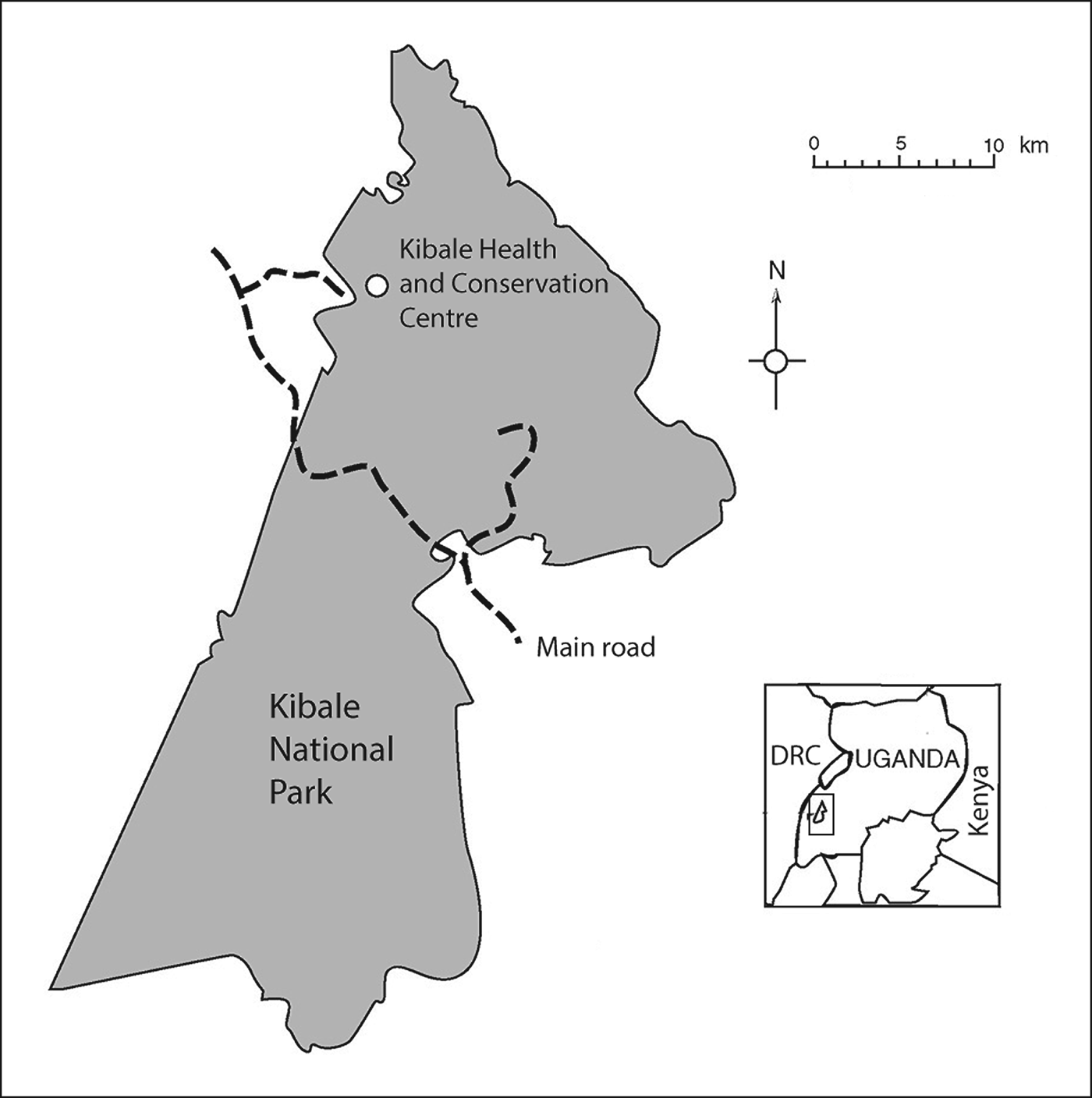
Kibale National Park (hereafter Kibale; 795 km2; Fig. 1) is a mid-altitude moist–evergreen forest, with a mean annual rainfall of 1,691 mm (1990–2013; Chapman et al., Reference Chapman, Gautier-Hion, Oates, Onderdonk, Fleagle, Janson and Reed1999; Chapman & Lambert, Reference Chapman and Lambert2000). It is an important site for long-term research and has a dynamic history of conservation (Chapman et al., Reference Chapman, Struhsaker and Lambert2005; Wrangham & Ross, Reference Kasenene, Ross, Wrangham and Ross2008; Naughton-Treves et al., Reference Naughton-Treves, Alix-Garcia and Chapman2011). In the early days of the Park interactions with the local communities were often negative; illegal settlers were evicted and protection was strictly enforced (Chapman & Lambert, Reference Chapman and Lambert2000; Ryan & Hartter, Reference Ryan and Hartter2012). This changed in the mid 1990s after the Uganda Wildlife Authority was authorized to administer the area and governance became more participatory (UWA, 1997; MacKenzie, Reference MacKenzie2012). Now communities are permitted to engage in limited resource-extraction (MacKenzie et al., Reference MacKenzie, Chapman and Sengupta2012). Communities benefit economically from the Park, receiving 20% of the entrance fees, for development projects (Archabald & Naughton-Treves, Reference Archabald and Naughton-Treves2001; Hartter & Goldman, Reference Hartter and Goldman2011), and up to 800 local people find seasonal employment there (Hartter, Reference Hartter2009). Long-term researchers have established community-based projects, such as the education-focused Kasiisi Project, which started in 1997 (Kasenene & Ross, Reference Kasenene, Ross, Wrangham and Ross2008). Given the high population density around the Park (220–330 people per km2; Hartter, Reference Hartter2009), one motivation behind these efforts is to alleviate pressure on the Park from local communities.
The location of Kibale Health and Conservation Centre in Kibale National Park. The rectangle on the inset shows the location of the main map in Uganda.
In 2007 researchers and students from McGill University, Canada, established the Kibale Health and Conservation Centre (Plate 1), which provides free consultation and at-cost medication to the local community. During September 2008–September 2012 the centre provided direct health care for c. 7,200 patients, with patient visitation rates increasing steadily. Patients are treated on an outpatient basis for a wide range of health issues (Table 1), and testing, counselling and anti-retroviral therapy for HIV are also provided, circumventing lack of compliance in maintaining anti-retroviral therapy, which is one of the major reasons for the failure of antiretroviral drugs (Blower et al., Reference Blower, Bodine, Khan and McFarland2005; Geng et al., Reference Geng, Bangsberg, Musinguzi, Emenyonu, Bosco-Bwana and Yiannoutsos2010). In 2008 the clinic distributed 1,500 permethrin-impregnated bed nets supplied by the Buy-a-Net programme. Infant immunization clinics are held monthly and vitamin A supplements and anti-helminthic medications are administered biannually at six locations to children aged between 6 months and 5 years. The centre also provides outreach education to c. 4,500 school children per year, on topics including nutrition, sanitation, reproductive health and family planning, prevention of communicable diseases, and conservation (Plate 2).
Kibale Health and Conservation Centre, adjacent to Kibale National Park, Uganda (Fig. 1).

The nurse from the Kibale Health and Conservation Centre giving an outreach talk at a local school.

The major diagnoses made by the nurses and doctors at the Kibale Health and Conservation Centre in Kibale National Park, Uganda (Fig. 1), during September 2008–May 2010, with the total number of cases, the monthly mean, and the percentage of total diagnoses.
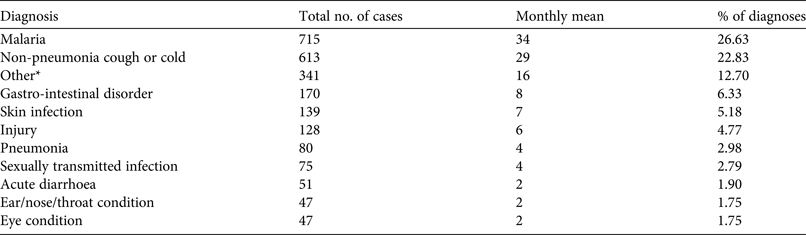
* Including, but not limited to, open cuts, burns, boils, abscesses, pyomyositis, and mast infections.
A common criticism of conservation programmes that aid local communities and improve economic welfare is that they promote immigration and increase population growth near the protected area. For example, Struhsaker et al. (Reference Struhsaker, Struhsaker and Siex2005) estimated that 47% of tropical protected areas in Africa had densities exceeding 90 people per km2 and that immigration was a problem in > 60% of these areas. Although this criticism also applies to health clinics, providing family planning may lower the birth rate and reduce the population density in the neighbouring communities in the next generation, thereby alleviating pressure on the protected area in the future (Harris et al., Reference Harris, Mohan, Flanagan and Hill2012). The centre provides reproductive health care and education, and recently Marie Stopes visited the clinic bimonthly and each time helped 60+families. Of the patients attending the clinic for assistance with family planning, 99% were women and the majority (67%) were > 25 years old. Of female patients, 27% received permanent treatments for birth control, such as ovarian-tube ligations, 64% received long-term birth control, such as intra-uterine devices or 3–5-year implants, and 9% received short-term treatment, such as 3-month injections or birth control pills. Recently students at McGill University donated 50,000 condoms, which may result in more men visiting the health centre.
The siting of KHCC within the legal boundary of Kibale National Park was neither coincidental nor a matter of convenience. Rather, the location and name of the clinic were chosen to have a positive influence on local people's perceptions of the Park, with the assumption that local people would view KHCC as a benefit of the protected area. As a result, activities such as illegal logging and bushmeat hunting may decrease, both because people feel a greater solidarity with the Park and because of the perception that such activities could jeopardize the continuation of health services. Such assumptions may not be valid. For example, it is possible that the majority of illegal extraction is conducted by only a few community members, whose actions may not be influenced by the provisioning of health care. Also, people may not perceive a direct or strong link between a health clinic and nearby protected area, despite attempts to advertise the linkage. Testing such assumptions will not be easy because quantifying illegal activities is practically and ethically difficult (Razafimanahaka et al., Reference Razafimanahaka, Jenkins, Andriafidison, Randrianandrianina, Rakotomboavonjy, Keane and Jones2012; Solomon et al., Reference Solomon, Jacobson and Liu2012). Data for the Centre are limited. However, since 1997, when the Kibale Chimpanzee Project launched a snare removal programme in a nearby area, the rate of chimpanzees being snared has fallen by c. 50% and the number of snares found in monitored areas has declined steadily (Kahlenberg & Wrangham, pers. comm.). Snares are set principally for duiker Cephalophus sp. but they are indiscriminate and also capture monkeys and maim chimpanzees Pan troglodytes and elephants Loxodonta africana. The decline in snare activity may be related to the activity of the health centre and other programmes (e.g., education programmes and the snare programme itself) but establishing a causal relationship will be difficult.
Provision of health care vs other approaches
Here we contrast the provision of health care to other approaches that attempt to foster community cooperation and reduce negative activities in protected areas. Ecotourism is the most widely employed strategy to promote positive relationships between people and protected areas and is used by governmental agencies such as the World Bank and the U.S. Agency for International Development, as well as non-governmental agencies, including the Wildlife Conservation Society (Coria & Calfucura, Reference Coria and Calfucura2012). Ecotourism is often perceived as creating economic incentives that encourage local communities to protect biodiversity in neighbouring reserves (Bookbinder et al., Reference Bookbinder, Dinerstein, Rijal, Cauley and Rajouria1998; Coria & Calfucura, Reference Coria and Calfucura2012). Tourists benefit a country's economy directly (e.g. through park entrance fees and airport taxes) and indirectly through in-country spending. In Uganda the revenue generated by tourism in 2012 is estimated to have been c. USD 800 million, which represents c. 5% of the country's gross domestic product (Weiss & Messerli, Reference Weiss and Messerli2012), with gorilla trekking being the most important tourist activity (Adams & Infield, Reference Adams and Infield2003).
A criticism of ecotourism is that the funds it generates do not diffuse to local communities, suggesting it does not create economic incentives for communities to protect biodiversity (Krüger, Reference Krüger2005; Sandbrook & Semple, Reference Sandbrook and Semple2006; Sandbrook, Reference Sandbrook2010). A survey of 16 protected forests in Africa considered all sources of income, including ecotourism, and demonstrated that a mean of only 4% of local communities derived financial benefit from the protected areas (Struhsaker et al., Reference Struhsaker, Struhsaker and Siex2005). In the case of gorilla ecotourism in Uganda, in the mid 2000s the local community received c. USD 400,000 annually from park and tourism revenue (Archabald & Naughton-Treves, Reference Archabald and Naughton-Treves2001; Sandbrook & Adams, Reference Sandbrook and Adams2012) but given that there are c. 160 people per km2 in the vicinity of Bwindi Impenetrable National Park (321 km2; Sandbrook & Adams, Reference Sandbrook and Adams2012) the individual benefit is small. Royal Chitwan National Park in Nepal is visited by > 60,000 tourists each year but only 6% of local households earn money from ecotourism (Bookbinder et al., Reference Bookbinder, Dinerstein, Rijal, Cauley and Rajouria1998). Near Kibale only 22% of adults are employed, 52% of which are employed as farm labourers, 23% as tea plantation workers and 13% in jobs related to the Park (reforestation, tourism, research, Uganda Wildlife Authority; MacKenzie, Reference MacKenzie2012). Kibale receives c. 7,700 visitors each year, primarily for chimpanzee trekking. This creates part-time employment in tourist facilities (UWA, 2009) for c. 250 people (MacKenzie, Reference MacKenzie2012) and generates annual income of c. USD 271,000 for Uganda Wildlife Authority. Given that there are c. 50,000 people living within 1 km of the Kibale boundary (Hartter, Reference Hartter2009), tourism provides direct income to c. 0.5% of the population. If this income was divided among communities adjacent to the Park it would amount to USD 1.08 per capita per year. Whether this amount of money is sufficient to foster a positive perception of Kibale National Park among local communities remains untested but it seems unlikely. By contrast, health centres are accessible to all community members within bicycle-riding distance and mobile clinics are accessible to everyone. The perceived value of treating a child suffering from malaria is considerable, although difficult to quantify.
Health clinics have attributes that may make them more stable than ecotourism ventures. Dependency on income from ecotourism can leave protected areas vulnerable to declines in tourist numbers (Sharpley, Reference Sharpley2000; Lepp, Reference Lepp2008; Coria & Calfucura, Reference Coria and Calfucura2012). For example, prior to the genocide in Rwanda in 1994 > 40,000 tourists visited the country each year; by 2002 tourist numbers had dropped to 8,000 (Grosspietsch, Reference Grosspietsch2006). Such periods of unrest may trigger an increase in bushmeat hunting and other ecologically detrimental activities (Lindsey et al., Reference Lindsey, Romanach, Tambling, Chartier and Groom2011). Health centres may be a more reliable means of maintaining a positive relationship between communities and protected areas during periods of minor political unrest and public health crises because they are not dependent on foreign tourists. Furthermore, health clinics do not create financial dependency to the same degree as ecotourism. Although the closure of a health clinic near a protected area would remove a convenient source of health care, local people could still attend hospitals and clinics operated by the government. The provision of health care may improve the overall health of the community over time but it does not alter people's lifestyles in the way ecotourism does, with people changing their behaviour to generate revenue by selling goods and commodities to tourists. When the provision of health care is coupled with health education the lessons learned may benefit local communities for generations.
Other approaches used to improve the lives of people living near protected areas include allowing extraction of non-timber forest products (NTFPs), providing primary education and establishing long-term research stations, under the untested assumption that positive conservation externalities will ensue. Allowing local communities to extract NTFPs is intended to provide revenue for communities adjacent to protected areas and ease tensions arising from restricted access, thus improving local perceptions of protected areas (Oates, Reference Oates1999; Zarin et al., Reference Zarin, Kainer, Putz, Schmink and Jacobson2003; Ahenkan & Boon, Reference Ahenkan and Boon2011). The success of such programmes depends on the resources extracted and the density of the local population that benefits from them. When resources are of high value and the population density is relatively low such programmes can be successful (Lyons, Reference Lyons2000). However, when this is not the case programmes can become difficult to regulate, which can result in overexploitation and economic inequity (Oates, Reference Oates1999; Struhsaker et al., Reference Struhsaker, Struhsaker and Siex2005; Solomon, Reference Solomon2007; Solomon et al., Reference Solomon, Jacobson and Liu2012). Thus, in situations where an NTFP strategy is most likely to be successful (low human population density and valuable product) the provision of health care would not be an ideal strategy for promoting positive park–people relations because administering health services to a scattered population is difficult. However, health-care provision may be a more appropriate strategy when population density is high and therefore an NTFP strategy would benefit only a small proportion of the community and would be more likely to be abused (Mugisha & Jacobson, Reference Mugisha and Jacobson2004; Struhsaker et al., Reference Struhsaker, Struhsaker and Siex2005).
Education has been employed as a conservation strategy for decades, based on the idea that if communities can understand the value of a protected area they will not exploit its resources. However, studies in Africa have demonstrated that community outreach programmes designed to promote positive community attitudes through education are seldom associated with successful conservation outcomes (Struhsaker et al., Reference Struhsaker, Struhsaker and Siex2005). A study in Uganda found no evidence that such programmes promoted positive community attitudes towards parks (Mugisha & Jacobson, Reference Mugisha and Jacobson2004). However, there is a resurgence in the use of this approach (Padua, Reference Padua2010; Savage et al., Reference Savage, Guillen, Lamilla and Soto2010) and its careful long-term evaluation (Jacobson, Reference Jacobson2010; Kuhar et al., Reference Kuhar, Bettinger, Lehnhardt, Tracy and Cox2010), and some of the original problems (Struhsaker et al., Reference Struhsaker, Struhsaker and Siex2005; Kasenene & Ross, Reference Kasenene, Ross, Wrangham and Ross2008) are being addressed. Education is often targeted at the young, and therefore its effect may only become apparent after many years (Chapman et al., Reference Chapman, Struhsaker and Lambert2005; Struhsaker et al., Reference Struhsaker, Struhsaker and Siex2005), whereas the effect of health care may be seen sooner because people of all ages need medical care.
Finally, establishing research stations can be an effective conservation strategy to help establish and maintain protected areas (Chapman et al., Reference Chapman, Struhsaker and Lambert2005; Struhsaker et al., Reference Struhsaker, Struhsaker and Siex2005; Wrangham & Ross, Reference Kasenene, Ross, Wrangham and Ross2008; Laurance et al., Reference Laurance, Useche, Rendeiro, Kalka, Bradshaw and Sloan2012). Research stations provide long-term employment, and the presence of researchers may act as a deterrent against illegal extraction of resources from the protected area. Research stations may also lead to other types of conservation efforts. For example, in Kibale researchers have established ecotourism sites, schools and health clinics. However, the presence of researchers, like tourists, can wax and wane with socioeconomic turmoil in the host country or in the home countries of researchers, who are dependent on grant funds.
Although it is not yet known whether and to what degree health centres have advantages over other approaches in promoting positive park–people relations (e.g. the provision of funds for health centres established by researchers will vary similarly to that described for research stations as they are similarly dependent on a continuous supply of funds from outside the host country), the provision of health care is complementary to, and does not compete with, these other endeavours. Health centres have the potential to add considerably to the arsenal of social programmes that can be used to address the challenge of protecting natural resources in poor countries. As forest resources in the tropics continue to decline, human populations continue to increase and infectious diseases continue to emerge, health centres become increasingly attractive tools for simultaneously improving health, well-being and conservations efforts.
Acknowledgements
Funding for this research was provided by the Canada Research Chairs Program, Natural Science and Engineering Research Council of Canada, National Geographic Society and National Science Foundation (CNH 1114977), and by a National Institutes of Health grant TW009237 as part of the joint NIH–NSF Ecology of Infectious Disease programme and the UK Economic and Social Research Council. RRG was funded by a fellowship from the Natural Science and Engineering Research Council of Canada and JFG was supported by a Graduate Research Fellowship from the National Science Foundation, the Systems Biology Training Program of the Canadian Institutes of Health Research, and an Explorers Club–Eddie Bauer Youth Grant. Permission to conduct this research was given by the Uganda National Council for Science and Technology and the Uganda Wildlife Authority. We thank Lauren Chapman, Jessica Rothman, Tom Struhsaker and two anonymous reviewers for helpful comments on this research.
Biographical sketches
Colin A. Chapman is a conservation biologist with a long-term programme in Kibale National Park to study forest dynamics, animal population change, and ecosystem conservation. He has initiated various conservation programmes in the Kibale area, including programmes focused on ecotourism, research stations, resource extraction, conservation education, and health care. Bianca van Bavel, Carl Boodman, Lauren Mechak and Sofia Poonawala are actively involved in the provision of health services to local communities and are interested in the role that such provision can play in conservation. Ria Ghai & Jan Gogarten are interested in disease dynamics and its application to conservation. Joel Hartter studies natural resource use in rural communities. Patrick Omeja has played an integral role in the management of the Kibale Health and Conservation Centre and is interested in the maintenance of forest systems in Uganda. Tony L. Goldberg is interested in the general concept of ecohealth, working with wildlife, domestic animals and local communities.



