

In February 2017, an essay was published in the online journal Nature Communications describing the results of a genomic study of a stratified burial assemblage from Pueblo Bonito in Chaco Canyon, New Mexico (Kennett et al. Reference Kennett, Plog, George, Culleton, Watson, Skoglund, Rohland, Mallick, Stewardson, Kistler, LeBlanc, Whiteley, Reich and Perry2017). The study found that nine individuals (five males and four females) interred in a burial crypt in Pueblo Bonito shared mitochondrial genomes (mitochondrial DNA) and that four of the six individuals in the group with the best-preserved nuclear DNA exhibited mother-daughter and grandmother-grandson relationships (Kennett et al. Reference Kennett, Plog, George, Culleton, Watson, Skoglund, Rohland, Mallick, Stewardson, Kistler, LeBlanc, Whiteley, Reich and Perry2017:2). Accelerator mass spectrometry 14C dates taken directly from the stratified skeletal remains span much of the more than 300-year occupation history of Pueblo Bonito, from the ninth to the eleventh or early twelfth century, suggesting that the matrilineage interred in the crypt remained intact for some three centuries. Associated grave goods—including caches of ritually important objects in adjacent rooms—suggest that the crypt contains the remains of a venerated matrilineal descent group.
For scholars who have done comparative research on Pueblo social organization, the genomic case for matrilineal descent in Chaco should come as no surprise, since evidence of any other descent principle among the Ancestral Pueblos would contradict a great deal of historical and ethnographic evidence. First and foremost, roughly two-thirds of all ethnographic Pueblos, from every Pueblo language family (there are four), still trace their descent primarily through the matriline, and patrilineal reckoning, much more common worldwide than its mirror image ideology, has never been documented among the Pueblos.Footnote 1 Matrilineal descent and female ownership of house and land were noted by the first Spanish explorers to the northern Southwest in the sixteenth century (James Reference James1997)—no doubt because they stood in stark contrast to the patriarchal ideologies of the Spanish—so these practices must have originated in precolonial times. In addition, many Pueblos still adhere to matrilocal residence norms despite historical shifts toward neolocality. At the time the Pueblo ethnographies were being compiled matrilocal residence was the norm among the Western Pueblos and persisted in ideology if not in majority practice at Jemez and the eastern Keresan Pueblos. And where matrilocal residence combines with matrilineal descent, female ownership of house and prime farmland tends to dominate as well. Finally, the Rio Grande Tanoan Pueblos (Tewa and Tiwa) are now thoroughly bilateral, but their surviving kinship terminologies preserve traces of both crossness and skewing,Footnote 2 suggesting that the descriptive “Eskimo” terminologies of the Tewa and Tiwa replaced an earlier classificatory Crow (matrilineal) terminology (Whiteley Reference Weiner2018). Peter Whiteley suggests that the Tanoan descriptive bilateral shift likely occurred fairly late, under Spanish colonial influence (Eggan [Reference Eggan1950] advanced a similar hypothesis; Hill [Reference Hill and Whiteley2018] provides additional support). There is, in short, compelling historical and ethnographic evidence that all Pueblos, regardless of language affiliation, were once predominately matrilocal-matrilineal and shared an Iroquois or Crow alliance structure. And we can now add archaeogenomic data from Pueblo Bonito as an independent line of evidence supporting the deep roots of matrilineal ideologies among the Southwestern Pueblos, from at least the ninth century AD onward and probably much earlier.
Rather than expand on the matrilineal evidence base, my object in this article is to provide some cultural and historical context for the recent archaeogenomic studies by exploring the social and political implications of matrilocal residence, matrilineal descent, and Iroquois and Crow alliance structures among the Southwestern Pueblos in general and Chaco in particular. In order to position the essay, let me begin with a few observations about the recent history of kinship studies in anthropology.
Kinship was once considered the finest flower of anthropology, to which all the great names made contributions (Barnes Reference Barnes2006:328). Today, however, formal kinship analysis is virtually a nonsubject. Anthropology has not abandoned the study of our closest social relationships, but in recent years there has been a major shift in focus. Early work on kinship concentrated almost exclusively on kinship rules, or the oughts of kinship. Since the 1980s, however, anthropologists have focused increasingly on kinship's is, or actual kinship behavior. In the words of Godelier and colleagues, “Nowadays … anthropologists tend to see the domain of rules as one of variations, contested meanings, hegemony, and resistance. The prevailing notion is that public symbols are argued over and manipulated in the pursuit of private advantage” (Reference Godelier, Trautmann and Tjon Sie Fat1998:4). By focusing their inquiries on actual behavior, in all its variability, modern kinship studies have opened up vast spaces beyond marriage and genealogy for investigating how people in different cultures relate to one another. Such studies of cultural “relatedness” (Carsten Reference Carsten2000) that grew out of house society models popularized in the 1990s (e.g., Carsten and Hugh-Jones Reference Carsten and Hugh-Jones1995; Joyce and Gillespie Reference Joyce and Gillespie2000) have been especially important in analyzing novel marriage types, family forms, and reproductive strategies that have emerged in postindustrial societies around the world—relationships that might be difficult to even perceive using standard formalist kinship models.
Many modern studies of relatedness take their inspiration from David Schneider's (Reference Schneider1984) deconstruction of formalist kinship theory, in which he argued that the biological foundation of kinship analysis is nothing more than “Western ethnocentrism” and proposed that kinship studies should properly focus on native cultural categories instead of Western constructs. Such relativist approaches have been embraced by many scholars but rejected by others who argue that relying solely on native categories would pose a challenge to comparative analysis and result in analytical vacuity. I, for one, am inclined toward Martin Ottenheimer's (Reference Ottenheimer, Feinberg and Ottenheimer2001) compromise view that both the emics and etics of kinship are important domains of anthropological inquiry. Although kinship is always culturally constructed (Sahlins Reference Sahlins2013), there are profound cross-cultural regularities in kinship practices that cry out for comparative analysis and explanation.
In archaeology, of course, one of our many handicaps is that we cannot see the is of kinship; we can only infer such practices by examining kinship's architectural containers, settlement and community patterns (Ensor Reference Ensor2013), and now ancient DNA. And if descendant communities are present, as they are among the Pueblos, upstreaming from present to past can provide valuable insights as well (as Whiteley and others have shown). Given such data limitations, and unless new analytical tools are developed, the best archaeologists can do, in my opinion, is apply comparatively derived kinship rules and see how closely the material remains conform to or depart from expectations. It goes without saying that cultural constructions of relatedness often depart widely from biological realities, and kinship rules are routinely broken by socially calculating individuals, so we should expect considerable variability around whatever oughts we choose to investigate. I offer this as a caveat to the formalist arguments that follow.
Archaeologies of Descent
Ideologies of descent and postnuptial residence norms can play crucial roles in the way traditional human communities form, and matrilineal ideologies impose special constraints due to gender asymmetries that exist in virtually all cultures. Where patrilineal ideologies predominate, descent is reckoned through the patriline, and political and ritual authority routinely passes from father to son. In contrast, where matrilineal ideologies predominate, although descent is reckoned through the matriline, political and ritual authority typically passes from maternal uncle to sororal nephew rather than from father to son.Footnote 3 David Schneider (in his pre-deconstruction days), inspired by the earlier work of Audrey Richards (Reference Richards, Radcliffe-Brown and Forde1950), summarized the key elements of this “matrilineal paradox”:
Despite the fact that the elements are the same, there are certain very obvious differences between matrilineal and patrilineal descent groups. Perhaps the first and most profound is that in patrilineal descent groups the line of authority and the line of descent both run through men. … In matrilineal descent groups, on the other hand, although the line of authority also runs through men, group placement runs through the line of women [Schneider Reference Schneider, Schneider and Gough1961:7].
Because of these gender asymmetries, matrilineal systems are not simple mirror images of patrilineal systems. There are fundamental structural differences from which other important differences flow. According to Schneider:
The two differences which are consequences of this structural difference and are in turn fundamental to all others are, first, that matrilineal descent groups depend for their continuity and operation on retaining control of both male and female members. Second, that the sex role of the “in-marrying affine” is different in matrilineal and patrilineal descent groups [1961:8; emphasis added].
Regarding the first difference, in matrilineal systems the brothers of female lineage members are not simply married off to distant communities in exchange for husbands—the fate of sisters in many patrilineal organizations—because the brothers often have important ritual and political roles to fulfill in the corporate lineages of their mothers and sisters (or at least, this is the rationale). Brothers must marry out, of course, but not very far out and usually not beyond the boundaries of their natal community. For this reason, there is a near-universal association between sedentary matrilocal-matrilineal communities and community endogamy (Murdock Reference Murdock1949:214).Footnote 4 Community endogamy requires, in turn, that sedentary matrilocal-matrilineal communities be composed of at least two unrelated descent groups, so that community members have access to eligible mates across the plaza as opposed to down the road or in the next valley over. There are rare cases where matrilineal men marry outside their natal community, but in these cases important male ritual and political leaders often bend or break the normative postnuptial residence rules. According to Keesing:
Where the rule that men are to marry “out” means much further out … adjustments that keep at least the few lineage men most central to the corporation's “board of directors” at home may be possible. They may remain unmarried, get divorced, bring their wives “home” (in an alternative residence pattern), or otherwise manage to stay at or near corporation “headquarters” [Reference Keesing1975:65].
Regarding the second difference, the mother's brother fills many traditional “father” roles in the lives of his sisters’ children. Among the matrilineal Pueblos, for example, mother's brother is the principal disciplinarian. The late Michael Kabotie once told me that “Wait till your uncle gets home” is the standard threat in Hopi households, and mother's brother traditionally takes on more responsibility than biological father in ensuring that his nieces and nephews follow the true Hopi path. Part of the knowledge imparted by Hopi uncles pertains to ritual knowledge that should not be shared outside the descent group, which suggests an explanation for the rise of secret men's chambers called kivas in early farming communities on the plateau. In fact, the much discussed Pueblo “cult of secrecy,” frequently attributed to historic colonial oppressions (e.g., Spicer Reference Spicer1962:185–186), may well have its roots in secret gatherings conducted in subterranean kivas where maternal uncles instructed their nephews beyond the eyes and ears of the nephews’ resident fathers (who, of course, had ritual responsibilities to their own nieces and nephews).
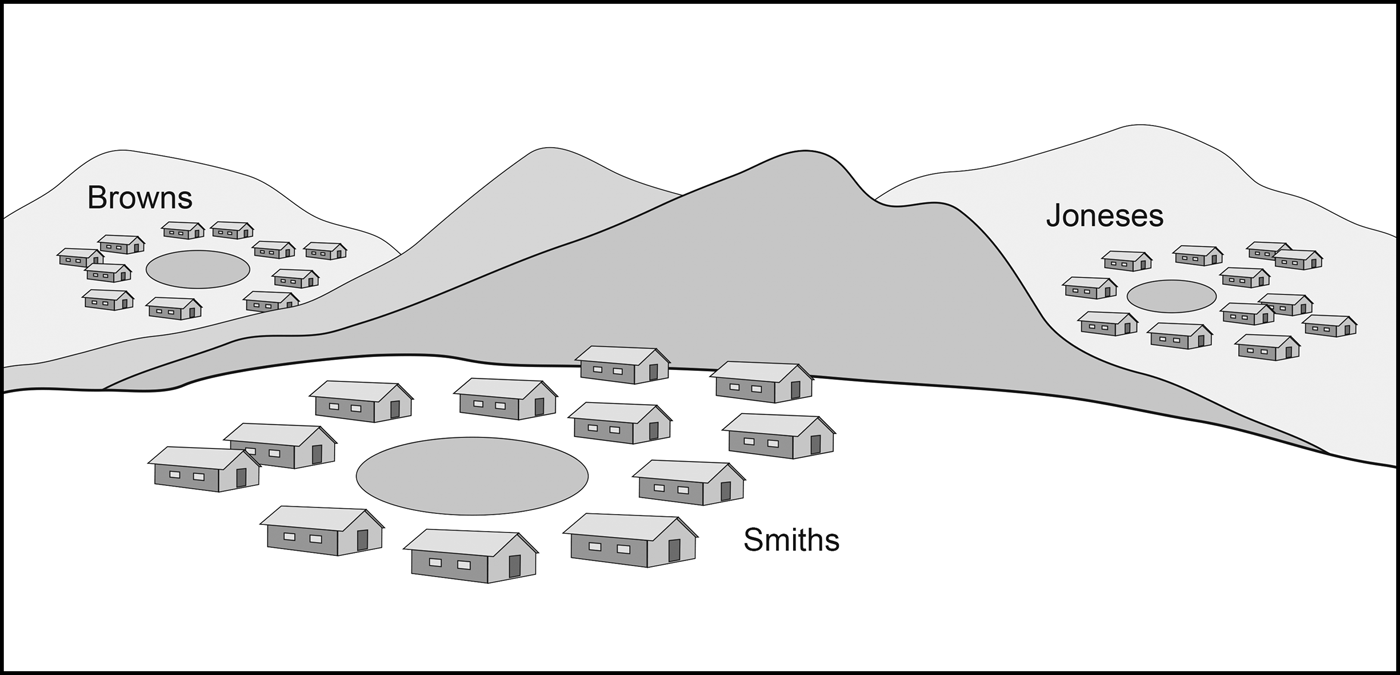
A couple of community graphics borrowed from Roger Keesing (Reference Keesing1975:40–43) may help to visualize some of these points (Keesing, in turn, adopted these graphics in somewhat modified form from Hogbin and Wedgewood [Reference Hogbin and Wedgewood1953a, Reference Hogbin and Wedgewood1953b]). The simplest of Keesing's communities consist of single descent groups (Figure 1). Descent groups are almost always exogamous, so spouses must come from neighboring communities, which are consequently bound together by marriage alliances. As we have seen, if these single descent group communities are sedentary and very far apart, it is unlikely that they will embrace matrilocal-matrilineal ideologies, since male members of the matrilineages would then be dispersed widely following marriage. No such constraints exist for patrilocal-patrilineal communities, where sisters from one community are routinely exchanged for wives from another community, sometimes over distances that would preclude regular contact between a woman and her lineal kin (combined with warfare or its threat, which routinely raises the valuation of males relative to females, patriarchy may well have some of its deepest roots in the exchange of sisters for wives). In his original statistical analysis of global kinship structures, Murdock (Reference Murdock1949:215) noted that over half (62.5%) of his patrilineal sample resided in single patriclan communities requiring the long-distance exchange of women, while the remainder were patriclan barrios in multiclan communities.
Single descent group communities (after Keesing Reference Keesing1975:40). Since each descent group is exogamous, spouses must come from neighboring communities.
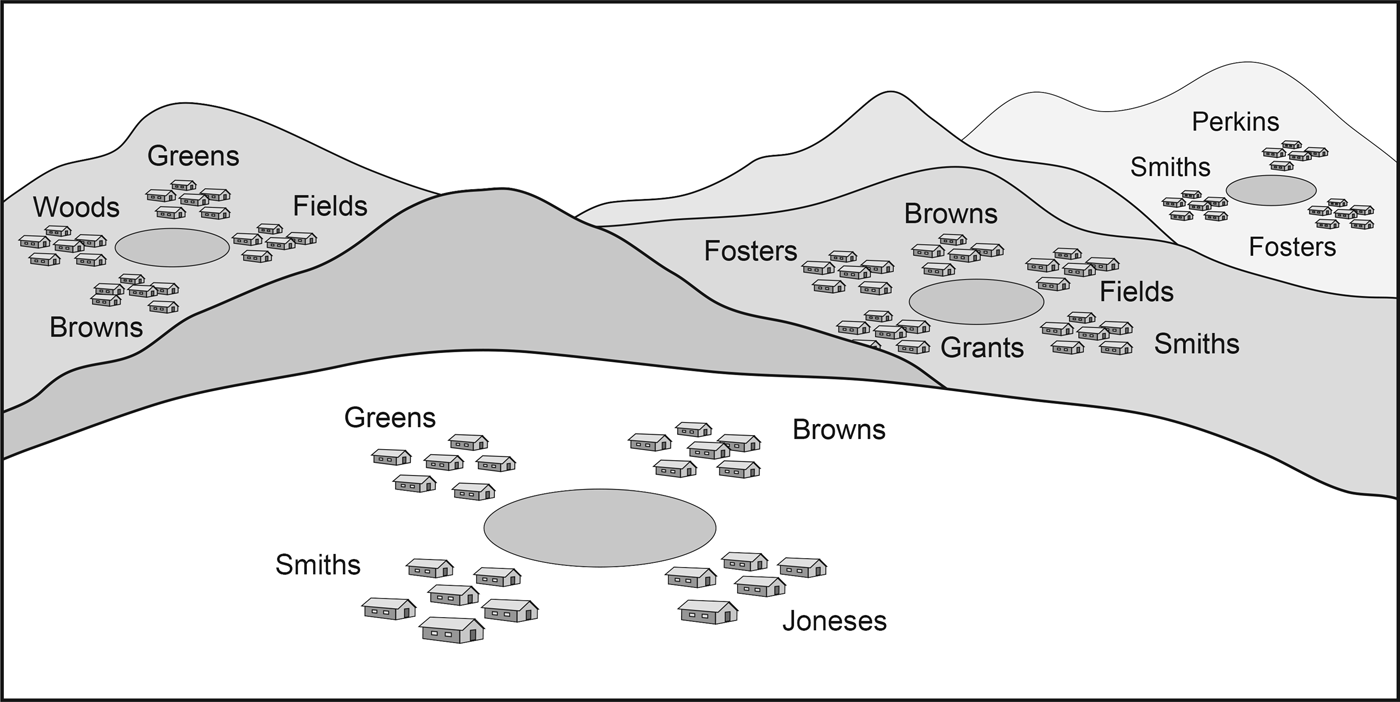
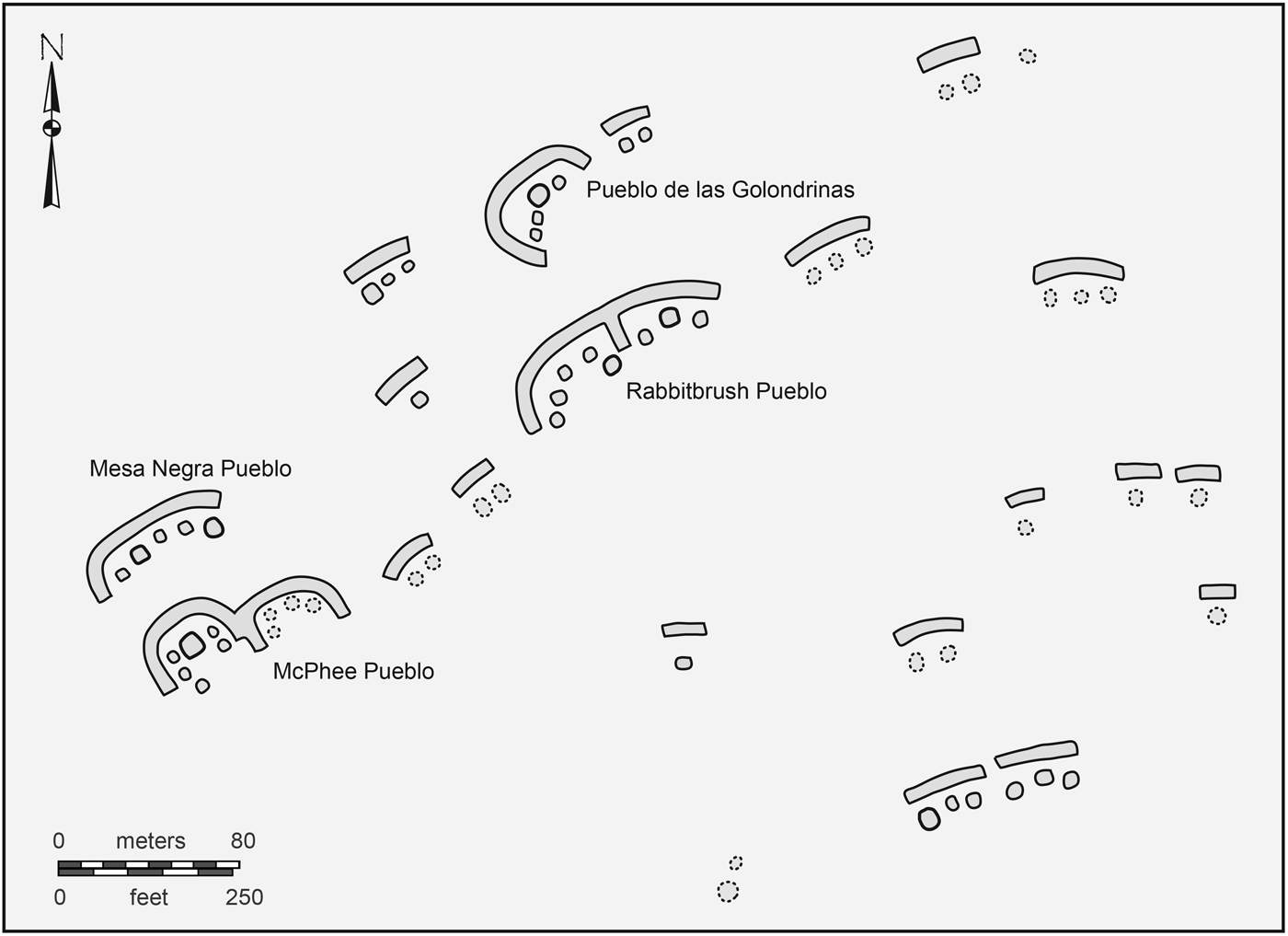
Keesing's second community type (Figure 2) consists of multiple exogamous descent groups residing together in one community. Multi–descent group communities are compatible with both patrilineal and matrilineal ideologies, but they are a structural requirement in matrilineal communities where community endogamy is necessary for the maintenance of matrilineal authority structures. Western Pueblo villages are a case in point. All Western Pueblo communities consist of multiple matrilineal descent groups (households and lineages) and descent categories (clans and, in the Hopi case, clan sets or phratries), and most marriages are community endogamous. These patterns appear to have roots deep in Pueblo antiquity. Visible at least by the eighth-century “pit house to pueblo” transition, most people lived in “segmented” communities consisting of clusters of front-oriented habitation units, each probably containing one or more households of a single descent group segment (Bullard Reference Bullard1962; Chang Reference Chang1958; Steward Reference Steward1955). At various times and places multiple habitation units formed tight clusters that approached the scale and density of “villages” (Figure 3). At other times—such as the eleventh-century “Pueblo II expansion”—habitations were more dispersed, making it much harder for us to discern community boundaries. By the twelfth through thirteenth centuries AD, habitation units often coalesced into multiroom aggregated pueblos, but the distribution of room blocks and associated front-oriented kivas provide clues to the location of embedded descent groups and their constituent households.Footnote 5
Multi–descent group endogamous communities (after Keesing Reference Keesing1975:43). Some or all local descent groups have segmentary relationships with groups in neighboring communities, resulting in dispersed clans.
McPhee Village, Dolores Valley, southwestern Colorado.
Schneider (Reference Schneider, Schneider and Gough1961:27) claimed that matrilineal descent groups are less likely than their mirror image organizations to segment into ranked hierarchies. Contrary to claim, however, matrilineal descent groups in the Western Pueblos are invariably ranked (as are many other matrilineal societies, including the Haida, Tlingit, Trobriands, various Austronesian chiefdoms, and others). Pueblo lineages are ranked within clans, and clans within communities, and high-rank descent groups own or control the most productive community farmland and most important communal ceremonies. Jorgensen observed that ritual and resource ownership among the matrilineal Pueblos always go hand in hand: “For the matrilineal Pueblos it was an all or none proposition: if they owned land they controlled rituals and if they did not own land they did not control rituals” (Reference Jorgensen1980:190). The rather clear implication is that control and performance of rituals validated ownership of the most productive farmland and hence the unequal distribution of economic resources within the community. Here, perhaps, is where Pueblo political-ritual hierarchies have some of their deepest roots.
In Western Pueblo ideology, the highest ranks normally go to the community founders. That is, founding descent groups claim the best farmland and control the most important rank-validating ceremonies. On Second and Third Mesas, according to Hopi tradition, the Bear Clan is the first arriving and apical descent group that owns the most productive floodwater cornfields.Footnote 6 Members of later-arriving clans are said to have been permitted to join the community if they could contribute rituals that would enhance the collective well-being by ensuring rain, a good harvest, success in war, and so on. And, of course, as long as there was enough food to go around, new arrivals were also welcome because they would expand the community's mating, labor, and defense pools. Once again, these patterns may have considerable time depth. In some of the earliest segmented communities on the Colorado Plateau there is evidence that the largest community segments with the most elaborate ritual architecture and material culture may have the earliest founding dates (e.g., McPhee Pueblo in the village of the same name). Few if any early Pueblo segmented communities have been excavated in their entirety, so this evidence must remain anecdotal until a great deal more work is done.
In addition to their effect on community structure, ideologies of descent and postnuptial residence norms may also influence how populations are distributed on the landscape and how communities interact through time and across space. For example, as communities grow they may outstrip local resources, encouraging the jettisoning of excess population to surrounding or distant communities. Single patriclan communities tend to fission along clan lines to produce additional patriclan scion communities (Keesing Reference Keesing1975). When multi–descent group Pueblo communities fission, who leaves and who stays may depend on lineage rank and ceremonial status. During times of food shortage, lower-rank households and lineage segments may leave to help establish new communities or join existing ones elsewhere (Levy Reference Levy1992). Community growth, expansion, and fission may, in fact, be the way dispersed clans form in the first place (Aberle Reference Aberle and Longacre1970; see discussion in Ware Reference Ware2014:89). Clans may have formed, that is, when kinship ties progressed from demonstrable, within the original pre-fission community, to vaguely remembered following dispersal, to legal fiction a few generations after dispersal. Since clan names are easier to remember than the details of distant genealogical relationships, they help preserve the legal fiction.
The dynamics of community fission can be seen historically at all Western Pueblo communities. At Hopi, village fissioning has created multiple satellite communities around the mother village that serve either farming (Moenkopi), colony (Sichomovi and Shipaulovi), or “guard” functions (Hano and Mishongovi; Connelly Reference Connelly and Ortiz1979). At Zuni, Acoma, and Laguna there is one “mother” village where all communal ceremonies are performed and multiple “farming” villages where many tribal members live for much of the year. These farming villages are always ritually and politically dependent on the mother village.
In summary, matrilineal ideologies tend to constrain community forms and intercommunity relations due, at least in part, to asymmetries in gender-based power relations that pervade nearly all cultures. Given the apparent ubiquity of matrilocal norms and matrilineal ideologies in the Pueblo past, and given the strong matrilineal structures that persist in the majority of Pueblos today, archaeologists can match these patterns and constraints to material archaeological data to help understand changes in community forms and social relations during the early Pueblo period.
Archaeologies of Alliance
Descent theory has a fairly straightforward application in archaeology because it describes social groups and social categories (households, lineages, clans, etc.) that can sometimes be inferred from their architectural containers: domiciles contain various kinds of domestic groups, mealing rooms enclose female-centered food and ritual processing activities, kivas house male secret societies (among other functions), great kivas and plazas bring together whole communities and facilitate intercommunity interactions, and so on. And, of course, genomic data from human remains may also be used to infer ideologies of descent. However, kinship is not just about descent. In fact, strongly corporate descent groups may be a comparatively recent Neolithic innovation—an overlay on ancient systems of marriage alliance that may be as old as human culture itself since marriage systems help regulate reproduction, one of the most basic of all biological functions. However, unless exogamous moieties are present and inferable from dyadic community plans, or clans can be reasonably inferred from the distribution of house clusters, marriage patterns have few obvious archaeological correlates (archaeogenomic data may eventually help here as well). Fortunately, at least two approaches hold promise for unraveling prehistoric marriage alliance systems.
Surviving kinship terminologies encode marriage rules, if not actual behaviors, and kin terms often persist long after marriage systems undergo structural changes. As mentioned above, Peter Whiteley (Reference Whiteley and Whiteley2018) has examined Rio Grande Tanoan (Tiwa and Tewa) kinship terminologies and found traces of an older alliance system preserved in contemporary Tanoan terminologies. Today, Rio Grande Tanoans share a descriptive bilateral kinship system similar to all Western European and Euro-American systems. In such bilateral systems, the primary terminological distinctions are between lineal (father, mother, son, daughter, etc.) and collateral (aunt, uncle, cousin, nephew, etc.) relatives, and these categories are almost never allowed to merge (e.g., Euro-Americans would never use the term mother to address an aunt or vice versa). But Whiteley has found terminological evidence among Rio Grande Tanoans of a former classificatory terminology, in which the primary distinction is between cross and parallel relatives—a feature known as crossness (bifurcate merging).Footnote 7 In classificatory systems, Ego's parents’ opposite-sex siblings are designated uncles and aunts—the same as in descriptive systems—but same-sex siblings are classified as parents, so that the father's brothers are also fathers and the mother's sisters are equally mothers. In Ego's generation, the children of all classificatory “fathers” and “mothers” (parallel cousins) are designated siblings; the children of all classificatory “uncles” and “aunts” (cross-cousins) are designated cousins. The logic continues into the next and all subsequent generations: the children of same-sex siblings are designated sons and daughters, the children of opposite-sex siblings are nieces and nephews. Thus, in classificatory alliance systems certain lineal and collateral relatives are merged, and all relatives are assigned to either cross or parallel categories by keeping cross-sex siblings distinct.
Crossness is all about marriage alliance. In classificatory alliance systems, parallel cousins are typically assigned sibling terms and are therefore prohibited from marriage, while cross-cousins are potential marriage partners (and in Dravidian kinship systems—a variation and likely antecedent of Iroquois—marriage to a cross-cousin is actually prescribed). The salient fact is that cross-cousin marriage functions to perpetuate marriage alliances among two (the classic moiety) or more groups over multiple generations. According to Trautmann, “Diachronically, the rule of cross cousin marriage under any form results in the perpetuation of affinity between two lineages, whether patrilineal or matrilineal, by the repetition of marriage alliance from one generation to the next” (Reference Trautmann1981:24–25). In other words, long before formal treaties were used to codify alliances among human groups, the marriage contract functioned to solidify such relations—as it continues to do in many social contexts to this day.
Trautmann suggests that crossness may also be a way of preventing kin relationships from being lost by remoteness. In descriptive alliance systems, collateral relatives are assigned degrees of distance from Ego (e.g., second cousins, great-uncles, etc.), and few people regularly interact with collaterals beyond the second or third degree (this was manifestly true following the rural-to-urban migrations that fractured extended families throughout North America during the nineteenth and early twentieth centuries). In contrast, classificatory terminologies render all kin as only one or two grades of distance from Ego, so that “genealogically remote relationships can be prevented from being lost” (Trautmann Reference Trautmann2013:6). This may be especially important on marginal landscapes like the southern Colorado Plateau, where periodic crop failures and other crises may have forced people to rely for their very survival on the assistance of distant kin (dispersed clans provide a similar measure of social and economic security).
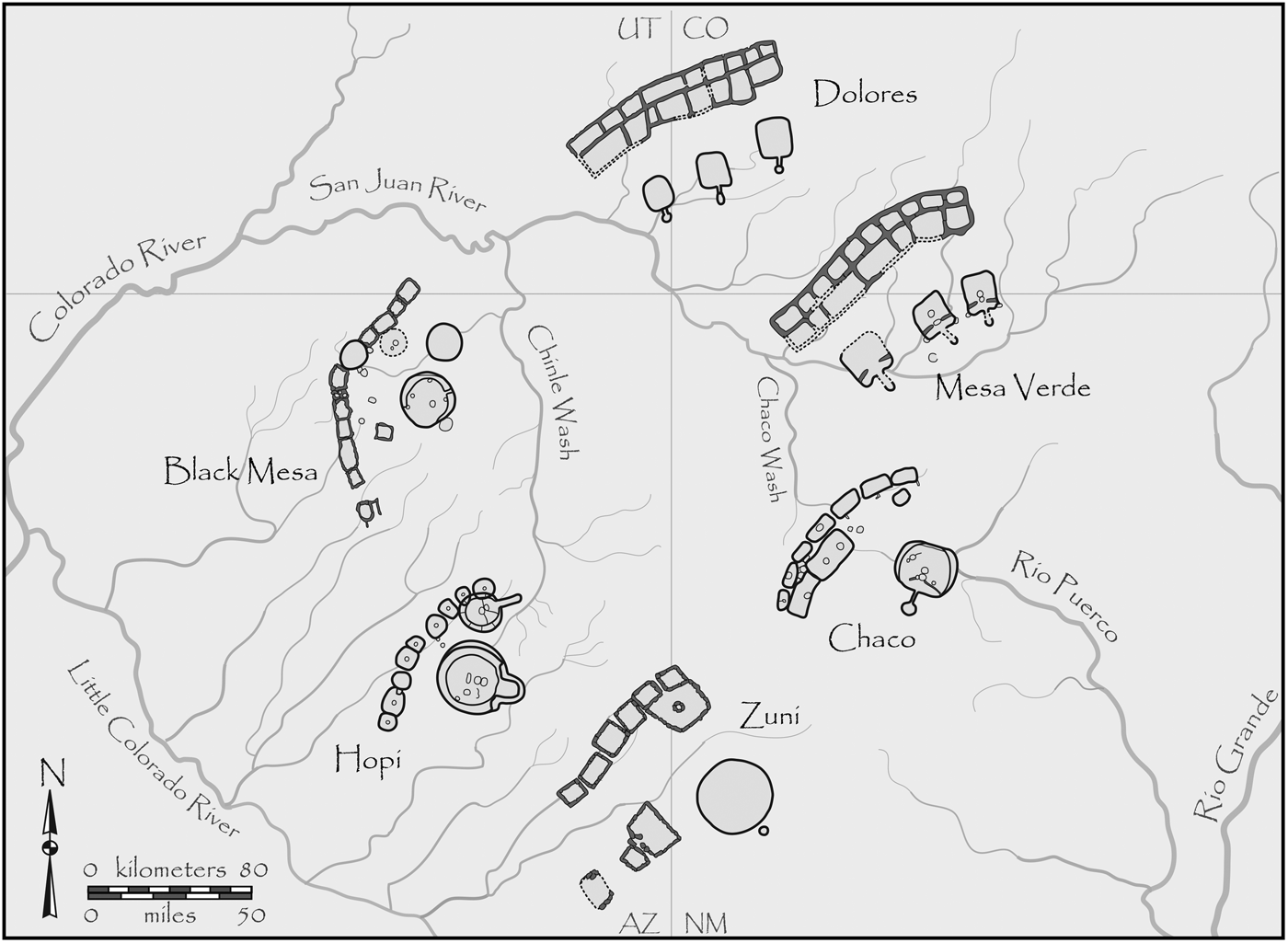
Peter Whiteley's discovery of traces of crossness in contemporary Rio Grande Tanoan terminologies demonstrates that Tanoan speakers formerly adhered to a classificatory alliance system similar to all other Pueblo groups and that the shift to descriptive terminologies, as mentioned above, was likely influenced by Roman Catholic marriage proscriptions and Pueblo-Hispano intermarriages. This is important to know, because it is now much safer to assume that the Ancestral Pueblos were all organized similarly at the kinship level, which helps explain some of the remarkable parallels in architectural patterns, community configurations, and other material expressions that existed across the southern Colorado Plateau among linguistically diverse Ancestral Pueblo populations. Take, as just one example, the front-oriented habitation unit or unit pueblo, the early Pueblo version of an extended family residence (Figure 4). With only minor variations—due partly to local preferences conditioned by construction material availability—unit pueblos are found throughout the southern Colorado Plateau, they are almost invariably oriented the same symbolically important south-southeast direction, and multiple habitation units made up intermarrying communities.
Front-oriented habitation units (after Ware Reference Ware2014:86).
The second approach to unraveling marriage alliance structures in prehistory relies on the observation, first made more than a century ago by the father (uncle?) of comparative kinship studies, Lewis Henry Morgan, that the different kinds of kinship terminologies appear to be transformations of one another (Godelier et al. Reference Godelier, Trautmann and Tjon Sie Fat1998:5). Lévi-Strauss codified these transformations in his groundbreaking Elementary Structures of Kinship (Reference Lévi-Strauss, Bell, von Sturmer and Needham1969). In Lévi-Strauss's model, elementary alliance systems (Iroquois and its various permutations) permit and sometimes prescribe marriage to a restricted category of kin, typically a cross-cousin. In contrast, complex alliance systems (e.g., “Eskimo”) have only negative marriage proscriptions. That is, marriage is forbidden with genealogically close relatives but permitted with everyone else (hence, predicting who someone will marry is inherently complex). A third category, semicomplex alliance systems (Crow-Omaha), has only negative rules as well, but the rules tend to exclude a much broader range of kin than complex systems. That is, marriage is forbidden with members of one's father's and mother's clan, at least, and usually a grandparent clan as well. The change from elementary to semicomplex to complex alliance systems was seen by Lévi-Strauss (see also Allen Reference Allen1986; Godelier Reference Godelier2011) as an evolutionary progression in which elementary marriage structures gradually shift toward more complex alliance systems as population increases and social relations become more complicated. The relaxation of positive marriage prescriptions can be seen as an opening out of alliance possibilities by prohibiting the repetition of former restricted alliances and actively promoting the more dispersed alliances necessary to integrate larger face-to-face populations (Trautmann and Whiteley Reference Trautmann and Whiteley2012:17–18; Whiteley Reference Whiteley, Heitman and Plog2015:292).
Based on the Pueblo Bonito archaeogenomic studies, it is probably safe to conclude that the Ancestral Pueblos of Chaco, and probably beyond, had reached a level of population density and social complexity that could support a semicomplex Crow alliance structure—the kind of kinship system found among all historic Western Pueblos. For those interested in precolonial Pueblo social and political organizations, this is important to know.
Chacoan Kinship and Community
If, thanks to recent archaeogenomic studies, kinship is now part of the conversation about Chaco, we need to take the next step and see how descent and alliance might have affected community formation and intercommunity relations in Chaco. These questions go to the heart of several of Chaco's more intractable puzzles. Why build such monumental edifices, and what or who do such structures memorialize? Where did the ritual labor force come from, and how and by whom was it directed? How many people occupied great houses year-round, and what was the nature of relationships between great house and small house residents? None of these questions have been answered to everyone's satisfaction, though opinions abound. Kinship theory can contribute to the conversation.
The term community has been applied to human collectives of vastly different scales, but I think that most Chaco scholars would accept the following Chaco-centric definition from Kantner and Kintigh: “We can regard the spatially distinct cluster of habitations, with public infrastructure including Chacoan architectural complexes, as the basic community unit” (Reference Kantner, Kintigh and Lekson2006:157). Outside the Chaco core, site aggregates that fit Kantner and Kintigh's community definition are relatively unambiguous. In many Chacoan communities a great house—typically a multistory structure utilizing massive core-veneer masonry, blocked-in kivas, and associated roads, shrines, and other earthworks—is surrounded by a swarm of much smaller habitation units usually within a few kilometers of the great house. For reasons outlined above, most sedentary matrilocal-matrilineal communities are endogamous, so we may reasonably presume that members of these great house communities were intermarrying and that the communities were partly held together by such alliances. These settlement and community patterns are repeated throughout the San Juan Basin and beyond, although there is inevitable variability in community form. For example, most but not all great houses appear to be associated with dispersed communities, and not all dispersed communities cluster around great houses (e.g., some cluster around great kivas, and some lack any obvious community-integrative architecture). Needless to say, investigating this variation may provide important clues to the role of great houses in Ancestral Pueblo communities.Footnote 8
Because of the density of sites and the history of site nomenclatures, community definition in “downtown” Chaco Canyon is more ambiguous. Early scholars working in Chaco Canyon routinely referred to great houses as “towns” and small houses as “villages.” This distinction was aided and abetted by spatial separation: most great houses are situated on the north side of Chaco Canyon, while most small houses cluster in rincons and along the floodplain on the canyon's south side (Figure 5). Early investigators speculated that small houses were ancestral to great houses, a hypothesis that was rejected quite early when ceramic studies (Shepard Reference Shepard and Morris1939), later confirmed by tree ring dating, demonstrated overlapping occupations. Given their contemporaneity, it was then proposed that great and small houses represented different cultural traditions (Kluckhohn Reference Kluckhohn, Kluckhohn and Reiter1939; Vivian Reference Vivian1990, Reference Vivian, Wiseman, O'Laughlin and Snow2005), but this hypothesis also gained little traction. Despite profound differences in architecture, the portable material culture of the two site classes is very similar except for the aforementioned high-status burial associations from the Bonito great house. Recent detailed stratigraphic studies showing that both great and small houses embraced similar construction ritual (Heitman Reference Heitman, Heitman and Plog2015) have helped lay the two culture hypothesis to rest once and for all. Rather than independent “towns” and “villages” clustered in a space the size of a few city blocks, it seems much more likely that Pueblo Bonito and its sister great houses (Chetro Ketl early on, Pueblo del Arroyo and Pueblo Alto added much later) were part of a single, large, segmented community that included the small house concentration south of Chaco Wash near the Casa Rinconada great kiva and one or two units at the base of the north escarpment between Chetro Ketl and Kin Kletso (and perhaps other nearby units).
Downtown Chaco (after Fagan Reference Fagan2005:7).

Communities with multiple great houses are not particularly unusual. Windes (Reference Windes and Lekson2007) notes that a number of early segmented communities in the greater San Juan region have two or more “big bumps,” indicating larger than average unit pueblos, which is precisely how Pueblo Bonito began its life. McPhee Village in the Dolores Valley of Colorado is perhaps the best excavated example. If the McPhee community (Figure 3) had been inhabited for more than a fraction of the 300+ years that Bonito was occupied, it might well have achieved downtown Chacoan proportions, and McPhee, Rabbitbrush, Masa Negra, and Las Golondrinas Pueblos might then have evolved into the earliest great houses of the northern San Juan (portions of the room block at McPhee Pueblo were actually constructed with Type I Chacoan masonry). The pattern also accords with historical practices. At most Western Pueblo communities, multiple high-rank descent groups collaborate (and often conflict) with the apical descent group to provide ritual and political leadership for the community.
If Pueblo Bonito and its great and small house companions are a large segmented community, a historically parsimonious explanation for the great house/small house dichotomy is the difference between ritual elites (great houses) and commoners (unit pueblos), a distinction that, not coincidentally, exists among all ethnographic Pueblos. This point is important because it is often glossed over in the literature. Despite an egalitarian ethos that pervades all historic Pueblos and militates against overt displays of wealth and power, the Pueblos remain deeply ranked societies, and structural evidence of ranking goes back at least to the early Pueblo period when some of the earliest year-round communities formed. The Pueblo Bonito community likely began with the ceremonially rich founders in oversized habitation units on the north side of Chaco Canyon that would eventually grow into great houses and subordinate, perhaps later-arriving or fissioned great house segments clustering on the south side of the canyon (Ware Reference Ware2014:116–118).
If Pueblo Bonito, Chetro Ketl, and their later companion great houses were community segments instead of whole communities, what can we reasonably say about Chaco's marriage alliance structures? Peter Whiteley (Reference Whiteley, Heitman and Plog2015) has addressed this issue and suggested that Pueblo Bonito, with its large size and multiple room-kiva associations, has all the earmarks of a semicomplex Crow alliance system, whereas the Wijiji great house (Figure 6), with its dichotomous structure and dual great kivas, looks like an elementary Iroquois pattern of restricted alliance via exogamous moieties. Whiteley points out that Pueblo Bonito was occupied for more than 300 years while Wijiji was inhabited for a generation or less (if it was occupied at all), and he draws a parallel to the modern Second Mesa Hopi villages of Songóopavi and Supawlovi. Songóopavi is the Second Mesa multiclan mother village occupied for centuries, while Supawlovi is a more recent colony village of Songóopavi founded by paired clans linked by marriage alliance. Other Hopi scion villages exhibit similar dual (clan and/or kiva) organizations, suggesting that new Hopi colonies are often founded by two intermarrying descent groups that “revert” to a more elementary dual alliance structure. Whiteley concludes that among the Pueblos, semicomplex Crow alliance structures may be an overlay on a more elementary Iroquois dual alliance system.
Wijiji great house, Chaco Canyon.
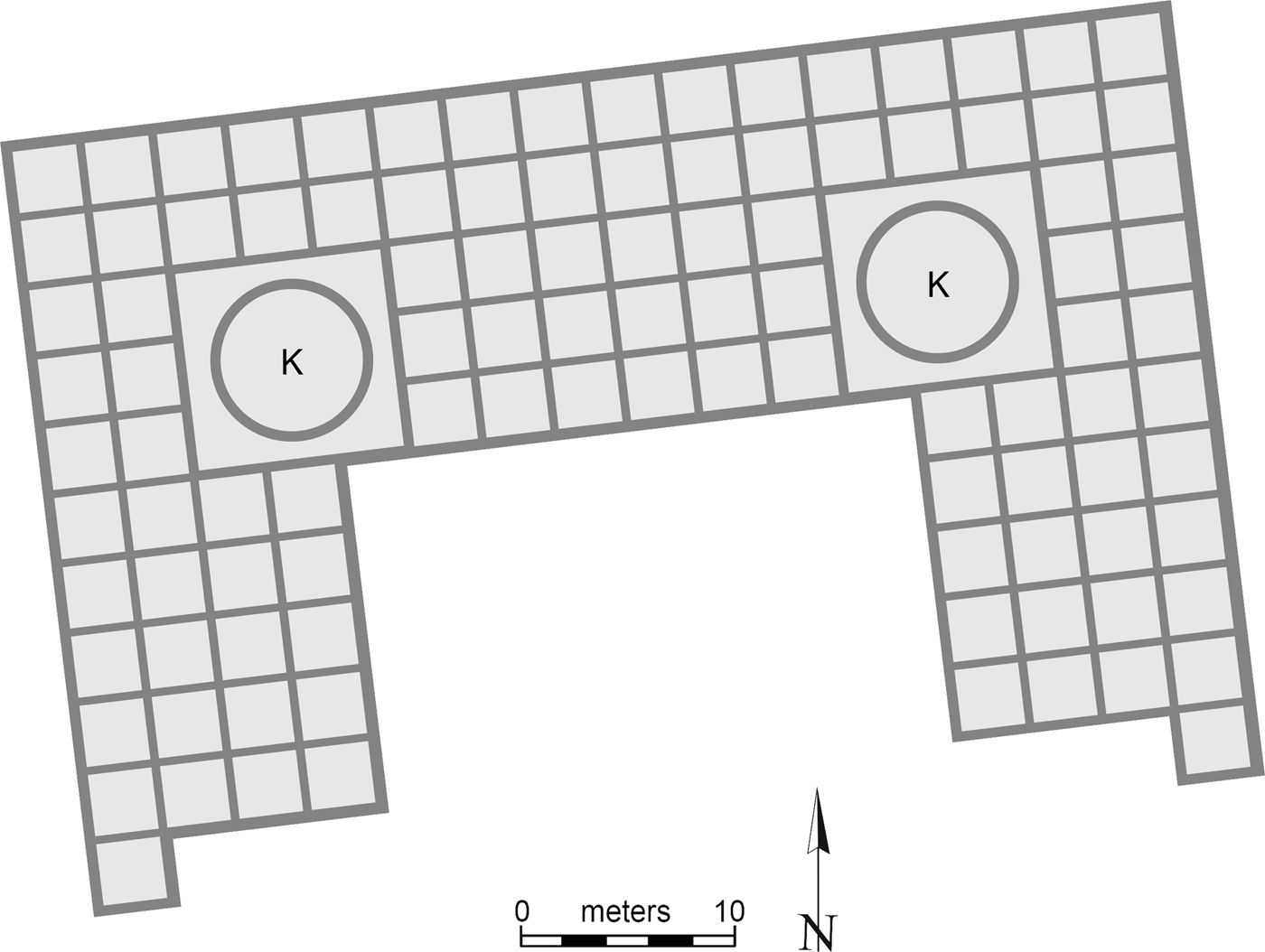
I think that Whiteley has identified an important dynamic in Western Pueblo community evolution that likely has considerable time depth, but his characterization of Pueblo Bonito requires some unpacking. On its surface, Pueblo Bonito looks like a classic multiclan “mother” village, similar to Songóopavi, with its large size, long occupation duration, and multiple room block/kiva units. However, studies of fire hearth frequencies suggest that Pueblo Bonito may have housed fewer than 100 year-round residents (Bernardini Reference Bernardini1999; Windes Reference Windes, Judge and Schelberg1984). Consistent with these low population estimates, a lot of things in Pueblo Bonito come not in multiples but in pairs: two distinct burial crypts, a south-oriented plaza divided in two (each with its own great kiva), two distinct walled refuse middens, and only two corn mealing rooms. These dichotomous features suggest an elementary dual alliance structure based on exogamous moieties, and the fact that the wall dividing the Bonito Plaza was constructed very late in Bonito's life history suggests that structural dualities were important from beginning to end at the Bonito great house (see discussion in Heitman and Plog Reference Heitman, Plog and Scarborough2005).
But if Pueblo Bonito had an elementary dual alliance structure with a comparatively small resident population, where did all the extra rooms and kivas come from, and what functions did they serve? (There are between 33 and 60 small kivas in Bonito, depending on how one counts the number of kiva reconstructions [Neitzel Reference Neitzel and Lekson2007:135].) Some have argued that Windes's and Bernardini's population estimates are too low. Reviewing the records from earlier excavations at Pueblo Bonito, Mills (Reference Mills2002; see also Plog Reference Plog and Whiteley2018) pointed out that collapsed upper-story rooms likely contained fire hearths that recent investigators failed to take into account; Heitman (Reference Heitman2016) has argued that the frequency of ground-stone artifacts confirms that Pueblo Bonito was never an “empty ceremonial center”; and Crown (Reference Crown2016) has shown that Pueblo Bonito trash mounds have abundant domestic trash from many resident households. However, if we accept Plog's estimate of 200–400 full-time residents, why has Pueblo Bonito yielded only 131 human burials, almost all from the two aforementioned burial crypts (Akins Reference Akins1986)?
One possibility is that the extra rooms and kivas were used by households of lineage segments that had fissioned off from Bonito's founding descent groups but returned periodically to participate in ceremonies at their ancestral clan home. If so, Acoma and Laguna Pueblos may be useful analogues for such seasonal congregations: comparatively small residential populations that swell to overflowing during periodic ceremonies and feasts. Seasonal aggregations over the course of 300+ years would have contributed to the labor force required for the construction of Bonito's monumental edifice, and under this scenario, the direction of ritual labor may well have adhered to kin-based authority structures. Speculation aside, we can be confident of one thing: if Pueblo Bonito is a high-rank segment of a much larger dispersed intermarrying community, then it fits Whiteley's semicomplex Crow alliance model without necessarily requiring a large year-round residential population at Pueblo Bonito itself.
Chaco Goes Nuts
From the eighth through the early eleventh century Chaco Canyon stood out from the rest of the southern Colorado Plateau primarily because it was one of only a handful of persistent places where communities were able to survive intact for hundreds of years (Hopi, Canyon de Chelly, and the Chuska Slope are examples of other persistent places). It was during the eleventh century that Chaco “went nuts”Footnote 9 and began to stand out as very different from all other Ancestral Pueblo regions. Great house construction in Chaco Canyon ramped up in the second half of the eleventh century, so that by century's end great houses achieved their famous monumental proportions. At the same time, great houses and associated earthworks, roads, and shrines started piling up across the San Juan Basin and beyond. Eventually, more than 150 (and still counting) “outlier” great house complexes were built during the eleventh and early twelfth centuries in an area of the southern Colorado Plateau roughly the size of Ohio. What, if anything, can kinship tell us about the dynamics of Chaco's eleventh-century regional expansion?
Some scholars have argued that Chaco's explosive growth and geographic expansion were generated by regional conquest, and they conjure up visions of armies marching forth from downtown Chaco intent on subjugating neighboring polities (Turner and Turner Reference Turner and Turner1999; Wilcox and Haas Reference Wilcox, Haas and Gumerman1994). Although militaristic theories of Chacoan expansion remain, I believe, a minority view among Ancestral Pueblo scholars, there is in fact a strong positive correlation between matrilocal-matrilineal ideologies and long-distance interethnic warfare, and some scholars have even suggested that matriliny often has its origins in such conflict conditions (Ember and Ember Reference Ember and Ember1971; Ember et al. Reference Ember, Ember and Pasternak1974). Long-distance warfare, often correlated with regional migration (Divale Reference Divale1974) and frequently interspersed with long-distance trade, routinely takes men away from their communities for extended periods. With most of the able-bodied men gone for much of the year, “Who is minding the store?” becomes, for some, an important question (Harris Reference Harris1980). According to this “male absence” theory, men from predominately patrilocal-patrilineal communities leave their property in the control of wives who may have conflicted loyalties. In contrast, matrilocal-residing and matrilineal-reckoning men leave their estates in the care of their mothers and sisters on the theory, presumably, that blood is thicker and more trustworthy than water. The matrilineal Iroquois are the axiomatic case from North America, but Ember and Ember (Reference Ember and Ember1971) point to other cases worldwide. Those who view Chaco as a regional hegemon will no doubt delight in these correlations. However, the pattern probably cannot explain the initial shift to matriliny, since the mitochondrial DNA evidence from Pueblo Bonito dates back at least to the ninth century, long before the eleventh-century Chacoan expansion.
Moreover, if eleventh-century Chaco had imperial ambitions, what were the political or economic incentives? Due to rising water tables after AD 900 and a more predictable precipitation regime after AD 1000 (Dean et al. Reference Dean, Euler, Gumerman, Plog, Hevley and Karlstrom1985:543), the tenth and eleventh centuries may have been the two best centuries for farming on the southern plateau in the last two millennia. It seems unlikely, therefore, that resource shortages were driving territorial expansion. Did turquoise acquisition figure into Chaco's expansionist goals (the two earliest burials in the northern Pueblo Bonito crypt were interred with thousands of turquoise beads)? Some of the closest reliable sources of turquoise to Chaco are the Cerrillos mines south of Santa Fe, but there is little evidence of Chacoan presence or influence in the northern Rio Grande, or, for that matter, the Kayenta region to the west, or the Gallina region to the northeast (with the exception of the Chimney Rock outlier), and Chacoan influence in the northern San Juan was uneven and perhaps locally contested (Kohler et al. Reference Kohler, Cole, Ciupe and Shennan2009). Moreover, there is relatively little evidence of inflicted violence during Chaco's heyday, a fact that prompted Steve Lekson (Reference Lekson2008) to label the time of Chaco's greatest regional influence “Pax Chaco.” In light of the evidence, there is a growing opinion that Chaco's spectacular growth had more to do with ideology than political or economic hegemony.
But if the Chaco expansion was mostly about ideology, what were the mechanisms for spreading the word, and what if any role did kinship play? Aside from the segmentary kinship relations that form when communities fission and their constituent descent groups disperse along clan lines, the most common mechanism of intercommunity alliance building in nonstate societies involves intermarriage.Footnote 10 As we have seen, however, intercommunity marriage alliances are normally constrained in matrilocal-matrilineal communities because of community endogamy norms. On the other hand, we do not have to read very far in the ethnographic literature to see that such deficiencies can be mended with the help of nonkinship institutions. For example, among the matrilineal Iroquois of the Northeast and matrilineal Creeks of the Southeast, formal confederacies were created to manage intercommunity and intertribal relations. Among the matrilineal Pueblos of the Southwest, pan-pueblo secret societies performed similar functions.
Secret societies are present among all Pueblos, where they manage communal rituals and many secular aspects of community life. Because membership in a Pueblo secret society is not determined primarily by kinship or coresidence, secret society memberships crosscut kinship boundaries to help minimize the divisive effects of kin-based infighting and factionalism. And since most Pueblo secret societies are pan-pueblo in distribution, their latent integrative function extends well beyond community boundaries. Particular secret societies originated in specific Pueblo communities or Pueblo language groups, but their rituals are exchanged with other Pueblos, even across language boundaries, and the training and initiation of society members normally takes place in the pueblo(s) where the society originated (Dozier Reference Dozier1970:171). For example, prospective members of Tewa medicine societies routinely go to a Keresan Pueblo or Towa-speaking Jemez for training and formal initiation before returning to their home community to join the local society chapter there (where many of the rituals are in the language of the originating community). Because of their pan-pueblo distribution, if a secret society should lapse in a Pueblo community because of disease, depopulation, colonial suppression, or other disruption, the society could be reconstituted by sending initiates to other pueblos where the society is intact. Alfonso Ortiz claimed that these formal ritual exchanges among the Pueblos represent “the single most important mechanism of cultural survival and revitalization that the Pueblos have, now as well as in the distant past” (Reference Ortiz, DeMallie and Ortiz1994:304).
The pantribal character of secret societies is not unique to the Pueblos. Harold Driver looked at native North American secret societies and concluded that the details of their expression in any particular society “are normally shared with neighboring tribes, as well as with tribes in other culture areas, and must be accounted for by contact of peoples, diffusion, acculturation, and other historical processes” (Reference Driver1969:361). These observations help explain why the best predictor of any particular Pueblo ritual organization is the ritual system of its nearest Pueblo neighbor—regardless of language affiliation. In other words, ritual emulation seems to be one of the main engines that drives secret society formation across the Pueblo world and elsewhere.
Did ritual emulation contribute to the expansion of Chacoan ideology in the eleventh and early twelfth centuries? Were secret societies even around when Chaco went nuts? The material evidence may not be entirely conclusive (Plog Reference Plog and Whiteley2018), but by definition the activities of secret societies are cloaked in secrecy, especially within their own communities and especially when secret societies fill important political roles, as they do among all Eastern Pueblos today. Consequently, the material evidence of secret societies is often very thin (Ware Reference Ware and Whiteley2018). On the other hand, abundant perishable and nonperishable material evidence of “ritual” practice has been recovered from Pueblo Bonito and Chetro Ketl rooms, including wooden ceremonial staffs and painted wooden objects, cylinder vessels, ornaments of ritually important animals and birds (along with the animals’ physical remains), and more symbolically important turquoise than found in all other Ancestral Puebloan sites combined, and many categories of objects found are still used in Pueblo rituals today (Judd Reference Judd1954). Since the communal rituals of all historic Pueblos, east and west, are controlled by secret societies, the material data from Chacoan great houses provide rather clear circumstantial evidence of their existence during the Bonito phase. Furthermore, the organization of Western Pueblos provides clues about how and when ritual associations may have first formed.
As mentioned above, Western Pueblo male secret societies are populated by individuals from across the community without respect to kinship affiliation, but among all Western Pueblos the ceremonies observed by the secret societies are owned by high-rank descent groups, the head priests of secret societies typically come from the prime lineage of the clan that owns the ceremony, and the office of society head priest routinely passes down from maternal uncle to sororal nephew within the avunculate (the matriline's uncles, brothers, and sons). If the avunculate is the germ of the ubiquitous Pueblo secret society, the origins of secret societies may date back to the emergence of the first protokivas, circa AD 700–800. In fact, if Peter Whiteley's analysis of Tanoan kin terms is correct and all Ancestral Pueblos shared matrilineal descent and semicomplex Crow alliance structures, we may reasonably propose that avunculate-based ritual systems were perhaps equally pervasive. This hypothesis clearly aligns with the genomic data from Pueblo Bonito. By far the most elaborate interments in the northern burial crypt at Bonito were two adult male members of the matrilineage that were buried there. These members of an elite matriline's avunculate were buried with objects symbolizing spiritual wealth and power—precisely what we would expect if avunculate leaders were controlling secret ritual knowledge.
Elsewhere I have hypothesized that the expansion of Chaco's influence during the eleventh century coincided with the detachment of avunculate-based secret societies from the land and ceremony-controlling matrilineages that had founded the communities within Chaco Canyon and its periphery (Ware Reference Ware2014:126–130).Footnote 11 The trajectory of such a power shift arguably culminated in the independent secret societies that have replaced kin-based authority structures among all Eastern Pueblos today. Big men and other aggrandizers had trouble gaining traction in the northern Southwest because of the low productivity and unpredictable nature of the plateau's semiarid, high-elevation (i.e., short growing season) environment. Predictably, kin-based hierarchies emerged first on the plateau, in order to control the most productive community farmland, but in the east their power was usurped and their governance functions were replaced when nonlocal secret societies were able to detach leaders from both kinship control and the egalitarian ethos of the local group by controlling secret knowledge that imparted special powers. That is how leadership is expressed among all Eastern Pueblos today, and the roots of independent secret society–based polities may well extend back a thousand years to the eleventh century, when Chaco went nuts.
Final Thoughts
Brian Fagan's most recent book, Fishing: How the Sea Fed Civilization (Reference Fagan2017), argues that the poor preservation of fish bones in archaeological deposits has allowed archaeologists to systematically underestimate the importance of a calorie source that may have been critical to human survival for most of our evolution. In Tim Flannery's review of the book he points out an archaeological truism: “Fagan's work reminds us that sometimes even the most sophisticated archaeological studies miss very big things, simply because the evidence for them does not preserve well or is difficult to interpret” (Reference Flannery2017:37). Clearly, fish bones may not preserve well and kinship is difficult to interpret, and both are very big things that are often overlooked by archaeologists. But are interpretive difficulties really at the root of archaeology's neglect of kinship? The answer, I think, goes deeper.
Today, lack of competence in the subject matter explains at least some of kinship's neglect. Most Southwestern archaeologists stopped thinking about kinship 40 years ago when the first coordinated attempts to infer prehistoric postnuptial residence patterns (Hill Reference Hill1970; Longacre Reference Longacre1970) were criticized (e.g., Allen and Richardson Reference Allen and Richardson1971; Stanislawski Reference Stanislawski and Longacre1973) and the effort was abandoned. Needless to say, kinship goes from difficult to impossible to interpret without a solid grounding in kinship theory. The decline of four-field anthropology is clearly implicated here. I am not aware of any modern anthropology department that requires student archaeologists to take courses in kinship (many departments do not even offer courses in the subject). For many years now archaeologists have seemed more inclined to borrow theories and methodologies from disciplines outside of anthropology or from European archaeologists who never embraced American anthropology's integrated four-field approach.
Archaeological critiques of ethnographic analogy in the 1970s and assumptions about historical disjunctions that were widely embraced in the 1980s and 1990s also contributed to kinship's neglect (e.g., Cordell and Plog Reference Cordell and Plog1979; Upham Reference Upham and Gaines1987). Both intellectual trends encouraged the now widely held view that the historical Pueblo ethnographies—especially those of the acculturated Eastern Pueblos—are largely irrelevant to understanding Ancestral Pueblo social practices and institutions. As a result, the direct historical approach, one of the most promising methods for overcoming kinship's interpretive challenges (Ware Reference Ware, Mills and Fowles2017), was abandoned in favor of more abstract modeling (Whiteley Reference Weiner2018). But as Bruce Trigger (Reference Trigger1989:342) pointed out, in the absence of written records the direct historical approach is perhaps the only method we have of reconstructing culturally specific aspects of religion and other practices that leave behind few unambiguous material remains—like kinship. Obviously, historical destinations do not determine antecedent conditions, but they help define the range of prior possibilities and may point to the most likely of multiple alternative narratives. I have argued that the ethnographic Pueblos of the Southwest are end points on historical trajectories that preserve important information about the contingent histories of Puebloan peoples, but Kent Lightfoot made the point more succinctly long before I took up the question: “Rather than viewing ethnohistorical and ethnographic sources as simple analogs for directly reconstructing the past, they should be viewed as revealing of the time when they were recorded, as end sequences of long-term developments in Native societies” (Reference Lightfoot1995:205).
Finally, there are several influential theories about how kinship systems may have evolved in deep history (e.g., Allen Reference Allen1986), but most of these constructions are based on comparative rather than diachronic data. Archaeology and history offer the only methods available to us to study the evolution of kinship systems directly (with a great deal of recent help from archaeogenomics). Historical methods are especially suited to the Pueblo Southwest, where the most accurate prehistoric chronologies in the world combine with the presence of thriving descendant communities that preserve vital historical data. My fear is that if we follow David Schneider's advice and use only native relatedness categories, we will never understand the historical development of kinship systems, in the Southwest or anywhere else. As the principal idiom of social, economic, and political relations in nonstate societies, kinship deserves nothing less than serious sustained scholarship by historians and archaeologists.
Acknowledgments
This article benefited from comments by Eric Blinman, Jake Ivey, Joan Mathien, Vernon Scarborough, Dave Stuart, Wolky Toll, Peter Whiteley, Tom Windes, and two anonymous reviewers. Thanks go to Robert Turner for drafting the figures. Special thanks go to Peter Whiteley for leading the way in Pueblo kinship studies and for helping archaeologists navigate kinship's arcane lexicon. And Peter, I apologize for stealing your “Morgan as uncle” quip, but I could not resist.
Data Availability Statement
No original data were presented in this article.



