


Introduction
Anthropogenic impacts on environmental processes, ecosystems and species are increasing globally, and, consequently, our responsibility for these changes is growing. The collection, analysis and forecasting of data are essential for understanding ongoing developments and making management decisions for the environment and individual species. To conserve rare and threatened species, it is important to assess the various threats they face. An example is the increasing frequency of wildlife casualties caused by collisions with vehicles, which pose a significant threat to the survival of rare mammal species (e.g. Banhos et al., Reference Banhos, Gatti, Santos, Merсon, Westermeyer and Ardente2021; Grilo et al., Reference Grilo, Borda-de-Água, Beja, Goolsby, Soanes and le Roux2021; Olgun et al., Reference Olgun, Mohammed, Mzee, Green, Davenport and Georgiev2022).
Collisions with vehicles can be a significant cause of mortality for large felids. For example, road fatalities in some cougar Puma concolor, jaguar Panthera onca and leopard Panthera pardus populations may comprise 20–48% of total mortality (Taylor et al., Reference Taylor, Buergelt, Roelke-Parker, Homer and Rotstein2002; Haines et al., Reference Haines, Tewes and Laack2005; Schwab & Zandbergen, Reference Schwab and Zandbergen2011; Swanepoel et al., Reference Swanepoel, Somers, van Hoven, Schiess-Meier, Owen and Snyman2015; Cullen et al., Reference Cullen, Stanton, Lima, Uezu, Perilli and Akcakaya2016). Vehicle collisions are also a threat to tigers Panthera tigris, with deaths frequently recorded across the species' range. (Kumar, Reference Kumar2015; Carter et al., Reference Carter, Pradhan, Hengaju, Sonawane, Sage and Grimm2022). In Russia, data obtained by the Amur Tiger Project in the Sikhote-Alin Reserve demonstrated how road accidents accounted for 12.5% of the deaths of radio-tagged tigers (Miquelle et al., Reference Miquelle, Smirnov and Goodrich2005). In the Lazovsky District during 1947–2009, 5% of 56 tiger deaths were a result of collisions with vehicles near Lazovsky Reserve (Salkina, Reference Salkina and Zhuravlev2010). In these studies, the survival rates of cubs and adult females were significantly higher in areas far from roads. This correlates with both the impact of road accidents and the fact that poaching is facilitated by roads. In addition, potential human contact with tigers decreases in proportion to the distance of tigers from roads (Kerley et al., Reference Kerley, Goodrich, Miquelle, Smirnov, Quigley and Hornocker2002; Miquelle et al., Reference Miquelle, Smirnov and Goodrich2005).
The largest and most robust population of the Amur tiger Panthera tigris altaica (Temminck, 1844) is in the Russian Far East. After a catastrophic decline in numbers during the 1930s–1940s as a result of uncontrolled hunting and trapping for zoos (leaving only 40–50 individuals remaining; Matyushkin, Reference Matyushkin1998), the population has since recovered and comprises 300–350 adults (Wildlife Conservation Society of Russia, 2021). The tiger is categorized as Endangered on the IUCN Red List (Goodrich et al., Reference Goodrich, Wibisono, Miquelle, Lynam, Sanderson and Chapman2022) and in the Russian Red Book (Pavlov, Reference Pavlov2021). The Amur tiger remains Endangered because of habitat disturbance and poaching, despite the stabilization of the population size (Skidmore, Reference Skidmore2021; Salkina et al., Reference Salkina, Poddubnaya and Kolesnikov2022b). In the Russian Far East poaching and the illegal wildlife trade have been identified as the most immediate threats to the Amur subspecies (Goodrich et al., Reference Robinson, Goodrich, Miquelle, Miller and Seryodkin2015; Robinson et al., Reference Robinson, Goodrich, Miquelle, Miller and Seryodkin2015). Poaching is facilitated by an expanding road network that gives poachers access to remote forest regions (Smirnov, Reference Smirnov and Novikov1992; Yudakov & Nikolaev, Reference Yudakov and Nikolaev2012; Skidmore, Reference Skidmore2021).
Researchers have long noted the negative impact of roads on the Amur tiger population (Abramov et al., Reference Abramov, Pikunov, Bazilinikov and Sablina1978). Within the Russian portion of the tiger range, the road network continues to expand, with increases in length and improvement of road surfaces. The total length of roads in Primorsky Krai and Khabarovsky Krai is c. 28,000 km, including > 4,000 km of paved roads (Lavrentiev, Reference Lavrentiev2014; Bardal & Shitova, Reference Bardal and Shitova2023). The number of vehicles, the intensity of road traffic and the speed of movement along roads are all increasing. The total length of the railway network is 3,800 km (Lavrentiev, Reference Lavrentiev2014), and in the southern Far East region has remained unchanged in the last decade. A significant part of the expansion of the road network in the Sikhote-Alin Mountains is in remote areas, where many roads are constructed for logging, without any environmental impact assessment (Bergen et al., Reference Bergen, Loboda, Newell, Kharuk, Hitztaler and Sun2020).
Logging, fires and the expansion of the road network lead to the fragmentation and degradation of tiger habitats beyond protected areas (Bergen et al., Reference Bergen, Loboda, Newell, Kharuk, Hitztaler and Sun2020; Salkina et al., Reference Salkina, Poddubnaya, Kolchin and Kolesnikov2022a; Kovalev & Gromyko, Reference Kovalev and Gromyko2023), increasing the risk of tigers colliding with vehicles. In this study we investigated the causes and circumstances of tiger mortality in traffic collision incidents, aiming to (1) assess the spatial distribution of such incidents; (2) identify any correlations with environmental factors; and (3) make recommendations to mitigate road-related fatalities for the northernmost population of this Endangered species.
Study area
We focus on collision incidents in Primorsky Krai and the southern regions of Khabarovsky Krai, Russia (Fig. 1), within the Sikhote-Alin Mountains and the spurs of the Manchurian–Korean Mountains. The Sikhote-Alin Mountains span c. 1,200 km north–south and 400 km east–west, with an asymmetric transverse profile that has a gentle western slope. The south-west comprises the eastern slopes of the Changbai (Paektu) Mountains that descend to the Sea of Japan. Vegetation is diverse, with coniferous–deciduous forests dominating the southern and central areas up to c. 500–700 m altitude and coniferous forests dominating the north. The vegetation has a distinct altitudinal zonation influenced by climate. Prevailing climate is monsoonal, characterized by cold, dry winters and warm, humid summers, with the highest precipitation in the summer (Gerasimov, Reference Gerasimov1969). Winter is November–March, when mean monthly temperatures are below freezing, spring is April–May, summer is June–August and autumn is September–October.
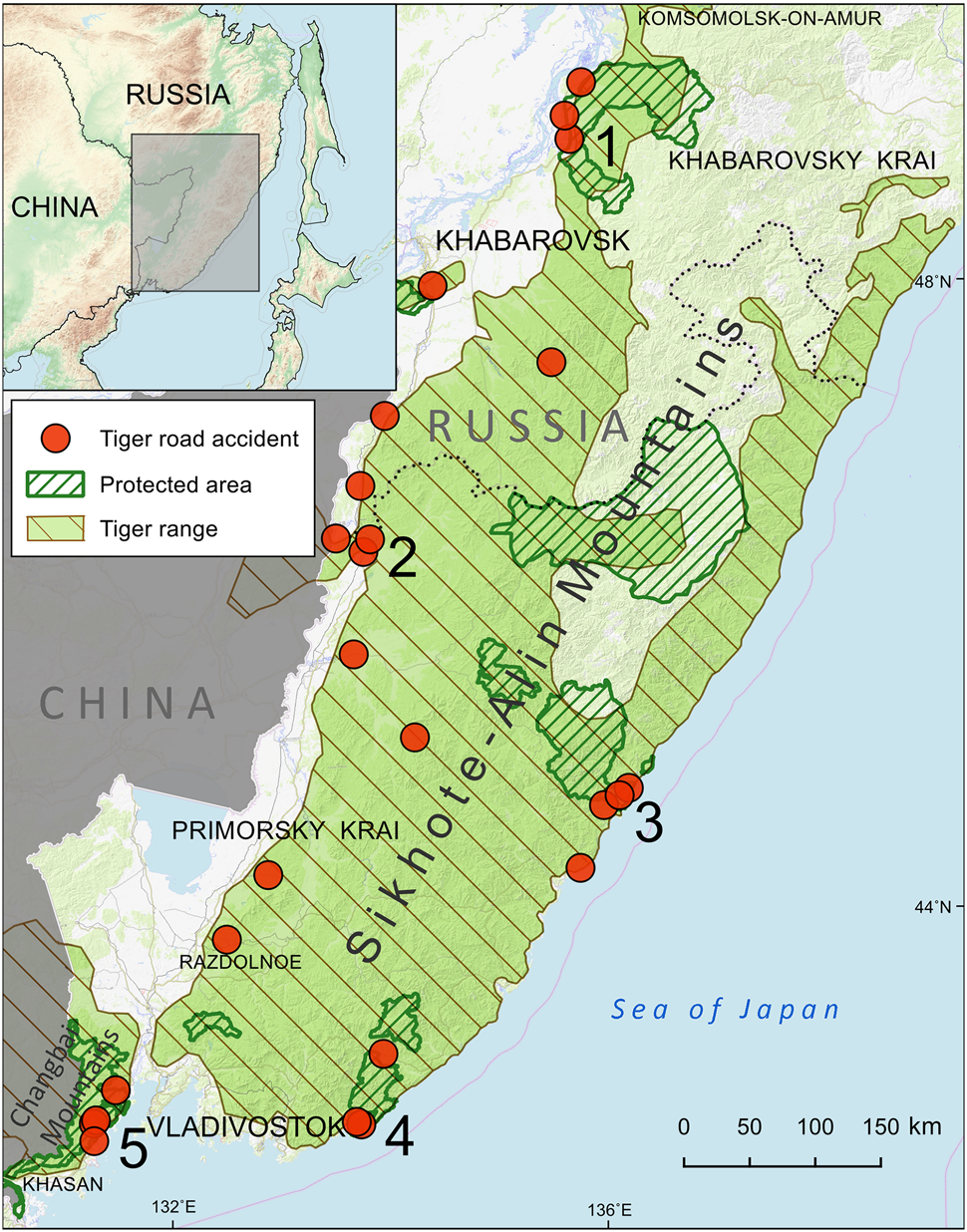
Locations of the 26 deaths of Amur tigers Panthera tigris altaica resulting from collisions with road vehicles or trains in the south of the Russian Far East documented during 1980–2023 (Table 1). Locations 1–5 indicate concentrations of incidents near Anyuisky National Park (1), Strelnikov ecological corridor (2), Sikhote-Alin Reserve (3), Lazovsky Reserve (4) and Land of the Leopard National Park (5).

Methods
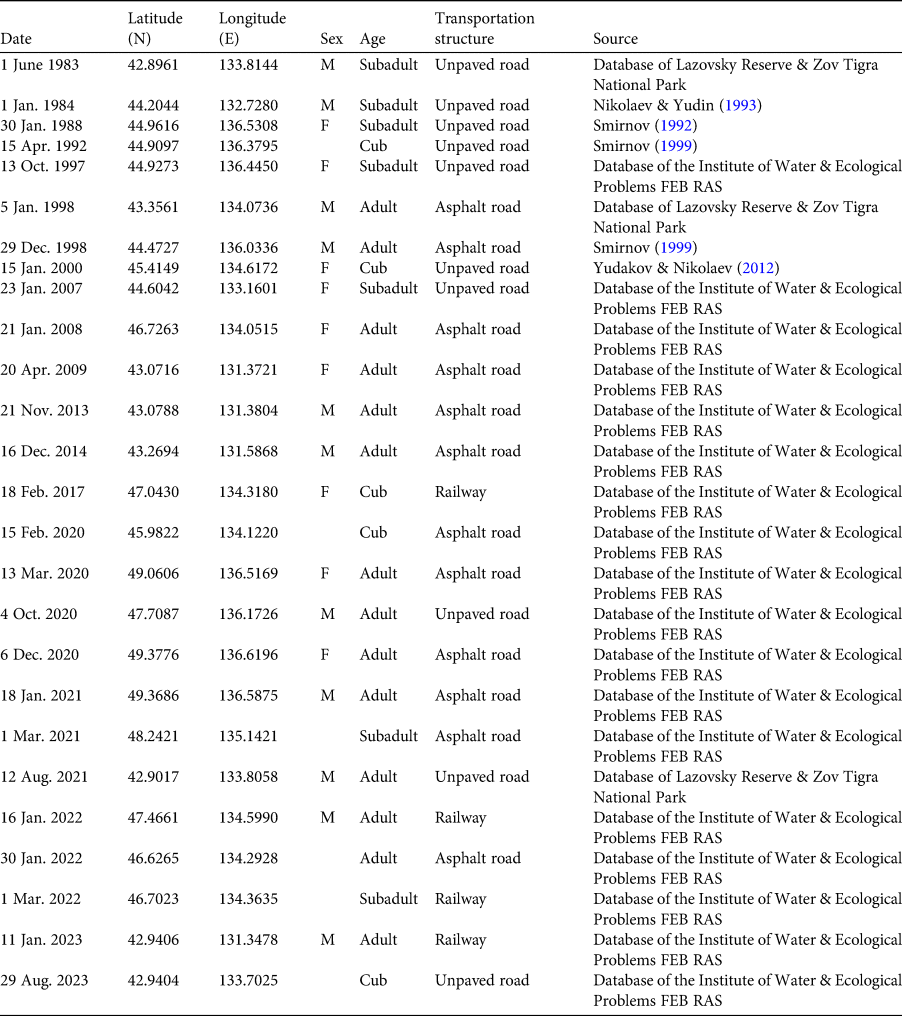
From the literature, reports from public authorities and our own databases, we obtained data for 26 traffic collision incidents involving tigers during 1980–2023 (Table 1). In official reports on tiger fatalities along federal highways and railways, the kilometre locations at which the incidents occurred are specified, allowing us to identify locations to an accuracy of at least 500 m for most incidents. For unpaved roads, reports included the name of the nearest watercourse or the distance from the closest settlement or other well-known geographical features. We subsequently visited 23 of the 26 locations. To assess the probability of detecting dead tigers on roads we categorized all cases in which detailed information regarding the tiger carcasses was available into four categories: (1) the tiger died at the collision site; (2) the tiger moved away from the collision site but within sight (≤ 30 m); (3) the tiger moved away from the collision site and out of sight (> 30 m); (4) the carcass was not found.
Date, geographical location, sex (where known) and age of Amur tigers Panthera tigris altaica involved in 26 traffic accidents in the Russian Far East during 1982–2023 (Fig. 1).

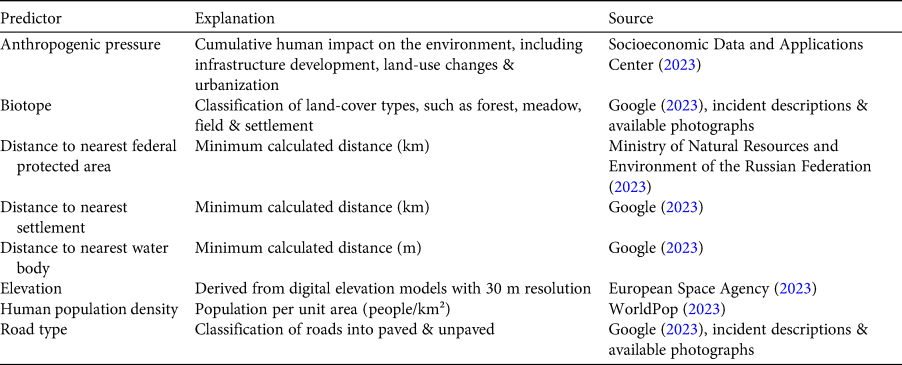
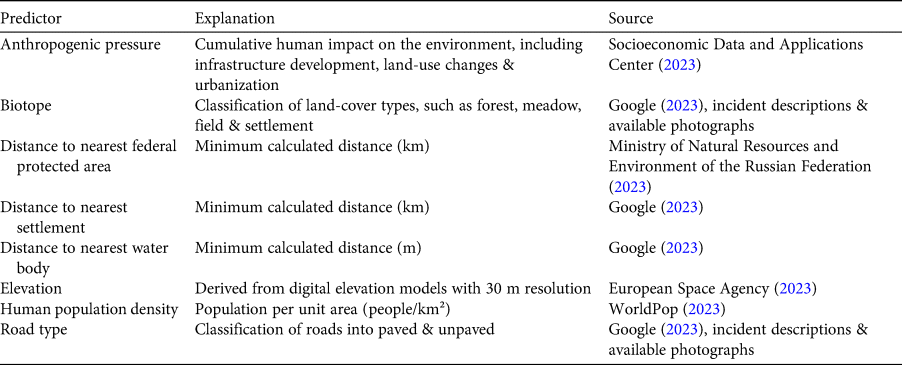
We used multiple regression analysis to examine the impact of eight potential predictors on tiger mortality in traffic collision incidents (Table 2). We used 26 tiger–vehicle collision points and 58 random control points along roads within tiger habitat. This ensured > 10 points per predictor, meeting guidelines for maintaining statistical power and minimizing overfitting (Harrell, Reference Harrell2015). We measured distances to the nearest settlements, federally protected areas and water bodies, and prepared a map of the incidents using QGIS 3.30.3 (QGIS Development Team, 2023). We derived biotope and road-type information from a combination of high-resolution satellite imagery (Google, 2023), incident descriptions and available photographs.
Environmental predictors used in the multiple regression analysis to examine tiger mortality in collisions with vehicles and trains.
For regression analysis we employed the car package (Fox et al., Reference Fox, Weisberg, Price, Adler, Bates and Baud-Bovy2023) in R 4.3.1 (R Core Team, 2023), and used the caret package (Kuhn, Reference Kuhn2008), for the selection and evaluation of regression models. We checked for multicollinearity, outliers and autocorrelation between the predictors. We used Pearson's χ 2 test with Yates' correction to examine association between categorical variables (the specific circumstances of tiger fatalities), with a significance level of P < 0.05, and measured the strength of the association with Pearson's contingency coefficient (C). As distances from collision locations to the nearest protected area were not normally distributed (confirmed by the Shapiro-Wilk normality test), we used the Mann–Whitney U test to compare the distances to protected areas from locations with single collision records and from five locations with concentrations of collision records.
Results
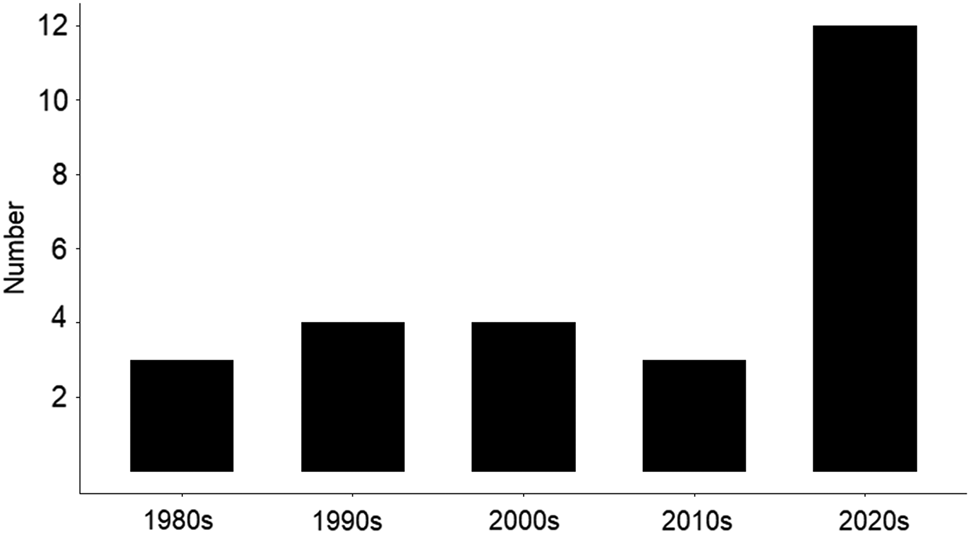
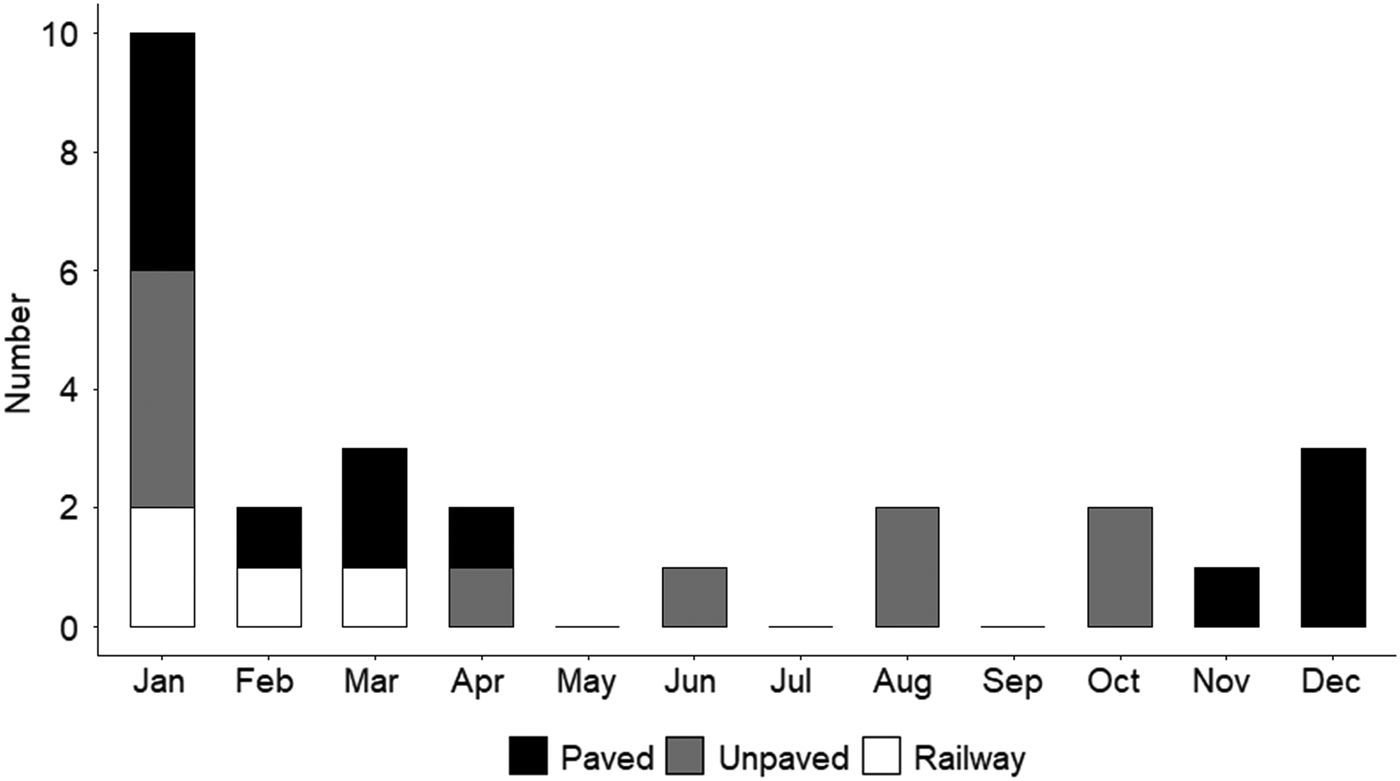
Of the 26 collision incidents involving tigers (Table 1), 22 occurred on roads and four on railways. We categorized these cases into 10-year periods (Fig. 2). From 1980 onwards there were 3–4 incidents in each decade but with a marked increase during 2020–2023 (46% of the total). The highest mortality was in winter, with 19 of the 26 cases (73%), 10 of which were in January (Fig. 3). The remaining seven cases were during April–October when mean temperatures are > 0 °C. The time of day was recorded for nine of the incidents, all of which were at twilight or at night. The four incidents on railways were all in the winter (January–March), and all during 2017–2023. Fourteen of the incidents involved adult tigers, seven involved subdadults and five involved cubs < 6 months old. Of the 20 tigers for which sex was known, 11 were male and nine female.
Number of tigers killed per decade in the Russian Far East during 1980–2023 as a result of collisions with road vehicles or trains.

Number of tigers killed per month in the Russian Far East during 1980–2023 as a result of collisions with road vehicles (on paved and unpaved roads) and trains.

We identified five locations with a high number of collision incidents (together comprising 62% of all recorded tiger deaths; Fig. 1), four of them close to federally protected areas: (1) a section of the Khabarovsk–Komsomolsk-on-Amur federal highway near the western border of Anyuisky National Park, (2) a section of the Khabarovsk–Vladivostok federal highway near Strelnikov Ridge (which is also a transboundary ecological corridor for wildlife between Russia and China), (3) a road traversing Sikhote-Alin Reserve, (4) roads adjacent to Lazovsky Reserve, and (5) a section of the Razdolnoe–Khasan highway (which runs along the eastern border of the Land of the Leopard National Park). In each of these locations, there were three incidents involving tigers. The Mann–Whitney U test revealed statistically significant differences between the groups (W = 37, P = 0.0079), indicating differences in the distance to the federal protected areas between isolated and clustered tiger collision locations. Fifty-four and 31% of incidents were on the western and eastern slopes of the Sikhote-Alin Mountains, respectively. The remaining incidents were in the south-west of Primorsky Krai near the Land of the Leopard National Park.
Notable changes in the spatial distribution of tiger fatalities caused by collisions were observed after 2020. During 1980–2019, collisions occurred predominantly on the roads of Primorsky Krai. However, during 2020–2023, the majority of incidents were near the northern edge of the tiger range in Khabarovsky Krai (χ 2 = 5.44, P = 0.02, C = 0.47).
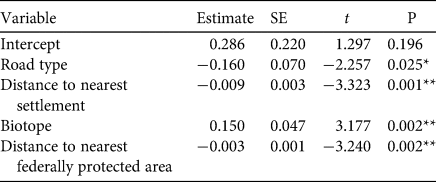
In the multiple regression analysis we excluded anthropogenic pressure, distance to the nearest water body, elevation and human population density as they did not have significant effects. Four variables (biotope, distances to nearest protected area and settlement, and road type) were significant predictors of tiger mortality (Table 3).
Results of multiple regression analysis for predictors of probability of tiger mortality in collisions with vehicles and trains.

*P < 0.05; **P < 0.01.
Despite their greater length, fewer tiger fatalities occurred on unpaved roads (10 incidents) compared to asphalt roads (12 incidents), and this was significantly different in both cold and warm seasons (χ 2 = 4.54, P = 0.03, C = 0.48). More tigers died on paved roads during the winter and on unpaved roads during warmer seasons (April–October). Vehicle types involved in incidents were diverse, with trucks and cars being the most common (29% each), followed trains (24%) and buses (18%). One incident involved a bus overturning because of a collision with a tiger, resulting in an injury to one passenger. In other cases involving vehicle damage, no information was available about injuries to people.
Ten of the tigers hit by vehicles remained at the collision site (42% of all cases for which reliable information was available), six carcasses were found within and six out of sight of the vehicle (25% each), and in two cases the tigers were not found after the collision and their fate remained unknown. For two additional cases, there was no reliable information. Driver behaviour after collisions varied: 76% fled and 24% remained until the arrival of the police. In all incidents involving the initiation of an administrative or criminal case, the fugitive driver and vehicle involved were not subsequently identified.
Discussion
Our analysis of tiger mortality on roads and railways in the Russian Far East indicates five clusters of incidents and a marked increase in incidents from 2020 onwards. The increase in mortality is probably an indirect effect of the reduced availability of prey and the subsequent sharp rise in human–tiger conflicts (Lukarevskiy et al., Reference Lukarevskiy, Oleynikov and Kolchin2024). Wild boars Sus scrofa are the primary prey of the Amur tiger, accounting for 33–45% of their diet (Tkachenko, Reference Tkachenko2009; Kerley et al., Reference Kerley, Mukhacheva, Matyukhina, Salmanova, Salkina and Miquelle2015; Yang et al., Reference Yang, Dou, Baniya, Han, Guan and Xie2018). Following an outbreak of African swine fever that commenced in 2019 (Lukarevskiy et al., Reference Lukarevskiy, Kolchin, Oleynikov and Salkina2021a; Zakharova et al., Reference Zakharova, Titov, Gogin, Sevskikh, Korennoy and Kolbasov2021), the wild boar population decreased by > 90% according to data from some protected areas in the Russian part of the tiger range (Waller et al., Reference Waller, Brodie, Miquelle, Robinson and Hebblewhite2022; Kastrikin et al., Reference Kastrikin, Babykina, Kunitskiy and Kryukova2023). Reduced prey availability and increased stress from intensive logging have led to more frequent tiger excursions into anthropogenic landscapes in the Amur and Ussuri valleys (Lukarevskiy et al., Reference Lukarevskiy, Oleynikov and Kolchin2024), where the main highways and railways of the region are located. In addition, since 2021, there has been a sharp increase in the number of conflicts between tigers and people (Lukarevskiy et al., Reference Lukarevskiy, Oleynikov and Kolchin2024), with the most common type of conflict being predation on dogs and livestock near settlements, particularly in winter (Goodrich et al., Reference Goodrich, Seryodkin, Miquelle and Bereznuk2011; Lukarevskiy et al., Reference Lukarevskiy, Kolchin, Oleynikov and Salkina2021a; Skidmore, Reference Skidmore2022). With rapid increases in prey populations and habitat recovery being improbable, this trend is likely to persist. The spatial distribution of tiger fatalities on roads in Russia has changed significantly because the primary hotspot of African swine fever was in the south-west of Khabarovsky Krai (Zakharova et al., Reference Zakharova, Titov, Gogin, Sevskikh, Korennoy and Kolbasov2021). Previously, most incidents occurred in Primorsky Krai, which encompasses the core range of the tiger population in Russia (Yudin & Yudina, Reference Yudin and Yudina2009), but there has been a northwards shift of collision fatalities into areas with fewer available resources (Fig. 1, Table 1).
The greater tiger mortality from collision incidents in winter may be a result of several factors. Firstly, in this period prey availability is reduced because some tiger prey species hibernate (the Asiatic badger Meles leucurus, raccoon dog Nyctereutes procyonoides, Asiatic black bear Ursus thibetanus and brown bear Ursus arctos). Secondly, ungulates born in the spring are larger by winter and thus less vulnerable to predation (Yudin & Yudina, Reference Yudin and Yudina2009). As a consequence, tigers must travel longer distances in search of food, often approaching settlements and roads, and they may utilize the road network because of the deep snow cover elsewhere. This period is also when the majority of conflicts occur between people and tigers (Lukarevskiy et al., Reference Lukarevskiy, Kolchin, Oleynikov and Salkina2021a). Thirdly, snow and ice on roads increase vehicle braking distances and thus the probability of a tiger dying as a result of a collision (Martin & Schaefer, Reference Martin and Schaefer1996; Sokolovskij, Reference Sokolovskij2007).
That tiger mortality is greater on paved than on unpaved roads in the winter is most likely associated with the availability of prey, as paved roads are near populated areas. That incidents are more common on paved than on unpaved roads despite the greater length of the latter is probably explained by the higher speed and density of traffic on paved roads, both of which may increase the probability of a collision. That all incidents for which time was recorded occurred during twilight or night-time is consistent with the daily activity pattern of tigers (Yudin & Yudina, Reference Yudin and Yudina2009; Yang et al., Reference Yang, Han, Xie, Mou, Kou and Wang2019).
The greater tiger mortality on the western slopes of the Sikhote-Alin Mountains may be a result of factors associated with the higher human population density in this area, such as greater prey availability and the longer road network. This is similar to south-west Primorsky Krai, where there are also high anthropogenic impacts and a dense tiger population (Kolbina & Nayden, Reference Kolbina and Nayden2013). More than half of all tiger mortality was on roads that traverse protected areas or lie near their borders. Even though most of the Amur tiger range lies outside these areas, they are nevertheless important for tiger conservation. Federally protected areas are the only places where large, undisturbed landscapes persist, supporting the natural spatial and demographic structure of reproductive tiger groups and maintaining higher population densities compared to other parts of their range (Matyukhina et al., Reference Matyukhina, Miquelle, Salkina, Abramov, Litvinov, Smirnov and Zhuravlev2010; Lukarevskiy et al., Reference Lukarevskiy, Lukarevskiy, Kolchin and Oleynikov2021b). Some of the protected areas are surrounded by roads (e.g. Bolshekhekhtsirsky and Lazovsky reserves). Of the 11 reserves and national parks in the tiger range in Khabarovsky Krai and Primorsky Krai, four are bisected by federal roads, five are located near highways and only two do not have major federal roads at their borders (Fig. 1). The fragmentation of protected areas by roads reduces their conservation value by limiting animal dispersal and gene flow. On secondary roads there are no wildlife crossings or barriers to prevent tigers accessing the road, and on paved highways there is only one wildlife tunnel, in the Khasansky District of Primorsky Krai (the Narvinsky tunnel). This 565 m-long passage was built in 2016 beneath the road separating the Land of the Leopard National Park and Kedrovaya Pad Reserve, connecting the two areas.
That most drivers fled following a collision with a tiger is probably because of the potentially severe legal consequences, and the lack of political will to investigate such cases. Prompt reporting of a collision with a tiger is important for reducing fatalities: tigers may remain alive and could potentially be saved with timely veterinary assistance. Any citizen who hits a wild animal in Russia is considered guilty regardless of the circumstances of the incident (the presumption of innocence does not apply) and could be subject to administrative or criminal prosecution. The administrative fine for causing the death of a tiger is the equivalent of c. USD 22,000.
Long-term tracking by the Amur Tiger Project indicated that 12.5% of tiger mortality was a result of road traffic incidents (Miquelle et al., Reference Miquelle, Smirnov and Goodrich2005), but stress and injuries during capture could also influence mortality (Zhuravlev, Reference Zhuravlev and Zhuravlev2010). For instance, one radio-collared tiger died in a road traffic accident shortly after capture and subsequent release in December 1998 (Table 1; Smirnov, Reference Smirnov1999; Miquelle et al., Reference Miquelle, Smirnov and Goodrich2005). As most drivers flee the accident scene, tigers may only be detected sometime later, or not at all if they have moved away from the road following injury; in 33% of the incidents we documented, tigers moved > 30 m from the road, and some were discovered after some time had passed. In cases of injury, including ultimately fatal ones, tigers can be capable of moving away from the collision site, and such incidents may therefore not be documented. For example, the cause of death could not be determined for three tiger carcasses found near roads in Khabarovsky Krai as the carcasses were only discovered after several months.
People may also be injured in collisions with tigers, as in the case we documented of a person injured after the collision of a bus with a tiger. Road incidents can also have indirect consequences for people. For example, on 21 August 2021 in the Nanaisky District of Khabarovsky Krai, an employee of a logging company was killed by a female tiger. A veterinary evaluation of this tiger, conducted by the Russian non-profit organization Amur Tiger, revealed she had previously sustained an extensive hematoma caused by a collision with a vehicle (Aramilev & Shorshin, Reference Aramilev and Shorshin2022). This injury likely impaired her ability to hunt natural prey effectively, potentially driving her to attack a person.
Our findings emphasize the need for measures to address the impacts of roads on wildlife. The majority of documented Amur tiger deaths from collisions with vehicles occurred at night during the winter on federal paved highways close to protected areas, highlighting the need for road safety measures near these critical stretches of road to protect both people and tigers. To mitigate the threat of vehicular collisions to the Amur tiger, we make the following recommendations: (1) improve compliance with speed limits on sections of road with high incidences of collisions by equipping these areas with video surveillance cameras, warnings and speed limit signs; (2) introduce wildlife-friendly road design practices, including the construction of wildlife overpasses, tunnels, aqueducts and fences for the safe passage of tigers and other wild animals; (3) strengthen road supervision during the night; (4) limit driving on abandoned logging roads; (5) incorporate appropriate environmental requirements in road and railway construction; and (6) introduce mandatory environmental impact assessments for major road projects.
It is likely that incidents in more remote areas go unreported, leading to underestimation of tiger deaths caused by road accidents as witnesses are reluctant to report collisions. For cases that are reported or otherwise witnessed, we recommend investigation, and application of appropriate punishment for drivers who collide with tigers as a result of violating traffic rules or of intentionally causing collisions. Drivers involved in unavoidable collision incidents should not, however, be penalized. Applying social marketing measures as a means of voluntary and conscious influence on the behaviour of residents could contribute to the long-term conservation of tigers (Veríssimo, Reference Veríssimo2013). In addition to educational initiatives and awareness-raising this would require engagement of residents in tiger conservation. This could be achieved through economic incentives, particularly by fostering ecotourism, with the Amur tiger as one of the principal attractions.
Conclusion
During 2020–2023, fatalities of tigers in traffic incidents significantly increased compared to the previous 4 decades, coinciding with a decline in wild boar populations because of African swine fever, as well as heightened human–tiger conflicts and ongoing forest degradation. Since 2019, tiger mortalities in traffic incidents have been concentrated in Khabarovsky Krai near the northern boundary of the tiger's range, highlighting the vulnerability of tigers in peripheral regions. The multiple regression analysis revealed that road type, distances to settlements and federally protected areas, and biotope significantly influenced the probability of tiger mortality in traffic incidents. Road characteristics, such as surface type, and seasonal patterns are also important factors to consider in reducing wildlife–vehicle collisions. Although collisions with trains were less numerous than road traffic collisions, monitoring and measures to mitigate risks on railway tracks remain necessary given potential increases in train speed and traffic. Wildlife-friendly road design, including crossings, tunnels and fences, is essential for reducing tiger mortality, especially near protected areas. Addressing road traffic incidents through strict traffic law enforcement, improved road planning, and habitat protection is crucial for ensuring the long-term survival of the Amur tiger in the Russian Far East.
Acknowledgments
We thank Allison Skidmore for her valuable advice and help with editing.
Author contributions
Conception and design: AYO, SAK; data collection: all authors; data analysis: AYO; writing: AYO; revision: all authors.
Conflicts of interest
None.
Ethical standards
This research abided by the Oryx guidelines on ethical standards and did not involve human subjects, experimentation with animals or collection of specimens.
Data availability
The data that support the findings of this study are available from the corresponding author, AYO, upon reasonable request.

 Open access

