


Disease-related malnutrition is a nutritional state in which a deficiency or imbalance of energy, protein and other nutrients causes measurable adverse effects on body composition, physical and psychological functions and clinical outcome(Reference Strattton, Green and Elia1). Diseases and their associated problems, such as swallowing difficulties, vomiting and nausea, are major predictors for malnutrition in Western countries. The prevalence of disease-related malnutrition during hospital stay has been found to be as high as 62 %, depending on the tool used for screening and the population under investigation(Reference Strattton, Green and Elia1–Reference Naber, Schermer, de Bree, Nusteling, Eggink, Kruimel, Bakkeren, van Heereveld and Katan4). Overall, during their hospital stay some 70 % of all patients lose weight, leading to prolonged admission periods, considerable costs and impaired quality of life(Reference Strattton, Green and Elia1, Reference Mcwhirter and Pennington3, Reference Bruun, Bosaeus, Bergstad and Nygaard5–Reference Isabel, Correia and Waitzberg8). Inadequate food intake is of key importance in the onset and progression of malnutrition. Although in the end the consequences are definitive, most of its adverse effects can be reversed if adequately addressed(Reference Strattton, Green and Elia1, 9). Feeding via a nasogastric, or, in case of an obstruction at the gastric level, nasojejunal tube is the most commonly used strategy to prevent or treat malnutrition because of impaired oral intake and increased needs.
The present investigation was sparked by preliminary observations from our nutrition support team suggesting that patients who lacked any intake besides their tube feeds (usually 1·5–2·5 litres/d) lost weight despite seemingly adequate prescriptions. This discrepancy between prescribed and delivered feeding volumes has been alluded to in recent guidelines issued by the European (ESPEN) and American (ASPEN) nutritional societies: ‘A significant discrepancy is often seen between prescribed and delivered calories; that is, the volume of the tube feeding received, expressed as a percentage of the goal intake is often less than 100 %’(10, Reference Howard, Jonkers-Schuitema, Furniss, Kyle, Muehlebach, Odlund-Olin, Page and Wheatley11). A literature survey learned that nearly all evidence on this topic comes from investigations performed within the intensive care unit (ICU) setting, and may therefore not be relevant for other patient populations(Reference Abernathy, Heizer, Holcombe, Raasch, Schlegel and Hak12–Reference Woodcock, Zeigler, Palmer, Buckley, Mitchell and MacFie20). We therefore decided to perform a cross-sectional study and investigate whether inadequate tube feed administration is a relevant problem in various clinical settings in patients who tolerate enteral nutrition but completely depend on tube feeding, by comparing prescribed and administered tube feeding volumes. Also, data relating to factors that might possibly cause any cause discrepancies were collected.
Materials and methods
This investigation was approved by the medical ethical committee and carried out between February and June 2003 at the Radboud University Nijmegen Medical Centre in Nijmegen, The Netherlands. Since scientific evidence to define thresholds for the adequate administration of tube feeding is lacking, we assumed a range of 100 % of the prescribed dose (in kJ/d) ± 10 % as being adequate, given that a 10 % discrepancy can be considered as clinically important.
The spectrum of enteral tube feedings in our institution comprises various formulations that differ in composition and energy content.
Adult patients (>18 years) from intensive care, general internal medicine, gastroenterology, otolaryngology, neurology and surgical wards without significant oral intake, i.e. who had been fully dependent on tube feeding the previous day, were enrolled. Post-operative patients were not included the first day post-surgery, since in this early phase temporary motility disorders frequently hinder the achievement of any nutritional goals.
All relevant data from medical records that had been registered during the previous 24 h before enrollment were collected. Relevant missing data were obtained from the medical staff, nurses and patients. Collected data comprised patient characteristics, prescribed and delivered amounts of tube feeding, feeding formula, technique of administration, indication for prescription of tube feeding, underlying disease, type of feeding tube, and indications for interruption of feed administration. The estimation of the administered volume when using a feeding pump (Kangaroo 324; Kendall Tyco Healthcare, Mansfield, USA) was deduced from the fixed setting of the volume button on the pump or calibration on the package of the feeding formula. In case of drip feeding without a pump the estimate was made through calibration on the outside of the formula package.
Sampling
According to the literature the percentage of tube feeding deficits in various hospital settings varies from 6 to 87(Reference Abernathy, Heizer, Holcombe, Raasch, Schlegel and Hak12–Reference Woodcock, Zeigler, Palmer, Buckley, Mitchell and MacFie20). However, since most of these studies have been performed in ICU we decided to provide an overall inventory of the problem in the present study with sixty patients coming from six different wards, thus covering the main consumers of tube feedings. A randomization procedure was used to allocate six relevant wards with a high consumption of tube feeding that would be visited for the recruitment of subjects. At the selected wards we numbered all patients totally dependent on tube feeding, and by means of a randomization table we selected ten patients per selected ward to obtain a total of sixty patients for enrolment in the study.
Statistical analysis was performed with the statistical software package SPSS version 10.0 (SPSS Inc., Chicago, IL, USA). Assuming non-parametrical data distribution, differences between prescribed and administered feeding doses, calculated in kJ/d, was evaluated using Wilcoxon's matched pairs signed-ranks test. Differences between wards and modes of delivery were analysed using the χ2 test. The significance level was set at 5 %.
Results
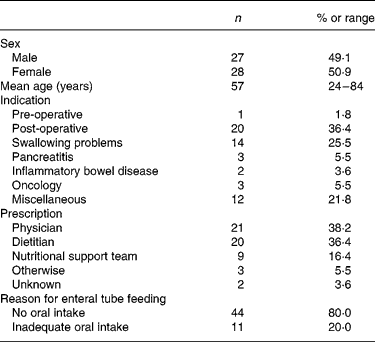
Fifty-five patients (twenty-seven men), with a mean age of 57 years (range 24–84) from six different wards were included. Patient characteristics are shown in Table 1. The major indications to prescribe tube feeding were surgical procedures in 36 %, and swallowing problems in 25 % of all cases. The latter indication was mainly observed on neurology wards. Tube feeding was prescribed by physicians (38 %), dietitians (36 %), the nutritional support team (16 %) or others (6 %, comprising nurses, or continued prescriptions from other institutions).
Patient characteristics
Modes for delivery of tube feedings varied from pump (n 37) or portions (n 14), to drip (n 3) or a combination of pump and portions (n 1). The administration of tube feedings on ICU, gastroenterology and surgery wards was exclusively by means of pumps and at the neurology ward exclusively by means of portions. The delivered volume was registered in 62 % of all cases by setting the volume button.
Prescription v. administration of tube feeding
Table 2 shows the mean prescription and administration and the percentage of administered tube feedings. The difference between administered and prescribed tube feeding (in kJ/d) is significant, with a deficit of 1089 kJ/d, range − 7955 to 795 (Wilcoxon signed ranks Z-score 5·2, P < 0·001). Feed administration was most frequently adequate on ICU and most inadequate on internal medicine wards. Actual intake delivered in ICU was 99 % (95 % CI 97, 100) v. 68 % at the internal medicine ward (95 % CI 23, 113).
Prescription, administration and % administered/prescribed tube feedings (n 55)*

* For details of procedures, see Materials and methods.
The portioned administration proved to be the most efficient mode of administration of tube feeding. Actual intake of tube feeding delivered by pump was 85 % (95 % CI 77, 92), by portions 94 % (95 % CI 87, 100) and by gravity 88 % (95 % CI 43, 133). No differences in adequacy were found between patients fed by drip v. portions (P = 0·4), or between surgical v. internal medicine wards (P = 0·4).
Interruptions during administration of tube feeding
Information concerning interruptions during administration ideally should be noted by nurses in their daily reports. We, however, observed discrepancies between daily reports and information from nurses and patients. Discrepancies between reported and actually delivered feeding volume could not be retrieved in reports from nurses in 54 % (n 22) of all cases with inadequate administration. Causes for interrupted tube feeding of patients with a dose deficit were patient-related (n 2), or caused by gastrointestinal problems (n 6) or medical investigations (n 4). A feeding pump was used in thirty-seven patients. The volume button was used in twenty-three cases. In only fifteen out of the latter the administered dose was adequate. In six out of the eight cases of inadequate administration interruptions during tube feeding had not been registered or went unnoticed by nurses (n 3) or patients (n 2).
Discussion
Over the years, disease-related malnutrition has remained in the limelight of clinical investigations because of its impact on numerous clinical outcome measures and quality of care parameters. According to an ESPEN newsletter ‘A professional lobbying at the European Union is created to promote the recognition of Clinical Nutrition and Metabolism and funding. The implementation of the important resolution of the European Committee of Ministers on the prevalence of malnutrition and the insufficient level of nutritional care in European hospitals is explored within the E.U.’(9). In this light, adequate administration of prescribed tube feedings is of key importance, but by no means guaranteed in clinical practice. We performed the present study to highlight this matter in patients completely depending on tube feeding for their nutritional intake, since this category inherently carries a high risk for the development of disease-related malnutrition and its consequences.
As mentioned, scientific criteria for adequate administration of tube feedings are not at hand. However, it is highly likely from our calculation described in the materials and methods section that a reduction of more than 10 % energy requirement per day for several days exerts detrimental effects on the patients' condition. In the present study a difference between prescribed and administered tube feeding doses of 87 (sd 21) % was observed, with a mean daily deficit of 1089 kJ and a prescribed daily dose that averaged 8185 kJ. Most importantly, this deficit was observed in 40 % of all patients, except for patients on ICU wards. We have to be cautious that with feeding pumps, exact feeding volumes cannot always reliably be deduced from settings of the volume button. We have previously shown that in this situation, deviations from expected volumes may amount to 21 % in excess of actually delivered volumes(Reference van den Broek, Naber and Rasmussen21). Of course, the latter observation might be relevant for the present data: more patients who were fed by pump using the volume button may have received inadequate amounts of feeding formulations.
The comparison of data obtained from the studies in this field is complex due to different study designs (longitudinal or cross-sectional in nature), as well as a wide range in observation and follow-up periods(Reference Abernathy, Heizer, Holcombe, Raasch, Schlegel and Hak12–Reference McClave, Sexton, Spain, Adams, Owens, Sullins, Blandford and Snider17). Some investigators report on fixed follow-up periods, extending to a maximum of 80 d(Reference Abernathy, Heizer, Holcombe, Raasch, Schlegel and Hak12, Reference de Beaux, Chapman, Fraser, Finnis, De Keulenaer, Liberalli and Satanek14–Reference Woodcock, Zeigler, Palmer, Buckley, Mitchell and MacFie20). However, a prolonged follow-up of individual patients on tube feeding could be confounded by the frequent occurrence of simultaneous complications in this population.
It is also important to note that none of the studies in the literature study(Reference Abernathy, Heizer, Holcombe, Raasch, Schlegel and Hak12–Reference Woodcock, Zeigler, Palmer, Buckley, Mitchell and MacFie20) were blinded. For instance, medical and nursing staff were informed of patients who were included in the study of Robertson(Reference Robertson19).
An attempt to define inadequate administration of tube feeding in relation to prescribed feedings has been made in some studies(Reference de Beaux, Chapman, Fraser, Finnis, De Keulenaer, Liberalli and Satanek14, Reference De Jonghe, Appere-De-Vechi, Fournier, Tran, Merrer, Melchior and Outin16, Reference McWhirter, Hill, Richards and Pennington18, Reference Woodcock, Zeigler, Palmer, Buckley, Mitchell and MacFie20). For instance, Beaux et al. (Reference de Beaux, Chapman, Fraser, Finnis, De Keulenaer, Liberalli and Satanek14) carried out a study with a follow-up of 7 d and defined adequate feeding as having two consecutive days of administration of more than 90 % of the prescribed dose. However, this implies that a patient might be classified as being adequately fed even while the intake in the remaining days was less than 90 % of this dose.
Energy calculation of adequate feeding (administered v. prescribed) has mostly been presented in kJ/d(Reference Abernathy, Heizer, Holcombe, Raasch, Schlegel and Hak12, Reference de Beaux, Chapman, Fraser, Finnis, De Keulenaer, Liberalli and Satanek14–Reference De Jonghe, Appere-De-Vechi, Fournier, Tran, Merrer, Melchior and Outin16, Reference McWhirter, Hill, Richards and Pennington18, Reference Woodcock, Zeigler, Palmer, Buckley, Mitchell and MacFie20) or ml/d(Reference McClave, Sexton, Spain, Adams, Owens, Sullins, Blandford and Snider17, Reference Robertson19, Reference Woodcock, Zeigler, Palmer, Buckley, Mitchell and MacFie20). Many studies do not take into account that the impact of differences in prescribed versus delivered feeding formulas in energy intake are mainly determined by the energy density of the formulation.
We did not verify the calculations underlying the prescription of tube feedings in the present study. This means that in the case of an excess of energy more patients should have been registered as being fed adequately, and vice versa with a deficit of prescribed energy.
In conclusion, the present study shows that while tube feeding is essential to treat disease-related malnutrition in patients who cannot eat, this population is frequently being undernourished during hospitalization. Several recommendations are at hand to prevent this problem: (1) interruptions of feeding should be limited to the absolute minimum; (2) the use of the volume button of feeding pump increases the awareness of any interruptions; (3) due to inaccuracies of administered feeding volumes, for instance when using a pump, the prescribed dose might be more easily given when administered as a whole package of 1 litre with different energy density.
Acknowledgements
There is no financial conflict of interest for all authors and no financial and material support for this study. The first author conceived the design and was responsible for data collection and analysis. The second and third authors substantially contributed to the design and interpretation of the data.



