

I focus on the distinction between colonialism and semi-colonialism, the two simultaneous political experiences of Asian societies, in this paper. As a framework of study, I evaluate the role of semi-colonialism in the universalization of international law in Indochina. Let us begin with what Gustave Rolin-Jaequemyns, General Advisor to Siam between 1892 and 1902, had to say about the state of negotiations and international law in Siam.
Prince Devawongse is not always as firm as he is intelligent, and it happens sometimes to him that he lets go of points, in conversation in which I do not participate, which I had made in my messages. This also applies to the fact that he does not always exactly understand the value of words. Naturally the French gain advantage from this, and even exaggerate the importance of what he has said or admitted, and then discreetly congratulate him for what they call an act of emancipation from my tutorship.Footnote 1
No less than the Khedive of Egypt and the King of Siam coveted Gustave Rolin-Jaequemyns—a Belgian lawyer and the founding Secretary General of the Institut de droit international—to join them. Rolin-Jaequemyns’s meeting with Prince Damrong in the winter of 1891 settled the matter in favour of Siam. He resigned from his position as Egypt’s Attorney-General to sail for Siam. Rolin-Jaequemyns’s decision had disappointed T.M.C. Asser and John Westlake, his two closest friends. Life turned full circle only seven years later. On Rolin-Jaequemyns’s suggestion King Chulalongkorn almost appointed T.M.C. Asser, F.F. Martens, and J.B. Moore, arguably the three leading international lawyers of the late nineteenth century, as advisors and arbitrators for the interpretation of the Franco-Siamese Treaty of 1867 should France agree to arbitration.Footnote 2 France chose gunboat negotiations over arbitration lest Siam found a more favourable legal award. Need anyone stress more the pivotal role Rolin-Jaequemyns played in Siam’s tryst with international law?
However, more historians than international lawyers have studied Thailand. Siam, as Thailand was known during its admission to the United Nations, was never formally colonized.Footnote 3 Should the lawyer’s study of Siam yield a useful lens about it, to wit, semi-colonialism, history, and international law? Notably in Asia, Japan, Siam, and China share a common semi-colonial past of varying degrees.Footnote 4 Siam managed to remain independent at a time when the British and the French Empires had conquered Burma and Cambodia to, respectively, its west and east.Footnote 5
In the twentieth century, while South Asia was under British “colonial rule”, Thailand and China were under the “foreign domination” of Japan and the European powers.Footnote 6 Siam’s tryst with international law in the nineteenth century—its attempt to join the “civilized” family of nations—is, arguably, unique in Asia.Footnote 7 It is so because, their common history notwithstanding, Japan, China, and Siam were to chart completely different futures during, respectively, the interwar and the postwar years.Footnote 8
Its independence notwithstanding, how did Western lawyers treat Siam? Oppenheim—perhaps the most influential of the writers of the twentieth century—had conflated the two political situations—colonial rule and semi-colonialism—to hold Siam as a “doubtful” case insofar as its recognition and admission into the family of nations was concerned.Footnote 9 The American Journal of International Law had at the time noted: “Oriental nations, however old their civilization, are not by the mere fact of statehood regarded as equals.”Footnote 10 To Western lawyers, problematically, semi-colonial Siam and colonial India were states of the same ilk. Ironically, a veritable absence of a Machiavellian attitude excluded such oriental states from the reckoning for statehood.Footnote 11 As the daughter of Prince Damrong noted: “It was generally known at the time that we only give the French an excuse to seize more territory by protesting. Things had been like that since they came into the river Chao Phya with their gunboats.”Footnote 12 Effectively, the Western imperial machinations, Empires, and their scholars, held Siam down by unequal treaties even as it shut, with the other hand, the doors of the family of civilized nations on it.
What is semi-colonialism, however? A metropolitan country in semi-colonialism exerts power and influence within an asymmetrical relationship without assuming “outright domination and formal sovereignty over the peripheral country”, as in colonialism.Footnote 13 “Foreign domination” and semi-colonialism are interchangeable political experiences in East Asia and Indochina, which can be contrasted with British colonialism in South Asia.Footnote 14
The political sociologists Vandergeest and Lee Peluso have noted the Thai semi-colonial situation: the Bangkok monarchy avoided the legal fragmentation—separate legal codes for different categories of people—that was prevalent in fully colonized polities.Footnote 15 Nevertheless, extra-territoriality, or the exemption of European and American subjects from Siamese laws as specified in the mid-nineteenth-century treaties, might be “considered a limited form of such fragmentation”. Footnote 16 The primary motivation for Siam to change its legal system was to meet European conditions for ending legal extra-territoriality.Footnote 17 Regardless, enormous gaps between the law and practice remained.Footnote 18
That said, China takes the lion’s share of attention among the works on semi-colonialism and informal empires in Asia.Footnote 19 Siam’s case is largely understudied. Clearly, the abundance of modern nation-states of Westphalian persuasion and its wilful universalization pushes into insignificance the semi-colonial nations like Siam’s lived experiences. One would expect the alternatively modern lived experiences of such Asian polities—flexible and hybrid—to bear upon the rigid statist conceptions of the modern international law.Footnote 20
Obviously, Asian polities under “foreign domination” were less legalistic in comparison to those under direct “colonial rule”.Footnote 21 Naturally, the former produced lesser stationery than the latter. If anything, the production, cataloguing, and archiving of the colonial stationery was, in fact, an essential part of running the colony. Contrarily, Siam, a semi-colonial polity, would borrow in good faith from the French and the British such colonial stationery as maps.Footnote 22 Furthermore, the unequal treaties imposed on Siam foisted limitations as well as European scrutiny on Siam’s hiring of experts. For example, by Article 6 of the Franco-Siamese Treaty 1904, the French forced Siam to deploy only “troops of Siamese nationality, commanded by officers of the same nationality”.Footnote 23 Prior “understanding” with the “French Government” had to be “reached” “should the Siamese Government wish to replace these officers with foreign officers of another nationality”.Footnote 24 Article 6 forced Siam to recruit the “police contingent” exclusively from “the natives of the locality”.Footnote 25
In the middle of the nineteenth century, the terms of the Bowring Treaty of 1851 had constrained the policy options available to the Siamese state, particularly in its efforts to respond to external threats. Strengthening its authority and control over territory and population continued to remain a challenge. At the time, John Westlake—worried about the French “Wolf and Lamb” treatment of “Further India”—felt “sorry to see the variety of types of civilization, already becoming too scanty, further diminish”.Footnote 26
I argue that colonialism is, generally speaking, a phenomenon of advantage to countries formerly under colonial rule in relation to interstate disputes on territory and boundary. Conversely, countries that battled semi-colonialism stand in a position of permanent disadvantage in interstate third-party adjudication. This is so because countries under colonial rule could use the archives and expertise of the erstwhile colonial powers.Footnote 27 Indeed, as Crawford and Miles note, “unreliable record-keeping, non-maintenance or destruction of archives and linguistic barriers have prevented other voices from being heard”.Footnote 28 Much less still, nations such as Siam under “foreign domination” are found wanting in producing actual evidence such as maps.Footnote 29
More generally, I ask how the varied colonial and semi-colonial pasts of Asian nations might play out in territorial disputes between such nations before international courts. I study two cases involving Siam —Cheek v. Siam (1897) arbitration,Footnote 30 and the Temple of Preah Vihear (1962)Footnote 31 dispute between Cambodia and Thailand—to answer that question. Cheek v. Siam is a key precedent to understand Siam’s attempt to maintain its independence from French colonial expansion. The Temple of Preah Vihear case, I argue, exposes the ways in which semi-colonial states stand at a disadvantage in relation to states that are a product of full-blown colonialism. Consequently, I emphasize the international lawyer’s scrutiny of the presence of the Empires as ghosts in actual territorial disputes between such states. Overall, I argue that these two cases should be read in their historical context beyond the well-known textbook approach.
The following argumentative structure would be necessary to establish my aforementioned thesis. Part I establishes semi-colonialism as a framework to study Siam by comparing the methods that legal historians and lawyers employ. Part II records the making of unequal treaties in Indochina. This section also discusses the role of colonial corporations in territorial capture. Part III registers the politics of investor-state commercial arbitration and the application of private law in the Cheek v. Siam (1898) arbitration. This section highlights Siam’s political strategy of distributing contracts to competing colonial powers to ward off a potential colonial capture. Part IV moves to the twentieth century to offer a detailed account of the majority and minority judgments, including their reasoning, in the Temple of Preah Vihear (1962) litigation. Next, Part V discusses the juridical ambivalence of the early post-colonial jurists engaged in issues of territory, state, and people in Asia generally and the Temple of Preah Vihear cases in particular, before concluding in Part VI.
I. OF HISTORIANS AND LAWYERS: A FORK IN THE POST-COLONIAL ROAD?
In the immediate decades after the World War II, historians and lawyers deployed two theoretical lenses—post-structuralist and post-colonial—to read international law.Footnote 32 This methodological dispute between post-structuralism on the one side, and post-colonialism on the other, continues to reflect in international legal scholarship today. The lived experiences of colonial subjugation remain the most identifiable difference between the two. Add to that the fact that international legal scholarship has often conflated Asia’s colonial and semi-colonial experiences.
Bringing much needed nuance to Asian legal history, historian Prasenjit Durara theorizes that Japanese semi-colonialism is functionally different from European colonialism. Duara defines the Manchukuo enterprise between Japan and Republican China as the “first full-blown instance” of a “new imperialism”. This imperialism was “new” insofar as it was “rooted in the historical circumstances of the United States, the Soviet Union and Japan, rather than in those of the older European powers”.Footnote 33 More importantly, this “new imperialism reflected a strategic conception of periphery as part of an organic formation designed to attain global supremacy for the imperial power”.Footnote 34
The imperialism that evolved [in] the twentieth century differed especially from earlier European … colonial[ism] in several ways. While the new imperialists maintained ultimate control of their dependencies or clients through military subordination, they often created or maintained legally sovereign nation-states with political and economic structures that resembled their own.Footnote 35
Evidently, Japan was competing with European powers in state-making in Asia during the early decades of the twentieth century. Very significantly, Japan and the West took a diametrically opposite approach to imperialism in semi-colonies; while the former created a new nation-state, the latter brought old native kingdoms down. For example, Ernest Satow, British Minister at Bangkok in 1884, recommended a typical European formula: “If the Siamese, Laos and Burmese Shans were ultimately to be united under one sceptre, that would constitute a populous and homogeneous state.”Footnote 36 Such an artificial state, for Satow, “might perhaps become strong enough to maintain its independence without extraneous aid”.Footnote 37
As for Siam, Japan has played a special role in Siamese legal history.Footnote 38 Tokyo was the first of the colonial powers to accept “a provisional clause in a treaty with Siam by which extraterritorial rights would disappear if and when internal reforms progressed to the point where the Siamese legal and juridical treatment could be on a par with the Western or ‘civilized’ nations”.Footnote 39 As a result, by the year 1900, Dauge, Belgium’s legal advisor, had already noted that: “Extraterritoriality has as its objective to assure to the nationals of certain States a protection which they believe they cannot obtain otherwise in a country less civilized than their own. This reason does not apply to subjects of States that find in Siam at least as much legal protection as in their homeland.”Footnote 40 This was remarkable since, only six years before, John Westlake had called Siam “a semi-civilized buffer state”.Footnote 41
Therefore, in the post-World War II world nations emerging in Indochina were a product of both a long European colonialism and a short Japanese imperialism. How did the post-colonial international lawyers respond to this fork in the road? Faced with spawning imperialism as well as an attempt to diagnose the nature of post-colonialism, in 1961 Syatauw attempted to decouple Asia’s colonial and semi-colonial past.Footnote 42 Syatauw, much like historian Duara today, had gainfully decoupled the Asian past as early as 1961 to theorize that both erstwhile semi-colonial and colonial states did not after decolonization yield the same kind of “newly established Asian states”.Footnote 43 Likewise, in the first decade of the twenty-first century, post-colonial international legal scholarship has witnessed a rise of the publicists of two different theoretical persuasions: those who use colonialism as against those deploying a semi-colonial lens to amplify the postwar imperialism of international law.
Antony Anghie has famously established that colonial rule is central to the formation of international law in the nineteenth century.Footnote 44 Matthew Craven, in contrast, thinks that semi-colonialism manifesting in the unequal treaty regime, and not colonial rule, is central to explaining the role of international law in Asia and the continuance of informal empires during the Cold War.Footnote 45 To make Craven’s point ontologically, for Becker Lorca, international law did not so much as impose itself on non-Western nations as the lawyers from semi-colonial states themselves appropriated international law to claim equality with European states.Footnote 46
Small wonder, since Oppenheim had conflated colonial and semi-colonial Asian states at the height of positivism, Oppenheim’s appropriation by post-colonial scholars ensured the inheritance of an international law that remains blind to the difference between, for instance, Siamese semi-colonial and South Asian colonial history.
It explains a good deal of what happened afterwards in post-colonial approaches to international law. Post-colonial lawyers spawned two kinds of post-colonial approaches to international law. While the semi-colonials went to the length of ossifying the individual history of their own nations in order to claim a place in the family of nations, the publicists of colonial states argued for an already existing native tradition of international law in their countries.Footnote 47 Notably, Craven and Becker Lorca omit Syatauw’s analytical framework.Footnote 48 Quite tellingly, Syatauw had prefigured the problems associated with painting nineteenth-century Asian history in singularly colonial ink. Because Syatauw’s analytical framework has since been lost on publicists, scholars of Asia and international law find inexplicable the East and South Asian ambivalence towards international law. Notably, a new twenty-first century division of international legal academic labour is witnessing a rising school of post-structuralists; they hide behind an esoteric vocabulary as if to evade the wrath of post-colonial states. This has left the job of challenging the state for the post-colonials alone to do.
II. UNEQUAL TREATIES AND SEMI-COLONIAL SIAM
A. Siam’s Internal Consolidation
Between 1851 and 1910, Siam confronted three issues: (1) internal integration or Siamese colonialism; (2) external territorial losses; and (3) the survival of an independent Siam.Footnote 49 In the nineteenth century, the modernization of states in Asia had a particular meaning. “Oriental nations” could be “admitted to full membership in the Family of Nations upon satisfactory evidence that the citizens or subjects of foreign states enjoy within their dominions the rights, privileges, and protection of law accorded in European and American communities”.Footnote 50
The unequal treaty with Japan became the template for the subsequent unequal treaties that Europe and Japan signed with China and Thailand. However, not all the unequal treaties were similarly worded, Siam had terms and clauses different from the Japanese treaties. As Larsson notes, “provisions in treaties imposed on Siam beginning in 1855 prevented a ‘developmental’ political equilibrium from emerging in a state whose geopolitical vulnerability increased dramatically from the 1870s. The ‘unequal’ treaties imposed on Japan by Western powers were not similarly constraining, thereby allowing for the emergence of a developmental political equilibrium.”Footnote 51
Meaning and interpretation of such treaties presented a set of non-European cultural-legal problems. During negotiations, Siamese princes and kings did not “always exactly understand the value of words” they spoke to the Europeans.Footnote 52 Much as Rolin-Jaequemyns wanted the Thai prince to be Machiavellian in negotiations about territories with France, the Siamese Prince Devawongse “had been too polite and not strong enough in his denials”.Footnote 53 Of course, international law would not admit such contexts to treaty making as part of treaty interpretations.Footnote 54 Irony is deepened when politeness, silence, and “oriental courtesy” would translate, as it did in the Temple of Preah Vihear case, into loss of territory in the twentieth-century international adjudication
Be that as it may, Rolin-Jaequemyns conducted law reforms as well as Siam’s foreign relations up until 1902.Footnote 55 Between 1909 and 1925, revising unequal treaties was the highest priority for which Siam now employed American lawyers.Footnote 56 As a result, much like Japan, Siam under Chulalongkorn had begun to learn colonial ways for territorial consolidation where, as Winichakul notes, “a new kind of geography in which neither overlapping margin nor multiple sovereignty was permitted”.Footnote 57 Although in the process of slow modernization, Siam had not abandoned its pre-colonial epistemology of statecraft. Maps continued to represent polity and not the exact territory, leading to confrontations “between different realms of geographical knowledge”.Footnote 58
Consequently, we may not expect modern Siam or France to conduct themselves in a “casual and inconsequential” manner in relation to territorial sovereignty, although Siam still saw itself as an unbounded kingdom working gradually to revise unequal treaties. As the closest minister to King Chulalongkorn, Prince Damrong supervised administrative and legal reforms in modern Siam. However, after the death of Chulalongkorn, as Judge Koo noted, Prince Damrong gave up his ministry to take up “duties connected with the National Library and archaeology”.Footnote 59 Damrong’s visit to the Temple, the visit that the International Court of Justice [ICJ] held binding against Siam in the Temple of Preah Vihear case, was not in his capacity as the “Minister of Interior”. That Prince Damrong is considered the first authentic historian of modern Siam should not be lost on international lawyers. Footnote 60 Between 1913 and 1932, Damrong had been “shifting his focus from administration to academia”.Footnote 61 He was Siam’s first writer to construct Siam’s history using Burmese sources for objectivity and perspective.Footnote 62
B. Colonial Corporations Between Trojan Horses and Unicorns
European companies were vectors of the colonization of various intensities in Asia. Such colonial companies were, to use the Privy Council’s words, “frequently of an ambiguous character, and […] it becomes extremely difficult to ascertain, whether any particular act is to be attributed to the exercise of the political power of a sovereign State, or to the functions of a company of merchants trading to the East Indies”.Footnote 63 Asia, as it were, inherited its ambivalence for international law from the colonial companies.Footnote 64
The unequal treaties with Asian polities, Craven thinks, did not have colonial capture or imperial annexation as their “overt intention”.Footnote 65 Although the territory of China and Siam were ceded, or leased to Western powers, “the dominant political ethos in Western Europe in the middle of the 19th Century was largely opposed to the expansion of formal colonial possessions—embracing, in its stead, the ideal of free trade”. These unequal treaties thus encapsulate the aim to eliminate the “historic impediments to trade such as local monopolies”.Footnote 66
The colonial companies were the Trojan horses of territorial capture—not unicorns of free trade, as many would have us believe. Should one pay close attention to the physical manifestation of the “ideal of free trade”, a different reality emerges. The representation of colonialism as an innocent spillover from free market ideology emerges from the international lawyers’ historically thin arguments.Footnote 67 Thant Myint-U—a historian and grandson of the first Secretary General of the UN—notes a particular account of the modus operandi of the London Chamber of Commerce:
[T]he Burmese Council of State imposed a large fine of over a hundred thousand rupees on the Bombay Burmah Trading Corporation. A provincial governor had charged that the Scottish company, based in Rangoon, had been allegedly exporting timber from Upper Burma without paying the proper royalties. The governor had imposed a fine, the company had appealed, and Mandalay had now upheld the provincial decision … The British commissioner in Rangoon suggested impartial arbitration. But the Court of Ava would not be moved, and the London Chamber of Commerce petitioned Lord Churchill either to annex Upper Burma or at least to establish a protectorate over the irksome kingdom.Footnote 68
International law in Indochina thus established its legal validity by coercing native states with unequal treaties. Consequently, what matters to the states formerly under foreign domination as well as colonial rule today? Arguably, the fact of occupation and possession in territorial disputes and not the real intentions behind the unequal treaty for free trade ultimately matter as evidence in international disputes. As a concrete example, the Temple of Preah Vihear dispute demonstrates that it is either the evidence of colonial possession or the colonial cartography, as fact, that holds the key to the operationalization of the law before a tribunal. Moreover, the irony of the ideal of free trade is further deepened when scholars today attribute Burma’s eventual loss of independence in 1885 to Britain to the Bombay-Burmah Trading Corporation, where the Corporation played a “central role”.Footnote 69
III. THE LAW AND POLITICS OF THE CHEEK V. SIAM ARBITRATION (1898)
The Cheek v. Siam arbitration conducted at the end of the nineteenth century provides an opportunity for a contextual analysis of the competing colonial stakes in Indochina. Cheek v. Siam flags the Siamese approach to colonial aggression.Footnote 70 It prods us to go beyond textbooks to offer a distributive analysis of the stakes, assumptions, and impacts of competing French and British colonialism in Indochina.
A. The Cheek v. Siam Arbitration
Dr Marion Cheek, an American national, operated a teak felling business in northern Siam. He ran out of capital in 1888. The Siamese government encouraged the presence of competing colonial powers in the teak felling industry to dilute the monopoly of the British in the timber trade. The Siamese government had therefore “twice loaned Cheek sufficient capital for the continuation of his business”.Footnote 71 However, when Cheek repeatedly defaulted on his interest payments between 1890 and 1892, “the government moved to confiscate his leases”.Footnote 72
As a result, the American Senate on 24 February 1897 passed a resolution in relation to the Cheek estate in Siam.Footnote 73 Siam’s confiscation of Dr Cheek’s property triggered a diplomatic action. The American government decided to mount a legal claim on behalf of Dr Cheek. Under the principles of international law in the nineteenth century, governments could initiate arbitration on behalf of their nationals to recover their investments. Siam appeared to have violated the Treaty Between the United States of America and the Kingdom of Siam 1856. Part of the papers submitted to the Senate is shown in Figure 1.
Cheek borrows from Siam

On 14 December 1896, Mr Barrett, American Minister resident in Bangkok, first spoke of the Siamese government’s desire to set up arbitration. The telegram show in Figure 2 suggests the name of the arbitrator, Sir Nicholas John Hannen, as the “one of the most capable jurists in the Far East”. At the time, Sir Nicholas was serving as Chief Justice of Her Britannic Majesty in the Supreme Court of China and Japan in Shanghai. The Americans found Hannen sufficiently impartial and an expert in “extraterritoriality and international law” who also had a “thorough knowledge of Asiatics”.Footnote 74
Hannen becomes the sole arbitrator

In such ways, the Cheek v. Siam arbitration was set up. By an agreement on 6 July 1897 between Prince Devawongse and John Barrett, the parties agreed to refer every matter of the dispute, both facts and law, to arbitration. Cheek’s case for ownership of the leases was upheld. On 21 March 1898, Sir Nicholas Hannen wrote his award: “I am of opinion that such seizure and entry into possession was a violation of the second article of the treaty of 1856 between the United States of America and the Kingdom of Siam.”Footnote 75
The Cheek v. Siam arbitration turned into a dispute of the law of contract as a matter of applicable law. Siam justified the seizure of goods on the grounds of Dr Marion Cheek’s “default in the performance of certain conditions of certain agreements made between him and the Siamese Government”.Footnote 76 One such condition, allegedly, was “the payment of interest upon a loan made by the Siamese Government to the said Dr. Marion A. Cheek upon the 31st day of March of each year”.Footnote 77 Arbitrator Sir Nicholas Hannen noted:
Whereas it is necessary that before default in the performance of a condition can be proved, the existence of the condition in the contract must first be demonstrated, and Whereas I am of opinion that it was not proved to my satisfaction that the said contracts contained, or that their wording necessarily implied, in the minds of the parties such a condition as was alleged to have been broken … I hereby award to the estate of the late Dr. Marion A. Cheek the sum of ticals 706,721 (seven hundred and six thousand seven hundred and twenty-one) as the indemnity to be paid by the Siamese Government for the satisfaction of all claims referred to my consideration.Footnote 78
Sir Nicholas thus spoke of absence in law and fact both express and implied contracts and the lack of any “condition”. Since there existed no condition of the kind Siam had imposed on Cheek, the question of its breach and therefore of the breach of the contract did not arise.Footnote 79 Sir Nicholas ordered the estate of Dr Cheek to be “placed in the same position as it would have been in had not the Siamese Government seized the property”.Footnote 80 The Cheek case demystifies an age-old position on the separation of law and politics. Not only has public international law been political in unequal treaties, the purported relative normativity of the law of contracts exposes private law as a ghost in the imperial machinations.
B. The Cheek v. Siam Arbitration and French Colonialism
Cheek v. Siam is key to understanding how Siam, as an unbounded kingdom, sagaciously distributed to nationals of European states concessions that, far from representing a political threat, were expected to support and reinforce Siamese independence. Colonial powers had the technology of cartography upon which Siam heavily, even imprudently, relied. Siam, on the other hand, tactically distributed concession contracts to square off colonial threats.
The French came to know from the American Legation about the “availability for purchase of the Cheek concessions”.Footnote 81 France had been trying to increase its influence in Siam in the second half of the nineteenth century without much success.Footnote 82 At the time, Mr Defrance, a politician and diplomat, was tasked with the conduct of the French colonial project in Indochina. Siam could not legally cancel or prevent the French from acquiring the Cheek farm. In consultations with the Americans, the French proposed a French Syndicate to exploit the Cheek concessions. Defrance wrote to Paris beseeching the French government “to seize this opportunity for expanding French political influence”.Footnote 83 As with other industries, Defrance saw the benefits of undermining the British hold on the Siamese teak industry too. He hoped that once Siam was forced to recognize French rights to register some 20,000 protégé migrants from the Luang Prabang area of Indochina working Siamese teak forests in the north, “the French Syndicate would become a form of French political enclave”.
Unfortunately for Defrance, the Banque de l’Indochine delayed its commitment for buying the Cheek concessions, and Defrance’s political project collapsed. Notably, in the matter of commercial concessions, the Siamese were acutely aware of the political implications of allowing large foreign commercial enterprise of any kind, let alone those of the French, to develop in Siam. On the infrequent occasions, as Tuck writes, when the Siamese government was “prepared to sanction important concessions to Europeans, they usually gave them to nationals of states which, far from representing a political threat, might be expected to support and reinforce Siamese independence”.Footnote 84
Besides, awarding contracts to nationals of competing colonial powers ensured that the French would not attempt territorial capture in those areas. Under nineteenth-century international law, such an attempt would give the government of the national with working contracts in Siam the right to diplomatically protect their national’s economic interest. Thus, Siam used commercial contracts as an instrument against territorial capture.Footnote 85
IV. THAILAND AND INTERNATIONAL LAW IN THE TWENTIETH CENTURY
A. The Temple of Preah Vihear case, 1962: The Original Sin
In 1959, Cambodia instituted proceedings against Thailand in the Temple of Preah Vihear case. In 1962, by nine votes to three, the ICJ found that the Temple of Preah Vihear was situated in Cambodia.Footnote 86 Evidently, the subject of the dispute was sovereignty over the region of the Temple of Preah Vihear. This temple stood on a promontory of the Dangrek mountain range, which constituted the boundary between Cambodia and Thailand. The dispute had its origins in the boundary settlements made in the period 1904–1908 between France—then conducting the foreign relations of Indochina—and Siam.Footnote 87
More particularly, the dispute involved the application of the Treaty of 13 February 1904. The Treaty, by virtue of a Franco-Siamese Mixed Commission, allegedly settled the frontier. The Commission was also expected to delimit the exact boundary. As per the Treaty of 1904, in the eastern sector of the Dangrek range, in which Preah Vihear was situated, the frontier was to follow the watershed line.Footnote 88
In January–February 1907, the President of the French section reported to his government that the frontier line had been definitively established. The ICJ assumed that a frontier had been surveyed and fixed, although there was neither any record of any decision nor reference to the Dangrek region in any minutes of the meetings of the Commission. The ICJ took this view also because, at the time when the Commission might have met for the purpose of winding up its work, a further Franco-Siamese Boundary Treaty of 23 March 1907 was concluded.Footnote 89
The preparation of maps constituted the final stage of the delimitation. Crucially, the Siamese government, lacking adequate technical means, had requested that French officers should map the frontier region. After the cartography, these maps were communicated to the Siamese government in 1908. Amongst them was a map, the famous Annex I map, of the Dangrek range showing Preah Vihear on the Cambodian side. Cambodia principally relied on this map in support of its claim to sovereignty over the Temple.
Thailand, on the other hand, contested the Annex 1 map’s validity. Thailand argued that the map had no binding character. It pointed out that the frontier indicated on the map was not the true watershed line according to the geography of the place. Consequently, Thailand made two arguments. First, for Thailand the true watershed line would place the Temple in Thailand; second, the map had never been accepted by Thailand. Alternatively, if Thailand had accepted the map, it had done so only because of a mistaken belief that the frontier indicated corresponded with the watershed line.Footnote 90
The ICJ, however, did not agree with Thailand’s arguments. It ruled that the map was communicated to the Siamese government as purporting to represent the outcome of the work of delimitation. Given Thailand’s silence at the time, and even much later, Thailand was deemed to have acquiesced to the validity of the map in law.Footnote 91 The map was, moreover, communicated to the Siamese members of the Mixed Commission. The Siamese Minister of Interior, Prince Damrong, even thanked the French Minister in Bangkok for the maps. Besides, the map was also shared with Siamese provincial governors. If the Siamese authorities accepted the Annex I map without investigation, the ICJ said, they could not now plead in law any error vitiating the reality of their consent.Footnote 92
The later negotiations for the 1925 and 1937 Franco-Siamese Treaties confirmed the existing frontiers. Subsequently, in 1947, before the Franco-Siamese Conciliation Commission in Washington, Thailand did not protest. The ICJ read this as Thailand accepting the frontier at Preah Vihear as it was drawn on the map, irrespective of its correspondence with the watershed line.
Thailand stated that—having been at all material times in possession of Preah Vihear—it had had no need to raise the matter. In fact, Thailand cited the acts of its administrative authorities on the ground as evidence that it had never accepted the Annex I line at Preah Vihear. The Court found it difficult to regard such “local acts” as overriding the consistent attitude of the “central authorities”. The Court therefore felt bound to pronounce in favour of the frontier indicated on the Annex I map in the disputed area, and it became unnecessary to consider whether the line as mapped did in fact correspond to the true watershed line. The Court thus upheld the submissions of Cambodia concerning sovereignty over Preah Vihear.Footnote 93
B. The Three Musketeers of the Preah Vihear Temple: Judges Quintana, Koo, and Spender
Not all the judges agreed with the merits ruling, however. The three dissenting opinions to the merits ruling of 1962 show the possibility of an epistemological alternative.Footnote 94 Not that the majority bench in Preah Vihear was incapable of appreciating oriental epistemology. However, what the ICJ was incapable of during the Cold War was a political conviction to rethink international law’s epistemological bases. The Court was not willing enough to go beyond the colonial law, despite the prodding by Judges Koo and Quintana in their dissenting opinions.
1. Judge V.K. Wellington Koo
As the head of nationalist China’s delegation to the League of Nations, Wellington Koo was a famous proponent of the clausula rebus sic stantibus in relation to unequal treaties. Koo had experienced Japanese imperialism in China first-hand during the interwar years.Footnote 95 Judge Koo wrote that a “customary act of Oriental courtesy” and the then prevailing conditions in Siam—and, in fact, in other parts of Asia—did not have the meaning and significance sought to be inferred from it by the French and other European colonial powers.Footnote 96 The hostile relations between Siam and French Indochina allowed Judge Koo to uphold as “natural and reasonable” Bangkok’s explanation that Siamese actions must not always be seen with a European eye.Footnote 97 Indeed, a situation not peculiar to Siam, generally speaking, it was “the common experience of most Asiatic States in their intercourse with the Occidental Powers during this period of colonial expansion”.Footnote 98
In the postwar world, the same Judge Koo was clearly well placed to appreciate Thailand’s predicament.Footnote 99 Judge Koo displayed an acute understanding of Siam’s semi-colonialism to offer an “Oriental” view of international law. Given Koo’s interwar Manchurian experiences while reporting to the League of Nations, his empathy for the Siamese situation in relation to French colonialism in Indochina made his powerfully reasoned dissent in the Temple of Preah Vihear case inevitable.Footnote 100 Conclusively, as a lawyer trained in America and an eminent Chinese diplomat, Koo was perhaps the most perceptive, informed, and empathetic of the judges on the merits bench. He could offer, as he did, simultaneously an equally powerful legal and a situational analysis of the facts and law in the case.
While during the interwar years Judge Koo was a leading proponent of rebus sic stantibus, on the bench of the ICJ Koo transformed into a proponent of “local customary law”. Only two years before, in his separate opinion in the Right of Passage case between an erstwhile colonial power (Portugal) and an ex-colony (India), Koo had rooted for a “local custom” and Portugal’s colonial rights of military passage.Footnote 101 Effectively, Koo had sided with the Portuguese claims, although he qualified his opinion by subjecting the right of military passage to India’s “control and regulation”. Having written separate opinion in the Right of Passage case, Koo dissented in the Temple of Preah Vihear case. Koo thus made a clear distinction between India’s colonial and Siam’s semi-colonial past. Judge Koo found unsustainable “in fact or law” Siam’s “customary act of Oriental courtesy” as binding on an erstwhile semi-colonial state.Footnote 102
Furthermore, Judge Koo doubted if the Annex I map had a treaty character. He noted that the frontier line marked on the Annex 1 map was neither approved nor even discussed by the Mixed Commission of Delimitation. Besides, the French and Siamese Presidents of the said Commission did not agree to this. After tabling these “indisputable facts”, Judge Koo opined that “the map in question does not possess a treaty character as claimed by Cambodia and therefore, as such, obviously cannot be binding upon Thailand in regard to the issue of territorial sovereignty over the Temple of Preah Vihear”.Footnote 103 Judge Koo’s dissent noted the clash between Asian and European customs and their different interpretation by the Thai Prince Damrong in relation to the planting of a flag. Koo was responding to Cambodia’s argument that the planting of the French flag during a visit of Prince Damrong of Bangkok to the temple area constituted acquiescence by the latter in favour of the French.Footnote 104
The display of his national flag by a foreign official, even by a private Occidental, was not an uncommon sight in an Asiatic country during that epoch; it may or may not have displeased the Prince. There was no clear cause for the Prince to make a protest at the time or to ask his Government to lodge one in Bangkok, though in the affidavit of one of his daughters who was with the Prince during this visit, it is stated that he privately considered the hoisting of the French flag at the place of their meeting and the donning of his official uniform by the French officer to be “impudent”.Footnote 105
Next, as to Prince Damrong’s request to the French for further copies of the alleged map, Judge Koo said it was not difficult to understand his request. Prince Damrong, given Siam at the time did not yet have a good modern map showing the whole frontier region between Siam and French Indochina, “called for more copies for distribution to the Siamese provincial authorities”.Footnote 106 It was part of a gradual learning in Siam where, as Winichakul would put it: “To fulfill the desire to have their geo-bodies concretized and their margins defined for exclusive sovereignty, the French and the Siamese alike had fought both with force and with maps.”Footnote 107 Because maps signified different priorities, a century of semi-colonial experience had forced Siam to learn colonial cartography, for which it was dependent upon Britain and France. Therefore, decades prior to the dispute Siam did not possess European cartographical capabilities.Footnote 108
Judge Koo gives context to the establishment of the Franco-Siamese Mixed Commission. Thailand’s chief claim before the Commission consisted of retrocession from France of several entire provinces. Siam had yielded territories to France mainly in 1904–1907, and the map in dispute was obviously used to indicate their location and limits.Footnote 109 Naturally, the precise question of the ownership of the Temple of Preah Vihear was not an original issue. Raising this question involving the territorial sovereignty of an area of the size covered by the ruins of this sanctuary along with Thailand’s principal claim for the retrocession of several provinces would obviously have appeared incongruous and out of place at the time.Footnote 110
2. Judge Moreno Quintana
Judge Quintana dissented, saying that to take a decision “on the basis of assumptions or hypotheses in order to resolve the question at issue would not seem very consistent with the rules of judicial settlement. There has been no conclusive evidence showing any tacit recognition by Thailand of the alleged Cambodian sovereignty over the area in question. It is the facts, clear facts, which must be taken into account.”Footnote 111 More importantly, “watershed is not an intellectual abstraction”, he noted.Footnote 112 He cautioned that “territorial sovereignty is not a matter to be treated lightly, especially when the legitimacy of its exercise is sought to be proved by means of an unauthenticated map”.Footnote 113
Next, Quintana defended Thailand’s silence. Silence has consequences in law, he said, “only if the party concerned is under an obligation to make its voice heard in response to a given fact or situation”.Footnote 114 Before acquiescence is used against Thailand, Quintana thought the Court must first show that Thailand was under such an obligation.Footnote 115
Thailand had argued that the Temple, being built upon a plateau, is difficult to access from the Cambodian side while from the Thai side it is far more easily accessible. This contention seems to be correct as it is based on a geographical fact which is clearly in favour of the exercise of territorial sovereignty by the country having easy access. Having regard to the topography of the frontier area, Quintana said, “the very suggestion that the Preah Vihear area lies within Cambodian jurisdiction is really contrary to sense”.Footnote 116
3. Judge Sir Percy Spender
Judge Spender’s dissent makes observations similar to that made by Judge Koo. It is easy, Sir Percy said, to fall into the error of thinking that the Temple and its sovereignty was the principal concern of the two states in 1908–1909, and therefore, “when Thailand received the maps, almost the first thing which she might be expected to do would be to see whether sovereignty over the Temple had been accorded to her. All this, I think, bears little relation to the realities.”Footnote 117 Judge Spender noted: “If these unsupportable assertions were deemed correct the two States in 1908–1909 could not have conducted themselves in a more casual and inconsequential manner in matters affecting territorial sovereignty.”Footnote 118 Between the three dissenters, Quintana and Spender based their opposition to the majority decision on doctrinal grounds, while Koo took a post-colonial, even an historical, approach.
C. Siamese Political Space: The Mandala System
“What appears to be reasonable on the map may not necessarily be reasonable from the viewpoint of implementation on the ground”, Judge Owada said in 2011.Footnote 119 In much of pre-colonial Asia, sovereign boundaries had been the domain of the peripheral polity. It was this aspect that the ICJ clearly denied when rejecting Thailand’s argument of the provincial administration of the region in which the Temple was situated. The idea of a boundary for Siam did not mean a thin line on the territory but a zone or area under the administration of the local and provincial rulers—a political space where sovereignty was shared, as opposed to a mathematically defined territory on a piece of paper called a map. Maps, therefore, had different meanings for Siam and for the Europeans; for the former it was a spatial representation of a non-bounded kingdom, for the latter, however, a map was a representation of a controlled territory inked on a paper with mathematical precision.
In direct contrast, a mandala system of governance was central to the lives of the Asian polities from India to Indochina.Footnote 120 Historian Thapar defines mandala theory as “a circle of kings, the one desirous of supremacy is surrounded by serried ranks of friends and enemies, and politics is connected with degrees of support and hostility within the widening circle”.Footnote 121 As a result, the sovereignty of a state in the pre-modern Asian polity was neither single nor exclusive. It was multiple and capable of being shared.
In Siam, the idea of extending a Chakravartin rule exemplified a “self-presumed protector who sought the protected to fulfill his own desire”.Footnote 122 Notably, however, the Asian overlord did not usurp the sovereignty of weaker tributary states, nor was it encroached upon as in modern colonialism.Footnote 123 It is no wonder that, while rooting for the validity of acts performed “by local or provincial authorities” over that of central Siamese authority, Judge Koo argued for the recognition for the mandala system, although without naming it.Footnote 124 Judge Koo noted:
Thailand, on her part, has filed with the Court a number of affidavits and copies of original documents as evidence of acts of administrative control by Siamese authorities in exercise of sovereignty in the area in which the Temple of Preah Vihear is situated. These acts relate, among other matters, to the building of roads to the foot of Mount Preah Vihear, the collection of taxes by Siamese revenue officers on the rice fields of Mount Preah Vihear, the grant of permits to cut timber in the area, the visits and inspections by Siamese forestry officers, the taking of an officia1 inventory in 1931 of ancient monuments which included the Temple of Preah Vihear.Footnote 125
Disputes after decolonization in Asia occasioned the clash of the two models, as in the Temple of Preah Vihear case, but more recently in the Malaysia/Singapore case, involving two Asian states, again.Footnote 126 In any case, Winichakul has long argued that “[t]he grid of modern mind renders the unfamiliarity of the indigenous polity and geography more familiar to us by translating them into modern discourses. Such scholars fail to recognize the rapidly increasing role of new technology of space. Consequently, these studies mislead us into considering only the point of view of those states which become modern nations.”Footnote 127 That said, the Siamese rulers “borrowed the Torrens system from Australia and other countries of the British commonwealth”.Footnote 128 Naturally, Siam too went on to construct a Westphalian state. After all, Asian states were permitted to enter the province of international law only after ossifying their histories in favour of uncritical universalism.
V. JUSTICE OVER PEACE AND THIRD-WORLD JURISTS
Given the colonial origins of the law of territory, Sookyeon Huh says, it could not be sustained intact today since colonization as a practice has been rejected, leading to the “instability of the law of territory”.Footnote 129 After the ICJ ruling in the Right of Passage case, India incorporated Goa—formerly under Portuguese colonial rule—into the Union of India, offering a rethinking of the law of territory in the post-colony.Footnote 130 At the time, Judge Hidayatullah ruled that the UN Charter does not prioritize “peace over justice” in the post-colony in relation to territory. Judge Hidayatullah wrote:
The question, when does title to the new territory begin, is not easy to answer. Some would make title depend upon recognition … when Italy conquered Abyssinia, the conquest was recognized because it was thought that the state of affairs had come to stay. Thus, although the United Nations Charter includes the obligation that force would not be used against the territorial integrity of other States (Article 2 para 4), events after the Second World War have shown that transfer of title to territory by conquest is still recognized. Prof. R.Y. Jennings poses the question: “What is the legal position where a conqueror having no title by conquest is nevertheless in full possession of the territorial power, and not apparently to be ousted?” He recommends the recognition of this fact between the two States. If cession after defeat can create title, occupation combined with absence of opposition must lead to the same kind of title.Footnote 131
Likewise, Gathii’s epithet “Geographical Hegelianism” highlights the ICJ’s problematic approach in African territorial disputes.Footnote 132 Anyhow, it would be erroneous to view the Temple of Preah Vihear litigation in isolation. Equally inaccurate would be treating in isolation the views of Asian jurists such as Koo, Hidayatullah, and Guha Roy in favour of justice over peace, local customary law and arguments for the validity of oriental customs over treaty-fication of colonial stationery like maps.
Asian jurists appear all too ambivalent towards international law’s sources as a result. The approach of the Republican Chinese and Indian scholars contrasted because of their differing colonial and semi-colonial experiences. For instance, Hidayatullah and Koo did not share similar views on sources of international law. Koo rooted for the rejection of colonial treaties—rebus sic stantibus—on at least three occasions: during East Asian semi-colonialism, in the Right of Passage case, and in the Temple of Preah Vihear case after decolonization.
In 2011, Cambodia approached the ICJ for a re-interpretation of the original ruling of 1962. Consequently, the ICJ issued an order indicating provisional measures where no less than five judges dissented.Footnote 133 Judge Xue Hanqin expressed “serious reservations” with the ICJ’s defining of a provisional demilitarized zone as “unprecedented in the sense that the Court has never before indicated provisional measures ordering the Parties to withdraw troops or personnel from their undisputed territories”. Such a measure, in Judge Xue’s view, “puts into question the proper exercise of the judicial discretion of the Court in indicating provisional measures, both under the law and by the jurisprudence of the Court”.Footnote 134 The Republican Chinese Judge Koo had in the Right of Passage case found a “military” rite of passage in favour of the Portuguese, a colonial power, as a “local custom”. By contrast, in her dissent on the provisional measure about the removal of the army supporting Thailand, Communist China’s Judge Xue, by analogy, seems to resist the visible footprints of French imperialism.
Judge Cançado Trindade drafted his question in terms of people and populations: “What further information can be provided by the Parties to the Court about such displaced local inhabitants? How many inhabitants were displaced? Have they safely and voluntarily returned to their homes?”Footnote 135 People-centricity and territoriality face each other in the Reinterpretaion of Preah Vihear case. Doubtless, when used by powerful states, the argument of “justice over peace” has a great destabilizing potential for world peace.
VI. CONCLUSION
How do international law’s leading textbooks record the Temple and Cheek cases? While the Temple of Preah Vihear case is known as a “leading case on estoppel”,Footnote 136 the Cheek v. Siam arbitration is a precedent for contractual damages involving sovereigns. Another textbook on international dispute settlement notes that the Temple of Preah Vihear case is an example that “a state may be a most unwilling litigant and yet still carry out a decision”.Footnote 137 Effectively, the textbook approach to the Temple of Preah Vihear case encrypts Asian legal histories.Footnote 138
Moreover, the Preah Vihear litigation confirms that political post-colonialism and epistemological decolonization, if any, are not time twins. Participation in international litigation in relation to territorial questions becomes a proxy for converting a semi-colonial Asian past into European, thus universal, history. Semi-colonial Siam’s assumed historical scarcity, as it were, offers Siam merely a past. In contrast, historical surpluses produced by colonial stationery gives Cambodia a history that is aligned with international law’s universalization. It is as if international law seeks its universalization by laundering Asian unauthentic past for a universal history through international lawyers as interlocutors.
One would assume that dissimilar escapades—i.e. semi-colonialism, colonial rule, or any other model in between—in Asia or elsewhere must necessarily lead to plural post-colonialisms. Today while ex-colonial India accepts the legality of colonial treaties, China rejects both colonial and post-colonial treaties in favour of customs; Thailand takes a ground somewhere in between India and China. Yet, as the Temple of Preah Vihear case explains, the ICJ as the “principle judicial organ” for international law’s universalism paints all histories with a broad European brush. Theoretically speaking, the Preah Vihear dispute is a case of the deployment of Thailand’s assumed semi-colonial scarcity against effusive surpluses from French colonialism in Indochina.
Footnote 139 Footnote 140 Footnote 141 Footnote 142
Footnote 143 Footnote 144 Footnote 145 Footnote 146 Footnote 147 Footnote 148 Footnote 149
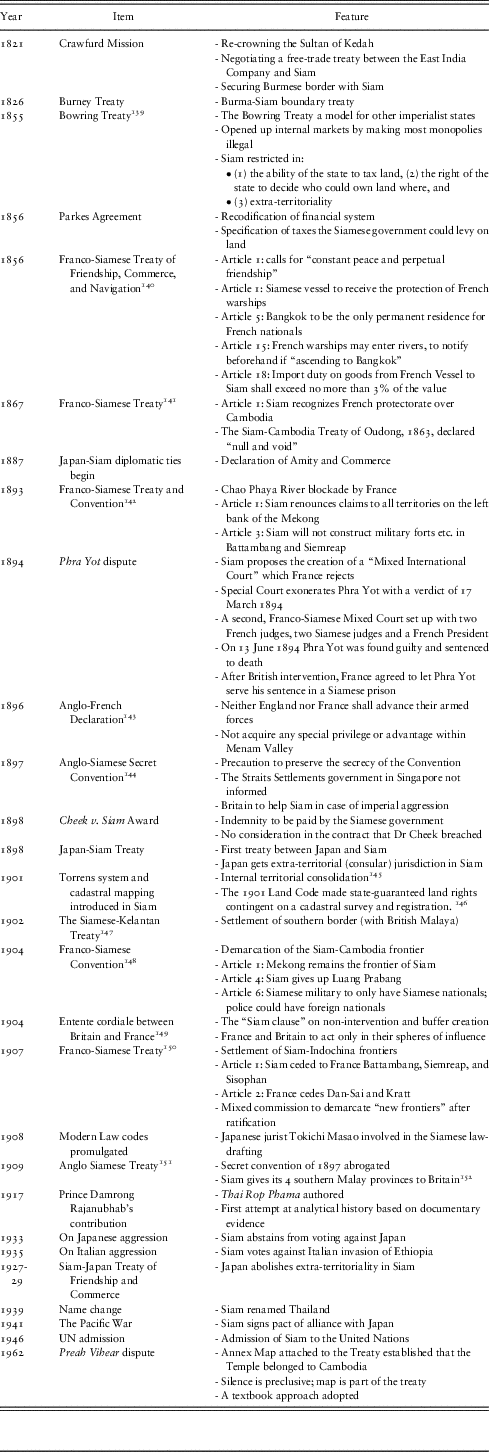
Footnote 150 Footnote 151 Footnote 152 Within positive international law, the production of colonial stationery such as photographs and cartography translate into the creation of a relative scarcity of evidence at international courts for territorial claims in erstwhile semi-colonial polities. In effect, Cambodia’s mimicking of colonial opportunism by using French colonial stationery represents an abdication of Siamese conceptions of space in favour of a colonial conception of territory. The artificial scarcity of colonial stationery in semi-colonies resulted in Thailand losing is claim over the Temple and surrounding territory. Nevertheless, having realized the value of maps as evidence, rising Asian powers display a cartographic aggression to sustain newly acquired imperial ambitions.Footnote 153 Even so, international law appears to be conclusively biased in favour of erstwhile colonial polities that are a product of colonial rule, while disadvantaging semi-colonial nations like Siam that managed to remain independent (Table 1).
International law during the Bangkok period (1821–1962).