





1. Introduction
Magnetic confinement fusion reactors will operate at higher plasma pressure than most present-day experiments. However, advanced contemporary devices can already explore regimes that aim at reactor conditions (Keilhacker et al. Reference Keilhacker1999; Knolker et al. Reference Knolker2021; Gong et al. Reference Gong2024; Maggi et al. Reference Maggi2024), featuring substantial density and temperature gradients, at high plasma $\beta =8\pi p/B^2,$
the ratio of plasma to magnetic pressure. In such regimes, the mechanisms regulating turbulent transport, which manifest themselves in the form of microinstabilities, undergo significant changes. A widely accepted picture on finite-
$\beta =8\pi p/B^2,$
the ratio of plasma to magnetic pressure. In such regimes, the mechanisms regulating turbulent transport, which manifest themselves in the form of microinstabilities, undergo significant changes. A widely accepted picture on finite- $\beta$
effects on electrostatic microinstabilities has emerged. It is now believed that the electrostatic ion-temperature-gradient driven instability (Rudakov & Sagdeev Reference Rudakov and Sagdeev1961; Coppi, Rosenbluth & Sagdeev Reference Coppi, Rosenbluth and Sagdeev1967) can be stabilised in the presence of electromagnetic perturbations (Kim, Horton & Dong Reference Kim, Horton and Dong1993; Zocco, Helander & Connor Reference Zocco, Helander and Connor2015) enabled by finite-
$\beta$
effects on electrostatic microinstabilities has emerged. It is now believed that the electrostatic ion-temperature-gradient driven instability (Rudakov & Sagdeev Reference Rudakov and Sagdeev1961; Coppi, Rosenbluth & Sagdeev Reference Coppi, Rosenbluth and Sagdeev1967) can be stabilised in the presence of electromagnetic perturbations (Kim, Horton & Dong Reference Kim, Horton and Dong1993; Zocco, Helander & Connor Reference Zocco, Helander and Connor2015) enabled by finite- $\beta .$
This is consistently observed in gyrokinetic (GK) simulations (Pueschel, Kammerer & Jenko Reference Pueschel, Kammerer and Jenko2008; Aleynikova & Zocco Reference Aleynikova and Zocco2017). As
$\beta .$
This is consistently observed in gyrokinetic (GK) simulations (Pueschel, Kammerer & Jenko Reference Pueschel, Kammerer and Jenko2008; Aleynikova & Zocco Reference Aleynikova and Zocco2017). As $\beta$
increases even further, however, the plasma conditions become dangerously close to destabilising a high-mode-number, pressure-driven, ideal magnetohydrodynamic (MHD) instability: the ballooning mode (Kulsrud Reference Kulsrud1966; Connor, Hastie & Taylor Reference Connor, Hastie and Taylor1978; Correa-Restrepo Reference Correa-Restrepo1978). Ballooning modes are particularly deleterious. Firstly, because they evolve on a much faster time scale than that of microinstabilities, the former being typically Alfvénic, the latter diamagnetic. Secondly, since their nonlinear evolution is often associated with the triggering of nearly explosive detrimental events, known as edge-localised modes (Zohm Reference Zohm1996; Connor Reference Connor1998). Furthermore, the nonlinear energy losses associated with ballooning modes (or rather their kinetic equivalent, which we will soon address) turned out to be non-negligible, even at
$\beta$
increases even further, however, the plasma conditions become dangerously close to destabilising a high-mode-number, pressure-driven, ideal magnetohydrodynamic (MHD) instability: the ballooning mode (Kulsrud Reference Kulsrud1966; Connor, Hastie & Taylor Reference Connor, Hastie and Taylor1978; Correa-Restrepo Reference Correa-Restrepo1978). Ballooning modes are particularly deleterious. Firstly, because they evolve on a much faster time scale than that of microinstabilities, the former being typically Alfvénic, the latter diamagnetic. Secondly, since their nonlinear evolution is often associated with the triggering of nearly explosive detrimental events, known as edge-localised modes (Zohm Reference Zohm1996; Connor Reference Connor1998). Furthermore, the nonlinear energy losses associated with ballooning modes (or rather their kinetic equivalent, which we will soon address) turned out to be non-negligible, even at $\beta$
below the linear destabilising threshold (Mulholland et al. Reference Mulholland, Aleynikova, Faber, Pueschel, Proll, Hegna, Terry and Nührenberg2023). To complicate the picture, the transition from stabilised ion-temperature-gradient to destabilised kinetic ballooning modes (KBMs) often occurs at
$\beta$
below the linear destabilising threshold (Mulholland et al. Reference Mulholland, Aleynikova, Faber, Pueschel, Proll, Hegna, Terry and Nührenberg2023). To complicate the picture, the transition from stabilised ion-temperature-gradient to destabilised kinetic ballooning modes (KBMs) often occurs at $\beta$
for which the effects of trapped electrons are not negligible (Pueschel et al. Reference Pueschel, Kammerer and Jenko2008; Merz & Jenko Reference Merz and Jenko2010; Aleynikova & Zocco Reference Aleynikova and Zocco2017; Aleynikova et al. Reference Aleynikova, Zocco, Xanthopoulos, Helander and Nührenberg2018, Reference Aleynikova, Zocco and Geiger2022).
$\beta$
for which the effects of trapped electrons are not negligible (Pueschel et al. Reference Pueschel, Kammerer and Jenko2008; Merz & Jenko Reference Merz and Jenko2010; Aleynikova & Zocco Reference Aleynikova and Zocco2017; Aleynikova et al. Reference Aleynikova, Zocco, Xanthopoulos, Helander and Nührenberg2018, Reference Aleynikova, Zocco and Geiger2022).
To date, our understanding of the physics of trapped electrons (Kadomtsev & Pogutse Reference Kadomtsev and Pogutse1970) is mostly based on electrostatic results (Helander, Proll & Plunk Reference Helander, Proll and Plunk2013). These have been extremely important in the description of particle transport both in tokamaks (Angioni et al. Reference Angioni, Fable, Greenwald, Maslov, Peeters, Takenaga and Weisen2009; Happel et al. Reference Happel2015) and stellarators (Helander & Zocco Reference Helander and Zocco2018), and in the assessment of the properties of turbulence in optimised stellarators (Proll, Xanthopoulos & Helander Reference Proll, Xanthopoulos and Helander2013; García-Regaña et al. Reference García-Regaña, Calvo, Sánchez, Thienpondt, Velasco and Capitán2024; Goodman et al. Reference Goodman, Xanthopoulos, Plunk, Smith, Nührenberg, Beidler, Henneberg, Roberg-Clark, Drevlak and Helander2024; Rodríguez et al. Reference Rodríguez, Helander and Goodman2024). However, the persistence of trapped-electron effects at finite $\beta$
in GK simulations, and the high-
$\beta$
in GK simulations, and the high- $\beta$
requirements in a stellarator like Wendelstein 7-X to achieve good trapped-electron properties (Lotz et al. Reference Lotz, Merkel, Nührenberg and Zille1990, Reference Lotz, Merkel, Nuhrenberg and Strumberger1992) [for the so-called max-
$\beta$
requirements in a stellarator like Wendelstein 7-X to achieve good trapped-electron properties (Lotz et al. Reference Lotz, Merkel, Nührenberg and Zille1990, Reference Lotz, Merkel, Nuhrenberg and Strumberger1992) [for the so-called max- $\mathcal J$
configurations (Rosenbluth Reference Rosenbluth1968)] put in doubt any electrostatic analysis.
$\mathcal J$
configurations (Rosenbluth Reference Rosenbluth1968)] put in doubt any electrostatic analysis.
Analytical studies of electromagnetic trapped electron instabilities are extremely rare in the literature (Rosenbluth & Sloan Reference Rosenbluth and Sloan1971). Rosenbluth & Sloan (Reference Rosenbluth and Sloan1971) famously proved what they defined ‘a clairvoyant’ prediction of John B. Taylor on the trapped-particle stabilisation of microinstabilities. Their result is based (but surely does not depend) on a peculiar choice for the electromagnetic gauge, which renders the analysis opaque. The Rosenbluth–Sloan formulation was put in relation to what then became the standard approach in KBM studies by Tang, Connor and Hastie (Tang, Connor & Hastie Reference Tang, Connor and Hastie1980), who, however, overtly admit that: ‘if trapped particles contributions are retained, it becomes considerably more complicated to obtain a single eigenmode equation’ for the KBM. This, of course, did not stop the authors from actually deriving what they stated was virtually impossible to derive [see their (3.42) in Tang et al. (Reference Tang, Connor and Hastie1980)], but their result remained somehow in fieri and not fully explored, in particular if is considered in relation to ideal MHD short-wavelength instabilities.
Kinetic effects on ideal (MHD) instabilities have been investigated in a number of highly influential works (Kruskal & Oberman Reference Kruskal and Oberman1958; Rosenbluth & Rostoker Reference Rosenbluth and Rostoker1959) in which several modifications of a variational MHD principle, first proposed by Mercier (Reference Mercier1960) and Mercier & Luc (Reference Mercier and Luc1974), were put forward. Within these theories, the role of trapped particles was emphasised by Connor & Hastie (Reference Connor and Hastie1974).
The advent of GKs in toroidal geometry (Antonsen & Lane Reference Antonsen and Lane1980; Tang et al. Reference Tang, Connor and Hastie1980) allowed for considerable analytical progress. In this context, Antonsen et al. (Reference Antonsen, Lane and Ramos1981) proposed an alternative variational principle which subverted conventional knowledge regarding the possibility of having pressure-driven instabilities even if the diamagnetic and the curvature drift frequencies of a species under consideration have opposite signs. The new result had to be ascribed to the electromagnetic response of trapped electrons. Here, we identify new results that could be considered in line with the findings of Antonsen et al. (Reference Antonsen, Lane and Ramos1981).
It is clear that while high-order corrections in a perturbative expansion for small magnetic drifts are necessary to reproduce ideal MHD results (Tang et al. Reference Tang, Connor and Hastie1980; Aleynikova & Zocco Reference Aleynikova and Zocco2017), it is not obvious to predict: (i) what is the electromagnetic trapped-electrons resonant contribution when no fluid (non-resonant) effect can provide destabilisation, like for the regular strongly driven KBM (Aleynikova & Zocco Reference Aleynikova and Zocco2017) and/or ideal ballooning modes (Connor et al. Reference Connor, Hastie and Taylor1978); (ii) what are the actual constraints on the plasma pressure that determine the validity of the Tang–Connor–Hastie (TCH) trapped-electrons-modified KBM equation; (iii) how do electrons participate to the interchange physical mechanism that drives KBMs unstable; (iv) what is the impact of the symmetries of magnetic curvature, for different families on confining devices, in relation to the destabilisation of finite- $\beta$
trapped-electron modes (TEMs). In this work, we address these problems.
$\beta$
trapped-electron modes (TEMs). In this work, we address these problems.
2. Basic equations
We aim to describe a magnetised plasma’s electromagnetic perturbations satisfying the GK ordering. The perturbed distribution functions of the plasma species will then follow the GK equation (Hastie & Taylor Reference Hastie and Taylor1964; Frieman & Chen Reference Frieman and Chen1982). These couple the plasma dynamics to the electromagnetic fields, which are determined by Maxwell’s equations. The resulting equations are now presented in their general form.
Let us start with the description of the perturbation of the plasma. For a species $s$
with electric charge
$s$
with electric charge $e_{s}$
and equilibrium temperature and density
$e_{s}$
and equilibrium temperature and density $T_{0s}$
and
$T_{0s}$
and $n_{0s}$
, we consider perturbations around an equilibrium distribution function,
$n_{0s}$
, we consider perturbations around an equilibrium distribution function, $F_{0s},$
taken to be Maxwellian. We formally separate the fluctuating distribution function
$F_{0s},$
taken to be Maxwellian. We formally separate the fluctuating distribution function $\delta f_s,$
and write
$\delta f_s,$
and write $f_{s}=F_{0s}+\delta f_{s}\equiv F_{0s}(1-e_{s}\varphi (\boldsymbol{r},t)/T_{0s})+h_{s}(\boldsymbol{R}_{s},\mu ,\mathcal{E},t)+{O}(\epsilon ^{2}),$
where
$f_{s}=F_{0s}+\delta f_{s}\equiv F_{0s}(1-e_{s}\varphi (\boldsymbol{r},t)/T_{0s})+h_{s}(\boldsymbol{R}_{s},\mu ,\mathcal{E},t)+{O}(\epsilon ^{2}),$
where $\delta f_{s}/F_{0s}\sim k_{\parallel }/k_{\perp }\sim \rho _*\equiv \epsilon \ll 1,$
where
$\delta f_{s}/F_{0s}\sim k_{\parallel }/k_{\perp }\sim \rho _*\equiv \epsilon \ll 1,$
where $k_{\parallel }$
and
$k_{\parallel }$
and $k_{\perp }$
are wavevectors of the perturbation along and across the equilibrium magnetic field, and
$k_{\perp }$
are wavevectors of the perturbation along and across the equilibrium magnetic field, and $\rho _*$
is the ratio of the Larmor radius to a macroscopic length. This is the GK ordering. Here
$\rho _*$
is the ratio of the Larmor radius to a macroscopic length. This is the GK ordering. Here $\boldsymbol{R}_{s}=\boldsymbol{r}+\boldsymbol{v}_{\perp }\times \boldsymbol{b}/\varOmega _{s}$
is the gyrocentre position,
$\boldsymbol{R}_{s}=\boldsymbol{r}+\boldsymbol{v}_{\perp }\times \boldsymbol{b}/\varOmega _{s}$
is the gyrocentre position, $\boldsymbol{r}$
is the particle position,
$\boldsymbol{r}$
is the particle position, $\varOmega _{s}=e_{s}B/(m_{s}c)$
the cyclotron frequency and
$\varOmega _{s}=e_{s}B/(m_{s}c)$
the cyclotron frequency and $\boldsymbol{b}=\boldsymbol{B}/B,$
where
$\boldsymbol{b}=\boldsymbol{B}/B,$
where $\boldsymbol{B}$
is the equilibrium magnetic field. The fluctuating, non-adiabatic part of the distribution function follows the GK equation (Frieman & Chen Reference Frieman and Chen1982)
$\boldsymbol{B}$
is the equilibrium magnetic field. The fluctuating, non-adiabatic part of the distribution function follows the GK equation (Frieman & Chen Reference Frieman and Chen1982)
 \begin{align} \left (\frac {\partial }{\partial t}+v_{\parallel }\boldsymbol{\nabla} _{\parallel }+\boldsymbol{v}_{d,s}\boldsymbol{\cdot }\boldsymbol{\nabla }\right )h_{s} & =\frac {e_{s}F_{0s}}{T_{0s}}\frac {\partial }{\partial t}\left \langle {\varPsi }\right \rangle _{\boldsymbol{R}_{s}} \nonumber \\[4pt]& -\frac {c}{B}\boldsymbol{b}\boldsymbol{\cdot }\boldsymbol{\nabla }\left \langle {\varPsi }\right \rangle _{\boldsymbol{R}_{s}}\times \boldsymbol{\nabla }F_{0s}-\frac {c}{B}\boldsymbol{b}\boldsymbol{\cdot }\boldsymbol{\nabla }\left \langle {\varPsi }\right \rangle _{\boldsymbol{R}_{s}}\times \boldsymbol{\nabla }h_{s}. \end{align}
The perturbed electromagnetic fields are encapsulated in ${\varPsi }=\varphi -\boldsymbol{v}\boldsymbol{\cdot }\boldsymbol{A}/c$
, where
${\varPsi }=\varphi -\boldsymbol{v}\boldsymbol{\cdot }\boldsymbol{A}/c$
, where $\varphi$
and
$\varphi$
and $\boldsymbol{A}$
are the perturbed electrostatic and magnetic vector potentials, and
$\boldsymbol{A}$
are the perturbed electrostatic and magnetic vector potentials, and $\left \langle {\varPsi }\right \rangle _{\boldsymbol{R}_{s}}=\sum _{\boldsymbol{k}}\left \langle {\varPsi }\right \rangle _{\boldsymbol{R}_{s},\boldsymbol{k}}\exp ( i\boldsymbol{k}\boldsymbol{\cdot }\boldsymbol{R_{s}}).$
Assuming gradients of
$\left \langle {\varPsi }\right \rangle _{\boldsymbol{R}_{s}}=\sum _{\boldsymbol{k}}\left \langle {\varPsi }\right \rangle _{\boldsymbol{R}_{s},\boldsymbol{k}}\exp ( i\boldsymbol{k}\boldsymbol{\cdot }\boldsymbol{R_{s}}).$
Assuming gradients of $\beta =8 \pi p/B^2$
to be sufficiently small to neglect magnetic compressibility (Zocco et al. Reference Zocco, Helander and Connor2015), we write
$\beta =8 \pi p/B^2$
to be sufficiently small to neglect magnetic compressibility (Zocco et al. Reference Zocco, Helander and Connor2015), we write $\left \langle {\varPsi }\right \rangle _{\boldsymbol{R}_{s},\boldsymbol{k}}=J_{0}(a_{s})(\varphi _{\boldsymbol{k}}-v_\parallel A_{\parallel ,\boldsymbol{k}}/c)$
, where the Fourier components (in
$\left \langle {\varPsi }\right \rangle _{\boldsymbol{R}_{s},\boldsymbol{k}}=J_{0}(a_{s})(\varphi _{\boldsymbol{k}}-v_\parallel A_{\parallel ,\boldsymbol{k}}/c)$
, where the Fourier components (in $\boldsymbol{r}$
) of the field potentials are used.Footnote
1
The Bessel function
$\boldsymbol{r}$
) of the field potentials are used.Footnote
1
The Bessel function $J_{0}=J_{0}(a_{s}),$
with
$J_{0}=J_{0}(a_{s}),$
with $a^2_{s}=(v_\perp k_{\perp }/\varOmega _{s})^{2}$
, relates the coefficients of the Fourier expansion of the fields in real space with that in gyrocentre coordinates. The velocity space variables are chosen to be
$a^2_{s}=(v_\perp k_{\perp }/\varOmega _{s})^{2}$
, relates the coefficients of the Fourier expansion of the fields in real space with that in gyrocentre coordinates. The velocity space variables are chosen to be $\mu =v_{\perp }^{2}/2B$
and
$\mu =v_{\perp }^{2}/2B$
and $\mathcal{E}=v^{2}/2$
, so that the magnetic drift takes the form
$\mathcal{E}=v^{2}/2$
, so that the magnetic drift takes the form $\boldsymbol{v}_{ds}=\boldsymbol{b}\times [\mu \boldsymbol{\nabla }B+v_{\parallel }^{2}(\boldsymbol{b}\boldsymbol{\cdot }\boldsymbol{\nabla })\boldsymbol{b}]/\varOmega _{s},$
where
$\boldsymbol{v}_{ds}=\boldsymbol{b}\times [\mu \boldsymbol{\nabla }B+v_{\parallel }^{2}(\boldsymbol{b}\boldsymbol{\cdot }\boldsymbol{\nabla })\boldsymbol{b}]/\varOmega _{s},$
where $v_{\parallel }=\sqrt {2(\mathcal{E}-\mu B)}$
(Helander & Sigmar Reference Helander and Sigmar2005).
$v_{\parallel }=\sqrt {2(\mathcal{E}-\mu B)}$
(Helander & Sigmar Reference Helander and Sigmar2005).
We then invoke quasineutrality,
 \begin{align} \sum _s e_s\int \left \langle h_s\right \rangle _{\boldsymbol{r}}\mathrm{d}^3\boldsymbol{v}=\left (\sum _s\frac {e_s^2n_{0s}}{T_{0s}}\right )\varphi , \end{align}
that is, the electrostatic potential $\varphi$
must be set up in a way consistent with no net charge accumulation. The
$\varphi$
must be set up in a way consistent with no net charge accumulation. The $A_\parallel$
part of the electromagnetic perturbation can be directly related to the parallel current, and thus the parallel component of Ampère’s law,
$A_\parallel$
part of the electromagnetic perturbation can be directly related to the parallel current, and thus the parallel component of Ampère’s law,
 \begin{align} \boldsymbol{\nabla} _{\perp }^{2}A_{\parallel }=-\frac {4\pi }{c}\sum _{s}e_{s}\int \text{d}^{3}\boldsymbol{v}v_{\parallel }\left \langle h_{s}\right \rangle _{{\boldsymbol{r}}}\!, \end{align}
where the right-hand side can be read as $-(4\pi /c)j_\parallel$
, where
$-(4\pi /c)j_\parallel$
, where $j_\parallel$
is the parallel current. The perpendicular component of Ampère’s law would link the compressible
$j_\parallel$
is the parallel current. The perpendicular component of Ampère’s law would link the compressible $\delta \!B_\parallel$
response to the perpendicular current, but we do not require it explicitly following the ordering in
$\delta \!B_\parallel$
response to the perpendicular current, but we do not require it explicitly following the ordering in $\beta$
that we will adopt.Footnote
2
$\beta$
that we will adopt.Footnote
2
3. Linear theory
The goal is now to find the linear modes of (2.1)–(2.3) as an eigenvalue equation in $\omega$
for the perturbations, assumed to evolve as
$\omega$
for the perturbations, assumed to evolve as $\exp (-i\omega t).$
The derivation follows closely the approach of Tang et al. (Reference Tang, Connor and Hastie1980), but here we evaluate explicitly the trapped-electron resonant response, and take advantage of more recent results for the ion fluid and resonant terms (Aleynikova & Zocco Reference Aleynikova and Zocco2017; Zocco et al. Reference Zocco, Xanthopoulos, Doerk, Connor and Helander2018). To that end, let us use the linearised form of the GK equation (Catto Reference Catto1978; Connor et al. Reference Connor, Hastie and Taylor1978; Antonsen & Lane Reference Antonsen and Lane1980; Tang et al. Reference Tang, Connor and Hastie1980), (2.1), to express the field equations, (2.2)–(2.3), in terms solely of the perturbed fields. By inspecting these field equations (2.2)–(2.3), we note that we only require two moments of the perturbed distribution function: the density and the parallel momentum.
$\exp (-i\omega t).$
The derivation follows closely the approach of Tang et al. (Reference Tang, Connor and Hastie1980), but here we evaluate explicitly the trapped-electron resonant response, and take advantage of more recent results for the ion fluid and resonant terms (Aleynikova & Zocco Reference Aleynikova and Zocco2017; Zocco et al. Reference Zocco, Xanthopoulos, Doerk, Connor and Helander2018). To that end, let us use the linearised form of the GK equation (Catto Reference Catto1978; Connor et al. Reference Connor, Hastie and Taylor1978; Antonsen & Lane Reference Antonsen and Lane1980; Tang et al. Reference Tang, Connor and Hastie1980), (2.1), to express the field equations, (2.2)–(2.3), in terms solely of the perturbed fields. By inspecting these field equations (2.2)–(2.3), we note that we only require two moments of the perturbed distribution function: the density and the parallel momentum.
3.1. The TCH equation
Having to find both even and odd (in $v_\parallel$
) moments of the distribution function increases the complexity of the problem, requiring us to solve for both parity parts of
$v_\parallel$
) moments of the distribution function increases the complexity of the problem, requiring us to solve for both parity parts of $h$
. However, there is a way around this, in which the odd parallel current moment can be expressed fully in terms of even ones. This approach was originally presented in the work of Tang et al. (Reference Tang, Connor and Hastie1980), and leads to an equation for the perturbed parallel current that we shall refer to as the TCH equation (Tang et al. Reference Tang, Connor and Hastie1980). Some conceptual steps are required (Antonsen & Lane Reference Antonsen and Lane1980; Tang et al. Reference Tang, Connor and Hastie1980), and we briefly review them. First, one considers an eikonal representation for the distribution function
$h$
. However, there is a way around this, in which the odd parallel current moment can be expressed fully in terms of even ones. This approach was originally presented in the work of Tang et al. (Reference Tang, Connor and Hastie1980), and leads to an equation for the perturbed parallel current that we shall refer to as the TCH equation (Tang et al. Reference Tang, Connor and Hastie1980). Some conceptual steps are required (Antonsen & Lane Reference Antonsen and Lane1980; Tang et al. Reference Tang, Connor and Hastie1980), and we briefly review them. First, one considers an eikonal representation for the distribution function $h(\boldsymbol R,\mathcal E,\mu ,t)=\hat {h}(\boldsymbol R,\mathcal E,\mu ,t)\exp [iS(\boldsymbol R)],$
and for all fields, with
$h(\boldsymbol R,\mathcal E,\mu ,t)=\hat {h}(\boldsymbol R,\mathcal E,\mu ,t)\exp [iS(\boldsymbol R)],$
and for all fields, with $\hat {\boldsymbol{b}} \boldsymbol{\cdot }\boldsymbol{\nabla }S =0,$
and
$\hat {\boldsymbol{b}} \boldsymbol{\cdot }\boldsymbol{\nabla }S =0,$
and $|\boldsymbol{\nabla }S|\hat {h}/|\boldsymbol{\nabla }\hat {h}|\sim \rho _*^{-1}\gg 1.$
Thus, equilibrium quantities are considered slowly varying (they will be expanded locally in our case) and the fast variations across the equilibrium field are contained in the function
$|\boldsymbol{\nabla }S|\hat {h}/|\boldsymbol{\nabla }\hat {h}|\sim \rho _*^{-1}\gg 1.$
Thus, equilibrium quantities are considered slowly varying (they will be expanded locally in our case) and the fast variations across the equilibrium field are contained in the function $S$
; i.e. one uses the ballooning transform (Connor et al. Reference Connor, Hastie and Taylor1978; Antonsen & Lane Reference Antonsen and Lane1980; Tang et al. Reference Tang, Connor and Hastie1980). We define
$S$
; i.e. one uses the ballooning transform (Connor et al. Reference Connor, Hastie and Taylor1978; Antonsen & Lane Reference Antonsen and Lane1980; Tang et al. Reference Tang, Connor and Hastie1980). We define $ \boldsymbol{k}_{\perp }\equiv \boldsymbol{\nabla }S,$
and simply relabel
$ \boldsymbol{k}_{\perp }\equiv \boldsymbol{\nabla }S,$
and simply relabel $\hat {h}=h_{\boldsymbol{k}}$
as is customary. This way, the streaming term in (2.1),
$\hat {h}=h_{\boldsymbol{k}}$
as is customary. This way, the streaming term in (2.1), $v_{\parallel }\boldsymbol{\nabla} _{\parallel },$
generates a first-order differential operator in the field-following coordinate acting on
$v_{\parallel }\boldsymbol{\nabla} _{\parallel },$
generates a first-order differential operator in the field-following coordinate acting on $h_{\boldsymbol{k}}(\boldsymbol R,\mathcal E,\mu ,t)$
which will play a key role.
$h_{\boldsymbol{k}}(\boldsymbol R,\mathcal E,\mu ,t)$
which will play a key role.
One then takes the following moment of the GK equation:
 \begin{align} \int \mathrm{d}^3\boldsymbol{v}=\sum _\sigma \int _0^{2\pi }\text{d}\vartheta \int \mathrm{d}\mu \mathrm{d}\mathcal{E}\frac { B}{|v_\parallel |}\equiv \sum _\sigma \int \mathrm{d}\mu \mathrm{d}\mathcal{E}\frac {2\pi B}{|v_\parallel |}\langle \rangle _{\boldsymbol r} \end{align}
where $\sigma =\mathrm{sgn}[v_\parallel ]$
, and
$\sigma =\mathrm{sgn}[v_\parallel ]$
, and $\vartheta$
is the gyrophase, that is the angle spanned by the particles during their gyromotion. The operation of gyroaverage ‘at constant
$\vartheta$
is the gyrophase, that is the angle spanned by the particles during their gyromotion. The operation of gyroaverage ‘at constant $\boldsymbol r$
’ is needed in order to relate moments of the GK function to the fields in the perturbed Maxwell equations, which are evaluated at their physical spatial location. This also means rewriting
$\boldsymbol r$
’ is needed in order to relate moments of the GK function to the fields in the perturbed Maxwell equations, which are evaluated at their physical spatial location. This also means rewriting $S(\boldsymbol{R})\approx S(\boldsymbol{r}) +\boldsymbol{k}_\perp \boldsymbol{\cdot }\boldsymbol{v}_\perp \times \hat {\boldsymbol{b}}/\varOmega _s$
, which upon gyroaveraging yields a Bessel function.Footnote
3
$S(\boldsymbol{R})\approx S(\boldsymbol{r}) +\boldsymbol{k}_\perp \boldsymbol{\cdot }\boldsymbol{v}_\perp \times \hat {\boldsymbol{b}}/\varOmega _s$
, which upon gyroaveraging yields a Bessel function.Footnote
3
Among all the terms in the GK equation, it is the moment of the streaming term (the only odd-in- $v_\parallel$
term) that leads to the perturbed current as follows:
$v_\parallel$
term) that leads to the perturbed current as follows:
 \begin{align} \sum _{s}e_{s}&\int \mathrm{d}^3\boldsymbol{v}{e^{i\boldsymbol k_{\perp }\boldsymbol{\cdot } {(({\boldsymbol v_{\perp }\times \hat {\boldsymbol b}})/{\varOmega _s})}}}\frac {v_{\parallel }}{B\sqrt {g}}\frac {\partial }{\partial \chi }h_{s,\boldsymbol{k}}= \sum _{s,\sigma }2\pi \sigma e_{s}\int \mathrm{d}\mathcal{E}d\mu J_{0}\frac {1}{\sqrt {g}}\frac {\partial }{\partial \chi }h_{s,\boldsymbol{k}}\nonumber \\[4pt] & =\sum _{s,\sigma }2\pi \sigma e_{s}\int \mathrm{d}\mathcal{E}d\mu \left (\frac {1}{\sqrt {g}}\frac {\partial }{\partial \chi }J_{0}h_{s,\boldsymbol{k}}-\frac {h_{s,\boldsymbol{k}}}{\sqrt {g}}\frac {\partial }{\partial \chi }J_{0}\right )\nonumber \\[4pt] & =\frac {1}{\sqrt {g}}\frac {\partial }{\partial \chi }\underbrace {\sum _{s,\sigma }2\pi \sigma \int \text{d}\mathcal{E}\text{d}\mu J_{0}h_{s,\boldsymbol{k}}}_{=j_{\parallel ,\boldsymbol{k}}/B}-\frac {1}{\sqrt {g}}\sum _{s,\sigma }2\pi \sigma \int \text{d}\mathcal{E}\,\text{d}\mu J_0 h_{s,\boldsymbol{k}}\frac {\partial }{\partial \chi }\ln J_{0}\nonumber \\[4pt] & \approx \frac {1}{\sqrt {g}}\frac {\partial }{\partial \chi }\left (\frac {j_{\parallel ,\boldsymbol{k}}}{B}\right )\!, \end{align}
with $\sqrt {g}=(\boldsymbol{B}\boldsymbol{\cdot }\boldsymbol{\nabla }\chi )^{-1},$
the Jacobian of the coordinates, and
$\sqrt {g}=(\boldsymbol{B}\boldsymbol{\cdot }\boldsymbol{\nabla }\chi )^{-1},$
the Jacobian of the coordinates, and $\chi$
a field line following coordinate, which we keep general. To get to the last line, we dropped the second term at the penultimate one, which is a small correction to the leading term, which is dominated by the electrons, due to their small mass. This statement will be made more quantitative once the solution for the distribution functions of each species is specified.
$\chi$
a field line following coordinate, which we keep general. To get to the last line, we dropped the second term at the penultimate one, which is a small correction to the leading term, which is dominated by the electrons, due to their small mass. This statement will be made more quantitative once the solution for the distribution functions of each species is specified.
The moment of all other terms in the GK equation involve only the even parity part of $h$
, and lead to the nonlinear counterpart of the TCH equation,
$h$
, and lead to the nonlinear counterpart of the TCH equation,
 \begin{align} \frac {1}{\sqrt {g}}\frac {\partial }{\partial \chi }\left (\frac {j_{\parallel ,\boldsymbol{k}}}{B}\right )=&-\sum _{s}\frac {e_{s}^{2}}{T_{0s}}\int \text{d}^{3}\boldsymbol{v}F_{0s}\left \{ \frac {\partial }{\partial t}\left (1-J_{0}^{2}\right )\varphi _{\boldsymbol{k}}-i\omega _{*,s}^{T}J_{0}^{2}\varphi _{\boldsymbol{k}}\right \} \nonumber \\ &-i\sum _{s}e_{s}\int \text{d}^{3}\boldsymbol{v}J_{0}\boldsymbol{k}_{\perp }\boldsymbol{\cdot }\boldsymbol{v}_{d,s}h_{s,\boldsymbol{k}}\nonumber \\ &-\sum _{s}e_{s}\int \text{d}^{3}\boldsymbol{v}\frac {c}{B}J_{0}\left (\frac {k_{\perp }v_{\perp }}{\varOmega _{s}}\right )\sum _{\boldsymbol{k^{\prime }}}\boldsymbol{\hat b}\boldsymbol{\cdot }\left (\boldsymbol{k}\times \boldsymbol{k^{\prime }}\right )J_{0}\left (\frac {k_{\perp }^{\prime }v_{\perp }}{\varOmega _{s}}\right ){\varPsi }_{\boldsymbol{k}^{\prime }}h_{s,\boldsymbol{k}-\boldsymbol{k}^{\prime }}, \end{align}
where $\omega _{*,s}^T=(c k_\alpha T_{0s}/e_s)\text{d}\log n_{0s}/\text{d}\psi \{1+\eta _s( m_s\mathcal E/T_{0s}-3/2)\}\equiv \omega _{*s}\{1+\eta _s( m_s\mathcal E/T_{0s}$ $-3/2)\},$
and
$-3/2)\},$
and $\eta _s=\text{d}\log T_{0s}/\text{d}\log n.$
We will consider conventional peaked profiles
$\eta _s=\text{d}\log T_{0s}/\text{d}\log n.$
We will consider conventional peaked profiles $\text{d}\log n_{0s}/\text{d}\psi \lt 0,$
with
$\text{d}\log n_{0s}/\text{d}\psi \lt 0,$
with $\psi \gt 0$
where
$\psi \gt 0$
where $\psi$
is the toroidal flux, and is used as a radial coordinate, while it is also useful to consider an equilibrium magnetic field of the form
$\psi$
is the toroidal flux, and is used as a radial coordinate, while it is also useful to consider an equilibrium magnetic field of the form $\boldsymbol B=\boldsymbol{\nabla }\psi \times \boldsymbol{\nabla }\alpha ,$
where
$\boldsymbol B=\boldsymbol{\nabla }\psi \times \boldsymbol{\nabla }\alpha ,$
where $\alpha$
is a scalar field whose spatial gradient is orthogonal to the twisted slice spanned by the line joining the magnetic axis and a given field line on a given surface defined by the equation
$\alpha$
is a scalar field whose spatial gradient is orthogonal to the twisted slice spanned by the line joining the magnetic axis and a given field line on a given surface defined by the equation $\psi (x,y,z)=\textit{const}.$
where
$\psi (x,y,z)=\textit{const}.$
where $(x,y,z)$
are the three-dimensional spatial coordinates.
$(x,y,z)$
are the three-dimensional spatial coordinates.
Now, we are in the position to use Ampère’s law, (2.3), to eliminate $j_{\parallel ,\boldsymbol{k}}$
in favour of
$j_{\parallel ,\boldsymbol{k}}$
in favour of $A_\parallel$
. Using
$A_\parallel$
. Using $\boldsymbol{\nabla} _\perp ^2 A_\parallel \rightarrow -k_\perp ^2A_{\parallel \boldsymbol{k}}=ik_\perp ^2(c/\omega B\sqrt {g})\partial _\chi \psi$
in the linearised TCH equation, using the perturbed ansatz
$\boldsymbol{\nabla} _\perp ^2 A_\parallel \rightarrow -k_\perp ^2A_{\parallel \boldsymbol{k}}=ik_\perp ^2(c/\omega B\sqrt {g})\partial _\chi \psi$
in the linearised TCH equation, using the perturbed ansatz $e^{-i\omega t}$
and multiplying through
$e^{-i\omega t}$
and multiplying through $i\omega$
, the equation reduces to (dropping all Fourier subindices)
$i\omega$
, the equation reduces to (dropping all Fourier subindices)
 \begin{align} & \frac {c^{2}}{2\pi \rho _{i,0}^{2}B_0^2}\frac {1}{\sqrt {g}}\frac {\partial }{\partial \chi }\left [\frac {b}{\sqrt {g}}\frac {\partial \psi }{\partial \chi }\right ] \nonumber \\[5pt]& =-\omega ^2\sum _{s}\frac {e_{s}^{2}}{T_{s}}\int \mathrm{d}^3\boldsymbol{v}F_{0s}\left [1-\left (1-\frac {\omega _{*s}^{T}}{\omega }\right )J_{0}^{2}\right ]\varphi +\omega \sum _{s}e_{s}\int \mathrm{d}^3\boldsymbol{v} J_{0}\omega _{ds}h_{s}, \end{align}
where we are using the notation $\omega _{ds}=\boldsymbol{k}_{\perp }\boldsymbol{\cdot }\boldsymbol{v}_{d,s}=2(\omega _{\boldsymbol{\nabla }B}\hat {v}_{\perp }^{2}/2+\omega _{\kappa s}\hat {v}_{\parallel }^{2}),$
with
$\omega _{ds}=\boldsymbol{k}_{\perp }\boldsymbol{\cdot }\boldsymbol{v}_{d,s}=2(\omega _{\boldsymbol{\nabla }B}\hat {v}_{\perp }^{2}/2+\omega _{\kappa s}\hat {v}_{\parallel }^{2}),$
with $2\omega _{\boldsymbol{\nabla }B}=\boldsymbol{k_{\perp }}\rho _{s}\boldsymbol{\cdot }\boldsymbol{b}\times (\boldsymbol{\nabla }B/B)v_{ths},$ $2\omega _{\kappa s}=\boldsymbol{k}_{\perp }\rho _{s}\boldsymbol{\cdot }\boldsymbol{b}\times (\boldsymbol{b}\boldsymbol{\cdot }\boldsymbol{\nabla })\boldsymbol{b}v_{ths}.$
Also
$2\omega _{\kappa s}=\boldsymbol{k}_{\perp }\rho _{s}\boldsymbol{\cdot }\boldsymbol{b}\times (\boldsymbol{b}\boldsymbol{\cdot }\boldsymbol{\nabla })\boldsymbol{b}v_{ths}.$
Also $b=k_{\perp }^{2}\rho _{i}^{2}/2,$
with
$b=k_{\perp }^{2}\rho _{i}^{2}/2,$
with $\rho _{i}=(B_{0}/B)\rho _{i,0},$
where
$\rho _{i}=(B_{0}/B)\rho _{i,0},$
where $B_0$
is a constant reference magnetic field. We will consider the potential
$B_0$
is a constant reference magnetic field. We will consider the potential $\psi$
instead of
$\psi$
instead of $A_\parallel .$
This is a more natural counterpart to the potential, as the parallel perturbed electric field reads
$A_\parallel .$
This is a more natural counterpart to the potential, as the parallel perturbed electric field reads $\delta \!E_\parallel =-\partial _\ell (\varphi -\psi ),$
but should be confused with the toroidal flux.
$\delta \!E_\parallel =-\partial _\ell (\varphi -\psi ),$
but should be confused with the toroidal flux.
3.2. Intermediate frequency regime
We have thus succeeded in reducing our field equations into a form that only involves even moments of the distribution function: the original quasineutrality equation in (2.2), and the TCH equation (3.4). We now need to find the even components of the distribution function solving the linearised GK equation. Under the intermediate frequency regime assumption,
 \begin{align} \omega ^{tr,b}_{i}\ll \omega \ll \omega ^{tr,b}_{e}, \end{align}
where $\omega ^{tr,b}_s$
are the transit and bounce frequencies for a given species, we may obtain closed forms for the even parts of the distribution functions [see Appendix A or Tang et al. (Reference Tang, Connor and Hastie1980)]. This ordering is useful for instabilities that do not give magnetic reconnection, or for the ion-scale solution of a reconnection problem, since the magnetic flux unfreezing is ordered out. The distributions are, for the ions (taking the ion charge to be unity),
$\omega ^{tr,b}_s$
are the transit and bounce frequencies for a given species, we may obtain closed forms for the even parts of the distribution functions [see Appendix A or Tang et al. (Reference Tang, Connor and Hastie1980)]. This ordering is useful for instabilities that do not give magnetic reconnection, or for the ion-scale solution of a reconnection problem, since the magnetic flux unfreezing is ordered out. The distributions are, for the ions (taking the ion charge to be unity),
 \begin{align} h_{i}=\frac {eF_{0i}}{T_{i}}\frac {\omega -\omega _{*i}^{T}}{\omega -\omega _{di}}J_{0}\varphi , \end{align}
the passing electrons
 \begin{align} h_{e,p}=-\frac {eF_{0e}}{T_{e}}\left (1-\frac {\omega _{*e}^{T}}{\omega }\right )\psi \end{align}
and the trapped electrons
 \begin{align} h_{e,tr}=-\frac {eF_{0e}}{T_{e}}\left \{ \left (1-\frac {\omega _{*e}^{T}}{\omega }\right )\psi +\frac {\omega -\omega _{*e}^{T}}{\omega -\overline {\omega }_{de}}\overline {\left [\varphi -\left (1-\frac {\omega _{de}}{\omega }\right )\psi \right ]}\right \}\!. \end{align}
We define the bounce average of any function $\mathcal{A}$
 \begin{align} \overline {\mathcal{A}}=\frac {\int _{tr.}\text{d}\chi ({B\sqrt {g}}/{v_{\parallel }})\mathcal{A}}{\int _{tr.}\text{d}\chi ({B\sqrt {g}}/{v_{\parallel }})}, \end{align}
where the integral is performed between two consecutive bounce points.
The given forms of the perturbed distribution functions allow us to say more about the parallel current density in the intermediate frequency regime. This is
 \begin{align} \begin{aligned} j_{\parallel }&=-e\int \text{d}^{3}\boldsymbol{v}v_{\parallel }\left (h_{e}^{(0)}+h_{e}^{(1)}+\cdots \right )+e\int \text{d}^{3}\boldsymbol{v}v_{\parallel }\big(h_{i}^{(0)}+h_{i}^{(1)}+\cdots \big)\\[5pt] & \quad \sim -e\int \text{d}^{3}\boldsymbol{v}v_{\parallel }\big(h_{e}^{(1)}+\cdots \big)+e\int \text{d}^{3}\boldsymbol{v}v_{\parallel }\big(h_{i}^{(1)}+\cdots \big)\\[5pt] & \quad \sim -e\int \text{d}^{3}\boldsymbol{v}v_{\parallel }\frac {\omega }{k_{\parallel }v_{\parallel }}h_{e}^{(0)}+e\int \text{d}^{3}\boldsymbol{v}v_{\parallel }\frac {k_{\parallel }v_{\parallel }}{\omega }h_{i}^{(0)}\\[5pt] & \quad \sim -en_{0}v_{the}\frac {\omega }{k_{\parallel }v_{the}}\psi +en_{0}\frac {k_{\parallel }v_{thi}}{\omega }v_{thi}\phi , \end{aligned} \end{align}
where we put in evidence the fact that the leading-order solutions (3.6) and (3.7) do not yield a parallel perturbed current density, but the first-order corrections (and the electromagnetic correction to the ion solution) do. However, considering the relative orderings in (3.10), one finds
 \begin{align} \psi \div \frac {k_{\parallel }^{2}v_{thi}^{2}}{\omega ^{2}}\phi . \end{align}
Thus, within the intermediate frequency approximation, $k_{\parallel }^2 v_{thi}^2\ll \omega ^2,$
the ion contribution to the perturbed parallel current density is a second-order correction. This justifies dropping any ion contribution to
$k_{\parallel }^2 v_{thi}^2\ll \omega ^2,$
the ion contribution to the perturbed parallel current density is a second-order correction. This justifies dropping any ion contribution to $j_\parallel$
in (3.2). To complete the simplification of the equation, the electron Larmor radius is effectively taken to be zero.
$j_\parallel$
in (3.2). To complete the simplification of the equation, the electron Larmor radius is effectively taken to be zero.
Alternative frequency regimes can of course be treated, and they have been. A notable case is the one of Zonca et al. (Reference Zonca, Chen and Santoro1996, Reference Zonca, Chen, Dong and Santoro1999), developed for simple axisymmetric geometries. Here a multiscale analysis for the eigenfunction provides an eigenvalue problem where the lower bound of our ordering is relaxed, i.e. $\omega _i^{tr,b}\sim \omega$
but, to leading-order, fields are expressed through (delocalised) sinusoidal and cosinusoidal functions of the field-following coordinate. This approach is of course not suited for all circumstances. Indeed, this multiscale analysis might not capture magnetic well localisation, in regimes where trapped electrons are important. For instance, Chavdarovski & Zonca (Reference Chavdarovski and Zonca2009) include some trapped-particles effects in their analysis, but their resonant electromagnetic contribution to quasineutrality cancels exactly owing to the specific type of eigenfunctions chosen. Instead, we allow for any structure to develop along the field line. The problem of field-line localisation, while retaining
$\omega _i^{tr,b}\sim \omega$
but, to leading-order, fields are expressed through (delocalised) sinusoidal and cosinusoidal functions of the field-following coordinate. This approach is of course not suited for all circumstances. Indeed, this multiscale analysis might not capture magnetic well localisation, in regimes where trapped electrons are important. For instance, Chavdarovski & Zonca (Reference Chavdarovski and Zonca2009) include some trapped-particles effects in their analysis, but their resonant electromagnetic contribution to quasineutrality cancels exactly owing to the specific type of eigenfunctions chosen. Instead, we allow for any structure to develop along the field line. The problem of field-line localisation, while retaining $\omega \sim \omega _{tr},$
was recently addressed by Rodríguez & Zocco (Reference Rodríguez and Zocco2025) in some specific regimes.
$\omega \sim \omega _{tr},$
was recently addressed by Rodríguez & Zocco (Reference Rodríguez and Zocco2025) in some specific regimes.
Let us then use these expressions explicitly in, first, the TCH equation, (3.4). Substituting in, rearranging terms and performing some of the integrals, one obtains
 \begin{align} \frac {v_A^2}{B_0^2}\frac {1}{\sqrt {g}}\frac {\partial }{\partial \chi }\left [\frac {b}{\sqrt {g}}\frac {\partial \psi }{\partial \chi }\right ]&=-\omega ^2\left [\left (1-\frac {\omega _{*i}}{\omega }\right ) \varphi -Q[\omega ]\varphi -\tau S[\omega ]\psi \right ] \nonumber \\[5pt]& \quad +\tau \omega \int _{tr.}\text{d}^{3}\boldsymbol{v}\frac {F_{0e}}{n_{0}}\omega _{de}\frac {\omega -\omega _{*e}^{T}}{\omega -\overline {\omega }_{de}}\overline {\left [\varphi -\left (1-\frac {\omega _{de}}{\omega }\right )\psi \right ]} , \end{align}
with $v_A^2=B_0^2/(4\pi m_i n_0)$
,
$v_A^2=B_0^2/(4\pi m_i n_0)$
, $\tau =T_i/T_e$
, defining
$\tau =T_i/T_e$
, defining
 \begin{align} Q[\omega ]=\int \text{d}^{3}\boldsymbol{v}\frac {F_{0i}}{n_{0}}J_{0}^{2}\frac {\omega -\omega _{*i}^{T}}{\omega -\omega _{di}}, \quad S[\omega ]=\int \text{d}^{3}\boldsymbol{v}\frac {F_{0e}}{n_{0}}\left (1-\frac {\omega _{*e}^{T}}{\omega }\right )\omega _{de}. \end{align}
The equation has been manipulated to express it in terms of the resonant ionic integral $Q$
, a well-known integral (Zocco et al. Reference Zocco, Xanthopoulos, Doerk, Connor and Helander2018). The non-resonant integrals over the equilibrium Maxwellian distributions constitute well-known Weber-type integrals that involve
$Q$
, a well-known integral (Zocco et al. Reference Zocco, Xanthopoulos, Doerk, Connor and Helander2018). The non-resonant integrals over the equilibrium Maxwellian distributions constitute well-known Weber-type integrals that involve $\varGamma _n(b)=e^{-b}I_n(b)$
, where
$\varGamma _n(b)=e^{-b}I_n(b)$
, where $I_n$
is the
$I_n$
is the $n$
th modified Bessel function of the first kind (see Appendix B.1).
$n$
th modified Bessel function of the first kind (see Appendix B.1).
We need to close the system with the quasineutrality equation. Substituting the different contributions of $h$
into (2.2), we obtain its electromagnetic form (Tang et al. Reference Tang, Connor and Hastie1980)
$h$
into (2.2), we obtain its electromagnetic form (Tang et al. Reference Tang, Connor and Hastie1980)
 \begin{align} \left (1-\frac {\omega _{*e}}{\omega }\right )\psi =\left (1+\frac {1}{\tau }-\frac {Q[\omega ]}{\tau }\right )\varphi -\int _{tr.}\text{d}^{3}\boldsymbol{v}\frac {F_{0e}}{n_{0}}\frac {\omega -\omega _{*e}^{T}}{\omega -\overline {\omega }_{de}}\overline {\left [\varphi -\left (1-\frac {\omega _{de}}{\omega }\right )\psi \right ]}. \end{align}
This form of the quasi-neutrality (QN) equation reduces to the electrostatic result for $\psi \rightarrow 0.$
Equations (3.12)–(3.14) constitute our system of equations to solve. They accommodate a fully electrostatic ion response and a fully electromagnetic response for passing electrons, as the kinetic solutions in (3.6) and (3.7) imply. The trapped-electrons population is affected by both electrostatic and electromagnetic perturbations, as the solution in (3.8) implies. Evaluating the electronic trapped integrals and $S[\omega ]$
explicitly (see Appendix B for definitions and derivations), the full eigenvalue resonant problem is then given by the following two equations:
$S[\omega ]$
explicitly (see Appendix B for definitions and derivations), the full eigenvalue resonant problem is then given by the following two equations:
 \begin{align} & \frac {v_{A}^{2}}{B_{0}^{2}}\frac {1}{\sqrt {g}}\frac {\partial }{\partial \chi }\left [\frac {b}{\sqrt {g}}\frac {\partial \psi }{\partial \chi }\right ] =-\omega ^{2}\left (\alpha _{0i} - Q[\omega ]\right ) \varphi +2\tau \alpha _{1e}\omega \omega _{\kappa e}\psi \nonumber\\[8pt] & +2\tau \omega \omega _{\kappa e}\int _{1/B_{max}}^{1/B}\frac {d\lambda B}{\sqrt {1-\lambda B}}\left (1-\frac {\lambda B}{2}\right )\left ( \alpha _{-3/2\,e}I_{e}^{(4)}-\eta _{e}\frac {\omega _{*e}}{\omega }I_{e}^{(6)}\right ) \left (\overline {\varphi }-\overline {\psi }\right )\nonumber\\[8pt] & +4\tau \omega \omega _{\kappa e}\int _{1/B_{max}}^{1/B}\frac {\text{d}\lambda B}{\sqrt {1-\lambda B}}\left (1-\frac {\lambda B}{2}\right )\left ( \alpha _{-3/2\,e}I_{e}^{(6)}-\eta _{e}\frac {\omega _{*e}}{\omega }I_{e}^{(8)}\right )\overline {\frac {\omega _{\kappa e}}{\omega }\left (1-\frac {\lambda B}{2}\right )\psi }, \end{align}
 \begin{align} \left (1-\frac {\omega _{*e}}{\omega }\right )\psi =&\left (1+\frac {1}{\tau }-\frac {Q[\omega ]}{\tau }\right )\varphi \nonumber\\[8pt] & -\int _{1/B_{max}}^{1/B}\frac {\text{d}\lambda B}{\sqrt {1-\lambda B}}\left (\alpha _{-3/2\,e}I_{e}^{(2)}-\eta _{e}\frac {\omega _{*e}}{\omega }I_{e}^{(4)}\right ) \left (\overline {\varphi }-\overline {\psi }\right )\nonumber\\[8pt] & -2\int _{1/B_{max}}^{1/B}\frac {\text{d}\lambda B}{\sqrt {1-\lambda B}}\left ( \alpha _{-3/2\,e}I_{e}^{(4)}-\eta _{e}\frac {\omega _{*e}}{\omega }I_{e}^{(6)}\right )\overline {\frac {\omega _{\kappa e}}{\omega }\left (1-\frac {\lambda B}{2}\right )\psi }, \end{align}
where we have borrowed from the notation of TCH, defining $\alpha _{ns}=1-\omega _{*s}(1+n\eta _s)/\omega .$
For the trapped integrals, we have introduced the useful velocity-space variable
$\alpha _{ns}=1-\omega _{*s}(1+n\eta _s)/\omega .$
For the trapped integrals, we have introduced the useful velocity-space variable $\lambda =\mu /\mathcal E$
that, among other things, allows us to write
$\lambda =\mu /\mathcal E$
that, among other things, allows us to write $\omega _{ds}=2\omega _{\kappa s}(v^2_{\perp }/2+v^2_{\parallel })/{v_{th_s}^2}=2\omega _{\kappa s}(1-\lambda B/2)v^2/v_{ths}^2.$
The electronic integrals,
$\omega _{ds}=2\omega _{\kappa s}(v^2_{\perp }/2+v^2_{\parallel })/{v_{th_s}^2}=2\omega _{\kappa s}(1-\lambda B/2)v^2/v_{ths}^2.$
The electronic integrals, $I_e^{(\alpha )},$
are defined in Appendix B.
$I_e^{(\alpha )},$
are defined in Appendix B.
We also remind the reader that the drift frequency $\omega _\kappa$
is a function of
$\omega _\kappa$
is a function of $\chi$
(i.e. it varies along the field line), and in the low beta ordering considered
$\chi$
(i.e. it varies along the field line), and in the low beta ordering considered $\omega _\kappa \approx \omega _{\boldsymbol{\nabla }B} + O(\beta _i),$
where
$\omega _\kappa \approx \omega _{\boldsymbol{\nabla }B} + O(\beta _i),$
where ${\beta _i=8\pi p_i/B^2}.$
That is, we are dropping
${\beta _i=8\pi p_i/B^2}.$
That is, we are dropping $\beta _i$
corrections to the right-hand side of both equation. Such approximation is consistent with ignoring the contribution from the magnetic compressibility,
$\beta _i$
corrections to the right-hand side of both equation. Such approximation is consistent with ignoring the contribution from the magnetic compressibility, $\delta \!B_\parallel$
; this can be shown to scale with
$\delta \!B_\parallel$
; this can be shown to scale with $\beta _i$
from the perpendicular Ampère’s law, rather explicitly in the low drift, long wavelength limit (Tang et al. Reference Tang, Connor and Hastie1980; Zocco et al. Reference Zocco, Helander and Connor2015; Aleynikova & Zocco Reference Aleynikova and Zocco2017)
$\beta _i$
from the perpendicular Ampère’s law, rather explicitly in the low drift, long wavelength limit (Tang et al. Reference Tang, Connor and Hastie1980; Zocco et al. Reference Zocco, Helander and Connor2015; Aleynikova & Zocco Reference Aleynikova and Zocco2017)
 \begin{align} \frac {\delta B_{\parallel \boldsymbol{k}}}{B}\approx \frac {\beta _{i}}{2}\left [\frac {\omega _{*p}}{\omega }\frac {e\varphi _{\boldsymbol{k}}}{T_{i}}+\text{trapped}\right ]\!, \end{align}
with $\omega _{*p}=\omega _{*i}(1+\eta _{i})-\omega _{*e}(1+\eta _{e})$
, and ‘trapped’ indicating trapped electron terms. A consistent inclusion of finite
$\omega _{*p}=\omega _{*i}(1+\eta _{i})-\omega _{*e}(1+\eta _{e})$
, and ‘trapped’ indicating trapped electron terms. A consistent inclusion of finite $\beta _i$
corrections, including
$\beta _i$
corrections, including $\delta \!B_\parallel$
(although without the trapped contribution) can be found in the literature (Tang et al. Reference Tang, Connor and Hastie1980; Zocco et al. Reference Zocco, Helander and Connor2015; Aleynikova & Zocco Reference Aleynikova and Zocco2017). Here, anticipating that we will be interested in second-order corrections in a small
$\delta \!B_\parallel$
(although without the trapped contribution) can be found in the literature (Tang et al. Reference Tang, Connor and Hastie1980; Zocco et al. Reference Zocco, Helander and Connor2015; Aleynikova & Zocco Reference Aleynikova and Zocco2017). Here, anticipating that we will be interested in second-order corrections in a small $\omega _{\kappa }/\omega$
expansion, we are effectively considering,
$\omega _{\kappa }/\omega$
expansion, we are effectively considering,
 \begin{align} \frac {\beta _{i}}{2}\frac {\omega _{*p}}{\omega }\ll \frac {\omega _{\kappa i}^{2}}{\omega ^{2}}\ll 1, \end{align}
for now, not assuming any particular ordering of $b$
.
$b$
.
4. The trapped-electron-modified KBM
To make progress with the system of equations (3.15a
)–(3.15b
), we consider the limit $\omega _{\kappa }\ll \omega .$
This tend to be a good approximation for large aspect ratios, under the rough estimate (not always true in stellarators)
$\omega _{\kappa }\ll \omega .$
This tend to be a good approximation for large aspect ratios, under the rough estimate (not always true in stellarators) $\omega _{\kappa }/ \omega \sim \omega _{\kappa }/ \omega _{*}\sim a/R,$
where
$\omega _{\kappa }/ \omega \sim \omega _{\kappa }/ \omega _{*}\sim a/R,$
where $a$
and
$a$
and $R$
are the minor and major radius of the machine, respectively. This approximation would suppress, to leading order, the kinetic resonant character of instabilities for which
$R$
are the minor and major radius of the machine, respectively. This approximation would suppress, to leading order, the kinetic resonant character of instabilities for which $\omega \sim \omega _{\kappa },$
yielding a plasma fluid non-resonant description that retains some effects of magnetic geometry. When fluid instabilities are encountered, the approach is simple and powerful. However, generally, non-resonant fluid equations, when background density and temperature gradients are also considered, support regimes in which diamagnetic effects might play a strongly stabilising role (Aleynikova & Zocco Reference Aleynikova and Zocco2017). Furthermore, subdominant resonant modes might play an important role nonlinearly (Mulholland et al. Reference Mulholland, Aleynikova, Faber, Pueschel, Proll, Hegna, Terry and Nührenberg2023). Then, the resonant contributions of passing ions and trapped electrons need to be retained, even for
$\omega \sim \omega _{\kappa },$
yielding a plasma fluid non-resonant description that retains some effects of magnetic geometry. When fluid instabilities are encountered, the approach is simple and powerful. However, generally, non-resonant fluid equations, when background density and temperature gradients are also considered, support regimes in which diamagnetic effects might play a strongly stabilising role (Aleynikova & Zocco Reference Aleynikova and Zocco2017). Furthermore, subdominant resonant modes might play an important role nonlinearly (Mulholland et al. Reference Mulholland, Aleynikova, Faber, Pueschel, Proll, Hegna, Terry and Nührenberg2023). Then, the resonant contributions of passing ions and trapped electrons need to be retained, even for $\omega _d\ll \omega .$
To second order in $\omega _{\kappa }/\omega \sim b\ll 1$
, and using the expressions in Appendix B, (3.15a
) becomes
$\omega _{\kappa }/\omega \sim b\ll 1$
, and using the expressions in Appendix B, (3.15a
) becomes
 \begin{align} & \frac {v_{A}^{2}}{B_{0}^{2}}\frac {1}{\sqrt {g}}\frac {\partial }{\partial \chi }\left [\frac {b}{\sqrt {g}}\frac {\partial \psi }{\partial \chi }\right ]\nonumber\\[5pt] & \quad =\underset {\mathrm{ion\,fluid}}{\underbrace {-\omega ^2\left [b\left (\alpha _{1i}-\frac {3}{4}b\alpha _{2i}\right )-2\frac {\omega _{\kappa i}}{\omega }\left (\alpha _{0i}-\frac {3}{2}b \alpha _{3 i}\right ) - 7\frac {\omega _{\kappa i}^{2}}{\omega ^2}\alpha _{2\,i} +\cdots \right ]\varphi }}\nonumber\\[5pt] & \qquad +\underset {\mathrm{ion\,resonant}}{\underbrace {i\omega ^{2}\Im [ Q]\varphi }}+\underset {\mathrm{electron\,fluid}}{\underbrace {2\tau \omega \omega _{\kappa e}\alpha _{1\,e}\psi }}\nonumber\\[5pt] & \qquad +2\tau \omega \omega _{\kappa e}\int _{1/B_{max}}^{1/B}\frac {\text{d}\lambda B}{\sqrt {1-\lambda B}}\left (1-\frac {\lambda B}{2}\right )\nonumber\\[5pt] & \qquad\quad \times \Bigg [ \underset {\mathrm{tr.\,el.\,fluid}}{\underbrace {\frac {3}{4}\left (\alpha _{1e}+\frac {5}{2\zeta _e^2}\alpha _{2e}\right )}}+\underset {\mathrm{tr.\,el.\,resonant}}{\underbrace {\eta _{e}\frac {\omega _{*e}}{\omega }\zeta _{e}^{7}i\sqrt {\pi }e^{-\zeta _{e}^{2}}}}\Bigg ] \left (\overline {\varphi }-\overline {\psi }\right )\nonumber\\[5pt] & \quad +4\tau \omega \omega _{\kappa e}\int _{1/B_{max}}^{1/B}\frac {\text{d}\lambda B}{\sqrt {1-\lambda B}}\left (1-\frac {\lambda B}{2}\right )\nonumber\\[5pt] & \qquad\quad \times\Bigg ( \underset {\mathrm{tr.\,el.\,fluid}}{\underbrace {\frac {15}{8}\alpha _{2e}}}+\underset {\mathrm{tr.\,el.\,resonant}}{\underbrace {\eta _{e}\frac {\omega _{*e}}{\omega }\zeta _{e}^{9}i\sqrt {\pi }e^{-\zeta _{e}^{2}}}}\Bigg ) \overline {\frac {\omega _{\kappa e}}{\omega }\left (1-\frac {\lambda B}{2}\right )\psi }. \end{align}
Here $\zeta _e^2 = \omega /\overline \omega _{de}$
, with
$\zeta _e^2 = \omega /\overline \omega _{de}$
, with $\overline \omega _{de}(\lambda )=\overline {\omega _{\kappa s}(2-\lambda B)}$
. Notice that the electron resonant response is always driven by the electron temperature gradient, and will only be present if
$\overline \omega _{de}(\lambda )=\overline {\omega _{\kappa s}(2-\lambda B)}$
. Notice that the electron resonant response is always driven by the electron temperature gradient, and will only be present if $\zeta _e^2\gt 0$
(see Appendix B). In the same limit, up to first order, quasineutrality, (3.15b
), becomes (Connor et al. Reference Connor, Hastie and Taylor1978)
$\zeta _e^2\gt 0$
(see Appendix B). In the same limit, up to first order, quasineutrality, (3.15b
), becomes (Connor et al. Reference Connor, Hastie and Taylor1978)
 \begin{align} \alpha _{0e}\psi =&\left [\alpha _{0e}+\frac {1}{\tau }\left (b\alpha _{1i}-2\frac {\omega _{\kappa i}}{\omega }\alpha _{1i}\right )\right ]\varphi -\frac {i}{\tau }\Im [Q]\varphi \nonumber\\[7pt] & -\int _{1/B_{max}}^{1/B}\frac {\text{d}\lambda B}{\sqrt {1-\lambda B}}\left ( \frac {1}{2}\alpha _{0e}+\frac {3}{4}\frac {\overline {\omega }_{de}}{\omega }\alpha _{1e}+i\sqrt {\pi }\eta _{e}\frac {\omega _{*e}}{\omega }\zeta _{e}^{5}e^{-\zeta _{e}^{2}}\right )\left (\overline {\varphi }-\overline {\psi }\right )\nonumber\\[7pt] & -2\int _{1/B_{max}}^{1/B}\frac {\text{d}\lambda B}{\sqrt {1-\lambda B}}\left ( \frac {3}{4}\alpha _{1e}+i\sqrt {\pi }\eta _{e}\frac {\omega _{*e}}{\omega }\zeta _{e}^{7}e^{-\zeta _{e}^{2}}\right ) \overline {\frac {\omega _{\kappa e}}{\omega }\left (1-\frac {\lambda B}{2}\right )\psi }. \end{align}
In these two equations, all leading terms are first order, but we also retain the second-order corrections, i.e. the last term of the right-hand-side of the second line, and the final line, in (4.1). No higher-order corrections are needed in (3.15b ). As we need to use this equation to eliminate one of the perturbed fields from (4.1), such corrections would unnecessarily lead to terms of order higher than second. Full Larmor radius versions of these equations can be found in Appendix C.1.
Let us treat (4.2) as an equation for the electrostatic potential as a function of $\psi$
, and solve it perturbatively in
$\psi$
, and solve it perturbatively in $\omega _\kappa /\omega \sim b$
, to eliminate
$\omega _\kappa /\omega \sim b$
, to eliminate $\varphi$
from (4.1). To leading order,
$\varphi$
from (4.1). To leading order,
 \begin{align} \varphi -\psi =\frac {1}{2}\int _{\mathrm{trap}}\frac {\mathrm{d}\lambda B}{\sqrt {1-\lambda B}}\overline {\varphi -\psi }, \end{align}
whose unique solution is $\varphi =\psi$
, the no-parallel-electric-field ideal MHD condition (see Appendix D for a proof). If the trapped contribution were neglected, after substituting this leading ideal MHD relation into (4.1), one would obtain the diamagnetically modified ballooning mode equation of Aleynikova & Zocco (Reference Aleynikova and Zocco2017):
$\varphi =\psi$
, the no-parallel-electric-field ideal MHD condition (see Appendix D for a proof). If the trapped contribution were neglected, after substituting this leading ideal MHD relation into (4.1), one would obtain the diamagnetically modified ballooning mode equation of Aleynikova & Zocco (Reference Aleynikova and Zocco2017):
 \begin{align} \frac {v_{A}^{2}}{B_{0}^{2}}\frac {1}{\sqrt {g}}\frac {\partial }{\partial \chi }\left [\frac {b}{\sqrt {g}}\frac {\partial \psi }{\partial \chi }\right ]=-\omega \left [\omega -\omega _{*i}(1+\eta _i)\right ]b\psi -2\omega _{\kappa i}\omega _{*p}\psi . \end{align}
To incorporate the resonant contributions and trapped particle effects, we must proceed to next order, to write
 \begin{align} \varphi \approx \psi & +\frac {2}{\tau }\frac {\alpha _{1i}}{\alpha _{0e}}\left [\left (\frac {\omega _{\kappa i}}{\omega }-\frac {b}{2}\right )\psi +\frac {1}{2}\int _{1/B_{max}}^{1/B}\frac {\mathrm{d}\lambda B}{\sqrt {1-\lambda B}}\overline {\left (\frac {\omega _{\kappa i}}{\omega }-\frac {b}{2}\right )\psi }\right ]+\frac {i}{\tau }\frac {1}{\alpha _{0e}}\Im [Q]\psi \nonumber\\[8pt] & +\frac {1}{2}\int _{1/B_{max}}^{1/B}\frac {\mathrm{d}\lambda B}{\sqrt {1-\lambda B}}\left (3\frac {\alpha _{1e}}{\alpha _{0e}}+4i\sqrt {\pi }\frac {\omega _{* e}}{\omega }\eta _e\zeta _e^7e^{-\zeta _e^2}\right )\overline {\frac {\omega _{\kappa e}}{\omega }\left (1-\frac {\lambda B}{2}\right )\psi },\nonumber\\ \end{align}
where we are not interested in high-order modifications within the resonant ionic integrals, and therefore we used $\Im [Q]\varphi \approx \Im [Q]\psi$
. It remains to substitute this result in (4.1), to yield the final equation, which we present, for simplicity, in the subsidiary limit
$\Im [Q]\varphi \approx \Im [Q]\psi$
. It remains to substitute this result in (4.1), to yield the final equation, which we present, for simplicity, in the subsidiary limit $b\sim (\omega _\kappa /\omega )^2,$
and
$b\sim (\omega _\kappa /\omega )^2,$
and $\lambda B\approx 1.$
This allows us to drop mixed terms of the form
$\lambda B\approx 1.$
This allows us to drop mixed terms of the form $b\omega _{\kappa i}$
(see the complete expression in Appendix C.2),
$b\omega _{\kappa i}$
(see the complete expression in Appendix C.2),
 \begin{align} \begin{aligned} \frac {v_{A}^{2}}{B_{0}^{2}}\frac {1}{\sqrt {g}}\frac {\partial }{\partial \chi }\left [\frac {b}{\sqrt {g}}\frac {\partial \psi }{\partial \chi }\right ]=&-\omega ^2\alpha _{1i}b\psi -2\omega _{\kappa i}\omega _{p}\psi +i\omega ^2\left (1+\frac {4}{\tau }\frac {\alpha _{1i}}{\alpha _{0e}}\frac {\omega _{\kappa i}}{\omega }\right )\Im [Q]\psi \\ & +\left (7\alpha _{2i}+\frac {4}{\tau }\frac {\alpha _{1i}^{2}}{\alpha _{0e}}\right )\omega _{\kappa i}^{2}\psi \\[5pt] & +\frac {1}{\tau }\left [ \frac {15}{8}\alpha _{2e}+\frac {\alpha _{1i}}{\alpha _{0e}}\left (2\alpha _{1i}-3\alpha _{1e}\right )\right ] \omega _{\kappa i}\int _{1/B_{max}}^{1/B}\frac {\text{d}\lambda B}{\sqrt {1-\lambda B}}\overline {\omega _{\kappa i}\psi }\\[5pt] & +i\sqrt {\pi }\frac {\eta _{e}}{\tau }\frac {\omega _{*e}}{\omega }\omega _{\kappa i}\int _{1/B_{max}}^{1/B}\frac {\text{d}\lambda B}{\sqrt {1-\lambda B}}\zeta _{e}^{9}e^{-\zeta _{e}^{2}}\overline {\omega _{\kappa i}\psi }, \end{aligned} \end{align}
where we left the leading-order terms of the diamagnetically modified KBM theory of Aleynikova & Zocco (Reference Aleynikova and Zocco2017) explicit, while reminding the reader that $\alpha _{ns}=1-\omega _{*s}(1+n \eta _s)/\omega .$
This equation includes the ion resonant response, represented by the
$\alpha _{ns}=1-\omega _{*s}(1+n \eta _s)/\omega .$
This equation includes the ion resonant response, represented by the $\Im [Q]$
term, which enters through the original ion resonant and the electrons non-resonant response [see the third line of (4.1)].Footnote
4
One important implication of this result is that, even if the removal of the electron resonance by acting on the geometry (the so-called maximum-
$\Im [Q]$
term, which enters through the original ion resonant and the electrons non-resonant response [see the third line of (4.1)].Footnote
4
One important implication of this result is that, even if the removal of the electron resonance by acting on the geometry (the so-called maximum- $\mathcal{J}$
property) can lead to a microinstability reduction, as found for advanced tokamaks (Roach, Connor & Janjua Reference Roach, Connor and Janjua1995), and frequently pointed out in stellarators electrostatic studies (Proll et al. Reference Proll, Helander, Connor and Plunk2012), at finite
$\mathcal{J}$
property) can lead to a microinstability reduction, as found for advanced tokamaks (Roach, Connor & Janjua Reference Roach, Connor and Janjua1995), and frequently pointed out in stellarators electrostatic studies (Proll et al. Reference Proll, Helander, Connor and Plunk2012), at finite $\beta ,$
the ionic resonance might enable ionic modes instead of electron ones, and spoil some sought after good geometric properties!
$\beta ,$
the ionic resonance might enable ionic modes instead of electron ones, and spoil some sought after good geometric properties!
4.1. Comparison with TCH
A comparison of the non-resonant part of (4.6) to (3.42) of Tang et al. (Reference Tang, Connor and Hastie1980) evidences that the equation here derived is different from the original by TCH. We now attempt to describe the origin of such discrepancy.
First of all, the TCH equation consists of the parallel current divergence equation but written in terms of the electrostatic potential $\varphi$
, rather than
$\varphi$
, rather than $\psi$
. To reach this form we need to solve QN for
$\psi$
. To reach this form we need to solve QN for $\psi$
as a function of
$\psi$
as a function of $\varphi$
, which we may schematically represent as
$\varphi$
, which we may schematically represent as
 \begin{align} \begin{aligned} & \psi \approx \left ( H^{(0)}+H^{(1)}\right ) \varphi -\frac {i}{\tau }\frac {1}{\alpha _{0e}}\Im [Q]\varphi + \mathrm{trapped}, \end{aligned} \end{align}
with the upper index giving the ordering in the small quantity $\omega _{\kappa }/\omega .$
From (4.2) one can read off
$\omega _{\kappa }/\omega .$
From (4.2) one can read off $H^{(0)}=1$
and
$H^{(0)}=1$
and $H^{(1)}=(b\alpha _{1i}-2\omega _{\kappa i}\alpha _{1i}/\omega )/\alpha _{0e}$
. This equation, replaced into (4.1), gives a complicated expression, which we report in Appendix C.3 in full detail. Symbolically, we may write
$H^{(1)}=(b\alpha _{1i}-2\omega _{\kappa i}\alpha _{1i}/\omega )/\alpha _{0e}$
. This equation, replaced into (4.1), gives a complicated expression, which we report in Appendix C.3 in full detail. Symbolically, we may write
 \begin{align} \frac {v_{A}^{2}}{B_{0}^2}\frac {1}{\sqrt {g}}\frac {\partial }{\partial \chi }\left [\frac {b}{\sqrt {g}}\frac {\partial \varphi }{\partial \chi }\right ] & = \mathrm{RHS}^{(1)}[\mathrm{Eq.}\,(C1)]+\mathrm{RHS}^{(2)}[\mathrm{Eq.}\,(C1)]\nonumber\\ & \quad -H^{(1)}\mathrm{RHS}^{(1)}[\mathrm{Eq.}\,(C1)] -\frac {v_{A}^{2}}{B_{0}^2}\frac {B}{\sqrt {g}}\frac {\partial }{\partial \chi }\left [b\frac {B}{\sqrt {g}}\frac {\partial }{\partial \chi }(H^{(1)}\varphi )\right ]\!. \end{align}
With this notation, $\mathrm{RHS}^{(j)}[equation]$
is the
$\mathrm{RHS}^{(j)}[equation]$
is the $j$
th-order term on the right-hand-side of the equation under consideration. We now implement the approximations used by Tang et al. (Reference Tang, Connor and Hastie1980): we consider the trapped-electrons integrals being dominated by
$j$
th-order term on the right-hand-side of the equation under consideration. We now implement the approximations used by Tang et al. (Reference Tang, Connor and Hastie1980): we consider the trapped-electrons integrals being dominated by $\lambda B\approx 1,$
the subsidiary limit
$\lambda B\approx 1,$
the subsidiary limit $b\sim (\omega _{\kappa }/\omega )^2 \ll 1,$
and
$b\sim (\omega _{\kappa }/\omega )^2 \ll 1,$
and $\partial _\chi H^{(1)}\equiv 0.$
This would not reproduce their result unless we also ignore the mixed second-order term
$\partial _\chi H^{(1)}\equiv 0.$
This would not reproduce their result unless we also ignore the mixed second-order term $H^{(1)}\mathrm{RHS}^{(1)},$
to obtain
$H^{(1)}\mathrm{RHS}^{(1)},$
to obtain
 \begin{align} \frac {v_{A}^{2}}{B_{0}^{2}}\frac {1}{\sqrt {g}}\frac {\partial }{\partial \chi }\left [\frac {b}{\sqrt {g}}\frac {\partial \varphi }{\partial \chi }\right ] & = -\omega \left (\omega -\omega _{*i}\right )b\varphi -2\omega _{\kappa i}\omega _{p}\varphi\nonumber\\[4pt] & +i\omega \left (\omega -2\omega _{\kappa e}\frac {\alpha _{1e}}{\alpha _{0e}}\right )\Im [Q]\varphi +\omega _{\kappa i}^{2}\alpha _{0i}\left (7+\frac {4}{\tau }\frac {\alpha _{1e}}{\alpha _{0e}}\right )\varphi\nonumber \\[8pt] & +\frac {1}{\tau }\left [ \frac {15}{8}\alpha _{2e}+\frac {1}{2}\frac {\alpha _{1e}}{\alpha _{0e}}\left (\alpha _{1i}-3\alpha _{1e}\right )\right ] \omega _{\kappa i}\int _{1/B_{max}}^{1/B}\frac {\text{d}\lambda B}{\sqrt {1-\lambda B}}\overline {\omega _{\kappa i}\varphi }\nonumber\\[8pt] & + i\sqrt {\pi }\frac {\eta _{e}}{\tau }\frac {\omega _{*e}}{\omega }\omega _{\kappa i}\int _{1/B_{max}}^{1/B}\frac {\text{d}\lambda B}{\sqrt {1-\lambda B}}\zeta _{e}^{9}e^{-\zeta _{e}^{2}}\overline {\omega _{\kappa i}\varphi }. \end{align}
The non-resonant part of this equation is precisely (3.42) of Tang et al. (Reference Tang, Connor and Hastie1980), where the resonant response has now been derived explicitly, for the first time. While rejoicing for the reproduction of such result, we cannot help but noticing that there is no clear physical ground to allow us to neglect the first term in the second line of (4.8), which should be included. If one rigorously includes the first term on the second line of (4.8), the resulting non-resonant part would then be different from the TCH expression, but invariant whether $\varphi$
is expressed as a function of
$\varphi$
is expressed as a function of $\psi$
or vice versa [which would match our (4.6)], provided the mode variation along the line is much stronger than the variation of
$\psi$
or vice versa [which would match our (4.6)], provided the mode variation along the line is much stronger than the variation of $b$
and
$b$
and $\omega _{\kappa },$
which means
$\omega _{\kappa },$
which means $\partial _{\chi }H^{(1)}\ll \partial _{\chi }\varphi /\varphi .$
This invariance is true if, very importantly, all second-order corrections are retained, including the mixed term
$\partial _{\chi }H^{(1)}\ll \partial _{\chi }\varphi /\varphi .$
This invariance is true if, very importantly, all second-order corrections are retained, including the mixed term $H^{(1)}\mathrm{RHS}^{(1)}$
[Eq. (C1)]. At the same time, it is less intrusive to express the equation in terms of
$H^{(1)}\mathrm{RHS}^{(1)}$
[Eq. (C1)]. At the same time, it is less intrusive to express the equation in terms of $\psi$
as in (4.6), as it avoids any additional terms upon expansion of the differential operator. Thus, we prefer to express the eigenvalue equation in term of
$\psi$
as in (4.6), as it avoids any additional terms upon expansion of the differential operator. Thus, we prefer to express the eigenvalue equation in term of $\psi ,$
as in (4.6), instead
$\psi ,$
as in (4.6), instead $\varphi ,$
as in (4.9).
$\varphi ,$
as in (4.9).
4.2. Trapped-electron-KBM coupling: density gradient effects
Large density-gradients. Let us consider large density gradients, $\omega _{*s}=c(T_{0s}/e_s)d$ $\log n_{0s}/d\psi \rightarrow \infty .$
In this limit, one would expect the density-driven TEM to be maximally destabilised. At the same time, the ballooning mode could be diamagnetically suppressed, since the plasma inertia term [the first on the right-hand-side of (4.6)] becomes linear in
$\log n_{0s}/d\psi \rightarrow \infty .$
In this limit, one would expect the density-driven TEM to be maximally destabilised. At the same time, the ballooning mode could be diamagnetically suppressed, since the plasma inertia term [the first on the right-hand-side of (4.6)] becomes linear in $\omega ,$
remember
$\omega ,$
remember $\alpha _{ns}=1-\omega _{*s}(1+n \eta _s)/\omega$
, and its balance with the interchange drive [the second term on the right-hand-side of (4.6)] cannot cause instability (i.e. a non-zero imaginary solution). Any instability must arise from the resonant action of trapped electrons and passing ions, which will emerge, formally, from the explicit evaluation of the resonant terms in (4.6). We want to stress that this is not a flat-density limit.
$\alpha _{ns}=1-\omega _{*s}(1+n \eta _s)/\omega$
, and its balance with the interchange drive [the second term on the right-hand-side of (4.6)] cannot cause instability (i.e. a non-zero imaginary solution). Any instability must arise from the resonant action of trapped electrons and passing ions, which will emerge, formally, from the explicit evaluation of the resonant terms in (4.6). We want to stress that this is not a flat-density limit.
First consider the leading-order solution for the mode. The key formal step is to take the $\int \mathrm{d}\ell \psi ^*/B$
integral of (4.6) (Helander et al. Reference Helander, Proll and Plunk2013), where we are using
$\int \mathrm{d}\ell \psi ^*/B$
integral of (4.6) (Helander et al. Reference Helander, Proll and Plunk2013), where we are using $B\sqrt g \mathrm{d}\chi = \mathrm{d}\ell$
and
$B\sqrt g \mathrm{d}\chi = \mathrm{d}\ell$
and $\ell$
is the distance along the field line. Setting the stabilising field-line-bending term aside, one finds the dominant frequency,
$\ell$
is the distance along the field line. Setting the stabilising field-line-bending term aside, one finds the dominant frequency,
 \begin{align} \omega _{0}\approx 2\frac {\omega _{*p}}{\omega _{*i}}\frac {\int {(({\mathrm{d}\ell })/{B})}\omega _{\kappa i}\left |\psi \right |^{2}}{\int {(({\mathrm{d}\ell })/{B})}b\left |\psi \right |^{2}}, \end{align}
which is order $\omega _{*i}$
for
$\omega _{*i}$
for $b\sim \omega _{\kappa i}/\omega \sim \omega _{\kappa i}/\omega _{*i}$
. For this to be verified, a subsidiary ordering for the typical variation scale of the magnetic drift,
$b\sim \omega _{\kappa i}/\omega \sim \omega _{\kappa i}/\omega _{*i}$
. For this to be verified, a subsidiary ordering for the typical variation scale of the magnetic drift,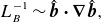 $L_B^{-1}\sim \hat {\boldsymbol b}\boldsymbol{\cdot }\boldsymbol{\nabla }\hat {\boldsymbol b} ,$
is required, thus
$L_B^{-1}\sim \hat {\boldsymbol b}\boldsymbol{\cdot }\boldsymbol{\nabla }\hat {\boldsymbol b} ,$
is required, thus $L_B/L_n\ll 1,$
with
$L_B/L_n\ll 1,$
with $L_n^{-1}\sim \textrm{d} \log n_{0s}/\textrm{d}r.$
The mode localises to the energetically favourable interchange region,
$L_n^{-1}\sim \textrm{d} \log n_{0s}/\textrm{d}r.$
The mode localises to the energetically favourable interchange region, $\omega _{*i}\omega _{\kappa i}\gt 0,$
which for
$\omega _{*i}\omega _{\kappa i}\gt 0,$
which for $\omega _{*i}\lt 0$
implies
$\omega _{*i}\lt 0$
implies $\omega _{0}\lt 0$
: the frequency is in the ion direction. The localisation of the mode can be demonstrated interpreting the governing equation as a Schrödinger equation with a potential set by
$\omega _{0}\lt 0$
: the frequency is in the ion direction. The localisation of the mode can be demonstrated interpreting the governing equation as a Schrödinger equation with a potential set by $\omega _{\kappa i}$
. This direction of rotation would make the resonant electron contribution exactly zero, if it were not for the trapped electron population (portion of the
$\omega _{\kappa i}$
. This direction of rotation would make the resonant electron contribution exactly zero, if it were not for the trapped electron population (portion of the $\lambda$
domain) that coprecesses in the ion diamagnetic direction (namely,
$\lambda$
domain) that coprecesses in the ion diamagnetic direction (namely, $\overline {\omega _{de}}\omega _{*e}\lt 0$
) (Connor, Hastie & Martin Reference Connor, Hastie and Martin1983).
$\overline {\omega _{de}}\omega _{*e}\lt 0$
) (Connor, Hastie & Martin Reference Connor, Hastie and Martin1983).
We now need to compute the imaginary corrections to this leading stable mode. The resonant ion contribution, $\Im [Q]$
, was first derived in the long wavelength limit,
$\Im [Q]$
, was first derived in the long wavelength limit, $b\ll 1,$
by Biglari, Diamond & Rosenbluth (Reference Biglari, Diamond and Rosenbluth1989). Zocco et al. (Reference Zocco, Xanthopoulos, Doerk, Connor and Helander2018) and Ivanov & Adkins (Reference Ivanov and Adkins2023) found its full Larmor radius counterpart, and expressed the long-wavelength limit in terms of plasma dispersion functions. Thus (ignoring the ion temperature gradient),
$b\ll 1,$
by Biglari, Diamond & Rosenbluth (Reference Biglari, Diamond and Rosenbluth1989). Zocco et al. (Reference Zocco, Xanthopoulos, Doerk, Connor and Helander2018) and Ivanov & Adkins (Reference Ivanov and Adkins2023) found its full Larmor radius counterpart, and expressed the long-wavelength limit in terms of plasma dispersion functions. Thus (ignoring the ion temperature gradient),
 \begin{align} Q\underset {\eta _{i}\equiv 0}{=}\left (1-\frac {\omega _{*i}}{\omega }\right )\frac {\omega }{\omega _{\kappa i}}Z^{2}\left (\sqrt {\frac {\omega }{\omega _{\kappa i}}}\right )\underset {\omega _{*i}\rightarrow \infty }{=}-\frac {\omega _{*i}}{\omega _{\kappa i}}Z^{2}\left (\sqrt {\frac {\omega }{\omega _{\kappa i}}}\right )\!, \end{align}
and thus
 \begin{align} \Im [Q]\approx -\omega _{* i}\sqrt {\frac {4\pi }{\omega \omega _{\kappa i}}}e^{-\omega /\omega _{\kappa i}}, \end{align}
when $\omega \omega _{\kappa i}\gt 0$
. With this ion resonance and the electron resonant equation in the last line of (4.6), and writing
$\omega \omega _{\kappa i}\gt 0$
. With this ion resonance and the electron resonant equation in the last line of (4.6), and writing $\omega =\omega _0+\delta \omega ,$
with
$\omega =\omega _0+\delta \omega ,$
with $\delta \omega \ll \omega _0 ,$
the leading-order imaginary correction to
$\delta \omega \ll \omega _0 ,$
the leading-order imaginary correction to $\omega _0$
then is given by
$\omega _0$
then is given by
 \begin{align} \Im [\delta \omega ] & \approx \left [2\omega _0^2\int _{\omega _{\kappa i}(\ell )\lt 0}\frac {\mathrm{d}\ell }{B}\sqrt {\frac {\pi }{\omega _0\omega _{\kappa i}}}e^{-\omega _0/\omega _{\kappa i}}|\psi |^2 -|\omega _0|\sqrt {\pi }\frac {\eta _{e}}{\tau ^{2}}\int _{\overline {\omega _{de}}(\lambda )\lt 0}\text{d}\lambda \sum _{j}\tau _{j}(\lambda )\right.\nonumber\\& \qquad \left.\times \left (\frac {\omega _{0}}{\overline {\omega }_{de}}\right )^{9/2}\left |\frac {\overline {\omega _{\kappa i}\psi }}{\omega _{0}}\right |^{2}e^{-\omega _{0}/\overline {\omega }_{de}}\right ]\Bigg / \left (\int \frac {\text{d}l}{B}b\left |\psi \right |^{2}\right )\!, \end{align}
where $\tau _j$
is the bounce time evaluated at each
$\tau _j$
is the bounce time evaluated at each $j$
th trapping well. Thus, we confirm the drift resonant destabilising action of ions (i.e. positive imaginary contribution from the first line). Trapped electrons, provided their contribution is non-zero owing to the details of geometry, if
$j$
th trapping well. Thus, we confirm the drift resonant destabilising action of ions (i.e. positive imaginary contribution from the first line). Trapped electrons, provided their contribution is non-zero owing to the details of geometry, if $\overline \omega _{de}(\lambda )\omega _{*i}\gt 0$
for some
$\overline \omega _{de}(\lambda )\omega _{*i}\gt 0$
for some $\lambda ,$
can after all be stabilising, and set a critical gradient for destabilisation, if
$\lambda ,$
can after all be stabilising, and set a critical gradient for destabilisation, if $\eta _e \sim O(1)$
. We cannot exclude a destabilising effect, for a somewhat unconventional equilibrium where the density and temperature gradients have opposite signs, thus
$\eta _e \sim O(1)$
. We cannot exclude a destabilising effect, for a somewhat unconventional equilibrium where the density and temperature gradients have opposite signs, thus $\eta _e\lt 0.$
Ideal MHD marginal frequency. At the marginal frequency $\omega _{0}=\omega _{*i}/2,$
the interchange drive of the fluid limit, the second term on the right-hand-side of (4.9), remains the dominant destabilising actor, acting in a fluid fashion. Equation (4.4) becomes the relevant one, and the analysis of Aleynikova & Zocco (Reference Aleynikova and Zocco2017) applies. The KBM dispersion relation is then a simple second-order algebraic equation of the type
$\omega _{0}=\omega _{*i}/2,$
the interchange drive of the fluid limit, the second term on the right-hand-side of (4.9), remains the dominant destabilising actor, acting in a fluid fashion. Equation (4.4) becomes the relevant one, and the analysis of Aleynikova & Zocco (Reference Aleynikova and Zocco2017) applies. The KBM dispersion relation is then a simple second-order algebraic equation of the type $\omega (\omega -\omega _{*i})=-\lambda _{MHD}^2,$
and with
$\omega (\omega -\omega _{*i})=-\lambda _{MHD}^2,$
and with $|\lambda _{MHD}/\omega _{*i}|\gg 1$
can acquire an imaginary part if indeed
$|\lambda _{MHD}/\omega _{*i}|\gg 1$
can acquire an imaginary part if indeed $\omega \approx \omega _{0}=\omega _{*i}/2.$
Flat-density limit. We now consider $\omega _*\rightarrow 0,$
but
$\omega _*\rightarrow 0,$
but $\omega _{Ts}=\eta _s\, \omega _{*s}$
finite. In this case (and ignoring the line bending term once again), the dispersion relation becomes an algebraic quartic equation in
$\omega _{Ts}=\eta _s\, \omega _{*s}$
finite. In this case (and ignoring the line bending term once again), the dispersion relation becomes an algebraic quartic equation in $\omega$
,
$\omega$
,
 \begin{align} \omega ^{3}(\omega -\omega _{Ti})+\alpha \omega ^{2}+\beta \omega +{\delta }=0, \end{align}
with
 \begin{align} \alpha & =\frac {1}{d}\Bigg[2\left (\omega _{Ti}-\omega _{Te}\right )\int \frac {\mathrm{d}\ell }{B}\omega _{\kappa i}\left |\psi \right |^{2}-\left (7+\frac {4}{\tau }\right )\int \frac {\mathrm{d}\ell }{B}\omega _{\kappa i}^2\left |\psi \right |^{2}\nonumber\\& \qquad\qquad -\frac {7}{8\tau }\int \text{d}\lambda \sum _{\jmath }\tau _{j}\left |\overline {\omega _{\kappa i}\psi }\right |^{2}\Bigg],\\[-10pt]\nonumber \end{align}
 \begin{align} \beta & =\frac {1}{d}\left [ \left (14+\frac {8}{\tau }\right )\omega _{Ti}\int \frac {\mathrm{d}\ell }{B}\omega _{\kappa i}^{2}\left |\psi \right |^{2}+\left (\frac {3}{4}\omega _{Te}+\omega _{Ti}\right )\frac {1}{\tau }\int \text{d}\lambda \sum _{\jmath }\tau _{j}\left |\overline {\omega _{\kappa i}\psi }\right |^{2}\right ]\!,\\[-10pt]\nonumber \end{align}
 \begin{align} {\delta } & =-\frac {\omega _{Ti}}{\tau d}\left [ 4\omega _{Ti}\int \frac {\mathrm{d}\ell }{B}\omega _{\kappa i}^{2}\left |\psi \right |^{2}+(2\omega _{Ti}-3\omega _{Te})\int \text{d}\lambda \sum _{\jmath }\tau _{j}\left |\overline {\omega _{\kappa i}\psi }\right |^{2}\right ] \end{align}
and
 \begin{align} d=\int \frac {\mathrm{d}\ell }{B}b\left |\psi \right |^{2}. \end{align}
For simplicity, let us also set to zero the ionic drive, $\omega _{Ti}\equiv 0$
, so that
$\omega _{Ti}\equiv 0$
, so that ${\delta }\equiv 0,$
and (4.14) becomes a quartic with a trivial root. We are left with a cubic which can be solved with a
${\delta }\equiv 0,$
and (4.14) becomes a quartic with a trivial root. We are left with a cubic which can be solved with a $\omega _{\kappa i}/\omega \ll 1$
expansion. To leading order, the solution to this equation then reads
$\omega _{\kappa i}/\omega \ll 1$
expansion. To leading order, the solution to this equation then reads
 \begin{align} \omega ^2\approx 2\omega _{Te}\frac {\int {(({\mathrm{d}\ell })/{B})}\omega _{\kappa i}\left |\psi \right |^{2}}{\int {(({\mathrm{d}\ell })/{B})}b\left |\psi \right |^{2}}. \end{align}
The interchange drive due to passing particles (the linear term in $\omega$
), for large gradients, has a destabilising effect if the mode is localised to the bad curvature region. In that case,
$\omega$
), for large gradients, has a destabilising effect if the mode is localised to the bad curvature region. In that case, $\omega _{Te}\omega _{\kappa i}\lt 0$
and this term would lead to a leading-order imaginary
$\omega _{Te}\omega _{\kappa i}\lt 0$
and this term would lead to a leading-order imaginary $\omega$
. Thus, we may ask what the role played by trapped electrons is. Considering the next order correction to
$\omega$
. Thus, we may ask what the role played by trapped electrons is. Considering the next order correction to $\omega$
, assuming the mode is unstable to leading order, one can show that
$\omega$
, assuming the mode is unstable to leading order, one can show that
 \begin{align} \Im [\delta \omega ] & =-\left [\left (7+\frac {4}{\tau }\right )\int \frac {\mathrm{d}\ell }{B}\omega _{\kappa i}^2\left |\psi \right |^{2}\right.\nonumber\\[5pt]& \quad \left.+\frac {7}{8\tau }\int \text{d}\lambda \sum _{\jmath }\tau _{j}\left |\overline {\omega _{\kappa i}\psi }\right |^{2}\right ]\Bigg /2d\sqrt {\left |2\omega _{Te}\frac {\int {(({\mathrm{d}\ell })/{B})}\omega _{\kappa i}\left |\psi \right |^{2}}{\int {(({\mathrm{d}\ell })/{B})}b\left |\psi \right |^{2}}\right |}. \end{align}
Thus, in this limit, trapped particles play a stabilising role, in line with the result of Cheng & Gorelenkov (Reference Cheng and Gorelenkov2004).
This section has delved into the second-order corrections in $\omega _{\kappa }/\omega \ll 1$
to the equation for the divergence of the plasma current. One more comment on these terms is necessary. Such corrections are fundamental, and play a key role, for instance, in determining the correct temperature dependence of the plasma specific heats ratio,
$\omega _{\kappa }/\omega \ll 1$
to the equation for the divergence of the plasma current. One more comment on these terms is necessary. Such corrections are fundamental, and play a key role, for instance, in determining the correct temperature dependence of the plasma specific heats ratio, $\varGamma .$
Indeed, after neglecting the trapped particles contribution, one finds that (Tang et al. Reference Tang, Connor and Hastie1980)
$\varGamma .$
Indeed, after neglecting the trapped particles contribution, one finds that (Tang et al. Reference Tang, Connor and Hastie1980)
 \begin{align} {\varGamma }=\frac {{({7}/{4})}T_{i}+T_{e}}{T_{i}+T_{e}}. \end{align}
Equation (4.21) is an intriguing result, since some specific values of $\varGamma$
can be calculated from collisional theory. For instance, by neglecting ion heating and electron thermal conduction, the analysis of Braginskii would give
$\varGamma$
can be calculated from collisional theory. For instance, by neglecting ion heating and electron thermal conduction, the analysis of Braginskii would give $\varGamma = 5/3,$
which of course is incompatible with the collisionless result of (4.21). The local values of the equilibrium temperatures are not constrained, but, as shown by Chandrasekhar and Fermi, it is known that some general stability argument based on the virial theorem can constrain
$\varGamma = 5/3,$
which of course is incompatible with the collisionless result of (4.21). The local values of the equilibrium temperatures are not constrained, but, as shown by Chandrasekhar and Fermi, it is known that some general stability argument based on the virial theorem can constrain $\varGamma$
(Chandrasekhar & Fermi Reference Chandrasekhar and Fermi1953). Thus, KBM stability imposes a constraint on the temperature ratio, at some specific plasma surface where the virial theorem can be applied, in its full form. However, trapped-particles effects also enter to second order in
$\varGamma$
(Chandrasekhar & Fermi Reference Chandrasekhar and Fermi1953). Thus, KBM stability imposes a constraint on the temperature ratio, at some specific plasma surface where the virial theorem can be applied, in its full form. However, trapped-particles effects also enter to second order in $\omega _{\kappa }/\omega \ll 1,$
and can in principle affect any general conclusion based on (4.21).
$\omega _{\kappa }/\omega \ll 1,$
and can in principle affect any general conclusion based on (4.21).
Summarising the findings of this section, we have seen that for maximum- $\mathcal J$
fields, even those for which
$\mathcal J$
fields, even those for which $\omega _{*e}\overline {\omega _{de}}\lt 0$
for all
$\omega _{*e}\overline {\omega _{de}}\lt 0$
for all $\lambda$
, the collisionless electromagnetic trapped-particle response does not bring about stability, since the fundamental frequency, due to coupling to KBMs, can be in the ion direction, thus destabilising ionic modes. The main result is them (4.6), where one can furthermore see that the resonant ion response, the integral
$\lambda$
, the collisionless electromagnetic trapped-particle response does not bring about stability, since the fundamental frequency, due to coupling to KBMs, can be in the ion direction, thus destabilising ionic modes. The main result is them (4.6), where one can furthermore see that the resonant ion response, the integral $Q,$
couples to the KBM equation through both species. This proves that max-
$Q,$
couples to the KBM equation through both species. This proves that max- $\mathcal J$
is not enough to guarantee the absence of microturbulence at finite
$\mathcal J$
is not enough to guarantee the absence of microturbulence at finite $\beta .$
For large density gradients, we have derived a simple algebraic eigenvalue equation to determine trapped-electrons effects on KBMs, far from the KBM marginal frequency
$\beta .$
For large density gradients, we have derived a simple algebraic eigenvalue equation to determine trapped-electrons effects on KBMs, far from the KBM marginal frequency $\omega =\omega _{*i}(1+\eta _i)/2,$
(4.14), where trapped electrons can have a stabilising effect.
$\omega =\omega _{*i}(1+\eta _i)/2,$
(4.14), where trapped electrons can have a stabilising effect.
5. The electromagnetic TEM
The analysis of § 4.2 is bound to be valid close to ideal marginality, since we treated all kinetic effects merely as corrections of the fundamental balance
 \begin{align} \psi \approx \varphi , \end{align}
which is equivalent to the ideal MHD condition $E_{\parallel }=\partial _\ell (\varphi -\psi )\approx 0.$
We now explore the possibility of having a predominantly electromagnetic regime, i.e.
$E_{\parallel }=\partial _\ell (\varphi -\psi )\approx 0.$
We now explore the possibility of having a predominantly electromagnetic regime, i.e. $\varphi \ll \psi$
.
$\varphi \ll \psi$
.
Before that, we first notice that (4.2), quasineutrality, has the same structure of the electrostatic TEM equation, had we neglected the electromagnetic potential, and is indeed the eigenvalue equation for the electrostatic TEM for $\psi \rightarrow 0.$
In fact, to leading order in
$\psi \rightarrow 0.$
In fact, to leading order in $\omega _{\kappa }/\omega \sim b\ll 1$
the equation is invariant under the
$\omega _{\kappa }/\omega \sim b\ll 1$
the equation is invariant under the $\varphi \leftrightarrow \psi$
transformation, the symmetry being broken by how differently passing ions and trapped electrons experience a magnetic drift, or by finite ion Larmor radius effects. There is also a trapped particles contribution to the parallel electric field [third line of (4.2)]. We thus identify (4.2) as a generalised Ohm’s law which we expect to accommodate an electromagnetic trapped electron mode. How can the electromagnetic component be dominant in (4.2)
$\varphi \leftrightarrow \psi$
transformation, the symmetry being broken by how differently passing ions and trapped electrons experience a magnetic drift, or by finite ion Larmor radius effects. There is also a trapped particles contribution to the parallel electric field [third line of (4.2)]. We thus identify (4.2) as a generalised Ohm’s law which we expect to accommodate an electromagnetic trapped electron mode. How can the electromagnetic component be dominant in (4.2) $?$
$?$
Let us turn our attention to our version of the TCH equation, (3.15a), or more explicitly (C3). If $\beta$
is large enough to ignore line bending (how large will soon be clear), we can drop the left-hand-side and express, in the limit of
$\beta$
is large enough to ignore line bending (how large will soon be clear), we can drop the left-hand-side and express, in the limit of $\omega _{\kappa }/\omega \ll 1,$ $\varphi$
as a function of
$\varphi$
as a function of $\psi .$
If we do not order
$\psi .$
If we do not order $b$
small, or
$b$
small, or $\varphi$
with respect to
$\varphi$
with respect to $\psi ,$
the electrostatic potential is in this way manifestly small in the
$\psi ,$
the electrostatic potential is in this way manifestly small in the $\omega _\kappa /\omega$
sense compared with
$\omega _\kappa /\omega$
sense compared with $\psi$
. We replace the result in (4.2), and obtain, up to first order in
$\psi$
. We replace the result in (4.2), and obtain, up to first order in $\omega _{\kappa }/\omega ,$
an eigenvalue equation for a high-
$\omega _{\kappa }/\omega ,$
an eigenvalue equation for a high- $\beta$
electromagnetic TEM. Setting to zero the ion drive,
$\beta$
electromagnetic TEM. Setting to zero the ion drive, $\eta _i\equiv 0,$
and considering a large electron drive
$\eta _i\equiv 0,$
and considering a large electron drive $\eta _e\sim \omega /\omega _{\kappa e}\gg 1,$
 \begin{align} & \psi -\frac {1}{2}\int _{\mathrm{trap}}\frac {\text{d}\lambda B}{\sqrt {1-\lambda B}}\overline {\psi }\nonumber\\[9pt] & \quad = -2\tau \eta _{e}\frac {\omega _{*e}\omega _{\kappa e}}{\omega ^{2}}\frac {1+{({1}/{\tau })}\left (1-\varGamma _{0}\right )}{1-\varGamma _{0}}\left [\psi -\frac {3}{4}\int _{\mathrm{trap}}\frac {\text{d}\lambda B}{\sqrt {1-\lambda B}}\left (1-\frac {\lambda B}{2}\right )\overline {\psi }\right ]\nonumber\\[9pt] & \quad +\tau \eta _{e}\frac {\omega _{*e}}{\omega ^{2}}\int _{\mathrm{trap}}\frac {\text{d}\lambda B}{\sqrt {1-\lambda B}}\overline {\frac {\omega _{\kappa e}}{1-\varGamma _{0}}\left (\psi -\frac {3}{4}\int _{\mathrm{trap}}\frac {\text{d}\lambda B}{\sqrt {1-\lambda B}}\left (1-\frac {\lambda B}{2}\right )\overline {\psi }\right )}\nonumber\\[9pt] & \quad -\frac {3}{2}\eta _{e}\frac {\omega _{*e}}{\omega ^{2}}\int _{\mathrm{trap}}\frac {\text{d}\lambda B}{\sqrt {1-\lambda B}}\left [\overline {\omega _{\kappa e}\left (1-\frac {\lambda B}{2}\right )}\overline {\psi }-\overline {\omega _{\kappa e}\left (1-\frac {\lambda B}{2}\right )\psi }\right ]\!. \end{align}
The validity of (5.2) is given by the request that the field-line bending term of (C3) [the full Larmor radius form of (4.1)] is negligible. To assess when this can be satisfied, let us consider the following estimates. Take a typical interchange-like mode $\omega \sim \sqrt {\omega _* \omega _d}\sim v_{thi}{(L_{B}L_{T})}^{-1/2}k_{\alpha }\rho _{i},$
so that a negligible line bending amounts to a large enough
$\omega \sim \sqrt {\omega _* \omega _d}\sim v_{thi}{(L_{B}L_{T})}^{-1/2}k_{\alpha }\rho _{i},$
so that a negligible line bending amounts to a large enough $\beta _i\gg k_{\parallel }^{2}L_{B}L_{T}$
(without any Larmor radius ordering), as can be seen by using the first and the third lines of (C3). At the same time, since magnetic compressibility corrections are not allowed to interfere with our small
$\beta _i\gg k_{\parallel }^{2}L_{B}L_{T}$
(without any Larmor radius ordering), as can be seen by using the first and the third lines of (C3). At the same time, since magnetic compressibility corrections are not allowed to interfere with our small $\omega _{\kappa }/\omega$
expansion, we must have
$\omega _{\kappa }/\omega$
expansion, we must have $ \beta _{i}\ll (\omega _{\kappa i}/\omega )^2,$
(3.17). Thus, the (5.2) is valid in the intermediate
$ \beta _{i}\ll (\omega _{\kappa i}/\omega )^2,$
(3.17). Thus, the (5.2) is valid in the intermediate $\beta$
-regime
$\beta$
-regime
 \begin{align} k_{\parallel }^{2}L_{B}L_{T}\ll \beta _{i}\ll \frac {L_{T}}{L_{B}}. \end{align}
To put (5.2) into a more useful form, we shall take $\int \mathrm{d}\ell \psi ^*/B,$
integrating along the field line, and for simplicity in the discussion (i.e. to simplify the electrostatic terms) consider the short wavelength limit, to find
$\int \mathrm{d}\ell \psi ^*/B,$
integrating along the field line, and for simplicity in the discussion (i.e. to simplify the electrostatic terms) consider the short wavelength limit, to find
 \begin{align} & \left (\int \frac {\text{d}l}{B}\left |\psi \right |^{2}-\frac {1}{2}\sum _{j}\int _{1/B_{max}}^{1/B_{min}}\text{d}\lambda \tau _{j}\left |\overline {\psi }\right |^{2}\right )\omega ^{2}\nonumber\\[5pt] & = -2\tau \eta _{e}\omega _{*e}\left [\left (1+\frac {1}{\tau }\right )\int \frac {\text{d}l}{B}\omega _{\kappa e}\left |\psi \right |^{2}-\frac {1}{2}\int _{1/B_{max}}^{1/B_{min}}\text{d}\lambda \sum _{j}\tau _{j}\overline {\omega _{\kappa e}\left |\psi \right |^{2}}\right ]\nonumber\\[5pt] & \quad -\tau \eta _{e}\omega _{*e}\frac {3}{2}\sum _{j}\tau _{j}\int _{1/B_{max}}^{1/B_{min}}\text{d}\lambda \left [\overline {\frac {\omega _{\kappa e}}{2}\int _{1/B_{max}}^{1/B}\frac {\text{d}\lambda B}{\sqrt {1-\lambda B}}\left (1-\frac {\lambda B}{2}\right )\overline {\psi }}\,\overline {\psi ^{*}}\right .\nonumber\\[5pt] & \quad \left .-\left (1+\frac {1}{\tau }\right )\overline {\omega _{\kappa e}\left (1-\frac {\lambda B}{2}\right )\psi ^{*}}\,\overline {\psi }\right ]\nonumber\\[5pt] & \quad -\frac {3}{2}\eta _{e}\omega _{*e}\sum _{j}\int _{1/B_{max}}^{1/B_{min}}\text{d}\lambda \tau _{j}\overline {\psi }^{*}\left [\overline {\omega _{\kappa e}\left (1-\frac {\lambda B}{2}\right )}\overline {\psi }-\overline {\omega _{\kappa e}\left (1-\frac {\lambda B}{2}\right )\psi }\right ]\!. \end{align}
The second line is the first-order correction to $\psi$
from the electrostatic potential, while the final line is purely electromagnetic. Because as a result of Schwarz’s inequality the bracket on the left-hand side of the equation is positive [as shown in Helander et al. (Reference Helander, Proll and Plunk2013), or as a consequence of the proof in Appendix D], the sign of the coefficients on the right-hand-side determine whether an interchange instability can be triggered or not. This interpretation of the equation with a right-hand-side of the interchange type
$\psi$
from the electrostatic potential, while the final line is purely electromagnetic. Because as a result of Schwarz’s inequality the bracket on the left-hand side of the equation is positive [as shown in Helander et al. (Reference Helander, Proll and Plunk2013), or as a consequence of the proof in Appendix D], the sign of the coefficients on the right-hand-side determine whether an interchange instability can be triggered or not. This interpretation of the equation with a right-hand-side of the interchange type $\omega _{\kappa }\omega _*$
is reminiscent of the universal-mode eigenvalue equation of Coppi & Pegoraro (Reference Coppi and Pegoraro1977). Here the electron contribution can compete with the ion Larmor radius to determine the sign of the interchange driving terms, as for the electrostatic case of the ubiquitous mode (Coppi & Pegoraro Reference Coppi and Pegoraro1977), then revisited in general geometry (Plunk, Connor & Helander Reference Plunk, Connor and Helander2017), and dubbed iTEM.
$\omega _{\kappa }\omega _*$
is reminiscent of the universal-mode eigenvalue equation of Coppi & Pegoraro (Reference Coppi and Pegoraro1977). Here the electron contribution can compete with the ion Larmor radius to determine the sign of the interchange driving terms, as for the electrostatic case of the ubiquitous mode (Coppi & Pegoraro Reference Coppi and Pegoraro1977), then revisited in general geometry (Plunk, Connor & Helander Reference Plunk, Connor and Helander2017), and dubbed iTEM.
Let us then consider one-by-one the terms on the right-hand side of the equation. The first thing to notice is that passing electrons, generating the first term of the second line from a balance with the ion response in TCH, have a destabilising effect which can be somewhat reduced by trapped electrons (second term of the second line). This drive suggests that an electromagnetic unstable mode can exist so long as it localises itself in a bad curvature region ( $\omega _{\kappa e}\lt 0$
), being a standard interchange mode.
$\omega _{\kappa e}\lt 0$
), being a standard interchange mode.
The third line is the purely trapped-electron contribution to the electrostatic $\omega _{\kappa }/\omega$
corrections of
$\omega _{\kappa }/\omega$
corrections of $\psi .$
By estimating the third line (keeping the leading order in the trapped particle fraction) as
$\psi .$
By estimating the third line (keeping the leading order in the trapped particle fraction) as
 \begin{align} \sim \left (1+\tau \right )\eta _e\omega _{* e}\int \text{d}\lambda \tau _B \overline {\omega _{\kappa e}\psi ^{*}}\,\overline {\psi }, \end{align}
we see that this term plays the opposite role of the passing electron contribution; if localised to bad curvature, it is generally stabilising.
The final term, which is purely electromagnetic, also deserves some attention. This contributes to instability if (taking for simplicity $\lambda B\approx 1$
)
$\lambda B\approx 1$
)
 \begin{align} \mathrm{Re} \sum _{j}\int _{1/B_{max}}^{1/B_{min}}\text{d}\lambda \tau _{j}\overline {\psi }^{*}\left \{ \overline {\omega _{\kappa e}}\overline {\psi }-\overline {\omega _{\kappa e}\psi }\right \} \gt 0. \end{align}
Since $\omega _{\kappa e}$
is not sign-definite, the condition (5.6) requires the existence of at least one
$\omega _{\kappa e}$
is not sign-definite, the condition (5.6) requires the existence of at least one $\lambda _0$
for which the
$\lambda _0$
for which the $\text{d}\lambda$
integral, over the domain for which the integrand is positive, dominates. Let us then consider the condition that brings about a purely growing mode (had we neglected all other terms in the eigenvalue equation), with a simple
$\text{d}\lambda$
integral, over the domain for which the integrand is positive, dominates. Let us then consider the condition that brings about a purely growing mode (had we neglected all other terms in the eigenvalue equation), with a simple $\psi \in \mathbb{R}_+$
,
$\psi \in \mathbb{R}_+$
,
 \begin{align} \eta _{e}\omega _{*e}\left [\overline {\omega _{\kappa e}}\overline {\psi }-\overline {\omega _{\kappa e}\psi }\right ]\equiv A(\lambda )\gt 0, \end{align}
for an appropriate $\lambda -$
domain. The sign of
$\lambda -$
domain. The sign of $\omega _{\kappa e}$
is relatively unimportant for this inequality, since adding an arbitrary
$\omega _{\kappa e}$
is relatively unimportant for this inequality, since adding an arbitrary $f(\psi ,\alpha )$
to
$f(\psi ,\alpha )$
to $\omega _{\kappa e}$
cancels overall, because of the average. Thus, the lack of cancellation due to the field-line dependence of the electromagnetic component of the perturbed electric field plays an important role in the destabilisation of this term. In particular, if
$\omega _{\kappa e}$
cancels overall, because of the average. Thus, the lack of cancellation due to the field-line dependence of the electromagnetic component of the perturbed electric field plays an important role in the destabilisation of this term. In particular, if $\psi$
had no field-line dependence, the destabilising term would cancel exactly. While further analytical progress is difficult, we can make an important remark about the parity of the eigenfunction, and how the different geometric features of the field become relevant to this destabilising contribution. Consider the case where
$\psi$
had no field-line dependence, the destabilising term would cancel exactly. While further analytical progress is difficult, we can make an important remark about the parity of the eigenfunction, and how the different geometric features of the field become relevant to this destabilising contribution. Consider the case where $\psi$
is localised in a well and, say, it has odd parity about the centre (this can be associated with magnetic reconnection, but we shall not pursue this further here). Then
$\psi$
is localised in a well and, say, it has odd parity about the centre (this can be associated with magnetic reconnection, but we shall not pursue this further here). Then $\overline \psi = 0$
and
$\overline \psi = 0$
and $A(\lambda )$
reduces to
$A(\lambda )$
reduces to
 \begin{align} A(\lambda ) = -\omega _{* e} \eta _e \overline {\omega _{de}\psi }. \end{align}
We now write $\omega _{de}\approx \omega _{\kappa e} = \omega _\psi + \omega _\alpha$
, to keep a clearer link to the discussion that follows on the equation above. In tokamaks and optimised stellarators,
$\omega _{de}\approx \omega _{\kappa e} = \omega _\psi + \omega _\alpha$
, to keep a clearer link to the discussion that follows on the equation above. In tokamaks and optimised stellarators, $\omega _\psi$
can be regarded to be ‘odd’ in order to achieve
$\omega _\psi$
can be regarded to be ‘odd’ in order to achieve $\overline \omega _\psi =0$
[omnigeneity (Hall & McNamara Reference Hall and McNamara1975; Bernardin, Moses & Tataronis Reference Bernardin, Moses and Tataronis1986; Cary & Shasharina Reference Cary and Shasharina1997; Helander Reference Helander2014)], which ensures no net radial drift of particles and hence good confinement. In addition, tokamaks and quasisymmetric stellarators (Boozer Reference Boozer1983; Nührenberg & Zille, Reference Nührenberg and Zille1988; Burby, Kallinikos & MacKay Reference Burby, Kallinikos and MacKay2020; Rodríguez et al. Reference Rodríguez, Helander and Bhattacharjee2020) have a dominantly even
$\overline \omega _\psi =0$
[omnigeneity (Hall & McNamara Reference Hall and McNamara1975; Bernardin, Moses & Tataronis Reference Bernardin, Moses and Tataronis1986; Cary & Shasharina Reference Cary and Shasharina1997; Helander Reference Helander2014)], which ensures no net radial drift of particles and hence good confinement. In addition, tokamaks and quasisymmetric stellarators (Boozer Reference Boozer1983; Nührenberg & Zille, Reference Nührenberg and Zille1988; Burby, Kallinikos & MacKay Reference Burby, Kallinikos and MacKay2020; Rodríguez et al. Reference Rodríguez, Helander and Bhattacharjee2020) have a dominantly even $\omega _{\alpha }$
(poloidal precession) in the field-following variable
$\omega _{\alpha }$
(poloidal precession) in the field-following variable $\chi$
(Rodríguez et al. Reference Rodríguez, Helander and Goodman2024). This observation is linked to the bad curvature position of the field being located at the minimum of
$\chi$
(Rodríguez et al. Reference Rodríguez, Helander and Goodman2024). This observation is linked to the bad curvature position of the field being located at the minimum of $B$
. In such scenarios,
$B$
. In such scenarios, $A(\lambda )$
only has a contribution from the radial part, and its destabilising effect would be maximal (with no cancellation) and proportional to the interchange instability,
$A(\lambda )$
only has a contribution from the radial part, and its destabilising effect would be maximal (with no cancellation) and proportional to the interchange instability, $\omega _* \omega _{\kappa },$
but averaged over the trapping well. In this scenario then, it is the geodesic curvature that drives the destabilising behaviour. Quasi-isodynamic stellarators (Cary & Shasharina Reference Cary and Shasharina1997; Gori, Lotz & Nührenberg Reference Gori, Lotz and Nührenberg1997; Helander & Nührenberg, Reference Helander and Nührenberg2009; Nührenberg Reference Nührenberg2010) have a dominantly odd
$\omega _* \omega _{\kappa },$
but averaged over the trapping well. In this scenario then, it is the geodesic curvature that drives the destabilising behaviour. Quasi-isodynamic stellarators (Cary & Shasharina Reference Cary and Shasharina1997; Gori, Lotz & Nührenberg Reference Gori, Lotz and Nührenberg1997; Helander & Nührenberg, Reference Helander and Nührenberg2009; Nührenberg Reference Nührenberg2010) have a dominantly odd $\omega _{\alpha }$
(Rodríguez et al. Reference Rodríguez, Helander and Goodman2024), and so the poloidal precession also contributes to the destabilisation. This analysis has been rather simplified, in particular, as we have assumed that
$\omega _{\alpha }$
(Rodríguez et al. Reference Rodríguez, Helander and Goodman2024), and so the poloidal precession also contributes to the destabilisation. This analysis has been rather simplified, in particular, as we have assumed that $\psi$
has only real values. However, an inhomogeneous phase of the mode could also lead to further contributions to the instability. Finally, we might argue that the solution of (5.2) can provide a large-scale drive for a trapped-electron-driven collisionless (micro)tearing instability, as the one numerically observed by Dickinson et al. (Reference Dickinson, Roach, Saarelma, Scannell, Kirk and Wilson2013), in the spirit of the analysis of Connor, Hastie & Zocco (Reference Connor, Hastie and Zocco2013).
$\psi$
has only real values. However, an inhomogeneous phase of the mode could also lead to further contributions to the instability. Finally, we might argue that the solution of (5.2) can provide a large-scale drive for a trapped-electron-driven collisionless (micro)tearing instability, as the one numerically observed by Dickinson et al. (Reference Dickinson, Roach, Saarelma, Scannell, Kirk and Wilson2013), in the spirit of the analysis of Connor, Hastie & Zocco (Reference Connor, Hastie and Zocco2013).
6. Conclusions
In this article, we have examined the modification of KBMs due to trapped electrons, whose fully resonant response is explicitly derived (4.9). We found that, close to ideal marginality, the presence of the ion magnetic-drift resonance, as well as the electron resonance, can compromise the positive effect of having a maximum- $\mathcal J$
configuration, for which the trapped electron resonance would be removed. Resonant electrons participate to the setting of a critical threshold for the KBM destabilisation, through their temperature gradient (4.13). For large density gradients, the effect of trapped electrons on KBMs is fully described by a simple quartic eigenvalue equation and a stabilising impact is identified. At moderately high plasma
$\mathcal J$
configuration, for which the trapped electron resonance would be removed. Resonant electrons participate to the setting of a critical threshold for the KBM destabilisation, through their temperature gradient (4.13). For large density gradients, the effect of trapped electrons on KBMs is fully described by a simple quartic eigenvalue equation and a stabilising impact is identified. At moderately high plasma $\beta ,$
the eigenvalue equation for the electromagnetic TEM is derived (5.2) and (5.4). An electromagnetic interchange instability can be driven by the electron temperature gradient in regions of bad curvature. The field-line-following parity of the eigenfunctions, in relation to the magnetic curvature’s parity, opens the possibility for this unstable mode to act as a large-scale drive for trapped-electron-driven collisionless microtearing modes, whose full analysis is left for future work. Our results provide a first set of basic ideas useful for a comprehensive approach to stellarators optimisation of finite-
$\beta ,$
the eigenvalue equation for the electromagnetic TEM is derived (5.2) and (5.4). An electromagnetic interchange instability can be driven by the electron temperature gradient in regions of bad curvature. The field-line-following parity of the eigenfunctions, in relation to the magnetic curvature’s parity, opens the possibility for this unstable mode to act as a large-scale drive for trapped-electron-driven collisionless microtearing modes, whose full analysis is left for future work. Our results provide a first set of basic ideas useful for a comprehensive approach to stellarators optimisation of finite- $\beta$
kinetic local instabilities.
$\beta$
kinetic local instabilities.
Acknowledgments
The authors are grateful to J.W. Connor, M. Hardman, P. Helander, P. Mulholland, F. Parra and A. Schekochihin for useful discussions. Part of this work was performed at several Simons Hidden Symmetry meetings, held under the auspices of the Simons Foundation. E.R. was partially supported by a Humboldt scholarship, J.E. was supported by an internship sponsored by the Max Planck Institute for Plasma Physics, Greifswald. We thank L.C. Hirst for the coordination of the project at the Cavendish Laboratory, Cambridge. A.Z. expresses his profound gratitute for the inspirational presence of T.K. during the conclusion of this work.
Editor Peter Catto thanks the referees for their advice in evaluating this article.
Declaration of interests
The authors report no conflict of interest.
Appendix A. Intermediate frequency solution of linear GK equation
In this appendix we consider the solution of the linearised GK equation for the perturbed, non-adiabatic distribution function $h$
. The linearised GK equation written in the standard velocity space coordinates
$h$
. The linearised GK equation written in the standard velocity space coordinates $\{\mathcal{E},\mu ,\sigma \}$
may be written as
$\{\mathcal{E},\mu ,\sigma \}$
may be written as
 \begin{align} iv_\parallel \frac {\partial }{\partial \ell }h_{s,\boldsymbol{k}}+(\omega -\omega _{ds})h_{s,\boldsymbol{k}}=\frac {e_sF_{0s}}{T_{0s}}\big(\omega -\omega _{* s}^T\big)\left \langle \chi \right \rangle _{\boldsymbol{R}_{s},\boldsymbol{k}}, \end{align}
where
 \begin{align} \left \langle \chi \right \rangle _{\boldsymbol{R}_{s},\boldsymbol{k}}=J_{0}(a_{s})(\varphi _{\boldsymbol{k}}-v_\parallel A_{\parallel ,\boldsymbol{k}}/c), \end{align} $a_s=k_\perp v_\perp /\varOmega _s$
and we have dropped
$a_s=k_\perp v_\perp /\varOmega _s$
and we have dropped $\delta \! B_\parallel$
. We now solve this equation in the intermediate frequency regime [as Tang et al. (Reference Tang, Connor and Hastie1980)],
$\delta \! B_\parallel$
. We now solve this equation in the intermediate frequency regime [as Tang et al. (Reference Tang, Connor and Hastie1980)],
 \begin{align} \omega ^{tr,b}_{i}\ll \omega \ll \omega ^{tr,b}_{e}. \end{align}
A.1. Passing electrons
Let us consider the limit
 \begin{align} \omega \ll v_{\parallel }\boldsymbol{\nabla} _{\parallel } \end{align}
of the electron GK equation (A1), which we may safely consider as for passing particles $v_\parallel \neq 0$
(up to a small boundary layer). Consider the even part of the distribution function (superscript e), so that we may write
$v_\parallel \neq 0$
(up to a small boundary layer). Consider the even part of the distribution function (superscript e), so that we may write
 \begin{align} iv_\parallel \frac {\partial }{\partial \ell }h_{e,\mathrm{p}}^e\approx \frac {v_\parallel }{c}\frac {eF_{0e}}{T_{0e}}\big(\omega -\omega _{* e}^T\big)J_0 A_{\parallel \boldsymbol{k}}. \end{align}
Cancelling $v_\parallel$
, and using the definition of the potential
$v_\parallel$
, and using the definition of the potential $A_\parallel =-i(c/\omega )\partial _\ell \psi$
, we are left with an exact derivative in
$A_\parallel =-i(c/\omega )\partial _\ell \psi$
, we are left with an exact derivative in $\ell$
. Thus, taking
$\ell$
. Thus, taking $\psi \rightarrow 0$
at
$\psi \rightarrow 0$
at $\ell \rightarrow \infty$
,
$\ell \rightarrow \infty$
,
 \begin{align} h_{e,\mathrm{p}}^e\approx -\frac {eF_{0e}}{T_{0e}}\left (1-\frac {\omega _{* e}^T}{\omega }\right )\psi . \end{align}
A.2. Trapped electrons
For trapped electrons, $v_\parallel =0$
at bounce points, and thus we cannot proceed as in Appendix A.1. To find the distribution function, we follow Taylor & Hastie (Reference Taylor and Hastie1968). We first introduce an integrating factor
$v_\parallel =0$
at bounce points, and thus we cannot proceed as in Appendix A.1. To find the distribution function, we follow Taylor & Hastie (Reference Taylor and Hastie1968). We first introduce an integrating factor
 \begin{align} h_{e,\mathrm{t}}=e^{i\sigma M}g, \end{align}
where
 \begin{align} M(\ell _L,\ell )=\int _{\ell _L}^\ell \frac {\omega -\omega _{de}}{|v_\parallel |}\mathrm{d}\ell , \end{align}
using $\sigma =\mathrm{sign}[v_\parallel ]$
and defining the integral between consecutive bounce points
$\sigma =\mathrm{sign}[v_\parallel ]$
and defining the integral between consecutive bounce points $[\ell _L,\ell _R]$
. Substituting this into (A1), and, we obtain
$[\ell _L,\ell _R]$
. Substituting this into (A1), and, we obtain
 \begin{align} v_{\parallel }\boldsymbol{\nabla} _{\parallel }g=i\frac {eF_{0e}}{T_{0e}}\left (\omega -\omega _{*e}^T\right )e^{-i\sigma M(\ell _L,\ell )}{\left (\varphi -\frac {v_\parallel }{c}A_{\parallel }\right )}. \end{align}
Integrating (A9), and considering the different solution for $\sigma =\pm 1$
,
$\sigma =\pm 1$
,
 \begin{align} h_{e,\mathrm{t}}^+ & = He^{iM(\ell _L,\ell )}+ie^{iM(\ell _L,\ell )}\frac {eF_{0e}}{T_{0e}}\left (\omega -\omega _{*e}^T\right )\int _{\ell _L}^\ell \left (\varphi -\frac {|v_\parallel |}{c}A_\parallel \right )J_0e^{-iM(\ell _L,\ell ')}\frac {\mathrm{d}\ell '}{|v_\parallel |}, \end{align}
 \begin{align} h_{e,\mathrm{t}}^- & = He^{-iM(\ell _L,\ell )}-ie^{-iM(\ell _L,\ell )}\frac {eF_{0e}}{T_{0e}}\left (\omega -\omega _{*e}^T\right )\int _{\ell _L}^\ell \left (\varphi +\frac {|v_\parallel |}{c}A_\parallel \right )J_0e^{iM(\ell _L,\ell ')}\frac {\mathrm{d}\ell '}{|v_\parallel |}, \end{align}
where we have an unknown boundary condition $H$
that is the same for both
$H$
that is the same for both $\sigma$
signs, as they must match at the bounce point
$\sigma$
signs, as they must match at the bounce point $\ell =\ell _L$
. In fact, requiring equality of these two distribution functions at the correct bounce point, call it
$\ell =\ell _L$
. In fact, requiring equality of these two distribution functions at the correct bounce point, call it $\ell _R$
, imposes an additional condition that gives
$\ell _R$
, imposes an additional condition that gives $H$
,
$H$
,
 \begin{align} H & =-\frac {1}{\sin M(\ell _L,\ell _R)}\frac {eF_{0e}}{T_{0e}}\left (\omega -\omega _{*e}^T\right )\int _{\ell _L}^{\ell _R}\bigg[\varphi \cos M(\ell _R,\ell ') \nonumber\\[5pt]& \qquad + iA_\parallel \frac {|v_\parallel |}{c}\sin M(\ell _R,\ell ')\bigg]J_0\frac {\mathrm{d}\ell '}{|v_\parallel |}. \end{align}
Using the shorthand $C_{\ell ,\ell '}=\cos M(\ell ,\ell ')$
(and
$C_{\ell ,\ell '}=\cos M(\ell ,\ell ')$
(and $S$
for the sine), we may then compute the even part of the distribution function
$S$
for the sine), we may then compute the even part of the distribution function $h_{e,\mathrm{t}}^e=(h_{e,\mathrm{t}}^++h_{e,\mathrm{t}}^-/2)$
using multiple angle formulae,
$h_{e,\mathrm{t}}^e=(h_{e,\mathrm{t}}^++h_{e,\mathrm{t}}^-/2)$
using multiple angle formulae,
 \begin{align} h_{e,\mathrm{t}}^e & = -\frac {eF_{0e}}{T_{0e}}\left (\omega -\omega _{*e}^T\right )\frac {1}{S_{\ell _L,\ell _R}}\left [\int _{\ell _L}^{\ell }\left (\varphi C_{\ell ,\ell '}C_{\ell ,\ell _R}+i\frac {|v_\parallel |}{c}A_\parallel C_{\ell ,\ell _R}S_{\ell _L,\ell '}\right ){J_0}\frac {\mathrm{d}\ell '}{|v_\parallel |}\right .\nonumber \\[5pt]& \quad\left .+\int _{\ell }^{\ell _R}\left (\varphi C_{\ell _L,\ell }C_{\ell ',\ell _R}+i\frac {|v_\parallel |}{c}A_\parallel C_{\ell _L,\ell }S_{\ell ',\ell _R}\right ){ J_0}\frac {\mathrm{d}\ell '}{|v_\parallel |}\right ]\!. \end{align}
Notice that we corrected a typo at the third line of (2.29) of Tang et al. (Reference Tang, Connor and Hastie1980), where there is a term that does not satisfy a manifest symmetry of the solution. The imprecision had no consequences in all subsequent results of the reference, in which the previous results of Rosenbluth & Sloan (Reference Rosenbluth and Sloan1971) were reproduced. At this point the expression is exact, and we have not used the fast transit time approximation pertaining the intermediate frequency regime. In that limit, after expanding the trigonometric functions in the smallness of their argument (and ignoring the electron gyroradii effects), one finds
 \begin{align} h_{e,\mathrm{t}}^e & \approx -\frac {eF_{0e}}{T_{0e}}\frac {\omega -\omega _{*e}^T}{M(\ell _L,\ell _R)}\left [-\int _{\ell _L}^{\ell }\varphi \frac {\mathrm{d}\ell '}{|v_\parallel |}-\frac {i}{c}\int _{\ell _L}^{\ell }A_\parallel M(\ell _L,\ell ')\mathrm{d}\ell '\right.\nonumber\\[7pt]& \qquad\qquad\quad\qquad\qquad \left.+\frac {i}{c}\int _{\ell }^{\ell _R} A_\parallel M(\ell ',\ell _R)\mathrm{d}\ell '\right ]\!. \end{align}
Using the definition of $\psi$
in terms of
$\psi$
in terms of $A_\parallel$
, and integrating by parts, we are left after rearranging and introduction of the bounce average notation with
$A_\parallel$
, and integrating by parts, we are left after rearranging and introduction of the bounce average notation with
 \begin{align} h_{e,\mathrm{t}}^e=-\frac {eF_{0e}}{T_{e}}\left \{ \left (1-\frac {\omega _{*e}^{T}}{\omega }\right )\psi +\frac {\omega -\omega _{*e}^{T}}{\omega -\overline {\omega }_{de}}\overline {\left [\varphi -\left (1-\frac {\omega _{de}}{\omega }\right )\psi \right ]}\right \}\!, \end{align}
which agrees with (3.9) of Connor et al. (Reference Connor, Hastie and Taylor1978). In the $\omega _{de}/\omega \ll 1$
limit, the leading-order bounce-averaged electromagnetic component cancels exactly, reverberating the odd-parity of the
$\omega _{de}/\omega \ll 1$
limit, the leading-order bounce-averaged electromagnetic component cancels exactly, reverberating the odd-parity of the $A_{\parallel }$
-term of the GK equation from which (A14) originated. When using this result in quasineutrality, one can recognise the similarity of our (3.15b
) with (13) and (14) of Chavdarovski & Zonca (Reference Chavdarovski and Zonca2009). However, in their case, the electromagnetic resonant trapped particles contribution cancels exactly, since the authors are choosing to approximate
$A_{\parallel }$
-term of the GK equation from which (A14) originated. When using this result in quasineutrality, one can recognise the similarity of our (3.15b
) with (13) and (14) of Chavdarovski & Zonca (Reference Chavdarovski and Zonca2009). However, in their case, the electromagnetic resonant trapped particles contribution cancels exactly, since the authors are choosing to approximate
 \begin{align} \frac {\omega -\omega _{*e}^{T}}{\omega -\overline {\omega }_{de}}\left (\overline {\phi }-\overline {\psi }+\overline {\frac {\omega _{de}}{\omega }\psi }\right )\approx \frac {\omega -\omega _{*e}^{T}}{\omega -\overline {\omega }_{de}}\left (\overline {\phi }-\overline {\psi }+\frac {\overline {\omega }_{de}}{\omega }\overline {\psi }\right )\!, \end{align}
but we are not. The same issue is found in all works that use this approximation.
A.3. Ions
The solution for the ion perturbed distribution function can be done with the ordering $v_\parallel \boldsymbol{\nabla} _\parallel \ll \omega ,\omega _d$
, which does therefore not require us to distinguish between passing and trapped ones. In this limit then we are left simply with an algebraic equation in phase space, and we may simply write
$v_\parallel \boldsymbol{\nabla} _\parallel \ll \omega ,\omega _d$
, which does therefore not require us to distinguish between passing and trapped ones. In this limit then we are left simply with an algebraic equation in phase space, and we may simply write
 \begin{align} h_{i}^e\approx \frac {e_iF_{0i}}{T_{0i}}\frac {\omega -\omega _{* i}^T}{\omega -\omega _{d i}}J_0 \varphi . \end{align}
Appendix B. Explicit integrals
B.1. Non-resonant integrals over equilibrium
In the derivation of the governing equations describing our linear electromagnetic mode, (3.15a )–(3.15b ), it was necessary to evaluate a number of velocity space integrals over the Maxwellian distribution. Such integrals are commonplace in kinetic treatments of plasmas, but we present a brief summary of the expressions needed for completeness.
The general integral required is
 \begin{align} I_{nm} & =\int x_\parallel ^{2n}x_\perp ^{2m}J_0^2\big(x_\perp \sqrt {2b}\big) \frac {F_{0s}}{n_{0s}}\mathrm{d}^3\boldsymbol{v}\nonumber\\[5pt]& =\frac {2}{\sqrt {\pi }}\varGamma \left (n+\frac {1}{2}\right )(-1)^m\left (\frac {\partial }{\partial \lambda }\right )^m\left [I_0\left (\frac {b}{\lambda }\right )\frac {e^{-b/\lambda }}{2\lambda }\right ]_{\lambda =1}, \end{align}
which suffices to evaluate exactly all relevant non-resonant integrals. In here $I_0$
denotes the modified Bessel function of the first kind. Here
$I_0$
denotes the modified Bessel function of the first kind. Here $x_\perp =v_\perp /v_{thi}$
.
$x_\perp =v_\perp /v_{thi}$
.
With this general form we may then evaluate all relevant integrals. As a way of example consider
 \begin{align} \int J_0^2\big(\omega -\omega _{* i}^T\big)\frac {F_{0i}}{n_{0i}}\mathrm{d}^3\boldsymbol{v} & = \int \mathrm{d}^3\boldsymbol{v}\left [\left (\omega -\omega _{* i}\left (1-\frac {3\eta _i}{2}\right )\right )-\omega _{* i}\eta _i\big(x_\parallel ^2+x_\perp ^2\big)\right ]\frac {F_{0i}}{n_{0i}} \nonumber \\[5pt] & = (\omega -\omega _{* i})\varGamma _0+\omega _{* i}\eta _i b(\varGamma _0-\varGamma _1), \end{align}
where $\varGamma _n=e^{-b}I_n(b)$
.
$\varGamma _n=e^{-b}I_n(b)$
.
It will also be useful, most immediately for the integral $S$
in (3.13), to have the analogue to (B1) with no Bessel function; namely,
$S$
in (3.13), to have the analogue to (B1) with no Bessel function; namely,
 \begin{align} \bar {I}_{nm}=\int x_\parallel ^{2n}x_\perp ^{2m}\frac {F_{0s}}{n_{0s}}\mathrm{d}^3\boldsymbol{v}=\frac {1}{2}\varGamma \left (m+1\right )\varGamma \left (n+\frac {1}{2}\right )\!. \end{align}
With this,
 \begin{align} S[\omega ]=\int \text{d}^{3}\boldsymbol{v}\frac {F_{0e}}{n_{0}}\left (1-\frac {\omega _{*e}^{T}}{\omega }\right )\omega _{de}=2\omega _{\kappa e}\left [1-\frac {\omega _{* e}}{\omega }(1+\eta _e)\right ]\!. \end{align}
B.2. Electron integrals
Let us consider the resonant electronic integral
 \begin{align} J_{e}^{(\alpha )}=\frac {1}{n}\int \text{d}^{3}\boldsymbol{v}\left (\frac {v}{v_{the}}\right )^{\alpha -2}F_{0e}\frac {\omega -\omega _{*e}^{T}}{\omega -\overline {\omega }_{de}(\lambda )v^{2}/v_{the}^{2}}. \end{align}
We shall use here $\lambda$
and
$\lambda$
and $\hat {v}=v/v_{ths}$
as integration variables, for which we may change variables using
$\hat {v}=v/v_{ths}$
as integration variables, for which we may change variables using $\hat {v}_{\perp }^{2}=\lambda B\hat {v}^{2},$
and
$\hat {v}_{\perp }^{2}=\lambda B\hat {v}^{2},$
and $\hat {v}_{\parallel }=\hat {v}\sqrt {1-\lambda B},$
and used the determinant of the Jacobian
$\hat {v}_{\parallel }=\hat {v}\sqrt {1-\lambda B},$
and used the determinant of the Jacobian
 \begin{align} \det J=\left |\begin{array}{c@{\quad}c} \sqrt {1-\lambda B} & \dfrac{-\hat {v}B}{2\sqrt {1-\lambda B}}\\[15pt] 2\hat {v}\lambda B & B\hat {v}^{2} \end{array}\right |=\frac {B\hat {v}^{2}}{\sqrt {1-\lambda B}}. \end{align}
The integral may then be written as
 \begin{align} \begin{aligned} J_{e}^{(\alpha )} & = 2\pi \int _{0}^{\infty }\text{d}\hat {v}\int _{1/B_{max}}^{1/B}\frac {B\text{d}\lambda }{\sqrt {1-\lambda B}}\frac {\hat {v}^{\alpha }e^{-\hat {v}^{2}}}{\pi ^{3/2}}\frac {\omega -\omega _{*e}^{T}}{\omega -\overline {\omega }_{de}(\lambda )\hat {v}^{2}}\\[4pt] & =-\int _{1/B_{max}}^{1/B}\frac {B\text{d}\lambda }{\sqrt {1-\lambda B}}\zeta ^{2}\int _{-\infty }^{\infty }\text{d}\hat {v}\hat {v}^{\alpha }\frac {e^{-\hat {v}^{2}}}{\pi ^{1/2}}\frac {1- {({\omega _{*e}}/{\omega })}\left [1+\eta _{e}(\hat {v}^{2}- {({3}/{2})})\right ]}{(\hat {v}+\zeta )(\hat {v}-\zeta )}\\[4pt] & =-\int _{1/B_{max}}^{1/B}\frac {B\text{d}\lambda }{\sqrt {1-\lambda B}}\zeta \int _{-\infty }^{\infty }\text{d}\hat {v}\hat {v}^{\alpha }\frac {e^{-\hat {v}^{2}}}{\pi ^{1/2}}\frac {1}{\hat {v}-\zeta }\left \{ 1-\frac {\omega _{*e}}{\omega }\left [1+\eta _{e}\left (\hat {v}^{2}-\frac {3}{2}\right )\right ]\right \}\!, \end{aligned} \end{align}
and
 \begin{align} \zeta ^{2}=\frac {\omega }{\overline {\omega }_{de}(\lambda )}. \end{align}
We shall, to be precise, specify that it is convenient to define $\zeta =\sqrt [*]{\omega /\overline {\omega _{de}}}$
with the branch cut placed in the positive real line, so that
$\zeta =\sqrt [*]{\omega /\overline {\omega _{de}}}$
with the branch cut placed in the positive real line, so that $\Im [\zeta ]\rightarrow +\infty$
when
$\Im [\zeta ]\rightarrow +\infty$
when $\Im [\omega ]\rightarrow +\infty$
. We can then express the full electron integral
$\Im [\omega ]\rightarrow +\infty$
. We can then express the full electron integral $J_e$
in terms of the following one:
$J_e$
in terms of the following one:
 \begin{align} I_{e}^{(\alpha )}=-\zeta \int _{-\infty }^{\infty }\text{d}\hat {v}\frac {e^{-\hat {v}^{2}}}{\pi ^{1/2}}\frac {\hat {v}^{\alpha }}{\hat {v}-\zeta }, \end{align}
which we can now easily relate to the plasma dispersion function, whence
 \begin{equation} I_{e}^{(2)}=-\zeta ^{2}\left [1+\zeta Z(\zeta )\right ]\!, \end{equation}
 \begin{equation} I_{e}^{(4)}=-\zeta ^{2}\left \{\frac {1}{2}+\zeta ^{2}\left [1+\zeta Z(\zeta )\right ]\right \}\!, \end{equation}
 \begin{equation} I_{e}^{(6)}=-\zeta ^{2}\left \{ \frac {3}{4}+\frac {1}{2}\zeta ^{2}+\zeta ^{4}\left [1+\zeta Z(\zeta )\right ]\right \}\!, \end{equation}
 \begin{equation} I_{e}^{(8)}=-\zeta ^{2}\left \{ \frac {15}{8}+\frac {3}{4}\zeta ^{2}+\frac {1}{2}\zeta ^{4}+\zeta ^{6}\left [1+\zeta Z(\zeta )\right ]\right \}\!. \end{equation}
The evaluation of the real part of the electronic integral $J_e$
for
$J_e$
for $\zeta \gg 1$
requires the knowledge of the expansion of the plasma dispersion function up to ninth order. This can be obtained by using the series representation of the error function of imaginary argument (Fried & Conte Reference Fried and Conte2015),
$\zeta \gg 1$
requires the knowledge of the expansion of the plasma dispersion function up to ninth order. This can be obtained by using the series representation of the error function of imaginary argument (Fried & Conte Reference Fried and Conte2015),
 \begin{align} Z(\zeta ) = i\sqrt {\pi }\sigma e^{-\zeta ^2}-\frac {1}{\sqrt {\pi }}\sum _{n=0}^\infty \frac {\zeta ^{-(2n+1)}}{(n-1/2)!}. \end{align}
Here $\sigma$
is zero for
$\sigma$
is zero for $\Im [\zeta ]\gt 0$
, unity when
$\Im [\zeta ]\gt 0$
, unity when $\Im [\zeta ]=0$
and 2 otherwise. With our definition of
$\Im [\zeta ]=0$
and 2 otherwise. With our definition of $\zeta$
, then, the plasma dispersion function will contribute with this explicit imaginary resonant piece only when
$\zeta$
, then, the plasma dispersion function will contribute with this explicit imaginary resonant piece only when $\zeta ^2\in \mathbb{R}^+$
, and thus
$\zeta ^2\in \mathbb{R}^+$
, and thus $\sigma =1$
.
$\sigma =1$
.
Appendix C. Complete forms of equations
In this appendix we include some equations derived in the main text but presented here in their full form. In cases, preserving full Larmor radius effects, in others without subsidiary expansions.
C.1. Full Larmor radius form of eigenvalue system
Let us here consider the full Larmor radius form of the quasineutrality equation, (4.2), and the parallel current continuity equation, (4.1). Let us start with quasineutrality, and use the exact integrals from Appendix B.1 to incorporate full Larmor radius effects,
 \begin{align} \alpha _{0e}(\psi -\varphi ) & = \left [\frac {\alpha _{0i}}{\tau }(1-\varGamma _0)-\frac {1}{\tau }\frac {\omega _{* i}\eta _i}{\omega }b(\varGamma _0-\varGamma _1)-\frac {1}{\tau }\frac {\omega _{\kappa i}}{\omega }W_1\right ]\varphi \nonumber\\[3pt] & \quad -\frac {i}{\tau }\Im [Q]\varphi \nonumber\\[3pt] &\quad -\int _{1/B_{max}}^{1/B}\frac {\text{d}\lambda B}{\sqrt {1-\lambda B}}\left ( \frac {1}{2}\alpha _{0e}+\frac {3}{4}\frac {\overline {\omega }_{de}}{\omega }\alpha _{1e}+i\sqrt {\pi }\eta _{e}\frac {\omega _{*e}}{\omega }\zeta _{e}^{5}e^{-\zeta _{e}^{2}}\right )\left (\overline {\varphi }-\overline {\psi }\right )\nonumber\\[5pt] & \quad -2\int _{1/B_{max}}^{1/B}\frac {\text{d}\lambda B}{\sqrt {1-\lambda B}}\left ( \frac {3}{4}\alpha _{1e}+i\sqrt {\pi }\eta _{e}\frac {\omega _{*e}}{\omega }\zeta _{e}^{7}e^{-\zeta _{e}^{2}}\right ) \overline {\frac {\omega _{\kappa e}}{\omega }\left (1-\frac {\lambda B}{2}\right )\psi }, \end{align}
where
 \begin{align} W_1=\left [(2-b)\varGamma _0+b\varGamma _1\right ]\alpha _{0i} -\frac {\omega _{* i}\eta _i}{\omega }F_4(b),\\[-10pt]\nonumber \end{align}
 \begin{align} F_4(b) = 2\left [(1-b)^2\varGamma _0+\left (\frac {3}{2}-b\right )b\varGamma _1\right ]\!. \end{align}
We shall use this in the considerations of a $\psi$
-dominated mode in § 5.
$\psi$
-dominated mode in § 5.
We may proceed similarly with the $j_\parallel$
continuity equation in (4.1), to write
$j_\parallel$
continuity equation in (4.1), to write
 \begin{align} & \frac {v_{A}^{2}}{B_{0}^{2}}\frac {1}{\sqrt {g}}\frac {\partial }{\partial \chi }\left [\frac {b}{\sqrt {g}}\frac {\partial \psi }{\partial \chi }\right ]\nonumber\\[5pt] & \quad = -\omega ^2\left [\alpha _{0i}(1-\varGamma _0)-\frac {\omega _{* i}\eta _i}{\omega }b(\varGamma _0-\varGamma _1)-\frac {\omega _{\kappa i]}}{\omega }W_1-\left (\frac {\omega _{\kappa i}}{\omega }\right )^2W_2\right ]\varphi \nonumber\\[5pt] & \qquad +i\omega ^{2}\Im [ Q]\varphi +2\tau \omega \omega _{\kappa e}\alpha _{1\,e}\psi\nonumber \\[5pt] & \qquad +2\tau \omega \omega _{\kappa e}\int _{1/B_{max}}^{1/B}\frac {\text{d}\lambda B}{\sqrt {1-\lambda B}}\left (1-\frac {\lambda B}{2}\right )\Bigg [\frac {3}{4}\left (\alpha _{1e}+\frac {5}{2\zeta _e^2}\alpha _{2e}\right )\nonumber\\[5pt] & \qquad +\eta _{e}\frac {\omega _{*e}}{\omega }\zeta _{e}^{7}i\sqrt {\pi }e^{-\zeta _{e}^{2}}\Bigg ] \left (\overline {\varphi }-\overline {\psi }\right )\nonumber\\[5pt] & \qquad +4\tau \omega \omega _{\kappa e}\int _{1/B_{max}}^{1/B}\frac {\text{d}\lambda B}{\sqrt {1-\lambda B}}\left (1-\frac {\lambda B}{2}\right )\nonumber\\ & \qquad \times \Bigg (\frac {15}{8}\alpha _{2e}+\eta _{e}\frac {\omega _{*e}}{\omega }\zeta _{e}^{9}i\sqrt {\pi }e^{-\zeta _{e}^{2}}\Bigg ) \overline {\frac {\omega _{\kappa e}}{\omega }\left (1-\frac {\lambda B}{2}\right )\psi }, \end{align}
where
 \begin{align} W_2&=\alpha _{1i}\left [5\varGamma _0+2b(\varGamma _1-\varGamma _0)+F_4\right ] - \frac {\omega _{* i}\eta _i}{\omega }((1-b)\varGamma _0+b\varGamma _1+F_6), \end{align}
 \begin{align} F_6&=[6-b(2-b)(9-4b)]\varGamma _0+b(1-b)(11-4b)\varGamma _1. \end{align}
C.2. Order $b\sim \omega _\kappa /\omega$
of (4.6)
$b\sim \omega _\kappa /\omega$
of (4.6)

In the text we considered the subsidiary small Larmor radius ordering $b\sim (\omega _{\kappa i}/\omega )^2$
, which allowed us to simplify the resulting form of the equation. In particular, this allowed us to drop a whole host of mixed terms (proportional to
$b\sim (\omega _{\kappa i}/\omega )^2$
, which allowed us to simplify the resulting form of the equation. In particular, this allowed us to drop a whole host of mixed terms (proportional to $b\omega _{\kappa i}$
), which we now present for completeness. In the following we still insist on neglecting the trapped corrections to the resonant terms. With that,
$b\omega _{\kappa i}$
), which we now present for completeness. In the following we still insist on neglecting the trapped corrections to the resonant terms. With that,
 \begin{align} \frac {v_{A}^{2}}{B_{0}^{2}}\frac {1}{\sqrt {g}}\frac {\partial }{\partial \chi }\left [\frac {b}{\sqrt {g}}\frac {\partial \psi }{\partial \chi }\right ]= & -\omega ^{2}\alpha _{1i}b\psi -2\omega _{\kappa i}\omega _{p}\psi +i\omega ^{2}\left [1+\frac {2}{\tau }\frac {\alpha _{1i}}{\alpha _{0e}}\left (\frac {\omega _{\kappa i}}{\omega }-b\right )\right ]\Im [Q]\psi \nonumber\\[5pt] & +\left [\left (7\alpha _{2i}+\frac {4}{\tau }\frac {\alpha _{1i}^{2}}{\alpha _{0e}}\right )\omega _{\kappa i}^{2}-\omega \omega _{\kappa i}b\left (3\alpha _{2i}+\frac {4\alpha _{1i}^{2}}{\tau \alpha _{0e}}\right )\right .\nonumber\\[5pt] & \left .+\omega ^{2}b^{2}\left (\frac {3}{4}\alpha _{2i}+\frac {\alpha _{1i}^{2}}{\tau \alpha _{0e}}\right )\right ]\psi \nonumber\\[5pt] & +\frac {1}{\tau }\left [\frac {15}{8}\alpha _{2e}+\frac {\alpha _{1i}}{\alpha _{0e}}\left (2\alpha _{1i}-3\alpha _{1e}\right )\right ]\omega _{\kappa i}\int _{1/B_{max}}^{1/B}\frac {\text{d}\lambda B}{\sqrt {1-\lambda B}}\overline {\omega _{\kappa i}\psi }\nonumber\\[5pt] & -b\omega ^{2}\frac {\alpha _{1i}}{2\tau \alpha _{0e}}\int _{1/B_{max}}^{1/B}\frac {\text{d}\lambda B}{\sqrt {1-\lambda B}}\overline {\left [\left (2\alpha _{1i}-\frac {3}{2}\alpha _{1e}\right )\frac {\omega _{\kappa i}}{\omega }-\alpha _{1i}b\right ]\psi }\nonumber\\[5pt] & +\frac {\omega \omega _{\kappa i}}{2}\int _{1/B_{max}}^{1/B}\frac {\text{d}\lambda B}{\sqrt {1-\lambda B}}\left (\frac {3}{4}\alpha _{1e}-\frac {2}{\tau }\frac {\alpha _{1i}^{2}}{\alpha _{0e}}\right )\overline {b\psi }\nonumber\\[5pt] & +i\sqrt {\pi }\frac {\eta _{e}}{\tau }\frac {\omega _{*e}}{\omega }\omega _{\kappa i}\int _{1/B_{max}}^{1/B}\frac {\text{d}\lambda B}{\sqrt {1-\lambda B}}\zeta _{e}^{9}e^{-\zeta _{e}^{2}}\overline {\omega _{\kappa i}\psi }. \end{align}
C.3. Full second-order trapped-electron-modified KBM equation
In the main text we discussed the difference between the equation derived for $\psi$
, (4.6), and that presented in TCH, (4.9). We referred to the procedure there schematically, and for completeness, we show the equation that under the appropriate approximations (taking
$\psi$
, (4.6), and that presented in TCH, (4.9). We referred to the procedure there schematically, and for completeness, we show the equation that under the appropriate approximations (taking $\lambda B \approx 1,$ $b\ll \omega _{\kappa }/\omega \ll 1$
and ignoring cross-terms) yields (4.9). We now replace (4.2) into (4.1) to obtain
$b\ll \omega _{\kappa }/\omega \ll 1$
and ignoring cross-terms) yields (4.9). We now replace (4.2) into (4.1) to obtain
 \begin{align} & \frac {v_{A}^{2}}{B_{0}^{2}}\frac {1}{\sqrt {g}}\frac {\partial }{\partial \chi }\left (\frac {b}{\sqrt {g}}\frac {\partial }{\partial \chi }\left \{ \left [1+\frac {\omega -\omega _{*i}}{\omega -\omega _{*e}}\frac {1}{\tau }\left (b-2\frac {\omega _{\kappa i}}{\omega }\right )\right ]\varphi \right \}\right ) =-\omega \left (\omega -\omega _{*i}\right )b\varphi \nonumber\\[5pt] & \quad -2\omega _{\kappa i}\omega _{p}\varphi +\omega \left [\omega -2\omega _{\kappa e}\frac {1-{({\omega _{*e}}/{\omega })}\left (1+\eta _{e}\right )}{1-{({\omega _{*e}}/{\omega })}}\right ]i\Im Q[\varphi ]\nonumber\\[5pt] & \quad +\frac {1}{\tau }\frac {\omega }{\omega -\omega _{*e}}\frac {v_{A}^{2}}{\sqrt {g}B_{0}^{2}}\frac {\partial }{\partial \chi }\frac {b}{\sqrt {g}}\frac {\partial }{\partial \chi }i\Im Q[\varphi ]\nonumber\\[5pt] & \quad +\left \{ \omega \left (\omega -\omega _{*i}\right )\left [-3\frac {\omega _{\kappa i}}{\omega }b+7\frac {\omega _{\kappa i}^{2}}{\omega ^{2}}+\frac {3}{4}b^{2}\right ]\right .\nonumber\\[5pt] & \quad \left .-\omega \left [\omega -\omega _{*e}\left (1+\eta _{e}\right )\right ]\frac {\omega -\omega _{*i}}{\omega -\omega _{*e}}\frac {2}{\tau }\frac {\omega _{\kappa i}}{\omega }\left (b-2\frac {\omega _{\kappa i}}{\omega }\right )\right \} \varphi\nonumber \\ & \quad +2\tau \omega \omega _{\kappa e}(\chi )\left [1-\frac {\omega _{*e}}{\omega }\left (1+\eta _{e}\right )\right ]\left \{ \frac {\left (\omega -\omega _{*i}\right )}{\left (\omega -\omega _{*e}\right )}\int _{1/B_{max}}^{1/B}\frac {\text{d}\lambda B}{\sqrt {1-\lambda B}}\overline {\frac {1}{2\tau }\left (b-2\frac {\omega _{\kappa i}}{\omega }\right )\varphi }\right .\nonumber\\[5pt] & \quad \left .-\frac {3}{2}\frac {\omega -(1+\eta _{e})\omega _{*e}}{\omega -\omega _{*e}}\int _{1/B_{max}}^{1/B}\frac {\text{d}\lambda B}{\sqrt {1-\lambda B}}\overline {\frac {\omega _{\kappa e}(\chi )}{\omega }\left (1-\frac {\lambda B}{2}\right )\varphi }\right \} \nonumber\\[5pt] & \quad -\tau \omega \omega _{\kappa e}(\chi )\frac {3}{2}\left [1-\frac {\omega _{*e}}{\omega }\left (1+\eta _{e}\right )\right ]\frac {\left (\omega -\omega _{*i}\right )}{\left (\omega -\omega _{*e}\right )}\int _{1/B_{max}}^{1/B}\frac {\text{d}\lambda B}{\sqrt {1-\lambda B}}\nonumber\\[5pt] & \qquad \times \left (1-\frac {\lambda B}{2}\right )\overline {\frac {1}{\tau }\left (b-2\frac {\omega _{\kappa i}}{\omega }\right )\varphi }\nonumber\\[5pt] & \quad +4\tau \omega \omega _{\kappa e}(\chi )\int _{1/B_{max}}^{1/B}\frac {\text{d}\lambda B}{\sqrt {1-\lambda B}}\left (1-\frac {\lambda B}{2}\right )\left \{ \frac {15}{8}\left [1-\frac {\omega _{*e}}{\omega }\left (1+2\eta _{e}\right )\right ]\right .\nonumber\\[5pt] & \quad \left .+\eta _{e}\frac {\omega _{*e}}{\omega }\zeta _{e}^{9}i\sqrt {\pi }e^{-\zeta _{e}^{2}}\right \} \overline {\frac {\omega _{\kappa e}(\chi )}{\omega }\left (1-\frac {\lambda B}{2}\right )\varphi }, \end{align}
where we are only retaining the leading-order electron resonant contribution.
Appendix D. Solution to (4.3)
In this appendix we present the proof that the solution to (4.3),
 \begin{align} \varphi -\psi =\frac {1}{2}\int _{\mathrm{trap}}\frac {\mathrm{d}\lambda B}{\sqrt {1-\lambda B}}\overline {\varphi -\psi }, \end{align}
is $\varphi =\psi$
.
$\varphi =\psi$
.
To do so, let us construct a bound for the trapped integral on the right-hand side. Write
 \begin{align} \left |\frac {1}{2}\int _{1/B_{\mathrm{max}}}^{1/B}\frac {\mathrm{d}\lambda B}{\sqrt {1-\lambda B}}\overline {\varphi -\psi }\right |\leqslant \frac {1}{2}\int _{1/B_{\mathrm{max}}}^{1/B}\frac {\mathrm{d}\lambda B}{\sqrt {1-\lambda B}}\left |\overline {\varphi -\psi }\right |\leqslant \left |\varphi -\psi \right |_{\mathrm{max}}\sqrt {1-\frac {B}{B_{\mathrm{max}}}}, \end{align}
where we conveniently bounded the bounce average by the maximum value in the relevant trapping well, and performed the integral over $\lambda$
explicitly.
$\lambda$
explicitly.
Then, because the square root factor is necessarily less than unity for a nowhere vanishing magnetic field, from (4.3) it follows that:
 \begin{align} |\varphi -\psi |\lt |\varphi -\psi |_{\mathrm{max}}, \end{align}
if $\varphi \neq \psi$
. This inequality, evaluated at the point where
$\varphi \neq \psi$
. This inequality, evaluated at the point where $\varphi -\psi$
is maximum cannot be satisfied. Hence, the only solution is
$\varphi -\psi$
is maximum cannot be satisfied. Hence, the only solution is $\psi =\varphi$
there. But if this is the maximum, then it must be the case that the only solution to (4.3) is the trivial solution.
$\psi =\varphi$
there. But if this is the maximum, then it must be the case that the only solution to (4.3) is the trivial solution.



 Open access

