


Introduction
Ex situ conservation initiatives developed by botanic gardens have proven effective through the establishment of long-term ecological research and species conservation programmes (Hultine et al., Reference Hultine, Majure, Nixon, Arias, Búrquez and Goettsch2016). Well-curated living plant collections play a crucial role in supporting species conservation through research, horticulture and education whilst also providing seeds and plants for reintroduction (BGCI, 2014). These collections are expected to become increasingly important for conserving plant diversity, but to maximize their value a careful assessment of these collections is required, ensuring both species and genetic diversity, with a specific emphasis on threatened species (Grace & Majure, Reference Grace and Majure2017). Botanic gardens directly support the Global Strategy for Plant Conservation, particularly its Target 8, which aims to conserve 75% of threatened species in ex situ collections, preferably in their home countries, with at least 20% being available for recovery and restoration programmes (Wyse Jackson & Kennedy, Reference Wyse Jackson and Kennedy2009; CBD, 2011).
At the Rio de Janeiro Botanic Garden, one of the cultivated collections is the Cacti and Succulents Themed Collection (referred to here as the Cactarium), which brings together succulent species from various botanical families. Approximately 31% of Cactaceae are theatened globally (Goettsch et al., Reference Goettsch, Hilton-Taylor, Cruz-Piñón, Duffy, Frances and Hernández2015), and the family Cactaceae is well represented in this collection. This family is particularly important in Brazil, where two of the seven global centres of Cactaceae diversity (the Caatinga and Atlantic Forest) are located (Barthlott et al., Reference Barthlott, Burstedde, Geffert, Ibisch, Korotkova and Miebach2015), with 38 genera, including 15 endemic, and a total of 276 species and 102 subspecies (Flora e Funga do Brasil, Reference Flora e Funga do Brasil2023). The diversity and endemism of this family form a compelling argument for its conservation (Zappi et al., Reference Zappi, Taylor and Santos2011).
Brazil has dedicated 24% of its land to the protection of native vegetation (Embrapa, 2020). However, there are reports of illegal extraction (Caitano et al., Reference Caitano, Dutra, Valadares and Calazans2022), and some important areas for in situ conservation remain unprotected (Diniz et al., Reference Diniz, Gonçalves and Brito2017). Amongst the Cactaceae, 46 native species (of which 17 are categorized as Critically Endangered, 19 as Endangered and three as Vulnerable) have distribution ranges entirely outside these protected areas, probably a result of the limited geographical distribution and high micro-endemism amongst cacti (Goettsch et al., Reference Goettsch, Durán and Gaston2019; IUCN, 2023), and therefore lack in situ conservation.
One of the predicted effects of global climate change is that arid and semi-arid environments will cover over half of the terrestrial surface of the Earth by the end of this century, a 45% increase compared to today (Huang et al., Reference Huang, Yu, Guan, Wang and Guo2016). Although these environments may favour cacti, most of which have crassulacean acid metabolism, the impact of climate change on cacti will go beyond physiology. Ecological factors, including dependence on pollinators and nurse plants, also play a key role in their survival (Reyes-García & Andrade, Reference Reyes-García and Andrade2009; Goettsch et al., Reference Goettsch, Hilton-Taylor, Cruz-Piñón, Duffy, Frances and Hernández2015). Some authors have suggested cacti are not vulnerable to the potential impacts of climate change (Larios et al., Reference Larios, González, Rosen, Pate and Holm2020), but others have emphasized the risks they face because of low population growth rates (Shryock et al., Reference Shryock, Esque and Hughes2014) and their limited natural ranges (Barthlott et al., Reference Barthlott, Burstedde, Geffert, Ibisch, Korotkova and Miebach2015; Hultine et al., Reference Hultine, Majure, Nixon, Arias, Búrquez and Goettsch2016), which could affect population regeneration and success in reintroduction programmes (Carrillo-Angeles et al., Reference Carrillo-Angeles, Suzán-Azpiri, Mandujano, Golubov and Martínez-Ávalos2016).
The uncertainty that surrounds the potential impact of climate change on cactus diversity is a challenge for conservation planning. Nevertheless, the number of threatened species of Cactaceae is projected to rise, particularly in hotspots such as the Atlantic Forest and Caatinga, with up to 90% of species potentially threatened by 2050 (Pillet et al., Reference Pillet, Goettsch, Merow, Maitner, Feng, Roehrdanz and Enquist2022).
Numerous globally threatened cacti, including Critically Endangered species, have not yet been secured in ex situ collections (Oldfield & Hunt, Reference Oldfield and Hunt2010). The Cactarium collection of the Rio de Janeiro Botanic Garden, established in 1913 (Brasil, 1914), has recently strengthened its contribution to ex situ conservation, including prioritizing species diversity, mapping in situ populations and conducting field surveys. This has resulted in an increase in the number of threatened species present in the collection from 11 in 2014 to 64 in 2019 (Gonzaga et al., Reference Gonzaga, Reis, Coelho, Lima, Guapo, Justino, Pinto and Guedes2019).
Because of the importance of this collection, assessing its current holdings and planning future conservation actions are vital to enable the Rio de Janeiro Botanic Garden to support the effective conservation of cacti both in the wild and in cultivated collections. Here we evaluate the diversity of the collection and recommend strategic actions to enhance its conservation value.
Methods
The c. 3,000 m2 Cactarium of the Rio de Janeiro Botanic Garden (Gonzaga & Reis, Reference Gonzaga, Reis and Santos2019) is located in the Atlantic Forest and contains species of Cactaceae and other families. Specimens are cultivated in three greenhouses, a pergola and external beds for public viewing, and two further greenhouses, a pergola for shade plants and a technical reserve area for research. Specimens for public viewing (Plate 1a–c) are planted in the ground and arranged in groups for landscaping and educational purposes. Research specimens are maintained in vases (Plate 1d,e) for conservation and study. We inventoried all plants in this living collection during January–May 2022, counting all specimens and recording label data in a digital database. Specimens of Cactaceae were the most abundant in the collection, and identifications were confirmed by the curator of the Cactarium, who is a taxonomist specializing in this family.
Rio de Janeiro Botanic Garden Cactarium, Brazil: (a) aerial view, (b) greenhouse for visitation, (c) outdoor flower beds, (d) pergola with the shade plant collection, (e) greenhouse for research. Photos: (a) A. Machado; (b–e) T.M.H. Almeida.

We consulted information on the inventoried plants in the institutional specimen registry system, Jabot (Silva et al., Reference Silva, Fraga, Almeida, Gonzalez, Lima and Rocha2017). We checked and updated scientific names, following Flora e Funga do Brasil (Reference Flora e Funga do Brasil2023) for native species, and the Tropicos database (Tropicos, Reference ropicos2023) and the Plants of the World Online database (POWO, 2023) for exotic species. We used Flora e Funga do Brasil (Reference Flora e Funga do Brasil2023) as the source of information on the status of species (native, endemic, exotic) and their distribution in phytogeographical domains.
We defined knowledge of the municipality of origin of each specimen as representing provenance data and we used the term ‘duplicate’ to refer to different specimens of the same taxon and provenance data (locality and/or collector) or to specimens of the same taxon but without known provenance data. In a second database we listed all native Brazilian species and subspecies of Cactaceae, following Flora e Funga do Brasil (Reference Flora e Funga do Brasil2023), with information on the species name, endemism in Brazil and occurrence in phytogeographical domains, to map the cultivated diversity in the collection.
For the threatened species analysis we considered two systems: the Brazilian Red List (Brasil, 2022) and the IUCN Red List (IUCN, 2023). We evaluated ex situ conservation value by analysing the provenance data of the specimens and taxa in the collection, and comparing these data with those on the two Red Lists.
Results
We inventoried a total of 5,227 specimens of 413 taxa (Supplementary Table 1). Cactaceae was the most numerous, with 249 species (native and exotic) and 3,303 specimens, representing 63% of the cultivated plants (Table 1). Among these, 1,113 specimens and 93 species are exotic. Other cultivated plants belong to 18 additional families (Supplementary Table 2). Of 739 records in cultivation at the time of the inventory (some records are represented by more than one specimen), we identified 650 (88%) to species or subspecies, 74 (10%) only to genus and 15 (2%) only to family.
The 133 species of Cactaceae with known provenance data in cultivation in the Rio de Janeiro Botanic Garden Cactarium, Brazil (Plate 1), as of January–May 2022, with the number of specimens in cultivation, whether a voucher specimen is present in the institute's herbarium (herbarium code RB), and categorization on the Brazilian (Brasil, 2022) and global (IUCN, 2023) Red Lists for species assessed as threatened.

1 CR, Critically Endangered; EN, Endangered; VU, Vulnerable.
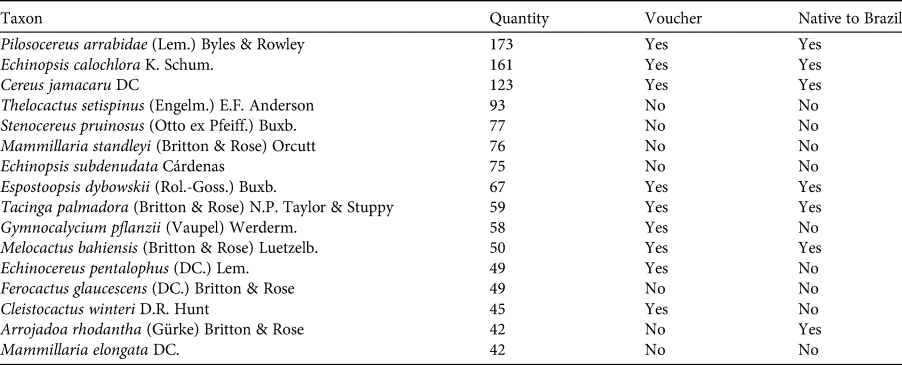
Many species had numerous duplicates in cultivation, both specimens with known provenance data and specimens that lack provenance data and have been in the collection for a long time. Notably, the species with the most holdings are mostly represented by specimens of unknown provenance. For example, Pilosocereus arrabidae (Lem.) Byles & Rowley had the highest number of duplicates (173). Sixteen other species had > 40 specimens in the collection (Table 2), requiring significant space and maintenance. Of these 16 species, seven did not have voucher specimens in the institutional herbarium.
Cacti accessions with > 40 duplicates, with number of duplicates, in the Rio de Janeiro Botanic Garden Cactarium, whether there is a corresponding voucher specimen in the institute's herbarium and whether the species is native to Brazil.
Of the 276 Brazilian Cactaceae species (Flora e Funga do Brasil, Reference Flora e Funga do Brasil2023), 156 (57%) are in cultivation in the Cactarium, with 133 (48%) having known provenance data. Considering species and subspecies, 170 taxa are in cultivation (141 with provenance data). All Brazilian phytogeographical domains are represented in the collection: Cerrado with 68 species (68% of the species of Cactaceae that occur in this domain), Atlantic Forest with 70 species (63%), Caatinga with 68 species (61%) and Pantanal with 16 species (55%). These four domains have the highest representation, and the Amazon and the Pampa domains are the least represented, with five (36%) and nine species (16%), respectively. Of the native species and subspecies not in the collection, 109 are endemic to Brazil, distributed across the phytogeographical domains: 10 in the Amazon, 43 in the Caatinga, 30 in the Cerrado, 40 in the Atlantic Forest, 49 in the Pampa and 13 in the Pantanal.
Of the 78 species of Cactaceae categorized as threatened on the Brazilian Red List (12 Critically Endangered, 46 Endangered and 20 Vulnerable; Brasil, 2022), 43 (55%) are in cultivation in the Cactarium (eight Critically Endangered, 25 Endangered and 10 Vulnerable), of which 36 species (46% of the total) have provenance data (Plate 2, Table 3). Of the 113 species of Cactaceae in Brazil categorized as threatened on the IUCN Red List (28 Critically Endangered, 52 Endangered and 33 Vulnerable; IUCN, 2023), 57 (50%) are in cultivation in the Cactarium (14 Critically Endangered, 26 Endangered and 17 Vulnerable), of which 48 species (43% of the total) have provenance data. On the two Red Lists combined, 74 species in cultivation in the Cactarium are categorized as threatened.
Some of the threatened species in the Rio de Janeiro Botanic Garden Cactarium (Plate 1): (a) Arthrocereus rondonianus, (b) Echinopsis calochlora, (c) Melocactus glaucescens, (d) Parodia ottonis, (e) Rhipsalis pilocarpa, (f) Uebelmannia pectinifera. Photos: (a–c, f) D.R. Gonzaga; (d,e) A. Machado.


Discussion
Since its establishment in 1913, the Cactaceae collection at the Rio de Janeiro Botanic Garden has gathered many specimens for which provenance data have been lost. Although not useful for conservation, these specimens are now well adapted to the local climatic conditions of the Garden and contribute to the Garden's other missions, such as environmental education and awareness, research and public contemplation.
Although we considered the municipality of origin as known provenance data, we acknowledge that additional information is important, including not only taxonomic data but also the biotic and abiotic characteristics of the collection site, the collection date, geographical coordinates and the herbarium voucher specimen associated with the collection. These data establish a connection between the taxon and its natural habitat, potentially providing insights that could be useful for species reintroduction (Gratzfeld, Reference Gratzfeld2016).
Species of Cactaceae are generally underrepresented in herbarium collections because of the difficulty of preparing specimens and the risk posed by their spines and glochids (Walters et al., Reference Walters, Figueiredo, Crouch, Winter, Smith, Zimmermann and Mashope2011). Ninety-five species in cultivation in the Rio de Janeiro Botanic Garden are absent from the Garden's herbarium (herbarium code RB). It is, however, crucial to deposit material in the herbarium, even if doing so requires sacrificing plants, as herbarium voucher specimens provide essential information on the species and their traits, phenology, environment and occurrence, supporting evidence-based conservation decisions (Greve et al., Reference Greve, Lykkec, Faggd, Gereaue, Lewis and Marchantg2016).
Significant progress has been made in the identification of cultivated specimens in the Cactarium collection of the Rio de Janeiro Botanic Garden. In the previous inventory, in 2002, only generic names were listed, and except for the Cactaceae family all other plants were categorized simply as succulents. By 2022, almost 90% of records had been identified to species and subspecies, with only 21 records identified to genus and only 15 records to family. Identifying specimens to species remains challenging because factors such as altitude, soil, temperature, precipitation and other, unknown, reasons could hinder flowering in the Garden. Flowering is often essential for accurate species identification, as reproductive structures are critical for distinguishing between closely related species (Hawthorne & Harris, Reference Hawthorne and Harris2006). Accurate plant identification is vital to increase the scientific value of the collection and its utility for research, education and conservation (Aplin, Reference Aplin2014).
However, the Cactarium still faces several challenges. It is currently at maximum capacity, with fully occupied greenhouses and beds, and with no space for new acquisitions. In addition to the 16 species listed with > 40 duplicates, many species have 20–40 duplicates. This duplication may be excessive given the current constraints on space.
A botanic garden is an institution holding documented collections of living plants for the purposes of scientific research, conservation, display and education (Smith & Harvey-Brown, Reference Smith and Harvey-Brown2017). Although undocumented plants have no utility for conservation, they can be used for scientific research, display and education. Making duplicates, even those undocumented, available to other Brazilian institutions could be beneficial, facilitating the reciprocal sharing of plant material in the form of donations or exchanges. Botanic gardens need to work as a collective network (Raschke et al., Reference Raschke, Pegram, Melkonoff, Davis and Blackwell2022), and supporting other Brazilian botanical gardens is one of the stated missions of the Rio de Janeiro Botanic Garden. Contributing healthy, identified plants such as those in the Cactarium to other institutions fosters collaboration and mutual benefit, and is essential because of limitations in human, material and spatial resources. By planning strategically and optimizing resources and space through a planned approach for the number of specimens held it is possible to cultivate more species from a range of locations with the same available resources (Gratzfeld, Reference Gratzfeld2016), and this would ensure the ongoing improvement of the conservation value of the collection. We recommend aiming for qualitative growth of this collection at the expense of quantitative increases in specimens. A similar approach has been followed at the Recife Botanic Garden, Brazil, where increases in species richness were facilitated by reducing excessive duplication (Pimentel & Maciel, Reference Pimentel and Maciel2018).
Diversity of Cactaceae in the collection
We note the importance of the Cactarium for Cactaceae conservation: of the 276 cacti species that occur in Brazil, 57% (48% with provenance data; Table 1) are in the collection, and this is 55% of the 78 threatened cacti species on the Brazilian Red List (Brasil, 2022). However, some groups have limited representation in the collection. For instance, Parodia Speg., which primarily occurs in the south of Brazil in the Pampa and Atlantic Forest (Flora e Funga do Brasil, Reference Flora e Funga do Brasil2023), is better represented at Porto Alegre Botanic Garden in the state of Rio Grande do Sul (R. Singer, pers. comm., 2022). Similarly, Melocactus Link & Otto, mainly found in the north and north-east regions of Brazil, is the most diverse genus in the Cactarium Guimarães Duque at the Paraíba State Semiarid National Institute collection (Gomes et al., Reference Gomes, Cassimiro, Freitas, do Felix and da Batista2020), and Embrapa Agroindústria Tropical (a research unit) in Ceará State that conducts ex situ Cactaceae conservation in the Caatinga region (Coelho et al., Reference Coelho, Fuck Júnior and Nascimento2015).
This reinforces the importance of taking a regional approach to a global conservation problem. To that end, we recommend that the Rio de Janeiro Botanic Garden establishes collaborative networks with other institutions, each focusing on the ex situ conservation of the local threatened flora for which their specific climate and edaphic conditions are suitable (Costa et al., Reference Costa, Wyse Jackson, Fernandes and Peixoto2018). Such an approach would optimize conservation efforts and enhances the efficiency of ex situ conservation.
Prioritization of Cactaceae in cultivation
A recent study that mapped the coverage of Cactaceae in protected areas (Goettsch et al., Reference Goettsch, Durán and Gaston2019) could guide prioritization of species for ex situ conservation that are not covered by in situ conservation in protected areas. Although 16 of these species are cultivated in the Cactarium, 26 are not (Table 4) and these should be prioritized for future collection acquisitions. Of these, Melocactus conoideus Buining & Brederoo, Melocactus ferreophilus Buining & Brederoo, Melocactus lanssensianus P.J.Braun and Micranthocereus polyanthus (Werderm.) Backeb. are cultivated in the Paraíba State Semiarid National Institute collection (Gomes et al., Reference Gomes, Cassimiro, Freitas, do Felix and da Batista2020), Frailea curvispina Buining & Brederoo, Parodia arnostiana (Lisal & Kolarik) Hofacker, Parodia crassigibba (Ritter) N.P.Taylor, Parodia fusca (Ritter) Hofacker & P.J.Braun, Parodia gaucha M.Machado & Larocca, Parodia muricata (Otto) Hofacker and Parodia neohorstii (S.Theun.) N.P.Taylor are cultivated in the Porto Alegre Botanic Garden (R. Singer, pers. comm., 2022), and in August 2022 a specimen of Cereus insularis Hemsl. was acquired, with provenance data, for the Rio de Janeiro Botanic Garden Cactarium. Thus 11 of the 26 species are already being conserved ex situ in other Brazilian institutions. The remaining 15 species should be priorities for both in situ and ex situ conservation.
Cactaceae species occurring in Brazil that are not covered by protected areas, in cultivation or not in cultivation in the Rio de Janeiro Botanic Garden Cactarium, with IUCN Red List category, whether provenance data are available for species in cultivation, phytogeographical domain and states of occurrence (list of species modified from Goettsch et al., Reference Goettsch, Durán and Gaston2019).

1 CR, Critically Endangered; EN, Endangerded; VU, Vulnerable; LC, Least Concern; DD, Data Deficient.
2 From Flora e Funga do Brasil (Reference Flora e Funga do Brasil2023).
3 AL, Alagoas; BA, Bahia; CE, Ceará; ES, Espírito Santo; GO, Goiás; MG, Minas Gerais; PB, Paraíba; PE, Pernambuco; PI, Piauí; PR, Paraná; RJ, Rio de Janeiro; RN, Rio Grande do Norte; RS, Rio Grande do Sul; SC, Santa Catarina; SE, Sergipe; SP, São Paulo; TO, Tocantins.
4 Data obtained from POWO (2023).
Regional knowledge of environmental conditions is also important for successful ex situ conservation. We recommend that the Cactarium should firstly direct its efforts towards the acquisition of regional flora, such as species that occur in the Atlantic Forest, and secondly towards species from the Cerrado, which have historically shown adaptability to the environmental conditions in Rio de Janeiro. For species that occur in the Amazon, Caatinga, Pampa and Pantanal, partnering with institutions in these regions could improve conservation efficiency, ensuring cultivation of Cactaceae in environmental conditions similar to those in which they occur naturally. However, because of potential future risks to cacti from climate change (Pillet et al., Reference Pillet, Goettsch, Merow, Maitner, Feng, Roehrdanz and Enquist2022), cultivation of all species of Brazilian Cactaceae that could feasibly grow in a particular location, regardless of current threat status, is also advisable. Whichever species are cultivated, curation of full provenance data and registration in the institutional digital system is crucial to ensure the conservation value of the collection and the sharing of data between institutions.
Given resource limitations, personnel constraints and lack of space, and to collaborate with the National Plan for Cactus Conservation (Ribeiro-Silva et al., Reference Ribeiro-Silva, Zappi, Taylor and Machado2011), Rio de Janeiro Botanic Garden should also explore long-term ex situ conservation through seed banks (O'Donnell & Sharrock, Reference O'Donnell and Sharrock2017; Rivière & Müller, Reference Rivière and Müller2017). Many cactus species have orthodox seeds (Almeida et al., Reference Almeida, Andrade and Lopes2009; Abud et al., Reference Abud, Gonçalves, Reis, Pereira and Bezerra2010) that can be successfully stored. However, some of the challenges include limited knowledge of the seed biology of native Brazilian cacti (Assis et al., Reference Assis, Resende, Bellintani, Coelho, Correia and Marchi2011) and the limited numbers of seeds per fruit and fruits per plant in many species (Ribeiro-Silva et al., Reference Ribeiro-Silva, Zappi, Taylor and Machado2011), which present difficulties for acquiring sufficient quantities of seeds for storage.
Ex situ conservation involves techniques to conserve genetic diversity and reduce the extinction risk of species (Costa & Bajgielman, Reference Costa and Bajgielman2016). Therefore, assessing a collection, defining a target species list and prioritizing regional flora with a focus on rare and threatened species are all important but are not endpoints in themselves. Collection of genetic material in the wild, following appropriate guidelines, is required (Griffith et al., Reference Griffith, Cartwright, Dosmann, Fant, Freid and Havens2021), in particular seed collection. Ex situ conservation can then be achieved through seed banks and living collections, research on cultivation and propagation protocols and study of species biology (Assis et al., Reference Assis, Resende, Bellintani, Coelho, Correia and Marchi2011). Seedlings propagated from high-quality seeds produced through in vivo cross-pollination, cultivated specimens and stored seeds can be used for reintroduction into suitable natural habitats, followed by monitoring (Costa & Bajgielman, Reference Costa and Bajgielman2016). Such ex situ conservation and reintroduction benefit from the development of networked collections and periodic reassessments of the effectiveness of conservation efforts (Gratzfeld, Reference Gratzfeld2016; Griffith et al., Reference Griffith, Cartwright, Dosmann, Fant, Freid and Havens2021).
The Cactarium of the Rio de Janeiro Botanic Garden has made significant progress in seeking to meet Target 8 of the Global Strategy for Plant Conservation in terms of analysing the diversity of and data quality for the plants in cultivation. However, to maximize the value of living plant collections for conservation, we recommend that collection assessments consider the current conservation status of species, both in situ and ex situ, to ensure the ongoing relevance of the collection. In addition, we recommend that identification and provenance data are made available online, to maximize the value of cultivated living collections for the conservation of native flora.
Author contributions
Study design: THMA, DRG; data collection: THMA, DRG; data analysis: THMA, DRG; writing: all authors.
Acknowledgements
We thank the Cactarium interns Thiago F. Gonçalves and Ricardo M. Tortorelli for their assistance with the inventory; Cactarium gardeners Jorge Ronaldo Simão and Vinícius Apareciano Lourenço for their assistance with plant maintenance during the inventory; Marcus A.N. Coelho, curator of the Rio de Janeiro Botanic Garden living collection, for supporting this assessment; Associação de Amigos do Jardim Botânico, and Sylvia Aranha and family for supporting this collection; and the reviewers for their helpful critiques. This research received no specific grant from any funding agency or commercial or not-for-profit sectors.
Conflicts of interest
None.
Ethical standards
This research abided by the Oryx guidelines on ethical standards.
Data availability
The data that support the findings of this study are openly available in the Jabot–Rio de Janeiro Botanic Garden database at rb.jbrj.gov.br/v2/consulta.php.


 Open access

