





1. Introduction
Crosslinguistically, all positive indefinites are PPIs (Positive Polarity Items) – that is, they cannot occur in the local scope of negation (Horn Reference Horn1989, Reference Horn2001). This is illustrated for English with a ‘some-pronoun’ and a ‘some-NP’ in (1a) and (1b), respectively, and for French with a nominal built with the so-called ‘partitive article’ (henceforth des-NP) in (2):Footnote 1


There are, however, various contexts in which PPIs occurring in the local scope of negation can be ‘rescued’ (Szabolcsi Reference Szabolcsi2004: 419, Spector Reference Spector2014: 3). Such contextsFootnote 2 include if-clauses (3a), the adversative predicate surprise (3b) and only (3c) (from Szabolcsi Reference Szabolcsi2004, her ex. [35], [37] and [39]):

What is puzzling, however, is that not all PPIs are equally acceptable in these contexts. In particular, some-NPs (4) are severely degraded, as first observed by Dobrovie-Sorin (Reference Dobrovie-Sorin and Ihsane2020) and then discussed in Dobrovie-Sorin & Ihsane (Reference Dobrovie-Sorin, Ihsane, Alboiu, Isac, Nicolae, Tănase-Dogaru and Tigău2022). The French counterparts of (4) are, however, fully acceptable (5), thus patterning with some-pronouns and contrasting with some-NPs in English.


The aim of this paper is to explain the puzzles observed in (3)–(5) – namely, the difference in distribution between, on the one hand, some-pronouns and some-NPs in English, and, on the other hand, between English some-NPs and French des-NPs. To reach this goal, we will first establish that the difference between some-pronouns and some-NPs illustrated in (3) and (4) is robust: an online-based Acceptability Judgment Task carried out in 2021 demonstrates that, in the rescuing contexts tested, there is a statistically significant difference in acceptability between these two types of PPIs in favor of some-pronouns (see Section 3). Our experimental study thus confirms that the some-NPs tested are degraded in rescuing contexts. The analysis we will develop relies on the assumption that rescuing constructions, in contrast to anti-licensing constructions, comprise several illocutionary functional heads above TP (Tense Phrase), one of which hosts the rescuing triggers (for example surprise, if, only). Given this assumption, the negation in anti-licensing constructions (1)–(2) is ‘internal’ to the extended projection of TP, whereas in rescuing examples like (3) and (5), it is ‘external’, in the sense that, at LF (Logical Form), it takes as an argument one of the illocutionary functional projections above TP. Given this syntactic analysis, the ‘rescuability’ of some-indefinites amounts to their being unaffected by external negation.
As for our puzzle (i.e. why some-pronouns [3] and des-NPs [5] are fully rescuable in contrast to some-NPs [4]), we propose that this is due to the interplay between the distinct semantic representations of these two classes of indefinites and a pragmatic constraint that requires the proposition expressed by the TP to describe a minimal event.
The paper is organized as follows. In Section 2, we evaluate whether previous accounts of rescuing can capture the facts under investigation here. The experiment is reported in Section 3. Section 4 is a preview of the explanation we will propose in the remainder of the paper. In Section 5, we explain the notion of ‘external’ negation and briefly review several constructions associated with this type of negation. In Section 6, we report the aspects of Krifka’s (Reference Krifka and Cordes2021, Reference Krifka, Hartmann and Wöllstein2023) framework on which we will build our analysis – in particular, his hierarchy of illocutionary functional projections above TP and the selectional ambiguity of main verbs. Section 7 is devoted to the core issue of this paper: we provide different semantic representations for some-pronouns and des-NPs on the one hand, and for some-NPs on the other hand, and suggest a pragmatic constraint that is responsible for the unrescuability of some-NPs. Finally, we mention two contexts in which some-NPs may nevertheless be rescued and provide a few hints as to how our analysis could extend to those facts. Section 8 concludes the paper.
2. State of the art
In this section, we will review four analyses of Rescuing Contexts (henceforth RC) in order to check whether any of them can account for the puzzles described in Section 1. We will see that none of them can.Footnote 3
2.1. Szabolcsi (Reference Szabolcsi2004)
Szabolcsi (Reference Szabolcsi2004) investigates the similarities and differences in the distribution of PPIs and NPIs (Negative Polarity Items) like any-words, which have to be in the local scope of negation (John *(didn’t) hurt anyone/any policemen). In her account, PPIs are double NPIs in that they are endowed with two NPI features. These features are dormant but become active (in the sense that they need to be licensed) in the presence of a Downward Entailing (henceforth DE) operator.Footnote 4 Since the operator activating these features licenses only one of them, configurations of the type [Neg … PPI] are ruled out for the same reasons that exclude NPIs from positive contexts– namely, the presence of an NPI feature that is not licensed. The PPI can be rescued if a second DE-operator is introduced, as this operator will license the second NPI feature of the PPI:

Accordingly, (6) is grammatical because one of the NPI features of someone is licensed by didn’t and the other one by don’t. In the examples in (3), sentential negation licenses one of the NPI features of someone and another operator (surprise, if, only) licenses the second feature. The problem with this explanation of rescuing is that the analysis extends to the examples in (4), built with some-NPs (note that Szabolcsi herself exemplifies her theory only with some-pronouns) predicting that they should be acceptable, contrary to fact. Indeed, the sentences in (4) contain two operators that could license the NPI features of the PPIs: a negation and either surprise, if or only. Szabolcsi’s analysis can therefore not explain why the examples in (4) are strongly degraded, in contrast with the ones in (3). This is because all indefinite PPIs – in particular, both some-NPs and some-pronouns – are PPIs (insofar as they are anti-licensed in the immediate scope of negation), and as such, elements of both of these types of PPIs would be endowed with two NPI features and should thus be equally rescuable. As for the grammaticality of the French examples in (5), it is expected: the above explanations for (6) and (3) extend to these sentences, since they contain a negation (pas) and another operator (surprise ‘surprise’, si ‘if’, seulement ‘only’) which can license the NPI features of the PPI des policiers ‘policemen’.
2.2. Homer (Reference Homer2011)
In his analysis of the distribution of NPIs and PPIs, Homer (Reference Homer2011: 2–3) proposes that what matters is the monotonicity of the environments in which these polarity elements occur:

This means that a PPI is licensed in a sentence only if it is contained in at least one eligible constituent of the sentence that is not DE with respect to its position: in (6), the eligible constituent is the phrase headed by the matrix negation don’t since this phrase is upward entailing with respect to someone. It is upward entailing because the two DE-operators in the phrase, don’t and didn’t, ‘cancel’ each other. The examples in (3) can be analyzed in the same way: they all comprise a negation and either surprise, if, or only, and the combination of the former with one of the latter leads to an upward entailing environment licensing someone. This, however, is also true of the sentences in (4), which minimally differ from the ones in (3) – only the PPIs are different (some-NPs vs. some pronouns, respectively) – thus predicting that these examples will also be acceptable, contrary to fact. To illustrate, in (4a), there is a rescuing operator and the negation don’t, which create the environment needed for some policemen to be acceptable. This example is, however, strongly degraded, as already observed. This means that Homer’s analysis cannot account for our data; it runs into the same shortcomings as Szabolczi’s because it does not distinguish between different PPIs – in particular, some-NPs and some-pronouns. The French examples in (5) are unproblematic since they all contain two operators (surprise ‘surprise’, si ‘if’, seulement ‘only’, in addition to sentential negation) that give rise to the upward entailing environments licensing the PPI des policiers ‘policemen’.
2.3. Nicolae (Reference Nicolae2012)
Nicolae (Reference Nicolae2012) proposes an analysis of PPIs based on Chierchia’s (Reference Chierchia2011) alternative-based theory of NPIs. For Nicolae (Reference Nicolae2012), the restricted distribution of NPIs and PPIs is the result of the interaction between a syntactic requirement and a semantic requirement. The syntactic requirement is that these polarity items need to enter into an agreement relation with a covert exhaustifying operator, involved in the calculation of implicatures, often represented as only and even (covert counterparts of only and even, respectively). For instance, PPIs carry the feature [+DE], which can only be checked by a c-commanding operator carrying the same feature (i.e. E for even). As for the semantic requirement, it is imposed by the fact that PPIs (on a par with NPIs) activate alternatives that need to be integrated into meaning via exhaustification by the exhaustifying operator. The crucial difference between PPIs and NPIs, according to Nicolae, is the nature of the domain alternatives: NPIs activate sub-domain alternatives, whereas PPIs activate super-domain alternatives. This amounts to the hypothesis that the alternatives of PPIs are all entailed by the assertion (upward entailment from subsets to supersets). Since such alternatives are strengthened/exhaustified by even in upward contexts, PPIs are legitimated by even in upward contexts.
Nicolae’s analysis for RCs like (3) is that the PPIs are licit in such examples because they are embedded under two DE-operators, since such an environment is equivalent to a positive environment. In (6), for instance, the requirements of even are satisfied because the downward entailment of the embedded negative clause (John didn’t call someone)Footnote 5 is reversed by the higher DE operator (don’t), thus yielding upward entailment, an environment allowing PPIs. As each example in (3) and (5), but also in (4), contains a negation and a rescuing operator (cf. Sections 2.1 and 2.2), these data should all be analyzed as (6) and should allow PPIs. However, this is not the case as discussed here. The problem comes from the fact that, in Nicolae’s analysis, all PPIs have a feature [+DE], implying that some-pronouns and some-NPs are treated on a par. As a result, her approach cannot explain the difference between the examples in (3) and the ones in (4).
2.4. Larrivée (Reference Larrivée2012)
The focus of Larrivée’s (Reference Larrivée2012) paper is the question of PPIs under the scope of a clausemate negation, both when there is a single negation (e.g. John doesn’t often say something) and when there are two licensing elements, as in (3) or (6). To account for such data, Larrivée formulates a proposal in terms of what Dryer (Reference Dryer1996) calls ‘activated proposition’ – namely, a proposition accessible to the speaker and the hearer (Larrivée Reference Larrivée2012: 885). For instance, in (3b) (I am surprised that John didn’t call someone), the subordinate clause is presupposed; it is a factive presupposition. Crucially, in this analysis, the negation is not at the same level as the propositional contents (Horn Reference Horn2001), and ‘[t]he activated proposition is thus treated as a whole to be rejected by negation’ (Larrivée Reference Larrivée2012: 892). Since the focus of negation is the complete proposition, the negation and the PPI do not interact, which explains why some-PPIs can co-occur with a clausemate negation. The proposal is not explicit enough though to determine whether it would account for the distributional difference between some-NPs and some-pronouns we are interested in. Larrivée rather seems to allow his suggestions to cover both types of some-PPIs (although all the examples he uses contain a some-pronoun). A priori, since in our examples with a some-pronoun and their counterparts with a some-NP (cf. [3] vs. [4]), the PPIs occur in the same position and hence in the same proposition, there is no reason to assume that the activation process would affect these PPIs differently. The same observation holds for (5), the French data corresponding to (4): in terms of propositions, (4) and (5) do not seem to differ. If this were correct, Larrivée’s analysis would not be able to account for the differences among the PPIs at the heart of this paper and would thus not fare better than the three proposals reported above.
2.5. Conclusion
In sum, none of the analyses briefly summarized above can explain the difference in rescuing among positive indefinites because all of them treat PPIs as a homogeneous class. Beyond their differences, Szabolcsi, Homer and Nicolae analyze rescuing as amounting to polarity reversal. In other words, the overall context in RCs is upward entailing, which would explain why the anti-licensing condition on PPIs is absent. This line of investigation cannot explain the difference in rescuing because PPIs are treated as a homogeneous class. For Larrivée, PPIs are rescued because, although they occur in the scope of negation at surface structure, a positive proposition is activated by virtue of pragmatic processes. But no room is made for possible differences among PPIs.
The account we will develop in this paper is in line with Larrivée’s (Reference Larrivée2012) view that rescuing operators are responsible for the activation of propositions (Dryer Reference Dryer1996). We will propose that the activation of positive propositions in the scope of Neg involves the LF raising of Neg to the illocutionary left periphery proposed by Cinque (Reference Cinque1998) and further developed by Krifka (Reference Krifka and Cordes2021, Reference Krifka, Hartmann and Wöllstein2023). We will view rescuing triggers – for instance if, surprise and only – as elements that activate the illocutionary left periphery (Section 7), thereby providing high syntactic slots that can be targeted by Neg.
3. Acceptability judgment task: The rescuability of some-pronouns vs. some-NPs
The acceptability contrast in RCs between some-pronouns as in (3) and some-NPs as in (4), repeated here for the sake of convenience as (8) and (9), respectively, has – to the best of our knowledge – gone unnoticed in the literature until very recently (Dobrovie-Sorin Reference Dobrovie-Sorin and Ihsane2020, Dobrovie-Sorin & Ihsane Reference Dobrovie-Sorin, Ihsane, Alboiu, Isac, Nicolae, Tănase-Dogaru and Tigău2022; cf. Section 1).


To further investigate the above-mentioned contrast, we conducted an online-based Acceptability Judgment Task (AJT) targeting the acceptability contrast under study. Section 3.1 describes the design of this AJT; Section 3.2 reports the results obtained. As will be shown, the experimental data reveal a statistically significant difference in naturalness between some-pronouns (8) and some-NPs (9) in favor of the former in all RCs tested.Footnote 6
3.1. Experiment design
In order to empirically test the acceptability contrast between some-pronouns and some-NPs in RCs, we designed an online AJT with the help of the free-of-charge experimental software OnExp 1.2 (Onea & Syring Reference Onea and Syring2011–). The experiment was completed by 96 monolingual speakers of American English (51 females, 44 males, 1 diverse; mean age: 34.8 years), who, at the time the experiment was conducted (September 2021), lived in the United States of America. All participants were recruited via the platform prolific.co and were paid £1.25 for their participation (approximately $1.70 at the time of the experiment). Prior to the experiment, participants only received the unspecific information that the experiment dealt with the use of English words in different contexts and that there were no right or wrong answers to the questions. The experiment itself was divided into two parts: a short warm-up phase and the main experiment. The warm-up phase consisted of five trial rounds and had the purpose of familiarizing the participants with the task to be fulfilled in the main experiment. The latter is described in detail in what follows.
The aim of the main experiment was to elicit acceptability judgments for some-pronouns and some-NPs in RCs – that is, in the local scope of negation with the additional presence of a further operator (cf. Section 1). As a starting point, four different rescuing operators were selected: if-clauses, adversative surprise, only and don’t think. This procedure resulted in a total of eight conditions tested. However, in order to limit the length of the experiment (and, thus, to prevent the loss of participants during the experiment), not all 96 participants were presented with all RCs. Instead, the 96 participants were pre-divided into two groups of 48 participants each. Group1 was assigned to subexperiment1, which only targeted the RCs don’t think and surprised and, thus, conditions 1–4. Group2 was assigned to subexperiment2, which only targeted the RCs if and only and, thus, conditions 5–8. The conditions tested in the two subexperiments are summarized in Tables 1 and 2, respectively.
Rescuability of some-NPs vs. some-pronouns: conditions tested in subexperiment1

Rescuability of some-NPs vs. some-pronouns: conditions tested in subexperiment2

Examples (10a) – (10h) illustrate all eight conditions by means of one example each. Note that every test sentence comes in four variants corresponding to the conditions in Tables 1 and 2, respectively. These variants are test items.

In the main part of the experiment, participants were presented test items for conditions 1–4 (subexperiment1) and for conditions 5–8 (subexperiment2). Subsequently, they were asked to rate these test items for naturalness on a 7-point Likert scale, where the value ‘1’ corresponded to ‘completely unnatural’ and the value ‘7’ to ‘completely natural’. The evaluation of the items was preceded by a single reminder that there were no right or wrong answers. In addition, we asked the participants to give their rating on the items individually and not to worry if they found some items to be very similar to other items already evaluated.
The experimental design followed the Latin Square method (2x2 Latin Square design; cf. Table 1 and 2) with five repetitions per condition (cf., for example, Abbuhl, Gass & Mackey Reference Abbuhl, Gass, Mackey, Podesva and Sharma2013: 120–121). Thus, each subexperiment contained four lists with 20 different test items each, and participants were randomly and evenly assigned to one of the four lists, meaning that every list was presented to a total of 12 participants (= 48 participants per four-list subexperiment). In line with the logics of the Latin Square method (for a nice visualization, see Zeugin Reference Zeugin, Kabatek, Obrist and Wall2021: 287–288), the 20 different test items per list were variants of 20 different test sentences. As every list also included 20 filler items (i.e. 50% fillers), every participant evaluated a total of 40 items. The total number of relevant answers retrieved in subexperiment1 and subexperiment2 was 1,920 (48 participants*20 test items*2 subexperiments). All test items and filler items are available as online supplementary materials to this paper and as an OSF repository at this link: https://osf.io/t27uw/?view_only=3bca8d72c7224eaba3338c6cc48fa764. The remainder of this section adds some information on the design of the test items and the filler items.
As described above, every subexperiment contained 20 test sentences coming in four variants (i.e. four lists of 20 test items), where every test item realized one of four conditions. Two example test sentences were given in (10). The 20 test sentences all contained different transitive verbs (in [10]: call) and different proper names (in [10]: John), the latter being balanced between male and female. The some-pronoun and the some-NP were held constant over all test sentences and corresponded to someone and some boys, respectively. The reason for this was to preclude a potential additional factor of variation (for the intuition that there are some nominal lexemes that make some-NPs in RCs less awkward, see Dobrovie-Sorin & Ihsane Reference Dobrovie-Sorin, Ihsane, Alboiu, Isac, Nicolae, Tănase-Dogaru and Tigău2022: 219, fn. 2). The length of both the test items and the filler items was between ten and sixteen syllables. In addition, the mean length of the test items and the filler items was very similar (subexperiment1: test items = 11.4 syllables, filler items: 11.9 syllables; subexperiment2: test items = 12.4 syllables, filler items: 13.5 syllables). As for the filler items, which were different in the two subexperiments, these were designed in a way to superficially look very similar to the actual test items: the filler items contained 20 different transitive verbs and 20 different names (10 male and 10 female) not already used in the test sentences as well as the noun boys. Moreover, half of the filler items each contained don’t think or surprised (subexperiment1) and only or if (subexperiment2). However, beyond the superficial similarity between the filler items and the test sentences, none of the filler items contained PPIs such as some + noun or someone. In addition, most filler items did not feature RCs either. The idea behind this decision – and the main purpose of including fillers (but also see below) – was to prevent participants from figuring out which items were test items and which ones filler items and, thus, to indirectly make them unable to identify RCs as the structure targeted by the experiment (cf. Schütze & Sprouse Reference Schütze, Sprouse, Podesva and Sharma2013: 39 for this idea).Footnote 7 The procedure described was all the more necessary, as the test items themselves were very similar among each other. Without the inclusion of similar filler items it would have been very likely that participants would have figured out what structure we were trying to investigate.
Examples of filler items are given in (11). The filler items (11a, b) are superficially similar to the test items (10a, b), and the filler items (11c, d) are similar to the test items (10c, d):

Of the 20 filler items, 10 were perfectly grammatical (i.e. of type [11a, c]), while the other 10 were ungrammatical (i.e. of type [11b, d]). The ungrammatical and the grammatical fillers were evenly distributed over the filler items containing don’t think and surprised (subexperiment1) and over those containing only and if (subexperiment2). One reason for including both grammatical and ungrammatical filler items was to enhance the likelihood that the full Likert-scale range would be used by all participants and, thus, to prevent scale biases such as skewing and compression (cf. Schütze & Sprouse Reference Schütze, Sprouse, Podesva and Sharma2013: 39). This was the second purpose of including filler items in the experiment. The third and last reason was that the ungrammatical filler items served as a control: ratings from participants who rated more than two clearly ungrammatical fillers with ‘5’ or higher were excluded from the data analysis, as we took this as sufficient evidence for a lack of attention during the experiment.
3.2. Experiment results
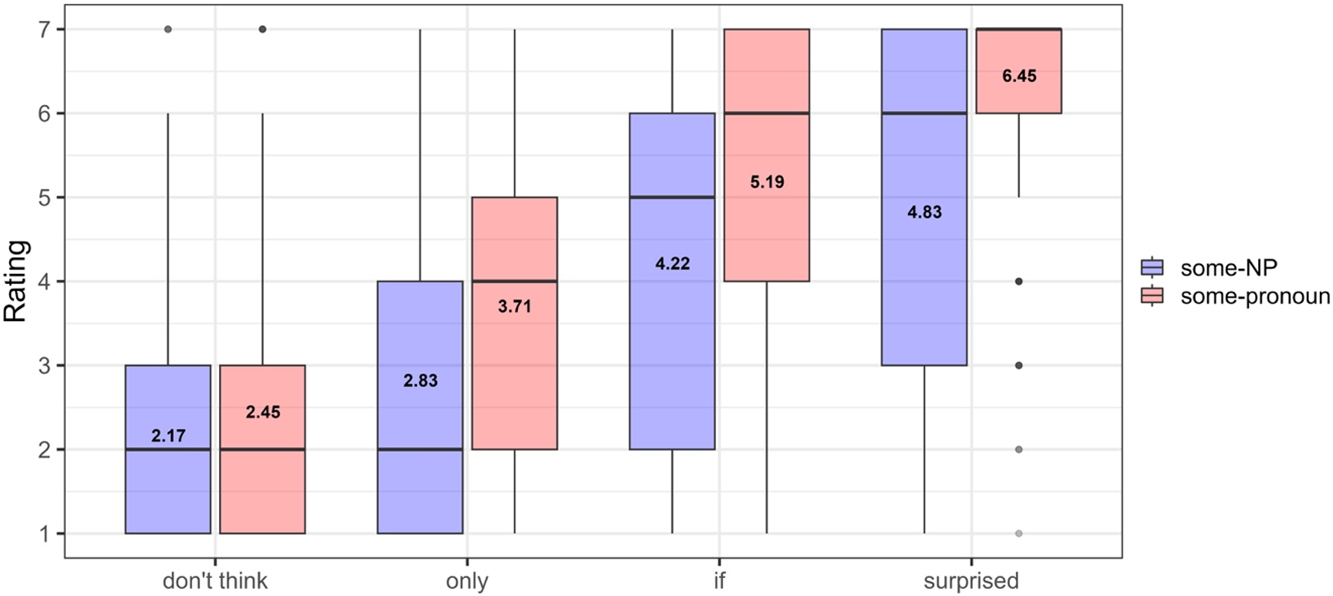
Figure 1 shows the distribution of naturalness ratings for the two types of PPIs embedded in different RC-operators. As it is evident, there is a clear contrast in naturalness between some-NPs and some-pronouns (plotted in light blue and light red, respectively) in favor of the latter. Interestingly, naturalness is variable across the different RC-operators: the judgments remain quite low in the don’t think-RC, while they increase moving from left to right in the graph, with best judgments for the surprised-RC.
Rating for naturalness of some-NP (light red) vs. some-pronoun (light blue) in the four RCs tested. The black lines in each box represent the median of the ratings, the numbers represent the mean.

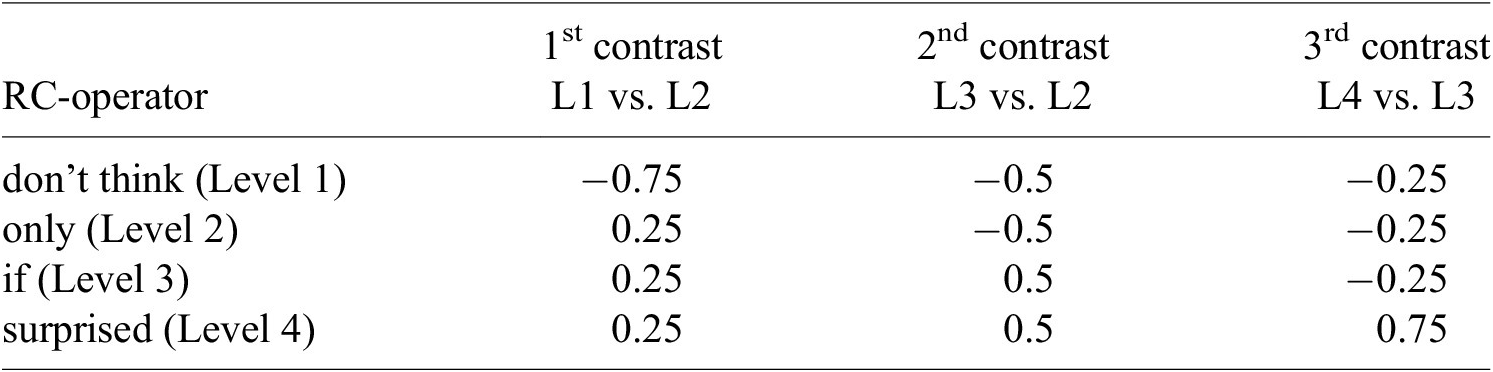
To analyze the data, we implemented a mixed-effects ordinal regression model with a logit link function, using the clmm () function in the ordinal package in R (Christensen Reference Christensen2019), which is the most suitable to treat ratings that cannot be assumed to represent equally spaced points in an interval scale (McCullagh Reference McCullagh1980). Moreover, provided that our independent variable has four levels corresponding to the four RC-operators (don’t think, only, if, surprised) and that the naturalness ratings across conditions increase moving from one level to the other (cf. Figure 1), we set a backward difference coding schema for factor variables with four levels to best capture the graded nature of the judgments. By means of the coding schema summarized in Table 3, the statistical model will allow us to determine if there are significant differences moving from level 1 of our variable (i.e. the don’t think-operator) to level 4 (i.e. the surprised-operator), also considering all intermediate steps (level 2, the only-operator and level 3, the if-operator).
Contrast set for RC-operators by applying the function contr.sdif(4)

We modeled (naturalness) ratings as a function of (i) PPI (contrasting some-NPs to some-pronouns) and (ii) RC-operator (in the contrast schema detailed in Table 3), also considering, (iii), the interaction of these factors. Lastly, we included random intercepts for participants and items in the model. The output of the statistical analysis is presented in Table 4.
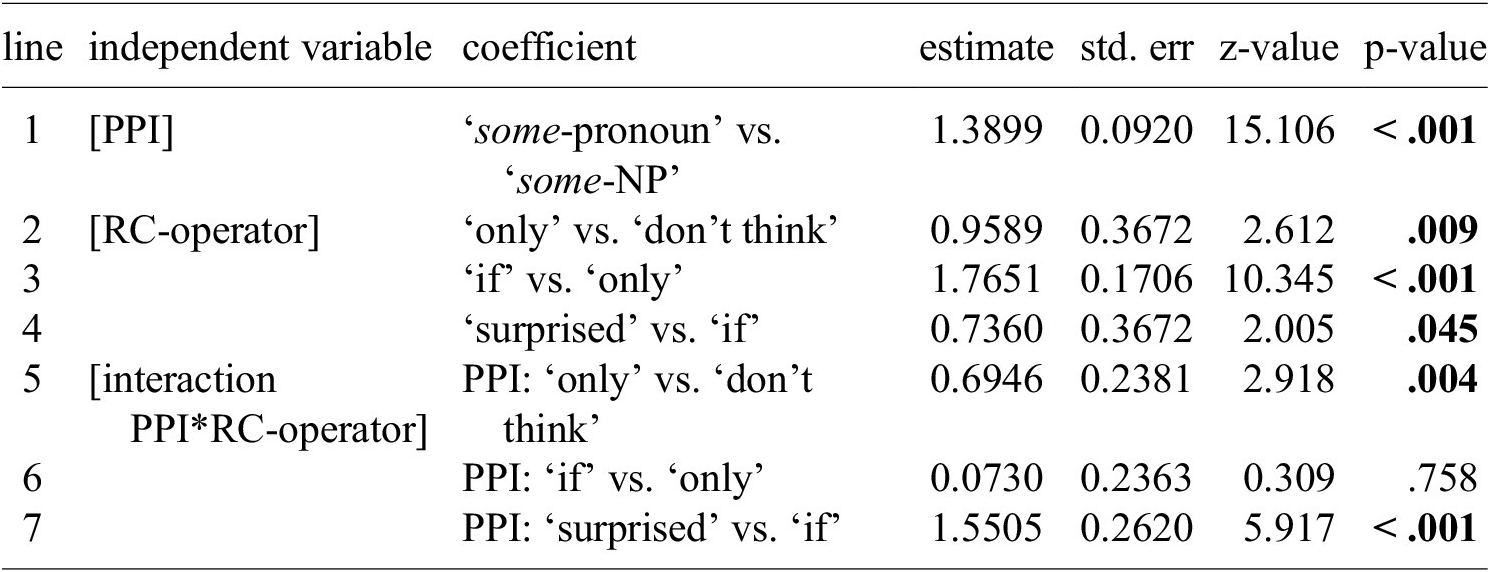
Output of fixed effects of the ordinal regression model

Firstly, line 1 of Table 4 reveals a general significant difference between some-pronouns (Mean=4.45, SD=1.03) and some-NPs (Mean=3.51, SD=1.22) over all RC-contexts tested but abstracting away from the different RC-operators. Secondly, a significant difference emerged across all contrasts set for the RC-operators in the case of some-NPs (set as reference level in all contrasts), compatible with the ascending trend observed in Figure 1: as a rescuing operator only is more effective than don’t think (line 2), if is more effective than only (line 3) and surprised is more effective than if (line 4). The first finding means that some-pronouns are more rescuable than some-NPs in general; the second finding means that not all RC-operators display an equal rescuing ability of some-NPs. Thirdly, a significant interaction of PPI and RC is observed in the case of the first (comparing only and don’t think, line 5) and last (comparing surprised and if, line 7) contrast, but not in the second contrast (comparing if and only, line 6). The last result suggests a difference in the rescuing potential of the different operators, depending on the PPI. To further inspect this possibility, we set two ordinal models with nested contrasts of PPI and RC-operators (the detailed model outputs of the statistical analyses for all experiments are available as an OSF repository at this link: https://osf.io/t27uw/?view_only=3bca8d72c7224eaba3338c6cc48fa764). What emerges is a significant difference between some-NPs and some-pronouns in favor of the latter across all the four RC-operators, including don’t think, for which the contrast returns a statistically significant difference despite the overall very low judgments (Est. = 0.445, SE = 0.168, z = –2.646, p = .008). This means that, across all operators, some-pronouns are always significantly more accepted than some-NPs, suggesting that the latter are indeed less rescuable across the board.
To check that this last observation was really due to the behavior of some-pronouns and some-NPs in RCs (and not, as would logically be possible, to a generally lower acceptability of some-NPs as compared to some-pronouns, regardless of rescuing), we conducted a follow-up experiment in which we compared some-pronouns and some-NPs in non-RC contexts (i.e. without any further operator). We tested 30 monolingual American English speakers, using the same platform, the same demographic criteria, the same experimental design and procedure of the main experiment. Each participant evaluated a total of 40 items on a 7-point Likert scale: 10 were experimental sentences like John called someone on the phone (some-pronoun) or John called some friends on the phone (some-NP), presented on two lists in a Latin square design; 20 were grammatical and ungrammatical control sentences to control for participants’ attention to the experiment. Additionally, we also included a set of 10 stimuli sentences with the RC-operator only, similar to those used in the original experiment reported in the present paper. This was done in order to verify whether the pattern observed in the original experiment with RC-contexts could be replicated with a new group of participants. After inspecting participants’ responses on clearly grammatical and ungrammatical control sentences, 8 participants were excluded. The mean ratings of the 22 remaining participants show that participants’ judgments were below 2 (M = 1.6, SD = 0.48) for the ungrammatical control sentences and above 5 (M = 5.62, SD = 0.87) for the grammatical control sentences, as expected. Importantly, judgments were almost at ceiling both for some-NPs (M = 6.67, SD = 0.55) and some-pronouns (M = 6.72, SD = 0.44) when no RC operator was involved, and no statistical difference emerged in this case (Est.= 0.53, SE = 0.44, z = 1.21, p =.225). This suggests that the statistical difference observed in the main experiment between some-NPs and some-pronouns in RCs cannot be reduced to a general dispreference of the former over the latter. In addition, the participants of the follow-up experiment also fully replicated the pattern observed in the main experiment when some-NPs and some-pronouns appeared in sentences with an RC operator (only in this case), showing more degraded judgments in the case of some-NPs (M = 3.19, SD = 1.51) compared to some-pronouns (M = 3.89, SD = 1.52). Statistical analyses by means of mixed-effects ordinal regression models confirmed a significant difference in the acceptability of the two PPIs with only (Est. = 1.15, SE = 0.27, z = 4.28, p < .0001), already observed in the main experiment.
Returning, again, to this main experiment, some further aspects of the results reported in Table 4 are worth commenting on. While a significant difference emerges between each operator pair (all ps < .001), the magnitude of the effect, which reflects the rescuing potential within each contrast, is always greater in the case of some-pronouns compared to some-NPs.Footnote 8 For instance, the statistical difference between don’t think and only is much reduced in the case of some-NPs compared to some-pronouns (the z score in the former is 2.612, as attested in Table 4, line 2, while it is 4.502 in the latter, which is compatible with a larger difference in the mean ratings of these two operators in the case of some-pronouns). Similarly, the difference between surprised and if is much reduced in the case of some-NPs compared to some-pronouns (the z score in the former is 2.005, as attested in Table 4, line 4, while it is 5.982 in the latter). These differences explain the significant interactions observed in the first and third contrasts in the main analysis (Table 4, lines 5 and 7): in the case of surprised, the naturalness ratings are consistently higher with some-pronouns than with some-NPs, and crucially, they are also significantly higher than the judgments for some-pronouns under the if-operator. In turn, in the case of some-NPs, although the judgments remain subject to significant variability, the rescuing potential remains much reduced in this case, even when moving from if to surprised, for which the highest rescuing potential is attested. Nested comparisons in this case clearly show a great difference (z = 13.311) between the rescuing potential of surprised in the case of some-pronouns, for which the acceptability ratings approach 6.5, compared to some-NPs, for which mean ratings remain below 5. At the other end of the scale, while all participants tend to dislike both PPIs under the don’t think-operator, their judgments are still significantly higher with some-pronouns than with some-NPs, as noted above. Also, while only can rescue some-pronouns significantly more than don’t think, there is little sign of rescuing improvement of only in the case of some-NPs. In sum, all results obtained clearly indicate that, despite some variability in the judgments – which is expected given the complexity of these constructions – rescuability of some-pronouns is much higher than that of some-NPs. In addition, some operators have a greater rescuing potential than others, a fact that might well be due to other factors to be investigated in future work (cf. fn. 10). Finally, the rescuing ability of an operator also varies as a function of the PPI.
4. Preview of the explanation: External negation and the rescuing of some-PPIs
In Section 2, we have briefly reviewed some of the current theories of rescuing and shown that they were unable to account for the non-rescuability of some-NPs (as opposed to the rescuability of some-pronouns). Our own analysis of rescuing will rely on the distinction between ‘external’ and ‘internal’ Neg: Footnote 9

Bar-Asher Siegal’s (Reference Bar-Asher Siegal2015, Reference Bar-Asher Siegal, Siegal, Boneh, Grossman and Rubinsteinto appear) characterization of the distinction between internal and external negation is stated in semantic terms, as a lexical ambiguity between two distinct Negs:

As it is not clear to us how Bar-Asher Siegal’s semantic approach would handle the empirical data reported in Section 3.2, we will assume that the distinction between internal and external negation is represented syntactically (see Garzonio & Poletto Reference Garzonio and Poletto2015,Footnote 11 Bar-Asher Siegal & De Clercq Reference Bar-Asher Siegal, De Clercq, Bouzouita, Breitbarth, Danckaert and Witzenhausen2019) and develop our own analysis:

Our implementation will rely on the view that the left periphery of the clause is enriched with illocutionary functional categories (Cinque Reference Cinque1998, Speas & Tenny Reference Speas, Tenny and di Sciullo2003, Krifka Reference Krifka and Cordes2021, Reference Krifka, Hartmann and Wöllstein2023, Wiltschko Reference Wiltschko2021).Footnote 12
External negation is instantiated in several syntactic configurations (see Section 5), among which preposed/high negations in questions. The contrast in (15) illustrates the generalization in (12):

These examples qualify as rescuing contexts because a clausemate negation of someone is embedded inside a question operator. However, the theories reviewed in Section 2 cannot explain the contrast in (15) because in both examples, Neg is a clausemate of someone and is embedded inside a question. We conclude that the current theories need to be revised not only because they cannot explain the contrast between some-pronouns and some-NPs but also because they fail to explain why preposed/‘high’ negations in questions are potential rescuers, whereas ‘low’ negations are not.
As they stand, (12a) and (12b) are empirical generalizations. Some theoretical motivation for the hypothesis that PPIs are immune to external Neg comes from a syntactic approach to anti-licensing. According to Collins & Postal (Reference Collins and Postal2014), the anti-licensing of some-indefinites can be explained as follows (this is a non-technical restatement of Collins & Postal’s proposal, due to Dobrovie-Sorin Reference Dobrovie-Sorin and Ihsane2020): (i) internal Neg Footnote 13 translates at LF as a polyadic Q (¬∃e,x); (ii) Polyadic negative Q is syntactically constrained by what Collins & Postal call ‘Determiner-sharing’, which amounts to requiring that indefinites that correspond to argument-variables bound by ¬∃e,x be Neg-marked. This explains why indefinites that are narrow-scoped with respect to Neg cannot be expressed as positive indefinites. Depending on the language, they can surface either as NPIs (e.g. in English) or as Neg-words (in Negative Concord languages). Summarizing, the anti-licensing of some-indefinites can be viewed as being due to their lack of Neg-marking, which is required by internal Neg. Granting that the Neg that appears in rescuing contexts is external Neg, the rescuing of some-indefinites amounts to non-sensitivity to external Neg. This non-sensitivity is a correlate of Collins & Postal’s (Reference Collins and Postal2014) analysis of anti-licensing as involving a polyadic negative existential Q. Indeed, an external Neg translates as a unary propositional operator and as such does not require (viz., blocks) the Neg-marking of the indefinites that occur in its scope.
We may now wonder about the role of the rescuing triggers. In a nutshell, we will propose that rescuing triggers are illocutionary heads (or Spec of illocutionary heads) that extend the sentential domain and thereby provide illocutionary positions that can be targeted by Neg-raising at LF, yielding a configuration in which Neg is external (takes as a complement a functional projection higher than the TP). In the absence of rescuing triggers, a sentential negator that is internal (takes the TP as a complement) at surface structure will be unable to raise at LF. In sum, according to our proposal, the rescuing of some-PPIs amounts to the LF-raising of Neg, which thereby becomes ‘external’. Compare the previous accounts reviewed in Section 2, which (to the exception of Larrivée Reference Larrivée2012) implement the hypothesis that rescuing reduces to the cancellation of Neg.
Our syntactic proposal should be complemented by a one-by-one examination of the semantics of rescuing triggers that should explain why they can function not just as run-of-the-mill illocutionary heads but, moreover, as allowing the raising of Neg (there is no reason to believe that all illocutionary heads allow for Neg to raise at LF). We believe that our syntactic proposal can be complemented with Bar-Asher Siegal’s semantico-pragmatic characterization of the contexts that allow for external negation, but we need to leave this for future work.
In the remaining part of the paper, we will implement the line of analysis outlined above. In Section 5, we will briefly summarize some of the literature that describes phenomena in which external negation is involved. In Section 6, we will present Krifka’s (Reference Krifka and Cordes2021, Reference Krifka, Hartmann and Wöllstein2023) illocutionary periphery and show how external negation can be analyzed against that background. Section 7 is devoted to rescuing. In Section 7.1, we show that a theory of rescuing stated in terms of external negation can explain the rescuing of some-pronouns in English (and probably across languages) and of des-indefinites in French. In Section 7.2, we address the problem that is at the origin of our investigation of rescuing. In (16), this problem is restated in terms of external Neg:

Solving this puzzle requires two further ingredients: on the one hand, a distinction between two types of weak indefinites (Section 7.2.1) and, on the other hand, a pragmatic constraint on rescuing (Section 7.2.2).
5. External negation
This section is devoted to the evidence in favor of external negation found in the previous literature:Footnote 14 negators that are specialized for external negation (Section 5.1), the high position of negation in questions (Section 5.2) or in declaratives (Section 5.3). These phenomena are independent of rescuing, and as such they will not be critically examined. They are, however, crucial for our own proposal insofar as they constitute independent evidence for the existence of external negation.
5.1. Dedicated external negators
Some languages have dedicated external negators – for example, neca in Sicilian or law in Jewish Babylonian Aramaic (see Bar-Asher Siegal Reference Bar-Asher Siegal2015, Garzonio & Poletto Reference Garzonio and Poletto2015, Bar-Asher Siegal & De Clercq Reference Bar-Asher Siegal, De Clercq, Bouzouita, Breitbarth, Danckaert and Witzenhausen2019, respectively) – which are crosslinguistically relatively rare:Footnote 15

External and internal sentential negators differ in the positions in which they are merged. On their sentential use not and (ne) pas take TP as a complement, whereas – according to Garzonio & Poletto (Reference Garzonio and Poletto2015) and Bar-Asher Siegal & De Clercq (Reference Bar-Asher Siegal, De Clercq, Bouzouita, Breitbarth, Danckaert and Witzenhausen2019) – neca in Sicilian and law in Jewish Babylonian Aramaic are base-generated in a high functional projection, the Focus of Rizzi’s (Reference Rizzi and Haegeman1997) Left Periphery. In Section 6, we will suggest that Cinque’s (Reference Cinque1998) Epistemic head or Krifka’s (Reference Krifka, Hartmann and Wöllstein2023) Judge head constitute a better fit than Focus. But for the time being, the crucial point is the existence of external sentential negators.
Sentences built with dedicated external negators are arguably semantically equivalent to sentences of the type in (18), which are, however, clearly different from the syntactic point of view:

5.2. Yes/no questions with preposed negation
Let us next consider yes/no Questions with Preposed Negation (QPN):

As shown in (19), QPNs allow for both PPIs and NPIs (some boys and any boys, respectively). According to Ladd (Reference Ladd1981), (19a) and (19b) rely on two distinct underlying structures, which differ as to whether Neg is outside or inside the questioned proposition, respectively conveying a question about p or a question about ¬p.Footnote 16 Beyond this difference, these two types of QPNs are alike in that they contribute the same epistemic implicature: the speaker believes or expects that the positive answer is true (Ladd Reference Ladd1981, Han Reference Han1998, Büring & Gunlogson Reference Büring and Gunlogson2000, Romero & Han Reference Romero and Han2004). This epistemic implicature has the opposite polarity of the question (Romero & Han Reference Romero and Han2004: 640)Footnote 17 and is triggered by Verum, an epistemic conversational operator, which in (19) is triggered by the preposed negation (ibid., 633–634).Footnote 18
Building on previous literature on the Verum operator (Höhle Reference Höhle1992), Romero & Han (Reference Romero and Han2004) propose the following:

Romero & Han do not propose a syntactic analysis of QPNs and acknowledge that their analysis does not explain why it is that QPNs trigger the Verum operator.Footnote 19 In Section 6.1, we will see that Krifka’s (Reference Krifka and Cordes2021) hierarchy provides an adequate host for the high Neg in QPNs. More precisely, we will analyze (19a) as involving external Neg at LF, as a result of the LF-raising of Neg to the illocutionary section of the Left Periphery.
5.3. Declaratives with preposed negation
The following examples illustrate declaratives with preposed negative elements:

The interpretation of examples of this type involves the kind of epistemic implicature that is present in QPNs, whereas the corresponding examples without Neg-raising (John has never lied, Mary would never reveal the secret) do not convey any epistemic bias. According to Romero & Han, (21a) can be paraphrased as ‘It is for sure that we should add to CG [Common Ground] that John never lied’, and they propose that declaratives with preposed Neg rely on the same Verum as QPNs. Now, one may wonder whether the paraphrase given by Romero & Han is the only possible one, or whether – on a par with QPNs – declaratives with preposed Neg also allow for a Neg > Verum scope reading, which would yield the paraphrase ‘It is not for sure that we should add to CG that John ever lied.’ This possibility is expected if Verum (which according to Romero & Han is triggered by a preposed Neg) can scope both above and below Neg.Footnote 20
6. Illocutionary functional heads and external negation
Krifka (Reference Krifka2015, Reference Kratzer and Zalta2021, Reference Krifka, Hartmann and Wöllstein2023) provides a syntax-based semantics of the illocutionary layers of the sentence. The syntactic part of Krifka’s proposal is briefly summarized in Section 6.1. Section 6.2 is devoted to Krifka’s observation that certain verbs may be selectionally ambiguous, being able to take as a complement either a TP (as in the traditional view) or one of the higher illocutionary projections.
6.1. Krifka’s (Reference Krifka and Cordes2021 , Reference Krifka, Hartmann and Wöllstein2023) illocutionary heads
Krifka (Reference Krifka and Cordes2021, Reference Krifka, Hartmann and Wöllstein2023) proposes a hierarchy of three illocutionary functional heads that can generate abstract configurations such as the one in (23), which may be assumed to underlie the English example in (22).Footnote 21 J°, Com° and Act° are the heads of the Judge Phrase, Commitment Phrase and Act Phrase: Footnote 22


In this structure, the most embedded constituent is the TP, which denotes the ‘communicated proposition’. The head J° introduces a judge argument j, and adverbs such as probably are JP-internal modifiers that indicate the strength of the certainty of j to the truth of the proposition p communicated by TP. The ‘public commitment’ to a proposition is contributed by a silent commitment operator (notated ⊢) inserted in Com°, which is present both in declaratives and questions.Footnote 23 This latter distinction is encoded at the level of ActP, the head of which hosts an assertion or a question operator.
Given Krifka’s illocutionary projections, we may expect Neg° to be able to attach to TP, JP or ComP. Thus, in the representation of example (24) shown in (25) – see Krifka’s (Reference Krifka and Cordes2021) (37) and (39), respectively – Neg scopes above Com°.Footnote 24


Note that according to Krifka, the position of n’t shown in (25) is that of a negative modifier, the scope of which is ambiguous w.r.t. Com° (Com° > n’t or n’t > Com°).
In line with syntactic approaches (Zanuttini Reference Zanuttini1997, Zeijlstra Reference Zeijlstra2004, Reference Zeijlstra2006), we may assume instead that sentential Neg°Footnote 26 is a functional head that takes as a complement various functional projections. The resulting Neg-headed constituents may be viewed as extended projections of their complements, which we can label Neg/TP, Neg/JP and Neg/ComP, respectively. To illustrate, the representation in (25) can be written as in (26), in which the relevant part is Neg/ComP:

As we will see below, our analysis of rescuing will make crucial use of the lower negative extended projection allowed by Krifka’s system, Neg/JP, in addition to the currently assumed Neg/TP. We will refer to them as ‘external’ and ‘internal’ Neg, respectively.
6.2. On the selectional ambiguity of certain verbs
Krifka (Reference Krifka, Hartmann and Wöllstein2023: 155–163) argues that embedded clauses, which are traditionally given a uniform analysis as CPs (Complementizer Phrases), need to be distinguished depending on whether the complement of that (the Complementizer head) is a TP (as in the traditional view) or one of the higher illocutionary projections. The choice between these possibilities is determined by the selectional properties of the main verb. The following examples correspond to Krifka’s (16)–(18):


Following Krifka (Reference Krifka, Hartmann and Wöllstein2023, Section 4), we will further assume that certain main verbs allow for double selection, being compatible (depending on the context and intention of the speaker) with either a that-TP or a that-JP complement). This possibility may be assumed for predicates such as regret, think or be stupid:

Note that in (30b) the main verb is assumed to sit in Com°. This is in line with Krifka (Reference Krifka, Hartmann and Wöllstein2023: 144), who says that ‘it is a natural assumption that verbs that are used performatively do not originate in the TP, but as heads of the ComP, where they express a specific type of assertive commitment’. Moreover, in (30b), the judge, who is the speaker, is responsible for the truth of the proposition communicated in the embedded TP (Krifka Reference Krifka, Hartmann and Wöllstein2023: 125). The corresponding interpretation could be ‘I am surprised that it is true that the arriving of John happened’, whereas for (30a), it would be ‘I am surprised that the arriving of John happened’. Which interpretation is in use depends on the intention of the speaker, which may be difficult to determine without a specific context.
7. Back to rescuing
Canonical sentential negation is by default interpreted as ‘internal’. The examples of external negation reviewed in Section 5 above involve overt markers (negators specialized for external negation or the overt high placement of negators that normally occur in a lower position) that override this default interpretation. The core hypothesis of the present proposal is that rescuing triggers induce the LF-raising of Neg outside the TP-domain. In Section 7.1, we observe that Krifka’s (Reference Krifka and Cordes2021, Reference Krifka, Hartmann and Wöllstein2023) structuring of the illocutionary domain at the left periphery provides positions for both the rescuing operators and for the external negator. This configuration explains the rescuing of some-pronouns in English and of des-indefinites in French. In Section 7.2, we go back to the PPIs with reduced rescuability (some-NPs in English). Our explanation will rely on the interplay between two ingredients: a distinction between two types of weak indefinites (Section 7.2.1) and a pragmatic constraint on rescuing (Section 7.2.2).
7.1. When PPIs are rescuable
Let us now consider an example of rescuing:

It is interesting to observe that examples like (31) – and more generally, all examples built with rescuing triggers – allow not only for ‘rescued’ PPIs but also for NPIs (as indicated, both someone and anyone are allowed in [31]).
Under our proposal, the compatibility with both PPIs and NPIs can be explained if we assume, as already proposed in Section 6.2 above, that surprise may take as a complement both a that-TP and a that-JP. The ActP level is left aside because it does not interfere with our argumentation.

In (32a), the polarity item is realized as an NPI because it is in the scope of an internal Neg (Neg/TP). In (32b), however, the polarity item surfaces as a PPI because it is in the scope of an external NEG (Neg/JP). The intuitive interpretations corresponding to these two representations could be paraphrased as ‘I am surprised that inviting did not happen’ and ‘I am surprised that it is not true that inviting happened’, respectively.
A parallel analysis would explain why in RCs both des (which is a PPI) and de (which is an NPI) are possible in French:

When (33) contains de, its structure is parallel to (32a); when it contains des, its structure is parallel to (32b).
In both English and French, the RCs contrast with the ‘anti-licensing’ contexts illustrated below (also recall [1] and [2]):


The unacceptability of (34)–(35) can be explained as being due to the fact that, in the absence of rescuing triggers, the Com level is not projected, which in turn prevents the projection of the lower functional head J° itself.Footnote 27 Because there is no higher constituent (in particular no JP) Neg can only head the Neg/TP negative projection. This configuration is the defining context of anti-licensing, hence the acceptability of de (a strict NPI) and the unacceptability of des, which qualifies as a PPI (see Dobrovie-Sorin Reference Dobrovie-Sorin and Ihsane2020). Because the French quelqu’un behaves on a par with the English someone, we have not illustrated its behavior here. As for some-NPs, they are also ruled out in ‘anti-licensing’ contexts like (34)–(35). Why they are not rescued is due to a further constraint, which will be proposed in Section 7.2.2.
Let us now briefly consider the other RCs mentioned in Section 1 – in particular, constructions with if and only as in (3a) and (3c), repeated below as (36a) and (36b), respectively.

It seems natural/plausible to assume that if is selectional-ambiguous, on a par with surprised. Thus, if could take either TP or JP (or Neg/TP as in (37) or Neg/JP as in (38)) as a complement:


In (37), if expresses conditional relations between events (if an event e1 of non-calling occurs, then an event e2 will occur), whereas in (38), the relations hold between propositions (if a proposition non-p is true, then a proposition q will be true). A similar proposal can be made for only:


Example (39) says that ‘the non-occurrence of calling was instantiated only for John’ and (40) that ‘the non-truth of someone calling someone holds only for John’.
7.2. On the reduced rescuability of some-NPs
Let us now go back to the starting point of this article, the reduced acceptability of some-NPs (as opposed to some-pronouns and des-NPs in French) in rescuing contexts:

We need a further constraint, which rules out (41c) but not (41a) and (41b). But before formulating that constraint (Section 7.2.2), we first need to propose differentiating analyses of indefinites (Section 7.2.1).
7.2.1. Types of weak indefinites
On their unmarked interpretation, some-pronouns can be viewed as placeholders for a certain argument position of the main predicate. The individuals referred to by means of such pronouns are not introduced independently from the event to which they participate: there is no way of identifying the referent of someone otherwise than by the fact that he/she is singing. This type of interpretation can be analyzed as involving polyadic existential quantification over events and individuals:


A similar type of analysis is appropriate for des-NPs in French:


The interpretation of some-NPs is different. In an example such as (49), we assert the existence of a group of students, and we attribute to them the property of ‘singing’:


In a situation-semantic framework, existential quantification over individuals can be viewed as asserting the existence of individuals – that is, stating that an entity exists in a certain situation s. Furthermore, it is possible to combine existential quantification over individuals with existential quantification over events,Footnote 28 hence the following representation:

Independent evidence demonstrating the need for distinguishing the weak readings of English some-NPs on the one hand and the French des-NPs and some-pronouns on the other comes from their (in)compatibility with for-adverbials. As (52b) and the French (52c) show, something and des sandwiches ‘sandwiches’ are acceptable (on a par with the English bare plural in (52a)), in contrast to some sandwiches and that sandwich in (52d) and (52e), respectively.

Arguably, the differentiated representations suggested above for some-pronouns, des-NPs and some-NPs may allow us to explain the (un)acceptability observed in (52a–e). But of course, the ongoing debate around the sticky issues related to for-adverbials (see, in particular, Chierchia Reference Chierchia2023) goes far beyond our present purposes. In what follows, we show that the differentiated representations of weak indefinites may explain their contrasting behavior in rescuing contexts.
7.2.2. Constraining rescuing
Given the analysis of rescuing proposed in previous sections, a possible formulation of the relevant constraint, which needs further empirical support, goes as follows:

(53) could be due to some kind of general constraint on what is (proposed to be) inserted in the Common Ground: the more ‘minimal’ events are, the easier it is for them to be introduced in the Common Ground by the hearer.
Let us now consider again the examples in (41) and explain why some-pronouns, as well as des-NPs, satisfy the constraint in (53), in contrast to some-NPs:

After the raising of Neg above JP, the embedded TPs are represented as below:

The LF in (55a) asserts the existence of a reading of something by Mary. This event can be kept as short as possible, and as such it will satisfy the minimality constraint formulated above.
The LF in (55c) asserts the existence of the reading of several books by Mary, which violates (53): events are individuated w.r.t. the atomic individuals that participate in the event, which means that (54c) refers to a plural event the cardinality of which is identical to the cardinality of the books.
Note now that (55b) resembles (55c) in that several books are involved in the event, and yet the corresponding example in (54b) is acceptable. The reason is already represented in (55b) vs. (55c). In the latter case, the plural entity referred to by some books is introduced as occurring in the situation s separately from the event of reading itself; because of this independent identification, the plural individual referred to by some books forces the event of reading to be split up in as many atomic events as there are atomic books. In (55b), however, the books are not introduced separately from the event, and as such, they do not multiply the event to which they participate and minimality is satisfied.
7.3. When some-NPs are rescuable
In this section, we will consider several examples in which some-NPs seem rescuable. We plan to verify our judgments by means of experiments. Here, we will simply provide some examples and suggest a possible explanation for the indicated acceptability. The first type of example involves some-NPs built with mass nouns:

It seems plausible to suggest that the acceptability observed here is due to the fact that in unmarked contexts, mass entities are not made up of atoms, and as such, they cannot be individuated and introduced separately from the event to which they participate. Such examples are therefore represented as involving polyadic quantification over atomic events (individuated by the shortest time interval that allows the completion of an event of the relevant kind), thus obeying the minimality constraint.

Note, finally, that even some-NPs built with plural nouns seem rescuable in certain examples:

We would like to suggest that in this case, the acceptability is due to the fact that the verb together with the plural noun phrase convey the description of one event of calling, meeting, helping, etc. involving a group-participant. Such examples are also represented as involving polyadic existential quantification:

According to this formula, the example in (59) asserts the existence of an atomic event of a group of musicians being simultaneously called by John. The minimality constraint is satisfied. Compare the examples that we had considered previously – for example, (54c): since books are in general read one after the other, some books is not interpreted as a group participating to an atomic event but rather as a plurality of atoms that split up the event in a plurality of sub-events.
We may thus conclude that some-NPs and des-NPs differ regarding their default representations: the former introduce a plural entity individuated separately from the event denoted by the main verb, whereas the latter cannot do so on their unmarked reading, which is weak,Footnote 29 but instead introduce a variable over individuals that gets unselectively bound by a binary existential Q (over event, individual pairs). But the descriptive content of the verb combined with that of the noun may override the default representation of some-NPs, yielding polyadic quantification over events and individuals.
8. Conclusion
In this paper, we have investigated the empirical observation that there is a contrast among different indefinite PPIs regarding their rescuing potential (Dobrovie-Sorin Reference Dobrovie-Sorin and Ihsane2020, Dobrovie-Sorin & Ihsane Reference Dobrovie-Sorin, Ihsane, Alboiu, Isac, Nicolae, Tănase-Dogaru and Tigău2022). By means of an Acceptability Judgment Task, we confirmed that some-NPs are less rescuable, in contrast to some-pronouns (in both English and French) and des-indefinites in French, and showed that this difference is statistically significant. We also established that the rescuing ability of the various tested operators (if, surprise, only, don’t think) varies as a function of the PPI.
To explain the different distribution between some-pronouns and some-NPs in English, and between English some-NPs and French des-NPs in RCs, we have proposed that the left periphery of RCs differs from the left periphery of anti-licensing constructions: the former, in contrast to the latter, comprise several illocutionary functional heads above TP, one of which hosts the rescuing operator (for example, surprise, if, only). Correlatively, the negation involved in RCs is ‘external’ in the sense that, at LF, it takes as an argument JP, one of the illocutionary functional layers above TP: as a result, PPIs can scope under Neg, because they are insensitive to external negation (Neg/JP). In this setup, anti-licensing is a phenomenon that relates only to internal Neg (Neg/TP).
RCs also admit NPIs as in I am surprised that John didn’t invite anyone. To account for this possibility, we have assumed that certain main verbs display a selection ambiguity (Krifka Reference Krifka, Hartmann and Wöllstein2023): they may take as complement either one of the illocutionary projections above TP (hence, Neg is external and polarity items are realized as PPIs) or the TP (hence, Neg is internal and polarity items are realized as NPIs).
As for our initial puzzle – namely, the difference in rescuing potential between some-pronouns and des-NPs on the one hand and some-NPs on the other hand – we have proposed that this is due to the interplay between two assumptions, the distinct LF representations of these two classes of indefinites and a minimal-event constraint on propositions embedded under Neg/JP. The minimal-event constraint is satisfied by the use of des-indefinites and some-pronouns because their LF involves polyadic existential quantification over events and individuals, which amounts to asserting the existence of a single event. Some-NPs, on the other hand, assert the existence of plural individuals, and this will yield a plural event (comprising as many atomic sub-events as there are atomic individuals in the sum denoted by the referent of the some-NP), which will violate the minimal-event restriction. Hence, the degraded acceptability of some-NPs in RCs. It is, however, fully clear to us that these assumptions are in need of further investigation and are, as they stand, a first tentative approach to capture the data patterns observed.
In sum, unlike previous work on RCs (cf. Section 2), our analysis accounts for a contrast between two types of some-PPIs (some-pronouns and some-NPs) that has largely gone unnoticed in the literature so far and explains why both PPIs and NPIs are possible in RC contexts. Our proposal is syntax-based and builds on an assumption in line with Larrivée (Reference Larrivée2012) – namely, that the negation involved in rescuing is external to the propositional content. However, in contrast to Larrivée, we implement the fact that it is the ‘activation’ of the proposition by rescuing triggers that enables the negation to be external: it is because rescuing triggers occupy a TP-external illocutionary functional projection that the negation itself can be TP-external. We have also extended the proposal to cross-linguistic data, showing that des-NPs in French pattern with some-pronouns (in English and French), not with English some-NPs as one may expect. This difference is explained as being due to the distinct LF representations of des-NPs and some-NPs, which are independently supported by their differentiating behavior when combined with for-adverbials. Finally, we have observed that in some contexts the default representation of some-NPs may be overridden: when a mass noun or a group-participant is involved, the descriptive content of the nominal combined with that of the verb may yield polyadic quantification over a single event. As a result, the minimality condition is satisfied and the some-NP is rescued.
Supplementary material
The supplementary material for this article can be found at http://doi.org/10.1017/S0022226725100753.
Acknowledgements
We thank Karen De Clercq, Timothée Bernard, Lucia Tovena and Elena Castroviejo Mirò for constructive discussions and comments on different parts and versions of this work. This version of our paper has greatly benefitted from the comments of three JoL reviewers. In order to answer those comments, we have thoroughly revised the analysis of the experimental part, which we have completed by a new experiment. We also gratefully acknowledge the financial support of the IdEx Université Paris Cité – ANR-18-IDEX-0001 as part of the Labex Empirical Foundations of Linguistics – EFL.






 Open access

