


Introduction
The cemí (a representation of a spirit, ancestor or deity) in the collections of the Museo Nazionale Preistorico Etnografico ‘L. Pigorini’ in Rome (henceforth referred to as Pigorini) is a remarkable sculpture attributed to the Caribbean's early colonial period, with its collection history in Europe extending back to at least 1680 (Legati Reference Legati1680: 13) (Figure 1). It is a Janusesque figure—one side human, the other a bat—incorporating a lavish array of indigenous wealth (e.g. over 20000 shell beads) and exotic trade items woven into a cotton mesh and supported by a domed wooden base (Vega Reference Vega and Vega1987; Biscione Reference Biscione1991, Reference Biscione, Brecht, Brodsky, Farmer and Taylor1997; Roe Reference Roe, Brecht, Brodsky, Farmer and Taylor1997; Ostapkowicz in press). Merging European glass beads and mirrors, and, exceptionally, rhinoceros horn, it has become an icon of the post-colonial Caribbean, embodying the three key foundational strands of modern island culture: indigenous, African and European (Roe Reference Roe, Brecht, Brodsky, Farmer and Taylor1997: 165; Sullivan Reference Sullivan, Rischel and Stratton-Pruitt2006: 40). Given the calibre of artistry and the masterful incorporation of these new materials, the piece has long been attributed to a brief period of Taíno, Spanish and African interaction: AD 1492–1550 (Taíno being an umbrella term for the indigenous people of the Caribbean Greater Antilles; see Curet Reference Curet2014). Critically, this is prior to the collapse of Taíno traditions in the face of European incursions, slavery, warfare and introduced diseases. It thus encapsulates a fleeting moment in early trans-Atlantic cross-cultural exchange—a meeting of very different worldviews. This combination of foreign materials and what has been interpreted as strands of European and African iconography and influence (see Colini, in Biscione Reference Biscione1991: 78–79; Roe Reference Roe, Brecht, Brodsky, Farmer and Taylor1997; Sullivan Reference Sullivan, Rischel and Stratton-Pruitt2006: 39–40), together with an obscured early collection history, have suggested that the sculpture itself is potentially suspect (Rouse Reference Rouse1992: 159): a pastiche that may have been among the items made in Europe for the princely kunstkammer (the precursors to modern museums), “not as forgeries, but to create and present even more attractive and wonderful curiosities” (Scalini Reference Scalini, von Trnek and Hagg2001: 129–32).
Three views of the Pigorini cemí/belt, featuring a human mask of rhinoceros horn (right), and a bat face of green glass beads (left); height: 315mm; width: 245mm. Photography: J. Ostapkowicz, courtesy of the Museo delle Civiltá—Museo Nazionale Preistorico Etnografico L. Pigorini, su concessione del Mibact, 4190.
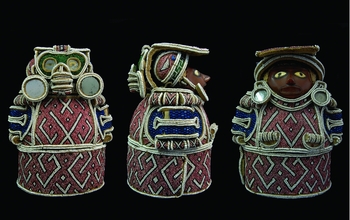
Many previous studies have proposed a single function for the sculpture—either as a reliquary or as a platform for the hallucinogenic snuff taken in the cohoba ceremony (Vega Reference Vega and Vega1987: 19–20; Kerchache Reference Kerchache1994: 162; Roe Reference Roe, Brecht, Brodsky, Farmer and Taylor1997: 164; Montás et al. Reference Montas, Borell and Moya Pons2003: 47)—although the piece is actually a composite object, with a separate belt beneath the Janusesque top section, both nailed to a supporting wooden base (Biscione Reference Biscione, Brecht, Brodsky, Farmer and Taylor1997). This combination of two artefacts, nailed to a static frame, is without precedent in the repertoire of Taíno material culture and practice, and seems more in keeping with their display in a Western context. Questions arise, therefore, concerning the possible histories of intervention of this long-term museum survivor. This paper seeks to clarify some of these issues through an investigation of the diverse materials in the objects’ construction, and their varied origins. We also present the first radiocarbon dating of the cotton and wood base, and the taxonomic identification of the wood, to understand better how and when this composite sculpture came together.
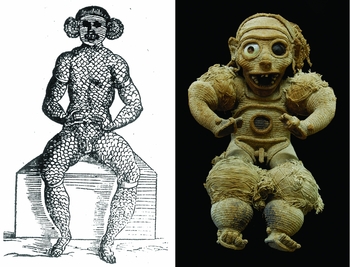
In terms of its authenticity, it is important to note that the Pigorini cemí and belt were not the only lavishly beaded artefacts from the Americas in early European collections. Listed in the 1598 inventory of the Munich Kunstkammer is a large ‘Mexican’ “idol, elaborately built up from white and red interlocking rings with big eyes made from blue glass”, attributed to the collections of Cardinal Francisco Jiménez de Cisneros, who died in 1517 (Diemer et al. Reference Diemer, Elke and Dorothea2004: 142; see also Feest Reference Feest1986, Reference Feest and Levenson1991: 581). This is too early for Mexican antiquities to have reached Europe, hence its provenance is probably Caribbean (Feest Reference Feest1986, Reference Feest and Levenson1991), especially given strong parallels with the only extant cotton reliquary recovered in the late nineteenth century from a cave in the Dominican Republic (Ostapkowicz & Newsom Reference Ostapkowicz and Newsom2012) (Figure 2, right). While the Munich inventory also mentions other possible Caribbean artefacts, including belts, the incorporation of European trade items is not expressly documented (Diemer et al. Reference Diemer, Elke and Dorothea2004: 55). Unfortunately, none of these Caribbean artefacts are known to have survived (Feest Reference Feest1986; Ostapkowicz Reference Ostapkowicz2013: 295). The only complete belt is in the Weltmuseum in Vienna (Figure 3). Its documented history stretches back at least to 1877, but most probably much longer, having been part of the Vienna Schatzkammer, which was originally established in 1556. It features a thick layer of indigenous beads, mirror eyes, jet beads and brass pins. It thus shares many similarities with the Pigorini cemí and belt (Ostapkowicz Reference Ostapkowicz2013). Despite Spanish admiration for Taíno weaving skills, and with examples of their work—from hammocks to belts and cemís—being sent back to Europe, only four cotton pieces attributed to the Taíno survive: the Turin cotton reliquary, the Vienna belt and the composite Pigorini cemí and belt (Ostapkowicz & Newsom Reference Ostapkowicz and Newsom2012; Ostapkowicz Reference Ostapkowicz2013). Of these, only the Vienna belt and the Pigorini cemí feature European ‘exotics’.
Left) the Munich Kunstkammer cemí, originally part of the Cardinal Cisneros collection (pre-1517) (Pignoria Reference Pignoria and Cartari1626). Image courtesy of the Bodleian Libraries, University of Oxford, BL720.C27 CAR 1626: 563–64. Right) the Turin cemí, AD 1439–1522 (76.7% probability); height: 550mm (maximum, aligned on stand); width: 355mm. Photograph: J. Ostapkowicz, courtesy of The Museum of Anthropology and Ethnography, University of Turin, Italy.
Cotton belt with indigenous shell beads and European jet, brass and mirror additions, featuring a central zoomorphic cemí with upturned hands, AD 1475–1635 (95.4% probability). Full length, with straps: 1165mm (beaded strap only: 855mm); height: 70mm. Photograph: J. Ostapkowicz, courtesy of the KHM-Museumsverband Weltmuseum, Vienna (inventory number 10.443).

History
It is not clear when the Pigorini cemí and belt first entered Europe, although there have been speculative links to the court of Carlos V (1500–1558), and some of the most influential houses of sixteenth-/seventeenth-century Europe, including the collections of Ferdinand II, Archduke of Tyrol (1529–1595) and Leopoldo de’ Medici (1617–1675) (Vega Reference Vega and Vega1987: 20–22). Unfortunately, these attributions cannot be confirmed due to the absence of supporting evidence. Its early history in Europe remains obscure until 1680, when it first appears in the catalogue of the Marchese Ferdinando Cospi's (1606–1686) museum. The brief description clearly captures its features: “Idol from the West Indies with two faces, all made of minute worked rings of bone [sic], of various colours” (Legati Reference Legati1680: 13, translation by Ostapkowicz). Given that an earlier 1677 catalogue makes no mention of the cemí, it most probably entered Cospi's collection between the years 1677–1680 (Feest Reference Feest1986: 193). Further work on the early documentation of these collections and collectors is underway, although the vagaries of the archival records may present an insurmountable obstacle to establishing the cemí’s early European history.
Cospi's collection was transferred several times in the following centuries, eventually obscuring the cemí’s history and resulting in the loss of the ‘West Indies’ provenance. In 1878, when it was finally transferred to the newly established Museo Nazionale Preistorico Etnografico di Roma, the curator, Giuseppe Colini, noted that “it is believed to be from West Africa, due to the geometric designs similar to those featured on Angolan mats or carpets, and due to the same type of head-dress and rhinoceros horn that make up the face” (in Biscione Reference Biscione, Brecht, Brodsky, Farmer and Taylor1997: 162). In the Pigorini catalogue, it was identified as a “wooden idol covered with bone [sic] and glass beads in various colours; it has two faces, one of which has four round mirrors, the other, two” (in Laurencich-Minelli Reference Laurencich-Minelli1982: 200). It was not until 1952 that Schweeger-Hefel (1952) reinstated it as a Caribbean artefact in a thorough review that noted its parallels to the Vienna belt.
Materials and structure: indigenous and foreign
The cemí is a composite object on a number of levels: in the rich tapestry of materials (including shell and glass beads, rhinoceros horn, mirrors and gold) woven together into the cotton framework, and in its integration of two separate elements (belt and figural top) onto an underlying wooden base. These diverse elements together constitute its current form, at first glance giving the appearance of a single object. Deconstructing the cemí into its individual components raises several questions concerning its integrity, answers to which are critical to engaging with its history.
The wooden base is an important starting point. Kerchache (Reference Kerchache1994: 162), while noting the cemí’s ‘inner core of wood’, nevertheless interpreted the sculpture as a reliquary. This is improbable, as the base leaves no space for human remains, nor does the dome-shaped figural top share any similarities to the only surviving cotton reliquary from the region (Figure 2; Ostapkowicz & Newsom Reference Ostapkowicz and Newsom2012), which is woven in the round as a human figure. A brief visual inspection of the base in the 1980s suggested that it was constructed of palm wood, raising the possibility that it was original and integral to the composition (Biscione pers. comm.). The wood is, however, lathe-turned on the inside, with knife or adzing marks on its outer surface, and square, hand-cut nails are used to secure the cotton artefacts (Figure 4). This is completely incongruous with indigenous use. Belts, for example, were the prime male body ornament, worn on important occasions, or given as gifts to visiting dignitaries in recognition of their rank, and probably stored away safely when not in use (Ostapkowicz Reference Ostapkowicz2013). The top may have functioned as an elaborate headpiece; its widest internal circumference is around 0.6m, which would fit an adult's head comfortably. Exactly such a cap was documented in the 1589 catalogue of the Munich Kunstkammer (the same collection as that which held the Cisneros cemí discussed above), described as “an Indian man's hat, covered with bone [shell?] rings in white, red and black, on top are two devil's faces, on the back a hood hangs down; it looks like this was the hat of a heathen high priest” (Diemer et al. Reference Diemer, Elke and Dorothea2004: 141). Although no provenance is provided, the description of the bead colours and two faces has striking similarities to the Pigorini cemí, and its identification as a headdress supports the suggestion that the Pigorini cemí was also used in this capacity.
Left) the cemí’s lathe-turned wooden base. Diameter of wooden base only: 180mm. Right) hand-cut nail securing the cotton artefacts to the wooden base. Photographs: J. Ostapkowicz, courtesy of the Museo delle Civiltá—Museo Nazionale Preistorico Etnografico L. Pigorini, su concessione del Mibact, 4190.

Other aspects of the piece are completely within the indigenous genre: both the belt and the figural top incorporate thousands of shell beads in vibrant geometric designs. Shell beads were an important indigenous valuable in the Caribbean. The labour involved in their manufacture in this quantity would entail months, if not years, of work (see Ostapkowicz in press). Glass beads—despite their foreign source—echoed the qualities of their shell counterparts, but had the further merit of being exotic and relatively scarce during the early years of Spanish-Taíno interactions, thus adding another layer of value. European mirrors also had indigenous precedents, in the form of highly polished sheets of gold or guanín (a gold-copper alloy), but again had the additional cachet of being foreign. Inlaid in the cemí’s eyes and earflares, the mirrors took the traditional place of gold or shell. Even the green glass beads used to enhance the cemí’s bat face echoed the highly valued jadeite beads employed widely in the circum-Caribbean (Ostapkowicz in press). The incorporation of so much indigenous and foreign wealth reflects the affluence of a high-status cacique (chief) who would have worn or otherwise used these valuables to enforce or enhance his prestige.
While these foreign glass and mirror components sit comfortably amidst the indigenous materials, in many ways echoing their appearance and meaning, there is another element that is much more difficult to reconcile: the rhinoceros horn, carved as the cemí’s human face. It is remarkable (and rather improbable) that such an unusual material made its way to a fledging Spanish port on Hispaniola, where it eventually entered a cacique's sphere of influence via trade and/or alliance negotiations with the Spanish, and was then carved into the face of a cemí by a local artisan sensitive to its physical properties. Rhinoceros horn was an extremely desirable commodity in sixteenth-century Europe and Asia (Pérez de Tudela & Gschwend Reference Pérez de Tudela, Gschwend, von Trneck and Haag2001)—by some accounts exceeding even gold in value (Anonymous 2008). As with ivory and other exotics, such as ostrich eggs (Kemp Reference Kemp and Farago1995: 184), it may have become more accessible to European elites after the Portuguese established trade monopolies with Africa and India in the fifteenth century. In 1515, the diplomatic gift of a live rhinoceros from Sultan Muzaffar II, ruler of Cambay (Gujarat, India) to King Manuel I of Portugal caused a sensation in Europe (Dackerman Reference Dackerman and Dackerman2011), undoubtedly further fuelling the market for horn and other exotic materials. The horn's long journey to Hispaniola could have followed the routes of Portuguese/Indian trade via Europe or Spanish slavers along the coast of Africa. But rhinoceros horn is far from an obvious trade item in the Caribbean. In fact, to our knowledge, there are no other documented examples (whether raw or manufactured) from early colonial sites in the Americas.
The assured carving of the horn suggests the work of an artist well versed in this material. But while the Taíno were adept woodcarvers, using woods such as Guaiacum (its colouring reminiscent of the tones of the rhinoceros-horn mask) to create important ritual objects, horn as a carving medium was entirely unknown in the pre-Colombian Caribbean. No large mammals remained on the islands after the Pleistocene (Newsom & Wing Reference Newsom and Wing2004). This changed dramatically in the early colonial period, however: the early introduction of cattle by the Spanish was so successful that by 1503 it was no longer necessary to import them (VanderVeen Reference VanderVeen2006: 23). Evidence suggests that the Taíno had access to cattle meat within the first few years of the colonial period (VanderVeen Reference VanderVeen2006), and probably also had access to cattle horn, although no indigenous artefacts in this material are known to survive. If a skilled artisan knew how to work horn—whether through independent trial and error, or by learning directly from the Spanish or Africans—the challenges of working rhinoceros horn may not have been too dissimilar. African slaves were present on Hispaniola early on, and Spanish records document some of the first cimarrones (runaways/fugitives) escaping to remote indigenous communities in 1503 (Landers Reference Landers and Hurst Thomas1990: 317; Deagan & Cruxent Reference Deagan and Cruxent2002: 210). Within this context of newly introduced goods and peoples, and of cultural exchanges, perhaps there was scope for relevant new skills to be developed and honed to the degree seen in the Pigorini mask, or guiaza (indigenous mask or maskettes usually made of shell and wood; Mol Reference Mol2007; Oliver Reference Oliver2009). But how did this material come to feature as the guiaza and what was its particular significance to the Taíno? Is it indeed African horn as has been assumed (e.g. Rouse Reference Rouse1992: 159; Sullivan Reference Sullivan, Rischel and Stratton-Pruitt2006: 39), or might it have an even more distant source in Asia? Further work is planned to understand better how this material was worked and incorporated into the cemí, including a determination of its source and what this may indicate concerning the histories of this piece.
Other materials comprise compact bundles of coarse fibres (previously identified as vegetable fibres) inserted into the domed cotton support positioned between the two heads (Biscione Reference Biscione1991: 78; 1997: 162). Scanning electron microscopy (SEM) indicates that these include feathers from an as yet unidentified species (Figure 5, left). This material is in striking contrast to the short, thick bundles on the forehead of the cemí’s human face, which SEM imaging indicates are hair (Figure 5, right). Although damaged, their diameter (approximately 100 µm) and imbricate cuticle pattern appears consistent with human hair (this is still under investigation). These new findings suggest that these materials were specifically selected to parallel and emphasise the distinctions between—or perhaps the transformative aspects of—the cemí’s human and animal faces.
Left) bundles of organic materials, including feathers, tightly bound within the cotton dome supporting both heads. Left inset) SEM image of sample from bundle, ×180. Right) bundles of short, straight hair framing the cemí’s human face. Right inset) SEM image of ‘hair’ sample, ×750. Photograph: J. Ostapkowicz, courtesy of the Museo delle Civiltá—Museo Nazionale Preistorico Etnografico L. Pigorini, su concessione del Mibact, 4190.

This rich layering of materials and labour expenditure reflects the degree of care and planning invested in the cemí’s creation, particularly as the separate cotton attachments (heads, mirror ear ornaments, shoulder epaulettes, neck guards) had to be woven into the base structure to secure them. The two heads are positioned back to back, giving the appearance of a combined anthropo-/zoomorphic being when viewed from the side (Figure 6). Both are, however, movable to a degree (Biscione Reference Biscione, Brecht, Brodsky, Farmer and Taylor1997: 162, pers. comm.) and can be separated into their ‘divisible’ selves. The bat head is attached at the neck in two places, and is woven as one complete strip of cotton merging the face with the flat platform at the top of both heads. This platform folds forward (so that the bat's chin is resting on its chest) to reveal the richly decorated cap worn by the human head. Although this area would not normally have been visible, it is lavishly covered with indigenous shell beads in the same patterns as seen on the chest and belt, bordered with designs in green glass and white shell beads. The bat face has a wider forward movement than the human face, which is secured at three points along its neckline (Biscione Reference Biscione, Brecht, Brodsky, Farmer and Taylor1997: 162, pers. comm.). It is clear from this that both heads were woven and decorated separately before being added to the ‘body’ of the cemí, a technique also seen in the Turin cotton reliquary (Ostapkowicz & Newsom Reference Ostapkowicz and Newsom2012).
Profile view of the head. Photograph: J. Ostapkowicz, courtesy of the Museo delle Civiltá—Museo Nazionale Preistorico Etnografico L. Pigorini, su concessione del Mibact, 4190.

Chronology and wood identification
Previous researchers have proposed a sixteenth-century date for the cemí’s manufacture, based on the incorporation of European trade items, and on an assessment of when Taíno culture ‘collapsed’: these dates span AD 1510–1515 (Roe Reference Roe, Brecht, Brodsky, Farmer and Taylor1997: 164), 1519–1558 (Vega Reference Vega and Vega1987) and 1520–1600 (Schweeger-Hefel Reference Schweeger-Hefel1952: 225–26). Roe, for example, argues that the cemí “must have been commissioned by a high-ranking cacique favoured by the Spaniards in the period after contact but before Taíno culture and its standards of craftsmanship dissolved” (Roe Reference Roe, Brecht, Brodsky, Farmer and Taylor1997: 164). There remains, however, a discrepancy between the internal wooden structure and the woven cotton secured by hand-cut nails. Furthermore, the combination of style and materials—particularly the rhinoceros horn with the purportedly ‘African’ facial features of the human mask (the “face is truly negroid and uses West African rather than Amerindian conventions”; Roe Reference Roe, Brecht, Brodsky, Farmer and Taylor1997: 165)—have raised the possibility that it is not solely a product of indigenous hands (Scalini Reference Scalini, von Trnek and Hagg2001: 129–32, 142; see also Vega Reference Vega and Vega1987; Rouse Reference Rouse1992: 159; Roe Reference Roe, Brecht, Brodsky, Farmer and Taylor1997: 165). Indeed, Sullivan suggests that West African slaves introduced the Taíno to their designs, to the degree that the cemí is an “adumbration of the cultural and spiritual significance of African forms in the shaping of American art” (Sullivan Reference Sullivan, Rischel and Stratton-Pruitt2006: 40). Notwithstanding the deep African influence on the arts of the Americas, in this particular instance the styles featured on the cemí and belt were not introductions to the islands: there is a long pre-history of such aesthetic conventions and geometric designs within the Caribbean itself (e.g. Veloz Maggiolo Reference Veloz Maggiolo1972: 140–45; Kerchache Reference Kerchache1994: 136, 178; Roe Reference Roe, Brecht, Brodsky, Farmer and Taylor1997: 167–68). It is, however, important to engage with the debate concerning the sculpture's cultural and chronological context and the origins of its various materials.
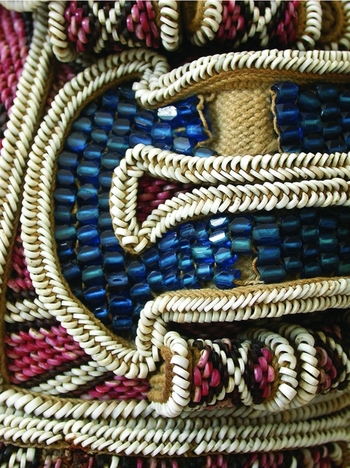
To this end, samples were extracted from the wooden base for radiocarbon dating and wood identification. A small cotton sample was also taken from a damaged area on the right shoulder, from the mesh used to secure the deep-blue corner-faceted beads. Critically, the European blue glass beads at the shoulders preceded the incorporation of the white shell beads, which overlap them around the borders, and so could not have been added at some later point in the object's history (Figure 7). The same mesh technique was also used to secure both the indigenous and European beads. Dating the cotton from this area was therefore critical in determining when the foreign and indigenous beads were woven together.
The framework of white shell beads overlaps the layer of blue glass beads, which are integrated directly into the weave structure. Photograph: J. Ostapkowicz, courtesy of the Museo delle Civiltá—Museo Nazionale Preistorico Etnografico L. Pigorini, su concessione del Mibact, 4190.
The results are summarised in Table 1. It is immediately apparent that the calibrated dates for the cotton and wood base overlap between AD 1447 and 1627, with the greatest probability in both cases falling within AD 1447–1523 (60–70%). The date can be further constrained to post-1492, given that the European additions are woven directly into the structure (see below). This suggests that the wooden base and cotton objects were assembled within a short span of time, and is consistent with the possibility that the cotton artefacts entered Europe at some point in the early sixteenth century, and were displayed soon thereafter in a private collection as the composite ‘sculpture’ seen today. The description of the West Indies ‘idol’ in Legati's catalogue certainly implies that, by 1680, it was considered a single object. The dates, however, do not in themselves resolve the key question of the integrity of the artefact and its history of intervention.
Radiocarbon dates for the Pigorini cemí/belt (OxCal v4.2.4).

The anatomical structure of the base clearly shows the wood to be willow (Salix sp.) (Figure 8), a north-temperate genus not native to the Caribbean (Mabberley Reference Mabberley2014). We could find no citations of botanically collected native Salix from the Caribbean, nor does it appear in the region's archaeological record (Lee Newsom pers. comm.). Given the historical context, a European, rather than North American or Asian, provenance can be inferred. This, together with the fact that it is lathe-turned (a technology unknown in the indigenous Caribbean), suggests that the base is an early European display mount. Furthermore, the outer surface of the bole was shaped to fit both the shape of the cotton top's inner diameter (approximately 180mm) and the overlapping belt (Figure 4), resulting in the removal of an unknown number of growth rings (assuming the pith is present at the centre of the carved base). Thus, the wood's incorporation must be more recent than indicated by the radiocarbon date, although probably not by more than two decades, given the rapid growth rate of Salix (e.g. Greene Reference Greene2016). Cotton, of course, is an annual, making it an excellent material for radiocarbon dating. While the storage of raw cotton is mentioned by early historians (e.g. Las Casas Reference Casas and De1951 [1561]: I: 447, Keen Reference Keen1992: 70), demand probably kept the turnover high—it should provide a reliable manufacture date.
Transmitted light micrographs of the wood anatomy of the wooden base. Unless otherwise noted, all scale bars are 200 μm. Top left) transverse section showing diffuse-porous wood, abundant vessels solitary and in multiples of 2–3 and apparently narrow rays. Top middle) radial section showing simple perforation plates (arrows) and larger than ray-vessel pitting (arrowheads). Top right) tangential section showing uniseriate rays and alternate, medium-sized intervessel pits (arrow). Bottom left) radial section showing clear distinction between procumbent cells and upright cells, including disparate ray-vessel pitting (100 μm). Bottom centre) radial section showing marginal upright cells (arrowheads), distinguishing between Salix and Populus (50 μm). Bottom right) tangential section clearly showing uniseriate rays and alternate intervessel pits (100 μm). Images: A.C. Wiedenhoeft.

Despite the Pigorini cotton and wood dates being largely indistinguishable and providing a very wide age estimate of AD 1447–1627 (Figure 9a–b), the integration of the European beads into the weave of the sculpture enables us to constrain the probability distribution of the calibrated date for the cotton to post-1492 (using the ‘After’ function in OxCal v4.2.4; Bronk Ramsey Reference Bronk Ramsey2013). This has the effect of making the second of the two ranges in the distribution more probable (Figure 9c). Assuming that traditional Taíno artistry effectively ceased by c. 1550, we can also constrain this end of the distribution (using the ‘Before’ function, entered as 1550±10 years to reflect the uncertainty in dating the Taíno cultural ‘collapse’). This provides a very tight modelled date range of AD 1492–1524, as there is a small trough in the calibration curve at c. 1530–1560 that greatly reduces the probability of the true date falling in those decades (Figure 9d). While broadly concurring with the date ranges proposed by previous researchers, these results are more robust, and, with the exception of Roe's (Reference Roe, Brecht, Brodsky, Farmer and Taylor1997) estimate, better constrained. Nevertheless, it is important to emphasise that, as with all Bayesian modelling exercises, both constraints are dependent on additional contextual information. In this case, for the reasons outlined above, we are confident that both assumptions are valid.
Radiocarbon dates on the cotton (a) and wood (b), constrained to post-AD 1492 (c), due to the presence of the foreign imports featured, and modelled on the assumption that traditional Taíno ‘high arts’ ceased by AD 1550 (d).

The glass beads featured on the cemí (the Pigorini belt does not show any European additions) may provide additional temporal resolution. There are three distinctive bead types, all of which were in circulation pre-1550: 1) approximately 1200 small, drawn emerald-green beads covering the bat face and embellishing the cap of the human head (Figure 10a); 2) approximately 450 deep-blue, four-sided, cornerless beads at the cemí’s shoulders (Figure 10b); and 3) one (of potentially ten) faceted three-layered turquoise bead at the top of the head (Figure 10c). Green beads were among the first documented in exchanges with the Taíno during Columbus's initial 1492 voyage. They continued to be imported and exchanged during the following decades (Deagan Reference Deagan1987: 110, 157); indeed, similar drawn emerald beads have been recovered from early contact sites on San Salvador, Bahamas, and Puerto Rico (Brill et al. Reference Brill, Barnes, Tong, Joel, Murtaugh and Gerace1987; Méndez Bonilla Reference Méndez Bonilla2006: 26; Brill Reference Brill, Brill and Stapleton2012; Ostapkowicz et al. Reference Ostapkowicz, Bronk Ramsey, Brock, Higham, Wiedenhoeft, Ribechini, Luceijko and Wilson2012: 2249). They are considered reliable chronological markers up to 1525 (Smith, in Hoffman Reference Hoffman and Gerace1987: 242), or more conservatively, 1550 (Deagan Reference Deagan1987: 169). Both the blue and turquoise faceted beads have parallels to Nueva Cadiz beads predominantly known from colonial American sites prior to AD 1560 (Smith & Good Reference Smith and Good1982: 10; Deagan Reference Deagan1987: 163; Jeffrey M. Mitchem pers. comm.). Both of the cemí’s beads are considerably smaller (about 5–7mm in length) than typical Nueva Cadiz beads (37–75mm), but this is not incompatible with some corner-faceted examples found in early colonial period sites in Peru, and may reflect an early, poorly documented Nueva Cadiz form (Deagan Reference Deagan1987: 163; Karlis Karklins pers. comm.).
a) Emerald-green wire-wound beads (length: approx. 3.5mm); b) deep-blue cornerless cube-style beads (length: approx. 5–6.5mm); c) faceted three-zone turquoise Nueva Cadiz-style bead (length: 7mm). Photographs: J. Ostapkowicz, courtesy of the Museo delle Civiltá—Museo Nazionale Preistorico Etnografico L. Pigorini, su concessione del Mibact, 4190.

Further parallels can be drawn with the belt in the Vienna Weltmuseum (AD 1474–1635, at 95.4% confidence) (Figure 3). The two share many structural similarities, from the same materials (red, white and black beads) arranged in geometric designs, to the same textile weaves and the use of lianas and wood to create frameworks for the cemís (Ostapkowicz Reference Ostapkowicz2013). These layered elements are also seen in the Turin reliquary, radiocarbon-dated to AD 1439–1624, with the greatest probability falling at AD 1439–1522 (76.7%) (Figure 2, right). As this sculpture does not feature any European materials, it was most probably constructed prior to 1492. Consequently, it is possible to document continuity in pre-colonial and early colonial weaving traditions, strengthening the argument that the Pigorini and Vienna pieces were most probably constructed while Taíno artistry was still at its apogee, and prior to the dramatic cultural dislocation and population losses that followed European contact. Objects such as the Pigorini cemí make sense only within a context that maintained traditional values of meaning and reciprocity, which were drastically altered with the introduction of the encomienda (forced labour) system along with Christianity and European social mores (e.g. Guitar Reference Guitar1998; Deagan Reference Deagan2004). Yet the cemí weaves together traditional aesthetics, values and sources of power with new European wealth and the connections that it implied; in so doing, it reflects the region's turbulent and transformative early sixteenth century (e.g. Deagan Reference Deagan2004; Keehnen Reference Keehnen2012; Valcárcel Rojas Reference Valcárcel Rojas2012; Hofman et al. Reference Hofman, Mol, Hoogland and Valcarcel Rojas2014).
Conclusions
Deconstructing an artefact to its basic components to explore the material, manufacture and chronology should be the initial step in building firmer foundations for interpreting the meaning and significance of the whole—even with objects as ostensibly familiar as the Pigorini cemí. Centuries of curation, display and interpretation have obscured details, with some features hidden in plain sight: two artefacts combined to create one; the presence of a lathe-turned sixteenth-century display base, long assumed to be original to the artefact; the incorporation of rhinoceros horn, hair and feathers, previously interpreted as wood and vegetable fibres respectively (Schweeger-Hefel Reference Schweeger-Hefel1952; Vega Reference Vega and Vega1987; Biscione Reference Biscione1991); the supposed ‘African influence’ of the geometric designs and style, despite the long history of such design elements within late pre-Columbian Caribbean artistic traditions. An indigenous source for the materials, aesthetics and purpose of the cemí and belt are far more parsimonious than a European fabrication of various components from disparate sources (although its ‘reinterpretation’ in European hands is clear, given the presence of the display base and nails). Indeed, it is this very combination of exceptional artistry, exotic materials sourced from three continents and long display and documentation history that must be untangled to understand better the physical and interpretive scope of this masterpiece, one that offers a glimpse of an extraordinary few decades that encapsulate the meeting of two worlds on Taíno terms.
Acknowledgements
The study was made possible by a grant from the Getty Foundation (Pre-Hispanic Caribbean Arts project, 2007–2010), with additional research on collection histories carried out during the first author's fellowship at the Center for Advanced Study in the Visual Arts, National Gallery of Art, Washington D.C., in 2006. Radiocarbon dating was supported by the Natural Environment Research Council (NF/2015/1/19). We are grateful to colleagues at the Museo Nazionale Preistorico Etnografico ‘L. Pigorini’ for facilitating access and making this work possible; Marco Biscione for discussions concerning the cemí; Lee Newsom for her input on the absence of Salix in the Caribbean; Chris Doherty for aid with SEM imagery; Jeffrey M. Mitchem and Karlis Karklins for their comments on the glass beads and their histories in the colonial Americas; and Daniela Hofmann for translating relevant Munich Kunstkammer catalogue sections. We thank reviewers Corinne Hofman and William Keegan for their useful comments.



