





Introduction
Gal's (Reference Gal2018:16) description of graftings—‘registers indexical of one social arena that are “implanted”, as analogies, in another arena that is conventionally considered widely different’—offers a significant contribution to understandings of what registers in circulation can construct in specific sites. Graftings are particularly interesting for their saliency, arising from the perceived incongruities of the arenas grafted together. Gal's description, as well as subsequent analyses that have applied graftings thus far (e.g. Baran Reference Baran2022; Borba Reference Borba2022; Bergozza, Coco, & Burnett Reference Bergozza, Coco and Burnett2024), have primarily focused on written or otherwise non-interactive texts. While these works are also significant for their examinations of the role of graftings in national and global political discourses and their circulation within and between certain arenas, this focus on relatively non-interactive texts can occlude the emergent particulars of graftings as they are used within extemporaneous spoken interaction—namely the ways in which graftings are constructed within their local contexts as well as their interactional functions. In this article, I carry out a sequential analysis of graftings preceded by constructed dialogue in spoken interaction, specifically in public comments made in American public school board meetings, to contribute a view of graftings as interactional achievements.
In my analysis, I examine public comments made in school board meetings held between March 2021 and January 2022 in two school districts in the US. School board meetings held during this time period were notable for particularly high attendance by members of the public who instigated fractious debates over Covid-19 mitigation policies as well as the use of curricula, teacher training materials, and administrative policies based in the principles of diversity, equity, and inclusion. Of the varying discursive strategies employed by members of the public during these meetings, graftings were especially salient for their applications of previous speakers’ discourses to new and sometimes ideologically opposed arguments. In my examination of these meetings, I use sequential analysis to examine how public commenters use graftings, particularly those preceded by constructed dialogue, to accomplish particular interactional functions, namely creating sequences where they would otherwise be limited by constraints on turn-taking as well as forming complaints against the school board and other audience members. Furthermore, I show how speakers actively construct graftings within their local contexts, citing prior talk to construct particular discourses as authoritative and working to project and subvert skepticism of the grafting.
Background: Graftings, intertextuality, and sequentiality
Grafting as an intertextual ‘moment’
Much work on language and interaction in the past decades has implicitly focused on alignment, the ways in which speakers orient towards and co-construct shared meaning in interaction. This implicit focus on alignment has often complemented the constructionist frameworks of various subfields, such as conversation analysis’ focus on the attainment and maintenance of intersubjectivity through sequence organization (Heritage Reference Heritage1984; Schegloff Reference Schegloff2007) and linguistic anthropological work on processes of enregisterment (Agha Reference Agha2003, Reference Agha2005), by which sets of linguistic forms and indexed social personae coalesce into recognizably meaningful registers within and across speech communities. However, scholars of language are increasingly examining practices of disalignment in interaction, or the ways in which speakers depart from presupposed norms of structure and usage. Notably, disalignment relies upon the same interactional mechanisms as alignment, taking advantage of the normative maintenance of intersubjectivity and intertextuality that undergirds talk, often to achieve some interactional function. This ranges from intentionally misprojecting the end of an interlocutor's turn for humorous or antagonistic effect (Bolden, Hepburn, & Potter Reference Bolden, Hepburn; and Potter2019) to the intentional misrecognition of indexical systems (Barrett & Hall Reference Barrett and Hall2024). Work by scholars in the field of language, gender, and sexuality in particular have explored indexical disalignment as a foundation of queer semiotics and, furthermore, how misrecognition as a practice is used to uphold (or even challenge) gendered and sexual power structures (e.g. Land & Kitzinger Reference Land and Kitzinger2005; Raymond Reference Raymond2019; Baran Reference Baran2022; Borba Reference Borba2022; Barrett & Hall Reference Barrett and Hall2024).
One such analysis of indexical misrecognition and its relation to power is Gal's (Reference Gal2018) concept of grafting. Gal (Reference Gal2018:16), for the most part, is concerned with the role of circulation in processes of enregisterment, and what registers can construct when taken up in an ‘arena that is conventionally considered widely different’. She focuses on ‘moments’ of enregisterment (2018:3), individual texts and interactions that trace the paths of circulation that these registers take and the intertextual relationships that they construct (or conceal). She describes three types of ‘moments’: clasps, relays, and graftings. Clasps connect distinct arenas, using a register associated with one arena to configure participants in a distinct arena in terms of hierarchical, characterological figures indexed by that register (2018:7). One such example is Inoue's (Reference Inoue2003) work on ‘Japanese women's language’, in which twentieth-century male intellectuals’ depictions of the register figured upper class women as inappropriately modern and intellectually inferior. Relays, by contrast, rely on perceived contrasts between registers to not only connect one distinct arena with another, but to also index ideological and characterological distinctions between institutions (Gal Reference Gal2018:12). One example comes from Muehlebach's (Reference Muehlebach2012) work on contemporary Italian non-profit organizations that assist the elderly. Non-profits variously frame their missions and the benefits of volunteering using registers that alternately cite Catholic doctrines, leftist politics, and neoliberal discourses of self-improvement to emphasize relationships with other prominent arenas within Italian life while simultaneously distinguishing themselves from ideologically distinct non-profits.
Of these three interdiscursive moments, graftings are particularly interesting for their seeming misrecognition of registers and the arenas they cite. Graftings are the use of a register that presupposes authoritative personae from one arena to entail that authority in an institutionally distinct arena, though the distinctions between the arenas are often downplayed, particularly to achieve political ends (Gal Reference Gal2018:4). Gal (Reference Gal2018) notes that while graftings seek to claim the authority of the original arena, they can also undermine the integrity of that arena by linking the new arena to it; an example is Vladimir Putin's use of humanitarian discourses to describe Russian military operations in Ukraine in a 2014 declaration, undermining humanitarian discourses by linking them to war (2018:4). Furthermore, because of the incongruities between the frame indexed by the authoritative register and the grafted arena, graftings tend to be highly salient to interlocutors and they may ultimately interpret them as ironic or non-serious (2018:4). While this interpretation of non-seriousness may be unintended, graftings nonetheless rely on a misrecognition of an authoritative register and the boundaries of the arena it indexes in order to graft the novel arena onto it.
Gal (Reference Gal2018) is primarily concerned with outlining the theoretical implications of these moments of enregisterment rather than with applying them to the analysis of specific data beyond brief, contained examples. Furthermore, the short examples she does cite tend to be taken from written texts or relatively non-interactive talk (e.g. political declarations). More recently, several scholars have taken up Gal (Reference Gal2018) to explicitly trace the circulation of discourses at other sites. For example, Borba (Reference Borba2022) examines the Catholic Church's development of an ‘anti-gender’ register through written texts published by Catholic theologians, and Baran (Reference Baran2022) examines a corpus of written texts containing TĘCZA, the Polish lemma for ‘rainbow’, which typically indexes pejorative, homophobic stances for conservatives in Poland. Baran's corpus does contain a few particularly interesting instances of the grafting of TĘCZA by Polish progressives, such as LGBTQ activists’ use of Matka Boska Tęczowa, ‘Our Lady of the Rainbow’, in response to a church in Płock listing ‘LGBTQ’ and ‘gender’ as sins in an Easter display, subverting conservatives’ grafting and pejoration of the term. While Borba's (Reference Borba2022) and Baran's (Reference Baran2022) work is significant for their analyses of the development and circulation of graftings in specific contexts, particularly in the formation of the ‘anti-gender’ register, they do both focus on written texts. As of yet, Gal's (Reference Gal2018) moments of enregisterment have not been applied to extemporaneous, multimodal, embodied spoken interactional data.
Expanding the moment: A sequential approach to grafting
One of the ways in which we can expand upon Gal's (Reference Gal2018) theorization of graftings (and their subsequent application by other scholars) is by considering other scales of interaction and intertextuality. If anthropology is a scale-making project (Carr & Lempert Reference Carr, Lempert, Summerson Carr and Lempert2016), then we must recognize when our creation of scales occludes functions and meanings present at unattended scales. Gal (Reference Gal2018) conceptualizes graftings as individual ‘moments’ of enregisterment, single events, situated in particular places and times, within the grand scale of enregisterment. However, these individual ‘moments’ are entire texts, made up of many, many moments within an extemporaneous, multimodal interaction. And while graftings rely on the recognition (and misrecognition) of their constituent intertextual relationships (Gal Reference Gal2018, Reference Gal2019), the emphasis on enregisterment has led analyses of grafting thus far to primarily focus on intertextual relationships with registers, broader types of texts, rather than specific tokens of texts (Silverstein Reference Silverstein2005). As we see in several public comments made at school board meetings in the following analysis, graftings made in spoken interactions commonly co-occur with instances of constructed dialogue, which explicitly cite a token of prior talk as the discursive source of the grafting. To better understand why and how speakers employ graftings in extemporaneous interaction, we must consider graftings not as whole texts, but as unfolding moments within interactions; as such, we must consider graftings on the scale of turns and sequences within individual interactions.
Sequential analysis—that is, analysis focused on the microstructure of interaction as used in conversation analysis, discourse analysis, and interactional linguistics—similarly draws from Bakhtinian conceptions of dialogism and intertextuality as the semiotic approaches used by Gal (Reference Gal2018), Borba (Reference Borba2022), Baran (Reference Baran2022), and others. Sequential analysis, however, emphasizes how speakers use the ability to reconstruct, recontextualize, and reframe prior texts, particularly through the use of constructed dialogue (or ‘reported speech’),Footnote 1 to achieve further interactional goals, namely, to construct sequences (Gumperz Reference Gumperz, Duranti and Goodwin1992; Gordon Reference Gordon2002; Tannen Reference Tannen2006, Reference Tannen1989/2007; Goodwin Reference Goodwin, Clift and Holt2007). The explicit citation of prior talk through constructed dialogue not only creates a chronological relationship between that talk and the present speech event, but it also contributes to particular interactional functions. Both Tannen (Reference Tannen2006) and Arnold-Murray (Reference Arnold-Murray2021) describe how speakers may use constructed dialogue citing previous talk to create sequences. Tannen (Reference Tannen2006) examines how couples may use constructed dialogue to cite prior arguments and ‘recycle’ them in later conversations, allowing the couple to essentially continue the previous sequence at a later point in time. And while Arnold-Murray (Reference Arnold-Murray2021) examines pre-recorded political ads rather than extemporaneous talk, she demonstrates how constructed dialogue can be used to reconstruct an opponent's prior talk and then create a sense of sequentiality, allowing the featured candidate to respond to their opponent's attacks without their opponent being co-present. In these cases, constructed dialogue can be used to create sequences that span speech events, even recruiting interlocutors who may be unwilling or unable to participate and responding to them at a later time.
Constructed dialogue is also frequently used to claim epistemic authority on a topic (Myers Reference Myers1999; Clift Reference Clift2006), and it is a regular component of complaint sequences (Goodwin Reference Goodwin1980; Drew Reference Drew1998; Holt Reference Holt2000). In complaints lodged in public forums in particular, constructed dialogue serves to both lend epistemic authority to as well as to establish a ‘common ground’ for complaints by citing recognized prior talk. Antaki & Leudar (Reference Antaki and Leudar2001) describe how members of the British House of Commons use constructed dialogue to cite the official parliamentary record to provide ‘evidence’ supporting an attack on a political opponent, often by holding their opponent accountable for previously recorded statements. Tracy & Durfy (Reference Tracy and Durfy2007) also note that constructed dialogue is often used in public comments at American public school board meetings to frame the speaker's criticisms as somehow ‘objective’, whether in quoting a supposed expert to support their position or another member of the public to frame some negative sentiment about the board and its policies as shared by the broader community.
Drawing from this work on sequential analysis and constructed dialogue, I show in my analysis how graftings preceded by constructed dialogue explicitly cite prior talk in order to create sequences and graft onto those discourses, as well as to leverage complaints of inconsistency against other participants. These interactional functions are what motivate the creation and circulation of graftings, and they further emphasize the ways in which graftings draw from the local context. In the following section, I describe the data used in this analysis and my considerations in collecting and analyzing them. Then, I analyze the ways in which graftings preceded by constructed dialogue create sequences, construct authority through the local context, and form complaints. Finally, I conclude with a discussion of how this analysis contributes to understandings of the relationship between grafting, authority, and indexical misrecognition more generally.
Data and methods
Contentious, politicized debates have periodically embroiled American public school board meetings throughout the contemporary era (Howell Reference Howell2005; Tracy Reference Tracy2011). Many public school districts in the US hold their school board meetings as ‘meetings in the public’, in which community members may attend to observe the board conduct its business and to offer comments on policies during a designated portion of the meeting: the public comment period. And while debates amongst school board members at these meetings can certainly be contentious, it is these public comment periods that have recently drawn widespread media attention for their uncharacteristically high attendance and charged rhetoric. One of the most recent controversies to wrack American public schools has involved concurrent debates over Covid-19 mitigation policies as well as the use of curricula and teacher training materials based in principles of diversity, equity, and inclusion (hereafter abbreviated as DEI). While debates over Covid-19 mitigation policies began with the onset of the Covid-19 pandemic in the US in the spring of 2020 and have arguably continued into the present, the debates over curricula primarily began in the spring of 2021 and continued through the following school years. These concurrent debates over dissimilar topics made meetings held during this period fruitful sites for graftings, particularly in the public comments, as speakers would often explicitly link debates about Covid-19 mitigation policies to ongoing debates about curricula, among other topics. While my analysis of these sampled meetings was not limited to the public comment periods, graftings were nonetheless only used by public commenters, possibly due to their utility in forming complaints against the school board, as described later in my analysis.
The data used in this study were recorded livestreams of public school board meetings in various school districts across the US gathered as part of a larger project. These videos were streamed on YouTube by the school districts themselves, and recordings remain available on the districts’ YouTube channels. For the purposes of this analysis, I draw from school board meetings held specifically in a suburban school district in Missouri and a suburban district in Florida, though the larger project includes data collected from other districts as well. Both of these districts are located in the suburbs of majority Democratic urban centers in states with Republican-led governments. When considering the political composition of the counties that these districts are located in (e.g. by comparing results from the 2020 presidential election as well as the political affiliations of city, state, and congressional representatives), they are more evenly split than other, majority Republican counties in the state. Notably, while school board members in each district (more or less) respectfully diverged with regard to the specifics of Covid-19 mitigation policies, they generally supported (or at least did not publicly oppose) the district's established DEI policies. The relatively even split in the political composition of these communities as well as the comparatively collegial relationships amongst the school board members in this time of highly polarized debates may have influenced the usage of graftings in these meetings during this period of time.
The specific school districts chosen for this study were selected through purposive sampling (Lindlof & Taylor Reference Lindlof and Taylor2011), as meetings from these districts were cited in national media coverage of nationwide trends in highly attended, contentious public school board meetings in the spring through fall of 2021. In the case of the Missouri district, news coverage focused on a scandal involving a conservative parents’ group leaking a district administrator's email to teachers regarding curricula. In the case of the Florida district, individual meetings from this district, among others, were offered as examples of particularly contentious meetings in a news article describing these trends.
The corpus formed from these districts’ meetings consists of fifteen meetings that took place between March 2021 and January 2022, with the majority of sampled meetings taking place between June and September 2021. For each district, I began by watching meetings held between June through August 2021 and then watched additional meetings for individual school districts based on local news coverage of topics discussed in meetings. For example, the collection contains meetings from the Missouri district starting in March 2021 as the email scandal began in that month; by contrast, there is a meeting from January 2022 from the Florida district in the collection as the Florida state legislature passed the ‘Stop Woke’ bill, targeting the use of DEI-based curricula (referred to as ‘Critical Race Theory’), that month. I watched these recorded meetings in their entirety, including periods of discussion amongst board members as well as public comment periods. Ultimately, graftings were only used by public commenters in these meetings.
There were 226 public comments made in these fifteen meetings. These comments addressed a wide range of topics and performed a variety of actions. In examining these comments in their local contexts, the comments containing instances of constructed dialogue immediately followed by a grafting stood out as performing unique interactional functions with regard to the ways in which they cited seemingly unrelated or ideologically opposed prior talk to advance their own arguments on distinct subjects, particularly to form complaints against the school board or other audience members. Given these unique interactional functions of constructed dialogue followed by a grafting, instances of grafting alone were not included in this analysis.
There were thirteen public comments from these meetings that elected to use a grafting immediately preceded by constructed dialogue referring to some prior talk, be it direct reported speech, indirect reported speech, or a metapragmatic description of that talk. Of these thirteen comments, ten grafted issues of Covid-19 mitigation (both in favor and against) onto some previously introduced discourse. While grafting Covid-19 mitigation onto social justice discourses was a relatively prominent combination, with four of these comments making such a grafting, the wide variety of topics discussed at these meetings led to considerable variation in these graftings, with prior uses of Christian, military, and mental health discourses, among others, cited as authoritative registers. These comments were transcribed in full according to Jeffersonian conventions for talk (Clift, Kendrick, Raymond, & Robinson Reference Clift, Kendrick, Raymond, Robinson, Robinson, Clift, Kendrick and Raymond2024), with multimodal features relevant to the present analysis indicated following Mondada (Reference Mondada, Robinson, Clift, Kendrick and Raymond2024).
A sequential analysis of graftings
In this analysis, I examine the interactional structure and functions of graftings preceded by constructed dialogue in public comments made at American public school board meetings. I first show how speakers use constructed dialogue with graftings as a means of creating sequences with other participants, despite restrictions on turn-taking inherent to the genre of public comments. Next, I show how that constructed dialogue explicitly cites discourses previously used in the district's meetings, allowing the speaker to graft onto those discourses and construct the grafting as authoritative within the local context. I then show that graftings are often accompanied by other talk, namely explanations of the grafting and claims of membership in authoritative categories, highlighting that graftings’ authority is not entirely presupposed but also locally and emergently constructed. I finally show how speakers cite and then graft onto a discourse to retroactively frame the prior talk as insufficient for its exclusion of the newly grafted topic. This insufficiency is then used to form complaints against the prior speaker(s) to compel a requested action on behalf of the school board. Notably, graftings carry out many of these functions simultaneously, and the ordering of these points in this section is done simply to aid in comprehension and should not be taken to suggest any sort of chronology in these actions. Throughout the analysis, we repeatedly return to the same examples in each subsection so as to illustrate how these functions are carried out simultaneously.
Public comments, turn-taking, and constructed dialogue
To understand the function of graftings in public comments, we must first understand public comments at American public school board meetings as a genre of talk, which, in turn, shapes the constructions used in these comments (Tracy Reference Tracy2011). As most public school board meetings are held as meetings in the public, public comment periods are one of several agenda items in each meeting, with board discussion on other agenda items making up the majority of the scheduled structure of the meeting. Some school boards also have bylaws limiting the extent and duration of public comment periods, often requiring that commenters sign up to speak in advance of each meeting and placing restrictions on how long each commenter may speak. Despite the time restrictions placed on turns, public comment periods can extend for several hours to accommodate dozens of speakers in times of controversy and high public turnout. In order to facilitate the public comment periods, many school boards also have rules of conduct strictly regulating turn-taking during these periods. These rules of conduct are typically read aloud at the beginning of each public comment period in these meetings. These rules often forbid interjection (and sometimes even choral responses like applause) from audience members during a commenter's turn. Furthermore, board members are often required to refrain from responding to public comments immediately after they are made; they are instead required to discuss them during a designated board discussion period following the conclusion of the public comment period of the meeting or to follow up with the commenter individually at a later time. In the meetings observed for this study, board members typically only spoke during the public comment periods to either call a speaker to the podium, to thank them at the conclusion of their turn, to instruct the speaker on how to use the microphone, or to reprimand the speaker or the audience for talk that violated rules of conduct. Given the restrictions on turn-taking enforced by the school board, audience members (which may include any number of past or future commenters at a given time) cannot respond to school board members or other commenters immediately after their turns; if they have signed up to make a comment, they must wait for their assigned turn to respond.
This then leads us to one of the functions of constructed dialogue and graftings in public comments at these meetings. As the genre of public comment does not presuppose any sort of sequentiality between comments, speakers may use constructed dialogue indexing a prior comment (or some other talk from the school board members) to entail a sequence (Antaki & Leudar Reference Antaki and Leudar2001; Gordon Reference Gordon2002; Silverstein Reference Silverstein2005; Arnold-Murray Reference Arnold-Murray2021). As we can see in the following two examples, constructed dialogue, whether citing specific tokens of talk or more general types, creates sequences. The comment excerpted for the first example concerns the school district's inaction regarding an incident in which the speaker's daughter was called a racist slur by another student. While the speaker does not explicitly identify herself or her daughter as a particular race, she appears to be Black, and her dialectal features are consistent with those of African American English. These features include, but are not limited to, the absence of possessive -s, as in the speaker's production of “my daughter name” (Green Reference Green2002), and unstressed syllable deletion, as in the speaker's production of “errything” [ɛɹiθɪŋ] for “everything” (Wolfram Reference Wolfram, Bernthal and Bankson1994). This speaker's comment immediately followed a comment that argued against Covid-19 mitigation efforts for their supposedly negative effects on mental health, citing statistics describing an increased number of suicide attempts among school-age children.

The speaker uses constructed dialogue in lines 53–55, citing the comment made immediately before her about recent suicide attempt rates. She then grafts her own discussion of her daughter's racist harassment onto the mental health discourses of the previous comment in lines 55–56, describing her daughter as being “emotionally scarred” and having “emotional triggers” as a result of being harassed. While the genre of public comments does not presuppose any kind of post-first turn for individual comments, by reconstructing the prior talk through constructed dialogue and then grafting from it, the speaker entails a sequence, retroactively positioning the prior talk as the first in a sequence focusing on mental health concerns and her comment about her daughter as next in that sequence. Notably, this use of constructed dialogue at this position in the comment lends a sense of importance to the speaker's comment. This segment occurs towards the end of the speaker's allotted time and is made as a final, last second complaint against the school board before her time runs out, as she acknowledges in the inserted segment “I know I got fifteen seconds” (lines 53–54). By citing the prior comment through constructed dialogue and grafting onto it, the speaker positions her comment as following in a sequence, which then allows the speaker to frame her grafted topic (the harassment of her daughter) as dialogically relevant, following in the vein of a topic previously established and engaged in by the other participants.
While example (1) uses constructed dialogue to cite a specific token of prior talk, other instances of constructed dialogue preceding graftings in the collection cite broader types of prior discourse in the district's meetings. We can see such a construction in the following example.

In this example, the speaker uses constructed dialogue to cite a broader pattern of discourse in this district's meetings, focusing on debates spanning several previous meetings concerning systemic inequities in the district's standardized testing scores as well as the incorporation of DEI-based curricula and policies. The citation of a type of discourse allows the speaker to construct prior comments concerning those topics as being in a sequence, with the present comment as the latest turn within that sequence. This then allows her to graft her present concern, the district's Covid-19 mitigation policies, onto the social justice discourses used in those comments.
Given the strict limitations on turn-taking within the genre of public comments, constructed dialogue and graftings serve as a way to create sequences within and between meetings. By citing prior talk, be it an individual token or a broader type of discourse, public commenters can then frame their present, ostensibly unrelated comment as next in a previously established sequence, creating a sense of adjacency in which they recall and reframe the prior talk as a first and thus framing their comment as the entailed second (Schegloff Reference Schegloff2007).
Authority as locally constructed
Graftings, as Gal (Reference Gal2018) describes them, rely on registers that index authority in some arena in order to entail that authority to a distinct arena. Gal's (Reference Gal2018) examples of graftings primarily cite broadly recognized authoritative registers (e.g. humanitarian and scientific discourses). However, graftings preceded by constructed dialogue, which explicitly cite the discursive source of the grafting, highlight that the authority of these discourses is not entirely presupposed but, more saliently, emergently constructed through their place in the local context. Looking back at example (2), in which the speaker grafts an anti-mitigation argument onto social justice discourses, the speaker uses constructed dialogue to cite previous authoritative talk, stating, “with all the talk of EQUITY, (0.5) a::nd, ACHIEVEMENT GAPS” (lines 48–49), and then appending her grafting. While the district's prior discussions of ‘equity’ and ‘achievement gaps’ had focused on systemic inequities for students of color, students living in poverty, English-language learners, and disabled students, the speaker grafts her present discussion of the district's Covid-19 quarantine policies onto them, reframing quarantine policies based on vaccination status as inequitable. Most notably, we can see in this example that the speaker's constructed dialogue cites the source of the grafting in “all the talk” of social justice issues, emphasizing the topicality of these discourses in the district's local context. The social justice discourses used in this example derive their authority through their previous use by members of the school board and other members of the community. Their presence within the district's local context and their association with authoritative members of the community are what make them authoritative to the speaker and, ostensibly, the other participants.
Similarly, in example (1), partially reproduced as example (3) below, the speaker also grafts onto locally authoritative discourses.

As discussed previously, the speaker grafts the racist harassment of her daughter onto the arena of mental health. While mental health discourses do broadly presuppose some authority and are commonly used in discussions of systemic racism (e.g. Williams & Williams-Morris Reference Williams and Williams-Morris2000), the speaker cites a specific token of these discourses used in the meeting: a previous comment concerning the supposed effects of Covid-19 mitigation efforts on students’ mental health. Furthermore, the agent of the reconstructed mental health discourse is “you guys” (lines 53–55), referring to the meeting participants as a whole, including the school board members and the audience. The mental health discourses of the previous comment, seemingly accepted by the other participants, are taken to be a discourse of the audience and board rather than of the previous commenter alone. As mental health discourses had been used only once by that point in that meeting and were used infrequently in this district's meetings at this time, the attribution of the mental health discourses to the board and audience magnifies its role in the meeting, granting further value to the speaker's grafting. The explicit citation of these discourses in the meeting shows that the speaker grafts onto these discourses not merely for their presupposed authority but also for their presence and valuation in the local context.
As Gal (Reference Gal2018) notes, graftings draw upon authoritative discourses to entail that authority to a new arena. However, there is an element of audience design that goes unstated in Gal's description (Sacks, Schegloff, & Jefferson Reference Sacks, Schegloff, Jefferson and Schenkein1978; Bell Reference Bell1984). Grafted discourses are selected because the speaker projects that the audience values them as authoritative. While this selection may involve some sort of presupposed, broadly recognized authority, it is also based on the local context, and the discourses historically valued by the community within that context. As we can see in the speakers’ constructed dialogue in both examples (2) and (3), the authoritativeness of the selected discourses resides primarily in their prior use in that district's meetings. And in grafting onto these discourses, the speaker seeks to lend that authority to their present topic and persuade the audience to accept their argument as well, as they allegedly did with prior instances of the discourse.
Reinforcing authority through accompanying talk
While the authoritativeness of graftings is achieved, in part, through citation of prior talk in the local context, the citation itself is not the only way that this authority is constructed. Gal (Reference Gal2018) notes that participants may reject graftings as a whole for the incongruities between the newly linked arenas. This, however, belies some of the limitations of examining graftings at the scale of enregisterment. At this scale, the texts containing graftings constitute entire ‘moments’ on their own, and so a grafting is either accepted or rejected as a whole. On the scale of individual spoken interactions, however, we can see that speakers often project skepticism of the grafting on behalf of their interlocutors and work to validate the legitimacy of their graftings in various forms of accompanying talk. As we see in the examples below, speakers may do this by explaining the graftings, elaborating on how exactly their newly introduced topic fits within the arena of the authoritative discourse. They may also identify themselves as belonging to certain membership categories within the authoritative arena that ostensibly allow them to make such graftings. While not every example in this collection included such accompanying talk, its recurrent use across the collection further illustrates the collaborative achievement of graftings in extemporaneous interaction.
We first look at explanations of graftings by referring back to an expanded excerpt of example (2), reproduced as example (4) below.

The speaker first introduces the grafting in lines 48–51, describing the school district's quarantine policies as being inequitable in light of their previous discussions of the district's achievement gap. She continues with an explanation of how the policy is inequitable in lines 51–55, describing how the Covid-19 vaccine was not available to everyone in the district at that point in time, including vaccine skeptics (who often claimed that their refusal of the vaccine stemmed from its lack of full approval from the Food and Drug Administration at that point) and children under the age of twelve. An unseen audience member briefly applauds during this explanation (lines 53–54), and the speaker pauses to accommodate their show of support before continuing with her explanation. Since some groups could not (or would not) be vaccinated at that point in time, a policy that treated unvaccinated and vaccinated individuals differently is framed as inequitable. She concludes her grafting by emphasizing the egregiousness of the school board's supposed inconsistency, claiming that the inequities of the policy were “plain:, (.) black and white” (lines 56–57). When looking at graftings as a way to form complaints, as discussed further in the following section, these explanations may also function as a part of the complaint sequences themselves. Drew (Reference Drew1998) notes that explanations of transgressions are common features of complaint sequences, as a way to emphasize the egregiousness of the transgression. In this example, this interpretation is certainly supported by the conclusion emphasizing the school board's supposed inconsistency. However, we must also consider the novelty of the grafting in context as well. At this point in time, anti-mitigation arguments at school board meetings were not typically framed as a matter of social justice. The grafting of disease mitigation policies onto social justice discourses is constructed by the speaker as novel and locally relevant through the citation of previous meetings, where other speakers focused on social justice in the form of equity in standardized testing and curricula but not in Covid-19 mitigation. Given the novelty of the grafting, the explanation of the grafting (in this case, how exactly disease mitigation policies could be inequitable) serves to anticipate and counteract skepticism on part of the other participants. The authority of social justice discourses is not taken for granted when linked to a new arena; rather, that authority is further constructed through an explanation.
Another form of accompanying talk used to bolster the authority of a grafting is claims to membership in the authoritative arena. We can see such a membership claim in the following example of a speaker arguing in favor of the school district enacting a mandatory masking policy.

In this example, the speaker begins with a segment of constructed dialogue citing a video the superintendent had recorded for the beginning of the school year in which he quoted Rita Pierson, an educational activist. The constructed dialogue does not reconstruct the quote, but the speaker's citation of Rita Pierson serves to introduce her grafting of Covid-19 mitigation policies onto the social justice discourses used by Pierson (lines 38–41), claiming that optional masking in schools would exacerbate the problems faced by students in poverty. Notably, this example features an explanation of the grafting as well, describing how Covid-19 disproportionately affects those in poverty, and so policies that make masking optional in schools would thus also disproportionately affect students in poverty (lines 45–54). However, the link that underlies the grafting of Covid-19 mitigation onto social justice discourses is the speaker's category membership claim in lines 38–39, when she states, “I know about Rita Pierson as a teacher”. The speaker's position as a teacher in the district, and the pedagogical training that entails, grants her epistemic authority over the work of Rita Pierson as an educational activist as well as membership in this locally authoritative arena of social justice in education. Her authority over Pierson's work not only allows her to assess the superintendent's quotation of Pierson in his introduction video but also to graft the present arena of Covid-19 mitigation onto Pierson's work on social justice in education. By stating her identity as a teacher, the speaker claims the authority to make the grafting and to leverage a complaint of inconsistency against the superintendent for quoting Pierson but not considering how policies like optional masking would harm students living in poverty. The authority of the social justice discourses is bolstered by the speaker's claim to authority to use them and graft onto them in the present discussion. Notably, these claims to authority add another perspective to Gal's (Reference Gal2018) description of the ‘directionality’ of graftings. The examples that she discusses typically involve a speaker grafting onto an authoritative arena to which they are not perceived as belonging (e.g. Vladimir Putin's use of humanitarian discourses). It is for this reason that participants may interpret the grafting as non-serious or illegitimate, as they may view the speaker as lacking the commensurate authority to make such an analogy. In cases like example (4), however, speakers claim membership in an authoritative arena in order to then graft a distinct arena onto it, thus possibly staving off interpretations of illegitimacy of the grafting. The grafting occurs in a somewhat different direction in examples like these, highlighting the role of identity construction and audience design in the emergent construction of graftings.
Graftings as the basis of complaints
In these school board meetings, graftings preceded by constructed dialogue are not made simply to lend authority to arguments for or against particular policies. Rather, they are also used to form complaints of inconsistency against the school board or other audience members. Tracy (Reference Tracy2008) has written that public comments at American public school board meetings are often motivated by norms of reasonable hostility rather than the face-promoting norms so often thought to guide spoken interaction. As Tracy (Reference Tracy2008) describes it, reasonable hostility in public comments at school board meetings is borne out of the expectations ascribed to the institutional roles of the school board, rather than simple promotion of positive or negative face-wants. When public commenters view school board members as acting contrary to the expectations of their roles (e.g. acting in a way that supposedly does not promote students’ wellbeing), they may engage in overtly hostile face-attacks so as to reprimand the board members for dereliction of duty. However, these face-attacks are often mitigated in certain ways to lessen their hostility, leading Tracy to characterize such moves as ‘reasonable’ hostility. As we can see in some of the comments from this collection, the use of graftings preceded by constructed dialogue are one of many ways these public commenters can form complaints against the school boards and ‘do reasonable hostility’. We can see an instance of a grafting forming the basis of a complaint in the following example. The meeting in which this comment was made hosted a panel of pediatric and public health experts earlier in the meeting, so that school board members could ask them questions regarding Covid-19 mitigation policies. Some board members had asked about the possible negative mental health effects of some of these mitigation policies, such as masks causing anxiety in some children. The speaker in this example was one of many public commenters in this meeting to argue in favor of mitigation policies like mandatory masking.
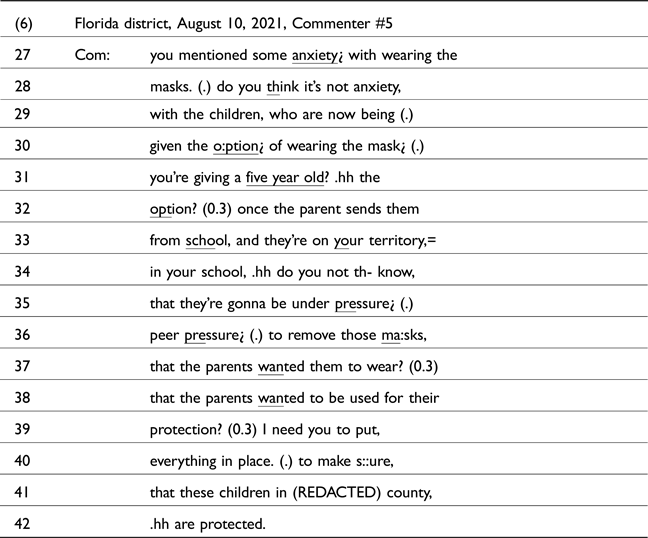
In this example, the speaker grafts onto the mental health discourses used previously in the meeting to frame masking as harmful to instead argue in favor of mandatory masking. Most notably, the speaker uses these mental health discourses in a series of rhetorical questions that call into question the anti-mitigation arguments that rely on these discourses, reframing them to focus on the mental health effects of optional masking policies on masked children. Beyond the use of rhetorical questions in this example, we can see how the grafting itself is used to form the complaint against the school board. The speaker first reconstructs the previous use of the discourse using constructed dialogue; in this case, the prior uses of mental health discourses characterized masking policies as causing anxiety in some students (lines 27–28). However, in grafting a new topic onto this discourse, in this case, the anxiety of voluntarily masked students surrounded by unmasked students, the speaker frames the prior use of the discourse as incomplete for its lack of consideration of the newly grafted topic. In this example, the speaker asks the school board, “do you think it's not anxiety with the children, who are now being (.) given the o:ption¿ of wearing the mask¿ … do you not th- know, that they're gonna be under pressure¿ (.) peer pressure¿ (.) to remove those masks,” (lines 28–36). Her criticism of the school board (and other public commenters) is not that they framed masking policies as a mental health issue, but that they only considered the mental health of one group of students (those who become anxious when wearing masks) and did not consider that of others (those who wear masks and become anxious around unmasked students). Tracy & Durfy (Reference Tracy and Durfy2007), in their description of public comments at American public school board meetings as a genre, note that rhetorical questions function as a way for public commenters to criticize the board while mitigating the hostility of overt criticism. Indeed, when we consider the restrictions on turn-taking in this genre, questions made in public comments typically do not receive responses. This speaker takes advantage of this genre feature, using the lack of expected response to lobby relatively hostile questions regarding the school board's incomplete consideration of mental health and Covid-19 mitigation policies.
The grafting itself, in incorporating a new topic into a prior discourse, forms the basis of the complaint against the school board. First, the speaker uses constructed dialogue to reconstruct a prior discourse as valued by the school board, either because they themselves had used those discourses or because another public commenter had successfully used them. The citation of prior discourse through constructed dialogue reaffirms the place and authorship of that talk with the audience, holding the principals (the school board) accountable for their supposed stances (cf. Antaki & Leudar Reference Antaki and Leudar2001; Reynolds Reference Reynolds2011). After citing a prior discourse through constructed dialogue, the speaker then grafts a new arena onto that discourse, criticizing the board for their lack of consideration of the newly introduced topic in spite of their previous use of that discourse. We have seen this same structure in other examples given in this analysis. Notably, in examples (4) and (5), the speakers also accuse the school board of inconsistency for previously engaging in particular discourses but not considering how they may apply to supposedly related matters, such as how quarantine policies may be inequitable in example (4) or how an educational activist's social justice discourses may promote mandatory masking policies in example (5). This accusation thus functions to urge the school board to act in favor of the speaker's argument; if they truly value the discourses they have previously used, then they should apply them to the speaker's grafted topic and act in their favor.
Discussion and conclusions
Gal's (Reference Gal2018) description of graftings and other ‘moments’ of enregisterment is a significant contribution to understanding the role of individual texts in processes of enregisterment and what the circulation of discourses can construct in individual texts. As I have shown, sequential analysis further expands upon our understanding of graftings as emergent constructions, their interactional functions, and what motivates their usage. In examining instances of graftings preceded by constructed dialogue in public comments made at American public school board meetings, we can see that speakers take advantage of local intertextual relationships to create graftings so as to advance arguments and form complaints against the school board. By reconstructing prior talk from meetings using constructed dialogue, speakers can position themselves as following in a sequence as well as construct that discourse as authoritative, allowing them to graft a new arena onto it. However, speakers do not always take the incongruities of the grafting for granted or assume that the audience will similarly misrecognize the grafting, sometimes giving explanations of the grafting or claiming category membership in the authoritative arena so as to stave off skepticism. This sequential analysis of graftings highlights how graftings are interactional achievements, in which their authority is constructed from the local context and designed for specific interlocutors.
Beyond describing the interactional structure and functions of graftings, this analysis has also brought forth an opportunity to elaborate on the ways in which graftings construct authority and misrecognize indexical systems. The examples of graftings described by Gal (Reference Gal2018), Borba (Reference Borba2022), and Baran (Reference Baran2022), among others, primarily focus on graftings made by conservative and far-right figures and institutions (e.g. far-right Hungarian politicians, conservative theologians within the Roman Catholic Church) in which these figures graft onto a broadly authoritative (and typically more liberal) arena to which they are not seen as belonging, and may even have a documented history of working against. What is so interesting about the graftings made in these school board meetings is how they construct authority within their specific fractious, highly polarized local contexts.Footnote 2 This is perhaps best demonstrated in comparing example (4) and example (5), in which two speakers in the Florida district both graft onto social justice discourses used by school board members at varying points in time, but in support of opposing anti-mitigation and pro-mitigation arguments, respectively. The school board members and residents of the Florida district during the sampled time period had to contend with state laws strictly limiting or even outright banning various Covid-19 mitigation efforts. Even though pro-DEI and pro-mitigation discourses are both typically seen as indexing broader liberal stances, given the particular political context of this district, the school board's prior use of pro-DEI discourses did not necessarily entail pro-mitigation stances. Each speaker variably figures the school board as hostile to their causes, with the far-right, anti-mitigation speaker in example (4) citing the school board's promotion of longer quarantine periods for unvaccinated individuals and the more liberal, pro-mitigation speaker in example (5) citing the discontinuation of mask mandates despite ongoing surges in Covid-19 cases. As such, each speaker relies on previously used, and thus ostensibly valued, discourses by the school board to advance their respective arguments. Both graftings rely on a misrecognition of the social justice discourses as they were used in context, but each speaker misrecognizes them differently due to the relativity of their local indexical field and the ways in which they figure their audience (Barrett & Hall Reference Barrett and Hall2024). It is through sequential analysis and its focus on the microstructure of interaction that we can draw out the ways in which speakers orient to local indexical systems and emergently construct graftings as authoritative within their local context. Additionally, the variety of graftings made in this collection as well as their utility in leveraging complaints against the school board emphasizes that graftings have generally antagonistic discursive functions. While graftings made by far-right public figures are especially salient within national and global political discourses (e.g. Gal Reference Gal2019; Borba Reference Borba2022; Baran Reference Baran2022; Tebaldi & Baran Reference Tebaldi and Baran2023; Bergozza et al. Reference Bergozza, Coco and Burnett2024), this analysis, through its focus on the discursive microstructure of smaller regional communities, demonstrates the diverse forms of graftings and highlights that graftings can be motivated by a general antagonism towards particular interlocutors and their stances.
In conclusion, by using sequential analysis, I have contributed a novel perspective of graftings at a different scale of discursive structure. Graftings are not only moments in grander processes of enregisterment and circulation but interactional achievements in their own right, motivated by and constituent of intertextual relationships within the local context. This perspective of graftings at the scale of extemporaneous turn construction allows us to better understand what motivates the usage of graftings in interaction and their particular discursive structure.

 Open access

