Introduction
The recently concluded ‘People of the British Isles’ project (hereafter PoBI) combined large-scale, local DNA sampling with innovative data analysis to generate a survey of the genetic structure of Britain in unprecedented detail; the results were presented by Leslie and colleagues in 2015. Comparing clusters of genetic variation within Britain with DNA samples from Continental Europe, the study elucidated past immigration events via the identification and dating of historic admixture episodes (the interbreeding of two or more different population groups). Among its results, the study found “no clear genetic evidence of the Danish Viking occupation and control of a large part of England, either in separate UK clusters in that region, or in estimated ancestry profiles”, therefore positing “a relatively limited input of DNA from the Danish Vikings”, with ‘Danish Vikings’ defined in the study, and thus in this article, as peoples migrating from Denmark to eastern England in the late ninth and early tenth centuries (Leslie et al. Reference Leslie, Winney, Hellenthal, Davison, Boumertit, Day, Hutnik, Røyrvik, Cunliffe, Lawson, Falush, Freeman, Pirinen, Myers, Robinson, Donnelly and Bodmer2015: 313). Here, we consider the details of certain assumptions that were made in the study, and offer an alternative interpretation to the above conclusion. We also comment on the substantial archaeological and linguistic evidence for a large-scale Danish Viking presence in England.
PoBI and Anglo-Saxon vs Danish Viking genetic signals
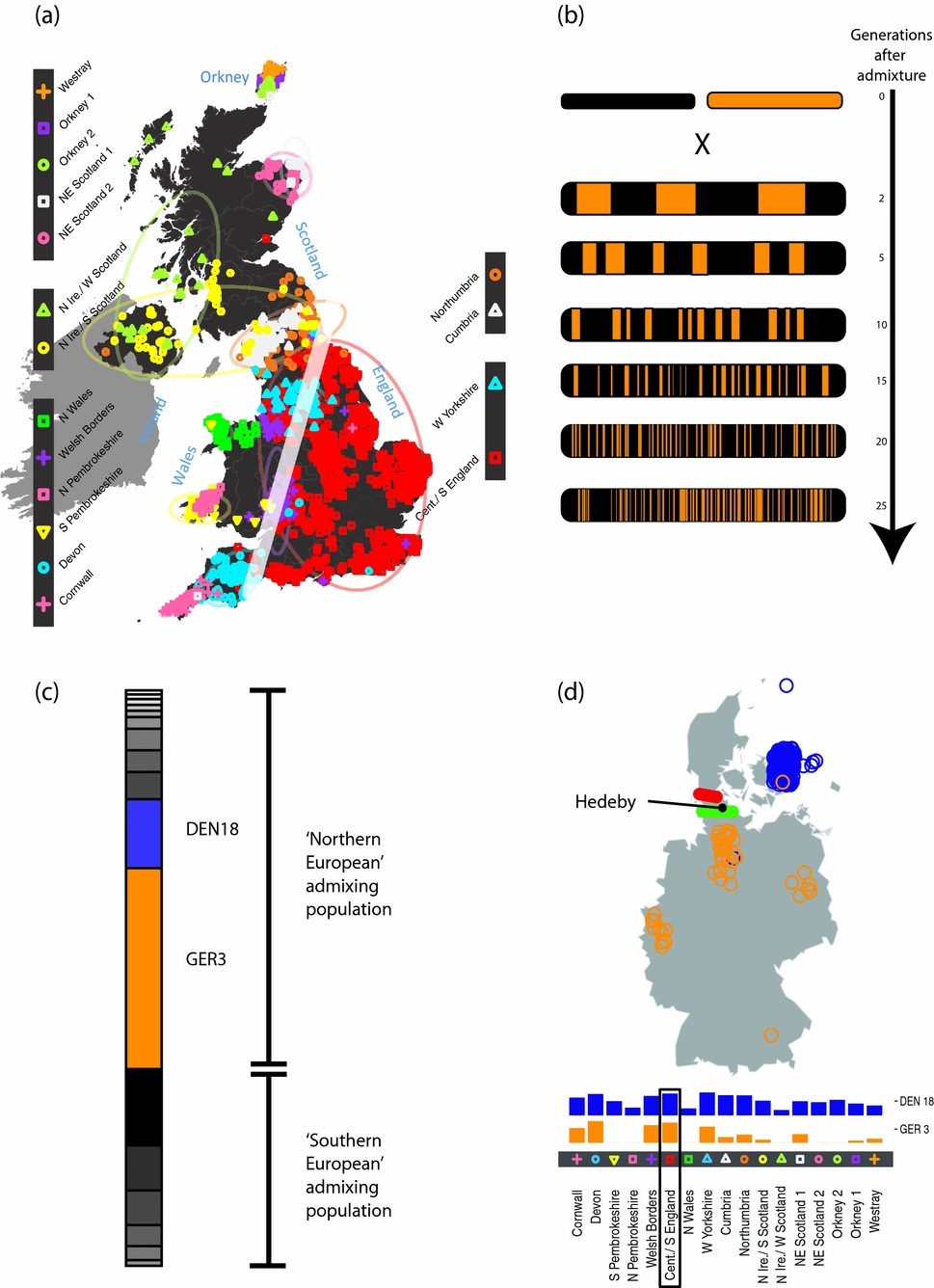
PoBI used samples from over 2000 individuals from rural areas whose grandparents were born within a 40km radius of each other, and identified 17 geographically discrete genetic clusters within the UK (Figure 1a). Critically, the clusters were determined solely by the genetic make-up of their constituent individuals, without reference to the individual's sampling location. While this genetic clustering is the main result of the project, additional data and analyses were included to throw light on Britain's genetic relationship with Europe, and to investigate past demographic events. Equivalent genetic clustering to that carried out for Britain was performed on Continental European samples, with combinations of these European clusters serving as proxies for historical Continental populations. Analyses also aimed to reveal and date admixture: the interbreeding between two populations.
PoBI clustering and admixture. a) Clusters of genetic similarities in Britain, where each symbol is an individual, plotted at the centroid of their grandparental birthplace. The white line separates highland and lowland zones. b) Schematic of decreasing genetic segment sizes with time (i.e. generations from admixture). c) Schematic of ‘Anglo-Saxon’ admixture event for the British lowland cluster, with north-west German (GER3) and Danish (DEN18) contributions to the ‘northern-European-looking’ admixing population highlighted. d) Sampling locations for European clusters GER3 and DEN18; modern Danish border in red, Viking Age Danish ‘border’ in green (above), and their relative genetic contributions to British clusters, where lowland Britain (red squares) is highlighted (below); (a, c and d adapted from Leslie et al. Reference Leslie, Winney, Hellenthal, Davison, Boumertit, Day, Hutnik, Røyrvik, Cunliffe, Lawson, Falush, Freeman, Pirinen, Myers, Robinson, Donnelly and Bodmer2015).
In this article we focus on the largest British cluster, both in terms of the number of individuals (n = 1044) and the geographic area it covers. The cluster represents central and south-eastern England—the area traditionally referred to as the lowland zone of Britain (Fox Reference Fox1943). For this cluster, PoBI identified, and approximately dated, a single admixture event, and it equated this with the Anglo-Saxon invasion of Britain. The admixture event was modelled as a single ‘pulse’ of genetic (i.e. demographic) input; no evidence was found for multiple pulses. It is important to note here that the admixture event discussed in Leslie et al. (Reference Leslie, Winney, Hellenthal, Davison, Boumertit, Day, Hutnik, Røyrvik, Cunliffe, Lawson, Falush, Freeman, Pirinen, Myers, Robinson, Donnelly and Bodmer2015) emerged from the genetic data, rather than being assumed to exist, in the fashion of a circular argument. In this way, admixture events detected (devoid of any cultural assumptions) are simply mapped onto historical cultural horizons.
The dates of admixture were, conceptually, determined by assessing the size of DNA sections in the English cluster that were identical to the ‘donor’ population in question. Briefly, the process of meiotic recombination breaks up the contribution of any given ancestor into successively smaller fragments in each generation (see, for example, Røyrvik Reference Røyrvik, Cunliffe and Koch2010). The average size of genetic tracts in the descendant population that are derived from a donor population can be converted into an estimated number of generations since the admixture event: the smaller the tract, the greater the time since the event (see Figure 1b).
The study posits evidence for the Anglo-Saxon invasions, citing an admixture event for the lowland British cluster, where the largest contribution to one parental proxy was provided by north-western Germany (Continental cluster GER3, at 35% of the event; see Figure 1c). This was estimated to have occurred around 38 generations ago, which, using a generation time of 28 years, a principled average from Fenner (Reference Fenner2005), corresponds to the year AD 858 (95% confidence interval: AD 802–914). This admixture event also includes a smaller contribution from the modern Danish cluster, DEN18 (Figure 1c). The study did not, however, identify any other admixture events with large contributions from DEN18, which it implicitly assumes is the best proxy source for the Danish Viking population. Hence, it concludes a limited genetic influence on England from Danes in the Viking Age.
These stated conclusions can be questioned on two main grounds. First, GER3 may also represent Danish Vikings; and second, DEN18 may not adequately represent Danish Vikings.
The PoBI article (Leslie et al. Reference Leslie, Winney, Hellenthal, Davison, Boumertit, Day, Hutnik, Røyrvik, Cunliffe, Lawson, Falush, Freeman, Pirinen, Myers, Robinson, Donnelly and Bodmer2015) implies that distinguishing between the Anglo-Saxon and Danish Viking genetic contributions is relatively straightforward. In fact, as the authors themselves make clear in their supplementary information, “definitively separating Saxon and Danish Viking inputs is impossible” (Leslie et al. Reference Leslie, Winney, Hellenthal, Davison, Boumertit, Day, Hutnik, Røyrvik, Cunliffe, Lawson, Falush, Freeman, Pirinen, Myers, Robinson, Donnelly and Bodmer2015: S11), owing to the geographic overlap, in northern Germany/Jutland, of the two component groups. Indeed, the authors exploit this ambiguity by suggesting that a considerable proportion of the DEN18 genetic signal in central to south-eastern England may be attributable to the Saxon invasion. This is because a DEN18 contribution is present across the entire lowland region, not just in the so-called Danelaw: the region of northern and eastern England embracing East Anglia, Yorkshire and the East Midlands, ruled by Danes in the ninth century—a point we address below.
The ambiguity identified by Leslie and colleagues can also be used to reach the opposite conclusions, namely that GER3 could also represent a Danish Viking genetic input. Given that the geographic scope of Viking Age Denmark included northern Germany (its southern extent lying in the region of the River Eider), it is very possible that the north-west German group (GER3), taken as representing the Anglo-Saxons in the PoBI article, is also the best representative of Danish Viking settlers in the European cohort (contra the authors’ claims that “no Vikings originated from northern Germany”; Leslie et al. Reference Leslie, Winney, Hellenthal, Davison, Boumertit, Day, Hutnik, Røyrvik, Cunliffe, Lawson, Falush, Freeman, Pirinen, Myers, Robinson, Donnelly and Bodmer2015: S18). The majority of GER3 individuals lie geographically closer to the great Viking Age Danish emporium of Hedeby (historically in Denmark, now part of Germany) than do the DEN18 individuals (Figure 1d). This is significant, as there are substantial archaeological connections between Hedeby and the Danelaw (Kershaw 2013). A related point here is that the supposition that DEN18 is the best proxy source for the Danish Vikings is uncertain. DEN18 consists of multiple sclerosis patients who were majority resident in Copenhagen, but of unknown provenance beyond ‘European’—by contrast, at least some of the northern German sampling was rural and population-based (The International Multiple Sclerosis Genetics Consortium & The Wellcome Trust Case Control Consortium 2 2011). The Danish cluster, then, is quite a poor representative of any local population, and not necessarily representative of Denmark as a whole.
Leslie and colleagues strengthen their identification of GER3 with Anglo-Saxons (as opposed to Danish Vikings) by observing that GER3 is represented in all English population clusters, not just that which covers the Danelaw (Leslie et al. Reference Leslie, Winney, Hellenthal, Davison, Boumertit, Day, Hutnik, Røyrvik, Cunliffe, Lawson, Falush, Freeman, Pirinen, Myers, Robinson, Donnelly and Bodmer2015: SI). This is not a great objection if one acknowledges that: a) GER3 also, and probably mostly, represents Anglo-Saxon migrants; and b) the Viking contribution will have had over 1000 years to spread through what is now England. The undifferentiated lowland Britain cluster is itself testament to the ease and frequency of communication and mate exchange in this part of the island. The Viking genetic legacy has had nearly as long to reach the periphery of the lowland zone (northern England, the Welsh Marches, Devon) as that of the Anglo-Saxons.
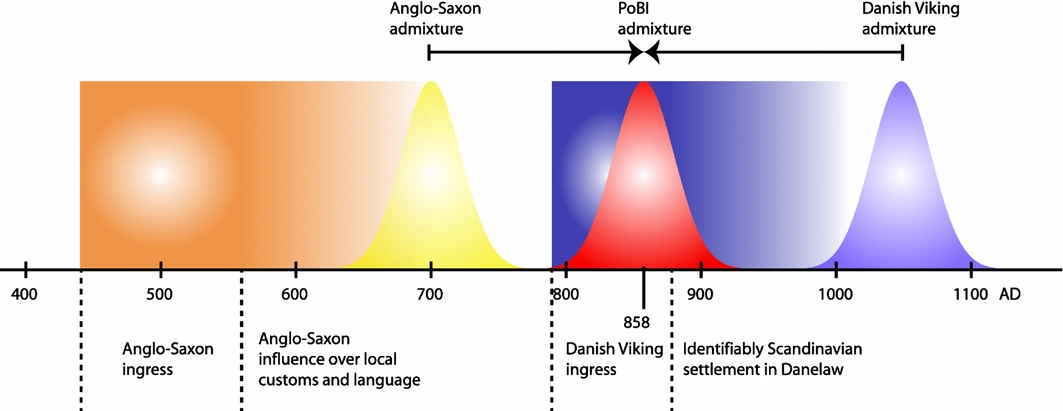
An additional element to strengthen the case for a Danish Viking genetic contribution relates to the dating of the admixture events. The ‘Saxon’ admixture event was found to correspond to the year AD 858 (95.4% confidence interval: AD 802–914). The authors of the PoBI article stress that the admixture event must necessarily occur after immigration, with the estimated admixture dates thereby representing “upper bounds on the dates of the migrations” (Leslie et al. Reference Leslie, Winney, Hellenthal, Davison, Boumertit, Day, Hutnik, Røyrvik, Cunliffe, Lawson, Falush, Freeman, Pirinen, Myers, Robinson, Donnelly and Bodmer2015: 313). A Saxon admixture date within the range of AD 802–914 post-dates, however, the onset of Anglo-Saxon migration to Britain in the middle of the fifth century by some 350–450 years. Even allowing for ongoing immigration and a very gradual admixture process reflected in limited rates of intermarriage between migrant and local groups (Thomas et al. Reference Thomas, Stumpf and Härke2006), it is unlikely that ethnic distinctions would have remained so prominent over four centuries. For comparison, the same method was used to discover a three-way admixture event in the history of modern Maya, between Native American, West African and European groups, dated to AD 1670—150 years after the start of the Spanish conquest of Mexico (Hellenthal et al. Reference Hellenthal, Busby, Band, Wilson, Capelli, Falush and Myers2014). In particular, a model of ethnic isolation is inconsistent with the cultural influence asserted by Anglo-Saxon groups over much of the native population of lowland Britain, as they affected changes in dress, language and burial rites (Loveluck & Laing Reference Loveluck, Laing, Hamerow, Hinton and Crawford2011). Indeed, there is little evidence for distinctions between Britons and Anglo-Saxons as late as the ninth century, with archaeological, skeletal and textual data all pointing to the seventh century as the time when ethnic differences began to break down (Thomas et al. Reference Thomas, Stumpf and Härke2006). We must therefore expect the Anglo-Saxon/Briton mixing to be virtually complete before the AD 802–914 date range presented by Leslie and colleagues. By contrast, Scandinavian settlement in England, following nearly a century of raiding activity, is documented in the Anglo-Saxon Chronicle from AD 876 (Whitelock Reference Whitelock1979), and Danish rule in the north and east is officially recognised in a late-ninth-century treaty between King Alfred of Wessex and the Viking leader Guthrum. A Danish Viking contribution to the signal, resulting from Scandinavian settlement, would have the effect of skewing the ‘Anglo-Saxon’ admixture to a later date (see Figure 2), if the latter is truly a conglomerate reflecting two different historical events.
Timeline of Anglo-Saxon and Danish Viking influence. Boxes indicate immigration periods and subsequent cultural influences; the red distribution schematically represents the admixture date estimate given by Leslie et al. (Reference Leslie, Winney, Hellenthal, Davison, Boumertit, Day, Hutnik, Røyrvik, Cunliffe, Lawson, Falush, Freeman, Pirinen, Myers, Robinson, Donnelly and Bodmer2015), which we assume includes some Viking influence, and the yellow and blue distributions represent when putative ‘pure’ admixture dating profiles might be localised.

An equivalent fine sampling strategy to that of the PoBI project extended across Europe, as envisioned by Walter Bodmer and restated in Leslie et al. (Reference Leslie, Winney, Hellenthal, Davison, Boumertit, Day, Hutnik, Røyrvik, Cunliffe, Lawson, Falush, Freeman, Pirinen, Myers, Robinson, Donnelly and Bodmer2015), would certainly contribute to disentangling this issue. Likewise, the increasing capabilities of ancient DNA (aDNA), both in terms of the number of human remains sampled and the genetic information recoverable from them, will probably prove helpful in identifying a separate Danish Viking migratory event. Such studies, genotyping Iron Age and early medieval Scandinavian and British archaeological human remains, are starting to appear (e.g. Krzewińska et al. Reference Krzewińska, Bjørnstad, Skoglund, Olason, Bill, Götherström and Hagelberg2015; Schiffels et al. Reference Schiffels, Haak, Paajanen, Llamas, Popescu, Loe, Clarke, Lyons, Mortimer, Sayer, Tyler-Smith, Cooper and Durbin2016), although the number of individuals and their geographic coverage is still small. Crucially, aDNA studies will allow direct comparison between earlier Anglo-Saxons (as judged by date and material culture) and later, Viking Age inhabitants of the Danelaw. If sample sizes are large enough, this could reveal whether a supplementation of Continental Germanic genetic material took place, and, if so, of what magnitude.
Distinguishing between a fifth–sixth-century north and north-west German/southern Danish (Anglo-Saxon) genetic contribution to the modern English population, and a ninth–tenth-century north German/pan-Danish (Viking) one will, however, probably remain exceedingly difficult, as it will involve populations that, based on their partial geographic overlap and temporal proximity, are unlikely to be genetically very distinct. What, then, is the unambiguous evidence for a specifically Danish Viking presence in England, as distinct from both geographically similar Anglo-Saxons and temporally similar Norwegian Vikings, whose settlement in England centred on the north-west? This is a long-standing question within early medieval studies, and one to which we now turn.
Danish Viking settlement in England: linguistic and archaeological evidence
Both linguistic and archaeological sources suggest sizeable Danish Viking settlement in England. The language of the Viking Age Scandinavians, Old Norse, heavily influenced place-names in areas of documented Scandinavian settlement. The evidence for Scandinavian place-names is late, deriving mainly from post-Conquest sources, but linguists argue that the coining of such names occurred early in the settlement process (Abrams & Parsons Reference Abrams, Parsons, Hines, Lane and Redknap2004: 399–400, 404). Names typically denoting Danish—as opposed to Norwegian—influence, including those ending in -by (= farmstead/settlement) and -thorp (= outlying settlement), are extremely common in Yorkshire and the East Midlands. In Yorkshire, for instance, 744 Scandinavian place-names (48% of the total) are recorded by 1086 in the Domesday Book. While it has been suggested that such names may have been coined by Anglo-Saxon adopters of Old Norse names (e.g. Hadley Reference Hadley2006), a review of the largest category, -by names, concluded that as such names are much more commonly compounded with a Norse, rather than English, word or personal name, and sometimes preserve Norse inflectional endings, they were probably coined “in a predominantly Norse-speaking environment” (Abrams & Parsons: Reference Abrams, Parsons, Hines, Lane and Redknap2004: 398).
Importantly, it is not only major place-names that show pervasive Scandinavian influence, but also minor names: those of fields, streams and lesser topographic features (Townend 2012). As minor names were probably coined by the local farming population, this suggests the use of Norse vocabulary by non-elite, rural communities. The hundreds of Norse personal names recorded from the Danelaw (both male and female, e.g. Gunnælf in Gunnelfcroft) include some that are rare within Scandinavia and/or were first coined in England (Insley Reference Insley1994; Parsons Reference Parsons2002), and corroborate the presence of a sizeable population of Norse speakers.
More broadly, the influence of Old Norse on the English language, in terms of vocabulary, grammar and pronunciation, is also indicative of a substantial population of Norse speakers. Dialectal Middle and modern English reveal strong remnants of Norse in the Danelaw, as well as in north-west England (Samuels Reference Samuels and Laing1989). The most prominent effects are a large number of loanwords from Norse, and English words that took on the meaning of their Norse cognates (Townend 2006). Loanwords from Norse include the third-person plural pronoun set they, them and their: central language elements that are rarely transferred between languages (Durkin Reference Durkin2014). One of the major restructurings of grammar in the transition from Old to Middle English, namely the loss of inflectional endings, may also have resulted partly from high levels of contact between speakers of Old Norse and Old English (Townend Reference Townend2002).
The cultural legacy left by the migrating Danish Viking population is also now well attested in the archaeological record. Traditionally, Scandinavian cultural traits have proved difficult to identify in rural settlement and burial archaeology (Hadley & Richards Reference Hadley and Richards2000). The national recording of metal-detector finds has, however, led to the creation of an entirely new archaeological dataset for Viking Age England, adding dramatically to our understanding of the Viking settlements. The number of ninth- and tenth-century metalwork items now identified as diagnostically Scandinavian is considerable. Close to 500 single finds (as distinct from site finds and material deposited in hoards) of late ninth- and early tenth-century date have been identified, predominantly from the Danelaw region. Hundreds more objects have been identified as ‘Anglo-Scandinavian’: local Danelaw products made in imitation of Scandinavian items (Kershaw 2013). As these are items that were a) lost in the Viking period, b) recovered by a metal-detectorist and c) reported to the relevant recording bodies, this number will reflect just a tiny fraction—conservatively estimated to be 1–5%—of the number of items originally in circulation (Kershaw 2013: 246).
The diagnostically Scandinavian metalwork comprises three main artefact groups: non-elite male and, in particular, female dress fittings (Leahy & Paterson Reference Leahy, Paterson, Graham-Campbell, Hall, Jesch and Parsons2001; Kershaw Reference Kershaw2009, Reference Kershaw2013); silver and weights associated with bullion exchange (Kershaw forthcoming); and amulets with iconography drawn from pagan Scandinavian mythology (Pestell Reference Pestell, Bates and Liddiard2013). The striking feature of the metalwork is its ‘Scandinavian-ness’. Thus, the female brooch styles, represented by more than 125 finds from the Danelaw, are not found elsewhere in England, but have direct parallels in finds from Scandinavia, particularly Viking Age Denmark. The bullion-related finds, comprising ingots and hack-silver as well as weights, relate to the Scandinavian practice of a metal-weight economy, a means of exchange not practised by the coin-using Anglo-Saxons. Rather than representing the transfer of isolated objects, this material reflects the import of distinctive Scandinavian cultural traits related to fundamental social norms: female costume, economic practice, and religious belief and expression.
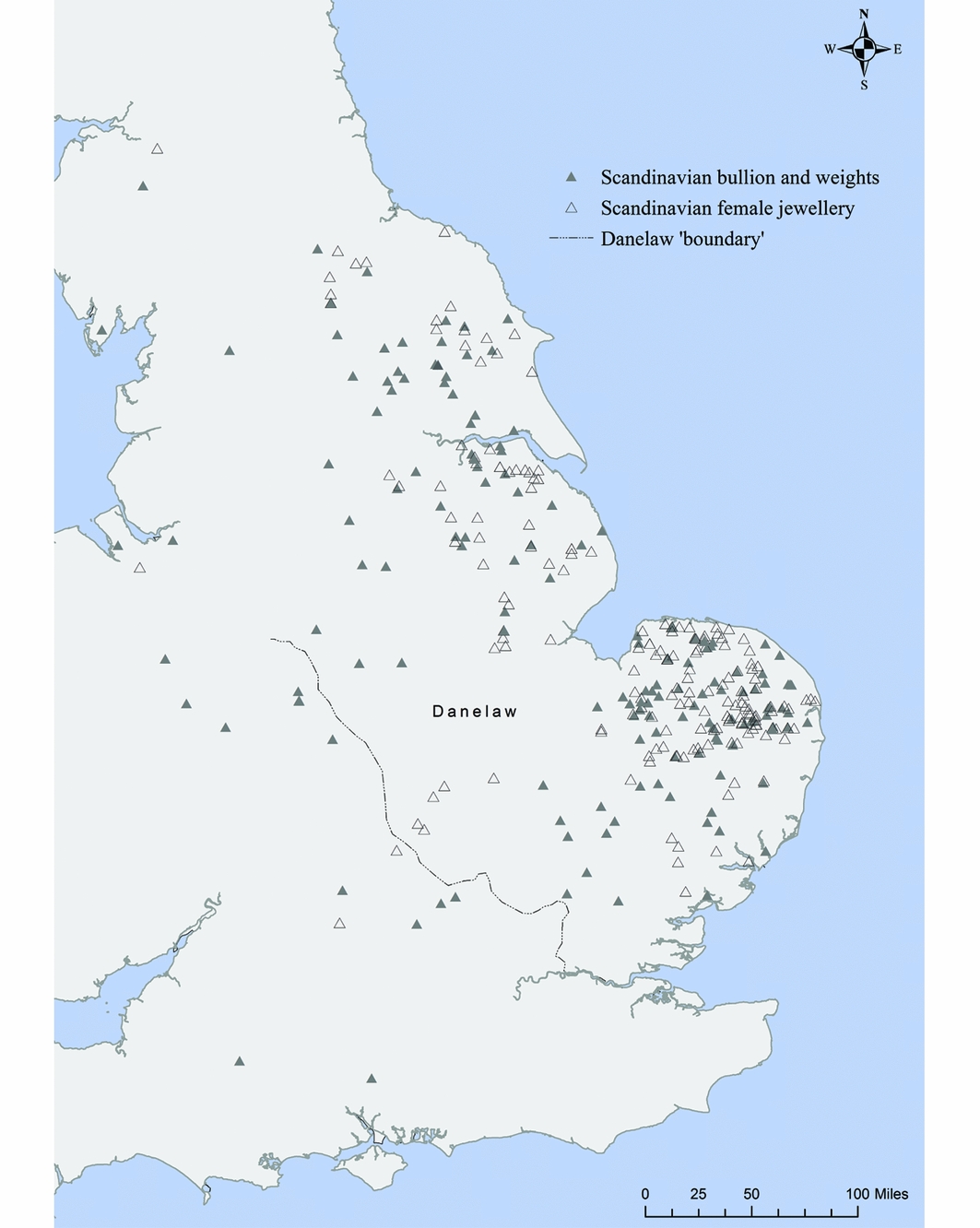
A number of features suggest that this material results from large-scale Scandinavian settlement, rather than from trade or the local production of artefacts of Scandinavian appearance. First, as with the name data, the metalwork repertoire is extremely diverse, reflecting most of the types and sub-types current in Scandinavia, with particularly close parallels with southern Scandinavia: Viking Age Denmark (Kershaw 2013). This suggests that such metalwork was, in general, likely to have arrived in the possession of settlers from Scandinavia, over an extended settlement period. This is further supported by the distribution of Scandinavian imports within the Danelaw, which is widespread, diffuse and almost exclusively rural (Figure 3). While metal-detecting is largely confined to rural areas, excavations in Danelaw towns such as Thetford, Norwich, Lincoln and York have yielded only a modest number of comparable items, suggesting a genuine paucity of Scandinavian metalwork in urban environments (Kershaw forthcoming). Such patterning is at odds with a scenario in which such material reached England primarily via trade (in which case we might expect to see items clustered in towns), but it is entirely consistent with the presence in rural areas of well-populated Scandinavian communities. Combined with the place-name evidence discussed above, the case for sizeable Scandinavian settlement in the Danelaw countryside is strong.
Distribution of Scandinavian metalwork finds in England.
Scandinavian cultural influence in the Danelaw was thus pervasive, and can only truly be explained by the presence of substantial numbers of settlers from Scandinavia speaking Old Norse, retaining their traditional dress and preserving their distinctive economic system. Chronological data available for the small finds suggests that these distinctive practices were maintained into the early decades of the tenth century; that is, for at least two generations (Kershaw 2013, forthcoming). Dating the coining of Scandinavian place-names is far less precise, but there are clear linguistic grounds for believing that -by names, and others, were partially coined during the tenth century (Abrams & Parsons Reference Abrams, Parsons, Hines, Lane and Redknap2004: 399–400, 404). The evidence for a female Scandinavian presence, in both the name data and metalwork, is especially striking, and points to the migration of family groups, rather than simply a male military elite.
Migrant numbers
Putting a precise figure on the number of Danish Viking settlers remains challenging. An interpretation of the genetic data in the PoBI study suggests that they cannot have contributed more than 40% to the contemporary lowland British population (this being the probable upper bound of the identified ‘Anglo-Saxon’ admixture). Allowing for a genuine Anglo-Saxon genetic component, the Danish Viking component must be significantly less. At the same time, the heavy influence of Old Norse on place-names in England, the linguistic impact of Old Norse on English, and the emerging archaeological evidence for imported Scandinavian metalwork argues strongly for the presence of a sizeable Norse-speaking, Scandinavian migrant population.
We offer two methods of roughly estimating an absolute number of settlers: one on the basis of single find artefacts, and one on population proportions. In order to account for the uncertainty of our input variables, we used Caladis: a probabilistic calculator that performs calculations using probability distributions, rather than simply point estimates (Johnston et al. Reference Johnston, Rickett and Jones2014). Figure 4 provides a summary of the input data, settings, calculations and results. For the proportional approach, an estimate of the total Viking Age population of the ‘core’ Danelaw was based on numbers derived from the 1086 Domesday Book (Broadberry et al. Reference Broadberry, Campbell and van Leeuwen2010), and scaled, according to extremes of ninth–tenth century population growth estimates, to between 30–100% of the 1086 estimates (Richards Reference Richards2000: 94). The core Danelaw is defined here as Yorkshire, Lincolnshire, Norfolk and Suffolk (see the distribution shown in Figure 3). The estimated genetic proportion ( AS ) of the total population P that was introduced in the PoBI ‘Anglo-Saxon’ admixture event is 10–40% (Leslie et al. Reference Leslie, Winney, Hellenthal, Davison, Boumertit, Day, Hutnik, Røyrvik, Cunliffe, Lawson, Falush, Freeman, Pirinen, Myers, Robinson, Donnelly and Bodmer2015), and the Danish Viking contribution to AS ( V ) is 10–50%, the upper bound indicating that Danes at most equalled the genetic input of the Anglo-Saxons. Both methods, which are broadly independent of each other, indicate the probable number of original migrants to be in the region of 20000–35000 over the course of the settlement period, a number of the same order as that estimated for the contemporaneous Scandinavian settlement of Iceland (Byock Reference Byock2001).
Estimations of Danish Viking settlers: a) input variables, probability distributions chosen for input variables, and formulae for calculations. The values are discussed in the main text; b) overlaid histograms of estimates for absolute numbers of settlers, where that based on artefact numbers (in blue) has a cut-off at 100000 (omitting the highest estimates, accounting for 11.1%).

Conclusion
We suggest in this article that, contrary to the conclusions of Leslie et al. (Reference Leslie, Winney, Hellenthal, Davison, Boumertit, Day, Hutnik, Røyrvik, Cunliffe, Lawson, Falush, Freeman, Pirinen, Myers, Robinson, Donnelly and Bodmer2015), Danish Vikings probably contributed appreciably to the lowland British population. The GER3 signal, interpreted as an Anglo-Saxon genetic signal by Leslie et al. (Reference Leslie, Winney, Hellenthal, Davison, Boumertit, Day, Hutnik, Røyrvik, Cunliffe, Lawson, Falush, Freeman, Pirinen, Myers, Robinson, Donnelly and Bodmer2015) is likely to also include a Danish Viking signal, given that both populations originated from largely the same geographic location. Furthermore, the acknowledgement that the admixture proportion from GER3 is influenced, perhaps heavily, by Danish Vikings would also help to explain the unexpectedly late date for said signal. In light of the convincing linguistic and archaeological evidence, we would urge a re-interpretation of the genetic analysis to allow for significant levels of Scandinavian migration to, and settlement in, England.