


Despite strides taken towards rebranding Christianisation as a slow and peaceful religious and cultural transformation in the last sixty years, the ghosts of decline and religious violence have haunted late antique studies since Edward Gibbon set the tone with A History of the Decline and Fall of the Roman Empire (1776–91).Footnote 1 The academic discourse has oscillated between the poles of a number of dichotomies, seeing the changes as either violent or peaceful, and representing break or continuation. Material manifestations of Roman religion, the items that are thought to have been literally ‘broken’, have been at the nexus. Archaeologists have shaped their understanding of the role of material religion in the Christianisation process around the narratives in late antique textual sources – texts that ultimately are biased accounts aimed at Christian world-building.
The striking descriptions in hagiographical accounts such as the Saints’ vitae of violent idol-smashing, temple-burning bishops, the desperation of the pagans witnessing the destruction of their gods, and the new Christian cities that rose in the wake of destruction, have therefore contributed to a persistent narrative of the Christianisation of the Roman Empire as a violent affair, with pagan sanctuaries and idols becoming victims of Christian rage and intolerance.Footnote 2 Temple destructions and transformations empire-wide have been studied in order to build a universal Christianisation narrative. Contrasting the scholarly voices arguing for violent destruction of temples are those who argue for a peaceful religious transition where pagan buildings and monuments are harvested for building material or are removed because they go out of use, decay, and collapse, and are demolished because they take up valuable space in the city centre where space for monumental buildings like churches and basilicas is scarce.Footnote 3 Still, religious sanctuaries remain the focus.Footnote 4
Recently, several studies have nuanced this polarised debate by focusing on the spatial aspects of Christianisation, and particularly Christianisation in and of urban space, including Nathaniel Andrade’s sensory and movement-focused approach to John Chrysostom’s Christianisation of the streets of Constantinople, and Ine Jacobs’s comprehensive work on urban renewal, relocation of statues, and Christian inscriptions and graffiti in streetscapes in Asia Minor.Footnote 5 What these studies have in common is that they consider objects and buildings along with their surrounding material world as well as their relationships and interactions with humans in these spaces. Both Andrade and Jacobs expand our knowledge of the roles of small things and urban spaces in the Christianisation process by showing that Christians took to the streets in Late Antiquity.
Inspired by the spatial turn in Roman studies, and particularly the many studies focused on material interactions and movement in urban space,Footnote 6 I expand on spatial theory with a new materialist approach to the agency of streetscapes to drag the Christianisation process out of the temple gates and into the streets of the late antique city. I particularly draw on Karen Barad’s concept of ‘intra-activity’ and assemblage theory to understand how the many components in the streetscape acted together with humans to produce Christianisation in the late antique city.Footnote 7 The aim is to demonstrate that the urban space was a vital and important arena in the Christianisation effort in Late Antiquity. My case study is the ‘Triodos’, a small intersection in the centre of Ephesus. I argue that this small square was an important religious locus despite the absence of sanctuaries, and that the streetscapes in Roman cities were central in the Christianisation process.
The gods are in the streets
Recent influential studies on lived religion in the Roman world – including Christian Late Antiquity – have shed light on a rich religious life outside the boundaries of civic religion.Footnote 8
Roman sanctuaries, with their monumental temples and cult images, were the domains of civic religion before Late Antiquity. Ritual interaction with cult images in temples was reserved for religious specialists, the priesthoods and religious colleges, who performed public rituals on behalf of the community. The sanctuaries were generally not accessible to the public except during festivals, religious games, and feast days. Instead, people in ancient cities interacted with Roman gods outside the boundaries of the sanctuaries. They prayed, sacrificed, and requested favours on behalf of themselves, their friends, and families in their homes, in the necropoleis, and at altars and depictions of the gods in public places.
When Christians destroyed sanctuaries and/or transformed them into churches, non-Christian religious life was obviously affected. However, focusing our spatial analyses of Christianisation on the sanctuaries would not be sufficient. Scholars of lived religion have emphasised that Christian religious practice was equally unconfined by the boundaries of the church walls and organised worship.Footnote 9 The streets of the ancient cities were important religious arenas before, during, and after Christianisation.
The streets are alive
In order to understand the significance of an urban space like the Triodos, its religious importance, and how it became an agent in the Christianisation of Ephesus, we first need to understand how all the elements of the Triodos together made a difference – their collective ability to act, affect, and interact with human and non-human others. The idea that matter is not representational but has the capability to act and affect is not new. Material agency theory has for a long time emphasised that material things are not only physical frameworks of (human) social life, but also are formative social agents in their own right: things have agency.Footnote 10 Social and individual human lives depend upon and are constituted by their relationships with material things, and material entities are understood as social agents because people recognise and exploit their ability to act and affect. When a chain of social events is started, the inanimate object must be included among the social agents.Footnote 11
It can be difficult to highlight material agency when we study social processes. For example, Christianisation and other religious transformations have traditionally been seen as a process among humans. To some extent this is correct. It is about humans dictating what other humans should believe. However, the multitude of material vestiges of Christianisation – the emergence of new religious symbols and buildings and the disappearance and changes in the old – demonstrates that this process was relational beyond humans, and beyond humans and their deities. In other words, if material things were not important actors in Christianisation they would not have been moved, marked, destroyed, manipulated, or displayed.
Things do not shape social relationships only between humans and things; they affect social relationships among humans. This means that material agency can be used by humans to deliberately influence and affect other humans. A statue or religious symbol in Late Antiquity evoked emotion, and importantly, action among humans: emotion and action towards the material entities and among humans. That means that we should focus not just on what things are, but what things do. Importantly, it is their capacity to do that in turn makes it possible and relevant to do things to them: to change how the doing gets done.Footnote 12
How can we understand the agency of a streetscape – a milieu compounded of many separate material entities? Ben Jervis and others argue in a study of void spaces in medieval cities that streetscapes have been thought of as static material backdrops for activity rather than active participants in urban life (when thought of at all); void spaces that people pass through on their way from A to B without noticing them or engaging with them.Footnote 13 In order to situate the urban spaces outside sanctuaries in the process of Christianisation and understand how they were transformed to facilitate religious transformation in Late Antiquity, it is necessary to breathe life into these neglected spaces, or rather, to reveal the vibrancy that always existed in the streetscapes of ancient cities. I draw on the central principles of new materialism concerning the compound agency of non-human material things in my understanding of the Christianisation of space in Late Antiquity, connecting them to the Spatial Turn’s emphasis on the agency of space itself.
Assemblage theory serves to connect the dots between individual material, human, and immaterial components to demonstrate how they affect the world together. Material agency is not only present in individual things and in set situations; things also act together as assemblages.Footnote 14 A streetscape is in its very definition an assemblage. It is a collection of many parts that together constitute a larger whole: roads, buildings, pavements, street-furniture. As assemblages, streetscapes are ordered, or ‘coded’ in various ways, and the relationships among its individual elements is key to their functioning and agency. A streetscape, as an assemblage that is definitively ordered by the location of individual objects in space makes those relationships even more meaningful. Importantly, a streetscape and its components impose obligations upon things and people, create environments in which we are socialised, and internalise spatial and social rules in us: how we move, how and when we interact with the components in the streetscape, and how we interact with other humans in these spaces. As such, streetscapes affect not only our relationship with the streetscapes themselves, but also other things – material and immaterial – outside the assemblage, and interhuman relationships; we build spaces to structure other material things, ourselves, and each other.
Streetscape assemblages and their components relate to other assemblages. Religion, economy, politics, and the lives of people moving past and through are entangled, and changes in a streetscape such as the Triodos have potential ripple affects: they affect and are affected beyond the individual space, to human–thing interactions, to human–human interactions, and larger societal processes.Footnote 15 New materialist assemblages are never static, and always emergent – in constant change – albeit at different scales and speeds.Footnote 16 Components in the assemblage may be detached and enter new relationships in other assemblages in which their interactions and affective capabilities are different.Footnote 17 Herein lies the key to understanding how the Triodos was more than an unassuming intersection where people passed through on their way from A to B. The inherent capacities of an emergent space can be tapped into to provoke change in the larger assemblage. One moving part had the capacity to change the interactions and affective capabilities of the entire streetscape – and beyond – in constant processes of negotiating and renegotiating its relationships with people, its role in the urban milieu, and as a religious space. In an assemblage streetscape religious change could be affected through multiple small changes to images and monuments.
In our street(scape): the Triodos
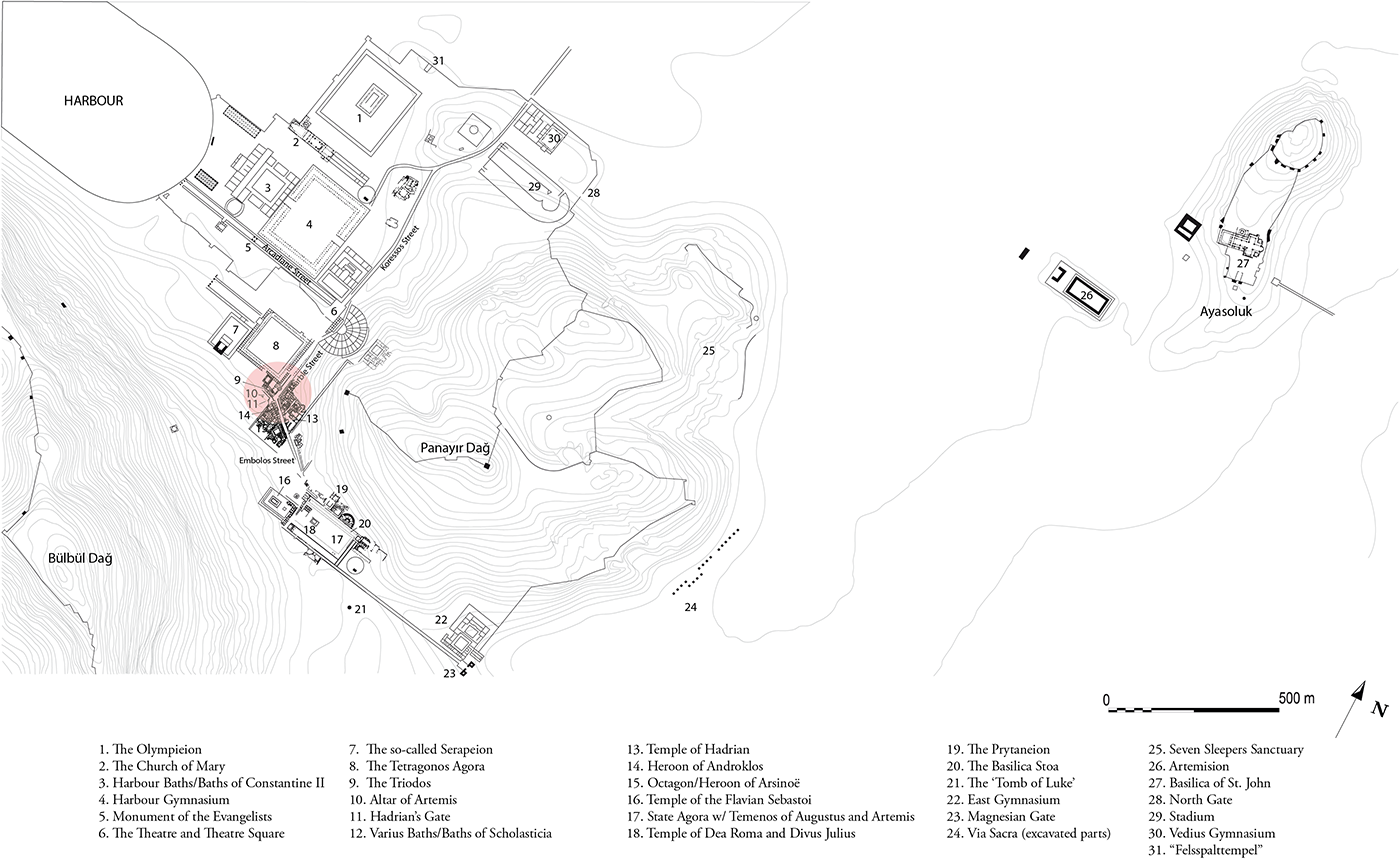
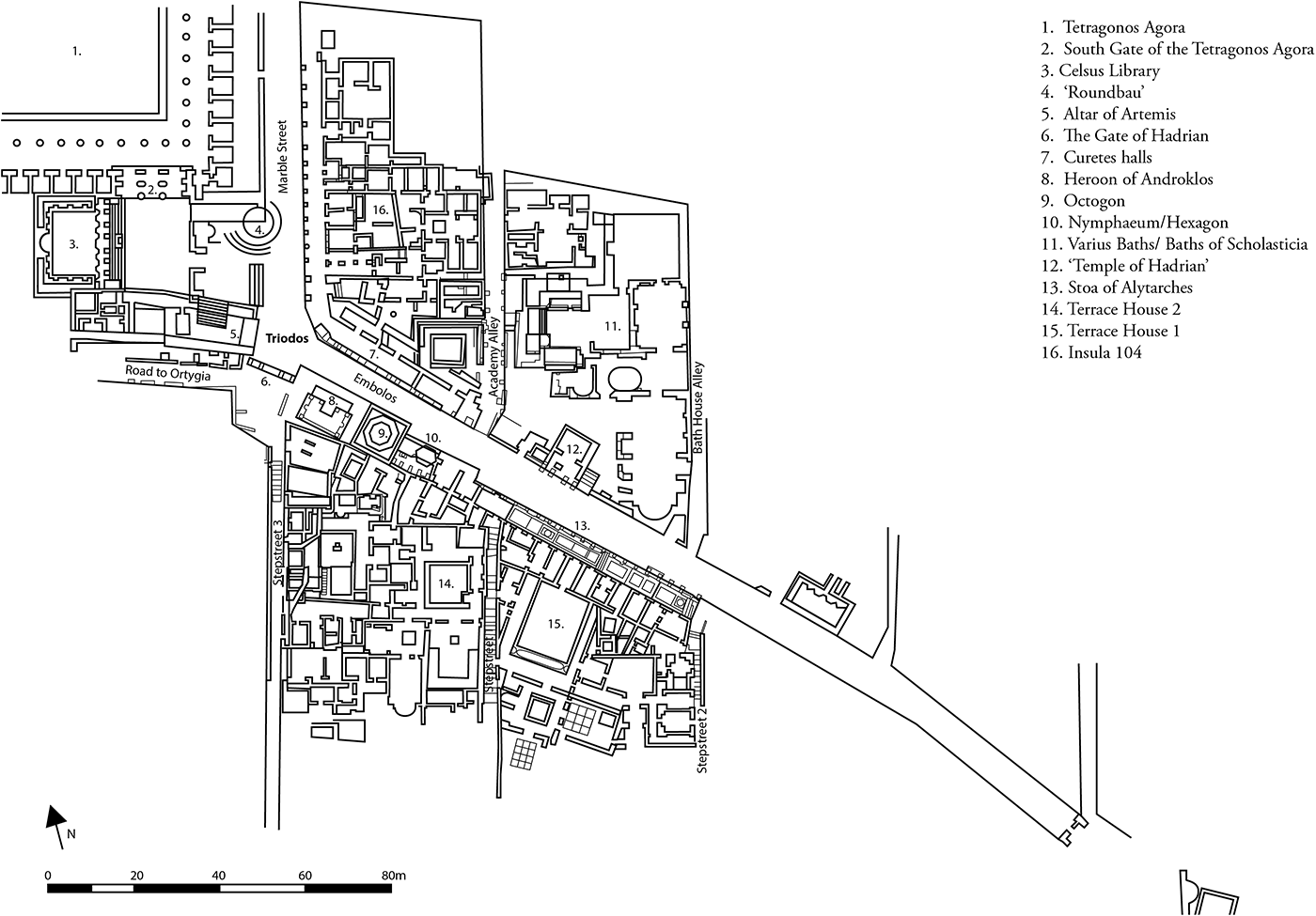
Our example streetscape is that of the Triodos, a small street intersection in the south-western part of central Ephesus (Fig. 1). Its name indicates that this was the place where three roads met, but it was in fact the meeting place of four important roads: the two main streets now conventionally named Embolos Street and Marble Street, the Ortygia Road exiting the city towards mount Bülbül Dağ, and Stepstreet 3 leading to the upper-class terrace houses flanking the south side of the Embolos (Fig. 2).Footnote 18 The area has been under archaeological investigation by the Austrian expedition since the early twentieth century, with multiple phases of excavation, study, and reconstruction of individual monuments and the diachronic development of the streetscape.Footnote 19
General plan of Ephesus (by author).

Plan of the Triodos in the Roman period (by author, adapted from Waldner (Reference Waldner2020)).

Despite being the locus of many ritually active monuments and being emphasised as ‘an area with great religious significance’ by Peter Scherrer,Footnote 20 the role of the Triodos streetscape in the Christianisation of Ephesus has not received marked interest. Most likely the main reason for this is that there were no sanctuaries located here. As such it did not draw the attention of (highly temple-centric) Christian authors – nor (just as temple-centric) scholarship.Footnote 21 The only monumental manifestation of Roman religious ritual was a large altar possibly dedicated to Artemis. Despite this seeming absence of prior religious significance, a Christian man, Demeas, erected a monumental cross with an inscribed base at the intersection sometime between 390 and 430 CE. The dedicatory inscription declared that Demeas had removed the ‘demon Artemis’ and replaced her with a Christian cross: ‘Upon tearing down the deceitful image of the demon Artemis, Demeas set up this infallible sign to honour God, who drives away idols, and the Cross, Christ’s eternal victory-bringing symbol.’Footnote 22
This inscription is the only known epigraphic record from Late Antiquity of a pagan deity being replaced by a Christian symbol and clearly indicates that the area in which it was erected was instrumental in the Christianisation of Ephesus.Footnote 23 It is unclear which Artemis Demeas claims to have removed from the Triodos. Hilke Thür and Troels M. Kristensen have both suggested that the inscription referred to a statue of Artemis that had been part of the decorative scheme on the arch of the Gate of Hadrian,Footnote 24 but it may also have referred to the altar of Artemis, discussed below. Kristensen further argues that the inscription was displayed here at the Triodos because it would draw attention from the large amounts of people moving around in this streetscape.Footnote 25 Indeed, it is in this interaction between material components, the streetscape as a whole, and the people moving through that we find the key to understanding the religious importance of the Triodos intersection and its role in the Christianisation of Ephesus.
The Triodos streetscape before Late Antiquity
The Triodos was a place where people met people and interacted with monuments, texts, images, and the streetscape. Situated in the central urban area of the city, this intersection must have bustled with life on an everyday basis in the imperial period as well as in Late Antiquity. People had to pass through the Triodos upon entering the city at the Gate of Hadrian, on their way to nearby domestic and commercial areas. Additionally, the Triodos was part of several religious procession routes in the Roman period. In the following we will embark on a walk through the Triodos as it appeared to a visitor before the late antique changes to the urban space, highlighting essential components in the streetscape assemblage.
The main gates in Ephesus were the Magnesian and North gates (Fig. 1, nos. 23, 28). However, if approaching from the west, it was possible to enter the city directly at the Triodos through the Gate of Hadrian (Fig. 2, no. 6). This monumental gate occupied a prominent position at the Triodos, where it marked the transition from suburban to urban space. The gate had a tripartite plan with three arches and three storeys, and was outfitted with statues of the gods, imperial family members, and mythical founders of Ephesus. The north façade, facing the intersection, was more ostentatiously decorated than the south façade, which faced a small square. Clearly, the gate’s main audience was the urban area of the Triodos rather than visitors entering the gate from the outside.Footnote 26
Upon passing under the Gate of Hadrian, those arriving would be immediately confronted by marbled street paving and a marble colonnade joining the Marble and Embolos street. Turning left, they would come upon a small square with the Celsus Library as its main focal point (Fig. 2, no. 3). A group of individual and mostly free-standing monuments contributed to making the Triodos an unique urban environment. The first monument to appear to a new visitor upon exiting the Gate of Hadrian was a large, monumental altar located between the gate and the Celsus Library, facing the Library Square (Fig. 2, no. 5). This altar was so severely fragmented, and its parts so widely redistributed in Late Antiquity, that a firm identification has proven to be difficult. Most likely it was an altar dedicated to Artemis, the main goddess of Ephesus, erected sometime after 169 CE.Footnote 27
Turning right after passing through the Gate of Hadrian, our visitor would immediately encounter the Heroon of Androklos (Fig. 2, no. 8). Dedicated to the ktistes, the mythical founder of Ephesus, this heroon was erected in the Hellenistic period some time before 50 BCE here at the corner where the Triodos and Embolos met. The two-storey monument featured a frieze depicting the foundation legends of Ephesus, including Androklos’ wild boar hunt, the personification of the Hypeleia spring, Heracles and Dionysos in battle with Amazons, a soldier sacrificing at an altar while being crowned by Nike/Victoria, and Androklos flanked by gods and heroes.Footnote 28 Hilke Thür proposes that the Heroon of Androklos was a place of cultic veneration for Androklos as a founder. The rituals would include sacrifices and processions, a range of competitions on the annual commemoration day, and the cult would have had a dedicated priesthood.Footnote 29
If choosing to leave the Triodos from the Library square to the Tetragonos Agora (Fig. 1, no. 8) rather than proceeding up the Embolos, our visitor would pass through the agora’s South Gate (Fig. 2, no. 2). This commercial agora generated much traffic to the Triodos, both in everyday life and on festive occasions. It housed c. 100 offices, workshops, and meeting spaces for political meetings in rooms behind the colonnades, and additionally a latrine, a water clock, and a sundial.Footnote 30 As we shall see, it was also part of the processional route of the Salutaris procession.
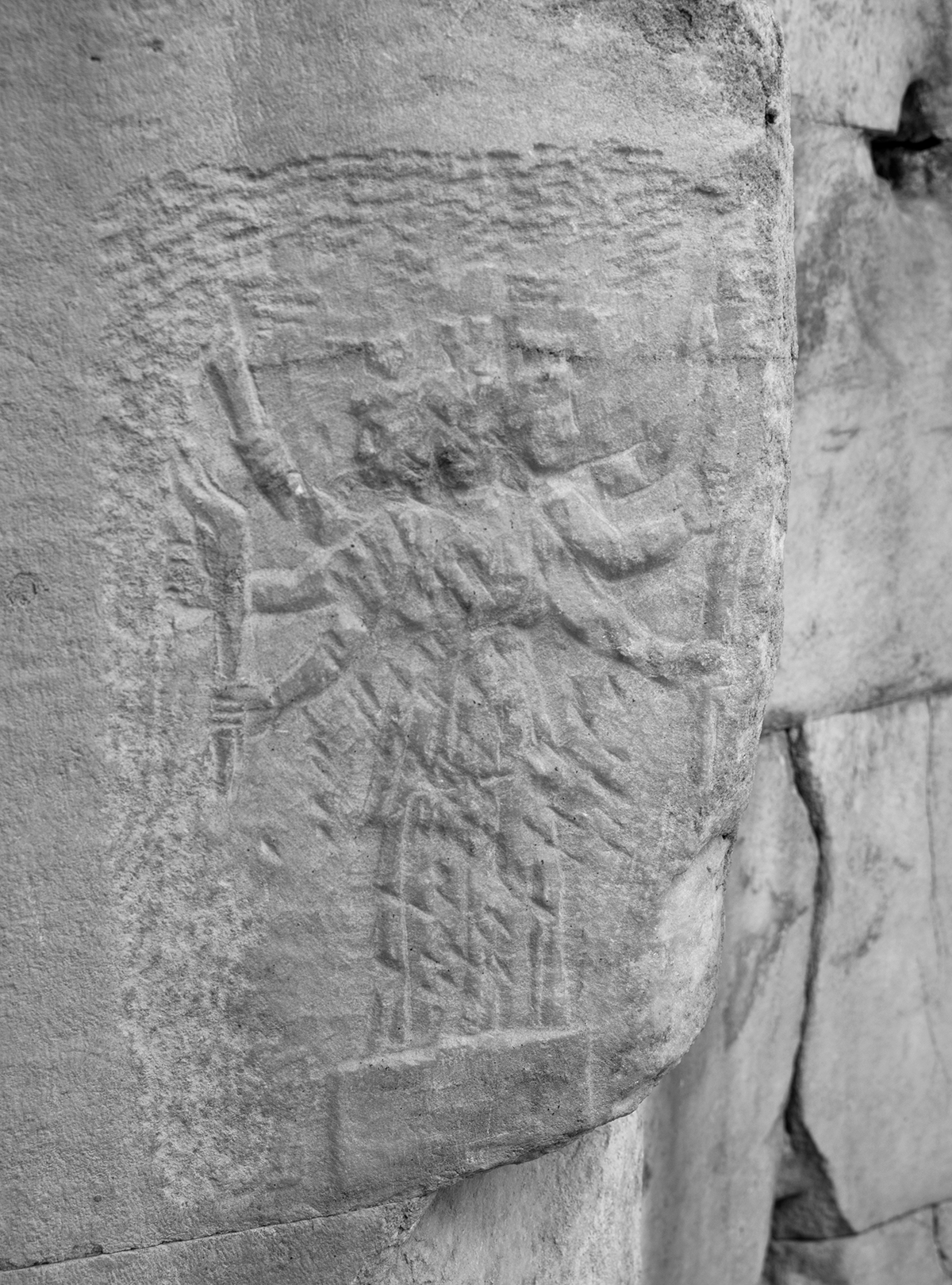
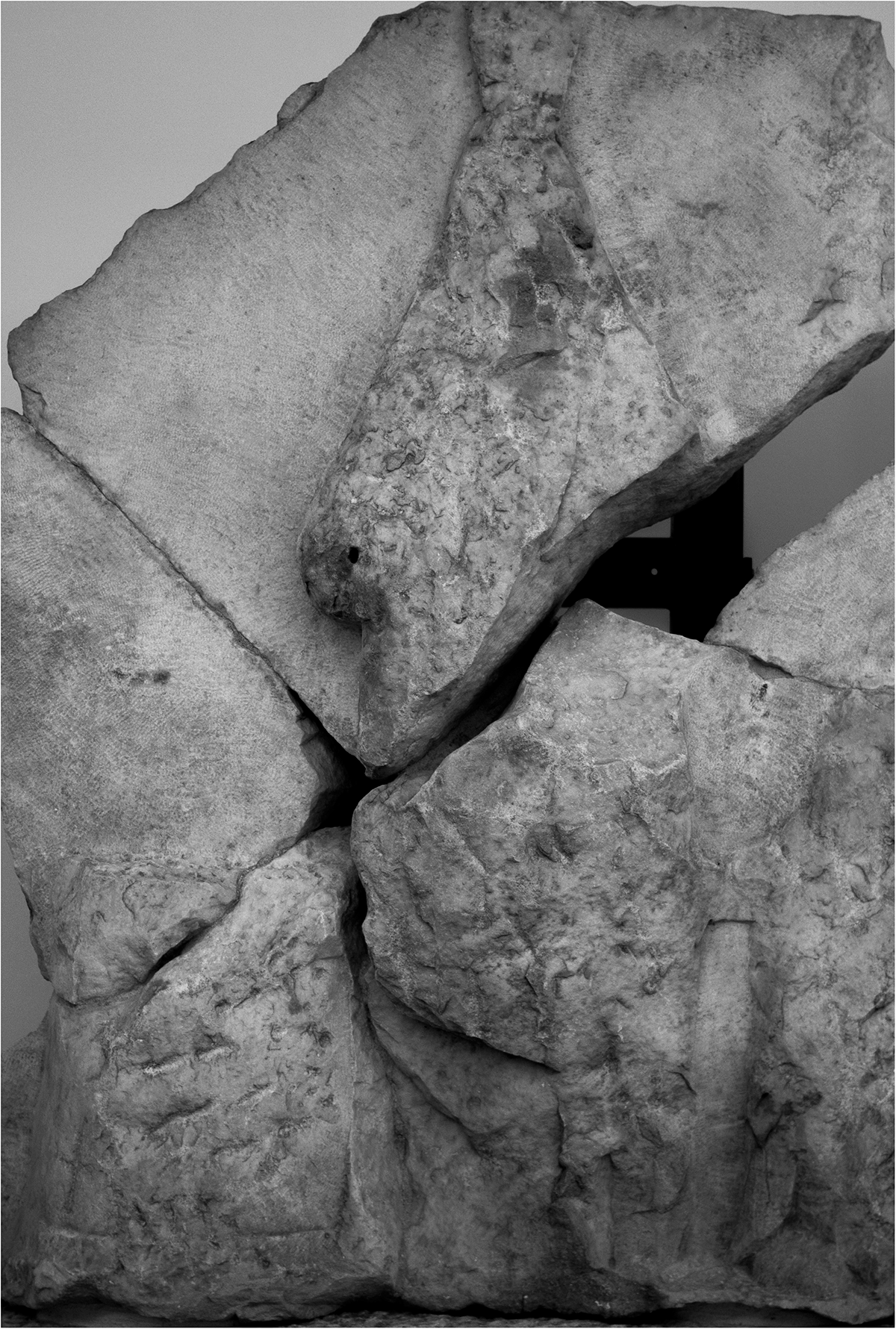
At the agora South Gate, a small carved relief of the goddess Hekate served to protect those passing through the gate (Fig. 3). Hekate served as a protecting and guiding presence at crossroads and other liminal places such as doors and gates in the Graeco-Roman world, and she had a strong presence in Asia Minor. Her protection was secured with rituals and small sacrifices before her image.Footnote 31 Moving through the South Gate, when her image was active, was an act associated with pagan ritual, or was even a pagan ritual act in itself. Hekate’s influence as protector likely extended onto the Triodos intersection, as such extending the zone of agency for the Hekate relief on the South Gate.
The mutilated three-bodied Hekate at the South Gate to the Tetragonos Agora (photo by Hallvard Indgjerd, with kind permission).

In this small tour of the Triodos before Late Antiquity I have only detailed those monuments situated on the central area of the Triodos that have been firmly established as active participants in Roman rituals in previous scholarship. Together, they witness a ritually diverse and vibrant religious streetscape that invited passers-by to engage with mythic founders and Roman deities. Several known adjacent monuments at and near the Triodos were also ritually active, such as nymphaea and the intramural tombs and cenotaphs such as the Celsus Library (Fig. 2).Footnote 32 In addition to the architectural monuments, the Triodos was home to graffiti and inscriptions, honorary statues, various material manifestations of the gods, and other components that are not visible in the archaeological record today but were common features of the urban assemblage in Roman cities.Footnote 33 Movement and ritual encounters entangled gods, the imperial family, heroes, and mythical founders with the Roman population of Ephesus and transformed the Triodos from a street corner to a vibrant urban assemblage. The Triodos underwent a multiscalar process of change during Late Antiquity. As we will see below it emerged as a different – yet still vibrant – urban assemblage.
Changes to the Triodos in Late Antiquity
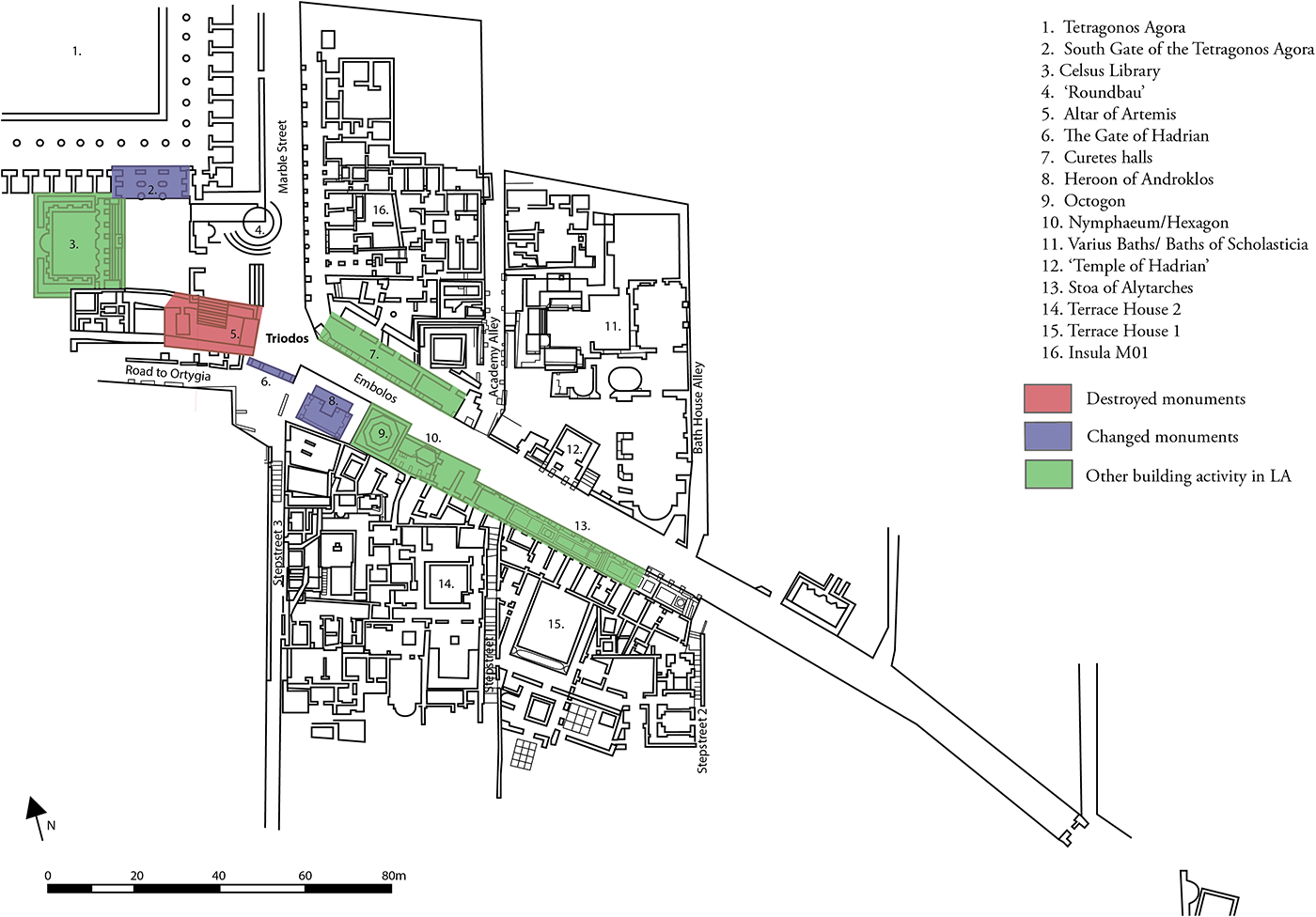
A visitor to Ephesus arriving in the fifth century CE encountered a much altered, but still recognisable, urban space at the Triodos compared to our visitor in the third century. Already in the late third century a series of earthquakes wrought severe damage to the urban spaces in Ephesus. Of relevance to the Triodos, the adjacent residential quarters at Hanghaus 2 (Fig. 4, no. 14) and Insula M01 (Fig. 4, no. 16) were not restored and reinhabited.Footnote 34 These abandonments may have contributed to changing the dynamics of the Triodos as there would be a significant decrease in daily movement associated with the loss of these residential areas.Footnote 35
Plan of the Triodos with indicated changes in Late Antiquity (by author, adapted from Waldner (Reference Waldner2020)).

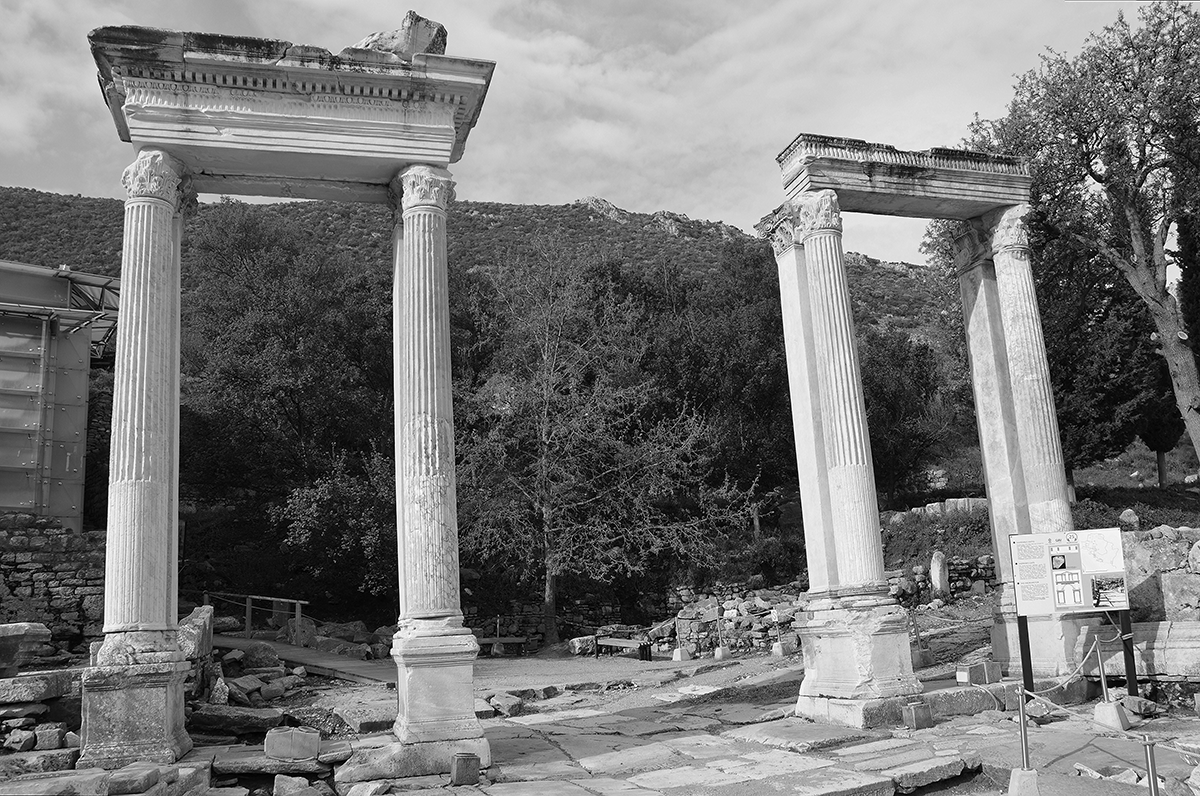
The Gate of Hadrian (Fig. 5) collapsed in the third century CE. It was not rebuilt immediately. However, its important presence at the Triodos must have been remembered since it was rebuilt in the late fourth century in a larger reconstruction programme at the lower Embolos.Footnote 36 This new iteration of the gate continued to invoke religion and empire, but in new ways. When its arches were re-erected, the two smaller arches of the gate were closed and transformed into water basins decorated with carved Christian crosses. The sculptural elements were not recreated in the reconstruction. It is not surprising that the rebuilders found the Olympian gods and mythical founders were not suitable agents in the late antique streetscape. Similarly, it would make little sense to reinstate the Antonine emperors at the gate, as the seventh-century emperors did not draw on Antonine mnemonic agency for legitimacy. Importantly, statues of the early emperors were deeply entangled with the imperial cult, which was extremely popular at Ephesus; they were effectively pagan cult statues.Footnote 37 Statues of emperors and their family members were removed or inscribed with Christian crosses in several places in Ephesus, probably because the imperial cult had been so popular there.Footnote 38
Gate of Hadrian at the Triodos as it appears today (photo by Carole Raddato, CC BY-SA 2.0).

An inscription acclaiming the ‘Christian Emperor(s) and the Blue [chariot team]’ was added to gate next to its main arch, probably in in the reign of Phokas (602–610 CE). The inscription was later altered from acclaiming the Blue to acclaiming the Green (Πράσινος).Footnote 39 The inscription emphasises the fact that the emperor was Christian even 200 years after the most intense phase of the Christianisation process, accentuated by a carved cross accompanying the inscription. This acclamation is one of many informal graffiti and acclamations added to the walls and paving in the Ephesian streetscape. Together, these changes to the Gate of Hadrian changed human–material interactions and movement through the gate upon entering and exiting the Triodos. Pagan imagery was removed, and new and updated iconography added. The now-closed side arches forced all movement through the main arch past two Christianised basins, effectively situating all who entered or exited the Triodos in a Christian urban space.
Where our third-century visitor would immediately notice the ‘Altar of Artemis’ upon entering the Triodos, our fifth century visitor would be met with a wall and a stoa occupying this space. The monumental altar had in the meantime been so thoroughly dismantled that few traces of it were left above ground at its original location.Footnote 40 Ashlar blocks from the altar stairs were reused in a nearby mixed wall. From the remaining structures discovered under the late antique stoa we know that the altar was U-shaped, c. 22 × 8 m, with a flight of stairs leading up to it.Footnote 41 A cross was carved on the fifth step of these stairs before or during the dismantling of the altar, and the name of the man responsible for the erection of this wall, Andreas, was inscribed on two marble blocks. Both inscriptions were flanked by crosses, therefore adding another layer of Christianisation to erection of the wall and use of the altar blocks as spolia.Footnote 42 Andreas can be identified with the proconsul of Asia around 400 CE from an honorary base on the Marble Street.Footnote 43 He was the agent behind many building projects in Ephesus at the time, and Jobst connects him directly to the destruction of the Altar and the subsequent erection of the overlying hall.Footnote 44
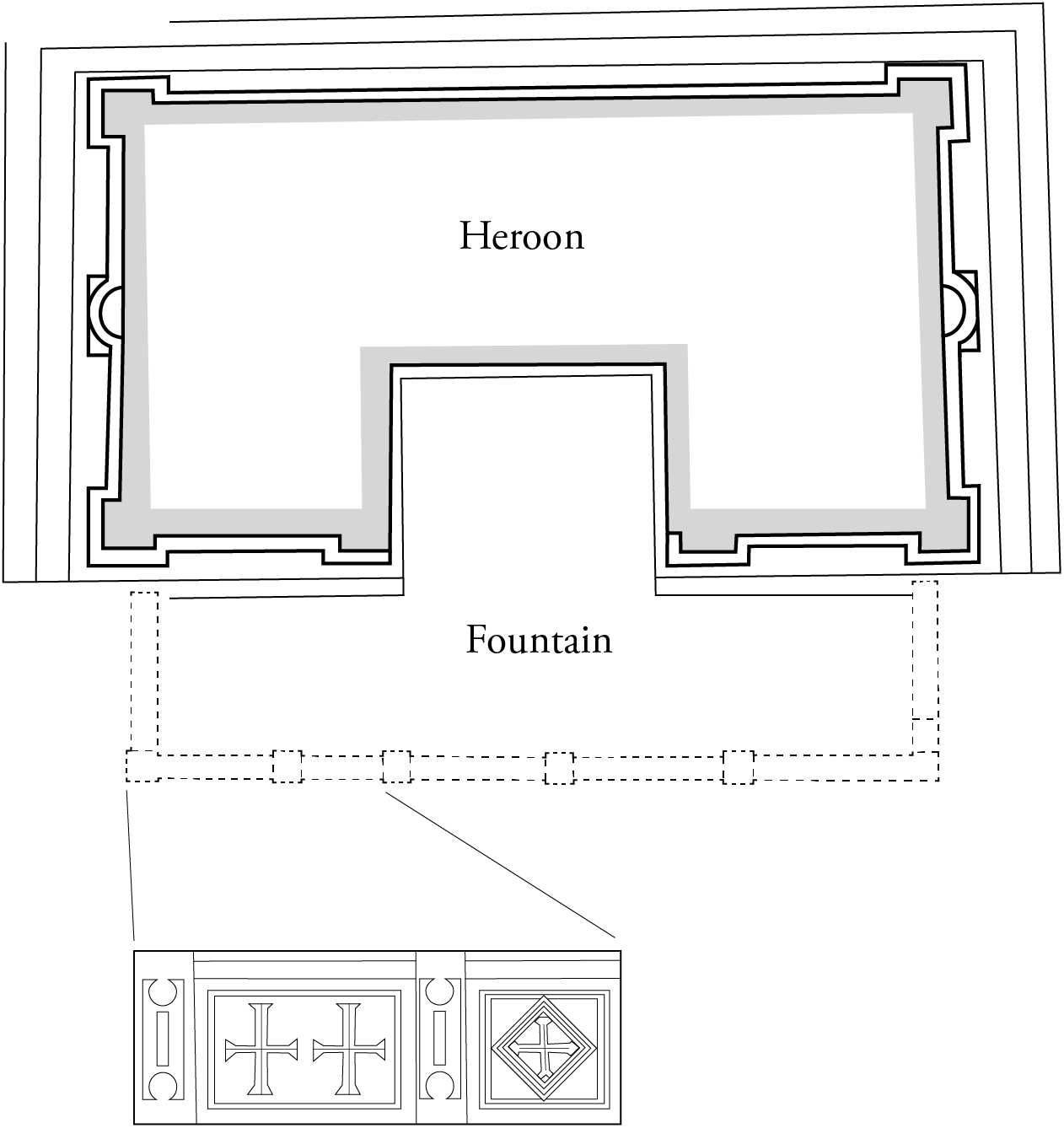
Returning to the Heroon of Androklos, the fifth-century visitor would encounter an altered but recognisable monument. By then, the monument had been converted to a fountain. The fountain was a basin constructed in front of the monument, decorated with marble slabs engraved with Christian crosses (Fig. 6). The original monument was set back approximately 5 m from the street, but the new basin closed half of this distance. The monument became more visually and physically accessible.Footnote 45 Simultaneously, the fountain basin emerged as a barrier between the street and the original monument. It restricted the ability of the heroon to affect and interact with passers-by, and made impossible ritual interaction with the mythical ksistes Androklos. The Christian crosses on the new front basin further accentuated the termination of pagan ritual activity at the monument and secured the monument in a Christian framework.
Late antique alteration of the Heroon of Androklos (by author, adapted from Thür (Reference Thür and Koester1995, figs. 1 and 3)).

Elements were also removed from the heroon, further changing its appearance and ability to affect. One relief panel from it was discovered in the area around the ‘Basilica of St. John’ on the Ayasoluk hill, where it was probably used as spolia.Footnote 46 Other panels moved to the so-called Temple of Hadrian, approximately 40 m further up the Embolos Street (Fig. 4, no. 12), where they entered a new assemblage and new relationships. For example, the panels from the Heroon of Androklos were joined by a new relief panel depicting the Christian emperor Theodosius, with the Ephesian Artemis, the ktistes Androklos, and other pagan deities being added to this frieze during the reign of Theodosius I.Footnote 47 This display of the anti-pagan Theodosius in the company of the pagan gods is unique. Ursula Quatember has recently argued that the depiction of Theodosius with the mythical ktistes Androklos and the Ephesian Artemis should be understood as an attempt to connect the mythical past of Ephesus to the Christian Theodosian house, and to frame the Theodosian urban renewal work as a new foundation of Ephesus. The agent may have been the same proconsul responsible for erecting a statue of Flavius Theodosius in front of the same temple.Footnote 48 If so, the Heroon of Androkles demonstrates well the importance of entangling new and old ideas and materials during the Christianisation process, and that it was a process that was negotiated at a local level in Ephesus.Footnote 49 In this case, Androklos and Artemis held such central places in the Ephesian civic memory that the community may have tried to use the material agency of imagery to entangle them closely with the emperor in order to prolong the process of untangling them from Ephesian civic identity.
A good example of how the agency of imagery was deliberately altered can be found on the South Gate to the Tetragonos Agora – the gate that connected the small square outside the Celsus Library to the large commercial agora (Fig. 4, no. 2). Here, the relief depicting a statue of the three-bodied Hekate has been conspicuously mutilated.Footnote 50 This was a selective and partial mutilation, with superficial chisel marks concentrated on the body and lower face of the goddess; she is still easily recognised as Hekate today (Fig. 3). Image mutilation has a long history in the Roman world within the context of damnatio memoriae of ‘bad emperors’ and other political personae non gratae in Roman political culture,Footnote 51 but was frequently utilised to cancel or alter the agency of religious images. A comparable example of this practice can be found in Aphrodisias, where shallow relief mutilation of selected deities, including depictions of cult images, was used to cancel the agency of pagan deities in the Sebasteion porticos (Fig. 7).Footnote 52
Mutilated relief panel from the Sebasteion sanctuary in Aphrodisias (Aphrodite Polias, panel C1). Notice also the Christian cross carved on the depicted altar (photo by author).

Seen in the light of Hekate’s agency as protectress of movement and liminal spaces, the effect of the mutilation of the South Gate Hekate would sever the protective bond that Hekate weaved between herself, the liminal space of the gate and the intersection, and humans and non-humans moving around there. However, they did not need to go unprotected. There are several Christian graffiti in the same area, including an Alpha-Omega inscribed in the stairway leading up to the Marble Street from the square between the South Gate to the Tetragonos Agora and the Celsus Library. These came in addition to the more elaborately carved crosses at the Gate of Hadrian, the Heroon of Androklos, and the cross set up by Demeas. Christian symbols added to the streetscape at the Triodos may have replaced Hekate’s apotropaic protection.Footnote 53
In addition to monuments that changed structurally in Late Antiquity there are several cases where pagan imagery was removed, and Christian imagery was added at the Triodos. We cannot know the full extent to which pagan images were removed from the Triodos, or from the urban landscape of Ephesus more broadly; however, the Demeas inscription with which I began is a unique document that demonstrates that pagan images were in fact removed from the Triodos in the name of Christianity, and that their absences were meaningful. In fact, inscribing and displaying the absence of the material gods perpetuated their absence rather than letting their existence be forgotten over time.
In Late Antiquity there was what Alice Waldner calls a ‘veritable construction boom’ at the lower Embolos, demonstrating the continued relevance of the streetscape until Ephesus was deurbanised in the seventh century CE. As in many urban settlements in Asia Minor, Ephesus made focused investments in maintaining, reconstructing, and even improving its monumental colonnaded streets.Footnote 54 Renewal programmes represented possibilities to add material agents to further the Christianisation process. At the Triodos, the Curetes Stoa, constructed on the north side of the lower Embolos in the sixth century (Fig. 4, no. 7), displayed Christian symbols alongside spolia from Roman cult buildings. The new stoa featured engraved crosses on screens on the upper storey and crosses and monograms on the capitals on the first floor. At street level, the stoa had spoliated columns from the Prytaneion inscribed with yearly lists of curetes priests elected to the priesthood responsible for tending the sacred flame of Hestia.Footnote 55 Clive Foss has argued that the importance of the Embolos to civic life was even more significant in Late Antiquity compared to the Imperial period. In addition to being an axis of a major residential and commercial district the street was a locus for display of honorific statues, dedications, and decrees. Honorific statues and decrees had previously been located at agorai. According to Foss, the diminishing importance of the agorai as formal marketplaces in favour of the colonnaded streets in Late Antiquity was the reason why these types of public documents and statues moved into the streetscapes.Footnote 56
That the locations around the Triodos were used for public political events and meetings of official nature throughout Late Antiquity is demonstrated by numerous carved acclamations on colonnades, walls, and gates on and near the Triodos, including the acclamation to the Christian Emperors and the Green/Blue at the Gate of Hadrian mentioned above. Ine Jacobs argues that these acclamations are vestiges of actual political events taking place on the streets at the location of the carvings or at public arenas such as the theatre, baths, or the Tetragonos Agora.Footnote 57 Similarly, Christian prayers and acclamations were commonly carved in the late antique streetscapes. An example from Ephesus is an acclamation invoking the aid of Mary, mother of Christ accompanied by a cross, carved on a column on the Marble Street: ‘+ O Theokotos, help this city!’.Footnote 58 Informal graffiti such as game boards indicate that people met and spent time in the streets, not just moved through them on their way elsewhere.Footnote 59 This shift is significant for the urban space assemblage, and for our understanding of the importance of streetscapes such as the Triodos in Late Antiquity and the entanglement of material beings with political, civic, and religious processes in these spaces.
Processional way
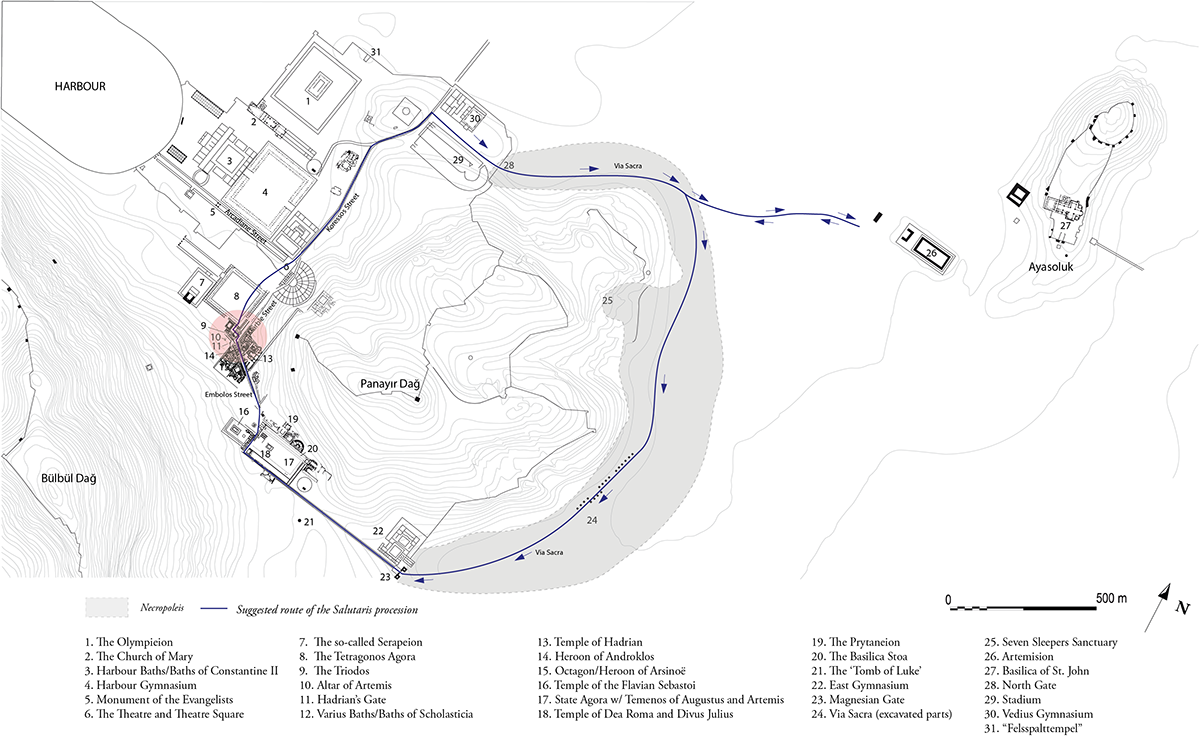
Before Late Antiquity, the Triodos was a place where two significant processional ways in Ephesus met: the Via Sacra Ephesiaca connecting the urban streetscape to the Artemision sanctuary, the processions from Ephesus to Ortygia on Artemis’ birthday, and a procession to Mount Solmissos. Processions were important civic and religious events in Roman cities, and occasions where relationships and interactions between humans, gods, monuments, and the streetscapes were amplified. The Salutaris procession, a unique Ephesian procession probably celebrating the foundation of Ephesus, may serve as an example here. The procession and its itinerary are documented in a unique inscription 568 lines long in the Theatre, dated to the early second century (Fig. 8).Footnote 60 The procession was a civic-religious ritual repeated weekly or fortnightly at religious and civic holidays.Footnote 61 It was an integral part of Ephesian life. Cecilia F. Weiss argues that the majority of the population of Ephesus must have participated in or observed the procession during their lives.Footnote 62 The latter must also hold true for visitors to the city. We do not know when the procession ceased to be performed, or whether Christianisation was the cause of its end, but the procession is mentioned by Ignatius of Antioch in the second century CE. According to Portefaix,Footnote 63 Ignatius may have been inspired by the Salutaris procession when he describes the Ephesian Christians as ‘travellers on the road of love, carrying with them God, the Temple, and Christ, adorned by the commandments of Jesus’ (Ignat. Epist. Eph. 9).
General plan of Ephesus with the reconstructed procession route of the Salutaris procession (by author).

The participants consisted of human and material beings, organised in thematic triads. The first triad was spearheaded by a golden statue of the Ephesian Artemis, while the remaining other triads were spearheaded by silver statues of Artemis the huntress. In addition to Artemis, the procession carried statues of among others notable local individuals, the imperial family and divus Augustus, the founders Androklos and Lysimachos, images of the Roman senate, the deified mount Pion and other gods.Footnote 64
The procession started in the extra-urban Artemision sanctuary, where the statues carried in the procession were housed. From the Artemision, the procession crossed the temenos and followed the Via Sacra around Panayırdağ (Mount Pion) to the Magnesian Gate. After entering the city, the procession passed the State Agora and entered the Embolos Street. At the bottom of the hill the procession passed the Heroon of Androklos and the Gate of Hadrian and entered the square in front of the Celsus Library. Here, they performed rituals at the Altar of Artemis before passing through the South Gate over the Tetragonos Agora to the square in front of the Theatre, where the statues carried in the procession were set down on bases for what should be assumed to be a more substantial ceremony. After this, the procession continued down the Koressos Street towards the Stadium, before exiting the city through the Koressos Gate and continuing back to its starting point in the Artemision.Footnote 65
Weiss argues that the Salutaris procession with its frequency and monumentality entangled the people of Ephesus with the urban topography and monuments to such a degree that the procession can be seen as a part of the urban landscape itself.Footnote 66 The procession regularly manifested the relationships of the Ephesian people with their most important deity Artemis, the deified emperors, and other divinities, and with civic institutions and the physical fabric of the city itself. These relationships were perpetuated with each repetition of the procession. At least three other religious processions that were held regularly in Ephesus are documented in written sources: a procession carrying the goddess Artemis along the procession way through the city, a procession carrying a cult image of Artemis to her birthplace in Ortygia on her birthday on 6 May, and a procession from Ephesus to the Artemision. Groh argues that all these processions involved ritual interaction with monuments at the Triodos, including sacrifices at the Altar of Artemis, as one of several stopping places before or after exiting through the South Gate of the Tetragonos Agora.Footnote 67 Processions were integral to and characteristic of pagan and Christian religious life in Ephesus, as in all Roman cities, and it is therefore important to take them into consideration when seeking to understand the Christian transformation of the city. The participants’ processions were intrinsically connected with the physical environments they passed through and interacted with along the itinerary. As noted above, the monuments and streetscape of the Triodos were subject to an array of subtle and not-so-subtle changes in Late Antiquity. The entanglement of the Triodos with religious processions adds a new dimension to these changes. The changes to the individual monuments restricted their ability to act, which again prevented them from participation in Roman ritual. Ultimately, these numerous small changes prevented the Triodos as an assembled milieu from participating in ritual processions.Footnote 68
The question remains whether the area was used similarly in Christian ritual. Christian ceremonials in Ephesus are not documented in the same way as the Salutaris procession and the Ortygia procession, despite Ignatius’ second century imaginations (Ignat. Epist. Eph. 9.1–2). Simultaneously, evidence recently collected by Luke Lavan demonstrates a rich procession culture in Late Antiquity. In addition to processions organised by families, such as wedding processions and funerary processions, the church regularly organised ritual processions.Footnote 69 There is no reason why Ephesus should be an exception. Processions were held to martyr shrines and saints’ churches in the fourth century, but they mainly moved from the cities to extramural locations. By the late fourth century the Christians started carrying relics from the churches around in the cities in elaborate processions, much recalling the statues carried around Ephesus in the Salutaris procession. As such, the Christianised streetscapes were enveloped in a Christian framework alongside the intramural churches. Some of these looked very familiar to their predecessors; Christian festivals for saints and martyrs would involve the cityscapes in much the same ways as the pagan festivals in Late Antiquity.Footnote 70 A festival for St. John in Ephesus was held every year on 8 May, only two days after the procession celebrating Artemis’ birthday was previously celebrated. The closeness in time was probably not coincidental. There are many examples of Christian feast days located on or close in time to important pagan feasts; for example, the Great Litany procession in Rome adopted the date, route, and composition of the pagan Robigalia. During the festival for St John, ‘holy dust’ was taken from the tomb of the saint and used to fill pilgrim flasks.Footnote 71 Festival processions and pilgrims headed towards the Basilica on 8 May using the Via Sacra.Footnote 72 The removal of Roman ritual agency and the addition of Christian elements in the assemblage that disabled the Triodos as a participant in Roman rituals enabled it to be part of Christian ritual.
Out of the temples and into (re)assembled streetscape
At first glance, not much has changed at the late antique Triodos streetscape. The intersection is still very much in use, and the majority of the monuments are still there – the grand exception being the ‘Altar of Artemis’, which was completely dismantled. It is only when we put together the many small details that we see how the changes in the urban assemblage were bigger than its isolated components. Christianisation at the Triodos has moved under the radar because it was not a singular cataclysmic event. It was the many small acts of removal, alteration, mutilation, and addition that made the Christian intersection emerge at different scales and tempos in Late Antiquity.
The Triodos was an intensely affective urban space. It was a hub in everyday movement. It was a relatively restricted space with gates that also contributed to slowing down movement. It was capable of inducing people to crowd together and to slow their movement. As such, humans were set up to interact with and study the small details around them, to engage with the changed monuments, the moved blocks and friezes, the mutilated images. This interaction is key to understanding the role streetscapes such as the Triodos played in Christianisation. In contrast to the sanctuaries, the streetscapes were widely accessible. One mutilated image, one dismantled altar, or one added Christian cross in a streetscape had more affective capability than an empty temple and a destroyed cult statue hidden from view behind a temenos wall.
Zooming in on the streetscape of the Triodos and its components shows that the agency of Roman religion was omnipresent in the Roman city. Importantly, the changes at the Triodos demonstrate that the material capacities of the Triodos assemblage and its components were recognised and utilised in the Christianisation process. The Triodos reveals a multiplicity of different alterations, demonstrating that the Christianisation affected and was affected by the material world not only in terms of destroyed temples, beheaded idols, and church buildings. Individually, the monuments and images at the Triodos may not stand out in terms of religious significance; it is only when seen as an assemblage that their importance is revealed. Analysing the Roman streetscape as assemblages allows us to consider how material things act in unison with people, environments, and ideas during the Christianisation process. Individual objects – and parts of objects, as many of our pagan monuments now have become – entered in relationships with others on a larger scale. At the Triodos, monuments that previously participated in pagan ritual underwent changes that acted together with new Christian monuments and imagery and with the larger urban environment to facilitate Christianisation of urban space and the humans in it.
Spolia in particular, being reused materials, illustrate assemblage thinking since they are material vestiges, reminders, of broken-up and reassembled materials. For example, the Altar of Artemis was completely disassembled, its parts reused and displayed in multiple other monuments and buildings in the vicinity. While the Altar could not be used in pagan ritual any longer, the displayed redistributed parts acted as reminders of its previous life. Destruction is temporally fixed, but the spolia from the Altar and other monuments were present for a long time, and people could interact with the destroyed altar for the duration of the life of the new assemblages its parts entered into. Its meaning and place in society changed together with the society of which they were part. Meanwhile, the new inscriptions and crosses on the Gate of Hadrian and the Demeas inscription changed the meaning of the old monuments and perpetuated their memory, while referencing old practices like the processions which also formed part of the assemblage.
In this article, I have focused on how material things and spaces in the streetscape affected and were affected during the religious transformation, making space an active participant in the Christianisation process. The Christianisation debate has traditionally relied on the ancient literary narratives of religious violence, which emphasised the destruction of pagan temples and statues. Stepping out of the temples and into the streets adds new dimensions to this debate. The pagan gods were strongly present outside the sanctuaries, in streetscapes that were in constant use and could not be shut down, burnt, or removed. Thanks to the religious processions such as the Salutaris processions – unique to Ephesus – the gods paraded through the streets on a frequent basis, each time cementing the entanglement between civic life, religious life, and daily life when the procession interacted with the streetscape and monuments at the Triodos. These links could not be severed overnight during Christianisation. Instead, they were utilised to their full potential: the street assemblages were central agents in urban Christianisation in Late Antiquity.
Acknowledgements
I would like to express my gratitude to Amy Russell and Maxine Lewis for including me in their Spatial Turn and for insightful discussions and feedback on this article, and the anonymous reviewers for their valuable comments and suggestions. Thanks to the participants in the Material Worlds Masterclass for their feedback and discussions, and especially to Ben Jervis and Lesley McFadyen for their assembled thoughts on assemblages. Lastly, thanks to Lewis Webb for reading an early version of the manuscript. All remaining errors are my own.

 Open access

