



The vulnerability of much of the Arab world in relation to ecological degradation and resource scarcity has been identified as a major challenge to human health in this geographical region( Reference El-Zein, Jabbour and Tekce 1 ). Of particular concern are the supplies of water, food, energy and labour, the security of which is compounded by political and climatic instability( 2 ).
It is well recognised that armed conflict imposes substantial hardship on individuals and populations( Reference Darnton-Hill and Cogill 3 ). During the past century, wars and internal conflicts have claimed over 100 million lives, 90 % of which were civilians( Reference Sivard 4 ). Displacement is one of the consequences of armed conflict and is the basis of major disruptions in access to basic services related to health, food, water, education and employment. The most recent internal conflicts in Syria, Libya and Egypt have highlighted the compounding effects of armed conflict in areas already under natural resource stress in low-income Middle East and North Africa (MENA) countries( Reference Coutts, Stuckler and Batniji 5 ).
Kuwait is a small, primarily desert, country in the Arabian Gulf which has undergone substantial economic and social transitions in the recent past. The discovery of large oil reserves, the wealth from which fuelled population growth well in excess of the carrying capacity of the environment, necessitated a substantial dependency on food imports( Reference Miladi 6 ), with over 90 % of food being imported and a diminution of local food production( 7 ). By international comparisons, food security in Kuwait is the highest of the MENA nations, with an average total export:food import ratio of 25 which is well above the international average of 11·3. This means that the total value of exports from Kuwait (mainly oil) is twenty-five times the value of food imports.
In early August 1990, Iraq invaded Kuwait, initiating a 7-month occupation that resulted in about 1000 deaths, as well as substantial destruction of physical and social infrastructure, and major disruption to supply of and access to food and other resources. This military invasion revealed many vulnerabilities, in particular those related to food security and access.
Food insecurity and associated malnutrition are indeed important consequences of armed conflict on civilian populations. A range of case studies across the world have demonstrated this( Reference Miller and Kershaw 8 – Reference Tool, Galson and Brady 11 ). More recent examples include the siege in Sarajevo and the wars in Bosnia( Reference Smaijkic, Zec and Telebak 12 ) and the Congo( Reference Salignon, Cabrol and Liu 13 ). It is important to understand the processes contributing to food acquisition in these situations, since the pressures on food supply through natural and anthropogenic climate change processes continue to impose substantial burdens on global health.
Most analysis of national and regional food security in the MENA rightly focuses on the poorest of these nations. The present study provides insight into the vulnerability of food supply in Kuwait, one of the most affluent countries in the MENA region.
Methods
Recruitment
A snowball sampling protocol involving two sampling sites (diwaniyas and university classes) was used to access the target group, since no public databases on the identity of those who remained were available. A total of 500 self-completed survey questionnaires were distributed through these two sites. Data were collected approximately 11 years after the occupation. The target age group for the questionnaire was 25 to 60 years of age, corresponding to a mean range of 15 to 50 years of age at the time of the occupation.
Diwaniyas are an important feature of Kuwaiti life, where extended family and friends meet on a regular basis for social interaction( Reference Redman 14 ). A total of twenty-five diwaniyas were selected from the six Governates of Kuwait, and ten questionnaires were distributed at each location. Each diwaniya was checked weekly for two months to collect completed questionnaires. Respondents had the option of calling a toll-free telephone number to arrange collection of the completed questionnaire directly. Of the total of 250 questionnaires distributed in this manner, 64 % were returned completed.
A further 250 questionnaires were distributed to university and college students in class. The students generally were not the target subjects, but were requested to pass questionnaires on to their parents or others who they knew to have been in Kuwait during the occupation. The response rate from this distribution was 88 %. Questionnaires were distributed between 15 August and 15 October 2001, which coincided with media activity commemorating the eleventh anniversary of the (August) invasion.
Questionnaire
The fifty-item questionnaire comprised a mix of closed-ended questions with a number of closed-format answers to measure single variables, Likert-scale questions and some open-ended questions. Topics covered included demography, income, health status, and perceived food quality and availability. All surveys were written in Arabic and independently reverse translated to confirm meaning.
The survey tool required respondents to remember events that had occurred 11 years previously. Considering this, a pilot study was conducted over a two-week period with twenty-five individuals to identify ambiguity in question format and suitability of content. These individuals were contacted by snowball sampling through a single diwaniya. Respondents in this pilot were also asked to provide comments on each question, and the survey as a whole, in relation to context and comprehension. In response to this feedback, minor modifications were made to question structure and survey format.
Results
Age and gender distributions of the study population are shown in Table 1.
Age and gender distributions of study participants: individuals aged 15–50 years at the time of the Iraqi military occupation in Kuwait, 1990

There was a general consensus among respondents (75·2 %) of dramatic food price rises during occupation. This was compounded by 47·7 % reporting having no income during this time. Since there was no access to banking systems, respondents generally relied on money hidden in their homes (37·9 %) or on selling capital items (22·1 %) to purchase food. A small proportion (4·6 %) was able to find employment during the occupation to gain income to buy food.
The emergence of a local Kuwaiti resistance group was instrumental in providing access to food and other resources, with 55·1 % of respondents reporting being supported with money or food via this group. Prior to the invasion, food in Kuwait was mostly available through chains of food cooperatives. A group of Kuwaiti volunteers ran and managed a network that had recovered and hidden food obtained from these cooperative societies during the occupation, supporting 31·3 % of respondents with food. Five of these volunteers were killed during the course of the occupation. There was some indication of the emergence of an informal social support network, with 34·7 % reporting having been assisted with food by their neighbours.
A black market for food also emerged in Kuwait during the occupation with 43·6 % of respondents having bought food on the street, usually on the highway or near roundabouts. Mostly, food sold on the black market was either stolen in Kuwait or brought from Iraq.
Food variety was reported by respondents to be very limited. Table 2 compares the degree of food availability and food quality. Rice was perceived to be the most available staple food, and fish the least. These data also show a significant correlation for many foods between perceived food availability and food quality.
Comparison of scores for reported food availability and food quality (1=excellent, 5=very poor) during the occupation among individuals aged 15–50 years at the time of the Iraqi military occupation in Kuwait, 1990
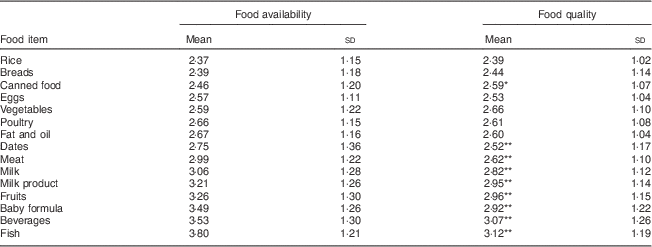
*P<0·05, **P<0·001.
Despite the harsh nature of the local environment, there was a significant increase (P<0·01) in the contributions of home gardens and domestic animals to food security during the occupation. Before the invasion 13·6 % of the respondents cultivated some vegetables in a home garden, while during the occupation this number increased to 23·1 %. The figure for domestic animal production increased from 21·3 % prior to 39·0 % during occupation.
The most commonly cultivated vegetables during occupation were tomato (reported by 16·0 %), rocket (9·2 %), cucumber (7·2 %), potato (5·9 %), parsley (5·1 %), radish (5·1 %), onion (4·4 %), coriander (3·6 %), lettuce (2·8 %), carrots (2·6 %), mint (2·3 %), aubergine (2·1 %), chilli (2·1 %), water melon (1·5 %), cabbage (1·3 %), corn (0·8 %) and white flowers (0·5 %). Animals most commonly raised during occupation were chicken (32·6 %), sheep (21·5 %), goat (9·5 %), pigeon (9·5 %), duck (6·4 %), cattle (1·5 %) and rabbit (1·0 %).
Kuwait fresh food markets provided an abundant and diversified diet before the invasion. However, food markets were strongly affected by occupation, although no specific schedule for this change emerged from respondents. Some markets remained open continuously, others closed, and some were open periodically. There was general consensus (61·3 %) that fish markets were closed during occupation.
Although 11·5 % of respondents reported a weight gain between 4 and 31 kg (seventeen male, twenty-seven female), many (32·2 %; fifty male, seventy-three female) reported weight loss during this time. Most respondents (82·0 %) reported decreasing either their daily meal number or meal size due to food shortages. Food management habits also changed with more respondents reporting keeping leftover food for later use, compared with habits previous to the invasion (P<0·01).
Most respondents (71·5 %) reported that the occupation had had a significant negative impact on their physical activity.
During the occupation, twenty-eight female respondents gave birth, in hospital (61·3 %), at home (29·0 %) or elsewhere (9·7 %) in other places. A total of 40·5 % of babies were breast-fed, 13·5 % were bottle-fed, 40·5 % both bottle- and breast fed, and 5·4 % were breast-fed by someone other than their mother (surrogate or wet nurse).
A small proportion (12·6 %) of respondents were arrested and imprisoned during the occupation. Their period of internment ranged from less than one week to more than one month. These prisoners reported their food consumption patterns having been strongly affected, with 30·5 % of detainees consuming only one meal per day, 61·5 % consuming two meals per day, and 9·0 % consuming three meals per day. The food was limited, either lentil soup with dried bread or rice (the Iraqis call this timan). Detainees consumed meat only rarely, and were never given fish, fruit, vegetables or dairy products. Meal sizes were reported by most (85·0 %) to be far less than adequate to satisfy hunger.
Discussion
This account of experiences of Kuwaitis during the military occupation highlighted many serious economic and social consequences of military conflict. Our data showed that during the occupation, food prices increased dramatically, a characteristic of wartime that has been reported previously( Reference Hammond 15 ). Compounding this was a fall in disposable income. Kuwaiti income fell from one of the highest per capita incomes in the world, to 47·7 % of respondents reporting no income during the occupation. In addition, 22·1 % of respondents sold capital items to raise money to buy food. There was a need for respondents to balance immediate needs for food and to stockpile reserves for future adversity to maintain food security for themselves and their families. This balance was compounded by uncertainty as to how long the occupation would last.
Perceived general food availability in occupied Kuwait varied among respondents. However, some specific foods were not available and reported food quality fell substantially during this time. There was a distinct reported deterioration in both quantity and quality. Initially, UN sanctions against Iraq were problematic for the Kuwaiti population since the occupation led to Kuwait and Iraq being a single food system. Thus, sanctions against Iraq in effect became sanctions against the remaining Kuwaiti population.
Respondents indicated that the amount of food was a more important consideration than food quality during occupation. This is consistent with studies on food security during war( Reference Fieldhouse 16 ) and the general premise of a hierarchy of needs, based on Maslow, favouring meeting energy needs before pleasure( Reference Maslow 17 ). Rice was the most available food, with the lowest fall in perceived food quality during the period of occupation. Indeed, rice played a major role as a strategic staple food item to maintain food security during occupation, followed by bread and canned food. This finding supports the view that dried and canned products are useful forms of food under long-term siege conditions, in contrast to milk, milk products, fruit, baby formula, beverages and fish, which were less available and of far lower quality.
Fish had the lowest score of the foods in Table 2. Kuwait produced most of its own fish before occupation. The occupation had a particularly severe effect on fish production and consumption because local fisherman were restricted in their activities, due to the potential interference with military action, as well as the added hazard of landmines along the Kuwaiti coastline( 18 ). This represents a significant issue, since before the occupation people in Kuwait ate fish once or twice weekly on average. The highest reported fish intake in Kuwait occurred in a sub-population living on Failaka Island( Reference Kamel and Martinez 19 ). Most of the inhabitants of this island did not return after the occupation, probably affecting the subsequent fish intake of people from this former fishing community.
Children born during times of conflict are particularly vulnerable to long-term adverse social and health outcomes( Reference Jurges 20 ). A high proportion of pregnant women delivered their babies at home, or in places other than hospital, to minimise risk to their family and themselves. During the occupation breast-feeding rates were reported at approximately 40·5 %, which was lower than previous reports indicating 60·6 % of Kuwaiti infants were breast-fed, 14·0 % were bottle-fed and 25·4 % received mixed feeding( Reference Amine, Al-Awadi and Rabie 21 ). This is in contrast to reports on the Sarajevo siege which showed an increase in breast-feeding rates during adverse conditions( Reference Smaijkic, Zec and Telebak 12 ). Surrogate breast-feeding (5·4 % of babies) presents important issues since Islamic belief deems that children breast-fed by the same woman are considered siblings, which has implications for marriage later on.
An important occurrence was the emergence of a Kuwaiti secret resistance group that contributed strongly to food security by distributing food, money and shelter. This activity helped minimise hunger and encourage inhabitants to remain in Kuwait during military occupation( Reference Easton and Turner 22 ). Also, food was used as a resistance weapon against the invaders by facilitating independence from Iraqi employment( Reference Khalifouh 23 ). This was achieved in three main ways:
-
1. distribution remaining safe and away from exposure to random persecution;
-
2. creating independence from Iraqi employment and enabling boycotting of jobs (Khalifaouh); and
-
3. provision of food to the health-care system (e.g. hospitals, clinics).
Our findings indicate that this strategy was successful, since only 4·6 % of respondents reported working for the Iraqis during the occupation. These factors demonstrate the importance of such organisations in maintaining food security and health during critical times.
The Kuwaiti resistance group understood the importance of the cooperative societies (i.e. government-sponsored food stores) that dominated the food industry in Kuwait, with approximately forty cooperatives and over 600 branches in Kuwaiti cities just prior to occupation( Reference Baroon 24 ). Cooperatives were the main link between food import companies and consumers, accounting for about 80 % of food consumed in Kuwait( Reference Albeajan 25 ). During occupation, these cooperative societies were used to distribute free foodstuffs and money to Kuwaiti families, thus securing stocks that would help people remain at home for longer, and to empty food stores to reduce access by the occupation forces. In response to this, the Iraqi forces occupying Kuwait were instructed to seize all vehicles used in food distribution and arrest their owners, and summon all cooperative society managers, caution them against such acts, and obtain a written pledge from them indicating that they acknowledge that offenders shall face ruthless punishment( Reference Khalifouh 23 ). Five of the cooperative society managers and employees were killed, and nine were arrested and punished during the invasion( Reference Almokhlef 26 ).
During the 7-month occupation, the population depended mostly on stored food which was available before the occupation in ambient storage, cold storage and cooperative warehousing. A Kuwait strategic government policy stipulated that six months of food reserves be stored as a contingency in the event of a food supply crisis. According to the Ministry of Planning, the amount of stored food in 1990 was calculated on the basis of supplying 2 142 600 people( 27 ). However, during the occupation more than 750 000 foreign labourers fled the country( Reference Albraheam, Alshrah and Dashti 28 ) and the citizens who remained during the occupation were estimated at 210 000 people. This tenfold overestimate probably facilitated food access and distribution.
The only food production that persisted during the occupation was one dairy manufacturer and several bakeries. Before the invasion, there were 509 food manufacturing companies and industries in Kuwait. Most of these were looted and destroyed during occupation( Reference Baroon 24 ). Throughout occupation, home gardens and domestic animals contributed significantly to food supply, in response to shortages of food and livestock production. The importance of such activities to sociocultural well-being has been documented in other contexts( Reference Harris, Rowe-Minniss and Somerset 29 ). Both prior to the Iraqi invasion and post-occupation, food supply in Kuwait has relied largely on imports( Reference Bailey and Willoguhby 30 ). Notwithstanding this, Kuwait also has a history of domestic production of a range of commodities, most notably fish and other seafood. Small cropping, particularly vegetables and fruits grown in greenhouses, and minor livestock production have also contributed to the Kuwaiti food supply( 31 ). Access to these local foods has been primarily through central fresh food markets (souks) and via a network of government cooperatives. More recently, multinational supermarket chains have introduced significant competition in this sector( 32 ).
In the present study, the impacts of the occupation on the food system, and on food habits and dietary trends, were determined by asking respondents directly whether their food trends had been affected or changed during the occupation. Respondents were also asked if they reduced the number of meals and meal size during the day, and if they kept leftover food to reuse it later in the day or the next day. We found that a majority changed their food habits and trends, not only by reducing the meal numbers and sizes, but by food type and by managing leftover food. Aljamal and Bagnied( Reference Aljamal and Bagnied 33 ) have identified household food wastage practices as an important consideration in establishing and maintaining food security in Kuwait. Kamel and Martinez( Reference Kamel and Martinez 19 ) reported that 78 % of Kuwaitis did not usually save leftover food to be consumed for the next meal. During occupation, there was a statistically significant increase (P<0·01) in the use of leftover food for subsequent meals.
Before the Gulf War, Kuwaiti food companies exported their products to other Arabian Gulf countries. Fisheries (both wild caught and farmed) was the major food production sector, supplying both domestic and international markets( Reference Murad 34 ). Kuwait also had a small level of greenhouse-based vegetable and fruit production primarily for local consumption, with some export to neighbouring countries( 31 ). Most of the arable land was destroyed during the occupation through oil wells being set on fire, thus compromising future food production. However, after the occupation exports were severely disrupted. The Gulf War left a remarkable effect on Kuwaiti consumer trends and food habits. During the occupation, Kuwaiti markets suffered from food shortages. The occupation made food distribution extremely difficult after liberation, food aid being delivered mainly from trucks and cars until the markets were fully replenished with large quantities and varieties of imported products. This later affected Kuwaiti domestic food production because consumption shifted to new imported products which were dumped on the local markets due to lack of production from Kuwaiti companies, who found it difficult to win back market share( Reference Baroon 24 ). After the liberation, new multinational fast-food outlets opened in Kuwait, in addition to many new packaged products entering the market, mostly from the USA( 7 ).
The focus of the present study was on personal and household food acquisition during the occupation. However, food supply issues at an institutional level also emerged. For example, there is evidence of some negotiation between Kuwaiti hospitals and the underground food networks for food to feed patients( 35 ).
If occupation had extended beyond 7 months the outcomes in Kuwait probably would have been much worse, since most food consumed in Kuwait is imported and food reserves would have progressively depleted. The finding that food reserves in Kuwait were able to sustain the occupied population for so long highlights the importance of national strategies developed by the Ministry of Planning for public training in food production, preparation, preservation and storage. Home food production emerged as an important strategy to maintain food security during the occupation. It could have played an even more substantial role had the population been better prepared in appropriate knowledge and skills.
In comparison with other MENA countries, Kuwait is indeed a wealthy and affluent nation. Using the average total export:food import ratio as an indicator of food security, Kuwait rates over twice the international average. However, the 1990 invasion of Kuwait identified the precarious nature of this national food system that relies almost exclusively on imported food. This is compounded by Kuwait’s vulnerability through living far beyond the ecological carrying capacity of the land. Recent national food security strategies have involved partnerships between various Gulf States (including Kuwait) and countries in South-East Asia and North Africa( Reference Shabbir 36 ). However, this still does not insulate Kuwait from adverse events such as the invasion reported in the present study.
Over time, factors such as adverse climate and land limitation have discouraged home food production in Kuwait. Prior to the oil boom the majority of Kuwaitis had gardens. However, people are no longer attached to their gardens and farms, because the public has not experienced a food shortage since the oil boom. Our results show that community knowledge of food production can enhance food security. Respondents in the present study reported a twofold increase in home food production in response to the disruption to food supply. Albeit from a small base, this indicates a community capacity for food production more in line with sustainable use of resources. It is acknowledged that the extent of domestic food production during occupation was only of limited scale. Provision of plant seeds suitable for small-scale home gardens and skills on home storage of grains, wheat, dates, canned and dried foods may provide a useful buffer against household food insecurity in the future.
There are many challenges and potential weaknesses in the data collection process that are important to identify. The use of snowball sampling increases the likelihood of sampling bias. This approach to recruitment was used to access this group, since the identity of those who remained was not publicly available and there was tendency not to discuss these issues openly. This sampling approach is often used in situations where subjects are ‘hidden’ from traditional population-based sampling( Reference Hadland, DeBeck and Kerr 37 ). One of the networks used for recruitment was via university students. This may also have led to some bias in the data in terms of social stratum. Another potential source of bias is the 11-year interval between the occupation and data collection. However, the reliability of data may also have been somewhat enhanced by the significance of the experience as a life event.
Modern food production relies heavily on fossil fuel resources, not only in terms of on-farm machinery but also in relation to nitrogenous fertiliser production, food processing and distribution( Reference Woods, Williams and Hughes 38 ). Further, the high average salaries enable most households to employ domestic labour for basic tasks such as cooking, shopping and gardening, thus de-skilling much of the population in basic domestic activities related to food. Kuwait is indeed an extreme example of reliance upon fossil fuels for food and concomitant decline in capacity to produce, process and prepare food. However, this event in Kuwait’s recent history is a salient reminder of the value of diversity in resources (both physical and intellectual). The nation of Kuwait supports a population far in excess of the ecological carrying capacity of the land. This is due almost exclusively to the wealth brought about through exploitation of oil. This wealth subsidises an otherwise non-sustainable existence and affords Kuwait with a high level of apparent food security. However, the present study shows that under certain circumstances, wealth cannot completely insulate nations from the inherent vulnerability of living beyond the ecological carrying capacity of the land.
Acknowledgements
Financial support : This research received no specific grant from any funding agency in the public, commercial or not-for-profit sectors. Conflict of interest: None. Authorship: F.A. co-designed study, collected and analysed the data, and co-wrote the manuscript; S.M.S. co-designed study, assisted with data analysis and co-wrote the manuscript. Ethics of human subject participation: Ethical clearance was obtained through the Griffith University Human Research Ethics Committee (HSC/02/01/HREC).



