


The Health Star Rating (HSR) system was introduced in Australia and New Zealand in 2014 as a voluntary front-of-pack labelling scheme, endorsed by the Australian government( Reference Carrad, Louie and Yeatman 1 – 3 ). It is derived from a modified version of the Nutrient Profiling Scoring Criterion( Reference Carrad, Louie and Yeatman 1 – 5 ) developed by Food Standards Australia New Zealand and features a ten-point star rating increasing in half-star increments, with the healthiest options displaying five stars( Reference Carrad, Louie and Yeatman 1 – 5 ). The HSR was designed to assist consumers to easily compare the healthfulness of similar packaged foods( Reference Carrad, Louie and Yeatman 1 – 3 , Reference Hamlin and McNeill 6 ); however, development of the HSR system has been criticised for a lack of transparency and absence of an evidence base that supports the nutrient criteria cut-off points being predicative of health outcomes( Reference Lawrence and Woods 7 , Reference Lawrence, Dickie and Woods 8 ). Limitations in the algorithms have been raised, as well as misalignment with the Australian Dietary Guidelines( 9 ).
Despite these limitations, the ongoing formal review of the HSR system reported significant uptake by the food industry since 2014 and indications that this initiative has encouraged manufacturers to reformulate food products to obtain a higher HSR( 10 , 11 ). The most recent data indicate that uptake has continued to increase, although the specific uptake of branded and generic (private label) products has not been reported( 9 ).
Retailers are continuing to expand their selection of generic products, with some supermarkets aiming for 40 % of their product range to comprise generic products within the next five years( Reference Mortimer and Grimmer 12 ). Thus, there is a need to explore the HSR uptake and HSR scores between generic products and branded products. Limited research has investigated use of other front-of-pack labelling schemes with respect to branded and generic products. Studies in the UK, USA and Switzerland all concluded that generic products were nutritionally similar to their branded product counterparts( Reference Ahuja, Pehrsson and Cogswell 13 – Reference Khalatbari-Soltani and Marques-Vidal 15 ). However, only category-level comparisons were made. In Australia, a study found that generic products had lower mean Na content in comparison to their branded product counterparts but did not consider front-of-pack labelling schemes such as the HSR( Reference Trevena, Neal and Dunford 16 ).
The aim of the present study was to examine the HSR and nutrient profiles of branded v. generic products across different food categories, using unpaired and paired comparisons. Due to the voluntary nature of the HSR scheme, branded products with and without an HSR were also compared to assess any nutritional differences.
Methods
Data collection
The nutrient and labelling information from packaged foods was captured from four major supermarkets chains in metropolitan suburbs of Sydney, Australia: Woolworths, Coles, Aldi and IGA (Independent Grocers of Australia), between March and September 2017.
For every product, images were captured of the front- and back-of-pack nutrition information panel, ingredients list, country of origin, barcode and HSR using Lenovo Moto G4 smartphones. The brand, product name, packaging size, HSR and energy and nutrient contents (per 100 g/100 ml) displayed in the nutrition information panel were recorded in an online Excel database. Different package sizes (including multipacks) of the same product were photographed and entered into the database as a separate item but were excluded from analysis if the nutrient profiles were identical.
Food products were categorised based on a modified version of the criteria used by the Food Monitoring Group’s Food Categorisation System (see online supplementary material, Supplemental Table 1)( Reference Dunford, Webster and Metzler 17 ). As some categories did not display an HSR for branded products, these were excluded from analysis (Discretionary Beverages and Eggs). The ten major categories were: Bread, Cereal, Convenience Food (Mixed Dishes), Dairy, Discretionary Food, Fish, Fruit and Vegetables, Meat and Alternatives, Snacks and Spreads (Supplemental Table 1). Within these major categories, products were further sorted into sub-categories and then food types (using the AUSNUT (Australian Food and Nutrient Database) codes( 18 , 19 ); Supplemental Tables 2 and 3). For example, there were fifteen types of breakfast cereal in the Cereal category, and for each individual type, the number of branded products and generic products were reported and averaged. Only products that had at least one pair of branded and generic comparison were used. Branded products were identified as those not sold exclusively by a specific supermarket and generic products were classified as those sold exclusively in Woolworths, Coles, IGA or Aldi (e.g. Homebrand, $martbuy, Black & Gold and Aldi-exclusive products).
Number of branded and generic products in each food category and the number and percentage of products with a Health Star Rating (HSR) captured from an audit of four major supermarkets chains in metropolitan suburbs of Sydney, Australia, March–September 2017

Comparison of the Health Star Rating (HSR) score and nutritional profile per 100 g between branded and generic products that display the HSR captured from an audit of four major supermarkets chains in metropolitan suburbs of Sydney, Australia, March–September 2017: unpaired analysisFootnote †
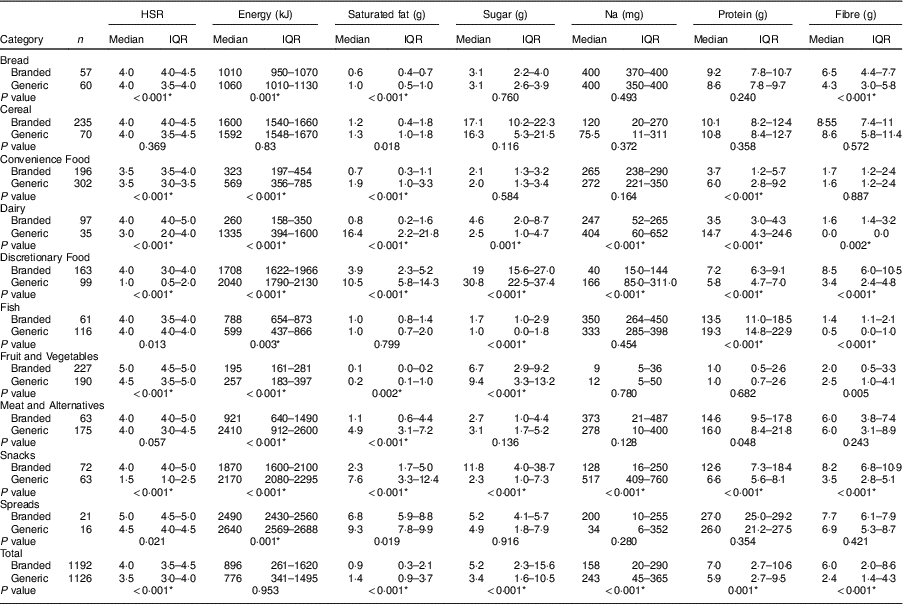
IQR, interquartile range.
* Statistically significant at P<0·005.
† Mann-Whitney U test
Comparison of the Health Star Rating (HSR) score and nutritional profile per 100 g between branded and generic products that display the HSR captured from an audit of four major supermarkets chains in metropolitan suburbs of Sydney, Australia, March–September 2017: paired analysisFootnote †

IQR, interquartile range.
* Statistically significant at P<0·005.
† Wilcoxon signed-rank test.
Data analysis
Data cleaning involved removing duplicates and cross-checking outliers against original photographs. For data analysis, values ‘<5’, ‘<1’ and ‘<0·1’ were replaced with ‘5’, ‘1’ and ‘0·1’, respectively.
Statistical analyses were conducted using the statistical software package IBM SPSS Statistics for Windows version 24.0. The Shapiro–Wilks W test indicated data were not normally distributed and therefore non-parametric tests were utilised. The Mann–Whitney U test was used to examine differences in HSR scores and nutrient contents between branded and generic product categories (Table 2), and between branded products with and without an HSR score (Table 4). Paired sample analysis was undertaken to examine differences between the same food types (i.e. comparing apples with apples). For the paired analysis, the Wilcoxon signed-rank test was used to compare HSR scores and nutritional profiles between branded and generic products (Table 3). All statistical analyses were two-tailed with P<0·005 denoting statistical significance. Ethics approval was not required for the present study.
Comparison of nutritional profile per 100 g of 4284 branded packaged products with and without a Health Star Rating (HSR) captured from an audit of four major supermarkets chains in metropolitan suburbs of Sydney, Australia, March–September 2017Footnote †

IQR, interquartile range; N/A, not applicable.
* Statistically significant at P<0·005.
† Mann–Whitney U test.
Results
A total of 4284 branded and 1985 generic packaged products across the ten food categories were analysed. Overall, 28 % of branded products and 57 % of generic products displayed an HSR (Table 1). Large differences were observed between branded and generic products displaying the HSR in all categories. In particular, within Convenience Food, 34 % of branded products displayed an HSR compared with 81 % of generic products; and similarly, for Spreads (47 % of branded products v. 84 % of generic products displayed an HSR).
Table 2 shows the comparison of the median HSR and nutritional profile per 100 g between branded and generic products that display an HSR across the ten food categories (unpaired analysis). The overall median HSR for branded products was significantly greater than for generic products (4·0 v. 3·5, P<0·001). Six out of the ten food categories showed a significant difference in the median HSR (P<0·005), with branded products revealing higher HSR than generic products. Within branded products, the median HSR of food categories ranged from 3·5 to 5·0, whereas the median HSR of generic products ranged from 1·0 to 4·5. The greatest discrepancy in median HSR was observed in Discretionary Food, with branded products scoring a median HSR of 4·0, compared with 1·0 for the generic products (P<0·001). Similarly, for Snacks, the branded products had a median HSR of 4·0 while the generic products had a median HSR of 1·5 (P<0·001).
The overall nutritional content comparison revealed that branded products contained lower amounts of saturated fat and Na, but higher amounts of protein, fibre and sugar than generic products.
Paired analyses were undertaken using a total of 146 pairs of branded and generic products that displayed an HSR across the ten categories (Table 3). Using this approach, no differences in HSR were observed within any of the ten categories, although for all categories combined, the HSR was higher for branded products. Overall, branded products with HSR had significantly lower energy, saturated fat and higher fibre content than their generic counterparts.
Lastly, to determine whether branded products selectively displayed an HSR, a comparison of nutrient content was undertaken of branded products with and without utilising the star rating system (Table 4). Overall, branded products with an HSR had significantly lower saturated fat and Na contents and greater fibre content than branded products without an HSR (all P<0·005).
Discussion
The present study compared the HSR and nutrient profiles of 6269 branded and generic products across ten food categories and was the first study to complete a paired analysis between specific branded and generic foods. Overall, use of the HSR on products was substantially greater for generic products (57 %) compared with branded products (28 %).
For these products the median HSR was significantly higher for branded compared with generic products, 4·0 v. 3·5 respectively. However, no categories showed any statistical differences between HSR or nutritional profile when branded products could be matched to generic counterparts for paired analysis. The conflicting result is likely due to the voluntary use of the HSR on food packaging, which allows food manufacturers to display an HSR only when desirable (higher HSR)( 3 ). Our data support this notion as branded products without an HSR had significantly higher saturated fat and Na and significantly less fibre, and supports commitments made by major Australian retailers to implement the HSR system across their own-product range( 20 , 21 ).
As the present study compared branded v. generic products with HSR, not entire categories, direct comparisons with similar research cannot be made. Nevertheless, similar to our findings, two studies in Switzerland (2014) and the UK (2016) reported that generic products were nutritionally similar to their branded product counterparts at a group level (no paired analysis was undertaken)( Reference Faulkner, Livingstone and McCaffrey 14 , Reference Khalatbari-Soltani and Marques-Vidal 15 ). While a previous study in Australia (2011 to 2013) found that generic products had lower mean Na content( Reference Trevena, Neal and Dunford 16 ), our findings revealed the opposite, with a significantly lower median Na content in branded products that displayed an HSR. The difference is likely due to product reformulation since the HSR system was introduced in 2014. Ni Mhurchu et al. compared over 15 000 products within New Zealand between 2015 and 2016, which revealed significant reductions in Na and energy( Reference Ni Mhurchu, Eyles and Choi 22 ). Additionally, it was found reformulations were greater in products that displayed an HSR( Reference Ni Mhurchu, Eyles and Choi 22 ).
Our data also revealed a propensity for brand manufacturers to exploit the voluntary nature of the HSR by displaying an HSR only when desirable, with branded product medians for food categories being≥3·5 compared with≥1·0 for generic product medians. Such limitations of the voluntary HSR system were recently brought to light by Lawrence et al. when evaluating products within Australia categorised into food groups or discretionary foods( Reference Lawrence, Dickie and Woods 8 ). The analysis revealed the median HSR for products that could be classified into one of the five food groups ranged between 3·5 and 4·5, while the snack foods HSR median was 4·0. Additionally, 56·7 % of all discretionary foods had an HSR≥2·5. These findings are reflected in our own results, with the median HSR being >3·5 for Convenience Food, Discretionary Food and Snacks for branded products.
A similar trend has also been demonstrated previously with other voluntary food labelling schemes. In 2003, Carter et al. investigated use of the Daily Intake Guide (DIG) in over 4000 discretionary products and found that 75 % of the products that displayed a DIG did not report nutrients associated with negative health outcomes, such as sugar and saturated fat. Additionally, products without the DIG contained approximately ten times more saturated fat and twice as much sugar than products displaying the DIG( Reference Carter, Mills and Lloyd 23 ). Furthermore, generic products were found to display the DIG including saturated fat and sugar contents more frequently than branded products.
Limitations of the HSR system need to be considered when interpreting our data. Namely, the HSR algorithm can make discretionary foods appear healthier than reality, as foods are awarded stars within their category rather than across the wider food supply. Consequently, the high ratings achievable by many discretionary foods do not align with the Australian Dietary Guidelines( 24 ). For example, in our study the median HSR for discretionary branded Snacks (e.g. crisps and popcorn) was 4·0, which is important as high HSR scores could promote the consumption of discretionary foods, thus not aligning with the Guidelines. Consequently, strong arguments have been made to cap the HSR scores of discretionary foods to below 2·5 out of 5( Reference Lawrence and Woods 7 , Reference Lawrence, Dickie and Woods 8 ). Moreover, as the HSR scoring system takes into account energy, saturated fat, protein and fibre to provide a single aggregate rating, this can veil the high sugar content. For example, branded Snacks (HSR=4·0) contained 11·8 g/100 g sugar, significantly greater than generic Snacks with 2·3g/100 g sugar and a median HSR of 1·5.
Some attempts to better align the HSR with dietary guidelines have been made. For example, Menday et al. explored whether substituting total sugar for added sugar would improve the capacity of the HSR to discriminate between ‘core’ (five food group foods) and ‘discretionary’ packaged foods( Reference Menday, Neal and Wu 25 ). The study found that using added sugar instead of total sugar assisted consumers to distinguish between ‘core’ foods and less healthy discretionary foods( Reference Menday, Neal and Wu 25 ).
To our knowledge, the present study is the first to investigate the use of the HSR and nutritional profile in a wide range of branded and generic packaged foods using both group-level and paired analyses. There were some limitations in our present study. The products were not strictly categorised according to the Australian Dietary Guidelines’ five food group foods and discretionary foods as most categories contained a combination of both. This limited the interpretation of the HSR scores from a dietary guidelines perspective. Data were not collected for some categories including oils and speciality dietary products. Several food categories were also excluded from the analysis as very few branded products displayed an HSR, such as sugar-sweetened beverages, and data were collected for products in metropolitan Sydney only. However, with 6269 products analysed, the study provided a good representation of the products available to consumers in ten food categories, thus providing a reliable sample of the packaged food products within Sydney, Australia.
Conclusion
In conclusion, our data show there is no difference in the HSR or nutrient profiles of similar branded and generic products that display an HSR. As generic products are far more likely to contain an HSR than branded products, it appears manufacturers of branded products are exploiting the voluntary nature of the HSR scheme by preferentially displaying the HSR on healthier products. Our findings in conjunction with previous research highlight limitations of the HSR scheme that need consideration to achieve the Australian government’s objective to guide and assist consumers to make informed, healthier dietary habits.
Acknowledgements
Acknowledgements: The authors would like to thank Eaden Roundtree, Irene Sangadi, Stephanie Liang, Ho Chun Terence Tong, Suzie Yang and Melissa Meier, who were involved in data collection and data cleaning. Financial support: This research received no specific grant from any funding agency in the public, commercial or not-for-profit sectors. Conflict of interest: None. Authorship: D.H.K. and W.G.A.L. are equal first authors. D.H.K. formulated the research idea; D.H.K. and W.G.A.L. designed and conducted the research; D.H.K., W.G.A.L., A.R. and L.G. analysed and interpreted the data; D.H.K., W.G.A.L., A.R. and L.G. wrote the paper. All authors read and approved the final manuscript. Ethics of human subject participation: Not applicable.
Supplementary material
To view supplementary material for this article, please visit https://doi.org/10.1017/S1368980019000508



