




1. Introduction
Grammatical variation and optionality has received considerable attention across different subfields in linguistics. The observation, for example, that the particle in the English verb–particle alternation, shown in (1)–(2) (see Gries Reference Gries2003 for seminal work), can be placed directly next to the verb, or follow the direct object in similar contexts, indicates that the two particle placement options are ‘structurally and/or lexically different ways to say functionally very similar things’ (Gries Reference Gries2017: 8).

Many analysts find the existence of such optionality (the term we will use in the remainder of this article, because ‘variation’ is ambiguous between intra- and inter-speaker variation) intriguing and, in fact, a bit puzzling. The reason is that optionality as in (1) and (2) is incompatible with the foundational notion in cognitive linguistics, construction grammar and functionalist linguistics that optionality is dysfunctional and thus abnormal. When it occurs, it must – or so many people assume – be suboptimal and short-lived.Footnote 1 Well-known axioms like the Principle of Isomorphism (Haiman Reference Haiman1980), the Principle of No Synonymy (Goldberg Reference Goldberg1995), or the revamped Principle of No Equivalence (Leclercq & Morin Reference Leclercq and Morin2023) posit that language as a complex adaptive system is designed, as it were, to find functionally different niches for particular form–function mappings. If multiple forms are associated with the same meaning, it is predicted that optionality is transitional until functional niches are found in the long run (see De Smet Reference De Smet, Bech and Möhlig-Falke2019 for critical discussion). In their criticism of this approach, Poplack & Dion (Reference Poplack and Dion2009: 557) call this way of thinking about optionality ‘the doctrine of form–function symmetry’.
For reasons of space, we cannot engage here in an extended discussion of the history of thought on form–function symmetry in linguistics. We do wish to acknowledge though that the reasoning that fuels axioms such as the Principle of Isomorphism, the Principle of No Synonymy and the Principle of No Equivalence is likely to be more nuanced than portrayed here, and it is also likely that these axioms can be interpreted in a different way. But then again, Haiman and Goldberg use strong and non-nuanced language in their original formulations (e.g. Goldberg Reference Goldberg1995: 67: ‘If two constructions are syntactically distinct, they must be semantically or pragmatically distinct’), which is why we feel that reading these principles at face value is not intellectually dishonest. And, crucially, the notion that optionality is somehow abnormal, suboptimal, short-lived when it exists, dysfunctional and at worst a figment of variationist imagination is exactly the message (intended or unintended) that – in our experience – many people take away from reading those axioms. It is this popular (mis)conception that we take issue with. Therefore, if we are deconstructing a strawman, then it’s one that many colleagues believe in.
The point is, then, there are some well-known empirical problems with the view that (grammatical) optionality is abnormal. First, the rich variationist literature in the tradition of e.g. Weiner & Labov (Reference Weiner and Labov1983) on grammatical variation and optionality demonstrates that optionality is by no means exceptional. Second, it is clearly not the case that grammatical variation phenomena are necessarily diachronically short-lived: for example, the particle placement alternation shown in (1)–(2) has been a feature of English grammar since the Middle English period (Szmrecsanyi & Grafmiller Reference Szmrecsanyi and Grafmiller2023: 30). Third, there is no evidence that we know of that variation and optionality are problematic in language acquisition; on the contrary, there is some positive evidence that neither monolinguals nor bilinguals seem to have particular problems with acquiring variables such as the dative alternation in English (Fernández Fuertes & Sánchez Calderón Reference Fernández Fuertes and Calderón2021).
Another, hitherto underexplored, way of looking at grammatical optionality consists of viewing optionality as a case of increased language complexity. The literature on language complexity suggests various definitions and metrics of complexity, which broadly fall into two groups: measures of absolute complexity and measures of relative complexity (Miestamo Reference Miestamo, Miestamo, Sinnemäki and Karlsson2008). Measures of absolute complexity focus on the complexity of system-inherent structures, such as counting the number of contrastive elements in a system (Nichols Reference Nichols, Auer, Hilpert, Stukenbrock and Szmrecsanyi2013). Measures of relative complexity, by contrast, focus on user complexity and evaluate system-inherent properties as they relate to a language user (Kusters Reference Kusters2003), for instance, how hard or difficult a particular language, or language variety, is to use compared to others. The point here is that linguistic optionality, by definition, increases the absolute complexity of a grammar, as the existence of multiple forms or patterns that encode the same meaning or grammatical function includes a greater number of forms than a grammar in which the same meaning or grammatical function is encoded by only one form. It is less clear, however, how optionality relates to relative complexity. Does having to choose between, for example, English particle placement variants make producing an utterance harder for language users? Further, are all types of choices between variants equal in their effect (if any) on production difficulty? These are the sorts of questions we seek to test in this study.
Note in this context that there are empirically enlightened reasons to believe that grammatical optionality could be cognitively burdensome, and thus increase relative complexity. Grammatical optionality is typically conditioned probabilistically by any number of contextual constraints. For example, the particle placement alternation in (1)–(2) is governed by constraints related to the direct object, such as length, definiteness, givenness, animacy, concreteness or thematicity (see Grafmiller & Szmrecsanyi Reference Grafmiller and Szmrecsanyi2018), among others. Thus, before they can make a choice as a function of the naturalness of variants in context, language users need to check the linguistic context for the various constraints that regulate the variation at hand. It is reasonable to conclude that this extra cognitive work, regardless of how automatic it is, results in increased cognitive load. This is on top of any social, stylistic or other considerations speakers might need to bear in mind when choosing one variant over another.
Against this backdrop, we endeavour to test the hypothesis that optionality is suboptimal because it incurs increased cognitive load. More concretely, we adopt a corpus-based psycholinguistics research design and tap into the full Switchboard Telephone Speech Corpus (SWITCHBOARD), a corpus of spoken American English (Godfrey, Holliman & McDaniel Reference Godfrey, Holliman and McDaniel1992), to investigate if conversational turns that contain optionality contexts tend to attract markers of increased relative complexity (i.e. production difficulty). We are interested in speech dysfluencies, such as filled pauses (hesitation markers, e.g. uh, um) and unfilled pauses (speech planning time), both well-known indicators of relative complexity (Merlo & Mansur Reference Merlo and Mansur2004; Christodoulides Reference Christodoulides2016; Grézause 2017). As to grammatical optionality, we investigate in aggregate 22 different alternations across the morphosyntactic spectrum (see table 2 below), such as the particle placement alternation (see examples (1)–(2)), the genitive alternation (Szmrecsanyi et al. Reference Szmrecsanyi, Grafmiller, Bresnan, Rosenbach, Tagliamonte and Todd2017), the dative alternation (Szmrecsanyi et al. Reference Szmrecsanyi, Grafmiller, Bresnan, Rosenbach, Tagliamonte and Todd2017), expressions of deontic modality (Tagliamonte Reference Tagliamonte, Lindquist and Mair2004) and indefinite pronouns with singular human reference (anybody vs anyone) (D’Arcy et al. Reference D’Arcy, Haddican, Richards, Tagliamonte and Taylor2013). We note in passing that the alternations we study are well-known cases of optionality as per the variationist literature. In variationist linguistics, ‘alternate ways of saying “the same” thing’ (Labov Reference Labov1972: 188) – that is: linguistic variables – are understood to cover the spectrum from truth-conditional equivalence to discourse-functional equivalence, given that semantic/pragmatic differences (to the extent that they exist) are considered to be often subject to neutralisation in discourse (Sankoff Reference Sankoff and Newmeyer1988: 153). Of course, choices between different ways of saying the same thing may be probabilistically predictable to some extent from various contextual, pragmatic or social factors, which is why these predictors are typically included as independent variables in variationist modelling. Note here that outside variationist circles, contextual/pragmatic/social probabilistic conditioning is sometimes assumed to be part of the ‘meaning’ of constructions (Leclercq & Morin Reference Leclercq and Morin2023).
We check for correlations between optionality and dysfluency via regression analysis, taking conversational turns as the unit of analysis. Our analysis is guided by these three research questions:
RQ 1. Does grammatical optionality attract speech production difficulty? If so, turns with more contexts in which grammatical optionality occurs, will also have more filled and unfilled pauses than turns with fewer or no contexts where grammatical optionality is possible. Pilot research (Gardner et al. Reference Gardner, Uffing, Van Vaeck and Szmrecsanyi2021) based on a small subset of SWITCHBOARD suggests that there should be little or no such attraction.
RQ 2. Does grammatical optionality regulated by more language-internal constraints attract more production difficulty than grammatical optionality regulated by fewer language-internal constraints? For example, the English genitive alternation (the speech of the president vs the president‘s speech) is regulated by approximately seven different language-internal constraints (see table 2). By contrast, the future temporal reference alternation in English (Tom will like the book vs Tom is going to like the book) is generally regulated by about four language-internal constraints (again, see table 2). Following the absolute complexity view (more is more complex), some analysts would thus predict that the genitive alternation is more ‘difficult’ than the future temporal reference alternation (see Shin Reference Shin2014 for an argument in this spirit).
RQ 3. Does optionality between more variants attract more production difficulty than optionality between fewer variants? Some grammatical alternations, such as the dative alternation in English (send him a letter versus send a letter to him) only require choices between two variants. The future temporal reference alternation, conversely, chooses among up to seven different options: will, shall, be going to, simple present plus a temporal adverb and so on (see e.g. Quirk et al. Reference Quirk, Greenbaum, Leech and Svartik1985: 213–18). Following again the absolute complexity view (more is more complex), some analysts would thus predict that the future temporal reference alternation is more ‘difficult’ than the dative alternation.
Our analysis will show that no demonstrable difficulty is detectable in the conversational SWITCHBOARD data, not for turns with more grammatical optionality contexts, nor for optionality contexts that putatively demand more cognitive effort. Alternations governed by more internal constraints and/or alternations with more variants to choose from do not co-occur with more dysfluencies. These findings call into question the doctrine of form–function symmetry and other beliefs that many linguists have about the cognitive complexity of grammatical variation and optionality.
This article is structured as follows. Section 2 introduces the SWITCHBOARD corpus, the operationalisation of dysfluencies, grammatical variables and the statistical analysis design. Section 3 presents the results of our three-step modelling process, followed by section 4 (discussion) and section 5 (conclusion).
2. Methods and data
2.1. Data
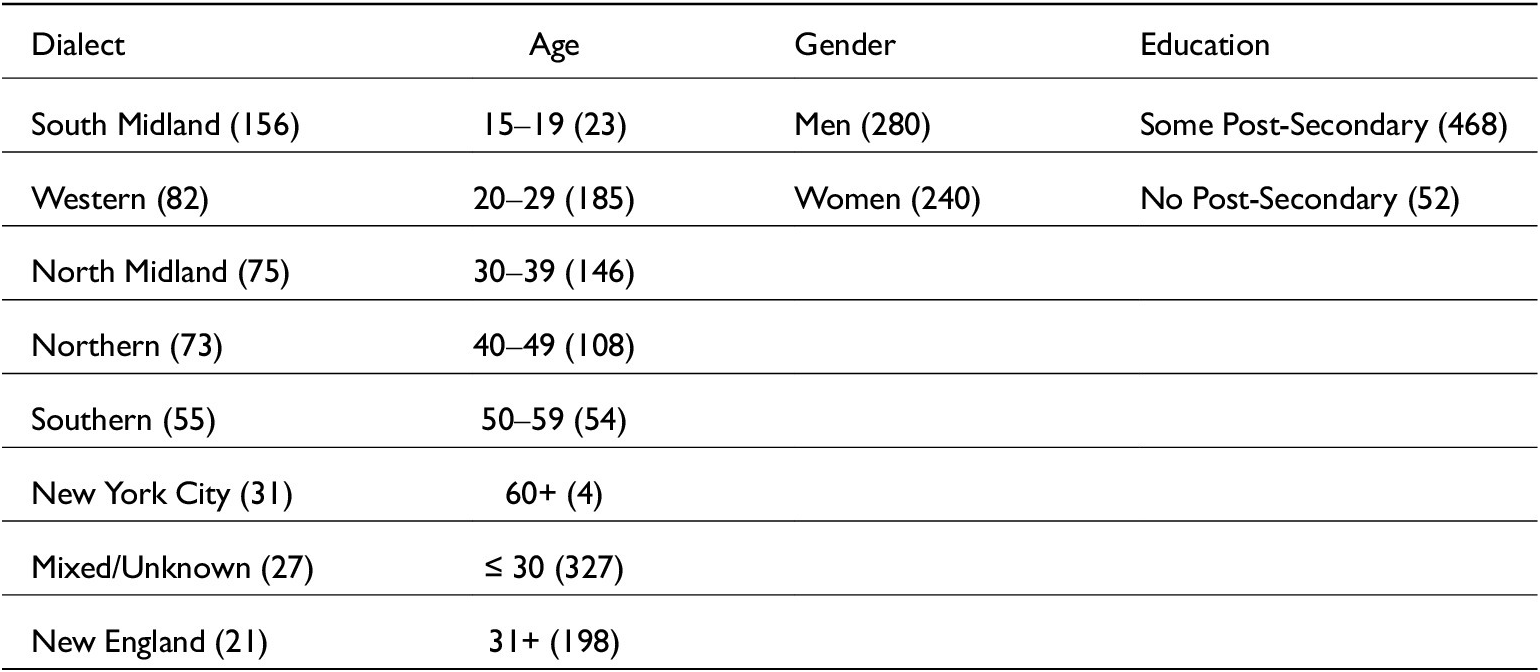
The SWITCHBOARD corpus of American English (Godfrey, Holliman & McDaniel Reference Godfrey, Holliman and McDaniel1992) consists of 2,438 telephone conversations between 520 American English speakers recorded by Texas Instruments in 1989/1990. Each conversation lasts 5 to 10 minutes. The full corpus totals 240 hours of recorded unscripted speech. All participants were ostensibly L1 speakers of English from all areas of the United States, ranging from 15 to 66 years old (table 1). The callers were given recorded prompts on one of the 70 topics by a robot operator system which also handled selecting and dialling the callee so no participants would have a telephone conversation with someone they had already spoken to. The topics only served as a conversation starter, after which they quickly evolve into unscripted naturalistic speech. Because it is anonymous, speakers often freely divulge their opinions during conversations. For these reasons, the SWITCHBOARD corpus is an excellent resource for investigating the relationship between relative and absolute complexity from an observational, psycholinguistic perspective.
Summary of speaker demographics in the SWITCHBOARD corpus

The SWITCHBOARD corpus has been widely used in corpus-based psycholinguistics and in variation studies (Bresnan & Hay Reference Bresnan and Hay2008; Calhoun et al. Reference Calhoun, Carletta, Brenier, Mayo, Jurafsky, Steedman and Beaver2010; Levy & Jaeger Reference Levy, Jaeger, Schölkopf, Platt and Hoffman2007). It has also been analysed for overt dysfluencies. Shriberg and colleagues (Reference Shriberg1996, Reference Shriberg1994, Reference Shriberg and Stolcke1998) extensively annotated and analysed the corpus for filled pauses, repairs and editing terms, and found filled pauses (uh’s and um’s) to occur more often than other types of overt dysfluencies. Le Grézause (Reference Le Grézause2017) reports 10,784 um’s and 30,187 uh’s across the entire corpus, equalling 0.79 and 2.07 per cent of total word count in the transcripts.
Following the pilot study by Gardner et al. (Reference Gardner, Uffing, Van Vaeck and Szmrecsanyi2021) on a reduced subset of the SWITCHBOARD corpus, in our analysis each speaker turn is treated as an individual data point. A turn is defined as speech (and its accompanying silence) by a speaker that occurs between the utterances of their interlocutor. We excluded utterances shorter than three words, as many grammatical variables discussed below cannot occur in such short turns. A total of 108,487 turns are included for analysis.
2.2. Speech dysfluency as response variable
Relative complexity and production difficulty (henceforth: production difficulty) can be measured by empirically tracking speech dysfluencies within turns. Two kinds of speech dysfluency are considered in this study: filled pauses (um and uh in North American English) and unfilled pauses (silence in the speech stream that occurs between words or utterances, also known as speech planning time). Filled pauses are counted based on time-aligned transcript produced by the corpus compilers. Unfilled pauses, i.e. speech planning time, is measured using the built-in silence detection script in Praat (Boersma & Weenink 2020). Silence is defined as a segment of the audio below 50 dB that lasts longer than 130 ms, following Hieke et al. (Reference Hieke, Kowal and O’Connell1983). While speakers undoubtedly plan their speech while listening to their interlocutor, we restrict our attention to turn-internal silences for practical purposes. Besides, Sjerps & Meyer (Reference Sjerps and Meyer2015) found that the cognitively demanding aspects of speech planning are not initiated until shortly before the end of the turn of the preceding speaker, which suggests even less need to consider the length of preceding turns.
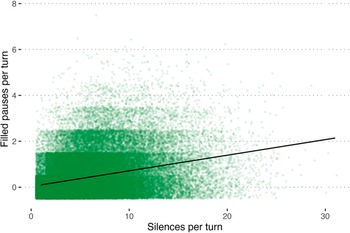
Deviating from Gardner et al. (Reference Gardner, Uffing, Van Vaeck and Szmrecsanyi2021) (who treat unfilled pauses as the combined duration of silence per turn), we count the number of times an unfilled pause is observed per turn. As shown in figure 1, there is no strong overall correlation between the number of silences and filled pauses per turn, suggesting that they are two incarnations of production difficulty that might operate independently of each other. We nonetheless collapse them into a variable speech dysfluency to facilitate a more elegant, unified modelling strategy (section 2.4). This can be achieved by min-max scaling. This transformation is called for because silences significantly outnumber filled pauses in the same turn (figure 1), and a sum of unscaled data would result in overrepresentation of unfilled pauses and underrepresentation of filled pauses. The formula for min-max scaling is presented in (3), where a = (a1,…an) is the number of silences in a turn, b = (b1,…bn) is the number of filled pauses in a turn, and $ {y}_i $
is the sum of scaled number of silences and scaled number of filled pause in the ith turn. This ensures the number of both types of dysfluencies range from 0 to 1.
$ {y}_i $
is the sum of scaled number of silences and scaled number of filled pause in the ith turn. This ensures the number of both types of dysfluencies range from 0 to 1.
 $$ {\mathrm{y}}_{\mathrm{i}}=\frac{{\mathrm{a}}_{\mathrm{i}}-\mathit{\min}\left(\mathrm{a}\right)}{\max (a)-\min (a)}+\frac{b_i-\mathit{\min}\left(\mathrm{b}\right)}{\max (b)-\min (b)} $$
The number of silences vs filled pauses in 108,487 conversational turns investigated in SWITCHBOARD. The scatterplot was jittered on both axes (±0.5) for clearer visualisation. The linear regression line is significant and weakly positive $ \left(r=0.07,p<0.001\right) $
.
$ \left(r=0.07,p<0.001\right) $
.

Additionally, a few control variables known to affect speech dysfluency are identified as well, i.e. turn duration, speech rate (number of words spoken by turn length in seconds) and content complexity, which is operationalised as mean orthographic character length of all words in a turn (character per word), under the assumption that the conceptual complexity of words is reflected by their length (Lewis & Frank Reference Lewis and Frank2016). Turn duration has been found to correlate with speech dysfluencies positively (Shriberg Reference Shriberg1994); speech rate, on the other hand, was found to have a negative correlation with dysfluencies (Maclay & Osgood Reference Maclay and Osgood1959; Oviatt Reference Oviatt1995).
2.3. Grammatical alternations, variants and constraints as predictors
In the present study we cover 22 grammatical alternations (a.k.a. variables in variationist sociolinguistics parlance) that are well attested in American English and other varieties of English. These 22 grammatical alternations are, as per the variationist literature, all alternative ways of saying the same thing (Labov Reference Labov1972: 188). It is worth noting that all the variable contexts were manually retrieved from the SWITCHBOARD corpus so as to ensure interchangeability and semantic/functional equivalence, in line with the variationist methodology (Tagliamonte Reference Tagliamonte2012: 10). For example, in the particle verb alternation, tokens such as I picked the book up are within the envelope of variation, because they are functionally equivalent to I picked up the book; on the other hand, tokens including intransitive (she went in late this morning) and passive particle verb alternations (the food brought over by his mum) are excluded because they are non-interchangeable, i.e. cannot be paraphrased.
A crucial measurement in the present study is the number of language-internal constraints to which variant choice is sensitive (RQ 2) and how many variants (RQ 3) are possible for a given alternation. Determining the number of constraints and variants for each of the 22 alternations started from a literature review. We identified the three most recent papers in peer-reviewed journals applying multivariate analysis to spoken data of L1 English speakers. Subsequently, we calculated the mean number of conditioning factors as well as the maximum number of variants that are freely interchangeable reported by the three studies. For alternations that are less well researched, i.e. with less than three papers studying their conditioning factors, we made use of existing research where available and approximated the number of constraints for those variables by analogy with more widely studied variables. For example, the tried complementation alternation (tried to vs tried doing, which is different from the try complementation alternation between try and vs try to) has not been extensively studied, if at all. However, as the verb try has been argued to have an aspectual meaning similar to begin and finish (Grano Reference Grano2011; Sharvit Reference Sharvit2003), we will apply results from studies that investigated conditioning factors for infinitival vs gerundial complementation for aspectual verbs. One issue that could be raised with our approach of adopting the mean number of constraints, is that not every constraint as deduced from previous studies necessarily applies to each instance of grammatical optionality context identified in SWITCHBOARD (as opposed to variants, which are freely interchangeable in all instances by definition). One could also argue that the true number of constraints at work can only be revealed by annotating the number of constraints each optionality context is conditioned by. While this concern is not without reason, we opt for a literature-review-based mean value nonetheless for the following reasons: first, it is largely impractical to annotate all the constraints for each grammatical alternation in the whole SWITCHBOARD corpus. Additionally, corpus-based research has produced results that proved to predict syntactic choices in both spoken and written corpora of different varieties of English remarkably well (Bresnan & Hay Reference Bresnan and Hay2008, among others). Therefore, an average of the number of constraints found to condition an alternation should suffice for the purpose of the current research, with the assumption that results from previous studies replicate in the corpus under study.
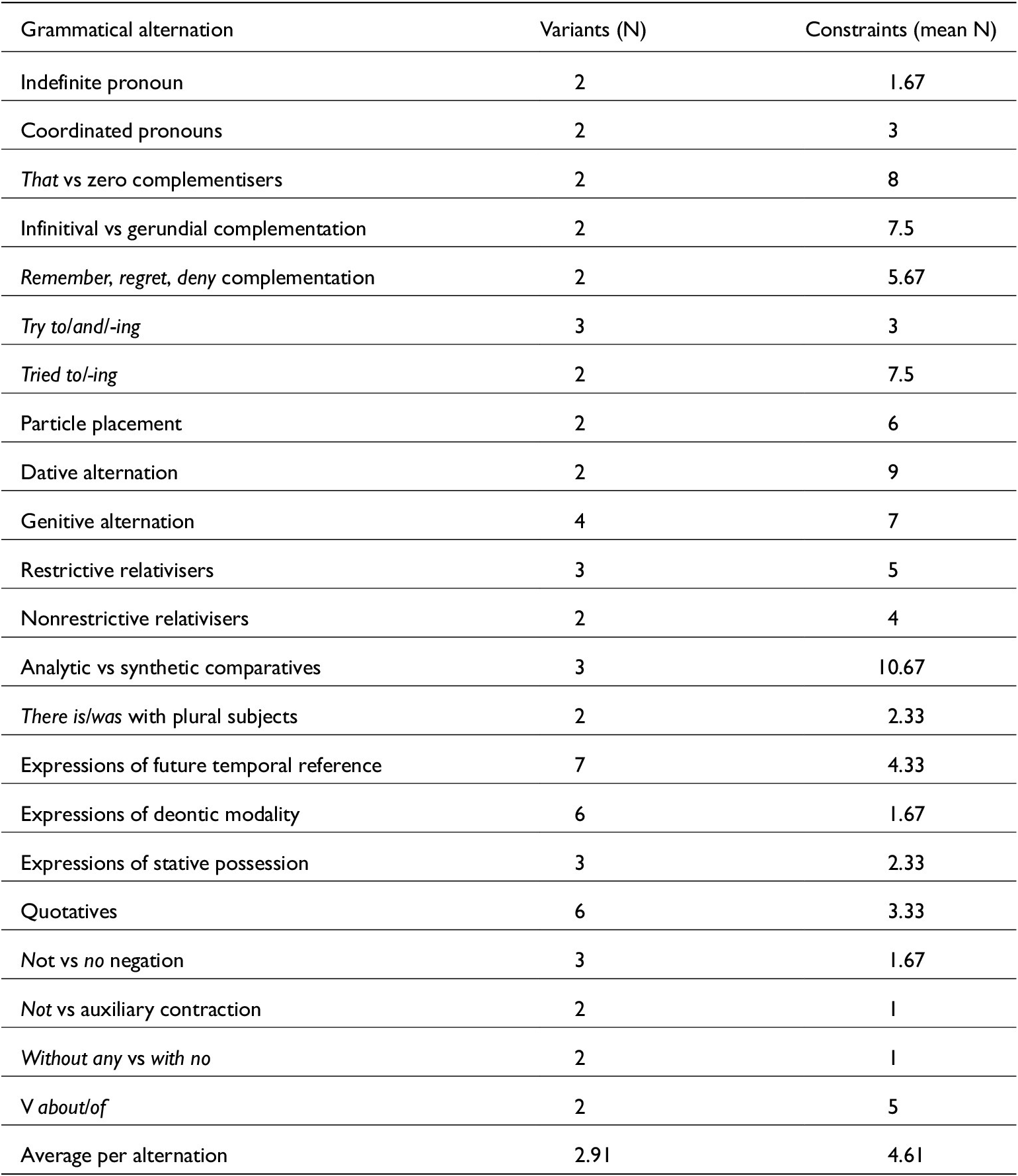
Table 2 reports the number of constraints by which each of the 22 linguistic alternations under study is conditioned, as well as the number of variants they have, and an average value across all alternations. This is followed by subsections detailing how the average number of constraints and number of variants per alternation were calculated.
Average number of constraints and number of variants of the 22 grammatical alternations under analysis
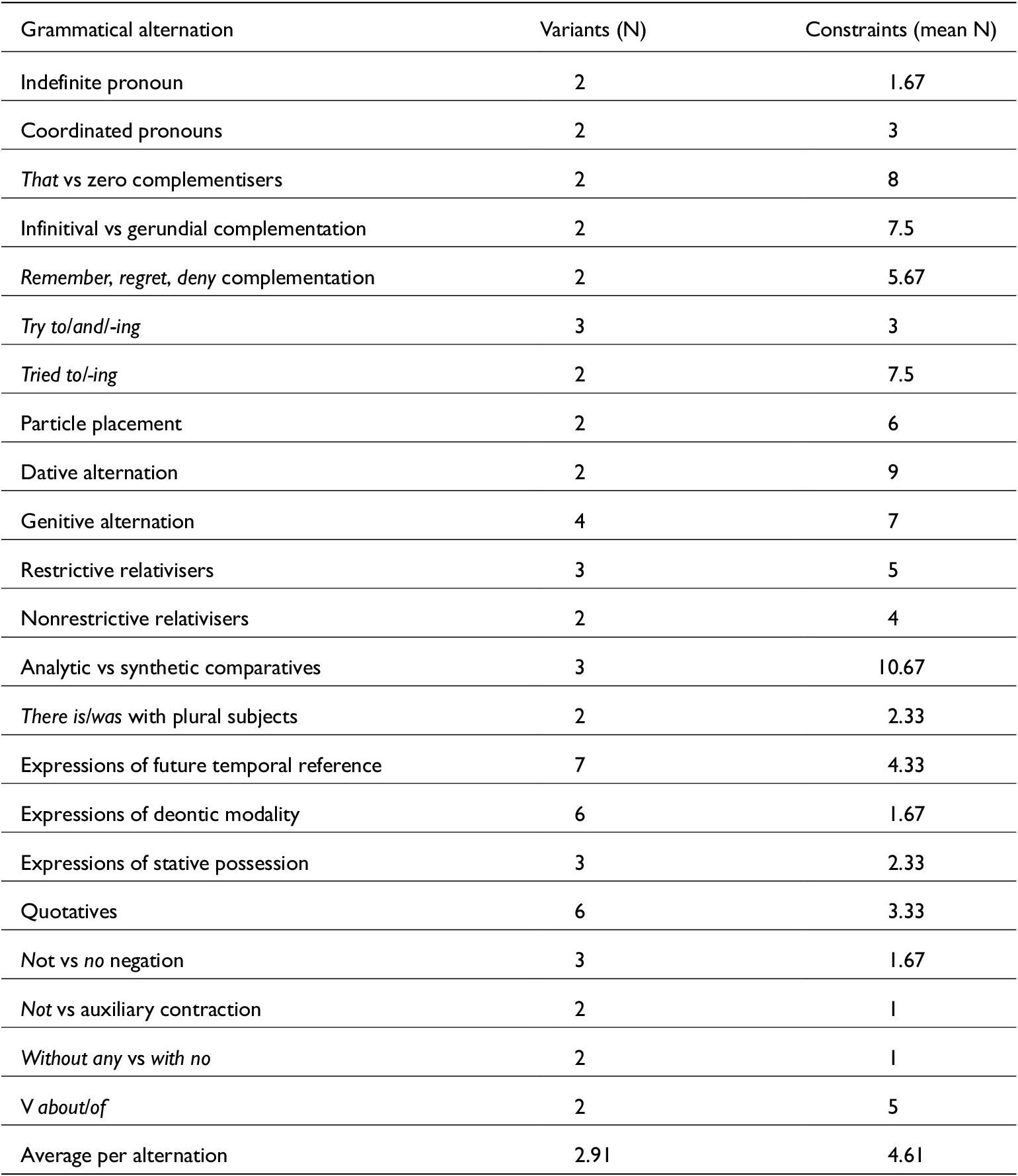
In what follows, for reasons of space we illustrate the coding scheme for the particle placement alternation, the dative alternation and the future temporal reference alternation. A complete coding protocol for all alternations under study can be found in the supplementary materials in our accompanying OSF repository: https://osf.io/5x9yw/?view_only=d00be2f79d814065b58d54dbca26cc40
2.3.1 Example 1: Particle placement alternation
The English particle verb (PV) alternation (pick up a book vs pick a book up) has been a popular research topic in recent years.
(A) Szmrecsanyi et al. (Reference Szmrecsanyi, Grafmiller, Heller and Röthlisberger2016) found three significant linguistic factors in four national varieties of English in the International Corpus of English (ICE) through conditional inference tree and conditional random forest analyses: length of direct object (DO), themacity of DO and presence of a directional preposition.
(B) Grafmiller & Szmrecsanyi (Reference Grafmiller and Szmrecsanyi2018) studied nine varieties of English in ICE and the Corpus of Global Web-based English (GloWbE). Through generalised linear regression modelling, they found eleven significant factors at work in the PV alternation, including the three identified by Szmrecsanyi et al. (Reference Szmrecsanyi, Grafmiller, Heller and Röthlisberger2016).
(C) Lee & Mackenzie (Reference Lee and Mackenzie2023) replicated an early variationist study to investigate the effect of social roles by using data from the Radiotalk Corpus. Four linguistic factors turned out to be significant: DO length, meaning frequency, semantic compositionality and particle prosody.
Therefore, the number of variants for the particle verb alternation is two, and the average number of constraints this alternation is conditioned by is (3+11+4)/3 = 6.
2.3.2 Example 2: Dative alternation
As one of the most well-researched topics in syntactic variation, the dative alternation (I give Jenny a flower vs I give a flower to Jenny) has been subject to a growing collection of probabilistic approaches (See Bresnan & Hay Reference Bresnan and Hay2008; Röthlisberger, Grafmiller & Szmrecsanyi Reference Röthlisberger, Grafmiller and Szmrecsanyi2017; Szmrecsanyi et al. Reference Szmrecsanyi, Grafmiller, Bresnan, Rosenbach, Tagliamonte and Todd2017, among others; Wolk et al. Reference Wolk, Bresnan, Rosenbach and Szmrecsanyi2013).
(A) Theijssen et al. (Reference Theijssen, ten Bosch, Boves, Cranen and van Halteren2013) used mixed-effects logistic regression, Bayesian Networks and Memory-based learning, and identified nine significant predictors involving properties of recipient and theme.
(B) Röthlisberger et al. (Reference Röthlisberger, Grafmiller and Szmrecsanyi2017) analysed a whopping 83 alternating dative verbs in the ICE, and found ten language-internal factors to play a significant role.
(C) Szmrecsanyi et al. (Reference Szmrecsanyi, Grafmiller, Bresnan, Rosenbach, Tagliamonte and Todd2017) conducted conditional random forest (CRF) analyses for four varieties of English, and showed that eight linguistic predictors have a significant effect through a simplified regression analysis.
The dative alternation therefore has two variants and an average of (9+10+8) / 3 = 9 constraints.
2.3.3 Example 3: Expressions of future temporal reference
Future temporal reference can be realised in several ways in English. Here, we restrict our attention to the seven most frequent variants: will, be going to, shall, be to, present progressive, simple present and be fixing to. That said, most multivariate analyses carried out to investigate the underlying factors motivating the variation and change in usage patterns are between will and be going to.
(A) Gardner (Reference Gardner2017) identified four significant predictors in Cape Breton English that influenced will vs be going to.
(B) Denis & Tagliamonte (Reference Denis and Tagliamonte2017) replicated Gardner’s methodology with data from the Toronto English Archive and also found four significant language-internal constraints contributing to the choice between will and be going to.
(C) Mikkelsen & Hartmann (Reference Mikkelsen, Hartmann, Flach and Hilpert2022) investigated the same alternation using data extracted from the spoken component of the British National Corpus (BNC 2014) by means of a multivariate analysis. Apart from four structural factors, the authors also considered priming effects, which emerged as a highly significant predictor along with the four other factors, adding up to five language-internal constraints.
In total, seven variants of future temporal references are considered in our study, which are conditioned by an average of (4 + 4 +5) / 3 = 4.33 language-internal constraints.
2.4. Research design and statistical analysis
Our dataset, then, covers 108,487 conversational turns in SWITCHBOARD, 22 grammatical alternation types yielding 57,032 optionality contexts, 589,124 unfilled pauses and 43,801 filled pauses. In the Results section, we shall run a number of mixed-effects linear regressions, by making use of the lme4 package in R (Bates et al. Reference Bates, Mächler, Bolker and Walker2015; R Core Team 2024). The dependent variable in all regression models is a unitary measure of speech dysfluency. Predictors consist of the control variables (turn duration, speech rate, mean character length; see section 2.2) and the variables of interest in this study: number of grammatical optionality contexts, number of variants and average number of constraints that govern the variants. SWITCHBOARD corpus speaker ID is included as an intercept adjustment as each speaker contributes multiple observations to the data.
We experimented heavily with various alternative modelling designs to optimise model fit and interpretability, including the following:
-
A. Dataset: using all turns vs using turns where grammatical optionality contexts are present vs using turns that contain one grammatical optionality context – this will be further elaborated in the three-step modelling approach below.
-
B. Dependent variables: treating the two measures of dysfluencies as separate dependent variables (filled pauses as a binary variable or discrete variable and speech planning time as a continuous variable), and modelling each of them in separate models using logistic regression and linear regression – we eventually adopt a unitary measure of dysfluency to facilitate a more concise and elegant modelling strategy, as is stated in section 2.2.
-
C. Independent variables: treating the number of grammatical optionality contexts as a continuous variable vs treating it as a binary variable (whether a given turn contains grammatical optionality contexts or not); using average number of constraints and average number of variants in a turn as opposed to using total number of constraints and total number of variants in a turn – this is further elaborated below.
-
D. Centring, scaling, log-transformation of numerical variables and combinations thereof: models fitted using data log-transformed obtained the best fits and are therefore retained.
-
E. Interaction terms: including interaction between number of constraints and number of grammatical variables, and between number of variants and number of grammatical variables: interaction terms turn out to be non-significant.
-
F. Random effects: only including speaker ID as a random effect (intercept and slope) vs including speaker ID as well as grammatical alternation type as a random effect (intercept and slope). The addition of random slopes results in singular fits for all models and is therefore removed, whereas random intercepts significantly improved model fits and are retained.
-
G. Regression modelling technique: linear regression model vs generalised additive model: GAM suggests that the relationship between response variables and predictors is closer to linear than non-linear.
The findings we report in this article are robust in the face of the above modelling variations. In the end, we found that the (non-)influence of number of grammatical optionality contexts (RQ 1), number of constraints (RQ 2) and number of variants (RQ 3) is demonstrated best through a three-step modelling approach outlined below.
The first (comprehensive) model explores the effect of grammatical optionality (RQ 1) in the context of the entire SWITCHBOARD corpus, checking among other things the extent to which Gardner et al.’s (Reference Gardner, Uffing, Van Vaeck and Szmrecsanyi2021) findings, which were obtained from a subset of the SWITCHBOARD corpus, replicate when considering the SWITCHBOARD corpus as a whole. This model also includes turn duration, mean word length and speech rate (as noted above, all known to influence pausing) as control predictors and individual speaker as a random effect (to allow for by-speaker intercept adjustments).
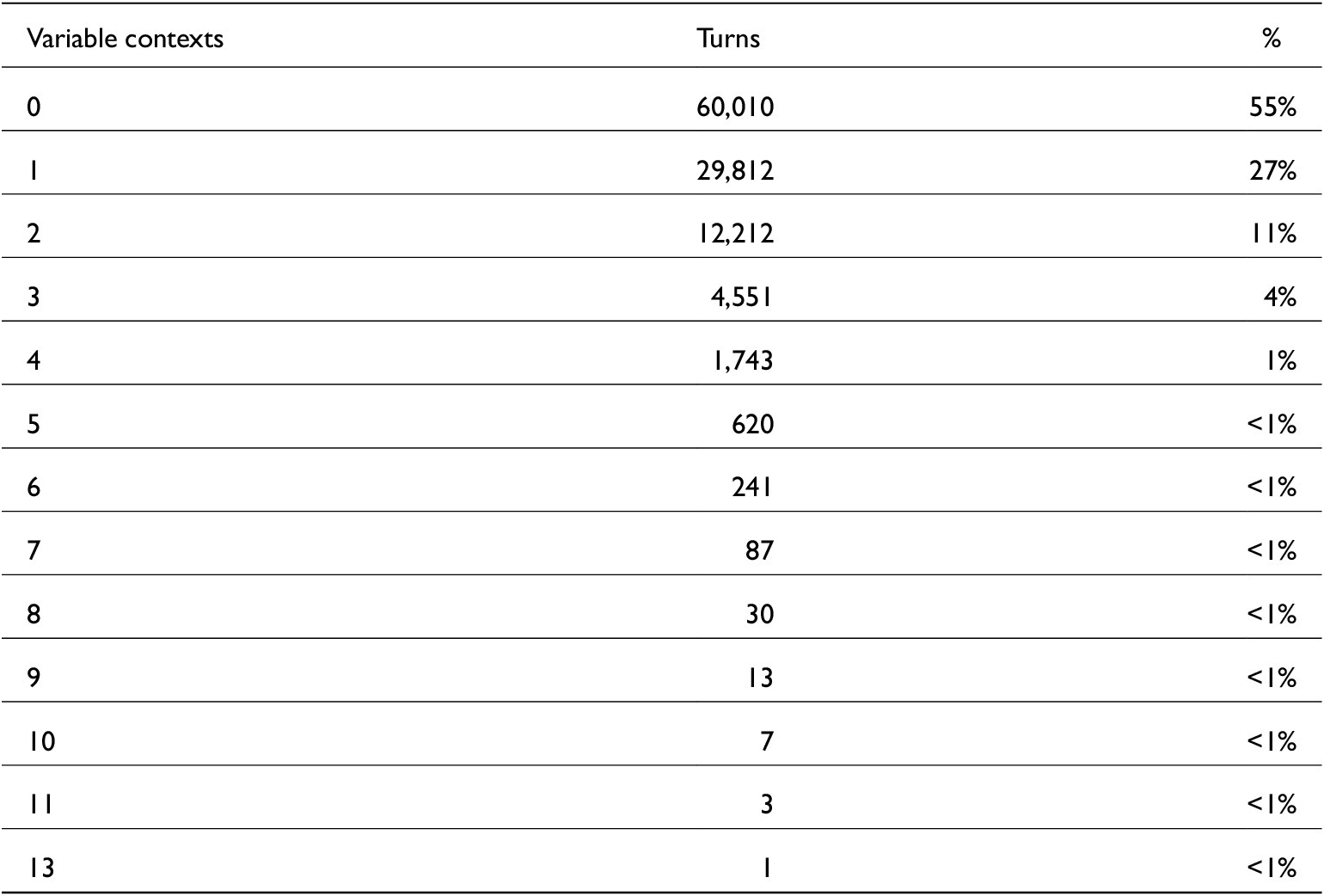
The second (baseline reduced) model and the third (enhanced) model examine the effect of number of constraints (RQ 2) and number of variants (RQ 3) using data restricted to turns containing one grammatical optionality context. This decision was called for because the number of constraints and number of variants inevitably vary with the number of optionality contexts, which results in high correlation between predictors and inaccurate results. We experimented with different strategies to tackle this problem, including using averages of all three variables of interest, but eventually settled with the current approach where we hold the number of optionality contexts constant to minimise intercorrelation. Of note, turns with one optionality context represent about 25 per cent of the full dataset, which constitutes the largest subset among all turns that contain optionality contexts. See table 3 for the distribution of number of variable contexts per turn among all speakers in the SWITCHBOARD corpus. Note also that all 520 speakers in the SWITCHBOARD corpus are represented in this reduced dataset, which indicates a high level of diffusion (Dion Reference Dion2023) of the grammatical alternations investigated in the subsample of our study. The second (baseline reduced) model is constructed with only the three control variables (turn duration, mean word length and speech rate). As the number of optionality contexts is constant, it is not included as a predictor in this model; instead, this model acts as a baseline for comparison with our third model.
Distribution of number of variable contexts per turn among all speakers in the SWITCHBOARD corpus

The third (enhanced) model builds on the second model but adds in the number of constraints (RQ 2), number of variants (RQ 3) as predictors. In addition to speaker ID, we also include grammatical alternations as an intercept adjustment for these two models, as it is reasonable to assume that the 22 grammatical alternations present in the sub-dataset contribute to dysfluencies to various degrees. The findings we report in the following section are robust in the face of combinations of these various modelling decisions.
3. Results
Here we present the results of the three-step modelling approach. Recall that data and analysis scripts can be found in the accompanying OSF repository.
3.1. The comprehensive model
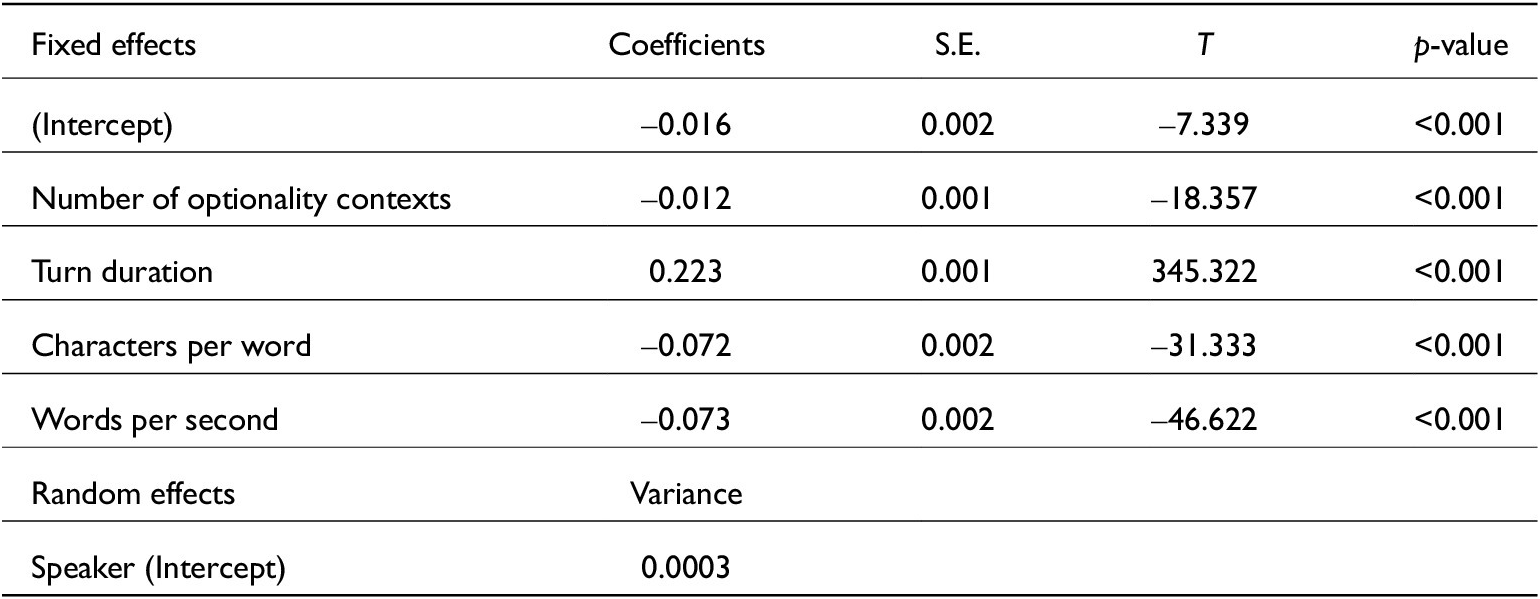
The aim of the comprehensive model is to explore the extent to which grammatical optionality contexts trigger dysfluencies (RQ 1), considering all turns in the SWITCHBOARD corpus in its entirety. As shown in table 4: when turn length, content complexity and speech rate are controlled, the effect of number of variable contexts is significant and negative, i.e. speakers are less likely to insert um’s and uh’s or stay silent for an extended period of time during speech when turns contain more grammatical optionality contexts, although it must be said that the effect size is very small.
Mixed-effects linear regression testing the fixed effects of numbers of grammatical variable contexts per turn, turn duration, mean word length, speech rate, and the random intercept of speaker on the sum of scaled number of filled and unfilled pauses
Model fit by maximum likelihood. AIC = -401,958.1, Marginal R2 = 0.506, Conditional R2 = 0.603. Variation inflation factors < 1.18. Nobservations = 108,487.

This observation corroborates Gardner et al.’s (Reference Gardner, Uffing, Van Vaeck and Szmrecsanyi2021) findings obtained from a subset of SWITCHBOARD, where a negative yet non-significant correlation was found between number of variable contexts and two types of dysfluencies (filled and unfilled pauses). Average utterance length is positively correlated with speech dysfluencies, which is not surprising given Oviatt’s (Reference Oviatt1995) conclusions that dysfluencies increase roughly linearly with the number of words in an utterance. On the other hand, dysfluencies are less likely when speakers generate more complex content or speak faster, which is in line with previous studies on their relationships (Engelhardt, Nigg & Ferreira Reference Engelhardt, Nigg and Ferreira2013; Maclay & Osgood Reference Maclay and Osgood1959). The R-squared values indicate a good performance of the model.
3.2. The reduced baseline model
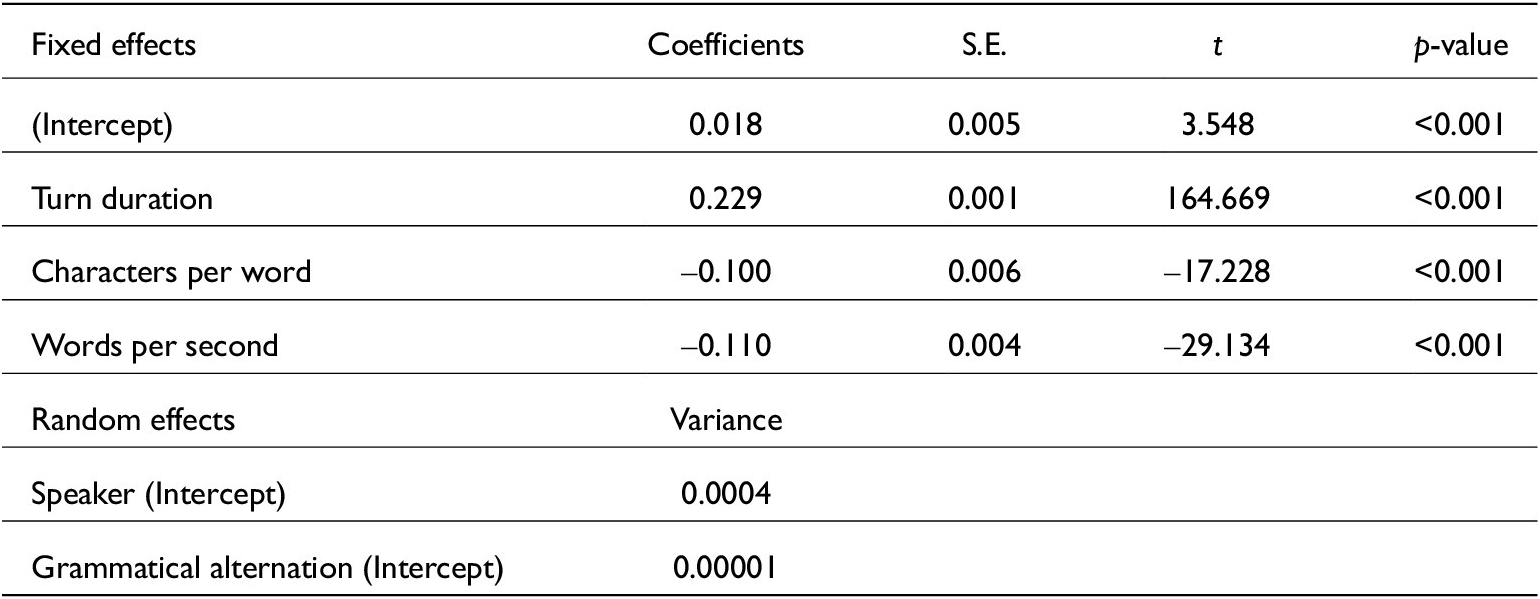
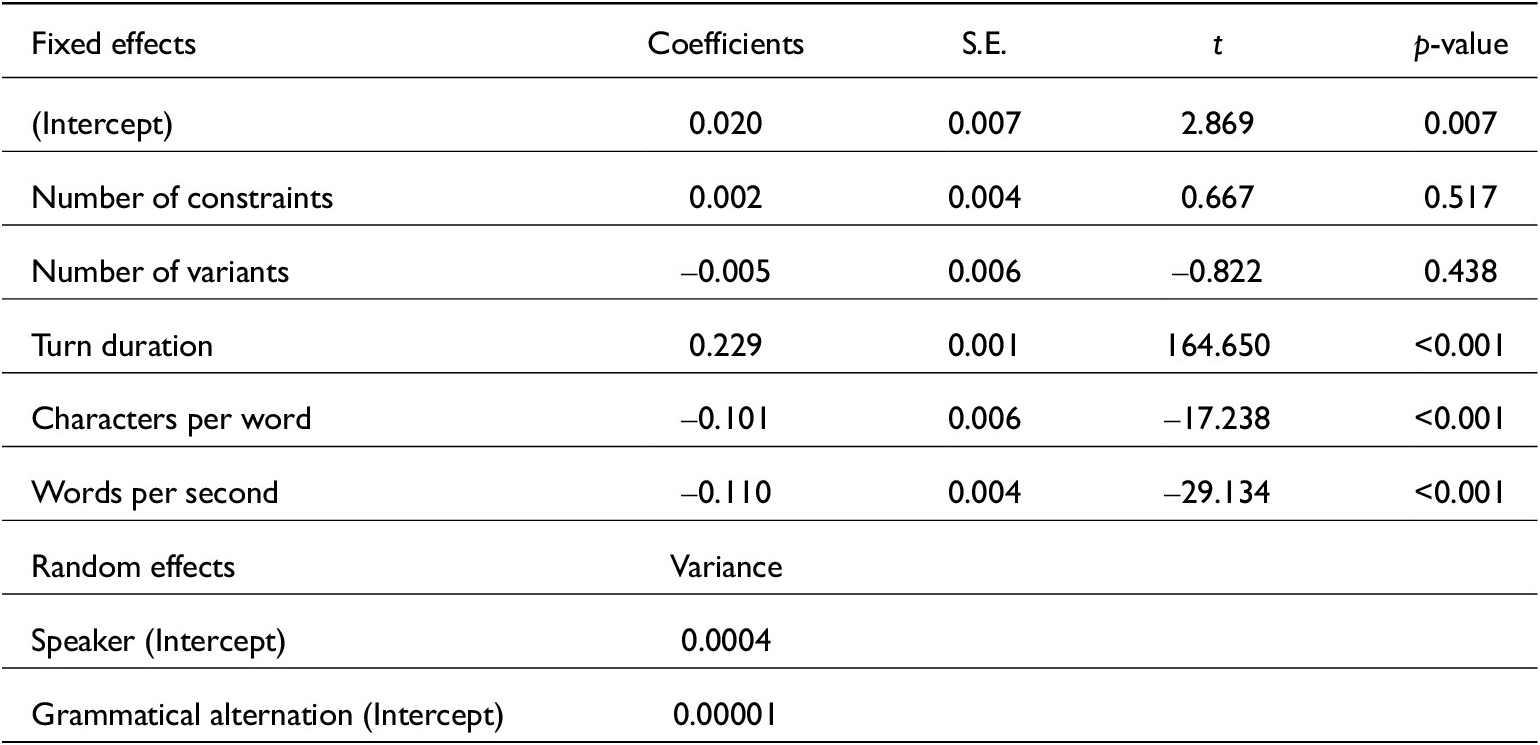
As mentioned, we limit the confounding effect that the occurrence of multiple variables in a turn may have on dysfluency insertion by restricting attention to turns with only one grammatical optionality context. Table 5 shows that in a thus reduced dataset, the three control variables (turn duration, speech rate and content complexity) behave like they do in the comprehensive model. The R-Squared values of the baseline model remain relatively high and comparable to the comprehensive model, showing a similar pattern of variance distribution. It is worth noting that both random effects, despite the minute variance they explain, are significant according to likelihood ratio tests we conducted.
The baseline model: mixed-effects linear regression testing the fixed effects of turn duration, mean word length, speech rate, and the random intercept of speaker and grammatical alternation type on the sum of scaled number of filled and unfilled pauses
Model fit by maximum likelihood. AIC = -92,496.1, Marginal R2 = 0.479, Conditional R2 = 0.600. Variation inflation factors <1.08. Nobservations = 25,703.

3.3. The enhanced model
In the enhanced model, we factor in the number of constraints on the optionality contexts occurring in the turns (RQ 2), as well as the number of variants associated with the alternations occurring in the turns (RQ 3). The enhanced model is displayed in table 6. With number of constraints and number of variants added to the equation, the model now has slightly better R squared values compared to the baseline model. The effect size and direction of the control variables remain largely unchanged. Both random effects significantly improve model performance compared to when either is absent. However, neither of the additional predictors in the enhanced model, i.e. number of constraints and number of variants, has a statistically significant correlation with speech dysfluencies. This answers research questions RQ 2 and RQ 3: these two predictors do not correlate with speech dysfluency.
The enhanced model: mixed-effects linear regression testing the fixed effects of number of constraints and number of variants per turn, turn duration, mean word length, speech rate, and the random intercept of speaker and grammatical alternation type on the sum of scaled number of filled and unfilled pauses
Model fit by maximum likelihood. AIC = -92493.4, Marginal R2 = 0.480, Conditional R2 = 0.601. Variation inflation factors <1.08. Nobservations = 25,703.

4. Discussion and conclusion
In this contribution, we tested widespread axioms about grammatical optionality using evidence-based methods. We specifically employ a corpus-based psycholinguistics research design with a variationist twist: we investigate the well-known SWITCHBOARD corpus of American English, asking if and how the presence of grammatical optionality contexts correlates with two established symptoms of production difficulty, namely filled pauses (um and uh) and unfilled pauses (speech planning time).
That optionality is abnormal, suboptimal, short-lived and dysfunctional, and should therefore inconvenience language users (for example, by triggering production difficulties) is a corollary of what has been called the ‘doctrine of form–function symmetry’ (Poplack & Dion Reference Poplack and Dion2009: 557) in variationist circles, canonised in widely cited axioms such as the Principle of Isomorphism (Haiman Reference Haiman1980), the Principle of No Synonymy (Goldberg Reference Goldberg1995) or the Principle of No Equivalence (Leclercq & Morin Reference Leclercq and Morin2023). In our view, these axioms – which have especially strong currency in cognitive linguistics and in functionalist circles – boil down to the prediction that because variation and optionality, by definition, increase absolute language complexity (see Miestamo Reference Miestamo, Miestamo, Sinnemäki and Karlsson2008), they should also increase relative language complexity, i.e. incur production difficulty. There is also an implicit assumption that speakers always aim to minimise production difficulty, and that language change will always be towards simplification (i.e. the erasure of dysfunctional optionality; see also De Smet et al. Reference De Smet, D’hoedt, Fonteyn and Van Goethem2018). This informs theorists who claim each grammatical form must be mapped to a specific, unique function (and vice versa) because it is easier than if speakers had to make choices between synonymous forms.
The prediction that grammatical optionality inconveniences language users is not borne out in our analysis. Specifically, the answers to our research questions are the following:
RQ 1. Does grammatical optionality attract speech production difficulty overall? No. Turns with more contexts in which grammatical optionality is possible do not have more filled and unfilled pauses than turns with fewer or no contexts where grammatical optionality is possible. This finding corroborates previous research (Gardner et al. Reference Gardner, Uffing, Van Vaeck and Szmrecsanyi2021) carried out on a much smaller subset of SWITCHBOARD. In fact, what we see in our modelling is that optionality contexts slightly repel dysfluencies, contrary to predictions generated by form–function-symmetry axioms.
RQ 2. Does grammatical optionality regulated by more language-internal constraints attract more production difficulty than grammatical optionality regulated by fewer language-internal constraints? No. The number of constraints by which an alternation is regulated does not make any difference in terms of dysfluency attraction or repellence. So increased absolute complexity (more constraints) of a local optionality phenomenon does not trigger increased relative complexity, i.e. production difficulty.
RQ 3. Does optionality between more variants attract more production difficulty than optionality between fewer variants? No. The number of variants among which language users can choose does not make any difference in terms of dysfluency attraction or retention. Therefore, again increased absolute complexity (more variants to choose from) of a local optionality phenomenon does not trigger increased relative complexity, i.e. production difficulty.
In short, grammatical optionality is just not empirically (i.e. measurably) more difficult for language users than non-optionality, regardless of the number of language-internal constraints by which alternations are regulated, or the number of variants among which language users can choose. Increased absolute complexity (optionality by definition increases absolute complexity, and even more so if there are more variants and/or more constraints involved) does not coincide with relative complexity. On the contrary: there are indications that optionality makes conversational English more fluent.
Theories reliant on the difficulty of optionality are therefore questionable. Why a ubiquitous element of human communication (optionality/variation) is one that theorists have dismissed as noise or deemed too dysfunctional to be a core feature of grammar remains an open question. To recapitulate: we knew before that there are serious empirical problems with ‘the doctrine of form–function symmetry’ (Poplack & Dion Reference Poplack and Dion2009: 557): variation and optionality are by no means exceptional, as the variationist literature reveals; grammatical variables are not necessarily short-lived; and optionality does not seem to be problematic in language acquisition. What we now also know is that optionality contexts, overall, do not make speech production in conversation more difficult. Optionality doesn’t seem to trouble language users – on the contrary.
Against this backdrop, we submit that it is perhaps optionality, rather than non-optionality (or synonymy avoidance), that is a design feature of language: the availability of a variety of options better equips a language user to cope with diverse social, cognitive and articulatory pressures. This we refer to as the Principle of Optionality (‘Languages and language users favour the availability of different ways of saying the same thing’) elsewhere (Szmrecsanyi et al. Reference Szmrecsanyi, Gardner, Ma, Van Hoey, Cukor-Avila, Tagliamonte and Baileyforthcoming). The Principle of Optionality is a strong interpretation of our findings. But the point is that the Principle of Optionality is superior to competing ‘principles’ (i.e. the Principle of Isomorphism, the Principle of No Synonymy and so on) because it does not flatly contradict the empirical facts (variation and optionality are widespread, not necessarily short-lived, unproblematic in acquisition, and they do not inconvenience speakers in speech production, as we have shown).
There is a puzzle, however. We have argued in section 1 that grammatical optionality is typically conditioned probabilistically by any number of contextual probabilistic constraints (constituent length, constituent animacy, information structure, subject type and so on). This means that before they can select the most natural variant given the context, language users need to check the linguistic context, which must increase cognitive load. How come this doesn’t result in production difficulty, according to our analysis? We submit that any cognitive load issues incurred by grammatical optionality are offset by additional cognitive benefits to having multiple ways of saying the same thing. Below we sketch the seven most important (in our view) of these benefits (see also Szmrecsanyi et al. Reference Szmrecsanyi, Gardner, Ma, Van Hoey, Cukor-Avila, Tagliamonte and Baileyforthcoming):
-
1. Adjusting explicitness. This is about alternations whose variants differ in explicitness (including insertion/deletion alternations, such as the complementiser that omission/retention alternation in English). According to Rohdenburg’s (Reference Rohdenburg1996: 149) Complexity Principle, ‘more explicit grammatical alternatives tend to be preferred in cognitively more complex environments’. Therefore, having the option of using overt variants can facilitate the planning of otherwise complex material.
-
2. Managing information density. This benefit is somewhat related to, but not entirely coreferential with, the first benefit, and concerns alternations whose variants differ in verbosity (including insertion/deletion alternations). The Uniform Information Density hypothesis (Levy & Jaeger Reference Levy, Jaeger, Schölkopf, Platt and Hoffman2007) postulates that within the bounds permitted by grammar, speakers prefer utterances that distribute information uniformly across the signal. Thus, the availability of more or less verbose grammatical variants provides flexibility to the speaker in spreading out information density (i.e. to make it more uniform) when following material (or even preceding material) is otherwise too dense informationally.
-
3. Communicating efficiently. This benefit is somewhat related to, but again not entirely coreferential with, benefits 1 and 2, and concerns alternations whose variants differ in verbosity (including insertion/deletion alternations). The benefit relates to the use of more or less effortful variants, and with the registers and styles that they are associated with. Levshina & Lorenz (Reference Levshina and Lorenz2022), for example, find that while more vs less verbose variants have a number of stylistic connotations, pressures of fast or casual speech makes these variants interchangeable, with a preference for the less verbose variant in more predictable contexts.
-
4. Establishing Easy First order. This benefit concerns permutation (i.e. constituent order) variables such as the dative alternation in English. The Easy First factor (MacDonald Reference MacDonald2013) predicts a preference for placing ‘easier’ constituents before less easy constituents. ‘Easy’ can mean shorter, discourse-given and probably also animate (as opposed to inanimate). So, permutation alternations put language users in a position to produce Easy First-compliant utterances.
-
5. Achieving rhythmic well-formedness (eurythmicity). This benefit is relevant for basically all types of grammatical variables. For example, we know speakers of English strive for the rhythmic alternation between stressed and unstressed syllables (Shih et al. Reference Shih, Grafmiller, Futrell, Bresnan, Vogel and Vijver2015; see, e.g., Ehret, Wolk & Szmrecsanyi Reference Ehret, Wolk and Szmrecsanyi2014). This is why the of-genitive variant in the respónse of the góvernment (WWS WWSWW) is more optimal than the alternative s-genitive variant in the góvernment’s respónse (WSWW WSW) (exemplification from Shih et al. Reference Shih, Grafmiller, Futrell, Bresnan, Vogel and Vijver2015).
-
6. Domain minimisation. Hawkins (Reference Hawkins2004: 33) argues that language users seek to parse the fewest possible forms and their associated properties in order to assign the property in question. Alternations that permit reordering of elements, like the dative alternation, or deletion of elements, like overt vs null relativisers, can facilitate this. For example, twelve words must be parsed before all three constituents are recognised in the sentence Mary vp [gave np [the book she had been searching for since last Christmas] pp [to Bill], whereas only four words need to be parsed in Mary vp [gave pp [to Bill] np [the book she had been searching for since last Christmas]].The availability of both dative options allows language users the flexibility to minimise parsing when direct and indirect objects are of varying lengths.
-
7. Stalling for planning time. This benefit is relevant for alternations whose variants differ in verbosity (including insertion/deletion alternations). The point is that more verbose variants allow speakers to stall for time to plan upcoming speech production. Consider, for example, the optionality between I think [complementiser omitted] uhm this is an exceptionally well-made motion picture and I think that this is an exceptionally well-made motion picture. In this scenario, verbose grammatical variants may be considered dysfluency repair devices.
Again, the fluency-enhancing nature of these benefits is likely to compensate for any cognitive load issues triggered by grammatical optionality. We note in passing that these benefits are also the reason why optionality is not dysfunctional, contrary to predictions in functionalist circles. We believe that variants can have functional benefits even though they are semantically equivalent.
The final issue that we would like to address here is whether or not all grammatical alternations are equal. We have seen that on the whole, grammatical optionality does not attract production difficulties, but are there perhaps more subtle differences in the extent to which individual grammatical alternations attract dysfluencies? Conveniently, the enhanced baseline model in table 6 has a significant random effect such that the intercept for dysfluency attraction is adjusted for different alternation types.Footnote 2 In other words: the model takes into account that different alternations may attract or repel dysfluencies to different extents.
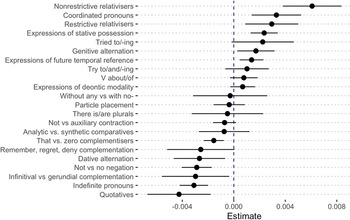
Figure 2 plots the intercept adjustments and thus generates a ranking that is to be interpreted as follows: alternations in the upper half of the plot (nonrestrictive relativisers through to expression of deontic modality) are more likely to attract dysfluencies, all other things being equal, than alternations in the lower half of the plot (without any vs with no through to quotatives).Footnote 3
Estimates and confidence intervals (estimates ± standard error) for adjustments to intercept by grammatical alternation type in the Enhanced Baseline Model. Alternations whose estimates are located to the right of the dotted line (> 0) attract dysfluencies, estimates to the left of the dotted line dispel dysfluencies.

The ranking to some extent defies neat, principled generalisations, but at the risk of indulging in telling just-so stories, we do take the liberty to note some interesting patterns:
-
• The top three dysfluency-attracting alternations are the nonrestrictive relativiser alternation (that vs which), the coordinated pronouns alternation (my husband and I vs me and my husband) and the restrictive relativiser alternation (again, that vs which). These are alternations that are subject to heavy prescriptivist regulation (see, e.g., Hinrichs, Szmrecsanyi & Bohmann Reference Hinrichs, Szmrecsanyi and Bohmann2015) and/or to hypercorrection (e.g. Angermeyer & Singler Reference Angermeyer and Singler2003).
-
• The dysfluency-attracting alternations in the top half of the diagram cover many variables known to be subject to language change in progress: consider, for example, the genitive alternation (the president’s speech vs the speech of the president) (Hinrichs & Szmrecsanyi Reference Hinrichs and Szmrecsanyi2007), the future temporal reference alternation (Denis & Tagliamonte Reference Denis and Tagliamonte2017) and the deontic modality alternation (I must admit vs I have to admit) (Tagliamonte & Smith Reference Tagliamonte and Smith2006).
-
• Conversely, the dysfluency-repelling alternations in the lower half of the diagram cover some classic diachronically stable alternations, such as the particle placement alternation, the dative alternation and the that versus zero complementiser alternation (He says ___ the book is nice vs he days that the book is nice). These have been a feature of English grammar for a long time.
In short: prescription and language change in progress may render optionality more difficult in production, while diachronically stable alternations are unproblematic (which is probably why they are diachronically stable in the first place – there is no evolutionary pressure to change things). But then again, there are inexplicable outliers, such as the quotative alternation (she goes, ‘Yeah!’ vs she’s like, ‘Yeah!’), which is the most dysfluency-repelling alternation in our sample but known to be highly dynamic (see, e.g., Tagliamonte & Hudson Reference Tagliamonte and Hudson1999).
5. Conclusion
In this article, we investigated correlations between grammatical optionality and dysfluencies in a large corpus of spoken English and found that grammatical optionality does not trigger production difficulties. This challenges the widespread notion that form–function symmetry is a design feature of language.
The limitations of our research design dictate directions for future research. First, the analysis in this contribution needs to be extended to optionality on other linguistic levels, such as the lexicon and phonology. Second, the analysis needs to be extended to languages other than English – there is no immediately obvious reason why English should be odd, but we need to know for sure. Third, we need to conduct parallel analyses targeting L1 acquisition and SLA data, to learn more about how learners deal with optionality. Fourth, it would be worthwhile to devise psycholinguistic experiments to corroborate our results in the lab.
Acknowledgements
Funding by the KU Leuven Research Council (grant # 3H220293) is gratefully acknowledged.


 Open access

