

Introduction
Globally, gender equality is the next frontier for social transformation, and women’s economic empowerment is promoted as the pathway to achieve that goal. The United Nations’ (‘UN’s) former Secretary General, Ban Ki-Moon, wrote that ‘gender equality remains the greatest human rights challenge of our time. The UN sees economic empowerment as a uniquely potent way for women to achieve greater control over their own lives’ (UN 2017, 3). The UN’s Secretary General’s High-level Panel on Women’s Economic Empowerment declared: ‘… empowering women economically is not only the right thing to do to honour the world’s commitment to human rights—it is also the smart thing to do for development, economic growth and business’ (UN 2017, v). Women’s economic empowerment is broadly defined as the capacity for women to participate in and benefit from economic activities on terms that value their contributions (OECD 2022). Advocates state that it has the potential to be a safeguard against violence, poverty, and precarity, enhance women’s health and wellbeing, and improve gender equality (Belingheri et al Reference Belingheri, Chiarello, Fronzetti Colladon and Rovelli2021; Dalal Reference Dalal2011; WHO 2005). National governments and other influential international organisations such as the United Nations (UN), the World Health Organisation, the Gates Foundation, and the Canadian International Development Research Centre have recognised women’s economic empowerment as a game changer and identified it as a key priority. The UN describes women’s economic empowerment as an area where the ‘scope for progress is so large’ (UN 2017), while UN Women (2024) has identified women’s economic empowerment as one of four impact areas within its most recent Strategic Plan (2022–2025).
Within this context, the aim of this article is to explore the benefits and risks of women’s economic empowerment. Using a critical-feminist lens, we provide an examination of the extent to which women’s economic empowerment is a pathway towards achieving gender equality, exploring whether it improves women’s lives or simply uses women’s labour as an instrument to reach larger economic goals. To this end, we first provide a brief snapshot of the social, political, and economic realities of women across the globe, demonstrating the enduring persistence of gender inequality and the need to address it. We then outline the two overarching perspectives on women’s economic empowerment: the ‘mainstream’ perspective adopted by many national, supranational, and international governments and bodies, and the feminist critique of that approach. This is followed by a synopsis of UN Women’s strategy for women’s economic empowerment in its most recent Strategic Plan (2022–2025). We trace how the current, mainstream conceptualisation of women’s economic empowerment has narrowed over time from a broad, collectivist approach to women’s empowerment to a narrowed, individualised approach to women’s economic empowerment. We then provide a brief review of the evidence on the benefits of a focus on women’s economic empowerment: economic growth in countries; improved rates of tertiary education and labour force participation for women; and some evidence for the growth of women’s autonomy. After summarising the benefits, the article examines the risks of the current, mainstream conceptualisation of women’s economic empowerment, which we distil into three key areas:
-
1) women collectively seen as a country’s ‘natural resource’ and used as instruments for economic prosperity without considering the impact on individual women’s wellbeing;
-
2) a focus on women’s labour force participation without adequately factoring in current labour market realities; and
-
3) pushing the women’s economic empowerment agenda forward without fully considering the scope of unpaid care and household work undertaken by women.
We conclude with an analysis of how UN Women (2024) is attempting to shift the agenda with their comprehensive and contextual framework for examining and implementing women’s economic empowerment, suggesting that there is room for cautious optimism if this framework is widely adopted by national, supranational, and international policy actors.
Global gender inequality by the numbers: a snapshot
Before tracing the development of women’s economic empowerment and what it aims to achieve, it is necessary to understand women’s economic and social position, using the indicators commonly applied by advocates for women’s economic empowerment. First, it is well known that paid and unpaid work are still highly gendered. Women spend three times as much time as men on unpaid childcare and household work (ILO 2018b). Second, the gender gap in labour force participation worldwide has stayed at around 30% since 1990; women’s labour force participation has been stable at 50%, while men’s sits at about 80% (World Bank 2022). While over 50% of women are employed in five of the seven global regions, North Africa, South Asia, and the Middle East continue to have women’s labour force participation rates at less than 25% (UN Women, 2024; World Bank 2022). Third, women are over-represented in informal and precarious employment. Globally, almost 60% of women’s employment is in the informal sector while in low-income countries, this number climbs to 90% (ILO 2018b). Fourth, the gender pay gap is 23% globally (UN Women 2018), and the share of total income held by women is below 35% and has notably only increased by 5% since 1990 (Chancel et al Reference Chancel, Piketty, Saez and Zucman2022). Relatedly, women’s ownership of bank accounts globally has dropped from 9% to 6% (Demirgüç-Kunt et al Reference Demirguc-Kunt, Ansar, Klapper and Singer2022; UN Women 2024). Fifth, although land ownership varies greatly by country, only 15% of agricultural landholders internationally are women (FAO 2018; UN Women 2024). Sixth, employment discrimination is high, with 90 of 190 countries (World Bank 2023) having laws restricting women from working in some jobs, with 2.4 billion women without the same rights as men (World Bank 2022). Seventh, sexual harassment and violence in work environments are widespread and are estimated to cost the global economy US $12 trillion annually (McKinsey 2015). Taken together, gender inequality remains a global problem, and women’s economic empowerment has been touted as the solution.
Defining women’s economic empowerment
In an earlier landmark article, gender and development economist Naila Kabeer (Reference Kabeer1999) argued that women’s empowerment entailed three key components: resources, agency, and accomplishments. Resources included material, financial, social, and human capital resources. Agency was defined as the ability to make choices and take actions. Achievements (or accomplishments) referred to the outcomes of resources and agency. Importantly, Kabeer emphasised that empowerment involved addressing the deeper structural inequalities that limit women’s agency and control over their own lives. She argued that empowerment must be understood in the context of the broader social, cultural, and political frameworks that shape gender relations. This included addressing issues such as patriarchy, social norms that marginalise women, and discrimination that restrict women’s access to markets, education, and employment. However, as we demonstrate, this broader conceptualisation of women’s empowerment later shifted to a narrower focus on women’s economic empowerment, demonstrating how empowerment is conceptually shifting terrain. Most recently, the OECD, whose definitions of women’s economic empowerment are frequently cited, made this statement:
Although there is no universal definition of women’s economic empowerment (WEE), a shared perspective exists in the international community that centers on women’s equal access to, and control over, resources such as financial services, assets and capital, technology, property and land, natural resources and food production. These definitions also include women’s access to skill and business development, financial literacy, and representation and leadership. (OECD 2022, 43)
The narrowing focus of women’s empowerment to one emphasising the economic aspect of empowerment has been accompanied by a focus on the individual woman rather than structural issues. As demonstrated by the OECD, this thinking has been largely adopted by international bodies such as the World Bank and has become mainstream. To illustrate, the World Bank (2017, 3) defines women’s economic empowerment as ‘power (control over one’s own life and over resources) and agency (capability to originate and direct actions for given purposes’, demonstrating the individualist orientation of their solution. The Gates Foundation defines women’s economic empowerment as ‘the transformative process that helps women and girls move from limited power, voice, and choice at home and in the economy to having the skills, resources, and opportunities needed to compete equitably in markets as well as the agency to control and benefit from economic gains’ (Gates Foundation 2024). While broader than the World Bank, it still focuses largely, although not completely, on individual transformation rather than structural change.
There are significant implications for women with this narrowed, economic individualised focus. It reduces women to economic instruments, views them as an untapped natural resource, and overlooks the context of women’s lives and experiences. Feminist scholars note the instrumental focus of this shift and view women’s economic empowerment as the exploitation of women at a global level (Eisenstein Reference Eisenstein2009; Gammage et al Reference Gammage, Joshi and van der Meulen Rodgers2020). Yet, while this narrowed, economic view of women’s empowerment stance is now mainstream in national, supranational, and international discourses, the recent 2024 UN Women’s definition suggests that a collectivist, contextualised approach that understands the importance of systems transformation is making a comeback.
Women’s economic empowerment strategy (UN Women 2024 )
UN Women (2024, 4), which is a branch of the UN set up to promote gender equality, defines women’s economic empowerment differently than other international bodies. It states that women’s economic empowerment is:
…a transformative, collective process through which economic systems become just, equitable and prosperous, and all women enjoy their economic and social rights, exercise agency and power in ways that challenge inequalities and level the playing field, and gain equal rights and access to, ownership of and control over resources, assets, income, time and their own lives. (UN Women 2024, 11)
According to UN Women, this process envisions a world where all women enjoy their economic and social rights, exercise their agency and power to challenge inequalities, and level the playing field. Notably, while the earlier OECD, World Bank, and Gates Foundation definitions tend more towards an individualised, human capital orientation, the UN Women definition has a more collectivised, contextual orientation.
The UN Women’s Economic Empowerment Strategy provides a comprehensive plan to improve the rights, opportunities, and contexts for women and girls globally. The first part of the strategy document reviews the global landscape of women’s realities, using a definition of women’s economic empowerment that is ‘rights-based and transformative’ (UN Women 2024). The second part of the document puts the strategy into action by articulating a clear vision, defining priority issues, showing pathways to advance the priorities, and outlining steps to implement and monitor the strategy. Importantly, the strategy identifies systemic inequalities that hinder women’s economic empowerment, focusing not only on inequality of opportunity but also on inequality of outcomes. Like the OECD and the World Bank, it recognises the importance of agency and women’s access to ownership and control over resources. However, it goes a step further by arguing that a critical element of women’s economic empowerment is systemic change, including institutions, policies, and norms (UN Women 2024). It calls for transformations to economic systems, regulatory frameworks, and laws to enable economic and social rights for women. It also employs an intersectional lens, recognising that global issues such as climate change have a disproportionate impact on marginalised women and girls –particularly Indigenous women, older women, LGBTQ+, women with disabilities, migrant women, and those in rural and remote areas. Importantly, it highlights the importance of a ‘cross-cutting approach’ that recognises the linkages between issues like decent work, paid and unpaid care work, and macroeconomic policies. In short, it calls for collectivist, integrated, and intersectional approaches to advance women’s economic empowerment, showing the critical impact that governments, systems, policies, institutions, and social norms have on creating environments in which women can achieve individual agency, power, and equality of opportunity. UN Women’s approach is not yet the predominant approach to thinking about women’s economic empowerment, but it is possible that the UN Women’s strategy could signal a turning point for how international bodies think about it.
Shifting terrain: from women’s empowerment to women’s economic empowerment
Feminist development scholars have general agreement that there has been a shift from women’s empowerment programmes to women’s economic empowerment (Batliwala, Reference Batliwala2007; Cornwall and Rivas Reference Cornwall and Rivas2015; Duncanson Reference Duncanson2019; Eyben and Napier-Moore Reference Eyben and Napier-Moore2009; Kabeer Reference Kabeer, Grantham, Dowie and de Haan2021; Moser Reference Moser1989). There is, of course, no straight line to women’s economic empowerment, and there are long-standing threads of both a broad, collectivist vision of women’s empowerment and a narrowed, individualist vision of women’s economic empowerment, depending on the perspective of diverse stakeholders. However, numerous feminist development economists, political scientists, and historians provide insights into when and why the concept became narrowed and what the consequences have been for women. While a detailed tracing of this shift in thought and policy direction is beyond the scope of this article, a brief overview will be provided here to provide context for the meandering pathway to current understandings of women’s economic empowerment. Feminist development scholars note that empowerment was originally a term employed by feminist activists to call for action to address structural problems that led to women’s poverty and oppression (Batliwala Reference Batliwala2007; Cornwall Reference Cornwall2016; Cornwall and Rivas Reference Cornwall and Rivas2015; Duncanson Reference Duncanson2019; Kabeer Reference Kabeer, Grantham, Dowie and de Haan2021). In the 1970s and 1980s, feminist development scholars used the term ‘women’s empowerment’ to promote consciousness-raising and women’s collective action (Batliwala Reference Batliwala2007; Cornwall Reference Cornwall2016; Batliwala Reference Batliwala2007; Moser Reference Moser1989). Women’s organisations used the language of women’s empowerment to critique the top-down ‘apolitical and economistic’ models that described women in international development discourses (Batliwala Reference Batliwala2007, 558). By the mid-1990s, the language of ‘women’s empowerment’ spread from women’s organisations to most development stakeholders (Elomäki Reference Elomäki2015; Moser Reference Moser1989; Eyben and Napier-Moore Reference Eyben and Napier-Moore2009). The uptake of this language is attributed to the 1995 Fourth United Nations Conference on Women in Beijing, as international development organisations and governments were ‘anxious to demonstrate a progressive approach to gender’ (Batliwala Reference Batliwala2007, 559).
As the popularity of women’s empowerment within international development skyrocketed across the 1990s, the meanings of the term began to change. Coinciding with the shift in global economic and political systems, stakeholders became increasingly focused on the relationship between gender equality and economic development. Slowly, in mainstream development discourses, the transformative discourse of women’s empowerment was replaced with a narrowed, economic understanding of empowerment. Cornwall (Reference Cornwall2018) argues that in the new understanding of empowerment, women were constructed as passive figures, waiting to be infused with financial power from ‘saviour-esque’ development agencies (Cornwall Reference Cornwall2018).
Batliwala (Reference Batliwala2007) notes that earlier conceptualisations characterised empowerment as a ‘socio-political process’ where ‘empowerment was about shifts in political, social, and economic power between and across both individuals and social groups’ (Batliwala Reference Batliwala2007, 559). Tracing the shift in empowerment discourse in India, she argues that empowerment shifted from collectivist calls for structural reform to fight women’s oppression to a more individualised, economic focus characterised by the introduction of micro-credit, entrepreneurship, and other finance solutions to bolster women’s individual human capital and economic self-sufficiency. Drawing on Sardenberg’s (Reference Sardenberg2008) distinction between liberal and liberating empowerment, Duncanson (Reference Duncanson2019) applies this conceptualisation to her analysis of women’s economic empowerment within the UN Women, Peace, and Security agenda. She differentiates between liberal approaches, which focus on integrating women into existing economic structures and liberating approaches, which emphasise collective organisation among women to challenge and transform those very structures. Eyben and Napier-Moore (Reference Eyben and Napier-Moore2009, 295) describe the new view of empowerment as ‘de-caffeinated’. Similarly, Cornwall calls the shift from a structural to an individualised, economic focus ‘empowerment lite’ (Cornwall Reference Cornwall2018). Eyben and Napier-Moore sum up the key consensus in the feminist development literature: ‘Today a privileging of instrumentalist meanings of empowerment associated with efficiency and growth are crowding out more socially transformative meanings associated with rights and collective action’ (Eyben and Napier-Moore Reference Eyben and Napier-Moore2009, 285). As Cornwall provocatively states, the contemporary conceptualisation of empowerment requires ‘the accommodation of women and girls within existing social and gender orders’ and puts them ‘to work for development rather than making development work for them (Cornwall Reference Cornwall2018, np emphasis in original).
The precise reasons for the narrowed shift to women’s economic empowerment are unclear but seem consistent with trends towards market-oriented approaches to gender equality in Europe and elsewhere in the Global North (Elomäki Reference Elomäki2015; Jenson Reference Jenson2015). A number of feminist scholars describe neoliberalism (i.e. Batliwala Reference Batliwala2007; Cornwall Reference Cornwall2018; Michaeli Reference Michaeli2021; Prügl Reference Prügl2017) as a prominent driver of women’s economic empowerment. Similarly, Canadian political scientist Jane Jenson (Reference Jenson2015) argues that the global economic crisis of the 1980s, which was characterised by high inflation, high rates of unemployment, and high rates of government debt, led to retrenchment in many countries, characterised by the predominance of neoliberal ideology. Jenson (Reference Jenson2015) goes one step further, however, arguing that neoliberal retrenchment was replaced with the social investment perspective, characterised by government investment in women and other ‘at-risk’ groups in response to emerging social risks in Europe and the Americas. According to this view, individual risk could be reduced in increasingly volatile markets through state investments in individuals’ human capital, entrepreneurship, and public–private partnerships (Giddens Reference Giddens1998; Jenson and Saint-Martin Reference Jenson and Saint-Martin2003). According to Jenson, the social investment perspective began ‘colonising’ political discourses at national, supranational, and international levels in the mid-1990s (Jenson Reference Jenson2015, 547). Although Jenson does not use the language of women’s economic empowerment, we suggest that her analysis of the shift from neoliberalism to social investment reflects the narrowed, mainstream focus on women’s economic empowerment in the Global South and the Global North.
The reach of women’s economic empowerment
Women’s economic empowerment has largely focused to date on the Global South, promoted by neoliberalist financial institutions such as the World Bank and International Monetary Fund, and governments such as the USA, UK, and the EU, which explicitly foreground women’s employment, microfinance, and entrepreneurship in programmes as the way to achieve better outcomes for women (Michaeli Reference Michaeli2021). However, there is also a move to introduce this concept in the Global North. To illustrate, the Group of Seven countries (Canada, USA, Japan, and the EU – the ‘G7’) has a WE EMPOWER G7 programme (ILO 2021), committed to investing in women’s economic empowerment through various mechanisms and implementing the UN Women’s economic empowerment programmes. In other examples, the new Canadian Women’s Entrepreneurship Strategy (Government of Canada 2024) focuses on creating and supporting women’s entrepreneurship, while in Australia, the focus over the past few decades has been on increasing women’s workforce participation in order to improve their economic security, as well as the nation’s Gross Domestic Product (GDP). More recently, this focus has somewhat broadened, and the most recent government strategy ‘Working for Women’ prioritises gender equality over the concept of women’s economic empowerment (Government of Australia 2024). Interestingly, it is in relation to international-level obligations that the Australian government specifically refers to the economic empowerment of women through their commitment ‘to advance gender equality’ and ensuring that women’s and girls’ empowerment is at the centre of their international efforts (Government of Australia 2024, 96). We see that while the 2022 OECD definition of women’s economic empowerment and the Canadian orientation is more focused on individual factors (the micro), UN Women (2024) and Australia’s focus has a more contextualised (macro) orientation.
Benefits of women’s economic empowerment
Undoubtedly, there are potentially positive outcomes of women’s economic empowerment globally. One of the benefits of women’s economic empowerment is to national GDPs. UN Women (2024) states that if the gender gap between men’s and women’s pay could be closed, the global economy would receive an economic increase of seven trillion dollars. The Government of Canada (2024), in introducing its Women’s Entrepreneurship Strategy, states unequivocally: ‘The full and equal participation of women in the economy is not just the right thing to do; it’s the smart thing to do’, noting that increased participation in the labour market by women could add $150 Billion to Canada’s GDP. The philanthropic Gates Foundation states: ‘Investing in women is good for families, communities, and economies and pays dividends in terms of inclusive economic growth and human capital’ (Gates Foundation 2024). In short, the claims about how women’s economic empowerment contributes to national and global economies are largely unquestioned. In his comprehensive review of the literature on the bidirectional linkages between women’s economic empowerment and economic growth, de Haan (Reference De Haan2017) shows how women’s economic empowerment is beneficial for economic growth within countries, although he also states that the evidence is not as robust as some of the claims.
Another benefit of women’s economic empowerment is via the pathway of supporting women’s education (de Haan Reference De Haan2017; Wodon et al Reference Wodon, Montenegro, Nguyen and Onagoruwa2018). Using big data from a range of global data sources, Wodon et al (Reference Wodon, Montenegro, Nguyen and Onagoruwa2018) identify education as a significant determinant of women’s and girls’ opportunities. They note that tertiary-educated women can expect their earnings to be double that of women with no education. Furthermore, tertiary and secondary education is correlated with higher labour force participation rates for women overall, and full-time work in particular, and women with secondary education report a higher standard of living and lower rates of food insecurity (Wodon et al Reference Wodon, Montenegro, Nguyen and Onagoruwa2018). Wodon et al (Reference Wodon, Montenegro, Nguyen and Onagoruwa2018) conclude that investing in girls’ education is one of the most effective strategies for achieving economic growth and gender equality. Women’s economic empowerment has focused on increasing women’s and girls’ education, and so this appears to be a clear benefit.
A third benefit of women’s economic empowerment is that it is generally associated with state strategies to increase women’s labour force participation, which has multiple benefits. Women’s paid employment increases household income and can consequently be positive for families and children through greater household income security. Increasing women’s economic independence is positive for gender norms and gender attitudes within countries (Seguino Reference Seguino2007). Furthermore, women’s labour force participation has been shown to increase negotiating power for women in households, enabling them to exercise more power within their intimate relationships (Kabeer and Natali Reference Kabeer and Natali2013). Finally, there is evidence that women’s collectives in low-middle-income countries are effective for women’s self-actualisation and may provide opportunities for increased economic autonomy for women, even when the social and political contexts are not particularly women-friendly (Breitkreuz et al Reference Breitkreuz, Stanton, Brady, Pattison-Williams, King, Mishra and Swallow2017; Cinar et al Reference Cinar, Akyuz, Ugur-Cinar and Onculer-Yayalar2021; IDRC International Development Research Centre 2021). Overall, the benefits of women’s economic empowerment are well observed with potentially positive outcomes for economies, particularly via the pathway of increasing educational opportunities for women, and in part, their labour force participation.
Risks with women’s economic empowerment
Although there is evidence that women’s economic empowerment brings some benefits, it also involves certain risks for women. These risks stem from structural inequalities in labour markets, gender norms, and unintended consequences that can arise as women enter new economic spaces.
While numerous governments and influential international organisations have adopted the language and focus of women’s economic empowerment, feminist analysis sheds doubt on the extent to which women’s economic empowerment initiatives will lead to positive outcomes for women (see, e.g. Cornwall and Rivas Reference Cornwall and Rivas2015; Duncanson Reference Duncanson2019; Eisenstein Reference Eisenstein2009; Gammage et al Reference Gammage, Joshi and van der Meulen Rodgers2020). Critics point out that careful scrutiny of the extent to which economic growth benefits individual women and their families is needed, as the gains may not be as pronounced as some proponents claim (Cornwall and Rivas Reference Cornwall and Rivas2015; Duncanson Reference Duncanson2019; Eisenstein Reference Eisenstein2009; Gammage et al Reference Gammage, Joshi and van der Meulen Rodgers2020; Kabeer Reference Kabeer, Grantham, Dowie and de Haan2021). These concerns are explored below.
Is women’s economic empowerment a handmaiden for economic instrumentalism and maternalism?
One major risk identified in the literature is the extent to which women’s economic empowerment initiatives provide a pathway to gender equality or whether they are simply a smoke screen to achieve other economic and social goods without improving women’s wellbeing. There are two ways that women might be seen as conduits through which to achieve other goals: instrumentalism and maternalism. While instrumental approaches view women as an ‘untapped labour resource’ that can contribute to greater economic outcomes, maternalist approaches view mothers as vessels through which greater child and family outcomes can be achieved.
Critics point out that much of the discourse surrounding women’s economic empowerment focuses on an instrumental approach (e.g. better labour supply, improved economies, more tax revenues, improved child health) (Dowie et al Reference Dowie, de Haan, Laszlo, Grantham, Grantham, Dowie and de Haan2021; Gammage et al Reference Gammage, Joshi and van der Meulen Rodgers2020). Relatedly, women’s economic empowerment seems to be linked to broader international trends such as a shift to the social investment state (i.e. human capital investments in underemployed groups such as women; entrepreneurship; and active labour market policies) in both developed and developing countries (Jenson Reference Jenson and Shaver2018; Jenson and Saint-Martin Reference Jenson and Saint-Martin2003; Jennings et al Reference Jennings, Breitkreuz and James2013). While the instrumental focus may be beneficial to economies and societies overall, it may not improve the lives of women per se (Eisenstein Reference Eisenstein2009; Kabeer Reference Kabeer, Grantham, Dowie and de Haan2021). Instead, women may be seen as an untapped natural resource, or an economic instrument, that can lead to greater economic outcomes such as increases in national GDPs or a cheap labour pool.
In addition to an instrumental approach, concerns about a maternalist approach have been raised by researchers such as Jane Jenson, a political scientist, and Maxine Molyneux, a sociologist (Jenson Reference Jenson2009; Jenson Reference Jenson2015; Jenson Reference Jenson2017; Molyneux Reference Molyneux2006). Defined simply, maternalism sees mothers as a conduit through which positive child and family outcomes can be nurtured. Maternalism is a somewhat fraught concept as it can have both empowering and constraining effects on women, depending on the context. On the one hand, maternalism considers the extent to which social and employment policies consider women’s contributions as mothers with reproductive roles and responsibilities. Maternalism highlights the tension between the desire for gender roles to converge between men and women in order to increase equality (e.g. more equal distribution of paid and unpaid work) and the recognition in policy that mothers may need special provisions to accommodate their roles as mothers. On the other hand, maternalism can reinforce the idea that these roles are solely women’s responsibilities and that women’s key value is in their capacity as mothers. Social policy scholars Blofield and Martinez Franzoni (Reference Blofield and Martínez Franzoni2015) argue that a maternalist floor is important to ensure policies such as maternity leave enable women to recuperate from childbirth while protecting their jobs. However, very long maternity leaves or other maternalist policies can entrench the idea that reproductive work is solely mothers’ responsibility.
Orloff (Reference Orloff and Levy2006), an American sociologist, declared the end of maternalism in social policy in high-income countries because of the erasure of recognition for low-income mothers’ care responsibilities through retrenchment of social assistance benefits and a concurrent shift to mandatory labour market activation for low-income, lone mothers. She stated that maternalist arguments among advocates of women’s equality had become less common and claims for resources from the state, based on mothers’ roles, had similarly become politically impossible to make (Orloff Reference Orloff and Levy2006). However, Jenson (Reference Jenson2009; Reference Jenson2015) argued that a new maternalism was reintroduced within the social investment state discourse in which social policy focused in part on the preparation of children to be productive workers in adulthood. In the new maternalism, good mothers became the vessel through which children would become contributing members of society. Both Jenson (Reference Jenson2009) and Molyneux (Reference Molyneux2006) examine the cash transfer programme in Mexico to show that the construction of need in the programme had a child focus. Molyneux (Reference Molyneux2006, 439) describes mothers in this programme as a ‘conduit of policy in the sense that resources channelled through them are expected to translate into greater improvements in the wellbeing of children and the family as a whole’. Furthermore, Jenson (Reference Jenson2009) demonstrates that the promotion of gender equality was present in initiatives to promote access to education for girls, but for adult women, the focus was on their roles as mothers. Jenson also showed that this policy discourse focused on ‘good mothering’ as the ‘foundation for economic development and societal wellbeing’ (Jenson Reference Jenson2015, 548). This policy trajectory focused on women in their roles as mothers and was ‘rarely promoted as part of claims for new rights for and empowerment of women’ (Jenson Reference Jenson2015, 548; Molyneux Reference Molyneux2006).
We agree with both Jenson (Reference Jenson2009; Reference Jenson2015) and Molyneux (Reference Molyneux2006) that a new maternalism is present, particularly in the Global South. One of the ways in which women’s economic empowerment is promoted, particularly by international non-governmental organisations, is by helping mothers help kids. This language buttresses the idea that the key reason to help women is to help children. In international development, maternalist views are often embedded in programmes that centre on women’s caregiving roles, focusing on maternal and child health (Molyneux Reference Molyneux2006). While such programmes may achieve significant outcomes in maternal and child health, education, and poverty reduction, they may also reinforce traditional gender roles and increase women’s unpaid care roles. Furthermore, a maternalist approach overlooks the economic vulnerability that motherhood brings to women who are expected to fulfil unpaid caring and household roles within the household, in addition to paid work outside of it (Molyneux Reference Molyneux2006). Programmes funded by organisations like the United Nations or the World Bank often focus on maternal health by providing resources for prenatal care, safe childbirth, and nutrition for infants. For instance, the UN’s Every Woman Every Child initiative (UN 2015) emphasises the health of mothers and children, implicitly reinforcing the idea that women are primarily responsible for caregiving.
Instrumentalism and maternalism are close cousins. While instrumentalism focuses on women’s contribution to the economy through labour market contributions and other economic activities, maternalism focuses on mothers as conduits of positive child and family outcomes for the good of the future economy. In both cases, women are vectors to the achievement of a greater good outside of themselves. Contributing to larger economic and societal goals and enhancing child and family wellbeing are positive contributions. However, without a concurrent focus on women’s personal and autonomous wellbeing, we have to ask: where are the women in this discussion, beyond instruments of economic and reproductive work?
Will increased labour force participation help or hinder women’s wellbeing?
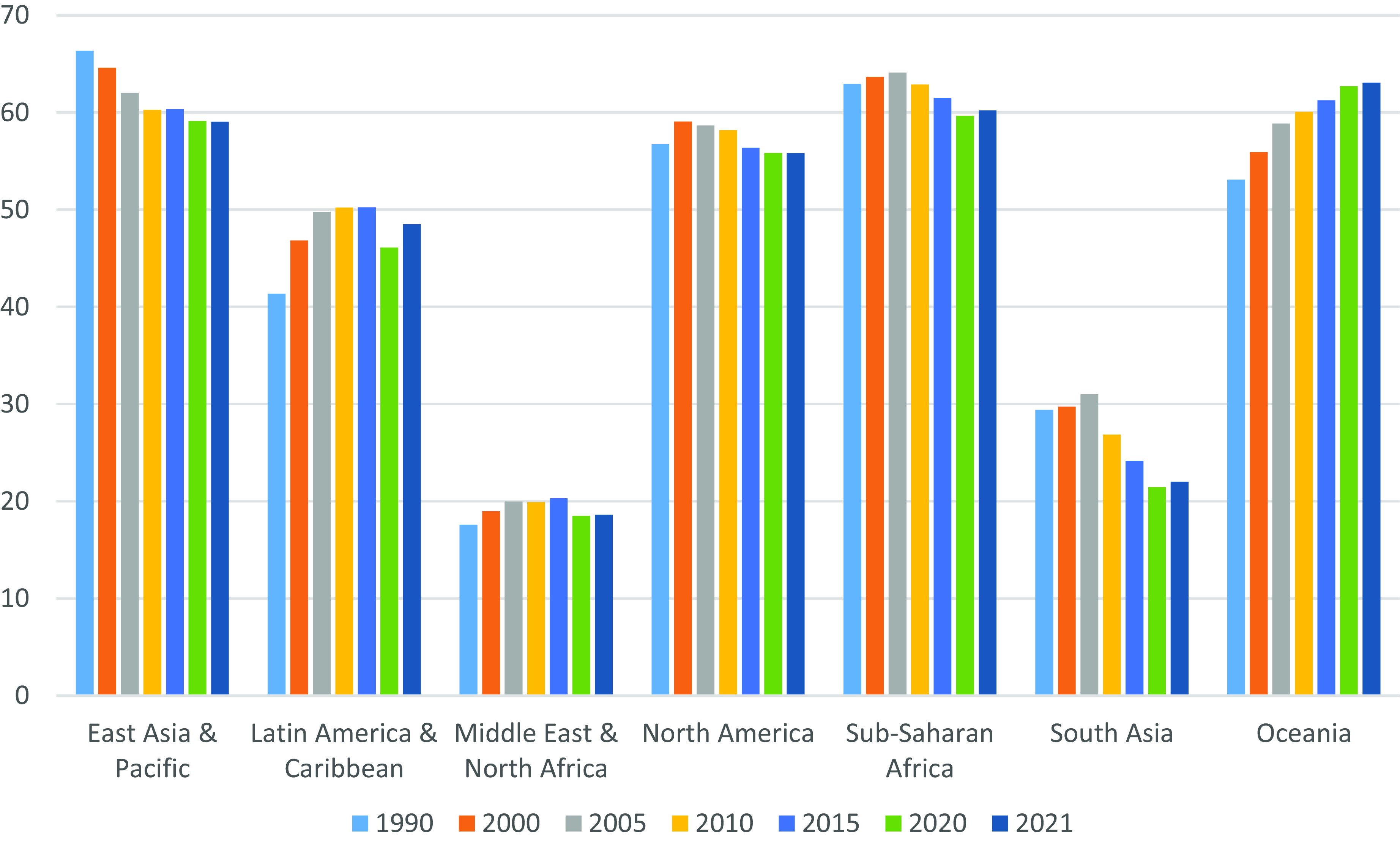
A second risk of women’s economic power initiatives is the predominant focus on increasing female labour force participation (‘FLFP’). As shown in Figure 1, there is a substantial difference in FLFP rates in different regions of the world. While the East Asia and Pacific region and the South Asia region have seen a substantial drop in FLFP, Oceania, Latin America, and the Caribbean regions have seen an increase. Other regions have remained relatively stable.
Female labour force participation (%), by region, 15+, (modelled ILO estimate).
Source: World Bank Development Indicators (2023).
The labour force participation (e.g. the proportion of the working-age population who are in the labour market, employed or looking for work) rates of women and men vary by countries; globally, they are declining. Importantly, women’s rates of labour force participation are around 25% lower than men’s (World Bank 2023), with a bigger gap for women 25–54 years old (31%) (UN Women 2018). The persistent gap between women’s and men’s labour force participation is a result of multiple factors, including sociocultural gender discrimination (e.g. limited access to education, expectations that women doing the bulk of reproductive work in the home) and legal discrimination (formal restrictions on women holding paid employment) (Heilman and Caleo Reference Heilman, Caleo, Colella and King2018). Furthermore, paid work is not a choice for many women, especially those in difficult socio-economic situations. In a recent collection of empirical studies focused on women’s economic empowerment initiatives in Africa and South Asia, Grantham et al (Reference Grantham, Dowie and de Haan2021, 5) note that in low-income countries, ‘women’s labour force participation is impacted by household composition and tends to be driven by distress’. In low-income countries, women will often leave the labour market as soon as they can, in part because of the poor working conditions, in part due to gendered expectations about women’s role, and in part because of because of the expectation that women will undertake the bulk of unpaid work.
Although there is a desire to have ‘decent work’ for all, defined by the International Labour Organization (ILO) (2023) as ‘productive work for women and men in conditions of freedom, equity, security and human dignity’, in practice, this is not the case in many countries. Women, in particular, are more likely to work part-time, for lower wages. In high-income countries, the majority of part-time jobs are held by women (OECD 2024), leading to lower overall earnings, benefits, savings, and pensions (Foster and Ginn Reference Foster, Ginn and Shaver2018). Furthermore, for women with full-time employment, gender pay gaps continue to persist, averaging 13.5% for full-time work among OECD countries (OECD 2024) and 20% across the globe (ILO 2024b). Women are more likely to work in gender-segregated occupations such as care and service work, also impacting their wages.
Women (as with men) have a better chance of experiencing decent paid work if it is in the formal economy. Furthermore, paid work in the formal economy rather than the informal economy is more likely to improve women’s agency and voice (Kabeer Reference Kabeer2018). Only in rich countries are the majority of workers formally employed (82%) (ILO 2018a), whereas in many countries, decent work in the formal sector is not an option for the majority of women. In low- and lower-middle-income countries, a higher percentage of women are employed in the informal economy (ILO 2018b) where they are under the radar of labour laws to protect their rights. We explore this issue further below.
Informal work
Informal work is characterised as employment with low earnings, precarious and intermittent incomes, low human capital, and a lack of social and legal protections (Chen Reference Chen2012; Chen and Carre Reference Chen, Carré, Chen and Carré2020; Guven Reference Guven2024). The ILO (2018a) shows that globally, over half of workers are employed in the informal economy. Importantly, this number increases to 90% in low-income countries and 67% in emerging economies, creating greater economic vulnerabilities in already economically unstable conditions. Informal workers are also more susceptible to economic shocks (Guven Reference Guven2024). Globally, men do a higher percentage of informal work than women (63% versus 58%, respectively) (ILO 2018b). This is, in part, because men do a higher percentage of paid work overall. However, women do a larger percentage of informal work in low- and low-middle-income countries (92% for women compared to 87.5% for men). Women are more likely to hold a disproportionate number of the worst jobs within this sector. A model developed and tested by the Women in Informal Employment Globalizing and Organizing body shows that there is a hierarchy of earning and risk of poverty within the informal economy in which the most ‘at-risk’ workers are women (Chen Reference Chen2012). Women who work in the informal economy are employed in jobs with the greatest amount of precarity and vulnerability as home-based workers, domestic workers, and family workers (ILO 2018b).
In sum, the labour market context for most women in low- and middle-income countries means that the choice is most likely to be between no paid work or low-quality, insecure, poorly paid work, usually in the informal economy. This is at least in part because women do 75% of the unpaid work globally (ILO 2018b; UN Women 2024), and because informal work more often entails flexible hours, women end up in informal and precarious jobs (Woodroffe and Donald Reference Woodroffe and Donald2014). Women’s work in the informal sector, particularly in developing countries, may increase with the birth of children as their work needs to align with their caring responsibilities and to be close to home. Work also needs to provide flexibility of hours (Chopra and Zambelli Reference Chopra and Zambelli2017) in a context where there are few formal employment opportunities, supportive family policies, and poor public services to support mothers’ employment. Gammage et al (Reference Gammage, Joshi and van der Meulen Rodgers2020) note a lack of international, comparative data on employment in the informal sector, leaving the vulnerability that women experience while working in the sector unscrutinised at an international level.
Does women’s economic empowerment adequately consider unpaid reproductive work?
The third risk looks at unpaid reproductive work, also referred to as unpaid care work in the literature. Here we use the terms unpaid reproductive work and unpaid care interchangeably to explore the unpaid care and household work involved in caring for the young, the old, and the sick. Globally, women spend twice as much time on household work and four times as much on childcare in comparison to their male counterparts (Seedat and Rondon Reference Seedat and Rondon2021; ILO 2024b; UNDP 2024). Estimates have women performing three-quarters of the unpaid work across the globe, some 11 billion hours a day (ILO 2018a; UNDP 2024). There is a strong bidirectional link between women’s unpaid care work and their participation in paid employment with the former creating veritable constraints to their participation in the latter and the latter affecting ‘the quantity, quality and outcomes’ of the former (Chopra and Zambelli Reference Chopra and Zambelli2017), as well as diminishing women’s overall wellbeing (Seedat and Rondon Reference Seedat and Rondon2021). International estimates indicate that if unpaid care was attributed to a dollar amount, the economy of unpaid care would be approximately 9% of GDP worldwide (ILO 2018a; UNDP 2024).
Because unpaid care is performed privately, it has often been overlooked in policy discussions, but this is changing. Various international organisations such as the ILO, the United Nations Development Programme, and UN Women recognise the importance of the care economy (e.g. ILO 2024a; UNDP 2024; UN Women 2024). These and other stakeholders point out the importance of high-quality care for children, persons with disability, and the elderly – indeed such care is foundational to social reproduction as Chopra and Krishnan (Reference Chopra and Krishnan2022) have argued. Feminist scholars and advocates have noted that the disproportionate amount of unpaid care work done by women is a significant factor, perhaps the most significant factor, in creating the conditions to sustain gender inequality. Elson (Reference Elson2017) asserts that unpaid work needs to be recognised, reduced, and redistributed, while Chopra (Reference Chopra, Grantham, Dowie and de Haan2021) notes that well-funded public services and decently paid work are first necessary to achieve this.
Ruiz-Castro et al (Reference Ruiz-Castro, Grau-Grau, Lupu, Daskalaki and McGinn2024, 1) assert that the unpaid reproductive labour that underscores productive labour (i.e. paid work) ‘is not self-regenerating or self-sustaining’, and that for women to achieve equality, attention must be paid to reproductive work in addition to productive or paid work. Gammage et al (Reference Gammage, Joshi and van der Meulen Rodgers2020, 14) highlight that women’s economic empowerment is ‘manifest in their choice of where and when to work, and under what terms and conditions, is intimately linked to reproductive empowerment and the choice about the timing, spacing, and number of births’. Additionally, the social relations between home, work, and other institutions that sustain productive labour must be recognised (Bhattacharya Reference Bhattacharya and Bhattacharya2017). The largely invisible work of reproductive labour must be made visible. Ruiz-Castro et al (Reference Ruiz-Castro, Grau-Grau, Lupu, Daskalaki and McGinn2024) argue that there are three processes that sustain productive labour: the unpaid work that rejuvenates the worker outside of productive work such as feeding, care, rest, and affection; unpaid work that sustains and provides care for non-workers (i.e. care of the young, old, and sick); and reproductive work to produce future workers (i.e. the work of pregnancy and childbirth). Social reproduction also includes socialisation, producing and reproducing culture, and environmental care (Ruiz-Castro et al Reference Ruiz-Castro, Grau-Grau, Lupu, Daskalaki and McGinn2024; Bhattacharya Reference Bhattacharya and Bhattacharya2017; Ferguson Reference Ferguson2020). In countries with support for women’s reproductive health (i.e. control over fertility, access to healthcare, and access to high-quality childcare), the likelihood of economic empowerment through employment is enhanced, although by no means assured. In countries that lack reproductive empowerment (i.e. lack of control over fertility and lack of support for maternal healthcare and child raising), women are more likely to be employed in the informal employment sector where they experience job precarity, minimal or no labour protections, and low paid jobs (ILO 2018a).
The combination of unpaid household and care work of family members has a number of impacts. Unpaid work puts an extra load on women, which is associated with decreased health and wellbeing outcomes (Seedat and Rondon Reference Seedat and Rondon2021; Chopra Reference Chopra, Grantham, Dowie and de Haan2021). In their systematic review, Magana et al (Reference Magaña, Martínez and Loyola2020) compared the health outcomes of caregivers and non-caregivers in Asia, Africa, and South America. They found that unpaid caregivers had higher rates of symptoms of depression and anxiety in comparison to those who were not caregivers in low- and middle-income countries. Unpaid work also has repercussions on the extent and intensity with which women engage in paid work. The lopsidedness in the gendered distribution of paid and unpaid work, particularly for mothers, has substantial implications for women’s economic independence and economic empowerment. UN Women (2024) state that globally, men earn double what women earn, and that women’s total share of income is below 35%.
The role of unpaid work in the impact of women’s opportunities and outcomes in paid work is significant. In high-income countries, professional women are more likely to change their ambitions from a career trajectory to an employment trajectory that includes part-time work in a ‘job’ (Becker and Moen Reference Becker and Moen1999) or pay lower-income women (often racialised) to perform unpaid work in their homes. Lower-income women in high-income countries are less likely to be securely attached to the labour market, but rather work in precarious jobs with lower pay, fewer benefits, poor job security, and little chance of upward progression (Vosko et al Reference Vosko, MacDonald and Campbell2009). In low-income countries with fewer labour laws and fewer family policies, women are more likely to move into the informal labour market in order to increase their flexibility (Chen Reference Chen2012). Thus, the role of unpaid work in women’s paid work lives cannot be overstated. Care work and household work (as well as the procurement of water and fuel in some countries) have substantial impacts on the trajectory of women’s economic empowerment across the globe.
Discussion: women’s economic empowerment: a pathway forward?
In this article, we have endeavoured to explore the benefits and risks of women’s economic empowerment with a critical-feminist lens to ask: to what extent does women’s economic empowerment advance the social development goal of gender equality and lead to improvement in the lives of women? In addition, we endeavoured to explore the extent to which the focus of women’s economic empowerment has an individualised or a collectivist orientation. We have reviewed evidence that shows that while women’s economic empowerment clearly benefits economies, the evidence for how it benefits individual women, or advances the goal of gender equality, is equivocal, at best. In their meta-analysis, which looked at the extent to which women’s economic empowerment promotes human development in low- and middle-income countries, Balasubramanian et al (Reference Balasubramanian, Ibanez, Khan and Sahoo2024) found that women who were part of women’s economic empowerment interventions did better in measures of income, employment, and savings and had more money for education and health. Importantly, however, the effects were modest. Notably, women’s economic empowerment interventions had little to no impact on women’s subjective wellbeing and poverty reduction. The authors indicated that their findings were unclear regarding the extent to which opportunities to generate income for women led to any increases in control over resources. The authors identified childcare responsibilities and gender norms as significant barriers for women.
Earlier feminist aspirations of empowering women through increasing their power and agency in familial, social, and political spheres have shifted to a focus on the economic empowerment of women, primarily through increasing women’s involvement in market activities. International funding agencies and governments targeting the Global South have been particularly interested in this concept, although there is evidence of these shifts in the Global North as well. Although striving for macro-level economic changes, women’s economic empowerment tends to have a micro, individualised emphasis, preoccupied with moving women into paid labour markets, through formal employment, informal employment, and micro enterprises. While on the surface this looks attractive, especially to policymakers who intend on creating macro-level economic improvements to national economies, the reality is that it is contingent upon the labour of individual women, often in poor working conditions with poor wages. Further, a focus on women’s market involvement often constrains women’s choices and time in the personal sphere. Such moves are typically not accompanied by the provision of adequate structures or resources to replace the unpaid reproductive work that women provide in their families and communities. Consequently, additional burdens are often added to women’s lives, rather than economically empowering them. The impact of social norms should also be acknowledged as unpaid care is rarely redistributed within families to men but instead to younger daughters and older women (Chopra and Zambelli Reference Chopra and Zambelli2017).
Jenson (Reference Jenson2009) cites Nelson and Chowdhury (Reference Nelson and Chowdhury1994, 13) who ask: ‘Can a society have equality, even equality of opportunity, without a social commitment to distributive justice that understands the sex-gender organisation of life?’ Balasubramanian et al’s (Reference Balasubramanian, Ibanez, Khan and Sahoo2024) review and our analysis of the benefits and risks of women’s economic empowerment to date suggest that gender inequality – including gender discrimination, oppressive gender norms, and gender blindness in policies focused on labour market attachment in any job – is central to the current organisation of paid and unpaid work. Therefore, the answer to Nelson and Chowdhury’s question is ‘no’. Any policy attempt to meaningfully address gender equality must commit to fully understanding the context of women’s lives and factor that into policy solutions that will increase their power and agency. The risks of women’s economic empowerment are considerable for women if major policy actors, including governments and non-governmental organisations, do not recognise the context and diversity of women’s lives.
Economic empowerment for women cannot be attained without a full understanding of the social, political, legal, economic, and geographic contexts in which women live. In contexts in which gender norms and policy platforms limit women’s access to reproductive rights, education, opportunities, and social mobilities, economic improvements in their lives will be stifled. In political, legal, social, and economic environments that necessitate women’s paid work for survival but do not provide fair wages, safe working conditions, or recognition of women’s time constraints due to contributions to unpaid work, women will not thrive. In other words, the social, political, legal, and economic contexts of women’s lives must not only be acknowledged but also changed for women’s economic empowerment to be attained. The current realities of women’s lives in many country contexts point to the need for comprehensive strategies that address the social and structural factors that shape women’s lives to enhance their individual and collective economic empowerment.
To this end, UN Women has provided a blueprint for how this might happen in their 2024 Women’s Economic Empowerment Strategy. In this strategy, UN Women places an emphasis on rights and transformative elements in their definition of economic empowerment for women. Importantly, the focus is on ‘just, equitable, and prosperous’ economic systems that provide access to social and economic rights for all women. The emphasis on systems suggests a structural focus on change rather than an individual one. Furthermore, the strategy clearly outlines the linkages between social and economic systems, recognising that economic improvements will only happen for women within a context of enhanced social, legal, and political rights. The strategy also names patriarchy as a key barrier to gender equality and connects patriarchy to economic disempowerment. UN Women clearly makes linkages between women’s economic vulnerability and unequal power relations within households and larger social structures. They argue that ‘new ways of thinking are needed’ (UN Women 2024) and that the key to rewriting the way that we understand solutions to women’s economic wellbeing, is understanding and accounting for the ways in which economic systems produce intersecting forms of discrimination, including gender discrimination. Furthermore, they indicate that the contributions of paid and unpaid care work must be recognised, advocating for transformational care systems. Finally, they call for an overhaul of structures that ‘perpetuate gender and economic inequalities and the subordination of women in public and private life’ (UN Women 2024)
From a critical-feminist perspective, the language and direction of UN Women’s strategy to create women’s economic empowerment are encouraging. This strategy suggests a plan that moves away from individualised, decontextualised solutions to contextual ones. Rather than a preoccupation with individual human capital and labour market attachment in any job, no matter how poor quality or poorly paid, this plan recognises the need for collectivist approaches to transform systems and structures to provide enabling contexts for women’s lives. Furthermore, recognition of the critical importance of care for individuals, families, and economies, and the need for transformation in care systems, again takes the focus away from individual actions. Rather, it shows the importance of changing the conditions and institutions in which women live.
UN Women offers an example of a comprehensive strategy to shift women’s economic empowerment towards strategies that focus on systemic change. In this light, critical-feminist approaches can be used to shift policy thinking and therefore shift policy action. Critical- feminist research seeks to ‘make the voices of marginalised groups heard by identifying and creating evidence of those who are rendered invisible by contexts that exclude’ (Keating et al Reference Keating, Eales, Phillips, Ayalon, Lazaro, de Montes Oca, Skinner, Winterton and Walsh2021, 61). Not everyone has the capacity or the opportunity to be able to change the contexts in which they live (Keating et al Reference Keating, Eales, Phillips, Ayalon, Lazaro, de Montes Oca, Skinner, Winterton and Walsh2021). Therefore, governments, non-governmental organisations, and think tanks have a responsibility to gather evidence and provide solutions that include the voices of those most impacted by large systemic and societal issues. For these reasons, a critical-feminist perspective is a useful framework to analyse the extent to which mainstream ideas about women’s economic empowerment contribute to gender equality and enhanced wellbeing for women.
Conclusion
As Canadian policy scholar, Keith Banting (Reference Banting2005), said of welfare reform: ‘Whenever a set of ideas gains such predominance, it cries out for evaluation’. In this article, we have endeavoured to provide a critical-feminist analysis of the global focus on women’s economic empowerment. We have shown that the mainstream discourse of women’s economic empowerment has been adopted by national, supranational, and international bodies too readily, and without interrogation of what it means for women’s lived experiences. In identifying the risks of an individualised, economic focus on women’s economic empowerment, we have pointed out the pitfalls of instrumentalist and maternalist approaches to women’s economic empowerment, the risks associated with an approach that ‘any job is a good job’ entails, and the importance of carefully considering the contributions of unpaid reproductive work. In outlining these risks, we have shown how a more contextually informed understanding of empowerment is needed. UN Women’s newest Strategic Plan suggests an orientation in that direction, providing an example of hope for a more collectivist, feminist, and transformative approach to women’s economic empowerment in future iterations of the concept and in the international policy platform. Using such an approach provides a pathway towards achieving Sustainable Development Goal 5, gender equality, enhancing the lives of women worldwide.
Acknowledgements
We are deeply grateful for the excellent research assistance provided by Ms Alison Williams and wish to acknowledge her contributions to revising this article. We also want to thank the anonymous reviewers for their very comprehensive feedback and the guest editors for their guidance, both of which have helped to strengthen the paper. All errors remain the responsibility of the authors.
Funding statement
Support for the research and authorship of this article was received from Supports for the Advancement of Scholarship, University of Alberta.
Competing interests
The author declared no potential conflicts of interest with respect to the research, authorship, and/or publication of this article.
Rhonda Breitkreuz is Professor and Chair in the Department of Human Ecology at the University of Alberta in Edmonton, Canada. Her research explores the ways in which social policies impact wellbeing, gender equality, and access to resources for individuals and families in both Canada and internationally.
Marian Baird is Professor of Gender and Employment Relations in the University of Sydney Business School. Her research examines women’s interaction with the labour market across the life course and the policies that enable or hinder gender equality.

 Open access

