




 Open access

Crossref Citations

This article has been cited by the following publications. This list is generated based on data provided by Crossref.
Jahnke, Annika
Beck, Aaron J.
Becker, Richard L.
Bedulina, Daria
Braun, Ulrike
Gerdts, Gunnar
Hildebrandt, Lars
Joerss, Hanna
Klein, Ole
Korduan, Janine
Laforsch, Christian
Lannig, Gisela
Leslie, Heather A.
Lips, Stefan
Menger, Frank
Nabi, Deedar
Oberbeckmann, Sonja
Primpke, Sebastian
Pröfrock, Daniel
Ramsperger, Anja F.R.M.
Römerscheid, Mara
Schmitt-Jansen, Mechthild
Scholz-Böttcher, Barbara M.
Tröppner, Oliver
Wendt-Potthoff, Katrin
and
Kühnel, Dana
2025.
Perspective article: Multisectoral considerations to enable a circular economy for plastics.
Journal of Hazardous Materials,
Vol. 496,
Issue. ,
p.
139326.
Gündoğdu, Sedat
Puckett, Jim
Gedik, Kenan
Terzi, Yahya
and
Öztürk, Rafet Çağrı
2025.
The Global Plastics Treaty must include strict global controls on plastic waste trade.
Cambridge Prisms: Plastics,
Vol. 3,
Issue. ,
Szollosi-Mota, Andrei
Suvar, Niculina Sonia
Prodan, Maria
Nalboc, Vasilica Irina
and
Toplician, Asimina Iuliana
2025.
DETERMINATION OF DIFFERENT HEAVY METALS CONTENT IN CHILDREN TOYS USING ICP-OES ANALYSIS METHOD.
Vol. 25,
Issue. ,
p.
69.
Walker, Tony R.
2025.
Recycling alone cannot end the plastic pollution crisis.
Cell Reports Sustainability,
Vol. 2,
Issue. 9,
p.
100521.
Landrigan, Philip J
Dunlop, Sarah
Treskova, Marina
Raps, Hervé
Symeonides, Christos
Muncke, Jane
Spring, Margaret
Stegeman, John
Almroth, Bethanie Carney
Chiles, Thomas C
Cropper, Maureen
Deeney, Megan
Fuller, Lizzie
Geyer, Roland
Karasik, Rachel
Mafira, Tiza
Mangwiro, Alexander
Matias, Denise Margaret
Mulders, Yannick
Park, Yongjoon
Velis, Costas A
Vermeulen, Roel
Wagner, Martin
Wang, Zhanyun
Whitman, Ella M
Woodruff, Tracey J
and
Rocklöv, Joacim
2025.
The Lancet Countdown on health and plastics.
The Lancet,
Vol. 406,
Issue. 10507,
p.
1044.
Carney Almroth, Bethanie
2025.
Plastic pollution is a worsening public health crisis, but there are solutions.
BMJ,
Vol. 391,
Issue. ,
p.
r2104.
Chen, Aiping
Saxena, Saumitra
Samaras, Vasilios G.
and
Dally, Bassam
2026.
A Tiered Multi-Technique Decision-Support Framework for Contaminant Screening and Recycling-Route Assignment of Mixed Plastic Waste.
Polymers,
Vol. 18,
Issue. 10,
p.
1256.
Abbasi, Golnoush
Heras Hernández, Miguel Las
Hauser, Marina Jennifer
Bourgé, Émilien
Harju, Mikael
and
Nikiforov, Vladimir
2026.
Towards safe plastic recycling: A novel framework for identifying chemicals of concern in plastic waste.
Environment International,
Vol. 209,
Issue. ,
p.
110177.
Carney Almroth, Bethanie
Ralston, Rob
Tilsted, Joachim Peter
Balayannis, Angeliki
Bertram, Michael G.
Olsen, Tara
and
Short, Damien
2026.
Protecting the right to science in multilateral environmental agreements addressing chemicals and plastics pollution.
The International Journal of Human Rights,
Vol. 30,
Issue. 5,
p.
890.
Morales-Caselles, Carmen
Booth, Andy M.
Baztan, Juan
Berget, Line-Marie
Carmona, Eric
Corcoll, Natàlia
Dirven, Hubert
Filella, Montserrat
Gómez-Martínez, Daniela
Herzke, Dorte
Hjertholm, Hege
Jahnke, Annika
Jepsen, Per Meyer
Kardgar, Azora König
Lorenz, Claudia
Negi, Neema
Rojo-Nieto, Elisa
Snapkow, Igor
Sørensen, Lisbet
Syberg, Kristian
Takada, Hideshige
Turner, Andrew
and
Carney-Almroth, Bethanie
2026.
Integrated Chemical and Hazard Assessment of Plastic Pellets from the Toconao Spill (Galicia, Spain) Indicates Potential for Environmental Harm.
Environmental Science & Technology,
Vol. 60,
Issue. 8,
p.
6696.
Bendtsen, Malthe Kjær
Møllebjerg, Andreas
Peña‐Díaz, Samuel
Graham, Rosie
Petersen, Nicolai Claus
Isaksen, Bjørk Nolsøe
Carstensen, Mathias
Johansen, Martin B.
Sommerfeldt, Andreas
Petersen, Allan R.
Chuma, Iddi Khamisi
Ryberg, Cecilie
Wittenborn, Thomas Rea
Gichuru, Virginia
Wang, Huabing
Scavenius, Carsten
Sandahl, Alexander
and
Otzen, Daniel E.
2026.
Environmental Identification of Novel Enzymes for Polyurethane and Polyamide Degradation.
Angewandte Chemie,
Mihai, Florin-Constantin
Gündoğdu, Sedat
Dignac, Marie-France
Grilli, Natalia de Miranda
Snekkevik, Vilde Kloster
and
Arias, Andres H.
2026.
Plastic Pollution in Aquatic Systems.
p.
513.
Bertoldi, Simone
Klaes, Simon
Claus, Stefanie
Marsans, Alex
Heipieper, Hermann J.
and
Eberlein, Christian
2026.
Cross-feeding drives degradation of phthalate ester plasticizers in a bacterial consortium.
Frontiers in Microbiology,
Vol. 16,
Issue. ,
Tian, Yuan
Wang, Jiayu
Lu, Jiaqi
Chan, Faith Ka Shun
Wu, Liqing
Gu, Dungang
Hu, Tingting
Li, Guanghui
and
Chen, Wei-Qiang
2026.
Uncovering Pathways Toward Circular and Low-Carbon Development of PET Plastics for Bottled Water in China by Material Flow and Carbon Footprint Analyses.
ACS Sustainable Chemistry & Engineering,
Vol. 14,
Issue. 13,
p.
6251.
Chen, Aiping
Saxena, Saumitra
Samaras, Vasileios G.
and
Dally, Bassam
2026.
Advanced Analytical Framework for Pyrolysis Product Characterization and Emission Profiling in Mixed Plastic Waste: Implications for Recycling Strategy.
Polymers,
Vol. 18,
Issue. 11,
p.
1381.
Bendtsen, Malthe Kjær
Møllebjerg, Andreas
Peña‐Díaz, Samuel
Graham, Rosie
Petersen, Nicolai Claus
Isaksen, Bjørk Nolsøe
Carstensen, Mathias
Johansen, Martin B.
Sommerfeldt, Andreas
Petersen, Allan R.
Chuma, Iddi Khamisi
Ryberg, Cecilie
Wittenborn, Thomas Rea
Gichuru, Virginia
Wang, Huabing
Scavenius, Carsten
Sandahl, Alexander
and
Otzen, Daniel E.
2026.
Environmental Identification of Novel Enzymes for Polyurethane and Polyamide Degradation.
Angewandte Chemie International Edition,
Impact statement
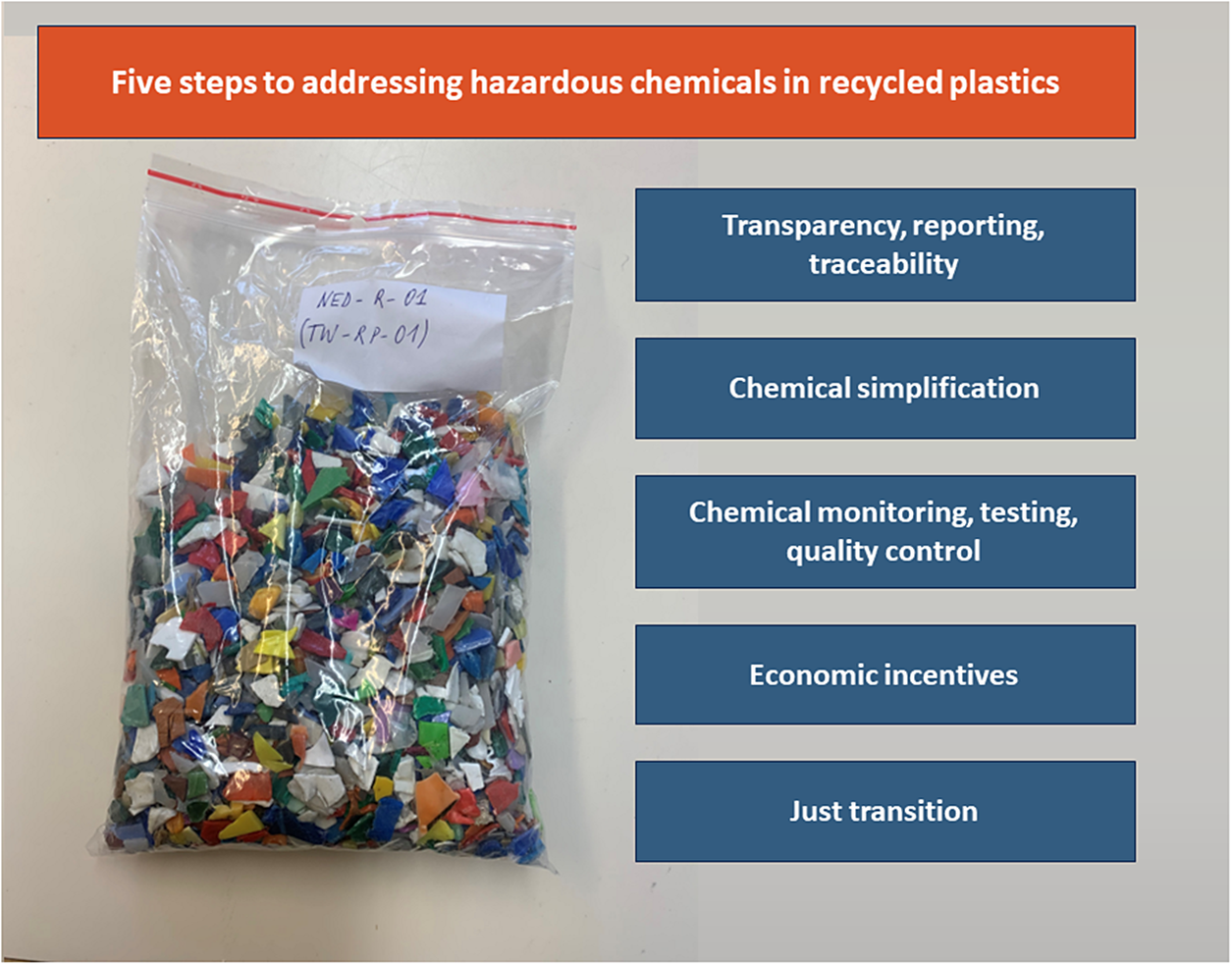
Plastics pollution is recognized as a major threat to the environment, with impacts on human health and well-being. While plastics recycling is often presented as the solution, this narrative is currently challenged by major issues, one of which is the presence of toxic chemicals in plastics. This includes substances intentionally added at various stages of the life cycle of a plastics item as well as nonintentionally added substances (NIASs). If we are to include recycling in the battery of solutions needed to address the plastics pollution crisis, several steps would first be needed in order to improve safety and sustainability of these practices. Global, regional and national policy changes are needed to support improvements throughout the plastics life cycle and will need to address chemicals at each of these stages. This article identifies five policy strategies to support this transition to safer, more sustainable plastics: 1) improved reporting, transparency and traceability of chemicals in plastics throughout their full life cycle; 2) chemical simplification and group-based approaches to regulating hazardous chemicals; 3) chemical monitoring, testing and quality control; 4) economic incentives that follow the waste hierarchy; and 5) support for a just transition to protect people, including waste pickers, impacted throughout the plastics life cycle. Adoption and implementation of these strategies will require ambitious action from various societal actors before recycling can contribute in a meaningful way to abating plastic pollution.
Introduction
Plastics production has already reached levels that are threatening the stability of Earth system functions, and current production levels exceed the safe operating space for humanity (Persson et al., Reference Persson, Carney Almroth, Collins, Cornell, de Wit, Diamond, Fantke, Hassellöv, MacLeod, Ryberg, Søgaard Jørgensen, Villarrubia-Gómez, Wang and Hauschild2022). The consequences of the plastics crisis in the environment and on human health are acknowledged as the nations of the world negotiate an international legally binding instrument (ILBI) building on the UNEA 5/14 resolution to govern plastics globally (UNEA, 2022).
Assuming a business-as-usual scenario, estimates suggests that the production of plastics may triple by 2060 (OECD, 2023a). This projected increase would have direct consequences for people and the planet and scientific evidence and modeling reports all indicate that primary plastics production reduction will be essential (Baztan et al., Reference Baztan, Jorgensen, Carney Almroth, Bergmann, Farrelly, Muncke, Syberg, Thompson, Boucher, Olsen, Álava, Aragaw, Bailly, Jain, Bartolotta, Castillo Aragi, Collins, Cordier, De-Falco, Deeney, Fernandez, Gall, Gammage, Ghiglione, Gündoğdu, Hansen, Issifu, Knoblauch, Wang, Kvale, Monsaingeon, Sangcheol, Morales-Caselles, Reynaud, Rodrígues-Seijo, Stoett, Varea, Velis, Villarrubia-Gómez and Wagner2024; OECD, 2024). Controls on production volumes would also be in line with the waste hierarchy as it would focus on the prevention and reduction of future wastes (European Waste Framework Directive 2008/98/EC (EU, 2018)).
However, to date, most policy focuses more downstream regulations. A recent inventory of the global plastics policy landscape identified 291 subnational, national and regional regulations addressing plastics (Diana et al., Reference Diana, Vegh, Karasik, Bering, Llano Caldas, Pickle, Rittschof, Lau and Virdin2022). Several of these policies target recycling, for example, via regulating labeling practices or mandating take back systems for specific products. In the European Union (EU), for example, several legislative initiatives of the EU support a circular economy and aim to increase recycling, but the EU currently has no regulations that call for reduction in primary plastics production at the top of the waste hierarchy and start of the plastics life cycle. Similarly, the EU Packaging and Waste Directive (94/62/EC; European Parliament, 2018 ; COM/2023/304; EC, 2023) calls for increased masses of recycled materials. The European Strategy for Plastics in a Circular Economy (COM/2018/028; European Commission, 2018) addresses design standards and production of plastics and products, highlighting reuse, repair and recycling and the need for more sustainable materials.
Data show that plastics recycling has repeatedly failed to operate in a safe and circular manner (Allen et al., Reference Allen, Spoelman, Linsley and Johl2024; Carroll, Reference Carroll2023). Estimates indicate that only 9% of plastics have been recycled (Geyer et el. 2017). This leaves a massive gap to the scenarios that highlight recycling as a means to curb plastics pollution, since those scenarios call for true recycling rates of 60% by 2060 according to the OECD (2023a). Another study shows that a seven-fold increase compared to 2019 baselines, with an increase to 95% collection rates and 15–68% recycling rates, would be required (Shiran et al., Reference Shiran, de la Fuente, Ragot, von Boetticher, Fuchs, Mauth, Lingeswaran, Hahn and Stein2023).
There are several challenges with plastics recycling. These include material complexity (e.g., materials containing multiple layers of different polymers and chemicals) and polymer degradation (e.g., degradation of polymer backbones; Ragaert et al., Reference Ragaert, Delva and Van Geem2017), lack of economic incentives (Larrain et al., Reference Larrain, Van Passel, Thomassen, Van Gorp, Nhu, Huysveld, Van Geem, De Meester and Billen2021), chemical contamination (Carmona et al., Reference Carmona, Rojo-Nieto, Rummel, Krauss, Syberg, Ramos, Brosche, Backhaus and Almroth2023), spread of microplastics (Stapleton et al., Reference Stapleton, Ansari, Ahmed and Hai2023) and energy inefficiency (Vogt et al., Reference Vogt, Stokes and Kumar2021). Scientists have therefore warned that policy initiatives focused on recycling technologies risk creating infrastructure “lock-in” and increased waste production (Syberg, Reference Syberg2022).
Mechanical recycling, the most commonly applied technology, is plagued by problems associated with decreasing material quality and increasing chemical contamination of the resulting materials (Gerassimidou et al., Reference Gerassimidou, Lanska, Hahladakis, Lovat, Vanzetto, Geueke, Groh, Muncke, Maffini, Martin and Iacovidou2022; Horodytska et al., Reference Horodytska, Cabanes and Fullana2020; Leslie et al., Reference Leslie, Leonards, Brandsma, de Boer and Jonkers2016). The technology entails collection of plastics wastes, sorting and separation into desired fractions (e.g., polyethylene, polypropylene or mixed plastics fraction), cleaning, grinding/chipping or fragmentation, heating and melting and then extrusion. This process normally involves mixing of different products and therefore, different cocktails of chemicals (Hahladakis et al., Reference Hahladakis, Velis, Weber, Iacovidou and Purnell2018). This mixing has, for example, been demonstrated in food-grade plastics, including polyethylene terephthalate (PET). Even though PET is often collected in separated waste streams, recycled PET can still contain >800 different food contact chemicals (Geueke et al., Reference Geueke, Phelps, Parkinson and Muncke2023). Other technologies than mechanical recycling exist, including so-called chemical recycling technologies, but currently do not work at scale, in part due to risks associated with chemical impurities in feedstocks, and these technologies have also been shown to cause high emissions of toxic chemicals (Al-Salem et al., Reference Al-Salem, Antelava, Constantinou, Manos and Dutta2017; Bell et al., Reference Bell, Gitlitz, Congdon and Rollinson2023; Quicker, Reference Quicker2024; Rollinson and Oladejo, Reference Rollinson and Oladejo2019; Uekert et al., Reference Uekert, Singh, DesVeaux, Ghosh, Bhatt, Yadav, Afzal, Walzberg, Knauer, Nicholson, Beckham and Carpenter2023).
Additionally, the regulatory initiatives that focus on increasing recycling rarely take chemicals in the plastics feed stock of recycled materials into account and may therefore risk causing further harm to human health and the environment. More than 16,000 chemicals are used in plastics production and products, and more than 4,200 of these were recently identified as having hazardous properties (Wagner et al., Reference Wagner, Monclús, Arp, Groh, Løseth, Muncke, Wang and Wolf2024).These include, for example, phthalates, bisphenols, brominated diphenyl ether (BDEs) and per- and polyfluoroalkyl substances (PFAS). The chemicals used in plastics products pose significant risks for human health (Trasande et al., Reference Trasande, Krithivasan, Park, Obsekov and Belliveau2024), and many of the chemicals have shown to leach during realistic use scenarios (Zimmermann et al., Reference Zimmermann, Bartosova, Braun, Oehlmann, Völker and Wagner2021). Still, less than 1% of plastic-associated chemicals are regulated internationally throughout their full life cycle (BRS, 2023).This regulatory gap is a significant challenge in managing chemicals in recycled plastics, especially since it is coupled with almost nonexistent transparency and traceability of chemicals.
The consequence is that it is rarely possible for downstream users, producers or recyclers to know anything about the chemicals used in the plastics that they encounter. In addition to chemicals that were in the original primary plastics materials, recent work shows that recycled plastics materials contain numerous other contaminants that likely sorbed to the materials during use, handling, processing or while the materials were out in the environment (if the plastics were collected from dump sites or the open environment; Carmona et al., Reference Carmona, Rojo-Nieto, Rummel, Krauss, Syberg, Ramos, Brosche, Backhaus and Almroth2023). These chemicals include various pesticides, pharmaceuticals and biocides, which renders the recycled plastics unfit for use in many products, especially in children’s toys and food contact materials. The complexities of the plastics life cycle, value chains, international trade and waste flows are plagued by a lack of transparency and reporting on the production of plastics and the use and presence of chemicals, resulting in complex materials containing complex mixtures of chemicals.
The right to knowledge and information has recently been highlighted as a human right to science in the context of toxic substances (Orellana and Wastes, Reference Orellana2021) and indicates that chemicals in plastics should be transparently reported, and trackable and traceable throughout the value chain. The importance of access to information on toxic chemicals is also highlighted under Article 9 of the Stockholm Convention on Persistent Organic Pollutants (POPs) which states that “information on health and safety of humans and the environment shall not be regarded as confidential” (UNEP, 2004). Existing EU regulations support this principle – in theory. For instance, Article 5 of the REACH legislation (EC, 2006) introduces the “no data, no market” principle – “substances on their own, in preparations or in articles shall not be manufactured in the community or placed on the market unless they have been registered in accordance with the relevant provisions.” However, a substantial amount of the REACH data are confidential and are therefore of only limited use for communicating chemical hazards and risk along the supply chain.
Therefore, beyond the limited efficacy of different recycling methodologies and practices, there are several concerns about consumers exposed to chemicals during the use of products and materials made from recycled plastics (Gerassimidou et al., Reference Gerassimidou, Lanska, Hahladakis, Lovat, Vanzetto, Geueke, Groh, Muncke, Maffini, Martin and Iacovidou2022; Geueke et al., Reference Geueke, Phelps, Parkinson and Muncke2023; Hawkins et al., Reference Hawkins, Potter and Race2015; Yang et al., Reference Yang, Ma, Thompson and Flower2018) and about the safety of waste pickers and other people working with plastics wastes and recycling. For workers, it has, for example, been shown that heavy metals were present in recycled plastics at or above the US EPA levels and that there was a clear exposure-risk association between heavy metals and worker health (Huang et al., Reference Huang, Xie, Li and Zhang2021). Waste pickers in Africa are exposed to hazardous materials including toxic chemicals (Binion and Gutberlet, Reference Binion and Gutberlet2012; Uhunamure et al., Reference Uhunamure, Edokpayi and Shale2021). Studies on materials and products made from recycled plastics have also shown that chemicals contaminate recycled materials, including food packaging and toys made from recycled plastics (Brosché et al., Reference Brosché, Strakova, Bell and Karlsson2021; Chibwe et al., Reference Chibwe, De Silva, Spencer, Teixera, Williamson, Wang and Muir2023; Gerassimidou et al., Reference Gerassimidou, Lanska, Hahladakis, Lovat, Vanzetto, Geueke, Groh, Muncke, Maffini, Martin and Iacovidou2022; Horodytska et al., Reference Horodytska, Cabanes and Fullana2020). The chemicals include POPs such as brominated flame retardants, benzotriazole UV stabilizers and PFAS and endocrine disrupting chemicals such as bisphenols. Aside from the safety concerns associated with toxic chemicals, some of the chemicals also pose physical challenges for the recycling process, for example, carbon black which complicates identification of plastic type (Rozenstein et al., Reference Rozenstein, Puckrin and Adamowski2017).
Given the challenges with plastic chemicals and recycling of plastics as it is currently conducted, it would be ill-advised to rely on recycling as a main solution to the plastics crisis. Instead, work needs to focus upstream and center on managing and decreasing production volumes, since reduction is at the center of the waste hierarchy and since the current production volumes are unmanageable, while simultaneously phasing out and eliminating toxic chemicals to allow for safer circular approaches. To move toward a circular economy and a safer, more sustainable, use of plastics, we must address toxic chemicals. We have identified several important areas for policy development: 1) improved reporting, transparency and traceability of chemicals in plastics throughout their full life cycle; 2) chemical simplification and group-based approaches to regulating hazardous chemicals; 3) chemical monitoring, testing and quality control; 4) economic incentives that follow the waste hierarchy; and 5) support for a just transition to protect people, including waste pickers, impacted throughout the plastics life cycle. These are developed below.
Improved reporting, transparency and traceability of chemicals in plastics throughout their full life cycle
A compulsory, globally standardized mandate that ensures transparent reporting of information regarding the chemicals used in plastics, including monomers, polymers, additives and nonintentionally added substances (NIASs) is an essential cornerstone for facilitating a safer and more sustainable reuse, refill, repurpose and recycling market. The ongoing negotiations for a future plastics treaty presents an opportunity to improve transparency and traceability through the implementation of suitable control measures.
To facilitate informed decisions regarding restrictions, bans and elimination of hazardous chemicals, it is important that a globally standardized public database with curated data on production and use of processing aids, additives and monomers and polymers within materials, products and their chemical constituents becomes publicly available. This inventory should encompass details about production and trade quantities of polymers and materials, along with the complete array of chemicals present in plastics products and materials throughout their complex value chains.
Such an approach will foster transparency and accountability and put the economic burden of generating information on producers and manufacturers. A system that systematically collects relevant information and makes them publicly available would be significantly more efficient than the current piecemeal production and publication of the necessary information by only a few companies, academic research projects and public authorities. The introduction of a universally standardized central data management system would not only cut down costs for individual nations but also ensure equal access to data globally. It would also simplify reuse, refill, repurposing and recycling of plastics as data availability will support increased safety of use of materials or products in these more downstream applications.
It is important to note that recycling practices may need to be sectorial to ensure that chemicals used for a specific purpose in one sector, for example, flame retardants in electronics, do not contaminate plastic streams in another sector, for example, toys or food packaging. Transparency and traceability, through labeling and other means of identification of chemicals used in the various plastics materials, would facilitate such sectorial recycling efforts.
Chemical simplification and group-based approaches to regulating hazardous chemicals
While there are thousands of chemicals used in plastics, the number of functions fulfilled by those substances is actually quite low. For example, a recent publication investigating the production and use of phenolic antioxidants in plastics (Orndoff et al., Reference Orndoff, Lone, Beymer-Farris, Wood, Sadler, Ternes, Hester, Miller and Seay2023) found that the large number of different chemicals in this group comprise only a limited number of functional groups. The slight variations in the side chains of the molecules are likely simply a means for different companies to compete for a given market segment. However, the resulting chemical complexity hinders testing, monitoring and tracing of chemicals in complex value chains. Thus, it is important to move toward more limited numbers of chemical molecules with simple structures, as Kümmerer et al. (Reference Kümmerer, Clark and Zuin2020) and Fenner and Scheringer (Reference Fenner and Scheringer2021) suggested in a chemical simplification concept.
To facilitate this transition, it is important that chemicals associated with plastics are not allowed to be used without publicly available data on their toxicity (see above, on data transparency). It is also important that the most hazardous chemicals are phased out and eliminated globally to ensure that future waste streams contain safer materials. Any new chemical coming onto the market to serve a particular function for which chemicals already exist should meet the requirements of proven lower toxicity and lower environmental persistence. Given the large number of chemicals in circulation and the current data gaps, the most suitable approach would be to use a group-based approach, which is an approach that has been used for several listings under the Stockholm convention (UNEP, 2024). These control measures could be developed under the Plastics Treaty. It is important to note that the regulation of chemicals under the treaty need to cover the full life cycle, so that it also includes production and recycling processes.
If implemented, this would result in a smaller number of chemicals, more readily traceable throughout the plastics life cycle, which would result in better control of chemicals in waste streams and ultimately in plastics recyclate.
Chemical monitoring, testing and quality control
Chemical simplification, together with mandatory reporting and transparency, will address chemical monomers, polymers and additives in plastics and products, but these policies will not prevent contamination of plastics during their use and waste phases. Even if waste streams are separated and new collection systems are supported, contamination of plastics with NIASs will occur, in particular during the use phase of the various plastic items, see the discussion of Carmona et al. (Reference Carmona, Rojo-Nieto, Rummel, Krauss, Syberg, Ramos, Brosche, Backhaus and Almroth2023) above. Therefore, analytical chemistry technologies will need to be developed in order to measure and assure that recycled materials are safe for their intended uses. New testing paradigms for improved safety need to be developed and implemented to address not only single chemicals but also the chemical mixtures present in the recycled materials. These methodologies for toxicity testing could include endpoints associated with noncommunicable diseases associated with exposure to plastics chemicals, as described in recent publication by Muncke et al. (Reference Muncke, Andersson, Backhaus, Belcher, Boucher, Carney Almroth, Collins, Geueke, Groh, Heindel, von Hippel, Legler, Maffini, Martin, Peterson Myers, Nadal, Nerin, Soto, Trasande, Vandenberg, Wagner, Zimmermann, Thomas Zoeller and Scheringer2023). This includes several cancers, metabolic and cardiovascular diseases, and reproductive and immunological disorders.
Development of new technologies can be costly and will require investments and capacity building, both of which should be supported by the future Global Plastics Treaty. However, it is important to acknowledge the high societal and health care costs associated with plastics chemicals (Trasande et al., Reference Trasande, Krithivasan, Park, Obsekov and Belliveau2024) and the potential benefits of implementing such requirements. Moreover, by increasing the transparency of chemicals throughout the full life cycle of plastics, the overall needs and costs associated with testing are expected to decrease and more targeted screenings can be done for NIASs.
Economic incentives that follow the waste hierarchy
While acknowledging the costs of a shift from the current production and consumption patterns of plastics to a safer and more sustainable system we must also recognize the costs of inaction. A recent publication estimates the global costs of action toward zero plastic pollution versus inaction, finding that costs of inaction might be significantly higher, though there are large uncertainties in the calculations (Cordier et al., Reference Cordier, Uehara, Jorgensen and Baztan2024). Beyond the hazardous properties of many plastic-associated chemicals (Groh et al., Reference Groh, vom Berg, Schirmer and Tlili2022; Landrigan et al., Reference Landrigan, Raps, Cropper, Bald, Brunner, Canonizado, Charles, Chiles, Donohue, Enck, Fenichel, Fleming, Ferrier-Pages, Fordham, Gozt, Griffin, Hahn, Haryanto, Hixson, Ianelli, James, Kumar, Laborde, Law, Martin, Mu, Mulders, Mustapha, Niu, Pahl, Park, Pedrotti, Pitt, Ruchirawat, Seewoo, Spring, Stegeman, Suk, Symeonides, Takada, Thompson, Vicini, Wang, Whitman, Wirth, Wolff, Yousuf and Dunlop2023; Sigmund et al., Reference Sigmund, Ågerstrand, Antonelli, Backhaus, Brodin, Diamond, Erdelen, Evers, Hofmann, Hueffer, Lai, Torres, Mueller, Perrigo, Rillig, Schaeffer, Scheringer, Schirmer, Tlili, Soehl, Triebskorn, Vlahos, vom Berg, Wang and Groh2023), and potential loss of ecosystem services and costs resulting from plastics pollution (Beaumont et al., Reference Beaumont, Aanesen, Austen, Börger, Clark, Cole, Hooper, Lindeque, Pascoe and Wyles2019; Cordier et al., Reference Cordier, Uehara, Jorgensen and Baztan2024), there are significant costs in human populations associated with adverse health outcomes and health care (Trasande et al., Reference Trasande, Krithivasan, Park, Obsekov and Belliveau2024).
There is a need for policy instruments that ensures that producers and other economic actors pay for the externalities caused by hazardous chemicals in plastics. Taxes, caps, fees, bans and extended producer responsibility regulations are examples of such instruments which, depending on the context, can be implemented to internalize the full costs of hazardous chemicals during the production, use and disposal of plastics (OECD, 2023b). When economic actors need to pay the full cost of pollution, this creates incentives for innovation and substitution to safer alternatives. However, improved transparency and access to information about hazardous chemicals in plastic products is a crucial prerequisite for the effective use of such instruments. The revised European eco-design regulation, mandating the use of digital product passports to track substances of concern throughout the life cycle of products and make this information available to consumers and waste management operators, is a positive development in this regard (European Parliament and Council of the European Union, 2024). The significant health, environmental and economic risks associated with plastic pollution are increasingly impacting insurance and investment portfolios. These risks – ranging from human health hazards to potential liability claims related to marine litter and plastic pollution – are expected to become increasingly relevant for insurers in the coming years (UNEPFI, 2019). Such policy changes will also affect private sector investments, which currently are primarily focused on downstream actions to reduce plastic pollution. Recovery and recycling receive 88% of investment capital, while only 4% is invested in reuse systems (Mah, Reference Mah2021; TCI, 2023). Public and private investments in reduce, reuse and redesign are essential to meet goals to prevent plastics pollution. Redesign could include redesigning for safer recycling, including phasing out hazardous chemicals and applying the concept of essential use (Cousins et al., Reference Cousins, Goldenman, Herzke, Lohmann, Miller, Ng, Patton, Scheringer, Trier, Vierke, Wang and DeWitt2019) to both chemicals and plastics, all of which would drive innovation and the potential for new marketable products. It is essential that funding is also invested in upstream mechanisms including product design at the polymer and chemical stage in order to facilitate circular initiatives in plastics production and consumption, including shifts to refill/reuse systems, and as a lower priority, recycling.
Support a just transition to support people throughout the plastics life cycle
A just transition should address environmental injustices throughout the plastics life cycle, including those caused by toxic chemicals, and should protect communities and Indigenous Peoples. Designing plastics that are safer, more durable and more sustainable would protect communities, including fence line and frontline communities, consumers and workers, including those in the informal waste sector.
Waste pickers account for 50–80% of recovery and recycling in the Global South, helping to uphold these systems while experiencing socioeconomic precarity alongside unhealthy working conditions and chemicals exposures (Dey, Reference Dey2020; Gidwani, Reference Gidwani2015; Gutberlet, Reference Gutberlet2023). While informal waste pickers are widespread in developing countries, they also exist in developed countries, and these individuals also suffer from social stigma, poverty and health and safety risks (Morais et al., Reference Morais, Corder, Golev, Lawson and Ali2022). Any circular transition must ensure safe working conditions and secure working contracts with rights and sufficient financial benefits to ensure sustainable livelihoods. Moreover, informal actors in waste-picking and recycling hold valuable practical and technical insights on the actual material complexities of plastic wastes (Dey, Reference Dey2022; Gill, Reference Gill2009). Many of these workers have previously recycled other materials, like glass, metals, paper, which can substitute plastics in many applications. As such, the practical expertise of material recovery agents and mechanical recyclers needs to be taken seriously, with provisions to include and reward their labor, enterprise, tacit knowledge and skills. By integrating the knowledge and skills of informal waste pickers alongside formal recycling systems, we can promote a more inclusive and sustainable approach to plastics management.
Conclusion
Plastics recycling is challenged by major issues, leading us to conclude that we cannot rely on recycling to end the plastics pollution crisis as things are done today. One of the major underlying reasons is the presence of toxic chemicals in plastics, either intentionally added or sorbed at various stages of the life cycle of a plastic item. The global Plastics Treaty negotiations should address these challenges with new policy obligations to support a future where recycling is safer and more sustainable. Improvements both upstream, midstream and downstream in the plastics life cycle are needed. A substantial reduction in the multitude of chemicals used in plastics manufacturing should be mandated in upstream interventions, in line with a “chemical simplification.” This effort should prioritize bans of chemicals known to be detrimental to both human health and the environment. Transparent reporting, tracking and monitoring of chemicals throughout the full life cycle will allow for safer and more sustainable systems, supporting reuse, repurposing and sectorial recycling. Downstream improvements in waste management infrastructure and strict regulations governing the discretionary use of recycled plastics must be enforced. The methodologies for implementing the strategies described here would be several and would require that changes in policy and best practices be adopted and implemented by several actors throughout the plastics value chain, including law makers, plastics producers, manufacturers, agencies responsible for monitoring and compliance, among others. Further development via multistakeholder dialogues and agreements together with education and support for implementation would support these efforts. Implementing these changes, together with appropriate economic investments would increase the safety of plastics, contributing to the transformation urgently needed.
Open peer review
To view the open peer review materials for this article, please visit http://doi.org/10.1017/plc.2025.1.
Author contribution
BCA and TK conceptualized the article; all authors contributed to the writing, reviewing and editing of the article. All authors have read and agreed to the published version of the manuscript.
Financial support
The authors thank the Swedish Research Council for Sustainable Development FORMAS (grant number 2021-00913) for financial support.
Competing interest
BCA is a non-remunerated steering committee member of the Scientists Coalition for an Effective Plastics Treaty. TB is an unpaid member of the board of the Food Packaging Foundation, a Swiss foundation working on the issue of plastics food packaging and plastics in general. The rest of the authors declare that they have no known competing financial interests or personal relationships that could have appeared to influence the work reported in this paper.