


The owl-faced monkey Cercopithecus hamlyni is categorized as Vulnerable on the IUCN Red List (Hart & Butynski, 2008). The species’ range is primarily the lowland forests of eastern Congo, restricted to a rainforest region bounded by the Congo River/Lualaba River in the west, the Lindi and Nepoko Rivers in the north, the Virunga Volcanoes in the east and by the forest savannah ecotone in the south (Colyn & Rahm, Reference Colyn and Rahm1987; Gautier-Hion et al., Reference Gautier-Hion, Colyn and Gautier1999) The Albertine Rift is the species' eastern limit and it survives there in only one, fragmented population restricted to a small area of c. 16 km2 of pure bamboo and a surrounding 16 km2 of bamboo–forest mix within Nyungwe National Park in south-west Rwanda. Other populations that existed (e.g. Gishwati Forest/Virunga Volcanoes, north-west Rwanda) have been extirpated (Hart & Butynski, Reference Hart and Butynski2008). The species may be declining in many areas because of uncontrolled commercial bushmeat trade across the major portion of the species' range in eastern Democratic Republic of Congo (DRC; Hart & Butynski, Reference Hart and Butynski2008). Human conflicts across large parts of its range in DRC add to the threats to this species (Hart & Butynski, Reference Hart and Butynski2008).
The localized distribution, cryptic colouration, secretive nature and predominantly terrestrial behaviour of the owl-faced monkey have meant this is one of the least-known of the African Cercopithecidae. It has proven difficult to survey and therefore there are no accurate population estimates across its range and the species’ conservation status remains unclear. Surveys in DRC, in Kahuzi-Biega National Park, indicate that the owl-faced monkey is widespread in that region (Inogwabini et al., Reference Inogwabini, Hall, Vedder, Curran, Yamagiwa and Basabose2000) and in the Ituri Forest (Thomas, Reference Thomas1991), although very low densities are usually recorded.
The owl-faced monkey was first discovered in Rwanda in 1989 in Nshili, in the southern sector of the present Nyungwe National Park (Gibson, Reference Gibson1992). A biodiversity survey carried out in 1999 failed to observe the owl-faced monkey and sightings of this species are rare (Plumptre et al., Reference Plumptre, Masozera, Fashing, McNeilage, Ewango, Kaplin and Liengola2002). Here we describe the first systematic assessment of the abundance, distribution and conservation status of the owl-faced monkey within the bamboo forest of this Park.
Nyungwe National Park (1,019 km2) is contiguous with Kibira National Park in Burundi and together they form one of the largest and most biologically important Afro-montane rainforest blocks in East Africa (Weber, Reference Weber1989; Vedder et al., Reference Vedder, Hall, Harcourt, Monfort, Wilson, Sayer, Harcourt and Collins1992; Plumptre et al., Reference Plumptre, Masozera, Fashing, McNeilage, Ewango, Kaplin and Liengola2002). Altitudinal range is 1,600–2,950 m, mean annual minimum and maximum temperatures 10.9 and 19.6°C, respectively, and mean annual total rainfall is 1,744 mm (Sun et al., Reference Sun, Kaplin, Kristensen, Munyaligoga, Mvuklyumwami, Kajondo and Moermond1996). There is a long dry season during July–August and a shorter dry season during December–January. The Park is rich in species and endemism and is well known for its primate diversity. At least 13 species of primate are known (20% of all African primate species), including the Endangered eastern chimpanzee Pan troglodytes schweinfurthii and the range-restricted L’Hoest’s monkey Cercopithecus l’hoesti. Our study focused on an area of 32 km2 of bamboo and mixed forest near Nshili at altitudes of 2,031–2,624 m. This bamboo forest extends southwards across the border with Burundi into Kibira National Park. This area is dominated by mountain bamboo Sinarundinaria alpina in either pure stands or intermixed with Macaranga kilimandscharica, Hagenia abyssinica and Polyscias fulva. Within the pure stands of bamboo there is often a dense herb under-storey of Mimulopsis spp..
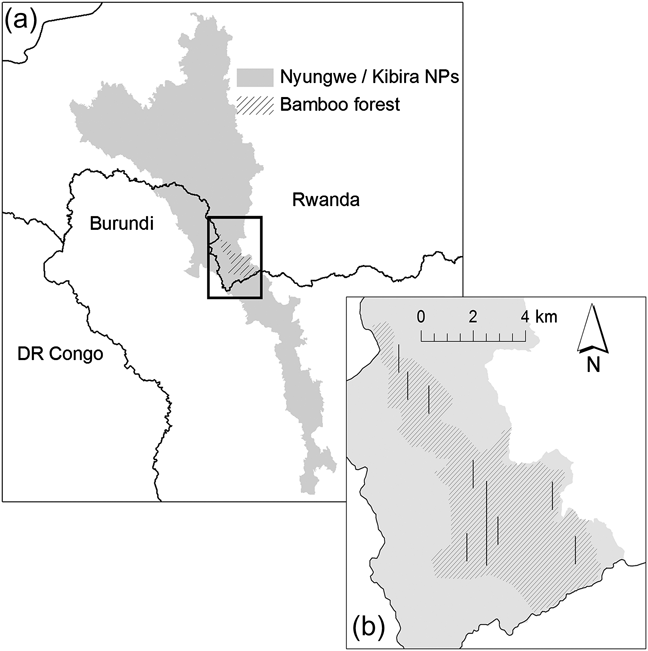
Eight 1 km north-south transects were randomly located in the bamboo forest (Fig. 1) using ArcGIS v. 9 (ESRI, Redlands, USA). These transects were surveyed 20–24 times each during June 2008–October 2009, with a 2-day minimum interval between repeats. An additional 3-km transect, used as part of a wider biodiversity survey of the Park, was surveyed four times. Survey methods broadly followed those of White & Edwards (Reference White, Edwards, White and Edwards2000). Two teams worked simultaneously and were composed of a principal observer responsible for animal sightings and a second observer who observed signs on the ground and recorded data. All observations of primates, together with associated vegetation types, were recorded. For all primate observations perpendicular distance from the transect to the group centre and number of individuals were recorded. Indirect observations (based on the distinctive boom calls of the owl-faced monkey) were also recorded.
(a) Nyungwe and Kibira National Parks (NPs) at the border between Rwanda and Burundi, respectively, and (b) the study area (rectangle on (a)) in the bamboo forest in Rwanda, showing the position of the nine transects (b).
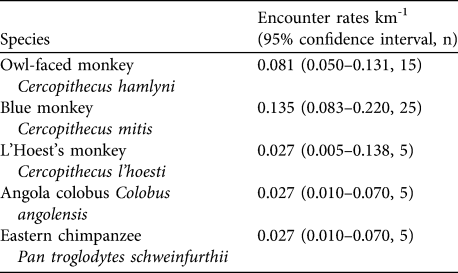
A total of 15 direct observations of owl-faced monkey groups were made. Group size is considered a minimum count and ranged from single individuals (n = 5) to a maximum of 11 (n = 1). Apart from single observations of groups of 10 and 11 individuals all group counts were of 5 or fewer (mean group size 3.6). These observations were made along a total of 185 km of transects, giving an encounter rate of 0.081 groups km-1 (95% confidence interval 0.05–0.131). Other primate species observed along the transects included blue monkey Cercopithecus mitis, L’Hoest’s monkey, chimpanzee and Angola colobus Colobus angolensis (Table 1).
Group encounter rates with diurnal primates along a total of 185 km of surveyed transects in the bamboo zone of Nyungwe National Park (Fig. 1) in 2008–2009.
In addition eight auto-triggered cameras were randomly positioned in the bamboo zone. A total effort of 182 camera days produced eight photographs of the owl-faced monkey from five cameras. Six blue monkeys, two blotched genets Genetta tigrina, a L’Hoest’s monkey and a chimpanzee were also photographed.
Nyungwe National Park implements ranger-based monitoring. Data collected during 2003–2009 within the bamboo zone provide an average combined encounter rate of direct and indirect observations of the owl-faced monkey of 0.051 groups km-1 (n = 78 groups, effort of 1,557 km) with a mean group size of c. 5.3 individuals. Elsewhere, studies have found group sizes from c. 2–3 (Hall et al., Reference Hall, White, Williamson, Inogwabini and Omari2003; Hart & Butynski, Reference Hart and Butynski2008) to 10 (Gautier-Hion et al., Reference Gautier-Hion, Colyn and Gautier1999; Kingdon, Reference Kingdon2003), and another research project in Nyungwe National Park counted a minimum of 22 individuals in a semi-habituated group as they crossed a forest path (Ntare, Reference Ntare2007). Density estimates report c. 5–7 individuals km-1 (based on vocalizations in the lowlands of Kahuzi-Biega National Park; Hall et al., Reference Hall, White, Williamson, Inogwabini and Omari2003) to c. 0.1 individuals km-1 in other areas of eastern DRC (Thomas, Reference Thomas1991; Gautier-Hion et al., Reference Gautier-Hion, Colyn and Gautier1999).
Despite intensive surveying we made limited direct observations of the owl-faced monkey. This suggests that this species is either present at low densities or that its flight distance is greater than the distance of detection, or both. Our results highlight the secretive nature and the difficulty in estimating population densities of this little-known species.
Estimates of primate group size from line transects are usually unreliable because of the limited time that the observers spend with each group and large group-spreads (Plumptre, Reference Plumptre2000; Plumptre & Cox, Reference Plumptre and Cox2006). A pilot sweep survey of 0.7 km2 within the bamboo forest resulted in a single group observation of a minimum of nine individuals, observed simultaneously by two teams on adjacent transects 50 m apart, illustrating the extent of spread of a group across the forest floor. The dense bamboo forest and terrestrial nature of the owl-faced monkey results in group size being underestimated from line transects.
Although the owl-faced monkey has been observed outside the bamboo forests, the majority of anecdotal observations have been within bamboo habitat or at its periphery. During an intensive biodiversity survey across Nyungwe National Park in 2009 the owl-faced monkey was only observed within the core bamboo forest (N. Chao et al., unpubl. data). This may indicate a preference for bamboo forest within the Park and thus the importance of this habitat for protecting the species. Apparent preference of the owl-faced monkey for bamboo habitat in this Park is not apparent in the lowland forests of eastern DRC, and the reasons behind the primate’s restricted range within Nyungwe National Park requires further research.
The bamboo forest is used by a number of mammal species, including at least five species of primates. However, this vegetation type is under great pressure from the surrounding human population. District development plans undertaken in 2008 indicate that districts bordering Nyungwe National Park have a mean density of 320 people km-2. Results from ranger-based monitoring showed bamboo cutting was consistently the most frequently encountered human activity (0.803 incidences km-1 in 2009; mean 2003–2009 = 0.828 km-1). In 2009 this was followed by traps (0.3 km-1), fires (0.01 km-1) and tree-cutting (0.006 km-1).
Threats come from both Rwanda and Burundi and the difficulty of controlling cross-border movements in the area means that addressing human activities within the Park is complex. Of particular concern is the ongoing illegal cutting of bamboo for construction, basket weaving and roofing. Alongside this, the owl-faced monkey is a terrestrial primate and the increase in the encounter rate of traps, found by ranger-based monitoring, is another threat. Recent discussions between Park and NGO staff and ex-poachers around the Park suggest a growing trend of targeting primates for bushmeat.
This study provides baseline data on the relative abundance and distribution of the owl-faced monkey and the level of current threats in Nyungwe National Park, essential elements for long-term monitoring. The development of an action plan for the owl-faced monkey in Rwanda has been recommended and the steps needed to achieve this outlined (Easton & Ntare, Reference Easton and Ntare2008). The National Park authority has plans to expand research on this species and, to reduce the pressure of illegal harvesting of bamboo, has been supporting communities in planting bamboo outside the Park. Improved law enforcement and habitat protection in the area is being addressed in part by the initiation of a transbounday conservation project between Nyungwe and Kibira National Parks. Continuing conservation efforts, strict law enforcement and deployment of alternatives to extraction of natural resources within protected areas are crucial for biodiversity conservation in this region and especially for the long-term survival of the last remaining population of the owl-faced monkey in Rwanda.
Acknowledgements
This study was funded by the GEF–UNDP Protected Areas Biodiversity Project in Rwanda and the Wildlife Conservation Society (WCS) and was undertaken in collaboration with Rwanda Development Board (RDB) Tourism & Conservation and Rwanda Environment Management Authority. We are grateful to the Projet Conservation de la Foret de Nyungwe staff, especially Martin Sindikubwabo, Venerand Ngirababyeyi, Augustin Ntamunoza, Jacques Hakizimana and Francois Nkurunziza for their fieldwork, RDB and the park rangers, and the head of patrol post, Ladislas Nkurikiyimana, for the collection and use of ranger-based monitoring data, Eugene Kayijamahe for GIS support, the WCS Rwanda Program, Nyungwe Forest Conservation Project and RDB for their support, and anonymous reviewers for valuable comments.
Biographical sketches
Julian Easton was a consultant for Wildlife Conservation Society (WCS)–Rwanda, with research interests in wildlife management issues. Nerissa Chao is the Director of Projet Conservation de la Foret de Nyungwe (PCFN) for the WCS–Rwanda programme, with interests in conservation management orientated research. Felix Mulindahabi is head of research and monitoring in Nyungwe National Park for the PCFN–WCS Rwanda programme, with a focus on the application of GIS to conservation issues. Nicolas Ntare is the research and monitoring assistant for the PCFN–WCS Rwanda programme, with research interests in primatology and tropical forest ecology. Louis Rugyerinyange is Chief Park Warden of Nyungwe National Park. Innocent Ndikubwimana is head of research and monitoring for Nyungwe National Park.



