





Nutritional epidemiological studies increasingly focus on overall dietary intake in place of the intake of individual foods or nutrients(Reference Hu1). One example approach is the use of diet quality scores to summarise dietary intakes based on predefined criteria. A number of scores have been developed and are now considered an important approach to evaluating overall dietary intake(Reference Wirt and Collins2,Reference Burggraf, Teuber and Brosig3) . Findings to date have associated higher diet quality with lower mortality and risk of non-communicable diseases such as CVD and type 2 diabetes mellitus in various populations(Reference Miller, Webb and Micha4–Reference Soltani, Jayedi and Shab-Bidar6). Assessing diet quality is an essential first step in improving diet quality and health in various settings, such as nutritional counselling and policy development(Reference Bailey7,Reference Vadiveloo, Lichtenstein and Anderson8) .
Diet quality is typically assessed by using dietary recalls, dietary records (DR) and FFQ(Reference McAuley, MacLaughlin and Hannan-Jones9,Reference Lim, Neelakantan and Lee10) . Dietary recalls and DR provide detailed information on consumed foods and their preparation methods, but are burdensome for participants and require multiple days of assessment to estimate usual intake(Reference Baranowski, Willett and Willett11). FFQ are generally less burdensome than dietary recalls and DR but usually consist of 50–200 question items and require more than 15 min to complete(Reference Cade, Thompson and Burley12,Reference Matsumoto, Murakami and Yuan13) . These methods are sometimes impractical in time-limited settings(Reference Bailey7). In fact, lack of time and limited access to rapid tools remain major barriers to dietary assessment in healthcare settings(Reference Vadiveloo, Lichtenstein and Anderson8). Additionally, time-consuming assessments are often difficult to implement in epidemiological studies, in which dietary habits are not primary exposures but nevertheless require adjustment when estimating the health impact of exposures.
Brief dietary screeners could overcome these barriers by serving as feasible substitutes for assessing diet quality in time-limited settings(Reference Bailey7). Although there are no criteria for the number of items included in screeners, a smaller number of items is generally more feasible in time-limited settings. To date, screeners with fewer than fifteen questions to assess diet quality have been developed in various countries(Reference Bivoltsis, Trapp and Knuiman14–Reference Paxton, Strycker and Toobert26). These typically aim to assess adherence to national dietary guidelines(Reference Bivoltsis, Trapp and Knuiman14,Reference Lara-Breitinger, Medina Inojosa and Li15) , the Mediterranean diet(Reference Ruggeri, Buonocore and Amoriello16–Reference Martinez-Gonzalez, Garcia-Arellano and Toledo18) and Alternate Healthy Eating Index(Reference Lafreniere, Harrison and Laurin19), as well as healthy dietary patterns for preventing some diseases(Reference Johnston, Petersen and Beasley20–Reference Chaplin, Nafria and Prohens22). Diet quality screeners can help identify individuals at risk of poor dietary quality during routine health checkups and encourage them to receive nutrition counselling(Reference Cade, Thompson and Burley12), as well as monitoring of diet quality after intervention or counselling(Reference Schroder, Fito and Estruch17).
Screeners which aim to discriminate between high and low diet quality related to health outcomes should be developed with consideration to evidence on diet-health associations(Reference Vadiveloo, Lichtenstein and Anderson8). To enhance reproducibility and ensure that future revisions reflect accumulated evidence, they should also report their evidence-based development processes. However, although the developers of many diet quality screeners have cited evidence on diet-health associations in their development process(Reference Lara-Breitinger, Medina Inojosa and Li15–Reference Martinez-Gonzalez, Garcia-Arellano and Toledo18,Reference Johnston, Petersen and Beasley20–Reference Kronsteiner-Gicevic, Tello and Lincoln24) , only a few have described in detail how the evidence was used in their development process, such as how score assignment was determined(Reference Lafreniere, Harrison and Laurin19,Reference Fresan, Boronat and Zazpe25) . In addition, while dietary habits in the target population should also be considered(Reference Cade, Thompson and Burley12), only a few screeners have incorporated dietary intake of the target population in their development(Reference Martinez-Gonzalez, Garcia-Arellano and Toledo18,Reference Lafreniere, Harrison and Laurin19,Reference Laviolle, Froger-Bompas and Guillo21) . To be a suitable tool for evaluating the diet quality of a population, screeners should be developed based on both evidence for diet-health associations and the dietary intake of the target population.
No screener that can be completed within a few minutes has yet been developed for assessing diet quality in Japan, a country with unique dietary habits such as lower intake of added sugars compared with Western countries and higher intake of fish, plant foods and sodium(Reference Murakami, Livingstone and Fujiwara27). These dietary habits and evidence on diet-health associations were used in the development of the Diet Quality Score for Japanese (DQSJ)(Reference Oono, Murakami and Fujiwara28,Reference Oono, Wada and Yamakawa29) . Although the DQSJ can be calculated using the brief-type self-administered diet history questionnaire (BDHQ)(Reference Oono, Murakami and Shinozaki30), the BDHQ includes more than fifty question items, takes 15–20 min to complete and requires complex scoring algorithms. A more rapid tool to assess the DQSJ would facilitate the assessment of diet quality in various time-limited settings in Japan. Here, we aimed to develop a DQSJ screener as a rapid tool for assessing diet quality in Japan and to describe its development process in detail.
Methods
In the Methods section, we provide an overview of the development process and the dietary data used in the development process. The details of the development process are described in the Results section.
Brief overview of the Diet Quality Score for Japanese
The DQSJ is described in detail elsewhere(Reference Oono, Murakami and Fujiwara28). Briefly, the DQSJ was developed based on well-established diet quality scores, associations of dietary intake with health outcomes and dietary intake in Japan. The DQSJ comprises 10 components, namely sodium and nine food groups: fruits, legumes, fish, nuts, whole grains, vegetables, dairy products, sugar-sweetened beverages (SSB) and red and processed meat. Each component is scored from zero to three points based on sex-specific quartiles of intake within the study population. For seven components (fruits, legumes, fish, nuts, whole grains, vegetables, and dairy products), participants in the highest quartile receive three points. For three components (SSB, red and processed meat, and sodium), participants in the lowest quartile receive three points. The total DQSJ was calculated by summing the component scores, resulting in a range from zero to thirty, with higher scores indicating higher diet quality. The DQSJ assigns equal weights to each component because evidence to determine appropriate weighting is insufficient in Japan(Reference Oono, Murakami and Fujiwara28). Additionally, optimal weighting may differ depending on the health outcomes, whereas the DQSJ was designed as a general diet quality index rather than one optimised for a specific disease. Alcohol consumption is not included in the DQSJ because it has often been considered a lifestyle factor rather than a dietary component(Reference Oono, Murakami and Fujiwara28).
General concepts of the screener and its development process
The primary aim of the DQSJ screener was to assess the DQSJ at both the population and individual levels. The secondary aim was to rank individuals according to their consumption of the ten components included in the DQSJ. The DQSJ screener was not intended to assess other dietary factors. We sought to design a screener with fifteen questions or fewer, considering the number of components of the DQSJ and the feasibility in time-limited settings (completion within a few minutes). While both one-month and one-year periods are commonly used as reference time periods in dietary assessment tools(Reference Matsumoto, Murakami and Yuan13), the DQSJ screener set the reference time period as the past month to capture dietary changes after interventions or counselling. Furthermore, we assumed that this period reasonably provides the usual diet quality, as seasonal variation in the intake of most food groups and nutrients is not obvious in Japan(Reference Adachi, Oono and Matsumoto31). The DQSJ screener was designed for use in the general adult population.
As shown in Figure 1, we developed questions and response options and assigned scores to the response options. These processes were mainly based on previous studies on diet-health associations(Reference Onni, Balakrishna and Perillo32–Reference Aune, Norat and Romundstad42) and data analysis of dietary intake derived from DR and dietary assessment questionnaires among 392 Japanese adults. In addition, we referred to existing screeners to assess diet quality and/or its components(Reference Bivoltsis, Trapp and Knuiman14,Reference Johnston, Petersen and Beasley20,Reference Kronsteiner-Gicevic, Tello and Lincoln24,Reference Fresan, Boronat and Zazpe25,Reference Moore, Connor and Burrows43,Reference Sasaki, Takada and Fukuma44) , previous studies on dietary assessment methods(Reference Molag, de Vries and Ocke45–Reference Tsubono, Kobayashi and Takahashi48), previous studies on dietary intake in Japan(Reference Imamura, Micha and Khatibzadeh49–51) and dietary guidelines in Japan(Reference Yoshiike, Hayashi and Takemi52) and the USA(53).
Overview of this study to develop the Diet Quality Score for Japanese screener.

Dietary data analysis to develop the screener
To determine the response options and score assignment, we considered consumption frequencies and intakes of the food groups included in the DQSJ. Consumption frequencies were calculated using diet history questionnaires, whereas intakes were assessed using DR. These data were obtained from a dietary survey conducted between February and March 2013 in twenty areas across twenty-three of the forty-seven prefectures in Japan. Details of the study procedures and participant information are described elsewhere(Reference Oono, Murakami and Fujiwara28,Reference Asakura, Uechi and Sasaki54,Reference Sugimoto, Murakami and Fujiwara55) . The present analysis included 392 adults aged 20–69 years who completed the 4-non-consecutive-day DR, the self-administered diet history questionnaire (DHQ) and the BDHQ. Participants also completed questionnaires on demographic characteristics and lifestyle factors, including body height and weight, smoking status and educational attainment. BMI (kg/m2) was calculated from self-reported height and weight. All survey procedures were approved by the Ethics Committee of the University of Tokyo, Faculty of Medicine (approval no. 10005, 7 January 2013). A specific sample-size calculation was not conducted in this study.
Consumption frequencies of the food groups were derived from the BDHQ and DHQ(Reference Kobayashi, Murakami and Sasaki46,Reference Kobayashi, Honda and Murakami56) . The DHQ is a 16-page semi-quantitative questionnaire that assesses the consumption frequency and portion size of selected foods to estimate the intake of 150 food and beverage items and nutrients during the past month. The BDHQ is a four-page fixed-portion questionnaire that estimates the intake of fifty-eight food and beverage items over the past month by asking about the consumption frequency of selected foods, without inquiring about portion size. In the BDHQ, the consumption frequency for most foods was assessed using seven categories: never, less than once per week, once per week, 2–3 times per week, 4–6 times per week, once a day and more than twice a day. The 4-day DR was used to estimate habitual absolute intake of food groups. The 4-non-consecutive-day DR, conducted after completing the BDHQ and DHQ, consisted of three working days and one non-working day and was generally completed within 10–14 d. Participants were instructed to weigh and record all food and beverages consumed, both at home and outside. Each food item was coded based on the Standard Tables of Food Composition in Japan, 2015(57) and then categorised according to the definition of food groups included in the DQSJ(Reference Oono, Murakami and Fujiwara28).
For each food group included in the DQSJ, participants were categorised according to the consumption frequencies assessed using the BDHQ, except for nuts. As nuts are not included in the BDHQ, frequency from the DHQ was used instead. For processed meat, red meat and SSB, consumption frequencies were assessed using one question from the BDHQ. For fruits, legumes, fish, nuts, vegetables and dairy, consumption frequency of each food group was derived by summing the frequencies of relevant food items (number of food items = 2–9, depending on food groups) in the BDHQ or DHQ (online Supplementary Table 1). Due to the absence of a single question on the overall consumption frequency of each food group, we used the summed frequency of relevant food items as a proxy, which is consistent with the method used to calculate food group intake in the BDHQ and DHQ. For whole grains, a question on rice type was used instead of the consumption frequency of whole grains. For each category of consumption frequency, we then calculated the mean and sd of intake for that food group derived from the 4-day DR.
To provide examples of popular food items for legumes, processed meat, whole grains and SSB, we described commonly consumed food items in the DR, in accordance with the food code in the Standard Tables of Food Composition in Japan, 2015(57). All analyses were performed using the SAS statistical software (version 9.4, SAS Institute Inc.).
Results
Study population and summary of dietary data
Table 1 shows characteristics of the present study population. Mean (sd) age and BMI of these 392 adults were 44·5 (13·4) years and 23·3 (3·6) kg/m2, respectively. The mean (sd) DQSJ calculated from 4-day DR was 13·0 (4·0). Table 2 presents the mean and sd of food group intakes derived from the 4-day DR across their consumption frequencies assessed using the diet history questionnaires. While mean intakes generally appeared to increase with consumption frequency, sd were large, indicating substantial variations in intake from the DR within each frequency category. These data were used in the development process described below.
Participant characteristics of the population used to inform development of the Diet Quality Score for Japanese screener (392 Japanese adults)

Mean and sd of food group intakes (g/day) across the consumption frequency categories among 392 Japanese adults and rationale for assigning scores in the Diet Quality Score for the Japanese screener

DQSJ, Diet Quality Score for the Japanese; SSB, sugar-sweetened beverages.
*The consumption frequencies of food groups were calculated by summing the consumption frequencies of individual food items listed in the brief-type self-administered diet history questionnaire (BDHQ), except for nuts, which were obtained from a self-administered diet history questionnaire (DHQ). The food items listed in the questionnaires are provided in online Supplementary Table 1.
†Intake derived from the 4-day dietary records.
‡Rationale for assigning the scores for sodium intake is described in the Results section.
§As red and processed meat was assessed using separate questions, the maximum score for each was 1·5.
||The BDHQ did not include frequencies of whole grains but included a question on whether individuals add whole grains to rice, with response options of never, rarely, sometimes and always.
¶The BDHQ asked about the consumption frequency of 1 cup of milk and 1 serving of yogurt.
**The BDHQ asked about the consumption frequency of 1 cup of SSB.
Development of the screener
Development of the questions
The DQSJ screener assessed 10 components of the DQSJ using 12 questions: two for red and processed meat, two for sodium and one for each of the other eight components (Figure 1). Similar to existing screeners(Reference Moore, Connor and Burrows43), each component was assessed using a single question, except for red and processed meat and sodium. Red and processed meat was divided into processed meat and red meat, considering potential differences in their health effects and recommended intakes(Reference Onni, Balakrishna and Perillo32,Reference Chiuve, Fung and Rimm33) . They were independently assessed and assigned scores of 0–1·5. These scores were then summed to provide scores of red and processed meat ranging from 0–3. For sodium intake, we included two questions, with reference to an existing screener for excessive sodium intake in Japan(Reference Sasaki, Takada and Fukuma44): one about the frequency of soup consumption (including miso soup) and the second about the perceived saltiness of homemade meals compared with meals prepared outside the home. The two questions about sodium were also assigned scores of 0–1·5, which were then summed, resulting in scores of 0–3 for sodium.
The questions concerning food groups asked about their consumption frequencies or number of servings consumed. For most food groups (fruits, legumes, fish, processed meat, red meat, nuts and whole grains), consumption frequency was inquired about without portion sizes. This is because portion sizes had larger within-individual variations than between-individual variations for most food groups(Reference Hunter, Sampson and Stampfer47,Reference Tsubono, Kobayashi and Takahashi48) , and questions about portion sizes did not substantially improve the ability to estimate dietary intake(Reference Molag, de Vries and Ocke45,Reference Kobayashi, Murakami and Sasaki46) . This approach is consistent with several existing diet quality screeners that ask about the frequencies for most food groups(Reference Bivoltsis, Trapp and Knuiman14,Reference Johnston, Petersen and Beasley20,Reference Kronsteiner-Gicevic, Tello and Lincoln24,Reference Fresan, Boronat and Zazpe25) . For example, the question about nuts was as follows: ‘How often do you eat nuts?’ In contrast, the DQSJ screener directly asked about the number of servings for dairy products, SSB and vegetables. This is because some existing screeners and questionnaires also directly ask about the number of servings consumed for dairy products (mainly milk and yogurt) and SSB(Reference Bivoltsis, Trapp and Knuiman14,Reference Laviolle, Froger-Bompas and Guillo21,Reference Chaplin, Nafria and Prohens22,Reference Fresan, Boronat and Zazpe25,Reference Paxton, Strycker and Toobert26,Reference Kobayashi, Murakami and Sasaki46) . Additionally, our analysis indicated that over half of Japanese adults consume vegetables three or more times per day based on the summed consumption frequencies of nine vegetable items in the BDHQ (Table 2).
The DQSJ screener provided the amounts of food that corresponded to one serving of dairy products, SSB and vegetables. The serving sizes were in accordance with those used in the food- and dish-based dietary guidelines(Reference Yoshiike, Hayashi and Takemi52) because these standards are considered easily understood by the Japanese population: half a cup of milk (100 ml), one cup of yogurt (100 g) or one piece of cheese for one serving of dairy products; 200 ml for one cup of SSB and 70 g for one serving (one small plate) of vegetables.
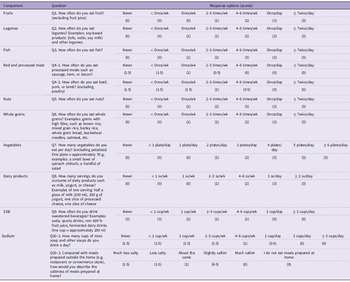
As the term ‘red meat’ is not commonly used in Japan and may be misinterpreted as referring to ‘lean meat’, the DQSJ screener asked about ‘beef, pork or lamb (excluding poultry)’ instead of using ‘red meat’. Examples of food items were included together with the questions about legumes, processed meat, whole grains and SSB. The examples were determined considering the food items commonly consumed by the 392 Japanese adults (online Supplementary Table 2) and the authors’ knowledge. In accordance with the scoring methods of the DQSJ(Reference Oono, Murakami and Fujiwara28), food items excluding fruits (i.e. fruit juice) and vegetables (i.e. potatoes) were also mentioned in the questions. The developed questions are shown in the second column from the left in Table 3.
Questions, response options and score assignment of the Diet Quality Score for the Japanese screener*

wk; week, d; day; sv; serving; SSB, sugar-sweetened beverages.
*Before the questions, the following sentences are presented: ‘Please reflect on your habitual diet over the past month and select the one response that best describes your diet. Please choose the one that feels closest without overthinking your response’. The total Diet Quality Score for the Japanese was calculated by summing all item scores, resulting in a range of 0–30.
Development of response options
In the DQSJ screener, 6–8 response options were provided for each question, with some options assigned to the same score. Rather than 4 response options directly corresponding to four scores, these options were intended to allow for potential modification of the scoring system if needed in the future. The response options for food groups were created by considering the number of participants across each consumption frequency, which referred to the consumption frequencies in Table 2, and retaining the same response options as much as possible across the food groups. Response options for sodium intake were created with reference to an existing screener for excessive sodium intake(Reference Sasaki, Takada and Fukuma44).
Assignment of scores to response options
The DQSJ screener assigned an absolute score to each response option, irrespective of sex. This approach was adopted to improve comparability across populations and facilitate individual-level use in practical settings, in contrast with the original DQSJ scoring system which was based on sex-specific quartiles of population intake(Reference Oono, Murakami and Fujiwara28). Scores of 0–3 were assigned for a single question about the eight food groups, whereas scores of 0–1·5 were assigned for each of the two questions about sodium and red and processed meat, resulting in 0–3 per component.
For the food groups, the maximum scores were assigned to achieve optimal consumption levels for health outcomes, in consideration of feasibility in Japan. We referred to diet-health associations suggested by current evidence(Reference Schwingshackl, Schwedhelm and Hoffmann34–Reference Aune, Norat and Romundstad42) and dietary guidelines in the USA(53) and then considered the consumption of the food group in the 392 Japanese adults (Table 2) and previous research in Japan(Reference Imamura, Micha and Khatibzadeh49–51). The rationale for assigning scores is provided in the right-hand column of Table 2. For sodium intake, scores of 0, 0·5, 1·0 and 1·5 for each question were assigned on the basis of the screener for excessive salt intake(Reference Sasaki, Takada and Fukuma44) and the authors’ knowledge.
Refinement of the screener and development of the final version
The developed screener was informally reviewed and tested by faculty members, research staff and graduate students from the Department of Social and Preventive Epidemiology, School of Public Health, University of Tokyo. Faculty members and graduate students are engaged in research on nutritional epidemiology, including the development of dietary assessment tools. The research staff, including registered dietitians, had expertise in dietary assessment, such as coding food items from DR. Based on the feedback, some minor modifications were made, such as adjusting the font size of the paper-based version and improving the fluency and clarity of the questions. The DQSJ screener was generally completed within 1–3 min.
Table 3 presents the questions, response options and score assignments of the final version of the DQSJ screener translated into English. The corresponding Japanese paper-based version is provided in online Supplementary Material.
Discussion
In this study, we developed the DQSJ screener, a rapid 12-question tool to assess diet quality in Japan. Development of the screener was primarily based on current evidence for diet-health associations and dietary intake in Japan. We describe the development process of the screener in detail and provide a printable version in online Supplementary Material for use in future surveys. To our knowledge, this is the first study to develop a brief screener to assess diet quality in Japan.
The DQSJ, the target measure of this screener, aims to capture critical aspects of dietary intake to prevent non-communicable diseases and premature deaths(Reference Oono, Murakami and Fujiwara28). A number of similar screeners have been developed to assess healthy dietary patterns related to various health outcomes, such as adherence to the Mediterranean diet(Reference Ruggeri, Buonocore and Amoriello16–Reference Martinez-Gonzalez, Garcia-Arellano and Toledo18) and dietary guidelines(Reference Bivoltsis, Trapp and Knuiman14). In contrast, other screeners have been developed to prevent specific diseases such as CVD(Reference Johnston, Petersen and Beasley20,Reference Laviolle, Froger-Bompas and Guillo21) and cancer(Reference Chaplin, Nafria and Prohens22). To allow for broader use, we assigned scores for the DQSJ screener based on evidence related to mortality and major chronic diseases, such as CVD and type 2 diabetes. It should be noted that the other diseases were not considered when score assignment was determined. Additionally, the DQSJ screener may not be appropriate for individuals with certain diseases, such as chronic kidney disease, for whom specific dietary treatment is required.
In the DQSJ screener, each question provides 6–8 response options with four possible scores. Some existing screeners assign three or more distinct scores for each question(Reference Bivoltsis, Trapp and Knuiman14,Reference Ruggeri, Buonocore and Amoriello16,Reference Johnston, Petersen and Beasley20–Reference Chaplin, Nafria and Prohens22,Reference Kronsteiner-Gicevic, Tello and Lincoln24,Reference Paxton, Strycker and Toobert26) , while others assign binary scores to each question(Reference Schroder, Fito and Estruch17,Reference Martinez-Gonzalez, Garcia-Arellano and Toledo18,Reference Fresan, Boronat and Zazpe25) . Binary score assignment is simple but may have limited ability to capture dietary changes and to rank individuals according to diet quality(Reference Oono, Murakami and Shinozaki30). Although most screeners provide four or fewer response options(Reference Schroder, Fito and Estruch17,Reference Martinez-Gonzalez, Garcia-Arellano and Toledo18,Reference Chaplin, Nafria and Prohens22,Reference Kronsteiner-Gicevic, Tello and Lincoln24–Reference Paxton, Strycker and Toobert26) , the DQSJ screener provides 6–8 response options for each question, some of which are assigned the same score. Another screener also provides five response options and assigns three scores(Reference Kronsteiner-Gicevic, Tello and Lincoln24). These relatively large numbers of response options allow potential revision of score assignments in the future and may also capture dose-response associations with health outcomes.
Although the original DQSJ is scored using the sex-specific quartiles of component intake in the population(Reference Oono, Murakami and Fujiwara28), the DQSJ screener assigns absolute scores to each response option to assess diet quality at the individual level without reference to the intake distribution. Score assignment was determined based on consumption frequencies among Japanese adults and evidence on associations of food groups with health outcomes. However, the optimal intake level used in this study should not be directly interpreted as the true optimal intake in the Japanese population. This is because the majority of research on diet-health associations used in this study was conducted in Western countries using FFQs(Reference Schwingshackl, Schwedhelm and Hoffmann34–Reference Aune, Norat and Romundstad42), which did not aim to estimate absolute intake. These score assignments should be revised when further evidence on optimal intake levels and corresponding consumption frequencies in the Japanese population is accumulated.
The validity of the DQSJ screener is currently being evaluated in more than 1000 Japanese aged 20–69 years who completed the DQSJ screener and a 4-day DR(Reference Murakami, Shinozaki and Livingstone58). This relatively large number of participants provides the opportunity to analyse not only all participants but also subgroups, such as by sex and age. In addition to this validation study, the DQSJ screener is planned to be used in a large-scale survey that incorporates self-reported lifestyle habits and health insurance claims data among 20 000 working adults. This survey will enable the examination of associations between DQSJ scores and diverse health outcomes. Additionally, this survey may help to determine appropriate cut-off points of the DQSJ which identify low diet quality related to poor health outcomes, such as mortality, risk of chronic diseases and biomarkers. After these cut-off points are established, the low burden of implementation of the DQSJ screener will provide opportunities to identify individuals recommended for nutrition counselling in healthcare settings.
The strength of this study is the detailed description of the development process of the DQSJ screener, which was based on both dietary intake in Japan and evidence on diet-health associations. While the DQSJ was developed for the Japanese population, its development process may provide a useful model for similar tools in other countries. However, this study has several limitations. First, the dietary data used to inform the food examples and score assignments were based on 392 Japanese adults, who were volunteers and most of whom worked at welfare facilities. The participants had somewhat higher educational attainment than a nationally representative sample aged 30–69 years in 2020 (11 % for junior college or technical school and 39 % for a university degree or higher in men, and 29 % and 21 %, respectively, in women)(59). They might therefore have been more health-conscious than the general population. Additionally, the diet quality of our participants was somewhat higher than that of a national survey in Japan: the mean (sd) of the Healthy Eating Index-2015 was 55·3 (9·2) in our participants(Reference Oono, Murakami and Fujiwara28) v. 52·2 (9·2) in the national survey in Japan(Reference Murakami, Livingstone and Fujiwara27). The question of whether the DQSJ screener can assess diet quality in individuals with low diet quality should be evaluated.
Second, we developed it using data from adults aged 20–69 years; however, we did not intend to restrict its use to this age range. The applicability of the screener should be confirmed when it is applied to populations whose dietary habits differ from those of the study population. Third, although most questions in the DQSJ screener asked about consumption frequencies, dietary data analysis showed substantial variation in the amount of intake derived from the DR within the same consumption frequency. This may partly attribute day-to-day variation in the 4-non-consecutive-day DR but also suggests that consumption frequency does not allow the accurate estimation of absolute intake. Future research should examine whether the response options for each question can be used to determine intake. Additionally, usual intake was derived from 4-non-consecutive-day DR, which may not fully reflect usual intake due to day-to-day variation. Nevertheless, because an increasing number of recording days would substantially increase the burden of participants and may alter dietary intake(Reference Bailey7), we chose a 4-day recording period for feasibility. Finally, it should be noted that the DQSJ screener aims to assess only the total score of the DQSJ and the intake of food groups and nutrients included in the DQSJ. More detailed assessment tools, such as DR or comprehensive FFQs, should be used when assessing absolute intake or other dietary factors, including meal and snack frequency, energy intake and intakes of food groups and nutrients not included in the DQSJ.
In conclusion, we developed the DQSJ screener, a rapid 12-question tool for the assessment of diet quality in Japan. We have described the development process in detail to enable future revisions to reflect accumulated evidence. The same strategy can be used to develop similar tools for other populations. After validation, the DQSJ screener will contribute to assessing diet quality in various time-limited settings, such as practical settings and in large-scale research that primarily focuses on non-dietary factors. Nevertheless, confirmation of the validity of the DQSJ screener before any broad use is critical.
Supplementary material
For supplementary material/s referred to in this article, please visit https://doi.org/10.1017/S0007114526106837
Acknowledgements
We thank Guy Harris DO from Dmed (https://www.dmed.co.jp/) for editing drafts of this manuscript.
This research was supported in part by the Japan Society for the Promotion of Science (to F. O., JSPS KAKENHI Grant Number 21J22440 and 24KJ0098). The funders had no role in the design, analysis or writing of this article.
F. O. contributed to the development of the screener, analysed and interpreted the data, prepared the first draft of the manuscript and had primary responsibility for the final content; N. S. and R. A. contributed to the development of the screener and provided critical input into the final draft of the manuscript; K. A. contributed to the dietary survey and provided critical input into the final draft of the manuscript; S. M. contributed to the dietary survey; S. S. contributed to the dietary survey and the development of the screener; and K. M. contributed to the concept of the study and development of the screener and provided critical input into the final draft of the manuscript. All authors have read and agreed to the final version of the manuscript.
F. O. belongs to the Department of Eat-loss Medicine, Graduate School of Medicine, the University of Tokyo, which is a social cooperation programme with Itoen, Co., Inc. However, this company was not involved in any part of the study. The other authors declare no competing interests.




 Open access

