





1 Introduction
Let $q \in (1,2)$
and let
$q \in (1,2)$
and let $I_q = [0 , {1}/({q-1})]$
. We say that a sequence
$I_q = [0 , {1}/({q-1})]$
. We say that a sequence $(\epsilon _j)_{j=1}^{\infty } \in \{0,1\}^{\mathbb {N}}$
is a base q expansion of
$(\epsilon _j)_{j=1}^{\infty } \in \{0,1\}^{\mathbb {N}}$
is a base q expansion of $x \in I_q$
if
$x \in I_q$
if
 $$ \begin{align*}x = \sum_{j=1}^\infty \epsilon_j q^{-j}.\end{align*} $$
It is a straightforward exercise to show that x has a base q expansion if and only if $x \in I_q$
. In order to put our work in context, we observe where the research in base q expansions started, how it developed, and what current open questions are receiving attention. Initially, base q expansions were studied via the dynamical system
$x \in I_q$
. In order to put our work in context, we observe where the research in base q expansions started, how it developed, and what current open questions are receiving attention. Initially, base q expansions were studied via the dynamical system $T(x) = qx \pmod {1}$
on
$T(x) = qx \pmod {1}$
on $[0,1]$
. Each point
$[0,1]$
. Each point $x \in [0,1]$
has a unique orbit in this system which corresponds to what is known as the greedy expansion of x. In an early paper by Rényi [Reference Rényi16] it is shown that there exists a T-invariant probability measure, equivalent to Lebesgue, which is also ergodic. Following this, Parry [Reference Parry15] gave sufficient conditions on a sequence
$x \in [0,1]$
has a unique orbit in this system which corresponds to what is known as the greedy expansion of x. In an early paper by Rényi [Reference Rényi16] it is shown that there exists a T-invariant probability measure, equivalent to Lebesgue, which is also ergodic. Following this, Parry [Reference Parry15] gave sufficient conditions on a sequence $(\epsilon _j)_{j=1}^{\infty }$
in order for it to appear as a greedy base q expansion. We note that these results were actually proved in the more general setting where q is some real number greater than
$(\epsilon _j)_{j=1}^{\infty }$
in order for it to appear as a greedy base q expansion. We note that these results were actually proved in the more general setting where q is some real number greater than $1$
, where instead of
$1$
, where instead of $\{0,1\}^{\mathbb {N}}$
the sequences
$\{0,1\}^{\mathbb {N}}$
the sequences $(\epsilon _j)_{j=1}^{\infty }$
are elements of
$(\epsilon _j)_{j=1}^{\infty }$
are elements of $\{0 , 1 , \ldots , \lfloor q \rfloor \}^{\mathbb {N}}$
when
$\{0 , 1 , \ldots , \lfloor q \rfloor \}^{\mathbb {N}}$
when $q\notin \mathbb {N},$
and are elements of
$q\notin \mathbb {N},$
and are elements of $\{0 , 1 , \ldots , q -1\}^{\mathbb {N}}$
when
$\{0 , 1 , \ldots , q -1\}^{\mathbb {N}}$
when $q\in \mathbb {N}$
. In the early 1990s, more attention was given to the broader system in which all possible base q expansions of
$q\in \mathbb {N}$
. In the early 1990s, more attention was given to the broader system in which all possible base q expansions of $x \in I_q$
are considered. This is the system in which we are interested in this paper.
$x \in I_q$
are considered. This is the system in which we are interested in this paper.
We define the set of base q expansions of $x \in I_q$
by
$x \in I_q$
by
 $$ \begin{align*}\Sigma_q(x) = \bigg\{ (\epsilon_j)_{j=1}^{\infty} \in \{0,1\}^{\mathbb{N}} : x = \sum_{j=1}^\infty \epsilon_j q^{-j} \bigg\},\end{align*} $$
and the projection map $\pi _q: \{0,1\}^{\mathbb {N}} \rightarrow I_q$
by
$\pi _q: \{0,1\}^{\mathbb {N}} \rightarrow I_q$
by
 $$ \begin{align*}\pi_q((\epsilon_j)_{j=1}^{\infty}) = \sum_{j=1}^\infty \epsilon_j q^{-j}.\end{align*} $$
The foundational results in base q expansions demonstrate that they behave very differently than the well-understood integer base expansions. Recall the familiar example of binary expansions, where every point $x \in [0,1]$
has a unique expansion apart from a countable set of points which have exactly two expansions, by virtue of the fact that
$x \in [0,1]$
has a unique expansion apart from a countable set of points which have exactly two expansions, by virtue of the fact that $\pi _2(10^\infty ) = \pi _2(01^\infty )$
. The same is true for all integer base expansions. By comparison, Sidorov proved that for every
$\pi _2(10^\infty ) = \pi _2(01^\infty )$
. The same is true for all integer base expansions. By comparison, Sidorov proved that for every $q \in (1,2)$
, Lebesgue almost every
$q \in (1,2)$
, Lebesgue almost every $x \in I_q$
will have uncountably many base q expansions [Reference Sidorov18]. Moreover, given any
$x \in I_q$
will have uncountably many base q expansions [Reference Sidorov18]. Moreover, given any $m \in \mathbb {N} \cup \{\aleph _0\}$
, we can choose
$m \in \mathbb {N} \cup \{\aleph _0\}$
, we can choose $q \in (1,2)$
and
$q \in (1,2)$
and $x \in I_q$
such that x has exactly m base q expansions [Reference Baker2, Reference Baker and Sidorov4, Reference Sidorov19]. Define
$x \in I_q$
such that x has exactly m base q expansions [Reference Baker2, Reference Baker and Sidorov4, Reference Sidorov19]. Define
 $$ \begin{align*} \mathcal{U}_q = \{ x \in I_q : |\Sigma_q(x)| = 1 \}, \end{align*} $$
and for $m \geq 2$
,
$m \geq 2$
,
 $$ \begin{align*} \mathcal{U}_q^{(m)} = \{x \in I_q : |\Sigma_q(x)| = m \}. \end{align*} $$
In this paper, our results concern the sets $\mathcal {B}_m$
, where
$\mathcal {B}_m$
, where
 $$ \begin{align*} \mathcal{B}_m = \{ q \in (1,2) : \mathcal{U}_q^{(m)} \neq \emptyset \}. \end{align*} $$
For all $k \geq 2$
, we define the k-Bonacci number
$k \geq 2$
, we define the k-Bonacci number $q_k$
to be the unique number in
$q_k$
to be the unique number in $(1,2)$
which satisfies
$(1,2)$
which satisfies
 $$ \begin{align*} q_k^k - q_k^{k-1} - \cdots - q_k - 1 = 0. \end{align*} $$
For $k = 2$
, we denote
$k = 2$
, we denote $q_2 = ({1 + \sqrt {5}})/{2}$
, the golden ratio, by G. This family of numbers will play an important role in our results and in the discussion below.
$q_2 = ({1 + \sqrt {5}})/{2}$
, the golden ratio, by G. This family of numbers will play an important role in our results and in the discussion below.
Particular attention was given to the number of expansions of $x = 1$
for different values of q. In particular, it was shown by Erdős et al. [Reference Erdős, Horváth and Joó8, Theorem 1] that the set of q for which
$x = 1$
for different values of q. In particular, it was shown by Erdős et al. [Reference Erdős, Horváth and Joó8, Theorem 1] that the set of q for which $1$
has a unique base q expansion has uncountably many elements, while Daróczy and Kátai [Reference Daróczy and Kátai7, Theorem 3] showed that it has zero Lebesgue measure, and Hausdorff dimension
$1$
has a unique base q expansion has uncountably many elements, while Daróczy and Kátai [Reference Daróczy and Kátai7, Theorem 3] showed that it has zero Lebesgue measure, and Hausdorff dimension $1$
. Moreover, in [Reference Erdős and Joó9] Erdős and Joó showed that there are uncountably many bases q for which
$1$
. Moreover, in [Reference Erdős and Joó9] Erdős and Joó showed that there are uncountably many bases q for which $1 \in \mathcal {U}_q^{\aleph _0}$
. Komornik and Loreti [Reference Komornik and Loreti14] found an algebraic construction for the value
$1 \in \mathcal {U}_q^{\aleph _0}$
. Komornik and Loreti [Reference Komornik and Loreti14] found an algebraic construction for the value $q_{\mathrm {KL}} \approx 1.787\,23$
, now known as the Komornik–Loreti constant, which is the smallest base for which
$q_{\mathrm {KL}} \approx 1.787\,23$
, now known as the Komornik–Loreti constant, which is the smallest base for which $1$
has a unique expansion. Later, it was found that
$1$
has a unique expansion. Later, it was found that $q_{\mathrm {KL}}$
plays an important role in our understanding of
$q_{\mathrm {KL}}$
plays an important role in our understanding of $\mathcal {U}_q$
[Reference Glendinning and Sidorov12].
$\mathcal {U}_q$
[Reference Glendinning and Sidorov12].
Generalizing the investigation of the number of expansions of $x=1$
for different bases q, we can ask for which values of q there exists at least one
$x=1$
for different bases q, we can ask for which values of q there exists at least one $x \in I_q$
that has a unique expansion in base q. It was shown by Erdős et al. [Reference Erdős, Komornik and Joó10] that if
$x \in I_q$
that has a unique expansion in base q. It was shown by Erdős et al. [Reference Erdős, Komornik and Joó10] that if $q \in (1,G)$
then all
$q \in (1,G)$
then all $x \in (0,{1}/({q-1}))$
have uncountably many base q expansions. (It is obvious that the endpoints of
$x \in (0,{1}/({q-1}))$
have uncountably many base q expansions. (It is obvious that the endpoints of $I_q$
,
$I_q$
, $0 = \pi _q(0^\infty )$
and
$0 = \pi _q(0^\infty )$
and ${1}/({q-1}) = \pi _q(1^\infty )$
, have unique expansions.) Sidorov and Vershik [Reference Sidorov and Vershik20] showed that if
${1}/({q-1}) = \pi _q(1^\infty )$
, have unique expansions.) Sidorov and Vershik [Reference Sidorov and Vershik20] showed that if $q = G$
then all
$q = G$
then all $x \in (0, {1}/({q-1}))$
have uncountably many expansions unless
$x \in (0, {1}/({q-1}))$
have uncountably many expansions unless $x = nG \pmod {1}$
for some
$x = nG \pmod {1}$
for some $n \in \mathbb {Z}$
, in which case
$n \in \mathbb {Z}$
, in which case $x \in \mathcal {U}_G^{\aleph _0}$
. In [Reference Glendinning and Sidorov12] Glendinning and Sidorov proved the following dichotomy. If
$x \in \mathcal {U}_G^{\aleph _0}$
. In [Reference Glendinning and Sidorov12] Glendinning and Sidorov proved the following dichotomy. If $q \in (G , q_{\mathrm {KL}})$
then
$q \in (G , q_{\mathrm {KL}})$
then $\mathcal {U}_q$
is countably infinite and every unique expansion is eventually periodic, but if
$\mathcal {U}_q$
is countably infinite and every unique expansion is eventually periodic, but if $q \in (q_{\mathrm {KL}}, 2)$
then
$q \in (q_{\mathrm {KL}}, 2)$
then $\mathcal {U}_q$
contains a Cantor set with positive Hausdorff dimension. For
$\mathcal {U}_q$
contains a Cantor set with positive Hausdorff dimension. For $q= q_{\mathrm {KL}}$
, it is shown that
$q= q_{\mathrm {KL}}$
, it is shown that $\mathcal {U}_q$
is uncountably infinite and has zero Hausdorff dimension. We will see in more detail later (Lemma 2.1) that if
$\mathcal {U}_q$
is uncountably infinite and has zero Hausdorff dimension. We will see in more detail later (Lemma 2.1) that if $q \in (G,2)$
then
$q \in (G,2)$
then $\dim _{\mathrm {H}}(\mathcal {U}_q) \nearrow 1 $
as
$\dim _{\mathrm {H}}(\mathcal {U}_q) \nearrow 1 $
as $q \nearrow 2$
[Reference Glendinning and Sidorov12]. Another avenue of research concerns the function
$q \nearrow 2$
[Reference Glendinning and Sidorov12]. Another avenue of research concerns the function $q \mapsto \dim _{\mathrm {H}}(\mathcal {U}_q)$
which is shown by Komornik et al. in [Reference Komornik, Kong and Li13] to be continuous, have bounded variation, and resemble the Cantor function. Further work was carried out on the properties of this function by the Barrera et al. in [Reference Barrera, Baker and Kong6]. Together these results provide us with a reasonably complete understanding of
$q \mapsto \dim _{\mathrm {H}}(\mathcal {U}_q)$
which is shown by Komornik et al. in [Reference Komornik, Kong and Li13] to be continuous, have bounded variation, and resemble the Cantor function. Further work was carried out on the properties of this function by the Barrera et al. in [Reference Barrera, Baker and Kong6]. Together these results provide us with a reasonably complete understanding of $\mathcal {U}_q$
for all
$\mathcal {U}_q$
for all $q \in (1,2)$
.
$q \in (1,2)$
.
Following on from the study of $\mathcal {U}_q$
it is natural to ask, given
$\mathcal {U}_q$
it is natural to ask, given $m \in \mathbb {N}$
, for which bases q is the set
$m \in \mathbb {N}$
, for which bases q is the set $\mathcal {U}_q^{(m)}$
non-empty and what is its Hausdorff dimension? In [Reference Sidorov19] Sidorov shows that the smallest element of
$\mathcal {U}_q^{(m)}$
non-empty and what is its Hausdorff dimension? In [Reference Sidorov19] Sidorov shows that the smallest element of $\mathcal {B}_2$
is
$\mathcal {B}_2$
is $q_{2} \approx 1.710\,64$
, which is the root in
$q_{2} \approx 1.710\,64$
, which is the root in $(1,2)$
of
$(1,2)$
of
 $$ \begin{align*}x^4 = 2x^2 + x + 1.\end{align*} $$
The next smallest element of $\mathcal {B}_2$
is
$\mathcal {B}_2$
is $q_f \approx 1.754\,88$
, which is the root in
$q_f \approx 1.754\,88$
, which is the root in $(1,2)$
of
$(1,2)$
of
 $$ \begin{align*}x^3 = 2x^2 - x + 1,\end{align*} $$
and it is shown by Baker and Sidorov in [Reference Baker and Sidorov4] that $q_f$
is also the smallest element of
$q_f$
is also the smallest element of $\mathcal {B}_m$
for all
$\mathcal {B}_m$
for all $m \in \mathbb {N}_{\geq 3}$
. Sidorov [Reference Sidorov19] proved the following key results concerning
$m \in \mathbb {N}_{\geq 3}$
. Sidorov [Reference Sidorov19] proved the following key results concerning $\mathcal {B}_2$
, and it is these results which we build on directly in this paper. After proving
$\mathcal {B}_2$
, and it is these results which we build on directly in this paper. After proving
 $$ \begin{align} q \in \mathcal{B}_2 \iff 1 \in \mathcal{U}_q - \mathcal{U}_q, \end{align} $$
it is a straightforward application of Newhouse’s theorem [Reference Sheldon17] (see §2.1) to prove that $[q_3, 2) \subset \mathcal {B}_2$
, where
$[q_3, 2) \subset \mathcal {B}_2$
, where $q_3 \approx 1.839\,29$
. Sidorov generalizes this theorem, claiming that there exists some
$q_3 \approx 1.839\,29$
. Sidorov generalizes this theorem, claiming that there exists some $\gamma _m> 0$
such that
$\gamma _m> 0$
such that $[2- \gamma _m , 2) \subset \mathcal {B}_m$
for all
$[2- \gamma _m , 2) \subset \mathcal {B}_m$
for all $m \geq 3$
. Unfortunately, the authors believe this proof contains a mistake which cannot be fixed. If this is true, and this result is invalid, then the question of whether the Lebesgue measure of
$m \geq 3$
. Unfortunately, the authors believe this proof contains a mistake which cannot be fixed. If this is true, and this result is invalid, then the question of whether the Lebesgue measure of $\mathcal {B}_m$
is positive is still open for
$\mathcal {B}_m$
is positive is still open for $m \geq 3$
. The main theorem of this paper (Theorem A) is a stronger version of Sidorov’s general result in the sense that we are able to find the first explicit intervals contained in
$m \geq 3$
. The main theorem of this paper (Theorem A) is a stronger version of Sidorov’s general result in the sense that we are able to find the first explicit intervals contained in $\mathcal {B}_m$
for
$\mathcal {B}_m$
for $m \geq 3$
. More recently it was proved by Baker and Zou [Reference Baker and Zou5] that for Lebesgue almost every
$m \geq 3$
. More recently it was proved by Baker and Zou [Reference Baker and Zou5] that for Lebesgue almost every $q \in (q_{\mathrm {KL}}, M+1]$
we have
$q \in (q_{\mathrm {KL}}, M+1]$
we have $\dim _{\mathrm {H}} \mathcal {U}_q^{(m)} \leq \max \{ 0 , 2 \dim _{\mathrm {H}} \mathcal {U}_q -1 \}$
for all
$\dim _{\mathrm {H}} \mathcal {U}_q^{(m)} \leq \max \{ 0 , 2 \dim _{\mathrm {H}} \mathcal {U}_q -1 \}$
for all $m \in \{2,3, \ldots \}$
. This result improves upon the bound of
$m \in \{2,3, \ldots \}$
. This result improves upon the bound of $\dim _{\mathrm {H}} \mathcal {U}_q^{(m)} \leq \dim _{\mathrm {H}} \mathcal {U}_q$
for all
$\dim _{\mathrm {H}} \mathcal {U}_q^{(m)} \leq \dim _{\mathrm {H}} \mathcal {U}_q$
for all $m \in \{2,3, \ldots \}$
which can be seen by a simple branching argument (see [Reference Sidorov19] or [Reference Baker2]). The equivalence (1) illustrates how information about
$m \in \{2,3, \ldots \}$
which can be seen by a simple branching argument (see [Reference Sidorov19] or [Reference Baker2]). The equivalence (1) illustrates how information about $\mathcal {U}_q$
can be used to study
$\mathcal {U}_q$
can be used to study $\mathcal {B}_2$
. More generally, we will see in §2.2 that we can guarantee that
$\mathcal {B}_2$
. More generally, we will see in §2.2 that we can guarantee that $q \in \mathcal {B}_m$
if a certain intersection of affine images of the set
$q \in \mathcal {B}_m$
if a certain intersection of affine images of the set $\mathcal {U}_q$
is non-empty. Moreover, via an application of a theorem of Falconer and Yavicoli [Reference Falconer and Yavicoli11, Theorem 6], we are able to bound the Hausdorff dimension of the corresponding
$\mathcal {U}_q$
is non-empty. Moreover, via an application of a theorem of Falconer and Yavicoli [Reference Falconer and Yavicoli11, Theorem 6], we are able to bound the Hausdorff dimension of the corresponding $\mathcal {U}_q^{(m)}$
set from below. The version of this theorem that we use appears as Theorem F&Y in §2.1.
$\mathcal {U}_q^{(m)}$
set from below. The version of this theorem that we use appears as Theorem F&Y in §2.1.
Our most general result is Theorem A, which locates an explicit collection of countably many intervals in $\mathcal {B}_m$
for all
$\mathcal {B}_m$
for all $m \geq 3$
. More precisely, for any
$m \geq 3$
. More precisely, for any $m \geq 3$
, Theorem A tells us that there is a neighbourhood of
$m \geq 3$
, Theorem A tells us that there is a neighbourhood of $q_k$
contained in
$q_k$
contained in $\mathcal {B}_{m}$
whenever k is sufficiently large. In the case of
$\mathcal {B}_{m}$
whenever k is sufficiently large. In the case of $\mathcal {B}_3$
we are able to obtain a stronger result which is the content of Theorem B.
$\mathcal {B}_3$
we are able to obtain a stronger result which is the content of Theorem B.
Theorem A. Let $m \in \mathbb {N}$
and let
$m \in \mathbb {N}$
and let $k \geq K_m$
where
$k \geq K_m$
where
 $$ \begin{align*} K_m = \lceil \tfrac{20}{19}( \log_{1.999}(m+2) + 24) + 4 \rceil. \end{align*} $$
If $|q - q_k| < q_k^{-(m+2)k-3}$
, then
$|q - q_k| < q_k^{-(m+2)k-3}$
, then $q \in \mathcal {B}_{m+2}$
and
$q \in \mathcal {B}_{m+2}$
and $\dim _{\mathrm {H}}(\mathcal {U}_q^{(m+2)}) \geq 1 - 1024(m+2)^{{20}/{19}} q^{4-k}> 0$
.
$\dim _{\mathrm {H}}(\mathcal {U}_q^{(m+2)}) \geq 1 - 1024(m+2)^{{20}/{19}} q^{4-k}> 0$
.
For small m, this table shows the leftmost interval contained in $\mathcal {B}_{m+2}$
and the lower bound on
$\mathcal {B}_{m+2}$
and the lower bound on $\dim _{\mathrm {H}}(\mathcal {U}_{q_{K_m}}^{(m+2)})$
, provided by Theorem A. We emphasize that these are the leftmost intervals guaranteed to exist by Theorem A; there may be other intervals in
$\dim _{\mathrm {H}}(\mathcal {U}_{q_{K_m}}^{(m+2)})$
, provided by Theorem A. We emphasize that these are the leftmost intervals guaranteed to exist by Theorem A; there may be other intervals in $\mathcal {B}_{m+2}$
contained to the left of these.
$\mathcal {B}_{m+2}$
contained to the left of these.
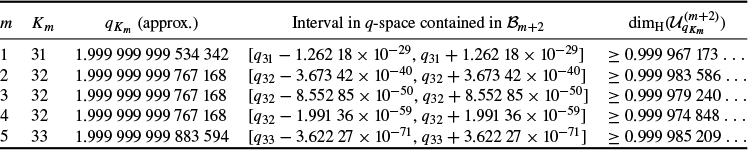
Table 1 Long description
From left to right, the table columns are: m, K sub m, q sub K sub m (approximate), interval in q-space contained in the set B sub m plus 2, and the lower bound on the Hausdorff dimension of U sub q sub K sub m to the m plus 2. For m equals 1, K sub m is 31, q sub K sub m is approximately 1.999999999534342, the interval is [q sub 31 minus 1.26218 times 10 to the minus 29, q sub 31 plus 1.26218 times 10 to the minus 29], and the lower bound is greater than or equal to 0.999967173. For m equals 2, K sub m is 32, q sub K sub m is approximately 1.999999999767168, the interval is [q sub 32 minus 3.67342 times 10 to the minus 40, q sub 32 plus 3.67342 times 10 to the minus 40], and the lower bound is greater than or equal to 0.999983586. For m equals 3, K sub m is 32, q sub K sub m is approximately 1.999999999767168, the interval is [q sub 32 minus 8.55285 times 10 to the minus 50, q sub 32 plus 8.55285 times 10 to the minus 50], and the lower bound is greater than or equal to 0.999979240. For m equals 4, K sub m is 32, q sub K sub m is approximately 1.999999999767168, the interval is [q sub 32 minus 1.99136 times 10 to the minus 59, q sub 32 plus 1.99136 times 10 to the minus 59], and the lower bound is greater than or equal to 0.999974848. For m equals 5, K sub m is 33, q sub K sub m is approximately 1.999999999883594, the interval is [q sub 33 minus 3.6227 times 10 to the minus 71, q sub 33 plus 3.6227 times 10 to the minus 71], and the lower bound is greater than or equal to 0.999985209.
Theorem B.
-
(a) For $k \geq 10$
, if
$|q - q_k| \leq q_k^{-2k-6}$
then
$q \in \mathcal {B}_3$
.
$k \geq 10$
, if
$|q - q_k| \leq q_k^{-2k-6}$
then
$q \in \mathcal {B}_3$
. -
(b) If
$0 < q - q_9 \leq q_9^{-24}$
then
$q \in \mathcal {B}_3$
.





Neighbourhoods of $q_k$
contained in
$q_k$
contained in $\mathcal {B}_3$
for small values of k, provided by Theorem B.
$\mathcal {B}_3$
for small values of k, provided by Theorem B.
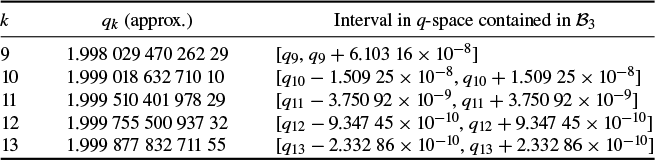
Table 2 Long description
The table has three columns. The first column lists k values: 9, 10, 11, 12, and 13. The second column gives approximate q sub k values: for k equals 9, 1.998, 029, 470, 262, 29; for k equals 10, 1.999, 018, 632, 710, 10; for k equals 11, 1.999, 510, 401, 978, 29; for k equals 12, 1.999, 755, 500, 937, 32; for k equals 13, 1.999, 877, 832, 711, 55. The third column provides the interval in q-space contained in mathcal B sub 3 for each k. For k equals 9, the interval is open bracket q sub 9, q sub 9 plus 6.103, 16 times 10 super negative 8 close bracket. For k equals 10, the interval is open bracket q sub 10 minus 1.509, 25 times 10 super negative 8, q sub 10 plus 1.509, 25 times 10 super negative 8 close bracket. For k equals 11, the interval is open bracket q sub 11 minus 3.750, 92 times 10 super negative 9, q sub 11 plus 3.750, 92 times 10 super negative 9 close bracket. For k equals 12, the interval is open bracket q sub 12 minus 9.347, 45 times 10 super negative 10, q sub 12 plus 9.347, 45 times 10 super negative 10 close bracket. For k equals 13, the interval is open bracket q sub 13 minus 2.332, 86 times 10 super negative 10, q sub 13 plus 2.332, 86 times 10 super negative 10 close bracket. All intervals are symmetric about q sub k.
Together Theorems A and B provide the first explicit intervals contained in $\mathcal {B}_m$
for
$\mathcal {B}_m$
for $m \geq 3$
. Since
$m \geq 3$
. Since $K_1 = 31$
, Theorem B proves the existence of intervals in
$K_1 = 31$
, Theorem B proves the existence of intervals in $\mathcal {B}_3$
where Theorem A does not apply, namely, when
$\mathcal {B}_3$
where Theorem A does not apply, namely, when $m = 1$
and
$m = 1$
and $9 \leq k < K_1$
. The reason for this discrepancy in the values of k where the theorems apply is due to the number of sets in the intersection which we require to be non-empty. To be precise, the argument for the proof of Theorem B boils down to proving that the intersection of two compact subsets of
$9 \leq k < K_1$
. The reason for this discrepancy in the values of k where the theorems apply is due to the number of sets in the intersection which we require to be non-empty. To be precise, the argument for the proof of Theorem B boils down to proving that the intersection of two compact subsets of $\mathbb {R}$
is non-empty; this allows us to apply Theorem N [Reference Sheldon17]. However, to prove Theorem A for some
$\mathbb {R}$
is non-empty; this allows us to apply Theorem N [Reference Sheldon17]. However, to prove Theorem A for some $m \in \mathbb {N}$
, we require a collection of
$m \in \mathbb {N}$
, we require a collection of $(m+2)$
sets to be non-empty, hence we cannot directly apply Theorem N [Reference Sheldon17].
$(m+2)$
sets to be non-empty, hence we cannot directly apply Theorem N [Reference Sheldon17].
In §2 we outline the main theorems and propositions used for Theorems A and B, whose proofs are contained in §§3 and 4, respectively.
2 Preliminaries
In this section we introduce the results required for the proofs of Theorems A and B. We draw special attention to Theorem F&Y—a special case of a theorem of Falconer and Yavicoli [Reference Falconer and Yavicoli11, Theorem 6]—on which Theorem A relies.
2.1 Thickness and interleaving
Let $|X|$
and
$|X|$
and $\mathrm {conv}(X)$
denote the diameter and convex hull respectively of a set
$\mathrm {conv}(X)$
denote the diameter and convex hull respectively of a set $X \subset \mathbb {R}$
. Given some compact set
$X \subset \mathbb {R}$
. Given some compact set $C \subset \mathbb {R}$
, Newhouse [Reference Sheldon17] defines its thickness
$C \subset \mathbb {R}$
, Newhouse [Reference Sheldon17] defines its thickness $\tau (C)$
via its gaps and bridges. A gap G of C is a connected component of
$\tau (C)$
via its gaps and bridges. A gap G of C is a connected component of $\mathbb {R} \setminus C$
(including both the unbounded components to the left and right of
$\mathbb {R} \setminus C$
(including both the unbounded components to the left and right of $\mathrm {conv}(C)$
), and since C is compact, all such gaps are open intervals. Any compact set
$\mathrm {conv}(C)$
), and since C is compact, all such gaps are open intervals. Any compact set $C \subset \mathbb {R}$
admits a stepwise construction removing gaps in order of decreasing diameter. Specifically, we start by removing the unbounded gaps from
$C \subset \mathbb {R}$
admits a stepwise construction removing gaps in order of decreasing diameter. Specifically, we start by removing the unbounded gaps from $\mathbb {R}$
to leave
$\mathbb {R}$
to leave $\mathrm {conv}(C)$
. From here we remove from
$\mathrm {conv}(C)$
. From here we remove from $\mathrm {conv}(C)$
the next largest gap
$\mathrm {conv}(C)$
the next largest gap $G_1$
(if there is a tie, take any). This leaves two closed intervals, called bridges,
$G_1$
(if there is a tie, take any). This leaves two closed intervals, called bridges, $B_1^L$
and
$B_1^L$
and $B_1^R$
with the gap
$B_1^R$
with the gap $G_1$
in between. We continue in this way, removing the next largest gap from the remaining union of bridges. In general, at step n, gap
$G_1$
in between. We continue in this way, removing the next largest gap from the remaining union of bridges. In general, at step n, gap $G_n$
, with
$G_n$
, with $|G_{n-1}| \geq |G_n| \geq |G_{n+1}|$
, is removed from a closed interval, leaving bridges
$|G_{n-1}| \geq |G_n| \geq |G_{n+1}|$
, is removed from a closed interval, leaving bridges $B_n^L$
and
$B_n^L$
and $B_n^R$
either side of
$B_n^R$
either side of $G_n$
. We define the thickness of C by
$G_n$
. We define the thickness of C by
 $$ \begin{align*} \tau(C) = \inf_n \bigg\{ \min \bigg( \frac{|B_n^L|}{|G_n|} , \frac{|B_n^R|}{|G_n|} \bigg) \bigg\}. \end{align*} $$
Note that the initial step removing the unbounded gaps of C is not involved in the thickness calculation. Moreover, it can be checked that the thickness is independent of the choice of gap when two or more gaps have the same diameter [Reference Falconer and Yavicoli11]. If B is a bridge of C then all gaps contained within B have diameter no larger than the gaps on either side of B. Note also that any bridge B of C has the property that all gaps of C are either contained in B or contained in the complement of B.
We will be interested in the thickness of certain compact subsets of $\mathcal {U}_q$
for
$\mathcal {U}_q$
for $q \in (1,2)$
. To study these effectively we will need to define some notation. Let
$q \in (1,2)$
. To study these effectively we will need to define some notation. Let $\{0,1\}^*$
be the set of all finite words in
$\{0,1\}^*$
be the set of all finite words in $\{0,1\}$
and let
$\{0,1\}$
and let $|\delta |$
denote the length of a finite word
$|\delta |$
denote the length of a finite word $\delta \in \{0,1\}^*$
. A sequence
$\delta \in \{0,1\}^*$
. A sequence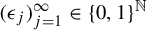 $(\epsilon _j)_{j=1}^{\infty } \in \{0,1\}^{\mathbb {N}}$
is said to avoid a word (finite or infinite)
$(\epsilon _j)_{j=1}^{\infty } \in \{0,1\}^{\mathbb {N}}$
is said to avoid a word (finite or infinite) $(\delta _j)_{j=1}^{m} \in \{0,1\}^m$
if there is no index
$(\delta _j)_{j=1}^{m} \in \{0,1\}^m$
if there is no index $i \in \mathbb {N}$
such that
$i \in \mathbb {N}$
such that $(\epsilon _j)_{j=i}^{i+m-1} = (\delta _j)_{j=1}^{m}$
. For any
$(\epsilon _j)_{j=i}^{i+m-1} = (\delta _j)_{j=1}^{m}$
. For any $k \in \mathbb {N}$
, define the set
$k \in \mathbb {N}$
, define the set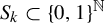 $S_k \subset \{0,1\}^{\mathbb {N}}$
by
$S_k \subset \{0,1\}^{\mathbb {N}}$
by
 $$ \begin{align*}S_k = \{ (\epsilon_j)_{j=1}^{\infty} \in \{0,1\}^{\mathbb{N}} : (\epsilon_j)_{j=1}^{\infty} \ \mathrm{avoids} \ (01^k) \ \mathrm{and} \ (10^k) \}.\end{align*} $$
The following key lemma is a consequence of the work in [Reference Glendinning and Sidorov12, Lemma 4].
Lemma 2.1. Let $k \geq 2$
.
$k \geq 2$
.
-
(a) If
$q \in (q_k , 2)$
then
$\pi _q(S_k) \subset \mathcal {U}_q$
. -
(b) If
$q \in (q_k , 2)$
then
$\pi _q(S_k)$
is a Cantor set and, moreover, every gap of
$\pi _q(S_k)$
is an open interval of the form where
$$ \begin{align*} (\pi_q(\delta (01^{k-1})^\infty) , \pi_q(\delta (10^{k-1})^\infty)), \end{align*} $$
$\delta \in \{0,1\}^*$
avoids
$(01^k)$
and
$(10^k)$
.




It is also shown in [Reference Glendinning and Sidorov12] that $\dim _{\mathrm {H}}(\pi _q(S_k)) \rightarrow 1$
as
$\dim _{\mathrm {H}}(\pi _q(S_k)) \rightarrow 1$
as $q \rightarrow 2$
, but more important for us is the following result which is a consequence of the estimates in the proof of [Reference Sidorov19, Theorem 4.4].
$q \rightarrow 2$
, but more important for us is the following result which is a consequence of the estimates in the proof of [Reference Sidorov19, Theorem 4.4].
Lemma 2.2. We have $\tau (\pi _q(S_k))> q^{k-3}$
whenever
$\tau (\pi _q(S_k))> q^{k-3}$
whenever $k \geq 4$
and
$k \geq 4$
and $q> q_k$
.
$q> q_k$
.
We define interleaving along with a stronger version we call $\epsilon $
-strong interleaving. Two compact sets
$\epsilon $
-strong interleaving. Two compact sets $C_1, C_2 \subset \mathbb {R}$
are interleaved if neither set is contained in a gap of the other. The Hausdorff metric, defined on compact subsets of
$C_1, C_2 \subset \mathbb {R}$
are interleaved if neither set is contained in a gap of the other. The Hausdorff metric, defined on compact subsets of $\mathbb {R}$
, is given by
$\mathbb {R}$
, is given by
 $$ \begin{align*} d_{\mathrm{H}}(X,Y) = \max\Big\{ \sup_{x \in X} d(x , Y) , \sup_{y \in Y} d(y , X) \Big\}, \end{align*} $$
where d is the normal Euclidean distance on $\mathbb {R}$
. Let
$\mathbb {R}$
. Let $\epsilon> 0$
and let A and B be compact subsets of
$\epsilon> 0$
and let A and B be compact subsets of $\mathbb {R}$
. We say that the sets A and B are
$\mathbb {R}$
. We say that the sets A and B are $\epsilon $
-strongly interleaved if the sets
$\epsilon $
-strongly interleaved if the sets $A'$
and
$A'$
and $B'$
are interleaved whenever
$B'$
are interleaved whenever $A'$
and
$A'$
and $B'$
are compact subsets of
$B'$
are compact subsets of $\mathbb {R}$
with the property that
$\mathbb {R}$
with the property that $d_{\mathrm {H}}(A , A') \leq \epsilon $
and
$d_{\mathrm {H}}(A , A') \leq \epsilon $
and $d_{\mathrm {H}}(B , B') \leq \epsilon $
. Observe that if A and B are
$d_{\mathrm {H}}(B , B') \leq \epsilon $
. Observe that if A and B are $\epsilon $
-strongly interleaved for some
$\epsilon $
-strongly interleaved for some $\epsilon> 0$
then A and B are
$\epsilon> 0$
then A and B are $\epsilon '$
-strongly interleaved for every
$\epsilon '$
-strongly interleaved for every $0 < \epsilon ' < \epsilon $
. It is clear that for any
$0 < \epsilon ' < \epsilon $
. It is clear that for any $\epsilon> 0$
, if A and B are
$\epsilon> 0$
, if A and B are $\epsilon $
-strongly interleaved then they are interleaved. The following lemma allows us to declare that two compact sets in
$\epsilon $
-strongly interleaved then they are interleaved. The following lemma allows us to declare that two compact sets in $\mathbb {R}$
are
$\mathbb {R}$
are $\epsilon $
-strongly interleaved if they contain points which are sufficiently well separated. This will be useful for the proof of Theorem B.
$\epsilon $
-strongly interleaved if they contain points which are sufficiently well separated. This will be useful for the proof of Theorem B.
Lemma 2.3. Suppose A and B are compact subsets of $\mathbb {R}$
and there exist
$\mathbb {R}$
and there exist $a_1, a_2 \in A$
and
$a_1, a_2 \in A$
and $b_1 , b_2 \in B$
with the property that
$b_1 , b_2 \in B$
with the property that
 $$ \begin{align*} a_1 \leq b_1 \leq a_2 \leq b_2; \end{align*} $$
then A and B are interleaved. Moreover, if
 $$ \begin{align*} \min \{ (b_1 - a_1) , (a_2 - b_1) , (b_2 - a_2) \} \geq 2\epsilon, \end{align*} $$
for some $\epsilon> 0$
then A and B are
$\epsilon> 0$
then A and B are $\epsilon $
-strongly interleaved.
$\epsilon $
-strongly interleaved.
Proof. Let A and B be compact subsets of $\mathbb {R}$
with
$\mathbb {R}$
with $a_1, a_2 \in A$
and
$a_1, a_2 \in A$
and $b_1, b_2 \in B$
satisfying
$b_1, b_2 \in B$
satisfying $a_1 \leq b_1 \leq a_2 \leq b_2$
. By definition, A and B are interleaved if neither is contained in a gap of the other. Since
$a_1 \leq b_1 \leq a_2 \leq b_2$
. By definition, A and B are interleaved if neither is contained in a gap of the other. Since $a_2 \in A$
we can partition the gaps of A into those that lie to the left of
$a_2 \in A$
we can partition the gaps of A into those that lie to the left of $a_2$
and those that lie to the right of
$a_2$
and those that lie to the right of $a_2$
. B cannot be contained in a gap to the left of
$a_2$
. B cannot be contained in a gap to the left of $a_2$
because
$a_2$
because $b_2 \in B$
and
$b_2 \in B$
and $b_2 \geq a_2$
. Similarly, B cannot be contained in a gap to the right of
$b_2 \geq a_2$
. Similarly, B cannot be contained in a gap to the right of $a_2$
because
$a_2$
because $b_1 \in B$
and
$b_1 \in B$
and $b_1 \leq a_2$
. A cannot be contained in a gap of B by a similar argument partitioning the gaps of B into those to the left and right of
$b_1 \leq a_2$
. A cannot be contained in a gap of B by a similar argument partitioning the gaps of B into those to the left and right of $b_1$
.
$b_1$
.
Suppose $\epsilon> 0$
and
$\epsilon> 0$
and $\min \{ (b_1 - a_1) , (a_2 - b_1) , (b_2 - a_2) \} \geq 2\epsilon $
. Let
$\min \{ (b_1 - a_1) , (a_2 - b_1) , (b_2 - a_2) \} \geq 2\epsilon $
. Let $A'$
and
$A'$
and $B'$
be compact subsets of
$B'$
be compact subsets of $\mathbb {R}$
satisfying
$\mathbb {R}$
satisfying $d_{\mathrm {H}}(A , A') , d_{\mathrm {H}}(B, B') \leq \epsilon $
. Therefore, there exist
$d_{\mathrm {H}}(A , A') , d_{\mathrm {H}}(B, B') \leq \epsilon $
. Therefore, there exist $a_1' , a_2' \in A'$
and
$a_1' , a_2' \in A'$
and $b_1' , b_2' \in B'$
satisfying
$b_1' , b_2' \in B'$
satisfying
 $$ \begin{align*}|a_1' - a_1| , |a_2' - a_2| , |b_1' - b_1| , |b_2' - b_2| \leq \epsilon.\end{align*} $$
Hence,
 $$ \begin{align*}b_1' - a_1' \geq (b_1 - a_1) - |b_1' - b_1| - |a_1' - a_1| \geq 2\epsilon - \epsilon - \epsilon = 0,\end{align*} $$
 $$ \begin{align*}a_2' - b_1' \geq (a_2 - b_1) - |a_2' - a_2| - |b_1' - b_1| \geq 2\epsilon - \epsilon - \epsilon = 0,\end{align*} $$
 $$ \begin{align*}b_2' - a_2' \geq (b_2 - a_2) - |b_2' - b_2| - |a_2' - a_2| \geq 2\epsilon - \epsilon - \epsilon = 0.\end{align*} $$
So $a_1' \leq b_1' \leq a_2' \leq b_2'$
and we conclude that
$a_1' \leq b_1' \leq a_2' \leq b_2'$
and we conclude that $A'$
and
$A'$
and $B'$
are interleaved by the first part of the lemma.
$B'$
are interleaved by the first part of the lemma.
Newhouse [Reference Sheldon17] proved that information on the thickness and interleaving of two compact sets in $\mathbb {R}$
can be sufficient to imply a non-empty intersection of the sets. This is the content of Theorem N and will be used to prove Theorem B.
$\mathbb {R}$
can be sufficient to imply a non-empty intersection of the sets. This is the content of Theorem N and will be used to prove Theorem B.
Theorem N. Let $C_1$
and
$C_1$
and $C_2$
be interleaved compact subsets of
$C_2$
be interleaved compact subsets of $\mathbb {R}$
with thicknesses
$\mathbb {R}$
with thicknesses $\tau _1$
and
$\tau _1$
and $\tau _2$
, respectively. If
$\tau _2$
, respectively. If $\tau _1 \tau _2 \geq 1$
then
$\tau _1 \tau _2 \geq 1$
then $C_1 \cap C_2 \neq \emptyset $
.
$C_1 \cap C_2 \neq \emptyset $
.
In our proof of Theorem A, we apply Theorem F&Y, which is a special case of a more general theorem proved by Falconer and Yavicoli [Reference Falconer and Yavicoli11, Theorem 6].
Theorem F&Y. For any $m \in \mathbb {N}$
, let
$m \in \mathbb {N}$
, let $(C_j)_{j=1}^{m+2}$
be compact subsets of
$(C_j)_{j=1}^{m+2}$
be compact subsets of $\mathbb {R}$
where each
$\mathbb {R}$
where each $C_j$
has thickness at least
$C_j$
has thickness at least $\tau $
. Assume that
$\tau $
. Assume that
-
(i)
$B = \bigcap _j \mathrm {conv}(C_j)$
is non-empty

and
-
(ii) there exists
$c \in (0,1)$
such that (2)where
$$ \begin{align} (m+2)\tau^{-c} \leq \tfrac{1}{(432)^2}\beta^c(1-\beta^{1-c}), \end{align} $$
$\beta = \min \{ \tfrac 14 , {|B|}/{\max _j |C_j|} \}$
.



Then $\dim _{\mathrm {H}} (\bigcap _j C_j) \geq 1 - 1024(m+2)^{1/c}\tau ^{-1}> 0$
.
$\dim _{\mathrm {H}} (\bigcap _j C_j) \geq 1 - 1024(m+2)^{1/c}\tau ^{-1}> 0$
.
2.2 A sufficient condition for
$q \in \mathcal {B}_m$

We define the maps $f_0$
and
$f_0$
and $f_1$
by
$f_1$
by
 $$ \begin{align*} \begin{aligned} f_0&:\bigg[0,\frac{1}{q(q-1)}\bigg] \rightarrow I_q, &f_0(x) &= qx, \\ f_1&:\bigg[\frac{1}{q}, \frac{1}{q-1}\bigg] \rightarrow I_q, &f_1(x) &= qx - 1, \end{aligned} \end{align*} $$
and set $E_q = \{f_0 , f_1\}$
(Figure 1). For any map h, we denote its inverse by
$E_q = \{f_0 , f_1\}$
(Figure 1). For any map h, we denote its inverse by $h^{-1}$
and the i-fold composition
$h^{-1}$
and the i-fold composition $\underbrace {h \circ \cdots \circ h}_{i \ \mathrm {times}}$
by
$\underbrace {h \circ \cdots \circ h}_{i \ \mathrm {times}}$
by $h^i$
.
$h^i$
.
(a) The maps generating base q expansions. (b) The special case of the greedy expansion given by $f(x) = \textit{qx} \,\pmod {1}$
on
$f(x) = \textit{qx} \,\pmod {1}$
on $[0, 1]$
.
$[0, 1]$
.

Figure 1 Long description
The left panel shows a square plot with x-axis labeled 0, 1 over q, 1 over q times open parenthesis q minus 1 close parenthesis, and 1 over q minus 1, and y-axis from 0 to 1. Two main lines, f sub 0 and f sub 1, originate at the bottom left and bottom right corners, respectively, and rise to the top right and top left corners. f sub 0 is blue from 0 to 1 over q, f sub 1 is blue from 1 over q to 1. Dotted and dashed lines mark vertical and horizontal breakpoints at 1 over q and 1 over q times open parenthesis q minus 1 close parenthesis. The right panel shows a similar square plot for the greedy expansion, with only vertical dotted lines at 1 over q and blue lines for f sub 0 and f sub 1, but without the extra breakpoints or dashed lines. Both panels have f sub 0 and f sub 1 labeled at the top.
Note that $f_0$
and
$f_0$
and $f_1$
depend on q implicitly, but in all cases the value of q will be clear from the context, so we suppress this in the notation. The following lemma is a routine check from the definitions of the maps
$f_1$
depend on q implicitly, but in all cases the value of q will be clear from the context, so we suppress this in the notation. The following lemma is a routine check from the definitions of the maps $f_0$
,
$f_0$
, $f_1$
and
$f_1$
and $\pi _q$
, and builds the picture of how the maps of
$\pi _q$
, and builds the picture of how the maps of $E_q$
‘generate’ the base q expansions.
$E_q$
‘generate’ the base q expansions.
Lemma 2.4. For any $q \in (1,2)$
,
$q \in (1,2)$
, $(\delta _j)_{j=1}^{m} \in \{0,1\}^*$
,
$(\delta _j)_{j=1}^{m} \in \{0,1\}^*$
,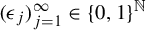 $(\epsilon _j)_{j=1}^{\infty } \in \{0,1\}^{\mathbb {N}}$
we have
$(\epsilon _j)_{j=1}^{\infty } \in \{0,1\}^{\mathbb {N}}$
we have
 $$ \begin{align*} f_{\delta_1}^{-1} \circ \cdots \circ f_{\delta_m}^{-1} (\pi_q((\epsilon_j)_{j=1}^{\infty})) = \pi_q( (\delta_j)_{j=1}^{m} (\epsilon_j)_{j=1}^{\infty}). \end{align*} $$
The map $\pi _q$
also applies to the extended alphabet
$\pi _q$
also applies to the extended alphabet $\{-1 , 0 , 1\}^{\mathbb {N}}$
. Define
$\{-1 , 0 , 1\}^{\mathbb {N}}$
. Define $I_q^* = [ {-1}/({q-1}) , {1}/({q-1}) ]$
. If
$I_q^* = [ {-1}/({q-1}) , {1}/({q-1}) ]$
. If $(\epsilon _j)_{j=1}^{\infty } \in \{-1 , 0 , 1\}^{\mathbb {N}}$
then
$(\epsilon _j)_{j=1}^{\infty } \in \{-1 , 0 , 1\}^{\mathbb {N}}$
then $\pi _q((\epsilon _j)_{j=1}^{\infty }) \in I_q^* $
. Moreover, if we define the set of maps
$\pi _q((\epsilon _j)_{j=1}^{\infty }) \in I_q^* $
. Moreover, if we define the set of maps $E_q^*$
by
$E_q^*$
by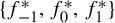 $\{f_{-1}^* , f_0^* , f_1^* \}$
, where
$\{f_{-1}^* , f_0^* , f_1^* \}$
, where
 $$ \begin{align*} \begin{aligned} f^*_{-1} &: \bigg[\frac{-1}{q-1} , \frac{2-q}{q(q-1)}\bigg] \rightarrow I_q^*, &f^*_{-1}(x) &= qx + 1, \\ f^*_{0} &: \bigg[ \frac{-1}{q(q-1)}, \frac{1}{q(q-1)}\bigg] \rightarrow I_q^*, &f^*_{0}(x) &= qx, \\ f^*_{1} &: \bigg[ \frac{-(2-q)}{q(q-1)}, \frac{1}{q-1}\bigg] \rightarrow I_q^*, &f^*_{1}(x) &= qx - 1, \end{aligned} \end{align*} $$
then Lemma 2.4 has the following natural generalization. However, we will not need this result until §4.2.
Lemma 2.5. For any $q \in (1,2)$
,
$q \in (1,2)$
, $(\delta _j)_{j=1}^{m} \in \{-1 , 0,1\}^*$
,
$(\delta _j)_{j=1}^{m} \in \{-1 , 0,1\}^*$
, $(\epsilon _j)_{j=1}^{\infty } \in \{-1 ,0,1\}^{\mathbb {N}}$
we have
$(\epsilon _j)_{j=1}^{\infty } \in \{-1 ,0,1\}^{\mathbb {N}}$
we have
 $$ \begin{align*}f_{\delta_1}^{*-1} \circ \cdots \circ f_{\delta_m}^{*-1} (\pi_q((\epsilon_j)_{j=1}^{\infty})) = \pi_q( (\delta_j)_{j=1}^{m} (\epsilon_j)_{j=1}^{\infty}).\end{align*} $$
For any $k \in \mathbb {N}_{\geq 2}$
,
$k \in \mathbb {N}_{\geq 2}$
, $q \in (1,2)$
, define
$q \in (1,2)$
, define $g_{q,k} = f_1^{-(k-1)} \circ f_0^{-1}$
, where the functions
$g_{q,k} = f_1^{-(k-1)} \circ f_0^{-1}$
, where the functions $f_i$
are implicitly dependent on q. For brevity, whenever
$f_i$
are implicitly dependent on q. For brevity, whenever $m \geq 0$
, we define
$m \geq 0$
, we define
 $$ \begin{align*}N_k^m(q) = \bigcap_{i=0}^m g_{q,k}^i (\mathcal{U}_q + 1) \cap g_{q,k}^m(\mathcal{U}_q).\end{align*} $$
Proposition 2.6 shows that to prove $q \in \mathcal {B}_{m+2}$
it is sufficient to prove that
$q \in \mathcal {B}_{m+2}$
it is sufficient to prove that $N_k^m(q)$
is non-empty.
$N_k^m(q)$
is non-empty.
Proposition 2.6. Let $k \geq 2$
,
$k \geq 2$
, $q \in (G,2)$
and
$q \in (G,2)$
and $m \geq 0$
. If x is such that
$m \geq 0$
. If x is such that $f_0(x) \in N_k^m(q)$
, then
$f_0(x) \in N_k^m(q)$
, then $x \in \mathcal {U}_q^{(m+2)} \cap J_q$
, and hence
$x \in \mathcal {U}_q^{(m+2)} \cap J_q$
, and hence $q \in \mathcal {B}_{m+2}$
.
$q \in \mathcal {B}_{m+2}$
.
To prove this proposition we will need the following definitions and lemmas. Let $q \in (1,2)$
,
$q \in (1,2)$
, $x \in I_q$
and recall that
$x \in I_q$
and recall that $\Sigma _q(x)$
is the set of base q expansions of x. We define the orbit space of x by
$\Sigma _q(x)$
is the set of base q expansions of x. We define the orbit space of x by
 $$ \begin{align*}\Omega_{q}(x) = \{ (f_{\epsilon_j})_{j=1}^\infty \in \{f_0 , f_1\}^{\mathbb{N}} : f_{\epsilon_k} \circ \cdots \circ f_{\epsilon_1}(x) \in I_q \ \mathrm{for \ all \ } k \in \mathbb{N} \}.\end{align*} $$
The following lemma was proved by the first author in [Reference Baker1, Lemma 2.4].
Lemma 2.7. For any $x \in I_q$
,
$x \in I_q$
, $\Sigma _q(x)$
is in bijection with
$\Sigma _q(x)$
is in bijection with $\Omega _{q}(x)$
via the map
$\Omega _{q}(x)$
via the map $(\epsilon _j)_{j=1}^{\infty } \rightarrow (f_{\epsilon _j})_{j=1}^\infty $
.
$(\epsilon _j)_{j=1}^{\infty } \rightarrow (f_{\epsilon _j})_{j=1}^\infty $
.
This bijection allows one to see clearly how some $x \in I_q$
may have multiple base q expansions. The region
$x \in I_q$
may have multiple base q expansions. The region $J_q = [{1}/{q} , {1}/{q(q-1)} ]$
, known as the switch region, has the property that
$J_q = [{1}/{q} , {1}/{q(q-1)} ]$
, known as the switch region, has the property that $x \in J_q$
if and only if
$x \in J_q$
if and only if $f_0(x) , f_1(x) \in I_q$
. Clearly, such an x satisfies
$f_0(x) , f_1(x) \in I_q$
. Clearly, such an x satisfies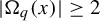 $|\Omega _{q}(x)| \geq 2$
and hence
$|\Omega _{q}(x)| \geq 2$
and hence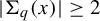 $|\Sigma _q(x)| \geq 2$
. Let
$|\Sigma _q(x)| \geq 2$
. Let $x \in I_q \setminus J_q$
,
$x \in I_q \setminus J_q$
, $y \in I_q$
. We say that x maps uniquely to y if there is a finite sequence of maps
$y \in I_q$
. We say that x maps uniquely to y if there is a finite sequence of maps $(f_{\epsilon _j})_{j=1}^m \in \{f_0 , f_1\}^*$
such that
$(f_{\epsilon _j})_{j=1}^m \in \{f_0 , f_1\}^*$
such that
 $$ \begin{align*}f_{\epsilon_m} \circ \cdots \circ f_{\epsilon_1}(x) = y\end{align*} $$
and
 $$ \begin{align} f_{\epsilon_k} \circ \cdots \circ f_{\epsilon_1}(x) \in I_q \setminus J_q, \end{align} $$
for all $1 \leq k \leq m-1$
. Note that we allow
$1 \leq k \leq m-1$
. Note that we allow $y \in J_q$
.
$y \in J_q$
.
Lemma 2.8. Let $q \in (1,2)$
and suppose
$q \in (1,2)$
and suppose $x \in I_q \setminus J_q$
maps uniquely to
$x \in I_q \setminus J_q$
maps uniquely to $y \in I_q$
. Then
$y \in I_q$
. Then $|\Sigma _q(x)| = |\Sigma _q(y)|$
.
$|\Sigma _q(x)| = |\Sigma _q(y)|$
.
Proof. Assuming the hypotheses of the lemma, we have $f_{\epsilon _k} \circ \cdots \circ f_{\epsilon _1}(x) \in I_q \setminus J_q$
for all
$f_{\epsilon _k} \circ \cdots \circ f_{\epsilon _1}(x) \in I_q \setminus J_q$
for all $1 \leq k \leq m-1$
, and
$1 \leq k \leq m-1$
, and $x \in I_q \setminus J_q$
, where
$x \in I_q \setminus J_q$
, where $(f_{\epsilon _j})_{j=1}^m$
exists by the assumption that x maps uniquely to y. For any
$(f_{\epsilon _j})_{j=1}^m$
exists by the assumption that x maps uniquely to y. For any $z\hspace{-1pt} \in\hspace{-1pt} I_q \setminus J_q$
, we can see by inspection of the domains of
$z\hspace{-1pt} \in\hspace{-1pt} I_q \setminus J_q$
, we can see by inspection of the domains of $f_0$
and
$f_0$
and $f_1$
that there is a unique element
$f_1$
that there is a unique element $\epsilon \in \{0,1\}$
such that
$\epsilon \in \{0,1\}$
such that $f_\epsilon (z) \in I_q$
. Applying this to
$f_\epsilon (z) \in I_q$
. Applying this to $x \in I_q \setminus J_q$
and to
$x \in I_q \setminus J_q$
and to $f_{\epsilon _k} \circ \cdots \circ f_{\epsilon _1}(x)$
for every
$f_{\epsilon _k} \circ \cdots \circ f_{\epsilon _1}(x)$
for every $1 \leq k \leq m-1$
, we see that the sequence
$1 \leq k \leq m-1$
, we see that the sequence $(f_{\epsilon _j})_{j=1}^{m}$
is unique among those sequences which satisfy (3) for all
$(f_{\epsilon _j})_{j=1}^{m}$
is unique among those sequences which satisfy (3) for all $1 \leq k \leq m-1$
. Hence,
$1 \leq k \leq m-1$
. Hence, $(f_{\delta _j})_{j=1}^\infty \in \Omega _{q}(x)$
if and only if
$(f_{\delta _j})_{j=1}^\infty \in \Omega _{q}(x)$
if and only if $(f_{\delta _j})_{j=1}^\infty $
is of the form
$(f_{\delta _j})_{j=1}^\infty $
is of the form $(f_{\epsilon _j})_{j=1}^{m} (f_{\delta _j})_{j=m+1}^\infty $
, where
$(f_{\epsilon _j})_{j=1}^{m} (f_{\delta _j})_{j=m+1}^\infty $
, where $(f_{\delta _j})_{j=m+1}^\infty \in \Omega _{q}(f_{\epsilon _m} \circ \cdots \circ f_{\epsilon _1}(x))$
. Since
$(f_{\delta _j})_{j=m+1}^\infty \in \Omega _{q}(f_{\epsilon _m} \circ \cdots \circ f_{\epsilon _1}(x))$
. Since $f_{\epsilon _m} \circ \cdots \circ f_{\epsilon _1}(x) = y$
, we know
$f_{\epsilon _m} \circ \cdots \circ f_{\epsilon _1}(x) = y$
, we know $(f_{\delta _j})_{j=m+1}^\infty \in \Omega _{q}(y)$
. Therefore, the elements of
$(f_{\delta _j})_{j=m+1}^\infty \in \Omega _{q}(y)$
. Therefore, the elements of $\Omega _{q}(x)$
are generated by taking the elements of
$\Omega _{q}(x)$
are generated by taking the elements of $\Omega _{q}(y)$
and adding a unique prefix of
$\Omega _{q}(y)$
and adding a unique prefix of $(f_{\epsilon _j})_{j=1}^{m}$
. Hence,
$(f_{\epsilon _j})_{j=1}^{m}$
. Hence, $|\Omega _{q}(x)| = |\Omega _{q}(y)|$
, and by Lemma 2.7,
$|\Omega _{q}(x)| = |\Omega _{q}(y)|$
, and by Lemma 2.7, $|\Sigma _q(x)| = |\Sigma _q(y)|$
.
$|\Sigma _q(x)| = |\Sigma _q(y)|$
.
The first part of the following lemma is precisely stating the heuristic that if $q \in (G,2)$
, then any orbit of a point under
$q \in (G,2)$
, then any orbit of a point under $E_q$
cannot remain in
$E_q$
cannot remain in $J_q$
for more than one ‘step’. The second part is a result touched upon in the introduction and is a consequence of Sidorov’s work in [Reference Sidorov19, Lemma 2.2], but for completion we prove it here anyway.
$J_q$
for more than one ‘step’. The second part is a result touched upon in the introduction and is a consequence of Sidorov’s work in [Reference Sidorov19, Lemma 2.2], but for completion we prove it here anyway.
Lemma 2.9. Let $q \in (G,2)$
.
$q \in (G,2)$
.
-
(a) If
$x \in J_q$
then for all
$l \in \mathbb {N}$
, the points
$f_0^{-l}(x)$
,
$f_1^{-l}(x)$
map uniquely to x via the sequences of maps given by
$(f_0)_{j=1}^l$
and
$(f_1)_{j=1}^l$
, respectively. -
(b) If
$x \in I_q$
is such that
$f_0(x) \in (\mathcal {U}_q + 1) \cap \mathcal {U}_q$
then
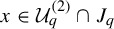
$x \in \mathcal {U}_q^{(2)} \cap J_q$
and hence
$q \in \mathcal {B}_2$
.




Proof. (a) Notice that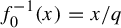 $f_0^{-1}(x) = x/q$
is linear and strictly increasing for all
$f_0^{-1}(x) = x/q$
is linear and strictly increasing for all $x \in I_q$
whenever
$x \in I_q$
whenever $q \in (1,2)$
. If
$q \in (1,2)$
. If $q \in (G,2)$
then
$q \in (G,2)$
then $q^2 - q - 1> 0$
, so
$q^2 - q - 1> 0$
, so ${q^{-2}}/({q-1}) < q^{-1}$
, which is equivalent to
${q^{-2}}/({q-1}) < q^{-1}$
, which is equivalent to $f_0^{-1}({1}/{q(q-1)}) < {1}/{q}$
. This means that the image of the right endpoint of
$f_0^{-1}({1}/{q(q-1)}) < {1}/{q}$
. This means that the image of the right endpoint of $J_q$
under
$J_q$
under $f_0^{-1}$
is less than the left endpoint of
$f_0^{-1}$
is less than the left endpoint of $J_q$
. Hence,
$J_q$
. Hence, $f_0^{-1}(J_q) \cap J_q = \emptyset $
. Extending this we can see that
$f_0^{-1}(J_q) \cap J_q = \emptyset $
. Extending this we can see that $f_0^{-i}({1}/{q(q-1)}) = {1}/({q^{i+1}(q-1)}) < {1}/{q}$
for all
$f_0^{-i}({1}/{q(q-1)}) = {1}/({q^{i+1}(q-1)}) < {1}/{q}$
for all $i \geq 1$
and hence
$i \geq 1$
and hence $f_0^{-i}(J_q) \cap J_q = \emptyset $
. Therefore, if
$f_0^{-i}(J_q) \cap J_q = \emptyset $
. Therefore, if $l \in \mathbb {N}$
and
$l \in \mathbb {N}$
and $x \in J_q$
is arbitrary, then
$x \in J_q$
is arbitrary, then $f_0^i \circ f_0^{-l}(x) \in f_0^{i-l}(J_q)$
, hence
$f_0^i \circ f_0^{-l}(x) \in f_0^{i-l}(J_q)$
, hence $f_0^i \circ f_0^{-l}(x) \in I_q \setminus J_q$
for all
$f_0^i \circ f_0^{-l}(x) \in I_q \setminus J_q$
for all $i = 0 , \ldots , l-1$
. The case for
$i = 0 , \ldots , l-1$
. The case for $f_1$
is similar.
$f_1$
is similar.
(b) Notice that for any $x \in J_q$
, we have that
$x \in J_q$
, we have that $f_0(x) - f_1(x) = 1$
, so
$f_0(x) - f_1(x) = 1$
, so $f_0(x) - 1 = f_1(x)$
. Therefore, if
$f_0(x) - 1 = f_1(x)$
. Therefore, if $f_0(x) \in (\mathcal {U}_q + 1)$
then
$f_0(x) \in (\mathcal {U}_q + 1)$
then $f_1(x) \in \mathcal {U}_q$
, and since both
$f_1(x) \in \mathcal {U}_q$
, and since both $f_0(x), f_1(x) \in I_q$
, we know that
$f_0(x), f_1(x) \in I_q$
, we know that $x \in J_q$
. If we also know that
$x \in J_q$
. If we also know that $f_0(x) \in \mathcal {U}_q$
, then
$f_0(x) \in \mathcal {U}_q$
, then $x \in \mathcal {U}_q^{(2)}$
by Lemma 2.7, and hence the claim.
$x \in \mathcal {U}_q^{(2)}$
by Lemma 2.7, and hence the claim.
Equipped with Lemmas 2.7, 2.8 and 2.9, we are now able to prove Proposition 2.6.
Proof of Proposition 2.6
Fix any $q \in (G,2)$
,
$q \in (G,2)$
, $k \geq 2$
, and proceed by induction on m. For the base case, let
$k \geq 2$
, and proceed by induction on m. For the base case, let $m=0$
and suppose that
$m=0$
and suppose that $N_k^0(q) = (\mathcal {U}_q + 1) \cap \mathcal {U}_q \neq \emptyset $
. Let
$N_k^0(q) = (\mathcal {U}_q + 1) \cap \mathcal {U}_q \neq \emptyset $
. Let $x \in I_q$
be such that
$x \in I_q$
be such that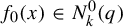 $f_0(x) \in N_k^0(q)$
. Then by Lemma 2.9(b),
$f_0(x) \in N_k^0(q)$
. Then by Lemma 2.9(b),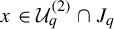 $x \in \mathcal {U}_q^{(2)} \cap J_q$
and
$x \in \mathcal {U}_q^{(2)} \cap J_q$
and $q \in \mathcal {B}_2$
.
$q \in \mathcal {B}_2$
.
For the inductive step, notice that $N_k^{m+1}(q) = (\mathcal {U}_q + 1) \cap g_{q,k}(N_k^m(q))$
. Assume the conclusion holds for m, namely that if
$N_k^{m+1}(q) = (\mathcal {U}_q + 1) \cap g_{q,k}(N_k^m(q))$
. Assume the conclusion holds for m, namely that if $f_0(x) \in N_k^m(q)$
then
$f_0(x) \in N_k^m(q)$
then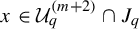 $x \in \mathcal {U}_q^{(m+2)} \cap J_q$
. Suppose that
$x \in \mathcal {U}_q^{(m+2)} \cap J_q$
. Suppose that $x \in I_q$
is such that
$x \in I_q$
is such that $f_0(x) \in N_k^{m+1}(q)$
. Then
$f_0(x) \in N_k^{m+1}(q)$
. Then $f_1(x) \in \mathcal {U}_q$
because
$f_1(x) \in \mathcal {U}_q$
because $f_0(x) \in (\mathcal {U}_q + 1)$
. Since
$f_0(x) \in (\mathcal {U}_q + 1)$
. Since $f_0(x) \in g_{q,k}(N_k^m(q))$
, we know that
$f_0(x) \in g_{q,k}(N_k^m(q))$
, we know that $f_0 \circ f_1^{k-1} \circ f_0(x) \in N_k^m(q)$
. Therefore, by assumption,
$f_0 \circ f_1^{k-1} \circ f_0(x) \in N_k^m(q)$
. Therefore, by assumption, $f_1^{k-1} \circ f_0(x) \in \mathcal {U}_q^{(m+2)} \cap J_q$
. Since
$f_1^{k-1} \circ f_0(x) \in \mathcal {U}_q^{(m+2)} \cap J_q$
. Since $f_1^{k-1} \circ f_0(x) \in J_q$
, Lemma 2.9(a) implies that
$f_1^{k-1} \circ f_0(x) \in J_q$
, Lemma 2.9(a) implies that $f_0(x)$
maps uniquely to
$f_0(x)$
maps uniquely to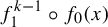 $f_1^{k-1} \circ f_0(x)$
and hence, by Lemma 2.8,
$f_1^{k-1} \circ f_0(x)$
and hence, by Lemma 2.8,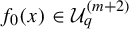 $f_0(x) \in \mathcal {U}_q^{(m+2)}$
. We can conclude by Lemma 2.7 that
$f_0(x) \in \mathcal {U}_q^{(m+2)}$
. We can conclude by Lemma 2.7 that $x \in \mathcal {U}_q^{(m+3)}$
and since
$x \in \mathcal {U}_q^{(m+3)}$
and since $f_0(x), f_1(x) \in I_q$
, we know
$f_0(x), f_1(x) \in I_q$
, we know $x \in J_q$
.
$x \in J_q$
.
Since $q> q_{k-1}$
implies that
$q> q_{k-1}$
implies that $\pi _q(S_{k-1}) \subset \mathcal {U}_q$
by Lemma 2.1(a), we have the following lemma as an immediate corollary to Proposition 2.6.
$\pi _q(S_{k-1}) \subset \mathcal {U}_q$
by Lemma 2.1(a), we have the following lemma as an immediate corollary to Proposition 2.6.
Lemma 2.10. If $k \geq 2$
,
$k \geq 2$
, $m \geq 1$
,
$m \geq 1$
, $q> q_{k-1}$
and the intersection
$q> q_{k-1}$
and the intersection
 $$ \begin{align} \bigcap_{i=0}^m g_{q,k}^i(\pi_q(S_{k-1}) + 1) \cap g_{q,k}^m(\pi_q(S_{k-1})) \end{align} $$
is non-empty, then $q \in \mathcal {B}_{m+2}$
.
$q \in \mathcal {B}_{m+2}$
.
We will see that it will be useful to consider subsets of the sets in (4) rather than the sets in $N_k^m(q)$
because of our existing knowledge of the structure of the sets
$N_k^m(q)$
because of our existing knowledge of the structure of the sets $\pi _q(S_{k-1})$
.
$\pi _q(S_{k-1})$
.
3 Proof of Theorem A
Section 3.1 serves to introduce our approach to proving Theorem A.
3.1 Proof outline
By Proposition 2.6, for all $m \in \mathbb {N}$
, if
$m \in \mathbb {N}$
, if $N_k^m(q) \neq \emptyset $
then
$N_k^m(q) \neq \emptyset $
then $q \in \mathcal {B}_{m+2}$
. Moreover, if
$q \in \mathcal {B}_{m+2}$
. Moreover, if $f_0(x) \in N_k^m(q)$
then
$f_0(x) \in N_k^m(q)$
then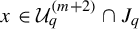 $x \in \mathcal {U}_q^{(m+2)} \cap J_q$
. So a lower bound on the Hausdorff dimension of
$x \in \mathcal {U}_q^{(m+2)} \cap J_q$
. So a lower bound on the Hausdorff dimension of $N_k^m(q)$
provides us with a lower bound on the Hausdorff dimension of
$N_k^m(q)$
provides us with a lower bound on the Hausdorff dimension of $\mathcal {U}_q^{(m+2)}$
. We seek to modify the sets in
$\mathcal {U}_q^{(m+2)}$
. We seek to modify the sets in $N_k^m(q)$
in order to apply Theorem F&Y. More precisely, for
$N_k^m(q)$
in order to apply Theorem F&Y. More precisely, for $i = 0, \ldots , m$
, we seek subsets
$i = 0, \ldots , m$
, we seek subsets $P_i(q) \subset g_{q,k}^i(\mathcal {U}_q + 1)$
and
$P_i(q) \subset g_{q,k}^i(\mathcal {U}_q + 1)$
and $Q_m(q) \subset g_{q,k}^m(\mathcal {U}_q)$
such that Theorem F&Y can be applied to the collection of compact subsets of
$Q_m(q) \subset g_{q,k}^m(\mathcal {U}_q)$
such that Theorem F&Y can be applied to the collection of compact subsets of $\mathbb {R}$
given by
$\mathbb {R}$
given by $\{P_0(q) , \ldots , P_m(q) , Q_m(q)\}$
. For any given finite collection of sets
$\{P_0(q) , \ldots , P_m(q) , Q_m(q)\}$
. For any given finite collection of sets $A_i \subset \mathbb {R}$
, with arbitrary subsets
$A_i \subset \mathbb {R}$
, with arbitrary subsets $B_i \subset A_i$
, it is obvious that if
$B_i \subset A_i$
, it is obvious that if $\bigcap _i B_i \neq \emptyset $
then
$\bigcap _i B_i \neq \emptyset $
then $\bigcap _i A_i \neq \emptyset $
. Hence, if
$\bigcap _i A_i \neq \emptyset $
. Hence, if
 $$ \begin{align*}M_k^m(q) = \bigcap_{i=0}^m P_i(q) \cap Q_m(q)\end{align*} $$
is non-empty, then $N_k^m(q) \neq \emptyset $
and
$N_k^m(q) \neq \emptyset $
and $q \in \mathcal {B}_{m+2}$
. Similarly, if
$q \in \mathcal {B}_{m+2}$
. Similarly, if $f_0(x) \in M_k^m(q)$
then
$f_0(x) \in M_k^m(q)$
then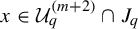 $x \in \mathcal {U}_q^{(m+2)} \cap J_q$
, so
$x \in \mathcal {U}_q^{(m+2)} \cap J_q$
, so $\dim _{\mathrm {H}}(M_k^m(q)) \leq \dim _{\mathrm {H}} (\mathcal {U}_q^{(m+2)})$
. For k sufficiently large, and
$\dim _{\mathrm {H}}(M_k^m(q)) \leq \dim _{\mathrm {H}} (\mathcal {U}_q^{(m+2)})$
. For k sufficiently large, and $q> q_{k-1}$
, each of the sets
$q> q_{k-1}$
, each of the sets $P_0(q) , \ldots , P_m(q) , Q_m(q)$
is shown to have thickness at least
$P_0(q) , \ldots , P_m(q) , Q_m(q)$
is shown to have thickness at least $q^{k-4}$
. Let
$q^{k-4}$
. Let $B(q) = \bigcap _{i=0}^m \mathrm {conv}(P_i(q)) \cap \mathrm {conv}(Q_m(q))$
(see Figure 2), which we show is non-empty, and let
$B(q) = \bigcap _{i=0}^m \mathrm {conv}(P_i(q)) \cap \mathrm {conv}(Q_m(q))$
(see Figure 2), which we show is non-empty, and let
 $$ \begin{align*} \beta_q = \min \bigg\{ \dfrac{1}{4} , \frac{|B(q)|}{\max\{|P_0(q)| , \ldots , |P_m(q)| , |Q_m(q)|\}} \bigg\}. \end{align*} $$ $\beta _q$
corresponds to
$\beta _q$
corresponds to $\beta $
in Theorem F&Y except that we have dependency on q here because the sets to which we are applying Theorem F&Y depend on q. To conclude Theorem A from Theorem F&Y it remains to find some
$\beta $
in Theorem F&Y except that we have dependency on q here because the sets to which we are applying Theorem F&Y depend on q. To conclude Theorem A from Theorem F&Y it remains to find some $c \in (0,1)$
such that
$c \in (0,1)$
such that
 $$ \begin{align} (m+2)(q^{k-4})^{-c} \leq \tfrac{1}{(432)^2}\beta_q^c(1-\beta_q^{1-c}) \end{align} $$
holds for all $m \in \mathbb {N}$
,
$m \in \mathbb {N}$
, $k \geq K_m$
and
$k \geq K_m$
and $|q-q_k| < q_k^{-(m+2)k-3}$
. Note that c could depend on q because the sets to which we are applying Theorem F&Y depend on q. However, since we eventually show that a constant value of c satisfies (5) under the required conditions, the standalone c notation reflects the independence on q. By requiring
$|q-q_k| < q_k^{-(m+2)k-3}$
. Note that c could depend on q because the sets to which we are applying Theorem F&Y depend on q. However, since we eventually show that a constant value of c satisfies (5) under the required conditions, the standalone c notation reflects the independence on q. By requiring $|q - q_k| < q_k^{-(m+2)k-3}$
we achieve a uniform lower bound on
$|q - q_k| < q_k^{-(m+2)k-3}$
we achieve a uniform lower bound on $\beta _q$
when
$\beta _q$
when $k \geq K_m$
. This bound on
$k \geq K_m$
. This bound on $\beta _q$
allows us to choose
$\beta _q$
allows us to choose $c \in (0,1)$
to satisfy (5) as described above. From here, Theorem F&Y tells us, under our assumptions
$c \in (0,1)$
to satisfy (5) as described above. From here, Theorem F&Y tells us, under our assumptions $m \in \mathbb {N}$
,
$m \in \mathbb {N}$
, $k \geq K_m$
and
$k \geq K_m$
and $|q-q_k| < q_k^{-(m+2)k-3}$
, that
$|q-q_k| < q_k^{-(m+2)k-3}$
, that $\dim _{\mathrm {H}}(\mathcal {U}_q^{(m+2)}) \geq \dim _{\mathrm {H}}(M_k^m(q)) \geq 1 - 1024(m+2)^{1/c}q^{k-4}> 0$
. Moreover, an immediate implication of this is that
$\dim _{\mathrm {H}}(\mathcal {U}_q^{(m+2)}) \geq \dim _{\mathrm {H}}(M_k^m(q)) \geq 1 - 1024(m+2)^{1/c}q^{k-4}> 0$
. Moreover, an immediate implication of this is that $\mathcal {U}_q^{(m+2)}$
is non-empty, so
$\mathcal {U}_q^{(m+2)}$
is non-empty, so $q \in \mathcal {B}_{m+2}$
. The majority of the work of the proof is in showing that the sets
$q \in \mathcal {B}_{m+2}$
. The majority of the work of the proof is in showing that the sets $P_0(q) , \ldots , P_m(q) , Q_m(q)$
satisfy the hypotheses of Theorem F&Y. We will see that it is simpler to consider
$P_0(q) , \ldots , P_m(q) , Q_m(q)$
satisfy the hypotheses of Theorem F&Y. We will see that it is simpler to consider $P_i(q)$
as a subset of
$P_i(q)$
as a subset of $g_{q,k}^i(\pi _q(S_{k-1}) + 1)$
for all
$g_{q,k}^i(\pi _q(S_{k-1}) + 1)$
for all $i = 0 , \ldots , m$
, and
$i = 0 , \ldots , m$
, and $Q_m(q)$
as a subset of
$Q_m(q)$
as a subset of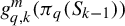 $g_{q,k}^m(\pi _q(S_{k-1}))$
. This is justified by Lemma 2.10. In the following section we construct the subsets
$g_{q,k}^m(\pi _q(S_{k-1}))$
. This is justified by Lemma 2.10. In the following section we construct the subsets $P_i(q)$
of
$P_i(q)$
of $g_k^i(\pi _q(S_{k-1}) + 1)$
for all
$g_k^i(\pi _q(S_{k-1}) + 1)$
for all $0 \leq i \leq m$
, and
$0 \leq i \leq m$
, and $Q_m(q)$
of
$Q_m(q)$
of $g_k^m(\pi _q(S_{k-1}))$
.
$g_k^m(\pi _q(S_{k-1}))$
.
The process of taking subsets of affine images of $\pi _q(S_{k-1})$
in order to bound
$\pi _q(S_{k-1})$
in order to bound $\beta _q$
. For
$\beta _q$
. For $|q - q_k| < q_k^{-2k-6}$
, the relative structure of the sets in all cases where
$|q - q_k| < q_k^{-2k-6}$
, the relative structure of the sets in all cases where $q < q_k$
,
$q < q_k$
, $q = q_k$
and
$q = q_k$
and $q> q_k$
is shown in Figure 3. (a) The relative structure of the convex hulls of the sets in (4) in the case when
$q> q_k$
is shown in Figure 3. (a) The relative structure of the convex hulls of the sets in (4) in the case when $|q - q_k| < q_k^{-2k-6}$
and
$|q - q_k| < q_k^{-2k-6}$
and $q < q_k$
. (b) For q as in (a), the figure shows the process of taking subsets given by
$q < q_k$
. (b) For q as in (a), the figure shows the process of taking subsets given by $\{P_0(q) , \ldots , P_m(q) , Q_m(q)\}$
, and their overlap given by
$\{P_0(q) , \ldots , P_m(q) , Q_m(q)\}$
, and their overlap given by $B(q)$
. For clarity, only the convex hulls of the
$B(q)$
. For clarity, only the convex hulls of the $P_0(q) , \ldots , P_m(q) , Q_m(q)$
sets are shown.
$P_0(q) , \ldots , P_m(q) , Q_m(q)$
sets are shown.
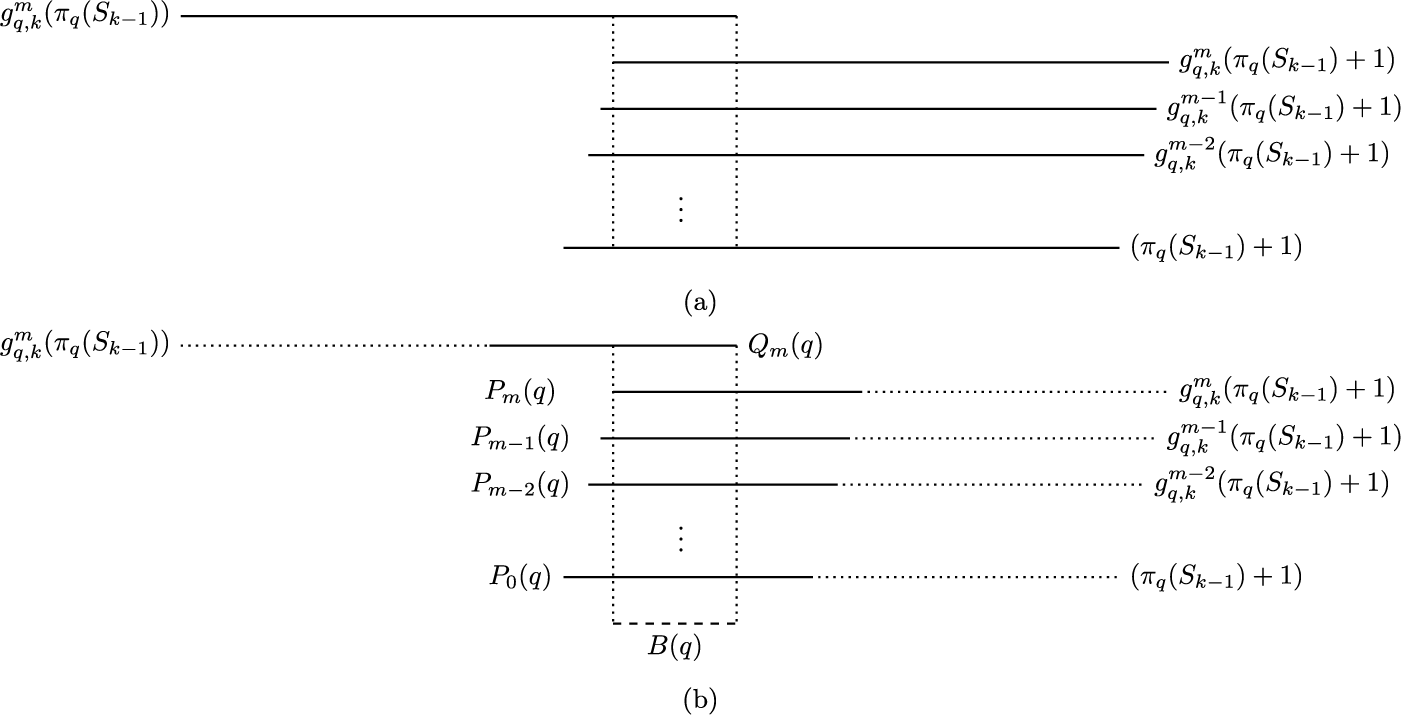
Figure 2 Long description
The diagram contains two horizontal panels labeled a and b. In panel a, the leftmost anchor is g sub q comma k super m open parenthesis pi sub q open parenthesis S sub k minus 1 close parenthesis close parenthesis. From this anchor, several horizontal lines extend rightward, each ending at g sub q comma k super m open parenthesis pi sub q open parenthesis S sub k minus 1 close parenthesis plus 1 close parenthesis, g sub q comma k super m minus 1 open parenthesis pi sub q open parenthesis S sub k minus 1 close parenthesis plus 1 close parenthesis, and so on, with ellipsis indicating continuation. The bottommost line ends at pi sub q open parenthesis S sub k minus 1 close parenthesis plus 1. Vertical dotted lines indicate the subset boundary. In panel b, the left anchor is again g sub q comma k super m open parenthesis pi sub q open parenthesis S sub k minus 1 close parenthesis close parenthesis. Horizontal lines extend rightward, each labeled P sub m open parenthesis q close parenthesis, P sub m minus 1 open parenthesis q close parenthesis, down to P sub 0 open parenthesis q close parenthesis, with ellipsis for omitted terms. These lines intersect a vertical boundary labeled B open parenthesis q close parenthesis, then continue to the right, ending at g sub q comma k super m open parenthesis pi sub q open parenthesis S sub k minus 1 close parenthesis plus 1 close parenthesis, g sub q comma k super m minus 1 open parenthesis pi sub q open parenthesis S sub k minus 1 close parenthesis plus 1 close parenthesis, and so on, with the bottommost line ending at pi sub q open parenthesis S sub k minus 1 close parenthesis plus 1. The top of panel b is labeled Q sub m open parenthesis q close parenthesis. The structure illustrates the mapping and overlap of convex hulls and subsets in the affine image process.
The relative structure of the convex hulls of the sets $P_0(q) , \ldots P_m(q) , Q_m(q)$
and
$P_0(q) , \ldots P_m(q) , Q_m(q)$
and $B(q)$
when
$B(q)$
when $|q - q_k| < q_k^{-(m+2)k-3}$
, as is proved in Lemma 3.7. (a)
$|q - q_k| < q_k^{-(m+2)k-3}$
, as is proved in Lemma 3.7. (a) $q < q_k$
. (b)
$q < q_k$
. (b) $q = q_k$
. (c)
$q = q_k$
. (c) $q > q_k$
.
$q > q_k$
.
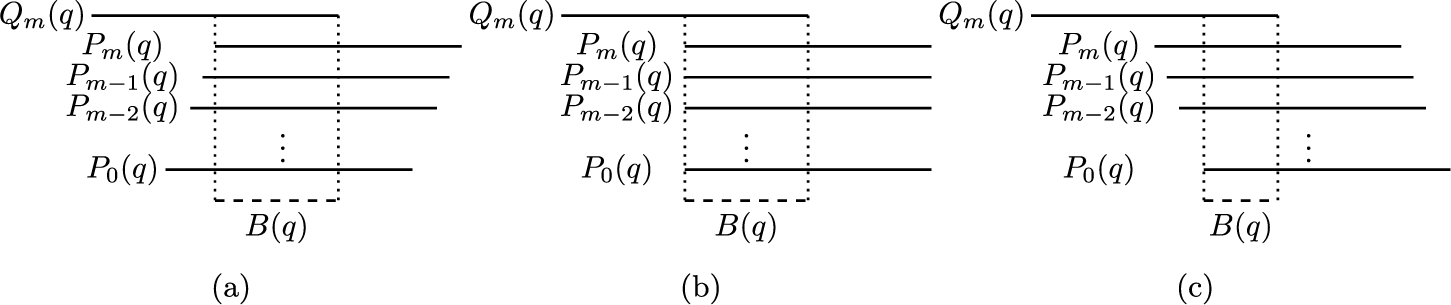
Figure 3 Long description
From left to right, panel a shows Q sub m of q at the top, followed by P sub m of q, P sub m minus 1 of q, P sub m minus 2 of q, and P sub 0 of q at the bottom. A dashed box labeled B of q encloses the lower segments. Panel b repeats the same vertical order and box placement. Panel c also repeats the order, with the dashed box B of q shifted slightly. Each panel illustrates a different relative position of the convex hulls as described in Lemma 3.7.
3.2 Construction of
$P_i(q)$
and
$Q_m(q)$


Fix $m \in \mathbb {N}$
,
$m \in \mathbb {N}$
, $k \geq 3$
and
$k \geq 3$
and $q> q_{k-1}$
. Recall from §2.1 that any compact subset of
$q> q_{k-1}$
. Recall from §2.1 that any compact subset of $\mathbb {R}$
admits a construction as a complement of at most countably many gaps. Let
$\mathbb {R}$
admits a construction as a complement of at most countably many gaps. Let $G(q)$
be the gap of
$G(q)$
be the gap of $\pi _q(S_{k-1})$
given by the open interval
$\pi _q(S_{k-1})$
given by the open interval
 $$ \begin{align*}G(q) = (\pi_q(0^{k-3} (01^{k-2})^\infty) , \pi_q(0^{k-3} (10^{k-2})^\infty)).\end{align*} $$
(Recall that we know this is a gap of $\pi _q(S_{k-1})$
by Lemma 2.1(b).) Similarly, let
$\pi _q(S_{k-1})$
by Lemma 2.1(b).) Similarly, let $H(q)$
be the gap of
$H(q)$
be the gap of $\pi _q(S_{k-1})$
given by the open interval
$\pi _q(S_{k-1})$
given by the open interval
 $$ \begin{align*} H(q) = (\pi_q(1^{k-3}(01^{k-2})^\infty) , \pi_q(1^{k-3}(10^{k-2})^\infty)). \end{align*} $$
Let $0 \leq i \leq m$
and define
$0 \leq i \leq m$
and define $P_i(q)$
to be the subset of
$P_i(q)$
to be the subset of $g_{q,k}^i(\pi _q(S_{k-1}) + 1)$
to the left of the gap
$g_{q,k}^i(\pi _q(S_{k-1}) + 1)$
to the left of the gap $G_i(q)$
where
$G_i(q)$
where
 $$ \begin{align*} G_i(q) = g_{q,k}^i ( q^{-(m-i)k}G(q) + 1 ), \end{align*} $$
that is,
 $$ \begin{align*}P_i(q) = g_{q,k}^i(\pi_q(S_{k-1}) + 1) \cap [g_{q,k}^i(1) , g_{q,k}^i(1 + q^{-(m-i)k}\pi_q(0^{k-3}(10^{k-2})^\infty))]. \end{align*} $$
Similarly, define $Q_m(q)$
to be the subset of
$Q_m(q)$
to be the subset of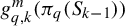 $g_{q,k}^m(\pi _q(S_{k-1}))$
to the right of the gap
$g_{q,k}^m(\pi _q(S_{k-1}))$
to the right of the gap $H_m(q)$
where
$H_m(q)$
where
 $$ \begin{align*}H_m(q) = g_{q,k}^m ( H(q) ),\end{align*} $$
that is,
 $$ \begin{align*}Q_m(q) = g_{q,k}^m(\pi_q(S_{k-1})) \cap [g_{q,k}^m(\pi_q(1^{k-3}(10^{k-2})^\infty)) , g_{q,k}^m(\pi_q(1^\infty))].\end{align*} $$
Since
 $$ \begin{align*}(\pi_q(0^{(m-i)k} 0^{k-3} (01^{k-2})^\infty) , \pi_q(0^{(m-i)k} 0^{k-3} (10^{k-2})^\infty))\end{align*} $$
is also a gap of $\pi _q(S_{k-1})$
for all
$\pi _q(S_{k-1})$
for all $0 \leq i \leq m$
by Lemma 2.1(b), and we can write the gap
$0 \leq i \leq m$
by Lemma 2.1(b), and we can write the gap $G_i(q)$
as
$G_i(q)$
as
 $$ \begin{align*} g_{q,k}^i( \pi_q(0^{(m-i)k} 0^{k-3} (01^{k-2})^\infty) + 1 , \pi_q(0^{(m-i)k} 0^{k-3} (10^{k-2})^\infty) + 1 ), \end{align*} $$
we know that $G_i(q)$
is a gap of
$G_i(q)$
is a gap of $g_{q,k}^i(\pi _q(S_{k-1})+ 1)$
. Similarly,
$g_{q,k}^i(\pi _q(S_{k-1})+ 1)$
. Similarly, $H_m(q)$
is a gap of
$H_m(q)$
is a gap of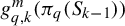 $g_{q,k}^m(\pi _q(S_{k-1}))$
. By Lemma 2.2, we know that
$g_{q,k}^m(\pi _q(S_{k-1}))$
. By Lemma 2.2, we know that $\tau (\pi _q(S_{k-1}))> q^{k-4}$
. To apply Theorem F&Y we need to make sure the process of taking the subsets
$\tau (\pi _q(S_{k-1}))> q^{k-4}$
. To apply Theorem F&Y we need to make sure the process of taking the subsets $P_0(q) , \ldots , P_m(q) , Q_m(q)$
described above preserves this lower bound on the thickness. This is the content of Lemma 3.2. To prove this, we will need the following definition and a lemma which is another consequence of [Reference Glendinning and Sidorov12, Lemma 4]. We say that
$P_0(q) , \ldots , P_m(q) , Q_m(q)$
described above preserves this lower bound on the thickness. This is the content of Lemma 3.2. To prove this, we will need the following definition and a lemma which is another consequence of [Reference Glendinning and Sidorov12, Lemma 4]. We say that $(\epsilon _j)_{j=1}^{\infty }$
is lexicographically less than
$(\epsilon _j)_{j=1}^{\infty }$
is lexicographically less than $(\epsilon ^{\prime }_j)_{j=1}^{\infty }$
if
$(\epsilon ^{\prime }_j)_{j=1}^{\infty }$
if $\epsilon _i < \epsilon ^{\prime }_i$
where
$\epsilon _i < \epsilon ^{\prime }_i$
where $i = \min \{j : \epsilon _j \neq \epsilon ^{\prime }_j\}$
. In this case we write
$i = \min \{j : \epsilon _j \neq \epsilon ^{\prime }_j\}$
. In this case we write $(\epsilon _j)_{j=1}^{\infty } \prec (\epsilon ^{\prime }_j)_{j=1}^{\infty }$
.
$(\epsilon _j)_{j=1}^{\infty } \prec (\epsilon ^{\prime }_j)_{j=1}^{\infty }$
.
Lemma 3.1. Let $k \geq 2$
,
$k \geq 2$
, $q \in (q_k,2)$
, and let
$q \in (q_k,2)$
, and let $ \delta _1, \delta _2 \in \{0,1\}^*$
be finite sequences which avoid
$ \delta _1, \delta _2 \in \{0,1\}^*$
be finite sequences which avoid $(01^k)$
and
$(01^k)$
and $(10^k)$
. For
$(10^k)$
. For $i \in \{1,2\}$
, let
$i \in \{1,2\}$
, let $G_i(q)$
be the gap of
$G_i(q)$
be the gap of $\pi _q(S_k)$
given by the open interval
$\pi _q(S_k)$
given by the open interval
 $$ \begin{align*} (\pi_q(\delta_i (01^{k-1})^\infty) , \pi_q(\delta_i (10^{k-1})^\infty)). \end{align*} $$
-
(a) If
$|\delta _1| < |\delta _2|$
then
$|G_1|> |G_2|$
. -
(b) If
$|\delta _1| = |\delta _2|$
and
$\delta _1 \prec \delta _2$
then the right endpoint of
$G_1$
is less than the left endpoint of
$G_2$
.


Lemma 3.2. For $k \geq 3$
and any
$k \geq 3$
and any $0 \leq i \leq m$
,
$0 \leq i \leq m$
, $\tau (P_i(q)) \geq \tau (\pi _q(S_{k-1}))$
and
$\tau (P_i(q)) \geq \tau (\pi _q(S_{k-1}))$
and $\tau (Q_m(q)) \geq \tau (\pi _q(S_{k-1}))$
.
$\tau (Q_m(q)) \geq \tau (\pi _q(S_{k-1}))$
.
Proof. Let $k \geq 3$
,
$k \geq 3$
, $q> q_{k-1}$
, and let
$q> q_{k-1}$
, and let $P^*(q)$
be the subset of
$P^*(q)$
be the subset of $\pi _q(S_{k-1})$
to the left of the gap given by
$\pi _q(S_{k-1})$
to the left of the gap given by $G(q)$
. That is,
$G(q)$
. That is,
 $$ \begin{align*}P^*(q) = \pi_q(S_{k-1}) \cap [0, \pi_q(0^{k-3}(01^{k-2})^\infty)].\end{align*} $$
We require $k \geq 3$
in order for the gap
$k \geq 3$
in order for the gap $G(q)$
to be well defined, and we require
$G(q)$
to be well defined, and we require $q> q_{k-1}$
to guarantee that
$q> q_{k-1}$
to guarantee that $\pi _q(S_{k-1})$
is a Cantor set by Lemma 2.1(b). Thickness is invariant under affine maps, and for each
$\pi _q(S_{k-1})$
is a Cantor set by Lemma 2.1(b). Thickness is invariant under affine maps, and for each $0 \leq i \leq m$
,
$0 \leq i \leq m$
, $P_i(q)$
is the image under an affine map of
$P_i(q)$
is the image under an affine map of $P^*(q)$
. Hence, to prove the first part it is sufficient to show that
$P^*(q)$
. Hence, to prove the first part it is sufficient to show that $\tau (P^*(q)) \geq \tau (\pi _q(S_{k-1}))$
. The result for
$\tau (P^*(q)) \geq \tau (\pi _q(S_{k-1}))$
. The result for $\tau (Q_m(q))$
can be proved in a similar way, and the lemma follows.
$\tau (Q_m(q))$
can be proved in a similar way, and the lemma follows.
Using Lemma 3.1, since $0^{k-3}$
is the lexicographically smallest sequence of length
$0^{k-3}$
is the lexicographically smallest sequence of length $k-3$
, we know that all gaps of
$k-3$
, we know that all gaps of $\pi _q(S_{k-1})$
contained in the interval
$\pi _q(S_{k-1})$
contained in the interval $[0, \pi _q(0^{k-3} (01^{k-2})^\infty )]$
must be smaller than
$[0, \pi _q(0^{k-3} (01^{k-2})^\infty )]$
must be smaller than $G(q)$
. Hence,
$G(q)$
. Hence, $\mathrm {conv}(P^*(q))$
is a bridge of
$\mathrm {conv}(P^*(q))$
is a bridge of $\pi _q(S_{k-1})$
so all bounded gaps of
$\pi _q(S_{k-1})$
so all bounded gaps of $\pi _q(S_{k-1})$
are either contained in
$\pi _q(S_{k-1})$
are either contained in $\mathrm {conv}(P^*(q))$
or contained in the complement of
$\mathrm {conv}(P^*(q))$
or contained in the complement of $\mathrm {conv}(P^*(q))$
. When we evaluate the thickness of
$\mathrm {conv}(P^*(q))$
. When we evaluate the thickness of $P^*(q)$
, we can observe that the set of bounded gaps over which the infimum is taken is a subset of the set of bounded gaps of
$P^*(q)$
, we can observe that the set of bounded gaps over which the infimum is taken is a subset of the set of bounded gaps of $\pi _q(S_{k-1})$
. Moreover, for any gap
$\pi _q(S_{k-1})$
. Moreover, for any gap $G'$
contained in
$G'$
contained in $\mathrm {conv}(P^*(q))$
, the left and right bridges of
$\mathrm {conv}(P^*(q))$
, the left and right bridges of $G'$
will be the same regardless of whether we consider
$G'$
will be the same regardless of whether we consider $G'$
to be a gap of
$G'$
to be a gap of $P^*(q)$
or a gap of
$P^*(q)$
or a gap of $\pi _q(S_{k-1})$
. Let
$\pi _q(S_{k-1})$
. Let $\mathcal {G}$
be the set of bounded gaps of
$\mathcal {G}$
be the set of bounded gaps of $\pi _q(S_{k-1})$
and let
$\pi _q(S_{k-1})$
and let $\mathcal {G}_{P^*}$
be the set of bounded gaps of
$\mathcal {G}_{P^*}$
be the set of bounded gaps of $P^*(q)$
. With the above observation in mind, and the fact that
$P^*(q)$
. With the above observation in mind, and the fact that $\mathcal {G}_{P^*} \subset \mathcal {G}$
, we see that
$\mathcal {G}_{P^*} \subset \mathcal {G}$
, we see that
 $$ \begin{align*} \begin{aligned} \tau(P^*(q)) & = \inf \bigg\{ \min \bigg\{ \frac{|L_n|}{|G_n|} , \frac{|R_n|}{|G_n|} \bigg\} : G_n \in \mathcal{G}_{P^*} \bigg\} \\ & \geq \inf \bigg\{ \min \bigg\{ \frac{|L_n|}{|G_n|} , \frac{|R_n|}{|G_n|} \bigg\} : G_n \in \mathcal{G} \bigg\}\\ & = \tau(\pi_q(S_{k-1})). \end{aligned} \\[-42pt] \end{align*} $$
We will only need to apply Lemma 3.2 in the case $k \geq 5$
because this is where the bound
$k \geq 5$
because this is where the bound $\tau (\pi _q(S_{k-1})) \geq q^{k-4}$
provided by Lemma 2.2 applies.
$\tau (\pi _q(S_{k-1})) \geq q^{k-4}$
provided by Lemma 2.2 applies.
3.3 The relative structure of the sets
$P_i(q)$
and
$Q_m(q)$


Recall that our plan is to apply Theorem F&Y to the collection $\{P_0(q) , \ldots , P_m(q) , Q_m(q) \}$
where
$\{P_0(q) , \ldots , P_m(q) , Q_m(q) \}$
where $B(q)$
is the intersection of their convex hulls. In order for the convex hulls of the sets
$B(q)$
is the intersection of their convex hulls. In order for the convex hulls of the sets $P_0(q) , \ldots , P_m(q) , Q_m(q)$
to overlap in a sufficiently large interval, that is, for
$P_0(q) , \ldots , P_m(q) , Q_m(q)$
to overlap in a sufficiently large interval, that is, for $|B(q)|$
to be sufficiently large, we need to impose stronger conditions on q. This is done in the following lemmas. Note that the projection of any sequence—besides
$|B(q)|$
to be sufficiently large, we need to impose stronger conditions on q. This is done in the following lemmas. Note that the projection of any sequence—besides $0^\infty $
—decreases as q increases. This is the content of the following lemma.
$0^\infty $
—decreases as q increases. This is the content of the following lemma.
Lemma 3.3. For any sequence $(\delta _j)_{j=1}^{\infty } \in \{0,1\}^{\mathbb {N}} \setminus \{0^\infty \}$
, and any
$(\delta _j)_{j=1}^{\infty } \in \{0,1\}^{\mathbb {N}} \setminus \{0^\infty \}$
, and any $q,q' \in (1,2)$
,
$q,q' \in (1,2)$
,
 $$ \begin{align*} q < q' \!\iff \pi_{q'}((\delta_j)_{j=1}^{\infty}) < \pi_q((\delta_j)_{j=1}^{\infty}). \end{align*} $$
Given some $q \in (1,2)$
,
$q \in (1,2)$
, $k \geq 2$
, define
$k \geq 2$
, define $\epsilon _q \in \mathbb {R}$
by
$\epsilon _q \in \mathbb {R}$
by
 $$ \begin{align} 1 = \pi_q((1^{k-1}0)^\infty) + \epsilon_q. \end{align} $$
We introduce $\epsilon _q$
as a means to bound
$\epsilon _q$
as a means to bound $|B(q)|$
and hence also
$|B(q)|$
and hence also $\beta _q$
from below. Recall from §3.1 that a lower bound on
$\beta _q$
from below. Recall from §3.1 that a lower bound on $\beta _q$
allows us to prove that (5) holds for some
$\beta _q$
allows us to prove that (5) holds for some $c \in (0,1)$
and ultimately to apply Theorem F&Y to prove Theorem A. We will always be dealing with q in a small neighbourhood of
$c \in (0,1)$
and ultimately to apply Theorem F&Y to prove Theorem A. We will always be dealing with q in a small neighbourhood of $q_k$
for some fixed k, so the implicit dependence of
$q_k$
for some fixed k, so the implicit dependence of $\epsilon _q$
on k is suppressed in the notation. Since
$\epsilon _q$
on k is suppressed in the notation. Since $1 = \pi _{q_k}((1^{k-1}0)^\infty )$
, Lemma 3.3 tells us that
$1 = \pi _{q_k}((1^{k-1}0)^\infty )$
, Lemma 3.3 tells us that $\epsilon _q < 0$
if
$\epsilon _q < 0$
if $q < q_k$
,
$q < q_k$
, $\epsilon _q = 0$
if
$\epsilon _q = 0$
if $q = q_k$
, and
$q = q_k$
, and $\epsilon _q> 0$
if
$\epsilon _q> 0$
if $q> q_k$
. The purpose of the following two lemmas is to find an upper bound on
$q> q_k$
. The purpose of the following two lemmas is to find an upper bound on $|\epsilon _q|$
, given an upper bound on
$|\epsilon _q|$
, given an upper bound on $|q - q_k|$
.
$|q - q_k|$
.
Lemma 3.4. Let $m \in \mathbb {N}$
,
$m \in \mathbb {N}$
, $k \geq 4$
. If
$k \geq 4$
. If $|q - q_k| < q_k^{-(m+1)k-3}$
then there is some sequence
$|q - q_k| < q_k^{-(m+1)k-3}$
then there is some sequence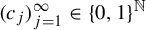 $(c_j)_{j=1}^{\infty } \in \{0,1\}^{\mathbb {N}}$
such that
$(c_j)_{j=1}^{\infty } \in \{0,1\}^{\mathbb {N}}$
such that $1 = \pi _q((c_j)_{j=1}^{\infty })$
and
$1 = \pi _q((c_j)_{j=1}^{\infty })$
and $(c_j)_{j=1}^{\infty } = (1^{k-1}0)^m (c_j)_{j=mk+1}^{\infty }$
.
$(c_j)_{j=1}^{\infty } = (1^{k-1}0)^m (c_j)_{j=mk+1}^{\infty }$
.
Proof. Let $m \in \mathbb {N}$
,
$m \in \mathbb {N}$
, $k \geq 4$
. Let
$k \geq 4$
. Let $q_- \in (1,2)$
be such that
$q_- \in (1,2)$
be such that $1 = \pi _{q_-}((1^{k-1}0)^m 0^\infty )$
and let
$1 = \pi _{q_-}((1^{k-1}0)^m 0^\infty )$
and let $q_+ \in (1,2)$
be such that
$q_+ \in (1,2)$
be such that $1 = \pi _{q_+}((1^{k-1}0)^m 1^\infty )$
. By Lemma 3.3,
$1 = \pi _{q_+}((1^{k-1}0)^m 1^\infty )$
. By Lemma 3.3, $q \in (q_- , q_+)$
is equivalent to
$q \in (q_- , q_+)$
is equivalent to
 $$ \begin{align} \pi_q((1^{k-1}0)^m 0^\infty) < \pi_{q_-}((1^{k-1}0)^m 0^\infty) = 1 = \pi_{q_+}((1^{k-1}0)^m 1^\infty) < \pi_q((1^{k-1}0)^m 1^\infty). \end{align} $$
This means that
 $$ \begin{align*}1 \in (\pi_q((1^{k-1}0)^m 0^\infty) , \pi_q((1^{k-1}0)^m 1^\infty)),\end{align*} $$
that is, there must exist some sequence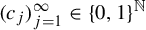 $(c_j)_{j=1}^{\infty } \in \{0,1\}^{\mathbb {N}}$
such that
$(c_j)_{j=1}^{\infty } \in \{0,1\}^{\mathbb {N}}$
such that $1 = \pi _q((c_j)_{j=1}^{\infty })$
where
$1 = \pi _q((c_j)_{j=1}^{\infty })$
where $(c_j)_{j=1}^{\infty } = (1^{k-1}0)^m (c_j)_{j=km+1}^{\infty }$
. Therefore, to prove the lemma, it suffices to show that if
$(c_j)_{j=1}^{\infty } = (1^{k-1}0)^m (c_j)_{j=km+1}^{\infty }$
. Therefore, to prove the lemma, it suffices to show that if $|q - q_k| < q_k^{-(m+1)k-3}$
then
$|q - q_k| < q_k^{-(m+1)k-3}$
then $q \in (q_- , q_+)$
.
$q \in (q_- , q_+)$
.
If $q = q_k$
then we know that
$q = q_k$
then we know that $1 = \pi _q((1^{k-1}0)^\infty )$
, which immediately gives
$1 = \pi _q((1^{k-1}0)^\infty )$
, which immediately gives $(c_j)_{j=1}^{\infty } = (1^{k-1}0)^\infty $
and also
$(c_j)_{j=1}^{\infty } = (1^{k-1}0)^\infty $
and also $q_k \in (q_- , q_+)$
. Assume that
$q_k \in (q_- , q_+)$
. Assume that $m \in \mathbb {N}$
,
$m \in \mathbb {N}$
, $k \geq 4$
and
$k \geq 4$
and $|q - q_k| < q_k^{-(m+1)k-3}$
. Since
$|q - q_k| < q_k^{-(m+1)k-3}$
. Since $1 = \pi _{q_k}((1^{k-1}0)^\infty )$
, expression (7) becomes
$1 = \pi _{q_k}((1^{k-1}0)^\infty )$
, expression (7) becomes
 $$ \begin{align} \pi_q((1^{k-1}0)^m 0^\infty) < \pi_{q_k}((1^{k-1}0)^\infty) < \pi_q((1^{k-1}0)^m 1^\infty), \end{align} $$
and so this is also equivalent to $q \in (q_- , q_+)$
. If
$q \in (q_- , q_+)$
. If $q < q_k$
then, by exchanging
$q < q_k$
then, by exchanging $\pi _q((1^{k-1}0)^m 1^\infty )$
for the smaller expression
$\pi _q((1^{k-1}0)^m 1^\infty )$
for the smaller expression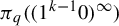 $\pi _q((1^{k-1}0)^\infty )$
, the second inequality of (8) is implied by
$\pi _q((1^{k-1}0)^\infty )$
, the second inequality of (8) is implied by
 $$ \begin{align*}\pi_{q_k}((1^{k-1}0)^\infty) < \pi_q((1^{k-1}0)^\infty),\end{align*} $$
which is itself a direct consequence of Lemma 3.3. If $q> q_k$
then the first inequality of (8) holds by similar reasoning. Therefore, it suffices to show
$q> q_k$
then the first inequality of (8) holds by similar reasoning. Therefore, it suffices to show
-
(1) if
$q < q_k$
then
$\pi _q((1^{k-1}0)^m 0^\infty ) < \pi _{q_k}((1^{k-1}0)^\infty )$
,


and
-
(2) if
$q> q_k$
then
$\pi _{q_k}((1^{k-1}0)^\infty ) < \pi _q((1^{k-1}0)^m 1^\infty )$
.


Case 1. Let $q < q_k$
. Using the fact that
$q < q_k$
. Using the fact that $\pi _q((1^{k-1}0)^m 0^\infty ) = (1-q^{-km})\pi _q((1^{k-1}0)^\infty )$
, the inequality
$\pi _q((1^{k-1}0)^m 0^\infty ) = (1-q^{-km})\pi _q((1^{k-1}0)^\infty )$
, the inequality $\pi _q((1^{k-1}0)^m 0^\infty ) < \pi _{q_k}((1^{k-1}0)^\infty )$
becomes
$\pi _q((1^{k-1}0)^m 0^\infty ) < \pi _{q_k}((1^{k-1}0)^\infty )$
becomes
 $$ \begin{align} q^{-km} \pi_q((1^{k-1}0)^\infty) &> \pi_q((1^{k-1}0)^\infty) - \pi_{q_k}((1^{k-1}0)^\infty), \nonumber \\ &= \bigg( \frac{1}{q-1} - \frac{1}{q^k-1}\bigg) - \bigg( \frac{1}{q_k-1} - \frac{1}{q_k^k-1}\bigg) \nonumber \\ &= \bigg( \frac{1}{q-1} - \frac{1}{q_k-1} \bigg) - \bigg( \frac{1}{q^k-1} - \frac{1}{q_k^k-1}\bigg). \end{align} $$
We show that this inequality is a consequence of our assumption that $|q - q_k| < q_k^{-(m+1)k-3}$
. The second term in parentheses in (9) is positive and the first term in parentheses equals
$|q - q_k| < q_k^{-(m+1)k-3}$
. The second term in parentheses in (9) is positive and the first term in parentheses equals $({q_k - q})/({(q-1)(q_k-1)})$
. Using Lemma 3.3 again,
$({q_k - q})/({(q-1)(q_k-1)})$
. Using Lemma 3.3 again, $\pi _q((1^{k-1}0)^\infty )> \pi _{q_k}((1^{k-1}0)^\infty ) = 1$
, so (9) is implied by
$\pi _q((1^{k-1}0)^\infty )> \pi _{q_k}((1^{k-1}0)^\infty ) = 1$
, so (9) is implied by
 $$ \begin{align} q^{-km}> \frac{q_k-q}{(q-1)(q_k-1)}. \end{align} $$
With $k \geq 4$
, we know that
$k \geq 4$
, we know that $q> 15/8$
(since
$q> 15/8$
(since $q_4 \approx 1.9276$
(by direct computation), the smallest possible value of q is
$q_4 \approx 1.9276$
(by direct computation), the smallest possible value of q is $q_4 - q_4^{-11}$
, so this is a very loose lower bound), so
$q_4 - q_4^{-11}$
, so this is a very loose lower bound), so $(q-1)(q_k-1)> 49/64 > q^{-1}$
, and hence (10) is implied by
$(q-1)(q_k-1)> 49/64 > q^{-1}$
, and hence (10) is implied by
 $$ \begin{align*}q_k - q < q_k^{-km-1},\end{align*} $$
which is definitely true if $q_k - q < q_k^{-(m+1)k-3}$
. This completes the first case.
$q_k - q < q_k^{-(m+1)k-3}$
. This completes the first case.
Case 2. Let $q> q_k$
. We have the following chain of equivalences from the inequality we set out to prove:
$q> q_k$
. We have the following chain of equivalences from the inequality we set out to prove:
 $$ \begin{align} & & \pi_{q_k}((1^{k-1}0)^\infty) & < \pi_q((1^{k-1}0)^m 1^\infty) \nonumber \\ & \Leftrightarrow & \pi_{q_k}((1^{k-1}0)^\infty) - \pi_q((1^{k-1}0)^\infty) & < q^{-km}\pi_q((0^{k-1}1)^\infty) \nonumber \\ & \Leftrightarrow & \bigg( \frac{1}{q_k-1} - \frac{1}{q-1}\bigg) - \bigg( \frac{1}{q_k^k - 1} - \frac{1}{q^k-1} \bigg) & < q^{-km} \frac{1}{q^k-1}. \end{align} $$
The first equivalence makes use of the equalities
 $$ \begin{align*} \begin{aligned} \pi_q((1^{k-1}0)^m 1^\infty) & = \pi_q((1^{k-1}0)^\infty) + \pi_q(0^{km} (0^{k-1}1)^\infty) \\ & = \pi_q((1^{k-1}0)^\infty) + q^{-km}\pi_q((0^{k-1}1)^\infty), \end{aligned} \end{align*} $$
while the second is simply rewriting the $\pi _q$
expressions using the standard formulas for geometric series, and rearranging them. As in the previous case, the second term in parentheses on the left-hand side of (11) is positive, which means this inequality is implied by
$\pi _q$
expressions using the standard formulas for geometric series, and rearranging them. As in the previous case, the second term in parentheses on the left-hand side of (11) is positive, which means this inequality is implied by
 $$ \begin{align*} \frac{q-q_k}{(q_k-1)(q-1)} < \frac{q^{-km}}{q^k-1}, \end{align*} $$
which we rearrange to
 $$ \begin{align*} q-q_k < q^{-km}\frac{(q_k-1)(q-1)}{q^k-1}. \end{align*} $$
Again, we aim to show this is a consequence of our assumptions on q. Using $k \geq 4$
, it can be checked that
$k \geq 4$
, it can be checked that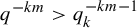 $q^{-km}> q_k^{-km-1}$
and
$q^{-km}> q_k^{-km-1}$
and $({(q_k-1)(q-1)})/({q^k-1})> q_k^{-k-2}$
, so the above inequality is implied by
$({(q_k-1)(q-1)})/({q^k-1})> q_k^{-k-2}$
, so the above inequality is implied by
 $$ \begin{align*} q-q_k < q^{-(m+1)k-3},\end{align*} $$
which is obviously a restriction of $|q - q_k| < q^{-(m+1)k-3}$
to the case
$|q - q_k| < q^{-(m+1)k-3}$
to the case $q> q_k$
. Therefore, the proof of the second case is complete. Hence, we have proved the conclusion in both cases and the lemma holds.
$q> q_k$
. Therefore, the proof of the second case is complete. Hence, we have proved the conclusion in both cases and the lemma holds.
Recall the definition of $\epsilon _q$
from (6) above.
$\epsilon _q$
from (6) above.
Lemma 3.5. Let $m \in \mathbb {N}$
,
$m \in \mathbb {N}$
, $k \geq 4$
and
$k \geq 4$
and $|q - q_k| < q_k^{-(m+2)k-3}$
. Then
$|q - q_k| < q_k^{-(m+2)k-3}$
. Then $-q_k^{-(m+1)k+1} < \epsilon _q < q_k^{-(m+2)k + 1}$
.
$-q_k^{-(m+1)k+1} < \epsilon _q < q_k^{-(m+2)k + 1}$
.
Proof. Assuming the hypotheses of the lemma, let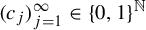 $(c_j)_{j=1}^{\infty } \in \{0,1\}^{\mathbb {N}}$
be of the form
$(c_j)_{j=1}^{\infty } \in \{0,1\}^{\mathbb {N}}$
be of the form $(1^{k-1}0)^{m+1}(c_j)_{j=k(m+1)+1}^{\infty }$
where
$(1^{k-1}0)^{m+1}(c_j)_{j=k(m+1)+1}^{\infty }$
where $\pi _q((c_j)_{j=1}^{\infty }) = 1$
, which we know exists by Lemma 3.4. Then,
$\pi _q((c_j)_{j=1}^{\infty }) = 1$
, which we know exists by Lemma 3.4. Then,
 $$ \begin{align} \pi_q((1^{k-1}0)^{m+1} 0^\infty) \leq \pi_q((1^{k-1}0)^\infty) + \epsilon_q \leq \pi_q((1^{k-1}0)^{m+1} 1^\infty). \end{align} $$
If $q = q_k$
then
$q = q_k$
then $\epsilon _q = 0$
so we consider the remaining two cases separately.
$\epsilon _q = 0$
so we consider the remaining two cases separately.
Case 1: $q < q_k$
. If
$q < q_k$
. If $q < q_k$
then
$q < q_k$
then $\epsilon _q < 0$
and the first part of (12) is equivalent to
$\epsilon _q < 0$
and the first part of (12) is equivalent to
 $$ \begin{align*}\epsilon_q \geq (1-q^{-k(m+1)})\pi_q((1^{k-1}0)^\infty) - \pi_q((1^{k-1}0)^\infty) = -q^{-k(m+1)}(1-\epsilon_q),\end{align*} $$
so
 $$ \begin{align*} \epsilon_q \geq -\frac{q^{-k(m+1)}}{1-q^{-k(m+1)}}. \end{align*} $$
From here, using $k \geq 4$
, it can be checked that
$k \geq 4$
, it can be checked that $\epsilon _q> -q_k^{-k(m+1)+1}$
. This is intuitive given the factor
$\epsilon _q> -q_k^{-k(m+1)+1}$
. This is intuitive given the factor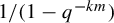 ${1}/({1-q^{-km}})$
is very close to
${1}/({1-q^{-km}})$
is very close to $1$
and q is very close to
$1$
and q is very close to $q_k$
.
$q_k$
.
Case 2: $q> q_k$
. If
$q> q_k$
. If $q> q_k$
then
$q> q_k$
then $\epsilon _q> 0$
and the second part of (12) is equivalent to
$\epsilon _q> 0$
and the second part of (12) is equivalent to
 $$ \begin{align*}\pi_q((1^{k-1}0)^\infty) + \epsilon_q \leq \pi_q((1^{k-1}0)^{m+1} 1^\infty),\end{align*} $$
which is equivalent to
 $$ \begin{align*}\epsilon_q \leq \frac{q^{-k(m+1)}}{q^k-1}.\end{align*} $$
It can be checked that this implies that
 $$ \begin{align*}\epsilon_q < q_k^{-(m+2)k + 1}.\end{align*} $$
Combining the two cases, we see that $-q_k^{-(m+1)k+1} < \epsilon _q < q_k^{-(m+2)k + 1}$
.
$-q_k^{-(m+1)k+1} < \epsilon _q < q_k^{-(m+2)k + 1}$
.
For $q \in (1,2)$
and
$q \in (1,2)$
and $k \geq 2$
, the map
$k \geq 2$
, the map $g_{q,k} = f_1^{-(k-1)} \circ f_0^{-1}$
has a natural symbolic interpretation. Let
$g_{q,k} = f_1^{-(k-1)} \circ f_0^{-1}$
has a natural symbolic interpretation. Let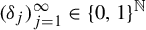 $(\delta _j)_{j=1}^{\infty } \in \{0,1\}^{\mathbb {N}}$
be a base q expansion for some point
$(\delta _j)_{j=1}^{\infty } \in \{0,1\}^{\mathbb {N}}$
be a base q expansion for some point $y \in I_q$
. Then an application of Lemma 2.4 is that
$y \in I_q$
. Then an application of Lemma 2.4 is that
 $$ \begin{align} g_{q,k}(\pi_q((\delta_j)_{j=1}^{\infty})) = \pi_q((1^{k-1}0)(\delta_j)_{j=1}^{\infty}). \end{align} $$
That is, the point $g_{q,k}(y)$
has a base q expansion given by
$g_{q,k}(y)$
has a base q expansion given by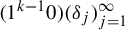 $(1^{k-1}0)(\delta _j)_{j=1}^{\infty }$
where
$(1^{k-1}0)(\delta _j)_{j=1}^{\infty }$
where $(\delta _j)_{j=1}^{\infty }$
is a base q expansion of y. In other words,
$(\delta _j)_{j=1}^{\infty }$
is a base q expansion of y. In other words, $g_{q,k}$
prefixes any base q expansion of y by
$g_{q,k}$
prefixes any base q expansion of y by $(1^{k-1}0)$
. By inspection
$(1^{k-1}0)$
. By inspection $g_{q,k}$
is an affine transformation whose linear part is a contraction by
$g_{q,k}$
is an affine transformation whose linear part is a contraction by $q^k$
and whose translation is a shift of
$q^k$
and whose translation is a shift of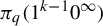 $\pi _q(1^{k-1}0^\infty )$
. It is straightforward to check that the fixed point of
$\pi _q(1^{k-1}0^\infty )$
. It is straightforward to check that the fixed point of $g_{q,k}$
is
$g_{q,k}$
is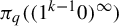 $\pi _q((1^{k-1}0)^\infty )$
. For any
$\pi _q((1^{k-1}0)^\infty )$
. For any $k \geq 2$
and any x such that
$k \geq 2$
and any x such that $\pi _q((1^{k-1}0)^\infty ) + x \in I_q$
,
$\pi _q((1^{k-1}0)^\infty ) + x \in I_q$
,
 $$ \begin{align} g_{q,k}(\pi_q((1^{k-1}0)^\infty) + x) = \pi_q((1^{k-1}0)^\infty) + q^{-k}x. \end{align} $$
We will also use the fact that, since $g_{q,k}$
is an affine transformation,
$g_{q,k}$
is an affine transformation,
 $$ \begin{align} g_{q,k}(x) - g_{q,k}(z) = q^{-k}(x-z) \end{align} $$
whenever $x,z \in I_q$
.
$x,z \in I_q$
.
The following lemmas allow us to determine the interval $B(q)$
as q varies relative to
$B(q)$
as q varies relative to $q_k$
. The argument provides useful bounds for the diameters of the
$q_k$
. The argument provides useful bounds for the diameters of the $P_i(q)$
and
$P_i(q)$
and $Q_m(q)$
sets which are needed in order to bound
$Q_m(q)$
sets which are needed in order to bound $\beta _q$
below in §3.4. We denote by
$\beta _q$
below in §3.4. We denote by $L(X)$
and
$L(X)$
and $R(X)$
the left and right endpoints of a compact subset
$R(X)$
the left and right endpoints of a compact subset $X \subset \mathbb {R}$
. Figure 3 provides a useful reference for Lemma 3.7.
$X \subset \mathbb {R}$
. Figure 3 provides a useful reference for Lemma 3.7.
Lemma 3.6. For any $m \in \mathbb {N}$
,
$m \in \mathbb {N}$
, $k \geq 3$
and
$k \geq 3$
and $q> q_{k-1}$
,
$q> q_{k-1}$
,
 $$ \begin{align*}|P_0(q)| = \cdots = |P_m(q)| = |Q_m(q)| = q^{-(m+1)k + 2} \pi_q((1^{k-2}0)^\infty).\end{align*} $$
Proof. Recall that for $k \geq 3$
,
$k \geq 3$
, $q> q_{k-1},$
 $$ \begin{align*} G_i(q) = g_{q,k}^i ( q^{-(m-i)k}G(q) + 1 ), \end{align*} $$
where
 $$ \begin{align*}G(q) = (\pi_q(0^{k-3} (01^{k-2})^\infty) , \pi_q(0^{k-3} (10^{k-2})^\infty)),\end{align*} $$
and that $P_i(q)$
is the subset of
$P_i(q)$
is the subset of $g_{q,k}^i(\pi _q(S_{k-1}) + 1)$
to the left of
$g_{q,k}^i(\pi _q(S_{k-1}) + 1)$
to the left of $G_i(q)$
. So
$G_i(q)$
. So $P_i(q)$
has the same left endpoint as
$P_i(q)$
has the same left endpoint as $g_{q,k}^i(\pi _q(S_{k-1}) + 1)$
, namely
$g_{q,k}^i(\pi _q(S_{k-1}) + 1)$
, namely $g_{q,k}^i(\pi _q(0^\infty ) + 1) = g_{q,k}^i(1)$
. Observe that, using (15), for any
$g_{q,k}^i(\pi _q(0^\infty ) + 1) = g_{q,k}^i(1)$
. Observe that, using (15), for any $0 \leq i \leq m$
,
$0 \leq i \leq m$
,
 $$ \begin{align*} |P_i(q)| &= L(G_i(q)) - L(P_i(q)) \\ &= g_{q,k}^i(\pi_q(0^{(m-i)k} 0^{k-3} (01^{k-2})^\infty) + 1) - g_{q,k}^i(1) \\ &= q^{-km}(\pi_q(0^{k-3} (01^{k-2})^\infty)) \\ &= q^{-(m+1)k + 2} \pi_q((1^{k-2}0)^\infty), \end{align*} $$
which we note is independent of i. Recall also that
 $$ \begin{align*}H_m(q) = g_{q,k}^m ( H(q) ),\end{align*} $$
where
 $$ \begin{align*}H(q) = (\pi_q(1^{k-3}(01^{k-2})^\infty) , \pi_q(1^{k-3}(10^{k-2})^\infty)),\end{align*} $$
and that $Q_m(q)$
is the subset of
$Q_m(q)$
is the subset of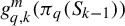 $g_{q,k}^m(\pi _q(S_{k-1}))$
to the right of the gap
$g_{q,k}^m(\pi _q(S_{k-1}))$
to the right of the gap $H_m(q)$
. Using (15) again, we see that
$H_m(q)$
. Using (15) again, we see that
 $$ \begin{align*} |Q_m(q)|&= R(Q_m(q)) - R(H_m(q))\\ &= g_{q,k}^m(\pi_q(1^\infty)) - g_{q,k}^m(\pi_q(1^{k-3} (10^{k-2})^\infty))\\ &= q^{-km}(\pi_q(0^{k-3} (01^{k-2})^\infty))\\ &= |P_i(q)|, \end{align*} $$
for all $0 \leq i \leq m$
.
$0 \leq i \leq m$
.
By Lemma 3.6, we know that $|P_0(q)| = \cdots = |P_m(q)| = |Q_m(q)|$
. We denote this value by
$|P_0(q)| = \cdots = |P_m(q)| = |Q_m(q)|$
. We denote this value by $D_q$
.
$D_q$
.
Recall that $L(X)$
and
$L(X)$
and $R(X)$
denote the left and right endpoints respectively of a compact set
$R(X)$
denote the left and right endpoints respectively of a compact set $X \subset \mathbb {R}$
.
$X \subset \mathbb {R}$
.
Lemma 3.7. Let $m \in \mathbb {N}$
,
$m \in \mathbb {N}$
, $k \geq 4$
, and let
$k \geq 4$
, and let $|q - q_k| < q_k^{-(m+2)k-3}$
.
$|q - q_k| < q_k^{-(m+2)k-3}$
.
-
(a) If
$q < q_k$
then
$$ \begin{align*} \begin{aligned} & L(Q_m(q)) < L(P_0(q)) < \cdots < L(P_m(q))\\ & \quad < R(Q_m(q)) < R(P_0(q)) < \cdots < R(P_m(q)). \end{aligned} \end{align*} $$
-
(b) If
$q = q_k$
then
$$ \begin{align*} \begin{aligned} & L(Q_m(q)) < L(P_0(q)) = \cdots = L(P_m(q))\\ & \quad < R(Q_m(q)) < R(P_0(q)) = \cdots = R(P_m(q)). \end{aligned} \end{align*} $$
-
(c) If
$q> q_k$
then
$$ \begin{align*} \begin{aligned} & L(Q_m(q)) < L(P_m(q)) < \cdots < L(P_0(q)) \\ & \quad < R(Q_m(q)) < R(P_m(q)) < \cdots < R(P_0(q)). \end{aligned} \end{align*} $$


Proof. The proof of this lemma is calculation heavy so we take a moment to separate the proof into the stages the argument takes. Each step of the argument handles a different part of the long inequality to be proven, but will handle all three of the cases $q < q_k$
,
$q < q_k$
, $q = q_k$
and
$q = q_k$
and $q> q_k$
together. Suppose
$q> q_k$
together. Suppose $m \in \mathbb {N}$
,
$m \in \mathbb {N}$
, $k \geq 4$
,
$k \geq 4$
, $|q - q_k| < q_k^{-(m+2)k-3}$
. The inequalities we aim to prove in the cases
$|q - q_k| < q_k^{-(m+2)k-3}$
. The inequalities we aim to prove in the cases $q < q_k$
,
$q < q_k$
, $q = q_k$
and
$q = q_k$
and $q> q_k$
are respectively
$q> q_k$
are respectively
 $$ \begin{align*} \begin{aligned} & L(Q_m(q)) \underbrace{ <}_{\mathrm{A}} L(P_0(q)) \underbrace{ < \cdots <}_{\mathrm{B}} L(P_m(q)) \\ & \quad\underbrace{< R(Q_m(q)) <}_{\mathrm{C}} R(P_0(q)) \underbrace{< \cdots <}_{\mathrm{D}} R(P_m(q)), \end{aligned} \end{align*} $$
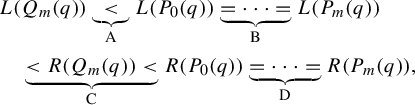 $$ \begin{align*} \begin{aligned} & L(Q_m(q)) \underbrace{ <}_{\mathrm{A}} L(P_0(q)) \underbrace{ = \cdots =}_{\mathrm{B}} L(P_m(q)) \\ & \quad \underbrace{< R(Q_m(q)) <}_{\mathrm{C}} R(P_0(q)) \underbrace{= \cdots =}_{\mathrm{D}} R(P_m(q)), \end{aligned} \end{align*} $$
 $$ \begin{align*} \begin{aligned} & L(Q_m(q)) \underbrace{ <}_{\mathrm{A}} L(P_m(q)) \underbrace{ < \cdots <}_{\mathrm{B}} L(P_0(q)) \\ & \quad \underbrace{< R(Q_m(q)) <}_{\mathrm{C}} R(P_m(q)) \underbrace{< \cdots <}_{\mathrm{D}} R(P_0(q)). \end{aligned} \end{align*} $$
We start by proving all relations (B) by finding a general expression for $L(P_i(q))$
. Lemma 3.6 tells us that
$L(P_i(q))$
. Lemma 3.6 tells us that $|P_i(q)|$
takes the common value
$|P_i(q)|$
takes the common value $D_q$
for all i and so the relations (D) are implied by the relations (B). It also tells us that
$D_q$
for all i and so the relations (D) are implied by the relations (B). It also tells us that $|Q_m(q)|$
shares this common value, so the relations (A) follow from the relations (C). Therefore, it suffices to prove the relations (B) and (C).
$|Q_m(q)|$
shares this common value, so the relations (A) follow from the relations (C). Therefore, it suffices to prove the relations (B) and (C).
Relations (B). As in the proof of Lemma 3.6, $L(P_i(q))$
is the left endpoint of
$L(P_i(q))$
is the left endpoint of $g_{q,k}^i(\pi _q(S_{k-1}) + 1)$
. Since
$g_{q,k}^i(\pi _q(S_{k-1}) + 1)$
. Since $0 \in \pi _q(S_{k-1})$
is the smallest element of this set, we see, using (14), that
$0 \in \pi _q(S_{k-1})$
is the smallest element of this set, we see, using (14), that
 $$ \begin{align} L(P_i(q)) = g_{q,k}^i(1) = g_{q,k}^i(\pi_q((1^{k-1}0)^\infty) + \epsilon_q) = \pi_q((1^{k-1}0)^\infty) + q^{-ki}\epsilon_q. \end{align} $$
By (16) we have the following implications. If $q < q_k$
then
$q < q_k$
then $\epsilon _q < 0$
and
$\epsilon _q < 0$
and
 $$ \begin{align*}L(P_0(q)) < \cdots < L(P_m(q)).\end{align*} $$
If $q =q_k$
then
$q =q_k$
then $\epsilon _q = 0$
and
$\epsilon _q = 0$
and
 $$ \begin{align*}L(P_0(q)) = \cdots = L(P_m(q)).\end{align*} $$
If $q> q_k$
then
$q> q_k$
then $\epsilon _q> 0$
and
$\epsilon _q> 0$
and
 $$ \begin{align*}L(P_m(q)) < \cdots < L(P_0(q)).\end{align*} $$
Relations (C). Given $|q - q_k| < q_k^{-(m+2)k-3}$
we show that
$|q - q_k| < q_k^{-(m+2)k-3}$
we show that
-
(1) if
$q < q_k$
then
$L(P_m(q)) < R(Q_m(q)) < R(P_0(q))$
,


and
-
(2) if
$q \geq q_k$
then
$L(P_0(q)) < R(Q_m(q)) < R(P_m(q))$
.

 $R(Q_m(q))$
is the right endpoint of the set
$R(Q_m(q))$
is the right endpoint of the set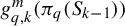 $g_{q,k}^m(\pi _q(S_{k-1}))$
, so
$g_{q,k}^m(\pi _q(S_{k-1}))$
, so
 $$ \begin{align} R(Q_m(q)) &= g_{q,k}^m(\pi_q(1^\infty))\nonumber \\ &= g_{q,k}^m(\pi_q((1^{k-1}0)^\infty) + \pi_q((0^{k-1}1)^\infty))\nonumber \\ &= \pi_q((1^{k-1}0)^\infty) + q^{-km}\pi_q((0^{k-1}1)^\infty)\nonumber \\ &= \pi_q((1^{k-1}0)^\infty) + \frac{q^{-km}}{q^k-1}. \end{align} $$
To find values for $R(P_i(q))$
for
$R(P_i(q))$
for $0 \leq i \leq m$
, we use
$0 \leq i \leq m$
, we use $R(P_i(q)) = L(P_i(q)) + D_q$
. By (16) and Lemma 3.6 this gives
$R(P_i(q)) = L(P_i(q)) + D_q$
. By (16) and Lemma 3.6 this gives
 $$ \begin{align} R(P_i(q)) =\pi_q((1^{k-1}0)^\infty) + q^{-ki}\epsilon_q + q^{-(m+1)k + 2} \bigg( \frac{1}{q-1} - \frac{1}{q^{k-1} -1} \bigg). \end{align} $$
In the first case, when $q < q_k$
and
$q < q_k$
and $\epsilon _q < 0$
, by (16) and (17),
$\epsilon _q < 0$
, by (16) and (17),
 $$ \begin{align} R(Q_m(q)) - L(P_m(q)) = \frac{q^{-km}}{q^k-1} - q^{-km}\epsilon_q> q^{-(m+1)k} > 0. \end{align} $$
The second inequality is only valid when $q < q_k$
, but we only use this bound under this premise. Also, by (17) and (18),
$q < q_k$
, but we only use this bound under this premise. Also, by (17) and (18),
 $$ \begin{align*} R(P_0(q)) - R(Q_m(q)) &= \bigg( \epsilon_q + q^{-(m+1)k + 2} \bigg( \frac{1}{q-1} - \frac{1}{q^{k-1} -1} \bigg) \bigg) - q^{-km}\bigg( \frac{1}{q^k-1} \bigg)\\ &= \epsilon_q + q^{-km}\bigg( q^{-k+2}\bigg( \frac{1}{q-1} - \frac{1}{q^{k-1} -1} \bigg) - \frac{1}{q^k-1} \bigg). \end{align*} $$
Since $\epsilon _q> -q_k^{-(m+1)k + 1}$
whenever
$\epsilon _q> -q_k^{-(m+1)k + 1}$
whenever $|q-q_k| < q_k^{-(m+2)k-3}$
, according to Lemma 3.5, by factoring out
$|q-q_k| < q_k^{-(m+2)k-3}$
, according to Lemma 3.5, by factoring out $q^{-km}$
, the above expression is positive if
$q^{-km}$
, the above expression is positive if
 $$ \begin{align} \bigg(q^{-k+2}\bigg(\frac{1}{q-1} - \frac{1}{q^{k-1}-1}\bigg) - \frac{1}{q^k-1} \bigg) - q^{-k+1}> 0. \end{align} $$
This inequality is made clear by interpreting the terms as projections of sequences in base q. In this way, the left-hand side of (20) is equal to
 $$ \begin{align*} \begin{aligned} & \pi_q(0^{k-2}(1^{k-2}0)^\infty) - \pi_q((0^{k-1}1)^\infty) - \pi_q(0^{k-2}10^\infty) \\ & \quad =\pi_q(0^{k-1}1^{k-3}0(1^{k-2}0)^\infty) - \pi_q((0^{k-1}1)^\infty). \end{aligned} \end{align*} $$
Thus, to verify (20) it suffices to show that
 $$ \begin{align*}\pi_q(0^{k-1}1^{k-3}0(1^{k-2}0)^\infty) - \pi_q((0^{k-1}1)^\infty)>0,\end{align*} $$
or equivalently
 $$ \begin{align} \pi_q(1^{k-3}0(1^{k-2}0)^\infty) - \pi_q((10^{k-1})^\infty)>0. \end{align} $$
When $k=4$
, inequality (21) is a consequence of the inequality
$k=4$
, inequality (21) is a consequence of the inequality
 $$ \begin{align*}q^{-1}+q^{-3}+q^{-4}>q^{-1}+\sum_{l=5}^{\infty}q^{-l},\end{align*} $$
which holds whenever $q>q_{2}$
and in particular when
$q>q_{2}$
and in particular when $|q-q_{4}|<q_{4}^{-(m+2)4-3}$
. When
$|q-q_{4}|<q_{4}^{-(m+2)4-3}$
. When $k\geq 5$
, inequality (21) is a consequence of the inequality
$k\geq 5$
, inequality (21) is a consequence of the inequality
 $$ \begin{align*}q^{-1}+q^{-2}>q^{-1}+\sum_{l=6}^{\infty}q^{-l},\end{align*} $$
which holds whenever $q>q_{2}$
and in particular when
$q>q_{2}$
and in particular when $|q-q_{k}|<q_{k}^{-(m+2)k-3}.$
In the second case, when $q \geq q_k$
and
$q \geq q_k$
and $\epsilon _q \geq 0$
, using Lemma 3.5 again, we know
$\epsilon _q \geq 0$
, using Lemma 3.5 again, we know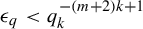 $\epsilon _q < q_k^{-(m+2)k+1}$
, and by (16) and (17) we have
$\epsilon _q < q_k^{-(m+2)k+1}$
, and by (16) and (17) we have
 $$ \begin{align} R(Q_m(q)) - L(P_0(q)) &= \pi_q((1^{k-1}0)^\infty) + q^{-km}\bigg(\frac{1}{q^k-1}\bigg) - (\pi_q((1^{k-1}0)^\infty) + \epsilon_q) \nonumber \\ &= \frac{q^{-km}}{q^k-1} - \epsilon_q \nonumber \\ &> q^{-(m+1)k} - q_k^{-(m+2)k+1} \nonumber \\ &> q_k^{-(m+1)k-1} \nonumber\\ &>0. \end{align} $$
The lower bound of $q_k^{-(m+1)k-1}$
from step (22) follows from a routine calculation. Also, by (18) and (17),
$q_k^{-(m+1)k-1}$
from step (22) follows from a routine calculation. Also, by (18) and (17),
 $$ \begin{align*} R(P_m(q)) - R(Q_m(q)) &= \bigg(q^{-km}\epsilon_q + q^{-(m+1)k + 2} \bigg( \frac{1}{q-1} - \frac{1}{q^k -1} \bigg)\bigg) - q^{-km}\bigg(\frac{1}{q^{k-1}-1}\bigg)\\ &> q^{-km}\epsilon_q + q^{-km}\bigg( q^{-k+2}\bigg( \frac{1}{q-1} - \frac{1}{q^{k-1} -1} \bigg) - \frac{1}{q^k-1} \bigg), \end{align*} $$
and it follows from our analysis of (20) that this is positive. This completes the proof.
3.4 Bounding
$\beta _q$
below

Recall that
 $$ \begin{align*}B(q) = \bigcap_i \mathrm{conv}(P_i(q)) \cap \mathrm{conv}(Q_m(q))\end{align*} $$
and
 $$ \begin{align*} \beta_q = \min \bigg\{ \frac{1}{4} , \frac{|B(q)|}{\max\{|P_0(q)| , \ldots , |P_m(q)| , |Q_m(q)|\}} \bigg\}. \end{align*} $$
Lemma 3.8. If $m \in \mathbb {N}$
,
$m \in \mathbb {N}$
, $k \geq 2$
and
$k \geq 2$
and $|q - q_k| < q_k^{-(m+2)k-3}$
, then
$|q - q_k| < q_k^{-(m+2)k-3}$
, then $\beta _q> 1/8$
.
$\beta _q> 1/8$
.
Proof. Let $m \in \mathbb {N}$
,
$m \in \mathbb {N}$
, $k \geq 2$
and
$k \geq 2$
and $|q - q_k| < q_k^{-(m+2)k-3}$
. Using Lemma 3.7, we know that if
$|q - q_k| < q_k^{-(m+2)k-3}$
. Using Lemma 3.7, we know that if $q < q_k$
, then
$q < q_k$
, then $B(q)$
is given by the interval
$B(q)$
is given by the interval $[L(P_m(q)) , R(Q_m(q))]$
, and if
$[L(P_m(q)) , R(Q_m(q))]$
, and if $q \geq q_k$
, then
$q \geq q_k$
, then $B(q)$
is given by the interval
$B(q)$
is given by the interval $[L(P_0(q)) , R(Q_m(q))]$
. By Lemma 3.6,
$[L(P_0(q)) , R(Q_m(q))]$
. By Lemma 3.6, $\max \{ |P_0(q)| , \ldots , |P_m(q)|, |Q_m(q)|\} = D_q$
(their common value), so
$\max \{ |P_0(q)| , \ldots , |P_m(q)|, |Q_m(q)|\} = D_q$
(their common value), so $\beta _q = \min \{ \tfrac 14 , {|B(q)|}/{D_q} \}$
.
$\beta _q = \min \{ \tfrac 14 , {|B(q)|}/{D_q} \}$
.
If $q < q_k$
then
$q < q_k$
then $q^{-1}> q_k^{-1}$
and
$q^{-1}> q_k^{-1}$
and $|B(q)| = R(Q_m(q)) - L(P_m(q))$
. Recall that
$|B(q)| = R(Q_m(q)) - L(P_m(q))$
. Recall that $|P_i(q)| = D_q$
for all
$|P_i(q)| = D_q$
for all $i = 0 , \ldots , m$
, and it can be checked using Lemma 3.6 that
$i = 0 , \ldots , m$
, and it can be checked using Lemma 3.6 that $D_q < q_k^{-(m+1)k+3}$
. It follows from (19) and the fact that
$D_q < q_k^{-(m+1)k+3}$
. It follows from (19) and the fact that $q^{-(m+1)k}> q_k^{-(m+1)k}$
that
$q^{-(m+1)k}> q_k^{-(m+1)k}$
that $R(Q_m(q)) - L(P_m(q))> q_k^{-(m+1)k}$
and hence
$R(Q_m(q)) - L(P_m(q))> q_k^{-(m+1)k}$
and hence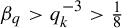 $\beta _q> q_k^{-3} > \tfrac 18$
.
$\beta _q> q_k^{-3} > \tfrac 18$
.
If $q \geq q_k$
then
$q \geq q_k$
then $q^{-1} \leq q_k^{-1}$
and
$q^{-1} \leq q_k^{-1}$
and $|B(q)| = R(Q_m(q)) - L(P_0(q))$
. We know from (22) that
$|B(q)| = R(Q_m(q)) - L(P_0(q))$
. We know from (22) that $R(Q_m(q)) - L(P_0(q))> q_k^{-(m+1)k-1}$
. Using Lemma 3.3, we have
$R(Q_m(q)) - L(P_0(q))> q_k^{-(m+1)k-1}$
. Using Lemma 3.3, we have $\pi _q((1^{k-2}0)^\infty ) \leq \pi _{q_k}((1^{k-2}0)^\infty )< 1$
, so Lemma 3.6 implies that
$\pi _q((1^{k-2}0)^\infty ) \leq \pi _{q_k}((1^{k-2}0)^\infty )< 1$
, so Lemma 3.6 implies that $D_q < q_k^{-(m+1)k+2}$
, so
$D_q < q_k^{-(m+1)k+2}$
, so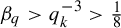 $\beta _q> q_k^{-3} > \tfrac 18$
. Hence, if
$\beta _q> q_k^{-3} > \tfrac 18$
. Hence, if $|q - q_k| < q_k^{-(m+2)k-3}$
then
$|q - q_k| < q_k^{-(m+2)k-3}$
then $\beta _q> \tfrac 18$
.
$\beta _q> \tfrac 18$
.
3.5 Proof of Theorem A
The above results allow us to prove Theorem A.
Proof of Theorem A
Let $m \in \mathbb {N}$
,
$m \in \mathbb {N}$
, $k \geq K_m$
and
$k \geq K_m$
and $|q - q_k| < q_k^{-(m+2)k-3}$
. As discussed in §3.1, to prove Theorem A it suffices to show that the collection of compact subsets of
$|q - q_k| < q_k^{-(m+2)k-3}$
. As discussed in §3.1, to prove Theorem A it suffices to show that the collection of compact subsets of $\mathbb {R}$
given by
$\mathbb {R}$
given by $\{P_0(q) , \ldots P_m(q) , Q_m(q)\}$
satisfy the assumptions of Theorem F&Y. We know that
$\{P_0(q) , \ldots P_m(q) , Q_m(q)\}$
satisfy the assumptions of Theorem F&Y. We know that $B(q) = \bigcap _{i=1}^m \mathrm {conv}(P_i(q)) \cap Q_m(q)$
is non-empty by Lemma 3.7, and we know that each of
$B(q) = \bigcap _{i=1}^m \mathrm {conv}(P_i(q)) \cap Q_m(q)$
is non-empty by Lemma 3.7, and we know that each of $P_0(q) , \ldots , P_m(q) , Q_m(q)$
has thickness at least
$P_0(q) , \ldots , P_m(q) , Q_m(q)$
has thickness at least $q^{k-4}$
by Lemmas 2.2 and 3.2. By Lemma 3.8 it remains to show that there exists some
$q^{k-4}$
by Lemmas 2.2 and 3.2. By Lemma 3.8 it remains to show that there exists some $c \in (0,1)$
such that the following inequality holds:
$c \in (0,1)$
such that the following inequality holds:
 $$ \begin{align} (m+2)(q^{k-4})^{-c} \leq \tfrac{1}{(432)^2}8^{-c}(1-8^{c-1}). \end{align} $$
Given any $c \in (0,1)$
, since
$c \in (0,1)$
, since $\lim _{k \rightarrow \infty }(q^{k-4})^{-c} = 0$
, and since the right-hand side of (23) is independent of k, we know there is some value of k for which (23) holds. Hence, we can arbitrarily fix
$\lim _{k \rightarrow \infty }(q^{k-4})^{-c} = 0$
, and since the right-hand side of (23) is independent of k, we know there is some value of k for which (23) holds. Hence, we can arbitrarily fix $c = \frac {19}{20}$
and find the smallest value of k in terms of m for which (23) holds. (Some numerical testing showed that
$c = \frac {19}{20}$
and find the smallest value of k in terms of m for which (23) holds. (Some numerical testing showed that $c = \frac {19}{20}$
is a reasonable choice, and the authors do not believe that we can strengthen Theorem A by choosing a different value of c.) Notice that
$c = \frac {19}{20}$
is a reasonable choice, and the authors do not believe that we can strengthen Theorem A by choosing a different value of c.) Notice that $K_m$
is non-decreasing with m and
$K_m$
is non-decreasing with m and $K_1 = \lceil \frac {19}{20}( \log _{1.999}(3) + 24 ) + 4 \rceil = 31$
. Therefore,
$K_1 = \lceil \frac {19}{20}( \log _{1.999}(3) + 24 ) + 4 \rceil = 31$
. Therefore, $K_m \geq 31$
for all
$K_m \geq 31$
for all $m \in \mathbb {N}$
and because
$m \in \mathbb {N}$
and because $q_{31}> q_{10} > 1.999$
(by direct computation), if
$q_{31}> q_{10} > 1.999$
(by direct computation), if $k \geq K_m$
, then (23) is implied by
$k \geq K_m$
, then (23) is implied by
 $$ \begin{align} (m+2)(1.999)^{(4-k)\frac{19}{20}} \leq \tfrac{1}{(432)^2}(8^{-\frac{19}{20}})(1-8^{-\frac{1}{20}}). \end{align} $$
The right-hand side of (24) is bounded below by $7.3389 \times 10^{-8}$
. Using
$7.3389 \times 10^{-8}$
. Using $\log _{1.999}(7.3389 \times 10^{-8})> -24$
, a sufficient condition on k to satisfy (24) is
$\log _{1.999}(7.3389 \times 10^{-8})> -24$
, a sufficient condition on k to satisfy (24) is
 $$ \begin{align*} k \geq \tfrac{20}{19}( \log_{1.999}(m+2) + 24 ) + 4, \end{align*} $$
which is obviously true when $k \geq K_m$
. This completes the proof.
$k \geq K_m$
. This completes the proof.
4 Proof of Theorem B
We first outline the proof of Theorem B.
4.1 Proof outline
Using Proposition 2.6, we know that for any $q \in (G,2)$
, if
$q \in (G,2)$
, if
 $$ \begin{align*}(\mathcal{U}_q + 1) \cap g_{q,k}((\mathcal{U}_q + 1) \cap (\mathcal{U}_q)) \neq \emptyset,\end{align*} $$
then $q \in \mathcal {B}_3$
. Let
$q \in \mathcal {B}_3$
. Let $k \geq 9$
. If
$k \geq 9$
. If $|q - q_k| \leq q_k^{-2k-6}$
then it can be checked that
$|q - q_k| \leq q_k^{-2k-6}$
then it can be checked that $q> q_{k-1}$
and hence
$q> q_{k-1}$
and hence $\pi _q(S_{k-1}) \subset \mathcal {U}_q$
by Lemma 2.1(a). For each q such that
$\pi _q(S_{k-1}) \subset \mathcal {U}_q$
by Lemma 2.1(a). For each q such that $|q - q_k| < q_k^{-2k-6}$
, we construct a family of sets
$|q - q_k| < q_k^{-2k-6}$
, we construct a family of sets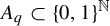 $A_q \subset \{0,1\}^{\mathbb {N}}$
such that
$A_q \subset \{0,1\}^{\mathbb {N}}$
such that $\pi _q(A_q) \subset (\mathcal {U}_q + 1) \cap \mathcal {U}_q$
whenever
$\pi _q(A_q) \subset (\mathcal {U}_q + 1) \cap \mathcal {U}_q$
whenever $q> q_9$
. This means that if
$q> q_9$
. This means that if
 $$ \begin{align} (\pi_q(S_{k-1}) + 1) \cap g_{q,k}(\pi_q(A_q)) \neq \emptyset, \end{align} $$
then $q \in \mathcal {B}_3$
. Hence, to prove Theorem B it suffices to prove that (25) holds when either
$q \in \mathcal {B}_3$
. Hence, to prove Theorem B it suffices to prove that (25) holds when either
-
(a)
$k \geq 10$
and
$|q - q_k| \leq q_k^{-2k-6}$


or
-
(b)
$0 < q - q_9 \leq q_9^{-24}$
.

Since (25) concerns an intersection of only two sets, we can employ Theorem N to conclude their intersection is non-empty. To do this, we require the sets in question to be interleaved and for the product of their thicknesses to be at least 1. By Lemma 2.2 we know that $\tau (\pi _q(S_{k-1}))> q^{k-4}$
when
$\tau (\pi _q(S_{k-1}))> q^{k-4}$
when $k \geq 4$
and
$k \geq 4$
and $q> q_{k-1}$
, and it has been shown in previous work by the authors [Reference Baker and Bender3, Proposition 3.13] that the set
$q> q_{k-1}$
, and it has been shown in previous work by the authors [Reference Baker and Bender3, Proposition 3.13] that the set $A_q$
we will construct satisfies
$A_q$
we will construct satisfies
 $$ \begin{align} \tau(\pi_q(A_q))> q^{-5}, \end{align} $$
when $q> q_9$
. Recall by the definition of
$q> q_9$
. Recall by the definition of $g_{q,k} = f_1^{-(k-1)} \circ f_0^{-1}$
that
$g_{q,k} = f_1^{-(k-1)} \circ f_0^{-1}$
that $g_{q,k}$
is an affine map and hence preserves thickness, so
$g_{q,k}$
is an affine map and hence preserves thickness, so
 $$ \begin{align*} \tau(\pi_q(S_{k-1}) + 1) \times \tau(g_{q,k}(\pi_q(A_q)))> q^{k-4} \times q^{-5} \geq 1, \end{align*} $$
whenever $k \geq 9$
,
$k \geq 9$
, $q> q_9$
. Therefore, the thickness condition of Theorem N is satisfied for both cases (a) and (b) of Theorem B, and it only remains to prove that the sets in (25) are interleaved for q in the required range. We do this using the notion of
$q> q_9$
. Therefore, the thickness condition of Theorem N is satisfied for both cases (a) and (b) of Theorem B, and it only remains to prove that the sets in (25) are interleaved for q in the required range. We do this using the notion of $\epsilon $
-strong interleaving, introduced in §2.1.
$\epsilon $
-strong interleaving, introduced in §2.1.
Let $k \geq 9$
,
$k \geq 9$
, $|q - q_k| \leq q_k^{-2k-6}$
. We show the following assertions.
$|q - q_k| \leq q_k^{-2k-6}$
. We show the following assertions.
-
(1) The sets
$(\pi _{q_k}(S_{k-1}) + 1)$
and
$g_{q_k,k}(\pi _{q_k}(A_{q_k}))$
are
$q_k^{-2k-4}$
-strongly interleaved. -
(2) Both
$d_{\mathrm {H}}((\pi _{q_k}(S_{k-1}) + 1) , (\pi _q(S_{k-1}) + 1))$
and
$d_{\mathrm {H}}(g_{q_k,k}(\pi _{q_k}(A_{q_k})) , g_{q,k}(\pi _q(A_q)))$
are less than
$q_k^{-2k-4}$
.






By the definition of $\epsilon $
-strong interleaving, these results tell us that
$\epsilon $
-strong interleaving, these results tell us that $(\pi _q(S_{k-1}) + 1)$
and
$(\pi _q(S_{k-1}) + 1)$
and $g_{q,k}(\pi _q(A_q))$
are interleaved. To prove the first item, we will find four points in
$g_{q,k}(\pi _q(A_q))$
are interleaved. To prove the first item, we will find four points in $(\pi _{q_k}(S_{k-1}) + 1) \cap g_{q_k,k}(\pi _{q_k}(A_{q_k}))$
that are sufficiently far apart and then apply Lemma 2.3. Since the thickness condition (26) only holds when
$(\pi _{q_k}(S_{k-1}) + 1) \cap g_{q_k,k}(\pi _{q_k}(A_{q_k}))$
that are sufficiently far apart and then apply Lemma 2.3. Since the thickness condition (26) only holds when $q> q_9$
, the complete argument only applies in the smaller domain where either (a) or (b) is true. Hence, Theorem N applies to (25) when either (a) or (b) is true and the proof is complete.
$q> q_9$
, the complete argument only applies in the smaller domain where either (a) or (b) is true. Hence, Theorem N applies to (25) when either (a) or (b) is true and the proof is complete.
4.2 Construction of
$A_q$

In this subsection we construct the set $A_q$
which will have the important property that for
$A_q$
which will have the important property that for $q> q_9$
,
$q> q_9$
, $\pi _q(A_q) \subset \mathcal {U}_q \cap (\mathcal {U}_q + 1)$
and
$\pi _q(A_q) \subset \mathcal {U}_q \cap (\mathcal {U}_q + 1)$
and $\tau (\pi _q(A_q))> q^{-5}$
. Define the set
$\tau (\pi _q(A_q))> q^{-5}$
. Define the set
 $$ \begin{align*}W_2 = \{ (-1 0) , (0 -\!1) , (00) , (01) , (10) \},\end{align*} $$
and write $W_2^{\mathbb {N}}$
for the set of infinite concatenations of elements of
$W_2^{\mathbb {N}}$
for the set of infinite concatenations of elements of $W_2$
. For any
$W_2$
. For any $k \in \mathbb {N}$
and
$k \in \mathbb {N}$
and $(\delta _j)_{j=1}^{k} \in \{-1, 0 ,1\}^k$
, define the notation
$(\delta _j)_{j=1}^{k} \in \{-1, 0 ,1\}^k$
, define the notation
 $$ \begin{align*}(\delta_j)_{j=1}^{k} W_2^{\mathbb{N}} = \{ (\epsilon_j)_{j=1}^{\infty} \in \{-1, 0,1\}^{\mathbb{N}} : (\epsilon_j)_{j=1}^{k} = (\delta_j)_{j=1}^{k} \ \mathrm{and} \ (\epsilon_j)_{j=k+1}^{\infty} \in W_2^{\mathbb{N}} \} .\end{align*} $$
Lemma 4.1. If $k \geq 9$
and
$k \geq 9$
and $|q - q_k| \leq q_k^{-2k-6}$
then there exists a sequence
$|q - q_k| \leq q_k^{-2k-6}$
then there exists a sequence $(c_j)_{j=1}^{\infty } \in 1^k0^{k+4} W_2^{\mathbb {N}}$
such that
$(c_j)_{j=1}^{\infty } \in 1^k0^{k+4} W_2^{\mathbb {N}}$
such that $1 = \pi _q((c_j)_{j=1}^{\infty })$
.
$1 = \pi _q((c_j)_{j=1}^{\infty })$
.
In words, this lemma is claiming the existence of an expansion of $1$
in base q which agrees with the expansion of
$1$
in base q which agrees with the expansion of $1$
in base
$1$
in base $q_k$
, given by
$q_k$
, given by $1^k 0^\infty $
, for the first
$1^k 0^\infty $
, for the first $2k+4$
digits, and, moreover, this expansion has a tail in
$2k+4$
digits, and, moreover, this expansion has a tail in $W_2^{\mathbb {N}}$
. We will see that this lemma is required to show that the sets
$W_2^{\mathbb {N}}$
. We will see that this lemma is required to show that the sets $\pi _q(A_q)$
and
$\pi _q(A_q)$
and $\pi _{q_k}(A_{q_k})$
remain sufficiently close in the Hausdorff metric when
$\pi _{q_k}(A_{q_k})$
remain sufficiently close in the Hausdorff metric when $|q - q_k| < q_k^{-2k-6}$
. The intuition here is that since the sets
$|q - q_k| < q_k^{-2k-6}$
. The intuition here is that since the sets $A_q$
will be shown to depend upon a given fixed expansion of
$A_q$
will be shown to depend upon a given fixed expansion of $1$
in base q, we require the expansions of
$1$
in base q, we require the expansions of $1$
themselves to be nearby in the sense that they agree on a large initial segment.
$1$
themselves to be nearby in the sense that they agree on a large initial segment.
Proof. For all $q \in (1,2)$
, define
$q \in (1,2)$
, define $H_q$
to be the interval
$H_q$
to be the interval $[\pi _q((-10)^\infty ) , \pi _q((10)^\infty )]$
. We want to show that if
$[\pi _q((-10)^\infty ) , \pi _q((10)^\infty )]$
. We want to show that if $k \geq 9$
and
$k \geq 9$
and $|q - q_k| < q_k^{-2k-6}$
then
$|q - q_k| < q_k^{-2k-6}$
then $1$
satisfies
$1$
satisfies
 $$ \begin{align} f_0^{k+4}{\circ} f_1^k(1) \in H_q. \end{align} $$
It was shown in [Reference Baker and Bender3, Lemma 3.8] that if $x \in H_q$
then x admits a base q expansion in
$x \in H_q$
then x admits a base q expansion in $W_2^{\mathbb {N}}$
. Therefore, if (27) holds, there is a sequence
$W_2^{\mathbb {N}}$
. Therefore, if (27) holds, there is a sequence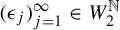 $(\epsilon _j)_{j=1}^{\infty } \in W_2^{\mathbb {N}}$
such that
$(\epsilon _j)_{j=1}^{\infty } \in W_2^{\mathbb {N}}$
such that $f_0^{k+4} \circ f_1^k(1) = \pi _q((\epsilon _j)_{j=1}^{\infty })$
. By Lemma 2.5, this tells us that
$f_0^{k+4} \circ f_1^k(1) = \pi _q((\epsilon _j)_{j=1}^{\infty })$
. By Lemma 2.5, this tells us that $1 = \pi _q(1^k0^{k+4}(\epsilon _j)_{j=1}^{\infty })$
. Hence, we know there is a sequence
$1 = \pi _q(1^k0^{k+4}(\epsilon _j)_{j=1}^{\infty })$
. Hence, we know there is a sequence $(c_j)_{j=1}^{\infty } \in 1^k 0^{k+4} W_2^{\mathbb {N}}$
with
$(c_j)_{j=1}^{\infty } \in 1^k 0^{k+4} W_2^{\mathbb {N}}$
with $1 = \pi _q((c_j)_{j=1}^{\infty })$
, and so the lemma holds. Setting
$1 = \pi _q((c_j)_{j=1}^{\infty })$
, and so the lemma holds. Setting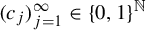 $(c_j)_{j=1}^{\infty } \in \{0,1\}^{\mathbb {N}}$
to be any sequence with
$(c_j)_{j=1}^{\infty } \in \{0,1\}^{\mathbb {N}}$
to be any sequence with $1 = \pi _q((c_j)_{j=1}^{\infty })$
, we can observe, using Lemma 2.5 again, that (27) is equivalent to
$1 = \pi _q((c_j)_{j=1}^{\infty })$
, we can observe, using Lemma 2.5 again, that (27) is equivalent to
 $$ \begin{align*}\pi_q((c_j)_{j=1}^{\infty} \in [\pi_q(1^k0^{k+4} (-1 0)^\infty) , \pi_q(1^k0^{k+4} (1 0)^\infty)],\end{align*} $$
that is,
 $$ \begin{align*}\pi_q(1^k0^{k+4} (-1 0)^\infty) \leq \pi_q((c_j)_{j=1}^{\infty}) \leq \pi_q(1^k0^{k+4} (10)^\infty),\end{align*} $$
and we have the equivalent inequalities
 $$ \begin{align*}\pi_q(0^{2k+4}(-10)^\infty) \leq \pi_q((c_j)_{j=1}^{\infty}) - \pi_q(1^k0^\infty) \leq \pi_q(0^{2k+4}(10)^\infty),\end{align*} $$
 $$ \begin{align} |\pi_{q_k}(1^k0^\infty) - \pi_q(1^k 0^\infty)| \leq \pi_q(0^{2k+4} (10)^\infty), \end{align} $$
where we have replaced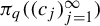 $\pi _q((c_j)_{j=1}^{\infty })$
with
$\pi _q((c_j)_{j=1}^{\infty })$
with $\pi _{q_k}(1^k 0^\infty )$
in the last step since both are equal to
$\pi _{q_k}(1^k 0^\infty )$
in the last step since both are equal to $1$
. It can be checked that (28) is equivalent to
$1$
. It can be checked that (28) is equivalent to
 $$ \begin{align} \bigg|\bigg( \frac{1}{q_k-1} - \frac{1}{q-1}\bigg) - \bigg( \frac{q_k^{-k}}{q_k-1} - \frac{q^{-k}}{q-1}\bigg) \bigg| \leq q^{-2k-4}\frac{q}{q^2-1}. \end{align} $$
Both terms in parentheses always have the same sign and the latter has smaller magnitude, so we can ignore it and deduce that inequality (29) is implied by
 $$ \begin{align*}\frac{|q - q_k|}{(q-1)(q_k-1)} \leq q^{-2k-4}\frac{q}{q^2-1}.\end{align*} $$
Since $({q^2}/{q^2-1})>1$
for all
$({q^2}/{q^2-1})>1$
for all $q \in (1,2)$
, expression (27) is true if
$q \in (1,2)$
, expression (27) is true if
 $$ \begin{align*}|q-q_k| < q^{-2k-5}(q_k-1)(q-1).\end{align*} $$
Using $|q - q_k| < q_k^{-2k-6}$
, this is implied by
$|q - q_k| < q_k^{-2k-6}$
, this is implied by
 $$ \begin{align} 1 < q_k \bigg(\dfrac{q_k}{q}\bigg)^{2k+5}(q_k-1)(q-1), \end{align} $$
and this is what we aim to prove.
Let $k \geq 9$
and
$k \geq 9$
and $|q - q_k| \leq q_k^{-2k-6}$
. If
$|q - q_k| \leq q_k^{-2k-6}$
. If $q_k> q$
then
$q_k> q$
then $({q_k}/{q})> 1$
, so (30) is a result of
$({q_k}/{q})> 1$
, so (30) is a result of $q_k> 1.9$
and
$q_k> 1.9$
and $(q_k-1)(q-1)> 0.9$
(which can be easily checked). If
$(q_k-1)(q-1)> 0.9$
(which can be easily checked). If $q_k < q$
, set
$q_k < q$
, set $\delta = q - q_k> 0$
and observe that
$\delta = q - q_k> 0$
and observe that
 $$ \begin{align} \delta/q < \delta \leq q_k^{-2k-6}. \end{align} $$
Since $k \geq 9$
we know that
$k \geq 9$
we know that $q_k> 1.998$
(by direct computation). Bernoulli’s inequality tells us that if
$q_k> 1.998$
(by direct computation). Bernoulli’s inequality tells us that if $2k+5 \geq 1$
and
$2k+5 \geq 1$
and $0 \leq \delta /q \leq 1$
(which are true under our assumptions) then
$0 \leq \delta /q \leq 1$
(which are true under our assumptions) then
 $$ \begin{align*}\bigg(\dfrac{q_k}{q}\bigg)^{2k+5} = (1- \delta/q)^{2k+5}> (1 - (2k+5)q_k^{-2k-6}) > 0.999\,99,\end{align*} $$
where the first inequality makes use of (31) and the final inequality follows from a direct computation estimating $(2k+5)(1.99)^{-2k-6}> 1.55 \times 10^{-6}$
at
$(2k+5)(1.99)^{-2k-6}> 1.55 \times 10^{-6}$
at $k=9$
, and the fact that
$k=9$
, and the fact that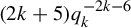 $(2k+5)q_k^{-2k-6}$
is decreasing as k increases. Because
$(2k+5)q_k^{-2k-6}$
is decreasing as k increases. Because $q_k> 1.998$
we also know that
$q_k> 1.998$
we also know that
 $$ \begin{align*} (q_k - 1)(q-1)> (\tfrac{499}{500})^2 > 0.996,\end{align*} $$
so the right-hand side of (30) is bounded below by $1.998\times 0.999\,99\times 0.996> 1$
. Therefore, (30) holds when
$1.998\times 0.999\,99\times 0.996> 1$
. Therefore, (30) holds when $k \geq 9$
and
$k \geq 9$
and $|q - q_k| < q_k^{-2k-6}$
, which completes the proof.
$|q - q_k| < q_k^{-2k-6}$
, which completes the proof.
Let $k \geq 9$
, and let
$k \geq 9$
, and let $|q - q_k| \leq q_k^{-2k-6}$
. We associate to q a so-called fixed expansion of
$|q - q_k| \leq q_k^{-2k-6}$
. We associate to q a so-called fixed expansion of $1$
, given by
$1$
, given by $(c_j)_{j=1}^{\infty } \in 1^k 0^{k+4}W_2^{\mathbb {N}}$
and satisfying
$(c_j)_{j=1}^{\infty } \in 1^k 0^{k+4}W_2^{\mathbb {N}}$
and satisfying $\pi _q((c_j)_{j=1}^{\infty }) = 1$
, which we know exists by Lemma 4.1. There may be several possible choices for the sequence
$\pi _q((c_j)_{j=1}^{\infty }) = 1$
, which we know exists by Lemma 4.1. There may be several possible choices for the sequence $(c_j)_{j=1}^{\infty }$
; in this case we just pick one arbitrarily. As in [Reference Baker and Bender3], we let J be the set of zeros of the sequence
$(c_j)_{j=1}^{\infty }$
; in this case we just pick one arbitrarily. As in [Reference Baker and Bender3], we let J be the set of zeros of the sequence $(c_j)_{j=1}^{\infty }$
,
$(c_j)_{j=1}^{\infty }$
,
 $$ \begin{align*} J = \{j \in \mathbb{N} : c_j = 0\}, \end{align*} $$
which we enumerate as follows: $J = \{j_0, j_1 , \ldots \}$
where
$J = \{j_0, j_1 , \ldots \}$
where $j_0 < j_1 < \cdots $
. Define
$j_0 < j_1 < \cdots $
. Define
 $$ \begin{align*}J_{\mathrm{fixed},1} = \{j_n \in J : n =4m + 1 \ \mathrm{for \ some \ } m \in \mathbb{N}\},\end{align*} $$
 $$ \begin{align*} J_{\mathrm{fixed},0} = \{j_n \in J : n = 4m+3 \ \mathrm{for \ some \ } m \in \mathbb{N}\} \end{align*} $$
and
 $$ \begin{align*}J_{\mathrm{free}} = \{j_n \in J : n \ \mathrm{is \ even} \}.\end{align*} $$
If $j \in J_{\mathrm {free}}$
then we call j a free zero of
$j \in J_{\mathrm {free}}$
then we call j a free zero of $(c_j)_{j=1}^{\infty }$
. If
$(c_j)_{j=1}^{\infty }$
. If $j \in J_{\mathrm {fixed},1} \cup J_{\mathrm {fixed},0}$
or if
$j \in J_{\mathrm {fixed},1} \cup J_{\mathrm {fixed},0}$
or if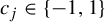 $c_j \in \{-1,1\}$
then j is called a fixed index. Clearly, if j is not a fixed index then it must be a free zero. Let
$c_j \in \{-1,1\}$
then j is called a fixed index. Clearly, if j is not a fixed index then it must be a free zero. Let $1^k 0^{k+4} (c_j)_{j=2k+5}^{\infty } \in 1^k 0^{k+4} W_2^{\mathbb {N}}$
be the fixed expansion of
$1^k 0^{k+4} (c_j)_{j=2k+5}^{\infty } \in 1^k 0^{k+4} W_2^{\mathbb {N}}$
be the fixed expansion of $1$
associated to q. The set
$1$
associated to q. The set $A_q$
consists of the sequences
$A_q$
consists of the sequences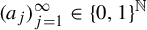 $(a_j)_{j=1}^{\infty } \in \{0,1\}^{\mathbb {N}}$
which satisfy the following properties:
$(a_j)_{j=1}^{\infty } \in \{0,1\}^{\mathbb {N}}$
which satisfy the following properties:
-
(1)
$a_j = 1$
if
$c_j = 1$
; -
(2)
$a_j = 0$
if
$c_j = -1$
; -
(3)
$a_j = 1$
if
$j \in J_{\mathrm {fixed},1}$
; -
(4)
$a_j = 0$
if
$j \in J_{\mathrm {fixed},0}$
.


Notice that there are no restrictions on the value of $a_j$
if
$a_j$
if $j \in J_{\mathrm {free}}$
. Notice also that
$j \in J_{\mathrm {free}}$
. Notice also that $A_q$
depends on
$A_q$
depends on $(c_j)_{j=1}^{\infty }$
and recall that this sequence was itself an arbitrary choice. The following lemma is an immediate consequence of [Reference Baker and Bender3].
$(c_j)_{j=1}^{\infty }$
and recall that this sequence was itself an arbitrary choice. The following lemma is an immediate consequence of [Reference Baker and Bender3].
Lemma 4.2. If $q \in (q_9, 2)$
then
$q \in (q_9, 2)$
then $\pi _q(A_q) \subset \mathcal {U}_q \cap (\mathcal {U}_q + 1)$
.
$\pi _q(A_q) \subset \mathcal {U}_q \cap (\mathcal {U}_q + 1)$
.
Heuristically, this lemma is proved by showing that the strings $(01^9)$
and
$(01^9)$
and $(10^9)$
are forbidden in elements of
$(10^9)$
are forbidden in elements of $A_q$
, so
$A_q$
, so $A_q \subset S_9$
. Then, if
$A_q \subset S_9$
. Then, if $q \in (q_9,2)$
, we know that
$q \in (q_9,2)$
, we know that $\pi _q(S_9) \subset \mathcal {U}_q$
and hence
$\pi _q(S_9) \subset \mathcal {U}_q$
and hence $\pi _q(A_q) \subset \mathcal {U}_q$
. For any
$\pi _q(A_q) \subset \mathcal {U}_q$
. For any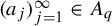 $(a_j)_{j=1}^{\infty } \in A_q$
, let
$(a_j)_{j=1}^{\infty } \in A_q$
, let $(b_j)_{j=1}^{\infty } = (a_j - c_j)_{j=1}^\infty $
; then
$(b_j)_{j=1}^{\infty } = (a_j - c_j)_{j=1}^\infty $
; then $\pi _q((b_j)_{j=1}^{\infty }) = \pi _q((a_j)_{j=1}^{\infty }) - 1 $
. With this, the containment of
$\pi _q((b_j)_{j=1}^{\infty }) = \pi _q((a_j)_{j=1}^{\infty }) - 1 $
. With this, the containment of $\pi _q(A_q)$
in
$\pi _q(A_q)$
in $(\mathcal {U}_q +1)$
is a result of
$(\mathcal {U}_q +1)$
is a result of $(b_j)_{j=1}^{\infty }$
also being contained in
$(b_j)_{j=1}^{\infty }$
also being contained in $S_9$
.
$S_9$
.
As mentioned in the outline in §4.1, the authors previously proved the following lemma [Reference Baker and Bender3, Proposition 3.13].
Lemma 4.3. If $q> q_9$
then
$q> q_9$
then $\tau (\pi _q(A_q))> q^{-5}$
.
$\tau (\pi _q(A_q))> q^{-5}$
.
4.3 Hausdorff distances and interleaving
Using Lemmas 4.2, and 2.1(a), the following lemma is an immediate corollary to Proposition 2.6.
Lemma 4.4. If $k \geq 10$
,
$k \geq 10$
, $q> q_{k-1}$
and the intersection
$q> q_{k-1}$
and the intersection
 $$ \begin{align*}(\pi_q(S_{k-1}) + 1) \cap g_{q,k}(\pi_q(A_q))\end{align*} $$
is non-empty then $q \in \mathcal {B}_3$
.
$q \in \mathcal {B}_3$
.
We prove the following result on $\epsilon $
-strong interleaving with the intention of applying Lemma 2.3.
$\epsilon $
-strong interleaving with the intention of applying Lemma 2.3.
Lemma 4.5. If $k \geq 9$
then the sets
$k \geq 9$
then the sets $(\pi _{q_k}(S_{k-1}) + 1)$
and
$(\pi _{q_k}(S_{k-1}) + 1)$
and $g_{q_k,k}(\pi _{q_k}(A_{q_k}))$
are
$g_{q_k,k}(\pi _{q_k}(A_{q_k}))$
are $q_k^{-2k-4}$
-strongly interleaved.
$q_k^{-2k-4}$
-strongly interleaved.
Proof. Let $k \geq 9$
. By the definition of
$k \geq 9$
. By the definition of $q_k$
,
$q_k$
,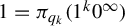 $1 = \pi _{q_k}(1^k 0^\infty )$
and we label
$1 = \pi _{q_k}(1^k 0^\infty )$
and we label $(c_{k,j})_{j=1}^\infty = 1^k 0^\infty $
. By the definition of
$(c_{k,j})_{j=1}^\infty = 1^k 0^\infty $
. By the definition of $A_{q_k}$
when associated with the fixed expansion of
$A_{q_k}$
when associated with the fixed expansion of $1$
given by
$1$
given by $(c_{k,j})_{j=1}^\infty $
, we know that for any
$(c_{k,j})_{j=1}^\infty $
, we know that for any $m \in \mathbb {N}_{\geq 0}$
, the indices
$m \in \mathbb {N}_{\geq 0}$
, the indices $k+(2m+1)$
are free
$k+(2m+1)$
are free $0$
s, the indices
$0$
s, the indices $k + (4m+2)$
are fixed
$k + (4m+2)$
are fixed $1$
s, and the indices
$1$
s, and the indices $k + (4m+4)$
are fixed
$k + (4m+4)$
are fixed $0$
s. Using this, we construct four points in
$0$
s. Using this, we construct four points in $\pi _{q_k}(A_{q_k})$
, with the intention of applying Lemma 2.3.
$\pi _{q_k}(A_{q_k})$
, with the intention of applying Lemma 2.3.
Consider the points $a^{(i)} = \pi _q((a^i_j)_{j=1}^{\infty })$
where
$a^{(i)} = \pi _q((a^i_j)_{j=1}^{\infty })$
where $i \in \{1, 2, 3,4\}$
and
$i \in \{1, 2, 3,4\}$
and $a^{(1)} < a^{(2)} < a^{(3)} < a^{(4)}$
are given by
$a^{(1)} < a^{(2)} < a^{(3)} < a^{(4)}$
are given by
 $$ \begin{align*} a^{(1)} &= \pi_{q_k}(1^k (0100)^\infty) = q_k^{-k}\frac{1}{q_k^4-1}(q_k^2) , \\ a^{(2)} &= \pi_{q_k}(1^k (0110)^\infty) = q_k^{-k}\frac{1}{q_k^4-1}(q_k+q_k^2), \\ a^{(3)} &= \pi_{q_k}(1^k (1100)^\infty) = q_k^{-k}\frac{1}{q_k^4-1}(q_k^2+q_k^3), \\ a^{(4)} &= \pi_{q_k}(1^k (1110)^\infty) = q_k^{-k}\frac{1}{q_k^4-1}(q_k + q_k^2 +q_k^3). \end{align*} $$
We check that $g_{q_k,k}(a^{(i)}) \in (\pi _{q_k}(S_{k-1}) + 1) \cap g_{q_k,k}(\pi _{q_k}(A_{q_k}))$
for all
$g_{q_k,k}(a^{(i)}) \in (\pi _{q_k}(S_{k-1}) + 1) \cap g_{q_k,k}(\pi _{q_k}(A_{q_k}))$
for all $i \in \{1,2,3,4\}$
. Since
$i \in \{1,2,3,4\}$
. Since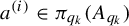 $a^{(i)} \in \pi _{q_k}(A_{q_k})$
by construction, it is obvious that
$a^{(i)} \in \pi _{q_k}(A_{q_k})$
by construction, it is obvious that $g_{q_k,k}(a^{(i)}) \in g_{q_k,k}(\pi _{q_k}(A_{q_k}))$
for all
$g_{q_k,k}(a^{(i)}) \in g_{q_k,k}(\pi _{q_k}(A_{q_k}))$
for all $i \in \{1,2,3,4\}$
. For the other containment, we show that
$i \in \{1,2,3,4\}$
. For the other containment, we show that $g_{q_k,k}(a^{(i)}) - 1 \in \pi _{q_k}(S_{k-1}) $
. Recall that
$g_{q_k,k}(a^{(i)}) - 1 \in \pi _{q_k}(S_{k-1}) $
. Recall that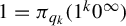 $1 = \pi _{q_k}(1^k 0^\infty )$
, and since
$1 = \pi _{q_k}(1^k 0^\infty )$
, and since $q = q_k$
, we can replace
$q = q_k$
, we can replace $01^k$
with
$01^k$
with $10^k$
at any point in the expansion. (This is a consequence of the definition of
$10^k$
at any point in the expansion. (This is a consequence of the definition of $q_k$
, which is equivalent to
$q_k$
, which is equivalent to $q_k^{-1} = q_k^{-2} + \cdots + q_k^{-(k+1)}$
.) Recall also that (13) tells us that
$q_k^{-1} = q_k^{-2} + \cdots + q_k^{-(k+1)}$
.) Recall also that (13) tells us that $g_{q,k}$
acts to prefix base q expansions by
$g_{q,k}$
acts to prefix base q expansions by $(1^{k-1}0)$
. This allows us to write
$(1^{k-1}0)$
. This allows us to write
 $$ \begin{align*} g_{q_k,k}(a^{(i)}) - 1 &= \pi_{q_k}(1^{k-1} 0 1^k (a^{(i)}_j)_{j=k+1}^{\infty}) - \pi_{q_k}(1^k 0^\infty) \\ &= \pi_{q_k}(1^k 0^k (a^{(i)}_j)_{j=k+1}^{\infty}) - \pi_{q_k}(1^k 0^\infty) \\ &= \pi_{q_k}(0^{2k} (a^{(i)}_j)_{j=k+1}^{\infty}). \end{align*} $$
For all $i \in \{1,2,3,4\}$
, the tail
$i \in \{1,2,3,4\}$
, the tail $(a^{(i)}_j)_{j=k+1}^{\infty }$
avoids
$(a^{(i)}_j)_{j=k+1}^{\infty }$
avoids $0^4$
and
$0^4$
and $1^4$
because they are sequences in
$1^4$
because they are sequences in $A_q$
. This allows us to declare that
$A_q$
. This allows us to declare that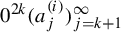 $0^{2k}(a^{(i)}_j)_{j=k+1}^{\infty }$
is contained in
$0^{2k}(a^{(i)}_j)_{j=k+1}^{\infty }$
is contained in $S_{k-1}$
. Therefore,
$S_{k-1}$
. Therefore, $g_{q_k,k}(a^{(i)}) \subset (\pi _{q_k}(S_{k-1}) + 1)$
for all
$g_{q_k,k}(a^{(i)}) \subset (\pi _{q_k}(S_{k-1}) + 1)$
for all $i \in \{1,2,3,4\}$
. The four points
$i \in \{1,2,3,4\}$
. The four points $g_{q_k,k}(a^{(i)})$
where
$g_{q_k,k}(a^{(i)})$
where $i \in \{1,2,3,4\}$
are given by
$i \in \{1,2,3,4\}$
are given by
 $$ \begin{align*} g_{q_k,k}(a^{(1)}) &= \pi_{q_k}(1^{k-1} 0 1^k (0100)^\infty), \\ g_{q_k,k}(a^{(2)}) &= \pi_{q_k}(1^{k-1} 0 1^k (0110)^\infty), \\ g_{q_k,k}(a^{(3)}) &= \pi_{q_k}(1^{k-1} 0 1^k (1100)^\infty), \\ g_{q_k,k}(a^{(4)}) &= \pi_{q_k}(1^{k-1} 0 1^k (1110)^\infty), \end{align*} $$
and we seek the minimum distance between them. Since $a^{(1)} < a^{(2)} < a^{(3)} < a^{(4)}$
and
$a^{(1)} < a^{(2)} < a^{(3)} < a^{(4)}$
and $g_{q,k}$
is increasing, we need only consider the distances
$g_{q,k}$
is increasing, we need only consider the distances $(g_{q,k}(a^{(i+1)}) - g_{q,k}(a^{(i)}))$
for
$(g_{q,k}(a^{(i+1)}) - g_{q,k}(a^{(i)}))$
for $i \in \{2,3,4\}$
. Observe that since
$i \in \{2,3,4\}$
. Observe that since $q_k^3 - q_k = q_k(q_k^2-1)> q_k$
, the smallest of
$q_k^3 - q_k = q_k(q_k^2-1)> q_k$
, the smallest of
 $$ \begin{align*} (a^{(2)} - a^{(1)}) &= q_k^{-k}\frac{1}{q_k^4-1}q_k, \\ (a^{(3)} - a^{(2)}) &= q_k^{-k}\frac{1}{q_k^4-1}(q_k^3 - q_k), \\ (a^{(4)} - a^{(3)}) &= q_k^{-k}\frac{1}{q_k^4-1}q_k \end{align*} $$
is given by $({q_k^{-k+1}})/({q_k^4 - 1})$
. The smallest over
$({q_k^{-k+1}})/({q_k^4 - 1})$
. The smallest over $i \in \{1,2,3,4\}$
of
$i \in \{1,2,3,4\}$
of $g_{q_k,k}(a^{(i+1)}) - g_{q_k,k}(a^{(i)}) = q_k^{-k}(a^{(i+1)} - a^{(i)})$
is then given by
$g_{q_k,k}(a^{(i+1)}) - g_{q_k,k}(a^{(i)}) = q_k^{-k}(a^{(i+1)} - a^{(i)})$
is then given by $q_k^{-k}({q_k^{-k+1}})/({q_k^4-1})$
. Therefore, by Lemma 2.3,
$q_k^{-k}({q_k^{-k+1}})/({q_k^4-1})$
. Therefore, by Lemma 2.3, $(\pi _{q_k}(S_{k-1}) + 1)$
and
$(\pi _{q_k}(S_{k-1}) + 1)$
and $g_{q_k,k}(\pi _{q_k}(A_{q_k}))$
are
$g_{q_k,k}(\pi _{q_k}(A_{q_k}))$
are $\epsilon $
-strongly interleaved where
$\epsilon $
-strongly interleaved where $2 \epsilon = ({q_k^{-2k+1}})/({q_k^4-1})$
. So
$2 \epsilon = ({q_k^{-2k+1}})/({q_k^4-1})$
. So
 $$ \begin{align*}\epsilon = \frac{q_k^{-2k+1}}{2(q_k^4-1)} = q_k^{-2k-3} \frac{1}{2(1-q_k^{-4})}.\end{align*} $$
Since $q_k \geq q_9 \geq 1.998> 2(1-2^{-4}) = 1.875 > 2(1-q_k^{-4})$
, we know that
$q_k \geq q_9 \geq 1.998> 2(1-2^{-4}) = 1.875 > 2(1-q_k^{-4})$
, we know that
 $$\begin{align*}{1}/({2(1-q_k^{-4})})> ({1}/{q_k}), \end{align*}$$
so $\epsilon> q_k^{-2k-4}$
. Hence, we have shown that
$\epsilon> q_k^{-2k-4}$
. Hence, we have shown that $(\pi _{q_k}(S_{k-1}) + 1)$
and
$(\pi _{q_k}(S_{k-1}) + 1)$
and $g_{q_k,k}(\pi _{q_k}(A_{q_k}))$
are
$g_{q_k,k}(\pi _{q_k}(A_{q_k}))$
are $q_k^{-2k-4}$
-strongly interleaved.
$q_k^{-2k-4}$
-strongly interleaved.
We use the following lemma as a tool in the proofs of Lemmas 4.7 and 4.8.
Lemma 4.6. Let $q_1, q_2 \in (1,2)$
and
$q_1, q_2 \in (1,2)$
and $(\epsilon _j)_{j=1}^{\infty } \in \{-1,0,1\}^{\mathbb {N}}$
. Then
$(\epsilon _j)_{j=1}^{\infty } \in \{-1,0,1\}^{\mathbb {N}}$
. Then
 $$ \begin{align*}|\pi_{q_1}((\epsilon_j)_{j=1}^{\infty}) - \pi_{q_2}((\epsilon_j)_{j=1}^{\infty})| \leq \frac{|q_1 - q_2|}{(q_1-1)(q_2-1)}.\end{align*} $$
Proof. By the definition of the projection maps,
 $$ \begin{align*} \begin{aligned} |\pi_{q_1}((\epsilon_j)_{j=1}^{\infty}) - \pi_{q_2}((\epsilon_j)_{j=1}^{\infty})| & = \bigg|\!\sum_{j=1}^\infty\epsilon_j(q_1^{-j} - q_2^{-j})\bigg| \leq \bigg|\!\sum_{j=1}^\infty(q_1^{-j} - q_2^{-j})\bigg| \\ & =\bigg| \frac{1}{q_1-1} - \frac{1}{q_2-1}\bigg| = \frac{|q_1 - q_2|}{(q_1-1)(q_2-1)}. \end{aligned} \\[-34pt] \end{align*} $$
The following two lemmas provide us with upper bounds on the Hausdorff distances between the sets in question when q is in the required range.
Lemma 4.7. If $k \geq 9$
and
$k \geq 9$
and $|q - q_k| < q_k^{-2k-6}$
then
$|q - q_k| < q_k^{-2k-6}$
then $d_{\mathrm {H}}(\pi _q(S_{k-1}) , \pi _{q_k}(S_{k-1})) < q_k^{-2k-4}$
.
$d_{\mathrm {H}}(\pi _q(S_{k-1}) , \pi _{q_k}(S_{k-1})) < q_k^{-2k-4}$
.
Proof. Let $k \geq 9$
,
$k \geq 9$
, $|q - q_k| < q_k^{-2k-6}$
, and let
$|q - q_k| < q_k^{-2k-6}$
, and let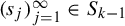 $(s_j)_{j=1}^{\infty } \in S_{k-1}$
be arbitrary so
$(s_j)_{j=1}^{\infty } \in S_{k-1}$
be arbitrary so $\pi _{q_k}((s_j)_{j=1}^{\infty }) \in \pi _{q_k}(S_{k-1})$
is arbitrary. Then by Lemma 4.6,
$\pi _{q_k}((s_j)_{j=1}^{\infty }) \in \pi _{q_k}(S_{k-1})$
is arbitrary. Then by Lemma 4.6,
 $$ \begin{align*} |\pi_{q_k}((s_j)_{j=1}^{\infty}) - \pi_q((s_j)_{j=1}^{\infty})| &\leq \frac{|q-q_k|}{(q_k-1)(q-1)} \\ & < \frac{5}{4}|q-q_k| \\ & < \frac{5}{4}q_k^{-2k-6} \\ & < q_k^{-2k-4}. \end{align*} $$
Since $q_{9} \approx 1.998 $
the factor of
$q_{9} \approx 1.998 $
the factor of $5/4$
appears as an easy lower bound for
$5/4$
appears as an easy lower bound for ${1}/({(q_k-1)(q-1)})$
. So we have found a point
${1}/({(q_k-1)(q-1)})$
. So we have found a point $\pi _q((s_j)_{j=1}^{\infty }) \in \pi _q(S_{k-1})$
such that
$\pi _q((s_j)_{j=1}^{\infty }) \in \pi _q(S_{k-1})$
such that $|\pi _{q_k}((s_j)_{j=1}^{\infty }) - \pi _q((s_j)_{j=1}^{\infty })| < q_k^{-2k-4}$
. This argument also proves the converse, that is, for an arbitrary point
$|\pi _{q_k}((s_j)_{j=1}^{\infty }) - \pi _q((s_j)_{j=1}^{\infty })| < q_k^{-2k-4}$
. This argument also proves the converse, that is, for an arbitrary point $\pi _q((s_j)_{j=1}^{\infty }) \in \pi _q(S_{k-1})$
the point
$\pi _q((s_j)_{j=1}^{\infty }) \in \pi _q(S_{k-1})$
the point $\pi _{q_k}((s_j)_{j=1}^{\infty }) \in \pi _{q_k}(S_{k-1})$
satisfies
$\pi _{q_k}((s_j)_{j=1}^{\infty }) \in \pi _{q_k}(S_{k-1})$
satisfies $|\pi _{q_k}((s_j)_{j=1}^{\infty }) - \pi _q((s_j)_{j=1}^{\infty })| < q_k^{-2k-4}$
. Therefore, the desired upper bound on the Hausdorff distance holds.
$|\pi _{q_k}((s_j)_{j=1}^{\infty }) - \pi _q((s_j)_{j=1}^{\infty })| < q_k^{-2k-4}$
. Therefore, the desired upper bound on the Hausdorff distance holds.
Lemma 4.8. If $k \geq 9$
and
$k \geq 9$
and $|q - q_k| < q_k^{-2k-6}$
then
$|q - q_k| < q_k^{-2k-6}$
then $d_{\mathrm {H}}(g_{q,k}(\pi _q(A_q)) , g_{q_k,k}(\pi _{q_k}(A_{q_k}))) < q_k^{-2k-4}$
.
$d_{\mathrm {H}}(g_{q,k}(\pi _q(A_q)) , g_{q_k,k}(\pi _{q_k}(A_{q_k}))) < q_k^{-2k-4}$
.
Proof. Let $k \geq 9$
,
$k \geq 9$
, $|q - q_k| < q_k^{-2k-6}$
and let
$|q - q_k| < q_k^{-2k-6}$
and let $(c_j)_{j=1}^{\infty }$
be the fixed expansion of
$(c_j)_{j=1}^{\infty }$
be the fixed expansion of $1$
associated to q. Recall that
$1$
associated to q. Recall that $A_q$
is defined with respect to
$A_q$
is defined with respect to $(c_j)_{j=1}^{\infty }$
. Using Lemma 4.1 and the fact that
$(c_j)_{j=1}^{\infty }$
. Using Lemma 4.1 and the fact that $(c_j)_{j=1}^{\infty }$
and
$(c_j)_{j=1}^{\infty }$
and $1^k 0^\infty $
agree on the first
$1^k 0^\infty $
agree on the first $2k+4$
indices, we know that the free and fixed indices on this initial segment coincide. Therefore, for every
$2k+4$
indices, we know that the free and fixed indices on this initial segment coincide. Therefore, for every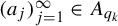 $(a_j)_{j=1}^{\infty } \in A_{q_k}$
, we can find some
$(a_j)_{j=1}^{\infty } \in A_{q_k}$
, we can find some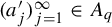 $(a^{\prime }_j)_{j=1}^{\infty } \in A_q$
such that
$(a^{\prime }_j)_{j=1}^{\infty } \in A_q$
such that $(a_j)_{j=1}^{2k+4} = (a^{\prime }_j)_{j=1}^{2k+4}$
, and vice versa. We show that these sequences satisfy the property that
$(a_j)_{j=1}^{2k+4} = (a^{\prime }_j)_{j=1}^{2k+4}$
, and vice versa. We show that these sequences satisfy the property that
 $$ \begin{align} | g_{q_k,k}(\pi_{q_k}((a_j)_{j=1}^{\infty})) - g_{q,k}(\pi_q((a^{\prime}_j)_{j=1}^{\infty}))| < q_k^{-2k-4}. \end{align} $$
Notice that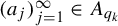 $(a_j)_{j=1}^{\infty } \in A_{q_k}$
was arbitrary, so
$(a_j)_{j=1}^{\infty } \in A_{q_k}$
was arbitrary, so $g_{q_k,k}(\pi _{q_k}((a_j)_{j=1}^{\infty }))$
is an arbitrary element of
$g_{q_k,k}(\pi _{q_k}((a_j)_{j=1}^{\infty }))$
is an arbitrary element of $g_{q_k,k}(\pi _{q_k}(A_{q_k}))$
. Therefore, it suffices to prove that (32) holds since the converse direction, where we first choose an arbitrary point in
$g_{q_k,k}(\pi _{q_k}(A_{q_k}))$
. Therefore, it suffices to prove that (32) holds since the converse direction, where we first choose an arbitrary point in $A_q$
, proceeds in exactly the same way.
$A_q$
, proceeds in exactly the same way.
Let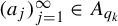 $(a_j)_{j=1}^{\infty } \in A_{q_k}$
be arbitrary and pick
$(a_j)_{j=1}^{\infty } \in A_{q_k}$
be arbitrary and pick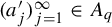 $(a^{\prime }_j)_{j=1}^{\infty } \in A_q$
such that
$(a^{\prime }_j)_{j=1}^{\infty } \in A_q$
such that $(a_j)_{j=1}^{2k+4} = (a^{\prime }_j)_{j=1}^{2k+4}$
. Then
$(a_j)_{j=1}^{2k+4} = (a^{\prime }_j)_{j=1}^{2k+4}$
. Then $g_{q_k,k}(\pi _{q_k}((a_j)_{j=1}^{\infty }))$
is given by
$g_{q_k,k}(\pi _{q_k}((a_j)_{j=1}^{\infty }))$
is given by $\pi _{q_k}(1^{k-1} 0 (a_j)_{j=1}^{\infty })$
and
$\pi _{q_k}(1^{k-1} 0 (a_j)_{j=1}^{\infty })$
and  is given by $\pi _{q}(1^{k-1} 0 (a^{\prime }_j)_{j=1}^{\infty })$
. Observe that by the triangle inequality,
$\pi _{q}(1^{k-1} 0 (a^{\prime }_j)_{j=1}^{\infty })$
. Observe that by the triangle inequality,
 $$ \begin{align} & | \pi_{q_k}(1^{k-1} 0 (a_j)_{j=1}^{\infty}) - \pi_q(1^{k-1} 0 (a^{\prime}_j)_{j=1}^{\infty})| \leq |\pi_{q_k}(1^{k-1}0 (a_j)_{j=1}^{\infty}) - \pi_{q_k}(1^{k-1}0 (a^{\prime}_j)_{j=1}^{\infty})| \nonumber\\ & \quad + |\pi_{q_k}(1^{k-1}0 (a^{\prime}_j)_{j=1}^{\infty}) - \pi_q(1^{k-1}0 (a^{\prime}_j)_{j=1}^{\infty})|. \end{align} $$
Since $(a_j)_{j=1}^{\infty }$
and
$(a_j)_{j=1}^{\infty }$
and $(a^{\prime }_j)_{j=1}^{\infty }$
agree on their first
$(a^{\prime }_j)_{j=1}^{\infty }$
agree on their first $2k+4$
entries, we know the sequences
$2k+4$
entries, we know the sequences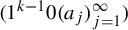 $(1^{k-1}0 (a_j)_{j=1}^{\infty })$
and
$(1^{k-1}0 (a_j)_{j=1}^{\infty })$
and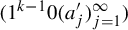 $(1^{k-1}0 (a^{\prime }_j)_{j=1}^{\infty })$
agree on their first
$(1^{k-1}0 (a^{\prime }_j)_{j=1}^{\infty })$
agree on their first $3k+4$
entries. Therefore, we can bound the first term as follows:
$3k+4$
entries. Therefore, we can bound the first term as follows:
 $$ \begin{align*} |\pi_{q_k}(1^{k-1}0 (a_j)_{j=1}^{\infty}) - \pi_{q_k}(1^{k-1}0 (a^{\prime}_j)_{j=1}^{\infty})| &\leq q_k^{-3k-4}|\pi_{q_k}((a_j)_{j=2k+5}^{\infty}) - \pi_{q_k}((a^{\prime}_j)_{j=2k+5}^{\infty})|\\ &\leq q_k^{-3k-4}\bigg(\dfrac{1}{q_k-1}\bigg), \end{align*} $$
where the ${1}/({q_k-1})$
term appears as an upper bound for the difference between the images of any two sequences under
${1}/({q_k-1})$
term appears as an upper bound for the difference between the images of any two sequences under $\pi _{q_k}$
, that is, the diameter of
$\pi _{q_k}$
, that is, the diameter of $I_{q_k}$
. By Lemma 4.6, the second term satisfies
$I_{q_k}$
. By Lemma 4.6, the second term satisfies
 $$ \begin{align*}|\pi_{q_k}(1^{k-1}0 (a^{\prime}_j)_{j=1}^{\infty}) - \pi_q(1^{k-1}0 (a^{\prime}_j)_{j=1}^{\infty})| \leq \frac{|q - q_k|}{(q-1)(q_k-1)}.\end{align*} $$
Since both ${1}/({q_k-1})$
and
${1}/({q_k-1})$
and $(q_k^{-k+2} + {1}/({q-1}))$
are easily bounded above by
$(q_k^{-k+2} + {1}/({q-1}))$
are easily bounded above by $q_k$
, we can see that the left-hand side of (32) can be bounded as follows:
$q_k$
, we can see that the left-hand side of (32) can be bounded as follows:
 $$ \begin{align*} | g_{q_k,k}(\pi_{q_k}((a_j)_{j=1}^{\infty})) - g_{q,k}(\pi_q((a^{\prime}_j)_{j=1}^{\infty}))| &\leq q_k^{-3k-4}\bigg(\frac{1}{q_k-1}\bigg) + \frac{q_k^{-2k-6}}{(q-1)(q_k-1)} \\ &\leq q_k^{-2k-6}\bigg(\frac{1}{q_k-1}\bigg)\bigg(q_k^{-k+2} + \frac{1}{q-1}\bigg)\\ &\leq q_k^{-2k-4}. \end{align*} $$
So we have proved that (32) holds, which proves the lemma.
4.4 Proof of Theorem B
Proof of Theorem B
Let $k \geq 9$
and
$k \geq 9$
and $|q - q_k| < q_k^{-2k-6}$
. By Lemma 4.4, it suffices to prove that (25) holds in cases (a) and (b). Using the definition of
$|q - q_k| < q_k^{-2k-6}$
. By Lemma 4.4, it suffices to prove that (25) holds in cases (a) and (b). Using the definition of $\epsilon $
-strong interleaving alongside Lemmas 4.5, 4.7 and 4.8, we know that
$\epsilon $
-strong interleaving alongside Lemmas 4.5, 4.7 and 4.8, we know that $(\pi _q(S_{k-1}) + 1)$
and
$(\pi _q(S_{k-1}) + 1)$
and $g_{q,k}(\pi _q(A_q))$
are interleaved. If we make the further restriction that
$g_{q,k}(\pi _q(A_q))$
are interleaved. If we make the further restriction that $ 0 < q - q_9 < q_9^{-24}$
when
$ 0 < q - q_9 < q_9^{-24}$
when $k = 9$
, then by Lemmas 2.2 and 4.3 we know that
$k = 9$
, then by Lemmas 2.2 and 4.3 we know that $\tau (\pi _q(S_{k-1}) + 1) \times \tau (g_{q,k}(\pi _q(A_q)))> q^{5} \times q^{-5} =1$
. Hence, we can apply Theorem N to (25) in both cases (a) and (b) and the proof is complete.
$\tau (\pi _q(S_{k-1}) + 1) \times \tau (g_{q,k}(\pi _q(A_q)))> q^{5} \times q^{-5} =1$
. Hence, we can apply Theorem N to (25) in both cases (a) and (b) and the proof is complete.
Acknowledgements
The first author was financially supported by an EPSRC New Investigators Award (EP/W003880/1). The authors would like to thank the referee for their useful feedback.


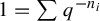
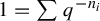



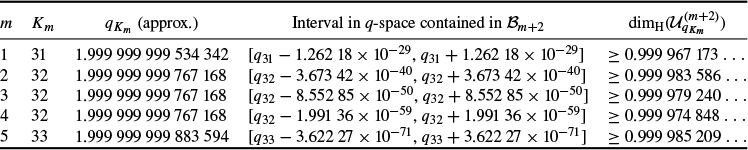


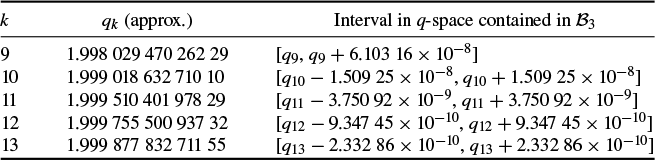


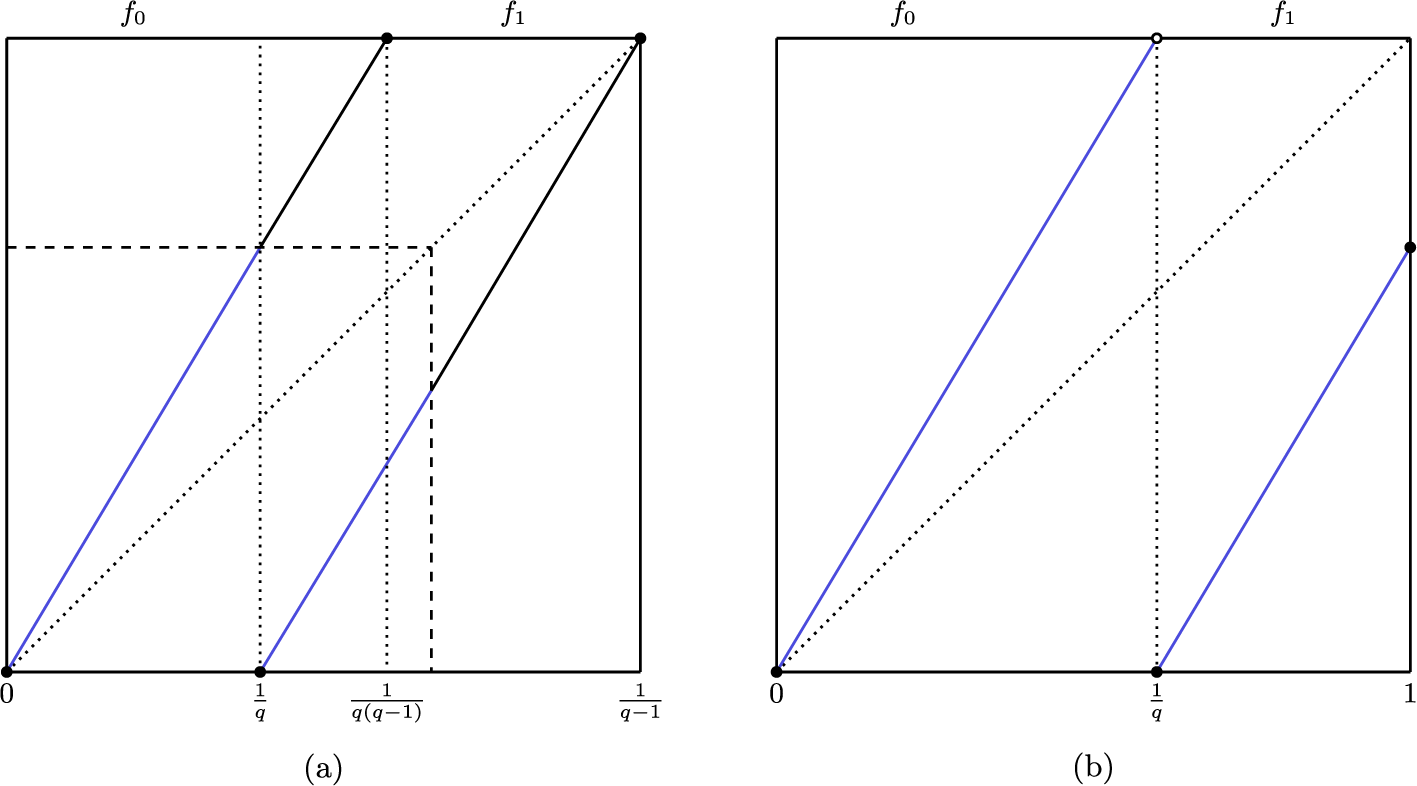


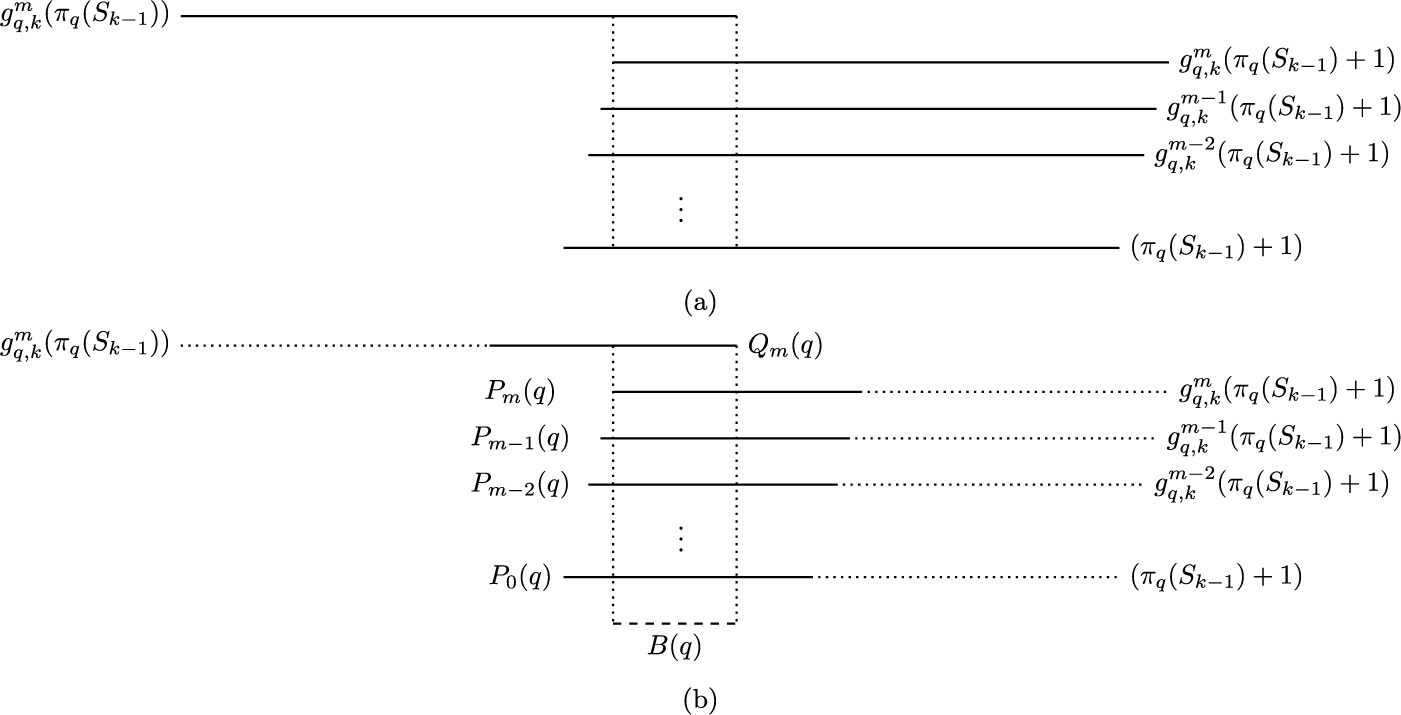


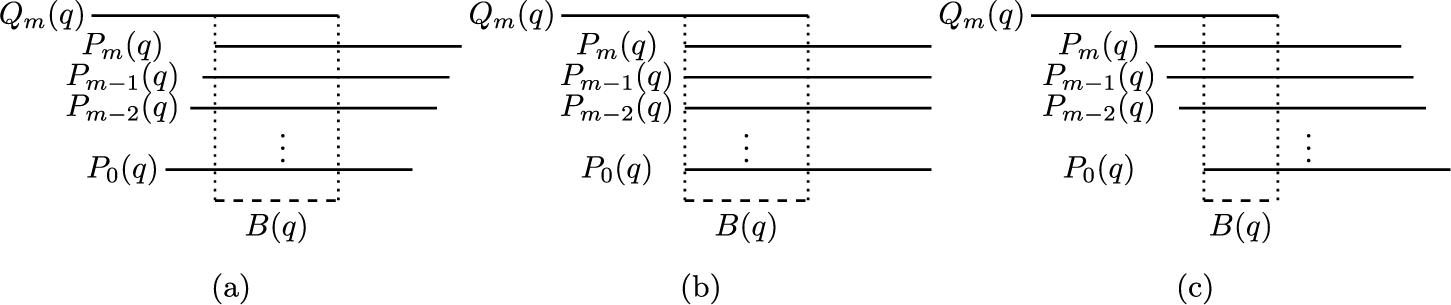


 Open access

