


Introduction
Mental disorders contributed significantly to the global burden of disease, with 125.3 million years lived with disability (YLDs) attributed to mental disorders in 2019, the second largest cause of YLDs worldwide.(1) Some nutrients and diets are considered modifiable risk factors for mental health. Alanine, a non-essential amino acid, is usually found in meat. Alanine supplements are popular in sports nutrition due to their ability to enhance athletic performance and exercise endurance.(Reference Minegishi, Otsuka and Ota2–Reference Coqueiro, Raizel and Hypólito4) The potential role of alanine in mental disorders has raised concern, considering that it can cross the blood–brain barrier and may alter the levels of neurotransmitters or provide energy for the brain.(Reference Dalangin, Kim and Campbell5,6)
In mammals, alanine plays a key role in the glucose-alanine cycle, which is a provider of energy to the muscle, nervous system, and brain.(Reference Sarabhai and Roden7) It is also a precursor of several substances, including glutamate, glutamine, β-alanine, and γ-aminobutyric acid (GABA), which are involved in neurotransmission and the metabolism of amino acids in the central nervous system.(Reference Schousboe, Sonnewald and Waagepetersen8–Reference Waagepetersen, Sonnewald and Larsson10) Importantly, alanine may also act as an agonist that binds to the brain glycine site of N-methyl-d-aspartate (NMDA) receptors (ionotropic glutamatergic receptors).(Reference Schmidt and Thompson11) Dysfunction of NMDA receptors is known to be associated with various psychiatric disorders, including depression, bipolar disorder, schizophrenia, and anxiety.(Reference Lakhan, Caro and Hadzimichalis12–Reference Barkus, McHugh and Sprengel14) However, it remains unclear whether alanine is a friend or foe in mental health. In animal experiments, central injection and oral administration of alanine showed an attenuating effect on anxiety.(Reference EdS and Guedes15,Reference Kurauchi, Asechi and Tachibana16) A small placebo-controlled trial found that oral administration of d-alanine improved the negative, positive, and cognitive symptoms of patients with schizophrenia, suggesting a therapeutic role for alanine in psychosis.(Reference Tsai, Yang and Chang17) A later study measured plasma alanine levels in patients with schizophrenia and found that from admission to discharge, patients’ total plasma alanine increased significantly with improvement in clinical symptoms,(Reference Hatano, Ohnuma and Sakai18) adding to the evidence for a beneficial effect of alanine. However, contradictory evidence showed that plasma alanine was higher in patients with bipolar disorder compared with controls and positively correlated with the severity of depression,(Reference Wan Nasru, Ab Razak and Yaacob19,Reference Mitani, Shirayama and Yamada20) raising safety concerns. Also, an in vitro study showed that children with attention-deficit hyperactivity disorder (ADHD) had an elevated access of alanine in the brain which may interfere the normal brain activity,(Reference Johansson, Landgren and Fernell21) but epidemiological studies are lacking.
It is worth noting that most studies had relatively small sample sizes or were conducted in animal models. Observational studies are vulnerable to confounding by factors such as socioeconomic status, lifestyle, and medication. They may also lack sufficient power for rare outcomes. Large randomised controlled trials (RCTs) designed to assess the mental health effects of alanine may be challenging due to ethical issues and funding constraints. Mendelian randomisation (MR) offers a promising method for studying the causal effects of alanine without the need for harmful interventions.(Reference Lawlor, Harbord and Sterne22) MR studies use genetic variants as instruments to predict exposure, independent of environmental factors, as genetic variants are determined at conception, which largely mitigates confounding, a major limitation of traditional observational studies.(Reference Lawlor, Harbord and Sterne22,Reference Davies, Holmes and Davey Smith23) The increasing availability of large genome-wide association studies (GWASs) has enabled well-powered MR studies.
In this study, using the largest available GWAS summary statistics from large consortia, we applied MR to investigate the potential causal role of genetically predicted plasma alanine in the major depression, bipolar disorder, schizophrenia, anxiety, the four disorders that contributed most to mental disorders YLDs,(1) as well as in ADHD. Considering that alanine may have sex-specific effects due to its interaction with sex hormones and that alanine levels are higher in males compared to females in brain regions such as the striatum, hypothalamus, cerebellum, and midbrain,(Reference Jiang, Xu and Yan24) we also performed sex-specific analyses.
Methods
Genetic instruments for plasma alanine
We extracted genome-wide significant (P < 5 × 10⁻⁸) and uncorrelated (r 2 < 0.01) SNPs as instrumental variables (IVs) for plasma alanine from the Nightingale Health Metabolic Biomarkers GWAS in the UK Biobank. It involved 115,078 randomly selected participants of European ancestry from the UK Biobank with over 12.3 million SNPs.(Reference Barry, Lawlor and Shapland25,Reference Borges, Haycock and Zheng26) The median age of participants in this subset was 58 years, ranging from 39 to 71, and 54% were female.(Reference Ritchie, Surendran and Karthikeyan27) 249 metabolic traits, including alanine (N = 115,074), were measured from non-fasting EDTA-plasma samples via Nightingale Health assay under strict quality control (QC) procedures.(Reference Ritchie, Surendran and Karthikeyan27) All metabolites were standardised and normalised prior to analyses using rank-based inverse normal transformation.(Reference Borges, Haycock and Zheng26) Genetic associations with alanine (standardised to SD units) were obtained using a Bayesian linear mixed model implemented in BOLT-LMM, with age, sex, fasting status, and genotyping array included as fixed effects.(Reference Borges, Haycock and Zheng26) As BOLT-LMM explicitly accounts for population structure and cryptic relatedness through random effects based on a genetic relationship matrix,(Reference Loh, Tucker and Bulik-Sullivan28,Reference Loh, Kichaev and Gazal29) adjustment for principal components (PC) is not required.(Reference Borges, Haycock and Zheng26,Reference Loh, Tucker and Bulik-Sullivan28–Reference Wong, Mo and Zhou30) Considering potential pleiotropy, we assessed the associations of selected SNPs with potential confounders in the UK Biobank, including Townsend index, education, smoking status, alcohol drinking, physical activity and BMI.
For replication, we also used two independent sets of genetic instruments from other published GWASs. The first set included 16 genetic instruments for alanine (P < 5 × 10⁻⁸, r 2 < 0.01), identified in a large GWAS meta-analysis of 174 circulating metabolites.(Reference Lotta, Pietzner and Stewart31) This meta-analysis comprised 56,034 participants of European ancestry from the Fenland, EPIC-Norfolk, and INTERVAL cohorts.(Reference Lotta, Pietzner and Stewart31) In this study, genetic associations with plasma alanine (in SD) were adjusted for age, sex, and the top four genetic PCs.(Reference Lotta, Pietzner and Stewart31) The second set included 20 strict genetic instruments for alanine (P < 5 × 10⁻⁸, r 2 < 0.01), defined as SNPs associated with fewer than three metabolic traits.(Reference Karjalainen, Karthikeyan and Oliver-Williams32) These instruments were provided by a recent GWAS meta-analysis of 233 metabolic traits across 33 cohorts (excluding UK Biobank), comprising 136,016 individuals, of whom 88.5% were of European ancestry.(Reference Karjalainen, Karthikeyan and Oliver-Williams32) In this study, genetic associations with plasma alanine (in SD) were adjusted for age, sex, genetic PCs, and additional study-specific covariates.(Reference Karjalainen, Karthikeyan and Oliver-Williams32)
Genetic associations with mental disorders
Overall genetic associations with common mental disorders, including major depression, bipolar disorder, schizophrenia, anxiety, and ADHD, were obtained from GWAS data shared by the Psychiatric Genomics Consortium (PGC). Specifically, for major depression, the summary statistics were from a GWAS meta-analysis of three largest depression cohorts.(Reference Howard, Adams and Clarke33) We used data of European ancestry removing 23andMe (170,756 cases and 329,443 controls; 72.2% from UK Biobank). The definition of depression cases included self-reported help-seeking for problems with nerves, anxiety, tension or depression (termed ‘broad depression’), self-reported depressive symptoms, self-reported diagnosis or treatment for clinical depression, and diagnosis from hospital admission records or structured clinical interview. For bipolar disorder, we used data from a GWAS meta-analysis comprising 57 European-ancestry cohorts collected in Europe, North America, and Australia (41,917 cases and 371,549 controls; 14.4% from UK Biobank).(Reference Mullins, Forstner and OConnell34) Cases of bipolar disorder were established using structured diagnostic instruments from assessments by trained interviewers, clinician-administered checklists, or medical record review. Genetic associations with schizophrenia were obtained from the PGC latest GWAS meta-analysis, comprising 90 European-ancestry cohorts (52,017 cases and 75,889 controls; UK Biobank not included).(Reference Trubetskoy, Pardiñas and Qi35) Cases with schizophrenia or schizoaffective disorder were diagnosed using multiple strategies, including: (i) consensus between psychiatrists based on DSM or ICD criteria, (ii) structured diagnostic interviews such as SCID, SCAN, MINI, CASH, or other psychiatric assessments, (iii) review of medical records or hospital registers, and (iv) a mixed approach combining the above methods. Genetic associations with anxiety disorder were derived from a GWAS meta-analysis of nine samples of European ancestry from seven studies (7,016 cases and 14,745 controls; UK Biobank not included).(Reference Otowa, Hek and Lee36) The phenotype of cases covered five core anxiety disorders, including generalised anxiety disorder, panic disorder, social phobia, agoraphobia, and specific phobias. Genetic associations with ADHD were obtained from the latest GWAS meta-analysis of European ancestry combining data from the newly extended Danish iPSYCH cohort, the Icelandic deCODE cohort and published data collected by the PGC (38,691 cases and 186,843 controls; UK Biobank not included).(Reference Demontis, Walters and Athanasiadis37) ADHD cases were individuals diagnosed by psychiatrists according to the ICD10 criteria (F90.0, F90.1, F98.8 diagnosis codes) or individuals who had been prescribed medication specific for ADHD symptoms. We also obtained overall genetic associations with four mental disorders except schizophrenia from FinnGen Biobank, with diagnosis defined by the F5 Mood category. The GWAS summary statistics provided by the PGC for schizophrenia have included several Finnish cohorts.
Sex-specific genetic associations with schizophrenia restricted to European ancestry were obtained from a GWAS meta-analysis provided by the PGC, with up to 33,097 cases and 35,190 controls in males and 17,710 cases and 36,803 controls in females (UK Biobank not included).(Reference Trubetskoy, Pardiñas and Qi35) We also obtained sex-specific genetic associations with ADHD from the GWAS meta-analysis of PGC and iPSYCH, containing 14,154 cases and 17, 948 controls in males and 4,945 cases and 16,246 controls in females (UK Biobank not included).(Reference Martin, Walters and Demontis38) For other mental disorders, no sex-specific GWAS were available from PGC, so the sex-specific analyses for major depression, bipolar disorder, and anxiety were not conducted.
Statistical analysis
We calculated the F-statistic for each SNP to check their validity, which was obtained by dividing the square of each SNP-exposure association by the square of its standard error. SNP with an F-statistic less than 10 was indicated as a weak instrument and was removed from the IVs.(Reference Bowden, Del Greco and Minelli39)
Data harmonisation was conducted to make sure that the effect of a SNP on the exposure and the effect of that SNP on the outcome correspond to the same allele. Palindromic SNPs were aligned based on the effect allele and allele frequency, and ambiguous SNPs with the effect allele frequency close to 0.50 (i.e. 0.42–0.58) were removed from the analysis. MR estimates were obtained from meta-analysis of the SNP-specific Wald estimates (ratio of the genetic association with the risk of mental disorders to the genetic association with plasma alanine) by using inverse variance weighting (IVW) with multiplicative random effects in the main analysis.(Reference Palmer, Sterne and Harbord40,Reference Burgess, Butterworth and Thompson41) In sensitivity analyses, we also used multiple MR analytic methods based on different assumptions, including weighted median, MR-Egger, MR Robust Adjusted Profile Score (MR-RAPS), and MR Pleiotropy RESidual Sum and Outlier (MR-PRESSO). Weighted median can provide reliable estimates of the causal effect even in the presence of up to 50% of the genetic variants that are invalid or subject to pleiotropy.(Reference Bowden, Davey Smith and Haycock42) MR-Egger assumes the pleiotropic effects of genetic instruments are independent of the direct effect of the exposure on the outcome, enabling estimation of the causal effect even in the presence of pleiotropy.(Reference Burgess and Thompson43) MR-Egger intercept test was used to assess horizontal pleiotropy. MR-RAPS can provide more accurate and reliable causal effect estimates even if horizontal pleiotropy and weak instrument bias exist by using a robust adjusted profile score approach.(Reference Zhao, Wang and Hemani44) MR-PRESSO can assess the overall presence of horizontal pleiotropy by global test, identify SNPs with potential horizontal pleiotropy, and provide corrected MR estimates by removing these SNPs.(Reference Verbanck, Chen and Neale45)
We meta-analysed MR estimates from the PGC and FinnGen Biobank with random effects to maximise power. Power calculation was performed based on the approximation that the sample size required in an MR study is the sample size for a conventional observational study divided by r 2 (the variance in alanine explained by the SNPs).(Reference Burgess46,Reference Freeman, Cowling and Schooling47) Due to the presence of multiple comparisons, we corrected the P values using the Bonferroni method. P < 0.05 but above the Bonferroni-corrected threshold (P < 0.05/5 = 0.01) was considered suggestive of significance. We repeated the analyses by sex for schizophrenia and ADHD and assessed the sex differences using a two-sided z-test, with a P-value < 0.05 indicating a significant difference.(Reference Paternoster, Brame and Mazerolle48) MR Steiger test was used to infer the causal direction.(Reference Hemani, Tilling and Davey Smith49)
We excluded SNPs that are associated with potential confounders identified in the UK Biobank in the sensitivity analyses. In addition, for replication, we used two independent sets of genetic instruments for plasma alanine from other published GWASs for circulating metabolites(Reference Lotta, Pietzner and Stewart31,Reference Karjalainen, Karthikeyan and Oliver-Williams32) and repeated the main MR analyses.
The overall study design is shown in Figure 1. The two-sample MR analysis, horizontal pleiotropy tests, and sensitivity analyses were performed using R (Foundation for Statistical Computing, Vienna, Austria; Version 4.1.1) and ‘TwoSampleMR’, ‘MRPRESSO’, ‘mr.raps’, ‘meta’, and ‘forestplot’ R package.
Flowchart of overall study design. GWAS, genome-wide association study; IVW, inverse variance weighting; MR-PRESSO, MR Pleiotropy RESidual Sum and Outlier; MR-RAPS, MR robust adjusted profile score.

Results
We identified 43 independent (r 2 < 0.01) genome-wide significant (P-value < 5 × 10⁻⁸) genetic instruments for plasma alanine, which explain 2.51% of the variance of plasma alanine (Supplementary Table S1). F-statistics for all SNPs were larger than 10, indicating a low possibility of weak instrumental bias. rs1260326, rs11866219, rs8061221, and rs1047891 were associated with alcohol consumption or BMI in the UK Biobank at genome-wide significance (Supplementary Table S2). We included rs1260326, rs11866219, rs8061221, and rs1047891 in the main analysis and excluded them in the sensitivity analysis.
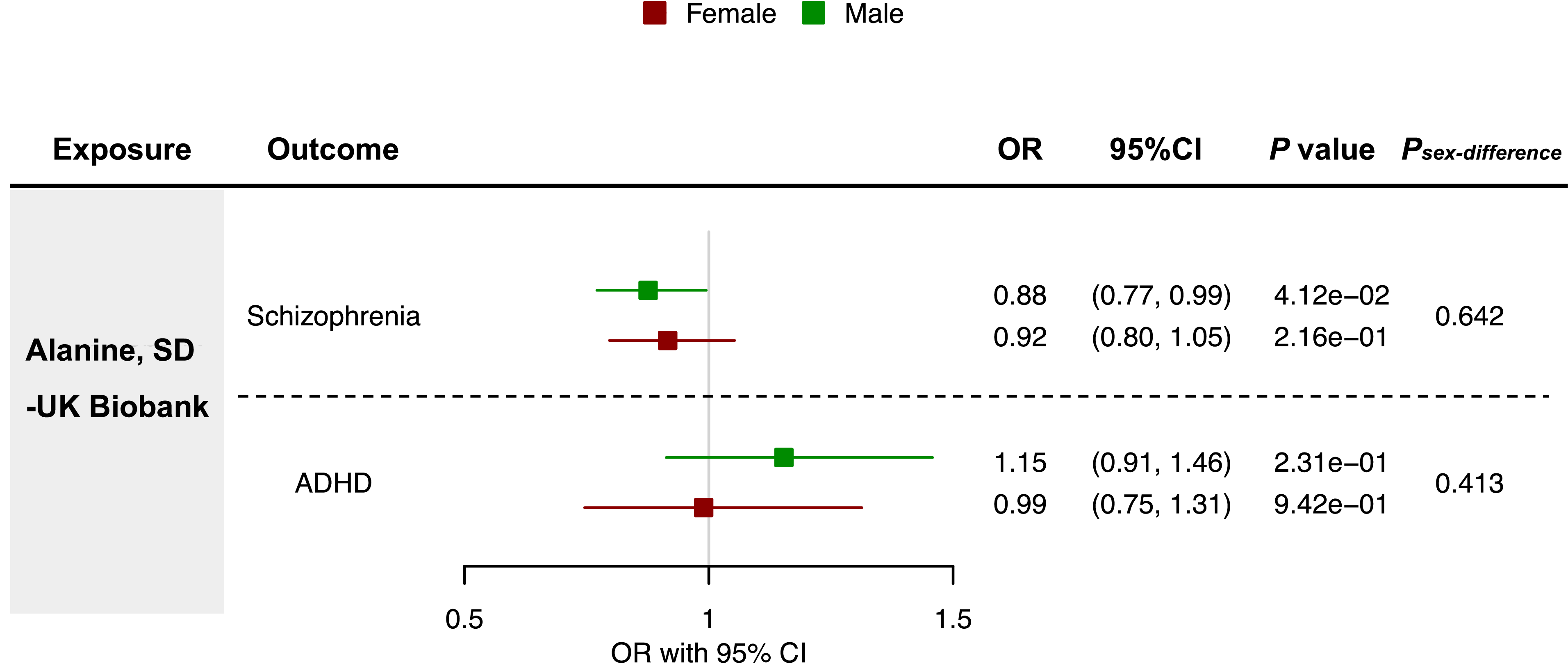
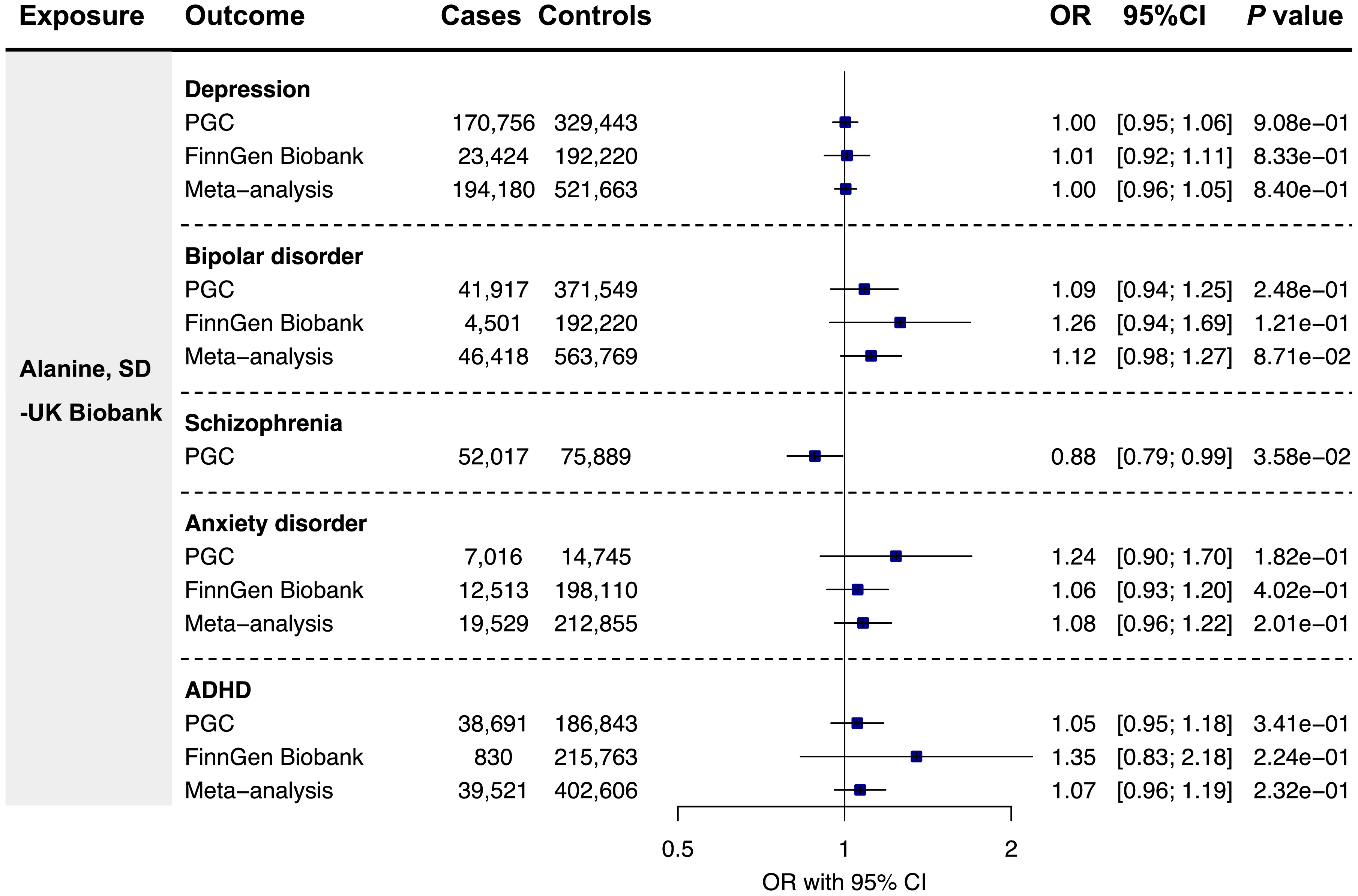
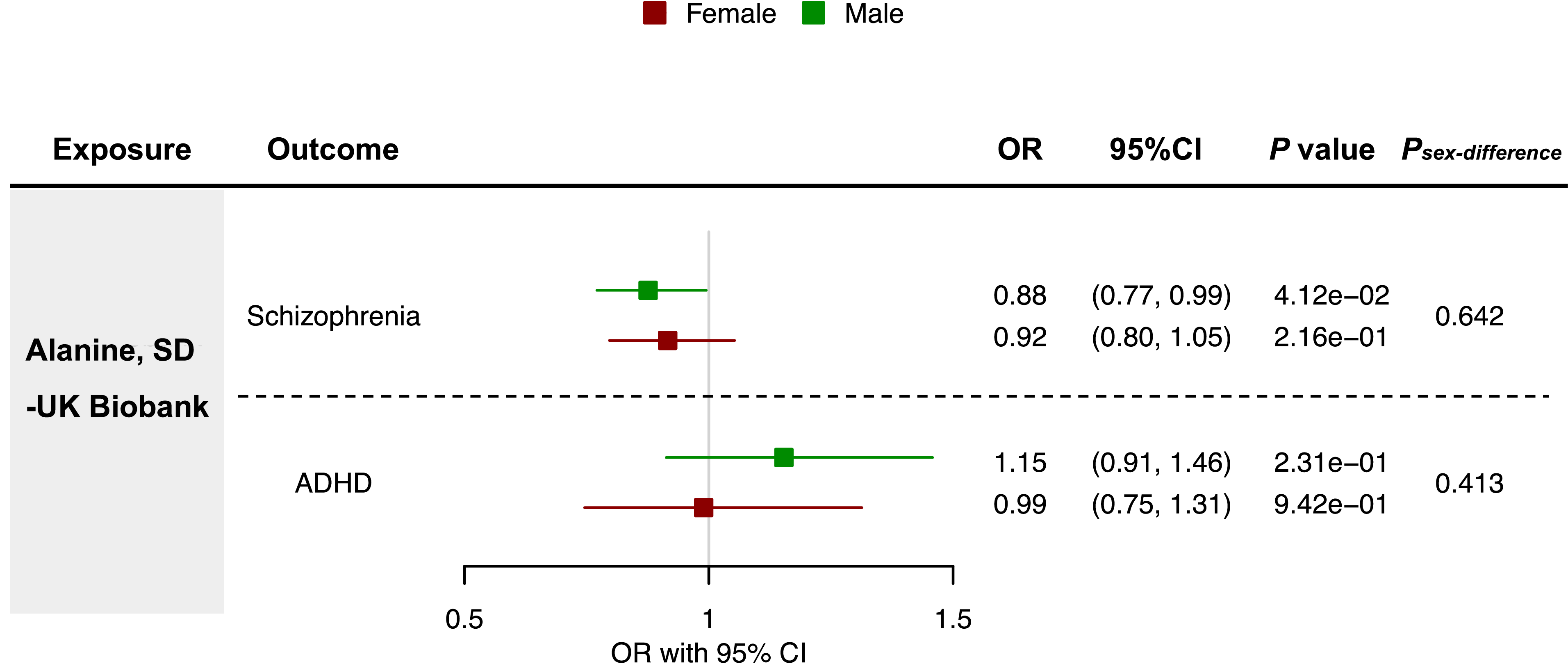
Results of the power calculation were shown in Supplementary Table S3. We found that genetically predicted plasma alanine was nominally associated with a lower risk of schizophrenia (OR 0.88, 95% CI: 0.79–0.99 per SD increase in genetically predicted plasma alanine) when using the IVW method (Figure 2), although this association did not meet the Bonferroni-corrected significance threshold (P < 0.01). The weighted median, MR-Egger and MR-RAPS gave directionally similar estimates (Supplementary Table S4). The MR-Egger intercept test did not indicate potential horizontal pleiotropy (P intercept = 0.840). MR-PRESSO suggested the presence of pleiotropy (P global test < 0.001) and identified rs2629665 as an outlier (Supplementary Table S4); the effect estimate remained directionally consistent after its removal. In the sex-specific analysis, the negative associations were only nominally significant in males (OR 0.88, 95% CI: 0.77–0.99) but not in females (OR 0.92, 95% CI: 0.80–1.05), although the sex difference was not statistically significant (P sex difference 0.642) (Figure 3). MR Steiger did not suggest reverse causality.
The Mendelian randomisation associations of genetically predicted circulating levels of alanine with mental disorders. Results are based on the inverse variance weighted method. The estimates are presented as OR with 95% CI, per SD increase in genetically predicted plasma alanine. The combined estimates were derived from random-effect meta-analysis.
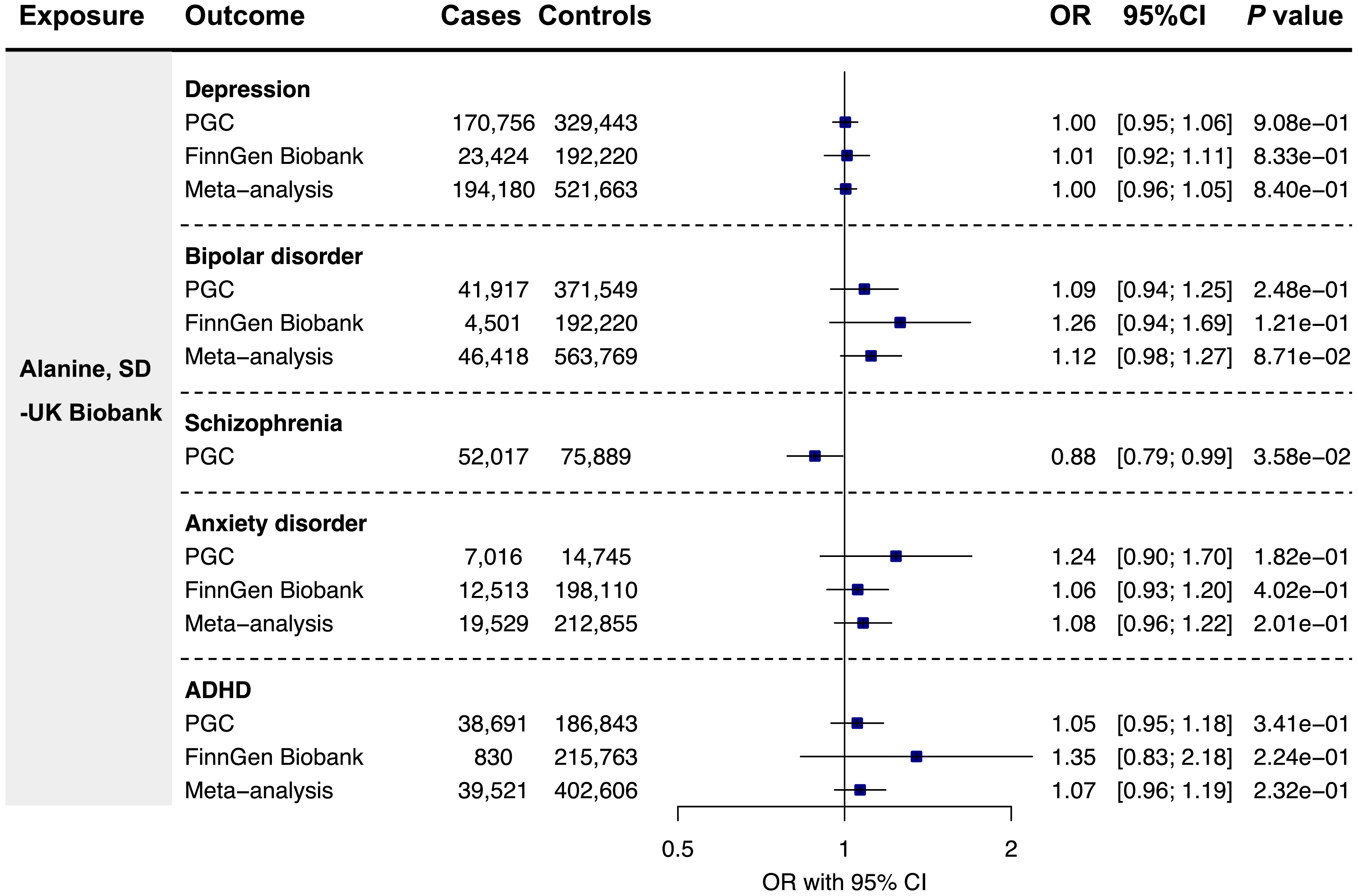
Figure 2. Long description
The table presents the associations of genetically predicted circulating levels of alanine with various mental disorders. It includes data for depression, bipolar disorder, schizophrenia, anxiety disorder, and ADHD. The table has 5 rows and 7 columns. The columns are labeled Exposure, Outcome, Cases, Controls, OR, 95%CI, and P value. The rows are grouped by mental disorder outcomes: Depression, Bipolar disorder, Schizophrenia, Anxiety disorder, and ADHD. Each row provides the number of cases and controls, the odds ratio (OR) with 95% confidence interval (CI), and the P value for the association between alanine levels and the respective mental disorder. The data is derived from different studies: PGC, FinnGen Biobank, and a meta-analysis. For example, in the row for Depression under PGC, there are 170,756 cases and 329,443 controls with an OR of 1.00 and a P value of 9.08e-1. The table provides a detailed comparison of how alanine levels are associated with different mental disorders.
The sex-specific Mendelian randomisation associations of genetically predicted circulating levels of alanine with mental disorders. Results are based on the inverse variance weighted method. The estimates are presented as OR with 95% CI, per SD increase in genetically predicted plasma alanine. The two-tailed P-value for sex difference was calculated based on z-statistic. z-statistic = (b1–b2)/sqrt (SE1 2+SE2 2) where b1 and b2 are MR estimate (beta-coefficient) in females and males, SE1 and SE2 are the standard error of b1 and b2.
We found null associations of plasma alanine with major depression, bipolar disorder, anxiety disorder, and ADHD (overall and sex-specific). MR estimates were consistent across PGC, FinnGen Biobank and their meta-analyses (Figure 2). Results were generally similar when using other analytic methods (Supplementary Table S4). The MR-Egger intercept test did not indicate directional pleiotropies for all associations.
All results remain consistent after excluding pleiotropic SNPs (Supplementary Table S5). 16 and 20 genetic instruments, explaining 1.4% and 1.06% of the variance in plasma alanine, respectively, from two large published GWASs,(Reference Lotta, Pietzner and Stewart31,Reference Karjalainen, Karthikeyan and Oliver-Williams32) were used in the replication analyses (Supplementary Table S6). The inverse association between alanine and the risk of schizophrenia overall was replicated when using instruments from Karjalainen et al., (Reference Karjalainen, Karthikeyan and Oliver-Williams32) and the association in males was replicated when using both Lotta et al. and Karjalainen et al., (Reference Lotta, Pietzner and Stewart31,Reference Karjalainen, Karthikeyan and Oliver-Williams32) despite not being significant after accounting for multiple testing (Supplementary Figures S1 and S2). Alanine showed a nominally significant association with a lower risk of anxiety in the PGC analysis when using instruments from Karjalainen et al., (Reference Karjalainen, Karthikeyan and Oliver-Williams32) but this became non-significant after meta-analysis with results from the FinnGen Biobank. Null associations were observed with other mental disorders in the replication analyses (Supplementary Figure S1 and S2).
Discussion
The findings of this MR study do not suggest any adverse association of plasma alanine with mental disorders, but provide suggestive evidence of an association between alanine and lower schizophrenia risk in the overall and male-specific analyses. Null associations of plasma alanine with depression, bipolar disorder, anxiety, and ADHD are somewhat inconsistent with previous animal experiments or small case–control studies.(Reference EdS and Guedes15,Reference Kurauchi, Asechi and Tachibana16,Reference Wan Nasru, Ab Razak and Yaacob19–Reference Johansson, Landgren and Fernell21) Animal models have provided evidence that alanine can provide metabolic fuel for neurons and may act as an antioxidant molecule to regulate anxiety-like behaviour.(Reference EdS and Guedes15,Reference Tsacopoulos, Veuthey and Saravelos50) However, this proposed neurological role has not been confirmed in the human brain. Alanine is more likely to be a clinical biomarker reflecting disease state or response to treatment, which helps alleviate concerns regarding potential psychiatric side effects associated with alanine consumption.
Our results provide suggestive evidence that alanine may reduce the risk of schizophrenia. Studies on D-alanine administration in rodent models of schizophrenia have reported that it reduced hyperactivity, stereotypy, and ataxia.(Reference Tanii, Nishikawa and Hashimoto51,Reference Hashimoto, Nishikawa and Oka52) Human clinical studies added evidence by showing that administering alanine at 100 mg/kg for 6 weeks to schizophrenia patients as an adjunctive treatment improved cognitive function and both negative and positive symptoms, and that increases in plasma alanine levels were correlated with reduced severity of schizophrenia, suggesting that alanine may serve as a symptomatic and therapeutic marker for schizophrenia.(Reference Tsai, Yang and Chang17,Reference Hatano, Ohnuma and Sakai18) Alteration in excitatory signalling, particularly hypofunction of the NMDA receptor, is considered a key cause of schizophrenia.(Reference Balu53) Alanine acts as a full potent agonist at the NMDA-glycine binding site.(Reference Tsai, Yang and Chang17) Principal NMDA receptor agonists, such as glutamate and serine,(Reference Blanke and VanDongen54) were also found to be associated with a lower risk of schizophrenia in previous MR studies.(Reference Huang, Wang and Zheng55,Reference Gilchrist, Mutz and Hysi56) Sex-stratified analyses showed that the effect of alanine was only significant in males but not in females, which may inform sex-specific interventions. This is possibly due to the power difference, as there is a smaller number of cases in females. Also, compared with females, males have a higher risk of schizophrenia (Reference Aleman, Kahn and Selten57) and higher levels of alanine in the brain and liver,(Reference Jiang, Xu and Yan24,Reference Yamasaki and Natori58) which may explain the stronger associations observed in males. The findings need to be interpreted cautiously, given that these associations did not reach Bonferroni-corrected significance, and the sex difference was not statistically significant. However, these nominal associations were replicated using different GWASs, which provides support to the findings.
The findings also require careful consideration in a public health context. Alanine exposure in our study represents circulating plasma levels rather than short-term dietary intake or supplementation. Although supplementation with alanine increases blood alanine levels,(Reference Klein, Nyhan and Kern59,Reference Oshima, Toyama and Toyama60) whether these findings can be translated into exogenous alanine intake requires further investigation. In addition, plasma alanine may not capture its levels in the brain or cerebrospinal fluid, which may be more relevant to schizophrenia. The extent to which plasma alanine reflects neurotransmission of alanine in the brain has not been studied. Compared to other possible NMDA receptor agonists, such as serine, alanine has a smaller central bioavailability and therefore requires a larger effective therapeutic dose.(Reference Tsai, Yang and Chang17,Reference Oldendorf61,Reference Tsai, Yang and Chung62) Although the ‘true’ no observed adverse effect level (NOAEL) for alanine is unknown, therapeutic doses of alanine have exceeded the maximum NOAEL for alanine supplementation that has been assessed.(63) So, caution is warranted when considering its clinical use, given the potential side effects at higher doses.
Our study is the first study to explore the causal relationship between circulating alanine and multiple psychiatric disorders by using a study design with less confounding than traditional observational studies. The findings from this study have the potential to offer valuable insights into the safety and efficacy of alanine in relation to psychiatric conditions. Despite the novelty of this study, we also acknowledge some limitations. First, three assumptions must be satisfied in MR, that is, the relevance, the independence, and the exclusion-restriction assumption.(Reference Davies, Holmes and Davey Smith23) To satisfy these assumptions, we only used genetic variants with F-statistic >10 and excluded SNPs that are potentially pleiotropic. We also used different analytic methods robust to pleiotropy in the sensitivity analysis. MR-PRESSO detected evidence of pleiotropy for the association between alanine and schizophrenia; however, sensitivity analyses excluding pleiotropic SNPs associated with potential confounders and replication analyses using different independent studies with varying confounding structures provided consistent findings, supporting the robustness of the association. Although residual pleiotropy cannot be fully excluded, our previous work suggests that the potential pleiotropy from other metabolites, such as pyruvate and lactate, likely reflects vertical pleiotropy within the alanine-glucose metabolic pathway and is therefore not expected to bias MR estimates.(Reference Davies, Holmes and Davey Smith23,Reference Huang and Zhao64) Second, genetic predictors only explain a small proportion of the variance in plasma alanine (2.51%), hence MR requires a larger sample size than traditional observational studies to obtain precise estimates.(Reference Burgess46) The marginally significant associations between alanine and schizophrenia and the lack of significance in sex difference are likely due to limited power. Subsequent replication analysis in larger samples is necessary. Third, we only obtained genetic associations from European populations; the results might not be applicable to other populations. Existing studies on alanine and psychiatric disorders have mostly been conducted in Asian countries, such as Japan and Malaysia.(Reference Tsai, Yang and Chang17–Reference Mitani, Shirayama and Yamada20) Exploration of the role of alanine in Asian populations is warranted; however, genetic instruments reflecting plasma alanine levels in Asian populations are not yet available. Fourth, partial sample overlap may bias two-sample MR results. However, a simulation study has suggested that such bias is generally limited in large cohorts, such as the UK Biobank.(Reference Minelli, Del Greco and van der Plaat65) In addition, we included analyses using data from the FinnGen Biobank, which has no sample overlap with the exposure datasets, providing further support for the robustness of our findings. Fifth, inconsistencies in defining cases for mental disorders across different cohorts may introduce heterogeneity and impact the accuracy of the associations. Sixth, alanine in the brain or cerebrospinal fluid may interact more with psychiatric activity, but there are no GWAS data on cerebrospinal fluid alanine levels. Seventh, we have not identified sex-specific data with comparable sample sizes for depression, bipolar disorder, and anxiety. In addition, genetic associations with alanine were not from sex-specific GWAS, potentially leading to conservative effect estimates in sex-stratified analyses. However, evidence suggests that the genetic architectures of most metabolic traits are largely shared between males and females.(Reference Flynn, Tanigawa and Rodriguez66) The findings were also replicated using different GWASs of alanine with different gender ratios. Finally, despite existing evidence from animal experiments and clinical studies supporting the effect of alanine on treating schizophrenia, the underlying mechanisms have not been fully clarified, and larger human trials are needed before these findings can be confidently extrapolated to clinical care.
In summary, this study does not support a causal effect of plasma alanine on major depression, bipolar disorder, anxiety, and ADHD but suggests a potential inverse association with schizophrenia, which may be restricted to males. This goes some way to allaying safety concerns regarding the psychiatric side effects of alanine consumption. Caution is required when considering alanine as a modifiable factor to reduce the risk of schizophrenia, given the marginal significance.
Supplementary material
The supplementary material for this article can be found at https://doi.org/10.1017/jns.2026.10128
Data availability statement
Data on plasma alanine have been contributed by the UK Biobank, available from https://gwas.mrcieu.ac.uk/datasets/met-d-Ala/. Genetic associations with major depression, bipolar disorder, schizophrenia, anxiety, and ADHD were from GWAS summary statistics shared by the PGC or FinnGen Biobank, downloaded from https://pgc.unc.edu/for-researchers/download-results/ and https://gwas.mrcieu.ac.uk/datasets/.
Acknowledgements
The authors would like to thank the UK Biobank, Psychiatric Genomics Consortium, and FinnGen Biobank for sharing the valuable data.
Author contributions
JVZ and XH designed the study; XH and JVZ analysed the data and interpreted the findings; XH wrote the first draft; JVZ critically revised the manuscript for important intellectual content. Both authors read and approved the final manuscript.
Funding statement
This research received no specific grant from any funding agency, commercial or not-for-profit sectors.
Competing interests
The authors have no competing interests.
Ethics approval and consent to participate
This study used only published summary data from studies involving human participants, with written informed consent and approval by their respective institutional ethics review committees. No additional ethical approval was required. Written informed consent was obtained from all individual participants for each of the studies included in the analysis and can be found in the original publications.
Consent for publication
Not applicable.



 Open access

