





1. Introduction
How bilinguals process information in each of their languages, and whether multiple languages are active when only one of them is needed, are topics that continue to draw attention in research on bilingualism (Elgort et al., Reference Elgort, Siyanova-Chanturia and Brysbaert2023). A broadly accepted view is that bilingual lexical processing is non-selective; namely, bilingual speakers access all their languages even when only one language is explicitly used. In lexical processing, evidence to support this view comes from cross-language influences observed in studies with interlingual homographs (Dijkstra et al., Reference Dijkstra, Grainger and Van Heuven1999), cross-language orthographic and phonological neighbours (Brysbert et al., Reference Brysbert, Van Dyck and Van de Poel1999; Van Heuven et al., Reference Van Heuven, Dijkstra and Grainger1998), compounds (Ko et al., Reference Ko, Wang and Kim2011; Zhang et al., Reference Zhang, van Heuven and Conklin2011) and cognates (Degani et al., Reference Degani, Prior and Hajajra2018; Gollan et al., Reference Gollan, Forster and Frost1997). Overall, lexical processing appears to benefit from cross-language overlap, with the strongest evidence provided by cognate facilitation studies (De Groot et al., Reference De Groot, Delmaar and Lupker2000; Libben & Titone, Reference Libben and Titone2009). However, the strength and even the direction of cross-language influences may be modulated by bilinguals’ proficiency in their respective languages, their age of acquisition and the context of language use (Bertram & Kuperman, Reference Bertram and Kuperman2020; Chaouch-Orozco et al., Reference Chaouch-Orozco, Alonso and Rothman2021; Chen, Reference Chen2024; Jared & Kroll, Reference Jared and Kroll2001; Silverberg & Samuel, Reference Silverberg and Samuel2004). Moreover, most evidence for cross-language lexical processing comes from experimental studies with single words, with cross-language influences in the processing of lexical items above the word level – such as multi-word expressions – being less understoodFootnote 1 (Du et al., Reference Du, Siyanova-Chanturia, Elgort and Elgort2023; Zeng et al., Reference Zeng, Branigan and Pickering2020).
The present study examined cross-language activation of one type of multi-word expression, idioms. Idioms are familiar, conventional phrases that convey a figurative meaning that is different from the sum of the meanings of its individual components. Many idioms are ambiguous as they have a literal and a figurative meaning (e.g., “spill the beans;” figurative meaning: “to reveal secret information unintentionally,” literal meaning: “to scatter the beans on the floor”). Idioms are often culture-specific, although some are universal. Idioms with similar form and meaning (“play with fire” [English], “igrać z ogniem” [Polish], “玩火自焚” [Chinese]) in both languages of a bilingual are referred to as “congruent idioms.”
It has been argued that bilinguals may process congruent idioms faster, more accurately and less effortfully than incongruent idioms in the non-dominant language (Carrol et al., Reference Carrol, Conklin and Gyllstad2016; Titone et al., Reference Titone, Columbus, Whitford, Mercier, Libben, Heredia and Cieślicka2015). However, it is not clear what mechanisms underpin the bilingual idiom congruency effect. It may rely on sequential, word-by-word translation (lexical route). Alternatively (or additionally), whole-phrase figurative meaning representations may be activated cross-linguistically when core component words are encountered together, even in the absence of a fully matching phrase structure (Carrol & Conklin, Reference Carrol and Conklin2014, Reference Carrol and Conklin2017). The main goals of the present study were to test cross-language activation of figurative idiom meanings during reading and to clarify its mechanism.
2. Literature review
2.1. Idiom processing research
Early idiom research examined the processing of figurative versus literal meanings in ambiguous idioms that allow both interpretations (e.g., “tie the knot”) and the processing of idioms versus control (novel) phrases. These studies tested a number of hypotheses about the representation and processing of the two meanings available in idioms, figurative and literal (e.g., Bobrow & Bell, Reference Bobrow and Bell1973; Cacciari & Tabossi, Reference Cacciari and Tabossi1988; Giora, Reference Giora1997, Reference Giora2003; Mashal et al., Reference Mashal, Faust, Hendler and Jung-Beeman2008; Swinney & Cutler, Reference Swinney and Cutler1979). Although these theories vary in their predictions about the time-course of relative figurative versus literal meaning activation, they tend to view idioms as fixed expressions, not subject to internal analysis by the language processor.
More recent evidence argues against treating idioms as word-like elements (but see Gibbs et al., Reference Gibbs, Nayak, Bolton and Keppel1989, who distinguished between decomposable and non-decomposable idioms). Regular decompositional analyses have been reported during idiom processing at the level of syntax, phonology and semantics, showing that idioms, much like literal language, are amenable to priming (e.g., Cutting & Bock, Reference Cutting and Bock1997; Snider & Arnon, Reference Snider, Arnon, Gries and Divjak2012; Sprenger et al., Reference Sprenger, Levelt and Kempen2006). Additional evidence comes from reading studies using eye movements that probed how idioms are processed when their highly canonical and fixed structure is modified. Kyriacou et al. (Reference Kyriacou, Conklin and Thompson2020) examined whether the figurative meaning of English idioms was lost if they were used in the passive, rather than the canonical active, form (kick the bucket – the bucket was kicked). As idiom modification did not disrupt idiom processing, the authors argued against treating idioms as word-like entities. In a follow-up study, Kyriacou et al. (Reference Kyriacou, Conklin and Thompson2021) investigated whether idiom modification (in the form of adjective insertion) affected idiom processing. Inserting one or two adjectives did not interfere with idiom processing. Interestingly, idioms were read more slowly than novel controls; it was argued that a competition between idioms’ literal and figurative meanings slowed down idiom processing.
Studies focusing on how idioms’ figurative meanings are represented and processed have used semantic priming experiments in which idioms serve as primes. In Van Ginkel and Dijkstra (Reference Van Ginkel and Dijkstra2020; Experiment 1), Dutch speakers made Dutch lexical decisions to target words following minimal-context idiom primes (“Hij voelde haar aan de tand,” Lit: “He felt her on the tooth,” Fig. “He interrogated her”) presented in the repeated serial visual presentation paradigm. Target words were related to the figurative meaning of the idiom (VRAAG “question”), to the literal meaning of the final word (KAAK “jaw”), or were unrelated (SOORT “kind”). The authors observed figurative meaning priming, as shown in faster response times (RTs) in the figurative than the unrelated condition, suggesting that the whole idiom’s representation is accessed in reading. They also found literal meaning priming relative to the unrelated condition, showing that the literal meanings of idiom constituents were also activated. These findings support the dual route model (Van Lancker Sidtis, Reference Van Lancker Sidtis and Faust2012; Wray & Perkins, Reference Wray and Perkins2000) of idiom processing, which argues that idiomatic expressions may be stored in the memory holistically and retrieved directly, and also computed using a words-and-rules approach (Carrol & Conklin, Reference Carrol and Conklin2014). Therefore, the idiom processing advantage may be due to either or both of these processing routes.
2.2. Cross-language influences in bilingual idiom processing
Although automatic cross-language activation is a well-established phenomenon in single-word processing (De Groot & Nas, Reference De Groot and Nas1991; Ko et al., Reference Ko, Wang and Kim2011; Wu et al., Reference Wu, Cristino, Leek and Thierry2013; Zhang et al., Reference Zhang, van Heuven and Conklin2011), evidence for cross-language activation in the processing of idioms and other types of multi-word expressions is less clear (e.g., Carrol & Conklin, Reference Carrol and Conklin2017; Du et al., Reference Du, Elgort and Siyanova-Chanturia2021). Congruent idioms are usually processed more readily than idioms that only exist in one of the bilingual’s languages (Titone et al., Reference Titone, Columbus, Whitford, Mercier, Libben, Heredia and Cieślicka2015; Pritchett et al., Reference Pritchett, Vaid and Tosun2016, but see Cieślicka & Heredia, Reference Cieślicka and Heredia2017, for the opposite findings). However, establishing the drivers of this congruency advantage is not straightforward, as factors other than cross-language activation (such as cumulative phrase frequency and order-of-acquisition) may contribute to this effect.
One way to study cross-language activation while avoiding these confounds is to use idioms that only exist in one of the bilinguals’ languages translated into their other language. This approach was used by Carrol and Conklin (Reference Carrol and Conklin2014), who conducted an idiom priming study with unbalanced high-proficiency Chinese–English bilinguals and English monolinguals. The stems of English idioms (e.g., “spill the …[beans]”) and translated Chinese idioms known as “chengyu” or “fixed expressions” (e.g., “draw a snake and add …[feet]”) served as primes and the final words of these expressions (“beans”, “feet”) were used as targets in a lexical decision task. The bilinguals’ RTs on the targets were faster for the translated Chinese idioms than the controls (“draw a snake and add feet/hair”), but no priming was observed for English-only idioms (“spill the beans/chips”). For English monolinguals, priming was observed for English but not Chinese idioms. This study showed that Chinese–English bilinguals accessed Chinese-only idioms in English processing. However, the reading was self-paced, giving participants ample time to translate the primes into Chinese and to actively anticipate the phrase completion. Additionally, the experimental paradigm used in the study was designed to “investigate whether the form of an idiom was the principle driver of recognition” (Carrol & Conklin, Reference Carrol and Conklin2014, 793) and, therefore, faster lexical decisions to the final word of the idiom may be explained by lexical translation-based processes, without the need to access figurative phrase meanings of the idioms.
In a follow-up study, Carrol and Conklin (Reference Carrol and Conklin2017) used eye-tracking to examine real-time processing of Chinese-only idioms translated from participants’ first language (L1), Chinese, into their second language (L2), English. Experiment 1 compared reading times on idioms and control sequences (“draw a snake and add feet/hair”) in short contexts supportive of the L1-idiom figurative meanings. The results showed shorter reading times on idioms compared to controls, suggesting access to L1-idiom knowledge in L2 reading. However, this facilitation may have been driven by the lexical-translation route without accessing figurative meanings. When reading component English words of a translated idiom, Chinese–English bilinguals may automatically activate their Chinese translation equivalents that activate a known Chinese idiom (画蛇添足 – “hua she tian zu”); the last word, 足, in turn, activates its English translation equivalent, “feet,” resulting in a shorter reading time on that word. This cross-language activation route does not require access to the figurative meaning of the Chinese idiom for the priming to occur, although it is plausible that the L1-idiom figurative meaning is also activated once the L1 idiom is recognised.
To adjudicate whether figurative L1-idiom meanings are activated cross-linguistically, Experiment 2 used translated Chinese-only idioms with plausible literal meanings in English (e.g., “add oil and vinegar”), comparing their processing in contexts that prioritised their literal versus figurative meanings (“add some dressing”/“embellish a story”). In line with the predictions of dual route models, if bilinguals are able to access figurative L1-idiom meanings in L2 reading, they would show comparable processing facilitation for literal and figurative meanings of idioms (as in L1-idiom processing, e.g., Siyanova-Chanturia et al., Reference Siyanova-Chanturia, Conklin and Schmitt2011). However, the results showed that bilinguals read translated L1-only idioms slower in the figuratively biased than in the literally biased contexts, indicating that figurative meanings of the L1-Chinese idioms were either not accessed or accessed after their literal meanings. The authors argued that translated L1-only idioms (never previously encountered in English) were more difficult for bilinguals to process when used figuratively than literally. The translated idioms might have been faster to compute literally, using the meanings of the constituent words in both English and Chinese (via automatic cross-language translation), than to retrieve cross-linguistically as whole-phrase figurative meanings.
While cross-language activation of figurative L1-idiom meanings in eye-movement studies remains undetermined, it has been observed in lexical decision tasks. Beck and Weber (Reference Beck and Weber2016; Experiment 1) compared cross-language activation of two types of L2-English idioms with high-proficiency German–English bilinguals. These authors used “translatable idioms” (e.g., “to lend [someone] an ear”/“jemandem sein Ohr leihen” – matching meanings and word-for-word translation) and “non-translatable idioms” (e.g., “to kick the bucket”/“den Löffel abgeben” [“the spoon give away”] – similar meanings without translation equivalence). In a cross-modal priming task, participants listened to English sentences that contained idioms (e.g., “pull someone’s leg”) and made visual lexical decisions on target words related to the figurative meaning (“joke”), literal meaning of the last content word (“walk”), or unrelated to either. Facilitatory semantic priming was observed for both literally and figuratively related targets, suggesting that bilinguals were able to access figurative meanings of L2 idioms. Translatable and non-translatable idioms produced comparable priming for literally and figuratively related targets, suggesting that bilinguals may have activated figurative meanings of the L1 idioms even without word-for-word equivalency. However, without L1-only or L2-only idiom controls, it is unclear whether semantic priming in the figuratively related condition was driven by the activation of figurative idiom meanings in L1 or L2, or both. In Experiment 2, similar semantic priming was observed for English monolinguals, casting doubt over the role of cross-language idiom activation in the study.
A study by Jared et al. (Reference Jared, Nguyen, Grant-Pereira, Rizkyana and Maziyah Mohamed2023), immediately relevant to the present investigation, tested whether bilinguals activate figurative meanings of L1-only idioms when exposed to their L2 translations. The study comprised three experiments using a cross-modal priming task based on Beck and Weber (Reference Beck and Weber2016) with three groups of bilinguals: a closer language/culture group of French–English bilinguals and two groups of participants with less similar language/culture pairings, namely, Vietnamese–English and Indonesian–English. They listened to sentences containing L1-only idioms translated into English (e.g., “to sell melons,” from the Vietnamese “buôn dưa,” meaning “to gossip”) and made lexical decisions on English target words related or unrelated to the idioms’ figurative meanings (“gossip”/“gallop”). To check the cross-language origin of the priming effect, monolingual English-speaking controls with no knowledge of the bilinguals’ L1s were also tested.
Results showed some semantic priming for all bilingual groups, indicating the activation of L1-idiom figurative meanings during L2 processing, although the effects varied in magnitude and direction for the three groups. French–English bilinguals showed reliable positive priming, with no priming observed for monolinguals. Vietnamese–English bilinguals had slower RTs on related than unrelated targets, whereas the results were in the opposite direction for monolinguals. In Experiment 3, Indonesian–English bilinguals and monolinguals showed faster RTs for related than unrelated targets, indicating that the priming effect may have been influenced by within-English factors.
Importantly, Jared et al. (Reference Jared, Nguyen, Grant-Pereira, Rizkyana and Maziyah Mohamed2023) showed that high-proficiency bilinguals activate figurative meanings of L1-only idioms when exposed to their L2 translations, confirming cross-language activation of L1 figurative meanings in L2 processing. This phenomenon was most evident in French–English bilinguals, particularly those who had higher English proficiency and spent more time reading in English. The inhibitory priming observed for Vietnamese–English bilinguals may have been due to the participants’ relatively low L1 exposure at the time of the experiment or the highly culturally specific nature of the Vietnamese idioms, resulting in the need to inhibit the figurative meanings from the non-English culture (Jared et al., Reference Jared, Nguyen, Grant-Pereira, Rizkyana and Maziyah Mohamed2023, 11–12). Thus, further research is needed to test cross-language activation of figurative phrase meanings for bilinguals with distant language/culture pairings (such as Chinese–English) and to understand the effect of language context on this activation.
One limitation of Jared et al. (Reference Jared, Nguyen, Grant-Pereira, Rizkyana and Maziyah Mohamed2023) is the use of a lexical decision task, as cognitive and decision-making processes deployed by participants in this task may affect (e.g., amplify) the finding of cross-language activation. More naturalistic measures, such as eye-tracking during reading, provide insights into cross-language activation of figurative idiom meanings that are closer to real language use. Previous eye-tracking studies, however, have their own limitations; their tendency to directly compare reading times on translated L1-only idioms and their controls does not afford differentiation between lexical translation-based priming and cross-language figurative meaning activation. Moreover, measuring priming on the same L2 word (instead of varying the target or terminal phrase word) could provide more stable results, reducing confounds related to individual differences in L2 knowledge and processing.
3. The present study
The present study aimed to test whether unbalanced Chinese–English bilinguals activate the knowledge of idiomatic expressions in their dominant L1 (Chinese) when reading texts in their L2 (English). To better understand the mechanisms underpinning this cross-language activation, we created two versions of Chinese–English expressions by translating Chinese-only idioms into English either as close translations (e.g., “水至清则无鱼” – “clear water contains no fish,” original idiom), or as translations that kept the key content words from Chinese idioms but modified their word-order and structure (e.g., “fish do not like clear water,” paraphrased idiom). This design was used to clarify whether word-by-word automatic translation (also referred to as the lexical route, Carrol & Conklin, Reference Carrol and Conklin2014, Reference Carrol and Conklin2017) is necessary to activate figurative meanings of the L1 idioms in L2 reading, or whether cross-language activation can be facilitated by the activation of a holistic idiom representation, when translation-equivalent component words and the phrase structure are only partially shared (Zeng et al., Reference Zeng, Branigan and Pickering2020). We developed and tested a novel cross-language contextual idiom priming paradigm with eye-tracking, in which critical expressions (i.e., idioms or novel word sequences – controls) embedded in short texts were followed by meaning probes – words related to the figurative meaning of the idioms, but not the controls. The differences between the idiom and control conditions in the earlier and later processing measures on the probe were used as proxies for activation of figurative meanings of L1 idioms in L2 reading.
We used familiar Chinese-only idioms translated into English to eliminate two confounds that may have contributed to the idiom congruency effect in previous cross-language studies: the frequency effect (i.e., additive phrase frequency in L1 and L2, which may facilitate the processing of congruent L2 idioms) and the order-of-acquisition effect (i.e., congruent idioms may be learned more easily than L2-only idioms). Thus, idiom priming observed on meaning probes downstream in reading could be interpreted as evidence of cross-language activation of figurative L1-idiom meanings. This effect may be realised either as faster processing of the probes (facilitation), due to semantic activation by the preceding idiom, or slower processing (inhibition) caused by effortful processing of L1-only idioms never encountered previously in the L2 (Carrol & Conklin, Reference Carrol and Conklin2017), and/or the need to inhibit L1, more generally, during L2 reading comprehension.
To test whether the context of L2 use is a factor in cross-language activation of L1 idioms in L2 processing, we recruited two groups of unbalanced Chinese–English bilinguals with advanced English proficiency and a control group of L1-English speakers (controls) with no knowledge of Chinese. The two bilingual groups were: English-as-a-second-language (ESL) university students in an English-speaking country (L2 context) and English-as-a-foreign-language (EFL) university students in China (L1 context). We conjectured that ESL participants, who are immersed in the L2-English environment and study exclusively in their L2, may experience the L2 reading task as relatively less demanding and may not need to actively inhibit their L1 during L2 reading, compared with EFL participants in China, who may find the L2 reading task more taxing and may need to actively inhibit their L1 to prioritise L2 lexical processing. Prior to the main study, we conducted an L1 experiment to test the proposed novel contextual idiom priming paradigm before using it in the main study.
4. The novel contextual idiom priming paradigm validation study
The contextual idiom priming paradigm used the logic of canonical semantic priming (McNamara, Reference McNamara2005; Neely, Reference Neely, Besner and Humphreys1991), where RTs to the target word (e.g., “doctor”) are faster when it is preceded by a semantically related prime (e.g., “nurse”), compared with a semantically unrelated prime (e.g., “beard”). This design decreases unwanted variability associated with individual differences in word processing, as the RTs on the same target word in the related and unrelated conditions are compared. Although originally observed in decision-based experiments, semantic priming has also been tested using eye-tracking in reading. In an early eye-movement study, Carroll and Slowiaczek (Reference Carroll and Slowiaczek1986, Experiment 1) showed that encountering a category name in a sentence can facilitate processing of a category member downstream in the sentences (even when a relative clause or phrase was inserted between the prime and the semantic probe).
Semantic priming is interpreted as a proxy for spreading activation across lexical-semantic networks (McNamara, Reference McNamara2005). In text comprehension, the “activation spreads automatically from meaning features of previous text to words or propositions that share these features,” making the latter easier to process (Calloway & Perfetti, Reference Calloway and Perfetti2017, 2). This spread of activation accounts for key memory processes associated with reading comprehension: prediction and memory-based integration. While prediction involves forward association, memory integration involves associating a currently read word with the previously read text.
Following this logic, we tested whether idioms prime non-adjacent words related to their figurative meaning downstream in reading. We predicted that reading an idiom activates its figurative meaning, which should facilitate the processing of a semantically related word (a meaning probe) downstream in the text, compared to the unrelated condition when the idiom is replaced by a novel word sequence unrelated to the probe. This facilitation results from spreading activation (arising from forward associations) that may pre-activate the probe and increase its predictability. To test this, we used the first-fixation duration and gaze duration eye-movement measures that reflect automatic lexical activation and predictive processes in reading (Rayner, Reference Rayner2009). We also conjectured that a contextual encounter with an idiom would be added to the text representation and would later resonate with the meaning features of the related probe (Stafura et al., Reference Stafura, Rickles and Perfetti2015). We argued that this resonance, if present, should be observed on later eye-movement measures: the total reading time and go-past time, indicative of word-to-text integration and processes associated with memory-based integration. This memory-based integration has been shown to be responsible for integrating word meanings across sentence or clause boundary (Calloway & Perfetti, Reference Calloway and Perfetti2017). Below we present the findings of the L1 study conducted to validate the novel contextual idiom priming paradigm (for full details of the study, see Supplementary Appendix 1).
In the experiment, 50 L1-English participants silently read sentences presented in the middle of the monitor screen while their eye movements were recorded. The critical items were 68 opaque two- to three-word-long English idioms (e.g., “bite the bullet”) from Carrol et al. (Reference Carrol, Conklin and Gyllstad2016). The idioms were embedded in the first part of sentences and the semantic probes in the second part, after two or three words. In the control condition, the idioms were replaced with novel word sequences with the same number of words and a similar syntactic structure as the idioms (e.g., “You need to bite the bullet [idiom]/check the diary [control] and make this unpleasant [probe] decision immediately before it is too late.”) In half of the sentences, the probe was embedded in a second clause, marked by a semicolon (e.g., “I had to eat my words [idiom]; I reluctantly admitted [probe] I was wrong”). In the counterbalanced design, the participants saw each probe once, either paired with the idiom or with the control. After the sentence reading procedure, participants completed the idiom knowledge check (rating the knowledge of the idioms on a 7-point scale, from 1 = no knowledge to 7 = excellent knowledge).
We fitted linear mixed-effects regression models to the log-transformed fixation data using the R package lme4 (Bates et al., Reference Bates, Kliegl, Vasishth and Baayen2015) on the four measures (justified above): first-fixation duration (FFD), gaze duration (GD), total reading time (TRT) and go-past time (GPT). The analyses showed facilitation priming on the TRT measure: the probes preceded by idioms were read 14 ms faster, compared with the control condition. We also found significant two-way interactions between Experimental condition and Self-rated idiom knowledge on TRT: participants were likely to read the probe faster in the idiom than the control condition when they rated their idiom knowledge higher; the difference between the two conditions was not significant for less well-known idioms. We found a significant two-way interaction between Condition and Probe_frequency in the FFD and GPT analyses. Higher-frequency probes were processed faster after idioms than controls, but lower-frequency probes were processed slower. In other words, participants tended to predict (or activate) higher-frequency probe words in the idiom condition, but lower-frequency probe words were inhibited. Lower-frequency probes were also more difficult to integrate into the preceding text after idioms, compared with controls, while higher-frequency probes were integrated into context somewhat faster. There was no effect of the clause boundary in any of the four analyses.
These findings show that the proposed experimental paradigm is sensitive to contextual idiom priming. For L1-English participants, idioms primed the reading of non-adjacent meaning probes downstream in the sentences, but the priming was stronger for more familiar idioms. The idioms also facilitated early processing on the probes, likely due to the forward associations resulting in pre-activation and/or prediction of the higher-frequency probes. Conversely, encountering the idioms in reading made lower-frequency probes more difficult to process, possibly due to lexical competition (FFD) and difficulties at the contextual integration stage (GPT).
5. Main study
The overarching research question posed in the present study is: Can cross-language activation of figurative idiom meanings be observed during reading, in the absence of the cumulative (L1 + L2) frequency and order-of-acquisition confounds? To answer this question, Chinese-only idioms translated into English were embedded in non-biasing English texts that contained a meaning probe related to the figurative meaning of the idioms. We were looking for contextual idiom priming by comparing the reading of the meaning probe preceded by idioms versus novel word sequences. Based on the results of the novel paradigm study with L1 participants, we predicted that, if bilingual participants were able to fully activate figurative phrase meanings of L1 idioms during L2 reading, the meaning probes would be read faster in the idiom than in the control condition. If the figurative meanings of L1 idioms were weakly activated and/or activated after their literal meanings, the meaning probes would be read more slowly compared to the unrelated controls.
The second goal of the study was to test whether figurative meanings of translated L1-only idioms could be activated based on the meanings communicated by the key content words of Chinese idioms translated into English, even without the exact structural overlap. Following recent studies suggesting that modified idioms may be processed as idioms by L1 readers (e.g., Kyriacou et al., Reference Kyriacou, Conklin and Thompson2020, Reference Kyriacou, Conklin and Thompson2021, Reference Kyriacou, Conklin and Thompson2023), we tested whether modified translations of L1 idioms may activate their figurative meanings in L2 reading.
5.1. Method
5.1.1. Participants
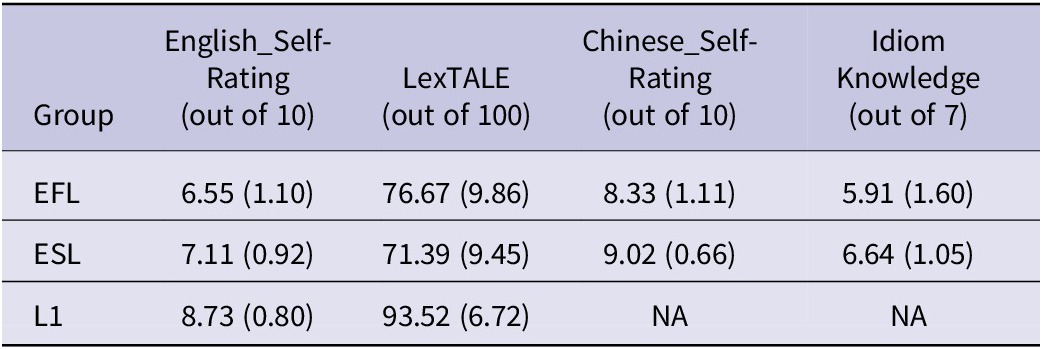
Five ESL and four EFL participants were excluded due to problems with eye-tracker calibration and one L1 participant was excluded because this participant did not follow instructions. After the exclusions, study participants were 38 EFL Chinese–English bilinguals at a university in China (average age = 21, 25 female, 12 male, 1 other), and 30 ESL Chinese–English bilinguals (average age = 28, 18 female, 11 male, 1 other) and 27 L1 participants (English-speaking controls, average age = 24, 21 female, 5 male, 1 other) at a university in an English-speaking country. Participants in the two bilingual groups were L1 speakers of Chinese; the groups had similar English and Chinese proficiency self-ratings (calculated as a mean of three ratings: reading comprehension, reading speed/fluency and conversational fluency) and a similar (high) level of knowledge of the critical Chinese idioms (see Table 1).
Participants’ characteristics by group (standard deviations in parentheses)

Note: Chinese–English bilingual groups: EFL – English-as-a-Foreign-Language, ESL – English-as-a-Second-Language; Control group: L1 – English-speaking controls.
5.1.2. Materials
The initial set of non-transparent Chinese idioms with no equivalent idioms in English was selected using Chinese idioms dictionaries, websites, corpora and L1 speaker intuitionFootnote 2. The following criteria were used. First, the idiom could be paraphrased by changing the word order and/or modifying the surface structure while retaining the key content words, imagery and associations from the original idiom. We wanted to preserve key imagery underpinning the figurative meanings of the L1 idioms because mental imagery plays an important role in communicating idiomatic meanings (Jackendoff, Reference Jackendoff2002). Second, the core aspects of the figurative meaning of the idiom were possible to communicate using a single word (to be used as the meaning probe in the experiment). Finally, the idiom could be embedded in a longer text. This selection process resulted in a list of 71 Chinese-only idioms, their close translations and associated paraphrased translations. These idioms underwent further checks with seven L1-Chinese speakers, who explained figurative meanings of the translated original and paraphrased Chinese idioms (presented in English) and provided their corresponding idioms in Chinese. They also rated the meaning similarity of the original and paraphrased idioms on a 7-point scale (identical = 7; completely different = 1). The items that had been correctly translated back into Chinese, generated correct figurative meaning explanations, and had been rated between 5 and 7 on the original and paraphrased idioms’ meaning similarity were included in the study. This resulted in the final set of 66 idioms.
Meaning probes were 66 single words (length M = 8.50 SD = 2.45 Min = 4 Max = 15; Frequency SUBTL-US-Zipf M = 3.67 SD = 0.88 Min = 1.77 Max = 5.69). No low-frequency words were used as probes; 95% of the probes were within the first 4,000 most frequent word families of English (Nation, Reference Nation2017). This is because the participants were L2 readers (although advanced proficiency) and because the verification study with L1-English participants showed that idiom priming was more likely with higher-frequency words.
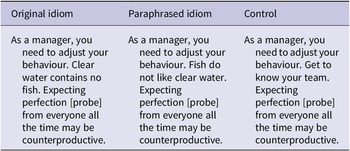
The idioms and probes were embedded in texts with the following structure: the first short sentence set the scene and did not contain any experimental items; the second sentence was a minimal context idiom presentation; the third sentence contained the meaning probe positioned one to three words to the right of the critical item (idiom or control) (see Table 2). Care was taken not to bias readers towards the idiom’s figurative meaning in the first sentence and not to use any words overlapping with the meaning of the meaning probe. In the control condition, idioms were replaced with novel word sequences (controls) that contained the same (or similar) number of words, made sense in the text, but were not related to the meaning of the probe (For experimental materials, see OSF Project Folder).
Example of a single text used in three experimental conditions

The idiom-probe meaning relatedness rating task was completed by 36 Chinese speakers to establish the perceived relationship between the original idioms, paraphrased idioms and controls and the meaning probes, all presented in English (on a 7-point scale). A counterbalanced presentation of the three experimental conditions was used in the rating task. The results showed a significant effect of condition (F (2,195) = 218.2, p < .001), with the two experimental conditions rated as significantly more related to the probe than the controls (original M = 5.8, paraphrased M = 5.7, control M = 2.9; contrasts: original idiom–control: t = 18.40, p < .001; paraphrased idiom–control: t = 17.76, p < .001), with no difference between the two idiom conditions (p = .798) (Supplementary Appendix 2, Figure A2.1). This confirmed the quality of the experimental materials.
In the reading texts, 98.2% of the running words were within the most frequent 4,000 word-families of English, to facilitate comprehension by L2 readers. Fourteen filler texts not containing idioms were also created using the same text structure. Yes/No comprehension questions were created for 16 experimental items and all fillers (total n = 30; 45% of the texts); the questions were not about the idioms or probe words. This was to encourage participants to read for meaning. The questions were displayed immediately after the texts, and participants pressed one of the two designated keyboard keys to register their responses.
Three experimental material lists were created in such a way that each meaning probe only occurred once in each list, in one of the experimental conditions (original idiom, paraphrased idiom or control). A counterbalanced within-participant experimental design was used, with all participants experiencing each of the three experimental conditions the same number of times in the experiment. The same fillers were used in all lists. Participants were assigned to one of the experimental lists on their arrival at the lab. Five practice trials (with comprehension questions) were used at the start of the experiment.
5.1.3. Procedure
Participants were tested individually. Prior to the experiment, they completed the LexTALE test (Lemhöfer & Broersma, Reference Lemhöfer and Broersma2012), used as one of the qualifying criteria for the study. They completed the main experiment, the language background questionnaire and the bilinguals completed the idiom knowledge check (rating their knowledge of the idioms presented in Mandarin Chinese on a 7-point scale), in that order. The whole experiment took 50–60 minutes.
In the main experiment, participants silently read the texts presented in the middle of the monitor screen (in a randomised order) while their eye movements were recorded. The texts were presented in black Courier New font, size 15, on a light grey background. The probe words were never the first or last word in a sentence or line. Participants pressed the space key to move to the next text. They were instructed to read the texts once naturally for meaning and answer comprehension questions when they were displayed. Participants had a chance to take a break halfway through the experiment.
The ESL and L1 participants were tested in the same lab. Their eye movements during reading were recorded using a desktop-mounted EyeLink 1000 Plus eye-tracker with a sampling rate of 2,000 Hz. The camera-to-eye distance was 55 cm. A chinrest was used to reduce head movements. The EFL data were collected at a university in China, using a tower-mounted EyeLink 1000 Plus eye-tracker with a sampling rate of 1,000 Hz; the eye-to-screen distance was 70 cm. A 9-point calibration was used before the beginning of the reading procedure and after the breaks. A drift check was performed before each text; additional calibrations were performed for each participant, as required. Data Viewer (version 4.3, SR Research, 2018) was used to inspect and clean the eye-movement data. For minor drift cases, a combination of built-in and manual drift correction was used.
5.1.4. Data analysis
Data from the three participant groups were analysed togetherFootnote 3. We fitted linear mixed-effects regression models to the log-transformed fixation data using the R package lme4 (Bates et al., Reference Bates, Kliegl, Vasishth and Baayen2015) on the same four measures as in the paradigm validation study: FFD, GD, TRT and GPT. Skipped probes were not included in the analyses. Utilising these multiple eye-tracking measures allows us to dissociate, at least to some extent, the two types of memory processes involved in reading comprehension: prediction (forward idiom-to-probe association affecting early word processing, indexed by FFD) and memory-based integration (backward association between probes and the preceding context, indexed by GPT).
In addition to the four fixation duration measures, we analysed regression-out (RO) – probability of regressive movements outside of the word to earlier portions of the text (a binary predictor) – that may reflect uncertainty/hesitations in the probe integration into the larger discourse (Rayner, Reference Rayner2009). The decision to analyse RO in addition to the four fixation-duration measures was driven by the predicted and observed higher re-reading tendencies of bilingual participants. The probes, related to the figurative meanings of the idioms, afford disambiguating between the literal and figurative meanings of the idioms; such a disambiguation attempt is indexed by regressive eye movements to the left from the disambiguating area (Frazier & Rayner, Reference Frazier and Rayner1982; Meseguer et al., Reference Meseguer, Carreiras and Clifton2002). In the RO analysis, we used a logit model (with z and χ2 distributions).
Condition (original, paraphrased and control) was a primary-interest predictor. We also tested whether the effect of Condition differed for the participant groups (EFL, EFL and L1). Therefore, all models included the Condition×Group interaction as a primary-interest predictor. Condition and Group were contrast coded. Following the findings of the paradigm verification study, we tested the Condition×Group×Probe_frequency interaction (but, because we controlled probe frequency, the likelihood of this interaction was predicted to be higher for L2 than L1 readers). The following covariates were included in initial models: Probe_length (in letters), Vocabulary_knowledge (log-transformed LexTALE score) and Self-rated proficiency. All continuous independent variables were centred. All initial models were fitted with the following initial formula: Y ~ Condition × Group × Probe_frequency + Probe_length + Vocabulary_knowledge + English_self-ratings. The models were fit with Participant and Probe as crossed random effects.
Final models were identified using backward stepwise simplification with the likelihood ratio test for model comparisons (Baayen et al., Reference Baayen, Davidson and Bates2008). The primary-interest predictor, Condition × Group, was retained in the final models. We attempted to fit random slopes, justified by the data (Matuschek et al., Reference Matuschek, Kliegl, Vasishth, Baayen and Bates2017) in all analyses but, if they did not improve the model fit and resulted in the “boundary (singular) fit” errors, we did not include them in the final model. Initial minimal a priori outlier screening and removal was followed by model criticism; potentially harmful outliers were removed, and the model was refit. The proportions of the data points removed in the fixation duration analyses were as follows: FFD = 8.08%, GD = 5.88%, TRT = 4.95%, GPT = 2.13%. The initial alpha was .05. Type III analysis of variance was used as test of effects. We used F tests with the Satterthwaite approximation for degrees of freedom. Post hoc analyses with the Bonferroni adjustment were conducted to clarify the critical contrasts, using the emmeans package (Lenth, Reference Lenth2024) (see Supplementary Appendix 2 for descriptive statistics and full model reporting).
5.2. Results
The accuracy of responses to the comprehension questions was acceptable (EFL M = 0.80 SD = 0.40, ESL M = 0.82 SD = 0.39, L1 M = 0.88 SD = 0.33), indicating that participants were reading the texts for meaning (for descriptive statistics, see Supplementary Appendix 2, Table A2.1).
In the FFD analysis (Supplementary Appendix 2, Tables A2.2–2.4), a Condition × Group interaction was observed (F (4,5153) = 4.13 p = .002). The post hoc analysis showed that, in the ESL group, FFDs on the probe were significantly faster in the paraphrased-idiom than the control condition (t = −2.74 p = .018). Conversely, in the EFL group, FFDs were slower in the paraphrased-idiom than the control condition (t = 2.39 p = .051). No difference was observed between the original-idiom and control conditions for either bilingual group. In the L1-control group, the contrasts between the two idiom conditions and control condition were not significant. This suggests that ESL participants were more likely to predict/activate the meaning of the probe in the paraphrased-idiom than the control condition but, for the EFL participants, the early processing of the probe was inhibited (Figure 1a). The main effects of group (F (2,92) = 48.99 p < .001, L1 < ESL ≲ EFL) and probe_frequency (F (1,64) = 14.36 p = .002) were also significant.
Interaction plots for Condition × Group in the FFD A) and RO B) analyses, and for Condition × Group × Probe_frequency in the TRT C) and GPT D) analyses. Note: FFD = first-fixation duration, RO = regression-out; TRT = total reading time, GPT = go-past time. Chinese–English bilingual groups: EFL = English-as-a-Foreign-Language, ESL = English-as-a-Second-Language; Control group: L1 = English-speaking controls. Experimental conditions: original – word-by-word translation, paraphrased – modified idiom structure, unrelated = control (free word sequences unrelated to the probe). All dependent variables have been back-transformed to milliseconds for ease of interpretation.

In the GD analysis (Supplementary Appendix 2, Tables A2.5–2.8), the interactions were not statistically significant. Although there was a main effect of Condition (F (2,5059) = 3.75 p = .024), neither of the critical contrasts (namely, the two experiential conditions versus the control condition) were statistically significant in the post hoc analysis with Bonferroni adjustment. There were significant main effects of Group (F (2,108) = 33.71 p < .001, L1 < ESL < EFL), Probe_length (F (1,72) = 70.03 p < .001), Probe_frequency (F (1,63) = 17.51 p < .001) and Vocabulary_knowledge (F (1,90) = 5.76 p = .018) (in the expected direction).
In the TRT analysis (Supplementary Appendix 2, Tables A2.9–2.12), there was a three-way interaction between Condition, Group and Probe_frequency (F (4,5413) = 3.78 p = .005; Figure 1c). The post hoc analysis showed that the contrasts between the two idiom conditions and the control condition were significant only in the EFL group and only when probes were higher-frequency, with slower reading of the probe in the two idiom conditions than the control condition: original–control (t = 2.78 p = .016), paraphrased–control (t = 3.80 p < .001). The two-way interaction between Group and Probe_frequency was also significant (F (2,63) = 14.42 p < .001), with faster reading times on higher-frequency than lower-frequency probes for EFL and ESL participants, but not L1 participants. The main effects of Group (F (2,102) = 51.44 p < .001, L1 < EFL ≲ ESL), Probe_length (F (1,64) = 96.89 p < .001) and Probe_frequency (F (1,65) = 14.49 p < .001) were also significant (in the expected direction).
In the GPT analysis (Supplementary Appendix 2, Tables A2.13–2.17), there was a three-way interaction between Condition, Group and Probe_frequency (F (4,5293) = 3.27 p = .011, Figure 1d). The post hoc analysis showed that, when probes were higher-frequency, L2 participants had longer GPTs on the probes in the idiom conditions than the control condition (EFL: original–control t = 2.42 p = .046, paraphrased–control t = 2.76 p = .018; ESL: original–control t = −3.29 p = .003). There was also a main effect of Condition (F (2,5331) = 12.27 p < .001): GPT was longer in both idiom conditions than the control condition (original–control t = 3.10 p = .006, paraphrased–control t = 4.94 p < .001). The two-way interaction between Group and Probe_frequency was also significant (F (2,74) = 6.27 p = .003), with shorter go-past times on higher-frequency than lower-frequency probes for EFL and ESL participants; no effect of probe frequency on GPT was observed for the English-speaking controls. The main effects of Group (F (2,101) = 44.84 p < .001, L1 < EFL ≈ ESL), Probe_length (F (1,69) = 79.86 p < .001) and Probe_frequency (F (1,72) = 32.64 p < .001) were also significant (in the expected direction).
In the RO analysis with Type III Wald chi-square tests (Supplementary Appendix 2, Tables A2.18–2.21), the Condition × Group interaction did not reach statistical significance (χ2 = 5.97, p = .202). However, the model with the interaction was a somewhat better fit, and the fixed-effects output of the logit model suggested that the RO behaviour of the two bilingual groups was in the opposite direction (Supplementary Appendix 2, Table A2.18). Based on this initial evidence, we conducted a post hoc analysis of the Condition × Group interaction with Bonferroni adjustment, which showed that the contrast between the probability of RO was significantly greater in the idiom conditions than the control condition for ESL participants (original–control z = 3.02 p = .008; paraphrased–control z = 2.57 p = .031; Figure 1b; Supplementary Appendix Table A2.20), but not for the other two groups. For ESL participants, we observed a 52% increase in the odds of the RO in the original-idiom and 43% in the paraphrased-idiom condition compared with the control condition. There were also main effects of Group (χ2 = 31.60, p < .001, EFL < L1 < ESL), and Probe_frequency (χ2 = 4.34, p < .037), and the effect of Condition approached statistical significance (χ2 = 5.79, p = .055).
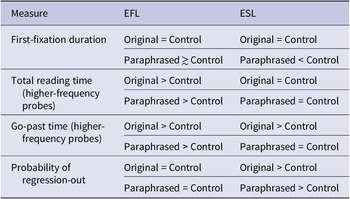
In summary, contextual idiom priming was observed for the two bilingual groups on most eye-movement measures, but not for the English-speaking controls. For the EFL (non-immersion) participants, we observed inhibitory priming on FFD, TRT and GPT for higher-frequency probes. For ESL (immersion) participants, facilitation was observed on FFD, and inhibition on GPT (for higher-frequency probes). A significantly higher likelihood of regressions back from the probe to the preceding context was found for ESL bilinguals in the two idiom conditions compared with the control condition (see Table 3). We discuss these results below.
Summary of pairwise comparisons for the bilingual groups

Note: EFL – English-as-a-Foreign-Language, ESL – English-as-a-Second-Language. Experimental conditions: Original – word-by-word translation, Paraphrase – modified idiom structure, Control – free word sequences unrelated to the probe.
6. Discussion
The aims of the present study were to establish whether figurative meanings of L1 idioms are activated in L2 reading and, if yes, whether the exact mapping of the phrase structure that affords word-by-word L2-L1 translation is necessary for the cross-language meaning activation to occur. We used Chinese-only idioms translated into English to avoid the confounds of the cumulative phrase frequency and order-of-acquisition that may contribute to the congruency effect reported in previous studies.
The novel contextual idiom priming paradigm allowed us to probe activation of figurative L1-idiom meanings in real-time L2 reading. We used eye-movement measures instead of explicit lexical decisions, making the findings more generalisable to real language use. By measuring idiom priming on semantic probes, we were able to test activation of figurative idiom meanings while reducing unwanted variability in L2 processing. We compared cross-language idiom activation for ESL (immersion) and EFL (non-immersion) Chinese–English bilinguals of comparable L2 proficiencies and used a group of English speakers with no knowledge of Chinese to control for within-language influences that may affect the processing of the meaning probes.
6.1. Cross-language activation of figurative idiom meaning in reading
For the control group of English speakers, we did not find significant differences between the two idiom conditions and the control condition on any of the measures. This suggests that priming observed in the two bilingual groups is of a cross-language origin. For the bilingual participants, differences between the idiom and control conditions were observed on all eye-movement measures (but not always for both bilingual groups). This suggests that figurative meanings of translated L1-only idioms were likely activated to some extent in real-time L2 processing. However, similar to Jared et al. (Reference Jared, Nguyen, Grant-Pereira, Rizkyana and Maziyah Mohamed2023, Experiment 2), this priming effect was not necessarily facilitatory. Faster processing of the meaning probes after related idioms than unrelated controls was observed on FFD (but only for ESL participants). This finding suggests that figurative meanings of L1 idioms were likely activated during L2 reading, creating forward associations that increased predictability of the probe word, facilitating its early processing (Rayner, Reference Rayner2009). Of note is that significant positive priming was observed for the paraphrased-idiom condition for ESL participants, implying that word-by-word translation equivalence may not be necessary for L1-idiom activation. This, in turn, can be interpreted as evidence of cross-language holistic phrase meaning activation (as proposed by Du et al., Reference Du, Siyanova-Chanturia, Elgort and Elgort2023; Zeng et al., Reference Zeng, Branigan and Pickering2020). We will return to this point in the theoretical implications section below.
Nevertheless, evidence of facilitation was relatively weak: after the Bonferroni correction, the critical contrast reached statistical significance only for paraphrased idioms (t = −2.74, p = .018), and the difference was small (about 12 ms with the mean FFD of 290 ms). On the other hand, robust inhibition priming was observed on all later eye-movement measures (for at least one of the bilingual groups). Recall that, in the present study, participants encountered translated L1-only idioms in non-biasing contexts that did not prioritise their figurative meanings up until the disambiguation point, when the meaning probe was encountered in the subsequent sentence. Considering that translated L1-only idioms were novel L2 word sequences, their literal meanings were likely more prominent in these neutral contexts (due to combined L1 and L2 lexical level activation) than figurative L1-idiom meanings. Creating backward associations from the meaning probes to these weakly activated figurative meanings might have been rather effortful. Consequently, memory-based integration needed for text comprehension was slower, causing inhibition on the later eye-movement measures on the probe (TRT, GPT and RO).
Our results are in line with Kyriacou et al. (Reference Kyriacou, Conklin and Thompson2023), who examined the processing of modified versions of ambiguous canonical idioms by L1 readers. In their study, modified (passivised) idioms (e.g., “the bucket was kicked”) were followed by three types of keywords: related to the figurative meaning (“dead” – “body”), literal meaning (“bucket” – “water”) or incongruent controls (e.g., “time”). Using eye-tracking, they found that keywords related to figurative meanings were processed significantly slower than literal keywords on the GPT measure. They concluded that the literal meanings of passivised idioms must have been easier to activate than the figurative meaning, negatively affecting figurative keyword integration into context. Similarly, inhibition on late eye-movement measures in the present study might be due to strong cumulative (L1 + L2) activation of literal meanings of translated L1 idioms, slowing down bilinguals’ contextual integration of the probes related to the figurative idioms’ meanings. Jared et al. (Reference Jared, Nguyen, Grant-Pereira, Rizkyana and Maziyah Mohamed2023, p. 11) also argued that the need to inhibit L1, including figurative L1 idiom meanings, during L2 processing could result in the literal meaning of the idiom being activated more highly than the figurative meaning. Competition from strongly activated literal meanings of the idioms has also been identified by Carrol and Conklin (Reference Carrol and Conklin2017; Experiment 2) as a likely reason why bilinguals read translated L1-only idioms slower in the figuratively biased than in the literally biased contexts.
6.2. Cross-language idiom processing by immersion and non-immersion bilinguals
The findings for the two bilingual groups were markedly different (see Table 3). For EFL participants, we only observed inhibitory priming in the idiom conditions (on all measures, apart from RO). A stronger effort needed to inhibit their L1 (including L1 idiomatic meanings) during L2 reading could have resulted in EFL participants prioritising literal meanings of the translated L1-only idioms, reducing the likelihood/strength of activating their figurative meanings. This competition from relatively stronger activated literal meanings likely resulted in inhibition priming observed on the later eye-movement measures (TRT, see Table 3) for EFL participants. Notably, for EFL participants, there was no difference between the idiom and control conditions in the RO analysis. Probability of RO may index the need for verification when comprehension is not going well, or the text is particularly difficult (Rayner, Reference Rayner2009). For example, in a syntactically ambiguous garden path sentence, readers are more likely to make a regression from the disambiguating word back to earlier parts of the sentence (Frazier & Rayner, Reference Frazier and Rayner1982; Meseguer et al., Reference Meseguer, Carreiras and Clifton2002). The finding suggests that EFL bilinguals may have been less sensitive to the presence of L1 figurative idiom meanings related to the probes, compared with ESL participants who were more likely to make regressive eye movements from the probe (serving as a disambiguating word) to the earlier portions of the text in the idiom conditions, compared with the control condition (Supplementary Appendix 2, Tables A2.20–21).
For ESL participants, facilitation was observed on the early eye-movement measure (FFD) and inhibition on the later measure (GPT), indexing word-to-text integration (Rayner & Pollatsek, Reference Rayner and Pollatsek2006). With less need to proactively suppress their L1 in L2 reading, figurative meanings of L1 idioms may have been activated well enough to predict (or automatically activate) the related meaning probes. Additionally, since ESL (immersion) participants experience higher levels of L2 exposure/use, compared with EFL (non-immersion) participants, they may be able to more fully activate the semantic representations of L2 meaning probes (Chaouch-Orozco et al., Reference Chaouch-Orozco, Alonso and Rothman2021; Dijkstra et al., Reference Dijkstra, Wahl, Buytenhuijs, Van Halem, Al-Jibouri, De Korte and Rekké2019), making their overlapping semantic features resonate more strongly with weakly activated figurative meanings of the L1 idioms. Moreover, for ESL participants immersed in the L2 patterns through everyday L2 use and high volumes of L2 course readings, eye-movement measures are predicted to be affected by contextual prediction-driven semantic processes, whereas EFL readers are more likely to rely on word-level cues (notably, word frequency), being less sensitive to a word’s context-driven predictability (Berzak & Levy, Reference Berzak and Levy2023). These experience-based differences between the two groups offer a possible explanation for the presence of facilitation in the early processing of ESL but not EFL participants.
Interestingly, L1 idiom meanings appear to have been activated more strongly for paraphrased than original idioms. This finding is in line with Cieślicka and Heredia (Reference Cieślicka and Heredia2017), who observed longer reading times on the last word in congruent than non-congruent idioms with Spanish–English bilinguals reading English sentences. They argued that automatically activated congruent L1 idioms may have resulted in lexical-level competition, whereas this was not the case for non-congruent idioms. This lexical-level competition may have reduced figurative meaning activation in the original-idiom condition in our study.
On the other hand, inhibition priming on the word-to-text integration measure may index readers’ effortful attempts to integrate probe meanings with the contents of memory for the preceding text (Calloway & Perfetti, Reference Calloway and Perfetti2017). Although inhibition was present for both bilingual groups on GPT, possibly indicating more effortful integration of the probes after encountering the L1 idioms (compared with the controls), for the EFL group, it was accompanied by inhibition on TRT, suggesting overall probe processing difficulties. For the ESL group, inhibition on GPT was accompanied by a significantly higher likelihood of regressing back from the probe to the preceding text in the idiom conditions (higher odds of RO), indicative of an effort to resolve the ambiguity between the figurative and literal phrase meaning. Kyriacou et al. (Reference Kyriacou, Conklin and Thompson2023) argued that, in idiom processing, figurative meaning selection and integration may come at a cost, compared to literal control phrases, for which meaning integration is easier. This effortful activation of the L1 figurative meaning may have made later stages of probe processing more laborious and necessitated the use of more explicit meaning verification strategies to resolve semantic ambiguity (hence, more regressions back). This conjecture that ESL participants opted for a more careful reading strategy (possibly, as a result of the presence of the translated L1-only idioms) is also supported by slower total reading times for ESL participants (718 ms), compared with EFL (613 ms) and L1 (347 ms) participants. Taken together, these results suggest that ESL bilinguals might have made more of an effort to reconcile the probes’ meanings with the related figurative meanings of L1-only idioms than EFL bilinguals.
6.3. Theoretical implications
Theoretically, our findings contribute to building a more detailed understanding of mechanisms underpinning cross-language idiom activation during L2 processing. We did not find major differences between the processing of close translations and paraphrased translations (that retained the mental imagery and key content words of L1-only idioms but not the exact surface structure). This suggests that the lexical route, operationalised as word-by-word automatic translation, may not be necessary for the cross-language idiom activation, as L1-idiom figurative meanings can be activated when the idiom’s key component words and phrase structure are only partially shared. As bilingual readers encounter L2 words that overlap with the core mental imagery and concepts comprising a known L1 idiom, the figurative meaning of the idiom is activated and gets incorporated into memory associated with the preceding context, which can resonate with the meanings of L2 words encountered downstream in the text. In the present study, this was realised via slower, more effortful processes due to weakly activated figurative L1 meanings. However, the effect may be facilitatory for less distant language pairs (e.g., facilitation of French–English idiom priming was observed by Jared et al., Reference Jared, Nguyen, Grant-Pereira, Rizkyana and Maziyah Mohamed2023).
Another way to account for the paraphrased cross-language idiom priming is to assume the criticality of conceptual activation in bilingual processing. Zeng et al. (Reference Zeng, Branigan and Pickering2020) proposed that congruent and incongruent multi-word expressions can be linked across languages via common semantic/conceptual representations. This hypothesis is aligned with the Multilink computational model of bilingual word recognition and translation (Dijkstra et al., Reference Dijkstra, Wahl, Buytenhuijs, Van Halem, Al-Jibouri, De Korte and Rekké2019), which implements cross-language activation as connections between conceptual nodes corresponding to word forms in different languages. If conceptually driven cross-language facilitation is assumed as a baseline, the congruency effect (i.e., faster processing of congruent than incongruent idioms, e.g., Carrol et al., Reference Carrol, Conklin and Gyllstad2016; Titone et al., Reference Titone, Columbus, Whitford, Mercier, Libben, Heredia and Cieślicka2015) may arise due to the boost from parallel activation of the constituent word representations and similar phrase structure across the languages for congruent expressions.
To go back to the fundamental question of cross-language activation, our results support the non-selective view that the available languages of bilinguals are continuously active in the mind, even when information they process is encoded and communicated exclusively in one language. Our results furnish evidence of non-selective access to language units beyond single words and literal meanings, even for distant language pairs that do not share script, such as Chinese and English. On the other hand, our findings question the primacy of the automatic word-by-word translation mechanism behind cross-language activation of idioms and call for the development of theoretical and computational models of cross-language idiom processing that explain semantically and conceptually driven cross-linguistic activation at the level of multi-word expressions.
7. Conclusions
The present study tested cross-language activation of figurative meanings of L1-Chinese idioms during L2-English reading for two groups of Chinese–English bilinguals: ESL (immersion) and EFL (non-immersion) participants, without the need to make explicit lexical or semantic decisions. Our results showed contextual idiom priming for the bilinguals (but not for the control group of L1-English speakers) on the early and late eye-movement measures. We are interpreting this as evidence of cross-language idiom activation in real-time processing. The priming effects observed in the present study were mostly inhibitory. We argued that L2 processing effort, the need to inhibit L1, competition from highly activated (cumulative) literal phrase meanings and insufficiently strong activation of figurative phrase meanings were key drivers of this inhibitory priming. Combined evidence for the ESL participants points to their effort to integrate meaning probes with the memory of the preceding context, incorporating weakly activated figurative meanings of L1 idioms. In addition, ESL bilinguals were able to predict semantic probes related to the figurative L1-idiom meaning, providing further evidence of real-time cross-language activation of L1 idiom meanings in L2 reading. These initial findings support non-selective bilingual access above the single-word level. Future testing and replication of these findings with more and less similar language pairs would further contribute to the study of cross-language influences in real language use.
Supplementary material
The supplementary material for this article can be found at http://doi.org/10.1017/S1366728926101096.
Data availability statement
The data that support the findings of this study are openly available in OSF at https://osf.io/ja48b/?view_only=35af8c2ce1b24941af9a434d430d8faa. The authors assert that all procedures contributing to this work comply with University Human Ethics regulations and with the Helsinki Declaration of 1975, as revised in 2008.
Acknowledgements
This research was funded by Te Herenga Waka – Victoria University of Wellington strategic grant #410041.
Competing interests
The authors declare none.



 Open access

