


Introduction
Media bias is a well-documented phenomenon that can influence how people vote (Peisakhin and Rozenas, Reference Peisakhin and Rozenas2018), their opinions on specific topics (Pan et al., Reference Pan, Shao and Xu2022), or their general knowledge of what is discussed in the daily news (Shultziner and Stukalin, Reference Shultziner and Stukalin2021). Given its effectiveness, it’s no surprise that governments around the world would want to sway the messages delivered by the media. Articles on governmental corruption are of utmost importance because of their proven impact at the ballot box (Ferraz and Finan, Reference Ferraz and Finan2008; Larreguy et al., Reference Larreguy, Marshall and Snyder2020) and the existing literature reflects that importance. Various studies have identified a clear linkage between governmental publicity spending and coverage of corruption scandals (Di Tella and Franceschelli, Reference Di Tella and Franceschelli2011; Szeidl and Szucs, Reference Szeidl and Szucs2021; Trombetta and Rossignoli, Reference Trombetta and Rossignoli2021), but it is unclear from these studies whether governments use their advertisement budgets to influence other types of political journalism. In this paper we explore why incumbents have a vested interest in the contents of political opinion articles, and the mechanism through which they systematically persuade newspapers using the power of the purse.
Our contribution is twofold; we propose a novel way of measuring media capture using readily available data; and we estimate its impact on media bias by reviewing political opinion articles that mention two principal political leaders: the incumbent vs their main challenger. We argue that incumbents may use their government’s advertisement budget to promote divergent messages, to highlight their agenda and to attack that of their main political rival. Political opinion articles cover more than just corruption scandals, they provide readers with a summarized and succinct opinion on the successes, failures, and critiques of politicians that audiences can easily digest. This type of content has garnered much attention in recent years and many new media outlets are solely dedicated to researching and publishing about politics. Legacy outlets are aware of how effective political gossip is in driving sales and thus dedicate entire sections to this content in their printed and digital publications.
We leverage the high salience of political opinion articles and analyze thousands of articles using natural language processing. Through a sentiment analyser we identify the extent to which an article portrays a political leader in a negative tone. This overcomes limitations from existing studies that rely on manual annotations of a small collection of articles and generates a more scalable measurement in variations of negative frames. We use this measurement to estimate the impact of government advertising on tone. We argue that, in contexts where media organizations must compete for advertisement dollars and audiences, media’s susceptibility to capture through procurement varies. Hence, such susceptibility may explain differences in media bias.
In the United States there is evidence of local governments punishing local newspapers for critical articles by retracting purchases for public service announcements (Flitter, Reference Flitter2023). Di Tella and Franceschelli’s (Reference Di Tella and Franceschelli2011) seminal study finds that, in Argentina, the purchase of government advertisements led to corruption scandals being suppressed from the front page of newspapers. Szeidl and Szucs (Reference Szeidl and Szucs2021) extend these findings to Hungary while incorporating friendship between newspaper owners and the incumbent as a moderator of advertisement’s effectiveness. In this paper we focus on the case of Mexico, a country where a large information market exists and various news organizations compete for readers and advertisers.
On the one hand, the Mexican federal government controls a large pot of advertisement spending strategically used to promote its agenda, success, and priorities. On the other hand, media organizations are relatively free to publish without being censored by the government. We compile over 200,000 opinion articles from the online portals of Mexico’s eight largest newspapers and use a Spanish-language sentiment analyser to measure the tone of each article. The period of analysis runs from 2013 through 2018, covering the entire presidency of a single political leader, allowing us to compare tone fluctuations (in terms of negativity) on the incumbent vs that of their main challenger. To do so, we focus on political opinion articles that mention either the incumbent or their main political rival, as these tend to be much more critical and offer authors the chance to express their opinion free of fact-checking. We match the procurement of advertisements by the central government to each newspaper and obtain their monthly and annual government-advertisement revenues. We use this information to analyze the relationship between advertisements and the sentiment of opinion articles. In contrast to existing studies, we analyze a much larger collection of political content that politicians are also sensitive to. In addition, we build a measure on the degree of media capture for each news organization using the procurement data combined with a proxy for a newspaper’s size and define media capture as the disproportionate targeting of government advertising relative to a newspaper’s daily circulation rate. The results suggest that our degree of media capture is an excellent predictor of negative articles that mention the incumbent or their main challenger, with opposite effects.
Advertisement dollars do influence the media’s bias towards political leaders, but this effect is moderated by the degree to which the source is disproportionately targeted with publicity spending. The findings are validated with two distinct case studies (providing both qualitative and quantitative evidence) of newspapers (struggling financially) that adjusted their tone in political opinion articles after receiving large sums of publicity spending. Our results help disentangle the complex relationship between media competing for readership vs. incumbents tipping the narrative in their favor.
The importance of media bias
The media is often the main or only source of information for audiences across the world. Research on media attention shows that different information outlets influence people’s perceptions of problems and policies (Barabas and Jerit, Reference Barabas and Jerit2009), consumer preferences (Rinallo and Basuroy, Reference Rinallo and Basuroy2009), and politicians’ effectiveness (Snyder and Strömberg, Reference Snyder and Strömberg2010). Given the evident importance of media, governments may attempt to influence the press through diverse mechanisms, ranging from outright cooptation in authoritarian regimes to more subtle strategies like favoring certain journalists. This begs the question: Can governments use their advertisement budgets to buy favoritism?
Shopping for media
Besley and Prat (Reference Besley and Prat2006) argue that governments try to influence news organizations through what they refer to as a “cozy” relationship. Schiffrin (Reference Schiffrin and Schiffrin2021) notes that rather than a single act of coercion, media capture can be conceptualized as a spectrum that is shaped by how governments exploit financial and institutional vulnerabilities of media outlets. This may include providing an outlet with exclusive access to government officials or facilities, strategic leaks to certain journalists, or an annual gala where the hosting official wines and dines the press. An incumbent government must invest in publicizing public policies, public service announcements, reminders to submit tax returns, and other official accomplishments; often, through traditional media outlets in the form of paid advertisements.
Ideally, an impartial and independent media outlet would not be swayed by the government’s media strategy, especially if it seeks to maintain the trust of its readers. Yet evidence from multiple contexts shows that advertising procurement can distort coverage. In Argentina, government advertising purchases reduced reporting on corruption scandals involving the incumbent (Di Tella and Franceschelli, Reference Di Tella and Franceschelli2011); the same dynamics appear in Hungary, where pro-government outlets receive disproportionate advertisement spending and publish fewer reports on corruption scandals (Szeidl and Szucs, Reference Szeidl and Szucs2021). Similar patterns are observed in the private sector, for example, Beattie et al. (Reference Beattie2021) find that news organizations tend to underreport on auto safety recalls of the auto manufacturers who purchase significant amounts of advertisements. In Italy, companies who purchase advertisements in newspapers tend to receive preferential news coverage (Gambaro and Puglisi, Reference Gambaro and Puglisi2015). A cross-country study finds similar effects of fashion brands that purchase ads across newspapers in Italy, France, Germany, the UK, and the USA. These newspapers, in turn, provide preferential news coverage to those brands (Rinallo and Basuroy, Reference Rinallo and Basuroy2009). Preferential treatment for advertisers implies that media outlets adjust their output for two potential reasons: to continue attracting their patronage, and to avoid falling out of favor. These studies demonstrate how financial dependence creates incentives for bias within individual outlets.
At a broader level, recent research shows economic and institutional dependencies can lead to systemic media capture. Mabweazara and Pearson (Reference Mabweazara, Bethia, Mabweazara and Pearson2025) document how financial dependencies, state advertising, and regulatory alignment jointly constrain editorial autonomy across the Global South. In Colombia, political advertising is often targeted based on economic hierarchies, demonstrating how financial resources shape political communication (de la Puente Pacheco et al., Reference de la Puente Pacheco, Torres and Guzmán Murillo2025). Meanwhile, scholarship in political marketing emphasizes the persuasive use of advertising to influence voters (Harris et al., Reference Harris, Lock and O’Shaughnessy1999), a review by Kocaman and Coşgun (Reference Kocaman and Coşgun2026) finds that this micro-level focus leaves open questions about the macro-level conditions that shape communication environments. We build on these literatures by studying how government advertising procurement operates as a mechanism of media capture, linking financial dependence to variation in tone and coverage.
If media organizations are susceptible to the preferences of their advertisers, we may also expect this behavior to apply to government advertisements. Thus, studies on corruption underestimate the effectiveness of government advertisements in capturing the messages delivered by the media. Corruption scandals are important to incumbents but are often rare and far between, but content on political matters is published daily and its framing is also of interest to incumbents.
Paying the piper
A politician’s public image is one of their most valuable assets. Given that politicians care about their public persona and media content, we ask how does government advertisement purchases influence the framing of political leaders in media outlets? Specifically, how does messaging about the incumbent (who signs the checks) vary from articles about their main political rival? An incumbent who wants to stay in power may attempt two divergent strategies. First, they aim to promote their political agenda, successful experiences, and their public image in a favorable frame to continue courting the support of voters. Second, they seek to portray the opposition as weaker, less effective, or a danger to the country through more intense negative frames that deter voters. These frames are present in official party propaganda or a press secretary’s briefings, but independent media should not be susceptible to this bias in their reporting.
Although the existing literature has identified monthly purchases as important predictors of bias, a media outlet’s susceptibility to government capture may vary (Trombetta and Rossignoli, Reference Trombetta and Rossignoli2021). In contexts where media outlets must compete for readers and advertisers, the cost to capture will vary based on a media organization’s reliance on the government’s publicity procurements for their daily operations. Therefore, although monthly advertisements may influence newspapers, the extent of that influence is moderated by other latent factors. Media outlets that consistently receive a disproportionate amount of government procurement relative to their peers may offer evidence of their susceptibility to government capture, assuming government officials want to utilize their publicity budget strategically and target those mediums where they expect to get the most bang for their buck. Thus, across a large-scale analysis of news articles, we expect the framing of political leaders to vary on the degree to which a media outlet is captured by the incumbent’s publicity fund. Organizations that are disproportionately targeted with government advertising relative to their peers will systematically portray the incumbent in a more favorable tone while framing the main challenger more negatively:
H1: Media outlets that are targeted with a disproportionate amount of government advertisements are more susceptible to government capture, will produce articles that are less negative towards the incumbent, and publish pieces that are more negative to the main challenger.
These expectations apply to any context in which the government buys advertisements. There’s anecdotal evidence of this across various levels of government in the US (Flitter, Reference Flitter2023). Although it is known that news organizations favor their advertisers, this paper is the first to quantitatively demonstrate the extent to which the government targets certain news outlets with publicity spending and the contrasting effect this has on coverage. This topic is of utmost importance as misinformation in non-traditional news sources grows; understanding the mechanisms that lead to bias in traditional media can support efforts by civil society to counter the decreasing quality of objective information.
Case study: Mexico
Mexico is a democratic country with 19 national newspapers distributed throughout its 32 states and more than 400 regional newspapers at the local level. The variety and extent of printed media implies there is a strong market for it, and these newspapers frequently publish political content with most of them employing staff dedicated to politics. Although their sales and advertising strategies vary, a large proportion of their business model relies on official governmental advertising (Márquez Ramírez and Larrosa-Fuentes, Reference Márquez Ramírez and Larrosa-Fuentes2019). Newspapers across the country reserve portions of their front pages and websites exclusively for banners and advertisements purchased by national and subnational governments to promote programs, services, or achievements. Anecdotal evidence of newspapers relying on government advertising (Castaño, Reference Castaño2017; Centro Nacional de Comunicación Social, 2019) suggests variation on the extent with which the government targets certain outlets (Reporters Without Borders, 2023). Journalists in Mexico self-censor, but survey evidence attributes this behavior to fear of narco-retribution (Hughes and Márquez-Ramírez, Reference Hughes and Márquez-Ramírez2017). In fact, Mexico is the second most dangerous country to be a journalist in because of narco-violence (Reporters Without Borders, 2023). At the subnational level, Stanig (Reference Stanig2015) finds that local newspapers tend to report corruption less frequently in states with stronger libel laws. In the national context though, rarely have prosecutors targeted individual journalists. In addition, major scandals of governmental corruption are frequently covered by Mexican and foreign press, and various politicians have faced prosecution due to those reports.
Rather than outright banning journalists or specific messages, media outlets may engage in what the World Association of News Publishers (WAN-IFRA) refers to as “soft-censorship”, or indirect pressures that skew news coverage based on the government’s preferences (Dupuy and Ruelas, Reference Dupuy and Cristina Ruelas2014). Podesta (Reference Podesta2009) documents how such soft censorship operates globally, particularly in post-authoritarian contexts, where governments use public advertising and financial incentives to reward compliant outlets and punish critical ones. This type of bias is subtle and happens through the moderation of tone and frames that comply with the political interests of the government. Quantifying that subtle moderation is a challenge. Across the existing literature, researchers rely on manually reviewing newspapers to categorize content and identify moderation, but this approach is subject to a reader’s own bias and fails at detecting small changes in tone. To overcome this limitation, we implement a technique that can measure the extent of bias more objectively.
We analyze opinion articles from Mexico’s most prominent printed newspapers. These outlets are widely recognized as the principal national newspapers in Mexico, with the largest circulation, representation across the political spectrum, and regular platforms for the country’s leading opinion columnists (see Larrosa-Fuentes et al., Reference Larrosa-Fuentes and Dragomir2024). The opinion section is a space for columnists to be critical; here they are not responsible for publishing facts or reporting on events but rather synthesizing their informed opinions for their readers. Columns receive guidance from an editorial board that sets the institution’s priorities and stance on issues. Columnists, though, are free to publish within the editorial board’s ethical requirements, thus they have enough room to express opinions so long as they do not damage the organization’s reputation. Our expectation is that opinion articles are generally more critical across all types of content, consistent with previous research that highlights how readers tend to prefer negative news content (Trussler and Soroka, Reference Trussler and Soroka2014). Opinion articles also help drive public opinion by deconstructing complicated topics into bite-size pieces for their readers.
Historically, the use of government advertising to influence the media in Mexico has been well documented. In the 1970s, President José López Portillo bluntly declared to the press “No pago para que me peguen” (“I don’t pay to get hit”) (Saba, Reference Saba and Ugarte2019), publicly revealing what had long been evident during the Partido Revolucionario Institucional’s (PRI) 70-year dominance. This practice of exchanging publicity budgets for favorable coverage became institutionalized across all levels of government. Following Mexico’s democratic transition, civil society organizations increasingly flagged the rise in official government advertising expenditures. Throughout the 2000s, the federal government roughly doubled its annual spending on official communications campaigns, reinforcing long-standing patterns of patronage through state advertising (Asociación por los Derechos Civiles, 2010).
In contrast, during the 1990s columnists played an important role in voicing societal concerns (Santillán Buelna, Reference Santillán Buelna2008), when the growing demand for democratization from civil society led to the transformation of the press into an open platform for political negotiations with the government (Santillán, Reference Santillán2016). Since then, the institutionalization of these commentocrats (Arellano Ríos, Reference Arellano Ríos2018) as opinion leaders setting the public debate has consolidated, making them the primary reference for the interpretation and understanding of the political process to their readership. Further highlighting the importance of the press, Beltrán (Reference Beltrán2007) finds that in the run-up to the 2000 national election, campaign advertisements were less effective in persuading voters as compared to news coverage about presidential candidates. Thus, the implications of biased media are profound, and a further understanding of the mechanisms used for coopting it is necessary.
More broadly, the Mexican case aligns with a pattern observed across Latin America. Democratic transitions and new regulatory frameworks that should have enabled more plural and representative media now operate in an increasingly competitive and shrinking market for readers. Where in the past direct repression was possible, today we observe selective reward systems that may enable friendly outlets while excluding critical ones from access to resources (Becerra and Wagner, Reference Becerra and Wagner2018). By reviewing procurement choices we may see how indirect censorship (Saba, Reference Saba and Ugarte2019) is evidenced by biased media.
Measuring bias
We collect 200,000 opinion pieces directly from the website of eight newspapers using a web crawler. For each newspaper, we only compiled articles from the Opinión tab where regular columnists, editorials, and op-eds are published. Opinion articles can discuss a wide range of topics and even individual articles may weave through multiple issues. All the articles within this tab are included in our full sample, and only news, interviews, or lifestyle columns are excluded. The historical archive of each source varies; thus, we do not have a balanced panel of opinion articles per source. We measure media bias by estimating the tone of each article using sentiment analysis in Spanish.
Sentiment analysis is used across various disciplines to automate the classification of tone in text. Many tools exist for the English language and current debates center on whether it can effectively convey a stance towards a target (Bestvater and Monroe, Reference Bestvater and Monroe2023) or on the merits of translating content to English in order to use these tools (Moritz Laurer et al., Reference Laurer2023). Sentiment analysis in Spanish is in a burgeoning stage though (Osorio Angel et al., Reference Osorio Angel, Negrón and Espinoza-Valdez2021), and complexities such as varying regionalization, the difficulty of measuring sarcasm, and word inflections complicate progress towards other debates (del Valle Martín and de la Fuente, Reference del Valle and de la Fuente2023). Regardless, recent developments in large language models have significantly improved development of Spanish-language sentiment analysis (de Arriba et al., Reference de Arriba, Oriol and Franch2021).
In contrast to the existing literature that manually reviews a small collection of articles, we automate our classification using pysentimiento, a Python library that can detect emotions and sentiment in Spanish-language text using state-of-the-art transformer-based models that have been validated across hundreds of applications (Pérez et al., Reference Pérez2021). The library relies on BETO, a Spanish version of BERT (Cañete et al., Reference Cañete2020) which is a large language model that can make inferences about Spanish words based on their surroundings as well as the model’s understanding of a word’s meaning.
The sentiment analyser uses contextual cues as well as the encoding of specific words and emotions associated with those cues to estimate the overall sentiment of a document. An article can convey many sentiments, from praising in one paragraph to admonishing in the next; the model takes that information and weighs it based on the frequency of these sentiments across paragraphs and returns a probability score for each of the three sentiments it is capable of detecting: positive, neutral, and negative.
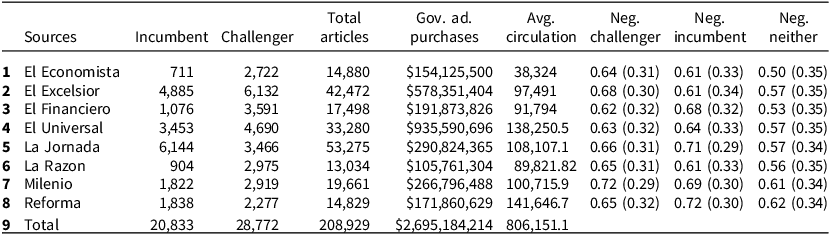
Our dependent variable is a negative tone score for each article. This score ranges from 0 to 1, with 0 implying no negativity and a 1 as extremely negative; allowing us to measure varying degrees of negativity. Next, we subset our sample to the entire tenure of a single president, to differentiate between the incumbent and their main challenger between 2013 and 2018. Within this collection, we perform string matching to search for articles that mention either the incumbent, the challenger, or neither. This classification facilitates differentiating political opinion articles from other topics, allowing us to build a placebo category for comparison. See Table 1 for an article breakdown by source and other summary statistics. We focus on articles that mention either the incumbent or the challenger, but not both. By having a single person mentioned in each article, we can parse out the measurable differences in sentiment when they only mention one of these individuals.
Summary statistics

Table 1. Long description
The table presents a detailed comparison of political articles across various sources, focusing on the period from 2013 to 2018. It includes data on the number of articles mentioning the incumbent and the challenger, total articles published, government advertising purchases, average circulation, and negativity scores for each source. The negativity scores range from 0 to 1, with 0 indicating no negativity and 1 indicating extreme negativity. The table also differentiates between articles mentioning the incumbent, the challenger, or neither, allowing for a comparison of political opinion articles. Key sources include El Economista, El Excelsior, El Financiero, El Universal, La Jornada, La Razon, Milenio, and Reforma. Notable trends include varying levels of negativity towards the incumbent and challenger across different sources, with some sources showing higher negativity scores for the challenger and others for the incumbent.
Note: Standard deviations reported in parentheses.
Politics and procurement
Throughout the sexenio covered in the sample (Mexico has 6-year presidential terms), the incumbent was Enrique Peña Nieto (EPN) of the Partido Revolucionario Institucional (PRI). EPN was referred to as the Telenovela President because of his soap opera-esque life and having married a TV star. His public image was the key to winning the presidency and to maintaining popular support throughout his incumbency. In 2012, EPN led PRI and their coalition back to power, defeating a left-wing coalition where Andrés Manuel López Obrador (AMLO) was the opposing candidate. AMLO had also lost in 2006, and immediately after the narrow loss in 2012, he announced his intent to run again in 2018. He set the groundwork for it by registering a new grassroots political party, MORENA. Officially, this party was born as a response to the left-wing Partido de la Revolución Democrática’s (PRD) alliance with PRI, but it was also an opportunity for AMLO to continue the 2012 campaign and to participate in subnational elections in the build-up to 2018’s presidential election. From the outset, it was clear that MORENA and AMLO would serve as the main rival to PRI, and the party managed electoral success in the midterm elections of 2015 consolidating themselves as the opposition on their way to eventually winning the presidency in 2018.
During his presidency, EPN spent over $3 billion USD in official government advertising across television, radio, and printed press (Artículo 19 and Fundar, 2018). We compiled the line-item purchase of advertisements in our eight newspapers from official data published by the Secretaria de la Funcion Publica (Secretariat of the Civil Service, SFP). The SFP data contains the line-item purchases for all areas of government, ranging from the president’s chief of staff to lower-level commissions. We focus on advertisements purchased by the cabinet ministries and agencies where the president appoints their leader. These political appointments enable an agency’s politicization and are often filled by individuals closest to the president (Peters and Pierre, Reference Peters and Pierre2004). During 2013–2018, the federal government purchased close to $150 million USD from the eight newspapers studied (see Table 1 for a breakdown by source in MXN values adjusted for inflation). The procurement data is then aggregated by source and month, resulting in the total value of advertisements purchased each month.
Estimating media capture
Ideally, an outlet’s dependence on government publicity would be measured as a percentage of total revenue, including ads purchased by private entities and revenue from unit sales. That information is not public, instead we build a novel approximation using readily available data. First, we use a news organization’s average daily circulation rate, a measure of how many copies are printed and distributed on any given day, as a proxy for a newspaper’s size and reach, with data from the Padrón de Medios Impresos (the Database of Printed Media, PMIFootnote 1 ). The PMI is compiled annually, and the daily circulation rate refers to a year’s estimated circulation. Second, we aggregate government advertisement purchases by source and month to obtain the monthly value of government publicity purchased in each newspaper. Given the difference in scales, we normalize the monthly values and daily circulation rates into z-scores to facilitate comparisons across outlets. This implies that rather than looking at the total value of advertisements or the annual estimate of average daily circulation, we focus on the distribution of procurement within our eight outlets and map out the relative value of advertisements in standard deviations from the mean.
In the aggregate, we would expect the government to procure advertisements across multiple sources to reach as wide an audience as possible. Each of the eight newspapers in the sample is distributed throughout the country. Although some of these outlets have noticeable political leanings, the EPN government still purchased advertisements in all of them. If the government were impartial, we might expect their procurements to vary based simply on the size of the audience (i.e., even audiences of the opposition party need to be reminded to pay their taxes). Thus, this impartiality or need to reach as wide an audience as possible should be reflected in advertisements that vary based solely on the size of the venue.
The z-scores of circulation in the x-axis and government advertisements on the y-axis estimated for each month in our sample are plotted in Figure 1; the line represents a 1:1 correlation of advertisements relative to the daily circulation rate. If procurement was impartial, we would expect a high concentration of dots along the 45-degree line, implying they are purchasing advertisements in a newspaper based on their potential reach rather than any other prioritizations. It is apparent though, that the incumbent government bought advertisements in larger or smaller amounts than what corresponds to a newspaper’s size.
Distribution of z-scores per month.

Figure 1. Long description
A scatter plot with hundreds of data points showing the relationship between z scores of newspaper circulation and annual government advertising. The x-axis represents the z score of newspaper circulation, ranging from -2 to 2. The y-axis represents the z score of annual government advertising, also ranging from -2 to 2. The data points are scattered with a visible positive correlation, indicated by a trend line running diagonally from the bottom left to the top right. The plot suggests that higher newspaper circulation is associated with higher government advertising spending. All values are approximated.
To better quantify the degree to which certain outlets are over-targeted with advertisements, we estimate the difference in z-scores between the monthly sum of government-purchased ads and the size of a media outlet. Equation (1) presents this estimation approach by source s and month m for advertisements, and by source s and year t for the average daily circulation rate. Through this approach, we can compare the disparities between sources using the limited information available, facilitating the identification of media outlets that receive procurement that is disproportionate to their size (i.e., the degree of media capture).Footnote 2 $Deg. \; of \; Media \; Capture_{sm} = (Gov. \; Ads_{sm}) - (Avg. \; Circulation_{st})$
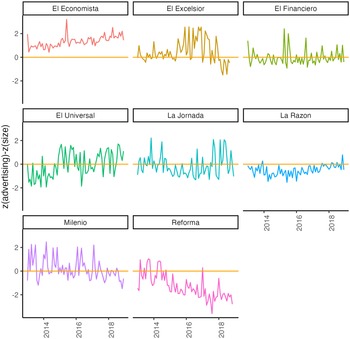
The evolution of the degree of media capture is visualized in Figure 2, where values above the line imply an outlet is receiving more in annual advertisements than what corresponds to their size; those below the line receiving less; and those at or near zero receiving publicity spending that corresponds to their size relative to our sample. We use this score as our metric of media capture, estimating the degree to which a media organization is disproportionately targeted with excessive government spending.
Temporal evolution of media capture.

Figure 2. Long description
The line graph displays the temporal evolution of media capture across different newspapers from 2014 to 2018. The x-axis represents the years from 2014 to 2018, while the y-axis represents the z-score of advertising size. The graph is divided into nine sections, each representing a different newspaper: El Economista, El Excelsior, El Financiero, El Universal, La Jornada, La Razon, Milenio, and Reforma. Each section shows a line graph with fluctuations in advertising size over time. The lines vary in color and pattern, indicating different trends and levels of media capture for each newspaper. All values are approximated.
Media capture and media bias
As stated in our hypothesis, news organizations that are targeted with a disproportionate amount of government advertisements will bias their articles to be less negative towards the incumbent and more negative towards the main challenger.
We test this hypothesis using the linear model: $y_{stmi}=\beta_0+\beta_1 z_{sm}+\beta_2 {\rm p}_{smi}+\beta_3 z_{sm} {\rm p}_{smi}+\beta_4 x_{sm}+\beta_5 c_{sm}+\beta_6 j_{sm}+{\boldsymbol W}_m {\boldsymbol {\delta}}+ {\boldsymbol K}_t {\boldsymbol {\zeta}}+\epsilon_{stmi}$
where $y_{stmi}$
is the dependent variable of negative sentiment by source
$y_{stmi}$
is the dependent variable of negative sentiment by source $s$
, month
$s$
, month $m$
in year
$m$
in year $t$
, and individual article
$t$
, and individual article $i$
.
$i$
. $\beta_0$
is the intercept, while the variable
$\beta_0$
is the intercept, while the variable $z_{sm}$
represents the degree of media capture calculated in Equation (1) for source
$z_{sm}$
represents the degree of media capture calculated in Equation (1) for source $s$
and month
$s$
and month $m$
. Variable
$m$
. Variable $p$
is a categorical variable specifying whether the article
$p$
is a categorical variable specifying whether the article $i$
references the incumbent, the challenger, or neither for each source and month. The
$i$
references the incumbent, the challenger, or neither for each source and month. The $\beta_3$
coefficient represents the interaction of our degree of media capture variable with the article topic so that we can identify the contrasting influence of capture on sentiment by political leaders. We control for the log of monthly advertisement purchases in
$\beta_3$
coefficient represents the interaction of our degree of media capture variable with the article topic so that we can identify the contrasting influence of capture on sentiment by political leaders. We control for the log of monthly advertisement purchases in $x_{sm}$
on a source and monthly basis. We also control for the total number of opinion articles published by a source each month in
$x_{sm}$
on a source and monthly basis. We also control for the total number of opinion articles published by a source each month in $c_{sm}$
(regardless of content). To account for the readership preferences unique to each source, we estimate a monthly average sentiment on all opinion articles they published in
$c_{sm}$
(regardless of content). To account for the readership preferences unique to each source, we estimate a monthly average sentiment on all opinion articles they published in $j_{sm}$
. Last, we include a set of dummy variables at the month and year levels (i.e., vectors
$j_{sm}$
. Last, we include a set of dummy variables at the month and year levels (i.e., vectors ${\boldsymbol W}_m$
and
${\boldsymbol W}_m$
and ${\boldsymbol K}_t$
) to account for seasonal and within-year-specific variation.
${\boldsymbol K}_t$
) to account for seasonal and within-year-specific variation.
Results
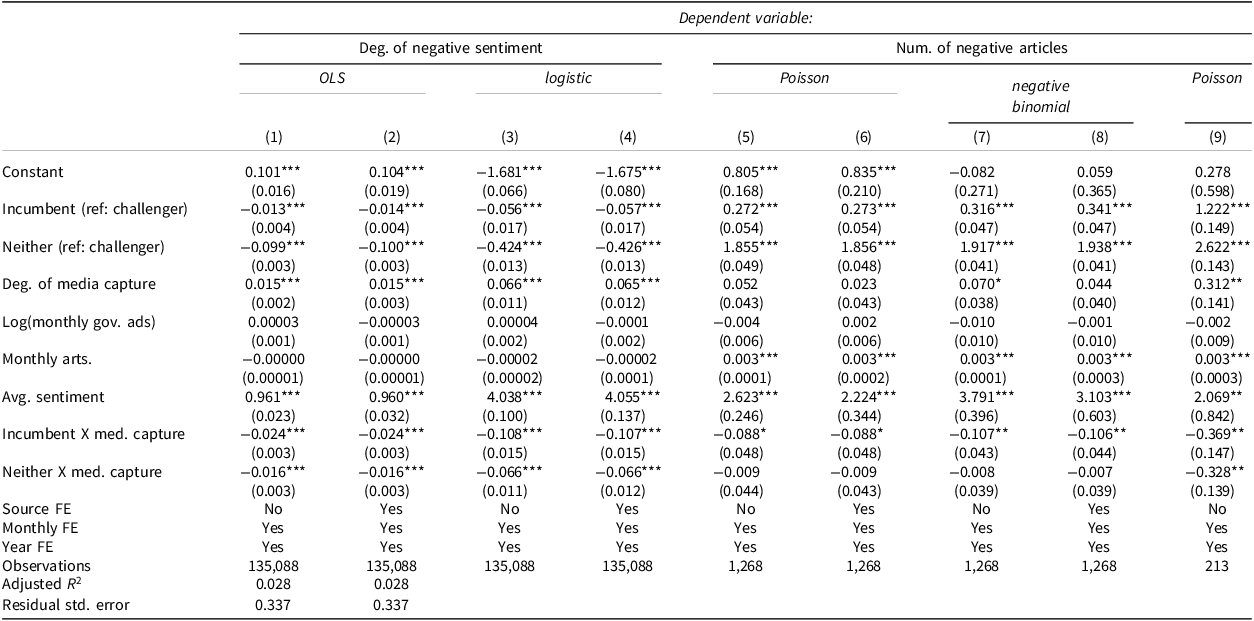
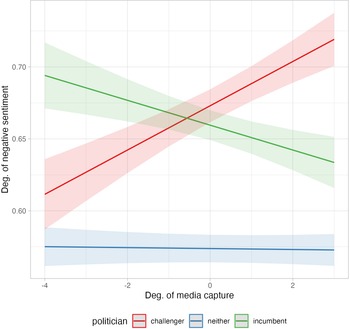
We estimate our model using ordinary least squares regression as well as with logit and with source fixed effects. The results are consistent across estimation methods and can be reviewed in Table 2. We use the results from model 1 to visualize the marginal effect of media capture on negative sentiment interacted with whether an article mentions the incumbent, the challenger, or neither in Figure 3. The neither category serves as an interesting placebo, given media capture should have no influence on general opinion articles that do not mention either political leader. The marginal effects plot supports this notion since the neither category does not move along the degree of media capture continuum. For both political leaders, we see very different results.
Model results
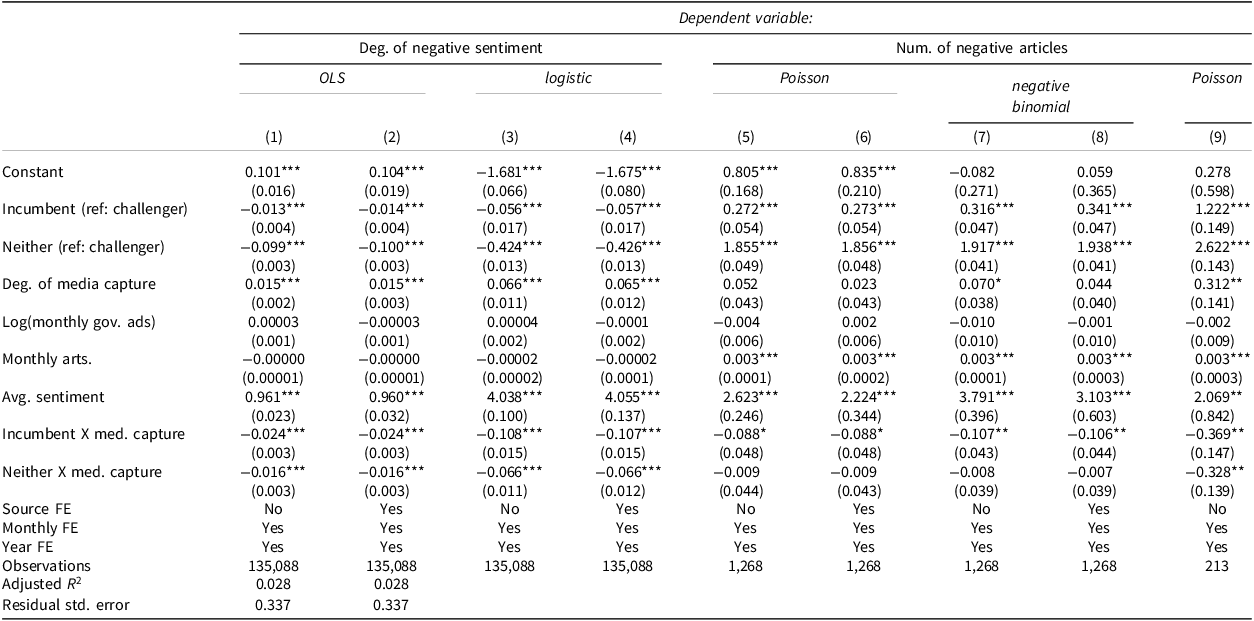
Table 2. Long description
The table presents model results for the degree of negative sentiment and the number of negative articles using ordinary least squares (OLS), logistic regression, Poisson regression, and negative binomial regression. It includes nine columns with different models and rows for variables such as constant, incumbent, neither, degree of media capture, log of monthly government ads, monthly articles, average sentiment, and interactions between incumbent or neither with media capture. The table also indicates the inclusion of source fixed effects, monthly fixed effects, and year fixed effects. Observations, adjusted R-squared values, and residual standard errors are provided at the bottom. The results show the coefficients and their statistical significance for each variable across different models.
Note: Heteroskedastic robust SE.
* p < 0.1; **p < 0.05; ***p < 0.01
Marginal effect of media capture on sentiment by political leader.

Figure 3. Long description
The line graph illustrates the relationship between the degree of media capture and the degree of negative sentiment for different types of politicians. The x-axis represents the degree of media capture, ranging from -4 to 4, while the y-axis represents the degree of negative sentiment, ranging from 0.60 to 0.70. Three lines are plotted: one for challengers in red, one for neither in blue, and one for incumbents in green. The red line for challengers shows a positive correlation, indicating that as the degree of media capture increases, the degree of negative sentiment also increases. The green line for incumbents shows a negative correlation, indicating that as the degree of media capture increases, the degree of negative sentiment decreases. The blue line for neither shows a relatively flat trend, indicating little to no correlation between media capture and negative sentiment. Each line is accompanied by a shaded area representing the confidence interval.
At the lower band of media capture, the articles about the incumbent are substantially more negative while those mentioning the challenger are generally less. These organizations are less targeted with advertisements and may be free to critique the incumbent’s policies and actions without fear of losing access to their patronage. In contrast, they are less negative about the main challenger because they are not necessarily doing anything (policy-wise) for the opinion leaders to criticize. An interesting observation is that, for a neutral degree of media capture (values near zero where sources receive advertisement purchases that correspond to their size), the difference in tone between the two politicians is basically null. At the furthest extreme of capture, the sources that are targeted with a disproportionate amount of government advertisements write in the tone one would expect, being much more negative about the challenger than the incumbent. These findings support our hypothesis and theoretical expectations.
Given the difficulty of conceptualizing a percent change in negativity, we estimate an additional set of models with a revised dependent variable. Rather than looking at the predicted sentiment as a ratio, we instead count the number of articles that pysentimiento predicts as negative for each source per month. The expected effect is the same: the media capture should reduce the number of negative articles about the incumbent and increase those on the main challenger. The model formula remains the same but we change the estimation procedure to a Poisson regression with heteroskedastic robust standard errors since we are now counting the number of monthly articles.
The results and robustness checks can be reviewed in Table 2. Figure 4 visualizes the marginal effect of media capture on the predicted number of articles by incumbent and challenger using the results from model 3. We exclude the neither category from the visualization to avoid skewing the scale on the y-axis and instead estimate the effects at the mean number of neither articles for each level of capture. The results are the same as before: fewer negative articles about the incumbent and more about their main challenger as we progress along the degree of media capture. These findings suggest that our approach is an effective strategy at identifying potentially coopted media outlets, measured as the difference in the monthly procured advertisements and the normalized average daily circulation rate. They highlight how newspapers that receive a disproportionate amount of government advertising are biasing their opinion columns in alignment with the political preferences of the incumbent.
Marginal effect of capture on negative articles by political leader.

Figure 4. Long description
A line graph showing the marginal effect of media capture on the number of negative articles by political leaders. The x-axis represents the degree of media capture, ranging from -4 to 4. The y-axis represents the number of negative articles, ranging from 15 to 35. Two lines are plotted: one for incumbent politicians in red and another for challenger politicians in blue. The red line for incumbents shows a negative trend, indicating that as the degree of media capture increases, the number of negative articles decreases. The blue line for challengers shows a positive trend, indicating that as the degree of media capture increases, the number of negative articles increases. The shaded areas around the lines represent the confidence intervals. All values are approximated.
In estimating capture, we rely on advertisements procured in a month and the articles published in the same month. Thus, it is not possible to parse out a quid pro quo where the government pays for less negative articles. In addition, we rely on the procurement date, which is not necessarily the payment date (often invoices are paid at varying moments and frequently left until the very end of that fiscal year). Although one could argue that a lagged degree of media capture may better explain tone in the month after, we contest that newspapers are more concerned about getting paid on their current invoices.
An alternate explanation could be that the negative sentiment leads to a reduction in advertisement purchases while favorable coverage results in more procurement. In a context of competition between media outlets, this is a real possibility. If this were the case, we might expect a race to the bottom where all venues rush to publish favorable articles for the incumbent. Rather, each media outlet must publish content that sells newspapers. Evidently biased articles risk turning away readers who seek objective pieces, reducing sales, and lowering the incentive for the incumbent government to buy advertisements. We recognize though that negative articles can turn away the government from purchasing advertisements. To further demonstrate the power of our degree of media capture variable in biasing newspapers, we present evidence from two specific case studies.
To the tune of the incumbent
The newspaper La Jornada, from its birth in the 1980s until today, has consistently catered to a left-wing leaning readership. It has covered sensitive political topics and government controversies through various investigative pieces (Centro Nacional de Comunicación Social, 2019). La Jornada’s position in the left side of the political spectrum is well documented and its physical distribution through subscription implies that readers actively seek this type of content. In addition, its independence from the government was highly touted and valued by its readership (Santillán, Reference Santillán2016). Between 2015 and 2017 rumours in the media noted the potential demise of this newspaper, as competition from online sources and new outlets began to chip away at their grip over its readership. Layoffs of personnel and declining sales were well documented; their business model was suffering (Dabdoub, Reference Dabdoub2017). In 2017 and 2018 the incumbent government increased the procurement of advertisements in La Jornada. At the time, many opinion leaders referred to this as the newspaper’s “bail out”.
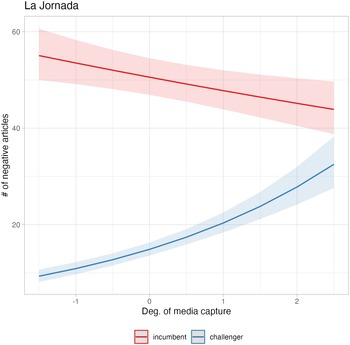
How did additional government advertisements affect the newspaper? To further highlight how media outlets can be coopted through advertisements, we estimate the degree of media capture and its relationship with negative articles published by La Jornada. Figure 5 visualizes the difference in average monthly articles published in a negative tone, split by whether the articles mention the incumbent or the main challenger, using the results from model 9 in Table 2. During the months when the newspaper received a procurement less than proportional to its size, the number of negative articles on the incumbent was high when compared to those on the main challenger. As media capture increases, it is apparent that the government’s overspending influenced La Jornada. The number of negative articles on the main challenger, a candidate they had actively supported across two presidential elections, increased to an average of 34 articles per month. In addition, the number of negative articles on the incumbent reduced to 37 per month, suggesting the newspaper biased its reporting to accommodate the preferences of the incumbent.
Marginal effects of media capture on La Jornada.

Figure 5. Long description
A line graph titled ‘La Jornada’ displays the marginal effects of media capture on the number of negative articles. The x-axis represents the degree of media capture, ranging from -1 to 2, while the y-axis represents the number of negative articles, ranging from 0 to 60. Two lines are plotted: one for incumbents in red and another for challengers in blue. The red line for incumbents starts at a higher number of negative articles and shows a downward trend as the degree of media capture increases. The blue line for challengers starts at a lower number of negative articles and shows an upward trend as the degree of media capture increases. The shaded areas around the lines indicate the confidence intervals. All values are approximated.
Although the number of negative articles on the incumbent dropped, it did not drop to zero. As argued earlier, La Jornada still needed to sell newspapers to their readers and thus could not pivot their reporting in ways that would turn away those buyers. Not publishing negative articles on the incumbent would have given away the coopted relationship and may have compromised sales. Instead, roughly matching the number of negative articles for both politicians may have potentially damaged the electoral chances of the main challenger with readers who already supported them.
The change in negative articles for both politicians in months where the newspaper became disproportionately targeted with government advertisements supports the argument that cooptation leads to bias, and not the other way around. La Jornada’s precarious financial situation may have reduced the cost of capture, and the incumbent government saw the opportunity to “save” the publication in exchange for more favorable coverage. This example further highlights the validity of the measure we propose to estimate media capture. Furthermore, it suggests that we can use this metric in dynamic contexts to characterize the evolution of media capture.
Across the anecdotal evidence and the empirical analysis presented in this paper we have suggested that the incumbent is sensitive to how the media portrays them, but it is difficult to fully tie the advertisement purchases with a desired tone in articles. The line-item purchases do not explicitly state a quid pro quo where the government outright buys positive articles. We have argued that this phenomenon occurs organically, but in the background of these advertisement purchases there are real backroom deals and political pressures applied to the editors and owners of these newspapers. The incumbent’s ability to strong-arm, or to bless media outlets with patronage is shown to have a significant effect on reporting. To further demonstrate this ability, we highlight the case of a different newspaper not included in our sample, Eje Central.
Founded in 2009, Eje Central is one of the first fully online newspapers publishing political opinion articles. Its target audience is opinion leaders across the country and frequently attracts publications from a variety of journalists and experts around Mexico. Given that it was only available through the Internet for most of our period of analysis, we could not estimate the size of the media outlet using average circulation rates. However, we can rely on a detailed interview with the founder of this newspaper to provide evidence on the evolution of their cooptation.
In a thorough transcription of the interview with the founder of Eje Central, Raymundo Riva Palacio, Tamariz Estrada (Reference Tamariz Estrada2020) asks him a variety of questions, including how the concept was born, the struggles he faced, and where the newspaper is headed. In his detailed explanation of how the outlet has evolved, Riva Palacio notes that the beginning of the EPN presidency was a difficult time for them. Given online newspapers were still a novelty in Mexico, Eje Central did not manage to attract private advertisers and thus struggled financially. In the transcribed interview, Riva Palacio says that the newspaper was banned from government publicity for four years. He explains that there was a condition holding back procurement and that his friends within government would tell him: “look, we have a registry of all the negative articles about the president; you are always in first place with 15 or 17 per month” (Tamariz Estrada, Reference Tamariz Estrada2020). Given that ban, Riva Palacio recognized that the website was in danger. The solution was to publish a printed version of Eje Central that attracted private investors. Here, Riva Palacio asserts that “with the printed version, the ban disappeared without any conditions, they (government) have been buying publicity in the last two years” (Tamariz Estrada, Reference Tamariz Estrada2020).
Riva Palacio tries to provide an explanation of the government’s procurement shift by appealing to the competitiveness of the media industry. Sustaining a new newspaper requires capital that private advertisers and investors cannot provide. Thus, in the case of Eje Central and La Jornada, the government’s large publicity pot can provide these much-needed resources. In any other scenario, say, a “friend” picking up a tab may not be conditioned on it being reciprocated, but the expectation that the action can buy some good faith is not far-fetched. Notice that Riva Palacio highlights his friendship with government officials (for “20 or 30 years”) who eventually purchased advertisements in the printed version of the newspaper. But then, he explains that the lifting of the ban was “unconditional”. This rather inconsistent explanation as to why the ban was removed begs the question of whether his friends in government bought some good faith.
Figure 6 presents a scatterplot of monthly negative articles published by Eje Central that mention EPN. We overlay a locally estimated scatterplot smoothing (LOESS) regression to better visualize the trend in monthly articles. The color of each dot indicates the months in which the government purchased advertisements. The articles were downloaded directly from Eje Central’s digital archive.Footnote 3 Riva Palacio argues that the advertisements were not conditioned on anything, as the government simply wanted to purchase advertisements in the printed media instead of digital. In the interview though, he states that the ban was due to the number of negative articles published monthly. In 2015 and 2016, Eje Central published negative articles about the incumbent with a frequency that matches that mentioned in the interview. The dashed line represents the year when the government began purchasing advertisements in their printed newspaper, this clearly correlates with the number of negative articles published per month, as we can see from the sharp drop.
Evolution of Eje Central.

Figure 6. Long description
A scatter plot illustrates the number of negative articles over time, with data points color-coded to indicate whether government advertisements were purchased or not. The x-axis represents the years from 2015 to 2019, while the y-axis shows the number of negative articles, ranging from 0 to 30. The plot includes dozens of data points, with red circles representing years when government advertisements were purchased and teal circles representing years when no government advertisements were purchased. A blue trend line with a shaded confidence interval is present, showing a general decline in the number of negative articles over time. A vertical dashed line marks a significant event or change around 2017. The data points exhibit some clustering and variability, with notable decreases in negative articles post-2017. All values are approximated.
Eje Central’s founder’s comment that government advertisements were not conditional may be true to some extent. However, Eje Central’s financial situation suggests that the newspaper may have had no choice but to adapt their writing. The evidence presented by the Eje Central and La Jornada demonstrates that the incumbent government, through its massive advertisement budget, could dictate the tone of articles published about themselves across two independent sources, providing further support to our hypothesis.
Conclusion
The relationship between media capture and its effect on media bias is an understudied area. Although the existing literature has identified a relationship between funding and bias in specific contexts, none have quantified the degree of capture and its varying effect on tone. This paper fills that gap by developing an approach that measures capture across sources and relies on readily available data. The results suggest that there is a strong relationship between the degree of media capture, or the disproportionate targeting of government advertising in certain sources, and the negative tonality of opinion articles published by them. We leverage a Spanish-language sentiment analyser to detect negative tones and estimate media bias.
A combination of case studies and a series of regressions demonstrate how government advertisement purchases can capture media organizations, especially when these resources are received in periods of financial struggle. Although we rely on automated sentiment analysis to scale the identification of tone across thousands of articles, the approach follows much of the logic used in more traditional approaches of content analysis, which focus on frames, themes and narratives. We have also demonstrated that across different specifications of our dependent variable, disproportionate advertisement purchases result in a shift in tone and change in the number of negative articles published about each politician, while not affecting the tone or frequency of articles not relevant to our study (the placebo category). Across models, the direction and magnitude of the results remain stable.
We argue that advertisement purchases can reduce the negativity of articles written about the incumbent and can increase the negative tone of articles about their main challenger. Although the models presented cannot fully disentangle the temporal relationship between advertisement purchases and media bias due to the timing of government payments, the case studies analyzed suggest that our assumption of patronage influencing editorial choices is valid. The cross-outlet regression analysis identifies systematic patterns across the media landscape, but it is the case-level evidence from La Jornada and Eje Central that exposes the finer dynamics such as financial precarity, editorial decision-making under pressure, and the informal conditions attached to government patronage that do not show up in the aggregate data alone. Together, these approaches help us build a more complete picture of how media capture operates in practice.
Our findings also underscore the value of examining everyday political content rather than focusing exclusively on corruption scandals, contrary to the existing literature. Scandals are highly salient events that attract considerable attention but their infrequency makes them easily forgotten. In contrast, opinion articles are published daily and offer a more sustained channel of information that can drive public opinion by providing readers with pre-processed and bite-sized pieces of content. Articles that are merely less negative toward the incumbent, rather than being overly friendly toward them, are harder for readers to identify as biased. This makes them much more valuable over time as sustained frames help readers build their worldview. Given how subtle the bias is, it may explain why the existing literature has largely ignored broader content and focused instead on corruption scandals, thus underestimating the scope of government influence on the media. While we do not identify a single causal mechanism linking advertisement purchases to immediate coverage, our approach offers a systematic complement that may motivate further research into the mechanisms linking state advertising and media behavior.
Potential future directions to improve upon this study could include analyzing more nuanced expenditure data, for example, at the level of policy issues. This would allow further understanding whether media capture, as a coercion mechanism, is more frequently used or more effective in certain domains of public life and agenda setting. Studying more specific emotions/intentions in the opinion pieces (beyond negativity) could open promising avenues to understand how media capture translates into media discourse. Analyzing the outcome of media capture across a broader set of pieces (not only opinions) could provide a more complete picture of the many ways in which governments can influence the perception of different types of readerships. Finally, comparing media capture across different types of media could help with understanding its evolution and how governments have needed to innovate in their ways to exert some degree of control over traditional and non-traditional outlets.
The economic precarity of newspapers in Mexico is not unique to this country. Worldwide, legacy media have seen steep declines in ad revenues as digital platforms capture the market ( Podesta, Reference Podesta2009; Dupuy and Ruelas, Reference Dupuy and Cristina Ruelas2014; Schiffrin, Reference Schiffrin and Schiffrin2021). In particular, printed media as a source of news has declined from 51% of Mexican readers in 2017 to only 17% in 2025 (Gutiérrez Rentería and Montalvo, Reference Gutiérrez Rentería and Montalvo2025). This broader erosion of revenue heightens the susceptibility of outlets like La Jornada and Eje Central to government patronage. Since governments purchase advertisements across media outlets, we expect procurement choices to be strategic. This research was made possible by the granular procurement records published by the Mexican government. Such detailed, publicly available data on government advertising expenditures is rare across the world. This is another example of how advanced methodologies can help systematically expose corrupt practices through subtle measurements of latent behaviors, contributing to a growing research stream on using natural language processing for generating new insights from unstructured data (Beltran, Reference Beltran2023). We urge national governments to publish more of this data to enable cross-country assessments; this paper offers researchers and practitioners evidence as to the importance of such detailed data. We believe the arguments and findings presented here to be consistent across other cases where procurement data are available and where opinion articles are common and politically instrumental in the printed press.
The anecdotal evidence stemming from news reports and watchdog organizations suggests that the incumbent government favors and punishes certain outlets with an expected “payback”. More importantly, the occurrence of this phenomenon across developed and developing countries highlights the importance of studying the issue from a comparative perspective. As media markets become more competitive globally and new technologies continue to challenge the trustworthiness of established outlets, understanding how governments exploit financial vulnerabilities and information vacuums to shape coverage becomes ever more pressing. The framework developed here provides researchers and civil society with a replicable pipeline for identifying and monitoring these dynamics across contexts.
Data availability statement
Data available on request from the authors.
Acknowledgements
The authors thank the anonymous reviewers for their constructive feedback. We are especially grateful to Nicolai Berk and Daniel Saldivia-Gonzatti for their generous comments on earlier drafts. A version of this paper was presented at the Text-as-Data Reading Group and the Political Communication APSA pre-conference.
Author contributions
Alejandro Beltran: conceptualization (equal); writing – original draft (lead); data curation (equal); formal analysis (lead); methodology (equal); writing – review and editing (equal). Daniele Guariso: conceptualization (equal); writing – original draft (supporting); data curation (equal); formal analysis (supporting); methodology (equal); writing – review and editing (equal). Omar Guerrero: conceptualization (equal); writing – original draft (supporting); data curation (equal); supervision (lead); methodology (equal); writing – review and editing (equal).
Funding statement
The authors acknowledge funding from the Economic and Social Research Council (ESRC), UK. Grant code: ES/T005319/1. The funding source was not involved in the development of the research.
Competing interests
The authors report there are no competing interests to declare.
Ethical standards
This research did not involve human subjects and relied entirely on secondary analysis of publicly available data. No ethical approval was required.




 Open access

