



England has high levels of obesity and overweight, and the impact on health is a grave concern. Nearly one-third (27 %) of adults in England were obese in 2015 compared with 15 % in 1993( 1 ). Over one-third (35 %) of the population is predicted to be obese by 2030( 2 ). Diabetes now affects more than 4 million people in the UK and this figure is projected to rise to 5 million by 2025( Reference Diabetes 3 ). The majority of cases of diabetes (90 %) are type 2, which is strongly associated with obesity. The costs associated with the consequences of being overweight or obese are £6·1 billion every year for the National Health Service and £27 billion for the wider economy( 4 ).
Government policies to date have been inadequate in preventing the increase in obesity and overweight although rates have attenuated in recent years( Reference van Jaarsveld and Gulliford 5 ). Addressing obesity first became a policy priority in 1991 when the UK Government set a target to reduce obesity among adults to 7 % by 2005( 6 ). Two government strategies followed in 2008( 7 ) and 2011( 8 ) but despite the substantial investment in resources, there is limited evidence of success( Reference Jebb, Aveyard and Hawkes 9 ). The Childhood Obesity Plan published in August 2016( 10 ) focused on two main areas: (i) reducing sugar consumption, through the introduction of a soft drinks industry levy in 2018 and a voluntary 20 % reduction of sugar in products by 2020; and (ii) increasing the health of primary-school children through physical activity of at least 60 min/d and supporting healthy breakfast clubs with funding raised through the soft drinks industry levy. The Plan also noted that the programme would be extended to include setting targets to reduce total energy in a wider range of products contributing to children’s energy intake and across all sectors, including the out-of-home sector. Health campaigners have been disappointed, arguing that a more ambitious strategy is needed and that the government needs to do more( 11 – 13 ).
The Food Environment Policy Index (Food EPI) is designed to highlight policy gaps and prioritise policy actions to improve the food environmentFootnote * and contribute to reduced obesity and related diseases. The tool has been developed by the International Network for Food and Obesity, Non-Communicable Diseases Research, Monitoring and Action Support (INFORMAS). Three countries, New Zealand, Thailand and Australia, have applied the Food EPI tool. The present paper describes how Food EPI was applied in England to systematically document existing food- and diet-related policies, bring experts together to identify policy gaps and generate a set of priority actions that, if implemented by government, could contribute to reducing obesity and overweight in the population.
Methods
Conceptual framework
The Food EPI was first conceptualized in November 2012 at a week-long meeting of international experts in Bellagio, Italy, described in detail elsewhere( Reference Swinburn, Sacks and Vandevijvere 14 ). As shown in Fig. 1, the index is made up of two components: government policies and infrastructure support. These, in turn, are categorized into thirteen domains that represent aspects of the food environment and its supporting infrastructure. A total of forty-eight good practice statements were developed under each of the thirteen domains (see online supplementary material, Supplemental File 1). These statements describe policies that are considered by international experts to be good practice.
Conceptual framework for Food EPI (Food Environment Policy Index). (From Swinburn et al.( Reference Swinburn, Vandevijvere and Kraak 21 ))

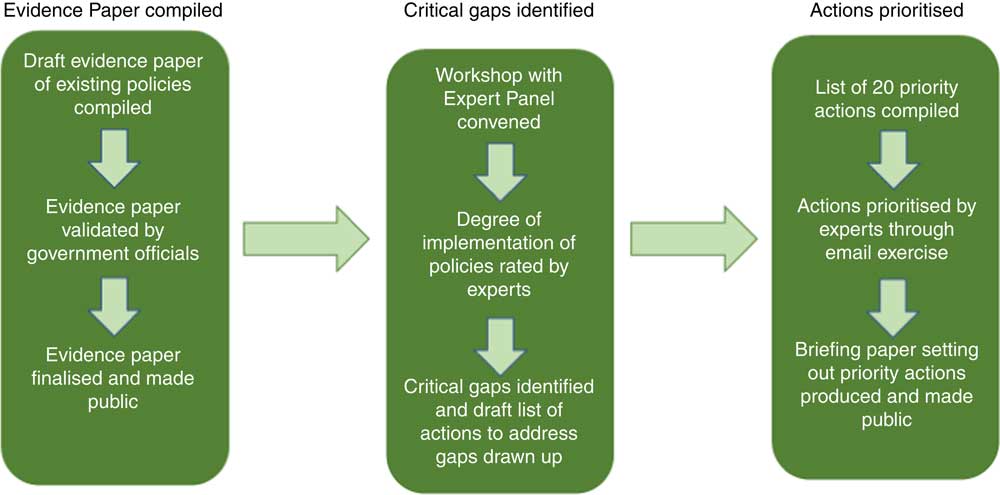
A full description of the Food EPI research approach and methods, as they have been applied in New Zealand( Reference Vandevijvere and Swinburn 15 , Reference Vandevijvere, Mackay and Swinburn 16 ), Thailand( Reference Phulkerd, Vandejivere and Lawrence 17 ) and Australia( 18 ), has been published elsewhere. The Food EPI is applied in two stages. First, the evidence on all relevant policies is compiled in an evidence paper which is reviewed for accuracy and completeness by government officials. Second, independent experts are brought together to identify critical gaps and prioritise actions to fill those gaps based on their expertise and knowledge. A flow diagram setting out the stages of the method is shown in Fig. 2.
Flow diagram for Food EPI (Food Environment Policy Index) methods
Compilation and validation of evidence about existing government policies
All current government policy documents that relate to the food environment in England were reviewed between September 2015 and February 2016. Documents were accessed through an Internet search, using the UK Government site (http://www.gov.uk/government/publications) which holds more than 100000 publications. Policies were included where they applied to England, the UK (before devolution in 1999) and EU legislation that is being enacted in England. The evidence was compiled into a draft evidence paper, which was divided into seven policy domains and six infrastructure domains following the Food EPI conceptual framework (see Fig. 1 for the list of domains). The evidence was described for each of the forty-eight good practice statements.
A consultation draft of the evidence paper was circulated to officials within government departments, arms-length departmental bodies, non-departmental public bodies and self-regulatory organisations for validation. Officials were asked to identify inaccuracies and/or absence of relevant information. The policy expertise of individuals, rather than formal endorsement, was sought.
Identification of critical gaps
An Expert Panel was identified and invited to participate in a workshop, at the University of Westminster in London, to identify critical gaps in current government policies regulating the food environment. The criteria used to select the Expert Panel were: (i) individuals with expertise in one or more domain areas; and (ii) individuals from organisations independent of the government.
Materials were prepared in advance of the workshop and sent to confirmed participants. These included the evidence paper, the methods paper and a set of PowerPoint slides.
During the workshop, critical policy gaps were identified through a process of ‘rating’ the degree of implementation of existing policies and infrastructure support. A rating was required for policies and infrastructure support for each of the forty-eight good practice statements. In advance of each rating, two slides were shown for each good practice statement: the first presented evidence of measures taken by the government in England to adopt policies and develop infrastructure support related to that area and was based on the evidence paper; the second slide presented examples from other countries of measures taken by governments to partially or fully adopt relevant policies. These international examples were taken from a list that was compiled by INFORMAS (see online supplementary material, Supplemental File 1). An example from England (where it existed) was always included on the second slide to reinforce the existence of policies already being implemented in England.
Participants from the Expert Panel were asked to rate the current degree of implementation of policies and infrastructure support in England on a scale from 1 to 5 (1=less than 20 % implementation, 2=20–40 % implementation, 3=40–60 % implementation, 4=60–80 % implementation, 5=80–100 % implementation). They were asked to consider the previously presented evidence, and their own informed judgement, when rating. An option of ‘cannot rate’=6 was included for those who felt they lacked sufficient evidence to come to a decision.
Two forms of rating were conducted. First, policies were rated against the international examples (How well is England doing compared with other countries?). Second, policies were rated against the ‘gold standard’ as set out in the good practice statement (Is England doing as well as it should?).
Each Expert Panel participant was provided with a paper rating sheet and assigned a hand-held interactive polling device: ‘TurningPoint’( 19 ). The paper rating sheet was used to rate policies both against international examples and good practice statements. Space was made available on the rating sheet for comments.
Participants also rated the good practice statements using the clicker which was integrated into the PowerPoint slides. Participants rated at the end of the presentation of each domain and anonymised results were displayed visually on screen following each rating. The TurningPoint system tracked responses to individual clickers, which allowed inter-rater reliability to be analysed.
The ratings from the TurningPoint clicker were automatically transferred to an Excel sheet. These were checked against paper records and additional data from the rating sheets were entered manually. All ratings of ‘6’ (insufficient information to rate) were excluded.
Prioritisation of actions
Prioritisation of actions, which were recommendations for policies and infrastructure support that the government could put in place to improve the food environment, was carried out by email. A long list of actions was initially drafted that related to each of the forty-eight good practice statements. The proposed actions were based on existing recommendations for action from civil society groups active in England (Obesity Health Alliance, Jamie Oliver Food Foundation, Fabian Society) and from the government body Public Health England.
Further refinement of the actions took place during group discussion sessions at the workshop based on where the greatest gaps in implementation had been identified, which resulted in a list of sixty potential actions.
A shortlist of twenty actions was identified by enlisting the support of individuals from the Expert Panel who had specific knowledge and expertise in a specific domain. These experts were asked to: (i) refine the wording of the actions to ensure that they were as SMART (Specific, Measurable, Achievable, Relevant and Timebound) as possible; and (ii) prioritise the actions (high, medium, low) based on importance and feasibility. The shortlist of actions comprised the reworded actions allocated high priority by the experts. Experts were not able to provide input to domains 1, 7, 10, 12 and 13. These actions were refined and prioritised based on notes from the workshop group discussions.
The Expert Panel was invited to prioritise the shortlist of twenty actions. Each Expert Panel member was asked to complete an Excel sheet prioritisation form, which was sent by email. Prioritisation was done separately for twelve policy actions and eight infrastructure actions using two criteria: (i) importance (need, impact, equity, other positive effects, other negative effects); and (ii) achievability (feasibility, acceptability, affordability, efficiency). These criteria were developed as part of the New Zealand Food EPI exercise( Reference Vandevijvere and Swinburn 15 ).
The twelve policy actions had a total of 60 points which could be allocated across the statements for importance (equivalent to an equal weighting of 5 points×12 policy actions) and a further 60 points for achievability. The more points allocated, the higher the priority. Actions could be allocated 0 points and only whole numbers could be used.
In addition, Expert Panel members were informed that the two scores (for importance and achievability) would be combined to result in one score for each action. They were asked whether they thought the importance and achievability criteria should be weighted the same or not. They were able to change the weighting from 50 %:50 % if they thought that this was warranted.
A similar exercise was undertaken for the eight infrastructure support actions although in this case a total of 40 points (equivalent to an equal weighting of 5 points×8 infrastructure actions) could be allocated for importance and a further 40 points for achievability.
Results
Participants
A total of seventy-three experts from forty-one organisations (universities, civil society organisations and professional bodies) took part in the rating and prioritisation exercises.
Compilation and validation of evidence about existing government policies
A draft evidence paper was compiled and reviewed by staff within Food Standards Agency England, Food Standards Scotland, Food Standards Wales, Public Health England, Department of Health, HM Treasury, Department for Education, Department for Communities and Local Government, and the Committee of Advertising Practice. Detailed comments were received, and corrections and amendments were subsequently made to the evidence paper. No response was received from the Department for Environment, Food and Rural Affairs.
The final evidence paper is available on the Food Foundation website (http://www.foodfoundation.org.uk/wp-content/uploads/2016/11/Appendix-3-Evidence-Paper.pdf).
Identification of critical gaps
In total, 107 people were invited to join the Expert Panel from organisations including academic institutions, professional bodies and civil society. Of these, fifty-one participated in the workshop to identify critical gaps and an additional eight government officials came as observers. Only the non-government members of the Expert Panel took part in the rating. Some independent participants chose not to take part in the rating process because either they were not present throughout the whole day or they preferred to observe the process. A total of forty-one members of the Expert Panel completed the rating.
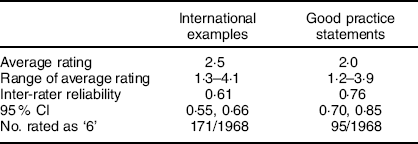
The rating of government policies could range from 1 (less than 20 % implementation) to 5 (80–100 % implementation). On average, the participants rated policies relating to the food environment in England as mid-way between these extremes against both international examples and good practice statements (see Table 1), although the scores for comparing policies in England with international examples tended to be higher. This means that participants judged that England was, in general, doing averagely well in relative terms (compared with other countries) and in absolute terms (compared with a ‘gold standard’).
Results of rating of policies against international examples and good practice statements by forty-one members of the Expert Panel using the Food EPI (Food Environment Policy Index), England, 2016
Agreement among the experts
The level of agreement was ascertained using the Gwet AC2 inter-rater reliability coefficient and was relatively high( Reference Gwet 20 ). The level of agreement between raters was higher when rating against good practice statements (0·76; 95 % CI 0·70, 0·85) compared with rating against international examples (0·61; 95 % CI 0·55, 0·66).
Ratings of policies and infrastructure support
A short-hand form of the good practice statements is used in the lists below and figures; see the online supplementary material, Supplemental File 1, for a full list of good practice statements and international examples.
There was not a lot of consistency within a domain, but, in general, the policies that received the highest scores (most implementation) were in the domains of Food Labelling (domain 2), Leadership (domain 8) and Monitoring & Intelligence (domain 10). The Expert Panel gave the highest scores (i.e. good implementation of policies and infrastructure support) to the following ten areas when rated against international examples (starting with the highest score), as shown in Fig. 3: (i) monitoring of overweight and obesity; (ii) monitoring of non-communicable disease risk factors; (iii) labelling with regard to nutrient declarations; (iv) access to information and key government documents relating to the food environment; (v) dietary guidelines established; (vi) school food standards; (vii) population intake targets established; (viii) labelling with regard to front of pack; (ix) monitoring of nutrition status; and (x) food composition standards established.
Rating implementation of policies against international examples by forty-one members of the Expert Panel using the Food EPI (Food Environment Policy Index), England, 2016. See the online supplementary material, Supplemental File 1, for the full list of international examples (NCD, non-communicable disease)

The same policy areas received the highest scores when rated against good practice statements, with the addition in eighth place of existence of a health promotion agency with dedicated funding (see Fig. 4).
Rating implementation of policies against good practice statements by forty-one members of the Expert Panel using the Food EPI (Food Environment Policy Index), England, 2016. See the online supplementary material, Supplemental File 1, for the full list of good practice statements (NCD, non-communicable disease)
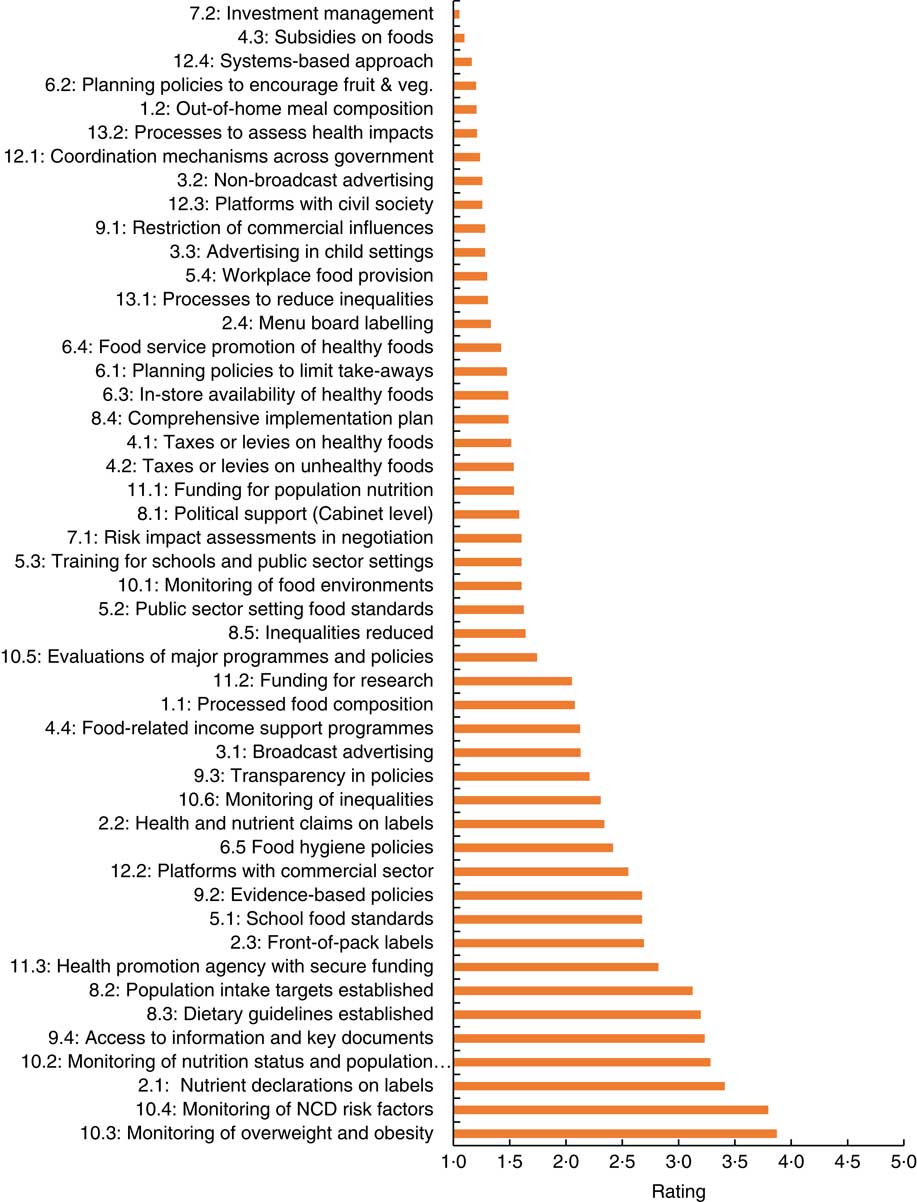
The Expert Panel gave the lowest scores (i.e. poor implementation of policies) to the following ten policy areas when rated against international examples (starting with the lowest score): (i) platforms between civil society and government; (ii) subsidies in favour of healthier foods; (iii) investment management and non-food policy development that takes account of public health nutrition; (iv) planning policies that favour healthier foods; (v) systems-based approach to improving food environments; (vi) advertising in child settings; (vii) coordination mechanisms across different government departments; (viii) workplace food provision; (ix) advertising through non-broadcast media; and (x) comprehensive implementation plan to improve food environments.
The above policies were also scored lowest when rated against good practice statements, with the addition of processes to assess the impact of policies on health (sixth lowest) and restriction of commercial interests in government policy development (tenth lowest).
Prioritisation of actions
The action prioritisation Excel sheets were sent out to all 107 Expert Panel members. A total of thirty-four responses were received, although in several cases this represented an organisation response rather than an individual response.
Priority policy actions
The six most important policy actions (out of a total of twelve actions listed in the online supplementary material, Supplemental File 2) are, in order of prioritisation (both for unweighted and weighted scores):
-
1. Control advertising of foods high in fat, sugar and/or salt to children. Government to significantly reduce the exposure of children under the age of 16 years to the promotion of foods and drinks high in fat, sugar and/or salt by removing such promotion from: (i) broadcast media before 21.00 hours; (ii) all non-broadcast media (including digital) that have an above-average child audience; and (iii) the sponsorship of cultural and sporting events that appeal to children (average non-weighted score=515/4080, range 2–30).
-
2. Implement the levy on sugary drinks. Government to implement the levy on sugary drinks by April 2018 and redesign the levy as a sales tax to ensure that the intervention provides a clear price differential at point of sale to promote a reduction in consumption of sugary drinks (average non-weighted score=472/4080, range 1–20).
-
3. Introduce composition standards for processed foods. Government to introduce composition standards for processed foods and dishes sold through food service in relation to free sugar, saturated fat and salt (average non-weighted score=462/4080, range 4–20).
-
4. Monitor school and nursery food standards. The Department of Education to work with Ofsted, the Care Quality Commission and the Food Standards Agency to set out a new framework and independent body for inspection and monitoring of school and nursery food standards in England (average non-weighted score = 382/4080, range 2–10).
-
5. Introduce mandatory buying standards for all public-sector institutions. Government to make Buying Standards and application of the Balanced Scorecard for Food and Catering Services mandatory for all public-sector institutions by 2020 (average non-weighted score=348/4080, range 0–11).
-
6. Strengthen planning laws to discourage less healthy food offers. Government to support local authorities to develop supplementary planning guidance and provide them with sufficient powers for a simplified mechanism of planning laws to enable them to both promote healthier food options and discourage less healthy offers (average non-weighted score=340/4080, range 1–10).
Priority infrastructure actions
The four most important infrastructure actions (out of a total of eight listed in the online supplementary material, Supplemental File 2) are, in order of prioritisation (whether weighted or unweighted):
-
1. Prioritise health and the environment in the 25-year Food and Farming Plan. Prioritise sustainable health and environment principles within the Government’s 25-year Food and Farming Plan (average non-weighted score=376/2720, range 2–11).
-
2. Adopt a National Food Action Plan. Parliament to adopt a National Food and Nutrition Action Plan, to ensure healthy and sustainable food supplies affordable to all (average non-weighted score=366/2720, range 3–10).
-
3. Monitor the food environment. Government to identify a suite of indicators to monitor the food environment to be included in the public health outcomes framework (average non-weighted score=358/2720, range 2–10).
-
4. Implement independent evaluations of major programmes. Government to outline a plan to evaluate policies related to the food environment and commission independent evaluations of major programmes and policies (average non-weighted score=337/2720, range 2–10).
Discussion
The Food EPI was applied in the context of England. Existing food- and diet-related policies were systematically documented, and independent experts were brought together to identify policy gaps and generate a set of ten priority actions that, if implemented by government, could contribute to reducing obesity and overweight in the population. The Food Foundation, an independent think tank that tackles the growing challenges facing the UK’s food system through the interests of the UK public, used the information generated by the Food EPI to produce a policy briefing, which is available on the Food Foundation website (http://www.foodfoundation.org.uk/wp-content/uploads/2016/11/Food-Environment-policy-brief.pdf). This was circulated to Members of Parliament who attended an event in Westminster at which the Food EPI priority actions were presented in November 2016.
An advantage of using the Food EPI is that it follows a standard method that can be reapplied in England at a future date. Thus, Food EPI is a potentially useful tool for assessing a government’s record with regard to putting in place policies to improve the food environment. The tool was pilot-tested in New Zealand in 2014 and the assessment was repeated in 2017. The method has also been applied in Thailand and Australia. This means that cross-country comparisons can be made and common policy priorities can be highlighted. In all four countries, priority actions included tighter control on the marketing of unhealthy foods to children and introduction of composition standards for processed foods. Achievements in one country can be helpful for advocating for and implementing policy actions in another country. In England, for example, the Expert Panel recognised that school food standard policies are in place, although monitoring of standards was included as a priority action. This is not the case in Thailand and New Zealand, where introducing healthy food policies in schools was identified as a gap in implementation in comparison with international examples and a priority area for action.
A further strength of the Food EPI method is that it relies on the expertise and knowledge of independent experts and government officials. This builds legitimacy and increases the potential to influence government. There are limitations with the method, however. Rating the implementation of policies and infrastructure support for the food environment to identify policy gaps is hindered by: (i) few international examples for comparison; (ii) misleading or unclear good practice statements; and (iii) the collective nature of the exercise, which means that group dynamics play a role and could lead to either lower average ratings or higher average ratings due to peer pressure. Furthermore, it is a time-consuming exercise. Given that there was a good level of agreement in the ratings within a domain, an alternative way of rating by domain rather than by good practice statements could be considered.
While a standard method was developed for the Food EPI in New Zealand( Reference Vandevijvere and Swinburn 15 ), its application varies according to the national context. New Zealand has a relatively small population and limited legislation regarding the food environment. Only non-governmental experts were involved in identifying policy gaps and priority actions. In Thailand, the method was adapted to include state actors, as well as non-state actors, in assessing policy gaps and in reaching consensus on priority actions( Reference Phulkerd, Vandejivere and Lawrence 17 ). England has a population twelve times that of New Zealand, and complex legislation and guidance relating to different parts of the food environment, partly resulting from its membership of the EU. Furthermore, there is a large number of groups with an interest in different parts of the food environment. These groups have been actively campaigning for many years to improve different aspects of the food environment. In England, therefore, the initial set of potential actions was based on existing recommendations that campaign groups had already developed.
The Childhood Obesity Plan published by the UK Government in August 2016 aims to significantly reduce England’s rate of childhood obesity within the next 10 years. The Government has committed to implementation of a levy on sugary drinks by April 2018 and introduction of a voluntary 20 % reduction of sugar in products by 2020( 10 ). The former is a levy on producers and importers designed to encourage them to reduce the amount of sugar in their products. The latter is a voluntary programme which applies primarily to sugar. A ‘snap’ general election took place on 8 June 2017 in the UK so another one is not expected for some years. A subsequent election would be an ideal time to reassess policies relating to the food environment in England to consider how well the outgoing government has done and to set targets for the incoming government.
Acknowledgements
Acknowledgements: Experts from the following institutions contributed to Food EPI for England: Alexandra Rose Charity (Jonathan Pauling); British Medical Association (George Roycroft); C3 Collaborating for Health (Katie Cooper); Cancer Research UK (Alison Cox); Children’s Food Trust (Patricia Mucavele); City University (Corinna Hawkes and Geof Rayner); Compassion in World Farming (Daphne Rieder); Eating Better Alliance (Sue Dibb); Food Ethics Council (Dan Crossley); Food Foundation (Anna Taylor and Robin Hinks); Food Research Collaboration (Victoria Schoen); Food System Academy (Geoff Tansey); Forum for the Future (Mark Driscoll); Health Equalities Group (Robin Ireland); Independent (Amber Wheeler); Institute of Education (Rebecca O’Connell); London School of Hygiene and Tropical Medicine (Laura Cornelsen); Medact (Elizabeth Atherton); National Obesity Forum (Tam Fry); Nourish Scotland (Pete Ritchie); Queen Mary University (Kawther Hashem); Soil Association (Peter Melchett); Sustain (Hannah Laurison); Sustainable Food Trust (Tom Andrews); UK Health Forum (Modi Mwatsama); University of Aberdeen (Flora Douglas); University of Aberystwyth (Naomi Salmon); University of Cambridge (Jean Adams); University College of London (Richard Watt); University of East Anglia (Andrew Fearne); University of Liverpool (Christopher Birt); University of Oxford (Susan Jebb, Peter Scarborough and Mike Raynor); University of Southampton (Alan Jackson); University of Stirling and Open University (Gerard Hastings); University of Ulster (Sinead Furey); University of Westminster (Regina Keith and Jessica Swann); Which? (Sue Davies); World Obesity Federation (Tim Lobstein); World Cancer Research Fund (Simone Bosch); WRAP (Bojana Bajzeli); WWF (Duncan Williamson). Staff from the following government institutions also contributed: Food Standards Agency England; Food Standards Scotland; Food Standards Wales; Public Health England; Department of Health; HM Treasury; Department for Education; Department for Communities and Local Government; Committee of Advertising Practice; multiple teams within the Scottish and Welsh Governments. Financial support: This work was supported by the Bill and Melinda Gates Foundation (grant number GA022216); the Esmee Fairbairn Foundation (grant number 16-2002); and the Nuffield Foundation (grant number OPD/42980). M.R. is funded by the British Heart Foundation (grant number 006/PSS/CORE/2016/OXFORD). The four funders had no role in the design, analysis or writing of this article. Conflict of interest: None. Authorship: F.W. was the lead investigator who had overall responsibility for designing and conducting the study, analysing the data and writing the article. She also liaised with INFORMAS colleagues who had conducted similar studies in different countries. A.T. was the co-investigator who supported the research study at all stages. She was a member of the Steering Committee for the study, read and critiqued drafts detailing the proposed methods, results and the article itself, and chaired the workshop with the independent experts. M.R. was a co-investigator, member of INFORMAS and member of the study Steering Committee. He provided input to the methods used at the workshop of independent experts and participated in the workshop. He also supported the development and wording of the policy actions and supported the writing of the article. T.L. was a co-investigator, member of INFORMAS and member of the study Steering Committee. He provided input to the methods used at the workshop of independent experts and participated in the workshop. He also supported the development and wording of the policy actions and supported the writing of the article. R.H. was a member of the study Steering Group and was responsible for analysis of the data generated through the TurningPoint device. He also supported the development and wording of the policy actions and supported the writing of the article. Ethics of human subject participation: Not applicable.
Supplementary material
To view supplementary material for this article, please visit https://doi.org/10.1017/S1368980017003500



