




Introduction
For some time now, I have been noticing how coniferous trees in my neighbourhood and in nearby forests where I often walk are stressed and suffering. I live in Canada’s southwest coastal corner, where the Pacific coastal temperate rainforest climate is seeing intensified periods of summertime heat and drought. Trees are feeling the effects, especially conifers at the edges of forests and in semi-urban treed areas, where they are more exposed to the elements than those in the sheltering support of close-knit tree communities. Periods of heat and drought disrupt the ecosystem’s ability to properly nurture the rainforest, causing significant and complex, multi-consequential stress to forest life (Price & Daust, Reference Price and Daust2012). While our region remains mostly green, in recent years it has come to the point where if one looks carefully in almost any treed area, there will be signs of climate-caused stress and demise.
Cedars, trees of great ecological and cultural value to our ecosystem (Zahn et al., Reference Zahn, Palmer and Turner2018), are among those who suffer most. Particularly noticeable to me are two cedars in the greenspace across from my home, where they have been companions to my life for two decades. They have gone from being healthy, green and full, to mere skeletal filigrees of what they once were. Their presence is there for me everyday, a reminder and a haunt, family members to my time in this home, now strangely gone while still here. Unlike most fauna and unlike us humans, trees remain physically present and visible when they die, continuing to stand tall in the landscape. Visually, their branch lines remain integrated with the lines of nearby trees and with the horizon behind.
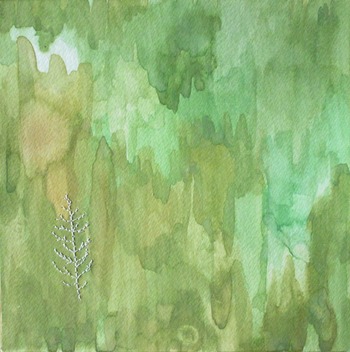
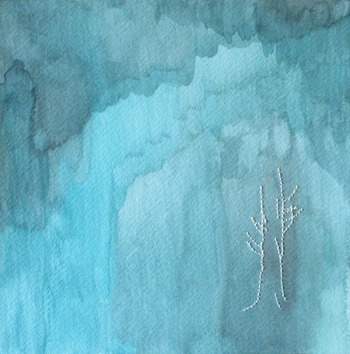
These and other dying community members prompted me to make small works of art in a kind of loving elegy of noticing. The making was important here — hands responding to what eyes and heart see, in a way that might help body better connect with what is happening, and to make sense of it with the soul. On backgrounds of green watercolour vertical forms suggesting forestscapes, over the course of a year I depicted the ghost-like lines of these skeletal trees with faint-white stitching, offering them the care and attention I feel they deserve, even in their passing. It was a need to give homage to these beings suffering from human-caused climate change and from suburban development practices.
I have been bewildered as to why so few locals seem to remark on this loss of what, to me, are integral community members whose presence I feel in the neighbourhood every day. Wondering how this damage cannot simply be something “outside” of ourselves but rather deeply connected with our human lives, I am reminded of writings that have long resonated for me: on how the environment is us (Evernden, Reference Evernden1993), how our psyches include and are inseparable from our ecologies whereby the self is not only “in here” but also “out there” (Hillman, Reference Hillman, Roszak, Gomes and Kanner1995), and how the wellness of the earth is not separate from the wellness of the human soul (Bai et al., Reference Bai, Cohen, Scott, Jing Lin and Brantmeier2013). These thinkers show how a sense of self is not bordered by the skin but indeed extends to the places we inhabit — socially, ecologically and relationally — and how the wellness of the beings around us is inseparable from our own.
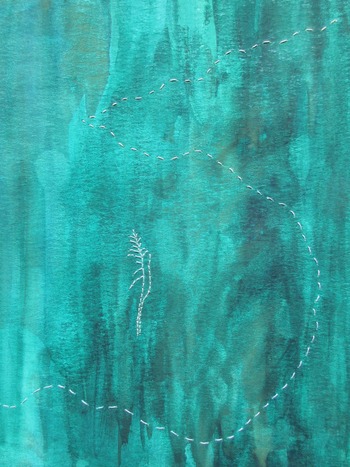
In addition to the depictions of deceased trees amidst areas of green, there are other small artworks in the series where net-like forms hint at the ever-present yet intangible, interconnected webs of life that weave together the pan-sentience of living systems, and especially of treed communities. In part, this paper explores some of the theoretical ideas that arose from this process of making — how engaging in relational as well as aesthetic connectionFootnote 1 with local trees and land offers needed ways to relearn our receptivity to the companionship and teachings of forest and tree systems. Arts-based ecological learning is particularly valuable to noticing the conditions of life in our local environs and to forming much-needed personal bonds with local places (Vasko, Reference Vasko2016, Reference Vasko2021; van Boeckel, Reference van Boeckel2021). When infused in respectful engagement with Indigenous land-based worldviews, I feel they can be especially powerful. Here, I specifically explore how epistemologies grounded in a worldview of interconnectivity between all beings (Kohn, Reference Kohn2013, Sheridan & Longboat, Reference Sheridan and Longboat2006) might be nurtured through holistic, affective forms of attention characterised by betweenness (McGilchrist, Reference McGilchrist2019). Particular attention is given to Sheridan and Longboat’s (Reference Sheridan and Longboat2006) notion of minding all things, where human minds (and their development) are seen as inseparable from the land.
In many respects, this is an inquiry into the entwined intricacies of suffering, neglect and loss: human, sylvan and ecological; psycho-spiritual and intellectual as well as arboreous. Questions I seek to explore are: In what ways is the well-being of the human mind — our own psycho-spiritual intactness — inextricably linked with the well-being of the land, and particularly with our arboreous and sylvan ecologies? If, according to Indigenous ontologies, the authenticity and cultivation of human minds is inextricable from the land (Sheridan & Longboat, Reference Sheridan and Longboat2006) and parts of our immediate ecosystems are suffering and dying, might this imply that aspects of human minds, spirits and epistemologies are similarly affected? In other words, is drought for the trees also a drought in the human psyche? I want to explore what is being lost in us through the loss of our arboreous community members, and further, what capacities we may be losing when we no longer even notice (Kahn & Weiss, Reference Kahn and Weiss2017; MacFarlane, 2024).
Watercolour and thread stitching on paper (2025).

While becoming conscious of loss, suffering and death is difficult, facing these is likely integral to the continuation and affirmation of life. Yet while beginning with themes of loss, I ultimately want to find ways to affirm and entwine with life in the most viable and enriching ways. A key question is around what forms of attentiveness and healing might be needed to enable us to “think with and through” local land (Sheridan & Longboat, Reference Sheridan and Longboat2006, p. 71) and forests, rather than merely about them — often as mere settings for our own activities or resources for our use. In essence, my inquiry is into how we might engender a sense of deep attunement with treed spaces and with the intricate web of life of which we are part, and that is also part of us. In this regard, I cannot but agree with Kuchta’s observation that arguably, attuning ourselves to our more-than-human ecologies, to the lands that support and nurture us, is one of the most important tasks of our time (Love Studies Institute, 2024).
In responding to the dying of my tree neighbours, artwork — crafting something by hand — was the most intuitively visceral beginning. Those who have a creative practice or who turn to arts-based work in response to land — for themselves or in their teaching — know how creative work makes room for the processing of what cannot easily be stated in words and yet is deeply felt, embodied and personally meaningful. A verbal response cannot often evoke the same kind of appreciative and spiritual understanding, nor can a rational one do it the justice that is called for (McGilchrist, Reference McGilchrist2019).
Watercolour and thread stitching on paper (2024).

Mind and land as connected: Cues from Haudenosaunee Indigenous ontology
Haudenosaunee Indigenous ontology observes a direct connection between the intactness and well-being of the land, and the health and authenticity of human minds (Sheridan & Longboat, Reference Sheridan and Longboat2006). In this view, the sentience of the land is inextricably linked with the consciousness of humans in what Sheridan and Longboat describe as the “interplay of human and more-than-human consciousness” and the “enduring spiritual and intellectual relationships” that connect people, communities and land (p. 365). Notably, for traditional Haudenosaunee, notions of “autonomous, anthropogenic minds” — minds that deem themselves individualised and separate from their land ecologies — are regarded as “aberrations that violate the unity, interrelation, and reciprocity between language and psychology, landscape and mind” (p. 366).
I’ve returned to this writing several times over the years so that, as an immigrant to this land, I may more fully appreciate and more deeply sense what Sheridan and Longboat convey. While it may initially be challenging to intellectually “grasp” (more on the notion of “grasping” later), intuitively and viscerally this worldview makes good sense and is to me a deeply welcome ontology with which I find much resonance. I also return to this work for a kind of assurance of what is possible in terms of how we might be present with our local ecologies. Practiced by Indigenous peoples across innumerable generations, worldviews of interconnectivity, of being inseparable from the web of life around us, have been around far longer than many current ecological theories. In the words of Poelina et al. (Reference Poelina, Paradies, Wooltorton, Guimond, Jackson-Barrett and Blaise2023a), “Indigenous wisdom as environmental education is the oldest education, being tens of thousands of years of continuity” before colonial violence disrupted land-connected knowledge systems and practices (p. 269). In a different article, Poelina et al. (Reference Poelina, Perdrisat, Wooltorton and Mulligan2023b) eloquently invite anyone, whether or not of Indigenous ancestry, to take guidance from Indigenous knowledges and engage in relational presence with their local ecosystems through “feeling and hearing” the landFootnote 2 and, relevantly to my work here, to deepen their identity by doing so. Williams (Reference Williams2023) further adds that in environmental education, Indigenous philosophy does important work in “deconstructing western modernist subjectivities” and contributing to “human-earth relationality” (p. 320); she calls for Indigenous ontologies and kinship laws of interconnectivity to be brought to bear also on larger, global climate issues.
To bring the relevance I see in these forms of relational presence and interconnectivity into connection with the harm to trees I see around me, I need to first expand a bit on the connection between mind and land. When Sheridan and Longboat speak of “minding all things” (p. 365) they describe a responsibility to all things integrated with the land and community as well as how, in traditional Haudenosaunee thought, the land and community in turn compose the mind. Whether or not it is in our awareness, the infinitely complex life-web of which we are all part gifts us with what we need to live: physical nourishment, a place to be and a home, as well as spiritual nourishment through awe, beauty, serenity, wonder and connectedness. We have shelter and protection from tree shade as well as materials to build homes, and, if we are open to them, the companionship and teachings of the more-than-human. As Kimmerer reminds us, “Everything that makes our lives possible… is provided by the lives of more-than-human beings… it all comes from the Earth” (Reference Kimmerer2024, p. 8). The consequences of our lacking this awareness are everywhere in our ecological and planetary systems. According to these writers, we would do well to learn the humility of knowing that we have co-evolved with the earth and how dependently interconnected we are.
Watercolour and thread stitching on paper (2024).

There is also much more to this than our physical sustenance. When it comes to the development of human minds, Sheridan and Longboat observe how cultivating the interrelation of the land’s sentience with human consciousness is part of becoming a mature and authentic human being: “Haudenosaunee minds are required to accomplish that symmetry in accomplishing their authenticity” (p. 366). The idea that one can only be a genuine human being insofar as they are sensitive to — and in sync with — their local ecologies and care for them responsibly is further echoed by Canadian Indigenous scholars Donald (Reference Donald, Tomlins-Jahnke, Styres, Lilley and Zinga2019) and Simpson (Reference Simpson2023) as well as by Indigenous-led movements that insist on personal and responsible connection with land/place as a foundation of human education and learning (Cajete, Reference Cajete1994).
In Sheridan and Longboat’s view, the cultivation of this authenticity is also necessary for the restoration of both mind and ecosystem. This congruence of mind and land — seen as originating together in their creation story — is inextricable from the humble awareness of dependence on what the earth offers for the nourishment and indeed the development of the whole human: body, mind and spirit. In other words, one cannot be well without the wellness of the other; humans cannot be well if local more-than-human life is compromised. The “restoration of mind, spirit and imagination” (p. 366) includes knowing that human beings and minds are embedded with, and dependent on the land for not only their sustenance, but their very origin and existence. This, Sheridan and Longboat (Reference Sheridan and Longboat2006) insist, is a necessary prerequisite for the healing of local ecologies. In their words, “Only with restored identities can we know when restored ecologies have reestablished their authenticity. Onkwehonwe confirm the success of their own identities when that success is confirmed [by the land] in their traditional territories.” (p. 367).
Watercolour and thread stitching on paper (2024).

Cultural intelligence and imagination are thus not the proprietary domain of humans but rather exist in the land, the forests and in ecological communities. Sheridan and Longboat assert that nature and mind have responsibilities to one another in an “intellectual and spiritual reciprocity where the more-than-human grants qualities of mind to the human” (p. 368, my italics). Without a healthy relationship with the diverse multi-species minds and ways of knowing and being shown to us by the land, and without an open heartedness to those teachings, Sheridan and Longboat observe, “we are less human because we are less natural” (p. 368).
Minding everything and its betweenness
I would like to bring specific focus here to the proposal of minding all things: to the integration of human minds/psyches with all that is living and entwined in the web of life. Once there is a spiritual connection where “everything is connected to everything else” and the understanding that “every being participates in everything,” we can come to see how it “immunizes against anthropocentrism and… offers a conscious humility that keeps humans in their place of thankfulness, respect, and appreciation.” (p. 369). This, Sheridan and Longboat say, is necessary for these webs of life to continue.
The idea that how we attend to the world actually affects that world is interestingly echoed in the work of neurologist and philosopher Iain McGilchrist (Reference McGilchrist2019). The very nature of our attention, he says, “is nothing less than the way in which we relate to the world” (p. 13). He continues, “it doesn’t just dictate the kind of relationship we have with whatever it is: it dictates what it is we come to have a relationship with” (p. 13). An expert in brain hemispheres and their interrelated, asymmetrical complexities, McGilchrist claims that with the right hemisphere, we attend to the world with “the broadest possible open attention” (p. 13) rather than separating it into fragments or parts, or separating ourselves from what we see. A mode of attending that sees the living whole of entities also “enables us to see ourselves connected to — and…to empathise with — whatever is other than ourselves” (p14). It is a kind of attention that essentially joins us with everything else in ways that enable us to be deeply embodied and connected, as well as spiritually and experientially present. We appreciate the complex uniqueness of things rather than reducing them to general abstractions. We value the animated life within the world rather than wanting to analyse or “grasp” it so it that may be usable and manipulable for our own purposes. And, perhaps most relevantly here, it focuses on the relationship between things — on the intimate in-betweenness that binds everything and us all together. In this regard, McGilchrist goes so far as to say that “attention is a moral act” (The Wonderstruck Podcast with Elizabeth Rovere, 2024. 0:01).
Watercolour on paper (2025).

For almost twenty years, I have been walking in a forest close to my home. I have undertaken several drawing projects there to better know the forest and her dynamics, intricacies and intelligence. Arts-based and visually aesthetic processes enhance our capacities to notice what we wouldn’t otherwise notice (Greene, Reference Greene1995) and this noticing is the beginning of many further openings. On one occasion where I was taking photographs on my walks, I could not but be struck at the immense interwovenness of the tree branch lines — the entanglement and interconnectedness of these beings who exist together, their bodies entwining through branches, limbs and roots. There is an inevitable sense of interdependence in tree communities that we know of from the work of Canadian forestry researcher Simard (Reference Simard2016, Reference Simard2021), who invites us to see forests as social communities who share resources and function as a single organism, passing wisdom between diverse trees for mutual resilience. I also notice how in forests, the living and the dead co-exist together: those who die and decompose nurture the young who, with time, rise up. I notice, too, how the edges of forests are far more vulnerable to climate: to heat, drought and winds. And I notice how, outside the forest, those who have died often don’t have anyone to nurture.
Separateness and threadbare reality
With these teachings of connectedness offered to us by forests, it is worthwhile to ask how a holistic sense of interbeing, to borrow Hanh’s term (Reference Hanh2020), might be integrated into all learning. While the left-brain’s ability to “grasp” things — “to pin them down and make them useful” (McGilchrist p. 11) helps us understand the world rationally, this often occurs at a remove from our immediate and involved experience. It also helps us to manipulate things as resources. Indeed, this approach has allowed us to advance remarkably as a civilisation, to lead convenient lives and to develop important human capacities, yet the cost we now face is that of significantly compromised life systems. The dying trees I notice in my neighbourhood are just a small example of the reduced flourishing all around — and, I would argue, within — us. The dominance of left-brain thought is of course pervasive in all our systems: governments, economies and education. I notice this domination when a student, sharing her deep chagrin that a beautifully treed area in her neighbourhood was cut to make room for development, felt that she “shouldn’t allow her emotions to take over.” I could not help but respond that such emotions have a relational and holistic wisdom that needs to be trusted, and that had unfortunately been trained out of us.
Indeed, how we attend to the world affects not only the world we create, it also affects who we become and how we relate to all kinds of others, human and non-human alike. McGilchrist posits that in the space between “a world where there is ‘betweenness’, and one where there is not” (p. 23) is a vast difference in who and how we are, as human beings. These, he says, are “not different ways of thinking about the world: they are different ways of being in the world” (p. 23). It is about a mode of being and a worldview that emphasises the relational and the empathic, versus one that does so much less. It appears that the techno-industrial world we inhabit was created in large part by what the left brain is good at, and what it finds reassuring — a world where things can be separated into distinct parts, analysed and used for our benefit. Of course, we need these modes of being for many of our everyday tasks. But the question — especially in education — is where the emphasis is placed. A reduced relational capacity affects our abilities to bond with our more-than-human neighbours, and a reduced connection with nature may in turn affect our empathetic and relational ways of being (Love Studies Institute, 2024). This is true also of how we, as humans, relate to each other.
Watercolour and thread stitching on paper (2025).

I began this work with a question of how suffering and dying trees in our home ecologies might reflect on, perhaps even contribute to, a kind of quiet, unstated suffering and loss within ourselves. If I were to pose this question to a broad general public in our production-oriented society, the response would likely be that we are not necessarily losing anything in ourselves, for, after all, the trees are not us. We are our own entities, we have separate lives and while it is sad and perhaps unsightly that trees are dying around us, we are not that much affected. Vanessa Machado de Oliviera (aka Andreotti) (Reference Machado de Oliveira2021) refers to this notion that we are separate from other beings and earth entities as a fundamental “socially sanctioned denial” of modernity. Separability, she says, is the very foundation on which our modern capitalist society is built. Further, the story of separateness is an overconfident one — as the left brain tends to be, not being aware of its own limits (McGilchrist, Reference McGilchrist2019). It pushes out the possibilities of other stories and other ways of being in the world. We are led to believe that this is simply “how reality is” even as we come to see that this worldview is completely unsustainable.
This notion of separability makes possible the exploitation and instrumentalization we have come to see as normal. I can use and manipulate something to which I’m not connected, something from which I’m removed, much more easily than I can do this with a valued community member or with someone intimately entwined with my own daily existence. Another way to put it is not in terms of practical dependency, but of relationship and connection. Donald (Reference Donald2022) observes how the tendency of relationship denial — including the denial of relationships with land and with more-than-human species — is a key barrier to Indigenous reconciliation and ecological change. Sheridan and Longboat (Reference Sheridan and Longboat2006) call this separateness, quite simply, a “lousy” worldview and are deeply critical of such a “threadbare settler reality” (p. 369) that divorces humans from our ecological contexts and human minds from the sacred relationships that help ensure the continuation of earthly flourishing. Its costs — to our ecologies and to ourselves — are enormous. Further, they powerfully assert that “diminishing biodiversity augers against the continued capacity to know how to think with everything” (p. 369). It goes in cycles then, and the very fabric of all our shared existence substantially loses its richness.
Watercolour and thread stitching on paper (2025).

I first found out about MacFarlane and Morris’s now classic children’s book, The Lost Words (Reference Macfarlane and Morris2017), through a radio interview with an elementary teacher doing a creative project with her young students to bring back nature words — such as willow, acorn, dandelion, starling and fern — that had been removed from the Oxford Junior Dictionary due to dwindling useFootnote 3. With that book and its sequel, The Lost Spells (Reference MacFarlane and Morris2020), MacFarlane and Morris’s beautiful project seeks to bring back into the minds and mouths of children (and all of us) the words of the everyday natural world — the names of things that “are slipping from daily speech and knowledge… due to underuse.” In MacFarlane’s words, “We are living through an age of loss, for which we are just starting to find a language of grief” (Reference Macfarlane2019).
MacFarlane (Reference Macfarlane2019) cites McCarthy in referring to “the great thinning” wherein “the fabric of life in the natural world, once so rich, has become threadbare, ragged and frayed.” And in MacFarlane’s own words, “thinner and thinner wears the cloth… absence briefly noted, if at all, as distant memory, half-forgotten grief.” (2020). I find it interesting that like Sheridan and Longboat (Reference Sheridan and Longboat2006), these writers use the metaphor of something once rich becoming threadbare, to describe what has happened to the “warp and weft” of life, where “the disappearance of things — a vanishing for which we do not have a name” signals “a profound change to the very fabric of existence” (2019). For young people, this noticing of loss is more difficult, as they cannot personally know the natural world experienced by previous generations. In the words of Kahn and Weiss (Reference Kahn and Weiss2017), the “problem of general environmental amnesia is that nature gets increasingly diminished and degraded, but children of each generation perceive the environment into which they are born as normal. Thus, across generations, the baseline shifts downward for what counts as healthy nature” (p. 7). In a world where the trees around us are not seen as entwined with our own lives, it can be easy to say this doesn’t matter. Certainly, say Kahn and Weiss, we adapt and live with it, “but that does not mean we live well, physically or psychologically” (p. 8). Personally, I’d prefer to educate toward a richly interwoven fabric of life, where this absolutely matters.
Forest minds
“Does a forest have a mind?” asks MacFarlane (Reference Macfarlane2025, p. 97) as he explores and writes about Los Cedros cloud forest in Ecuador for his book titled with a similarly provocative question: Is a River Alive? Of the Kichwa people there, he observes that it “was simply a given that the forest and the river were alive, and that together the water, trees, humans and creatures of the forest formed a ‘living, thinking being’” (p. 97).Footnote 4 My life in a semi-suburban neighbourhood in western Canada and the education I have received in industrialised countries feels vastly different in everyday ontology from that of Indigenous peoples living in the Amazon. And yet…
If trees have lives — and they often have lives much longer than ours, stretching over many climatic changes — then they must have experiences. If they have experiences, especially accumulated ones, and have preferences for some conditions over others, then it is rather possible they have perspectives. Indeed, this can be said of most living beings. Living in a rainforest area where all my life places are so characterised by the presence of tall trees, I cannot help but feel I share my life with them. We rely on similar water systems, on the same air and sunlight, are affected by the soil systems that feed us. We are thus members of the same ecological community (Vasko, 2024). We experience the same seasonal changes, of which they bear the effects much more directly than I do. The trees and I have grown older in each others’ presence. I am aware that their presence means more to me than mine does to them, yet I also feel that how I live my life has effects, even if indirect and small, on their lives. None of this means I can pretend to understand, in my human-limited view, what their lives are like or that my struggles compare to theirs, only that I feel the well-being of their lives connected with mine. And that they matter.
Eduardo Kohn’s (Reference Kohn2013) work, How Forests Think, shares his observations from four years of ethnographic work among the Runa in Ecuador, and how their lives are inextricably linked from other forest lives. One of his key themes is that thought does not need to be seen as residing in, or arising from, single entities — but rather as emergent and occurring between various inhabitants and bodies of the forest. In his observations on the entanglement of forest lives, Kohn (Reference Kohn2013) speaks of “ecological selves” and of the importance, to our own being, of attunement to more-than-human selves:
Under certain circumstances we are all forced to recognise the other kinds of minds, persons or selves that inhabit the cosmos… in this ecology of selves, to remain selves, all selves must recognise the soul-stuff of other souled selves that inhabit the cosmos. I’ve chosen the term soul blindness to describe the various debilitating forms of soul loss that result in an inability to be aware of and relate to other soul-possessing selves in this ecology of selves. (p. 117)
Are our current education systems engendering this kind of soul-blindness? Clearly, a lack of the acknowledgement of other, including more-than-human, selves and especially those with whom we share our ecologies, comes at significant cost to our own quality of being. It is not at all unreasonable, then, that I feel it my responsibility to notice when the trees in my place of being are stressed or suffering. And, since my ability as an individual to directly support them on a practical level is limited, the least I can do is to express what I notice in a caring way.
Watercolour and thread stitching on paper (2025).

I am walking in the forest during the last weeks of summer. The understory retains its magical greenness with swaths of ferns and salal, and the ubiquitous moss on nurse logs, filtering the sunlight at a special angle now that the earth tilts toward autumn equinox. Beneath my feet on the trail, the exposed soil is parched from weeks of dry heat, hard-baked, even despite a good rain a week ago that simply wasn’t enough to offer a much-needed deep soak. Trees at the trailhead edge of the woods bear the worst of these harsh elements, showing bare wood at their tops where there was once green. Some of the days these past weeks have been particularly scorching, the average temperatures of the summers rising noticeably. As someone who loves being outside and is sensitive to sun, I cannot help but feel what a precious, precious thing is shade. If this may well be one of the coolest summers in what’s left of my lifetime and possibly that of my children, I sense how necessary are our tree communities, and how much we need to learn from them about being, thinking and sharing life together.
Upon returning from being away, I find the hemlock behind my home showing the effects of the hot, dry weeks. When I position a soaker hose beneath her outer under-branches to offer relief, my brushing against them brings down a dry shower of browned needles. They carpet the ground. A neighbour comments on how there is more cleaning to do now that trees release brown needles onto the sidewalk; his lament perhaps more for the inconvenience that for the stress experienced by the tree.
Forms of attentiveness and expression in sync with the land
In my process of stitching the lines of trees, I have felt both their animateness and loss. While I have spoken here of learning from trees as collective interwoven communities, communal and collective thought does not deny the special uniqueness of each being, whether tree, human or otherwise. And so, I have given attention to individual trees even as they stand in their green collective. The verticality of the greenish watercolour background forms arose from what has been imprinted in me through many walks in local forests. In my sewing of net-like strands and wondering how the web of life might even be depicted, I reify my sense of the infinite intricacies that weave through everything and bind us all together.
While Kohn endeavours the complex task of putting into words the semiotics of multi-species thinking processes and how the experiences of forest beings matter to who and how humans might become, this is something I sense wordlessly - yet with certainty - through the haptic, embodied art process. It is a holistic knowing that does not need words, that is perhaps better explored without them. The thing about artmaking is that the emotional truth and resonance of something is what matters. There is no need to yield definitive conclusions. Kohn’s call to think with forests also implies that “wild thinking” might do well to be free of the obligation to give results, or to be about something definitive, articulable or even conscious. Educationally speaking, this is a different realm from common teaching practices which rely much on expository or analytical writing. Although the (largely left-brain) engagement of these forms of communication are helpful in enabling us to “grasp” things and to share understanding that is not gained experientially, Sheridan and Longboat go so far as to say that the expository prose we often teach with is deeply “at odds” with “the capacity to think in the language of the land” (p. 380). McGilchrist (Reference McGilchrist2019) would further add that making things explicit — rather than respecting and sensing their implicitness — tends to remove their aliveness.
There are, however, poetic, relational and contemplative forms of expression. It is fitting, for example, that MacFarlane turned to poetry and to Jackie Morris’ beautiful paintings and then later to song in their endeavour to re-invite the natural world back into the imaginations, minds and mouths of young people. As McGilchrist suggests, creative and right-brain processes offer better understanding of why these things matter, and of how to re-form and authenticate the connections between ourselves and the world around us in ways that are emotionally and perceptually immersive, embodied and personally involving. It is also the right hemisphere that understands the spiritual significance of these connections as well as their (both literal and metaphorical) life-giving capacities. And when we must use prose, Indigenous writers (see specifically Kimmerer, Reference Kimmerer2012) and MacFarlane (Reference Macfarlane2025) point to thoughtful language as a first call. Rather than living entities such as trees, forests and rivers being a “what” they deserve to be a “who” — with their own sovereignty, even as they give us life and support the living entanglements of which we are a deeply reliant part.
Watercolour and thread stitching on paper (2025).

I’m sitting in a clearing on a forest floor covered with Douglas Fir needles and cedar fronds. We are a small group, seated in a circle, part of a Forest Bathing workshop lead by Heather Burns, as part of a Geopoetics Symposium on Cortes Island. We have gathered here after a silent walk through the island woods, pondering the question, “What is in motion?” When we begin speaking again, my friend and colleague, Lee, pronounces, with some joy, “Everything is in motion.” And it is true. All is alive — whether through the movement of the gentle breeze, the insects and birdsong, their intertwined entanglement with each other. Nothing is static. All is vital. After a moment of silent circle, we are asked to find a spot close by where we might be in intuitive communication with the life and beings there. I sit leaning against the Douglas Fir; she is the largest tree in the immediate area and I sense her nurturing of other life there, of the younger trees, and in that moment, of us as well.
Concluding thoughts
Much of what I have addressed here — minding everything, feeling ourselves to be part of a larger web of life and engaging with aesthetic consciousness — can be applied in our relations to all local ecologies as a whole. Yet with trees showing us their suffering and dying so visibly and remaining among us in the landscape after their passing, they are a special signal to us humans (visual creatures that most of us are, compared to other species) of what is happening in our outer as well as inner ecologies.
It would be nice to have an easily statable pedagogical “solution.” Yet it is not easy to undo centuries of the foundation of separability on which industrialised societies have been built. The more I learn, the more I appreciate how thinking in terms of “solutions” is too easily equated with “getting rid of the problem.” This is particularly difficult with the problem is within us and the ontologies we live by. What seems clear, however, is that emotionally and ecologically immersive pedagogies — ones that focus on relationality and on our being just one humble part of a larger web of life — are deeply necessary. The most viable epistemologies are those of connectivity that value the pan-sentience of living systems and that invite humility, wonder and responsiveness as well as flourishing for the ecological collective as a whole, rather than for a few members of one species. This, we can learn from forests (Simard, 2013). And, the soulful work of creative/aesthetic engagement allows this learning to occur in deeply meaningful ways.
I have also mentioned the transformative powers of conscious choices in language, especially when this language is one of connectivity, respect and responsibility to each other. Going even deeper than language is the possibility of redefining our relationships with local more-than-human beings. The Kazie First Nation, for example, refers to local salmon as family (Ostroff, Reference Ostroff2022). Hill et al. (Reference Hill, Whintors and Bailey2022) have done beautiful ecologically-placed work with children learning about being responsive, responsible and caring family members to local salmon kin. Titled We are the Salmon Family and guided by Indigenous elder Rick Bailey, their project is about much more than inciting the language of family. It calls upon deeply responsive imagination, of which young children are immensely capable.
To the northwest of the Katzie lands where I live, members of the Haida nation share how in their worldview, “the cedar tree is known as ‘every woman’s sister’” (Raven Calling Productions, 2018). Perhaps viewing our tree neighbours as arboreous kin, as wise uncles who have seen much before our time in the neighbourhood, as big siblings — shade-giving sisters and brethren who shelter us and teach us about deep time and how essential are the basic elements of life: sufficient water, healthy climate, unharmed soil, a balanced ecosystem — can better allow our own bodies and psyches to be in balance. As Kimmer (Reference Kimmerer2024) puts it so well, all flourishing is mutual.
Acknowledgements
I would like to sincerely thank Cher Hill for inviting me to participate in the Critical Forest Studies collective; her warm-hearted support of my arts scholarship has meant a great deal. I would like to thank the leaders of the CFS initiative and the editors of this special issue, as well as the reviewers for their encouraging comments, particularly David Rousell for recommendations of Australian authors bringing Indigenous philosophies into Environmental Education. Much appreciation goes to my artist colleague, Erica Grimm, for her thoughtful observations on earlier stages of the watercolours. I am also grateful to Sean Blenkinsop for the conversation at Geopoetics on Cortes Island when he first brought the work of Sheridan & Longboat to my attention.
Financial support
This research received no specific grant from any funding agency, commercial or not-for-profit sectors.
Ethical standard
Nothing to note.
Author Biography
Zuzana Vasko teaches with the Faculty of Education at Simon Fraser University. Her research brings arts-based and contemplative approaches to ecological learning, with an emphasis on how the arts help us nurture and deepen personal relationships with local ecologies. Her artwork (found here) inquires into human-nature connections, interspecies commonalities, effects of climate on local ecologies and wisdom from ecological neighbours. She is grateful to make her home on the ancestral lands of the Katzie and Kwantlen peoples, where she frequently walks in the forests.






 Open access

