

As concern grows about the detrimental role played by people smugglers, tax evasion and the proliferation of small arms, increasing attention is being paid to the harms generated by serious and organised crime (SOC). Recent research has demonstrated that SOC – a contested concept that we define in detail below (Varese, Reference Varese, Carnevale, Forlati and Giolo2017: 27) – undermines the rule of law and democratic consolidation and has a detrimental impact on development, inequality and poverty (Karstedt, Reference Karstedt2012; Schultze-Kraft, Reference Schultze-Kraft2018; Allum and Gilmour, Reference Allum and Gilmour2019). Moreover, a range of studies from various countries have demonstrated that the spread of SOC networks, and their fusion with corrupt networks, can facilitate the emergence of ‘shadow states’ in which political power is gradually ceded to unelected – and often criminal – groups (Allum and Gilmour, Reference Allum and Gilmour2019; Cheeseman, Reference Cheeseman2020).
Developing effective counter-SOC strategies is therefore crucial. Presently, these strategies typically include an awareness-raising element, which is seen as important for building public support for counter-SOC policies, and intolerance for organised criminal activities in those communities where SOC may be viewed as offering unique economic opportunities. For example, the UK Government's Serious and Organised Crime Strategy (2018) identifies raising awareness of the consequences of SOC as key to reducing the space for SOC networks to operate. This makes intuitive sense. The success of SOC in part depends on the complicity of members of the public and state officials. However, a growing body of research suggests that raising awareness to issues such as SOC may risk doing more harm than good (Corbacho et al., Reference Corbacho, Gingerich, Oliveros and Ruiz-Vega2016; Peiffer, Reference Peiffer2017, Reference Peiffer2018). While – to the best of our knowledge – there has not been any systematic research conducted on the impact of SOC-specific awareness-raising efforts, findings from research on corruption, social distancing during coronavirus disease-2019 (COVID-19) and environmental protection suggest reasons to be cautious.
Studies on anti-corruption awareness raising, for example, have almost universally found that messaging either has no impact or can backfire (e.g. Cheeseman and Peiffer, Reference Cheeseman and Peiffer2021, Reference Cheeseman and Peiffer2022; Peiffer and Walton, Reference Peiffer and Walton2022). This is likely because, by making a social bad salient, messaging primes individuals to recall pre-existing pessimistic beliefs that the social bad cannot be effectively tackled. Such effects have been found to be especially likely for messages which highlight a ‘descriptive’ social norm, emphasising how widely practiced or facilitated a social bad is. Anti-corruption messaging, for instance, appears to lead individuals to focus on a belief that corruption is systemic and so unintentionally makes people feel that the problem is too big and intractable to try to resist (Peiffer, Reference Peiffer2018; Cheeseman and Peiffer, Reference Cheeseman and Peiffer2021). A similar dynamic may be at play with counter-SOC awareness-raising efforts – by highlighting the problem messages may unintentionally backfire, leaving people more pessimistic that SOC can be controlled.
The literature on public relations campaigns has so far offered one potential ray of hope. Messages that avoid telling the public how bad the situation is (descriptive norm) and instead emphasise how much the public disapproves of a particular kind of behaviour (injunctive norm) – such as organised criminal activity – may encourage hope that the social bad can be tackled, and/or even a rejection of the social bad itself (Widner and Roggenbuck, Reference Widner and Roggenbuck2000; Cialdini et al., Reference Cialdini, Demaine, Sagarin, Barrett, Rhoads and Winter2006; Agerberg, Reference Agerberg2022). By not highlighting the extent of the problem, injunctive norm messaging is thought to be better placed to reduce the risk of priming pessimistic beliefs, and at the same time promote the idea that the socially acceptable form of behaviour is to reject the social bad (Tankard and Paluck, Reference Tankard and Paluck2016; Agerberg, Reference Agerberg2022).
This paper seeks to advance this literature in three ways. First, this study represents the first ever systematic test of counter-SOC messaging and reveals the extent to which hypotheses that have largely been generated through research on anti-corruption campaigns apply to this similar policy area. Second, we provide a test of the impact of both descriptive and injunctive norm messages, which to our knowledge has not been done before. Third, we investigate whether such messaging also generates a further set of unwanted effects by examining its impact on support for populist and anti-system ideas. Recent research has highlighted the way in which political entrepreneurs leverage public concern about corruption and SOC to critique the status quo and build support for more radical policies (Hawkins et al., Reference Hawkins, Aguilar, Silva, Jenne, Kocijan and Kaltwasser2019; Minetti, Reference Minetti2022). If counter-SOC messaging backfires by encouraging people to believe the system is over-run by SOC, it may also inadvertently boost support for ideas which challenge the system itself.
To test the impact of counter-SOC messages, we conducted a survey experiment in Albania, which has recently become notorious for the rise of mafia-like organisations that are often said – at times hyperbolically – to have turned the country into a hotbed of organised crime (US Department of State, 2019: 37). Citing Transparency International, Arsovska (Reference Arsovska2015: xxi) reports that that ‘80 percent of the Albanian economy is a “parallel” one’ and that ‘most of this undocumented capital comes from organized crime activities’. Arsovska also concludes that there is widespread awareness of organised criminal activity among society (Reference Arsovska2015: 223–224). Albania is therefore a suitable country in which to assess the effectiveness of strategies designed to shift public attitudes to SOC.
To do this, we divided a 1,502-person nationally representative sample of Albanian adults into three groups: one we exposed to the kind of ‘descriptive norm’ counter-SOC message that is typical of current counter-SOC efforts, one we exposed to an ‘injunctive norm’ counter-SOC message and one that acted as the control group (not exposed to a message). All participants were then asked the same set of survey questions, including about reporting SOC activities, confidence in government and populist or anti-system ideas. By assessing whether individuals in the groups that were exposed to a message have distinctive attitudes as compared to those in the control group, we generated a systematic estimate of the impact of each message.
Our findings provide further evidence of the risk of using descriptive norms in public awareness campaigns about social bads. In line with our expectations, exposure to the descriptive message reduced confidence in law enforcement agencies and the government, as well as increased support for the removal of constraints on political leaders, and a demand that the government must always reflect the will of the people. Unexpectedly, the injunctive norm message had no overall positive effect on attitudes towards reporting SOC, law enforcement or most anti-system attitudes examined. Moreover, the message was found to have the unwanted impact of increasing agreement that people have lost confidence in the government because of SOC, and that it is more important for a leader to get things done than for them to be constrained by checks and balances.
These findings demonstrate that injunctive norm messaging can also be ineffective and may even generate negative unwanted impacts. They are therefore particularly important to the wider literature on social psychology and awareness-raising messages, serving as a corrective to the idea that injunctive messaging can be relied upon to avoid backfiring when dealing with social bads.
What is SOC and what do we know about the effectiveness and impact of awareness-raising campaigns?
The concept of organised crime has been defined in multiple ways across its ‘chequered history’ (Varese, Reference Varese, Carnevale, Forlati and Giolo2017: 27), and remains controversial. Following Hagen (Reference Hagen2006), Varese (Reference Varese, Carnevale, Forlati and Giolo2017) and Carnevale et al. (Reference Carnevale, Forlati and Giolo2017), we recognise the extent to which scholars have applied very different thresholds for how hierarchically organised, violent, ‘mafia-like’ and geographically extensive criminal activity must be before it counts as ‘organised crime’. We also recognise that there is often a considerable gap between such academic conceptualisations and the much simpler definition offered by government agencies, which tend to view SOC to be crime ‘that is planned, co-ordinated and conducted by people working together on a continuing basis’ such as ‘drug trafficking and supply; organised illegal immigration; counterfeiting; organised theft’ (UK Government, 2023).
As our purpose in this article is to understand how public attitudes towards SOC operate and change, it is important to focus on how organised crime is understood by the public in the Albanian context. In turn, this needs to be understood in relation to the historical expansion and rise to prominence of Albanian criminal networks, which was rooted in dramatic changes both inside and outside the country in the early 1990s (Arsovska, Reference Arsovska2015). The end of communist rule in 1989 led to socio-economic crisis and political unrest, the combination of which generated mass emigration, creating large Albanian diasporas in countries such as Greece, Italy and many other European nations. Externally, conflict and instability in nearby countries with large Albanian populations, such as Kosovo, generated fresh opportunities to operate in informal and illegal economies. The consequence of these processes was the ‘the spreading of Albanian criminal tentacles’, and the evolution of violent criminal networks involved in drug trafficking, human trafficking, weapons and ammunition smuggling, motor vehicle theft and smuggling and economic and financial crimes (Tabaku, Reference Tabaku2005: 123–124).
Along with growing domestic and international media attention to Albanian criminal gangs, this has led to a general understanding of organised crime among Albanians as being a set of organised criminal networks that are involved in widespread extortion and illegal cross-border activities, connected to members of the political establishment, and solidified through close friendship and ethnic alliances (Arsovska, Reference Arsovska2015). Indeed, while Arsovska (Reference Arsovska2015) argues that some of the way the country is seen from abroad is an oversimplification based on classic tropes regarding the mafia in the USA, her in-depth study also documents the deep economic and social impact of SOC in the country. As we explore in greater detail below, our survey reveals that Albanians believe that organised crime is endemic, with around one-third of respondents reporting that it is ‘extremely widespread’. The precise understanding of the nature and intensity of organised crime likely varies to some extent across citizens. While it is important to keep this nuance in mind, however, it is not a challenge for our study because the randomisation of individuals into our control/treatment groups means that we can expect similar distributions of differing beliefs in each group, and so such differences should not impact our findings.
Growing domestic concerns about SOC have been matched by an escalation of international efforts to counter organised crime. That many of these campaigns have placed a strong emphasis on counter-SOC communications is reflective of a call made over 20 years ago by the United Nations in its Convention Against Transnational Organised Crime (UNTOC) for the convention's 190 signatory states to promote public awareness about SOC (United Nations, 2001). Such messaging may be targeted at young people to discourage engaging in SOC; at adults, encouraging reporting SOC activity and hence aiding law enforcement or at whole communities to reduce potential sympathy for those involved (UNODC, 2021). The UK Government's Serious and Organised Crime Strategy (2018), for example, identifies raising awareness of the consequences of SOC as key to reducing SOC, while Mexico's National Public Security Strategy posits awareness raising as a tool to advocate for ‘alternative social attitudes’ with respect to SOC (UNODC, 2021).
These awareness campaigns are often seen as the answer to address the public's ‘knowledge gap’ around the issue (Campbell, Reference Campbell2017: 39), with the assumption that they will reduce public tolerance of SOC and increase reporting of organised criminal activity. This tacit assumption is evidenced in the fact that the effectiveness of awareness-raising efforts are often only assessed in terms of their ‘reach’, and not on whether or how they shift attitudes and behaviour (Campbell, Reference Campbell2017: 6). Given that the impact of these campaigns has not been systematically scrutinised, it remains unclear whether they represent effective interventions that offer good value for money.
An unfair assumption: the power of descriptive norms to backfire
One type of norm which is regularly relied on in counter-SOC awareness messaging is a descriptive norm, which is based on beliefs of how others behave (Cialdini et al., Reference Cialdini, Reno and Kallgren1990; Legros and Cislaghi, Reference Legros and Cislaghi2020). A central theme of counter-SOC campaigns has been to raise public awareness to the scale and consequences of SOC. Indeed, doing so is in line with the guidance given by UNTOC; signatory states are specifically asked to ‘promote public awareness regarding the existence, causes and gravity of and the threat posed by transnational organised crime’ (United Nations, 2001: Article 31.5). Such messaging invariably highlights a descriptive norm that many people in society engage in, benefit from and/or facilitate SOC.
However, raising awareness to the extent of a problem like SOC in contexts where it is pervasive is likely risky for two reasons. First, social norm researchers have shown that making salient a descriptive norm – in this case how widely practiced SOC is – may unintentionally make a social bad seem more socially acceptable and hence encourage facilitative attitudes and behaviours towards it (Tankard and Paluck, Reference Tankard and Paluck2016; Biccheri and Dimant Reference Bicchieri and Dimant2022). Second, descriptive norm messaging may encourage a feeling that a social bad is beyond repair (Peiffer and Alvarez, Reference Peiffer and Alvarez2016). Applied to SOC, these risks mean that exposure to a message highlighting the scale of the problem may encourage people to look more favourably upon those who earn an income from organised criminal activity, and/or to believe that the system is too overrun by SOC to be saved, and that citizen/government action will not make a difference.
The evidence base that underpins these concerns comes mainly from research on anti-corruption campaigns, which is particularly relevant for thinking about the impact of counter-SOC messaging. Corruption is similarly perceived to influence the actions of public officials (Cheeseman, Reference Cheeseman2020), and public acceptance and tolerance is known to frustrate anti-corruption efforts (Persson et al., Reference Persson, Rothstein and Teorell2013; Minetti, Reference Minetti2022). Previously, six studies have been conducted to assess the impact of anti-corruption awareness-raising messages (Corbacho et al., Reference Corbacho, Gingerich, Oliveros and Ruiz-Vega2016; Peiffer, Reference Peiffer2017, Reference Peiffer2018; Köbis et al., Reference Köbis, Troost, Brandt and Soraperra2019; Cheeseman and Peiffer, Reference Cheeseman and Peiffer2021, Reference Cheeseman and Peiffer2022; Agerberg, Reference Agerberg2022; Peiffer and Walton, Reference Peiffer and Walton2022). All establish whether messaging has an impact by comparing how participants who are exposed to messaging behave in a bribery game or respond to a survey, to participants who are not.
In each case (with the exception of Agerberg, Reference Agerberg2022), at least one ‘descriptive norm’ message was tested. These messages describe the extent to which ordinary people and/or public officials are engaged in corruption and most were found to have ‘backfired’ to some extent. For example, Corbacho et al. (Reference Corbacho, Gingerich, Oliveros and Ruiz-Vega2016) found that a message about bribery increasing elicited greater self-reported willingness to bribe in their study in Costa Rica. Similarly, in former work the authors found that a message describing corruption as widespread encouraged most participants, in a simulated bribery game, to pay a bribe in their study in Lagos (Cheeseman and Peiffer Reference Cheeseman and Peiffer2021). Additionally, Peiffer's (Reference Peiffer2017, Reference Peiffer2018) test of two descriptive messages about the prevalence of low- and high-level corruption in Indonesia was found to reduce pride in the government's anti-corruption response, reduce belief that ordinary people could easily fight corruption and reduce willingness to protest against corruption or join an anti-corruption civic organisation. These latter findings are supportive of the notion that messaging about the systemic nature of a social bad can engender resignation, rather than activism.
Only two studies on corruption messaging stand as exceptions, neither of which found that messaging about the extent of the problem had an intended impact. Using a survey experiment in Papua New Guinea, Peiffer and Walton (Reference Peiffer and Walton2022) found that a message about widespread corruption had no impact on attitudes towards reporting corruption. The other exception is Köbis et al. (Reference Köbis, Troost, Brandt and Soraperra2019), who tested a ‘positive’ descriptive norm. They found that exposure to a message about bribery decreasing reduced participants’ willingness to accept a bribe when they took on the role of a ‘public official’ in a bribery game. However, most participants were not public officials in real life, and those who took on the role of ‘citizen’ in the game were not affected by the message. It is therefore unclear how much confidence to place in the finding that the message reduced bribery.
Taken altogether, the balance of the evidence within studies focusing on corruption messaging thus far suggests that messaging which emphasises the scale of the problem risks backfiring. Scholars examining other social bads have also documented similar ‘backfire’ or ‘boomerang’ effects. For example, Paluck and Ball (Reference Paluck and Ball2010) argue that descriptive norm-based awareness raising around rape in the Democratic Republic of Congo may have encouraged men to commit gender-based violence. With respect to such campaigns, Paluck and Ball (Reference Paluck and Ball2010: 42) write, ‘awareness campaigns often propagate a descriptive norm that violent behaviour is prevalent in the community, perhaps licensing violent behaviour rather than activating behaviour to reduce gender-based violence’. For their part, Chambers et al. (Reference Chambers, Pearson, Lubell, Brandon, O'brien and Zinn2005) warn that awareness raising around suicide prevention may backfire because messages inadvertently present it as normative. Finally, Ryoo and Kim (Reference Ryoo and Kim2021) find that students at the University of Illinois became more likely to stop adhering to COVID-19 restrictions when they learned that many other students were non-compliant. This leads to our first hypothesis:
H1. A message that describes the scale and consequences of SOC will backfire, for example when it comes to willingness to report such activity to the authorities.
Backfiring beyond SOC: populism and anti-system beliefs
Exposure to counter-SOC messaging may also influence a wider set of political attitudes. Evidence of the pervasiveness of SOC activities can undermine public trust in the wider political system and even generate support for anti-system or ‘populist’ leaders, paving the way for democratic backsliding and political instability. SOC activities are often parasitic on networks of corruption and the willingness of those working in the formal sector to ‘look the other way’ (Marquette and Peiffer, Reference Marquette, Peiffer, Allum and Gilmour2021). This helps to explain why Liang includes organised crime – as well as international migration, terrorism and corruption – as one of the popular concerns regularly manipulated by right-wing figures, leading to a ‘new populist moment in Europe’ (Liang, Reference Liang2009: 1). Indeed, sympathies towards populist narratives are often cast as a reaction to perceptions that the rule of law is systematically violated (Hawkins, Reference Hawkins2010: 132, 160; Hawkins et al., Reference Hawkins, Aguilar, Silva, Jenne, Kocijan and Kaltwasser2019). Research focusing on SOC has discussed how it can undermine confidence in existing political systems, such as Arsovska's (Reference Arsovska2015) graphic depiction of the political and societal effects of the rise of Albanian organised crime in the late 1990s. Writing about Serbia in 2000s, Gordy (Reference Gordy2004: 15) explains how evidence from police investigations into such crimes, along with relevant arrests, deepened ‘endemic distrust’ in key political institutions.
One reason for this is that populist leaders often pick up on issues such as corruption and SOC to leverage their claim that a given country requires radical political change. The allegation that the government is tolerant or involved in SOC suggests systematic and far-reaching problems at the heart of the political system, and so such narratives ‘highlight the dishonesty of the political elite’ (Engler, Reference Engler2020: 643). As a result, they play to the foundation of populist leaders’ appeal, namely that the political class cannot be trusted and so someone from outside of the system represents the only hope for positive change. In the Albanian context, for example, the aim of the country's best known populist party, the Red and Black Alliance, was to ‘mobilise citizens against corruption and antidemocratic deeds of the government in Albania’ (Bino, Reference Bino2017: 7). Given this relationship between corruption, SOC and populism, it is plausible that messages that inadvertently prime individuals to think about the pervasiveness of SOC may reinforce existing negative associations between SOC and trust in political institutions, leading to our second hypothesis:
H2: Messages that backfire will have effects beyond SOC itself, including increasing support for populist and anti-system ideas and leaders.
Injunctive norms as the way forward?
An alternative kind of social norm, which is said to hold more promise for awareness raising to social bads, are injunctive norms. Injunctive norms capture beliefs about what others think is acceptable (Cialdini et al., Reference Cialdini, Reno and Kallgren1990; Legros and Cislaghi, Reference Legros and Cislaghi2020), such as the extent to which a social bad like SOC is viewed as unacceptable in society. While SOC awareness campaigns often condemn organised criminal activity, by highlighting the illegality of organised criminal activity, none that we know of highlight the fact that big majorities find such criminal activity unacceptable. Compared to the bleak picture painted about descriptive norm-messaging, research on injunctive norms is more optimistic.
This is partly because, by focusing on the fact that majorities feel social bads are unacceptable, injunctive norm messaging promises to avoid one of the most significant risks taken by descriptive norm messaging, which is to make people think that the social bad is socially accepted. Indeed, researchers have even found that by including such information on the injunctive norm, the ‘backfire effects’ associated with descriptive norm messaging can be ameliorated (Schultz et al., Reference Schultz, Nolan, Cialdini, Goldstein and Griskevicius2007; Ryoo and Kim, Reference Ryoo and Kim2021).
Moreover, injunctive norm messaging may also avoid making people feel more pessimistic about efforts to control a social bad. This is because the central motivating force associated with injunctive norms is that they pressure people to try to maintain or gain social approval and meet other people's expectations, rather than to match behaviours (Lapinski and Rimal, Reference Lapinski and Rimal2005; Anderson and Dunning, Reference Anderson and Dunning2014; Morris et al., Reference Morris, Hong, Chiu and Liu2015). According to this logic, a message emphasising that big majorities disapprove of SOC may encourage people to condemn it as well.
The limited corruption research into injunctive norm messaging has so far been consistent with this positive interpretation. Agerberg's (Reference Agerberg2022) survey experiment conducted in Mexico is the only one so far to test a message which emphasised that a majority of citizens strongly condemn corruption. Those exposed to this message demonstrated higher levels of interpersonal trust, less acceptance that corruption is a basic part of Mexican culture and a lower likelihood of self-reported willingness to pay a bribe, than those that did not receive a message at all. This leads to our third hypothesis:
H3: A message that describes the extent of public disapproval of SOC will generally work as intended, increasing public willingness to report SOC activity and positive attitudes about law enforcement.
Additionally, in not concentrating on the scale of the problem, but instead on the scale of disapproval, injunctive norm SOC messaging may also avoid encouraging SOC-related attitudes which could be aligned with populist narratives. As noted above, when it comes to SOC, the popular assumption may be that the system is over-run by SOC, that established elites are therefore not equipped or willing to tackle it and hence that a ‘political outsider’ is needed to fix the systemic problems. In contrast, to descriptive norm messaging which potentially risks reinforcing such problematic beliefs, injunctive norm messaging that calls attention to strong support for counter-SOC efforts (Schultz et al., Reference Schultz, Nolan, Cialdini, Goldstein and Griskevicius2007; Tankard and Paluck, Reference Tankard and Paluck2016; Ryoo and Kim, Reference Ryoo and Kim2021; Agerberg, Reference Agerberg2022) has the potential to foster popular solidarity against SOC and at the very least is less likely than descriptive norm messaging to encourage populist sentiments. For this reason, our fourth hypothesis is:
H4: A message that describes the extent of public disapproval of SOC will not impact populist attitudes.
In testing these hypotheses, this paper makes three contributions to the existing literature. First, by systematically testing the impact of descriptive and injunctive norm messages we advance the debate on which type of message is most effective when considering counter-social bads awareness raising. Second, we provide the first assessment of the potential for messages about social bads to backfire in a much broader way by examining their impacts on support for populist and anti-system ideas. Finally, we conduct the first ever test of the impact of SOC messaging, providing important insights into whether arguments that have largely – though not exclusively – been developed with reference to anti-corruption efforts also apply to similar social bads.
The research context
Albania represents an important test case in which to investigate the impact of counter-SOC messaging because – as discussed above – SOC is recognised as a major challenge by the population, government and civil society groups. It is important to note, however, that attitudes towards SOC in Albania itself are complex and so it should not be assumed that Albanians already condemn all the different SOC activities that occur in Albania. While almost all Albanians agree that it is important that the government acts against organised crime, and that SOC represents a threat to national security, only a little less than half of the population said that they would be likely to report SOC activity they were aware of, and just over a third agree that ‘sometimes money from organized crime can help the community’ (Cheeseman and Peiffer Reference Cheeseman and Peiffer2022b); a phenomenon that has also been reported in the UK (Hobbs, Reference Hobbs1998) and the USA (Venkatesh, Reference Venkatesh1997). As Arsovska notes (Reference Arsovska2015: 253), ‘practice shows that organized crime, leading to the growth of the “gray economy”, often has served the interests of people…enabling them to make profits and survive’.
Permissive attitudes that sometimes SOC can be good appear to be partly driven by the reality that it represents one of the main sources of income in some areas, and so is seen by many young people and their families as offering a potential route to economic opportunities and wealth (Interview Arjan Dyrmishi, Tirana, 13 July 2022). Such attitudes may also be rooted in the fact that certain forms of crime, such as working in ‘pot houses’ (cannabis farms) have become so widespread in some areas that they have become normalised (Interview Kristina Voko, Tirana, 13 July 2022). Considering the willingness of a significant portion of the population to condone SOC in some circumstances, it is easy to understand why shaping popular opinion has been put at the heart of counter-SOC strategies, and hence why it is particularly important to test the efficacy of such messaging. Albania also proved to be a good location for our study because SOC is not a socially taboo issue to discuss, which made the recruitment of participants unproblematic.
Finally, Albania also represents a good case study where populism is concerned, because while populist ideas have been shown to have some traction among voters, the party system is not structured in terms of a populist vs non-populist divide. One reason for this is that the main populist party to have emerged thus far, the Red and Black Alliance, failed to achieve a major electoral breakthrough, and is no longer a political force. This was not because it did not seek to present a clear populist alternative – it had ‘anti-establishment feelings at its core’ (Bino, Reference Bino2017: 1) – but rather because the party failed to provide clear and credible leadership and build a strong institutional structure (Bino, Reference Bino2017: 24–25). One reason for the failure of the Red and Black Alliance may be that Albania already had parties that demonstrate populist characteristics. Krasniqi (Reference Krasniqi2018: 169), for example, argues that Albanian parties ‘adopt an overtly subservient posture towards the narratives of their figureheads’ and are ‘institutions that are only officialised extensions of powerful political leaders’.
Following the decline of the Red and Black Alliance, Albania is now a case that ‘illustrates populism in established parties, closer to the theory of populist democracies’ (Koxha, Reference Koxha2023: x). Partly as a result, it is other factors that have predominantly shaped the party–political divide, most notably the regional divide between ‘the more-developed south, where the majority has preferred the Socialist Party, and the less-developed north, where the majority has voted for the Democratic Party’ and a ‘weak tendency for class voting’ (Ringdal and Starova Reference Ringdal and Starova2010: 109). In turn, this means that individual responses to questions about populism are less likely to simply be a function of their partisan loyalties, and that a research project on this topic is less likely to be viewed with suspicion by a certain section of the electorate.
Sample and experimental design
Our survey experiment was conducted between 15 January and 27 February 2022. We recruited a 1,502-person sample that is representative of all Albanian adults, which is notable as most awareness-raising survey experiments are restricted to urban-only samples. Details on the demographic characteristics of the sample and the sampling strategy and procedures are available in Supplementary Appendix A.
Participants were randomly assigned to one of the three groups: control, descriptive or injunctive (n = 500–501 in each). For each interview, professional enumerators from Institute for Development Research and Alternatives (IDRA), an experienced research firm based in Albania, started by reading a short introduction that described the study's aims as wanting to ‘learn what citizens think about politics, society, public services and the experiences they have with public officials’ and the study as having a particular interest in how the respondent feels about crime in Albania. It was then explained to all participants that they could withdraw at any time and that their responses would be treated confidentially.Footnote 1 All participants were asked the same simple demographic questions. If assigned to the treatment groups, after the demographic questions, respondents were then asked to read their group's respective treatment paragraph (message). Following exposure to the treatment (or not for those in the control group, which proceeded to the next set of questions), participants were asked a series of survey questions gauging their attitudes towards SOC, reporting SOC as well as their attitudes towards the government and political systems.
Treatments and dependent variables
In order to ensure that the messages we used were realistic and appropriate, we produced them in conversation with three sets of actors. First, civil society representatives and government officials – who requested full anonymity and so are not mentioned here by name – who were asked about how Albanians understand SOC and the kinds of messages that would resonate with citizens. These interviews took place face-to-face in Tirana in July 2022. Second, the research company IDRA implemented the survey and has considerable expertise on asking questions about these issues to Albanian citizens. This included a pilot study with 200 participants, to ensure that messages and questions were well understood. Third, the UK's Foreign, Commonwealth and Development Office programme team in Albania provided feedback on draft treatments. This team had valuable insights about how realistic the messages were because the UK government was actively working with its Albanian counterpart on these issues following a 2021 agreement that committed them to working ‘together to tackle organised crime and stop it spreading throughout Europe … As well as deepening our shared work against organised crime, the Agreement will allow for more cooperation on good governance and political cooperation – improving the security of the Western Balkans to make both Albania and the UK safer’ (UK Government, 2021). The treatments we developed were thus designed to test the hypotheses set out above, but also to resonate with the Albanian SOC context, as well as to reflect content that major governmental actors might use in actual campaigns, ensuring that our treatments reflect real-world practices.
Both treatments were a paragraph long (see Supplementary Appendix B for full text). The descriptive message described SOC activities that take place in Albania, and many negative impacts SOC is thought to have in the country, including threaten democracy, the rule of law, human rights and social and economic progress. This message chimes well with advice that counter-SOC strategic communication campaigns should highlight the negative consequences and prevalence of SOC activity (Jusufi and Demoli, Reference Jusufi and Demoli2022: 10). In contrast, the injunctive message reported that overwhelming majorities of Albanians strongly disapprove of SOC groups, SOC activity (like drug trafficking) and recognise that SOC has negative consequences for the country, and disapprove of using SOC to make money. These messages feature different content, in contrast to experimental techniques that reproduce the same narrative and only change one or two key words, because descriptive and injunctive messages operate on fundamentally different logics, as we discuss in greater detail below.
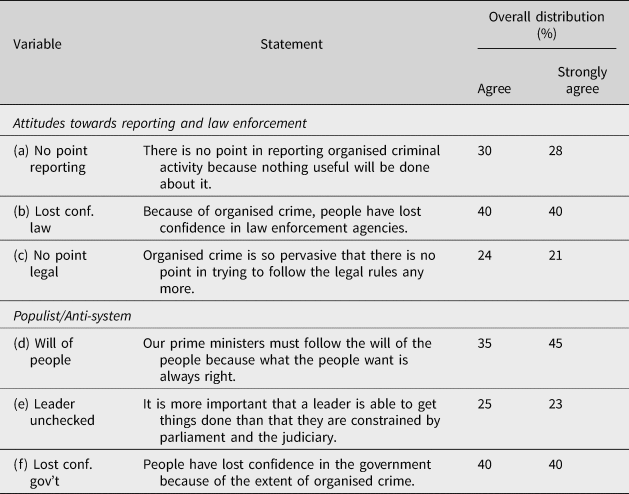
We examined whether exposure to these treatments affected agreement with six statements. We used a five-point Likert scale to measure agreement, with responses ranging from strongly disagree (1) to strongly agree (5). Table 1 displays the exact wording of each statement, as well as a note reflecting the distribution of agreement among the full sample. Three statements focused on reporting SOC and perceptions of the law and law enforcement (Table 1). These statements capture both how individuals feel about the fight against SOC (a) and what SOC means for the behaviour of citizens with regards to the rule of law (b, c). Overall, popular sentiments in Albania indicate the size of the challenge facing those who seek to combat SOC. Three-fifths of our sample agreed that there is no point in reporting organised criminal activity because nothing useful will be done about it (no point reporting). In total, 80% of the sample agreed that due to organised criminal activity, people have lost confidence in law enforcement (lost confidence law enforcement). The last statement, no point legal, approximates a resignation to systemic illegality. Nearly half of our total sample agreed that because organised crime is so pervasive, there was no point in trying to follow legal rules.
Dependent variable questions

Note: Distribution notes are based on full sample.
Three statements were included to capture populist sentiments and anti-systemic attitudes. Recognising that populist appeals classically focus on leaders who claim to represent the unmediated will of the people to overcome hostile elites and overly constraining institutions (Mudde, Reference Mudde2004: 543; Levitsky and Roberts, Reference Levitsky and Roberts2011: 6–7), we include two statements (d and e) to this effect. We also include an additional measure to capture a background condition that can facilitate the rise of anti-system parties, namely loss of confidence in the government (f). Overall, about four-fifths of our sample agreed that the prime minister should follow the will of the people because what the people want is always right (will of people) and just under half of our sample agreed that it is more important that a leader is able to get things done than that they are constrained by parliament and the judiciary (leader unconstrained), which is an important measure of public support for actions that would undermine democratic checks and balances – and hence potentially facilitate anti-system leaders and parties. Four-fifths also agreed that people have lost confidence in the government because of the extent of organised crime (lost confidence government).
Estimation strategy
Pair-wise difference in means (DIM) tests are appropriate to use when evaluating the influence of messaging in an experiment like this, when an assumption can be made that the only difference between the respondent groups is that they received different treatments or received no treatment (the control group). For this reason, DIM tests were run first with demographic indicators across groups (Supplementary Appendix C). These tests suggested that there may be small, yet potentially important differences between the three groups with regards to some of the demographic variables tested.Footnote 2
Therefore, instead of using DIM tests, we conducted ordered logistic regressions to determine how exposure to the treatment messages influenced agreement with the six statements. Doing so allows us to control for the potential influence of the range of demographic variables measured (urbanity, gender, age, education level and socio-economic status), to ensure that any differences in responses across groups detected are not due the fact that treatment groups were demographically different from that of the control group. Ordered logistic regression analyses are also appropriate because the dependent variables examined have 5-point ordered response options.Footnote 3
Our study is different from some messaging experiments that scrutinise the impact of subtle differences between messages. The two messages we test are substantially different from one another with respect to structure and tone. The reason for this is that descriptive and injunctive messages emphasise fundamentally different logics, and so the texts have to be substantially different in order to be internally coherent. Our aim is thus to examine what impact exposure to each message, individually, has on attitudes. We therefore focus our analyses on comparing the influence of exposure to each message to the behaviour of the control group, rather than on comparisons between our two treatment groups.Footnote 4 For this reason, in all analyses, the baseline group is the control group, and all reported messaging effects convey comparisons between those who were exposed to a message and those who were not. This approach is consistent with previous publications in relevant literature, such as anti-corruption messaging studies, which adopt a similar strategy for this reason (Cheeseman and Peiffer, Reference Cheeseman and Peiffer2021; Peiffer and Walton, Reference Peiffer and Walton2022).
What impact do SOC messages have on attitudes about the law and SOC?
We ran two sets of ordered logistic regressions to examine what impact exposure to each message had on agreement with our dependent variable statements. The first set focuses on the impact of messaging on attitudes about SOC and law enforcement, and so these analyses directly test whether the descriptive treatment backfired by undermining confidence in law enforcement and the belief that reporting SOC is worthwhile (H1), as well as whether the injunctive treatment had the opposite impact on these attitudes, which is the expectation described in H3. The second set of analyses focus on the impact of the messages on populist attitudes, providing a test of H2 – that the descriptive treatment will encourage populist attitudes – as well as H4 – that the injunctive treatment will not impact populist attitudes.
Impact of descriptive and injunctive messaging on attitudes about SOC and law enforcement
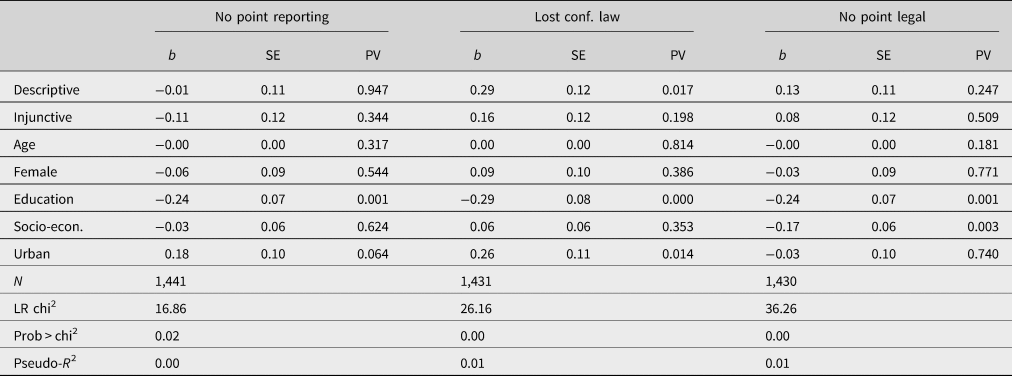
The results given in Table 2 provide some support for H1. Exposure to the descriptive treatment is significantly and positively associated with agreement that people have lost confidence in law enforcement (p-value: 0.017), a finding that echoes the literature that shows that descriptive messaging used in raising awareness to a social harm like SOC can unintentionally provoke negative feelings about elements of the state that are meant to control it (Peiffer, Reference Peiffer2017, Reference Peiffer2018; Cheeseman and Peiffer, Reference Cheeseman and Peiffer2021). However, exposure to the descriptive treatment is not significantly associated (p-values >0.10) with a belief that there is no point in reporting organised crime or that, because of organised crime, there is no point in abiding by the law. While these findings suggest that descriptive SOC messaging may not encourage these pessimistic beliefs, they also show that such messaging will likely not discourage them either.
Influences of descriptive and injunctive messaging on SOC and law attitudes
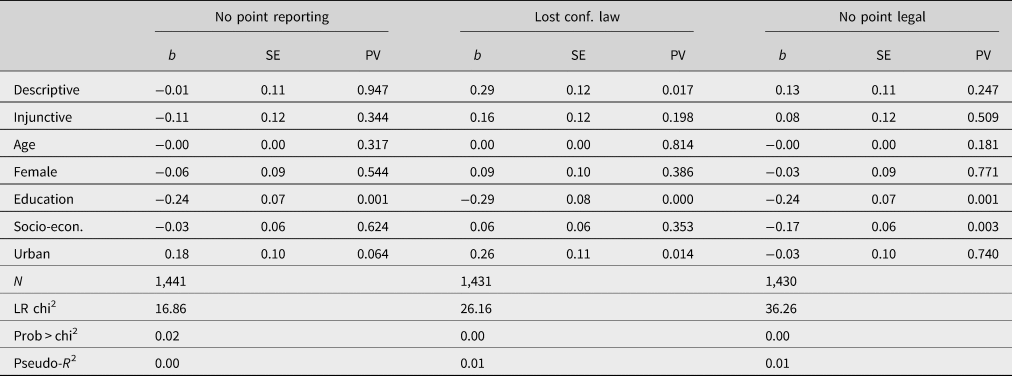
Notes: Displayed across columns are: b (coefficients), SE (standard errors) and PV (p-values).
In contrast, we find no support at all for H3 – that the injunctive norm message will work as intended, encouraging positive attitudes about law enforcement and about reporting SOC – in our Table 2 results. Instead, the results suggest that the injunctive message is uninfluential, as exposure to it does not significantly shape agreement with any of the SOC and law-related-dependent variable statements (p-values >0.10). This is an important finding, because it suggests that researchers should be cautious about the potential for injunctive norm messages to avoid the challenges that have been identified with their descriptive counterparts.
Impact of descriptive and injunctive messaging on populist attitudes
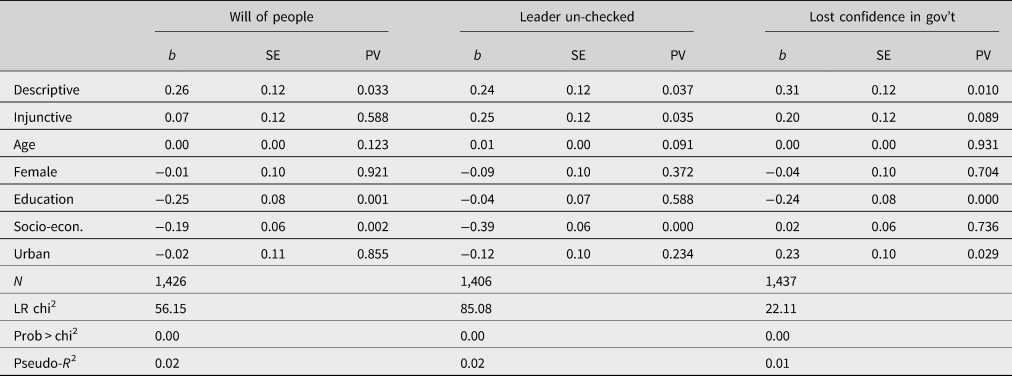
In examining the impact of the two treatments on populist attitudes (Table 3), we find considerable support for H2 – the expectation that exposure to the descriptive treatment would encourage agreement with populist sentiments. Table 3 shows that exposure to the descriptive treatment is positively and significantly associated with agreement that the prime minister must follow the will of the people because what the people want is always right (p-value: 0.033), that it is more important for a leader to get things done than that they are constrained by parliament and the judiciary (p-value: 0.037) and that, because of organised crime, people have lost confidence in the government (p-value: 0.010). These findings represent an important warning that raising public awareness about the scale of SOC can shape attitudes beyond those concerning SOC itself, in ways that may exacerbate political instability. They strongly suggest that concerns about SOC are related to these types of populist and anti-system attitudes.
Influences of descriptive and injunctive messaging on populist attitudes
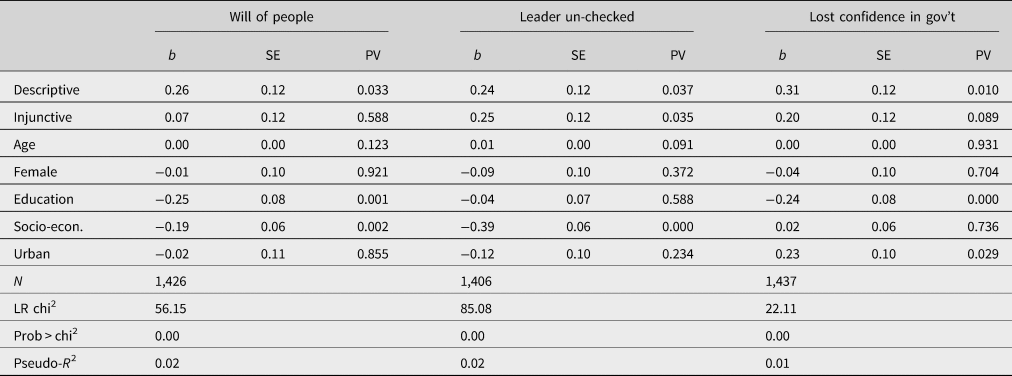
Notes: Displayed across columns are: b (coefficients), SE (standard errors) and PV (p-values).
Where H4 is concerned, our findings are also interesting, because we unexpectedly find that exposure to the injunctive treatment is associated with higher levels of agreement that it is more important for a leader to get things done than to be constrained by parliament and the judiciary (p-value: 0.035), as well as higher levels of agreement that people have lost confidence in the government because of the extent of organised crime (p-value: 0.089). Indeed, unreported Wald's tests estimate that exposure to the injunctive message has the same degree of influence in encouraging agreement with both of these statements as exposure to the descriptive message.Footnote 5 Although we also find that the injunctive norm treatment is not significantly associated with the other populist attitude we examine – will of people (p-values >0.10) – the fact that it appears to facilitate beliefs that are in tension with the strengthening of democratic checks and balances means that H4 is not confirmed. Where SOC messaging is concerned, our results mean that neither descriptive nor injunctive norms are found to be completely ‘safe’ from unwanted side effects.
Conclusion
This article contributes to the literature on social bads awareness-raising messaging and social norms by conducting the first ever systematic analysis of the impact of counter-SOC narratives that features both descriptive and injunctive norms. We find that, as expected, using descriptive norms was associated with reduced confidence in Albanian law enforcement agencies and in the government, as well as increased support for the removal of constraints on political leaders, and a demand that the government must always reflect the will of the people. We also find that, unexpectedly, the message channelling an injunctive norm did not have a positive effect, and actually backfired by increasing agreement that it is more important for a leader to get things done than for them to be constrained by checks and balances, and that people have lost confidence in the government due to SOC.
The extent to which these effects are seen to represent negative social and political consequences will vary depending on the outcome and one's preferences and beliefs. The weakening of checks and balances will concern democrats, while the growth in support for populist movements will worry those who think that evidence-based policy and rigorous scrutiny is the best way to govern a country. By contrast, a fall in confidence in the government or law enforcement activities, if this is driven by poor performance, may be seen as no bad thing – and indeed a potential positive trend if it leads to more realistic public attitudes towards such institutions. What is clear, however, is that these outcomes are generally unintended and unwanted by the types of organisations that deploy counter-SOC messaging.
That a message about a ‘social bad’ has had an unwanted impact, without explicitly emphasising the descriptive norm in its content, is consistent with at least one study on anti-corruption awareness raising. Peiffer (Reference Peiffer2017, Reference Peiffer2018), for example, found that a positively toned message that avoided discussing the prevalence or consequences of corruption and focused only on the ways citizens can get involved in civic anti-corruption activism also ‘backfired’ by increasing worry about corruption, reducing pride in the government's response and willingness to engage in anti-corruption civic activism. This suggests that when they are unable to inspire optimism, even positive messaging about ‘social bads’ risk simply reminding people about the scale of the problem itself, and hence priming unwanted responses.
These findings do not mean that all public awareness raising around SOC should be ended. Awareness raising has a long history within crime prevention and can play many roles. Simple messages to inform citizens about how to report crime may work to enable people to take action, for instance. Finckenauer and Chin (Reference Finckenauer, Chin, Bullock, Clarke and Tilley2013), for example, report that a Turkish municipality seeking to reduce sex trafficking ‘sent utility bills to customers with a refrigerator magnet attached’ that included a hotline number to encourage the public and potential victims to contact officials if they thought someone was in danger (Reference Finckenauer, Chin, Bullock, Clarke and Tilley2013: 76). According to the Turkish National Police, ‘116 trafficking victims were rescued in 2006 as a result of a hotline contact’. This initiative suggests that campaigns that share practical information may have significant concrete benefits, though it is unclear as to whether this particular campaign changed people's perceptions of sex trafficking as well. Our research suggests that potential positive benefits may be missing, however, from messages that solely focus on shifting public attitudes and beliefs, rather than sharing information about new ways to report crime.
The findings of this paper therefore have significant implications for how we design campaigns to fight SOC and other social bads in the contemporary world. Contrary to the early hopes of the social psychology literature, injunctive norm messaging may also fail to secure the desired effect and generate unwanted consequences. It is not enough for those designing these campaigns to simply come up with positive messages about social attitudes. Instead, those hoping to raise awareness need to have a deep understanding of existing public attitudes. This can come, in part, from conducting public opinion surveys, which can give insight into how different groups feel about social bads. But even the best designed surveys may not provide an accurate picture of how individuals respond to a specific message. It is therefore imperative that all messaging strategies – including those that emphasise a positive injunctive norm – are systematically tested before they are deployed. This will add to the cost of counter-SOC and other counter-social bads work, but it will reduce the risk that money spent on these activities is wasted – and worse, that such investments actively contribute to the problems they are designed to address.
Supplementary material
The supplementary material for this article can be found at https://doi.org/10.1017/bpp.2024.18.
Data
The data that support the findings of this study are openly available in Harvard Dataverse, V1.
Acknowledgements
This research was funded by UK Foreign, Commonwealth, & Development Office, through the Serious Organised Crime & Anti-Corruption Evidence (SOC ACE) research programme. We are grateful to the FCDO-Albania programme team for helping us, and to the team at IDRA for assisting us with conducting the fieldwork. We also thank Niheer Dasandi and Heather Marquette for reviewing previous drafts and providing helpful feedback. The views here do not necessarily reflect the UK Government's official policies.


 Open access

