


Introduction
Despite the high diversity of carnivores in Turkey information about them is limited and there is almost no monitoring of carnivores or other large mammals (Can & Togan, Reference Can and Togan2004). Poor knowledge of species ranges and population status hinder conservation initiatives for carnivores (Holloway & Swift, Reference Holloway and Swift1967; Huş, Reference Huş1974; Turan, Reference Turan1984).
Wildcats occur throughout parts of Eurasia and Africa (Nowell & Jackson, Reference Nowell and Jackson1996; Sunquist & Sunquist, Reference Sunquist and Sunquist2002; Bashta & Potish, Reference Bashta and Potish2005; Heltai et al., Reference Heltai, Biró and Szemethy2006), and are generally associated with forests (Macdonald & Barrett, Reference Macdonald and Barrett1993; Sunquist & Sunquist, Reference Sunquist and Sunquist2002). They take mostly small prey (rodents and birds) but also catch larger species such as hares (Lepus spp.) and young deer (Cervus spp.; Sunquist & Sunquist, Reference Sunquist and Sunquist2002). Wildcats are solitary and males and females associate only for mating (Sunquist & Sunquist, Reference Sunquist and Sunquist2002), which occurs mostly from mid February to late March, with the young born in April or May (Macdonald & Barrett, Reference Macdonald and Barrett1993; Sunquist & Sunquist, Reference Sunquist and Sunquist2002). The major threats to wildcats are persecution by humans and hybridization with domestic cats (Macdonald & Barrett, Reference Macdonald and Barrett1993; Beaumont et al., Reference Beaumont, Barratt, Gottelli, Kitchener, Daniels, Pritchard and Bruford2001; Randi et al., Reference Randi, Pierpaoli, Beaumont, Ragni and Sforzi2001; Sunquist & Sunquist, Reference Sunquist and Sunquist2002). Hybridization may threaten (Pierpaoli et al., Reference Pierpaoli, Birò, Herrmann, Hupe, Fernandes and Ragni2003) and even have caused the extinction of some local wildcat populations (Yamaguchi et al., Reference Yamaguchi, Kitchener, Ward, Driscoll and Macdonald2004).
Although categorized globally on the IUCN Red List as Least Concern (Driscoll & Nowell, Reference Driscoll and Nowell2009) the European wildcat is listed as a Strictly Protected Fauna Species in Annex II of the Convention on the Conservation of European Wildlife and Natural Habitats (Bern Convention), which was ratified by the Turkish Government on 2 May 1984 (Council of Europe, 2008). The species is protected by law in Turkey and any form of hunting or killing is prohibited (Turkish Ministry of Environment and Forestry, 2008).
The objectives of the study reported here were to evaluate the available information on the wildcat and its current status in Turkey, to examine the activity patterns and population size of the wildcat in one particularly important site, the Yaylacı k Research Forest, using camera trapping, and to provide baseline data to promote further research on the wildcat in Turkey.
Study area
The camera-trapping survey was conducted in the c. 50 km2 Yaylacı k Research Forest which lies within the c. 750 km2 Yenice Forest in northern Turkey (Fig. 1a), an area with an intact large mammal fauna of global importance (Morrison et al., Reference Morrison, Sechrest, Dinerstein, Wilcove and Lamoreux2007). Elevations are 100–2,000 m, most of the mean annual precipitation of 1,200 mm falls in the spring, and the mean number of days per year with snow is 25 (Can & Togan, Reference Can and Togan2009). Tree species include spruce Picea orientalis, the Balkan maple Acer hyrcanum, beech Fagus orientalis, Caucasian fir Abies nordmanniana, common ash Fraxinus excelsior, European hornbeam Carpinus betulus, Istranca oak Quercus hartwissiana, Norway maple Acer platanoides, Quercus petraea, Scots pine Pinus sylvestris, Turkey oak Quercus cerris and yew Taxus baccata (Lise, Reference L˙se2005; Can & Togan, Reference Can and Togan2009). As the entrance to the Yenice Forest is controlled by the forestry service and no recreational activities are allowed, human densities are low throughout the year.
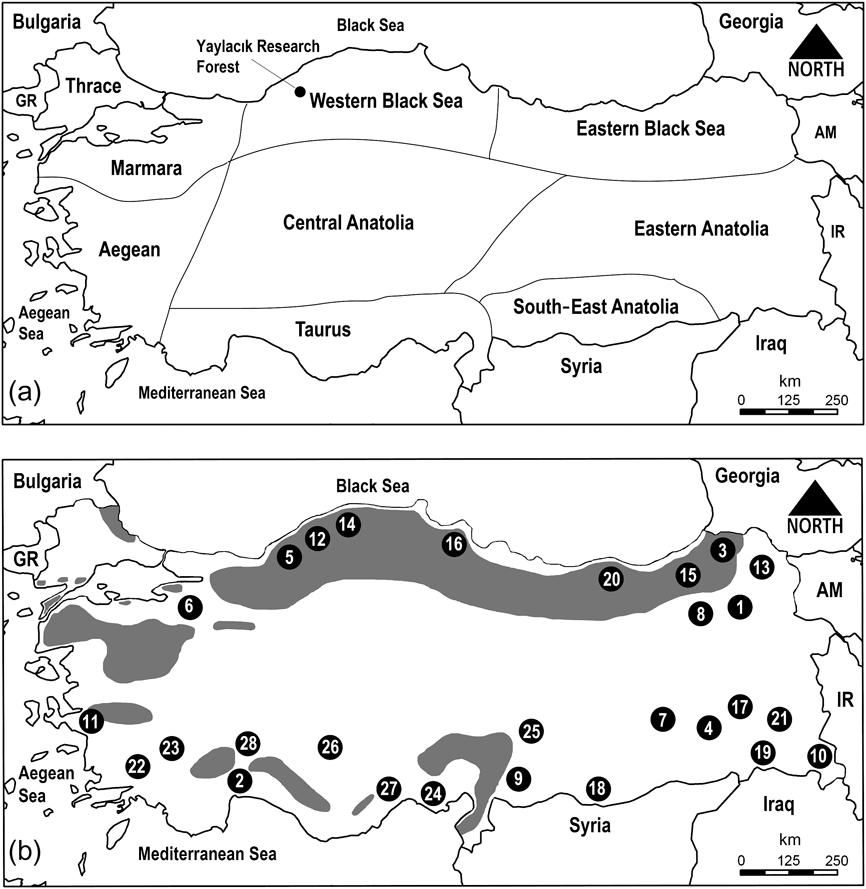
(a) The regions of Turkey and the camera-trapping survey site, Yaylacı k Research Forest in Yenice Forest. (b) Range map of the wildcat in Turkey (shaded areas, based on historical data, interviews and field visits; see text for details) and locations of the provinces in which we visited forest sites to search for signs of the wildcat: 1, Ağrı ; 2, Antalya; 3, Artvin; 4, Bitlis; 5, Bolu; 6, Bursa; 7, Diyarbakı r; 8, Erzurum; 9, Gaziantep; 10, Hakkari; 11, İzmir; 12, Karabük; 13, Kars; 14, Kastamonu; 15, Rize; 16, Samsun; 17, Siirt; 18, Şanlı urfa; 19, Şı rnak; 20, Trabzon; 21, Van. Other provinces mentioned in the text are: 22, Muğla; 23, Denizli; 24, Adana; 25, Kahramanmaraş; 26, Konya; 27, Mersin; 28, Isparta.
Methods
Countrywide survey
We firstly reviewed the available literature on the wildcat in Turkey, which was summarized in part by Kumerloeve (Reference Kumerloeve1967) and Turan (Reference Turan1984). We used the most recent forest inventory data and forest map (Turkish Ministry of Environment and Forestry, 2006) to assess potentially suitable habitats for the wildcat. We then conducted a countrywide questionnaire survey, with questionnaires disseminated to 331 local forestry stations, to collect information on the occurrence of the wildcat in the Taurus and South-east Anatolia regions (Fig. 1a). The questionnaire included questions on the occurrence of the wildcat and other mammalian species, habitats, and major threats to habitats and wildlife in general. The distributions of wildcat prey species were identified from Kryštufek & Vohralik (Reference Kryštufek and Vohralik2001, Reference Kryštufek and Vohralik2005). We then, in 2000–2007, made opportunistic visits to selected sites in 21 provinces (Fig. 1b) throughout Turkey to meet local forestry personnel, people and hunters and to collect further information. We visited forest sites to evaluate habitat suitability for wildcats and to document any presence signs (tracks, prey remains and scats) of the species.
Camera-trap survey
During January–May 2006 we conducted five sessions of camera trapping in the Yaylacı k Research Forest, which lies within Yenice Forest (Fig. 1a), using 12 CamTrakker (CamTrakker, Georgia, USA) and four DeerCam (DeerCam, Park Falls, USA) passive infrared camera traps. We divided the 50-km2 study area into fifty 1-km2 cells using a 1:50,000 map provided by the Central Anatolia Forestry Research Institute of the Turkish Ministry of Forestry. In each session we set up camera traps in an area of 8 km2 for 15 days, and then moved the traps to the next 8-km2 area for 15 days, and so on until we had surveyed 40 km2 (Karanth & Nichols, Reference Karanth and Nichols2002; Karanth et al., Reference Karanth, Chundawat, Nichols and Kumar2004). The average distance between camera traps in each session was c. 1 km. The total survey effort was 1,200 camera trap days.
We placed the camera traps to maximize the total number of photo-captures (Karanth & Nichols, Reference Karanth and Nichols2002; Holden et al., Reference Holden, Yanuar and Martyr2003; Wallace et al., Reference Wallace, Gomez, Ayala and Espinoza2003; Karanth et al., Reference Karanth, Chundawat, Nichols and Kumar2004; Maffei et al., Reference Maffei, Cuellar and Noss2004; Silver, Reference Silver2004; Wegge et al., Reference Wegge, Pokheral and Jnawali2004) and recorded their locations with a global positioning system. The camera traps were set for a 3-minute delay between photographs and 24-hour operation. Each camera trap was attached to a tree with padlocks, to prevent theft. Camera-trap performance was checked with test shots at the beginning of each session. After each session all films and batteries were replaced.
Individual camera-trapped wildcats were identified by general physical appearance and the unique patterns of tail rings. Assuming that timing of wildcat captures reflects their activity pattern, we grouped photographs into 6-hour intervals (Kawanishi, Reference Kawanishi2002; Maffei et al., Reference Maffei, Noss, Cuellar and Rumiz2005; Azlan & Sharma, Reference Azlan and Sharma2006; Bitetti et al., Reference Bitetti, Paviolo and De Angelo2006; Dillon & Kelly, Reference Dillon and Kelly2007).
We constructed a capture history matrix of 1s (captures) and 0s (non-captures) of individual wildcats across the five sampling occasions. The software MARK was used to estimate the wildcat population size using the assumption of population closure (White & Burnham, Reference White and Burnham1999). MARK offers four main population size estimators: model M 0 (capture probabilities of individuals are constant regardless of time, behaviour or heterogeneity in captures), model M h (capture probabilities of individuals are intrinsically heterogeneous), model M b (capture probabilities depend on animal behaviour, and model M t (capture probabilities are time specific). There are also four complex models (M bh, M th, M tb and M tbh) that incorporate the effects of heterogeneity, trap response and time in various combinations. To select the best-fit model and assess its parameters we used the model selection function of MARK, which scores the models between 0 (the poorest model) and 1 (the best model). We used a χ2 goodness-of-fit test (Daniel, Reference Daniel1999) to determine the relationship between wildcat captures and location of camera traps on forest roads, trails and slopes.
Results
Countrywide survey
According to the questionnaire results and the information available in the literature the wildcat is present in the Thrace, Marmara, Aegean, Taurus, Western and Eastern Black Sea Mountains and Eastern Anatolia regions of Turkey (Fig. 1b). The Western and Eastern Black Sea Mountains are the most suitable regions for wildcats given the extent of suitable habitat and the diversity of prey (Table 1). Thrace has a diversity of suitable prey species.
Major habitats, distribution, relative abundance and prey species of the wildcat Felis silvestris in Turkey (Fig. 1).
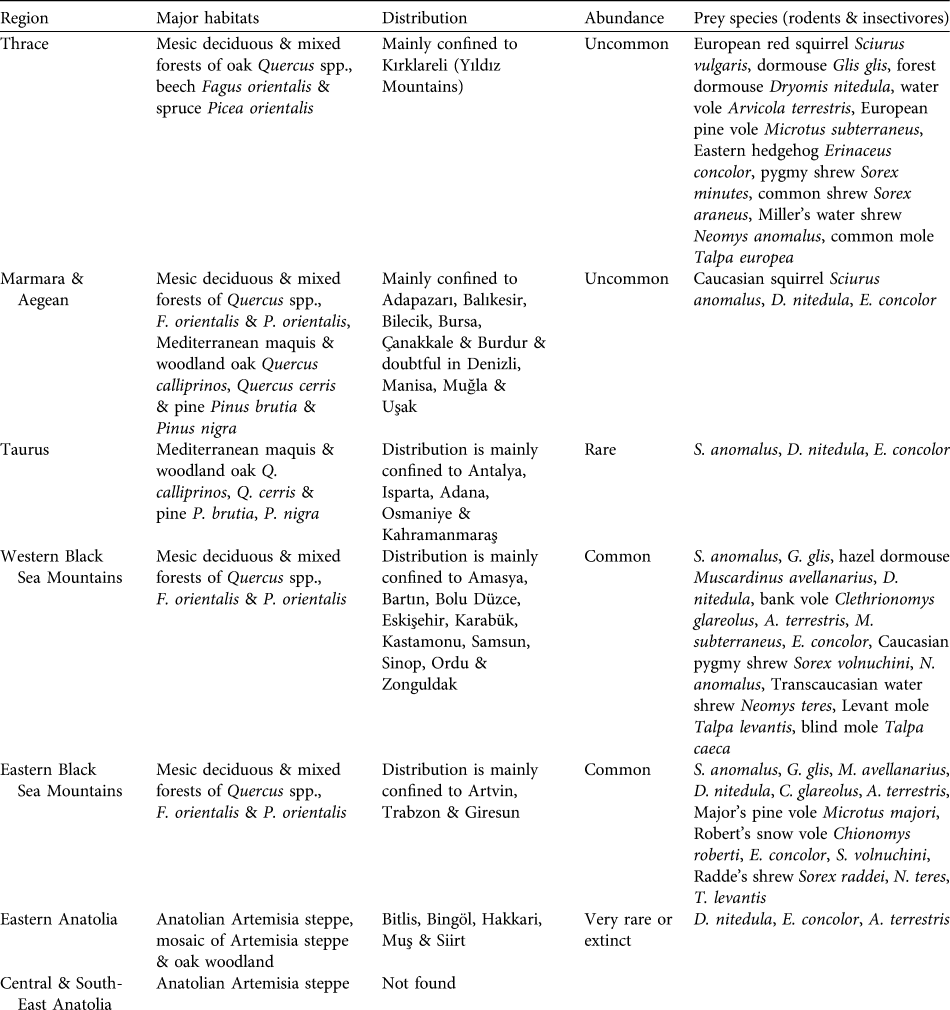
The prime wildcat habitats in Turkey are characterized by mesic deciduous and mixed forests of oaks Quercus spp., beech F. orientalis and spruce P. orientalis in northern Turkey. We did not document presence of the wildcat at the sites we visited in Ağrı , Bitlis, Hakkari, Kars, Şanlı urfa, Siirt, Şı rnak and Van. The questionnaire study conducted in the Taurus region provided information on the occurrence of the species in southern Turkey. All the respondents of the questionnaire survey from Muğla (n = 45) and Denizli (n = 34) stated that the wildcat is not present there. According to the questionnaire responses (n = 252) from Adana, Antalya, KahramanmaraŞ, Konya, Mersin and Isparta the wildcat is present in these provinces. The distribution map (Fig. 1b) was produced by synthesizing the results of the field visits, questionnaire responses and the forest map of Turkey.
Camera-trap survey
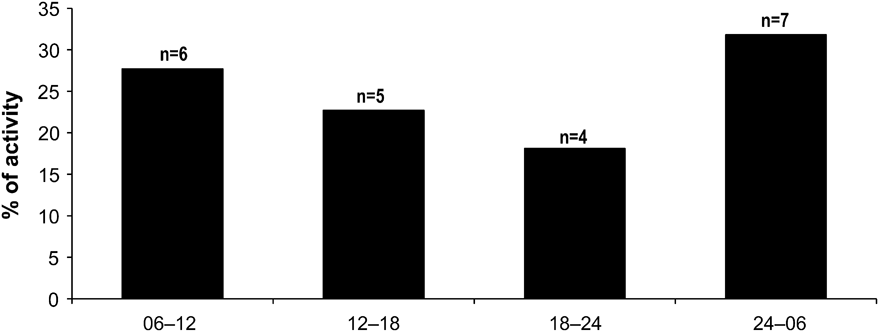
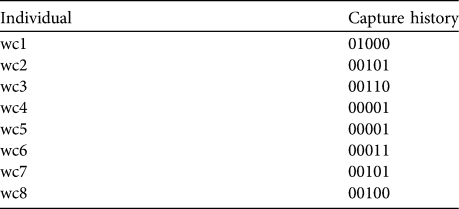
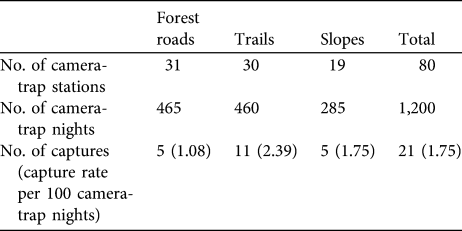
The camera-trap survey documented the wildcat in the Yaylacı k Research Forest (Plate 1). We obtained 402 records of animals of which 22 were of wildcats and 13 were appropriate for individual recognition. Relative abundance of wildcats was 18.3 per 1,000 camera-trap days. Eight different individual wildcats were identified from 12 camera-trap records (Table 2) across the five camera-trap sessions, i.e. an average of 150 camera-trap days were required to document the presence of an individual. The assumption of population closure, checked with MARK, was not violated (χ 2 = 4.41354, df = 2, P = 0.11006). The model selection algorithm selected the null model M 0 as the best fit. The estimated population size was 11.00 ± SE 2.97 (95% confidence interval 9–23). The distribution of the 80 camera-trap stations on forest roads, trails and slopes is given in Table 3. Captures of wildcats did not differ significantly across these location types (χ 2 = 0.491, P > 0.05). Activity patterns of wildcats in the Yaylacı k Research Forest were equally diurnal (06.00–18.00, 50.4%) and nocturnal (18.00–06.00, 49.6%; Fig. 2).
The activity pattern of wildcats camera-trapped in Yaylacı k Research Forest, summarized in 6-hour periods.
Camera-trap photograph of a wildcat in Yaylacı k Research Forest (Fig. 1a).

The capture history of eight individual wildcats camera-trapped in the Yaylacı k Research Forest across five sampling occasions (see text for details).
Number of camera-trap stations, camera-trap nights and wildcat captures on forest roads, trails and slopes.
Discussion
Kumerloeve (Reference Kumerloeve1967) provided the first information on the occurrence of the wildcat throughout Turkey. Turan (Reference Turan1984) later modified the map of Kumerloeve (Reference Kumerloeve1967), showing a greater range for the wildcat. Reviewing the available information we conclude that the current range of the species is much narrower than previously believed. We failed to document the presence of wildcats in the provinces of Ağrı , Diyarbakı r, Gaziantep, İzmir, Kars, Şanlı urfa, Şı rnak and Van, from where the species has probably vanished since Kumerloeve (Reference Kumerloeve1967) drew his map. Turan (Reference Turan1984) suggested that the wildcat occurred in the Marmara, Aegean and Taurus regions but we conclude that its current day distribution is limited there. In the Taurus region most forests are conifer and maquis, inappropriate for wildcats, and thus the species range is mainly confined to the Kahramanmaraş region, which contains the largest area of deciduous forest. We believe that the presence of wildcats in Erzurum, Bitlis, Siirt and Hakkari is doubtful because we did not document the species in the sites we visited. However, wildcat signs are difficult to find and may be confused with other species such as foxes Vulpes vulpes, jungle cats Felis chaus and martens Martes sp. If present in eastern Turkey the wildcat population there is isolated from that in other parts of the country and would be a priority region for conservation of the species.
Most of the prime wildcat habitat is in northern Turkey, including Thrace, and there is a need for conservation initiatives in this region. In the Marmara, Aegean and Taurus regions the wildcat population is heavily fragmented, possibly consisting of several isolated subpopulations, and the issue of connectivity deserves further research.
Although wildcats are normally crepuscular and nocturnal (Macdonald & Barrett, Reference Macdonald and Barrett1993) in the Yaylacı k Research Forest they are also diurnal (although our sample size of 22 photo-captures is small). Human-related land-use types such as roads can affect the behaviour of wildcats (Klar et al., Reference Klar, Fernandez, Kramer-Schadt, Herrmann, Trinzen, Büttner and Niemitz2008) but photo-capture rates in Yaylacı k Research Forest did not differ between forest roads, trails and slopes.
The Yenice Forest (750 km2), which includes the Yaylacı k Research Forest (50 km2) and two small protected areas (c. 12 km2), is one of the largest intact forests in Turkey but it does not have a protection status. Considering the size of the area, the general absence of human disturbance and the availability of prey species, Yenice Forest probably holds one of the largest wildcat populations in the country and may be one of the most important areas for conservation of the species. However, some sites within Yenice Forest have been logged, generating income for the state and local communities (Lise, Reference L˙se2005). The Yaylacı k Research Forest is meant to be used only for research purposes but selective logging is currently allowed during some part of the year to mitigate the pressure from local communities for the use of forest resources (Can & Togan, Reference Can and Togan2009). Nevertheless, the remoteness and intactness of the region reduces the risk of hybridization with the domestic cat Felis cattus, which is a main concern in most parts of Europe (Beaumont et al., Reference Beaumont, Barratt, Gottelli, Kitchener, Daniels, Pritchard and Bruford2001; Pierpaoli et al., Reference Pierpaoli, Birò, Herrmann, Hupe, Fernandes and Ragni2003; Yamaguchi et al., Reference Yamaguchi, Kitchener, Ward, Driscoll and Macdonald2004). The future of Yenice Forest will only be secured if it is given a protection status and the appropriate environmental legislation is enforced.
Political pressure from local communities to utilize parts of Yenice Forest is increasing (Can & Togan, Reference Can and Togan2009) and the Ministry of Environment and Forestry General Directorate of Forestry is considering selective cutting in some parts of Yaylacı k Research Forest. We have presented our findings to the relevant authorities and urge the Turkish Ministry of Environment and Forestry authorities to reconsider any future logging in Yaylacı k Research Forest. We recommend that the Turkish nature conservation organizations, particularly WWF Turkey, which identified Yenice Forest as a global forest hotspot, focus their attention on this region.
Acknowledgements
We thank Tuğba Can, Yı ldı ray Lise, Emin Nasuhoğlu, Dave Garshelis and Fridolin Zimmermann for their assistance, Metin Karadağ, Murat Başar, Durmuş Kanca, Mehmet Özgün and İsmet Telli for help with fieldwork, and two anonymous reviewers who helped us improve this article.
Biographical sketches
Özgün Emre Can’s research interests are in large carnivore monitoring and conservation. He is the founder of the Carnivore Initiative for Turkey, co-chair of the IUCN Bear Specialist Group South Asia Brown Bear Expert Team and a member of the IUCN Wolf, Hyaena, Canid and Cat Specialist Groups. İrfan Kandemi̇r studies population biology and genetics, including the molecular systematics of honeybees in Turkey and the Middle East, and is now applying genetic techniques to rodents such as Rattus, Nannospalax, Clethryonomys and Apodemus. İnci̇ Togan carries out research on population biology and genetics. She has previously studied the brown trout of Turkey and is currently studying the evolutionary history of human populations, domestic sheep and dogs in Anatolia. Using these studies she is hoping to be able to identify a strategy to prioritize the conservation of Anatolian sheep breeds.



