




Introduction
From an archaeological perspective, the direct observation of historical tipping points is rare. The ‘Big Bang’ that dramatically shifted the organisation and composition of Mississippian Cahokia in the Southeast USA around AD 1050 is well-documented in the sweeping changes to public plaza spaces and shifts in household material culture that followed (Pauketat & Alt Reference Pauketat and Alt2005; Beck et al. Reference Beck, Bolender, Brown and Earle2007). But we can now only speculate about the event or events—such as the ceremonial erection of a large cypress marker post in a centre plaza—that crystallised this major transformation of Mississippian history in the minds and memories of the Mississippians themselves. The arrival of Teotihuacanos to the Maya city of Tikal on 11 Eb 15 Mak (16 January AD 378) is recorded in post-factum textual documents and in the archaeological evidence of Teotihuacan presence or influence at the site at around this time (Stuart Reference Stuart, Carrasco, Jones and Sessions2000; Houston et al. Reference Houston, Ramírez, Garrison, Stuart, Ayala and Rosales2021; Moholy-Nagy Reference Moholy-Nagy2021), yet the arrival itself, occurring as a distinct event, is unknown in material terms. Such monumental events are historically contingent and emerge from the structural patterns and contexts of socially embedded ways of being (Marx Reference Marx1963; Giddens Reference Giddens1984). Yet, some moments stand out as particularly ‘eventful’; embodying simultaneously the termination of an era and the emergence of possibility (Sahlins Reference Sahlins1985, Reference Sahlins2005; Sewell Reference Sewell1996).
This article presents evidence for an early-ninth-century ritual fire-burning event at the Maya site of Ucanal, the capital of the K'anwitznal kingdom (Figure 1). Occurring at the dawn of a new political era in the Maya Lowlands during the Terminal Classic period (c. AD 810–950), this event marked a moment of change in the kingdom and in the Lowlands more generally, fulfilling Sewell's (Reference Sewell1996: 844) concept of an ‘event’ in history as an occurrence that not only imparts significant structural change but is recognised as significant by contemporaries. Much epigraphic and archaeological research in the Maya area has focused on the collapse of Classic Maya polities at the end of the eighth and the beginning of the ninth century AD, examining patterns in the last dated monuments or in the ritual termination and abandonment of elite palatial and ceremonial architecture. Rather than examine this fire-burning event as a bookend to Maya history, we view it as a pivot point around which the K'anwitznal polity reinvented itself and the city of Ucanal went on to a flourishing of activities.
Regional map of the Maya area with selected sites mentioned in the text (figure by C. Halperin).

New leadership in the K'anwitznal kingdom
One of the major transitions in the political history of the K'anwitznal kingdom came at the very beginning of the ninth century with the assumption of leadership by Papmalil (or Papamalil). The name Papmalil is unprecedented among Ch'olti’an texts of the Classic period and may have been foreign in origin, deriving from either Chontal Maya (Martin Reference Martin2020: 290, 295–6) or Nahua (Pallán Gayol & Meléndez Guadarrama Reference Pallán Gayol, Meléndez Guadarrama and van Broekhoven2010: 18–19), with the latter long having influenced Chontal Maya along the Gulf Coast. Papmalil ruled not with a royal title incorporating the K'anwitznal emblem glyph but as an ochk'in kaloomte’, a high title often associated with military leaders and powerful overlords of the highest status (Martin Reference Martin2020: 259–60, 290; Grube Reference Grube, Okoshi, Chase, Nondédéo and Arnauld2021: 41–2). Although we have no written record indicating when he came to power, texts from other sites mention his (or his namesake's) involvement in alliances, joint acts of warfare, gift-giving and supervision of ceremonies for a period between c. AD 814–859.
Papmalil's rule was not only seminal because of his possible foreign origins—perhaps breaking the succession of ruling dynasts at the site—but also because his rule shifted political dynamics in the southern Maya Lowlands. Most notably, Papmalil appears on Altars 12 and 13 at the site of Caracol, both dedicated in AD 820, in the act of gift exchange with the Caracol king, Toobil Yopaat (Grube Reference Grube, Chase and Chase1994: 95–6) (Figure 2). The fact that Altar 23, dedicated only 20 years earlier, depicts a K'anwitznal ruler, Xub Chahk, captive and in a state of bondage, underscores a rather abrupt change in relations (Stuart Reference Stuart2019). Simon Martin (Reference Martin2020: 160) argues that the mention of Papmalil on Caracol Altar 13 three times as opposed to twice for the Caracol king suggests that Papmalil was the dominant player in these exchanges. As detailed on Stela 32 at Naranjo, also dedicated in AD 820, Papmalil may have also presided over the accession rituals of the Naranjo king Waxaklajuun Ubaah K'awiil in AD 814 because the Naranjo king appears on Papmalil's palanquin (Martin Reference Martin2020: 295–6). Again this marks a change in relations from the Late Classic period when Naranjo's ruler, K'ahk’ Tiliiw Chan Chahk, conquered Ucanal (AD 698), initiating Naranjo's dominance over the K'anwitznal kingdom that lasted until at least 744–748 (Houston Reference Houston and Houston1983; Carter Reference Carter2016).
Left) illustration of Caracol Altar 12 showing Papmalil of K'anwitznal seated across and left from Caracol ruler, K'inich Toobil Yopaat, AD 820 (drawing by N. Grube, used with permission); right) Caracol Altar 13 showing Papmalil standing left of Caracol ruler, K'inich Toobil Yopaat, AD 820 (modified from University of Pennsylvania image Obj. 51-54-9) (figure by authors).

The K'anwitznal kingdom appears to have also forged key alliances with Nakum and Ceibal during the early Terminal Classic period. The K'anwitznal leader, Chan Ek’ ho’ pet, for example, installed the new Ceibal ruler, Wat'ul K'atel, to power on the eve before the turning of the 10th baktun in the Maya long-count calendar in AD 829 (Schele & Mathews Reference Schele and Mathews1998: 178–80). Under Wat'ul K'atel and for at least a century afterward, Ceibal experienced a renaissance of activity with household constructions, the erection of new monuments and the building of new types of ceremonial architecture, such as an I-shaped ballcourt and a circular shrine structure (Tourtellot Reference Tourtellot1988; Bazy & Inomata Reference Bazy and Inomata2017). During this time, the name Papmalil is mentioned on Stela 2 at Nakum in 849, named here as an elk'in kaloomte’ or eastern kaloomte’ (Zralka et al. Reference Zralka, Helmke, Martin, Koszkul and Velásquez2018: 22), and on Altar 1 at Ixlu in 859, where he was identified as a northern kaloomte’ (Martin Reference Martin2020: 290).
At the site of Ucanal, Papmalil appears to have ushered in an era of prosperity. Excavations first by the Proyecto Atlas Arqueológico de Guatemala, directed by Juan Pedro Laporte, and more recently by the Proyecto Arqueológico Ucanal (PAU), directed by Christina Halperin, Jose Luis Garrido (2014–2022) and Carmen Ramos (2023–present) reveal that substantial construction occurred in both the civic-ceremonial core and outer residential zones of the city with a slight increase in residential population between the Late Classic B'aaluum phase (c. AD 700–810) and the Terminal Classic Winik phase (c. 810–950) (Laporte & Mejía Reference Laporte and Mejía2002; Laporte Reference Laporte, Demarest, Rice and Rice2004; Halperin et al. Reference Halperin, LeMoine and Pérez Zambrano2019, Reference Halperin, Flynn-Arajdal, Miller Wolf and Freiwald2021; Halperin Reference Halperin2021). Several large phases of civic-ceremonial construction can also be attributed to the early Winik phase, c. 810–850/870. For example, Ballcourt 1 was constructed during this time and represents one of the largest ballcourts in the region at 40m long (Halperin et al. Reference Halperin, Cruz Gómez, Radenne, Bigué, Halperin and Garrido2020a & Reference Halperin, Garrido, Salas and LeMoineb) (Figure 3). The tallest building at the site, Structure A-5, and another large temple-pyramid building, Structure A-12, were also built during the early Terminal Classic period, creating a new centrally located east-west building axis in Plaza A, the oldest and most sacred ceremonial zone in the city (Laporte & Mejía Reference Laporte and Mejía2002: 9, 11, fig. 12).
Left) plan of part of the Ucanal site core showing the location of Structure K-2; right) illustrated reconstruction of Structure K-2 in its final phase (reconstruction by L.F. Luin) (figure by authors).

The ‘fire enters’ ritual at Structure K-2
During excavations at Ucanal in 2022, a burnt deposit that included human bone and other artefacts (Burial 20-1) was found in construction fill at the summit of Structure K-2, a temple-pyramid situated in the public Plaza K (Figure 3; Perea Reference Perea, Halperin and Garrido2023). The Burial 20-1 deposit was situated on an eroded floor of the penultimate architectural phase of the temple-pyramid (Sub-1) and covered by its final phase of architecture, which consisted of a rectangular temple with a low masonry wall that would have served as the base for a perishable upper wall and roof (Perea Reference Perea, Halperin and Garrido2023). The burning does not appear to have been conducted in the place of deposition since the limestone blocks and floor did not have evidence of fire damage. The final phase temple constructed over the deposit sat on a raised foundation whose floor (#1) was 1.5m above the previous phase floor (floor #2, which was part of Structure K-2, Sub-1) (Figure 4). The construction fill covering the deposit was built up using construction pens of rough wall alignments of cut stone blocks without mortar. The walls were roughly constructed and only 0.15–0.25m thick, too narrow to have served as the walls of a previous temple or building. The ceramics within this fill date to the early Winik phase, which is consistent with an accelerator mass spectrometry radiocarbon date of cal AD 773–881 (1218±18 BP at 92.3% probability using OxCal v4.4, UOC-20030) obtained from charcoal in the burial 20-1 deposit. The preservation of soot and other evidence of burning was excellent, indicating that the deposit had not been exposed to the elements for any length of time prior to the commencement of construction.
South profile of excavations at the summit of Structure K-2, showing the location of the Burial 20-1 deposit in red (with its largest concentration in dark red) in Unit 20B-32 and the large sculpted blocks used as the fill for its final-phase construction episode (figure by M. Perea).

Of note is the fact that most of the construction fill is composed of large, nicely carved stone blocks that would normally comprise the facing stones of a monumental building rather than its interior fill. The use of enormous quantities of recycled facing stones as construction fill was a common early Terminal Classic practice at the site. For example, the fill for the construction of the large 40m-long ballcourt (Ballcourt 1) and for one foundational phase of an elite residential platform (Group J) are also composed almost entirely of cut facing stones and, occasionally, vault stones that were likely dismantled from an earlier building or buildings (Halperin Reference Halperin2021). Radiocarbon and ceramic analyses indicate that these massive construction episodes also date to the very beginning of the Terminal Classic period.
The Burial 20-1 deposit consisted of fine black soot mixed with burnt and fragmented human bone and body ornaments (Figures 5 & 6). None of the bones were articulated but most of the bone, ornaments and soot were concentrated in a 0.6m-diameter zone (Figure 5a) in roughly the centre line of the building platform. Although some of the bone fragments and broken ornaments were found scattered as much as 1.5m away, covering a zone that extended into units UCA20B-31 and UCA20B-32, these bone and ornament fragments were also mixed slightly with the stone fill, indicating that the fill stones had been thrown into construction pens with no effort to protect the Burial 20-1 deposit.
Burial 20-1 deposit: a) largest concentration of soot, ash, human bone and ornaments, UCA20B-32-3-3520 (photograph by. M. Perea); b & c) burnt, cracked and warped long bone fragments, Individual 20-1A (photographs by C. Halperin & C. Bello-Hernandez); d) partially burnt femoral head fragment, Individual 20-1B (photograph by C. Bello-Hernandez).

Burial 20-1 human remains
Osteological analysis indicates that the minimum number of individuals within the deposit is four, all of which were adults (Figure 5c & d; see also online supplementary material (OSM) Table S1). Individual A was an adult whose sex could not be estimated osteologically, though the remains are generally gracile. The bone of this individual is burned a white to dark grey with fissures and cracks that indicate that significant amounts of collagen were still present in the bone when it was burned. There is evidence of shrinkage of the bone, reducing the size by up to 25 per cent, and warping that suggests the fire burned at a temperature of over 800°C (Ubelaker Reference Ubelaker2009; Symes et al. Reference Symes, Rainwater, Chapman, Gipson, Piper, Schmidt and Symes2015; Cerezo-Román et al. Reference Cerezo-Román, Fenn, Cruz Guzmán, Nava Maldonado, León Romero and Villalpando2023). The teeth were not recovered but voids in the mandibular alveolar bone indicate that the lower right first and second molars were in situ at the time of burning while remodelling of the maxillary alveolus suggests that the corresponding upper teeth were lost during life. Individual B was a young adult male (21–35 years old) with large, robust cranial and postcranial bones including a large femoral head fragment that exceeds the male range of a typical skeletal male (Buikstra & Mielke Reference Buikstra, Mielke, Gilbert and Mielke1985; Wrobel et al. Reference Wrobel, Danforth and Armstrong2002) (Figure 5d). The bones of this individual are denser than those belonging to individual A and are discoloured black, yellow and brown from heat exposure, but lack evidence of shrinkage, suggesting that the skeleton was subject to temperatures well under 700°C. Individual C was a young adult, probable male, with type-A1 tooth modification (single triangular cut at the tooth base) to the right mandibular lateral incisor (Romero Molina Reference Romero Molina1986). None of the bones or teeth of this individual show evidence of thermal damage. Individual D was an adult (40–60 years old) whose bones were robust, representing a probable male. The more advanced age is demonstrated in the degree of osteoarthritis present on the joint surfaces. Similar to individual C, the bones of this individual show no evidence of thermal damage.
Burial 20-1 ornaments and objects
The body ornaments included 1470 fragments of greenstone pendants, beads, plaques and mosaics (together weighing just over 2kg), 41 obsidian semi-spherical objects, large blades and mosaics and 10 004 marine shell beads (Figure 6) (8686 complete, 1318 fragmentary), as well as pendants made of mammal teeth, a bone perforator, ceramic ornaments, pyrite and slate pieces. As with bone from individuals A and B, most of the ornaments show evidence of burning at high temperatures (Tables S2 & S3). Many of the greenstone ornament fragments could be pieced together but not all fragments were recovered, perhaps due to explosive redistribution during burning. Fire exposure, fissures and fracture patterns on the greenstone ornaments are similar to those displayed on burnt jade ornaments recovered from the Sacred Cenote at Chichen Itza (Proskouriakoff Reference Proskouriakoff1974; Coggins & Shane III Reference Coggins and Shane1984), although the sheer quantity and variety of the examples from the Sacred Cenote suggest an accumulation from several burning rituals over a period of time rather than the single burning event that the Ucanal Burial 20-1 deposit probably represents.
Burnt ornaments from the Burial 20-1 deposit: a) medium spheroid greenstone beads (UC-PV-028); b) Prunum apicinum and other marine shell beads; c) marine shell discs; d) marine shell ornaments (Dentalium sp.) (photographs by C. Halperin).

Interpretation of the Burial 20-1 deposit
Several pieces of evidence indicate that the human bone and ornaments had once been part of the contents of a Late Classic royal tomb and we argue that the deposit was part of an early Terminal Classic fire-entering rite (och-i k'ak’ t-u-muk-il, ‘the fire entered his/her tomb’) that marked the symbolic and literal destruction of an earlier K'anwitznal dynastic line. Due to the chronological overlap of the fire event (AD 773–881) with Papmalil's reign (c. AD 814–859), we suspect that he was a key figure in this change in political regime.
First, radiocarbon dating of Individual A indicates that they died sometime during the Late Classic period (cal AD 660–775, 1294±17 BP at 95.4% probability using OxCal v4.4, UOC-20013), up to a century before the burning event itself. The greenstone pieces also correspond stylistically with the Late Classic period. Diagnostic Terminal Classic features, such as horizontal nose septum ornaments or more angular and blockier bodily proportions (Proskouriakoff Reference Proskouriakoff1974; Halperin & Martin Reference Halperin and Martin2020) are absent from the Burial 20-1 greenstone ornaments.
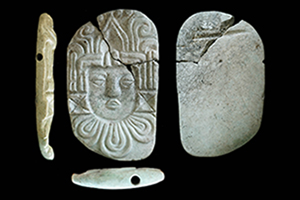
Second, the quantity and quality of the burnt and broken ornaments indicate that they derived from a royal context. One of the ornament fragments included a two-sided carved Hu'unal greenstone diadem, the jewel of royalty par excellence (Schele & Miller Reference Schele and Miller1986: 119–20) (Figure 7a & b). Other notable pieces include a round relief pendant of a human head (Figure 7c), a plaque with a mat design (another symbol of Maya royalty; Figure 7d), an incised decorated disc depicting a wind god figure (Figure 7e) and a carved pendant plaque of a human head (Figure 8). The recovery of at least four different sized and decorated ear flares (Table S2) suggests that ornaments belonged to multiple individuals. The carved pendant plaque may have been manufactured from an heirloom clam-shaped Olmec-style greenstone pendant, and a name likely comprised of three signs sits in the pictured headdress, a common position for name placement in Maya imagery. The signs include fire scrolls, three visible dots—although a fourth missing dot was likely part of the imagery—and two sticks with lines that may represent two torches (Figure 8). Thus, these symbols may read some combination of K'AHK (‘fire’), KAN (‘four’) and TAAJ (‘torch’) to name the figure, whose neck spouts blood or precious liquid scrolls.
Burnt and cracked greenstone ornaments from the Burial 20-1 deposit: a) Hu'unal greenstone diadem (UC-PV-061; scale bar shared with d); b) drawing of Hu'unal greenstone diadem, Topoxté (modified after Taube & Ishihara-Brito Reference Taube, Ishihara-Brito, Pillsbury, Doutriaux, Ishihara-Brito and Tokovinine2012: fig. 82d); c) round relief pendant of a human head (UC-PV-065); d) plaque with mat design (UC-PV-066) (drawing by D. Hounzell); e) an incised decorated disc (UC-PV-045) (photographs by C. Halperin).

Carved pendant plaque of a human head (UC-PV-062), Burial 20-1. Note: the original suspension hole ran through the long section of the plaque and a second suspension hole was added later, along with the carved head imagery, running through the short section of the plaque (photographs by C. Halperin).

Third, the remains of a greenstone mosaic funerary mask were recovered from the deposit (UC-PV-052) (Figure 9). Although such masks are occasionally found in caches, the majority accompany royal individuals in their tombs (Meléndez Reference Meléndez2019: tab. 1.2). The mosaic mask was identified by the nose piece, a diagnostic element of greenstone mosaic masks (Juna Carlos Meléndez pers. comm.), and two obsidian eye pupils, which are similar to examples from greenstone masks from royal Burials 8, 37, 39 and 61 from El Peru-Waka’ (Meléndez Reference Meléndez2019: 825). The edges of the mosaic mask fragments were all uniformly polished and pecked, distinguishing them from clean breaks that occurred during heat exposure.
Fragments from a greenstone mosaic mask UC-PV-052 (main image); two polished obsidian eye pupils (top right) with detail of one of them (top left), Burial 20-1 (photographs by C. Halperin).

Fourth, microscopic analysis of the ornaments indicates many have a rust-reddish coloured pigment on their surfaces or lodged in their incised crevices (Figure 10). Red pigments such as cinnabar or hematite were commonly sprinkled or painted upon the bodies of deceased royal persons as part of Preclassic and Classic period burial rites (Fitzsimmons Reference Fitzsimmons2009: 81–3; Scherer Reference Scherer2015: 76–9). A small piece of cinnabar was also recovered from the deposit (Table S3), making it likely that these ornaments had once been part of a royal tomb.
Ornaments from Burial 20-1 with traces of red pigment: a) perforated decorated disk (UC-PV-044); b) microphotograph of UC-PV-044's incised corner detail showing red pigment; c & e) mammal-tooth pendants; d) flat perforated greenstone rectangle (UC-PV-042) (photographs by C. Halperin).

Discussion
We argue that the Burial 20-1 deposit was part of a revolutionary historical moment that simultaneously rejected a Late Classic dynastic line and established an occasion for the founding of a new political order. As Sahlins (Reference Sahlins1985, Reference Sahlins2005) and Giddens (Reference Giddens1984) underscore, however, events are the reproduction and working out of structural traditions that, in turn, create new conditions for action in the world. In putting the Burial 20-1 deposit in a larger structural context, it is clear that royal fire-entering tomb rites were not new in the Maya area (Fitzsimmons Reference Fitzsimmons2009: 142–61; Tiesler Reference Tiesler, Tiesler and Scherer2018). Classic period glyphic texts describe such rites as och-i k'ak’ t-u-muk-il, ‘the fire entered his/her tomb’ (Stuart Reference Stuart and Houston1998: 384–98), often either marking the veneration of dynastic descendants or political acts of termination and rupture (Fitzsimmons Reference Fitzsimmons, Colas, LeFort and Persson2006). For example, David Stuart (Reference Stuart and Houston1998: 398–9) interprets the glyphic panels of Structure A-14 at Ceibal as detailing a fire-entering tomb ritual in AD 747 by Yich'aak Bahlam, an eighth-century Ceibal ruler. He entered the tomb of K'an Mo’ Balam, an Early Classic Ceibal ruler interred more than 300 years earlier for a ‘censing’ event that brought legitimacy to his reign. In turn, Late Classic Tomb 1 at Calakmul shows evidence of having been re-entered and scorched by fire, which Tiesler interprets as having been a desecratory act (Tiesler Reference Tiesler, Tiesler and Scherer2018: 225–7). In addition, the likely tomb of Piedras Negras Ruler 4 (Burial 13) was re-entered, the bones were burnt and the tomb contents scattered and destroyed. Piedras Negras Panel 3 suggests that this act was conducted by Ruler 7, a possible interloper (Houston & Scherer Reference Houston, Scherer, Luján and Olivier2010: 183–4). The Ucanal Burial 20-1 remains, however, represent tomb contents that were taken and displaced outside of the original tomb, whose location is currently unknown.
The Ucanal Burial 20-1 deposit appears to have been an act of desecration: it was dumped at the edge of a crude wall used as a construction pen and no effort was made to protect the fragmented bones and ornaments from the stone blocks deposited on top of them as construction fill. This type of deposition differs from that of an early Terminal Classic cremation burial found elsewhere at the site of Ucanal, Burial 21-2, which was located within elite residential Group 103 (Cano Estrada Reference Cano Estrada, Halperin and Garrido2020; Halperin et al. Reference Halperin, Garrido, Salas and LeMoine2020b: fig. 5a). The cremated bones of an adult female were placed within and protected by two lip-to-lip bowls with her cremated and fragmented jade ear flares placed carefully at the centre of the bones. It is possible that a Dolphin Head Red monochrome bowl was placed above the Burial 20-1 deposit within the construction fill of the final phase of Structure K-12 and just below the sealing of Floor #1 (Figure 4), but the placement of the burnt material appears otherwise haphazard.
The fire-burning event of the Burial 20-1 deposit was likely a dramatic public affair that had the potential to instantiate a sense of structural dislocation (Sewell Reference Sewell1996: 861). Structural dislocation occurs when there is a sentiment of uncertainty that allows the basic foundations of the current political, social or economic order to be questioned. For example, the French Revolution was part of a larger contingent series of events and processes, from problems of food insecurities and the hallowing out of the state treasury to the commoners’ creation of the National Assembly. Yet it was the storming of the Bastille, the symbol of French royal and militaristic hegemony, that stimulated an intense moment of structural disjunction in the minds of the French people, allowing them to see their world in a moment of punctuation. Similarly, many other events undoubtedly paved the way for the Ucanal Burial 20-1 fire-burning event. But because the fire-burning event itself had the potential to be highly ceremonial, public and charged with emotion, it could dramatically mark the dismantling of an ancient regime. The bones and ornaments themselves were likely agents in such a turn of history as they may have been imbued with a life force or animating soul that made contending with them a necessary part of change (Novotny Reference Novotny2013; Houston Reference Houston2014).
In turn, the structural changes of the Terminal Classic period did not occur overnight. While Ucanal inhabitants initiated a series of civic-ceremonial constructions during the early Winik phase, many of the new architectural introductions associated with changing political and religious traditions did not occur until the late Winik phase (c. AD 850/870–950). For example, the large ballcourt, Ballcourt 1, constructed in Plaza A was built in a traditional fashion during the early Winik phase, albeit larger than most Late Classic ballcourts. It was not until the late Winik phase, however, that a refurbished stucco floor was added and a low enclosure wall was built at its northern end to form a T-shaped alleyway (Halperin et al. Reference Halperin, Cruz Gómez, Radenne, Bigué, Halperin and Garrido2020a & Reference Halperin, Garrido, Salas and LeMoineb). Stela 29, the stela monument in front of Structure K-2, exhibited a new slimmed-down aesthetic of leadership, one in which the ruler was no longer depicted dripping with jade ornaments. The stela platform fill, however, dates to the late Winik phase and the stela itself was likely dedicated in AD 879 (Halperin & Martin Reference Halperin and Martin2020).
Nonetheless, some large structural changes occurred in the Maya Lowlands during the early Terminal Classic period and may be linked to the reign of Papmalil. Caracol Altar 12 depicts Papmalil in a seated, side-by-side ‘conference scene’ (Figure 2), one of the first monumental expressions from the Terminal Classic period to exhibit such positionality. Side-by-side seating emphasised horizontal relationships on a seemingly equal footing, which contrasts with the hierarchical positionality of Late Classic imagery in which rulers were often depicted higher and larger than all figures in the scene. Such horizontal political dispositions became popular throughout the Terminal Classic period (LeMoine et al. Reference LeMoine, Halperin and Salas2022; Carter & Lukach Reference Carter and Lukach2023) and it was during this time that political leaders in the southern Maya Lowlands began to shift away from ostentatious displays of wealth and that distinctions between elite and non-elite households greatly diminished (Halperin & Garrido Reference Halperin and Garrido2019; Chase & Chase Reference Chase, Chase, Okoshi, Chase, Nondédéo and Arnauld2021; LeMoine & Halperin Reference LeMoine and Halperin2021).
Conclusion
The Burial 20-1 fire-burning event at the site of Ucanal marked a major juncture in the political history of the K'anwitznal polity that rejected an earlier dynastic line in the making of a new era of political history. It comprised the re-entry into the tomb (or tombs) of Late Classic Maya royalty and the ritual burning of at least two royal bodies and their bodily ornaments. The ritual burning event, which occurred sometime during the early Terminal Classic period, coincides chronologically with the reign of Papmalil of K'anwitznal who was responsible for key shifts in political alliances throughout the southern Maya Lowlands. This new era was marked by monumental building construction at Ucanal that used facing stones of previous buildings as construction fill to bury the symbols of an earlier regime. The fire-burning event itself and the reign of Papmalil helped usher in new Terminal Classic forms of monumental imagery that emphasised horizontal political ties and fundamental changes in the social structure of society. In this sense, it was not just an end of an era, but a pivot point around which the K'anwitznal polity, and the Maya of the southern Lowlands in general, transformed themselves anew.
Acknowledgements
Research by the PAU would not be possible without the support and participation of the community of Pichelito located on and by the site of Ucanal, of our colleagues from Barrio Nuevo San José and project laboratory staff headed by Miriam Salas Pol (https://www.ucanal-archaeology.com). We are also grateful to the Departmento de Monumentos Prehistoricos y Coloniales from the Ministerio de Culture y Deportes in Guatemala for their support and permission to work at Ucanal.
Funding statement
Funding for research derived from a Canadian Social Sciences and Humanities Research Council Insight Grant (no. 435-2021-0462) and a Direction des Affaires Internationals travel grant from the Université de Montréal.
Data availability statement
All artefacts excavated from the site of Ucanal are under the purview of the Instituto de Anthropologia e Historía (IDAEH) as part of the Ministerio de Culture y Deportes, Guatemala. Digital data are housed in the Laboratoire d'archéologie mésoaméricaine at the Université de Montréal.
Supplementary material
To view supplementary material for this article, please visit https://doi.org/10.15184/aqy.2024.38.


 Open access

