



Introduction
At the ‘Landscapes of the Dead: Exploring Bronze Age Barrowscapes’ conference held in London in 2019, it was suggested that archaeologists would make more progress towards understanding barrows if they had a clearer notion of how Bronze Age people conceptualised their dead. While barrows undeniably had more functions than simply containing and marking graves, it is equally undeniable that some of these other roles were ultimately grounded in ideas about death and the dead. Prehistorians are understandably cautious about invoking spiritual or supernatural concepts that leave no direct material remains, but there comes a point when committing to some position is essential in order to advance our understanding. It makes a significant difference to the interpretation of barrows if, for example, the dead were thought to be aware and active within their barrows, rather than inert or departed to a distant afterlife.
In this article, we suggest a new interpretation based on a common feature of Bronze Age barrow burials in Britain—one that can be explained by a well-attested concept of the dead. More broadly, the approach employed here can also be used to reconstruct ideas about the dead in other societies and times (see Wiseman Reference Wiseman2019).
A recurring pattern of inversion
Barrows were constructed in Britain between c. 2400 and 1500 BC. Almost all were burial monuments, although a few empty ‘cenotaphs’ are known. The earliest contained inhumation burials, usually placed in a distinctive ‘crouched’ position, but from c. 2100 BC cremation burials appeared, becoming almost the sole form of burial in the period c. 1800–1500 BC. After the construction of barrows ceased at the end of the Early Bronze Age (c. 1500 BC), existing barrows continued to be used for secondary cremation burials, until cremation itself disappeared in Britain at the end of the Bronze Age (c. 800 BC).
Our starting point for interpreting barrows focuses on patterns of inversion found throughout Britain in association with these monuments. As there are obvious difficulties comparing inhumation and cremation burials, this analysis will focus on the latter burial rite.
Urns
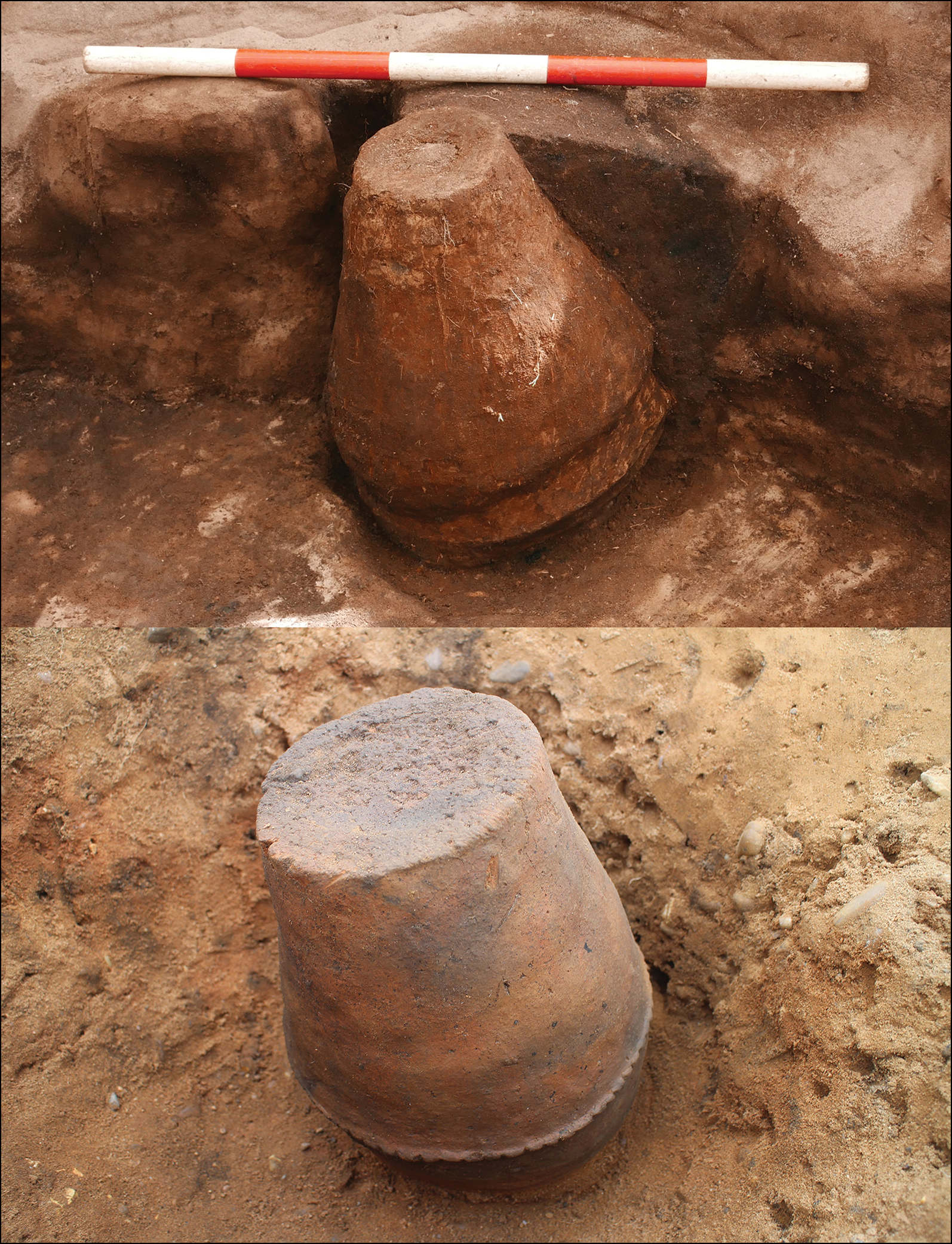
During the Bronze Age, urns containing, covering or accompanying cremated human remains were often deposited upside down (Figure 1). All the main vessel types that accompanied cremation burials have been found inverted, and the practice is reported in all parts of Britain, including Scotland, Wales and north-east and southern England (Owoc Reference Owoc2000; Bristow Reference Bristow2001; Fowler Reference Fowler2012; Medina-Petterson Reference Medina-Petterson2013; Pettitt Reference Pettitt2015).
Inverted urns during excavation: top) Early Bronze Age Collared Urn from Petersfield Heath in West Sussex (courtesy of S. Needham and the People of the Heath project); bottom) Middle Bronze Age Bucket Urn from Newark-upon-Trent (courtesy of Oxford Archaeology & Urban and Civic Plc.).
Inverting urns became established practice in the second half of the Early Bronze Age, although it occurred occasionally for several centuries before (Figure 2). Towards the end of the British Chalcolithic (c. 2300–2150 BC), a handful of cremation burials were accompanied by inverted Beaker vessels (Clarke Reference Clarke1970: 138–39). Beakers were succeeded by Food Vessels in the first half of the Early Bronze Age (c. 2150–1800 BC). The Atlantic Europe in the Metal Ages (AEMA) Project (http://www.aemap.ac.uk/search) recorded 1200 Food Vessels accompanying burials in Britain: 54 per cent with inhumations and 46 per cent with cremations. Where urns’ positions were documented, 20 per cent (106) were inverted, while 80 per cent (422) were upright. Inversion only began in earnest when Collared Urns became part of the funerary repertoire (c. 1800–1500 BC). At this time cremation became the dominant funerary rite, with only 20 of the 510 burials recorded by the AEMA project involving inhumations. Of the 363 Collared Urns where position was reported, 56 per cent (341) were inverted and 44 per cent (266) were found upright.
Percentage of urns found upright (grey) and inverted (red, bold text) (fl. = main period of use) (data sources: Grave Goods project; Atlantic Europe in the Metal Ages project; Cowie (Reference Cowie1978); Gibson (Reference Gibson1978); Longworth (Reference Longworth1984); Wilkin (Reference Wilkin2013); Caswell & Roberts (Reference Caswell and Roberts2018)).

Caswell and Roberts's (Reference Caswell and Roberts2018) review of cremation burials in the Middle Bronze Age (c. 1500–1150 BC) identified 3133 individual burials from 378 sites, mostly in southern England. Where information on orientation was available, almost exactly half of the urns were inverted (460 of 945 reported). The use of inversion was not uniform within cemeteries, however: Caswell and Roberts (Reference Caswell and Roberts2018) note 35 sites with both upright and inverted urns.
By the Late Bronze Age (c. 1150–800 BC), urns had disappeared almost completely from burials, although cremation continued. The few published examples of urned cremations do include inverted examples, such as the Post-Deverel-Rimbury urns at Kimpton barrow cemetery in Hampshire (Dacre et al. Reference Dacre, Ellison, Everton, Smith, Davies and Richards1981).
It is important to appreciate the peculiarity of inverting urns. Neither Roman nor Anglo-Saxon urned cremations in Britain were inverted (e.g. Hills et al. Reference Hills, Penn and Rickett1994; Philpott Reference Philpott1991: 30–44). Nor were other accompanying grave goods, unless they were used as ‘lids’ for cremation urns. Inversion defies the ‘right’ way to orientate any filled container, and inevitably means upsetting the contents (as did, in fact, happen in many Bronze Age urned burials). That half of the Middle Bronze Age urns were found rim-down attests to the importance of inversion. That it is not a full one hundred per cent presumably reflects the conceptual conflict between inversion and the ‘normal’ way of orienting a pot, and possibly a desire not to spill the urns’ contents.
Cremated remains
Although micro-excavation of cremation burials and urns is recommended practice (McKinley Reference McKinley, Nilsson Stutz and Tarlow2013: 156–57), all too often the results go unpublished. Consequently, British prehistorians lack a detailed picture of how bone, pyre debris and other material went into most Bronze Age cremation burials. This contrasts with examples elsewhere, such as the Late Bronze Age cremation cemetery at Cottbus in Germany, where micro-excavation demonstrated that bodies were ‘reconstructed’ within urns (Gramsch Reference Gramsch, Carrell and Fahlander2007), with cremated bone being placed in urns to replicate their arrangement in a living body. Nonetheless, even amongst the limited number of micro-excavated British cremations, examples of inversion have been reported. Downes's (Reference Downes2005) analysis of all 33 burial cists at Linga Fiold, Orkney, for example, found that, in the unurned primary burials and some secondary burials, material from the pyre was deposited in an inverse sequence. At the base of each cist was cremated bone, then cramp (a glassy slag, peculiar to Orcadian pyres, apparently produced by placing seaweed on the pyre), and then burnt turf or wood. Downes (Reference Downes2005) emphasises that this ordering must have been deliberate, as all the material had been meticulously picked out of the pyre, cleaned and sorted before being deposited. She also notes inversion in other Orcadian cremations, such as at Glitterpitten (Downes Reference Downes2005: 172–74).
In southern England, micro-excavation of an inverted Collared Urn cremation (no. 3914) from Lodge Farm, St Osyth, Essex found that most of the skull bones were placed at the top of the urn while lower limbs were concentrated at the base (Armstrong Reference Armstrong and Germany2007: 82–84). When the urn was placed upside down in the ground, the reconstructed body would also have been inverted. By contrast, micro-excavation of two urns buried right way up in nearby Chelmsford found that skull fragments were frequent at the base of each urn, axial bone in the centre and lower limb bones at the top, again inverting the bodies (Anderson Reference Anderson, Holloway and Spencer2005: 15–16).
Occasionally, the contents of urns may be layered (e.g. Brittain Reference Brittain, Cummings and Fowler2015: 226). While the inverted ordering of bones and pyre debris may sometimes simply reflect the way materials were collected from the pyre, other examples are clearly deliberate. An example is the Collared Urn excavated at Moel Goedog Cairn I (Lynch Reference Lynch1984: 22–23), where pyre ash was recorded at the base of the urn, overlain by cremated bone. The bone must have been retrieved from the pyre and set to one side, so that the pyre ashes could be placed into the urn first, then the bone, before the whole assemblage was finally inverted and placed in the ground.
Detecting inversion in cremation burials requires particular circumstances: the bulk of the skeleton must be present and fitted tightly within the urn. This is rare in most Bronze Age cremations, where burials usually contain 330–470g of bone (McKinley Reference McKinley, Nilsson Stutz and Tarlow2013: 13)—far less than the 1000–2400g of a typical adult. Furthermore, if the bone is not tightly packed within the urn, the pieces will quickly become jumbled—especially if the urn is inverted. Small, dense fragments will settle to the bottom and larger, less dense pieces rise to the top (as apparent in several half-filled urns; e.g. Felter Reference Felter2007: 14; McSloy & Ellis Reference McSloy and Ellis2016: 4).
Barrow construction
Many Bronze Age barrows in Britain were constructed of turf and, where evidence exists, the turves often appear inverted—apparently deliberately. Regrettably, the orientation of turves often goes unquestioned and unreported, even when it is apparent in site photographs. Turf orientation is often difficult to detect in the field and easy to misinterpret. In preparing this article, we found turf orientation reported for just 20 excavated barrows, and consequently it is impossible to estimate how widespread turf inversion was, although, when discussing soil micromorphology from barrows, Macphail and French say it is common (Macphail Reference Macphail and Tilley2017: 13; C. French pers. comm.). Inverted turves are reported in south-western England (six examples in Owoc Reference Owoc2000; see also McKenzie, in Bayer et al. Reference Bayer, Simmonds and Welsh2017: 64–72; Macphail & Lenka, in Tilley Reference Tilley2017: appendices 5 & 11), southern England (Bradley & Keith-Lucas Reference Bradley and Keith-Lucas1975; Ashbee & Dimbleby Reference Ashbee and Dimbleby1976; Drewett Reference Drewett1976; Macphail Reference Macphail1980; Green et al. Reference Green, Rollo-Smith, Crowfoot and Wells1984; Parfitt Reference Parfitt2018), and northern England (four examples in Smith Reference Smith1994: 55, 57, 65–66; see also Bu'lock et al. Reference Bu'lock, Rosser and Dimbleby1960).
Along with turf, barrows were also constructed from stones and layers of soil. It has long been recognised that these layers may reverse the stratigraphic sequence of the earth from which they were made (e.g. Owoc Reference Owoc2000: 218–19; Bradley & Fraser Reference Bradley and Fraser2010). While this inversion may sometimes simply reflect the order in which soil was excavated and heaped up to form the barrow, this does not explain all cases. In Wessex, for example, many round barrows were built with a turf core covered by chalk dug from the surrounding ditch; however, the grass must have come from a much wider area than the ditch could possibly have provided—over 10 000m2 for large mounds. Consequently, placing chalk over the turf must have been a deliberate choice, rather than a simple by-product of excavation. In Orkney, Downes (Reference Downes2005) has reported excavations of a dozen barrows, all showing inversion: some with turf being packed around the burial cist, then overlain by subsoil; others with clay subsoil overlain by stones. In upland areas there are numerous cairns with turf or soil cores that also display an inverted stratigraphy (e.g. Smith Reference Smith1994; Fowler Reference Fowler2012).
Barrow form
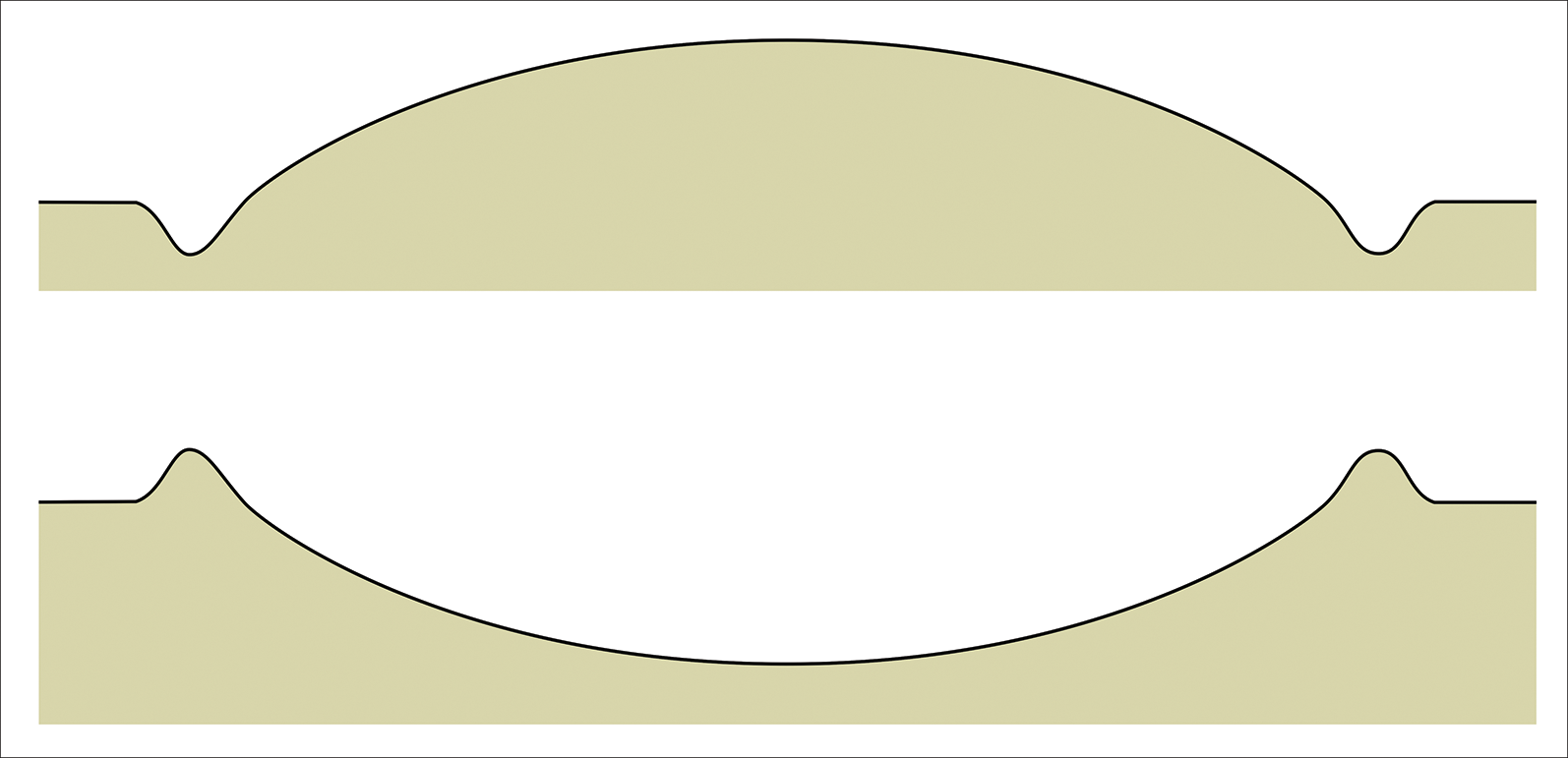
The examples discussed so far involved physically inverting elements of the burial or the barrow. One last potential type involves inverting the barrow's form. The most common barrow types in Britain—bowl, bell and saucer barrows—consist of an earth mound surrounded by a ring ditch. A rare alternative is the pond barrow, comprising a basin typically 10–25m across and 0.5–2.0m deep, with a surrounding earthen bank (Grinsell Reference Grinsell1953: 23). In cross section, this form appears to mirror that of regular barrows (Figure 3). Although they are not barrows in the usual sense of an earthen mound, pond barrows do nonetheless sometimes contain burials, and are often found alongside regular barrows. Nearly 300 years ago, Stuckeley (Reference Stuckeley1743: 12) described these as “barrows inverted” or “barrows reversed”, before they were renamed ‘pond barrows’ in the nineteenth century. This type of barrow first appears in the second half of the Early Bronze Age—around the same time that inverted urns became common.
Schematic profile of a ring barrow (above) and pond barrow (below), illustrating the potential inversion of form (figure by the authors).
Interpreting inversion: Conceptual Metaphor Theory
It is one thing to identify a recurring pattern like inversion. It is another matter entirely to connect it with an idea such as ‘the dead’. Here, we outline one way archaeologists may interpret this immaterial realm using only material evidence. Whatever other associations barrows later acquired, they are ultimately about the dead. Being dead, however, is not just the physical state of the deceased: it is also a concept in the minds of the living. There has been much work by cognitive scientists in recent decades into how people form concepts. One particularly productive area has been Conceptual Metaphor Theory (e.g. Gibbs Reference Gibbs2008, Reference Gibbs2017; Kövecses Reference Kövecses2010). Here we propose that the inversions displayed by the barrow builders are expressions of two underlying conceptual metaphors: the dead are upside down and the dead are in an underworld (under the barrow). Moreover, it is straightforward to explain how these two concepts could have formed during the Bronze Age. In this article, we will follow the usual convention in Conceptual Metaphor Theory of writing the underlying metaphor in small capitals and particular expressions in italics.
The formation of primary conceptual metaphors
To understand how conceptual metaphors form, we can consider a well-understood example: intimacy is warmth. People express this concept when they speak of ‘warm friendships’, ‘warm smiles’ and ‘a warm welcome’. From this concept also derive expressions of dislike or rejection based on a lack of warmth, such as ‘the cold shoulder’, ‘an icy stare’ and ‘a lukewarm reception’. Such expressions are found worldwide (Wiseman Reference Wiseman2014). The connection between warmth and intimacy is not just linguistic. Psychological experiments have found that providing warmth (e.g. in the form of a hot beverage) can induce positive feelings towards others (Williams & Bargh Reference Williams and Bargh2008; Ijzerman & Semin Reference Ijzerman and Semin2009), while people who are scorned or excluded can feel cold (Zhong & Leonardelli Reference Zhong and Leonardelli2008).
This concept develops in the first few months of life, and is a direct result of the way human babies are raised (Lakoff & Johnson Reference Lakoff and Johnson2003: 265; see also Lakoff & Johnson Reference Lakoff and Johnson1999: 46–47). When very young children are played with, fed or loved, their brains register several types of stimulation. One is positive emotion, another is the warmth of the person holding them. As human babies are unable to walk, feed or care for themselves for many months after birth, and therefore have to be held and carried by the adults caring for them, the two experiences frequently coincide. It is a basic property of brains that, when two different areas are activated, neural connections develop between them, a process known as ‘Hebbian learning’ (Feldman Reference Feldman2006). The result of an infant repeatedly experiencing positive emotions and warmth at the same time is that a neural connection develops between the parts of the brain being stimulated. Because this link is established while the child's brain is growing at its fastest, and is reinforced by frequently repeated experience, the outcome is a very strong neural connection—one that lasts into adulthood. This is the grounding for the conceptual metaphor positive emotion is warmth. And because the warmth is experienced literally at the hands of those with whom the growing baby has intimate social relations, warmth becomes linked with intimate social experiences.
The metaphor intimacy is warmth is what is termed a ‘primary conceptual metaphor’. These concepts are grounded in direct, embodied experience and develop through the repeated coincidence of two otherwise unrelated activities. Linguists and psychologists have identified over a hundred such primary metaphors (e.g. Grady Reference Grady1997: 281–99). Other examples include more is up, big is important, anger is heat, similar is close and difficulties are burdens. These all arise from experiences common to everyone: direction, size, heat, distance and weight. Unsurprisingly, therefore, such metaphorical concepts are also found across many unrelated cultures. The way that primary conceptual metaphors form means that, if archaeologists can show that people in the past had the same formative experiences as people today, then archaeologists can deduce that they would also have developed similar concepts.
Forming the concept of the inverted dead
Being dead is not a state that people can know by direct experience. To comprehend death people must unavoidably draw on experiences from other domains. In the process they create metaphors. Known conceptual metaphors for death include death is darkness, sleep, winter and the goal of a journey (Lakoff & Turner Reference Lakoff and Turner1989; Wiseman Reference Wiseman2019). Here, we highlight one other widespread example: being dead is (upside) down. This concept derives from another well-understood primary conceptual metaphor, life is up. It arises because humans have an upright body that lives in a world subject to gravity. We feel gravity pulling us down at every instant. Every moment we are ‘up and about’—every moment we are alive—we must apply effort to keep our bipedal bodies upright. Moreover, our brains are constantly engaged in monitoring and maintaining our posture. The parts of our sensorimotor system involved in keeping us upright are constantly active at the same time as we are conscious and aware. The result is a close association of being up(right) and being alive. This is the basis for the conceptual metaphor being alive is up. From this, we infer that when we lose consciousness—such as when we die—we cease to hold our bodies up: we ‘drop down dead’ or ‘lie down and die’. The metaphor dying is going down is apparent in expressions such as ‘the soldiers fell in battle’, ‘She dropped dead of a heart attack’ and ‘the firemen laid down their lives’. Resurrection involves movement in the opposite direction: being ‘raised from the dead’. Linguists have found similar expressions in unrelated languages around the world, including most European languages (Vogel Reference Vogel, Zlatev, Andrén, Johansson Falck and Lundmark2009), Turkish (Özçalişkan Reference Özçalişkan2003) and Chinese (Cong Reference Cong2014).
While the concept of dying as dropping down arises from our physical experience of keeping ourselves upright, the state of being dead is more complex, as we have several ways of experiencing ‘being down’. We can draw on not only our physical experience of verticality, but also our perceptions of up and down, and the associated notions of above and below. The last of these is enormously productive, and is used worldwide to infer where the dead are. In ancient Rome the dead were inferi, ‘those below’, and the place of the dead was infero, ‘below’ (Lewis & Short Reference Lewis and Short1962: 944). For the Zulu the dead are abaphansi, ‘those below’ (Ngubane Reference Ngubane1977: 51 & 56). The number of cultures worldwide who considered their dead to be somewhere below is striking. Examples include ancient Egyptian Duat, Neter-khertet; Greek Hades, Tartaros; Roman Avernus; Old Norse and Anglo-Saxon Hel; Finnish Manala; Saami Jabmeaimo; Biblical Hebrew She'ol, Eresh; Islamic Jahannam; Old Persian Duzakh; Sumerian Irigal, Ešgal, Kiši, Halib; Akkadian Erşetu; Swahili Ku-Zimu; Indian (Hindu and Buddist) Naraka, Pātāla; early Chinese Huángquán; Chinese (Daoist) Diya; Japanese (Shinto) Yomi; Aztec Mictlan; colonial Mayan Xibalba; Inca Ukhu Pacha; Māori Rarohenga; and the Society Islanders’ Po (Siikala Reference Siikala and Eliade1987: 300; Taylor Reference Taylor2000). The metaphor doubtless finds some corroboration in cultures that bury their dead, as this physically places the deceased below the world of the living. Unsurprisingly, in some of these cultures, the words for ‘grave’ and ‘underworld’ are identical (e.g. Sumerian Irigal, Hebrew She'ol).
There is an important variation on the concept of down. One of the ways in which the normally upright human body can go down is by tripping or falling—an uncommon experience, but a psychologically prominent one, as it literally ‘upsets’ us. In its most caricatured form, falling turns a person upside down, ‘head-over-heels’ or ‘topsy-turvy’. upside down is another attested notion for the dead. The Saami of northern Finland believed that their dead walked upside down in an inverted underworld, Jabmeaimo, “with the soles of their feet against those of the living on earth” (Pettersson Reference Pettersson1957: 148 & 155). The Egyptian Book of the Dead includes a prayer to protect the dead from the fate of walking upside down in the underworld (no. 53; Taylor Reference Taylor2010: 190). The Hebrew Bible suggests that come Judgment Day, the world would be turned upside down (Isaiah 24:1).
Apart from dead, there appears to be just one other primary conceptual metaphor based on inversion: chaos is being upside down. We see this in expressions such as ‘her world turned upside down’, ‘the thieves turned the house over’, and ‘his life is topsy-turvy’. This concept plainly does not apply in the case of Bronze Age barrows, as they present no evidence for chaos. Archaeologists, therefore, can infer that the various expressions of inversion found in barrows refer only to the dead and nothing else.
The inverted dead of Bronze Age barrows
We suggest that when inversion first appeared in barrows and burials, Bronze Age people may have been taking the concept of their upside-down dead quite literally. Inverting the urn or its contents was actually placing the cremated remains ‘right-way up’ into the underworld. Laying turves upside down may have been taking the idea one step further—placing grass and earth ‘beneath’ the newly dead. Pond barrows would have taken the concept even further by ‘building’ an inverted barrow and ring ditch. Later, inversion appears to have become less literal, so that several aspects of burial might appear upside down—inverted remains within an inverted urn, for example—multiplying the concept, even though it would negate literal inversion.
As the dead were rarely buried more than a metre below the ground surface, it seems to us that Bronze Age people might have envisioned the underworld as being just beneath the surface of the earth, close to the living. This idea finds parallels elsewhere. As noted above, the Saami's inverted underworld, Jabmeaino, also lay just beneath the ground. We are, of course, not claiming any direct connection between these two cultures, but the existence of this belief in the recent past demonstrates that such a way of conceptualising the dead was also possible in Bronze Age Britain.
The idea that the dead are just underfoot would explain one curious absence from these cremation burials: grave goods associated with travel. Objects such as shoes, carts and boats commonly accompany the dead worldwide. Their inclusion derives from what is possibly the most common conceptual metaphor for death: dying is a journey (to a distant place) (Wiseman Reference Wiseman2019). Cultures that view death this way often help their dead travel to the afterlife by placing travel-related objects in graves. But during the period when inversion was common in British Bronze Age burials, this category of grave goods was effectively unknown. The dozen ‘boat-shaped’ log coffins (Parker Pearson et al. Reference Parker Pearson, Sheridan, Needham, Melton, Montgomery and Knüsel2013: 47–48) and five ‘coracle burials’ (Watson Reference Watson1980) excavated in Bronze Age Britain all pre-date 1900 BC—that is, before the time when inversion became commonplace. Furthermore, horse gear only started to appear in British burials from the Early Iron Age (c. 800–400 BC), after evidence for inversion had disappeared from British cremation burials. But for the thousand-odd years between, when inversion was widespread, we suggest that people in Britain thought their dead were immediately underfoot, rather than in some distant ‘land of the dead’, and consequently needed no transportation to reach the underworld. A small hole in the ground would have been sufficient to deliver the deceased to their new home.
What we are proposing is more than a ‘just-so’ story about the Bronze Age dead: it helps explain not just why barrows were built, but potentially also some of their other functions. It has long been suggested, for example, that barrows in Britain may have claimed grazing land, guarded boundaries and controlled or overlooked routeways (e.g. Field Reference Field1998; Kitchen Reference Kitchen and Brück2001; Pryor Reference Pryor2001: 407–408; Watson Reference Watson and Brück2001; Buteux & Chapman Reference Buteux and Chapman2007; Garwood Reference Garwood and Garwood2007: 151–53; Johnson Reference Johnson2017). Implicit in such suggestions, however, is that barrows have something that controls, guards, claims and looks—and, moreover, that this something must also take action against those who transgress. The presence of this active something is most easily explained if the dead had some ongoing existence within their mounds, close to the world of the living. Such an interpretation, however, is one that many prehistorians have been wary of committing to.
A connection between inversion and the dead in Britain's Bronze Age raises questions about other inversions found in the same period, such as the occasional metalwork hoards found in inverted pots. This connection might also prompt archaeologists to think about the significance of reflections—particularly in pools of water—in which images are inverted. If watery reflections are images of the dead, this may provide insights into why materials, from butter to metalwork, were deposited in watery locations during the Bronze Age: they might have been placed into the care of the dead.
Other concepts
While we propose that the concept of inversion was important in structuring Bronze Age barrows and burials, we certainly do not consider it to be the only concept at work. It is worth highlighting other features of barrows that were also likely symbolic, but unrelated to inversion:
• Barrows are circular.
• Bronze Age cremation burials were preceded chronologically by tightly ‘crouched’ inhumations laid on their sides—akin to a sleeping or foetal position.
• Barrows were often built in prominent locations, such as on skylines or routeways.
• Grass is food for domesticated herds, and the turf provides organic matter for crops. Denuding hectares of grass to construct turf barrowfields would have involved the conscious destruction of a significant economic resource for the community.
• Stripping turf for barrowfields would have transformed the local flora for decades afterwards. Moreover, in the first spring after turf stripping, the newly disturbed earth would have germinated prominent flowering species, such as poppies and cornflowers—quite unlike the grasses they replaced.
None of these features ‘contradicts’ the concept of inversion, any more than an Egyptian pyramid ‘contradicts’ the Egyptian belief in death as a voyage on the Sun god's barge: significant monuments often express a number of concepts. Nonetheless, inversion is expressed in many aspects of barrow construction, which suggests that it was a primary concept used to comprehend death for around 1000 years in prehistoric Britain.
Conclusion
People structure their physical environment to conform to their concepts. Burial sites, unsurprisingly, reflect ideas about death. Interpreting such sites therefore demands that archaeologists understand these concepts. Conceptual Metaphor Theory provides a robust method for interpreting how ancient people conceptualised their worlds. The idea that the Bronze Age dead inhabited an inverted underworld immediately below the surface of the earth is consistent with well-understood concepts of death. Nothing in Conceptual Metaphor Theory is limited to prehistoric Britain: other metaphoric conceptualisations of death and the dead have been identified in other cultures where they may be grounded in experiences as diverse as journeys, the growth of plants, the metamorphosis of insects and the movement of the sun (Wiseman Reference Wiseman2019). Understanding how death was conceptualised in specific societies can help archaeologists interpret the potential roles of the dead within their communities. For example, if the dead remained close to the living, as in British Bronze Age barrows, then they were potentially able to interact with or help the living, which might explain why many Bronze Age barrows appear to overlook, control and guard the lands around them. Alternatively, if the dead are conceptualised as crop plants, such as rice or corn, then they might have had some influence over the weather, which caused crops to grow or wither (e.g. Bloch Reference Bloch1971; Ortman Reference Ortman, Glowacki and van Keuren2011). Or, if death is conceptualised as a journey to be with the gods, then the dead might interact with the gods on the behalf of the living, as in many parts of Africa (e.g. Wirudu Reference Wirudu, Meister and Copan2012). Conceptual Metaphor Theory provides a way for archaeologists to reconstruct intangible concepts, such as death, that shaped the lives of people in the past.
Acknowledgements
Our thanks to two anonymous reviewers for their most constructive comments, and Ed Caswell for allowing us to check our ideas against his PhD database of Middle Bronze Age burials.
Funding statement
This research received no specific grant from any funding agency or from commercial and not-for-profit sectors.


 Open access

