


Introduction
Women’s labour market participation has been a major issue in Australian governments’ policy agendas for two decades (ACOSS 2022). This has been evidenced through election platforms, government strategies and action plans, implementation of new policies such as parental leave, and public inquiries. Mothers and mature-age workers,Footnote 1 including mature-age women, are regularly identified in policy debate as important targets in raising labour market participation (Cassells et al. Reference Cassells, Duncan and Ong2015; Australian Labor Party 2021; ACOSS 2022).
The push for both groups of women to participate in the paid labour market is driven by a neo-liberal policy agenda that prioritizes economic productivity and seeks to reduce reliance on income support, in contrast to more egalitarian approaches (e.g. in Nordic countries) that recognize family contributions as a form of productivity (Glaser et al. Reference Glaser, Price, Di Gessa, Montserrat and Tinker2013; Price et al. Reference Price, Ribe, Di Gessa and Glaser2018). More recently, these policies have also been driven by an agenda focused on gender equity in the labour market (ALP 2025).
An important contributor to the labour market participation patterns of both mothers and mature-age women workers is grandparent childcare. As mothers are encouraged, through policy agendas, to enter, return to and extend their attachment to the paid labour market, in a context of strong barriers in the formal early childhood education and care (ECEC) market, grandparents are important providers of unpaid childcare to enable mothers to work. At the same time, as mature-age working women are encouraged through policy agendas to enter, return to and extend their attachment to the paid labour market (or to ‘age productively’), they feel the simultaneous pull out of work to provide unpaid childcare for their adult children (Hamilton and Suthersan Reference Hamilton and Suthersan2020). Given the high prevalence of grandparent childcare in Australia (Baxter Reference Baxter2022), the issue is coming to the fore in women’s employment policy.
There is now a growing body of research exploring the nature of grandparent childcare, its benefits for grandparents, parents and grandchildren (Hamilton and Suthersan Reference Hamilton and Suthersan2020), the impacts of grandparent childcare on the labour market participation of both parents and grandparents (Barslund and Schomaker Reference Barslund and Schomaker2019; Backhaus and Barslund Reference Backhaus and Barslund2021) and the impacts of different policy configurations on patterns of grandparent childcare (Glaser et al. Reference Glaser, Price, Di Gessa, Montserrat and Tinker2013; Di Gessa et al. Reference Di Gessa, Glaser, Price, Ribe and Tinker2016). But to date there is little interrogation of the ways in which grandparents and grandparent childcare are constructed in related policy discourse.
Policy discourse ‘consists of whatever policy actors say to one another and to the public in their efforts to generate and legitimise a policy programme’ (Schmidt Reference Schmidt2002, 210), and policy can be observed in official government documents and parliamentary debate, through official media channels and social media platforms. Policy discourses on ageing and older people matter because they shape policies that affect the experience of older age, which is intertwined with the lives of younger generations (Holstein and Gubrium Reference Holstein and Gubrium2007).
This article deploys feminist discourse analysis (Lazar Reference Lazar2007) to interrogate how Australian policy discourses construct grandparents in the context of what are depicted as their labour market and family childcare roles and cultivate gendered scripts about model ageing (Timonen Reference Timonen2016). This topic allows a critical examination of portrayals of older women in their societal, labour market and family contexts and contributes to social gerontology literature through illuminating the emphases (and telling absences) in how older women workers are depicted in debates about women’s work and care across the generations, which will be examined in relation to theorizing around model ageing as described later in the article. The generational dimension of gender roles reveals both pervasiveness of gendered expectations regarding childcare across the lifecourse and a distinct hierarchy between older and younger women’s labour market participation. Through this focus, the article contributes to the social gerontology literature by examining the intersection of intergenerational relations and gendered role expectations.
According to Heron and colleagues, a ‘striking feature’ of Australian policy development in the area of women, work and care is the ‘tendency to deal with these issues through national inquiries’ (Heron et al. Reference Heron, Cooper, Meagher, Baird, Ford and Hill2017, 175), which provide opportunities for civil society and private and public sector organizations and individuals to contribute their views and expertise to policy issues. Public inquiries are a rich source of textual data comprising the policy positions of a variety of actors. Inquiries may be initiated by government agencies or parliamentary committees. Individuals who are tasked with leading such inquiries are responsible for gathering evidence through written submissions and in-person hearings and preparing the findings into a report.
The analysis in this article draws on public submissions to four recent public inquiries that focus on younger and older women’s employment – two inquiries in the early 2010s (2012 and 2014) and two in 2022. Drawing on these four inquiries, this article analyses stakeholder discourses about women’s labour market participation across the generations, specifically the role of grandparent childcare in enabling or constraining optimum outcomes for work and care. This enables us to interrogate the tensions and contradictions that arise when mothers and grandmothers become targets for labour market policies, with a particular focus on the discursive portrayals of older women as both (potential) workers and childcare providers.
The next part of this article reviews the international literature on grandparent childcare and women’s labour market participation, reviews recent Australian trends concerning grandparent childcare and discusses how model ageing (Timonen Reference Timonen2016) is deployed in discourses to construct how older adults ought to be. This is followed by the method, the findings section and the discussion, which interprets how the findings align with four ‘models’ of grandparenting and paid work. The article concludes by outlining the contribution to theorizing model ageing and the social construction of grandparents as workers and carers.
Background
Configurations of grandparent childcare vary among countries depending on social policies and social and gender norms (Herlofson and Hagestad Reference Herlofson, Hagestad, Arber and Timonen2012). Countries with more generous publicly funded childcare, such as the Nordic countries, tend to have higher levels of parental labour market participation and higher rates of grandparent childcare that are occasional or complementary to formal childcare. These are known as defamilialized regimes where formal childcare is highly accessible and widely used (Floridi Reference Floridi2022). Conversely, countries with less generous early childhood education policies such as Spain, Greece and Turkey tend to have higher rates of intensive daily grandparent childcare (Glaser et al. Reference Glaser, Price, Di Gessa, Montserrat and Tinker2013; Di Gessa et al. Reference Di Gessa, Glaser, Price, Ribe and Tinker2016; Floridi Reference Floridi2022) because most childcare is provided by mothers but, where mothers work, access to ECEC is low and grandparents provide intensive levels of care (Bordone et al. Reference Bordone, Arpino and Aassave2017). These countries are known as familialized regimes because most childcare is provided by families (Floridi Reference Floridi2022). In a third group of countries, characteristic of liberal welfare states, grandparents are described as playing a ‘middling’ role, typified by moderate levels of participation in both intensive and occasional childcare (Glaser et al. Reference Glaser, Price, Di Gessa, Montserrat and Tinker2013).
Research suggests that, across most European countries, the availability of grandparent childcare boosts mothers’ labour supply (Garcia-Moran and Kuehn Reference Garcia-Moran and Kuehn2017; Bratti et al. Reference Bratti, Frattini and Scervini2018; Barslund and Schomaker Reference Barslund and Schomaker2019). However, the way in which grandparent childcare interacts with the provision of formal childcare varies across countries (Barslund and Shomaker Reference Barslund and Schomaker2019; Floridi Reference Floridi2022). In countries with high levels of state support (Nordic countries in particular), grandparent childcare is less likely to be intensive or necessary to mothers’ employment (Di Gessa et al. Reference Di Gessa, Glaser, Price, Ribe and Tinker2016; Floridi Reference Floridi2022). One study examining grandparent care in ten European countries found that becoming a grandparent is associated with reduced labour market participation, especially for grandmothers. The association is less significant in countries with high rates of formal ECEC use (Backhaus and Barslund Reference Backhaus and Barslund2021). Similarly, a study of 20 European countries shows that among grandparents providing daily grandparent care there is a stronger negative association between grandparent childcare and employment in countries with familistic approaches to care (Floridi Reference Floridi2022). While the precise associations differ, grandparent childcare is closely interwoven with both maternal and grandparental labour market participation.
Grandparent childcare in Australia
In Australia, there is a high prevalence of grandparent care. A recent study found that more than a quarter of people with a grandchild aged 13 or below provide childcare in a typical week (Baxter Reference Baxter2022). Australian research also suggests that grandparent childcare is widely used to support parents, especially mothers, to work (Hamilton and Suthersan Reference Hamilton and Suthersan2020; Baxter Reference Baxter2022). Patterns of grandparental childcare in Australia are shaped by high part-time employment rates, a patchy and high-cost market-based formal childcare system, very short paid parental leave by international standards (increasing to 26 weeks in July 2026) and a normative preference among many families for familial care of pre-school-aged children (Baxter Reference Baxter2022). Australian grandparents tend to play what Glaser and co-authors (Reference Glaser, Price, Di Gessa, Montserrat and Tinker2013) describe as a ‘middling role’ characteristic of liberal welfare states, as noted earlier. Importantly, grandparent childcare in Australia continues to be gendered, with more grandmothers than grandfathers providing childcare (Craig and Jenkins Reference Craig and Jenkins2016).
Australian qualitative research suggests that providing childcare shapes grandparents’ own labour force participation, with grandparents reporting changing shifts, reducing hours and changing jobs to accommodate their care responsibilities (Hamilton and Suthersan Reference Hamilton and Suthersan2020). However, paid work also appears to shape the amount of childcare that can be supplied by grandparents, with full-time working grandparents less likely to be providing regular childcare (Baxter Reference Baxter2022, 21). Causal direction is not conclusive, but research using nationally representative Australian panel data found clear reciprocal associations between grandmothers’ and mothers’ workforce participation, suggesting trade-offs between them (Hamilton et al. doi:Reference Hamilton, Adamson, Williams, Craig and Timonen10.1017/S1474746425000077).
As grandparent childcare to enable parental employment has become increasingly widespread, successive Australian governments from both sides of the political spectrum have invested a large amount of policy attention into reducing the gender gap in employment participation. Women’s labour force participation in Australia has increased over the last few decades (National Skills Commission 2021, 22).Footnote 2 However, there remains a substantial gender gap, and a large constellation of policies from both major parties has focused on closing it.
A significant focus of policy activity has been on mothers of young children. For example, in 2017 the former Liberal/National (conservative) government committed in its major strategy, Towards 2025, to reducing the gender gap in employment by 25 per cent by 2025 by boosting the employment of mothers (Australian Government 2017). Likewise, progressive (Labor) governments have prioritized the labour market participation of mothers with young children through, for example, raising subsidies for ECEC and extending paid parental leave from 18 to 26 weeks (Klapdor Reference Klapdor2023; PM&C 2023).
However, employment for older women has also received attention, through policies designed to boost mature-age employment participation and encourage people to work longer. In 2017, Towards 2025 also identified the need to invest in programmes for mature-age women’s participation (Australian Government 2017, 33). Likewise, the progressive Labor governments have included a range of policies to boost mature-age labour market participation, including raising the eligibility age for the federal government-funded Age Pension from 65 to 67 by 2023 (Services Australia, n.d.).
Discourses and models of ageing
Policy discourses about paid work and unpaid care in later life are shaped by social constructions of the ‘ideal’ older adult, or normative assumptions about how older people should act. These constructions are described by Timonen (Reference Timonen2016) as model ageing. These discourses, which are embedded in policy documents, ‘model’ the way that older adults are expected to respond to specific policy settings and incentive structures. Importantly, as Timonen (Reference Timonen2016) explains, it is common for these models to be infused with contradiction such as exhorting both saving (for old age) and spending (to contribute to economy).
This article brings together the literature on model ageing with the literature on the good mother to understand the discursive context of grandparent childcare. According to Goodwin and Huppatz (Reference Goodwin, Huppatz, Goodwin and Huppatz2010, 5), the ‘good mother’ is a construction of ideal or ‘model’ motherhood that sets normative expectations of how mothers should behave in ways that are ‘culturally recognisable and acceptable’. Like ideals of model ageing, ideals of good or ‘model’ motherhood are deeply embedded in public policy discourses that have considerable discursive power to shape social expectations of women (Goodwin and Huppatz Reference Goodwin, Huppatz, Goodwin and Huppatz2010). According to Blaxland (Reference Blaxland, Goodwin and Huppatz2010, 8), ‘new social and political imperatives that encourage women into education and employment’ have transformed ideals of the good mother so that, ‘for mothers to be regarded as good citizens, they are now expected to participate in paid work as well as care work’. Blaxland describes this as the ‘good mother/good citizen ideal’ (Blaxland Reference Blaxland, Goodwin and Huppatz2010, 16). In this article, we contribute to the literature by exploring the ways in which grandparents, like mothers, are subject to ideals of what we describe as ‘good grandparenthood’ and how these sit beside ideals of good citizenship, which increasingly valorize longer working lives.
Drawing on a corpus comprising submissions to four major public inquiries in the area of women and employment carried out over a ten-year period, this article conducts a critical discourse analysis (CDA) to examine how Australian policy discourses construct ideals of grandparenthood in the context of what are depicted as their labour market and family childcare roles and cultivate gendered scripts about model ageing.
Method
To select the corpus for this study, the research team identified seven public inquiries with a key focus on women’s workforce participation over the ten years to 2023. This time frame captured the period immediately prior to the change from a Labor to a Liberal/National government in 2013, and then the period immediately prior to the Labor government in 2022. Three inquiries were excluded from the corpus because the material on women’s workforce participation was not sufficient to enable analysis: one focused on women’s economic security in retirement, one focused on skills and had limited material on women, and one focused on a single amendment to the national parental leave scheme.
Four inquiries were selected for the corpus (Table 1). Two inquiries were undertaken in the early/mid-2010s: the 2012 Access All Ages (AAA) inquiry into barriers to mature-age labour market participation, led by the Australian Law Reform Commission, and the 2014 Productivity Commission Inquiry into Childcare and Early Childhood Learning (PC CECL). Two were undertaken in the early 2020s: the 2022 Employment White Paper (EWP), led by the Australian Government Treasury and the 2022 Senate Select Committee on Work and Care inquiry (W&C). These four inquiries all included terms of reference focused on women’s employment (at different stages of the lifecourse) and gender equality in the context of work and care, and all attracted many submissions from a broad range of stakeholders. Following the selection of these four inquiries, the analysis followed a systematic approach to searching and selecting submissions for analysis.
Selected inquiries

Stage 1: Search terms
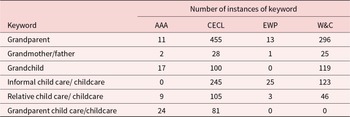
Using Adobe Acrobat advanced search tools, the research team conducted searches of the following terms, including variations, for both interim and final submissions to each of the inquiries: grand-parent/mother/father/child; informal child care/childcare; relative child care/childcare; grandparent child care/childcare. For search terms with multiple words, a proximity search within 15 words was undertaken. The resulting instances of the keywords for each inquiry are shown in Table 2.
Instances of keywords in selected policy documents

Through this process, Excel files were produced to show the results of the number of submissions and search terms for each of the inquiries, and manually reviewed in order to filter out any results that were irrelevant or repetitive. For example, some submissions included the search terms as part of the references list, footnotes or contents page, but did not have any substantial reference to grandparent care. Others mentioned grandparents/grandmothers in other contexts, for example as foster parents.
Stage 2: Selection of texts
An analysis of the selected texts determined how grandparent childcare was characterized within the submission. Some submissions were removed from the sample at this stage because their definition of carer implicitly excluded grandparent childcare (e.g. referred to other types of care provider, not including grandparents). Submissions from individuals (not representing an organization) were excluded in order to focus on the dominant or normative discourses produced by organizations and institutions which affect the structural organization of care, rather than on experiential accounts. So few individual submissions were made that including them may have skewed the results. Table 3 outlines the results from the search and filtering process.
Results from search and filtering process

The final corpus of 63 submissions allowed us to focus the CDA (Stage 3) on specific passages of text referring to grandparent childcare. The names of the organizations that made the submission are abbreviated in the quoted references using the numbered submission for the . The acronyms for the inquiry are outlined in Table 1 (i.e. ‘AAA 2012’) and the submissions are listed by number in the supplementary table.
Stage 3: Critical discourse analysis
The final stage of the analysis involved close reading of the selected passages of text from each of the submissions. This followed a sociological approach to discourse analysis that is interested in context, structure and power/social order – particularly how groups are represented and positioned within texts (van Dijk Reference van Dijk and van Dijk2011). For this article, we focused on assumptions about gender and age, and how unpaid care work is positioned in relation to paid work.
We used a feminist CDA to understand the ways in which grandparent childcare, and grandparents are framed in language about women’s labour market participation and care responsibilities (Lazar Reference Lazar2007; Wodak and Meyers Reference Wodak and Meyers2009). Critical discourse analysis, more generally, refers to a method of text analysis that focuses on how social power, dominance and inequality are produced and reproduced in language (Mullet Reference Mullet2018; Fairclough et al. Reference Fairclough, Mulderrig, Wodak and van Dijk2011). The feminist approach used is attuned to the ways in which gender ideology and power asymmetries feature in policy discourses (i.e. grandparent vs grandmother); further, it helped to interrogate the power asymmetries at the intersections of gender and age in policy discourses (Lazar Reference Lazar2007). Feminist CDA is important in this context because it recognizes that care and care-giving are ideologically entrenched as women’s work. The purpose of the feminist CDA was to chart how the issue of younger and older women’s employment and patterns of care features in these documents – what kinds of discourse are in evidence and are there any distinct patterns as to who promulgates the different discourses? Are there explicit or implicit contradictions between the discourses? How are grandparents and grandparent care represented as part of the problem and/or solution to women’s employment?
The analyses take an iterative and adaptive approach that allows for reflexivity through the process. The authors approach the corpus of text with an analytical lens that encourages questioning constructions and meanings about gender, age and the value of paid and unpaid work. Drawing on Fairclough’s approach allowed for descriptive, interpretive and explanatory stages (Johnson and McLean Reference Johnson, McLean and Kobayashi2020). As noted earlier, using submissions to four specific public inquiries enabled a corpus-based approach through which we could identify and examine the policy texts (Fairclough et al. Reference Fairclough, Mulderrig, Wodak and van Dijk2011).
As presented in Table 4, the analysis involved categorizing whether grandparents were described as enablers of others’ labour market participation, or as workers themselves. Table 4 identifies these categories to indicate the number of submissions where grandparents were interpreted as either enablers (child carers) or as workers (with grandparent childcare presented as a barrier). In some submissions, grandparents were framed as both care-givers and workers. The findings section explains these categories and interpretations in more detail. Although the analysis is qualitatively focused, the quantitative count of the number of submissions that framed grandparents as enablers or workers offers insight into potential gaps or silences across the inquiries.
Prevalence of discourses in submissions

Limitations
The total number of submissions selected (based on the keyword search results) was much higher for the 2014 Productivity Commission inquiry into PC CECL, thus skewing the quantity of findings that position grandparents in relation to the more dominant category of facilitators/enablers of employment for others. The analysis takes a qualitative approach and focuses on the different discourses across the inquiries, rather than the number of submissions in each category. It is also acknowledged that the inquiries attracted submissions from a diverse range of organizations, particularly organizations representing older people in the case of the AAA and childcare organizations in the case of PC CECL. While it is important to note the lower count of submissions to the CECL that presented grandparent childcare as a barrier to their own employment, as opposed to facilitating mothers’ employment, it was outside the scope of this study to examine these patterns and potential nuances.
Findings
Two overarching themes emerged from the analysis, and these are used to structure the findings. First, grandparents were constructed as enablers of parents’ (especially mothers’) paid labour market participation. This section presents different ways that grandparents are constructed as childcare providers, whereby grandparent childcare is framed as an alternative to the formal ECEC system and a means of supporting parents’ (especially mothers’) paid work. Second, grandparents were constructed as labour market participants – whereby grandparent childcare is constructed as a barrier to sustaining paid work for older workers and an inferior alternative to formal childcare. Throughout this section, the citation (e.g. PC CECL 2014, Sub000) refers to the inquiry acronym (see Table 1) and the submission numbers and corresponding organization names are listed in the supplementary materials.
Grandparents as enablers of parents’/mothers’ labour market participation
The broad framing of grandparents as enablers of (younger) women’s labour market participation was the dominant discourse across the corpus of submissions, present in 46 of the 63 submissions to the inquiries. Perhaps unsurprisingly, it was most apparent in the submissions to the 2014 PC CECL (38/40), but it also featured in the 2022 EWP (4/5) and the 2022 W&C inquiry (4/9). This framing was not present in the AAA inquiry (0/9). A number of stakeholders identified the key role that grandparents play in facilitating parents’ workforce participation. This included reference to more dual-earner families, leading to grandparents needing to fill in the gaps left when parents increase their labour market participation or by inadequate, unavailable and unaffordable formal ECEC. Grandparents were presented as the solution to parents’ constrained choices, particularly as a solution to the high cost of formal ECEC as well as the lack of available spaces, yet access to grandparent childcare was also portrayed as a privilege.
Filling gaps in the ECEC system
Grandparents are presented as a childcare arrangement that emerges in circumstances where other options (i.e. formal care) are less desirable for parents, or owing to the weaknesses of the ECEC system. For example, a non-profit ECEC provider stated that ‘the ongoing increase in the cost has resulted in families having a “patchwork” of care arrangements’, where parents have ‘reduced their booked days at centre-based care and use grandparents or extended family to fill the gap’ (PC CECL 2014, Sub355). This passage situates grandparents as a ‘cog’ in the childcare market and also as a care arrangement that emerges in response to the failure of the formal ECEC system. In another submission from an ECEC organization, grandparents are presented ‘as part of the mix in supporting parents’ return to work where childcare is unaffordable, not accessible or where the parents preference [sic] extended family to participation in the child’s overall development and wellbeing’ (PC CECL 2014, Sub262).
In many passages grandparents were presented both as enablers of parents’ work and as conscripts of a failing childcare system. For example, in one stakeholder’s submission to the PC inquiry, they explained that
many grandparents in Australia selflessly provide hours of childcare every week, taking on the role sometimes lovingly, but not necessarily willingly. They make it possible for their adult children to work without incurring childcare costs (PC CECL 2014, Sub431).
A submission by the Australian Women’s Chamber of Commerce referenced the lack of formal childcare for babies as ‘forcing women, on the whole, to resign in order to undertake child-caring responsibilities, rely on grandparents or hire expensive private nannies’ (PC CECL 2014, Sub336). Similarly, one stakeholder suggested that grandparents would ‘give up’ providing childcare if formal care was more affordable (PC CECL 2014, Sub412).
An ECEC service provider also explained that parents are ‘relying on extended family and grandparents to care for their children as they simply can’t afford the fees to send their children [to more days of childcare]’ (PC CECL 2014, Sub248). In another submission from a pre-school, grandparents were described as ‘supporters’ of working parents (PC CECL 2014, Sub169).
In other submissions, stakeholders praised grandparents for the wider national economic benefits that are generated by supporting parents to work, to save, to pay taxes and to claim fewer government subsidies for formal ECEC. For example, National Seniors Australia presented grandparents as key contributors to the economy, asserting that their unpaid childcare’ should not be understated’ given their ‘enormous benefit to the economy, making it easier for parents of young children or of dependent adults to engage in the workforce’ (W&C 2022, Sub11). They state:
Demand for formal childcare is partly being filled by informal, unpaid care without which there would be difficulties for parents being able to work. Informal care of grandchildren provides a significant, free economic benefit which reduces the fiscal burden on the government (W&C 2022, Sub11).
Grandparents were praised as contributors both to parents’ economic productivity and to the economy as a whole. In the EWP, the Australian Banking Association (ABA) identified the need to ‘recognise the caring role performed by extended family members such as grandparents’ (EWP 2022, Sub225) in order to ‘increase the participation and opportunities for women in the professional workforce’. While it is not explicit, the passage by ABA implies that greater recognition or formalization of grandparents’ caring role, through funding or subsidies, could act as a policy lever to boost younger ‘professional’ women’s (mothers’) participation in the paid workforce. Interestingly, and perhaps reflecting the inquiries’ terms of reference, submissions presented grandparents primarily as a benefit to the parent/mother and/or the government/economy, rather than addressing potential benefits for the child.
Access to grandparent care as a privilege
Grandparents were framed as a valuable resource that is not universally accessible. Some demographic cohorts or types of family were identified as more or less likely to use grandparent childcare. For example, one submission pointed out that one-third of mothers with young children did not draw on grandparent childcare (W&C 2022, Sub19). Some cohorts – particularly migrant women – were identified as a group who were less likely to have grandparents available to provide childcare. A submission by Settlement Council of Australia to the EWP referred to Australian Bureau of Statistics data to show that migrant women are
less likely to have the support of grandparents or other extended family to assist with child minding. Therefore, the accessibility of childcare, or lack thereof, has particularly acute impacts for migrant and refugee women (EWP 2022, Sub153).
In their submission to the PC CECL (2014), the Workplace Gender Equality Agency stated:
The close proximity of mothers or mothers-in-law has been linked with women’s increased labour force participation but living away from the extended family makes accessing sources of informal childcare difficult for a lot of parents. In Australia’s large metropolitan centres, even moving to the other side of the city can make using grandparents or other relatives for informal childcare problematic. (PC CECL 2014, Sub089)
This illustrates the tendency in the documents to link the role and potential value of grandparents to their unpaid childcare contributions.
Intergenerational trade-offs in women’s paid work and earnings
In some discourses that construct grandparents as enablers, the gendered transfer of care, and the impact on older women, primarily, are recognized. The Council on the Ageing (COTA Australia) asserts that older women are sacrificing current earnings and future income when they stop work early to provide childcare:
Older women who give up work prematurely to look after grandchildren are also sacrificing some of their future retirement income because they miss out on being able to build up their superannuation balances (PC CECL 2014, Sub412).
Similarly, the Australian Federation of Graduate Women (AFGW) articulates that ‘productivity is still lost in this scenario [when grandparents leave the workforce] although different groups of women are affected’ (PC CECL 2014, Sub417). Here, the AFGW explicitly recognizes the shift in care responsibilities from a younger to an older cohort of women. The Shop, Distributive and Allied Employees Association (SDA) also explicitly recognized the gendered transfer of childcare, from a younger to older generation of women, and the impact of this for older women’s retirement savings and superannuation. In their submission to the W&C inquiry (2022), they stated:
[Given] that it is most often grandmothers, this form of care is again gendered and consideration must be given to the fact that women retire on almost half the retirement savings of men and this impact on workforce participation in later stages in life impacts on women’s ability to save and contribute to their superannuation (W&C 2022, Sub37).
The COTA Australia submission to the PC CECL inquiry (2014) also recognizes the ‘significant sacrifices’ that ‘usually grandmothers’ make (PC CECL 2014, Sub412).
Importantly, the discourse on grandparents as enablers framed grandparents as resources to be drawn upon (or not) to support parents’ labour market participation. In this framing, grandparents were largely positioned as passive with little involvement in the decisions about the childcare arrangements. They were portrayed as resources readily available (within logistical boundaries, such as geographical distance) to prioritize parents’ paid labour market participation. In this way, grandparents’ employment is for the most part construed as less valuable – their primary role was to prop up parents’ capacity to earn. Throughout this discourse that framed grandparents as enablers, some stakeholders explained the intergenerational trade-offs and tensions between two cohorts of women, including the potential health and financial implications for grandparents providing childcare.
Declining availability of grandparent childcare as a threat
Grandparent childcare was framed as a resource in decline in a context of longer working lives. Submissions to the PC CECL inquiry (2014) and AAA (2012) reflect alarm about the declining availability of grandparent childcare as a result of policies that encourage later retirement age, as well as their declining health or capacity to provide care as they get older: ‘grandparents are much less available than they used to be’ (PC CECL 2014, Sub1). Similarly, the Young Men’s Christian Association (YMCA) noted that with ‘increasing retirement age grandparents are quite likely to still be in fulltime work during the first five years of their grandchildren’s lives’ (PC CECL 2014, Sub389). The Minister’s Education and Care Advisory Council submission indicated: ‘Grandparents are also working longer and are restricted in how they can help families with informal care’ (PC CECL 2014, Sub290).
Stakeholders cited earlier caution that grandparent childcare is incompatible with ideas of productive ageing that promote labour market participation late into working lives (Hamilton et al. Reference Hamilton, Timonen, Craig, Adamson, Daly, Pfau-Effinger, Gilbert and Besharov2023). This, and other passages, construct grandparents as a care resource that is becoming scarcer as their paid economic contributions are prioritized by government. The Australian Chamber of Commerce’s submission to the PC CECL 2014 inquiry, for example, points to how broader economic trends and policy priorities, namely increased participation rates, have affected the ‘availability of family child care options’ (PC CECL 2014, Sub324). Another submission acknowledged this tension, stating: ‘Relying on grandparents to provide care while their adult children work is in conflict with this [i.e. mature-age labour market participation] policy’ (PC CECL 2014, Sub431).
Stakeholders also identify health circumstances that shape grandparents’ continued ability to combine paid work and childcare. Westpac’s (a large financial services company) submission to the PC CECL inquiry expressed concern about ‘[grand]parents’ ability to continue to provide care as children get older and [caring for them is] more demanding’ (PC CECL 2014, Sub327). Grandparents are framed here as a fragile resource, whose capacity to care may expire as a result of health circumstances, or participation in the paid labour market.
Grandparents as (potential) labour market participants
The second, and less dominant, discourse that emerged constructed grandparents as paid workers (rather than carers) and as contributors to the economy in their own right. As Table 4 summarizes, in 32 of 63 submissions grandparents were presented as workers. This discourse was dominant in the 2012 AAA inquiry (9/9) and the 2022 W&C inquiry (7/9). In most of these submissions, grandparent childcare (especially by grandmothers) was presented as a barrier to their participation in the paid workforce. Importantly, where grandparents were presented as workers, it was almost always in a way that recognized the need to balance care responsibilities (including childcare), thus constructing grandparents as both workers and carers.
Grandparents as worker/carers – sacrificing work to care
This discourse was most evident in the AAA (2012) and the EWP (2022) inquiries. In the EWP, National Seniors Australia pointed to a recent research study that showed how providing grandparent childcare affected grandparents’ own work decisions and arrangements:
70% altered the days or shifts they worked, 55% reduced their working hours, and 18% had even changed their job because of their caring commitment. A third of survey respondents reported childcare commitments had changed the timing or expected timing of their retirement (EWP 2022, Sub344).
In this way, and distinct from the other discourses described earlier, grandparents are framed as active labour market participants who are making economic sacrifices to care for grandchildren. A submission by Business and Professional Women (BPW) Australia to the CECL inquiry recognized that
there are mixed emotions in caring for their grandchildren … It may mean a loss to their own income or reduced disposable income. This may eventually lead to a decreased standard of living for retirees and superannuants (PC CECL 2014, Sub085).
In many of the submissions where grandparents are framed as paid labour market participants, grandparents are presented as potential workers who can be better utilized to continue participating in paid work while carrying out their care responsibilities (AAA 2012, Sub71). Drawing on Timonen’s (Reference Timonen2016) theory of model ageing, grandparents are constructed as subjects who can be moulded into useful contributors to the workforce through access to flexible work and support for retraining. For example, in the Older Workers submission to AAA, they present older workers as subjects that can be ‘managed’ through strategies such as
ensuring flexible working arrangements including transition to retirement, retraining into more appropriate positions where required and reducing working hours to allow time for carer responsibilities for elderly parents, children or grandchildren (AAA 2012, Sub22).
Many submissions from stakeholders to the W&C inquiry position grandparents as deserving adequate support to balance their roles as workers and childcare providers. For example, the Social Policy Research Centre (SPRC) articulated that, ‘too often, the unpaid care [by grandparents] is provided with little if any support from the employers’ (W&C 2022, Sub19). The SDA put it this way:
There needs to be more support available to grandparents to enable them to work and provide care to grandchildren (W&C 2022, Sub37).
Submissions to the PC CECL inquiry also positioned grandparents as a group of workers who should be better supported to combine paid work and unpaid childcare (PC CECL 2014, Sub417).
Grandparents as potential formal childcare providers
A sub-discourse that emerged as part of the worker discourse situated grandparents neither as enablers of mothers’ work nor as workers in their own right, but as potential childcare workers who could be better utilized, supported or remunerated in policy and regulation. In the PC CECL inquiry and the EWP inquiry, submissions identified the potential for grandparent care-givers to be professionalized through payment schemes and/or training, and thus included in the formal ECEC workforce. In a submission to the EWP, one employment agency suggested that in some regions informal care forms a large component of childcare, and that if governments were to create access to childcare training,‘informal providers and retirees’ could become qualified professionals to transform informal care into formal care (EWP 2022, Sub322).
In response to the Productivity Commission’s terms of reference about the role of different forms of informal childcare, some organizations advocated for the inclusion of grandparents within the ECEC sector, showing recognition of their experience as parents and grandparents. For example, a nanny agency stated:
Many of our nannies have a minimum of 3 years’ experience working “one on one” as a nanny without a qualification. Those without qualifications are highly experienced; many are mothers or grandmothers who have cared for their own children/grandchildren. (PC CECL, 2014, Sub135)
These organizations suggest that providing training or extending subsidies to informal care-givers would reshape how grandparents are positioned within the sector. That is, a policy change could shift them from unpaid carers to paid workers or educators, who would then be approved providers subsidized through the formal childcare system. This aligns with ‘model ageing’ theory which proposes that policy and/or regulatory actors signal older adults’ (grandparents’) desirable and socially useful roles (Timonen Reference Timonen2016).
Several stakeholders gave international examples of how grandparents are positioned as a more formally recognized part of the ECEC system, for example Finland, Germany and New Zealand, where grandparents can receive a cash payment to provide childcare (PC CECL 2014, Sub186, 191, 289, 383). This included calls for support from the government to enhance grandparents’ skills and knowledge of child development, framing them as educators. The COTA stated: ‘Given the important role of grandparents in some children’s lives, it is important that grandparents understand their role as educators’ (PC CECL 2014, Sub412).
Other stakeholders, though, cautioned against including grandparents as formal childcare providers, with particular attention given to the importance of quality early learning and adequate administration as potential risks. In contrast to the previous sub-discourse, this sub-discourse firmly distinguishes the role of grandparents as carers rather than workers or educators. For example, one submission, put it this way:
Many … have their children “minded” by grandparents or neighbours, robbing the children of vital early learning and development programs (PC CECL 2014, Sub333).
In these instances, grandparents were sometimes framed as inferior to formal childcare, implying that being cared for by grandparents could be detrimental for the child.
Discussion
Informed by the two overarching discourses that construct grandparents primarily as carers or as workers, four key social constructions, or ‘models’, of grandparents are identified: mother savers, system savers, work/care jugglers and untapped labour. Within the discourse that constructs grandparents primarily as carers and as ‘enablers’, grandparents are framed as mother savers and as system savers (Herlofson and Hagestad Reference Herlofson, Hagestad, Arber and Timonen2012).
As mother savers, grandparents are framed as essential facilitators of (primarily) mothers’ (their daughters' and daughters-in-law) participation in paid work. Their provision of unpaid childcare is recognized and valued, but their contribution is presented as facilitating the economic activities of others, rather than making economic contributions in their own right. Grandparents’ unpaid childcare work is presented as the default option for parents who need to work.
The ‘mother saver’ discourse, which was particularly dominant in the 2014 PC CECL inquiry, privileges the workforce participation of mothers of young children, rendering the workforce participation of the (grand)mothers supporting their adult children invisible or of little intrinsic value. In these discourses, grandparents are largely considered passive actors within the intergenerational relationship, whereby they are conscripted into childcare duties to fill gaps in a failing childcare system. This discourse is strongly imbued with ideals of good grandparenthood whereby the prioritization of childcare over other activities by grandparents was a ‘natural’ order of things in families. This discourse, permeated with strong expectations about how grandparents ‘should’ act (Timonen Reference Timonen2016), is heavily inflected with gender, with a strong focus on grandmothers. According to qualitative research with grandparents (Hamilton and Suthersan Reference Hamilton and Suthersan2020), enactments of grandmotherhood are intrinsically bound up with enactments of the good mother, as grandmothers’ involvement in regular childcare is closely bound up with ‘deep moral requirements about supporting their adult children’. This article suggests that these entanglements exist not only in the subjective experiences of grandmothers but in normative constructions of older women in policy discourse.
This links with a second, closely aligned construct that emerged in the ‘enablers’ discourse: grandparents as system savers. The system savers discourse overwhelmingly presents grandparents as filling in gaps in the ECEC system, particularly when formal childcare services are not available or affordable. Grandparents are framed as complementary or alternative forms of care that buttress a failing formal ECEC system. As system savers, grandparents are constructed as contributors to the mixed market of formal and informal childcare, often with the assertion that the reliance on grandparent childcare ‘reduces the fiscal burden on the government’ (W&C 2022, Sub11). This discourse differed from ‘mother savers’ in that the economic benefits of grandparent childcare were recognized in the broader context, saving the government money (through savings in childcare subsidies) and reform efforts in creating a more tailored, fit-for-purpose formal ECEC system. This construction of the good grandparent aligns with the role of grandparents in more familialized regimes (Floridi Reference Floridi2022) where grandparent childcare is ‘assumed’ in response to an inadequate formal ECEC system (Glaser et al. Reference Glaser, Price, Di Gessa, Montserrat and Tinker2013), and is perhaps unsurprising given Australia’s policy context, in which ECEC is market-based and patchy.
The secondary discourse presents grandparents primarily as labour market participants and as potential economic contributors in their own right, while at the same time continuing to acknowledge their role as providers of childcare. Both of these discourses foregrounded the model older citizen who contributes directly to the economy through paid work while continuing to subscribe to the ‘good grandparent’. In most instances of the secondary discourse, grandparents are constructed as work/care jugglers, facing limitations on their labour market potential because of their childcare responsibilities. The discourses that privilege grandparents as workers also sometimes constructed grandparents as untapped labour, unable to reach their full capacity in the labour market because of care responsibilities. This more marginal discourse presented grandparent childcare as a barrier to boosting their own labour market participation, rather than as a facilitator of the labour market participation of a younger generation of women.
A small subsection of this discourse constructed grandparents as potential workers in the formal childcare system, that is, as skilled providers of childcare that can be better integrated, through formalization of skills or eligibility for subsidies, into the formal ECEC system. Yet, clear tensions emerged in this discourse, with some stakeholders advocating against the inclusion of grandparents within the formal/subsidized childcare sector because they were constructed as inferior to formal and regulated childcare settings.
Hence, in the first two discourses, model ageing was presented as enactments of the ‘good grandparent’, regular provider of childcare and enabler of parents’ paid work and, through that, contributor to the nation’s collective prosperity as ‘citizen grandparents’. In contrast, in the secondary discourse, model ageing was presented as enactments of the ‘good worker’, fulfilling their citizenly duty as productive agers participating in paid work, while maintaining effective work–care balance. This latter construction is resonant of the good mother/good citizen tension identified by Blaxland (Reference Blaxland, Goodwin and Huppatz2010). Older adults/grandparents are therefore called upon in policy discourse to make irreconcilable contributions to both paid work and childcare.
This tension is a likely product of Australia’s ‘middling’ grandparenting regime (Glaser Reference Glaser, Price, Di Gessa, Montserrat and Tinker2013). In middling grandparent care countries, patchy and inaccessible formal ECEC and short parental leaves combined with strong emphasis on boosting women’s workforce participation sees mixed patterns of work and care among women, with grandparents playing both occasional and intensive childcare roles. A lack of coherence or alignment in policies shaping the supply of and demand for grandparent childcare can generate tensions in the expectations of grandparent providers of childcare.
Conclusions
The analysis sheds new light on grandparent childcare by revealing the ways in which it is constructed in policy discourse as a manifestation of model ageing (Timonen Reference Timonen2016) in contemporary Australia. The predominant reliance on grandparents (mostly grandmothers) as childcare providers is ostensibly at odds with government policy that focuses on boosting women’s work. Analysis of the corpus of submissions suggests that gender intersects with age in the discursive framing of the policy objective of boosting women’s work, so that younger women’s work is favoured and older women’s contribution to the labour market is rendered indirect – facilitating younger women’s labour. Policy discourses that valorize maximizing paid work during women’s ‘productive’ years mean that grandparents (mostly grandmothers) are constructed as compensatory sources of reproductive labour as mothers of young children move into paid work. These discourses therefore present grandparent childcare as an activity of the model older adult (older woman) making her contribution not only to her family but to the wider economy, and to the labour market by proxy (i.e. through supporting her daughter or daughter-in-law).
However, the analysis also revealed a counter-type to this model older care provider, a grandparent who also should contribute to paid work in their own right. This secondary discourse was more aligned with the government policy focusing on boosting women’s work. However, it was inflected with an assumption that grandparent workers should also continue to make themselves available for childcare, so rather than constructing grandparents as workers, they are constructed as worker/carers. Both discourses re-inscribe the highly gendered framing of childcare as ‘women’s work’ and pay little attention to underlying inequities in the gendered division of reproductive labour in households.
Consequently, ‘model’ older adults with grandchildren are constructed both as workers and as childcare providers. In spite of high expectations of older adults as both workers and carers, language used in the texts implies that older adults are inferior, both as employees (vis-à-vis the younger employees, the parents whose careers are to be prioritized and supported by older family generations) and as childcare providers (vis-à-vis the professional, formal, centre-based care providers). Notably, there is an absence in these discourses of the older worker who is focused on their own, intrinsically valued labour market participation with its associated health and social benefits for the individual older worker (Grote and Guest Reference Grote and Guest2017), with the benefits of their labour focused on those generated for their adult children and the country’s economy.
This is reminiscent of the ideal of the ‘good mother’ (Goodwin and Huppatz Reference Goodwin, Huppatz, Goodwin and Huppatz2010; Holloway Reference Holloway1998; McDowell et al. Reference McDowell, Ray, Perrons, Fagan and Ward2005) evident in policy debates in the last half-century, which places pressure on mothers to conform to a series of moral and often conflicting standards of care for their children, while also facing imperatives to participate in paid work, in spite of their economic participation being framed as secondary to the participation of others. As grandmothers are expected to help their adult children and their partners to engage in paid work, this ‘good mother’ role is perpetuated into older ages, revealing the construction of the good grandmother, the model older adult with a moral imperative to support and prioritize the needs of younger family generations, while also undertaking their economic duties as productive contributors to the labour market in their own right.
The contradictory expectations that are directed at older persons in these policy discourses serve as an extension of model ageing theory to the intergenerational (policy) context. The policy discourses identified here amount to relegation of older women into roles that are onerous and even impossible (working longer and delivering childcare), or indicative of questioning the quality and worth of their paid and unpaid work. While it is not openly stated, these contradictory expectations arise from the inadequacy of childcare policies, something that the model older person (grandmother) is expected to compensate for by being available to deliver childcare. The findings presented here therefore add a generational and broader policy contextual dimension to the model ageing theory: where expectations directed at older persons meet inadequate policy provision for younger adults, the efforts to model older adults intensify and the contradictions of the modelling efforts are extended to policy fields outside old-age-specific policies. As always in discourse analysis, it is the silences and the absences that speak loudest and drive the expectations directed at older women, in this case the lack of a strategy for improved childcare policy. In its absence, the model grandmother works and cares, tirelessly compensating for gaps in policy.
Supplementary material
The supplementary material for this article can be found at https://doi.org/10.1017/S0144686X25100494.
Acknowledgements
This research is funded by the Australian Research Council Discovery Grant (DP210101107).
Competing interests
The authors declare none.



 Open access

