


Introduction
Participation in age- and dementia-friendly communities
Age- and dementia-friendly communities are a policy goal for national governments, the European Commission and the World Health Organization (WHO, 2017). However, research suggests that the simultaneous drive towards the mainstream digitalisation of communities may challenge the inclusivity of such policies (Kottorp et al., Reference Kottorp, Nygård, Hedman, Öhman, Malinowsky, Rosenberg, Lindqvist and Ryd2016; Nygård et al., Reference Nygård, Rosenberg and Kottorp2016; Gaber et al., Reference Gaber, Nygard, Brorsson, Kottorp and Malinowsky2019). All citizens of Swedish society, including people with dementia, are expected to interact with an increasing number of Everyday Technologies (ETs) to enact their right to participate in society (United Nations, 2006; Cahill, Reference Cahill2018). ET is an umbrella term encompassing mechanical, electronic as well as digital technologies that commonly exist in the everyday lives of older people (Nygård et al., Reference Nygård, Rosenberg and Kottorp2016). Together, public space ETs and portable ETs constitute the technologies typically used outside the home (Gaber et al., Reference Gaber, Nygard, Brorsson, Kottorp and Malinowsky2019). Public space ETs refer to technologies located within public space settings, such as a self-service checkout in a grocery store or a ticket machine at a transportation centre. Portable ETs can be used in different places, both inside and outside the home, and tend to be digital information and communication technologies (ICTs), such as a smartphone, mobile phone or tablet. Despite the apparent ubiquity of ET, research indicates that society’s requirements of digitalisation and digital skills do not sufficiently match the needs and abilities of people with dementia (Jakobsson et al., Reference Jakobsson, Nygård, Kottorp and Malinowsky2019). This motivates the aim of this study which is to deepen the knowledge about how use of ET outside the home, including portable ETs, relates to participation in places visited within public space among people with dementia over time.
Sweden, like many other countries, has an ageing (Statistics Sweden, 2018) and increasingly technological society (European Commission, 2019). On the one hand, Sweden is characterised as a ‘cashless’ society which is increasingly reliant upon sophisticated banking (i.e. mobile Bank ID) and payment technologies (i.e. Swish) in order to participate in activities of daily living (Eaton et al., Reference Eaton, Hedman and Medaglia2018). These range from accessing health care to using public transportation. On the other hand, 1.7 per cent of the Swedish population are living with dementia and this is projected to double by 2050 (Alzheimer Europe, 2019). This means that there is a population of older people with dementia who may have difficulties using technologies, already in the mild stages (Alzheimer's Disease International (ADI), 2019).
Due to the increasing prevalence of people with dementia living and ageing in their communities, international and national policies have sought to promote their opportunities for participation, as active and engaged citizens (Phinney et al., Reference Phinney, Kelson, Baumbusch, O'Connor and Purves2016; Li et al., Reference Li, Keady and Ward2021). A measure to promote participation, defined as ‘involvement in a life situation’ (WHO, 2002), is through the development of age- and dementia-friendly communities. Age- and dementia-friendly communities share a common goal to enable social engagement, confidence, health and wellbeing, by compensating for disability through environmental adaptations and affordances (WHO, 2007). Age- and dementia-friendly communities typically involve guidelines or recommendations for physical adaptations of public space, such as well-lit entrances or enlarged text on signage for increased legibility (Alzheimer’s Society, 2013). Both of the concepts of age- and dementia-friendly communities are relevant to older people with dementia, but dementia-friendly communities differ from age-friendly communities in their focus on issues pertaining to dementia. Dementia-friendly communities place an additional emphasis on training service providers who are likely to interact with people with dementia, as well as the development and provision of novel assistive technology, such as memory and wayfinding aids. However, ET are given less attention in the design and planning of dementia-friendly communities.
The Swedish National Board of Health and Welfare (2017) prioritised the creation of dementia-friendly services by 2022, particularly calling for more accessible public places, such as grocery stores, pharmacies, banks and public transportation. National policies, such as the Swedish National Strategy for Dementia (Swedish National Board of Health and Welfare, 2017), and international legislation, such as the United Nations’ (2006) Convention on the Rights of Persons with Disabilities, state that all people, including those with dementia, should have the right to full participation and inclusion in society. Full participation and inclusion in society includes opportunities to participate in places within public space, which in practice relies on an assumption of universal access and use of ET. However, earlier studies suggest that universal access and use of ET, including internet use, may not be assumed among older people (Peine and Neven, Reference Peine and Nevenin press; Stockwell et al., Reference Stockwell, Stubbs, Jackson, Fisher, Yang and Smithin press), especially for those living with dementia (Nygård et al., Reference Nygård, Pantzar, Uppgard and Kottorp2012).
Enacting citizenship through participation in society in relation to ET use
Research indicates that in order to implement the policy goals for age- and dementia-friendly communities, there is a need to develop knowledge about the citizenship of people with dementia in their everyday lives (Baldwin and Greason, Reference Baldwin and Greason2016; Bartlett, Reference Bartlett2016). A review of the discourse on citizenship and dementia elucidates a shift from the view of citizenship as a status bestowed on people, in favour of the conceptualisation of citizenship as a dynamic practice, enacted through a person's participation in everyday life (Nedlund and Nordh, Reference Nedlund and Nordh2018). Historically, citizenship referred to the status of belonging to a society, including its policies, rights and responsibilities (Higgs, Reference Higgs1995). Citizenship occurs on different levels (Baldwin and Greason, Reference Baldwin and Greason2016). On a national and community level, meta-citizenship is bestowed according to governmental dementia strategies and macro-citizenship involves individuals through communal actions, such as voluntary and advocacy groups (Baldwin and Greason, Reference Baldwin and Greason2016; Nedlund and Nordh, Reference Nedlund and Nordh2018). More recently, scholars have explored micro-citizenship. Micro-citizenship is defined as ‘those actions and practices of individuals, in immediate relationship, which uphold the liberties and freedoms of those involved while generating or supporting a sense of identity and belonging’ (Baldwin and Greason, Reference Baldwin and Greason2016: 293). Micro-citizenship may take various forms, but a pervasive theme is that people with dementia enact their citizenship through participation in the neighbourhood context. Clarke and Bailey (Reference Clarke and Bailey2016) explored the ways that micro-citizenship was enacted through narrative, as people with dementia living in rural and semi-urban communities shared their experiences about the people and places they encountered in their neighbourhoods. Other studies have shown how micro-citizenship can be enacted through participation in the routine activity of visiting a local hairdresser (Ward et al., Reference Ward, Campbell and Keady2016), or through the shared engagement in one’s community by participating in a neighbourhood walking group (Phinney et al., Reference Phinney, Kelson, Baumbusch, O'Connor and Purves2016). The enactment of citizenship, in particular micro-citizenship, relates to the concept of agency (Nedlund et al., Reference Nedlund, Bartlett and Clarke2019). Agency refers to the ability to influence and to determine one's personal circumstances (Boyle, Reference Boyle2014). A person with dementia can express their agency and self-determination through varying degrees of participation. Thus, the person with dementia is not regarded as a passive victim of an inaccessible and shrinking world (Duggan et al., Reference Duggan, Blackman, Martyr and Van Schaik2008). Rather, we view the person with dementia's changing participation as indicative of their sense of agency and choice to participate in some places within public space but not in others. Agency is also linked to a person with dementia's use and non-use of different types of ETs. Whilst earlier studies provide valuable insights into the ways that micro-citizenship is enacted by people with dementia as agents in their everyday lives, the role of ET is conspicuously absent.
As communities become increasingly reliant upon technology, patterns of behaviour, habits and social norms associated with ET use are evolving (Kielhofner, Reference Kielhofner2008; Vallor, Reference Vallor2016). Increasingly, research refutes the assumption that technology performs a subsidiary or neutral role in the lives of older people (Vallor, Reference Vallor2016; Peine and Neven, Reference Peine and Nevenin press), which may also be the case for older people with dementia. The central role of ET is evident in Stockholm, where the City Council has declared its goal to become the world’s smartest city by 2040 (Stockholms Stad, 2014). In smart cities, citizens interact with other people, with their technologies and with their technological environment (Cocchia, Reference Cocchia, Dameri and Rosenthal-Sabroux2014). Smart cities are not simply a compilation of ET but, rather, they are cities where ET is used to support data-driven decisions based on the interactions of the citizens, for instance GPS-based applications on smartphones that can provide real-time tracking and route information (Cocchia, Reference Cocchia, Dameri and Rosenthal-Sabroux2014). Yet, empirical evidence demonstrates that older people with dementia report lower ET use and increased challenges when using ET than older people with no known cognitive impairment (Malinowsky et al., Reference Malinowsky, Kottorp, Wallin, Nordlund, Björklund, Melin, Pernevik, Rosenberg and Nygård2017; Gaber et al., Reference Gaber, Nygard, Brorsson, Kottorp and Malinowsky2019). Increased challenges when using ET can impact a person with dementia en route and at destinations (Chaudhury et al., Reference Chaudhury, Mahal, Seetharaman and Nygaard2020) whilst travelling to, and participating in, places within public space (Brorsson, Reference Brorsson2013). In addition to cognitive issues, many older people with dementia also live with age-related comorbidity, such as mobility, auditory or visual impairments (Livingston et al., Reference Livingston, Sommerlad, Orgeta, Costafreda, Huntley, Ames and Samus2017). These various cognitive and functional impairments can adversely impact the person with dementia’s ability to participate in places within public space as well as their ability to access and use ET, e.g. managing stressful situations in public space or remembering the multiple steps to operate ET (Malinowsky et al., Reference Malinowsky, Almkvist, Nygård and Kottorp2012; Brorsson, Reference Brorsson2013). Due to the increased challenges that older people with dementia encounter whilst using ET, there is a risk that they may be excluded from a society which is increasingly dependent on smart and self-directed technology use. Restricted participation in places within public space may be a consequence. This study conceptualises participation in places visited within public space as a way for people with dementia to enact their citizenship on a micro-level, in other words micro-citizenship. Furthermore, to understand how micro-citizenship may be enacted in an increasingly technological society, this participation is investigated in relation to ET use. As micro-citizenship is conceptualised as a dynamic practice, it is important to investigate how this relationship stabilises or changes over time. The consideration of a temporal relationship is potentially crucial as the dementia progresses over time.
Participation in places within public space over time
Several longitudinal studies on ageing have explored cognitive function, activity limitation, health and physical performance over time (Classon et al., Reference Classon, Fällman, Wressle and Marcusson2016; Leone and Hessel, Reference Leone and Hessel2016; Daskalopoulou et al., Reference Daskalopoulou, Stubbs, Kralj, Koukounari, Prince and Prina2017; Evans et al., Reference Evans, Martyr, Collins, Brayne and Clare2019); however, these topics are rarely investigated prospectively among older people already living with dementia. Studies typically focus on the transition from healthy ageing to dementia, for instance investigating the risk of developing dementia (Zhou et al., Reference Zhou, Wang and Fang2018) or through retrospective analyses of archival database records (Stockholm Gerontology Research Center in collaboration with Aging Research Center, 2020). By focusing on a cohort of participants already living with dementia, this study attempts to address the knowledge gap about how people, or rather citizens, perceive participation in activities and places over time, as they live and age with a diagnosis of dementia. Earlier longitudinal research among a Swedish sample of older people with mild cognitive impairment (MCI) revealed reduced involvement in activities and a declining use of ET, over five years (Hedman et al., Reference Hedman, Nygård and Kottorp2017). The earlier research also found that older age was significantly related to decreasing activity involvement over time. Despite the reported decline in activity involvement and use of ET, longitudinal research indicates that older people value participation in places within public space, many of which entail technology use, for purposes of social engagement (Odzakovic et al., Reference Odzakovic, Hellström, Ward and Kullberg2020). Thus, there is a cogent rationale to develop knowledge about participation in places within public space over time for the increasing number of older people who are living with dementia in their communities.
The study tested the following hypothesis using multilevel statistical modelling:
• Decreasing use of ET outside the home is associated with decreasing participation in places visited within public space over time in people with dementia.
Furthermore, the study addressed the following two research questions using descriptive statistics:
(1) How does participation in places visited within public space remain stable or change over time for people with dementia?
(2) How does the use of ET outside the home remain stable or change over time for people with dementia?
Methods
Study design
This research is based on three years (four waves) of a longitudinal, observational study. People living with dementia in the mild to moderate stage were recruited at baseline (first wave) and participated in follow-up interviews at yearly intervals (second to fourth waves). The Regional Board of Research Ethics at the Karolinska Institutet granted permission for the study. The research complied with the Helsinki Declaration for research ethics (World Medical Association, 2018). Oral and written informed consent was obtained from all participants and across all waves of the study.
Participants
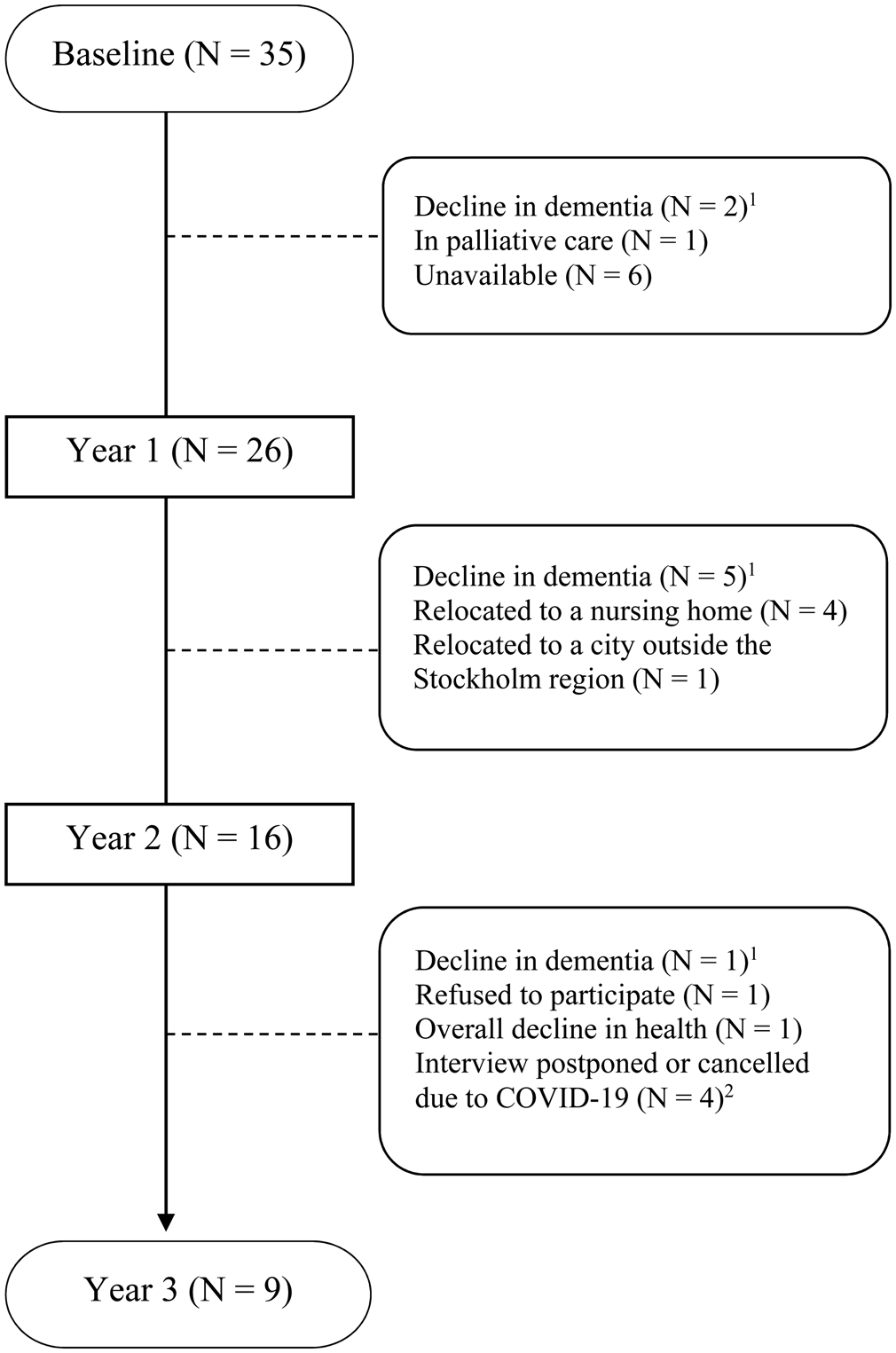
Thirty-five older people living with dementia were recruited between May 2015 and May 2017, and data collection finished in February 2020 (Table 1). Participants were recruited from three memory investigation units in Stockholm county and from voluntary, community-based settings for people with dementia, organised by local Stockholm municipalities, such as cafés and day care services. The inclusion criteria were: a diagnosis of dementia in the mild to moderate stage by a physician, according to criteria based on the fourth and fifth editions of the Diagnostic and Statistical Manual of Mental Disorders (American Psychiatric Association, 2000, 2013); capable of giving informed consent to participate in the research; aged 55 years or older; residing in ordinary housing in their community; performing activities within public space, either independently or with support from others; using at least some ET; and without any visual or auditory limitations which are not compensable via assistive technology. Table 1 outlines the characteristics of the participants at inclusion and Figure 1 presents the available data and attrition information, according to each wave of data collection. For each wave of the study, the potential participants received written information by post and a follow-up telephone call inviting them to participate.
Flowchart of data and attrition information, according to each wave of data collection.
Notes: 1. Decline in dementia to the extent that the participant was no longer able to communicate or participate in the interview. 2. In compliance with the Helsinki Declaration's obligation to protect vulnerable groups and individuals (World Medical Association, 2018), interviews that were scheduled during the period coinciding with the COVID-19 pandemic (WHO, 2020) were postponed or cancelled.
Participant characteristics at inclusion and for the sub-sample who remained in the study until Year 2 (third wave)
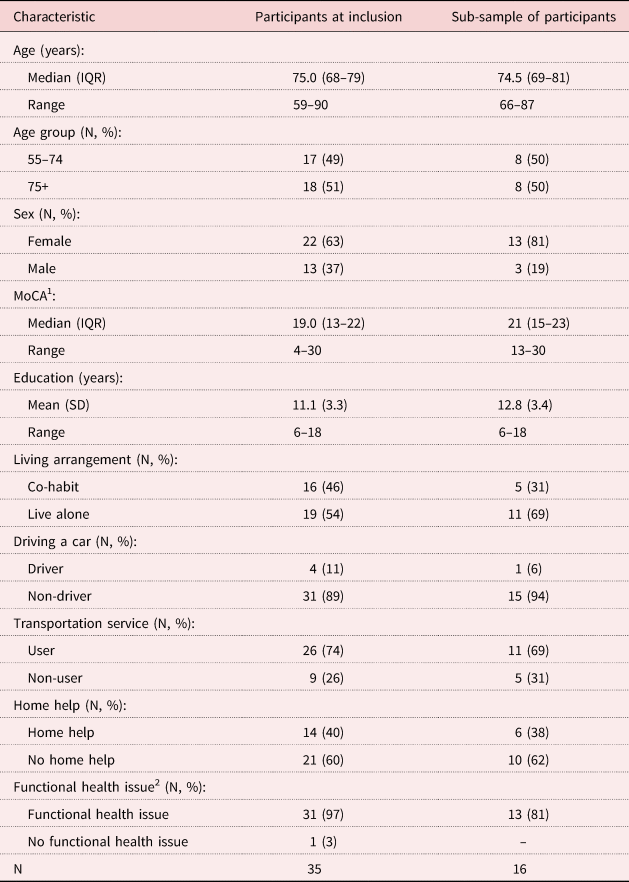
Notes: MoCA: Montreal Cognitive Assessment (potential score range 0–30; higher scores indicate higher cognitive status. Mean and standard deviation (SD) are presented for normally distributed data and median and interquartile range (IQR) are presented for skewed data. 1. One participant with dementia is an outlier according to MoCA score of 4. The rationale for retaining the outlying participant was twofold. Firstly, an investigation of the raw data revealed that the participant had challenges with communication due to Swedish not being their first language. Secondly, there was no statistically significant difference in the results when the participant was removed. 2. Missing data for three participants.
Data collection
Four occupational therapists who had received training in the use of the data collection tools and who have experience working with older people living with dementia collected the data. The data collection tools were used in the following order: (a) the Participation in ACTivities and Places OUTside Home Questionnaire (ACT-OUT); (b) the Montreal Cognitive Assessment (MoCA); (c) a demographic questionnaire; and (d) the Everyday Technology Use Questionnaire (ETUQ). Face-to-face, semi-structured interviews using the standardised questionnaires were performed in the participant's home, or an alternative location chosen by the participant. The interview procedure entailed a maximum of three interview sessions and the data collectors adopted a flexible approach to ensure that each interview session lasted no longer than 90 minutes. All participants had the option to be accompanied by a significant other for the purposes of support but not for proxy reporting.
Measures
Participation in places visited within public space was investigated using the ACT-OUT (Margot-Cattin et al., Reference Margot-Cattin, Kuhne, Kottorp, Cutchin, Öhman and Nygård2019). The purpose of the ACT-OUT is to capture detailed information on places and activities in combination, specifically identifying participation restrictions and pointing out barriers and facilitators in different contexts. The ACT-OUT is comprised of three parts. To address the research questions of this study only the first part was used, which maps the places that the participant reports going to in the present, according to a yes or no answer for a repertoire of 24 places. For instance, ‘Do you go to a bank or post office?’ The time horizons for what constitutes the present were self-determined by each participant. The 24 places are categorised according to four domains: places for purchasing, administration and self-care, e.g. a supermarket (Domain A, N = six places); places for medical care, e.g. a dentist's surgery (Domain B, N = five places); places for social, spiritual and cultural activities, e.g. a cinema or library (Domain C, N = six places); and places of recreation and physical activity, e.g. a park (Domain D, N = seven places). Earlier research provides information about the development of the ACT-OUT and psychometric testing is ongoing through studies in different populations (Gaber et al., Reference Gaber, Nygard, Brorsson, Kottorp and Malinowsky2019; Margot-Cattin et al., Reference Margot-Cattin, Kuhne, Kottorp, Cutchin, Öhman and Nygård2019; Olofsson et al., Reference Olofsson, Nyman, Kassberg, Malinowsky and Larsson Lund2020; Chaudhury et al., Reference Chaudhury, Mahal, Seetharaman and Nygaard2020).
The use of ET outside the home was investigated using the ETUQ (Nygård et al., Reference Nygård, Rosenberg and Kottorp2016). The ETUQ includes over 90 technological items that are commonly used by older people in their homes and within public space. To address the hypothesis and Research Question 2, we analysed a sub-sample of 49 ETs typically used outside the home. The 49 ETs included 33 portable ETs, such as a smartphone, mobile phone or ebook, and 16 public space ETs, such as a self-service checkout or a ticket machine (Nygård et al., Reference Nygård, Rosenberg and Kottorp2016). The data collector first investigated if an ET was relevant to the person. An ET was rated as relevant if it was available to the person and if it had either been used in the past, was currently used or will be used in the future. Next, the data collector determined whether the relevant ET was used, with varying levels of difficulty, or not used. Based on earlier research, the ETUQ is validated for use with older people living with dementia (Nygård et al., Reference Nygård, Rosenberg and Kottorp2016) and other health conditions (Malinowsky et al., Reference Malinowsky, Kottorp, Wallin, Nordlund, Björklund, Melin, Pernevik, Rosenberg and Nygård2017), in Sweden and other international contexts (Patomella et al., Reference Patomella, Kottorp, Ferreira, Rosenberg, Uppgard and Nygård2018; Wallcook et al., Reference Wallcook, Malinowsky, Nygård, Charlesworth, Lee, Walsh, Gaber and Kottorp2020).
Cognitive functioning was assessed at each data collection wave using the MOCA version 3 (Nasreddine et al., Reference Nasreddine, Phillips, Bédirian, Charbonneau, Whitehead, Collin, Cummings and Chertkow2005), with a maximum score of 30.
Demographic characteristics (e.g. age, gender, years of education, living arrangement) were gathered using a non-standardised demographic questionnaire. The rationale for collecting these data is based on earlier research which revealed the significance of age on activity involvement among older people, albeit with MCI as opposed to dementia (Hedman et al., Reference Hedman, Nygård and Kottorp2017), and other research which indicated that demographic characteristics may be relevant to ET use (Kottorp et al., Reference Kottorp, Nygård, Hedman, Öhman, Malinowsky, Rosenberg, Lindqvist and Ryd2016).
Data analysis
Preparatory data analysis
During the preparatory stage of analysis, the participation in places visited within public space variable was calculated by summing the total number of places each person reported visiting in the present, out of a maximum of 24 places in the ACT-OUT. The use of ET outside the home variable was generated for each participant, by summing the binary count of used (1) or not used (0) for 49 ET items from the ETUQ.
Primary data analysis
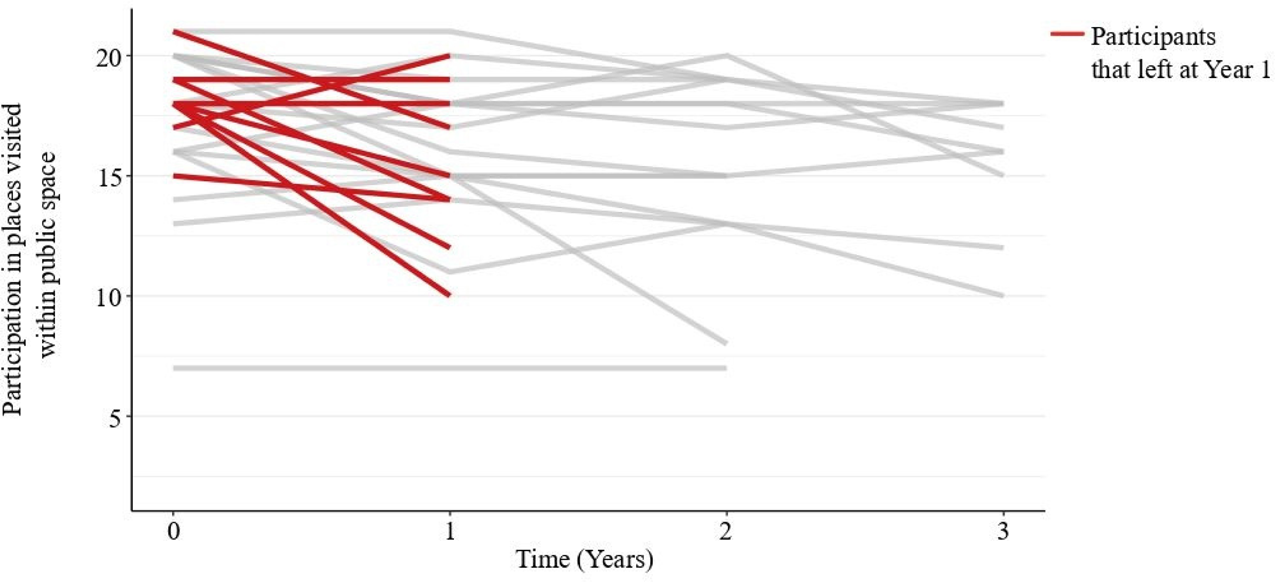
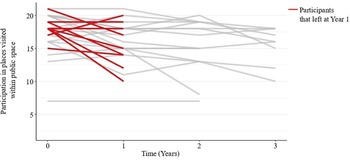
The primary data analysis stage used random intercept modelling to investigate the time effect over three years on the response variable (participation in places visited within public space). Random intercept modelling is well-suited to the multilevel structure of the data and it can accommodate incomplete data, which is assumed to be missing at random (Hedeker and Gibbons, Reference Hedeker and Gibbons2006). This is particularly relevant for health sciences and when working with people with dementia with repeated measurements over time, as unbalanced data over time is common due to mistimed measurements, for instance missed scheduled appointments, or the participant not being available (Figure 1) (Fitzmaurice and Ravichandran, Reference Fitzmaurice and Ravichandran2008). The model included follow-up time and use of ET outside the home as explanatory variables, whilst controlling for age (age group at baseline). To conserve power, the age group variable was divided into two groups, above and below the median cut-point. A profile line plot (spaghetti plot) was used to visualise the trajectory of participation in places visited within public space for each participant over time (Figure 2).
Profile line plot of participation in places visited within public space.
Notes: The outlying profile line corresponds to the participant living with several comorbidities, in addition to the diagnosis of dementia, including angina, issues with balance and dizziness, pain in the hips as well as impaired vision requiring glasses, which may partially account for the lower level of participation in places visited within public space.
Descriptive statistics were used to investigate participation in places visited within public space over time and use of ET outside the home over time, in two ways. Firstly, based on a total number of places visited and a total count of use of ET outside the home. Secondly, from the perspective of each of the 24 different place types and the degree of use of each of the 49 types of ETs. Sensitivity analysis revealed no statistically significant baseline differences on the demographic variables between the participants that left the study at any wave, compared with those participants (N = 9; 26%) that completed the study to the fourth wave (Year 3). However, the Mann–Whitney U test showed a statistically significant difference in MoCA score at baseline between the participants who remained until the final wave (Year 3) (median = 22) and those who left the study (median = 15.5, U = 42,500, Z = −2.83, p = 0.004, r = −0.48). The effect measure of r indicated a medium effect size. To mitigate the potential attrition bias at Year 3, a sub-sample of 16 participants who completed the study to Year 2 was investigated in relation to our research questions. The alpha level was set at p < 0.05 and the interpretation of the effect size thresholds was based on Cohen's (Reference Cohen1988) recommendations (0.1 = small, 0.3 = medium, 0.5 = large, 0.7 = very large).
Results
We begin by presenting the main results from the statistical model, in relation to the hypothesis that decreasing use of ET outside the home is associated with decreasing participation in places visited within public space over time in people with dementia. Next, we present the descriptive results to address the two research questions.
Decreasing use of ET outside the home is associated with decreasing participation in places visited within public space over time
A statistically significant association was identified between decreasing use of ET outside the home and decreasing participation in places visited within public space over time (F = 7.59, p = 0.01). With each increased year (one unit in the time variable), participation in places visited within public space decreased by 0.61 (Table 2). A one-unit decrease in the number of ETs used was significantly related to a decrease in the number of places visited by 0.18. However, age group at baseline had a non-significant effect on participation in places visited within public space over time (F = 0.15, p = 0.71). With increased age, participation in places visited within public space decreased by 0.42.
Random intercept model results for the association between Everyday Technology (ET) use outside the home and participation in places visited within public space, whilst controlling for age
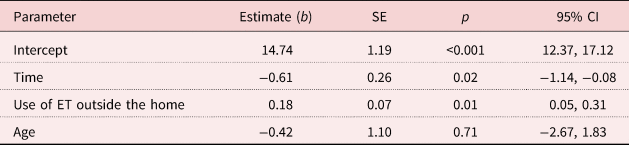
Notes: SE: standard error. CI: confidence interval. The random intercept model refers to the sample of 35 participants. Age refers to the age group at baseline. Estimate (b) corresponds to the effect of a one-unit increase of each explanatory variable on participation in places visited within public space, when the other explanatory variables have the value zero.
Stability and change in participation in places visited within public space over time
Number of places visited
A statistically significant time effect was identified for participation in places visited within public space (F = 5.34, p = 0.02). Based on a maximum of 24 places, participation in places visited within public space varied over time, among the participants. The highest median participation in places visited within public space was at baseline for both the sample of 35 participants that remained for the three waves (median = 18, interquartile range (IQR) = 16–19) and the sub-sample of 16 participants (median = 18, IQR = 16–20). The lowest median participation in places visited within public space for the sample after dropout was at Year 1 (median = 15.5, IQR = 14–18) but this was not the case for the sub-sample of 16 participants (median = 16.5, IQR = 15–18). The median participation in places visited within public space for the remaining sub-sample of 16 participants at Year 2 (median = 16, IQR = 13–19) remained stable to Year 3 for the remaining sub-sample of nine participants (median = 16, IQR = 13.5–18). A profile line plot (Figure 2) revealed that the participants’ profile lines of participation in places visited within public space generally declined over time. Several of the participants who left the study in Year 1 had particularly steep, descending slopes (Figure 2, highlighted profile lines).
Types of places visited
Regarding Research Question 1, Table 3 shows a frequency hierarchy of higher to lower participation in each of the 24 place types in the ACT-OUT. The frequency hierarchy is arranged according to participation at baseline (i.e. Year 0) and provides information about the participation for the sub-sample of 16 participants during the three waves of the study. There was a general trend for participation between the years to remain stable in the majority of places, when the attrition bias was removed in the sub-sample of 16 participants. The frequency hierarchy indicated consistently high participation in the neighbourhood (Domain D: places of recreation and physical activity) across the three waves of data collection (Table 3). Other types of places associated with relatively high participation included the friend, family member's place; cemetery, memorial place; and restaurant, café, bar (all belonging to Domain C: places for social, spiritual and cultural activities); the dentist's surgery (Domain B: places for medical care); and pharmacy (Domain A: places for purchasing, administration and self-care). There was an increasing trend in participation over time for the doctor's surgery (Domain B); and forest, mountain, lake, sea (Domain D). Conversely, the pattern varied in those places associated with low participation at baseline, as evidenced by the sports facility (Domain D); and day care (Domain B) where participation was consistently low. There was a descending trend in participation over time for the transportation centre (Domain D), and the bank, post office (Domain A).
Frequency hierarchy of participation in places visited in public space
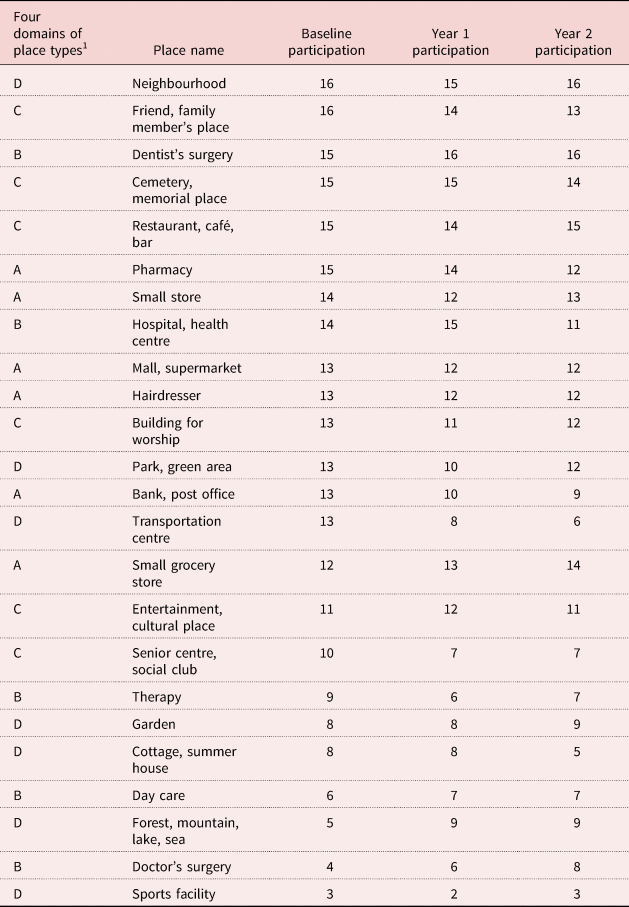
Notes: Counts of participation according to the Participation in ACTivities and Places OUTside Home Questionnaire (ACT-OUT), among the sub-sample of 16 participants who remained in the study until Year 2. 1. ACT-OUT domains: (A) consumer, administration and self-care places; (B) places for medical care; (C) social, spiritual and cultural places; (D) places for recreation and physical activities.
Stability and change in use of ET outside the home over time
Number of ETs used
Based on a maximum of 49 ET items, the median use of ET outside the home for the sample of 35 participants was 10 (IQR = 7–17) and for the sub-sample of 16 participants it was 14 (IQR = 8.5–19.5) at baseline. The median use of ET outside the home decreased by Year 1 for the sample after dropout (median = 9.5, IQR = 4–14.25) as well as the sub-sample of 16 participants (median = 11.5, IQR = 4–16.75). The median use of ET outside the home continued to decrease between Years 1 and 2 for the sub-sample of 16 participants (median = 7.5, IQR = 4–13.5). The median use of ET outside the home for the sample of nine participants who remained throughout the study was 11 (IQR = 4.5–15).
Types of ETs used
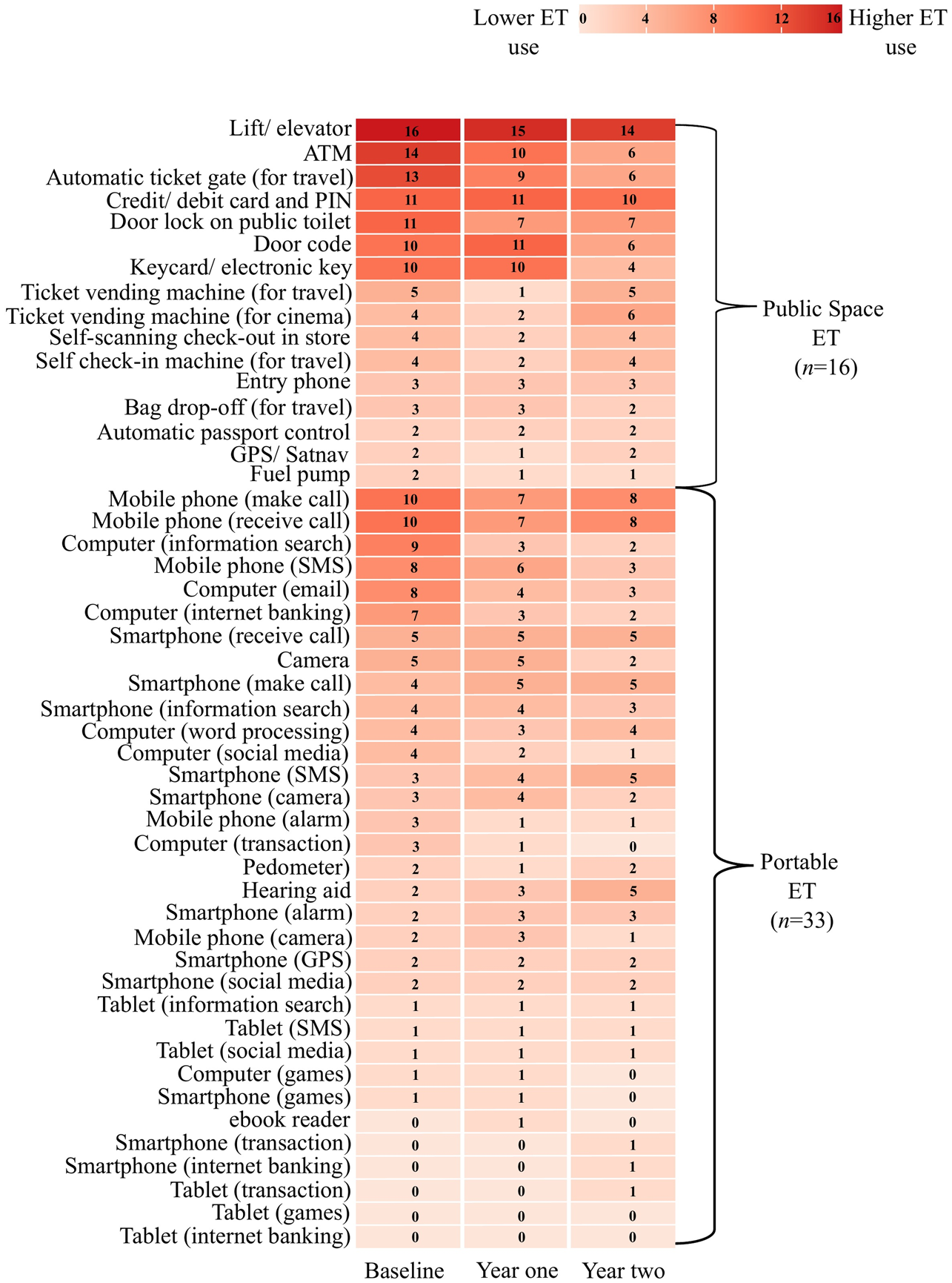
Concerning Research Question 2, Figure 3 presents visualisations of counts of the use of each type of ET outside the home, by the sub-sample of 16 participants over time. The counts of use of ET outside the home included the different levels of difficulty that the participant perceived. There was an overall trend for the sub-sample to use public space ETs to a higher degree of use than portable ET. The lift or elevator, ATM, automatic ticket gate for travel, credit or debit card and PIN, and door lock on public toilet, were among the public space ETs which were used to a higher degree by the sub-sample, at baseline and with decreasing use over time. However, the automatic passport control, GPS or satellite navigation, and fuel pump were public space ETs that were used to a lesser degree by the sub-sample, at baseline and over time. Regarding portable ET, the mobile phone was used to a higher degree by the sub-sample of 16 participants at baseline and over time, particularly for the functions of making a call and receiving a call. Conversely, the range of functions performed on a smartphone or tablet were used to a lesser degree by the sub-sample at baseline and over time. Overall, ET use tended to remain stable or decrease over time for each ET item, although there were exceptions where some ET use fluctuated, for instance a ticket vending machine (for travel), an ebook reader and a mobile phone (for camera functions).
The number of users for each type of Everyday Technology (ET).
Notes: Counts of use of ET outside the home, based on the Everyday Technology Use Questionnaire, among the sub-sample of 16 participants who remained in the study until Year 2. Data visualisation coded using R: A language and environment for statistical computing (R Core Team, 2020).
Discussion
The overarching aim of this study was to deepen the knowledge about how use of ET outside the home, including portable ETs, relates to participation in places visited within public space among people with dementia over time. Throughout the three-year study, the results showed that decreasing use of ET outside the home was indeed associated with decreasing participation in places visited within public space, in a statistically significant way when controlling for age. The discovery of a significant temporal relationship between use of ET outside the home and participation in places visited within public space indicates that facilitating access and use of ET outside the home, among people with dementia, may help to promote and maintain their micro-citizenship through participation in society over time. Based on the statistical model, the hypothesis that decreasing use of ET outside the home is associated with decreasing participation in places visited within public space over time in people with dementia could be accepted. More specifically, the results showed that one less ET item used outside the home was associated with a 0.18 decrease in participation in places visited within public space. This may have important policy and clinical implications for planning ways to promote accessibility and participation with consideration to the use of ET outside the home. The results substantiate earlier studies which showed that the association between ET use and activity involvement increased over time during cognitive decline (Hedman et al., Reference Hedman, Nygård and Kottorp2017) and that the amount of ETs used in a person's daily activities may infer clinically important aspects of cognitive impairment among the older population (Hedman et al., Reference Hedman, Nygård, Almkvist and Kottorp2015). Such knowledge may contribute to the discourse on age- and dementia-friendly communities, which has focused on design principles and recommendations for developing more physically accessible built environments, with insufficient consideration given to the role of technology or cognitive aspects which may facilitate or inhibit the person with dementia's ability to participate in society, as perceived by the person with dementia themselves. The results of this study underline the salience of considering the significant effect of ET use on people with dementia's ability to enact their micro-citizenship, through participation in places visited within public space, when planning and developing dementia-friendly communities, akin to those envisioned for cities such as Stockholm.
The results provide insight into the ways in which the participants with dementia enacted their micro-citizenship, according to participation in specific types of places within public space as well as through the use of specific types of ETs over time. Research Question 1 investigated how participation in places visited within public space remains stable or changes over time for people with dementia. Participation in the sports facility (Domain D: places of recreation and physical activity) and day care (Domain B: places for medical care) remained low. However, in terms of change, the sub-sample of 16 participants with dementia tended to abandon participation in the transportation centre (Domain D), and the bank, post office (Domain A: places for purchasing, administration and self-care). The decline in participation in these types of places corroborates earlier research among samples of older people with and without dementia in Sweden and the United Kingdom (UK) (Gaber et al., Reference Gaber, Nygard, Brorsson, Kottorp and Malinowsky2019, 2020). Moreover, places for banking and public transportation are among the places prioritised by policy as in need of being made more dementia-friendly (Swedish National Board of Health and Welfare, 2017). Despite the intention for redesigned dementia-friendly places for banking and public transportation, the results indicate that people with dementia are abandoning these types of places.
Change was also evident in relation to Research Question 2, which sought to understand how use of ET outside the home, including portable ETs, remains stable or changes over time for people with dementia. A cross-comparison of participation according to types of places (Table 3) and the types of ETs used (Figure 3) shows that the sub-sample of 16 participants with dementia did use ETs related to banking, such as an ATM and computer for internet banking. However, this ET use mirrored the descending trend found in participation in the place for banking. Similarly, use of ETs associated with public transportation decreased over time in the case of an automatic ticket gate, it fluctuated in the case of a ticket vending machine (for travel) or it remained low for other ET, such as the smartphone (GPS) which may, for example, be used to enable route planning or orientation. Lower use of ET related to transportation and travel may have influenced the decline in participation in the place for public transportation, but this trend may have also been influenced by other factors. A review of Table 1 reveals that the majority of participants in the study did not drive and that they accessed some type of transportation service. Driving cessation can have profound effects on the person with dementia as well as their family, care-givers and support network (Sanford et al., Reference Sanford, Rapoport, Tuokko, Crizzle, Hatzifilalithis, Laberge and Naglie2019). This may have increased the dependency on public transportation, especially at baseline, and hence, the higher degree of participation in the transportation centre and ET used for public transportation, such as the automatic ticket gate. However, over time the person with dementia may no longer be able to, or choose to, access public transportation, at least independently (Sanford et al., Reference Sanford, Rapoport, Tuokko, Crizzle, Hatzifilalithis, Laberge and Naglie2019; Gaber et al., Reference Gaber, Nygård, Kottorp, Charlesworth, Wallcook and Malinowsky2020). Over time, the person with dementia may depend on other people to travel together, for instance being driven by someone else, or using an alternative transportation service. This is also potentially exacerbated by the majority of participants having some form of functional health issue, in addition to dementia, which may inhibit their mobility. In this way, the ability to move or travel may also influence a person with dementia's ability to enact their citizenship, not only through participation in places specifically for public transportation, but also in order to travel to, and from, a variety of different places within public space.
Regarding Research Question 1, a degree of stability was identified according to the continuity of participation in the majority of places. Participation remained relatively high for the friend, family member's place; cemetery, memorial place; and restaurant, café, bar (all belonging to Domain C: places for social, spiritual and cultural activities); the dentist's surgery (Domain B: places for medical care); and pharmacy (Domain A: places for purchasing, administration and self-care). More specifically, the sub-sample of 16 participants with dementia continued to participate in the neighbourhood (Domain D: places of recreation and physical activity) over time. This confirms prior, mainly qualitative research, which suggests that older people with dementia value participating in their neighbourhoods for a multitude of reasons, such as opportunities for social interaction, physical activity and appreciation of the natural environment (Ward Thompson and Travlou, Reference Ward Thompson and Travlou2007; Brorsson, Reference Brorsson2013; Odzakovic et al., Reference Odzakovic, Hellström, Ward and Kullberg2020). A potential interpretation is based on the theory of Duggan et al. (Reference Duggan, Blackman, Martyr and Van Schaik2008) of a ‘shrinking world’ phenomenon. According to the ‘shrinking world’ phenomenon, people with dementia tend to abandon unfamiliar places which are located further away from their homes and only retain places that are familiar, or that are within close proximity to their homes, such as the neighbourhood. Whilst this theory may be applicable to the participants’ consistent participation in the neighbourhood which may be perceived as in close proximity and familiar, it does not necessarily explain the increase in participation in specific places. For instance, an increase in participation was identified for the forest, mountain, lake, sea (Domain D), in spite of the fact that the majority of participants were recruited from urban areas of Stockholm where the forest, mountain, lake, sea might not be in such close proximity to their home. The results suggest that the theory of a ‘shrinking world’ phenomenon should be questioned. Other studies exploring participation in places visited within public space among older people, with and without dementia, in Canada (Chaudhury et al., Reference Chaudhury, Mahal, Seetharaman and Nygaard2020) and the UK (Gaber et al., Reference Gaber, Nygård, Kottorp, Charlesworth, Wallcook and Malinowsky2020), suggest that whilst participation in the neighbourhood is relatively high, there are other local, contextual factors related to accessibility, habits and social norms which may contribute to the different modalities of participation in places visited within public space. These other local, contextual factors related to accessibility, habits and social norms may help to explain increased participation in the forest, mountain, lake, sea. Further research is required to explore these factors more deeply, including whether people with dementia participate independently or in the company of others, according to the different types of places.
An alternative interpretation of the consistent participation in the neighbourhood is discernible in the emerging dementia and citizenship discourse, which presents a more nuanced understanding of the ways that people with dementia participate in their neighbourhoods (Phinney et al., Reference Phinney, Kelson, Baumbusch, O'Connor and Purves2016). Earlier research has found that people with dementia view participation in their neighbourhoods as an opportunity to enact their micro-citizenship, and to express their sense of agency, through the physical and social connection to other people and places (Baldwin and Greason, Reference Baldwin and Greason2016; Bartlett, Reference Bartlett2016). A study exploring a neighbourhood walking group showed that people with dementia not only view walking in their neighbourhood as a leisure activity but also as an opportunity to contribute to their community through interactions with others, such as stopping to speak to a person walking their dog, and to play and engage with the dog (Phinney et al., Reference Phinney, Kelson, Baumbusch, O'Connor and Purves2016). The earlier study revealed that people with dementia also value the normalcy of walking and engaging in one's neighbourhood. Just as other members of the community walk around the neighbourhood and interact with each other, by participating in one's neighbourhood, people with dementia are able to choose to enact their micro-citizenship, as active and social citizens (Phinney et al., Reference Phinney, Kelson, Baumbusch, O'Connor and Purves2016). In this way, citizenship is not a static status or identity but rather it is enacted through everyday participation in places visited within public space, including the use of ET outside the home (Spinney et al., Reference Spinney, Aldred and Brown2015).
Similarly, in Research Question 2, a degree of stability was identified according to the continuity of use in the majority of ETs. Figure 3 revealed a general trend for public space ETs to be used to a higher degree of use than portable ETs. The higher use of public space ETs may be explained, in part, by their growing ubiquity in public space and, therefore, the lack of choice and unavoidability of their use to participate in some places, for instance an automatic ticket gate (for travel). There is also a potential stigma associated with non-use of ETs in public space (ADI, 2019), and research has identified an association between the non-use of ETs typically used in public space, such as ATMs or ticket vending machines, and life dissatisfaction among older people with MCI, Alzheimer's disease and no known cognitive impairment (Köttl et al., Reference Köttl, Fallahpour, Hedman, Nygård and Kottorp2021). Thus, public space ETs may serve as a key to unlock a technological society where the person with dementia can enact their micro-citizenship.
Methodological considerations
The lack of longitudinal research undertaken with people already living with dementia necessitates a critical discussion of the methodological considerations. The rationale for using participation in places visited within public space as the response variable and use of ET outside the home as an explanatory variable was based on earlier research which underlines the need to consider the co-constitution of ageing and technology (Peine and Neven, Reference Peine and Nevenin press). Peine and Neven's model and agenda for a co-constitution of ageing and technology proposes that there is a need to transition away from an interventionalist logic of technology as an instrument for solving the problem of ageing or, in this case, dementia (Peine and Neven, Reference Peine and Nevenin press). Earlier studies using this interventionalist logic have focused on technology acceptance and adoption in isolation, somewhat de-contextualised from the everyday lives of the end user (Pinto-Bruno et al., Reference Pinto-Bruno, García-Casal, Csipke, Jenaro and Franco-Martín2016). In this study, the focus is not on ET use for the sake of ET use but rather to gain knowledge about how ET use can more meaningfully be contextualised according to the person with dementia's participation in society.
The statistical approach of this study provides empirical insights into the different types of places and ETs that people with dementia participate in over time, in addition to the statistical association between participation in places visited over time and use of ET outside the home. However, the study does not attempt to provide the narrative motivating the participation in places or use of ET. Whilst interpretations may be drawn from the results and from earlier research, it is not known why the sample of people with dementia abandoned specific types of places to a higher degree (i.e. transportation centre; bank, post office) than other types of places (i.e. neighbourhood). This compels the need for further research exploring the motivation underlying the different modes of use of ET outside the home and participation in places visited with public space over time.
Due to the small sample size, the impact of each individual score pattern over time is relatively large. The results are therefore intended to be viewed as more indicative than deterministic. To the researchers’ knowledge, there are no previous longitudinal studies following the relationship between a person with dementia's ET use and participation in places visited within public space, which prohibited an a priori sample size calculation. This study follows a sample of people with dementia from an earlier cross-sectional study (Gaber et al., Reference Gaber, Nygard, Brorsson, Kottorp and Malinowsky2019) and the results from this study can be used to inform subsequent sample size and power calculations in future research.
Sensitivity analysis showed that the overall descending trend in participation in places visited within public space may have been greater in Years 2 and 3 if those participants who dropped out had remained in the study. The profile plot in Figure 2 highlighted particularly steep, descending slopes for those who left the study by Year 1. Moreover, there was a significant difference in the baseline MoCA score between those participants that left the study and those that remained to Year 3. A review of the demographic characteristics indicated that those participants that left the study, particularly by Year 1, had among the lowest cognition scores according to the MoCA. This underlines a challenge of conducting research with people with dementia due to an increased severity of symptoms and progressive decline in cognition. Notwithstanding the challenges involved in research with people with dementia, particularly research based on the self-report of people with dementia, there is an ethical imperative for more research to understand better how people with dementia perceive their participation in a technological society as an opportunity to enact their micro-citizenship over time.
Conclusion
The study showed that use of ET outside the home, including portable ETs, can have a significant impact on a person with dementia's participation in places visited within public space over time. Consequently, this may impact the person with dementia's ability to enact their micro-citizenship through participation in a technological society. Affirming earlier research, the participants with dementia consistently enacted their micro-citizenship through sustained participation in the neighbourhood over time. The types of places and services that the Swedish dementia-friendly policy identified as needing to be more accessible included places for public transportation and banking, which were among the places that were abandoned over time by the sub-sample of 16 participants in the study. Moreover, the types of ETs initially used to a higher degree but abandoned by people with dementia included those ETs that are typically used at the aforementioned places, such as an automatic ticket gate at a transportation centre and an ATM at a bank. Thus, the identification of the types of places and ETs that the participants with dementia abandoned, or retained, may have timely implications for clinicians, policy makers and other stakeholders supporting people with dementia to enact their micro-citizenship through everyday participation in a technological society.
Acknowledgements
We are grateful to the people who participated in this study and for their generosity in sharing their experiences of participating in places within public space and use of Everyday Technology, over time. We also wish to thank the occupational therapists Helena Brodin (HB), Ann-Louise Engwall (ALE), and Monica Pantzar (MP), who supported the data collection and data input, as well as the statisticians at the Medical Statistics Unit, Department of Learning, Informatics, Management and Ethics (LIME), Karolinska Institutet, for their statistical consultation.
Author contributions
SNG, LN, CM and AK conceived and designed the study. AB, HB and MP collected the data, ALE and SNG managed the data input and quality checking. SNG and AH performed the data analysis and SNG developed the data visualisations. SNG wrote the article with all authors contributing critical feedback. All authors read and approved the article.
Financial support
This work was supported by the H2020 Marie Skłodowska Curie Actions – Innovative Training Networks, H2020-MSCA-ITN-2015 (grant number 676265); the Swedish Research Council (grant number 2017-02768); the Swedish Council for Health, Working Life and Welfare (FORTE) (grant number 2013–2104); and the Kamprad Family Foundation (grant number 20180057). Open access funding was provided by Karolinska Institutet.
Conflict of interest
The authors declare no conflicts of interest.
Ethical standards
Ethical approval was obtained from the Regional Board of Research Ethics at the Karolinska Institutet (2015/77-31-5) and all participants provided full informed oral and written consent.




 Open access

