



Ultra-processed foods, as defined by the NOVA food classification(Reference Monteiro, Cannon and Moubarac1), are formulations of many ingredients, mostly of exclusive industrial use, that result from a sequence of industrial processes (hence ultra-processed). They are typically ready-to-consume, hyperpalatable and aggressively marketed food and drink products(Reference Monteiro, Cannon and Levy2). Worldwide statistics on sales of ultra-processed foods show that these products dominate the food supplies of high-income countries, and their consumption is now rapidly increasing in middle-income countries(Reference Monteiro, Moubarac and Cannon3). At the same time, over the past few decades, obesity and other diet-related non-communicable diseases (NCD) afflicting both developed and developing countries have progressively increased and have become the major cause of death and disability(Reference Malik, Willett and Hu4). Accordingly, diet-related NCD contribute to a large part of the burden of disease in Chile(Reference Corvalán, Reyes and Garmendia5,6) ; in the National Health Survey conducted between 2016 and 2017, 74·2 % of the population (15 years or above) had excess weight (i.e., 39·8 % overweight, 31·2 % obese and 3·2 % morbid obese), 27·6 % were affected by hypertension, 12·3 % by diabetes and 3·3 % reported a history of acute myocardial infarction and 2·3 % of stroke(7).
Given that ultra-processed foods have a poor nutritional profile, their dietary contribution has been proposed as an indicator of the dietary quality(Reference Monteiro, Cannon and Moubarac1,8) , especially for studying the content of nutrients related to the development of NCD(9). Studies based on nationally representative cross-sectional surveys in Brazil, Colombia, Mexico, the USA, the UK and Canada have shown that increased ultra-processed food intake is associated with both nutritionally unbalanced diets (i.e., higher in NCD-promoting nutrients: free sugars, saturated fats and energy density and lower in NCD-protective nutrients: K and fibre)(Reference Louzada, Ricardo and Steele10–Reference Marrón-Ponce, Flores and Cediel15) and increased prevalence of obesity(Reference Louzada, Baraldi and Steele16–Reference Nardocci, Leclerc and Louzada18). Furthermore, prospective cohort studies have shown that increased ultra-processed food intake is associated with higher incidence of obesity(Reference Mendonça, Pimenta and Gea19), hypertension(Reference Mendonça, Lopes and Pimenta20), dyslipidaemias(Reference Rauber, Campagnolo and Hoffman21) and cancer(Reference Fiolet, Srour and Sellem22). Furthermore, a recent randomised controlled trial has shown that limiting consumption of ultra-processed foods may be an effective strategy for obesity prevention and treatment(Reference Hall, Ayuketah and Brychta23).
One study that applied an earlier version of the NOVA food classification to the 2006–2007 Chilean household budget survey has shown that processed and ultra-processed foods, taken together, represent 55·4 % of the money expended on food, and that such foods had greater energy density and added sugars content but lower fibre content than all other purchased foods(Reference Crovetto, Uauy and Martins24). A subsequent study that applied the NOVA food classification(Reference Monteiro, Cannon and Moubarac1,Reference Monteiro, Cannon and Levy2) to the 2010 Chilean dietary survey showed that the average dietary share of ultra-processed foods in Chile in 2010 was 28·6 % of the total energy intake, and that increased dietary contribution of ultra-processed foods was associated with higher average dietary content of added sugars and higher risk of excessive intake of added sugars(Reference Cediel, Reyes and da Costa Louzada25). The current study expands the analysis of the 2010 Chilean dietary survey by (i) examining the consumption of ultra-processed foods and its association with the overall dietary content of a range of nutrients related to NCD including free sugars, total fats, saturated fats, trans fats, Na, K and fibre and (ii) estimating the population attributable fractions of ultra-processed food consumption on the unhealthy nutrient content in the diet.
Methods
Data source
The data analysed during the current study were extracted from the National Dietary Survey in Chile (Encuesta Nacional de Consumo Alimentario (ENCA)) performed by the University of Chile between November 2010 and January 2011. The ENCA used probability sampling by clusters, with stratification and multiple lottery stages, allowing it to represent the Chilean population aged 2 years or more, in urban and rural areas of every geographic region: North, Centre, South, South-Austral and Metropolitan. The survey response rate was 85·5 % for a total of 5753 individuals excluding pregnant women and individuals who showed signs of altered mental status. A final sample of 4920 individuals was studied(26).
All individuals studied by the ENCA were eligible for one 24-h dietary recall interview; in 20 % of the sample, a second 24-h dietary recall was obtained 2 or 3 d after the first 24-h recall to estimate variability. Recalls were conducted in person by trained dietitians using the multiple-pass method, developed by the United States Department of Agriculture(27). For children <12 years, an adult caretaker responded the interview, and adolescents between 13 and 18 years answered in the presence of the caretakers, while those >18 years were asked directly. Individuals provided information on quantities (using household measurement) and preparation methods of each consumed food item, assisted by a photographic ‘atlas’ of typical Chilean foods and recipes specifically designed for this survey. For the current analysis, food recipes were disaggregated into their ingredients (provided by the participants or standardised when participants did not have the information). Each household measurement was converted to grams or millilitres using a standardised conversion table(26). All reported values (n 150 156) were double-checked, and inconsistencies were verified by telephone resulting in no missing values. General information about how the dietary data were collected has been described elsewhere(Reference Cediel, Reyes and da Costa Louzada25,26) .
Usual intake estimates were obtained using the Multiple Source Method programme, a free web-based statistics package(Reference Harttig, Haubrock and Knüppel28). Multiple Source Method consists of a three-step calculation: (i) the estimation of the probability of consuming a food (or nutrient) in 1 d using a logistic regression model, which may optionally include the frequency of food intake (as other variables) as a covariate; (ii) the calculation of the usual intake on reported days from the 24-h dietary recalls, applying a linear regression model and (iii) the estimation of the usual daily intake for each individual by multiplying the values from steps 1 and 2. In the current study, we did not have information of frequency of intake, so we did not incorporate this information on step 1 and, therefore, assumed that all participants were consumers of NCD-promoting and NCD-preventing nutrients and as other works we use 2 d of short-term dietary measurements (24hRs) on a random subsample (20 %) of the population(Reference Previdelli, Andrade and Fisberg29).
Food classification according to processing
Every ENCA-reported food item was classified according to the extent and purpose of food processing, following the NOVA system(Reference Monteiro, Cannon and Levy2,Reference Monteiro, Cannon and Levy30) . Food items were sorted into mutually exclusive food subgroups within (i) unprocessed or minimally processed foods (eleven subgroups: e.g., fresh meat, roots and tubers, cereals, vegetables, legumes and fruits); (ii) processed culinary ingredients (four subgroups: e.g., plant oils, table sugar and animal fats); (iii) processed foods (five subgroups: e.g., unpackaged fresh bread, cheese, ham and salted meat, vegetables and fruits preserved in brine or sugar syrup) and (iv) ultra-processed foods (seventeen subgroups: e.g., carbonated soft drinks, sweet or savoury snacks, confectionery, industrial desserts, reconstituted meat products, shelf-stable or frozen meals and industrial packaged bread)(Reference Monteiro, Cannon and Levy2,Reference Monteiro, Cannon and Levy30) . Details are displayed in the online supplementary material.
Assessing energy and nutrient intake
The amount of energy and nutrients (i.e., sugars, total fats, saturated fats, trans fats, Na and K) and fibre of each reported food item were calculated using the US Food Composition Table (United States Department of Agriculture National Nutrient Database for Standard Reference – Release 28)(31). Every reported food item was matched to a food item from the United States Department of Agriculture food composition database, selected in a homologation process that allowed a 20 % variation between the known content of energy, macronutrients and Na (obtained from the Chilean Food Composition Table(Reference Jury, Urteaga and Taibo32) or the nutrient fact panels obtained from Chilean packaged foods). The nutritional information from packaged foods was collected in major supermarket chains in Santiago de Chile (2015 and 2016). Details on the methodology and a description of the nutritional quality of available packaged foods have been described elsewhere(Reference Kanter, Reyes and Corvalán33,Reference Kanter, Reyes and Swinburn34) . Free sugars were estimated using the algorithm proposed by the nutrient profile model launched by the Pan American Health Organization(8).
The WHO-proposed dietary goals were used for evaluating the prevalence of non-recommended intake of different key nutrients: ≥10 % kilojoules (kJ) of total energy intake for free sugars, ≥30 % kJ of total energy intake for total fats, ≥10 % kJ of total energy intake for saturated fats, ≥1 % kJ of total energy intake for trans fats, < 25 g/8368 kJ for fibre, ≥2000 mg/8368 kJ for Na, <3510 mg/8368 kJ for K and ≥1 for Na:K ratio(9,35,36) . Dietary energy density inadequacy was assessed separately for the diet fraction made of beverages (coffee, tea and herbal teas, soda, soft drinks, sports and energy drinks, fruit and/or vegetable juices, alcoholic beverages and non-alcoholic beers, bottled and flavoured water, tap water and milk)(Reference Vernarelli, Mitchell and Rolls37) and the diet fraction made of foods only (all beverages excluded). Criteria for the diagnosis of energy density inadequacy were ≥9·4 kJ/g for foods and ≥1·67 kJ/g for beverages. The cut-off of 9·4 kJ used for foods was based on the World Cancer Research Fund recommendation for limiting the consumption of high-energy density foods as a method for preventing obesity(Reference Vernarelli, Mitchell and Rolls37,38) . This cut-off corresponds to the 75th percentile of energy density of foods for the studied sample. The cut-off used for beverages was chosen to correspond also to the 75th percentile of the studied sample.
Covariates
We included as covariates the sociodemographic variables that were associated with the consumption of ultra-processed foods in our previous work(Reference Cediel, Reyes and da Costa Louzada25): sex, age group (2–19, 20–49, 50–64 and ≥65 years), residential area (urban or rural setting), geographic region (North, Centre, South, South-Austral and Metropolitan), family income (1, 2, 3–5 and ≥6 minimum wages) and education (years of schooling of the head of the family: ≤8, 9–11 and ≥12).
Data analysis
First, we estimated the mean contribution to the total energy intake of each of the NOVA groups and subgroups for the overall population and across quintiles of the dietary share of ultra-processed foods (the contribution of ultra-processed food consumption to the total energy intake). Second, we estimated the mean content of nutrients related to NCD (i.e., for NCD-promoting nutrients: energy density (kJ/g), free sugars (% of total energy intake), total fats (% of total energy intake), saturated fats (% of total energy intake), trans fats (% of total energy intake) and Na (mg/8368 kJ) and for NCD-protective nutrients: K (mg/8368 kJ) and fibre (g/8368 kJ). This was done in the overall Chilean diet and in two diet fractions, one restricted to ultra-processed food items and other restricted to non-ultra-processed food items (unprocessed or minimally processed foods, processed culinary ingredients and processed foods). Third, we estimated the mean content of nutrients related to NCD in the overall diet across quintiles of the dietary share of ultra-processed foods. Linear regression models were used to test linear trends across quintiles. Crude- and sociodemographic-adjusted standardised regression coefficients (β) were estimated to allow comparisons across variables with different measuring units. Fourth, we analysed the association between the dietary share of ultra-processed foods (quintiles) and the frequency of dietary nutrient inadequacies using Poisson regression models, where the status of each individual regarding dietary inadequacy on each nutrient is the outcome variable (No: 0; Yes: 1) and quintiles of the dietary share of ultra-processed foods (1–5) are the explanatory variable.
Finally, for nutrients that have been associated with the consumption of ultra-processed foods, population attributable fractions were calculated to estimate the reduction in the prevalence of nutrient inadequacies if the consumption of ultra-processed foods in Chile was the one seen in the 20 % lowest consumers of ultra-processed foods (the first quintile). Population attributable fractions were calculated using the following equation:
 $$\(PAF = {{P - Pq1} \over P},\)$$
where P is the prevalence of nutrient inadequacy in the overall population, and Pq1 is the prevalence of nutrient inadequacy in the first quintile of ultra-processed food consumption. The Taylor series linearisation variance approximation procedure was used for variance estimation in all analyses, in order to account for the complex sample design and the sample weights. Data were analysed using the Stata 15. Demo GraphPad Prism 7 was used for figures.
Results
Table 1 displays the distribution of total energy intake in Chilean diets according to NOVA food groups and subgroups. The mean dietary contribution of ultra-processed foods for the overall population was 28·6 % ranging from 3·8 % kJ (first quintile) to 60·1 % kJ (fifth quintile). As the dietary contribution of ultra-processed foods increased across quintiles, the individual contribution of each subgroup within the ultra-processed food group also increased whereas the contribution of all the three remaining NOVA food groups and most subgroups within these groups decreased.
Distribution (%) of total daily energy intake according to NOVA food groups in the whole population and across quintiles of the dietary share of ultra-processed foods*

* Chilean population aged 2 years or older (2010), n 4920.
† Mean (range) dietary share of ultra-processed foods per quintile: first = 3·8 (0–9·3); second = 14·4 (9·3–19·9); third = 25·7 (19·9–31·7); fourth = 39·2 (31·7–47·4); fifth = 60·1 (47·5–100).
‡ Others: unprocessed or minimally processed foods: chilli pepper, garlic, basil, cinnamon, cumin, curry, merken, chamomile, oregano, plain water, coffee, tea and mate. Processed culinary ingredients: table salt, honeybee and vinegar. Processed foods: chilli paste, wine and beer. Ultra-processed foods: dehydrated soup, artificial sweeteners, distilled liqueurs.
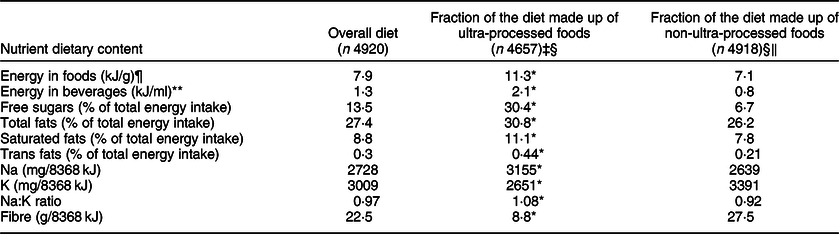
The mean content of NCD-related nutrients in the overall Chilean diet and in two diet fractions restricted to ultra-processed and non-ultra-processed items, respectively, is presented in Table 2. The average content of free sugars and Na in the overall diet exceeded the upper limits set to the intakes of these nutrients, while the average content of K and fibre was below the lower limits. Compared with the fraction restricted to non-ultra-processed foods, the fraction restricted to ultra-processed foods presented in average 4·5 times more free sugars, 2·5 times more energy density for solid foods, 2·1 times more trans fats, 1·6 times more energy density for beverages, 1·4 times more saturated fats and 1·2 times more total fats, more Na and more Na:K ratio. On the other hand, the diet fraction made only of ultra-processed foods had in average 3·1 times less fibre and 1·3 times less K. All differences between the ultra-processed and the non-ultra-processed diet fractions were statistically significant (P < 0·001).
Mean content of non-communicable disease-related nutrients in the overall daily diet and in two diet fractions†
† Chilean population aged 2 years or over (2010). National Nutrition Examination Survey 2010 (n 4920).
‡ Values are mean percentages. Comparison with the use of Student’s t tests in each nutrient.
§ Different size samples between the two fractions. Ultra-processed foods diet fraction (n 4657) and non-ultra-processed foods diet fraction (n 4918).
‖ It includes the following NOVA food groups: unprocessed or minimally processed foods, processed culinary ingredients and processed foods.
¶ Beverages excluded.
** Solid food excluded.
* Different from non-ultra-processed foods, P ≤ 0·001.
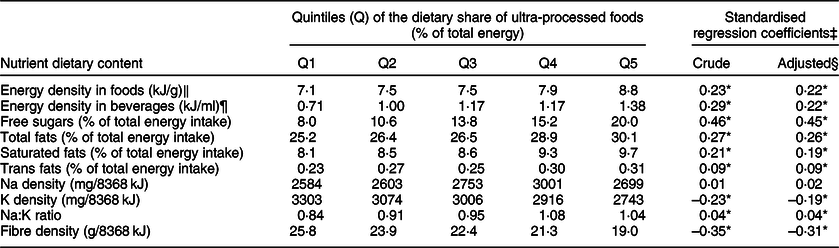
The mean nutrient contents of the overall diet across quintiles of the dietary share of ultra-processed foods are presented in Table 3. From the lower to the upper quintile, there were increases for free sugars (from 8·0 to 20·0 % kJ), total fats (from 25·2 to 30·1 % kJ), saturated fats (from 8·1 to 9·7 % kJ), trans fats (from 0·23 to 0·31 % kJ), Na:K ratio (from 0·84 to 1·04 mg/8368 kJ) and energy density (from 7·1 to 8·8 kJ/g for solid foods and from 0·71 to 1·38 kJ/ml for beverages), while there were decreases for K (from 3303 to 2743 mg/8368 kJ) and dietary fibre (from 25·8 to 19·0 g/8368 kJ). Both trends (the increase of NCD-promoting nutrients and the decrease of NCD-protective nutrients across quintiles of ultra-processed food consumption) were statistically significant even after adjusting for potential sociodemographic confounders (P ≤ 0·001). The mean dietary content of Na was similar across quintiles of ultra-processed food consumption.
Mean content of non-communicable disease-related nutrients in the overall diet across quintiles of the dietary share of ultra-processed foods†
† Chilean population aged 2 years or over (2010). National Nutrition Examination Survey 2010 (n 4920).
‡ Obtained from regressing dietary nutrient contents on quintiles of the dietary share of ultra-processed foods (expressed in sd units).
§ Adjustment for sex, age groups, residential area, geographic region and family income.
‖ Beverages excluded.
¶ Solid foods excluded.
* P < 0·01 for linear trend across quintiles.
Table 4 presents the prevalence of nutrient intake inadequacies for the overall population and across quintiles of the dietary share of ultra-processed foods. The higher prevalence of nutrient inadequacy was found for Na (81·2 %), followed by K (76·4 %), fibre (68·9 %), free sugars (58·7 %), total fats (35·0 %), Na:K ratio (32·9 %), saturated fats (32·4 %), energy density (22·3 % for solid foods and 24·2 % for beverages) and trans fats (3·1 %). Except for Na, the prevalence of nutrient intake inadequacies significantly increased with the consumption of ultra-processed foods, even after adjusting for potential sociodemographic confounders (P ≤ 0·001). Thus, compared with individuals in the lowest quintile, individuals in the highest quintile of ultra-processed food consumption were significantly more likely to have diets exceeding the dietary goals for trans fats (six times), energy density (more than three times for solid foods and four times for beverages), free sugars (almost three times), total fats (2·3 times), saturated fats (2·2 times) and Na:K ratio (1·8 times). They were also more likely to have diets that did not reach the dietary goals for fibre density (1·8 times) and K density (1·4 times).
Prevalence of non-recommended intake levels of nutrients related to non-communicable diseases† in the whole population and across quintiles of the dietary share of ultra-processed foods‡

PR, prevalence ratios estimated using Poisson regression.
† See methods for cut-offs used to define inadequate dietary nutrient contents.
‡ Chilean population aged 2 years or over (2010).
§ Adjusted for age groups, residential area, geographic region and family income.
* P < 0·001 for linear trend across quintiles of ultra-processed food consumption.
Figure 1 presents estimates for reductions in the prevalence of nutrient inadequacies that would be expected if the consumption of ultra-processed foods in Chile was the one seen among the 20 % lowest consumers of ultra-processed foods (the dietary share of ultra-processed foods among these consumers (n 1095) represented 3·8 % of the total energy intake, ranging from 0 to 9·3 %): in almost three-fourths for trans fats; in almost half for energy density (foods); in around one-third for free sugars, energy density (beverages), saturated fats and total fats; in near 20 % for Na:K ratio and fibre; and in 13 % for K.
Population attributable fraction due to the high consumption of ultra-processed foods (higher than the observed in the first quintile) of inadequate non-communicable disease-related nutrient dietary content. Chilean population aged 2 years or over (2010)

Discussion
The results of the current study showed that ultra-processed foods made almost 30 % of the average total energy intake in Chile (in 2010) ranging from 3·8 % in the lowest quintile of ultra-processed food consumption to 60·1 % in the highest quintile. As the dietary contribution of ultra-processed foods increased across quintiles, all the three remaining NOVA food groups and most subgroups within these groups decreased. They also showed the multiple unhealthier features of ultra-processed foods when their content in NCD-promoting nutrients (energy, free sugars, saturated fats, trans fats, total fats and Na) and NCD-protective nutrients (fibre and K) are compared with the same content existing in the three other NOVA food groups (unprocessed or minimally processed foods, processed culinary ingredients and processed foods) taken together.
Furthermore, after adjusting for potential sociodemographic confounders, increases in the dietary contribution of ultra-processed foods (quintiles) were shown to be linearly associated with increases in the dietary content of NCD-promoting nutrients (except Na) and decreases in the dietary content of NCD-protecting nutrients. The same trend was observed regarding the generally very high prevalences of dietary nutrient inadequacies between 30 and 80 % for most nutrients. Accordingly, these prevalences would be substantially reduced – in most cases between one-third and three-fourths – in the counterfactual scenario of a lower consumption of ultra-processed foods (first quintile of the dietary contribution of ultra-processed foods).
The average dietary share of ultra-processed foods in Chile in 2010 is higher than in other middle-income countries in the Latin American regions such as Colombia (15·9 % in 2005)(Reference Khandpur, Cediel and Obando39) and Brazil (20·4 % between 2008 and 2009)(Reference Louzada, Ricardo and Steele10) but still much lower than in high-income countries such as Canada (48·0 % in 2004)(Reference Moubarac, Batal and Louzada12), the UK (56·8 % between 2008 and 2014)(Reference Rauber, da Costa Louzada and Steele40) and the USA (57·5 % between 2009 and 2010)(Reference Martínez Steele, Popkin and Swinburn11). These data, combined with the low dietary share of minimally processed foods (33·8 % compared with 69·5 % from Brazil and 63·3 % from Colombia) and culinary ingredients, suggest that at that time Chile was in an advanced phase of the nutritional transition but not as advanced as many industrialised countries. However, time trends in the sales of ultra-processed foods point to rapid increases in Chile (and other middle-income countries) and slower increases in high-income countries(Reference Monteiro, Moubarac and Cannon3). Sales of ultra-processed foods and drink products in Chile increased 59·8 % between 2000 and 2013 (from 125·5 to 200·6 kg per annum)(Reference Moubarac41), suggesting that the 2010 dietary data may be underestimating the current impact of ultra-processed foods in the Chilean diet. Similar analyses in more updated dietary data are needed; unfortunately, the last version of the ENCA was in 2010 (when national prevalence of overweight and obesity among adults reached 64 %)(42).
The negative impact of ultra-processed food consumption on the dietary content of NCD-related nutrients shown in Chile confirms the findings from similar studies conducted in Brazil, Canada, the UK and the USA(Reference Martínez Steele, Popkin and Swinburn11,Reference Khandpur, Cediel and Obando39,Reference Rauber, da Costa Louzada and Steele40,Reference Louzada, Martins and Canella43) . As in Brazil, the USA and Canada(Reference Martínez Steele, Popkin and Swinburn11,Reference Louzada, Martins and Canella43,Reference Moubarac, Batal and Louzada44) , but not in the UK(Reference Rauber, da Costa Louzada and Steele14), the dietary content of Na in Chile was not associated with the intake of ultra-processed foods. In Chile, other dietary sources of Na may have relevance. The 24-h recall used for the ENCA specifically asked about salt addition in culinary preparations, but the estimation based on dietary surveys has little correlation with biomarkers measurements(Reference Mercado, Cogswell and Valderrama45). Unfortunately, the ENCA did not include urinary Na assessment. According to national health surveys (based on natriuria measured in isolated urine sample), 95 % of the adult population had an excessive Na intake in 2010, with a median intake of 3920 mg/d(42). Unpacked fresh bread could also be a potential important source of Na. The content of Na in fresh bread is 400–800 mg per 100 g(Reference Valenzuela, Quitral and Villanueva46), and the average daily intake of fresh bread according to the ENCA was 130 g(26). Further analyses focused specifically on Na content of foods and Na intake are needed for informing the success of ongoing measures (i.e., voluntary agreements from bread manufacturers for decreasing Na content, new labelling regulation) and informing health authorities and policy makers for future policies aiming at tackling the excessive Na intake.
It is important to remark the policy implications of these findings for the prevention of NCD. Our results support the set of strategies implemented to improve the healthiness of the diet by the Chilean government such as (i) taxation of sugar-sweetened beverages and (ii) the Chilean Law of Food Labeling and Advertising. Regarding the taxation of sugar-sweetened beverages, which represented one-quarter of the energy from ultra-processed foods and are also important contributors of the consumption of added sugars in the Chilean diet(Reference Cediel, Reyes and da Costa Louzada25), a small increase in the tax rate from 13 to 18 % on industrialised beverages with high levels of sugars was implemented in 2014; such taxation has shown a small but significant decrease in the purchases of such sugar-sweetened beverages, both in volume and energies(Reference Caro, Corvalán and Reyes47). As for the law, in 2016, a regulation was implemented incorporating front-of-package warning labels in pre-packaged foods that have been added ingredients increasing the natural amount of total sugars, saturated fats and Na and that have high content of such nutrients or high energy density. Additionally, such foods cannot be promoted to children nor can they be sold or offered for free at nurseries and schools(26,Reference Corvalán, Marcela and Maria Luisa48) . The Chilean regulation is not based on the NOVA classification; however, foods that are under the scope of the regulation overlap greatly with foods under processed and ultra-processed groups defined by NOVA, with the exemption of foods that have no addition of critical nutrients (and therefore are not under the scope of the Chilean regulation), but are ultra-processed based on their content of food additives (e.g., beverages with no added sugars but using non-nutritive sweeteners). Both policies should impact the influence of ultra-processed food consumption in the nutrient content of the Chilean diet. In turn, the food labelling and marketing regulation, together with other initiatives under discussion such as taxing foods with high content of energy, sugars, Na and saturated fats(Reference Agostini, Corvalán and Cuadrado49) or improving the availability and prices of minimally processed foods, could decrease the dietary share of ultra-processed foods. In concordance with these strategies, our results show that most prevalence of inadequacy of nutrients related to NCD would be substantially reduced in the scenario of lower consumption of ultra-processed foods.
Furthermore, our findings support actions to regulating the content of critical nutrients in the food supply such as the voluntary agreements with bread producers to reduce Na/salt content(50) and the law to reduce trans fats in the food products that could explain the low inadequacy intake in the population (3·1 % exceed the upper limit of ≥1 %)(6). They also support the promotion of fruit and vegetable consumption in the Chilean population through the ‘five a day’ programme(Reference Zacarías, Pizarro and Rodríguez51) and the message about reducing table salt in the dietary guidelines(52). In the light of our results, it might be convenient to include in such dietary guidelines recommendations according to the degree of food processing and to take into consideration nutrients, foods, combinations of foods, dishes and meals, and the social and cultural dimensions of eating and dietary patterns in concordance with the proposals of Brazil and Uruguay(53,54) .
The current study is not without limitations. The 24-h dietary recalls are subject to errors(Reference Shim, Oh and Kim55). To improve the reliability of data obtained by these recalls, the multiple-pass method was used, which improves the report of items frequently omitted by those interviewed(27). In addition, although information indicative of food processing, such as place of meals and product brands, was collected, these data were missing for some food items and thus may have led to errors in food classification.
Additionally, since Chile does not have an updated food composition table, the intake of energy and nutrients was estimated using information from the US Food Composition Table updated in 2016(31). In order to minimise potential differences on nutritional quality of packaged food supply between Chile and the USA, we used the content of energy, macronutrients and Na reported by manufacturers on nutrient fact panels (data collected between 2015 and 2016) to find the best match between foods actually consumed and foods available in the US Food Composition Table. In the time elapsed between the ENCA and the collection of nutrient fact panels, products reformulation may have occurred. In the case of foods with no available information on free sugars content (12 %), the algorithm proposed in the nutrient profile model launched by the Pan American Health Organization was used(8).
Another potential weakness is the fact that fresh unpackaged bread was classified as processed food based on a conservative approach (i.e., when doubting on the classification of a specific food, the group with lower processing was chosen), and the assumption that most fresh bread production is still done in a traditional way. On the contrary, packaged breads with additives were classified as ultra-processed foods. Given the importance of fresh bread intake (which represents 20 % of the total energy) and its content of Na, this decision could have influenced the null results between the dietary share of ultra-processed foods and Na intake. Finally, the information on dietary intake was collected between November and January (end of spring and start of summer in Chile), and thus the intake of beverages and other food groups (e.g., ice cream) could be overestimated and it may not represent the overall intake during the year.
The current study has several strengths. It is based on a large, nationally representative sample of the Chilean population in 2010 with information based on individual consumption data, rather than market or household purchasing data. It provides for the first time Chilean estimates on the association between ultra-processed food intake and the dietary content of a vast range of NCD-related nutrients as well as dietary inadequacies regarding these nutrients. Using the NOVA food framework, our results are comparable with those conducted under the same framework in other countries. Its results also reinforce the merit of a set of regulations conducted by the Chilean government aimed to improve diet quality and provide baseline information to evaluate these policies(Reference Corvalán, Marcela and Maria Luisa48).
Conclusion
In the Chile diet, an increased dietary contribution of ultra-processed foods was associated with an unhealthy nutrient content, with high dietary content of NCD-promoting nutrients (i.e., energy density, free sugars, total fats, saturated fats, trans fats and Na:K ratio) and low content of NCD-protecting nutrients (i.e., K and dietary fibre). Furthermore, the high prevalence of dietary nutrient inadequacies would be substantially reduced in the counterfactual scenario of a lower consumption of ultra-processed foods (the 20 % lowest consumers of ultra-processed foods – first quintile – represented 3·8 % of the total energy intake ranging from 0 to 9·3 %). This evidence suggests that decreasing the dietary share of ultra-processed foods in Chile is a potentially effective way to achieve recommendations on the intake of NCD-related nutrients and to promote eating in accordance with the international goals for a healthy diet.
Acknowledgements
Acknowledgements: The Ministry of Health of Chile supplied the Database (Chilean National Dietary Survey, 2010). Information from nutrients fact panels obtained from packaged foods in 2015 was supported by the International Development Research Center. Financial support: The analyses were supported by the Fundaçâo de Amparo à Pesquisa do Estado de São Paulo (grant number 2015/14900-9, G.C. is beneficiary of Postdoctoral fellowship, FAPESP-Process 2016/13522-3). Conflict of interest: The authors declare no conflict of interest. Authorship: G.C. and C.A.M. designed the research. G.C. and M.R. took care of data management and analyses. G.C., C.A.M., M.R., C.C., R.B.L. and R.U. interpreted the data. G.C. wrote the first draft of the manuscript. All authors read, edited and approved the final manuscript. Ethics of human subject participation: Not applicable.
Supplementary material
For supplementary material accompanying this paper visit https://doi.org/10.1017/S1368980019004737



