


1. Introduction
The Tibetan Plateau (TP), known as the third pole, is the highest land on Earth, with an average altitude of >4000 m. Its many mountain glaciers and ice caps comprise the largest glaciated area outside the polar regions. Ice cores retrieved from their accumulation zone preserve a wealth of high-resolution paleoclimatic and environmental information (Reference Mayewski, Lyons, Ahmad, Smith and PourchetMayewski and others, 1984; Reference ThompsonThompson and others, 1989, Reference Thompson1997, Reference Thompson, Yao, Mosley-Thompson, Davis, Henderson and Lin2000) and contribute much to the estimation of past climate changes and their linkage with the Asian monsoon (Reference Wake, Mayewski, Xie, Wang and LiWake and others, 1993). Investigations of the major ions in ice cores recovered from this region show the ions’ sources and controlling factors (Reference Wake, Mayewski, Xie, Wang and LiWake and others, 1993; Reference KangKang and others, 2002). Ions transported to the southern TP have two main sources: marine aerosols from the Arabian Sea and the Bay of Bengal, and continental aerosols from central Asia. The ions originating from continental and marine aerosols are named crustal and marine ions, respectively. Several ions (Ca2+, Mg2+, SO4 2– and NO3–) show higher concentrations outside the monsoon season, accompanied by dust aerosols from the arid regions of central and southern Asia, and are associated with the predominance of continental air masses (Reference Wake, Mayewski, Xie, Wang and LiWake and others, 1993; Reference KangKang and others, 2002). Marine ions are transported to the southern TP during summer and are associated with the occurrence of the south Asian monsoon (Reference Wake, Mayewski, Xie, Wang and LiWake and others, 1993; Reference Shrestha, Wake, Dibb and WhitlowShrestha and others, 2002). Therefore the range of ions can record the atmospheric circulations over the southern TP (Reference KangKang and others, 2002; Reference Shrestha, Wake, Dibb and WhitlowShrestha and others, 2002; Reference KaspariKaspari and others, 2007).
East Rongbuk (ER) glacier is located on the southern margin of the TP (Fig. 1) at an altitude of 6000-6600 m, and lies at the boundary of the south Asian monsoon and westerlies (Reference KangKang and others, 2002; Reference KaspariKaspari and others, 2007). High accumulation rate (-50cmw.e. a–1) and low temperature in the ice (borehole temperatures from -8.4°C to -9.85°C) at the site enable the preservation of the climatic and environmental record (Reference Hou, Qin, Zhang, Kang, Mayewski and WakeHou and others, 2003; Reference XuXu and others, 2010). Previous investigations of chemical records in the ER ice core have verified that the summer Mongolia high strengthens the control of the continental air mass and weakens the south Asian monsoon over the southern TP (Reference KangKang and others, 2002; Reference KaspariKaspari and others, 2007), and the winter Mongolia high strengthens the westerlies over the southern TP (Reference KangKang and others, 2002).
Location map of east Rongbuk (ER) glacier and atmospheric circulation over the southern Tibetan Plateau (TP). White dots locate ER and Guoqu glaciers. Arrows indicate the general trajectories of the winter westerlies and the summer south Asian monsoon.

The Asian-Pacific Oscillation (APO), first proposed by Reference Zhao, Zhu and ZhangZhao and others (2007), refers to a summer zonal teleconnection pattern over the extratropical Asian-Pacific region that exhibits a seesaw relationship in the middle-/ upper-tropospheric (500-200 hPa) mean temperature between Asia and the north Pacific (Reference Zhao, Zhu and ZhangZhao and others, 2007). When the troposphere cools in the mid-latitudes of the Asian continent, it warms in the mid-latitudes of the central and eastern north Pacific, as well as in North America and the north Atlantic Ocean, and vice versa (Reference Zhao, Zhu and ZhangZhao and others, 2007, Reference Zhao, Cao and Chen2010). This thermal pattern is associated with the Pacific Decadal Oscillation (PDO), so the APO is inversely related to the PDO (Reference Zhou, Zhao and LiuZhou and others, 2009). Reference Zhao, Zhu and ZhangZhao and others (2007) reported that the summer APO index may be related to an extratropical zonal vertical circulation between the Asian continent and the north Pacific. Elevated heating by the TP causes the mid-latitude zonal circulation to be upward in Asia and downward in the Pacific, and causes the temperature changes in these regions to be out of phase (Reference Zhao, Zhu and ZhangZhao and others, 2007). Thus the APO is closely related to the atmospheric circulation over the TP (Reference Zhao, Chen, Xiao, Nan, Zou and ZhouZhao and others, 2008), likely influencing the chemical record of ice cores recovered from the glaciers in this region. In this study, we test whether the APO is indeed represented by the records of major ions in the ER ice core over the past millennium.
2. Data and Methods
In 2002, a 108.83 m ice core was drilled from the col of ER glacier (28°01′N, 86°58 ′E; 6518ma.s.l.) on the northeast slope of Qomolangma (Mount Everest), central Himalaya. The ice core was maintained at less than -5°C until it reached the laboratory. After decontamination, it was melted and analyzed for several indexes. The concentration of major soluble ions was analyzed by ion chromatography. The ice was dated to AD 1534 at a depth of 98 m based on seasonal variations in δD and soluble ions, and below 98 m it was dated by a flow model (Reference KaspariKaspari and others, 2007, Reference Kaspari, Hooke, Mayewski, Kang, Hou and Qin2008). The dating error is ±0 years at AD 1963 and ±5 years at AD 1534 (Reference XuXu and others, 2010). More details of this ice core are provided by Reference HouHou and others (2004), Reference KaspariKaspari and others (2007, Reference Kaspari, Hooke, Mayewski, Kang, Hou and Qin2008) and Reference XuXu and others (2010). The ice-core base is dated at 1650 years BP applying a simple flow model (Reference HouHou and others, 2004); in this study the part of the core spanning the period AD 1003-2002 was used. Figure 2 shows the major-ion concentrations along different depths and the corresponding time series over the past 1000 years.
(a) Time series of EOF1, crustal major ions and summer APO index; (b) time series of EOF2, marine major ions and summer APO index (APOI). Each solid line is the smoothed time series of the thin line, calculated using a 9 year running mean.

The recent (1948–2001) APO index reconstructed from US National Centers for Environmental Prediction (NCEP)/US National Center for Atmospheric Research (NCAR) reanalysis data is useful for the study of APO. Reference Zhou, Zhao and LiuZhou and others (2009) analyzed the relationship between the recent APO index and the instrumental summer temperature of Beijing and the PDO index (calculated from instrumental data), and established a regression equation between the recent summer APO index, Beijing’s summer temperature and the PDO index. Using this equation, the summer APO index was extended back to AD 993 via a long time series of Beijing’s summer temperature (inferred from a stalagmite record) and a reconstructed time series of the PDO index (http://jisao.washington.edu/pdo/PDO.latest;Zhou) and others, 2009). Analysis shows that the APO index is reliable (Reference Zhou, Zhao and LiuZhou and others, 2009). Below, the reconstructed 993 year time series of the summer APO index (covering the period AD 993–1985) is employed to investigate the correlation between summer APO and the major ions in the past millennium. In view of the dating error, all correlation analysis was conducted after a 5year running mean smoothing filter was applied to the ionic concentration records and both oscillation indices.
Empirical orthogonal function (EOF) analysis allows robust assessment of the relationships between multiple variables, and EOF decomposition provides objective representations of multivariate data through the analysis of the covariance structure of its variates (Reference KangKang and others, 2002). EOF analysis of the major ions of the ice core reveals their common variance and the relationships between major ions, and also yields new time series representing their relationships (Reference Meeker, Mayewski, Bloomfield and DelmasMeeker and others, 1995; Reference KangKang and others, 2002; Reference Meeker and MayewskiMeeker and Mayewski, 2002). EOF analysis was therefore conducted on major ions of the ER ice core.
3. Results and Discussions
3.1. EOF analysis of major-ion time series
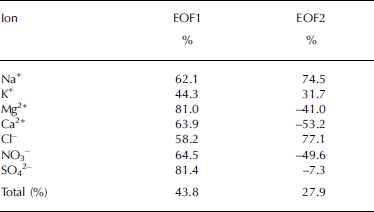
EOF analysis of the major ions reveals the common variance of these ions over the past millennium (Table 1). EOF1 accounts for 43.8% of the total variance in the major-ion time series, Mg2+, Ca2+, NO3 – and SO4 2– are strongly loaded on EOF1, and EOF1 explains 81.0%, 63.9%, 64.5% and 81.4% of changes in Mg2+, Ca2+, NO3 – and SO4 2– over the past millennium, respectively. Figure 2 shows the EOF time series and major ions over the past millennium. The high common variance suggests a common source for these ions, which are possibly derived from mineral aerosol of the central Asia arid zone and controlled by the continental air mass (Reference Wake, Mayewski and SpencerWake and others, 1990, Reference Wake, Mayewski, Xie, Wang and Li1993, Reference Wake, Dibb, Mayewski, Li and Xie1994; Reference KangKang and others, 2002; Reference KaspariKaspari and others, 2007). EOF1 time series can therefore be used to represent the activities of continental air masses (Reference KangKang and others, 2002; Reference KaspariKaspari and others, 2007). EOF2 accounts for 74.5% and 7 7 . 1% of total Na+ and Cl–, respectively. Na+ and Cl–, much of which are transported inland during the monsoon season, are associated with marine air masses from the Bay of Bengal and the Arabian Sea (Reference Shrestha, Wake, Dibb and WhitlowShrestha and others, 2002; Reference KaspariKaspari and others, 2007). Therefore, the EOF2 time series can be taken as proxies of the activity of the south Asian monsoon (Reference KaspariKaspari and others, 2007).
Results from EOF analysis of major-ion time series of the ER ice core over the past 1000 years
3.2. Recent relationships between ion record and temperature and APO
NCEP/NCAR reanalysis results provide the available global climate data since 1948. In order to investigate the recent relationship between the record of major ions and climatic factors, we compared EOF time series of major ions and climatic data from the NCEP/NCAR reanalysis. The upper-troposphere (200–500 hPa) temperatures (UTT) of the highest and lowest years of the two EOF time series were compared over the period of overlap, 1948–2001. Furthermore, repeating the work of Reference KangKang and others (2002) and Reference KaspariKaspari and others (2007), we investigated the surface pressure anomalies of the highest and lowest years of two EOF time series. Because of the inverse relationship between temperature and surface pressure, the values of pressure anomaly are not presented here, but the results of the pressure anomaly of the highest and lowest years of two EOF time series are the same as those obtained by Reference KangKang and others (2002) and Reference KaspariKaspari and others (2007).
The results show that, in summer, UTT is anomalously low (high) over Mongolia in years with high (low) EOF1 (Fig. 3a and b), and surface pressure is anomalously high (low) over Mongolia in years with high (low) EOF1. In contrast, higher EOF2 is associated with anomalously high UTT and anomalously low surface pressure over Mongolia (Fig. 3c), and lower EOF2 is associated with anomalously low UTT and anomalously high surface pressure over Mongolia (Fig. 3d). In winter, EOF1 is also inversely related to the UTT anomaly and positively related to surface pressure over Mongolia (Fig. 3e and f).
Upper-troposphere (500-200 hPa) temperature (UTT) anomalies corresponding to different phases of the EOF1 and EOF2 time series. (a, b) Summer (June-September) mean UTT anomaly for (a) high (selected according to the value >(mean value + 0.5δ)) and (b) low EOF1 years (selected according to the value <(mean value - 0.5δ)); (c, d) summer mean UTT anomaly for (c) high and (d) low EOF2 years; and (e, f) winter (December-February) mean UTT anomaly for (e) high and (f) low EOF1 years.

Because the APO phenomenon is observed in tropospheric eddy temperature (a difference bertween air temperature and its zonal mean) (Reference Zhao, Zhu and ZhangZhao and others, 2007), the APO index can be regarded as a proxy of the difference in air temperature between Asia and the north Pacific. Additional investigation of the EOF time series and tropospheric eddy temperature was conducted. The results show that in the years of high (low) EOF1, the tropospheric eddy temperature over Mongolia is below (above) average and the tropospheric eddy temperature over the northeast Pacific is above (below) average (Fig. 4a and b). In contrast, in the years of high EOF2, the tropospheric eddy temperature over Mongolia is above (below) average, and the tropospheric eddy temperature over the northeast Pacific is below (above) average (Fig. 4c and d). This suggests that periods showing high (low) concentrations of crustal major ions correspond to times with a weaker (stronger) summer APO, and periods showing high concentrations of marine major ions correspond to times with a stronger (weaker) summer APO.
Eddy temperature anomalies corresponding to different phases of the EOF1 and EOF2 time series. (a, b) Summer mean eddy temperature anomaly for (a) high (selected according the value >(mean value + 0.5δ)) and (b) low EOF 1years (selected according the value <(mean value -0.5δ)). (c, d) Summer mean eddy temperature for (c) high and (d) low EOF2 years. Here we used the eddy air temperature  as defined by Reference Zhao, Zhu and ZhangZhao and others (2007)
 . T is the air temperature and
  is the zonal mean of T. The vertically averaged (500-200 mbar) is used to represent the upper-tropospheric eddy temperature.

The thermal gradient between land and sea induces pressure difference which drives atmospheric circulation. Our interpretation of the results so far is that, in the summer, the stronger APO (corresponding with higher UTT and lower pressure over Mongolia) increases this gradient and causes the south Asian monsoon to shift north, weakening the control of the continental air mass over the southern TP. The outcome is higher concentration of marine ions and lower concentration of crustal ions reaching the TP (Reference KangKang and others, 2002; Reference KaspariKaspari and others, 2007).
3.3. Relationship between ion record and reconstructed summer APO index over the past 1000 years
The 993 year time series of the summer APO index (explained in Section 2) also exhibits long-term variations (Fig. 2). Comparing it with the ion records, we found a weak positive correlation between EOF2 and summer APO index (r = 0.368, p< 0.01, n = 727) and a weak negative correlation between EOF1 and summer APO index (r = –0.211, p < 0.01, n = 727).
However, on the century timescale, the correlation coefficients between major ions and summer APO index in different periods vary temporally (Fig. 2). During the period AD1000–1440, the summer APO index is above average but the concentrations of crustal ions did not have notably below average values, and the marine ions did not have notably above average values. The correlation coefficient between the summer APO index and EOF1, and the correlation coefficient between this index and EOF2, are both positive in the period AD 1000–1323, which coincides with the Medieval Warm Period (MWP) (Fig. 5). During the MWP, a constant drought has been reported in related areas, including north Africa (Reference Verschuren, Laird and CummingVerschuren and others, 2000), India and southeast Asia (Reference Cook, Anchukaitis, Buckley, D’Arrigo, Jacoby and WrightCook and others, 2010), central Asia (Reference Chen, Huang, Zhang, Holmes and ChenChen and others, 2006) and Europe (Reference Helama, Merilainen and TuomenvirtaHelama and others, 2009). The drought in the source region of crustal ions provides more aerosols to the southern TP. Meanwhile, the intensive source of the ions masked the circulation information of the APO. We therefore infer that the positive association between the summer APO index and both EOFs during the MWP is caused by drought conditions in the ion source regions. Reference Zhao, Wang and ZhouZhao and others (2012) also pointed out that an anomalously high APO index is consistent with reduced precipitation over the arid and semi-arid regions of north Africa, the Middle East and west Asia, which intensified the drought in this region. Higher ion concentrations when the APO index was high, during AD 1000–1323, likely imply a dry climate during this period.
The 30 year running correlation between the EOF time series and the 993 year time series of the summer APO index (APOI); the latter is reconstructed from Beijing’s summer temperature recorded by a stalagmite and the PDO index (Reference Zhou, Zhao and LiuZhou and others, 2009). The black solid line is the correlation coefficient between EOF time series and summer APO index; the green dashed line is summer APO index.
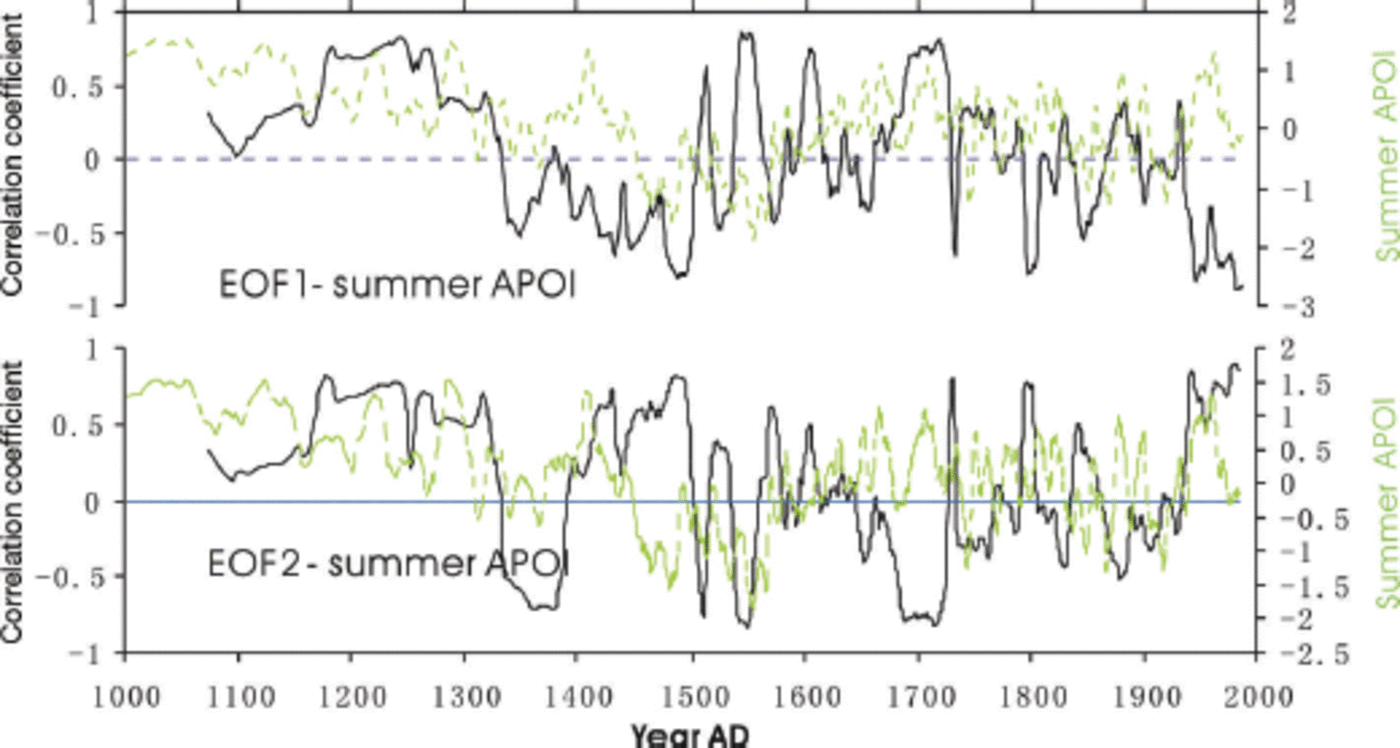
From AD1440 to 1900, the summer APO index was generally lower, fluctuating around zero (Fig. 2). Reference Zhou, Zhao and LiuZhou and others (2009) found that the monsoon circulation during this period was weaker. Over the period AD 1323–1900, the correlation coefficients of summer APO index and EOF time series fluctuate between –1 and 1 (Fig. 5), indicating the unstable relationships between APO and ion record over the southern TP. These likely reflect the complexity of factors that impact ion transport over the southern TP during AD 1323–1900.
After AD 1900, the correlation between EOF1 and summer APO index is negative and the correlation between EOF2 and summer APO index is positive (Fig. 5). As mentioned above, the higher APO strengthened the south Asian monsoon and weakened the control of continental air mass over the southern TP, hence it influences ion transport over the southern TP. This suggests that after AD 1900 the major-ion records mainly reflect the circulation information.
Both marine aerosols transported inland by the south Asian monsoon and dust derived from the vast arid and semi-arid regions of central Asia play major roles in the ion record of glaciers in the southern TP (Reference Wake, Mayewski and SpencerWake and others, 1990, Reference Wake, Mayewski, Xie, Wang and Li1993, Reference Wake, Dibb, Mayewski, Li and Xie1994). The south Asian monsoon, zonal wind and activities of Asian dust could impact the ion transport over the southern TP (Reference Wake, Mayewski, Xie, Wang and LiWake and others, 1993; Reference Kang, Wake, Qin, Mayewski and YaoKang and others, 2000, Reference Kang2002, Reference Kang, Mayewski, Qin, Sneed, Ren and Zhang2004, Reference Kang2010; Reference KaspariKaspari and others, 2007, Reference Kaspari2009; Reference Liu, Geng and HouLiu and others, 2010), and the drought in central and south Asia always contributes a sudden increase of Cl– and Na+ which could mask the marine Cl– and Na+ (Reference Wake, Mayewski, Xie, Wang and LiWake and others, 1993; Reference GrigholmGrigholm and others, 2009). Therefore the regional atmospheric circulation and the climatic condition of the ion source regions are both factors that could impact ion transport over the southern TP. On the millennial scale, either factor may dominate at different times. Therefore, the correlations between the APO index and the ion record are very weak over the past millennium.
3.4. Ion record and PDO
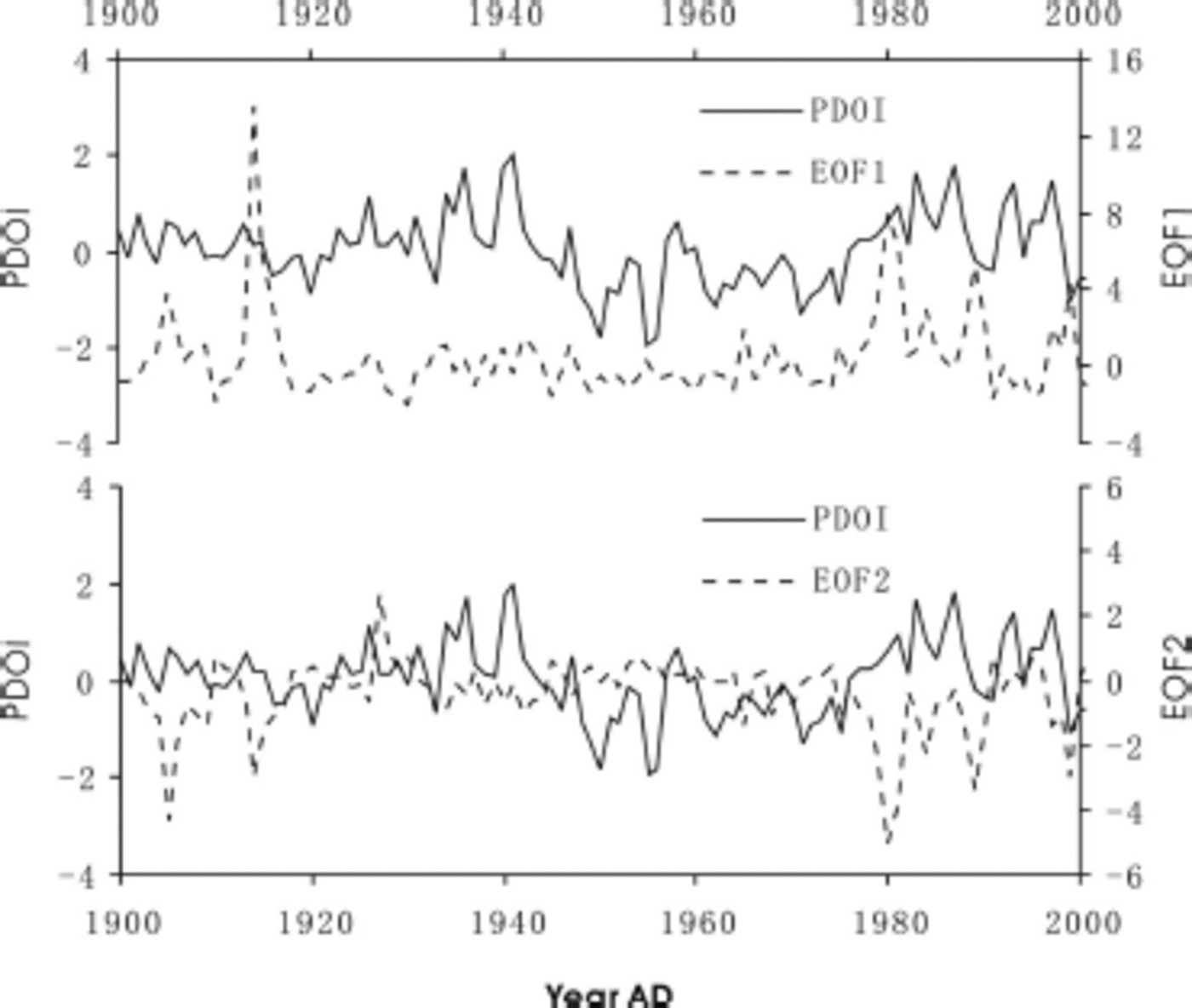
Owing to seesaw teleconnection of the air temperature over the north Pacific and Asia, PDO is inversely correlated with APO, and the abnormal warmer climate of the northeast Pacific region is accompanied by the cooler climate of the Asian continent and vice versa (Reference Zhao, Zhu and ZhangZhao and others, 2007; Reference Zhou, Zhao and LiuZhou and others, 2009). Here we examine the relationship between the record of major ions and the PDO index by studying the correlations between the time series of the EOFs and those of the PDO index http://jisao.washington.edu/pdo/PDO.latest, 1900–2000). A previous study has pointed out that there is a teleconnection between the PDO and atmospheric crustal aerosols on the central TP (Reference GrigholmGrigholm and others, 2009). Our results in Figure 6 show that EOF1 is significantly positively correlated with the annual PDO index (n= 103, r= 0.362, p < 0.01), meaning that when the sea surface temperature is higher over the northeast Pacific, more crustal ions are transported to the southern TP, whereas EOF2 is significantly negatively correlated with the annual PDO index (n = 103, r= –0.409, p < 0.01), meaning that when the sea surface temperature over the northeast Pacific is low, more marine ions are transported to the southern TP. Additional EOF analysis on EOF time series and the annual PDO index shows that EOF1 and annual PDO index share the 5 8% common variations (positive correlation), and EOF2 and the annual PDO index share the 60% common variations (negative correlation). The high annual PDO index is related to low APO index (lower UTT and higher surface pressure over Mongolia). When the PDO (APO) index is higher (lower), the air temperature over Eurasia is lower, indicating a stronger continental air mass and a weaker monsoon air mass over the southern TP. Accordingly, the relation between annual PDO index and ion concentration over the southern TP reflects the PDO’s impact on atmospheric circulation over the southern TP since AD 1900.
Time series of the annual values of EOF1, EOF2 and the PDO index (PDOI).
By studying the ion record retrieved from an ice core from Guoqu glacier on the northern side of Geladaindong mountain in the central TP, Reference GrigholmGrigholm and others (2009) showed that crustal ions are negatively correlated with the PDO index. This observation can be attributed to the fact that negative PDO values correspond to lower precipitation at Geladaindong. The drier condition at Geladaindong due to lower precipitation may provide a favorable environment for a higher burden of soluble dust in the atmosphere, leading to higher concentrations of ions in the Guoqu ice core. The negative correlation between the Guoqu ice-core crustal ions and the PDO index is opposite to the positive correlation between the PDO index and the ER ice-core crustal ions, which may suggest the different mechanisms of the PDO’s impact on ion transport to the central and southern TP. The influence of PDO on the Guoqu ice-core crustal ions may emphasize its impact on ion sources (drier or wetter environment), but its influence on ER ice-core crustal ions emphasizes its impact on ion transport (atmospheric circulation strength) since AD1900.
4. Conclusions
EOF analysis of the major ions in the ER ice core reveals the relationships among major ions and their common variation. EOF1 represents the common variance of the major crustal ions, and EOF2 represents the fluctuations of marine ions over the southern TP. UTT and surface pressure over the Mongolia region are closely related to ion transport over the southern TP. Periods of increased marine ions and decreased crustal ions correspond to times when higher UTT occurred over Mongolia. Investigations of the most recent 54 years (1948–2001) of the EOF time series and tropospheric eddy temperature indicate that the summer higher APO strengthened the south Asian monsoon and lower summer APO strengthened the control of continental air mass over the southern TP. This suggests that the record of major ions of the ER ice core can document the APO signals.
The ion concentrations measured in the southern TP ice core are influenced by both the regional atmospheric circulation and the climatic conditions of the ion source regions. During the last millennium, these factors varied over time. Because either factor may dominate at a given time, the correlations between the summer APO index and the EOF time series are weak.
Finally, an inverse relation between annual PDO index and concentration of crustal ions over Geladaindong and a positive relation between PDO index and crustal ion concentration on Qomolangma suggest two effects of the PDO: (1) it can influence the source of ions reaching the central TP, and (2) it can influence the transport of major ions (circulation) to the southern TP.
Acknowledgements
Thanks are due to many scientists, technicians, graduates and porters for their hard work in the field, and to Zhao Ping for providing the APO index. This work was supported in China by the Chinese Academy of Sciences (XDB03030101-4), the National Basic Research Program of China (2010CB951401), the Natural Science Foundation of China (41330526, 41171052, 41321062 and 40825017), the Ministry of Education (20110091110025) and the Priority Academic Program Development of Jiangsu Higher Education Institutions. We thank our editor, Felix Ng, and an anonymous reviewer for extensive suggestions on the science and the written English of the manuscript.



