

Introduction
Parent–child relationships, generally viewed as essential, involve various forms of resource sharing and emotional support. Moreover, these family bonds are beneficial throughout the lifecourse in most situations (Lye Reference Lye1996; Carr et al. Reference Carr, Holman, Abetz, Kellas and Vagnoni2015; Hartnett et al. Reference Hartnett, Fingerman and Birditt2018; Fingerman et al. Reference Fingerman, Huo and Birditt2020). But not all families maintain positive intergenerational relationships throughout the lifecourse, and some experience degradation or estrangement, in which one or more family members chooses to terminate contact with other members (Conti Reference Conti2015; Blake Reference Blake2017).
Many studies have found that, in most cases, parent–child estrangement has negative long-term consequences for both parties’ psychological and physical wellbeing (Silverstein and Bengtson Reference Silverstein and Bengtson1991; Umberson Reference Umberson1992; Zunzunegui et al. Reference Zunzunegui, Béland and Otero2001). Due to this significance, a substantial amount of previous research has explored the antecedents and variations of parent–child estrangement in diverse contexts (Gilligan et al. Reference Gilligan, Suitor and Pillemer2015; Hartnett et al. Reference Hartnett, Fingerman and Birditt2018; Arránz Becker and Hank Reference Arránz Becker and Hank2022; Reczek et al. Reference Reczek, Stacey and Thomeer2023).
However, these studies are limited in two important ways. First, a vast majority have been conducted in Western societies; thus, little is known about the patterns and variations of estrangement among family members in non-Western cultures. Second, many have been based on a cross-sectional framework; these models fail to account for the possibility of family estrangements being reconciled over time (Blake Reference Blake2017).
To bridge these gaps in the literature, the present study examines the determinants of parent–adult child estrangement, which is based on parents’ reports on their adult children, in Korea, where the tradition of filial piety for older parents is more robust than in Western societies (Park et al. Reference Park, Phua, McNally and Sun2005). Also, by using large panel data, this article tracks the ebbs and flows of relationship breakdowns over a longer period of the lifecourse. Additionally, the nationally representative sample being used here underscores socio-economic gradients in the likelihood of experiencing estrangement in Korean families.
Background
Theoretical frameworks for parent–child estrangement
Because intergenerational relationships are multi-layered and dynamic, various models and theoretical frameworks have been proposed to help explain them (Agllias Reference Agllias2012). The solidarity model, established by Bengtson’s serial works (Bengtson and Roberts Reference Bengtson and Roberts1991; Bengtson Reference Bengtson2001; Bengtson et al. Reference Bengtson, Giarrusso, Mabry and Silverstein2002), is perhaps one of the most influential theoretical frameworks for explaining parent–child estrangement or family relationships in general. This model postulates that solidarity between generations is composed of six dimensions (structure, association, affect, consensus, function and norms) which describe intergenerational interactions, emotions and supports over the long term (Bengtson and Roberts Reference Bengtson and Roberts1991; Bengtson et al. Reference Bengtson, Giarrusso, Mabry and Silverstein2002; Silverstein et al. Reference Silverstein, Conroy and Gans2012). According to this theory, the opportunity structure for family interaction, as well as the child’s and the parents’ norms of familism, affect the relationship through the availability of resources, the magnitude of interactions and the quality of the exchange (Bengtson and Roberts Reference Bengtson and Roberts1991).
Regarding the opportunity structure, the model suggests that interactions among family members would be diminished when (1) parents or children have health problems severe enough to restrict daily activities, (2) parents and children are separated by large geographical distances or (3) parents and adult children have time constraints due to full-time employment or raising young children. These conditions, therefore, elevate the probability of parent–child estrangement (Bengtson and Roberts Reference Bengtson and Roberts1991). However, empirical evidence supporting the influence of opportunity structure is mixed. For instance, Blake (Reference Blake2017) suggested that family relationships can be restrained when one of the members has physical or mental health problems, perhaps because care-giving duties and responsibilities tend to be distributed unevenly in the family. On the other hand, Fingerman et al. (Reference Fingerman, Huo and Birditt2020) found that older parents with ill health status are more likely than their healthy peers to receive support from their adult children, implying that ill health encourages intergenerational contact and reduces the likelihood of estrangement. Furthermore, physical distance between parents and adult children is more likely to be an outcome of accumulated conflicts in the family rather than a cause of estrangement (Agllias Reference Agllias2018). In addition, as Sarkisian and Gerstel (Reference Sarkisian and Gerstel2008) suggested, if marriage is a ‘greedy institution’ that absorbs time and resources, married adult children who are employed full-time and raising young kids would reduce exchanges with their older parents, which would increase the odds of estrangement. At the same time, however, a number of studies found that older parents tend to provide resources to adult children who have or are likely to have grandchildren (Lye Reference Lye1996).
The solidarity model also articulates that, other things being equal, an individual’s stronger adherence to familism or family obligations would facilitate intergenerational connection which would attenuate the risk of intergenerational estrangement (van Stee Reference van Stee2022). Religious beliefs might be one of the more important factors that can affect attitudes and behaviours towards family roles and responsibilities (Agllias and Gray Reference Agllias, Gray, Green and Carey2013). Moreover, though most religions emphasize altruism and caring for family members, there can be subtle differences in terms of orientations to individualism between Western and non-Western religions. For instance, Yasuda et al. (Reference Yasuda, Iwai, Yi and Xie2011) found that adults who have East Asian religious beliefs (e.g. Buddhism) were 1.5 times more likely to reside with their older parents compared to those affiliated with Western religions.
The concept of intergenerational ambivalence is another potentially essential dimension in intergenerational conflict (Pillemer et al. Reference Pillemer, Munsch, Fuller-Rowell, Riffin and Suitor2012; Fingerman et al. Reference Fingerman, Huo and Birditt2020). According to ambivalence theory, family relations inevitably involve competing needs and interests between parents and children and, hence, intergenerational ties can become simultaneously close and disturbing. There is some evidence that parents tend to feel greater ambivalence when adult children fail to accomplish important lifecourse markers, such as completing education, securing a job or getting married (Kalmijn and De Graaf Reference Kalmijn and De Graaf2012; Pei and Cong Reference Pei and Cong2019). Thus, it can be hypothesized that children’s unsuccessful life transitions escalate the likelihood of parental ambivalence, thereby increasing the likelihood of parent–child estrangement.
Also, gender theory postulates that patterns of family interaction tend to be deeply gendered. In general, women perform most of the work related to kinkeeping and are much more involved in the family network than men are (Lye Reference Lye1996). Because daughters are socialized to internalize these values, women place greater importance on maintaining emotional bonds with other family members than men do. It can therefore be inferred that women are less likely to experience estrangement either with their parents or with their adult children compared to their male counterparts.
Parent–child estrangement in Korea
Over the past several decades, Korea has undergone a demographic transition – that is, rapid decline of fertility and increase in longevity – that had profound implications for family relationships (Chang Reference Chang1999). As a result, the nuclear family became the standard family type and the prevalence of intergenerational co-residence plunged gradually (Kye and Choi Reference Kye and Choi2021), which potentially elevates the risk of parent–child estrangement. Nevertheless, past research that examined the changes in Korean family behaviours repeatedly found that there is no clear evidence that intergenerational transfers of financial or other supports has weakened ( Park et al. Reference Park, Phua, McNally and Sun2005; C.-S. Kim Reference Kim2008).
Though it did not have as strong an influence on an individual’s conceptions and behaviours as in the past, many Koreans still believe in traditional values such as hyo (filial piety) and family responsibility (Martin Reference Martin1990; Ha et al. Reference Ha, Yoon, Lim and Heo2016). Hyo, originated from Confucianism, denotes a social norm which emphasizes that children should not only respect their parents but also provide practical as well as financial support for them (Park et al. Reference Park, Phua, McNally and Sun2005). It can therefore be expected that the long-traditional emphasis on filial responsibility might partially offset the force of family nuclearization on intergenerational estrangement.
In practice, however, the responsibility of caring for older parents has not been distributed equally across children: in Korean culture, the first-born son (Jang-Nam) typically has the largest responsibility for taking care of older parents in exchange for receiving a greater inheritance than later-born children (Kim et al. Reference Kim, Lee and Kim2017). In a study that examined attitudes towards caring for older parents in East Asian countries, the proportion of respondents who believe that the eldest son should take care of old parents in Korea was substantially higher than in other societies such as Japan, China or Taiwan (Yasuda et al. Reference Yasuda, Iwai, Yi and Xie2011). On the other hand, Choi and Kim (Reference Choi and Kim2014) found that, while parents’ first priority when giving financial help was the eldest son, the eldest son did not necessarily provide the largest share of upward (i.e. from child to parent) monetary transfer.
Numerous past studies conducted in the West (e.g. Swartz et al. Reference Swartz, Kim, Uno, Mortimer and O’Brien2011) have documented that adult children who have better socio-economic standing are less likely to receive parental aid because parents tend to provide more help to the children in greater need. However, in Korea, Kim et al. (Reference Kim, Lee and Kim2017) found that parents are more likely to provide money and help to children who are more educated and own their housing. At the same time, Korean parents with higher levels of educational attainment tend to receive more financial help from their adult children than their counterparts with lower levels of education (Choi and Kim Reference Choi and Kim2014). These results imply that altruism theory might fit more tightly with intergenerational estrangement in the West, and that exchange theory may be more appropriate for explaining this relationship in Korea.
Based on aforementioned considerations, the following hypotheses are formulated.
Hypothesis 1: Parent–adult child estrangement will be significantly associated with the socio-economic characteristics of both generations, and greater socio-economic resources will attenuate the likelihood of intergenerational estrangement.
Hypothesis 2: Demographic attributes of parents, such as gender and marital status, will be closely associated with the probability of parent–adult child estrangement.
Hypothesis 3: The norm of familism represented by hyo will be negatively associated with the possibility of parent–adult child estrangement.
Method
Data
Data for the present study are drawn from eight waves of the Korean Longitudinal Survey of Ageing (KLoSA), a nationally representative survey administered biennially since 2006 by the Korea Labor Institute (Korea Employment Information Service 2024). The first wave of the KLoSA sampled 10,254 adults aged 45 and older living in randomly selected households in 1,000 census tracts except in the Jeju island (original sample). Due to panel attrition and respondent deaths, the KLoSA decided to add a sample of 920 persons born in 1962 and 1963 (i.e. aged 51 and 52 in 2014) (supplementary sample).
In the most recent round of interviews in 2020, the retention rate of the KLoSA was 77.1 per cent for the original sample, with 5,717 participants responding to the survey. For the supplementary panel, four surveys have been administered thus far, with a retention rate of 87.2 per cent, resulting in 771 valid samples. Throughout the survey, a total of 512 respondents (497 from the original sample and 15 from the supplementary sample) were reported as deceased (Korea Employment Information Service 2024).
Both the original and the supplementary samples are included in the following analyses. However, parents who responded that their marital status is ‘never married’ were excluded because the number of such cases were negligible (n = 76 in the original sample and n = 18 in the supplementary sample) and because never married parents who raise children would have distinctive characteristics in the Korean context.
Following past literature (Gilligan et al. Reference Gilligan, Suitor and Pillemer2015; Arránz Becker and Hank Reference Arránz Becker and Hank2022), the unit of analysis in the current study is adult child–parent dyads rather than individuals. Because the principal purpose of this research is to examine the influence of adult children’s and parents’ socio-economic attributes on adult child–parent estrangement, it is more appropriate to concentrate on child–parent pairs. After casewise deletion, 11,652 father–child dyads and 16,386 mother–child dyads, nested within 4,154 and 5,416 families, respectively, were retained for the final analysis.Footnote 1
Measures
The dependent variable is a dichotomous variable indicating whether an older parent experienced estrangement from an adult child at each wave. Regarding the dichotomy assignment process, the KLoSA asked older parents following two questions: (a) ‘How frequently do you have face-to-face meetings with your non-resident child?’ and (b) ‘How frequently do you have contacts with your non-resident child through phone calls, letters or emails?’ The ten-point response scale for this question ranged from 1 = almost every day (more than four times a week) to 10 = do not meet (contact) at all. Respondents who reported 9 (rarely see or contact in a year) or 10 to both questions were coded as 1 (estranged), otherwise 0 (not estranged). Also, adult children who are co-residing with an older parent were treated as not estranged. Thus, the estrangement status measured at every wave of the KLoSA is consistent with previous research that defined voluntary estrangement as when ‘one or more family members intentionally or voluntarily choose to end contact or communication’ (Conti Reference Conti2015; Blake Reference Blake2017; Scharp and Dorrance Hall Reference Scharp and Dorrance Hall2019). Also, it is a time-varying variable because the parent–child bond can evolve over the lifecourse as circumstances change (Goldman and Cornwell Reference Goldman and Cornwell2018).
The independent variables are parents’ and adult children’s demographic and socio-economic characteristics. Parent’s age was constructed by subtracting year of birth from each survey year, thereby creating a time-varying measure. Parent’s educational attainment was measured with four categories (1 = elementary school or lower, 2 = middle school, 3 = high school and 4 = college or higher) based on the highest grade completed. The KLoSA measured parent marital status with four categories (1 = never married, 2 = married, 3 = divorced/separated, and 4 = widowed). However, preliminary analysis indicated that the share of respondents who are never married or divorced/separated is trivial (less than 2 per cent), and it is collapsed to two categories by excluding never married and combining divorced/separated and widowed (1 = married, and 2 = not married). Total household income in the last year was measured with five classifications (1 = less than 6 million won [≈4,428 USD], 2 = 6–12 million won [≈8,856 USD], 3 = 12–24 million won [≈17,711 USD], 4 = 24–60 million won [≈44,279 USD] and 5 = greater than 60 million won). The number of sons and number of daughters were each reported by the respondent, and includes both co-residing and non-resident children. Though the KLoSA requested that respondents report only the number of surviving children, it is highly unlikely that exclusion of deceased children would affect the results because of the relatively low level of pre-elder mortality in Korea (OECD 2023). To account for the parent’s functional status, the present study utilized disability in performing activities of daily living (ADLs). The ADLs assessed whether the parents can perform seven daily activities, such as clothing, eating, washing, toileting and so on, independently, and the score ranges from 0 (completely independent) to 7 (completely dependent) (Korea Employment Information Service 2024). At each wave of the KLoSA, the region of residence was measured with three categories: 1 = metropolitan areas, 2 = small to medium-sized cities, 3 = rural areas. Respondents’ religious affiliation was measured with five categories: 1 = no religion, 2 = Protestant, 3 = Catholic, 4 = Buddhist and 5 = other religions).Footnote 2
The adult child’s demographic characteristics included gender (1 = male, 2 = female), age (in years) and birth order (1 = first born, 2 = second born, 3 = third or later born). To reflect the substantial expansion of Korean higher education over the past several decades (Kim Reference Kim2023), the adult child’s educational attainment is operationalized with four slightly different categories (1 = middle school or lower, 2 = high school, 3 = 2-year college and 4 = 4-year university or higher). The child’s work status was represented with two categories (1 = not working [i.e. unemployed and out of labour force], 2 = working). Adult child’s marital status was classified with four categories (1 = never married, 2 = married, 3 = divorced/separated and 4 = widowed). Home ownership of the adult child (1 = no, 2 = yes) and their number of children (i.e. the grandchildren of the older parents) were also included in the model.
Analyses
Given its panel data structure and binary outcome variable, a random-intercept logistic regression was fit to relax the assumption of conditional independence among the outcome variables for the same respondent given the covariates (Rabe-Hesketh and Skrondal Reference Rabe-Hesketh and Skrondal2008). Hence, the logit model includes a dyad-specific random intercept ζj in the linear predictor, as follows:
 \begin{equation*}\log {\text{it\{ Pr(}}{y_{{\text{ij}}}}{\text{ = 1}}|{x_{{\text{ij}}}}, {\zeta _{\text{j}}}{\text{)\} = }}{\beta _1} + {\beta _2}{x_{2{\text{j}}}} + \ldots + {\zeta _{\text{j}}} + {\varepsilon _{{\text{ij}}}}\end{equation*}
where ζ j|x ij ∼ N(0,ψ) and ζj are independent across dyad j. This panel data approach allows for the inclusion of time-varying covariates, such as work status, marital status and region of residence.
Mounting evidence from past research suggested that there are substantial gender differences in parent–child relationships, including the likelihood of estrangement (Lye Reference Lye1996; Agllias Reference Agllias2013; Fingerman et al. Reference Fingerman, Huo and Birditt2020). The current study, therefore, models for dyads of father–child and dyads of mother–child separately.Footnote 3 Further, models for father–child and mother–child dyads were estimated hierarchically. That is, Model 1 includes parents’ characteristics and Model 2 adds adult child’s attributes on top of Model 1. In addition, it is possible that different children of the same parent are highly correlated with respect to the dependent variable. Thus, to account for the data structure with observations nested within parents, all models employed robust standard errors.
Results
Preliminary analysis indicated that 3.63 per cent of parents in the KLoSA were estranged from at least one of their adult children in the baseline survey (i.e. 2006 wave). However, the prevalence of estrangement gradually declined in subsequent waves and it dropped to 1.74 per cent in the eighth round (i.e. 2020 wave) of the KLoSA.Footnote 4 The decreasing rate might be attributable to selective mortality by estrangement status – that is, estranged parents are more likely to die than their non-estranged counterparts (Silverstein and Bengtson Reference Silverstein and Bengtson1991; Zunzunegui et al. Reference Zunzunegui, Béland, Sanchez and Otero2009) – or it might be that estranged children restore the relationship as their parent’s health deteriorates over time (Scharp and Dorrance Hall Reference Scharp and Dorrance Hall2019). In any case, the rate of estrangement in Korea is significantly lower compared to rates reported in Western societies, such as 26.0 per cent and 6.3 per cent for estrangement from father and mother, respectively, in the US (Reczek et al. Reference Reczek, Stacey and Thomeer2023) and 12 per cent and 5 per cent for father’s and mother’s estrangement, respectively, in Germany (Arránz Becker and Hank Reference Arránz Becker and Hank2022).Footnote 5
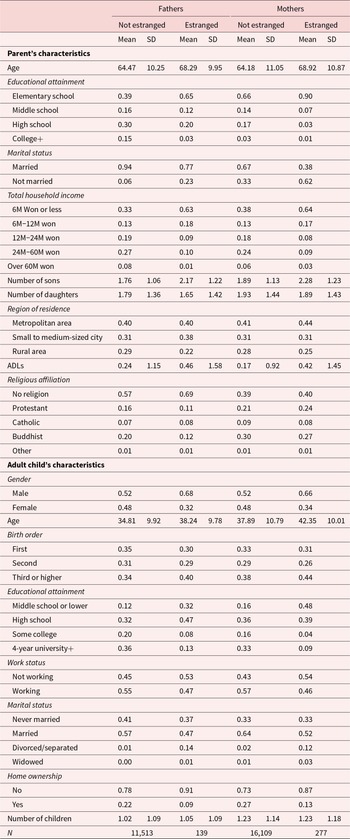
Summary statistics, delineated by estrangement status and parent’s gender, are presented in Table 1. The results suggest that there are significant differences in characteristics between parents who are estranged from children and those who are not. Among both parents, the estranged ones were, on average, much older than their counterparts. More specifically, estranged fathers were 3.82 years older than their peers who are not estranged from their children. Similarly, estranged mothers were, on average, 4.74 years older than their counterparts without such experience.
Sample characteristics, by parental gender and estrangement status
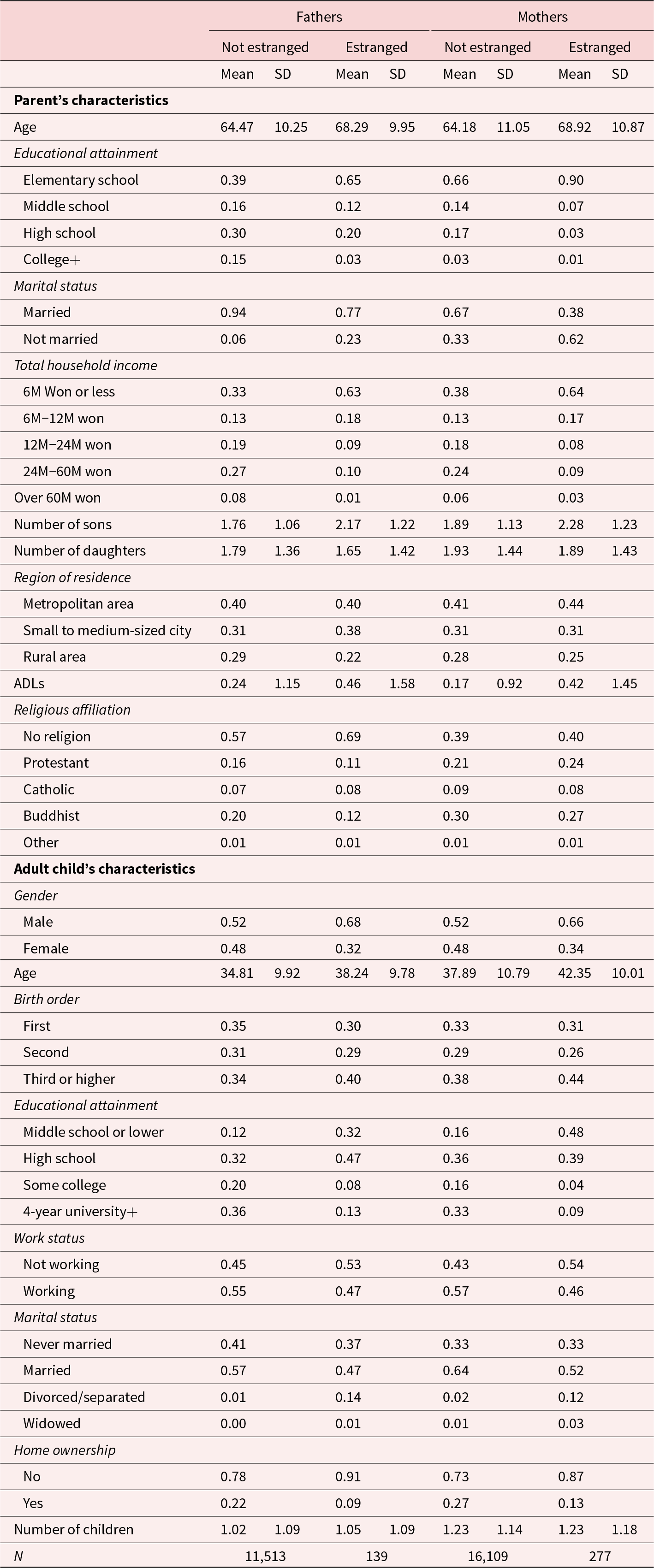
Note: Sample means are unweighted. Due to rounding, some proportions do not add up to one. The baseline refers to the 2006 wave of the KLoSA for respondents in the original sample, and denotes the 2014 wave for those in the newly added sample.
As found in past studies (Kalmijn Reference Kalmijn2023), parents not in a marital relationship were much more likely to be estranged from their adult children compared to the married ones, regardless of gender. Specifically, among non-estranged fathers, only 6 per cent were not currently in a marital relationship (i.e. divorced or widowed), whereas 23 per cent of the estranged were not currently married. Hence, fathers not in a marital relationship were roughly 3.8 times more likely to experience estrangement from their adult child. This discrepancy was less pronounced among mothers compared to fathers. Mothers not in a marital relationship were about 1.9 times more likely to experience it compared to their married peers.
It appears that a parent’s likelihood of estrangement declines as their educational attainment increases. For example, among estranged fathers, 65 per cent completed less than an elementary education, while the same proportion among non-estranged fathers was 39 per cent. Further, among fathers with more than a college education, the proportion of non-estranged is 5 times higher than the fraction of the estranged (15 per cent vs 3 per cent). However, except parents in the lowest household income group, the discrepancy between estranged and not estranged remained relatively stable across income levels.Footnote 6
In line with prior works (Blake Reference Blake2017; Reczek et al. Reference Reczek, Stacey and Thomeer2023), estranged parents have, on average, a greater number of daughters compared to those not estranged, whereas the former had more sons than the latter. This might stem from the fact that, like their mothers, adult daughters tend to play the role of kin-keepers in the family, and are therefore less likely to be estranged from parents. Nonetheless, the strong tendency of same-gender solidarity (e.g. father–son or mother–daughter) reported in Western countries (Lye Reference Lye1996) is not found in the Korean context. Furthermore, associations between factors that can affect a parent’s familism and estrangement status were not pronounced. That is, distributions of parents’ residential areas and religious affiliations were similar among those estranged and not estranged.
However, as found in Blake (Reference Blake2017), parents’ physical health problems, approximated with the ADL score in this study, appear to increase the likelihood of estrangement from their adult children. Results indicated that the average non-estranged father’s ADL score was 0.24, whereas the same score for estranged fathers was 0.46. Also, ADL scores for estranged and non-estranged mothers were 0.42 and 0.17, respectively.
The distribution of religious affiliations did not show significant discrepancies among mothers by estrangement status, but the distribution of the father’s religion differed by estrangement status: the share of those without any religion was higher among the estranged compared to those not estranged, and the fraction of Protestants and Buddhists was relatively lower among estranged fathers than those not estranged. Similarly, parents who are estranged from their adult children were more prevalent among those living in metropolitan areas than in rural areas.
As to adult children’s attributes, those who are estranged from their father and mother were, on average, older than their non-estranged counterparts. The disparity in average age between estranged and non-estranged children was more salient in estrangement from fathers than from mothers. This might imply that adult children tend to maintain intergenerational ties longer with mothers than with fathers, perhaps because mothers proactively participate in kin-keeping activities.
Birth order seems to matter for the likelihood of estrangement from one’s parents; the results indicate that the proportion of adult children who experienced estrangement from their father or mother was greatest among third or later-born children than among first-born children.
An adult child’s socio-economic resources appear to be negatively associated with the likelihood of estrangement from their parents. For instance, among adult children who were not estranged from their father, the share of those with middle school or less education was 12 per cent, but the same proportion among children who were estranged was 32 per cent. Similarly, the fraction of children who are not working is disproportionately higher among the estranged than the non-estranged. In addition, children who are not estranged from their parents were much more likely to have their own house than their estranged peers. About 22 per cent of children who are not estranged from father owned their home, while only 9 per cent of those estranged owned their home.
Contrary to Sarkisian and Gerstel’s (Reference Sarkisian and Gerstel2008) suggestion, married children are less likely to experience estrangement from their parents while divorced/separated ones are substantially more likely to experience it. In the case of children who are not estranged from their father, the share of divorced/separated was only 1 per cent, but the same fraction among children who were estranged from their father was 14 per cent. This rate among those who are non-estranged and estranged from their mother was 2 per cent and 12 per cent, respectively.
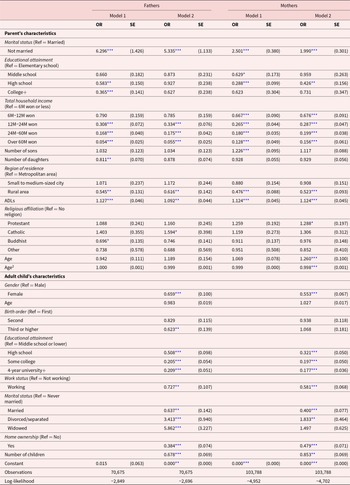
The estimated coefficients from random-intercept logistic regressions predicting parent–adult child estrangement are presented in Table 2. Results from Model 1, which included only parents’ characteristics, suggest that the odds of experiencing estrangement among those who are not in a marital relationship are substantially higher than those for married children. More specifically, compared to married fathers, those not in marital relationships were 6.3 times more likely to report estrangement from their adult children – even after accounting for the father’s other characteristics. Similarly, mothers not in a marital relationship were 2.5 times more likely to experience estrangement from adult children than their married counterparts. These results clearly indicate that unmarried parents are substantially more likely to experience estrangement from their grown children compared to married parents. Past studies repeatedly and consistently have shown that unmarried parents tend to contact and exchange supports less frequently with their grown children and, hence, experience more strains in the parent–child relationship compared to their married counterparts (Lye Reference Lye1996; Swartz Reference Swartz2009; Blake Reference Blake2017). Furthermore, the results imply that these tendencies are much more pronounced among unmarried fathers compared to mothers in the same situation. This may be attributable to the mothers generally playing an important role as kin-keepers in the family; their risk of losing contact with children even after marital dissolution is therefore significantly lower than fathers’ (Hartnett et al. Reference Hartnett, Fingerman and Birditt2018; Arránz Becker and Hank Reference Arránz Becker and Hank2022).
Results of random-intercept logistic regression models predicting parent–adult child estrangement
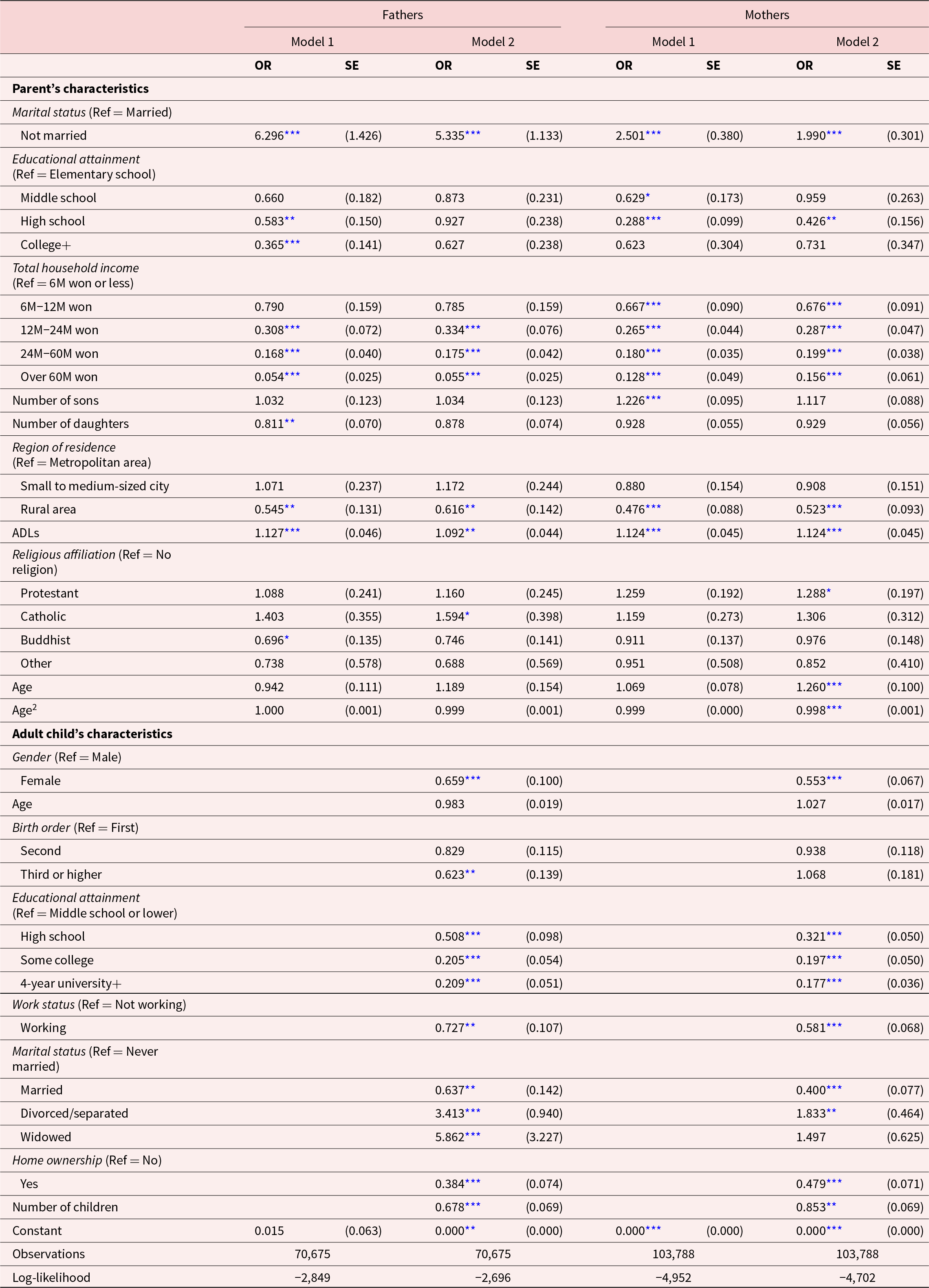
Note: Robust standard errors in parentheses,
*** p < 0.01, ** p < 0.05, * p < 0.1
The results suggest that parents’ socio-economic status is negatively associated with the odds of estrangement. Particularly among fathers, the odds of estrangement from adult children decreases monotonically as their educational attainment or income level increases. For instance, compared to those who completed elementary education, the odds of estrangement for fathers with a middle school, high school or college education were reduced by 34.0 per cent, 41.7 per cent and 63.5 per cent, respectively. Similarly, fathers being in the highest level of income level reduced the odds of estrangement by 94.6 per cent relative to those in the lowest level. Similar patterns were observed among mothers’ educational attainment and household income except for those in the highest level of education.
Of note is that the number of daughters suppressed parents’ likelihood of estrangement from their adult children significantly. Specifically, one more daughter reduced the odds of the father’s estrangement by 18.9 per cent while the same decreased the odds for the mother’s estrangement by 7.2 per cent. Though the influence of the number of sons is not as strong as the impact of the number of daughters, it appears to be positively associated with maternal estrangement, but not with paternal estrangement.
A respondent’s ADL score was positively and significantly associated with the odds of estrangement for both fathers and mothers: one more ADL increased the odds of estrangement for fathers by 12.7 per cent and mothers by 12.4 per cent. This aligns with the theory behind the solidarity model of intergenerational relationships (Silverstein and Bengtson Reference Silverstein and Bengtson1997), but less so with previously mixed research results: while some studies found that an older parent’s deteriorating health may improve the relationship, other studies suggested that an older parent’s health issues, such as disability or mental illness, would weaken the family bonds.Footnote 7
With respect to the influence of religious beliefs, which is employed as a surrogate for an individual’s familism, the results indicated that, compared to those without any religion, Buddhist fathers’ chance of estrangement was 30.4 per cent lower, while Protestant mothers’ odds were 25.9 per cent higher. In East Asian culture, Christianity tends to be perceived as conveying more modern values, such as independence and individualism, than Buddhism, and these values are negatively associated with the likelihood of parent–adult children co-residence (Yasuda et al. Reference Yasuda, Iwai, Yi and Xie2011). Hence, results from the current analysis are well-aligned with previous literature, but the effect of religious beliefs may differ depending on the parent’s gender: Buddhism may have a protective effect on fathers’ estrangement from adult children, while Protestantism seems to increase mothers’ estrangement. In addition, the coefficients for parents’ region of residence indicated that those who are living in rural areas have significantly lower odds of being estranged from their children relative to those in metropolitan areas. This result is also consistent with religious affiliation because traditional values such as hyo appear to be significantly more prevalent in rural areas than in urban areas (Park et al. Reference Park, Phua, McNally and Sun2005).
Turning to results from Model 2, which accounted for adult children’s characteristics in addition to parents’ attributes, daughters are significantly less likely to experience estrangement from their parents than sons – as gender theory predicts (Lye Reference Lye1996). After accounting for parents’ attributes as well as other children’s characteristics, daughters are 34.1 per cent less likely to be estranged from fathers and 44.7 per cent less likely to experience estrangement from mothers compared to sons.
Adult children’s age and birth order appear to be associated only with estrangement for fathers, but not for mothers. As children’s age increases by one year, the odds of estrangement from fathers decreased by 1.7 per cent. Silverstein and Bengtson (Reference Silverstein and Bengtson1997) found that, on average, younger children tend to have more integrated relations with both fathers and mothers than older children have. Also, being born as the third or later child in the family of origin reduced the odds of estrangement from the father by 37.7 per cent. While East Asian cultures typically believe that the chronological position in the sibling constellation is significant in many aspects (Park et al. Reference Park, Phua, McNally and Sun2005; Kim et al. Reference Kim, Lee and Kim2017), these results suggest that a child’s birth order matters only for estrangement from fathers, not from mothers.
Results indicate that, as adult children’s educational attainment increases, the odds of estrangement from both fathers and mothers declines significantly. More specifically, compared with those who completed middle school or lower education, the odds of estrangement from the father for those who completed high school are reduced by 49.1 per cent. In the case of individuals who completed a two- and four-year university education, the odds decreased by 79.5 per cent and 79.1 per cent, respectively. The odds of estrangement from the mother by children’s educational attainment were more pronounced, and clearly showed a negative gradient. Employment status, another linchpin of an individual’s socio-economic standing, is also negatively associated with the odds of estrangement from both parents. Working adult children are 27.3 per cent and 41.9 per cent less likely to experience estrangement from their father and mother, respectively, compared to their peers who were not working. In addition, it appears that adult children’s home ownership, which can represent financial status in Korea, also significantly suppresses the likelihood of estrangement from both parents.
Contrary to Sarkisian and Gerstel (Reference Sarkisian and Gerstel2008), who found that married people tend to have considerably greater restraints in intergenerational ties than the unmarried, results from the current study indicate that married children were significantly less likely to be estranged from fathers and mothers than never-married children. However, adult children not in marital relationships (i.e. separated/divorced or widowed) were substantially more likely to experience estrangement from parents compared to the never-married. For example, the odds of estrangement from fathers were 3.4 times higher for divorced/separated and 5.9 times higher for widowed children, relative to never married ones. Though the odds of estrangement from mothers for divorced or separated children increased by 83.3 per cent, the same odds for the widowed failed to reach statistical significance.
Childcare is perhaps the most common form of practical help that older parents provide to adult children, and it has been documented that the presence of young grandchildren facilitates intergenerational exchanges (Hogan et al. Reference Hogan, Eggebeen and Clogg1993). In line with these suggestions, the number of grandchildren was negatively associated with the odds of estrangement from both parents. One more grandchildren reduced the odds of estrangement from fathers by 32.2 per cent and from mothers by 14.7 per cent.
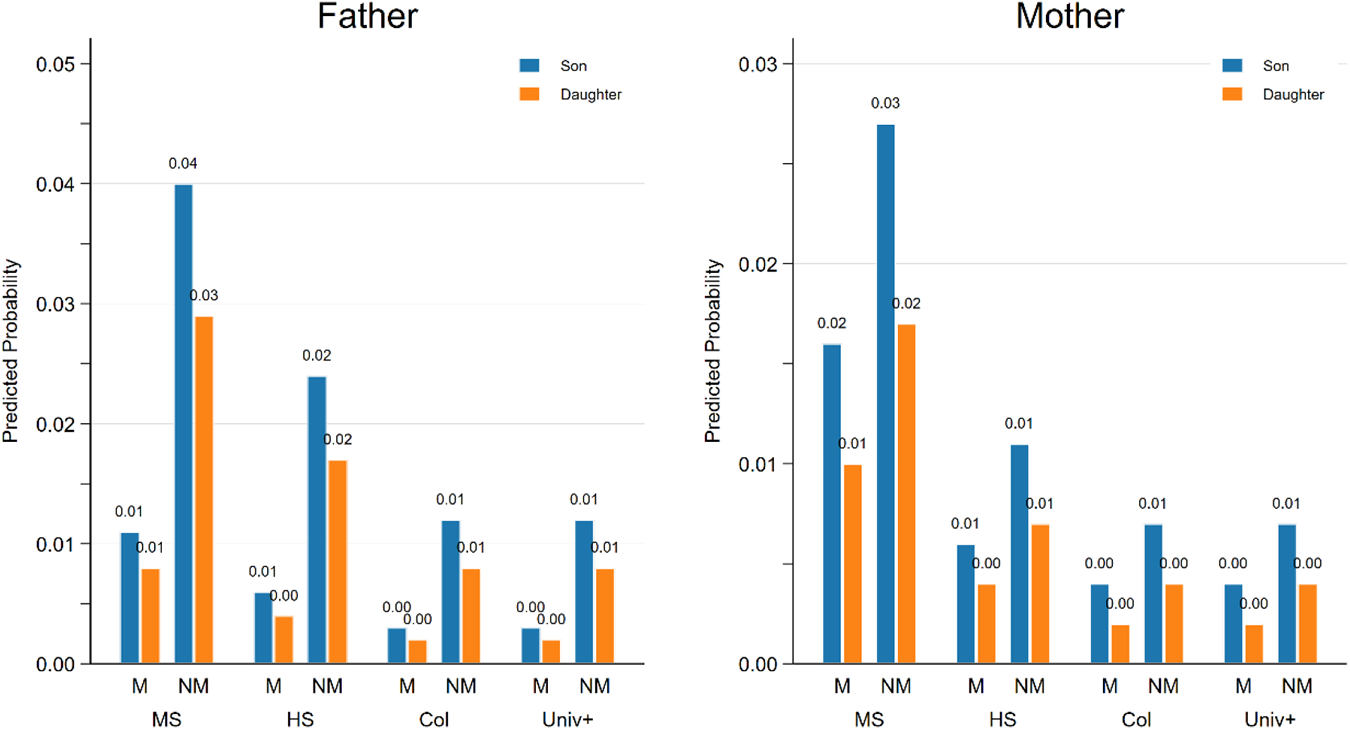
Predicted probabilities of estrangement from fathers and mothers by parent’s marital status, child’s education and gender are presented in Figure 1. This graph is derived from the estimated coefficients in a model that included both parents’ and adult children’s characteristics with all remaining covariates calibrated to their mean values.
Predicted probability of estrangement from fathers and mothers by parents’ marital status, child’s education and gender.
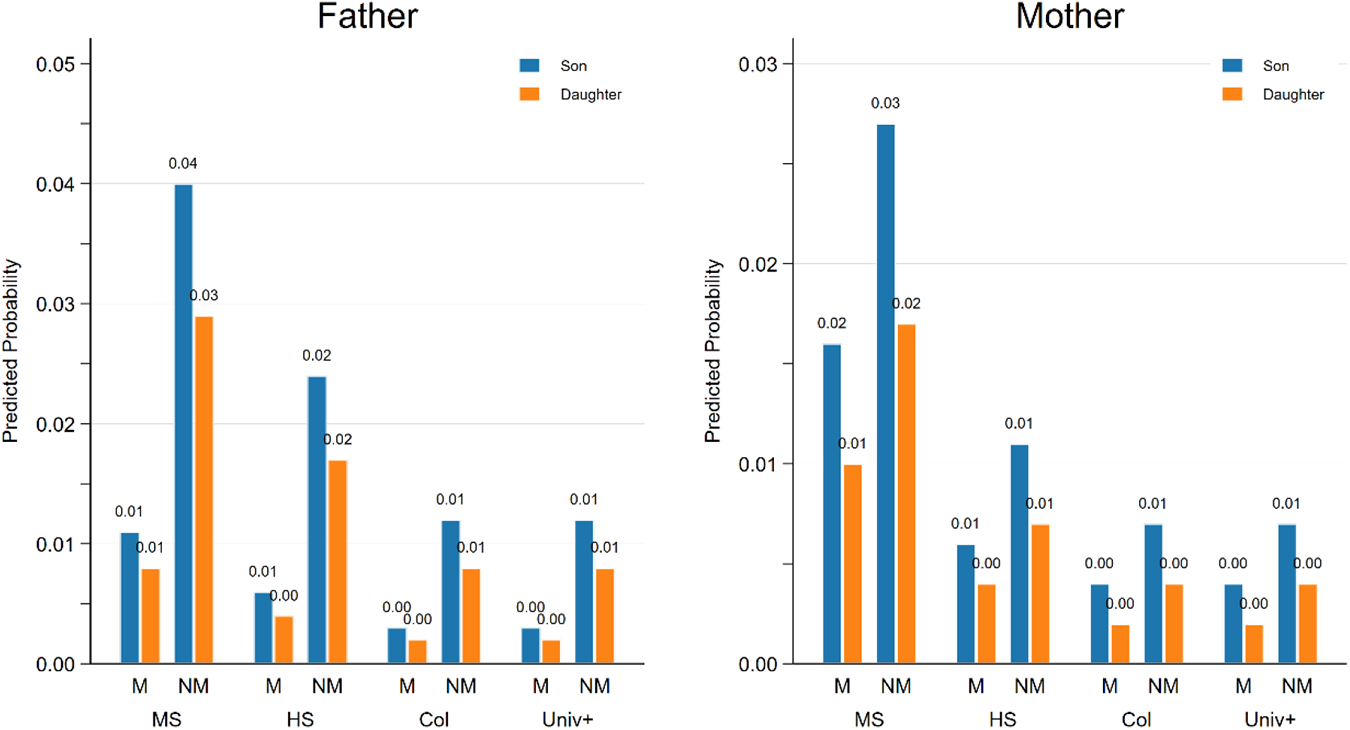
The graph for predicted values clearly demonstrates that, regardless of gender and educational level, adult children’s probabilities of experiencing estrangement from their parents are much higher when parents remain in the marital relationship than otherwise. Furthermore, when a parent’s marital status and a child’s gender are held constant, as the adult child’s educational attainment increases, the probability of estrangement declines monotonically. This may suggest that adult children’s socio-economic resources, approximated by educational attainment in the present study, have protective effects on estrangement, even after controlling for pertinent factors. Therefore, it can be inferred that the group most vulnerable to parental estrangement is adult sons with lower levels of education and parents not in marital relationships.
Discussion and conclusion
Most prior studies that addressed the various determinants of estrangement between older parents and adult children has been conducted by using data collected in Western countries. Accordingly, antecedents of family tie breakdowns in Korea, which has a strong tradition of hyo and Confucianism and is experiencing unprecedented population ageing, are substantially understudied. Also, because an increasing body of research underscores disparities in the likelihood of experiencing parent–child estrangement by socio-economic resources, one of the key motivations of this article is to explore whether similar discrepancies can be observed in non-Western contexts.
Three main findings emerged from the analyses, the first of which is that a higher level of socio-economic achievement for the adult child, approximated with educational attainment and full-time employment status, significantly reduces the odds of estrangement from both parents. More specifically, an adult child’s education status of four-year university or above decreased the odds of estrangement from fathers and mothers by 79.1 per cent and 82.3 per cent, respectively, compared to those who completed middle school or below. Also, relative to adult children who are not employed, the employed were 27.3 per cent and 41.9 per cent less likely to experience estrangement from fathers and mothers, respectively. To date, the effect of an adult child’s high socio-economic achievement on the likelihood of estrangement from their older parents has not been clear (Laditka and Laditka Reference Laditka and Laditka2001). Some scholars (e.g. Swartz et al. Reference Swartz, Kim, Uno, Mortimer and O’Brien2011) contend that adult children’s attainment of higher levels of education or full-time employment should increase the odds of estrangement because adult children’s greater socio-economic resources may alleviate their reliance on parents for financial or practical assistance. At the same time, given that greater socio-economic resources may be able to attenuate conflicts and tensions in a family, it is possible that adult children’s higher socio-economic achievement would be negatively associated with the risk of estrangement (van Stee Reference van Stee2022).
Second, both the gender and the marital status of the parent emerged as important factors for understanding intergenerational estrangement in Korea. Results indicated that, consistent with past literature (Arránz Becker and Hank Reference Arránz Becker and Hank2022), an adult child’s odds of estrangement from fathers were much higher than those of estrangement from mothers. More important is that the likelihood of estrangement in family relations significantly escalates when older parents are not currently partnered due to separation, divorce or death of spouse. The interaction of gender and marital status was much more salient among father–child dyads than among mother–child dyads, and it may reflect the fact that mothers tend to do the majority of kin-keeping roles such as contacting and arranging exchanges with family members in Korea. In addition, contrary to Silverstein and Bengtson (Reference Silverstein and Bengtson1997), the gender of adult children also showed a considerable influence on the odds of estrangement; a daughter’s probability of experiencing estrangement from both parents was almost halved compared to a son’s.
Finally, it is hypothesized that Koreans adhere to the norm of familism, which emphasizes connectedness among family members and obligations to support elderly parents more strongly than Western culture, and this expectation was partially supported by the results. On average, individuals who live in rural areas are presumed to believe in traditional values, and both fathers and mothers in those regions appear to be significantly less likely to experience estrangement from their adult children. Furthermore, while fathers who believe in Buddhism showed significantly lower odds of estrangement from adult children compared to their peers without any religion, a mother having the same religious affiliation did not produce this effect. By contrast, mothers who believe in Western religions, such as Protestantism or Roman Catholicism, showed significantly higher odds of estrangement from their adult children than those without any religion.
There are limitations to the current analyses. First, despite the noteworthy influence of an individual’s perceptions on family roles and relations (Fingerman et al. Reference Fingerman, Huo and Birditt2020; Reczek et al. Reference Reczek, Stacey and Thomeer2023), the present study was not able to explicitly incorporate measures that could represent familism due to the unavailability of such variables in the KLoSA; instead, following Yasuda et al. (Reference Yasuda, Iwai, Yi and Xie2011), the present study employed region of residence and religious affiliation as surrogates for those measures. However, an estimation of the association between an individual’s perceptions of family relations and estrangement would strengthen our understanding of family behaviours, and is therefore an important avenue for future research. Second, the present study relied exclusively on the parents’ assessment of estrangement from their adult children, and the child’s perspective could not be included. However, it is possible that parents and children might evaluate the quality of their relationships differently (Carr et al. Reference Carr, Holman, Abetz, Kellas and Vagnoni2015). Although this issue was not addressed in the current study due to this data limitation, it is crucial to take possible discrepancies in perceptions into account in future. Third, the KLoSA administered questions about the frequency of contact and communication with adult children only when the respondent had at least one child who was not currently living in the same household at the time of the survey. In other words, parent–child estrangement could not be measured if the adult child lived in the same household, and while complete communication cut-off among family members living in the same household can occur (Conti Reference Conti2015), it is highly unlikely that excluding adult children living with parents would affect the overall findings of the present study. This is because the average age of parents in this study is nearly 70 and only a small number of children were co-residing with parents. Finally, many adult children may not have surviving parents, and this tendency would be relatively more salient among the socio-economically disadvantaged. In other words, due to data construction, the sample is representative of older parents, not adult children, and, hence, interpretation of the analyses’ results should be limited to parents’ estrangement from adult children, not the other way around.
In conclusion, it has been demonstrated that the level of parent–child estrangement among Korean families is comparatively lower than has been found in Western societies. Whereas the compressed modernization (Chang Reference Chang2022) resulted in proliferation of nuclear family ideology, which can potentially increase the likelihood of parent–child estrangement, the long tradition of hyo in Korea seems to buffer the impact. Nevertheless, there were significant variations in the likelihood of intergenerational estrangement along with socio-economic standing. It appears that both parents and adult children with low education and low income are particularly vulnerable to experiencing family estrangement and, therefore, more refined policy measures for those segments of the population should be formulated.
Supplementary material
The supplementary material for this article can be found at https://doi.org/10.1017/S0144686X26100762.
Funding
This article is financially supported by the 2026 College of Public Policy at Korea University.


 Open access

