


Introduction
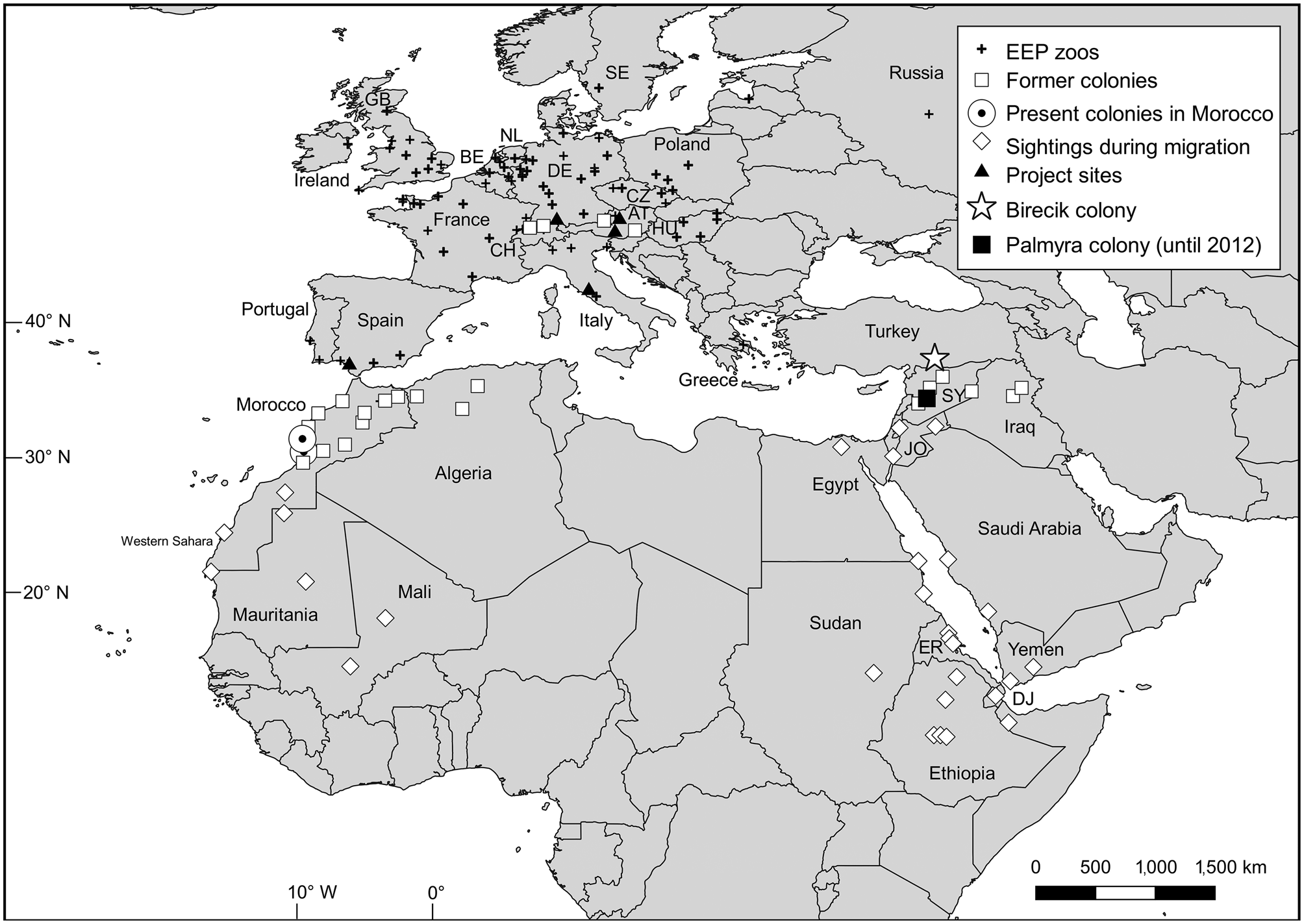
The northern bald ibis Geronticus eremita is one of the rarest birds. Although recently recategorized on the IUCN's Red List from Critically Endangered to Endangered, it has a precariously small wild population limited to a handful of breeding sites, and the main subpopulation has only recently recovered slightly (BirdLife, 2018). The northern bald ibis was probably once widespread across the Middle East, northern Africa, and southern and central Europe, with wintering populations as far south as Mauritania and Senegal, and from the Arabian Peninsula and African Red Sea coast to Eritrea and Ethiopia. Habitat destruction, persecution and the impacts of agricultural pesticides led to its disappearance from most of its former range (Hirsch, Reference Hirsch1976, Reference Hirsch1979; Collar & Stuart, Reference Collar and Stuart1985). It was extirpated from central Europe > 400 years ago, but breeding populations persisted in Morocco, Algeria, Turkey and Syria into the 20th century. The only viable wild population is now in Morocco, but there are significant captive zoo populations, release projects and semi-wild populations. Here we review the species' current status throughout its former range, and look at conservation prospects, ongoing reintroductions and natural recolonizations. The geographical distribution of colonies, projects and sightings (up to and including 2018), and consolidated figures for all wild, semi-wild, released and captive populations, are summarized in Fig. 1 and Table 1.
Former and recent distribution, projects sites and zoo colonies of the northern bald ibis Geronticus eremita. Data from Collar & Stuart (Reference Collar and Stuart1985), Welch & Welch (Reference Welch, Welch and Böhm2004) and Böhm et al. (Reference Böhm, Schad, Fienieg and Voorham2018).
Summary of the status of the estimated global adult northern bald ibis Geronticus eremita population in 2018. Totals for captive populations include non-breeding birds, but totals for semi-captive and free-flying populations are recent counts of actively breeding adult birds only. Semi-captive means only seasonally free-flying and not self-sustaining.
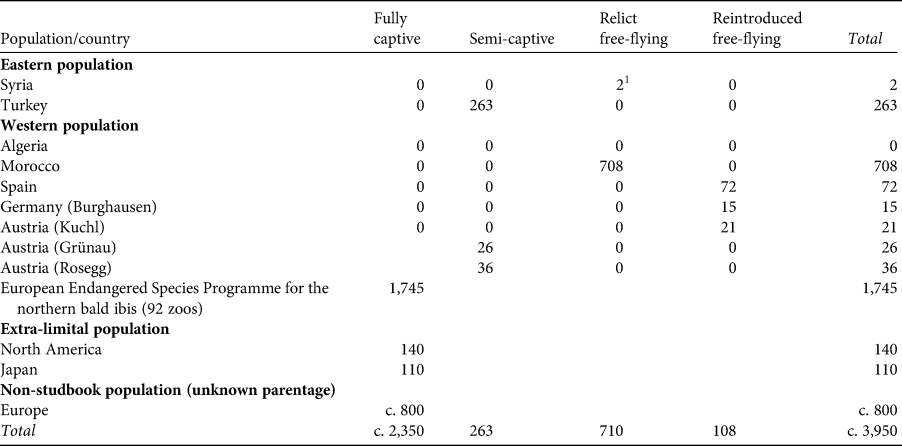
1 Syria figure is uncertain because of access and security issues.
Indigenous range and population structure
Based on minor morphological distinctions and preliminary genetic work, two populations (eastern and western) have been identified, but the extent and timing of their separation appears to be minor and recent (Pegoraro et al., Reference Pegoraro, Föger and Parson2001; Wirtz et al., Reference Wirtz, Böhm, Fritz, Hankelin and Hochkirch2016, Reference Wirtz, Böhm, Fritz, Kotrschal, Veith and Hochkirch2017). All fully captive populations in Europe, Japan and North America, and those used in European release projects, derive from western origin birds (Böhm, Reference Böhm1999, Reference Böhm2006), whereas the Turkish semi-wild birds are of local, eastern origin. Thus, although more work is needed, the two populations can be regarded as distinct management units.
Western subpopulations
Morocco
Historically, breeding colonies occurred in the High and Middle Atlas Mountains and some Atlantic coastal areas north of the present colonies. The number of populations declined from 38 sites in 1940 to 15 in 1975 and only three in 1989, as a result of habitat modification, human disturbance, hunting and pesticide use (Collar & Stuart, Reference Collar and Stuart1985). Thevenot et al. (Reference Thevenot, Vernon and Bergier2003) documented a higher number of historical colonies because they treated some dispersed colonies as separate entities. Historical records suggest that the now extinct inland populations were migratory, wintering further south in Morocco and as far away as Mauritania and Mali (Bowden, Reference Bowden2015).
The remaining global wild population now occupies a small coastal strip in southern Morocco in the region of Agadir, where it breeds on sea cliffs in two main areas and is resident year-round. In 1991 the Moroccan authorities designated the Parc National de Souss-Massa, a 33,800 ha coastal protected area specifically delimited to protect the nesting and feeding areas of the northern bald ibis south of Agadir. The other main breeding and feeding area is a coastal strip 50 km north of Agadir in the region of Tamri, a no-hunting area designated as a Site d'Interêt Biologique et Ecologique, but with no formal protection status. By 1995 a total population of c. 300 birds was breeding in three subcolonies within the Parc National de Souss-Massa, and in one colony at Tamri (Bowden, Reference Bowden1998). There is some movement between these sites, which are c. 100 km apart (Bowden et al., Reference Bowden, Aghnaj, Smith and Ribi2003; El Bekkay et al., Reference El Bekkay, Oubrou, Ribi, Smith and Bowden2007).
A project, started in 1993 as a collaboration between the Royal Society for the Protection of Birds and the Sociedad Española de Ornitología, and later Groupe de Recherche pour la Protection des Oiseaux au Maroc, working with Parc National de Souss-Massa, aims to increase the northern bald ibis population in Souss-Massa. Local fishers were hired and trained as wardens, and a range of local rural development projects were implemented in the area to develop grass-root interest in the species’ conservation. Managing and maintaining the local wardening at both Parc National de Souss-Massa and Tamri has been the main intervention, and has been consolidated recently with Moroccan government support.
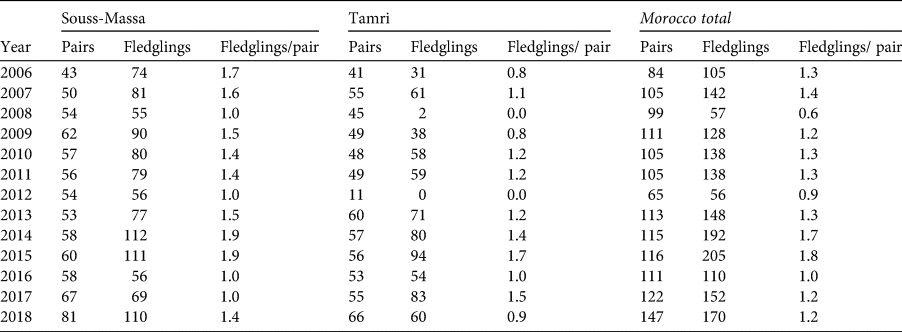
By 1997 the population had declined to 59 pairs following the unexplained death of 40 birds in 1996 (Bowden, Reference Bowden1998; Touti et al., Reference Touti, Oumellouk, Bowden, Kirkwood and Smith1999), but by 2007 it had recovered to 105 breeding pairs (Oubrou & El Bekkay, Reference Oubrou and El Bekkay2010) and has continued to increase. By 2014, there was a total of 524 individuals, with 115 pairs raising 192 fledglings. In 2015, 116 pairs bred and there was a post-breeding total population of 584 birds, including recently fledged juveniles. The total population at the end of the 2018 breeding season was > 700 individuals, with a breeding adult population of 147 pairs (Oubrou & El Bekkay, Reference Oubrou and El Bekkay2018; Table 2). These trends appear to be linked to measures taken by Parc National de Souss-Massa to engage local communities and develop wardening capacity. Intensive monitoring of breeding and feeding sites and the provision of supplementary fresh water has improved breeding productivity (Smith et al., Reference Smith, Aghnaj, El Bekkay, Oubrou, Ribi and Jimenez-Armesto2008). The population is apparently dependent on littoral steppe habitat and a traditional agriculture system where large areas are left fallow and grazed by sheep for several years at a time. This supports high biomass and diversity of the invertebrates and reptiles that are the main prey for the ibis (Aghnaj et al., Reference Aghnaj, Smith, Bowden and Ribi2001).
Breeding productivity of the northern bald ibis in Souss-Massa and Tamri, Morocco. Pooled data from Bowden et al. (Reference Bowden, Aghnaj, Smith and Ribi2003), El Bekkay et al. (Reference El Bekkay, Oubrou and Böhm2004) and Oubrou & El Bekkay (Reference Oubrou and El Bekkay2018).
There is renewed hope that the birds may naturally re-colonize former breeding sites in Morocco (as predicted in Böhm & Bowden, Reference Böhm and Bowden2010, Reference Böhm and Bowden2016). In 2017 breeding was confirmed for the first time in several decades in a small subcolony near Immsouane (Aourir et al., Reference Aourir, Bousadik, El Bekkay, Oubrou, Znari and Qninba2017), 30 km north of Tamri.
Algeria
In Algeria, most of the data on the historic distribution of the species are from the 1950s when 12 colonies were known. Another colony was discovered in 1974 in the north-western El Bayadh region, persisting until the late 1980s (Fellous, Reference Fellous2011). Northern bald ibises in Algeria were migratory, arriving at breeding sites towards the end of winter in February and early March, and departing after breeding in late summer.
The Algerian colonies were historically estimated to be c. 300–400 birds, but signs of population decline were noted in the 1950s (Collar & Stuart, Reference Collar and Stuart1985). Causes of decline included hunting, habitat loss caused by overgrazing, and droughts in the 1970s and 1980s, by which time < 20 individuals remained. The northern bald ibis became extinct in Algeria during the late 1980s or early 1990s (Fellous, Reference Fellous and Böhm2004).
Questionnaires circulated by Algeria's National Agency for Nature Conservation showed that in autumn 2004 two birds were seen flying at Thiet Ould Moumen, 2 km north of the last known breeding site for this species in Algeria; there have not been any subsequent observations.
Eastern subpopulations
Turkey
The northern bald ibis was once present through large areas of south-eastern Turkey. By the first half of the 1900s there were five documented colonies, one with as many as 3,000 birds (Akçakaya, Reference Akçakaya1990). This population underwent a dramatic decline from the late 1950s, principally resulting from the use of DDT to combat insect pests (Hirsch, Reference Hirsch1979, Reference Hirsch1980; Hatipoğlu, Reference Hatipoğlu2016). Following deaths and reproductive failure, the breeding population was reduced to 23 pairs by 1973 (Arihan, Reference Arihan and Böhm1999). In 1977 Turkey's General Directorate of Nature Protection and National Parks (now Doğa Koruma ve Milli Parklar Genel Müdürlüğü) initiated a project in collaboration with the Society for the Protection of Nature, Turkey (the former BirdLife Partner), to save the remaining wild northern bald ibis population in Birecik. A breeding station was established 3 km north of the town of Birecik, and 41 birds were caught during 1977–1989 and taken into semi-captivity. A similar number of birds were left in the wild. The captive birds were initially enclosed throughout the year, but a decision was made to release them from the aviaries each spring (in mid February, around the dates they would have arrived back from migration), and they were encouraged to breed on the rock ledges and in nest boxes outside the aviaries, with supplementary food provided twice per day. This spring release practice continues today, and the free-flying birds forage in the surrounding area during the breeding season and until they are recaptured each July. This prevents migration and is believed to improve survival rates, although a few birds (mainly juveniles) have disappeared before recapture, and it is possible some of them have migrated south. Unfortunately, the remaining fully wild population continued to decline, and was declared extinct in 1989 (Akçakaya Reference Akçakaya1990; Yeniyurt et al., Reference Yeniyurt, Oppel, Isfendiyaroğlu, Özkinaci, Erkol and Bowden2016).
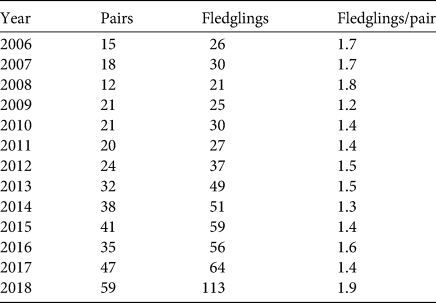
The semi-wild population has increased despite a number of sudden deaths of chicks and adult birds, notably during 1998–2000, in part caused by contamination of supplementary food. By December 2018 there were 263 birds, of all ages, in seasonal captivity at Birecik (Table 3). Doğa Derneği (BirdLife Turkey) together with Doğa Koruma ve Milli Parklar Genel Müdürelüğü have monitored the breeding population since 2003 (Yeniyurt et al., Reference Yeniyurt, Oppel, Isfendiyaroğlu, Özkinaci, Erkol and Bowden2016), and are working to enhance veterinary conditions in the breeding station in Birecik, to increase the size of the semi-wild colony and thereby re-establish the migratory population at Birecik.
Breeding productivity of the northern bald ibis in Birecik, Turkey.
From 2007 the release and tracking of juvenile birds from the Birecik Breeding Centre confirmed that the Turkish northern bald ibis had not lost the ability to migrate (Hatipoğlu, Reference Hatipoğlu2016). In 2007 juveniles moved south, following a similar trajectory to that of the Palmyra birds, and one bird returned to the colony in spring 2008, although the overwinter location of this individual was not identified (Lindsell et al., Reference Lindsell, Serra, Peske, Abdullah, Qaim and Kanani2009). None of the other released birds have returned. The release programme was suspended in 2011 when the Syrian civil war started, and satellite tags on three of the released birds stopped transmitting in circumstances suggesting hunting. Nevertheless, releases remain a high priority conservation action for the eastern flyway of the species.
Syria
The northern bald ibis was previously relatively common in the Al Badia landscapes of Syria (Serra et al., Reference Serra, Abdallah, Assaed, Abdallah, Al Qiam and Fayad2004). Little is known of the species’ former distribution in Syria, or the factors driving declines. The birds once migrated through Jordan, Saudi Arabia, Yemen, Eritrea and Sudan, with stopover sites during the autumn migration between breeding sites in Syria (and Turkey, see above) and the wintering ground in the Ethiopian Highlands (Lindsell et al., Reference Lindsell, Serra, Peske, Abdullah, Qaim and Kanani2009; Bowden, Reference Bowden2015). Hunting along the migration route through the western areas of the Arabian Peninsula (Jordan and Saudi Arabia) became unsustainable, and by the early 1900s the Northern Bald Ibis was believed to be extinct in Syria (Aharoni, Reference Aharoni1928; Safriel, Reference Safriel1980). This left the last known colony of eastern northern bald ibis at Birecik, Turkey, with < 100 breeding pairs in the 1970s (Bowden et al., Reference Bowden, Aghnaj, Smith and Ribi2003). However, the first well-documented observation in recent history was in 1985, when an expedition of the Ornithological Society of the Middle East recorded 12 northern bald ibises in the Taiz wetlands in Yemen. Birds were also sighted in western and south-western Arabia from 1985 (Brooks et al., Reference Brooks, Evans, Martins and Porter1987; Schulz & Schulz, Reference Schulz and Schulz1992), giving rise to speculation that there was a hitherto undiscovered colony in the region.
In 2002 a breeding colony of 7 birds was discovered in Syria's Palmyra region (Serra et al., Reference Serra, Abdallah, Assaed, Abdallah, Al Qiam and Fayad2004). Subsequent tagging and satellite-tracking of Syrian birds in 2006 confirmed winter migration through Arabia to the Ethiopian highlands (Lindsell et al., Reference Lindsell, Serra, Peske, Abdullah, Qaim and Kanani2009), c. 150 km from Addis Ababa, where sightings of northern bald ibises had been relatively common in the 19th century (Welch & Welch, Reference Welch, Welch and Böhm2004; Wondafrash, Reference Wondafrash, Böhm and Bowden2010).
Historical data (Welch & Welch, Reference Welch, Welch and Böhm2004) and satellite-tracking, in combination with field surveys in 2008, suggest young ibises disperse around the southern Red Sea basin to the Ethiopian highlands for 2–3 years before returning to their natal site in Syria, when close to sexual maturity. It is unknown to what extent juveniles rely on adults to guide them to optimum feeding sites, as is the case with the white stork Ciconia ciconia (Bildstein, Reference Bildstein1984; Rotics et al., Reference Rotics, Kaatz, Resheff, Feldman Turjeman, Zurell and Sapir2016), or whether the greater foraging time typical of juveniles mean they could struggle to find sufficient food (Brooks, Reference Brooks1987) and become too weak to migrate long distances (as for the white ibis Eudocimus albus; Del Hoyo et al., Reference Del Hoyo, Elliot and Sargatal1992). In Arabia, where juveniles tended to winter (Lindsell et al., Reference Lindsell, Serra, Peske, Abdullah, Qaim and Kanani2009; Serra, Reference Serra2010), threats such as hunting and powerlines could be drivers of decline. On the adult wintering grounds in Ethiopia, disturbance and rainfall shortages are potential short-term threats, whereas pesticide use and the conversion of pastures to crops could be significant in the longer term (Serra et al., Reference Serra, Bruschini, Peske, Kubsa, Wondafrash and Lindsell2013).
Following the Palmyra colony's discovery, the site was protected, but migration losses further reduced the tiny population (Serra, Reference Serra2003, Reference Serra2005). During 2003–2009 at least one adult failed to return from each migration, and of 24 juveniles leaving during 2002–2007 only seven returned (Table 4). Evidence suggests high mortality rates as a result of hunting in Syria and Saudi Arabia, in addition to electrocution on power lines (Serra et al., Reference Serra, Lindsell, Peske, Fritz, Bowden and Bruschini2014). Consequently, the Syrian population declined from seven birds in 2002 to five in 2009; fledged young failed to reach the wintering site in Ethiopia, reappearing in only very low numbers in subsequent years (Serra et al., Reference Serra, Lindsell, Peske, Fritz, Bowden and Bruschini2014).
Population structure of the northern bald ibis colony at Palmyra, Syria, 2002–2015. Data from Serra (Reference Serra and Wondafrash2009, Reference Serra2010), Serra et al. (Reference Serra, Lindsell, Peske, Fritz, Bowden and Bruschini2014), M. Abdallah, pers. comm. (2016) and M. Wondafrash, pers. comm. (2019).
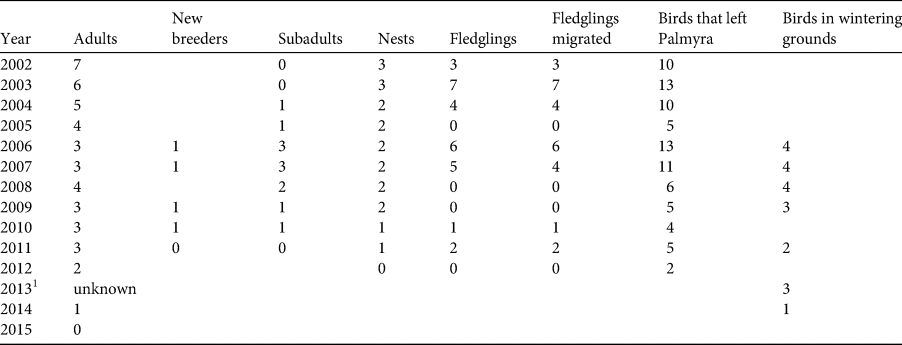
1 Reduced monitoring in 2013 because of security situation.
Unsustainably high annual mortality (c. 85%) of young birds outside the breeding grounds was the main reason for juveniles failing to return. Combined with breeding failures in 2009 and 2010 resulting from unknown causes, this reduced the colony to one pair and an unpaired female by 2010. There was an attempted supplementation using Turkish birds in 2010, when two tagged juveniles were released, with both successfully migrating to southern Saudi Arabia and surviving 6–8 weeks before dying (Bowden et al., Reference Bowden, Hamoud, Jbour, Fritz, Peske and Riedler2012). In summer 2012, during the Syrian civil war, only one pair returned to the site but did not breed. Three adults had been observed in 2013–2014 at their wintering grounds in Ethiopia, and one in 2015, but only one of these birds returned to the breeding grounds in 2014; no free-flying birds were seen by late February 2015 (Mahmud Abdallah & Yilma Dellelegn, pers. comm., 2016). The Syrian population now appears to be functionally extinct, although since 2015 monitoring at the site has been extremely difficult because of security issues (Table 4).
Captive populations
The northern bald ibis has been kept in zoos since the 1930s. The first few birds were imported from the eastern population, but none survived for longer than a few weeks, probably because of poor husbandry. The first surviving northern bald ibises were juveniles imported from Morocco to Basel Zoo in the early 1950s. They became founders of the captive northern bald ibis population (Böhm, Reference Böhm1999), and now all northern bald ibises in European zoos derive from the western population.
Overall there were 72 successful imports up to 1960, and a further two during 1960–1970. Approximately 30 birds were imported in 1976 and 1978 to Zoo Rheine and Zoo Rabat. All captive birds can be separated into three bloodlines, termed Basel stock, Rheine stock and Rabat stock. All three lines have been mixed in most collections, and currently most zoos keep descendants of at least two bloodlines (Böhm, Reference Böhm2006).
The captive population increased over 22 years from 330 in 1988 to > 1,100 birds by 2010, and 1,700 registered in the studbook by 2018. This increase is a result of breeding success (c. 100–130 offspring per year), low mortality and the longevity of the species.
Since 1997 juveniles have been donated from European Endangered Species Programme sources to three research projects. The Konrad Lorenz Research Station, Austria, received 61 northern bald ibises from seven locations during 1997–2017 to establish a sedentary semi-captive colony (Table 5), 51 of which subsequently died. Since then, the colony recovered sufficiently to require exchanges only with another nearby sedentary semi-captive colony in Tierpark Rosegg. The latter was set up with 25 birds in 2004–2011 (Table 5). During 2004–2018 a total of 289 chicks from nine different zoos were donated to the release project Waldrappteam; 128 have died while free flying and 25 returned to captivity because they were injured. Proyecto Eremita in Spain received 171 birds during the initial stage (2004–2009), and in total 423 birds from 19 different zoos (including Jerez Zoo); 202 had died by 2018.
Breeding productivity of the northern bald ibis in the two sedentary, semi-captive colonies Rosegg and Grünau, and the breeding sites in Austria and Germany in the context of the LIFE+ reintroduction project.
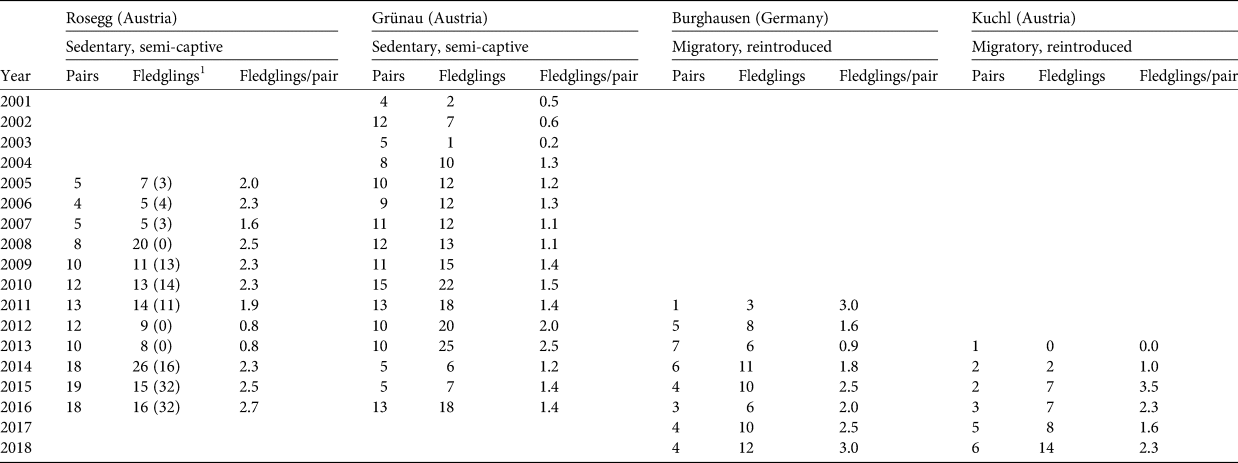
1 Numbers in parentheses are additional fledglings that were taken for hand-rearing by the LIFE+ Programme.
Each year 2–3 new colonies are founded in European zoos. Besides the European Endangered Species Programme there are two further studbooks, one in Japan and one in North America, with fewer birds (110 and 140, respectively). There are an estimated 800 additional non-studbook birds of unknown parentage in other collections.
European research and reintroduction projects
The northern bald ibis was native in Europe until the Middle Ages (Kumerloeve, Reference Kumerloeve1984; Pegoraro, Reference Pegoraro1996), but had become extirpated by 1650, possibly because of habitat loss, climate change and direct persecution (Schenker, Reference Schenker1977; Böhm & Pegoraro, Reference Böhm and Pegoraro2011). It is likely the European population was migratory, an idea reinforced by Conrad Gessner (Reference Gessner1557) in his Vogelbuch description of northern bald ibis distribution, behaviour and fledging time. Centuries later, the northern bald ibis had become a mythical creature until it was rediscovered by scientists at the end of the 19th century (Rothschild et al., Reference Rothschild, Hartert and Kleinschmidt1897).
Three hundred years after the extinction of the northern bald ibis in Europe, in the 1930s, European zoos started to keep the species, with the first captive breeding successes in the 1960s at Basel Zoo (Mendelssohn, Reference Mendelssohn1994). From the late 1970s improved husbandry resulted in the 1,745 birds now held in 87 European zoo colonies (Böhm et al., Reference Böhm, Schad, Fienieg and Voorham2018).
Austria and Germany: developing reintroduction methodologies
In 1991 Alpenzoo Innsbruck started hand raising and releasing northern bald ibis chicks (Thaler et al., Reference Thaler, Pegoraro and Stabinger1993). The Konrad Lorenz Research Station (a core facility of the University of Vienna) in Grünau im Almtal established the first European free-flying sedentary (but not self-sustaining) northern bald ibis colony in 1997 (Kotrschal, Reference Kotrschal and Böhm1999). This population has maintained 9–15 breeding pairs over the last 10 years (Table 5) and was a starting point for the experimental northern bald ibis restoration projects in Europe. In 2000 hand rearing was stopped, and no summer supplementary food was provided while the birds remained free flying. During 1998–2003 the birds were enclosed in the aviary during the dispersal period (July–September). Since 2004, there have also been exchanges with another sedentary semi-captive colony in Tierpark Rosegg. The primary aim of the Konrad Lorenz Research Station project was to investigate social behaviour and its relationships with physiology, ecological aspects of natural foraging, and the establishment of traditions through social learning (e.g. Puehringer-Sturmayr et al., Reference Puehringer-Sturmayr, Wascher, Loretto, Palme, Stoewe and Kotrschal2018). It also aimed to improve management and release methodology, to be applicable for wider northern bald ibis reintroduction.
Since 2003 the Konrad Lorenz Research Station aviary has been left open year-round. The population, which in 2018 comprised 13 adult pairs (Table 5), has remained sedentary despite no longer being enclosed during the dispersal period (Kotrschal, Reference Kotrschal, Böhm, C.G.R. Bowden, Jordan and King2007). The birds use nearby foraging areas, spending the summer in the neighbouring valley, and returning to the aviary in autumn. The fledglings do not migrate, but up to 50% of them (in 2015–2017) undergo juvenile dispersal, flying north/north-east and coming back to Grünau at the end of the summer. From 2004 Tierpark Rosegg in Carinthia has also managed a small sedentary, seasonally free-flying northern bald ibis colony, which in 2018 comprised 18 adult pairs (Table 5). Numbers released and post-release survival during 1997–2014 are presented in Supplementary Tables 1 and 2.
Austria and Germany: reintroduction of a migratory subpopulation
In 2002 the project Waldrappteam initiated a 12-year feasibility study (2002–2013) to develop methods for the establishment of migratory northern bald ibis colonies using human-led migration techniques, involving training birds to follow human foster parents in ultra-light aircraft (Fritz et al., Reference Fritz, Hoffmann, Unsöld, Böhm and Bowden2016).
During 2003–2018, a total of 318 chicks from European zoos have been taken for hand rearing (Fritz et al., Reference Fritz, Kramer, Hoffmann, Trobe and Unsöld2017). Before release, contact with the birds is limited to human foster parents to avoid habituation to other humans. During the first weeks, hand rearing takes place at a zoo. Shortly before fledging, the birds are transferred to a field camp in the area where they will be released. Flight training takes 2 months, starting immediately after fledging, with gradually increased flights up to 100 km. The human-led migration starts mid August, when the young birds enter a state of migratory restlessness (Bairlein et al., Reference Bairlein, Fritz, Scope, Schwendenwein, Stanclova and van Dijk2015). The human-led migration routes cross the Alps to a wintering area in Southern Tuscany (Italy), with daily flight stages of up to 300 km and 8 hours (Fritz et al., Reference Fritz, Kramer, Hoffmann, Trobe and Unsöld2017).
In 2011, the first juveniles hatched in the wild and followed conspecifics from Burghausen to the wintering site in Tuscany (Fritz et al., Reference Fritz, Kramer, Hoffmann, Trobe and Unsöld2017). Since then, an increasing proportion migrates independently. Spring migration starts in late March, with the oldest birds departing first. Autumn migration starts at the beginning of August, but birds regularly remain north of the Alps up to mid September. In the unusually mild winter of 2014 most of the birds delayed migration to late December, resulting in significant mortality (Fritz et al., Reference Fritz, Hoffmann, Unsöld, Böhm and Bowden2016). In 2018, 20 juveniles followed conspecifics to the wintering site, and one group of seven juveniles and two adults reached the wintering area within 24 days. On one day the birds covered over 400 km.
In 2014 the feasibility study evolved into a 6-year reintroduction project involving eight partners from Germany, Austria and Italy, with significant co-financing from the European Union under the LIFE+ programme. The aim was to establish three migratory breeding colonies with a total of at least 120 birds (Fritz et al., Reference Fritz, Kramer, Hoffmann, Trobe and Unsöld2017). A follow-up project has been proposed, aiming to achieve a viable population by 2026.
By the end of 2018, there were 100 free-flying, migrating northern bald ibises (10 breeding pairs; Table 5), belonging to two established breeding colonies at Burghausen, southern Germany, and Kuchl, Austria, with a third breeding colony establishing from 2017 in Ueberlingen at Lake Constance, southern Germany. A major challenge for the project are losses caused by illegal hunting during the autumn migration (Fritz, Reference Fritz2015). During the feasibility study (2002–2013) up to 71% of the annual losses were attributable to illegal hunting in Italy (Fritz, Reference Fritz2015; Fritz et al., Reference Fritz, Hoffmann, Unsöld, Böhm and Bowden2016). Since 2014, illegal hunting accounts for 17% of the annual losses, with electrocution at medium voltage power poles causing 31% of the mortality (Supplementary Table 1). Criminal and civil cases brought against an Italian northern bald ibis hunter raised awareness of the issues in Europe (Fritz et al., Reference Fritz, Hoffmann, Unsöld, Böhm and Bowden2016, Reference Fritz, Kramer, Hoffmann, Trobe and Unsöld2017). Since 2011 a total of 104 juveniles fledged in the wild at the two breeding sites (Table 5), a mean of 2.2 per nest.
Details of annual releases of 7–30 birds are presented in Supplementary Table 1. Overall annual post-release survival in the first year is c. 69%. All released birds are individually marked and tracked (Fritz et al., Reference Fritz, Kramer, Hoffmann, Trobe and Unsöld2017).
Spain: reintroduction of a sedentary population
In 2004 a joint project between Zoobotánico Jerez and the Andalusian government established Proyecto Eremita, to develop techniques for the release of captive-bred northern bald ibises (López & Quevedo, Reference López, Quevedo, Böhm and Bowden2016), with the aim to establish a sedentary, free-flying colony in southern Spain. The release area in south-western Cádiz province has coastal and inland cliffs, and extensive foraging areas, allowing the birds to feed all year round. Birds are hand-reared by human foster parents wearing black shirts and ibis-shaped cycle-helmets (Quevedo et al., Reference Quevedo, Sánchez, Aguilar, Cuadrado, López and Böhm2004; Quevedo, Reference Quevedo2016). Once a free-flying hand-reared group of ibises was established in the area, groups of parent-reared juveniles were kept in a neighbouring release aviary for several months (October–January), then released to join the free-flying birds. This technique facilitates the integration of additional birds coming from collaborating zoos that are members of the European Endangered Species Programme for the northern bald ibis.
Annual releases of 17–52 birds during 2004–2018 (Table 6) demonstrated the ability of captive bred northern bald ibises to survive after release and to establish a wild colony in the region of La Janda, Cádiz, south-west Spain. At present post-release survival in the first year is c. 44%, with the main causes of mortality being predation by eagle owls Bubo bubo and electrocution (Supplementary Table 3; López & Quevedo, Reference López, Quevedo, Böhm and Bowden2016). The first nesting of released birds was in 2008 at Tajo Barbate, a coastal cliff 5 km from the release site, where breeding occurred annually until 2010. In 2011 a new breeding site was established beside a busy road at Barca de Vejer, 15 km from the release site, and this has become the main colony (López & Quevedo, Reference López, Quevedo, Böhm and Bowden2016). In 2014 a new breeding site was established in Castilnovo, a coastal tower, 23 km from the release site. By 2018 there were two active breeding sites (Table 6) within 23 km of the release site, with a total of 90 birds in the wild, including 20 breeding pairs (Supplementary Table 3). The four breeding sites were naturally colonized by northern bald ibises; no boxes or ledges were provided. All birds are individually marked, and some carry transmitters. From the hand-reared groups, some juvenile dispersal, mainly southwards, has been recorded, in contrast with the wild-hatched juveniles that have remained in the area with their parents and the rest of the group. In July 2013 the Environment Ministry of Spain formally approved the work as a northern bald ibis reintroduction project. The project has two phases: (1) the consolidation of the existing colonies, and (2) applying the techniques refined by Proyecto Eremita to establish a second population of northern bald ibises in Cabo de Gata Natural Park, 200 km away, also in Andalusia. To date, Proyecto Eremita has succeeded in establishing a sedentary population without supplementary feeding or other intensive interventions. The population is not yet self-sustaining, so supplementation with additional birds is continuing, improving genetic variability and aiming for a minimum of 120 birds and 35 breeding pairs by 2020.
Breeding productivity of the northern bald ibis in the four breeding sites in Andalusia, Spain.
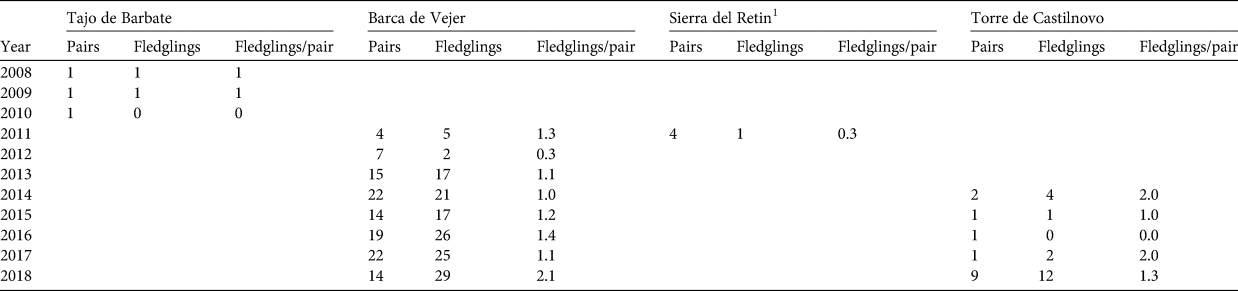
1 Nest boxes in open aviary.
Conservation progress
Management of the remaining population in coastal Morocco has generated the first sustained increase in the natural wild population in historical times. Although the northern bald ibis was categorized as Critically Endangered in the IUCN Red List up to 2018, the positive trend in Morocco since 1997 justified recategorization from Critically Endangered to Endangered (BirdLife, 2018). Management by the Moroccan National Parks authority has been key to this success, along with regulation of development pressures and increasing tourism. Maintaining the traditional agricultural areas and preventing disturbance around the breeding sites will be ongoing challenges to support this largely resident northern bald ibis population.
By 2014 the last wild migratory breeding northern bald ibis pair had disappeared from the Middle East, although they survive in semi-wild conditions and retain the ability to migrate, and thus could serve as a source of founders for the re-establishment of a migratory eastern population. The lessons learned from the European reintroduction projects provide cause for optimism that sedentary populations (Spain) and even migratory populations (Austria) can be re-established, and could inform the reintroduction of species with similarly migratory and sedentary phenotypes.
In 1999 the International Advisory Group for the Northern Bald Ibis was founded. Its principal aims are to facilitate good communication and information exchange amongst all parties working with the northern bald ibis. The group distributes new and accumulated knowledge about the species by organizing periodic meetings, publishing newsletters and the meeting proceedings, and maintaining its own website with a download section for reports. The group's activities have been recognized by the Agreement on the Conservation of African-Eurasian Migratory Waterbirds (AEWA) that initiated and sponsored the first Species Action Plan for the northern bald ibis in 2006. A revision of this action plan was produced from the 1st Meeting of the AEWA Northern Bald Ibis International Working Group in 2012 in Saudi Arabia, and finalized in 2015 (Bowden, Reference Bowden2015). It states that because of significant progress in methodology over the past decade, conservation translocation has become a viable approach to improve the status of the species in the wild (Bowden, Reference Bowden2015). The two European release projects (LIFE+ project and Proyecto Eremita) have so far developed largely independently of the AEWA process, but have demonstrated the potential to develop reintroduction projects within the more recent former range in Algeria, Turkey and Syria. The first steps for this were outlined in the updated implementation plan for Algeria (AEWA, 2018). The AEWA Northern Bald Ibis Working Group is composed of one nominated senior government representative plus a national expert from each of the range states, with a regional coordinator for the eastern and western populations, and an overall coordinator. Experts, usually from the International Advisory Group for the Northern Bald Ibis, are invited to periodic meetings in line with the main issues on the agenda for the implementation of the action plan. The Moroccan government hosted the most recent meeting in November 2016, at which 3-year implementation plans were developed and agreed for each country (AEWA, 2018). Significant progress has thus been made both in maintaining and steadily increasing the small western population in Morocco, and in developing the methodology and prospects for establishing a sedentary population in southern Spain and possibly also a migratory population in central Europe.
Future perspectives
There is a need to evaluate the suitability of potential and former breeding sites and associated feeding areas for both the western (Morocco, Algeria) and eastern (Syria, Turkey, Yemen, Iraq) populations. This is especially needed in Morocco where the in situ population increase means there is potential for natural recolonization beyond the currently occupied sites. In addition, there is evidence that birds from the Spanish project can cross to Morocco, with sightings of lone birds in both 2006 and 2007, and multiple observations in 2016 and 2017 (Muñoz & Ramírez, Reference Muñoz and Ramírez2017; Bowden et al., Reference Bowden, Orueta, Lopez, Onrubia and Quevedo2018).
Every year some birds at the Birecik Breeding Station, Turkey, disappear before enclosure; they may not be dead but, rather, migrating south. Release trials of satellite-tracked birds have shown promising results for potential re-establishment of a fully wild Turkish population, although because birds inevitably pass through Syria where civil conflict means personal firearms are ubiquitous, this may become viable only after the region has stabilized politically.
The captive population of western origin is managed through studbooks and continues to increase slowly, although individual captive colonies need careful breeding management as some bloodlines are already over-represented and aviary space is becoming limited. However, the age structure and sex ratio indicate that the captive population is still viable and > 65% of the birds are of optimal breeding age. This means sufficient genetically appropriate birds can be made available for reintroduction projects, but cooperation between holders is essential to control inbreeding and maintain genetic variability.
Finally, our understanding of methodology for the reintroduction of this species, for both sedentary and migratory populations, has advanced significantly since 2000. The positive trend for the remaining wild Moroccan population is a result of the measures taken by the Moroccan government together with partner NGOs. The recent signs of recolonization of former areas, if maintained, will be an important consolidation and a positive step in the recovery of the species. Meanwhile, pressures on current feeding and breeding habitats are increasing. Interventions such as wardening, water provisioning and law enforcement to prevent illegal construction activities thus remain a top priority and may need further reinforcement. Availability of viable management options such as reintroduction offers significant opportunities for the species and provides hope that the re-establishment of further self-sustaining populations is possible.
Acknowledgements
We thank the numerous funders and supporters of the enormous body of work this paper encompasses although these are too many to mention individually. Two anonymous referees helped develop earlier drafts of this paper, and Amina Fellous commented on the Algeria text. We are unable to mention all the field workers that have contributed to gathering the information presented, but due to the harsh conditions and the difficulties on the ground, we would particularly like to acknowledge the full team of wardens in Morocco who have dedicated their lives to protecting and monitoring the birds. The team continues to do this, often in very tough field conditions, and Mohammed El Gadrouri and Abdallah Essamar deserve special mention having both been fully involved for 25 years. Likewise, in Syria, the wardens and rangers there have served often through extraordinarily difficult times, well beyond the call of duty, and although many more have been involved, we would like to pay special tribute to Mahmud S. Abdullah and Ahmed Khaber Abdallah.
Author contributions
Lead on compiling the information and writing: CB, CGRB, PJS; contribution of updated information from the respective range states and projects, and revisions: TH, WO, MEB, MAQ, JF, CY, JML, JFO, DF, MU; overall coordination: CGRB.
Conflicts of interest
None.
Ethical standards
This work abided by the Oryx guidelines on ethical standards.


 Open access

